South West Water investing millions to tackle sewage spills

Remember SSW claim that they are investing £38m in Exmouth and Sandy bay to reduce pollution.

A year ago water minister Rebecca Pow confirmed £70 million of cash to improving sewage systems in Sidmouth, Tipton St John and Axminister, as well as Falmouth in Cornwall.

Now the figure for the whole region is £32m by 2025. How much of this is re-announcement?

And can you realistically “turn the taps” on that fast? – Owl

REBECCA SPEARE-COLE www.devonlive.com

Water companies will invest more than £180 million to tackle sewage spills – with South West Water investing £32 million, the Government has announced. The fast-tracked investment made by several water companies in England will support the effort to roll out storm overflow prevention measures by April 2025.

These include artificial intelligence systems, accelerated wetland programmes, installing new in-sewer monitors and recruiting and training specialist staff. The Government said it expects the measures to prevent more than 8,000 spills polluting English waterways.

Anglian will invest £50 million, Severn Trent will invest £41 mill­ion, Southern will invest £10 million, South West will invest £32 million, United Utilities will invest £39 million and Wessex will invest £8 million. Companies such as Northumbrian and Yorkshire Water have not announced new fast-tracked investment, having already announced plans to take forward additional investment to tackle storm overflows this year, the Government said.

Environment Secretary Steve Barclay said the investment is part of Government efforts to “push for better performance from water companies and hold them to account”. He said: “The amount of sewage being spilled into our rivers is completely unacceptable and the public rightly expects action.

“This money will mean more cutting-edge technology, including artificial intelligence, and more specialist staff to detect and reduce spills. Today’s announcement builds on significant work by this Government to protect and strengthen our waters with increased investment, stronger regulation and tougher enforcement action.”

The support comes after Mr Barclay directed water companies in December to accelerate plans and increase funding in order to measurably reduce sewage spills over the next 12 months. The investment will add to the water companies’ previous £3.1 billion investment for the period of 2020 to 2025.

It is the latest move to tackle concerns over levels of pollution being dumped into rivers, lakes and around the coasts from sources including overflow pipes and processing plants, causing harm to wildlife and the health of beachgoers as well as affecting tourism and leisure industries.

The Government recently announced plans to block bonuses for water company executives where firms have committed serious criminal breaches, subject to Ofwat consultation, as well as to quadruple inspections on water companies in the next year.

Giles Bristow, chief executive of Surfers Against Sewage, said: “It’s great to see the Government fast-tracking investment on the decades-old issue of sewage pollution. The informed and angry voices of constituents across the UK are clearly making those in power listen and take visible actions to address the sewage scandal.

“Despite today’s welcome announcement, questions still remain on the scale and scope of the Government’s ambitions for our rivers and seas. We’ll be watching closely to ensure that it’s the polluters, not the consumer, that pays to clean up this mess.”
Capacity crunch on National Grid is delaying new homes in UK by years

Housing projects are being delayed for years because of an “infra­structure crisis” caused by lack of capacity in the National Grid, council leaders have warned.

Those hoping to build new wind turbines, solar farms or micro-hydroelectric schemes face even longer waits.

The delays come after Ofgem had already taken action last year to remove so-called “zombie” projects – those that had been approved but had stopped being developed – from the connections queue.

Chaos – Owl

James Tapper www.theguardian.com 

Building schemes for thousands of homes are on hold, while new ­projects face delays of up to four years in some parts of the UK because of a ­lengthening queue of developers waiting to be connected.

Those hoping to build new wind turbines, solar farms or micro-hydroelectric schemes face even longer waits after a deluge of new connection requests, many of them from speculative schemes.

Ministers have asked the National Infrastructure Commission (NIC) to investigate, but senior members of the District Councils’ Network (DCN), part of the Local Government Association, say the delays are slowing down the UK economy. Bridget Smith, the DCN’s vice-chair and leader of South Cambridgeshire district council, said: “Nationally, we’ve got an absolute ­crisis in all infrastructure.”

Plans by Michael Gove, the housing secretary, to build 150,000 homes in Cambridge to create a British Silicon Valley were already being hampered by lack of water, she said. “And where’s the power coming from? Something fundamental has to change.”

Susan Brown, the leader of Oxford city council, who is also a DCN vice-chair, said that 90 new homes in the Littlemore district had been meant to have heat pumps. “The National Grid basically said ‘we won’t have enough power to connect them’ so half the houses are going to have to have gas boilers instead – it’s so frustrating.”

Brown, who is also chair of the Future Oxfordshire Partnership, said plans to expand the town of Bicester with 7,000 new homes and a commercial zone had ground to a halt.

“All of that has been paused, awaiting grid reinforcement,” she said.

Under the current first-come, first-served system, developers can pay to jump up the queue, but the Bicester project has a further twist of red tape because there are two developers – one for the housing and another for the commercial buildings.

“Competition rules mean they’re not allowed to broker a solution together,” Brown said. “That’s particularly mad because it means they are dancing around, hoping the other one is going to take the full cost of providing grid reinforcement. There are so many daft things in our system.”

Brown said that leaders in other areas such as Milton Keynes, Swindon, Cambridge and Peterborough – with whom she works as part of the Fast Growth Cities group – were ­reporting similar problems. “It’s really beginning to constrain our ability to grow our local economy, which is significant for UK plc because the Oxford-Cambridge wider area is a significant net contributor to GDP, and not many bits of the country are.

“It’s possible that we’re a little bit ahead of the curve across the ­country. If they’re not already experiencing [these problems], people elsewhere will be experiencing them very soon.”

Although demand for electricity from builders is not being met, plans to expand the electricity supply are also causing problems, as the National Grid has been swamped with applications to build solar and wind farms – far more than the country would ever need.

Two weeks ago, the National Grid’s electricity systems operator (ESO), which manages power distribution, said that the connections queue had “grown at unprecedented pace”.

Great Britain’s power stations together generate 75 gigawatts of electricity, and the mainland is expected to need about twice as much by 2050 as people switch to ­electric vehicles and heat pumps.

But in January alone, developers submitted projects that would add 49GW, and the ESO said the queue could reach the equivalent of 800GW by the end of the year – more than four times as much as the country would ever need.

Being swamped with applications has made delays even longer, and Ofgem has had to approve a three-month delay until developers even find out when they can get connected. David Wildash, the ESO’s interim director of engineering, said in a blogpost that “we recognise that the outcome of this process is not what was envisaged at the outset. The outcome will be hugely disappointing to our customers.”

The delays come after Ofgem had already taken action last year to remove so-called “zombie” projects – those that had been approved but had stopped being developed – from the connections queue.

Nick Winser at the National Infrastructure Commission, who last year issued a report recommending that homeowners should be given generous compensation for agreeing to have power lines built close to their homes, is examining ways to solve the electricity capacity problem. He said: “We can’t let the distribution network become a barrier to the transition away from fossil fuels, which is why the commission is looking at what further investment or policy changes are needed to ensure the whole network is ready for 2050 and beyond.”

A government spokesperson said: “We’re driving forward the biggest reforms to our electricity grid since the 1950s – halving the time it takes to build networks, speeding up grid connections, supporting thousands of jobs and reducing bills in the long-term for families.

“Meanwhile we are on track to build one million homes this parliament and have laid out an ambitious long-term plan for housing that includes speeding up the planning system, cutting bureaucracy, and reducing delays to ensure we deliver the homes that communities want and need.”

Pollution – now Sidmouth gets National coverage

Devon beauty spot suffers sewage outflow for over 12 hours

“A Devon beauty spot where Queen Victoria spent time as a child has seen raw sewage discharged for more than 12 hours.”

But Geoff Crawford has left this comment on the Sidmouth Community facebook page:

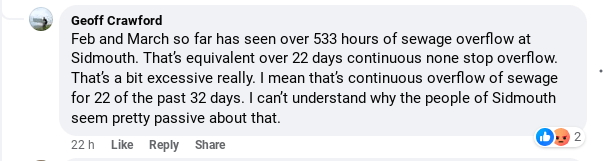
Feb and March so far has seen over 533 hours of sewage overflow at Sidmouth. That’s equivalent over 22 days continuous none stop overflow. That’s a bit excessive really. I mean that’s continuous overflow of sewage for 22 of the past 32 days. I can’t understand why the people of Sidmouth seem pretty passive about that.

Connie Dimsdale inews.co.uk

The seaside town of Sidmouth on the Jurassic Coast has seen raw sewage discharged from 7.38pm on Saturday 9 March, according to Surfers Against Sewage.

Queen Victoria visited the town as a baby during the winter of 1819 and 1820 when Sidmouth was a popular holiday destination, according to the biography Queen Victoria: Her Life and Legacy by Paul Kendall.

The town was a popular holiday destination in the Georgian and Victorian times and still attracts tourists today with an impressive coastline and beautiful countryside.

Now the town has been blighted by a sewage flow, which South West Water said was due to “heavy, localised rainfall” in the area in recent days.

Water companies are permitted to use “storm overflows” to discharge waste during periods of intense rainfall to prevent their infrastructure from becoming overwhelmed and sewage backing up into people’s homes.

The company said reducing the use of storm overflows is a “priority” and has invested in areas including Sidmouth.

Surfers Against Sewage has also warned of pollution along the Devon coast at the nearby coastal towns and villages of Sandy Bay, Budleigh Salterton, Seaton, and Beer.

It comes after i revealed that a sea swimmer from Exmouth, Devon, is taking South West Water to court over sea sewage discharges that she claims have harmed her health and prevented her from taking daily swims.

Retired NHS physiotherapist Jo Bateman has submitted an action to the Small Claims Court alleging that illegal sewage spills into the sea at her local beach have affected both her physical and mental wellbeing.

In her claim, Ms Bateman details 54 instances when she believes South West Water illegally dumped sewage into the sea during 2023.

Water companies have come under intense scrutiny over the last year for the amount of raw sewage that is being discharged into Britain’s rivers, lakes and coastal waters.

A spokesperson from South West Water said: “Due to the heavy, localised rainfall in the area over recent days, there has been storm overflow activity in Sidmouth.

“Storm overflows are pressure relief valves built into our network that stop homes and businesses from flooding during periods of heavy rainfall.

“However, reducing their use is a priority for us and we are investing record levels to do this – including in Sidmouth, where water quality is rated as excellent by the Environment Agency.”

Do the Environment Agency sample the water on Budleigh beach where bathers actually swim?

ONE of Budleigh’s two main swimming areas is sandwiched between frequently polluting channels. The other area MAY be much cleaner. But contrary to explicit legislation, Budleigh’s water sampling reports on neither.

Petercrwilliams fightingpoolution.com 

Beach water sampling is precisely regulated by the ‘2013 Bathing Water Directive’. This legislation clearly sets out the exact methodology that must be followed to provide a valid statement of the bathing water quality for all beaches.

One of the key instructions (not surprisingly), is how the sampling location must be selected at each beach. Here’s what the law says:

So it’s clear, the Environment Agency “must locate the point where most bathers are expected”.

So where on Budleigh beach do you think they sample?

  • Maybe immediately below the Lime Kiln car park, where most Summer visitors park and head to the beach?
  • Or alternatively, maybe Steamer Steps end – where most local swim, and is popular all year round?

In fact, the EA sample a section of the beach where very few people swim! They sample the water quality just by our iconic telephone box, west of the Longboat Café.

So the key question: does this make a difference to people’s swimming safety – and would you change your behaviour if you knew the facts?

The key purpose of water sampling, analysis and forecasting is to provide information that we can act on. Is it a good place to swim generally, and is it good to swim today?

Sampling the Telephone box location provides little useful information for any water user at Lime Kiln or Steamer Steps.

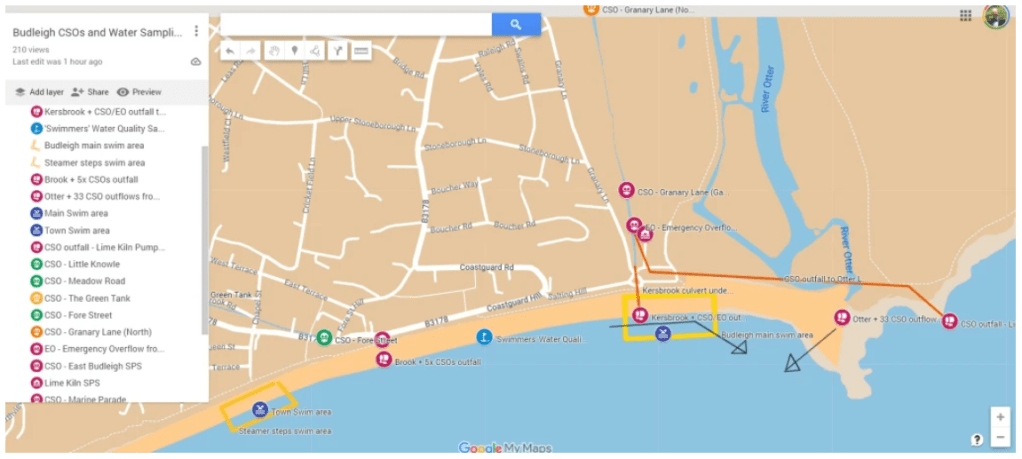
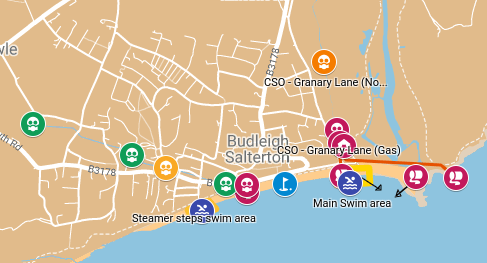
To understand why, we need to take a look at the ‘Sewage Map of Budleigh’.

You can see the Blue Sampling location flag in the middle of the map – where the water is sampled.

You can also see all of the sewage overflow points and outfalls (colour coded from RED = highest polluting outlet, to Green = lower polluting). Prevailing currents are marked with the black arrows.

The Lime Kiln car park and swim area is just a few metres ‘downstream’ from the Kersbrook outfall, which enters the beach below the west end of the carpark. This carries any sewage discharged from two Combined Sewage Overflows (CSOs), plus an Emergency Overflow, straight into the sea.

  • On 20th June 2023, the Environment Agency sampled the Kersbrook, just before it enters the sea, and found it contained greater than 100,000 E-coli cfu/100ml. That’s more than 200 times greater than the ‘safe’ limit for E-coli bacteria!
  • On 3rd August 2023, the Environment Agency found it contained more than 40 times the ‘safe’ E-coli limit!
  • On 4th July 2023, South West Water released raw sewage, sanitary towels and PPE into the Kersbrook through an Emergency Overflow, and from there directly into the sea. This discharge has been confirmed by the Environment Agency after an FOI request. Further details and photos of this can be found on the ‘Budleigh Sewage Action’ home page.
  • The EA sampled this point 20 times in Summer 2023, and – on average – the samples contained E-coli concentrations more than 14 times greater than the ‘safe’ limit for bathing.

And here’s the Kersbrook outfall as it enters the beach – on the edge of the Lime Kiln bathing area.

“Bubble, bubble, toilet trouble?” Kersbrook outfall below Lime Kiln car park

Go to the original article to watch video.

It’s important to point out that any sewage quickly mixes and gets diluted when it enters the sea, but in the local vicinity of these outfalls (maybe a few hundred meres), concentrations can still be significantly elevated for some time after a discharge. That’s exactly why pollution forecasts are mandatory during the Summer season, but these are based on the impact at the telephone box location.

But that’s not all that swimmers at Lime Kiln have to contend with.

The prevailing current carries the Kersbrook outfall along the bathing beach towards the Otter Estuary.

However, the Otter Estuary itself brings water which receives 31 of South West Water’s sewage overflows (CSOs) and pumping stations during its journey from the Blackdown Hills, as well as significant agricultural run-off. The Environment Agency’s average E-coli reading from the mouth of the River Otter in 2023 was approx. 3,200 E-coli cfu/100ml, that’s a large volume of water at more than 6 times greater than the ‘safe’ E-coli limit for bathing. And all of this bacterial load flows along the Lime Kiln beach area, and then out parallel with the Otter Ledge. Again, this water does mix and dilute when it reaches the sea, but there remains a localised effect for some distance.

So the beach next to Lime Kiln is located directly between these two significant pollution carriers, the effects of which are unlikely to be reasonably picked up by the existing ‘upstream’ sampling point at the Telephone box.

The reality is that we don’t know what the pollution load is actually like below Lime Kiln, because – contrary to the legal framework – no sampling is carried out in this area.

The opposite however, may be true for the Steamer Steps section of the beach.

We know that the background pollution level of the sea around Budleigh is very low. It also appears that the tidal current tends to run predominantly Eastwards along the sea front, potentially taking any bacterial load from the Marine Terrace sewage overflows / Knowle Brook outfall away from Streamer Steps.

So it’s not obvious to see that significant bacterial pollution would affect the Steamer Steps area – which may be some comfort to the majority of locals who use that area for their daily swims, all year round.

The problem is that we don’t know this. We can only surmise. And for as long as the Environment Agency only sample in a place where few people swim, that will continue to be the case.

So what ACTION do we want?

  • Firstly, we need the EA to start sampling at both Steamer Steps and Lime Kiln – beginning in the 2024 Summer Season, and publishing results throughout the season along with the current ‘Telephone box’ sample data. Once they have done this – and published a year or two’s data, we can get a proper understanding of where in Budleigh it is safest to swim
  • It would also be helpful if the EA could specifically forecast pollution alerts for the two main swimming areas, so people can make an informed choice in real time, of where and when to swim
  • Lastly, we all need South West Water to reduce or eliminate this frequent stream of pollution being dumped into Budleigh’s brooks, and into the whole Otter catchment.
  • It would also be great to see a comprehensive focus on cleaning up the agricultural pollution and run-off, right along the Otter river system.

How to achieve this?

  • Write to the EA and our MP, quoting ‘Schedule 4’, of the ‘2013 Bathing Water Regulations’, to request that the Environment Agency sample in accordance with regulations
  • Continue to put pressure on South West Water clean up their act
  • Support any initiatives which aim to improve the water quality of the whole Otter river system

If you’d like to explore the live and interactive ‘Budleigh Sewage Hotspots Map’, click the link.

You can use this map to locate and see all of South West Water’s worst polluting hotspots in Budleigh. Click on each location to see what it looks like (easiest on a PC), and how much pollution it has dumped onto our beach in 2022. We will update this map once we get 2023’s sewage data.

In terms of sampling and forecasting for both Steamer Steps and Lime Kiln swimming areas, the 2013 Directive allows for just our situation, and specifically states that ‘where more than one swimming area is popular, and they are some distance apart, then both locations may be sampled’. That’s just what we need for both local swimmers and our many visitors.