Average 2023 rainfall in South West not exceptional, beware the spin

Peter Williams comments on ESCAPE

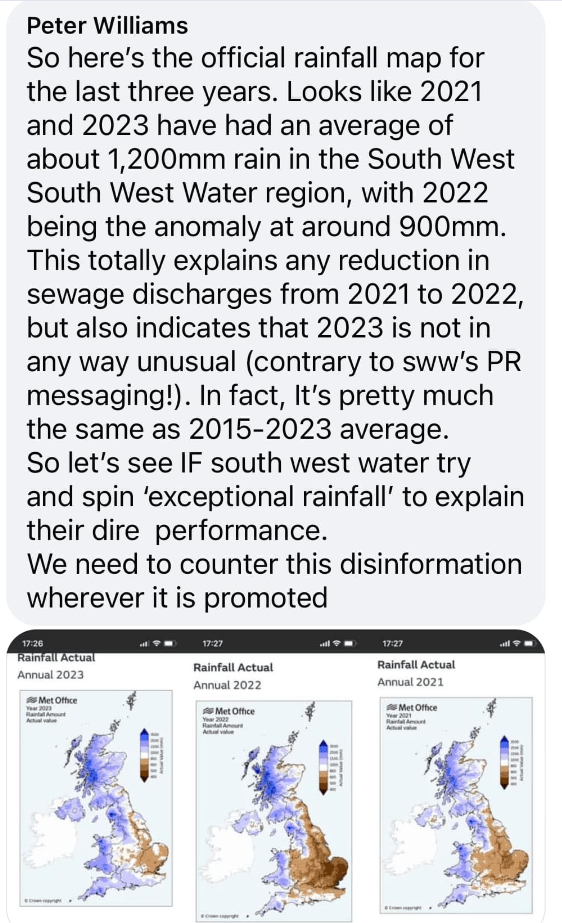
So here’s the official rainfall map for the last three years. Looks like 2021 and 2023 have had an average of about 1,200mm rain in the South West South West Water region, 2022 being the anomaly at around 900mm. This totally explains any reduction in sewage discharges from 2021 to 2022, but indicates that 2023 is not in anyway unusual (contrary to SWW’s PR messaging!). In fact, it’s pretty much the same as 2015-2023 average. So let’s see IF South West Water try and spin “excess rainfall” to explain their dire performance.

We need to counter this disinformation wherever it is promoted.

Peter Williams

4m hours of raw sewage discharges in England in 2023, data expected to show

More than 4m hours of raw sewage discharges poured into rivers and seas last year, a 129% increase on the previous 12 months, new figures are expected to reveal on Wednesday.

Sandra Laville www.theguardian.com 

Total discharges from the 14,000 storm overflows owned by English water companies that release untreated sewage into rivers and coastal waters increased by 59% to 477,972, making 2023 the worst year for sewage spills, according to an early estimate of the Environment Agency figures seen by the Guardian.

Senior industry sources were preparing for the government to turn its guns on water companies after the record year of discharges. The Environment Agency said it was setting up a whistleblowing hotline for people who work in the industry to report any activity that concerns them.

The heavy rainfall over the autumn and winter is likely to be blamed by the industry for the huge rise. Storm overflows are supposed to be used only in extreme weather but for many years they have been used routinely, discharging raw sewage even on dry days in some cases. The academic Peter Hammond has shown how water companies are routinely using storm overflow discharges in their water management.

This year, for the first time every storm overflow has been fitted with a monitor, known as an EDM, but the scale of the rise in discharges is beyond what full monitoring would be expected to provide.

The scale of releases into waterways comes as rivers in England are at crisis point, suffering from a toxic cocktail of raw and treated sewage pollution, chemical toxins and agricultural runoff.

The revelations will put pressure on the water industry and the government, whose plans to tackle storm overflows have been criticised for not going fast enough. The plan aims to eliminate only 40% of raw sewage overflows into rivers by 2040 and discharges would continue being released into waterways until 2050.

In the last few weeks ministers have engaged in a flurry of announcements in anticipation of the shocking data on record sewage spills.

These included an announcement of a £180m plan to fast-track action on sewage discharges, in the face of criticism not enough is being done.

The water industry wants to invest a record £96bn to the end of the decade to tackle sewage discharges, leaks and the impending water supply crisis but has been criticised for passing the costs on to customers for investment that should have been carried out years ago.

The regulator Ofwat has to decide whether to allow companies to increase water bills to pay for the investment. Some customers will face huge bill rises to pay for vital infrastructure work. Thames Water is seeking to raise bills the highest of any company, by 40 per cent. Ofwat is the ultimate arbiter of whether the industry will be allowed to pass the cost directly on to customers as they seek to tackle years of underinvestment and the pressure of extreme weather from climate change.

When the full data from every storm overflow in England is released by the Environment Agency on Wednesday, some rivers and seas are likely to be shown to be suffering hugely from sewage pollution.

As well as total discharges increasing from just over 301,000 in 2022, the average discharge per storm overflow has increased to almost 35, a 52% increase, suggesting huge surges in spills into some waterways.

More than 60 discharges a year from a storm overflow should spark an investigation by the Environment Agency. The agency is in the middle of a criminal investigation into potentially illegal discharges by water companies and the regulator Ofwat is investigating six firms for widespread illegal sewage dumping from treatment works via storm overflows.

Industry insiders said groundwater ingress into pipes is to blame for some of the scale of the discharges.

Figures from the Met Office show 2023 had four individual months within the top 10 wettest on record and the UK recorded its sixth wettest October since 1836 last year.

Met Office assessments said Storm Babet in the autumn brought the third wettest three-day period on record for England and Wales. In November Storm Ciarán was an exceptionally powerful storm, comparable to the Great Storm of 16 October 1987. Rainfall in the autumn of last year was 410mm, which is 122% of the 1991-2020 average.

Defra has been approached for comment.

Pay more for food if you want to cut sewage spills

Consumers should pay extra for food so farming becomes more sustainable and better for the environment.

Alison Stephenson, local democracy reporter www.radioexe.co.uk 

That’s just one of the ways to help improve water quality suggested at a special policy development committee of North Devon Council, where members of the public were invited to ask questions of a panel of experts.

Another suggestion is for councils to ask developers to clean up their act so that waterways don’t become polluted.

The meeting at Petroc College followed public concerns about sewage spills. Representatives attended from South West Water, the Environment Agency, North Devon Biosphere, Surfers Against Sewage, Westcountry Rivers Trust, North Devon Surfing Reserve and members of the farming and angling communities.

South West Water has committed to having no more than 10 spills from its 1,342 storm overflows a year by 2030, which is 20 years ahead of the government’s target.

The company, which reported 38,000 sewage spills in England in 2022, is investing £2.8 billion into improving water quality with a pledge to fix storm overflows at beaches and eradicate pollution.

But people from SWW told the meeting the company is only responsible for 30 per cent of water quality issues. Agricultural and surface water run -off from developments accounts for a large proportion of the problems.

Experts said all the data currently being collected, including from “citizen scientist” volunteers who have water testing equipment from Westcountry Rivers Trust, should not become a “data fog” but be used intelligently to inform solutions.

Exmoor farmer Robin Milton, who is also an independent North Devon councillor for Bishops Nympton, said when he was growing up he saw salmon and brown trout in the local rivers, but not any more.

He said 50 years of the government’s “cheap food policy” meant farmers had been free to do what they liked with their land, with limited regulation of chemicals which end up in the rivers.

Policies are changing to ensure farming is sustainable and protects the environment, but this means consumers having to pay more for food to make it a viable option for farmers, he said.

He said councils like North Devon would be tested on their commitment to biodiversity, which requires developers to leave the natural environmental in a better state than when they arrive. It is an opportunity to improve the environment and water quality through the planning process. Residents were asked to hold councillors to account over this.

Director of asset management at South West Water Mark Worsfold said developers should be encouraged to come up with ‘nature-based sustainable drainage solutions’ (SuDs) to reduce surface-water flooding and river pollution.

He said they work with Plymouth City Council on such projects and want more councils to come forward.

One resident said after reporting fish deaths in the River Torridge and signs of chemical pollution he was told by the Environment Agency that it was not of “major impact”.

Bruce Newport from the Environment Agency said they deal with the worst incidents first and there was are “simply not enough resource” to do any more.

The EA is investing in better technology and 500 more employees in the regulation department and would be much more effective at monitoring rivers in the future, he said.

North Devon’s beaches are currently rated excellent, with the exception of Hele Bay, Ilfracombe, but its rivers and streams are a different picture. The meeting heard that out of 98 bodies of water, 83 had failed to meet good ecological standards.

Residents asked for year-round testing of bathing waters, of which there are 151 in South West Water’s area. Right now they are tested from May to September.

Director of external liaison at South West Water Alan Burrows said wet wipes are still ending up in water courses following heavy rainfall, despite a campaign  to only put “pee, poo and paper” down the loo.

“The system was not designed for this. It’s like putting diesel in a petrol car. It’s a foreign body and they are causing a significant amount of problems on our network, for homes and the environment”

Animals in rivers and seas consume wet wipes which can result in them suffocating or starving to death.

This article was amended on 26 March to remove a reference to SWW monitoring half its overflows and being ahead of target on the rest. The company says it monitors all overflows.