‘Negative budgets’: cost of living crisis could lose the Tories dozens of seats

Rishi Sunak has been warned that scores of his most vulnerable seats risk being lost over an increasingly neglected cost of living crisis raging in marginal constituencies across the UK.

Michael Savage www.theguardian.com 

The seats held by Iain Duncan Smith and justice secretary Alex Chalk are among 85 Tory constituencies with a critical number of voters whose monthly outgoings are now higher than their income.

The new research comes amid concerns that falling inflation has led to the cost of living crisis dropping down the political agenda, despite households being left with energy bills far higher than they were three years ago and a widening group of people struggling to make ends meet.

The issue of “negative budgets” – where a family’s outgoings are no longer covered by their income – has become a key concern of Citizens Advice, which has been carrying out detailed research on the phenomenon.

While the problem is affecting a wider group of people, the group says there are now more far-reaching political implications for both main parties should they fail to consider radical action.

Its constituency-level research identified 85 seats won by the Tories in 2019 where the MP’s majority is smaller than the number of people with a negative budget.

It is also true of the 100 most marginal seats across Britain overall. It mirrors the regular Opinium polls for the Observer, which continue to suggest that the NHS and the cost of living are by far the most important issues heading into the election later this year.

Citizens Advice said that about 5 million people were affected by negative budgets, while a further 2 million were staying out of the red by cutting their essential spending on things such as meals, energy, and seeing friends and family, to unsafe levels.

The Conservatives have said that they are tackling the cost of living crisis by making two cuts to national insurance, a move they say saves the average worker more than £900 a year from April. However, higher earners save more than those on low incomes.

While Labour has focused many of its attacks on the cost of living, it has been criticised for not producing specific policies to tackle it in the short term, beyond vowing to handle the economy better than the Tories and pursuing economic growth.

Clare Moriarty, a former senior government official who now leads Citizens Advice, warned that falling inflation did not stop the cost of living being the critical factor for voters this year.

“For most of our history, Citizens Advice has seen people in moments of crisis,” she said. “But now, more and more people are stuck in a quicksand of hardship. What would’ve been a shocking level of living standards just a few years ago has sadly become the everyday reality for many in our society.

“Our advice can be life-changing, but our advisers can’t tackle the scale of this challenge alone. Falling inflation doesn’t mean this problem is over. For example, energy bills are still 48% higher than they were three years ago.

“Voters up and down the country want to hear what the next government will do to tackle plummeting living standards. But so far, politicians haven’t done enough to give them hope that any party has a plan to really turn the tide on the issue.”

 Lord Swire co-chairs trade organisation that “opened doors” for Frank Hester

A trade organisation that Lord Marland chairs with another Tory grandee, Lord Swire, opened doors for Hester’s healthtech company, The Phoenix Partnership (TPP), to expand internationally.

goodlawproject.org 

Tory Peer, Lord Marland, who claimed Frank Hester ‘is not a racist’ because he does business abroad, heads a trade organisation which lists The Phoenix Partnership as a ‘strategic partner’ and a ‘platinum’ sponsor for its summits.

Lord Marland was one of the first to jump to Frank Hester’s defence in the immediate fallout of the Guardian’s shocking revelations about his racist comments. On Wednesday, the Tory peer claimed in an LBC interview that his Party’s largest ever donor, “is not a racist” because “he does a lot of business in Jamaica, he does business in Malaysia, in Bangladesh and places like that”.

It’s an unconvincing line of argument to say the least. You might wonder why he’s even running it. And it now turns out that a trade organisation that Lord Marland chairs with another Tory grandee, Lord Swire, opened doors for Hester’s healthtech company, The Phoenix Partnership (TPP), to expand internationally.

The non-profit Commonwealth Enterprise and Investment Council (CWEIC), lists TPP as a strategic partner and platinum sponsor of its annual trade summits.

And along with sponsorship funding, Frank Hester has given it glowing testimony: “We have grown our business across Asia, Africa and the Americas, through CWEIC’s flagship events and with the full support of their exceptionally capable team.”

According to a CWEIC brochure, the benefits of becoming a strategic partner include “the opportunity to influence Government policy and decisions as a collective voice by engaging directly with senior government leaders and policy makers”.  

The CWEIC has also taken on as a strategic partner Life Partners, a firm run by Zoe Ley, who made obscene profits from brokering a huge PPE deal through the Government’s unlawful VIP Lane.

“In Toryland, nothing ever happens without a reason”, said Jo Maugham, Executive Director of Good Law Project. “Everyone is buttering everyone else’s bread. And, with the proceeds of his vastly lucrative DHSC contracts, Frank Hester is operating a very large dairy”.

But not everyone who has been involved with the CWEIC has been as keen as Lord Marland to defend Hester. Another big Tory donor, Mohamed Amersi, was on the board of the organisation up until the new year. On Thursday, Amersi took to LBC to brand the way the Conservative Party has handled the Hester scandal as “an absolute disgrace” and warn Rishi Sunak that he is “holding the cheque book back” ahead of the next election.

We approached The Phoenix Partnership, Lord Marland and the Commonwealth Enterprise and  Investment Group for comment.

Lord Marland said: “The Commonwealth Enterprise and Investment Council (CWEIC) is a not for profit organisation with an official mandate from Commonwealth Heads of Government to promote trade and investment throughout the 56 member countries. CWEIC is a networking organisation and has no interest in and does not promote transactions.

“Many governments and businesses have sponsored CWEIC events for which we are very grateful”.

Back in September 2023, we were the first to raise the alarm about the money flowing back and forth between Frank Hester and the Government – exposing the £137m worth of hidden contracts his company received through the Department of Health and Social Care. And since then, we have shone a light on the close relationship he has with the Prime Minister – from helicopter rides to cosy conversations about AI.

And with reports emerging that the Conservative Party is sitting on another £5m donation from Hester, we’re continuing our investigations into the level of his influence over the most senior Government figures.

‘Glimmer of hope’ for local news as Surrey publication given charitable status

A local news website conceived over a pint and named after a mythical creature has become the first in the UK to be given charitable status, providing a “glimmer of hope” to the future of local journalism.

Alexandra Topping www.theguardian.com 

The Guildford Dragon News has become the UK’s first charitable public interest news provider after a six-month application process that experts hope will provide a lifeline to the decimated local news industry.

“It would be fantastic if we’re successful and this leads the way for other similar news publications to also become sustainable,” said the Dragon’s editor, Martin Giles, who has worked – unpaid – seven days a week for the title for more than a decade.

The move could mark a step-change in an industry that has veered from crisis to life support. Figures published last month by Press Gazette show that in the 15 years leading up to 2022, revenue at the main regional publishers plummeted by more than 80%, when adjusted for inflation.

The number of local journalists scrutinising councils, interviewing MPs and keeping track of local developments fell from 13,000 to 4,000, which MPs and experts have said is having a devastating effect on the scrutiny of local democracy.

“The local newspaper as it existed in the 1950s has been dying for years, but it’s comprehensively dead now. There’s a very real crisis and that is a very real problem for democracy,” said Jonathan Heawood, the executive director of the Public Interest News Foundation, a charity that funnels donations into public interest journalism.

While more than 4 million people in the UK live in “news deserts” without adequate local journalism, the awarding of charitable status to the Dragon provided a “glimmer of hope”, he said.

Tom Murdoch from the law experts Stone King, which advises the Charitable Journalism Project (CJP) campaign, said the publication could now benefit from a range of traditional tax breaks, and attract donors who can also get tax relief on money handed over to support public interest journalism. “This decision accepts a public interest news definition that is charitable,” he said. “That is huge progress, it’s a doorway to sustainability.”

Government reaction to the struggles of local news has been muted. It rejected proposals, made in the 2019 Cairncross review, to extend charitable status to many struggling local news outlets, arguing they would be banned from supporting political parties, stopped from being for-profit, and that much journalism does not work “only for the public benefit”. They also dismissed calls for an arms-length, state-funded organisation supporting public service, on the basis it would damage press freedom.

Despite this, a new wave of local and hyper-local websites are rising up from the rubble of local news. The Bristol Cable is member-funded, while in Glasgow, two nonprofit outlets – Greater Govanhill and the Ferret – have come together to open the UK’s first community newsroom. Social Spider Community News, which has six London-based publications, is a social enterprise that is now breaking even.

“We are trying to find a way to save local journalism while keeping it free to access, as we consider it to be a public service,” said Social Spider’s editor, James Cracknell, who has spent his career in local news including a stint at Reach, which recently cut about 10% of its workforce.

Others are going down a commercial route. Reader-funded local news outlet Mill Media is expanding after being valued at £1.75m by a group of investors including the former New York Times boss Mark Thompson.

The Guildford Dragon News – which was conceived over a moan about the state of local news coverage by Giles and a former chief sub of the Surrey Advertiser in the local pub – has more modest short-term ambitions. It has already had a significant local impact – after one story about events at a local parish council all but one councillor stood down.

Giles hopes to raise £70,000 to pay for one and a half members of staff, so Guildford’s council meetings and coffee shop openings can be covered more comprehensively.

He explained that the name of the publication came from a legend of a dragon who had protected a local prehistoric site. “That’s why I’m so keen on sustainability because I’m not going to be around for ever. In the future I want the news to still be available to people in this community,” said Giles. “We like to think we also have a protective role over the area.”

Simon Jupp come clean about trains to Paddington facing a decade of disruption

Is Simon Jupp, Private Parliamentary Secretary to the Secretary of State for Transport, Mark Harper, privy to a file marked “sensitive do not disclose before election”? 

Plymouth Sutton and Devonport MP Luke Pollard has claimed the government’s plan to build the station at Old Oak Common for High Speed 2 services would result in disruption and longer journeys for passengers travelling from the South West to the capital on the Great Western line, including weekend closures.

Should mitigation involve an upgrade to the Waterloo line?

Fears new HS2 station will cause massive trains delays to South West

Carl Eve www.plymouthherald.co.uk 

Rail passengers in the South West could face a “decade of disruption” because of the Government’s ‘hidden’ plans to build a new High Speed 2 rail station alongside the Great Western mainline in west London, a Plymouth MP has claimed.

In a letter to the Secretary of State for Transport Mark Harper MP, Plymouth Sutton and Devonport MP Luke Pollard has claimed the government’s plan to build the station at Old Oak Common for High Speed 2 services would result in disruption and longer journeys for passengers travelling from the South West to the capital on the Great Western line.

Mr Pollard also warned that the construction of Old Oak Common would inevitably involve a large number of weekend closures of the line between Reading and London Paddington which would “significantly damage the rail service” to the South West and Wales – and asked if the Government had not made the potential damage known publicly ahead of a General Election.

The Minister’s office has not denied the new station was to be built but has insisted construction work would be “taking place many years in the future.” They added that there would be efforts to minimise disruption, and cited side-benefits to the South West such as the reopening of the Tavistock to Bere Alston railway using the scrapped HS2 funds.

However in his letter to Mark Harper MP, Secretary of State for Transport, Mr Pollard claimed the potentially considerable disruption appeared to have not been fully communicated with the travelling public in the South West of England and Wales, the areas which will be affected.

He said he had continually argued since being elected that journeys between Plymouth, the far South West and London needed to be shorter, as it would provide a real benefit to the region in terms of productivity and the regional economy. Noting that the HS2 service itself would offer “little benefit” to the South West and Wales, he added that the new station would in fact cause “significant disruption” instead.

He revealed in his letter that he had met with Network Rail and Great Western Railway about the mainline and was left concerned that the combination of projects will not only offer little benefit to the South West and Wales, but would add “considerable extra time to our journeys and cause significant economic disruption”.

His detailed letter raises five key areas of concern, the first being that GWR trains to and from London Paddington could be forced to stop at Old Oak Common, adding unnecessary minutes to every journey, which he claimed had “zero appetite” in the South West.

Secondly he highlighted the “build timetable” could involve a “large number of weekend closures” of the line between Reading and London Paddington. He questioned what was the currently predicted number of weekends which could be affected and how long this could go on for, saying that it could “severely damage the transport” links to the South West and effectively “risk creating the impression that the South West is closed for business”, hitting the region’s tourism industry as well as the regular commuters and business travellers.

The third area of concern Mr Pollard asked the transport minister to address was the weekend closures would “add significant extra journey time should trains be able to run to London Euston or London Waterloo”. He asked how may trains services would be able to run to those stations during the track closures.

He revealed that he had “heard estimates of 30 minutes extra to London Euston and 45 minutes extra to London Waterloo” and asked if these estimates were accurate.

His fourth concern was the potential changes to the funding of Network Rail’s renewals work “could mean speed restrictions” on the GWR mainline “that will further slow rail journeys”.

His fifth concern that the combination of delays caused by the construction of Old Oak Common mainline station and the delays to journeys once it finally opens would “significantly increase journey times from the South West and Wales to London”.

The sixth and final concern he raised was that the Department for Transport had “not communicated the aggregate effect of these changes” – effectively they had not publicly announced the considerably longer rail journeys and considerable delays to stakeholders in Wales and the South West” adding ominously that “there is little public understanding of the decade of disruption these plans will cause”.

Concluding his letter to the minister, Mr Pollard said he believed the department was about to approve changes that would “significantly damage the rail service between London Paddington and the South West and Wales – and no-one knows about them.”

He asked Mr Harper: “Is this a deliberate policy? Have you decided not to reveal details ahead of a General Election?”

Luke Pollard MP, Member of Parliament for Plymouth Sutton and Devonport, told PlymouthLive: “Ministers appear to be hiding plans that will deliver a decade of disruption on the railway from voters in the south west.

“Without proper mitigation, the government’s plans to build a new station at Old Oak Common in West London will result in a decade of disruption for passengers in the south west.

“It is clear to me that they are seeking to hide this disruption until after a General Election. We need Ministers to come clean about their plan now and what mitigations they are planning.”

A DfT spokesperson said: “The disruption referred to in this letter relates to construction work taking place many years in the future. While Network Rail and train operating companies are responsible for communicating with passengers and ensuring there are alternative travel options during works, we are always open and honest about the disruption caused during construction of infrastructure projects and what mitigations are in place to address this.

“As well as the new interchange at Old Oak Common referred to in this letter, thanks to reallocated HS2 funding we will see more investment into local transport improvements such as the reopening the rail line between Plymouth and Tavistock and reintroducing passenger services to Wellington and Cullompton.”

The DfT suggested that each point raised in Mr Pollard’s yet would be responded to in more detail, and explained how the disruption issues raised related to construction work which would be taking place many years in the future. The department maintained that it was not standard to publicise closures and mitigations this far in advance as it is not fully known what the situation will be at the time.

They added that Old Oak Common would provide “enhanced connectivity” for services from the West of England, Cornwall and South Wales to the North by creating an interchange between HS2 and Great Western Services, while connections to central, East and Southeast London would be realised through Elizabeth Line services calling at the station.

They added that the department was working with Network Rail, HS2 Ltd, and train operating companies to minimise the impacts of disruption. The reallocated HS2 funding would be invested in local transport improvements including reopening stations and reintroducing rail passenger services to Wellington and Cullompton, reinstating five miles of track and a new station at Tavistock to connect it with Plymouth. The department said the Levelling Up Fund would also deliver a new station on the Okehampton Line and would ‘transform’ rail services in mid Cornwall with a £50m contribution to the Mid Cornwall Metro scheme.

Edited photos could mean local Tories can no  longer be viewed as a trusted source

Adopting AFP standards they could be ”compared to North Korea”.

Kensington Palace has been compared to North Korea by a news agency executive, who said the Prince of Wales’s household was no longer viewed as a trusted source.Phil Chetwynd, the global news director of Agence France-Presse (AFP), said the photograph of the Princess of Wales and her three children – released to mark Mother’s Day and later revealed to have been edited – had “clearly” violated the agency’s rules. (Source www.telegraph.co.uk)

Last July we had the “Stitch – up” where numbers attending David Reed’s selection were “inflated”. A little bit of double counting going on?

Then in February a sharp eyed correspondent Spotted, Simon Jupp, MP for everywhere and nowhere, engaging with either his Mum or “Ann from the Office”. In “The Camera never lies”.

UK government overturns plans to phase out badger cull

The government has U-turned on its plans to phase out the badger cull, with proposals to exterminate the vast majority of some local populations across much of south-west and central England.

Will they go for our Beavers next?

“For what it’s worth, I think there are more important things than beavers,” They are not essential. Thérèse Coffey.

“There is no sense in reintroducing beavers into small chalk streams, or any other form of stream in Dorset…..As I understand it, they had to be culled in Scotland, because they broke out of the area given to them.Richard Drax MP Conservative, South Dorset – Owl

Helena Horton www.theguardian.com 

Ministers plan to introduce controversial targeted culling, also known as “epidemiological culling” or “epi-culling”, whereby populations of badgers can be reduced to almost zero in some areas where cattle are deemed to be at high risk of contracting bovine TB (bTB).

Tom Langton, an ecological consultant and badger expert, said: “Sunak now wants all the badgers dead.” He said the consultation launched by the government on Thursday included “chilling plans to kill 100% of badgers in bovine TB affected areas, an increase on the limit previously imposed since culling started in 2013”.

The cull, which has failed to get support of eminent scientists over more than a decade and has caused some badger populations to go locally extinct, was initially going to be phased out under plans announced by the then environment secretary, George Eustice, in 2021. After campaigning from farming unions, the government has announced it will continue to issue licences to shoot badgers.

Langton criticised the proposed introduction of epi-culling, saying it “is based on a single ‘model’ trial in Cumbria where over 1,100 badgers were shot dead between 2018 and 2022, but where a published report states no demonstrable benefit was achieved in terms of reduced TB breakdowns in cattle herds. It is also based on incompetent misunderstandings by government scientists of their own findings and the misbriefing of their minister.”

It is believed ministers wish to create a point of difference with the Labour party, which has said it would stop the cull, in an attempt to retain seats in rural areas. Recent polling by the Country Land and Business Association shows the majority of Conservative MPs in the most rural areas are at risk of losing their seats to Labour and the Liberal Democrats in the upcoming general election.

Langton said: “This looks like a last-chance grab at getting widespread culling back in place so it is difficult for Labour to scrap it.”

Ministers say that they do plan to end culling eventually, but have not given an end date. They said problem areas included “much of south-west and central England, where there are high levels of infection in cattle and where evidence suggests badgers are part of the problem in the spread of disease to these herds” and that culling will continue in these targeted areas until the disease situation has been deemed to have improved, after an annual review by the UK’s chief veterinary officer. When this happens, culling will stop and badgers will be vaccinated to end the disease.

The government cites peer-reviewed evidence from the first 52 areas where badger culling was conducted, which shows a reduction in rates of bTB breakdowns in cattle by 56% on average after four years of culling. But independent scientists have challenged this analysis, highlighting the presence of so many different variables and the absence of any scientific control.

Peter Hambly, executive director of the Badger Trust, said: “The UK government needs to protect our native wildlife while focusing on dealing with the scourge of bTB where it matters: within the cattle herd. This approach is best for cattle, farmers, taxpayers, wildlife and the wider community.

“We urge individuals, communities, and stakeholders to work together to tackle this disease, which importantly can only be done by demanding its accurate management. The UK government appears only to listen to stakeholders with vested interests and is fixated on a badger-focused policy that affects all of us and our right to nature. We must speak up to protect it.”

Steve Barclay, the environment secretary, said: “Bovine TB has taken a terrible toll on farmers, leading to the loss of highly prized animals and, in the worst cases, valued herds.

“There are no easy answers in the battle against TB, but badger culling has proved highly effective and needs to remain a key part of our approach. Our strategy has led to a significant reduction in this insidious disease, which we will continue to cull in areas where the evidence confirms it is required, as well as making use of vaccinations.”

On comments about Sunak’s attitude to badgers, a government spokesperson said the aim of the new policy was not to remove all badgers, but to lower the badger population to reduce infection, and that full extinction would not happen.

No compelling examples of what levelling up has delivered, watchdog finds

  • Just over 10% of promised funds actually spent and making a difference on the ground
  • PAC warns of lack of transparency and waste of public resources in funding approach

From the detail:

The Public Accounts Committee (PAC) found that 71 projects granted funding in the first round of bids had been due to spend the money by the end of this month, but that at least 60 had been delayed into the next financial year.

MPs also criticised Gove’s department for changing the rules for applying for levelling up funds part-way through the bidding process, meaning councils wasted scarce public funds.

They found that 55 councils had spent an average of £30,000 bidding for funds that they could not win because of government rule changes – squandering roughly £1.6m.

PAC Press Release:

committees.parliament.uk 

The Government is unable to provide any compelling examples of what Levelling Up funding has delivered so far. In a report published today, the Public Accounts Committee (PAC) warns that councils have been able to spend just a fraction of the Government’s promised Levelling Up funding, with only just over 10% of the funds provided to reduce inequality under the Levelling Up agenda actually spent and making a difference on the ground.

The PAC’s report finds that, of £10.47bn in total funding from central government, which must be spent between 2020-21 and 2025-26, local authorities have been able to spend only £1.24bn from the Government’s three funds as of Sept 2023. Furthermore, only £3.7bn had been given to local authorities out of the total allocation by the Department for Levelling Up, Housing and Communities (DLUHC) by December 2023.

In evidence to the PAC, DLUHC cited project-specific issues and the impact of the pandemic and inflation for a lower-than-anticipated level of spending to date. The PAC is calling for six-monthly updates from DLUHC, both on the amount of money released to and spent by councils, and on the progress of projects themselves.

The report finds that more impactful bids to funding lost out due to optimism bias in favour of so-called ‘shovel-ready’ projects. Yet, the report raises concerns that not enough was done by DLUHC to understand the readiness of schemes and the challenges facing local authorities before funds were awarded. This also means that DLUHC has had to extend the deadline for successful bidders for earlier funds to spend their money. Round 1 of Levelling Up Funding was awarded to ‘shovel-ready’ projects that were supposed to be completed and delivering for local people by March 2024 – but 60 out of 71 of these projects have had to extend to 2024-25, with further delays in other schemes likely.

The PAC’s inquiry also found a worrying lack of transparency in DLUHC’s approach to awarding funds, with rules for accessing funding changing while bids were still being assessed, which was also not communicated in advance to councils. 55 local authorities therefore bid under changed rules with no chance of being successful in Round 2, with an average bid for grants like Levelling Up costing around £30k. This approach wasted scarce public resources, and the report calls on DLUHC to set out the principles it will apply and the decision-making process for awarding future Levelling Up funds.

Chair’s comment

Dame Meg Hillier MP, Chair of the Committee, said:

“The levels of delay that our report finds in one of Government’s flagship policy platforms is absolutely astonishing. The vast majority of Levelling Up projects that were successful in early rounds of funding are now being delivered late, with further delays likely baked in. DLUHC appears to have been blinded by optimism in funding projects that were clearly anything but ‘shovel-ready’, at the expense of projects that could have made a real difference. We are further concerned, and surprised given the generational ambition of this agenda, that there appears to be no plan to evaluate success in the long-term.

Our Committee is here to scrutinise value for money in the delivery of Government policy. But in the case of Levelling Up, our report finds that the Government is struggling to even get the money out of the door to begin with. Government has not helped the situation by changing the rules for funding mid-process, wasting time and money and hindering transparency. We will now be seeking to keep a close eye on DLUHC’s progress in unclogging the funding system. Citizens deserve to begin to see the results of delivery on the ground.”

Predicted overspend in Devon drops by more than £4m

Savings in some areas help improve budget outlook.

Devon County Council’s predicted budget overspend has dropped by more than £4 million in two months.

Bradley Gerrard www.radioexe.co.uk 

The council, which has been cutting costs, now expects its overspend at the end of the financial year to be £291,000 – a steep drop from the £4.5 million it was predicting just a matter of weeks ago.

It is because some parts of the council have tightening their purse strings, although adult social care and children’s services respectively are expected to spend £2.9 million and £8.4 million more than budgeted.

Savings elsewhere include the climate change, environment and transport division (£2 million) and corporate services (£1.4 million), to help balance the books.

However, the reduced figure does not include the council’s ballooning special educational needs and disabilities (SEND) deficit, now forecast to hit £42 million for the 2023/24 financial year alone, an increase of £2.5 million in recent months.

The government allows this to be kept outside the main budget until at least 2026.

Devon’s cumulative SEND deficit is expected to be around £160 million by April.

Finance director Angie Sinclair said the main budget had “improved significantly” between November and January. Any overspend will have to be met from reserves, of which it has £121 million, with £105 million earmarked for specific purposes and £16 million for emergencies.

“Financial risks within adult social care and children and young people are still being experienced but the work underway across the authority to support these pressures continues to ensure the whole organisation is focused on achieving a break-even position for the end of the year,” Ms Sinclair said.

“The position has improved significantly since month 8 (November), with the forecast overspend reducing from £4.5 million to nearly breakeven, and demonstrates strong financial management.”

This budget forecast will be presented to Devon’s cabinet this week (Wednesday 13 March), and comes as the authority is awaiting news on its application to the government’s Safety Valve scheme, which provides grants to councils with ballooning special educational needs and disabilities (SEND) deficits.

Devon is hoping for a significant sum to help it reduce its SEND deficit – expected to be in the tens of millions of pounds – and if successful, it is likely to have to find ways of spending money more efficiently in its education budget.

More on Storm Overflow Plan – Exmouth the details

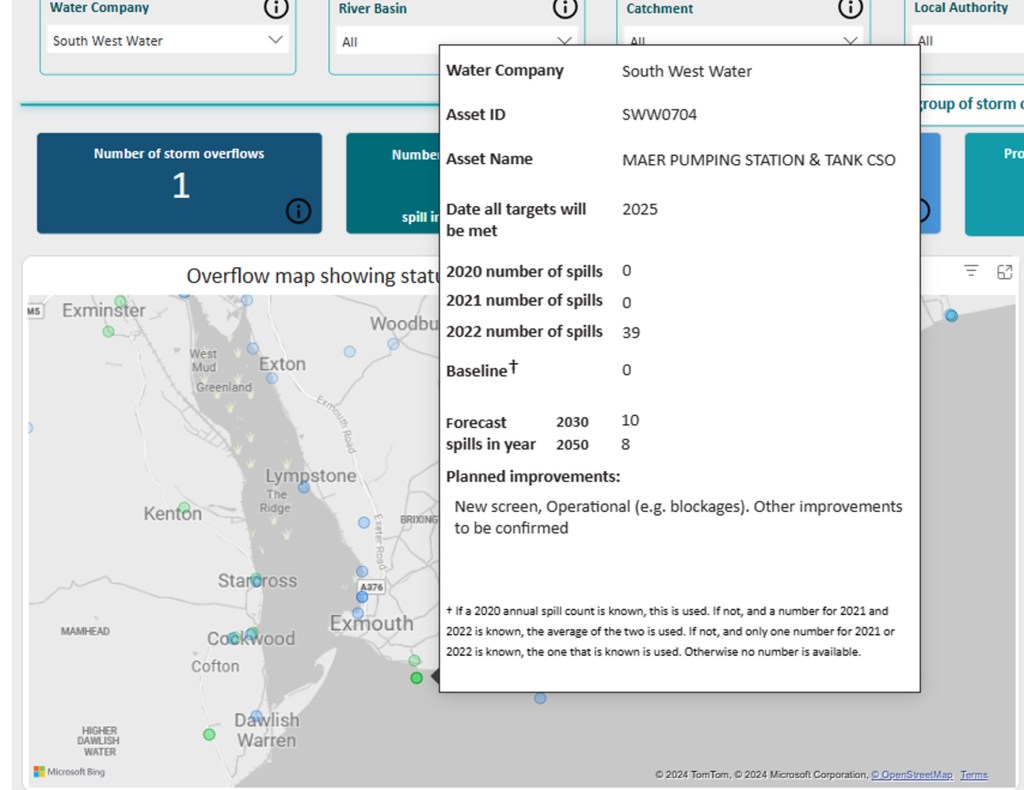
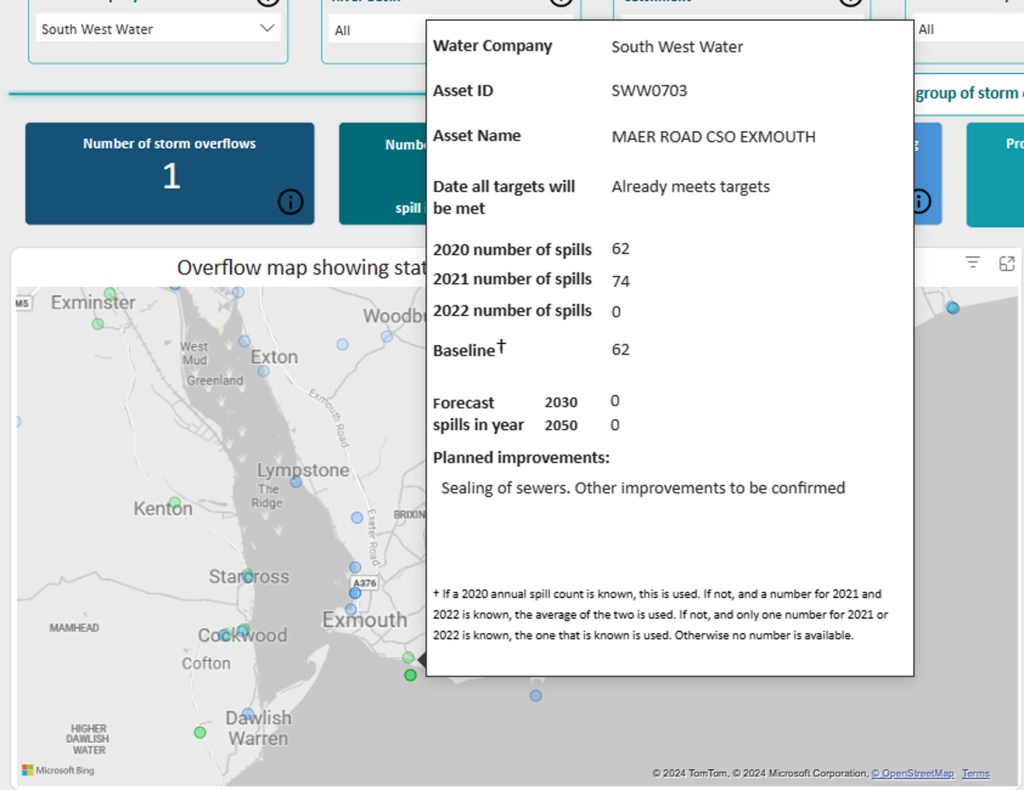
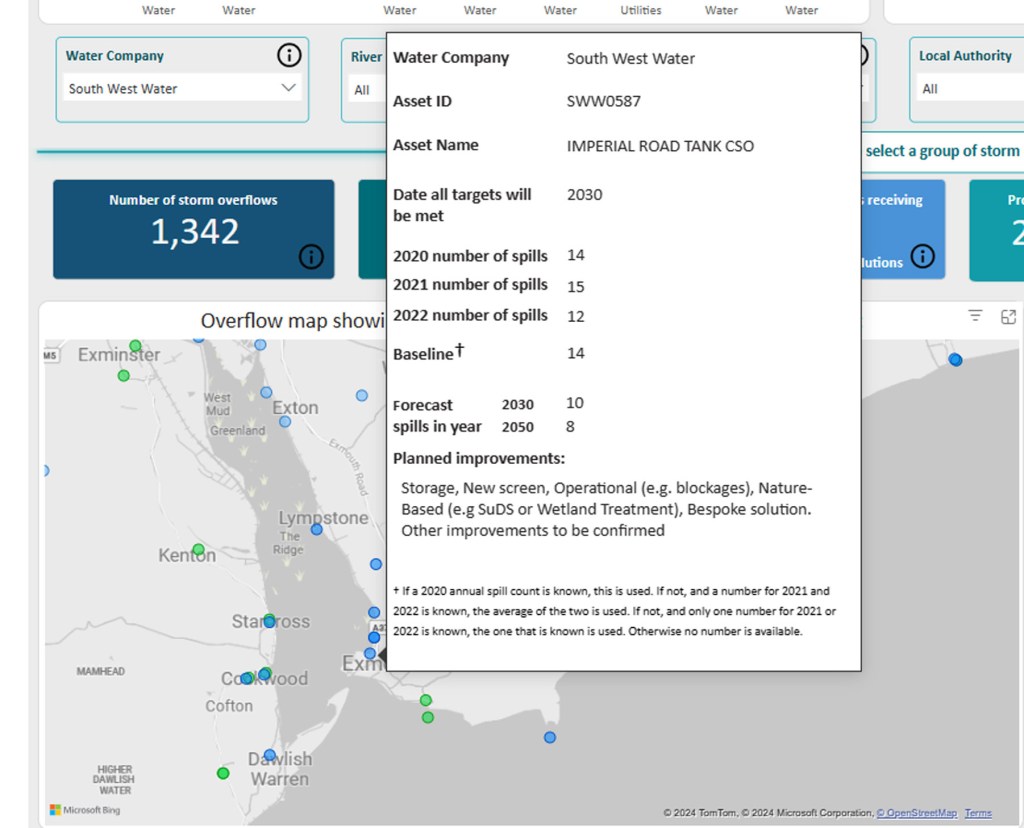
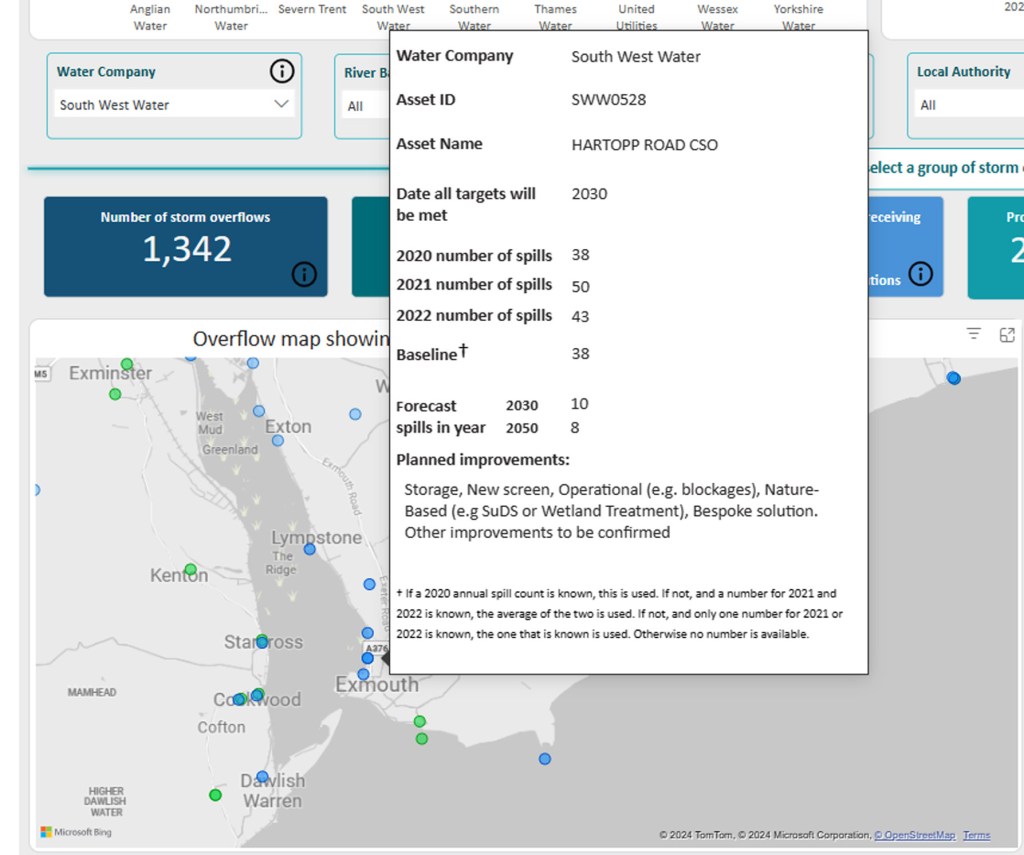
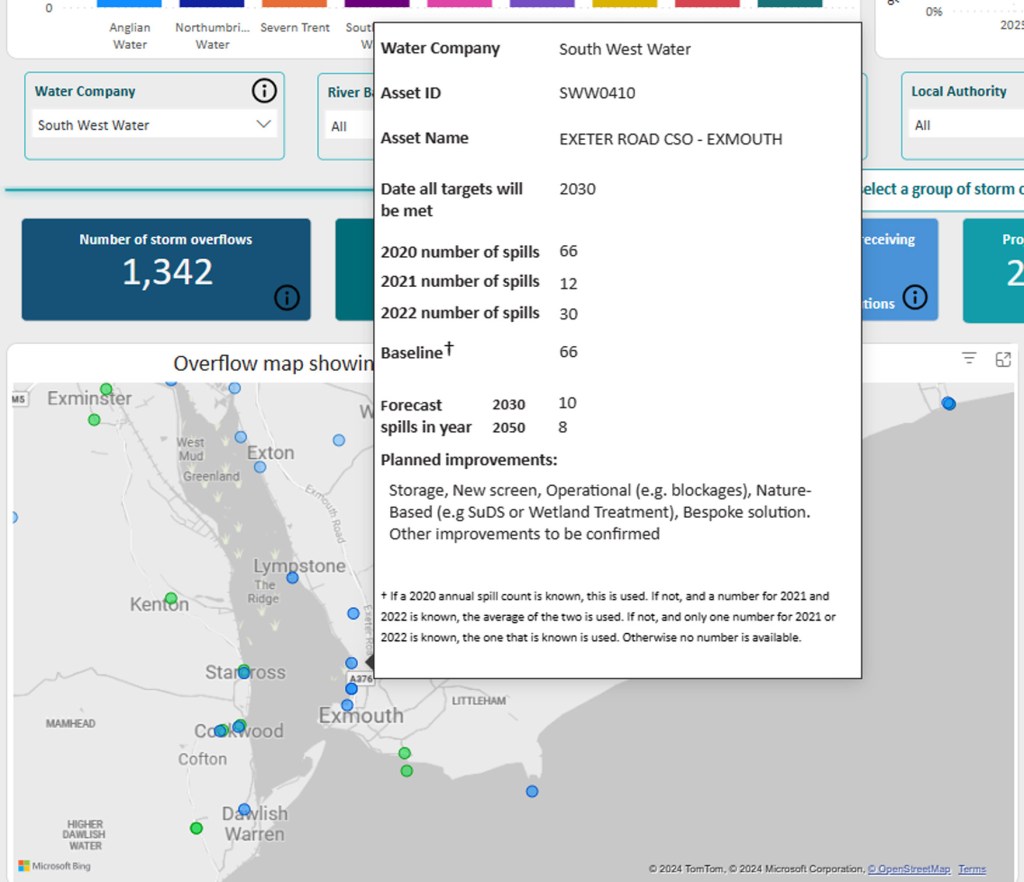
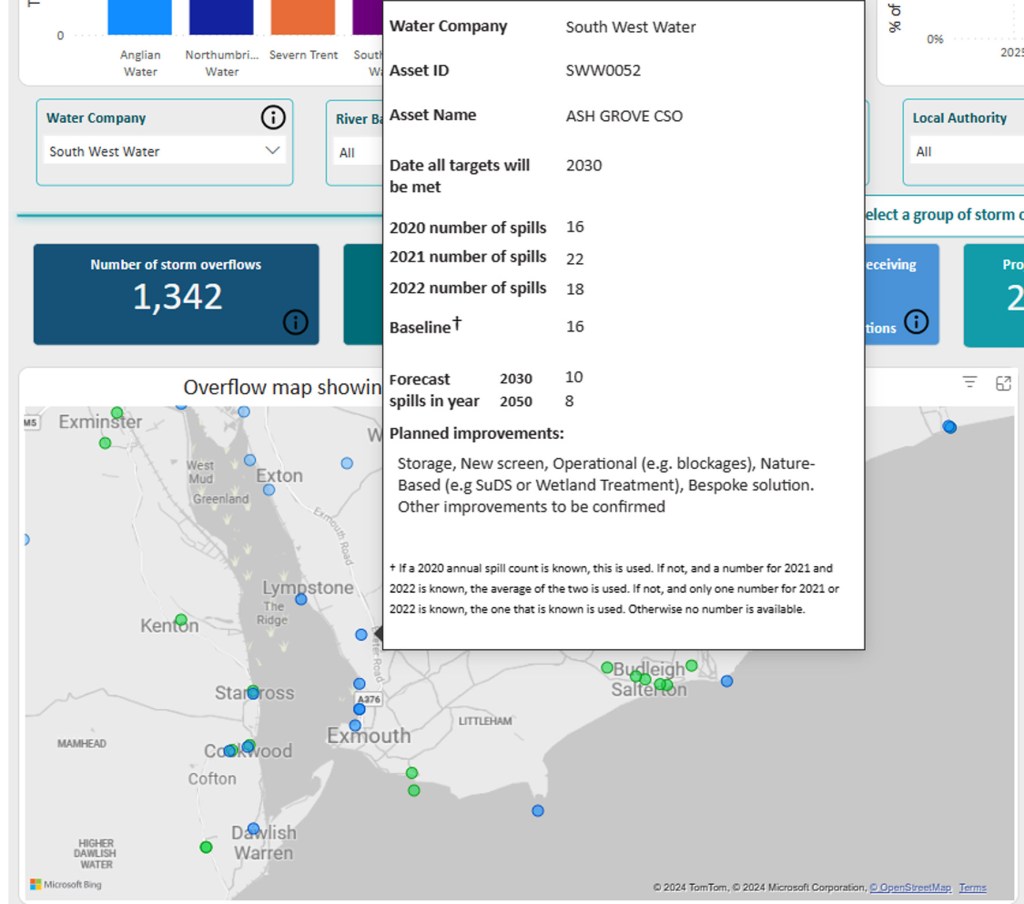
Following an earlier post, Owl has been asked to show the “popup” details of the plans, baseline and recent performance data for each storm overflow in Exmouth for comparison.

These “popups” are a bit elusive and disappear with only a slight move of the cursor.

The combined sewer outfalls associated with treatment works are also elusive, disappearing, for example, when “East Devon” is selected as the area of interest within the South West Water catchment. 

The title of the interactive map is the National Storm Overflow Plan and seems to exclude all emergency overflows associated with sewage pumping stations such as at Phear Park.

Exmouth sewage treatment works CSO – all targets by 2027

Maer pumping station and tank CSO – all targets by 2025

Maer Road CSO, all targets already met

Imperial Road tank CSO – all targets by 2030

Hartopp Road CSO – all targets by 2030

Exeter Road CSO – all targets by 2030

Ash Grove CSO – all targets by 2030

In many cases the estimated number of spills remaining after 2050 is a consistent “8”. How big an improvement this represents in these cases depends on the “calculation” of the baseline figure. In some cases it represents only a 50% reduction.

Base Map for the Exe and local bathing beaches

Exmouth sewage treatment works CSO

Maer pumping station and tank CSO

Maer Road CSO

Imperial Road tank CSO

Hartopp Road CSO

Exeter Road CSO

Ash Grove CSO

Planning applications validated by EDDC for the week beginning 26 February

Plans to upgrade coastal defences at Seaton one step closer

Plans are developing for a coastal protection scheme in Seaton that will better protect 41 homes, businesses, and the town’s coastline from erosion. 

Adam Manning www.midweekherald.co.uk

Construction is planned to begin in 2025. The scheme will involve improving a 400-metre length of existing rock armour along the foot of the cliffs at Seaton Hole beach, and repairing the existing Check House seawall.

Councillor Geoff Jung, EDDC’s portfolio holder for coast, country, and environment, said: “Like all other communities on the coast, Seaton is becoming more and more susceptible to coastal change due to our changing climate. More storms, higher rainfall, are clearly having a serious effect on our beaches and cliffs.”

“We are continually reviewing with other stakeholders such as the Environment Agency and the Town Council regarding the whole seafront. This section from Seaton Hole beach to the Check House is critical to protect a number of properties and we hope to start on this section next year.”

More than £500,000 in grant funding has been secured from the Environment Agency, with East Devon District Council (EDDC) allocating £250,000 towards the project. Additional funds from Devon County Council and Seaton Town Council have also been provided to support the scheme.

Local coastal defence specialists will be invited to tender for the works this spring, with the aim to start construction in summer 2025.

Come clean on secret taxpayer rescue plans for Thames Water, MP demands

Ministers must come clean on the secret details of an emergency plan for a taxpayer bailout in the event of Thames Water collapsing, a Liberal Democrat MP has said.

Those of us in the regions could end up paying twice for water, once for ours, and again for London”s water. Is this levelling up? – Owl

Sandra Laville www.theguardian.com

Sarah Olney will press in parliament this week for details of a behind-the-scenes rescue operation being drawn up for the biggest privatised water company in England. Olney said keeping the details of the contingency plan secret amounted to a cover-up.

The MP has secured a parliamentary debate this Friday, as intensive discussions are under way between ministers and the regulator Ofwat on the emergency rescue plan in case of the collapse of the ailing privatised water company, which provides water and waste services to 15 million people.

Olney wants details of the contingency plans, which are codenamed Operation Timber and being run by Tamara Finkelstein, the permanent secretary at the Department for Environment, Food and Rural Affairs, to be made public.

“This Conservative government’s refusal to make their contingency plan in the event of Thames Water’s collapse, public, is nothing short of a cover-up,” Olney said. “It is very clear they could easily slip into special administration. The public has a right to know what ministers plan to do.”

Thames Water, which has debts of more than £18bn, is trying to stay solvent and avoid a takeover by seeking an additional £2.5bn bailout from its shareholders for the second half of the decade.

But the company wants concessions from Ofwat to encourage shareholders to commit to the bailout. These include being allowed to pay higher dividends, while increasing bills by 40%, and limitations on fines for serious pollution of rivers.

In a sign its collapse could be looming, ministers recently updated 30-year-old water insolvency legislation, which can be triggered if a water company cannot pay its debts.

Emma Hardy, the Labour MP for Kingston upon Hull and Hessle, said the move reflected “the desperate and perilous situation that the sector had reached, with many companies on the precipice”.

The upgraded insolvency legislation is aimed at ensuring that drinking water and wastewater services for 15 million people are maintained if Thames became insolvent.

Special administrators can be appointed to a water company by the secretary of state or the regulator.

The company, along with five other water firms, is at the centre of an Ofwat investigation into the potentially illegal discharging of sewage from its treatment plants.

Water companies on Tuesday announced details of plans to remove 150,000 annual sewage spills by 2030, making nearly 9,000 storm overflow improvements in a £10bn investment over five years. They are seeking Ofwat approval to raise customer bills to pay for this.

Olney said: “For too long water companies have been allowed to get away with pumping raw sewage into our waterways while Conservative ministers have turned a blind eye. It is time they cracked down on these polluting giants and put an end to this disgusting practice.”

The MP said it was important for the government to be open about any discussions of a taxpayer bailout for Thames at a time when the water industry was under scrutiny. Companies including South East water, Southern Water and SES water are, like Thames Water, listed in Ofwat’s most recent highest category regarding concerns over their financial resilience and ability to operate.

The industry is opposed to putting Thames into special administration, fearing it will affect other struggling water companies by reducing investor confidence.

Olney said it was vital to exert public scrutiny over the emergency plans for Thames and taxpayer liabilities because of the potential for other companies to go under.

A government spokesperson said: “Water companies are commercial entities and we do not comment on the financial situation of specific companies as it would not be appropriate. We prepare for a range of scenarios across our regulated industries – including water – as any responsible government would.”

Thames Water declined to comment.

Water firms map out plan to cut 150k spills

Water companies have claimed they will cut sewage spills by 150,000 a year by the end of the decade, as they laid out a plan for tackling river pollution.

An online map published today shows where improvements will be made to curb spills in waterways, down to the level of individual storm overflow pipes. It will include new storm tanks to stop sewers being overwhelmed. [From the Times]

However, the map accompanying the National Storm Overflow Plan for England, ordered by the government, reveals that roughly 5,000 of about 14,000 overflows will not receive improvements by 2050. Water sector figures fear that risks a backlash from the public in areas that will miss out.

It also appears to fall short of a demand by the former environment secretary, Thérèse Coffey, 13 months ago who said all water companies must deliver “a clear plan for what they are doing on every storm overflow”.

[Owl -The interactive map is complicated and won’t win any prizes for using “plain English” but it does contain a lot of information. Here, by way of illustration are three screen shots. The first gives an overview of East Devon including the catchment areas of the Exe, Otter and Axe. This shows that the spills into our rivers will be the last to be cleaned up.

The second zooms in on our coast.

The third illustrates the history and projection of spills available for each outlet, in this case the Imperial Road CSO in Exmouth. From a baseline of 14 spills a year now, SWW estimate they won’t even halve that number by 2050! So you really need to read the “small print”.]

Update: see more details in this second post.

Back to the Times article…..

Adam Vaughan Environment Editor, The Times print edition 12 March.

The plan comes at a sensitive time for the water industry. Companies are braced for official figures this month that are expected to show a huge increase in sewage spills. That is because last year was wetter than normal, 2022 was drier than usual and the number of pipes being monitored rose to 100 per cent by last December.

The industry body Water UK said that it expected its new plan to cut 150,000 sewage spills by 2030, a 40 per cent reduction compared with the 372,000 that were recorded in 2020. The government’s plan had envisaged a cut of 64,000 sewage spills by 2030.

New infrastructure, which can vary from storm tanks to wetlands and “sustainable urban drainage systems” to slow the flow of rainwater into sewers, will be focused first on bathing waters and ecologically important waters including sites of special scientific interest. Great Britain’s longest river, the Severn, is set to have a 77 percent reduction in sewage spills.

Water companies are expected to spend in the region of £60 billion between now and 2050 to end the scourge of raw sewage being dumped when it rains, due to the way rainwater and sewage are collected in the same pipes.

The investment between 2025 and 2030 is expected to push up the average house-

hold water bill by about £13 a year. However, the amount will vary widely around the country. United Utilities, which covers northwest England, is expected to account for £3.1 billion of the water sector’s £10.2 billion slated for cutting spills between 2025 and 2030. On the flipside, it is expected to have the biggest reduction in spills, with the new map suggesting about 58,000 fewer spills by 2030. The Times Clean it Up campaign has

been urging regulators and politicians to sign off on new investment plans totalling £96 billion by 2030, with tariffs to protect the most vulnerable in society. A decision is expected by Ofwat this summer.

Water UK said the government could deliver on ten of its past commitments to help speed up the elimination of sewage spills. The list of ideas includes a 14-month-old promise to mandate ponds and other green drainage systems in new-build housing developments in England, and banning the sale of plastic wet wipes. The government said it was committed to banning wet wipes.

“The ban on wet wipes has now been announced in 2018, 2021 and then last April and yet they are still being sold by the millions, and are still clogging up our sewage system and polluting our rivers with microplastics,” Charles Watson, chairman of the campaign group River Action, said.

The water minister Robbie Moore said: “As part of our drive to improve transparency, we demanded these storm overflow action plans were created by industry and we will now closely scrutinise them to ensure significant action is taken to reduce harmful and unnecessary discharges.”

Simon Jupp’s so short of political ideas he’s stealing Richard Foord’s clothes again!

[And did Alison Hernandez get a ticking off?]

Once again Simon Jupp is claiming conservative credit for the “triple lock” in his latest facebook “Weekly roundup”.

As Owl explained in the middle of January, from a speech given by Richard Foord in parliament:

The Conservative 2010 manifesto talked about restoring the link between the basic state pension and average earnings”,

Whereas it was the 2010 Liberal Democrat manifesto that stated:

“We will uprate the state pension annually by whichever is the higher of growth in earnings, growth in prices or 2.5 per cent.”

In the same “Weekly roundup” Simon said:

“It was great to welcome Home Secretary James Cleverly to Sidmouth last weekend to talk to residents with Police & Crime Commissioner, Alison Hernandez. We have record police officer numbers in Devon & Cornwall & Honiton’s police station has recently reopened to the public, with more to come.

But Simon again forgot to mention that:

Honiton is in Richard Foord’s constituency – those of us actually living in “Juppland”, for example  Sidmouth and Exmouth have yet to see a police office reopen, and in Budleigh even see a police officer, except on training days!

A year ago Owl reported that about a third of the new “Bozzer” recruits (Boris Johnson’s promise to add 20,000 to the force) Alison Hernandez boasted about getting in 2019 (and we are paying for) had voted with their feet and had left. We are also paying through the nose for these recruits as Hernandez bangs up her take of the Council Tax once again by a “necessary” 4.95 per cent. Since coming into office in 2016 she has pushed her take of the average council tax by over £100.    Remember she spends 70% more of your Council Tax as EDDC does. (Council Tax is split: 73% DCC; 12% Police; 7% EDDC; 4% Fire; 4% Towns & Parishes).

Finally, did the Home Secretary take her aside for a little chat about her force not only being in “special measures” but rated poorly for failings in “Strategic Planning” and “Value for Money”? From the photos, perhaps he did.

Owl is wondering whether to start a “ministerial visit ” count as an indicator of how insecure the party feels the East Devon parliamentary seats are?

They are also kept pretty “hush hush” for some reason.

SWW charm offensive continues with more “Paid Content” in Exmouth Journal

If only they had shown such candour when facing EDDC’s scrutiny committee, but then they faced questioning. This way they are on transmit only. – Owl

John Halsall: ‘We are making good progress in Exmouth’

John Halsall, Chief Operating Officer, South West Water www.exmouthjournal.co.uk 

Following the operational issues we’ve faced in Exmouth over the last few months, I promised I’d keep you updated as we work to fix the problem, and I’d like to do that again now.

Firstly, I’d like to reiterate how sorry I am for the disruption we’ve caused in Exmouth. I’m pleased to say we are making great progress with our replacement of the section of sewer that runs from Plumb Park housing estate to Maer Lane, just outside the sewage treatment works.

In order to lay this sewer, the wastewater which normally flows through the pipe is being diverted around the new section by roughly 1.5km of temporary overland pipe. Once the new section of sewer is complete and connected to the network, we’ll begin work to remove the temporary pipe and reinstate the fields we are working in.

The new section of pipe will meet the existing sewer on Maer Lane, near Maer Lane Sewage Treatment Works. To make sure this whole area is as resilient to future bursts as possible, we’re also looking to upgrade the small section of sewer from Maer Lane which runs into the treatment works.

It won’t have escaped your attention that we’ve just had the wettest February ever in the South West, with more than twice the average rainfall. This has proved to be incredibly challenging for our teams on the ground in Exmouth and has led to some delays due to the poor ground conditions. While there is a risk we will not be able to fully complete our work by the end of March as originally expected, we’re still working as hard as we can to do so.

I’d like to thank you again for your patience and thank our teams on the ground for doing a great job under really difficult conditions. I’ll continue to provide regular updates as we work to provide better resilience for Exmouth.

Gordon Brown: UK has to get on war footing for economic growth

Britain needs to be put on an economic “war footing” if it is to break out of a vicious cycle of low growth, the former prime minister Gordon Brown will say [did say] on Monday.

Larry Elliott www.theguardian.com 

In a speech to the Institute for Government thinktank, he will call for the creation of a National Economic Council, jointly chaired by the prime minister and chancellor with a mission to deliver annual growth of 3%.

The former prime minister will say the Treasury must be fully committed to a growth strategy and not be allowed to retreat into a “comfort zone” in which it concentrates on balancing the books and reducing the national debt.

Jeremy Hunt, the chancellor, said in his budget last week that the economy would soon turn the corner after the damage caused by the pandemic and the cost of living crisis.

But the Office for Budget Responsibility, the government’s spending watchdog, said the outlook for the economy “remained challenging” and Brown, prime minister during the 2008 global financial crisis, will say that the way Britain is governed needs to change if there is to be an end to 15 years of stagnation.

He will say: “The way we govern will have to be radically transformed – and government put on a war footing – if Britain is to break free from the vicious low growth, low productivity, and low wage cycle that has seen annual growth halve in the last decade, investment levels stagnate at levels far below our main competitors, the worst productivity performance – less than 0.5% a year – since the Industrial Revolution, and the deepest regional economic inequalities in western Europe.”

Labour’s last prime minister will propose his new National Economic Council should be jointly staffed by the Treasury and the Cabinet Office, working alongside a council of the nations and regions, and have the task of hitting a 3% growth target. Brown will say the economic council should have equal status with the government’s national security council, meeting at least once a week, and twice a week if necessary.

Brown will argue that higher growth can be achieved through an industrial strategy founded on green, digital and medical technologies, linked to an employment and anti-poverty strategy focused on better jobs, skills, and services.

Brown will say the lesson he learned in his time as chancellor and prime minister is that the Treasury needs to be at the centre of a growth strategy rather than seeing its powers hived off to a new economic department.

“A myriad of improvisations have been tried and failed to turbocharge British economic growth, from the ill-fated Department of Economic Affairs of the 1960s, the National Enterprise Board of the 1970s, and Mrs Thatcher’s anointing of Sir Alan Walters in opposition to Chancellor Nigel Lawson in the 1980s,” he will say.

“But for a growth strategy to work, the Treasury has to be at the centre of a coordinated framework of economic policymaking and implementation led by it and No 10 and which involves all relevant economic departments.”

Rachel Reeves, the shadow chancellor, has said achieving higher growth will be at the heart of a future Labour government’s economic strategy and has insisted this has to be built on sound public finances.

Brown will say that for his plan to work, the Treasury “has to avoid the temptation to retreat into its comfort zone”, namely as “a finance department with an almost exclusive focus on debt and deficit reduction – neglecting its wider responsibilities for delivering growth”.

Brown helped to orchestrate the rescue of the UK’s stricken banks in 2008 but the deep recession that accompanied the global financial crisis resulted in him losing the 2010 general election.

In his speech on Monday, he will argue that the subsequent shift to austerity under the Conservative-Liberal Democrat coalition helped explain the UK’s weak economic performance while the US instead focused on a focus to growth.

South West Water investing millions to tackle sewage spills

Remember SSW claim that they are investing £38m in Exmouth and Sandy bay to reduce pollution.

A year ago water minister Rebecca Pow confirmed £70 million of cash to improving sewage systems in Sidmouth, Tipton St John and Axminister, as well as Falmouth in Cornwall.

Now the figure for the whole region is £32m by 2025. How much of this is re-announcement?

And can you realistically “turn the taps” on that fast? – Owl

REBECCA SPEARE-COLE www.devonlive.com

Water companies will invest more than £180 million to tackle sewage spills – with South West Water investing £32 million, the Government has announced. The fast-tracked investment made by several water companies in England will support the effort to roll out storm overflow prevention measures by April 2025.

These include artificial intelligence systems, accelerated wetland programmes, installing new in-sewer monitors and recruiting and training specialist staff. The Government said it expects the measures to prevent more than 8,000 spills polluting English waterways.

Anglian will invest £50 million, Severn Trent will invest £41 mill­ion, Southern will invest £10 million, South West will invest £32 million, United Utilities will invest £39 million and Wessex will invest £8 million. Companies such as Northumbrian and Yorkshire Water have not announced new fast-tracked investment, having already announced plans to take forward additional investment to tackle storm overflows this year, the Government said.

Environment Secretary Steve Barclay said the investment is part of Government efforts to “push for better performance from water companies and hold them to account”. He said: “The amount of sewage being spilled into our rivers is completely unacceptable and the public rightly expects action.

“This money will mean more cutting-edge technology, including artificial intelligence, and more specialist staff to detect and reduce spills. Today’s announcement builds on significant work by this Government to protect and strengthen our waters with increased investment, stronger regulation and tougher enforcement action.”

The support comes after Mr Barclay directed water companies in December to accelerate plans and increase funding in order to measurably reduce sewage spills over the next 12 months. The investment will add to the water companies’ previous £3.1 billion investment for the period of 2020 to 2025.

It is the latest move to tackle concerns over levels of pollution being dumped into rivers, lakes and around the coasts from sources including overflow pipes and processing plants, causing harm to wildlife and the health of beachgoers as well as affecting tourism and leisure industries.

The Government recently announced plans to block bonuses for water company executives where firms have committed serious criminal breaches, subject to Ofwat consultation, as well as to quadruple inspections on water companies in the next year.

Giles Bristow, chief executive of Surfers Against Sewage, said: “It’s great to see the Government fast-tracking investment on the decades-old issue of sewage pollution. The informed and angry voices of constituents across the UK are clearly making those in power listen and take visible actions to address the sewage scandal.

“Despite today’s welcome announcement, questions still remain on the scale and scope of the Government’s ambitions for our rivers and seas. We’ll be watching closely to ensure that it’s the polluters, not the consumer, that pays to clean up this mess.”

Capacity crunch on National Grid is delaying new homes in UK by years

Housing projects are being delayed for years because of an “infra­structure crisis” caused by lack of capacity in the National Grid, council leaders have warned.

Those hoping to build new wind turbines, solar farms or micro-hydroelectric schemes face even longer waits.

The delays come after Ofgem had already taken action last year to remove so-called “zombie” projects – those that had been approved but had stopped being developed – from the connections queue.

Chaos – Owl

James Tapper www.theguardian.com 

Building schemes for thousands of homes are on hold, while new ­projects face delays of up to four years in some parts of the UK because of a ­lengthening queue of developers waiting to be connected.

Those hoping to build new wind turbines, solar farms or micro-hydroelectric schemes face even longer waits after a deluge of new connection requests, many of them from speculative schemes.

Ministers have asked the National Infrastructure Commission (NIC) to investigate, but senior members of the District Councils’ Network (DCN), part of the Local Government Association, say the delays are slowing down the UK economy. Bridget Smith, the DCN’s vice-chair and leader of South Cambridgeshire district council, said: “Nationally, we’ve got an absolute ­crisis in all infrastructure.”

Plans by Michael Gove, the housing secretary, to build 150,000 homes in Cambridge to create a British Silicon Valley were already being hampered by lack of water, she said. “And where’s the power coming from? Something fundamental has to change.”

Susan Brown, the leader of Oxford city council, who is also a DCN vice-chair, said that 90 new homes in the Littlemore district had been meant to have heat pumps. “The National Grid basically said ‘we won’t have enough power to connect them’ so half the houses are going to have to have gas boilers instead – it’s so frustrating.”

Brown, who is also chair of the Future Oxfordshire Partnership, said plans to expand the town of Bicester with 7,000 new homes and a commercial zone had ground to a halt.

“All of that has been paused, awaiting grid reinforcement,” she said.

Under the current first-come, first-served system, developers can pay to jump up the queue, but the Bicester project has a further twist of red tape because there are two developers – one for the housing and another for the commercial buildings.

“Competition rules mean they’re not allowed to broker a solution together,” Brown said. “That’s particularly mad because it means they are dancing around, hoping the other one is going to take the full cost of providing grid reinforcement. There are so many daft things in our system.”

Brown said that leaders in other areas such as Milton Keynes, Swindon, Cambridge and Peterborough – with whom she works as part of the Fast Growth Cities group – were ­reporting similar problems. “It’s really beginning to constrain our ability to grow our local economy, which is significant for UK plc because the Oxford-Cambridge wider area is a significant net contributor to GDP, and not many bits of the country are.

“It’s possible that we’re a little bit ahead of the curve across the ­country. If they’re not already experiencing [these problems], people elsewhere will be experiencing them very soon.”

Although demand for electricity from builders is not being met, plans to expand the electricity supply are also causing problems, as the National Grid has been swamped with applications to build solar and wind farms – far more than the country would ever need.

Two weeks ago, the National Grid’s electricity systems operator (ESO), which manages power distribution, said that the connections queue had “grown at unprecedented pace”.

Great Britain’s power stations together generate 75 gigawatts of electricity, and the mainland is expected to need about twice as much by 2050 as people switch to ­electric vehicles and heat pumps.

But in January alone, developers submitted projects that would add 49GW, and the ESO said the queue could reach the equivalent of 800GW by the end of the year – more than four times as much as the country would ever need.

Being swamped with applications has made delays even longer, and Ofgem has had to approve a three-month delay until developers even find out when they can get connected. David Wildash, the ESO’s interim director of engineering, said in a blogpost that “we recognise that the outcome of this process is not what was envisaged at the outset. The outcome will be hugely disappointing to our customers.”

The delays come after Ofgem had already taken action last year to remove so-called “zombie” projects – those that had been approved but had stopped being developed – from the connections queue.

Nick Winser at the National Infrastructure Commission, who last year issued a report recommending that homeowners should be given generous compensation for agreeing to have power lines built close to their homes, is examining ways to solve the electricity capacity problem. He said: “We can’t let the distribution network become a barrier to the transition away from fossil fuels, which is why the commission is looking at what further investment or policy changes are needed to ensure the whole network is ready for 2050 and beyond.”

A government spokesperson said: “We’re driving forward the biggest reforms to our electricity grid since the 1950s – halving the time it takes to build networks, speeding up grid connections, supporting thousands of jobs and reducing bills in the long-term for families.

“Meanwhile we are on track to build one million homes this parliament and have laid out an ambitious long-term plan for housing that includes speeding up the planning system, cutting bureaucracy, and reducing delays to ensure we deliver the homes that communities want and need.”

Pollution – now Sidmouth gets National coverage

Devon beauty spot suffers sewage outflow for over 12 hours

“A Devon beauty spot where Queen Victoria spent time as a child has seen raw sewage discharged for more than 12 hours.”

But Geoff Crawford has left this comment on the Sidmouth Community facebook page:

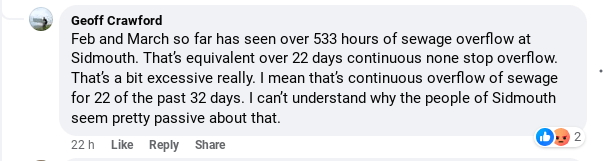
Feb and March so far has seen over 533 hours of sewage overflow at Sidmouth. That’s equivalent over 22 days continuous none stop overflow. That’s a bit excessive really. I mean that’s continuous overflow of sewage for 22 of the past 32 days. I can’t understand why the people of Sidmouth seem pretty passive about that.

Connie Dimsdale inews.co.uk

The seaside town of Sidmouth on the Jurassic Coast has seen raw sewage discharged from 7.38pm on Saturday 9 March, according to Surfers Against Sewage.

Queen Victoria visited the town as a baby during the winter of 1819 and 1820 when Sidmouth was a popular holiday destination, according to the biography Queen Victoria: Her Life and Legacy by Paul Kendall.

The town was a popular holiday destination in the Georgian and Victorian times and still attracts tourists today with an impressive coastline and beautiful countryside.

Now the town has been blighted by a sewage flow, which South West Water said was due to “heavy, localised rainfall” in the area in recent days.

Water companies are permitted to use “storm overflows” to discharge waste during periods of intense rainfall to prevent their infrastructure from becoming overwhelmed and sewage backing up into people’s homes.

The company said reducing the use of storm overflows is a “priority” and has invested in areas including Sidmouth.

Surfers Against Sewage has also warned of pollution along the Devon coast at the nearby coastal towns and villages of Sandy Bay, Budleigh Salterton, Seaton, and Beer.

It comes after i revealed that a sea swimmer from Exmouth, Devon, is taking South West Water to court over sea sewage discharges that she claims have harmed her health and prevented her from taking daily swims.

Retired NHS physiotherapist Jo Bateman has submitted an action to the Small Claims Court alleging that illegal sewage spills into the sea at her local beach have affected both her physical and mental wellbeing.

In her claim, Ms Bateman details 54 instances when she believes South West Water illegally dumped sewage into the sea during 2023.

Water companies have come under intense scrutiny over the last year for the amount of raw sewage that is being discharged into Britain’s rivers, lakes and coastal waters.

A spokesperson from South West Water said: “Due to the heavy, localised rainfall in the area over recent days, there has been storm overflow activity in Sidmouth.

“Storm overflows are pressure relief valves built into our network that stop homes and businesses from flooding during periods of heavy rainfall.

“However, reducing their use is a priority for us and we are investing record levels to do this – including in Sidmouth, where water quality is rated as excellent by the Environment Agency.”

Do the Environment Agency sample the water on Budleigh beach where bathers actually swim?

ONE of Budleigh’s two main swimming areas is sandwiched between frequently polluting channels. The other area MAY be much cleaner. But contrary to explicit legislation, Budleigh’s water sampling reports on neither.

Petercrwilliams fightingpoolution.com 

Beach water sampling is precisely regulated by the ‘2013 Bathing Water Directive’. This legislation clearly sets out the exact methodology that must be followed to provide a valid statement of the bathing water quality for all beaches.

One of the key instructions (not surprisingly), is how the sampling location must be selected at each beach. Here’s what the law says:

So it’s clear, the Environment Agency “must locate the point where most bathers are expected”.

So where on Budleigh beach do you think they sample?

  • Maybe immediately below the Lime Kiln car park, where most Summer visitors park and head to the beach?
  • Or alternatively, maybe Steamer Steps end – where most local swim, and is popular all year round?

In fact, the EA sample a section of the beach where very few people swim! They sample the water quality just by our iconic telephone box, west of the Longboat Café.

So the key question: does this make a difference to people’s swimming safety – and would you change your behaviour if you knew the facts?

The key purpose of water sampling, analysis and forecasting is to provide information that we can act on. Is it a good place to swim generally, and is it good to swim today?

Sampling the Telephone box location provides little useful information for any water user at Lime Kiln or Steamer Steps.

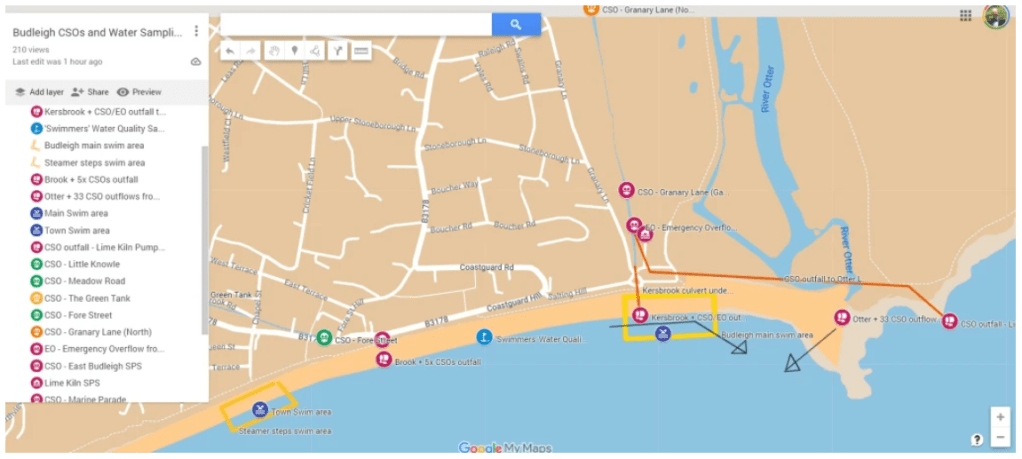
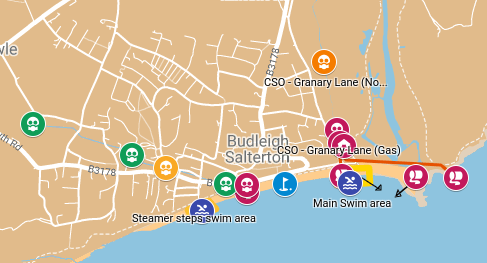
To understand why, we need to take a look at the ‘Sewage Map of Budleigh’.

You can see the Blue Sampling location flag in the middle of the map – where the water is sampled.

You can also see all of the sewage overflow points and outfalls (colour coded from RED = highest polluting outlet, to Green = lower polluting). Prevailing currents are marked with the black arrows.

The Lime Kiln car park and swim area is just a few metres ‘downstream’ from the Kersbrook outfall, which enters the beach below the west end of the carpark. This carries any sewage discharged from two Combined Sewage Overflows (CSOs), plus an Emergency Overflow, straight into the sea.

  • On 20th June 2023, the Environment Agency sampled the Kersbrook, just before it enters the sea, and found it contained greater than 100,000 E-coli cfu/100ml. That’s more than 200 times greater than the ‘safe’ limit for E-coli bacteria!
  • On 3rd August 2023, the Environment Agency found it contained more than 40 times the ‘safe’ E-coli limit!
  • On 4th July 2023, South West Water released raw sewage, sanitary towels and PPE into the Kersbrook through an Emergency Overflow, and from there directly into the sea. This discharge has been confirmed by the Environment Agency after an FOI request. Further details and photos of this can be found on the ‘Budleigh Sewage Action’ home page.
  • The EA sampled this point 20 times in Summer 2023, and – on average – the samples contained E-coli concentrations more than 14 times greater than the ‘safe’ limit for bathing.

And here’s the Kersbrook outfall as it enters the beach – on the edge of the Lime Kiln bathing area.

“Bubble, bubble, toilet trouble?” Kersbrook outfall below Lime Kiln car park

Go to the original article to watch video.

It’s important to point out that any sewage quickly mixes and gets diluted when it enters the sea, but in the local vicinity of these outfalls (maybe a few hundred meres), concentrations can still be significantly elevated for some time after a discharge. That’s exactly why pollution forecasts are mandatory during the Summer season, but these are based on the impact at the telephone box location.

But that’s not all that swimmers at Lime Kiln have to contend with.

The prevailing current carries the Kersbrook outfall along the bathing beach towards the Otter Estuary.

However, the Otter Estuary itself brings water which receives 31 of South West Water’s sewage overflows (CSOs) and pumping stations during its journey from the Blackdown Hills, as well as significant agricultural run-off. The Environment Agency’s average E-coli reading from the mouth of the River Otter in 2023 was approx. 3,200 E-coli cfu/100ml, that’s a large volume of water at more than 6 times greater than the ‘safe’ E-coli limit for bathing. And all of this bacterial load flows along the Lime Kiln beach area, and then out parallel with the Otter Ledge. Again, this water does mix and dilute when it reaches the sea, but there remains a localised effect for some distance.

So the beach next to Lime Kiln is located directly between these two significant pollution carriers, the effects of which are unlikely to be reasonably picked up by the existing ‘upstream’ sampling point at the Telephone box.

The reality is that we don’t know what the pollution load is actually like below Lime Kiln, because – contrary to the legal framework – no sampling is carried out in this area.

The opposite however, may be true for the Steamer Steps section of the beach.

We know that the background pollution level of the sea around Budleigh is very low. It also appears that the tidal current tends to run predominantly Eastwards along the sea front, potentially taking any bacterial load from the Marine Terrace sewage overflows / Knowle Brook outfall away from Streamer Steps.

So it’s not obvious to see that significant bacterial pollution would affect the Steamer Steps area – which may be some comfort to the majority of locals who use that area for their daily swims, all year round.

The problem is that we don’t know this. We can only surmise. And for as long as the Environment Agency only sample in a place where few people swim, that will continue to be the case.

So what ACTION do we want?

  • Firstly, we need the EA to start sampling at both Steamer Steps and Lime Kiln – beginning in the 2024 Summer Season, and publishing results throughout the season along with the current ‘Telephone box’ sample data. Once they have done this – and published a year or two’s data, we can get a proper understanding of where in Budleigh it is safest to swim
  • It would also be helpful if the EA could specifically forecast pollution alerts for the two main swimming areas, so people can make an informed choice in real time, of where and when to swim
  • Lastly, we all need South West Water to reduce or eliminate this frequent stream of pollution being dumped into Budleigh’s brooks, and into the whole Otter catchment.
  • It would also be great to see a comprehensive focus on cleaning up the agricultural pollution and run-off, right along the Otter river system.

How to achieve this?

  • Write to the EA and our MP, quoting ‘Schedule 4’, of the ‘2013 Bathing Water Regulations’, to request that the Environment Agency sample in accordance with regulations
  • Continue to put pressure on South West Water clean up their act
  • Support any initiatives which aim to improve the water quality of the whole Otter river system

If you’d like to explore the live and interactive ‘Budleigh Sewage Hotspots Map’, click the link.

You can use this map to locate and see all of South West Water’s worst polluting hotspots in Budleigh. Click on each location to see what it looks like (easiest on a PC), and how much pollution it has dumped onto our beach in 2022. We will update this map once we get 2023’s sewage data.

In terms of sampling and forecasting for both Steamer Steps and Lime Kiln swimming areas, the 2013 Directive allows for just our situation, and specifically states that ‘where more than one swimming area is popular, and they are some distance apart, then both locations may be sampled’. That’s just what we need for both local swimmers and our many visitors.