Is Tory morale collapsing?

General election poll: Quarter of 2019 Tory voters think party deserves to win no seats

A quarter of people who voted Conservative at the last election believe the party deserves to lose all its seats at the general election, a new poll has found.

Jacob Phillips www.standard.co.uk (Extract)

Nearly half of all voters think the Tories deserve to be totally wiped out, a survey by Public First has found.

The pollster quizzed 2,011 Brits between June 7 and 9 about what they expect and hope will happen when voters go to the polls on July 4.

Forty-six per cent of those polled believed the Tories “deserve to lose every seat they have” with 35 per cent disagreeing.

When asked what the ideal number of seats they would like to see the Tories win 24 per cent of people polled wrote zero.

Despite continual movement of sewage tankers, Budleigh has bathing risk warning

Budleigh Salterton 13/06/2024 08:30: Advice against bathing: pollution risk warning

From a Budleigh correspondent:

Dear Owl,

How can Budleigh Salterton beach be classified as “excellent” when time after time sewage is discharged into the sea?

I find it difficult to accept that if the Environment Agency (EA) issues an alert and declares this a “Short Term Pollution” event, samples from this event can be discounted. This is why, in total last year, Budleigh  had only 12 pollution risk warnings and the most recent classification is Excellent, based on samples taken from 2019 through to 2023

What sort of mind dreamt up this fix? It is all very well for the EA to say that

“The EA applies the law and issues real time alerts via Swimfo,and excludes samples in Short Term Pollution incidents from our data, just as our peer regulators across Europe do.” and

“It is also in line with World Health Organisation advice on best practice.”

Really, this “best practice” happens throughout the world? If this is the case surely the UK  needs to lead to stop this fiddle.

I would vote for any political party who could seriously try to sort this out.

A Budleigh Correspondent.

PS Another thing I do not understand is the regular number of tankers which are dyno-rodding their way through Budleigh High St. carrying sewage waste. And yet, today 13/06/24 Swimfo advises                                                                       

Budleigh Salterton

 Bathing is not advised today

Latest annual classification:

 excellent

Do we need to get more tankers on the job?

How much raw sewage is released into rivers and the sea, and what are the rules?

According to the Environment Agency, there were 3.6 million hours of spills, compared to 1.75 million hours in 2022.

Every major English water company has reported data suggesting they’ve discharged raw sewage when the weather is dry – a practice which is potentially illegal.

BBC News www.bbc.co.uk 

Water companies can release untreated sewage into rivers and seas when it rains to prevent it flooding homes, but such spills are illegal when it’s dry.

On dry days there is less dilution and sewage can cause more damage to the local environment and pose a health risk to swimmers.

How much sewage is released into the sea and rivers in England?

Sewage spills into England’s rivers and seas by water companies more than doubled in 2023.

According to the Environment Agency, there were 3.6 million hours of spills, compared to 1.75 million hours in 2022.

Water UK, the industry body for sewerage companies, said this was “unacceptable”, but argued that the record levels were due to heavy rain and increased data collection.

However, the Environment Agency said that increased rainfall does not override water companies’ responsibility “to manage storm overflows in line with legal requirements”.

Some environmental charities blame water companies for a failure to fix leaky pipes and other damaged infrastructure – and criticise the regulator for not forcing them to act.

Why is sewage released into the sea and rivers?

Most of the UK has a combined sewerage system, meaning that both rainwater and wastewater – from toilets, bathrooms and kitchens – are carried in the same pipes.

Wastewater is usually sent to a sewage treatment works.

But capacity can sometimes be exceeded during heavy rainfall, especially if dry ground cannot quickly absorb large quantities of water.

This could lead to inundation of sewage works and potential flooding of homes, roads and open spaces.

The system is therefore designed to overflow occasionally, and discharge excess wastewater into the sea and rivers.

This is called combined sewer overflows , external(CSOs).

However, according to the BBC there is evidence that some water companies are potentially spilling sewage when it is not raining.

Without rainwater to dilute the waste, this can lead to higher concentrations of sewage entering waterways – and is therefore illegal.

The BBC has examined spill data sent by the nine sewage companies from 2022 to the Environment Agency and cross-referenced it with rainwater. The results of the BBC’s analysis suggest there may have been dry spills starting on more than 200 days in 2022 lasting over 29,000 hours – including during the record summer heatwave when people were cooling off in England’s rivers and seas.

To confirm this has happened the Environment Agency says they carry out further checks and visit the sites where the spills may have taken place.

The BBC also found that untreated sewage was illegally released into Lake Windermere in the Lake District in February 2024 after a fault.

Water companies which are found to have breached the rules by spilling on dry days or failing to meet other conditions can be fined or prosecuted.

What is being done to tackle sewage discharges?

In April 2023 the Conservative government announced a plan, external to improve water quality.

As part of this, it said polluters could face unlimited fines in the future, external which would be re-invested into a new Water Restoration Fund which aims to improve water quality.

Six months later Water UK, the industry body, announced plans on behalf of its members to almost double spending to pay for upgrades and cut sewage discharges.

It said this would be the “most ambitious modernisation of sewers since the Victorian era”, but that customer bills would have to rise by £156 a year to cover the cost.

This week the UK’s political parties released their manifestos including their proposals for the sewage industry.

Steve Reed, Shadow Secretary of State for Environment, Food and Rural Affairs told the BBC that a Labour government would “put the water companies under special measures to force them to clean up their act”.

“We will give the regulator tough new powers to make law-breaking water bosses face criminal charges and ban the payment of their multi-million pound bonuses until they clean up their toxic filth,” he added.

The Liberal Democrats have said they will introduce a sewage tax on water company targets and set legally binding targets to prevent sewage dumping bathing waters and “highly sensitive nature sites by 2030”.

Sian Berry, parliamentary candidate for the Green Party told the BBC: “Private water companies have failed to invest, resulting in sewage leaks and run-off at record levels. It’s made our coastlines and inland waterways filthy and unhealthy when they should be clean and safe.”

The BBC has approached Reform for comment on this issue.

What are the health risks of swimming in polluted water?

In May 2024, a team of the UK’s top engineers and scientists warned of the growing public health risk from human faeces in the country’s rivers, and called for more regular testing.

The presence of faeces can expose people to bacteria such as salmonella and E.coli, which cause diarrhoea and vomiting, or viruses like hepatitis A which can lead to liver infection.

Also in May, thousands of residents in Devon were told to drink bottled water after their supply was contaminated with the cryptosporidium parasite – possibly as a result of a faulty valve on private land. Consumption of the parasite can cause prolonged diarrhoea.

How can I check if the sea near me is clean?

Every week between May and September, the Environment Agency measures the water quality at “bathing sites” across England, and in some places it issues daily pollution risk forecasts.

You can search its website, external by location. There are similar websites, external where you can find out about beaches and bathing water in Scotland, Wales or Northern Ireland.

But outside of these times and locations regularly testing for organisms carrying faecal-oral disease is not carried.

By the end of this year all water companies are expected to have maps showing near real-time discharges at their storm overflows to keep the public better informed.

How clean are UK waters overall?

Sewage spills have only been routinely monitored for a few years, external, so it is difficult to tell exactly how they have changed over time.

However, overall water quality has been monitored for decades. This also accounts for other sources of pollution, such as agriculture.

In May 2023, the Environment Agency said that 16% of assessed surface waters in England achieved “good” ecological status, external, including:

  • 14% of rivers and lakes
  • 19% of estuaries
  • 45% of coastal waters
  • 93% of designated bathing waters

Water quality is generally higher in other parts of the UK, external.

In Scotland, around two-thirds of surface waters are classed as having “good” ecological status.

In Wales the figure is 40%, and in Northern Ireland 31%.

Cranbrook expansion go-ahead: New ‘garden village’ includes building 1,000 homes, primary school, sports and traveller pitches

East Devon Reporter eastdevonnews.co.uk 

Cranbrook is to get a new ‘garden village’ of more than 1,000 homes, primary school, sports pitches, traveller pitches, play areas, employment land and allotments, it has been announced.

East Devon District Council (EDDC) has rubber stamped plans to expand Cranbrook – the second of four proposals to increase the town.

Image shows the Treasbeare planning permission map, agreed for Cranbrook. EDDC.

The granted planning permission includes:

  • Up to 1, 035 homes,
  • Five permanent pitches for gypsies and travellers,
  • 25 acres of employment land
  • 85 acres of recreational space
  • Primary school
  • Six sports pitches
  • Sports pavilion

Will Heath, Carden Group CEO, said: “We are delighted to have received planning permission for Treasbeare Garden Village; an exciting new community that will provide over 1,000 high quality new homes and a long list of new facilities including the early provision of a primary school, six sports pitches and sports pavilion, 85 acres of recreational space, a neighbourhood centre and 25 acres of employment land. These facilities will also benefit the existing Cranbrook community.”

He added: “I would like to thank East Devon District Council planning department for their support and proactive approach when determining such a complex planning application.

“We are now looking forward to working with like-minded delivery partners to bring forward high quality new homes, community facilities and employment uses.”

EDDC said  the granted planning permission was for the second of four expansion areas at Cranbrook.

It said the expansion at Treasbeare closely follows the permission issued in April for the Cobdens area, which together ‘will bring forward more than half of the town’s planned growth’.

The planning permission means the development of up to 1,035 homes, five permanent pitches for gypsies and travellers, up to 10 hectares (25 acres) of employment land, a primary school and a sports hub with full-sized artificial grass and turf pitches.

Other community facilities will include a neighbourhood centre, play areas, allotments and large areas of green space, EDDC said.

An EDDC spokesman said: “This second sports hub, together with the existing facility at Ingrams, will serve the whole town of Cranbrook, in this case providing important facilities for a range of sports including rugby, football and tennis.

“To complete Cranbrook’s expansion, additional planning permissions will be required and these are expected to see further homes, sports provision and a community centre together with more play areas, allotments, areas of open space and neighbourhood centres.”

Andy Wood, EDDC interim director of place, said: “Issuing this planning permission is the result of months of work by council officers negotiating with the developers to secure the best form of development for our thriving new community at Cranbrook.

“It will provide much-needed homes and employment opportunities, as well as community facilities for Cranbrook residents.”

He added: “We continue to work with the developers and the community to deliver high quality and sustainable development at Cranbrook.”

Martin Shaw: Sarah Wollaston’s resignation is a stark comment on the state of Devon’s NHS after 14 years of Tory rule

Martin Shaw

I am sad to see that Dr Sarah Wollaston, the Chair of Devon NHS who I met several times during our campaign for Seaton Hospital, has felt compelled to resign, saying she felt unable “to sign off on a further cut” with the “elastic already stretched too far”.

Sarah seemed genuinely concerned at the threat to Seaton Hospital, although she had signed off on the proposal and many other cuts. She seemed to be the person pushing the NHS to help us come up with a plan to mitigate the effects – which we are still doing, although progress is on hold because of the election.

That Sarah felt compelled to go is a stark comment on the state of Devon’s NHS after 14 years of Conservative rule. Tory underfunding has produced the threats to Seaton and the other community hospitals over the last ten years, the Tory decision to hand them to a property company made them vulnerable in the first place, and Tory MPs and councillors have sabotaged them.

No one who cares about the NHS or our community hospitals should vote Conservative – in Honiton & Sidmouth and in Exmouth & East Exeter, vote Liberal Democrat; in Exeter and in Plymouth vote Labour. Let’s make July 4th Devon’s day of independence from Tory domination.

Revealed: Six water firms sued for £1.5bn by bill payers over sewage pollution

Bill payers are suing six of the UK’s biggest water companies for £1.5bn over sewage discharges in one of the biggest legal battles of its kind, i can reveal.

Kyriakos Petrakos inews.co.uk

The companies have been accused of underreporting the number of raw sewage discharges they have made into canals and rivers, allowing them to charge customers more than they would had they reported an accurate number.

Bosses at the firms have refuted the claims and vowed to defend themselves in the legal challenge “robustly”.

Environmental consultant Carolyn Roberts is leading the case as the proposed representative for 35 million water customers that may be paid damages if she succeeds.

She told i that she wants to see bill payers compensated and hopes that the vast damages water companies may have to pay will “persuade them to change their behaviour”.

Leigh Day Solicitors, the legal firm overseeing the six claims, said that between them the companies may have to pay anywhere between £878m and £1.5bn in damages.

Environment Agency data released this year showed that more sewage was dumped into England’s waterways in 2023 than in any other year on record.

This has prompted an angry reaction from the public as water customers throughout the country shared stories of their gardens flooding with sewage, falling ill after swimming in rivers and having their streets flooded with E.coli infested water and used sanitary products.

The six water companies that have had claims issued against them as part of the legal case are Thames Water, Severn Trent Water, Northumbrian Water, United Utilities, Anglian Water and Yorkshire Water.

Environment agency data shows that these six firms dumped sewage over 330,000 times for 2.4 million hours last year, with the largest number of spills recorded along the River Severn.

Anglers at one of the Severn’s top fishing spots in Shrewsbury told i in 2023 that they “don’t want to come to Shrewsbury any more” because they are fed up of catching “more tampons than fish“.

The case against the six companies stems from data collected by Professor Peter Hammond, a mathematician who records illegal spills using sewage discharge monitoring data and Environment Information Requests covering hundreds of sewage treatment works across the country.

According to Mr Hammond, his findings revealed that water companies across the country “were underreporting their spills of untreated sewage”.

Mr Hammond added that the companies hadn’t “performed up to standard” but concealed this to avoid paying customers compensation.

Severn Trent refuted the claim brought against it, while Thames Water said it is aware of the claim against it but will “defend the claim robustly”. The other water companies are yet to respond.

Ms Roberts said that the central aim of the legal action was to see the amount of additional charges unfairly imposed on customers returned to them as compensation.

Water companies must report sewage discharges to Ofwat, the regulator. Ofwat takes these spills into account when deciding the prices companies are able to charge – with prices lowered if targets are not met.

In September last year, Ofwat ordered several water companies to pay back £114m to customers through lower bills after “falling short” on performance measures around leakages, supply and reducing pollution.

The legal challenge brought by Ms Roberts claims that water companies are underreporting discharged to avoid being found to have missed Ofwat’s target level.

“We are going after the six that we think will generate the largest returns, given their permit exceedances and the populations they serve,” she said. “The intention is that the amount that the companies have to pay back to their customers will persuade them to change their behaviour.”’

Ms Roberts has assisted in dozens of police investigations in which human corpses have been discovered in rivers, canals and other waterways, providing her with experience of the courts system.

She said: “I have experience of giving evidence in court and generating a case. I have done over 30 cases.”

Thames Water is the latest company to have a claim issued against it, which will be heard jointly with the claims made against the five other water companies at the Competition Appeal Tribunal.

The claim form issued against Thames Water says that it may need to pay £159.1m in compensation to nearly 11.5m customers if the case against it succeeds.

A Thames Water spokesperson said: “Thames Water is aware of the claims brought against it and other water and sewerage companies by Professor Roberts.

“Thames Water will defend the claim robustly.”

A Severn Trent spokesperson said: “This is a highly speculative claim with no merit which we strongly refute. Should pollutions ever occur, they are always reported to the Environment Agency. Any claim to the contrary is wholly and completely wrong.

“Our regulators, the Environment Agency and Ofwat, set strict targets and performance measures that deliver for our customers and the environment. Severn Trent is recognised as a sector leader by both regulators across operational and environmental measures. We consistently deliver for our customers, and are the only water company to have received the highest 4* status for environmental performance from the Environment Agency for four years running and are on track for a fifth year.”

While water companies are allowed to discharge untreated or partly treated sewage into waterways, they are only allowed to do so during exceptional periods of heavy rain.

Mr Hammond said: “There are regulations and permits governing what water companies are allowed to do,” but claimed, “there were many instances where they were breaching permits, which the Environment Agency considers illegal.

“They were underreporting their spills of untreated sewage. That influences their financial negotiations with Ofwat when they determine price increases or refunds for customers depending on whether they have or haven’t performed up to standard.”

According to Leigh Day Solicitors, this is what each company may have to pay in compensation to its customers if the case against it succeeds:

  • Thames Water: up to £159.1m may be paid to 11.46m customers
  • Anglian Water: up to £69.5m may be paid to 4.8m customers
  • Northumbrian Water: up to £225.1m may be paid to 2.06m customers
  • Yorkshire Water: up to £390.9m may be paid to 3.85m customers
  • United Utilities: up to £378m may be paid to 5.6m customers
  • Severn Trent: up to £322.5m may be paid to 8.1m customers

Katy Colley, 48, of Hastings, East Sussex, teamed up with Julie Wassmer, of Whitstable, Essex, to launch the website boycottwaterbills.com, which she claims has united thousands of people boycotting payments from all 11 water companies in England and Wales in protest of their inadequate wastewater services.

Speaking to i about the amount of compensation the six water companies may have to pay, Ms Colley said: “It’s a staggering amount and I am in no doubt that the water companies owe it to the public.

“At the same time, this collective action could take years. It is a slow process and it only involves around half of the water companies providing wastewater services.

“This is an urgent matter,” Ms Colley added. “We want to empower everyone to feel like they can do something about this now.”

Ms Colley told i that her own boycott campaign is “gaining momentum literally by the hour” and she encouraged water customers to “take a stand to cancel their direct debits as this is completely legal and risk-free”.

This legal challenge comes as i is urging political parties to get behind its manifesto to Save Britain’s Rivers amid growing public anger over the amount sewage dumped into waterways across the nation.

The manifesto sets out five key pledges that include improving the health of rivers and reducing sewage spills.

Its aim is to force political action and stop UK rivers being used as open sewers, returning them to people and nature.

The Liberal Democrats and Green Party have both pledged to support i‘s blueprint to rescue rivers.

Lib Dem leader Sir Ed Davey said “enough is enough,” vowing that the party “will have the most ambitious manifesto of any political party on cleaning up our rivers and coastlines”.

Ofwat, the Environment Agency and Yorkshire Water declined to comment on the proceedings.

Northumbrian Water, United Utilities and Anglian Water were also contacted by i for a comment.

Here’s another one: Severn Trent awards chief exec £3.2m despite sewage spills rising

Severn Trent has awarded its chief executive £3.2m, despite the company’s sewage spills rising by a third in 2023.

Euan O’Byrne Mulligan inews.co.uk (Extract)

Liv Garfield saw her pay package increase by 2 per cent, according to the FTSE 100-listed company’s annual report released on Tuesday.

She received a salary of £794,000, with her bonus increasing from £359,000 in 2022 to £584,000. The remainder of her package included pension payments and long-term share awards.

It comes despite Severn Trent, which supplies 4.6 million households and businesses in England, being responsible for more than 60,000 sewage spills last year – a rise of a third on 2022.

In February, the utility was also fined £2m by the Environment Agency for allowing more than 260 million litres of sewage – the equivalent of 10 Olympic-sized swimming pools – to be discharged into the River Trent between November 2019 and February 2020.

Ms Garfield’s latest pay rise confirms her position as the highest-paid boss in the water industry, having received more than £16m in the past five years.

Severn Trent said the increase was justified by the company’s strong financial performance, as revenues rose 8pc last year to £2.34bn, with profits jumping 20pc to £201m.

The company has proposed increasing bills by 36 per cent to £546 a year per household excluding inflation by 2030.

A spokesman for the company said: “Delivering for our customers, our communities and the environment underpins our approach to remuneration. Just under three quarters of executive pay is directly linked to performance, with stretching targets in place.”

Accounts published on Monday revealed that the boss of South West Water also received a pay increase of £300,000, just weeks after a parasite outbreak in Devon left residents unable to drink their water supply.

Last week, i launched its manifesto to save Britain’s waterways, which includes a call for regulators to be granted additional powers to restrict dividends and bonuses for underperforming companies.

All political parties have been invited to support the campaign. The Liberal Democrats became the first to do so on Thursday, followed by the Green Party of England and Wales on Monday.

The Conservatives and Labour have previously discussed restricting water company bonuses in cases of severe sewage pollution but the parties are yet to back i’s manifesto.

Martin Shaw: Voting Liberal Democrat is not just a tactical decision

Martin Shaw

I was a Labour member for a long time – and even a general election candidate back in 1987 – but I have never voted blindly for the party. In 2010, when I lived in Brighton, I helped elect Britain’s first Green MP, the great Caroline Lucas. I have been part of East Devon’s Independent movement, being Seaton and Colyton’s only non-Conservative county councillor in recent years, and supported Claire Wright in her bids for Parliament. But now I am backing the Liberal Democrats.

This is partly a tactical decision – it is essential to defeat the Tories, and the Lib Dems are best placed to win in both the Honiton & Sidmouth and Exmouth & Exeter East constituencies. It helps hugely that Richard Foord and Paul Arnott are both excellent candidates – doughty, dedicated and experienced campaigners and genuinely decent human beings to boot (now you can’t say that about all of the candidates on the anti-Tory side).

But there are also political reasons. Labour is tacking to the right, not prepared even to end the terrible two-child child benefit rule, and showing its authoritarian face in brutally removing some excellent candidates. The Lib Dems actually have some better policies, for example on social care, Europe and Palestine.

Perhaps most important, electing a large number of Lib Dems in this election could make them the official opposition in place of the Conservatives. We would then have a constructive opposition, helping push the Labour government to better places on some issues, and consigning the far-right Tory party to history. And East Devon could be part of this, not part of a discredited and irrelevant Conservative rump. What’s not to like?

Quote of the day Tonight on ITV: “Sorry to have kept you. It all just ran over.”

ITV’s Tonight programme was offered an interview slot for Thursday [D-Day] afternoon, with no alternative time slot provided.

As he arrived, Mr Sunak said: “Sorry to have kept you. It all just ran over. It was incredible, but it all just ran over, everything.”

Breaking: UK economy stagnated in April, a blow to Rishi Sunak’s claim that it has turned a corner

Office for National Statistics ONS

GDP was flat (0.0% growth) in April 2024 and grew 0.7% in the three months to April.

• Services grew 0.2%

• Production fell 0.9%

• Construction fell 1.4%

Global heating will increase risk of parasite outbreaks, say South West Water owners

A series of risks to water quality include: “odour, discolouration, dissolved organics, cryptosporidium”, plus “increased microbe propagation and survivability” and increased invasive species. Each of those problems would require costly maintenance or treatment to rectify, SWW claims. – You are forewarned!

Also “ice pigging” explained in plain language and graphically illustrated.

Jasper Jolly www.theguardian.com 

The owner of South West Water has warned that global heating will increase the risk of outbreaks of the parasite that caused diarrhoea and vomiting in south Devon.

Pennon Group said that “gradual and significant increasing average and high temperatures” could pose “risks to water quality and water treatment” – including the cryptosporidium parasite – in its annual report, published this week.

The parasite, which spreads from faeces, causes cryptosporidiosis, a disease that often entails fever, vomiting and diarrhoea.

The Devon outbreak has put the spotlight on the UK’s water quality, after years of scrutiny of the amount of sewage being dumped in British rivers and seas. It has also become an election issue, and the Conservative party manifesto on Tuesday promised to ban executive bonuses if a water company “has committed a serious criminal breach” and to invest in river restoration.

About 17,000 household customers of South West Water near the seaside town of Brixham in south Devon were last month advised to boil their tap water before drinking it, after more than 100 people reported symptoms.

Pennon’s report said global heating would increase the likelihood of floods from rain and rising sea levels and lead to more heatwaves and storms, all bringing higher costs.

A series of risks to water quality were also listed, including “odour, discolouration, dissolved organics, cryptosporidium”, plus “increased microbe propagation and survivability” and increased invasive species. Each of those problems would require costly maintenance or treatment to rectify.

Paul Johnston, of Greenpeace Research Laboratories, said water companies should redirect money away from shareholder dividends and executive bonuses towards increased resilience.

“Extreme temperatures will provide greater opportunities for toxic algae and pathogenic and parasitic organisms to appear in water sources and find their way into our water supply,” he said. “This is a significant risk, but blaming this all on climate change is disingenuous. The risk stems largely from our shoddy water supply and distribution system that has suffered from many years of underinvestment by water companies.”

In the latest cryptosporidium outbreak, South West Water said that it had started treatment of a tank at the hamlet of Boohay with ultraviolet light, which kills the microbes. It had previously treated a tank at nearby Hillhead.

The company has also flushed the pipes and cleaned them using “ice pigging”, which uses a slurry of ice and water to push out any dirt.

A demonstration of ice pigging (top) versus flushing with water on two pipes filled with mayonnaise.

Before parliament was dissolved ahead of the general election, the MPs’ select committee on environment, food and rural affairs wrote to Susan Davy, Pennon’s chief executive, requesting that she appear before the committee to answer questions over the outbreak.

It is unclear whether a new committee will take up the request after the election on 4 July, but Davy would also be likely to face questions about her pay. Despite giving up her annual bonus for 2023 in response to anger over sewage dumping, Davy’s total pay increased by £300,000 as share awards from 2021 vested.

‘Cosplaying Liz Truss’: Rishi Sunak condemned for £17bn tax giveaway

Vote Conservative and crash the economy again! – Owl

Rishi Sunak has presented a £17bn tax giveaway as the centrepiece of the Conservative manifesto, an offer that was immediately condemned for being “implausible” and mainly benefiting wealthier voters.

Peter Walker www.theguardian.com

The policy programme set out by the prime minister, seen by many Tory MPs as probably the party’s last big chance to win over voters, contained few big surprises and was centred on cuts to national insurance and stamp duty, higher thresholds for child benefit and help for pensioners.

Launching the manifesto at Silverstone racetrack in Northamptonshire, Sunak accepted he faced an uphill task in convincing voters, not least after his early departure from D-day commemorations last week.

“I’m not blind to the fact that people are frustrated with our party and frustrated with me,” the prime minister said. But in cutting taxes, he added, “we are the party of Margaret Thatcher and Nigel Lawson, a party, unlike Labour, that believes in sound money”.

However, with the tax cuts costing £17.2bn a year by 2029-30 and much of the money coming from cracking down on tax avoidance and slashing the welfare bill by as-yet uncertain means, thinktanks warned there was a big risk the sums would not add up.

Hours after Sunak launched the manifesto, Labour produced its own costings, which predicted a £17.4bn annual shortfall by the end of the parliament. Rachel Reeves, the shadow chancellor, said Sunak was “cosplaying Liz Truss” and risked sparking another rise in mortgage rates.

Launching the manifesto to an audience including almost all the cabinet, Sunak announced another 2p cut to national insurance contributions (NICs) and the gradual abolition of all NICs for self-employed people.

While some Tory MPs had hoped to reset a faltering election campaign with a bolder policy, for example abolishing inheritance tax, the cuts come on top of other expensive promises, including nearly £6bn annually to increase defence spending to 2.5% of GDP.

After the manifesto was announced, some Tory MPs were despondent. “It’s not going to shift the dial,” one said. Others felt it gave them some material to work with in their local constituencies.

Sunak has repeatedly attacked Labour over its spending plans, making the much-criticised claim that this would result in £2,000 of extra taxes a household. However, his tax and spend plans are now coming under significant scrutiny – and some scepticism.

Fiscal thinktanks, as well as Labour, were particularly critical of the manifesto’s proposed funding sources for the tax cuts and other spending, including a supposed £12bn saved a year by cutting back on social security payments, and £6bn annually on cracking down on tax avoidance and evasion.

Paul Johnson, the director of the Institute for Fiscal Studies, said the manifesto could be characterised as “definite giveaways paid for by uncertain, unspecific and apparently victimless savings”.

The Resolution Foundation thinktank said financing the tax cuts was conditional on cuts to social security including potentially up to 40% of the bill for payments for people with long-term ill health, as well as huge cuts to already-impoverished councils and unprotected government departments.

“All this raises questions over whether this tax and spend package passes the plausibility test,” it concluded.

Both thinktanks also noted that the stated tax cuts would mainly help richer earners, with those on lower wages seeing much of the benefit eroded by frozen thresholds for tax payments.

An analysis of the tax changes by the Resolution Foundation said that while the 20% of richest households would gain £1,300 a year on average, someone paid £30,000 would see their tax bill fall by just £170.

At a Labour press conference in London, Reeves announced calculations that the party said showed a potential £71bn deficit across the five-year parliament. The likely effect on interest rates could, Reeves said, see an average mortgage-holder pay £4,800 more over five years.

Labour aides said Keir Starmer was likely to use this statistic repeatedly when he and Sunak are interviewed by Sky News on Wednesday evening, much as Sunak used the £2,000 statistic when he and the Labour leader debated last week.

Reeves said the manifesto plans risked “a second Tory mortgage bombshell”, and undermined Sunak’s claims to be fiscally credible: “He said he was the antidote to Liz Truss. Instead, he’s cosplaying Liz Truss by again doing what the Conservatives did in that mini-budget with £71bn of unfunded commitments.”

Labour’s costings do not include the idea of abolishing all NICs. The Tory manifesto said this was the party’s “long-term ambition”, but only “when it is affordable to do so”.

Other part-surprises in the 70-page document included a beefed-up promise on migration, in which Sunak said a government “will” halve net arrival numbers, and a promise to build 1.6m new homes over the course of the parliament.

On green policies, the manifesto continued to push back against net zero commitments, with one policy including giving the Climate Change Committee, which advises the government on emissions, “an explicit mandate to consider costs to households and UK energy security in its future climate advice”.

The manifesto also ruled out any future green levies on bills, or taxes on frequent flyers.

Sunak’s language stayed the same on the European convention on human rights, despite pressure from the Tory right to offer stronger hints that the party should promise to leave if it created barriers in deporting asylum seekers to Rwanda.

“If we are forced to choose between our security and the jurisdiction of a foreign court, including the ECHR, we will always choose our nation’s security,” he said.

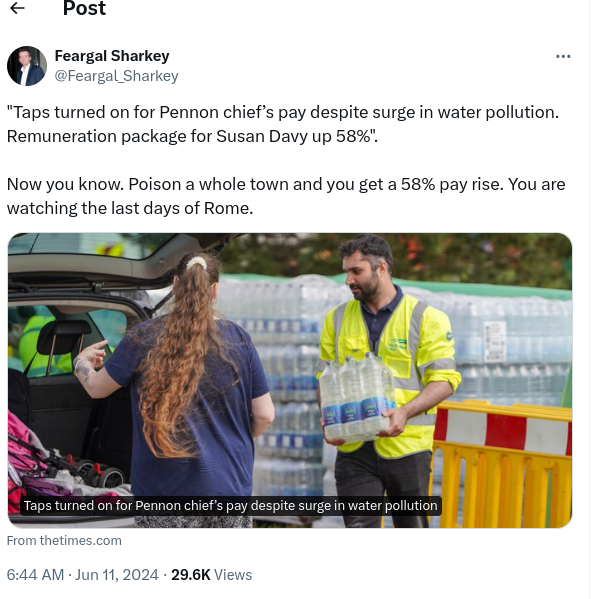
Poison a whole town and you get a 58% pay rise. You are watching the last days of Rome.

Feargal Sharkey, Richard Foord and Paul Arnott comment on Susan Davy’s jackpot pay rise on “X”.

But first a word from outgoing MP Simon Jupp (March 5 2024):

Thanks to this Conservative Government, we finally have the tools to hold South West Water to account.”

Just who is he kidding?

You are watching the last days of Rome

Feargal Sharkey 11 June

“Taps turned on for Pennon chief’s pay despite surge in water pollution. Remuneration package for Susan Davy up 58%”.

Now you know. Poison a whole town and you get a 58% pay rise. You are watching the last days of Rome.

South West Water has officially gone rogue

Richard Foord 10 June

This is a slap in the face for billpayers. South West Water has officially gone rogue and the Govt has let them get away with it. We need to crack down on their profiteering. If you want real action to fix our water industry, then @LibDems on 4th July.

It’s time to make water companies pay for their environmental vandalism. 

Paul Arnott 10 June

Disgraceful. South West Water’s Chief Exec has made a big show of foregoing £237,000 in performance bonuses this year – and then quietly taken nearly £300,000 in shares. It’s time to make water companies pay for their environmental vandalism. #VoteLibDem

And from “holding SWW to account” Tory candidates Simon Jupp and David Reed:

Nothing!

Owl has yet to find any matching comment from either of them on “X”. 

But the outgoing chancellor, Jeremy Hunt, vows to do more to help six-figure earners should Tories win the general election.

Sarah Wollaston quits as chair of NHS Devon in protest at further cuts

Does this leave an opening for Sarah Randall-Johnson (aka “Scandal Johnson” in Private Eye) the ruthless stripper of community hospital beds? 

See this post for chapter and verse on her past record.

Andrew Gregory www.theguardian.com 

A former Conservative MP and influential chair of the health select committee has quit a senior NHS post, saying she felt unable “to sign off on a further cut” with the “elastic already stretched too far”.

Sarah Wollaston, a GP for two decades before she joined parliament in 2010, resigned as chair of NHS Devon on Tuesday with immediate effect. She said she was “not happy” with new plans promising “unachievable” results that would only be possible with “unacceptable consequences” for patients.

She took aim at the government over the “frankly shocking” state of infrastructure in the NHS, warning of a “shocking waste of public money” and “lost opportunities” as crumbling hospitals and GP surgeries struggle to access vital capital funds. The crisis made her “genuinely sad”, she said.

Health bosses have repeatedly warned ministers of the desperate need to replace rundown buildings in order to protect the safety of patients and staff. The maintenance backlog has increased to £11.6bn in England, the Guardian reported earlier this year.

“With regret, I have decided to resign as chair of NHS Devon,” Wollaston wrote on X. “Thank you to all the wonderful NHS, care and voluntary sector teams that are out there doing their very best in challenging circumstances. Did not feel able to sign off on a further cut; elastic already stretched too far.”

Wollaston, who was appointed chair of NHS Devon in 2021, also criticised a funding regime that she said harmed NHS organisations facing the worst pressures.

“It really makes no sense to ‘punish’ the most challenged systems with penalties on their capital budgets when access to capital is essential to improving their performance, conditions and safety. The state of our infrastructure in too many places is frankly shocking.

“The next government needs to stop the cycle of capital to revenue transfers and pay serious attention to investing in NHS infrastructure. Also need to address the shocking waste of public money and lost opportunities due to delays in accessing capital.”

NHS Devon is one of the most severely challenged healthcare systems in England, with “significant financial and performance problems”, the Health Service Journal reported.

Wollaston added: “Genuinely sad to be leaving NHS Devon but in a nutshell, not happy as chair to sign off on the financials so time for me to go. No point promising the unachievable, especially if only achievable with unacceptable consequences.”

Wollaston became the Conservative MP for Totnes in Devon in 2010. In 2019, she quit the party to join Change UK, later becoming an independent MP before losing her seat in the election that year standing as a Liberal Democrat.

In a statement, Elizabeth O’Mahony, the south-west regional director of NHS England, thanked Wollaston for her “valuable contribution”. NHS Devon’s deputy chair, Kevin Orford, was named interim chair.

South West Water crypto progress report 11 June

If the clarity of the water matches the clarity of this report – there is still work to be done.

Just add lemon! – Owl

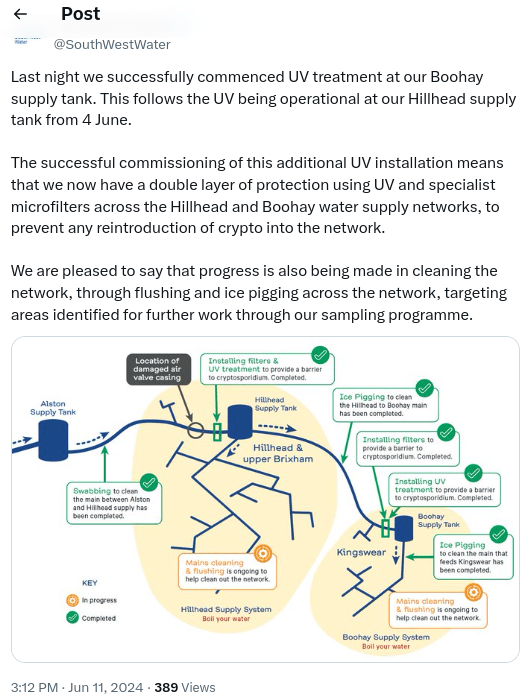
South West Water progress report:

Last night we successfully commenced UV treatment at our Boohay supply tank. This follows the UV being operational at our Hillhead supply tank from 4 June.

The successful commissioning of this additional UV installation means that we now have a double layer of protection using UV and specialist microfilters across the Hillhead and Boohay water supply networks, to prevent any reintroduction of crypto into the network.

We are pleased to say that progress is also being made in cleaning the network, through flushing and ice pigging across the network, targeting areas identified for further work through our sampling programme.

East Devon General Election news 2024: Full list of candidates for Honiton and Sidmouth, Exmouth and Exeter east constituencies

The list of candidates setting their sights of being elected by East Devon residents in the July general election have been announced.

eastdevonnews.co.uk

The district council has released the names of the candidates nominated for the Exmouth and Exeter East constituency, and the newly-created Honiton and Sidmouth constituency,

The country will go to the polls on Thursday, July 4, 2024, after a general election was called in May.

Honiton and Sidmouth is one of the new constituencies that will replace East Devon at the next general election.

This follows a review by the Independent Boundary Commission for England.

Melanie Wellman, East Devon District Council acting Returning Officer, said: “We urge everyone to register to vote by the 18 June deadline to make sure their voice is heard. We want to make sure this is the highest turnout possible.”

An EDDC spokesman said: “With the election only weeks away, East Devon District Council’s election team are urging all eligible voters to register and ensure their participation in shaping the country’s future.”

The candidates nominated for the Exmouth and Exeter East constituency are:

Name of Candidate/Description of Candidate (if any)

  • Paul Arnott – Liberal Democrats – for a fair deal
  • Mark Baldwin – Climate Party
  • Helen Dallimore – Labour Party
  • Olly Davey – Green Party
  • Peter Faithfull – Independent
  • David Reed – The Conservative Party Candidate
  • Garry Sutherland – Reform UK
  • Daniel Wilson – Independent

The candidates nominated for the Honiton and Sidmouth constituency are:

Name of Candidate/Description of Candidate (if any)

  • Jake Bonetta – Labour Party
  • Vanessa Coxon – Independent
  • Hazel Exon – Party of Women
  • Richard Foord – Liberal Democrats
  • Henry Gent – Green Party
  • Simon Jupp – The Conservative Party Candidate
  • Paul Quickenden – Reform UK

The East Devon constituencies – left is the Exmouth and Exeter East constituency and right is the Honiton and Sidmouth constituency. Images: EDDC.

To register to vote or to check your registration status, visit the official government website here.

For more information from EDDC about the UK General Election, see here.

Sunak promises to ‘keep cutting people’s taxes’

Tories turn to the “Magic Money Tree” (again). Remember Liz Truss? – Owl

The Conservative manifesto will include tax cuts, Rishi Sunak has said.

The prime minister told the BBC’s Nick Robinson: “We’re going to keep cutting people’s taxes. You’ll see that in our manifesto tomorrow.”

Becky Morton www.bbc.co.uk

Challenged over how he would fund his policies, Mr Sunak said they would all be “fully funded and costed”.

He insisted day-to-day government spending on public services would continue to increase ahead of inflation under a future Tory government.

But when pressed over whether certain departments would see cuts, he acknowledged “all governments prioritise within that”.

In the spring Budget, the government announced a 2p tax cut to National Insurance for 27 million workers – matching another reduction set out in last year’s Autumn Statement.

The Conservatives have also said they want to abolish National Insurance completely in the long term, when it is deemed affordable to do so.

The party’s manifesto, which is being launched on Tuesday and will outline what it plans to do if it wins the election, is expected to include a pledge to scrap stamp duty for first-time buyers of properties costing up to £425,000.

However, it is not thought to include anything on inheritance tax.

Asked if the Tory manifesto would promise more tax cuts, Mr Sunak said he wanted to build on the tax cuts “we have already started to deliver”.

Both the Tories and Labour have ruled out any increase to the rate of income tax, National Insurance or VAT.

However, both parties have also said income tax thresholds will remain frozen until 2028.

This means millions of people will be pulled into a higher tax band if their wages increase.

Mr Sunak said his party’s policies would be paid for by clamping down on tax avoidance, which he said would raise £6bn, as well as reforming the welfare system and getting more people into work.

However, the independent Institute for Fiscal Studies has said delivering the £12bn savings promised by the Tories by 2030 through reforming welfare “looks difficult to the extreme”.

The think tank has also warned whoever wins the next election will have to cut the scope of what the state provides or increase taxes to maintain levels of departmental spending.

Asked if he would be honest with people that his plans would also mean significant spending cuts for many government departments, the prime minister said: “No, that’s not what our plans show.”

He said day-to-day spending on public services under a future Tory government would continue to increase ahead of inflation.

But he added: “Of course, all governments prioritise within that.”

Mr Sunak said he also wanted to focus on productivity in the public sector, which he said had fallen “considerably since Covid”.

He added that increasing productivity to pre-pandemic levels would save £20bn and would make it possible to cut taxes.

Mr Sunak was also challenged over his party’s record on housing.

Asking if having your own home had got harder under a Tory government, the prime minister said: “It has got harder – and I want to make sure that it’s easier.

“And what we will do is not just build homes in the right places and do that in a way that is sensitive to local communities, but make sure that we support young people into great jobs so they can save for that deposit.”

He added that “saddling young people with higher taxes” would make it harder for them to save for a deposit to buy a house and he wanted people to “keep more of their money”.

One recent report by the Building Societies Association found first-time buyers were facing the toughest conditions in which to buy a house in 70 years.

It suggested home ownership among younger people has been in decline over the last 20 years.

Mortgage rates are relatively high compared with the last decade, and the cost of renting has also soared, making it harder for people to save.

This means first-time buyers face the double challenge of raising enough for a deposit as well as being able to afford a mortgage.

Labour’s shadow housing secretary Angela Rayner said Mr Sunak’s answer was “a damning indictment of 14 years of housing failure”.

She added: “Never once in 14 years have the Tories met their 300,000-a-year housing target, and their recent decision to appease the Tory MPs on their backbenches and abolish mandatory housing targets has seen housebuilding take a nosedive.”

Asked if record net migration figures showing 745,000 entered the UK in 2022 meant he had “lost control of the borders”, Mr Sunak said the numbers were “too high”.

But he argued that as PM he had brought in “the biggest, strictest reforms to bring down immigration that we’ve seen”.

In the interview, the Mr Sunak repeated his apology for leaving last week’s D-Day commemorations early, saying: “I hope people can find it within their hearts to forgive me.”

He asked people to “judge me by my actions”, pointing to increased investment in the armed forces and support for veterans.

Mr Sunak played down suggestions his election campaign had got off to a bad start, insisting he believed he was the right person “to build on the progress that we’ve made”.

“We’ve been through a tough few years and I do believe at this point we have turned a corner,” he said.

More on SWW Susan Davy’s whopping pay rise – why does she “scoop the pool”?

Her “balanced scorecard” of objectives contains so many objectives, despite all the pollution problems, she scored 46.5% of maximum, which the remuneration committee cut to 38.5% after applying its “discretion framework in respect of South West Water’s environment and pollution performance”.

Heads she wins; tails we lose. – Owl

South West Water owner’s boss should lose all bonuses after Devon parasite outbreak 

Nils Pratley www.theguardian.com 

Here’s a rarity: a chief executive turning down an annual bonus two years in a row out of solidarity with the suffering customers. But when the company is Pennon Group, owner of South West Water, the operation currently knee-deep in a diarrhoea and vomiting outbreak in Devon caused by polluted water, Susan Davy had little real choice. She cannot expect applause for leading “from the front” and “living our values”, as she described her decision to turn down £237,000 in cash.

In fact, the question is why she still thought it appropriate to collect £298,000 under her separate long-term share-based scheme. That award sent her overall pay up from £543,000 to £860,000, a figure that may cause stomach pain across the south-west, not just in the coastal town of Brixham, where the parasite cryptosporidium was found in the system.

A year ago, she saw the short- and long-term schemes as a job lot and waived both. If anything, the case for surrendering both elements of variable pay should have been more compelling this time because an outbreak of illness is bad even by the standards of the modern water industry. There was no explanation of the different logic in the annual report.

A deeper question is why the bonus issue even arose in the first place. Why wasn’t it automatically reduced to zero in current circumstances? The answer lies with the usual suspect – the fact the standard “balanced scorecard” of objectives for an executive includes so many elements that it is hard to miss them all. In Davy’s case, the formula spat out a ratio of 46.5% of maximum, which the remuneration committee cut to 38.5% after applying its “discretion framework in respect of South West Water’s environment and pollution performance”.

Come on though, outsiders will still be baffled as to why the committee’s discretion could be so minor (and so precise). Even ignoring the parasite outbreak, South West Water is still falling substantially short on the Environment Agency’s most important annual measure: the company got two stars, when four is the aim, under the latest industry-wide environmental performance assessment.

Nor is it the case that Pennon’s shareholders are having a better time. Yes, they got a £127m dividend even as the Devon outbreak was in full swing, but the share price has roughly halved during Davy’s four years as chief executive. Not for the first time, one must ask what is the point of these “balanced scorecards” if they produce unbalanced outcomes that miss the wider picture.

In a month’s time, Ofwat, the sector’s economic regulator, will unveil its first view of the English and Welsh water suppliers’ business plans for the next five years, including the company-by-company increases in bills to fund greater investment. Bill rises are inevitable and South West Water is looking for 30%-ish, which may be at the lower end of the industry’s range but will still come as a shock to many customers. Davy should have read the room: if it was right to turn down short- and long-term awards last year, it was right to do so again. Half measures don’t cut it.

Tough questions will face the election winners – Paul Jonson IFS

This isn’t another column about how the next government won’t have any money. If you haven’t gathered that by now, there’s probably little value in repeating it. Whichever of the main parties forms the next government, it will need to cut spending or raise taxes or it will miss its own fiscal targets. Instead of focusing on that fact, I want to explore why. 

Paul Johnson www.thetimes.com 

Why is it that, with taxes at pretty much the highest level in the UK in 70 years, it can be true both that many public services are in a terrible state and that there isn’t enough money to do much about them without raising taxes even further?

That public services are struggling was set out in stark terms in a report last week from the Institute for Government. To take a few choice quotes, it says that “hospital performance is arguably the worst in the NHS’s history”, “prisons are at crisis point” and “in the last six years there have been six times the number of bankruptcy notices filed by local authorities than in the previous three decades”. You get the picture. And that’s despite the fact that public spending as a fraction of national income has shot up over this parliament and, even on present implausibly tight plans, looks set to settle at well above its long-term average.

That taxes are at their highest level as a fraction of national income in seven decades is simply a fact. They have risen by more over this parliament than over any other in that period. The only bright spot is that many of us won’t have felt that directly. The direct tax burden on average earners is, surprisingly, at its lowest level in half a century. By contrast, companies and those on high incomes have been hit hard.

What on earth is going on? A new report from my colleagues at the Institute for Fiscal Studies tries to get under the skin of this apparent puzzle.

A little bit of history is important. The story of the past half-century or so has been one of successive governments trying desperately hard to prevent the state from growing. While spending on the welfare state has risen, defence spending has fallen and fallen and fallen. We have stopped building houses and supporting nationalised industries. Through the 2010s, our government responded to the fiscal problems created by the financial crisis by cutting spending. In most other countries in western Europe tax took more of the strain than it did here. Yet by 2019, after nearly a decade of austerity, the state was still at the same size that it had reached in 2007, after a decade of a Labour government that had poured large sums into public spending.

How did all that austerity apparently achieve so little? In part because the starting point in 2010 was so difficult. Spending had spiralled as a fraction of national income as the economy had shrunk. The economy then refused to grow at anything like its previous rate. And cuts in working-age welfare and education spending as proportions of national income were offset by spending on the ever-voracious NHS. It is a striking statement of both priorities and demographic determinism that between 2007 and 2019 spending on health rose by 1 per cent of national income, while spending on education fell by the same amount.

Since 2019, public spending has rocketed. Obviously, it grew by astonishing amounts during the pandemic, but that’s not what I mean. Public spending today, after all the Covid and energy crisis-related spending has ended, is about 4.5 per cent of national income, or £124 billion, higher than it was in 2019-20. That is a colossal change. Part of that growth was planned. The Boris Johnson-led Conservative government wanted to be rather less austere than its predecessors. But most of it, about four fifths, was not anticipated.

Alongside paltry economic growth, the two biggest contributors to that unplanned growth were a jump in debt interest spending and a big increase in spending on working-age welfare, particularly as a result of rising numbers receiving health-related benefits. These increases do not look like being transient. Even on official forecasts, which imply cuts in many areas of public service spending, overall public spending looks set to remain at nearly 3 per cent of national income, or £80 billion, higher at the end of this decade than it was pre-pandemic.

On top of these pressures from debt interest and welfare spending, health spending will continue on its ever upward path. Defence spending, after 70 years of cuts, looks set to turn a corner. It will no longer be the cash cow for the burgeoning welfare state that it has been since the war. Rather than reduce the scope of the state, our politicians still want to increase it, by expanding free childcare provision, for example. And, on top of the problems created by spending cuts, various aspects of public provision have had to face up to new pressures: remarkable increases in numbers with special needs in schools, in demands on social care for children and adults and for mental health services, among others.

Put all that together with low growth and the biggest pile of public debt since around 1960 and the reasons for our fiscal travails begin to become clear. We will need a multi-faceted response. Focus on productivity in public provision and do what we can to get economic growth, for sure, but they won’t be enough in themselves. We also need to face hard questions about how to manage demands, how to decide on the scope of state action and what size of state and level of tax we are comfortable with. However much our politicians might want to avoid these questions before the election, the winners will have little choice but to confront them in its aftermath.

Paul Johnson is director of the Institute of Fiscal Studies. Follow him on @PJTheEconomist