
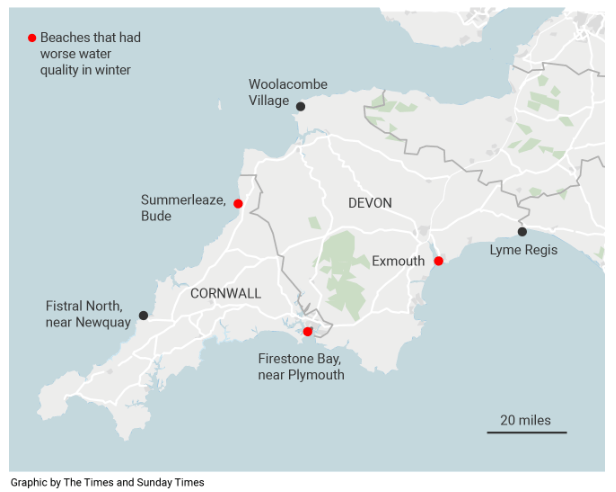
Several of England’s cleanest seaside swimming spots deteriorate in autumn and winter, an unpublished government report has found. This includes Summerleaze, Exmouth and Firestone Bay
Adam Vaughan www.thetimes.com
Outside the bathing water season, which runs from the middle of May to September, there is no regular site monitoring for harmful bacteria.
However, campaigners have called for year-round testing because of the growing popularity of cold-water swimming, thanks to advances in wetsuits.
The Times can reveal that the Environment Agency (EA) ran a pilot project of winter water testing at several bathing sites. It found year-round testing was feasible despite challenges, and an internal EA document obtained by Greenpeace’s investigative unit, Unearthed, showed three of six beaches in Devon, Cornwall and Dorset became dirtier in winter.
Water quality at designated swimming spots is rated “excellent”, “good”, “sufficient” or “poor” in summer, depending on the levels of harmful bacteria found by weekly tests.
Exmouth fell from excellent in summer to poor in winter, an unsafe level for swimming, the EA project found. Summerleaze, in Bude, and Firestone Bay, near Plymouth, both dropped from excellent to sufficient. Two beaches stayed the same; one, Lyme Regis, improved from good to excellent.
Jo Bateman, a retired physiotherapist who is a wild swimmer in Exmouth, said: “I just think it’s shocking, but not a surprise. It’s totally unacceptable. People swim all year round, and many people use the water in winter here: kitesurfers, windsurfers, kayakers, rowers.”
Bateman, who is taking legal action against South West Water for a loss of amenity — being unable to swim — due to sewage spills, said monitoring of bathing waters should be extended to winter. “One hundred per cent, it’s essential. To say the bathing water quality is excellent, but it’s only for four months of the year, that’s disingenuous.”
Andy Tyerman, a local resident and member of the campaign group End Sewage Convoys and Poollution Exmouth, said: “We are obviously very disappointed that the results for Exmouth were so poor.” The EA is considering legal action against South West Water over sewage discharges at the town in August, when swimmers were told to stay out of the water.
During the bathing water season officials from the EA take weekly tests for two types of bacteria that cause sickness: intestinal enterococci and E. coli, which are found in faeces. Sewage, manure run-off from fields and birds can all be sources of the pollution. Four years of data are usually used to inform classifications.
At a meeting last month the agency showed little interest in taking water samples all year round, but the water regulator did commission a project that tested waters at the six beaches from last October to March this year.
The aims of the project were to see if winter testing was possible and to gauge how bacteria levels differ in winter, when heavier rain can wash more pollutants down rivers to coastal waters.
The deterioration in winter at Summerleaze, Exmouth and Firestone Bay — the latter designated a bathing water spot only last year — was blamed on greater pollution from rivers. At Exmouth, sewage incidents on the beach were also an issue.
Analysis of the types of bacteria at Firestone Bay indicated the source was roughly half human and half cattle — suggesting a mixture of sewage and agricultural pollution. At Summerleaze and Exmouth, farming appeared to have played a greater role.
Rougher seas in winter meant only 60 per cent of a possible maximum of 174 samples were successfully collected across the six sites. Officials said with extra resources catch-up testing could be done on safer days, allowing a dataset for winter to be produced that was comparable with summer’s.
“This story simply states what surfers and swimmers across the country already know — sewage ain’t seasonal,” Giles Bristow, chief executive of Surfers Against Sewage, said.
“We demand a water quality testing regime which is based on the reality of how the polluting water industry operates and how people actually use our rivers, lakes and seas. It’s 2024, not 1924.”
South West Water said it was aiming for year-round high water quality at all bathing sites. The company has started going beyond statutory requirements, taking daily samples at 14 swimming spots including Exmouth and Firestone Bay. Richard Price, managing director of waste water services, said: “Bathing water quality in our region remains a priority, and we fully support efforts to better understand conditions across the 157 bathing waters we serve.”
The EA noted that 90 per cent of bathing waters in summer met “good” or “excellent” standards. It is understood to have chosen the six beaches as representative of bathing waters across the country and commissioned the project to see how climate change was affecting beaches.
“During the bathing water season, we take more than 7,000 samples at 451 bathing waters to provide people with water quality information to make informed choices on when and where to swim. We will continue to work closely with the agriculture sector, water companies and local communities to ensure the highest standard of bathing waters for the public,” the agency said.
The Times’ Clean it Up campaign has been demanding great regulatory action and investment to improve the UK’s waters.
 East Devon Watch