David Reed MP is being “played” by South West Water – Feargal Sharkey

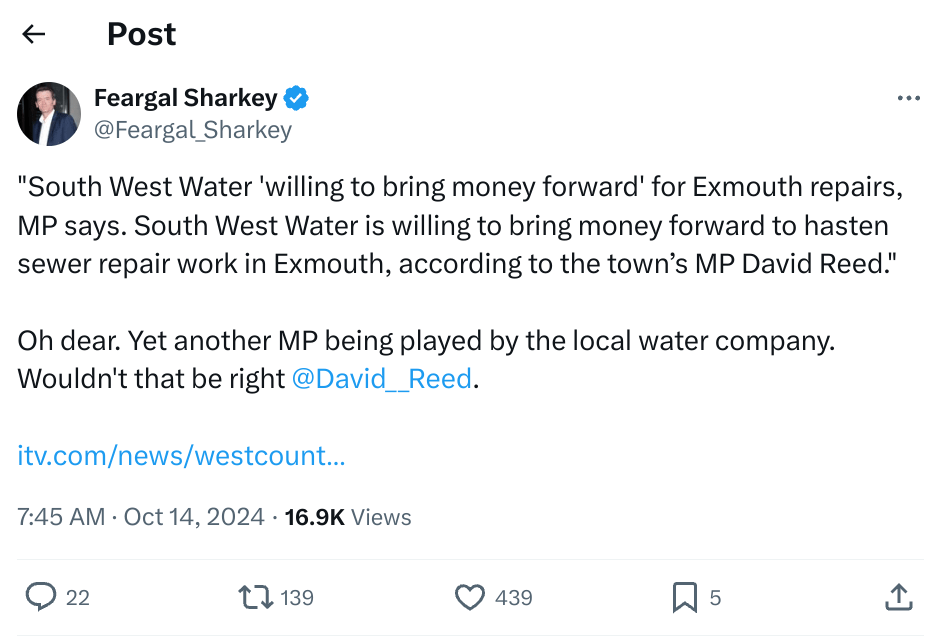
Text of the X post: Feargal Sharkey @Feargal_Sharkey

“South West Water ‘willing to bring money forward’ for Exmouth repairs, MP says. South West Water is willing to bring money forward to hasten sewer repair work in Exmouth, according to the town’s MP David Reed.” Oh dear. Yet another MP being played by the local water company. Wouldn’t that be right @David__Reed.

This is the source of Feargal’s commments:

Exmouth MP says SWW is willing to bring money forward for repairs

Bradley Gerrard www.exmouthjournal.co.uk 

South West Water is willing to bring money forward to hasten sewer repair work in Exmouth, according to the town’s MP David Reed.

Mr Reed says he met with the firm’s chief executive Susan Davy to urge her to speed up remedial work and improvements to Exmouth’s sewage infrastructure.

He said external consultants hired by the company had assessed the state of sewage pipes.

Sewage spills in August led to Exmouth’s beaches being closed at the height of tourist season, prompting anger from residents, while a burst pipe in Imperial Road near estuary in July also caused issues.

The company assured residents that no spillage had entered the water.

Mr Reed campaigned about sewage spills before the general election, and said he is working so the community can hold SWW to account.

“We’ve had a litany of mistakes over the past few months, with multiple burst pipes, local beaches closes, businesses affected and tourism hindered,” he told Radio Exe’s Devoncast podcast.

“We’re starting to get a reputation nationally for all the wrong reasons, and we’re in this position because of South West Water’s behaviour and unwillingness to put structural engineering funds in and to do the work over recent years.”

Mr Reed said Ms Davy and Richard Price, the company’s new managing director for waste water services, understood the “magnitude of anger felt by the local community” and were “willing to bring money forward”.

However, he acknowledged that SWW would need approval to do this from the Environment Agency and water regulator Ofwat.

He has asked a minister from the Department for Environment, Food and Rural Affairs (Defra) to meet with him and Ms Davy, so that “we have that other lever to make sure SWW is doing what it says”.

Mr Reed said the report on Exmouth’s sewage pipes, produced by Pell Frischmann Consulting Engineers, would be shared with county, district and town councillors, as well as with campaign groups, such as Escape (End Sewage Convoys and Poollution Exmouth).

He hoped to convene a meeting with interested parties “to make sure everyone understands what’s happening”.

“It becomes a really difficult situation when there are multiple different narratives online and in person about what is happening, so I want to bring everyone together into one room to allow them to be briefed by the Environment Agency and SWW to get a balanced view,” he said.

“I want them all to be briefed on what the report says and what SWW’s plans are in the short- and medium-term to put the relevant fixes in.

“By doing so, that will allow us to collectively put pressure on SWW as we are speaking with one voice.”

SWW did not respond to requests for comment.

However, in an article on its website last month attributed to Mr Price, the firm said it had tasked “over 100 people working around the clock to fix the issue” after a pipe burst at Maer Road.

He added that the leak in the sewer from Maer Road pumping station to Maer Lane waste water treatment works on Wednesday, August 14 was stopped “within two hours so we could start work on a temporary solution to bypass the damaged main so that a permanent repair can be made”.

“We know how disappointed residents and visitors to Exmouth are,” he said.

“I would like to reassure you that we are doing everything we can, as quickly and thoroughly as possible, to ensure your local wastewater network is fit for the future.”

Sewage Wars – The Establishment Strikes back!

Water watchdog chief seeks to stem consumers’ sewage lawsuits

A director of England’s water regulator is spearheading  a campaign that could make it harder for consumers to sue water companies that breach legal sewage limits.

Oliver Wright, Adam Vaughan www.thetimes.com

Seema Kennedy, a former Conservative minister, is the executive director of a group that is trying to tighten the funding rules for class action lawsuits and end what it calls the “predatory claims culture”.

Critics have claimed that her role represents a conflict of interest amid a continuing legal battle between consumers and five of Britain’s largest water companies over untreated sewage.

Kennedy is also a paid senior adviser to the lobbying firm Global Counsel, which works for the industry body that represents all the UK’s big water companies. Global Counsel has also previously carried out work for the anti-class action campaign.

Government rules state that directors of public bodies must ensure that “no conflict arises, or could reasonably be perceived to arise, between your public duties and your private interests, financial or otherwise”. In a statement Kennedy said there was “no conflict” with her position at Ofwat and other paid roles.

Kennedy was appointed as the executive director of Fair Civil Justice in 2022 — two years after being appointed by ministers as a non-executive director of Ofwat.

Fair Civil Justice campaigns for restrictions on third-party funding of class action that cover legal costs in exchange for a share of any awarded damages or settlements.

They describe such cases as “predatory litigation” that is a “drag on growth”. However, anti-pollution campaigners have said that such restrictions could potentially damage cases such as a class action being brought against Severn Trent water and potentially five other water companies.

Lawyers claim that the companies provided misleading information to Ofwat and the Environment Agency by under-reporting sewage pollution.

This, they claim, allowed the companies to charge bill payers more than they otherwise would have been able to. The claim is brought on behalf of twenty million customers, who may have been overcharged by between £800 million to £1.5 billion.

Professor Carolyn Roberts, emeritus professor at Gresham College in London, who is the lead claimant in the case, said that it had only been possible to bring the case because of outside funding. “It would not have been possible to bring my case and hold these companies to account without the support of litigation funders and the expertise of lawyers,” she said.

However, the Fair Civil Justice campaign said it had not had any involvement “whatsoever” with any water company and “had not commented on any ongoing litigation involving the water sector”. “We remain committed to speaking up on behalf of British businesses and consumers,” a spokesperson said.

Kennedy said she had “always complied with all legal and regulatory requirements, including regular disclosures in line with Ofwat’s conflicts of interest policy”.

She added: “I have provided some limited advice in my role as part-time adviser to Global Counsel, but this has never included any water company or mandate in which the firm is engaged  in.”

A spokesperson for Ofwat said: “Seema Kennedy has declared her role at Fair Civil Justice. We are satisfied that this does not present a conflict with her role at Ofwat.

“Seema acts as a senior adviser to Global Counsel, providing insight and advice on specific matters when requested. Again, this role has been declared. She has always made it clear to Global Counsel that she would not be able to provide advice in relation to the water sector.”

In a statement Global Counsel said: “Global Counsel manages potential conflicts of interest in accordance with all relevant legal and regulatory requirements.”

It comes as one large water company was issued with an unprecedented reprimand by the UK’s data watchdog for wrongly keeping sewage pollution data secret.

United Utilities become the first water company to be hit with a special enforcement measure by the Information Commissioner’s Office (ICO) over failure to comply with transparency laws.

The watchdog said it had received “numerous complaints” from the public over compliance by the water company, which serves the northwest of England and illegally dumped millions of litres of sewage in Windermere in February.

The ICO said United Utilities had repeatedly claimed that information people had asked for under Environmental Information Request (EIR) rules wasn’t environmental, when it clearly was. The firm has previously refused requests by The Times’ Clean it Up campaign, arguing that timings of raw sewage spilt into waterways wasn’t environmental information.

“Any information that would enlighten the public about how United Utilities operates and the impact it has on the environment is, by its very nature, likely environmental — this includes data on sewage spills and the performance of its wastewater treatment works,” Warren Seddon, director of FOI at the ICO, said.

United Utilities said it was committed to being more transparent and would consider the recommendations set out by the ICO.

A spokeswoman said: “We handle hundreds of Environmental Information Requests (EIRs) every year and, in a handful of cases, the Information Commissioner’s Office (ICO) clarified that the information we were asked to provide did fall under the scope of EIR. We have followed that clarification since we received it several months ago. We are receiving an increasing number and wider scope of EIRs and have recruited additional and dedicated resources to help us deal with these.”