
Owl thinks that the county democratic services have done well to provide easily assimilated visual guides to the local election outcomes.
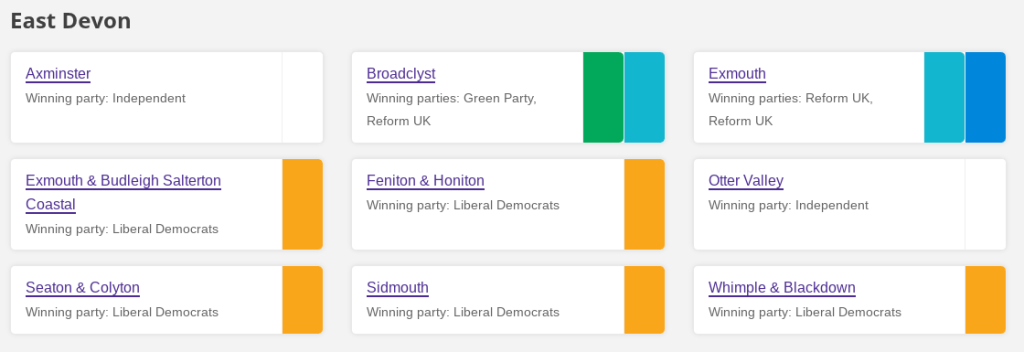
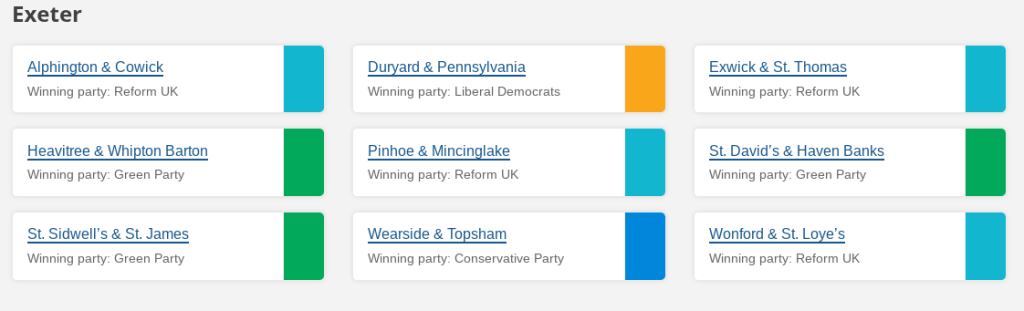
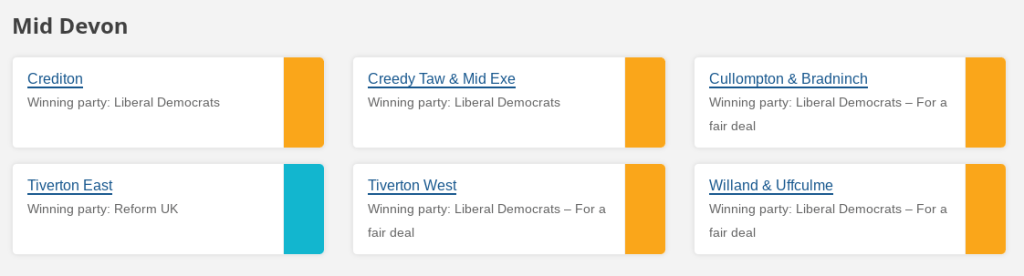
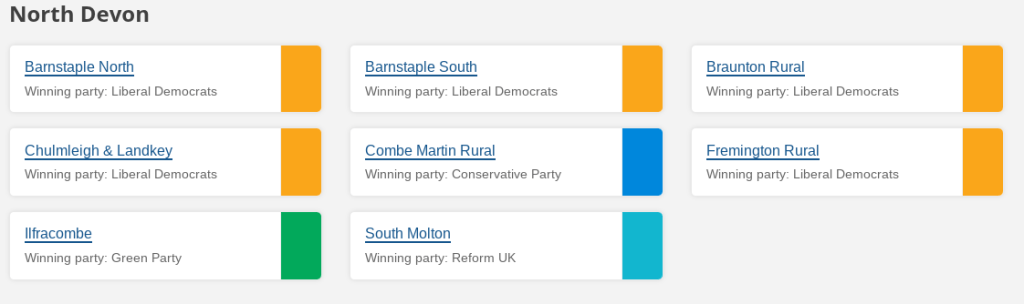
The first series in this post show, at a glance, the political colours of each seat won in each division.
Below these is the same information mapped geographically.
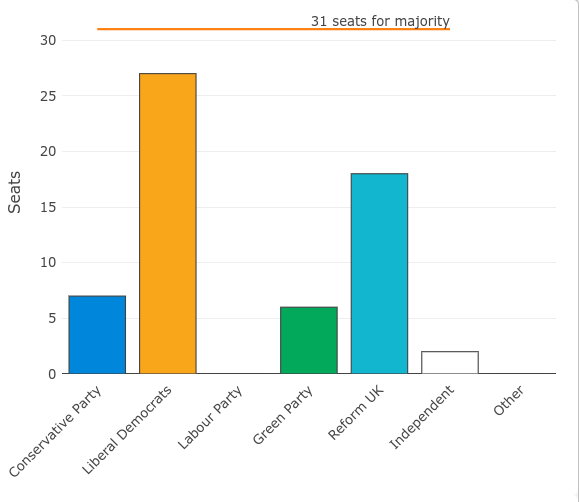
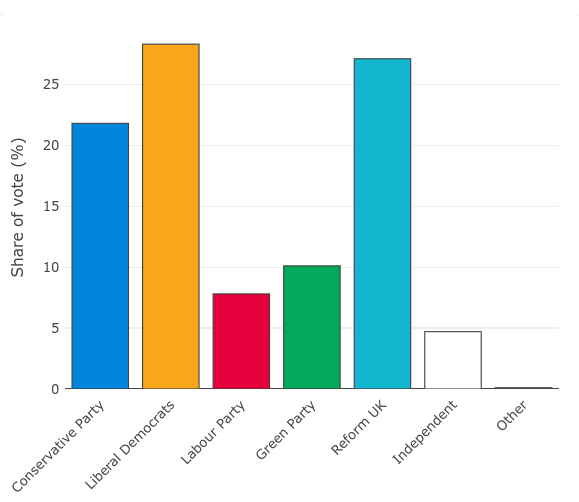
Below that are histograms showing the distribution of seats and number of votes cast for the main parties.
Some “off the cuff” observations (to provoke thought)
Exeter’s Labour wipe-out
Perhaps the most surprising result is the way that Exeter voters have turned against Labour.
In 2021 Labour had 7 seats based in and around the City, now they have none, with voters swinging all over the place.
Devon devolution
Although not a major issue in the election, the different councils’ declared approaches to local authority reorganisation are now likely to come under the spotlight..
Leader of the labour controlled Exeter City Council, Philip Bialyk has pursued the “go it alone” notion of Exeter and its commuter belt becoming a unitary authority. This has always begged the question as to who picks up the tab for the rural communities. A notion that maybe doesn’t command much voter support.
Likewise, the outgoing Conservative County Council initially claimed it was on the fast-track with its takeover proposal to swallow the districts, until this was rejected for not meeting government guidelines. Then it swung the other way with a smorgasbord of alternatives.
Neither of these ideas meet the current government guidelines.
The districts have other ideas and proposed the 1-4-5 three way split (the 1 is in deference to Exeter) before the election. The districts’ views are now likely to carry greater in the new County Council.
Will the government now double down on its devolution plans described recently as: The worst local government white paper in living memory? Or reconsider in the light of the overall local election results?
Owl doesn’t expect devolution to happen any time soon.
Distribution of Reform wins.
The Reform wins look to cluster in: Exeter, suggesting a protest vote against the government; and then in Teignbridge, Torrige and West Devon. Here Owl wonders to what extent this might reflect a cry to be heard from voters in a part of “forgotten rural Britain”, forgotten by the Conservatives and simply “not on the radar” of metropolitan Labour.
The case for a proportional voting system
With the general recognition that a “five party” system is now emerging, the case for a proportional voting system is being raised once again. In particular by Reform who did particularly badly in the general election.
The table below shows how each party fared in respect of the proportion of seats they gained compared to their share of the vote (numbers rounded).
In this instance Reform and the Greens both got about the appropriate number of seats. The Lib Dems were the big winners and the Conservatives and Labour were the losers.
| Party | % Share of seats | % Share of votes |
| Conservative Party | 12 | 22 |
| Liberal Democrats | 45 | 28 |
| Labour Party | 0 | 8 |
| Green Party | 10 | 10 |
| Reform UK | 30 | 27 |
| Independent | 3 | 5 |
The political colour of each Division

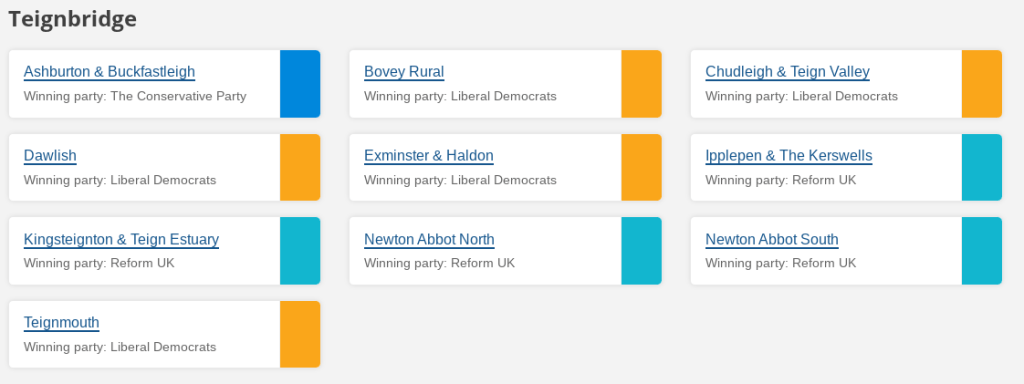


The colours mapped

Histograms of numbers of seats and share of the votes (see here for tabulation)
 East Devon Watch