Reform Devon county councillors reported to police by colleague

Infighting in the Reform UK party in Devon has seen two county councillors and an election agent reported to police by a colleague over election expenses.

[Fratricide on Devon County Council as reform Reform UK, in a rush to judgement, removes whistle blower from his post and the party, without telling him, for bringing the party “into disrepute”! Read on. – Owl]

Miles Davis, Bradley Gerrard www.bbc.co.uk 

Neil Stevens and his brother Tony were elected for Reform in May and documents seen by the BBC allege Neil Stevens spent about £170 more than the campaign spending limit.

This was reported to police by Ed Hill, who was also elected for Reform in May and was the chairman of the Exeter branch but was removed from the post for what the party says was bringing it “into disrepute”.

Neil Stevens said he misunderstood the process and his election agent Rob Sheridan said he was “confident” there were no errors. Tony Stevens declined to comment.

The Reform UK party won 18 seats in the Devon County Council elections held on 1 May – becoming the second biggest party on the council behind the Liberal Democrats.

Neil Stevens won the Alphington and Cowick seat with 1,126 votes – 72 votes ahead of the Labour candidate Yvonne Atkinson, with the Liberal Democrats a close third on 1,030 votes.

In county council elections, spending limits are set in each ward according to the number of voters, external.

In Alphington and Cowick the limit was set at £1,827.04 – however the election expenditure return papers for Stevens show he spent £1,995.72.

Hill was previously the election agent for Stevens but papers seen by the BBC show Sheridan was appointed as election agent on 3 June, a day before the election expenses forms were submitted.

Hill also alleges that a £250 podcast recording expense claimed by Tony Stevens, who won his Exwick and St Thomas seat by 22 votes, should be split equally between the brothers – further raising the expenditure of Neil Stevens.

Hill said he reported his concerns relating to Sheridan and Neil and Tony Stevens to the police and to the Electoral Commission on 1 June.

He said he had made “a clear promise to the people of Exeter” to “hold our candidates and councillors to the same high standards we expect of others”.

A spokesman from the national Reform UK party told the BBC: “Ed Hill has been removed as chairman of Reform UK Exeter after bringing the party into disrepute.

“There’s currently an ongoing internal investigation into the matter so we won’t be commenting further.”

Neil Stevens told the Local Democracy Reporting Service (LDRS) he believed the spending limit only related to the money he had personally contributed to his campaign – £1,703.60 – and not to donations of £292.12 he received, meaning he believed he was below the spending limit.

Sheridan told the LDRS he was “confident” there were no errors and that third parties had checked them.

He added further checks to the returns were now being made, and if there had been an error, then an amended return would be filed.

Exceeding limits on candidate expenses can lead to an unlimited fine, while making a false declaration attracts the same punishment and/or up to six months in prison for a less serious summary conviction, or up to 12 months on indictment, according to the College of Policing.

A spokesperson for the Electoral Commission said the spending limit applied “to all spending during the regulated period in the run up to the local elections” including any personal money spent and donations received.

It said: “Any allegations of spending over the limit would be a matter for the police.”

Devon and Cornwall Police did not respond to requests for comment.

Social Media records the spat

A flavour of the internal Reform row can be gained from Cllr Ed Hill’s facebook screenshots below, full link here!

So much for Nolan’s seven principles of public office: selflessness, integrity, objectivity, accountability, openness, honesty, and leadership! – Owl
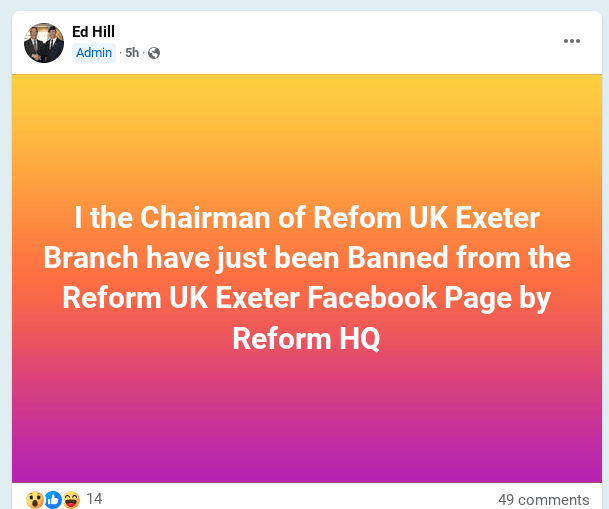
Cllr Ed Hill’s text reads:

I stepped away from the computer today and got stuck into replacing the wishbone on my car. Any mechanic will tell you—no matter how straightforward the job seems, if it’s a French car, it’s rarely simple.

Meanwhile, I’ve learned that I’ve been suspended from Reform UK Exeter and as a Reform councillor on Devon County Council. According to Matt Sykes, I’ve brought the party into disrepute.

It’s disappointing, especially given that the only communication I’ve received about it today was the same email sent to all members. Not even a phone call or a text.

That said, I’m now free to speak to the media without party restrictions. I’ll be on BBC tomorrow at 10:30, and later on LBC (time to be confirmed).

For the record, the two councillors who are actually under police investigation remain in post. I don’t think it takes an expert to see how that might come across.

Hopefully, in time, the party will reflect on this, recognise the facts, and do the right thing. Because I know I’ve acted with integrity and done nothing wrong

Richard Foord asks for restoration of local audiology services: Wes Streeting hears him loud and clear!

Owl has been receiving reports from East Devon NHS patients with hearing loss that they were told the Social Enterprise, Chime, would cease providing their audiology services from the beginning of April.

Information on how these services would be replaced has been patchy and mislesading.

Owl has discovered that the private Midlands based firm Scrivens, founded in 1938, is the replacement provider. 

Scrivens web site indicates that similar services eg repairs and replacement batteries will be provided at local East Devon health hubs as they were with Chime.

However, this appears to be misleading.

Richard Foord, who has obviously been getting similar reports from patients as Owl, has asked Secretary of State Streeting for these local services to be restored. Meanwhile it will have to be “on the bus”.

Topical Questions Health and Social Care – in the House of Commons on 17 June 2025.

Link to Hansard

Richard Foord Liberal Democrat, Honiton and Sidmouth

People in East Devon have been told that they must now travel to Exeter for audiology services that they previously received at their local community hospital. What steps are the Government taking to encourage new providers to restore accessible audiology services?

Wes Streeting Secretary of State for Health and Social Care

That has been a running theme this morning, which will not be lost on Ministers. We will ensure, as we deliver neighbourhood health services, that people can receive care closer to home, wherever they live. We have heard that message loud and clear today, and I think the hon. Member will see that priority reflected in our 10-year plan for health.

Financial cliff-edge for hundreds of councils looms in 2026 – where is the Govt’s response?

Government has a huge local government reform agenda, including finance and local audit systems, key social care services and an extensive reorganisation of local government structures; all happening at once. It is not clear whether local authorities will have the capacity to cope.

18 June 2025 sources: Committee of Public Accounts Local Government Financial Sustainability Thirty-First Report of Session 2024–25 and comments from the Chailr.

Local government finance is in a perilous state. Despite a real terms funding increase in central government grants, council tax and locally retained business rates of 4%, over the period 2015–16 to 2023–24, the amount per person fell over the same period. Funding has not kept pace with population growth, demand for services, complexity of need, or the rising costs of delivering services. As demand for targeted services such as social care, special educational needs, and temporary accommodation has grown, there has been a significant reduction in spending on commonly used discretionary services, such as street cleaning and lighting, parks and gardens, and leisure services. With exponential increases in demand for services they must provide, local authorities have less money for early intervention or preventative services, which can help reduce demand and deliver better outcomes for people. Yet government does not know if funding to local authorities is spent well, and there are signs that service quality is declining. At the same time local authorities’ ability to improve outcomes for people is made harder by having to navigate an overly complex funding system.

Local authorities fund their services from multiple sources including central government grants, council tax, locally retained business rates, commercial activities, sales fees and charges and their reserves. They spent over £72.8 billion in 2023–24, of which 58% went on adult and children’s social care. Some local authorities are spending as much as 80% of their budget on these services. Increases in national insurance contributions may have a significant impact on local service providers, particularly smaller charities. Yet neither the Ministry of Housing, Communities and Local Government (MHCLG) nor HM Treasury has assessed the impact.

With promised funding reforms delayed alongside rising demand, funding has not matched need nor local circumstances. Instead, MHCLG has implemented short-term and unsustainable approaches to keep local government afloat. Since 2020–21, 42 local authorities have received exceptional financial support from government to help manage financial pressures. Spending on special educational needs and disabilities (SEND) has outstripped the money available from the Department for Education (DfE) to pay for it. Local authority deficits from these overspends are expected to be between £2.9 billion and £3.9 billion a year by the end of 2027–28. The mechanism which allows local authorities to keep these deficits off their books is due to run out in March 2026 and without it, many local authorities are at risk of effectively going bankrupt.

Government has a huge local government reform agenda, including reforms to the finance and local audit systems, and key services such as adult and children’s social care, SEND and homelessness. This is in addition to extensive reorganisation of local government structures. With reforms all happening at once, it is not clear what transitional arrangements will be and whether local authorities will have the capacity to cope.

Chair comment 

Sir Geoffrey Clifton-Brown MP, Chair of the Committee, said:  

“Our inquiry heard that the government is concerned about local authority finances. But the lack of urgent action to come forward with a plan to address the fast-approaching cliff edge for under-pressure authorities would seem to suggest it is comfortable with the current state of affairs as normalised background noise. Alarmingly, scrutiny of council finances can now provoke a sense of déjà vu, with the same unfixed issues seen over and over. We would urge the government to use the funding announced in this spending review as a starting point for the paradigm shift required. 

“However, even with concrete measures to put councils back on a proper long-term sustainable footing, once again the government seems not to have taken a holistic view of the butterfly effect of its other policies. To introduce major changes to national insurance without taking into account the likely effect on an already tottering local government sector is a major misstep. Similarly, aspirations for wide-ranging reforms seem to be unengaged with a reality in which local authorities do not have good and strong capacity to fundamentally change the way they work.  

“Our report gives a wide overview of the various and severe challenges that local government face – for the sake of everyone who relies on local authorities’ services, we hope decision-makers begin to take a similar overview in how policy is delivered.”