Breaking: Reform County Council Member quits party to go independent

A Devon Reform UK politician has opted to quit the party and become an independent.

There are 60 seats on the council. Reform won 18 seats at the election. It now has only 16. – Owl

Bradley Gerrard, Local Democracy Reporter www.devonairradio.com

Councillor Angela Nash, who represents the Wonford & St Loyes division on Devon County Council, said she had informed Reform UK’s general secretary of her wish to exit the party and had also told council officials.


Cllr Nash said she would continue to represent her constituents as an independent councillor.


The move comes as Reform UK this week confirmed the permanent expulsion of Councillor Ed Hill from the party because of its view on his actions linked to two recent issues. Cllr Hill, who has stated he acted “in good faith”, represents his Pinhoe & Mincinglake ward as an independent member.


This means Reform UK now has 16 members on Devon County Council compared to the 18 seats it had secured after May’s local elections. It remains the largest opposition party, though.


“My decision to resign has not been made lightly,” Cllr Nash said.


“Entering public life, I made a commitment to act with honesty, integrity and transparency.


“The Reform party claims to stand for fairness and accountability, but my experience has shown otherwise.


“To remain under the Exeter Reform banner would be to compromise my own principles, and the trust placed in me by the people I represent.

“My focus will remain on delivering for residents supporting our communities and ensuring their voices are heard.”


Cllr Nash was elected to her seat in the May poll with 950 votes, equivalent to 30.5 per cent of the votes cast in the division and 107 more than her nearest rival, the Conservative candidate Anne Margaret Jobson.


Cllr Michael Fife Cook (Yelverton Rural), who leads the Reform UK group on the county council, said he had been informed indirectly of Cllr Nash’s decision.


He suggested part of the rationale for her decision could have been prompted by upset various Reform members felt after the most recent full council meeting.


Liberal Democrat Syed Jusef (Barnstaple North) appeared to state the chamber would find out “who is racist and who is not” before a vote on his motion calling for a policy of zero tolerance to hate crime at the council.


The vote was being recorded, meaning that every member’s vote would be logged individually against their name, rather than the vote just being expressed as a simple majority for or against, as is more common.


Cllr Jusef did apologise to members in the chamber, stating he had said the word ‘respect’ not ‘racist’, but several Reform UK members left the chamber in protest before the vote could be taken, with some remaining and abstaining.


“It could be partially because of that,” Cllr Fife Cook said, “as Angie was upset by it and she wasn’t the only one.


“But I also think there could be some influence in terms of her decision from Ed Hill.”


Cllr Fife Cook said he had written to Cllr Nash to state that her decision to leave Reform could annoy some of those who voted for her.


“Some people will feel let down as people voted for Reform,” he said.


“People did not vote for us, they voted for a party they hoped would do better so we shouldn’t consider that we are the wonderful ones.


“If we step back from Reform and stay as councillors, that could annoy some people as it isn’t what they voted for.”


Councillor Nash’s biography on the Devon County Council website has changed to state that she is now an independent member.
 

Reform UK permanently expels Devon County Councillor who reported colleague over expenses allegations

In the glare of scrutiny how does Reform stand up? – Owl

Reform UK has permanently expelled Ed Hill from the party over two issues, including actions linked to his reporting of a colleague over allegations around electoral expenses.

Bradley Gerrard, Local Democracy Reporter www.devonairradio.com 

Cllr Hill, who had been the election agent for Neil Stevens for part of the local election campaign, reported him to police after claiming Cllr Stevens had exceeded official spending limits.


Documents seen by the Local Democracy Reporting Service showed Cllr Neil Stevens’ election campaign spending limit was £1,827.04. Each division has a set spending limit based on the number of voters in that area.


However, documents submitted by Cllr Stevens and his replacement election agent, Robert Edwin Sheridan Jr, showed he recorded expenditure of £1,995.72, an overspend of £168.68.


Cllr Neil Stevens said at the time he believed the spending limit only related to the money he had personally contributed to his campaign – £1,703.60 – and not to donations of £292.12 he received, meaning he believed he was below the spending limit.
Reform UK has now decided to permanently expel Cllr Hill, and outlined in a letter that its party secretary, Adam Richardson, has reviewed Cllr Stevens’ expenses and is “satisfied there is no overspend”.


This is because, the letter states, Cllr Stevens included items which did not need to be recorded on his election expenses form.


“Several items were wrongly included that pre-dated the regulated period,” Mr Richardson said.


“Once excluded, the return falls below the statutory limit, leaving headroom for the candidate. In law, this was an error of form, not a criminal breach, as recognised in Finch v Richardson [2008] WLR (D) 389.”


Cllr Hill, who now represents his Pinhoe & Mincinglake ward as an independent member of Devon County Council, said he had “acted in good faith” in terms of his decision to report Cllr Stevens. 


Reform UK removed Cllr Hill from his post as chairman of the Exeter branch in June, and later expelled him from the party after he sent a letter campaigning on the issue of auto-enrolment of eligible children for free school meals.


The letter was purportedly signed by all of Reform UK’s county councillors, however, the party claimed some members had not given their permission for their names to be used.
Cllr Hill said he believed he had secured permission from Reform UK’s Devon members via conversations with one councillor in a WhatsApp group.


Cllr Hill appealed the decision to expel him in July, but has now been expelled permanently.


“The appropriate response would have been to raise the matter [of Cllr Stevens’ expenses] internally, where the position could have been explained and corrected,” the letter said.


“Cllr Hill’s conduct in referring a potential breach to the police was not improper in itself. Members are entitled to raise genuine concerns about legality and, had he stopped there, no complaint would lie against him.


“The difficulty arises from his decision to take the matter simultaneously to the media, in a way which created reputational harm for fellow members and for the party before the facts were tested.”


Cllr Hill stated that he had raised the issue with the party and to the county council before informing the media.


The Reform UK letter added that when internal disagreements are aired in the press, it “undermines trust, destabilises local campaigns, and exposes the party to reputational damage disproportionate to the underlying issue”.


“In both matters, the committee finds a consistent pattern of poor judgment,” the letter added.


“By attributing signatures to others without consent, and by escalating an administrative error into public allegations of fraud, Cllr Hill has shown disregard for the standards of integrity and loyalty expected of a Reform UK councillor.


“Whatever his intentions, the effect has been to destabilise colleagues, undermine confidence, and bring the party into disrepute.” 


Cllr Hill said: “I want to make it clear that I acted in good faith, and in line with my duty as an elected councillor, to ensure transparency and accountability in the democratic process.”


He added that while he was “disappointed” at the party’s decision, “I remain committed to representing the residents of Pinhoe & Mincinglake as an independent councillor”.


“My focus continues to be on serving the people who elected me,” he added.


Reform previously stated that Cllr Stevens had submitted an application for relief and that it expected this to be successful.


When contacted for comment on Cllr Hill’s permanent expulsion, :Cllr Stevens said he “noted the content of the Reform press release and the clarification it provides”.
He said he could not make a further comment because of his decision to take the matter to the High Court to seek relief.
 

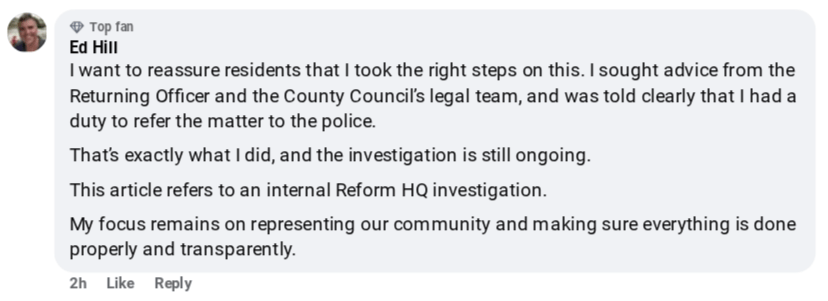
Ed Hill posted this comment on DevonAir’s facebook page:

I want to reassure residents that I took the right steps on this. I sought advice from the Returning Officer and the County Council’s legal team, and was told clearly that I had a duty to refer the matter to the police.

That’s exactly what I did, and the investigation is still ongoing.

This article refers to an internal Reform HQ investigation.

My focus remains on representing our community and making sure everything is done properly and transparently.

Revealed: river pollution twice as bad inside national parks as outside them – Dartmoor the worst.

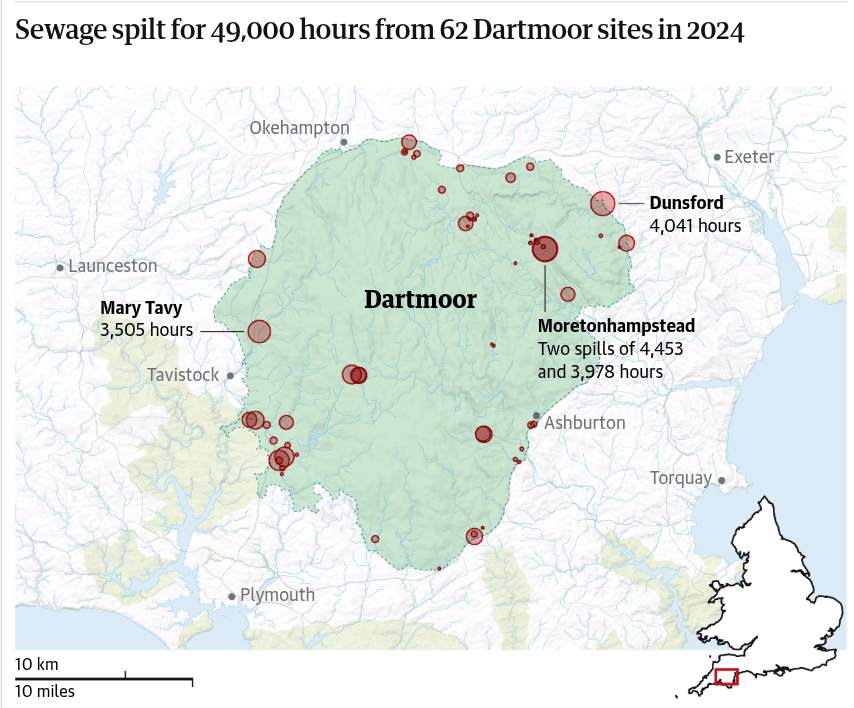
Sewage spilt for 49,000 hours from 62 sites on Dartmoor with spills from Mary Tavy, Dunsford and Moretonhamstead accounting for a third of them.

So many of Devon’s rivers are polluted within a few miles of their source. – Owl

River pollution twice as bad inside national parks as outside them

Damian Carrington www.theguardian.com (Extract omitting comments from water companies other than SWW)

Sewage is pouring into the rivers inside national parks at twice the rate that is occurring outside the protected areas, it can be revealed.

Campaigners described the situation as “outrageous” and said rivers and lakes in national parks in England and Wales should be the cleanest and most protected in the country.

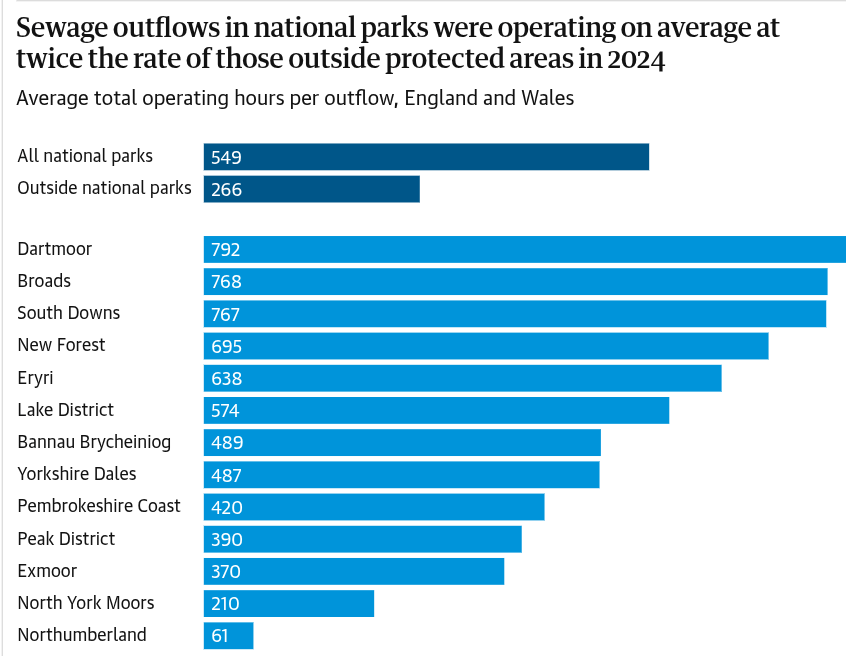
There are 464 water company overflow sites inside national parks and the average duration of sewage spills for each site in 2024 was 549 hours – the equivalent of eight hours a day for two months. In total, there were 254,808 hours of sewage outflows in national parks last year.

A report by the Campaign for National Parks (CNP) and the Rivers Trust also found that more than half of the rivers in national parks failed to meet the good ecological status required by law. Slurry and fertiliser runoff from farms and toxic pesticides also contributed to the ailing state of the bodies of water. The national parks worst affected by sewage overflows were Dartmoor, the South Downs, the Broads and Eryri, also known as Snowdonia.

As well as rivers, national parks contain internationally renowned wetlands and sensitive chalk streams, and host a huge variety of wildlife including salmon, beavers, water voles, bitterns and eels. They are valued by millions of visitors and help reduce flood risk downstream.

The campaigners are urging the government to bring forward stricter regulations, which were promised in January, and to ensure all sewage treatment works in national parks are upgraded to the same standard required in more populated areas. The Guardian revealed a year ago that wildlife was faring worse inside national parks than outside.

“National park rivers are being poisoned, drained and neglected – if we can’t protect these, we can’t claim to be serious about ending the UK’s water crisis,” said Dr Rose O’Neill, the chief executive of the CNP. “This outrageous level of sewage reflects ageing and poorly maintained infrastructure that is ill-designed and undersized to cope with actual resident and visitor populations.”

She added: “Without change, local groups working to protect national park waterways are often swimming against the current. Water regulators and companies have ignored national parks for far too long.”

David Johnson, a technical director at the Rivers Trust, said: “This data presents a tragic tale of underinvestment and mismanagement of the rivers that flow across our most iconic landscapes. Serious action is needed to break the cycle of pollution and destruction.”

Sewage pollution across the nations has become a big political issue and in July the government promised the biggest overhaul of water regulation since the industry was privatised in 1989 and pledged new laws in 2026.

In January, the flooding minister, Emma Hardy, told parliament: “We will strengthen through new regulation the role that public bodies, including water companies, must play in delivering better outcomes for nature, water, climate and access to nature in these special places.” However, the new regulations have yet to be put in place.

A spokesperson for the Department for Environment, Food and Rural Affairs, said: “The government is taking action to clean up England’s rivers, lakes and seas, especially in our iconic national parks and landscapes. [Across the country] we’re rebuilding sewage pipes to slash pollution levels in half with over £104bn of private investment.”

The CNP-Rivers Trust report analysed data on the combined sewage overflows (CSOs) occurring in national parks. CSOs occur when raw or partially treated sewage is discharged from water works and are only supposed to happen during extreme heavy rainfall.

In Dartmoor, the average hours of overflow per CSO was three times that outside national parks in England and Wales last year, in the South Downs and Broads it was 2.9 times, the New Forest 2.6 times and Eryri 2.4 times. Some rivers are particularly affected with, for example, the Lymington River in the New Forest national park having suffered 2,800 hours of sewage outflows in 2024.

Dartmoor also had the longest total duration of sewage releases, 49,076 hours in 2024, with Eryri second worst with 47,187 hours. Only two of the 13 national parks had sewage spill rates better than the rest of the country: Northumbria and North York Moors.

One reason for the disparity is that sewage treatment works deemed to be serving fewer than 2,000 people are not legally required to use “secondary treatment”, which removes organic matter, and therefore offer only basic water treatment.

The report found only 42% of water bodies in the national parks were classed as having good ecological status. That was better than the 12% of rivers in healthy condition outside national parks.

But with 57% of rivers in national parks failing to meet the minimum, legally required state, “there is still a hell of a long way to go”, said Gareth Ludkin at the CNP. “The [sewage infrastructure] is no longer adequate, and probably never has been, for large influxes of people visiting the parks – it’s just out of date and defunct.”

The South Downs is the national park most affected by water industry sewage, which is cited as a reason for 80% of its failing rivers. Pollution from farming is also a significant issue in most parks, listed as a reason for 76% of the failing water bodies in the Broads.

Overall, about half the failing rivers in national parks are the result of farm or sewage pollution, or both. In addition, a toxic chemical cocktail is polluting some rivers and lakes in national parks, the report said, including pharmaceuticals used by people and flea-killing chemicals used on dogs.

Vanessa Rowlands, the chair of National Parks England, praised the work of the national park authorities, communities, farmers, landowners and government agencies in making the ecological condition of national park rivers better than those outside. But she said: “We need to go further and faster. Waterways are the cornerstone of our habitats. Yet, as the report illustrates, our efforts are hampered by poor infrastructure, lack of investment and weak regulation.”

Hazel Tranchant, from South West Water, said: “Dartmoor experienced high storm overflow hours in 2024, and we recognise we need to do more to reduce spills.” She added that 2023-24 was the wettest hydrological year on record, “which made this a challenge”.

She said a quarter of the 62 CSOs in Dartmoor already met the legal requirement of fewer than 10 spills a year, with another quarter to be improved by 2035, and the rest by 2040.

…The CNP is calling for the new water legislation to include legally binding targets to clean up rivers, lakes and streams in national parks, meaning all CSOs must be fixed by 2035; all sewage works must have secondary treatment; all waterways must achieve at least good ecological status; and toxic chemicals must be banned. It also wants stricter regulation and support for farmers to better manage slurry and muck spreading.