Government considers tougher, faster fines for polluting water companies

Water companies that commit environmental offences could soon face quicker and tougher penalties of up to £500,000, under new measures being considered by the government.

Daniel Ware www.watermagazine.co.uk 

A public consultation has been launched to expand and strengthen the financial penalties available to the Environment Agency (EA) in an effort to clamp down on pollution and other rule breaches across the water sector.

At present, the EA faces difficulties in imposing penalties for frequent, minor or moderate offences – such as some breaches of licences or permits – because it must meet the same high legal standard of proof required in criminal courts. Officials say this makes it too costly and time-consuming to pursue less serious cases.

Under the proposed changes, the standard of proof would be lowered to a civil level, making it easier and faster for the agency to hold companies to account.

The plans also include setting a maximum penalty of either £350,000 or £500,000 for civil-standard offences and introducing new automatic fines – similar to speeding tickets – for clear and straightforward breaches. These automatic penalties could be set at £10,000, £15,000 or £20,000.

Environment Secretary Emma Reynolds said the proposals form part of the government’s wider “Plan for Change” to clean up the country’s water systems.

“I share the public’s anger at the current state of our water system, and this government is taking decisive action,” she said. “With new, automatic and tougher penalties for water companies, there will be swift consequences for offences – including not treating sewage to the required standard and maintenance failures.”

The consultation builds on recent measures, including blocking bonuses for senior executives at polluting water companies and introducing prison sentences of up to two years for those who obstruct investigations.

Alan Lovell, Chair of the Environment Agency, welcomed the potential reforms, saying they would strengthen the regulator’s enforcement powers.

“These changes would be a welcome boost to our current enforcement powers and allow us to deliver swifter and more appropriate penalties,” he said. “Through a larger workforce and upgraded digital tools, we can deter poor performance and achieve a cleaner water environment for communities and nature.”

The powers were introduced in the Water (Special Measures) Act and must undergo consultation before being implemented. The reforms follow a recommendation from Sir Jon Cunliffe to expand the regulator’s toolkit to enable faster enforcement.

Government modelling suggests the proposals could cost the water sector between £50 million and £67 million a year, although the actual cost is expected to be lower as companies adjust their behaviour.

The new penalties would sit alongside existing enforcement tools, including unlimited fines – known as Variable Monetary Penalties – where offences are proven to a criminal standard. Prosecution would still be reserved for the most serious breaches.

The Department for Environment, Food and Rural Affairs (Defra) said that any financial penalties will be borne by company shareholders and cannot be passed on to customers through higher bills.

In addition to the tougher penalties, ministers say they are pursuing long-term reforms to the water industry, including £104 billion in private investment to upgrade infrastructure, build new reservoirs and establish a single regulator to oversee the sector.

The consultation closes on 3 December 2025 and can be accessed here:

https://consult.defra.gov.uk/water-sector-civil-penalties/strengthening-penalty-powers/
Watch the leaked “suck it up” video

[No it’s not about Prince Andrew but Reform UK.] 

Despite gaining most council seats in Cornwall, Reform members were not cohesive enough to form an administration.

Devon county council has also experienced schisms and summary expulsions amongst its Reform councillors.

Now it is the turn of Kent where Reform seems to be trying to take the title of “the nasty party” from the Tories. – Owl

Reform suspends four Kent councillors after Guardian publishes leaked video of fierce infighting

Ben Quinn www.theguardian.com Reform UK has suspended four councillors on its showcase county council after a leaked video showing bitter divisions in their ranks.

Councillors on Kent county council were seen in the footage, first published by the Guardian, complaining about “backbiting” and being ignored by their leader, Linden Kemkaran, who told them to “fucking suck it up” if they did not agree with decisions made by her.

A spokesperson for Nigel Farage’s party said on Monday morning that four councillors on the council, one of 10 where Reform won outright control in local elections earlier this year, had been suspended.

“Councillors Paul Thomas, Oliver Bradshaw, Bill Barrett and Maxine Fothergill have had the whip suspended pending investigation, following evidence that they brought the party into disrepute,” said the spokesperson.

The suspensions now mean that, from winning 57 seats in elections in May, Reform has 50 councillors with the whip. Two other councillors had been suspended while a third joined Ukip.

The “chaos” on the Reform group was now having a direct impact on Kent constituents in need, warned Antony Hook, the leader of the Liberal Democrat group on the council.

He said a council committee that would have been involved in school transport issues and which was due to take place on Wednesday has been cancelled as a result of the suspensions.

“This potentially means a child or children delayed in getting school transport granted,” he said.

“We learned in the leaked video that they have no respect for each other, let alone respect for the public. Now they are turning on each other.”

Labour and Tory MPs also seized on the affair to heap criticism on Reform and warn that it was an insight into what Farage’s party would look like in power.

Sojan Joseph, the Labour MP for the Kent constituency of Ashford, described the affair as an “absolute shambles”, criticising other recent Reform initiatives in the county, including its attempt to roll out a local version of the cost-cutting “department of government efficiency” (Doge) launched by Elon Musk in the US, and concerns the party will have to raise council tax to balance its budget.

“They’ve not even made it until Christmas – Doge didn’t work. Council tax is rising, and now they’re having to suspend multiple councillors,” he said.

Louie French, the Tory MP for Old Bexley and Sidcup, said on X: “Reform promised Kent residents the world in May. Six months later they are in complete chaos, with residents facing the prospect of even higher bills. A serious warning to the rest of the UK of what Reform in power looks like.”

The footage of the meeting, which took place in late August, showed Reform councillors complaining about “backbiting” and being ignored by Kemkaran, who told them they would be “screwed” and that Reform could forget about winning the general election if they did not balance Kent’s budget.

A source said on Monday morning that the councillors had been removed “with no firm evidence” and that it was “panic stations” at the Reform grouping on Kent, which Kemkaran had described as a “showcase” for the party’s intentions of winning power in a general election.

They added that a vote of no confidence in Kemkaran was being readied for early November, either from the opposition or from within Reform UK.

Kemkaran told her fellow councillors in an email at the weekend that she launched a hunt for the “cowards” who had leaked the recorded meeting.

[Labour said the leaked footage showed that a government run by Nigel Farage would be “complete chaos”, while the Liberal Democrats said the meeting looked “more like an episode of The Traitors than the running of a major council. All that’s missing is for Claudia Winkleman to appear and ask who they’re going to banish next.”] (Source: Independent)

“We’ve got to keep money in our schools that will stay in Devon”: Cllr Denise Bickey

Denise Bickey makes progress on SEND funding

New state-funded special educational needs school opens in Devon

By John Ayres www.bbc.co.uk

A new state-funded school catering for children with Autism and ADHD (Attention Deficit Hyperactivity Disorder) has recently opened in Devon to try to improve access in the county to special needs education.

Castlebridge in Tavistock currently has 12 pupils, but that will rise to 30.

It is the first part of a much bigger school which is due open its main site at Ivybridge in 2027, catering for another 125 pupils.

Devon County Council said it believed this model of providing a state-funded school run by the Special Partnership Trust was a more effective use of its resources.

The head teacher of the new school said she believed it would provide a better environment for some pupils with autism than mainstream schools.

Bridget Williams said: “When we consider young people with autism, their sensory needs and that sensory overwhelm that can come in: too much noise; it’s too bright; it’s too big a space; even some of that echoing can be really unnerving and unsettling for our young people.

“It’s about who’s around them. They need to have time to think and process, and sometimes in a mainstream school, when there is a lot going on, that’s not always picked up on and always recognised.

“So here we can really see our children, see what they need and put in that support for them.”

The class sizes are much smaller, with about eight pupils per class, and the curriculum is tailored to the individual.

It also aimed to take the pressure off mainstream schools, who might find the children’s needs disruptive, leaders said.

“We’ve got to keep money in our schools that will stay in Devon,” said Denise Bickey, the Devon County Council cabinet member for Children’s Services SEND (Special Educational Needs and Disabilities).

“At the moment, a lot of that is going to independent special schools where they fill a gap. But we can’t rely on them forever.

“We need a sufficient strategy where we are running our own schools with our partnerships and making them work for Devon’s children so that the money stays where it should be,” she added.

Castlebridge opened in September and is part of what will be a much bigger school with its main site Ivybridge, being built by the Department for Education.

It is run by the Special Partnership Trust, which runs a number of special schools in Devon and Cornwall.

The admissions will be run by Devon County Council based on the child’s EHCP [education, health and care plan] and need.

The council said it was also working with the trust to improve SEND capacity and inclusivity in mainstream schools.

Breaking news: District Councils continue to back the 4-5-1 unitary split

Devon continues to tear itself apart with another swing of Labour’s wrecking ball. – Owl

Devon should be split into three unitary authorities in a huge shake-up of local government, according to the district councils in the county.

By Miles Davis Devon political reporter www.bbc.co.uk

All of the district councils and the county council will be abolished in the biggest national reorganisation of local government for 50 years.

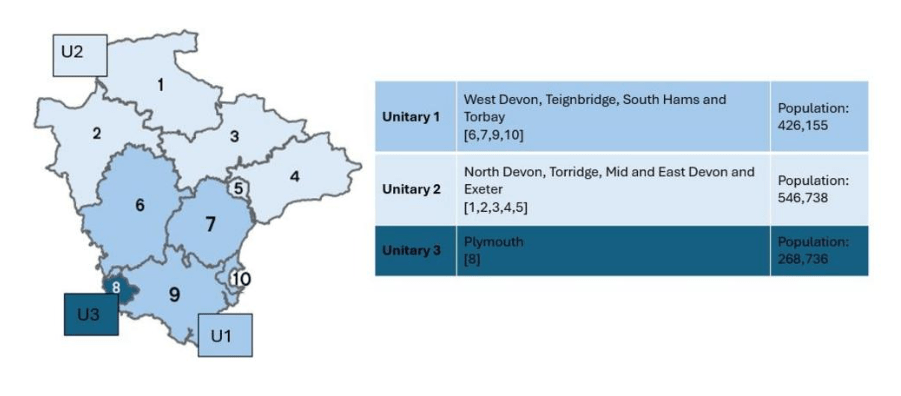
The existing district councils say they want to see a new unitary authority across north and east Devon and Exeter, a second unitary authority covering the south and west of the county and Plymouth staying as it is.

The plans are at odds with proposals put forward by Plymouth and Exeter, which both want to expand, and by Devon County Council with Torbay yet to announce its plans.

District councils in Devon want to see two new unitary authorities created in Devon and Plymouth to continue as it is

The district councils are backing what is known as the 4-5-1 proposal.

It involves one unitary authority for West Devon, Teignbridge, South Hams and Torbay.

A second unitary authority for North Devon, Torridge, Mid Devon, East Devon and Exeter.

Plymouth remaining as a standalone unitary authority.

In a joint statement on behalf of all district council leaders, they said: “Our proposal aims to create a more effective and financially sustainable local government for Devon by aligning council boundaries with real communities and local economies.”

Setting out its reorganisation plans, the government has said it would like to see new unitary authorities with a population of about 500,000, external but the figure is “a guiding principle, not a target”.

Plymouth City Council has said it wants to expand into parts of the South Hams to increase its population while Exeter City Council wants to expand in all directions.

Devon County Council announced its plans in September to keep the county looking broadly as it does now and keeping Torbay and Plymouth unitary authorities in place.

All of the councils will need to submit their plans for reorganisation by 28 November with final decisions to be made by the government.

The government’s rhetoric on planning and nature is heading the wrong way

From cpre:

We’ve been following the government’s latest planning announcements closely. This week, they announced a raft of hasty, last-minute amendments to the Planning and Infrastructure Bill.

But it’s not just the amendments themselves that are a concern. It’s the rhetoric around them. Ministers are speaking of ‘tearing up red tape’ and ‘removing obstacles’ as if nature and local democracy are the problem. We know that’s not true, and this is an approach which risks valuing the voices of investors and big developers over ordinary people and nature.

Some of these last-minute changes raise questions, including new powers for ministers to overrule local decisions, and proposals to reduce Natural England’s oversight. But the bigger issue is how little respect is being shown for scrutiny, transparency and meaningful engagement.

The government is blaming nature and communities for the housing crisis, when we know it’s bad policy and a broken market which has been dominated by big housebuilders, hoarding land and trickling out homes that most people can’t afford. Meanwhile, we continue to fall desperately short of delivering affordable and social rent homes, and brownfield for 1.4 million homes sits dormant.

We know we can tackle the housing crisis without harming nature, and that’s why we’re calling for a joined-up and grown-up conversation about the future of the planning system. A planning system that values both nature and people, and builds trust rather than division.

CPRE will keep pressing for a planning system that’s democratic, evidence-based, and genuinely sustainable – because that’s the only way to deliver the homes and energy we need without losing the countryside we all depend on.

Government continues to trot out nonsense about local authorities being the problem.

Independent Chair of West Devon Council write to the times

Letters to the Editor www.thetimes.com 

Sir,

Further to your report “Reeves hopes radical planning reforms will offer budget relief” (Oct 14), if the government really believes that “bulldozing through the barriers that have strangled growth” will reinvigorate the housing market, it would do well to pay us a visit here in west Devon. We have given permission for more houses than the government has demanded from us. But plots lie unbuilt, houses that have been built lie empty and affordable housing evaporates as builders claim the rising cost of development renders them unviable. If the government really wants its target of 1.5 million new homes to be met it would be better for it to understand why those housing plans already given permission are not being built rather than continuing to trot out nonsense about local authorities being the problem.


Ric Cheadle
Chair, West Devon borough council planning committee; Yelverton, Devon (Independent)

Cranbrook – local authority a delaying problem or essential to holding developers to account?

Is this recent example of planning in Cranbrook an example of our local authority being an interfering and delaying “problem” or an essential mechanism to hold developers to local account?

The government believes local planning authorities are holding back development and economic growth to such an extent they are getting rid of them in their proposed devolution reorganisation. – Owl

Go ahead for Devon homes after years of ‘difficult negotiations’

Bradley Gerrard www.devonlive.com

Years of discussions over land transfers and low affordable housing numbers delayed a decision

A total of 92 homes have been given the go-ahead in an East Devon town after years of “difficult negotiations”.

Planners were faced with two schemes being taken together in Cranbrook, with one from Persimmon Homes bringing forward 61 homes, and the other 31 from East Devon Community Partners.

The plots of land are both on Tillhouse Road and so essentially create a single area of housing in the county’s newest town.

Discussions about developing the sites for housing go back at least as far as 2020, and have eventually led to a bespoke agreement – known as a Memorandum of Understanding (MoU) – being struck.

This agreement has secured the likes of land transfers to local authorities for nominal £1 amounts, as well as financial contributions towards community facilities, but accepted that only seven affordable homes would be included as part of these schemes.

Councillor Brian Bailey (Conservative, Exmouth Town), questioned the low level of affordable housing, claiming it is “not sufficient”.

We use your sign-up to provide content in ways you’ve consented to and improve our understanding of you. This may include adverts from us and third parties based on our knowledge of you. More info

But Councillor Olly Davey (Green Party, Exmouth Town), who chairs East Devon District Council’s planning committee, said the MoU overrode certain rules that usually apply to housing applications in Cranbrook.

Thea Billeter, the Cranbrook new community manager at East Devon District Council, acknowledged the level of affordable housing on these sites was “not what we ideally wanted”.

“But after much debate, it was considered acceptable as part of the wider package,” she said.

“I can’t stress heavily enough how difficult negotiations were within the consortium,” she added.

“We acknowledge this creates a conflict with planning policy, but taking into account the other benefits, we consider it acceptable.”

Ms Billeter added that there had been examples in Cranbrook where homes were built, and then consequently transferred to a housing association. This meant, she added, that just because a planning application didn’t have a high number of affordable homes in it, further such properties could become available later on.

Josh Stevenson, speaking on behalf of Persimmon Homes South West, said “numerous changes” had been made to the plans”

“These homes will be contributing to East Devon’s housing shortfall, with properties ranging from 1-bed maisonettes to three-bed detached homes,” he said.

“We’ve had very helpful dialogue with East Devon District Council, Devon County Council, the Environment Agency, Natural England and others, and we have refined our proposals, and we thank all officers for their hard work.”

The issue of parking was also raised, however, officers noted the two applications had 142 parking spaces between them, with 112 of those being private and 30 unallocated.

Furthermore, 25 garages would be provided under flats that are part of the applications.

Persimmon’s Mr Stevenson said the amount and type or parking had been agreed with East Devon.

Cllr Ian Barlow (Independent, Sidmouth Town) asked whether the amount of parking was sufficient, given the issue is frequently raised in Cranbrook.

But officers said a 2021 census showed that just over half of Cranbrook households had no car or just one vehicle, just over two-fifths owning two, and only just over 7 per cent owning three or more.

As such, planners acknowledged parking issues in Cranbrook could be related to the fact that too many spaces were allocated to specific homes given the levels of car ownership in the town.

The planning committee unanimously approved the applications.

Impact as Labour’s devolution wrecking ball swings through Devon

This is a catch-up post to Owl’s earlier one on two press articles published over the past few weeks.

These articles report the details of how Devon Councils are tearing themselves apart as they attempt to find acceptable reorganisation plans to meet the Government’s criteria for eliminating district councils and imposing strategic mayoral authorities on top of what’s left.

Owl’s earlier post contained a stark warning on costs.

This article describes Devon County’s revised plan conceding an independent Torbay

Devon County Council has put forward a plan to create a new unitary authority.

Bobby Angelov www.midweekherald.co.uk

This plan, which is set to replace the existing two-tier district and county council structure, is seen as the most logical option to avoid disruption to key services and reduce funding deficits.

The proposal comes after the Government gave local authorities in Devon a deadline of November 28 to present their proposals.

Councillor Paul Arnott, who is leading the local government reorganisation, said that after thorough research and community engagement, it was clear that a single unitary authority replacing the eight district councils and Devon County Council was the most logical option.

The new council would function alongside the existing Plymouth and Torbay unitary authorities.

Mr Arnott said: “New Devon would provide stronger local accountability, smarter use of public money, consistent, high-quality public services and will create opportunities for our area’s economy bringing in new investment and jobs.

“It will allow us to join up local services, bringing together the strengths of district councils and the county council and will also allow for much closer working, and enhanced local decision-making, with key partners including the NHS, police and voluntary sector.”

The model was described by Councillor Julian Brazil, the leader of Devon County Council, as the “least worst” option amidst real-term funding cuts from central government.

Mr Brazil said: “The Government is intent on forcing through changes which will cost many millions of pounds to implement and provides a great deal of uncertainty for residents and staff who provide critical services.

“This option has emerged as the least worst, and if we do not put it forward then we may inadvertently pave the way towards a disastrous disruption to existing key services such as adult social care and children’s services.”

The new council would see the formation of Neighbourhood Area Committees, potentially comprising representatives from various organisations, including town and parish councils, police, and local health services.

These committees would introduce a new level of local decision-making to communities.

More than 6,000 Devon residents have already completed a survey on the local government reorganisation, with the council seeking further input before making a final decision in November.

The council is inviting residents to complete the New Devon survey by October 14, which can be found on the council’s website.

The input will play a significant role in shaping decisions around the local government reorganisation.

The aim is to create a system that benefits everyone living and working in Devon.

Here is Exeter’s response

Plans to reorganise local government in Devon have been heavily criticised by a rival council leader.

Miles Davis www.bbc.co.uk

All of the district councils and the county council will be abolished and replaced by unitary authorities in the biggest shake-up of local government for 50 years.

Devon County Council unveiled its plans on Thursday to create the unitary authority New Devon – retaining the geographical area currently covered by the county council.

Exeter City Council leader Phil Bialyk, who wants to see an expansion of Exeter into a new unitary authority, dismissed the county council plans as “ineffective” and “too remote” and said any collaboration between councils in Devon had “broken down”.

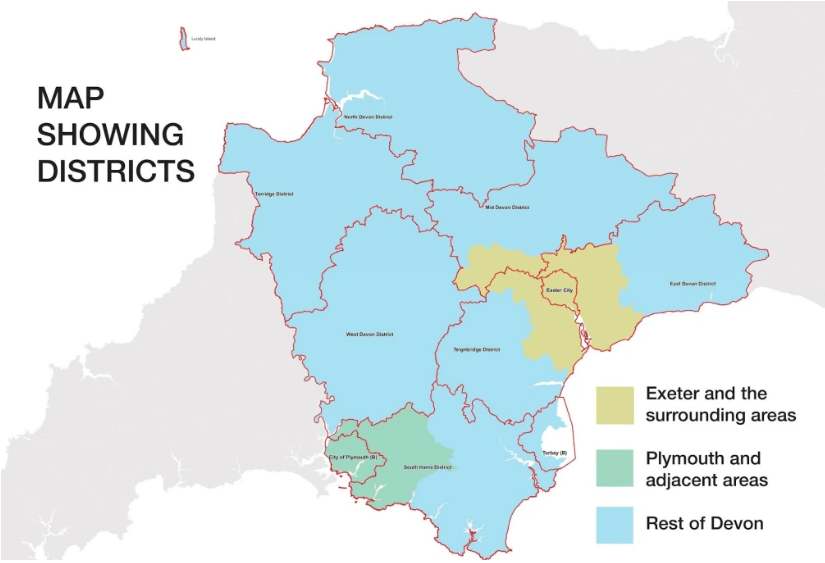
Exeter City Council wants to see an expanded Exeter, an expanded Plymouth and the rest of Devon as a coastal and rural authority Image source, Exeter City Council

Under Devon County Council’s plans, New Devon would have a population of about 830,000 and keep the current unitary authorities in Plymouth and Torbay.

At the moment the biggest unitary council in England by population size is North Yorkshire with about 615,000 people.

Bialyk said New Devon would be “too distant and remote to be able to reflect the needs and priorities of many residents and communities” and would “just deliver more of what our residents already receive”.

He said the plan put forward by Devon County Council “would reduce accountability, create a democratic deficit and reduce the ability to respond to the diverse needs of local areas in an effective way”.

Bialyk said the local government reforms should be an “opportunity” to design new local authorities.

He has put forward a plan for a new unitary authority for an expanded Exeter which would take in towns like Exmouth and Dawlish to the south and Crediton to the north.

That would exist alongside an expanded Plymouth and a separate rural and coastal unitary authority with a population of about 675,000.

The government asked all local authorities in any given area to work together , externalon coming up with proposals and share information.

However, Bialyk said: “Devon County Council has not engaged me at all – collaboration has broken down.”

Announcing the Devon County Council plans on Thursday, its Liberal Democrat leader Julian Brazil said it was the “least worst option”.

Deputy leader Paul Arnott, Liberal Democrat, said the council had been “handed a lemon” by the government and was attempting to “make democratic lemonade”.

Arnott said that keeping the same geographical area would “provide stronger local accountability” and “smarter use of public money”.

An expanded Exeter would have a population of about 255,000 people.

Plymouth City Council also wants to expand to take over parts of the South Hams and boost its population from about 265,000 to about 300,000.

Torbay Council is considering three options – to remain as it is, to expand into parts of South Hams and Teignbridge, or to cover all of South Hams, West Devon and Teignbridge.

Each area as a whole will have to submit one plan by the end of November,, external which might contain different proposals put forward by individual councils.

Note from OwlSee this post on cost implications for unitary authorities with populations below 300,000, and this post: Exeter townies vote to pull up the ladder on Devon’s rural bumpkins.

As Devon Councils tear themselves apart on reorganisation – here is a stark warning

Owl will need to find time to post the details of recent events, meanwhile here is a summary: 

Devon County has now abandoned its “1,5,4” option, conceding to Torbay’s wishes to remain a unitary authority. It is now proposing “the least worst option” of the county being split into three unitaries: Plymouth (plus a slice of the South Hams); Torbay and the rest. 

Exeter is having none of this and proposes a massive take over which would absorb towns like Exmouth and Dawlish to the south and Crediton to the north. The Exeter scheme retains a Plymouth authority but consigns the remaining coastal and rural bumkins to their own devices (including Torbay).

To cap it all Plymouth’s debt is now approaching a billion pounds. See cabinet member ‘comfortable’ on £1bn debt forecast.

Remember the government is hell bent on eliminating a layer of bureaucracy because district councils are far more likely to block the homebuilding plans that are central to Labour’s mission for economic growth.

Here is the warning

‘Make or break’ for social care as councils warn of a ‘triple whammy’ of risks from government reorganisation plans – County Councils Network

[This article relates costs to two population thresholds of 500,000 and 300,000. To put this in perspective here are the populations of the constituent parts of Devon: County Council administered Devon 812,000; Plymouth 265,000; Torbay 139,000 and Exeter 138,000. The current government proposals, and Devon’s responses to them are nonsense. – Owl]

Ian Burbidge www.countycouncilsnetwork.org.uk

Splitting county councils into multiple small unitary councils could hit millions of vulnerable people with a triple whammy of worse services, higher costs for care, and not enough staff to deliver support, a new report warns.

The County Councils Network (CCN), which commissioned the research, say the report’s findings are a stark warning for the government if it does not stick to its original plans of creating councils with populations over half a million, with the first wave of councils submitting competing proposals to ministers two weeks ago.

The network argues that these plans to overhaul local government structures will ‘make or break’ care services depending on which proposals ministers decide to implement. But a survey contained in the report reveals that the most senior care professionals in England, have little to no confidence that the risks of breaking up vital care services into smaller councils will be fully considered by ministers.

Last year’s English Devolution White Paper outlined plans for a radical overhaul of council structures, with government committing to end ‘two-tier’ local government: replacing 185 county and district councils with new unitary authorities in 21 areas.

Official government guidance had set out that new unitary councils should have a population of 500,000 or more and ‘avoid’ the fragmentation of vital care services. However, this guidance outlined that there may be ‘flexibility’ on this number in certain scenarios. District councils across the country are proposing to break up county councils who deliver social care into new unitary councils with populations of 300,000 or lower. Each of these new authorities will deliver care services, rather than one single upper tier council as is the case today.

The report by Newton concludes that the government’s forthcoming decisions about the size of new unitary councils will have ‘profound, long-lasting impacts on the most vulnerable members of society’. It argues that the evidence strongly suggests larger-scale councils are ‘essential’ to preserve service quality, prevent rising costs, and ensure financial sustainability of people-based services.

Download the report Local Government Reorganisation: analysing the impact on people services here.

Previous research for the network by PwC has shown that splitting county councils into multiple authorities as small as 300,000 could result in hundreds of millions extra costs every single year for local taxpayers.

And now today’s research, which draws on local data from half a million residents across 146 possible new unitary footprints, lays bare a further triple whammy of risks for care services and special educational needs:

  • New unitary councils with populations substantially below 500,000 people will increase the price councils pay for care, putting further financial costs on these under-pressure services. Modelling suggests that if all new unitary councils had a population below this figure, this would result in additional unit costs of between £180m and £270m annually solely as a result of reductions in purchasing power. In contrast, if all new unitary councils had a population above 500,000, it would reduce care fees by £65m a year across England.
  • Splitting county councils into smaller local authorities will require hundreds of new senior roles as councils already grapple with a shortfall in care staff. Modelling shows that if all new unitary councils had a population of below 500,000, this would result in a requirement of between 500 – 1,100 additional management and senior roles in care services – which the CCN warns will be impossible to fill. In contrast, if all new unitary councils had a population of above 500,000, fewer senior managers than are currently in place will be required, saving those areas money to reinvest in care services.
  • Breaking up ‘high-performing’ county councils into substantially smaller councils could lead to worse services. The report reveals that larger authorities are more likely to receive ‘Outstanding’ or ‘Good’ ratings from Ofsted for children’s care services and currently 16 of the 21 county councils are already Good or Outstanding for these services. Consequently, directors of care and special needs services warn in the report that smaller services could struggle to attract staff and invest in improving services.
  • Splitting county councils into smaller unitaries covering populations as small as 300,000 or lower could see some of these new authorities overwhelmed with demand. The report finds that the smaller the council, the more they could experience extreme concentrations of care users: effectively meaning care costs are highly variable between new authorities and may exceed planned budgets. This could leave some councils exposed to unaffordable costs and the use of expensive out of area placements. This could challenge their financial sustainability from inception.

The CCN says that instead of running the risk of worsening services, government should grasp the nettle and ensure that the reforms are a catalyst to transform the way in which vulnerable people are supported with local authority care. However, they say this research shows this can only be achieved by ensuring the government stick to their own statutory criteria and ‘rigorously evaluate’ all proposals against it.

A survey carried out for the research reveals that whilst senior care professionals are cautiously optimistic about the potential benefits of reorganisation – if delivered in the right way – there are widespread concerns that the risks to care services will not be adequately considered by ministers when they make their decisions on competing proposals. Less than one in 10 (6%) of county council chief executives and directors of adult social care and children’s services are confident they will be fully recognised.

The report recommends that the government avoid, where possible, splitting up people-based services. Where this cannot be avoided, the government must ensure that all new authorities are above their stated criteria of 500,000 or more.

The study also recommends that given the level of competing proposals, and the risks highlighted by the report, minister should give a heavy weighting towards the impact on splitting up these care services when they decide on proposals and should even consider appointing an independent body to evaluate the proposals.

Cllr Matthew Hicks, Chair of the County Councils Network said:

“Local government reorganisation has the potential to deliver significant benefits for local taxpayers and improve every day services residents rely on. However, it also carries with it significant risks if it’s not delivered in the right way. This report should focus minds on the impact that these proposals will have on the lives of the most vulnerable people who depend on local authority care and support day in, day out.

“With several areas now submitting competing proposals, the study clearly shows the stark choice facing the government. It provides clear evidence that there are very real risks to care services if county councils are split into multiple small unitary councils. Those that depend on care could face worse services, be met with significant upheaval, and have too few staff to adequately deliver their support. At the same time, councils and local taxpayers could be loaded with substantive extra costs.

“Put simply, reorganisation plans could make or break care services unless the government gets these reforms right.

“It is therefore vital that the government sticks to the criteria it set out earlier this year whereby new councils cover populations of over 500,000 people. Considering these are the most important and expensive local authority services, ministers must ensure they rigorously evaluate all proposals and heavily weight their decisions based on the risks to people-based services.”

Responding to the CCN report, President of the Association of Directors of Adult Social Services (ADASS), Jess McGregor said:

“This report reinforces concerns we raised with Ministers in August about the risks local government reorganisation poses to hundreds of thousands of people who are older-aged, disabled or in vulnerable situations that draw on care and support. The findings highlight important issues government must address: developing a pipeline of Directors of Adult Social Services, a plan to address disproportionate impacts of ordinary residence decisions, and ensuring adult social care can contribute to the shift from hospital to community care.

“New councils must be financially sustainable from day one and able to meet their legal duties to provide care and support. It’s vital that Ministers engage adult social care leaders in this process by inviting them to sit on Joint Committees and help assess all proposals. ADASS will continue to work with Ministers and civil servants as so many of the people our members serve rely on us getting this right.” 

More on the living dinosaurs of Devon’s “Jurassic Coast”

Martin Shaw writes:

Sidmouth may have the most 90+ residents, but Seaton is the “dementia capital”

seatonmatters.org 

Sidmouth has got some publicity [See “Sidmouth, Britain’s over-90s capital”] because it has the highest proportion of people over 90 in the country. But overall, Seaton, Sidmouth and Budleigh Salterton are the most elderly towns in Devon, with similar percentages (43-45 percent in the last census) of people over 65. Sidmouth has slightly more very old people, mainly because it has more nursing homes. But Seaton has more people with dementia than anywhere in Devon – our two GP practices are consistently 1st and 2nd in Devon for its prevalence. Both our towns need their community hospitals.

[Note from Owl – Budleigh Salterton Cottage Hospital was built in 1887 but closed as a community hospital at the end of 2016 becoming one of the first “Health Hubs” – see Budleigh Salterton “Health Hub” – the “Hospital” with no beds. ]

Devon Integrated Care Board float the idea of a sale and withdrawal of NHS services from Seaton Hospital “behind closed doors”

The Integrated Care Board (ICB), having offered to facilitate discussions in 2023 for a community takeover, appears to have abandoned the idea in favour of a sale and withdrawal of NHS services.

Instead of discussing this openly with the Seaton Hospital Steering Committee, the ICB (aka “One Devon”) has been floating other ideas but only so far with the League of Friends.

Looks to Owl as if NHS Property Services have an agenda and are hell bent on ignoring any community input at variance with it. Is the Devon ICB attempting to pick off opposition groups one by one?

This is a clear example of a lack of transparency and openness in public service. 

Whose health service is it?

Seaton Hospital Steering Committee – press release

The Seaton community is alarmed by reported new threats to both the continued existence of the Hospital and the NHS services currently offered in it. 

The Seaton Hospital Steering Committee, which represents all parties and communities in the wider Seaton area, has written to Steve Moore, the Chief Executive of the Devon Integrated Care Board, as follows.

Dear Mr Moore,

We are writing on behalf of the Seaton Hospital Steering Committee, a cross-party and cross-community body, including our MP, which was elected at a public meeting of 400 people in November 2023, after your proposal to hand back a wing of Seaton Hospital to NHS Property Services became known. The Dr Bob Jones Wing (named after the man who led the campaign to build the Hospital) had been built in 1991 entirely with public donations, after the community provided half of the funding for the original building in the 1980s, when the Exeter Health Authority agreed to run the hospital and provide NHS services in it. 

Over 10,000 people signed petitions against the 2023 proposal, which were handed to your chair outside County Hall, and our campaign repeatedly topped regional television news bulletins. Local feeling was exceptionally strong because of the unfairness of the previous (2017) decision to remove the Hospital’s beds, taken despite the Clinical Commissioning Group’s original view that Seaton was the best place to retain them. There was a widespread view that this decision reflected political pressure rather than a rational geographical distribution of resources.

In 2023, recognising the strength of local feeling, your board offered to facilitate discussions about a community takeover of the wing, for which we worked up a proposal that was handed to NHSPS and yourselves in June 2024. 16 months later, we have not received a formal response to this plan. Instead, this summer you approached representatives of the Seaton & District Hospital League of Friends, a constituent body within our committee, to float the ideas of a sale of the Hospital as a whole and a complete withdrawal of NHS services.

As you may imagine, we are extremely concerned about the potentially damaging effects of these ideas, which negate all the work that the community and the League have done to support the Hospital, practically and financially, over the last 37 years as well as to get it established in the first place. News of the discussions has caused considerable alarm in the local community. We find it shocking that, 8 years after the beds were removed, while Devon NHS has stabilised the use of all the other community hospitals which lost them, Seaton Hospital may now be singled out to lose its services. 

The original rationale for the creation of the hospital has only been strengthened by changes in the local community over recent decades:

  • Seaton’s population has almost doubled since the Hospital was built.
  • With 43 per cent over the age of 65 (2021 census), and a rapidly growing population over 85, Seaton has the most elderly population profile of any town in Devon except Budleigh Salterton.
  • The prevalence of dementia in the patients of the Seaton and Colyton Medical Practice is consistently the highest in Devon – currently 379 per cent of the national average.
  • It takes longer to travel to the RD&E from Seaton than from any other town with a community hospital.
  • One in six households (many of them single, widowed older people) lacks a car, and there is no direct bus service to the RD&E.

We do not accept, therefore, that NHS services can simply be removed from Seaton to other local community hospitals. We request that you put in writing any proposals that you have for the Hospital. We also ask that you meet our committee as soon as possible, to assure us of the continuation of the Hospital as an NHS facility and the continued provision of NHS services in it.

We look forward to hearing from you.

Regards,

Jack Rowland, Chair

Martin Shaw, Secretary

Seaton Hospital Steering Committee

‘Thriving not surviving’ in Sidmouth, Britain’s over-90s capital

[Putting Budleigh in its place] – Owl

“I’ve got a small fridge in my room – I’ve cans of cocktails in there, we crack open a few in the afternoon.”

One-hundred-year-old Dennis has been revealing his secrets to a long and happy life.

ByJen Smith www.bbc.co.uk

Sidmouth – the centenarian’s adopted hometown – has the highest number of residents aged more than 90 in England.

Recent ONS data, external, from June 2022, showed there were 319 people aged 90 or above living there – 6% of the population, compared to the British average of 0.9%.

But why are so many nonagenarians drawn to the seaside resort, and what effect is it having on the town?

Dennis moved to Sidmouth from Kent in the 1990s and now lives in a care home.

“I love the seafront,” he says.

“I love the views along the coast. I like the town too – it’s not big. Everybody knows you.”

He says the key to longevity is positivity.

“Always look on the bright side, try and smile a lot – I do,” he explains.

“If I smile – people smile back at you. That’s what’s Sidmouth’s good for.”

The latest census also suggests the town’s older population is not just surviving but thriving – with 95% of residents describing themselves as in fair, good or great health.

Corinne, 95, is originally from Yorkshire but moved to Sidmouth when her husband died 11 years ago.

“I dance twice a week… and I exercise a lot – I’ve got a treadmill, my cat thinks I’ve gone mad when I’m on it,” she says.

“I knew Sidmouth through dancing – it had a great dance hall here and my husband and I loved to dance.

“We also had lots of friends here.”

The former head teacher attends a luncheon club every day for a cooked lunch provided by Sidmouth Voluntary Service.

“You can sum it up in two words – care and love,” she says, adding: “The volunteers go above and beyond.”

Doreen, 92, visited the resort for a holiday two years ago to see family and never left.

“The people are extremely friendly,” she says.

“It’s a nice feature – people you don’t know come and chat to you.

“Being in my 90s is the worst part but being in Sidmouth… there are a lot of similar people in the same age group so I feel more at home here than I do in my own county.”

Doreen’s friend, 95-year-old Pamela, agrees.

The former professional ballerina who danced with the Royal Ballet says Sidmouth keeps her busy.

“There are quite a few clubs of various sorts,” she says.

“On Monday evenings I do line dancing, plus exercise classes on another day, meals out and luncheon club of course.

“It’s a very nice place. People are very friendly”.

Of the 4,400 people living in Sidmouth, more than 1,000 are aged 80 or above.

Councillor Rachel Perram, chair of youth provision at Sidmouth Town Council, says this “does provide us with a problem in regards to our infrastructure”.

“Our GP surgeries are rammed, hospital care at Exeter is under pressure,” she explains.

However, about 850 Sidmouth residents are under 30.

“For younger people, we’ve just launched a new youth club, life skills courses and youth mental health provision,” Ms Perram adds.

Councillor John Loudoun, deputy leader of East Devon District Council, says: “What is on offer has been designed and delivered in consultation with local young people, and that’s partly the way to ensure what we offer is the right thing.”

He adds it is “not quite the full picture” just think of the town as a place for the older generation, though getting on the property ladder is tricky for younger people, Ms Perram admits.

The online property website Zoopla says the average house price in Sidmouth is £411,000 – far higher than the national average of £271,000.

“We conducted a housing needs survey which proved that point,” Ms Perram says.

“So we’re using the results of that survey to encourage developers to build affordable housing here.

“I’m definitely confident that Sidmouth has a bright future.”

As Labour eases planning constraints – what do developers plan to do?

Labour blames the planning process for restricting housebuilding. Owl’s view is that they should turn their attention to “land banking” and  “the build-out rate” instead.

Taylor Wimpey pulls another brick away from housebuilding target

Tom Howard www.thetimes.com

One of Britain’s biggest developers has no plans to return to pre-pandemic levels of housebuilding in the near future, dealing a fresh blow to the government’s ambitious homes target.

Taylor Wimpey delivered more than 16,000 homes in 2019, but even with the post-lockdown housing “mini boom” brought on by the stamp duty holiday, it has not come near that figure since.

Last year, it completed just under 10,600 homes and bosses expect output to be similar in 2025. On Wednesday, they laid out medium-term plans showing that Taylor Wimpey aims to get back to 14,000 homes a year before the end of the decade.

This would still be 12 per cent or so below 2019, when a total of 243,000 homes were built across the UK. Labour is sticking to its promise of delivering 1.5 million new homes by the end of 2029, which would require an average of 300,000 flats and houses to be built every year.

To get anywhere near that figure, the government will be heavily reliant on the largest private developers. Almost all of them, however, are building fewer houses than they were, and industry consensus is that the 1.5 million target is unachievable.

Developers are all grappling with the same issues: a dramatic increase in build and regulatory costs that they have not been able to offset with higher prices; stubbornly high interest rates, which have left mortgage costs elevated; and no support for first-time buyers for the first time in 60 years.

On top of that, although Labour has sought to free up the planning system, it remains slow and especially so for high-rise blocks that must be signed off by the building safety regulator. The impact is being most keenly felt in London, where new-build housing has all but stopped.

Estate agents have reported a drop-off in both sales and enquiries in recent weeks as a result of speculation about a potential overhaul of the property tax system. Taylor Wimpey said it was mindful of the “impact of the delayed UK budget on short-term customer confidence”.

Bosses warned that “softer market conditions”, which began in the spring following the end of the stamp duty holiday, persisted over the summer. As a result, sales, after a stronger start to the year, have started to drop off.

Taylor Wimpey was selling an average of 0.65 homes a week at each of its 215 developments during August and September, down from 0.7 homes a week in the same period of 2024. Pricing has “remained broadly flat”, the company added.

Analysts said its performance showed that the market is “relatively subdued”. Persistent inflation means interest rates have not come down as fast as some had anticipated, and concerns about job security are starting to creep in. Economists expect those issues, and the uncertainty around stamp duty reform, to weigh on the housing market over the coming months.

Taylor Wimpey’s order book has contracted slightly and now stands at £2.12 billion, versus £2.15 billion this time last year. The group expects to deliver between 10,400 and 10,800 homes this year and is on course to deliver an operating profit of £424 million, which is broadly what analysts had pencilled in.

The shares, down 15 per cent since the end of June, improved by 1¼p, or 1.3 per cent, to close at 104½p. Analysts said investors should be reassured that the full-year guidance has been maintained and that bosses opted not to tweak the dividend policy, as some had speculated.