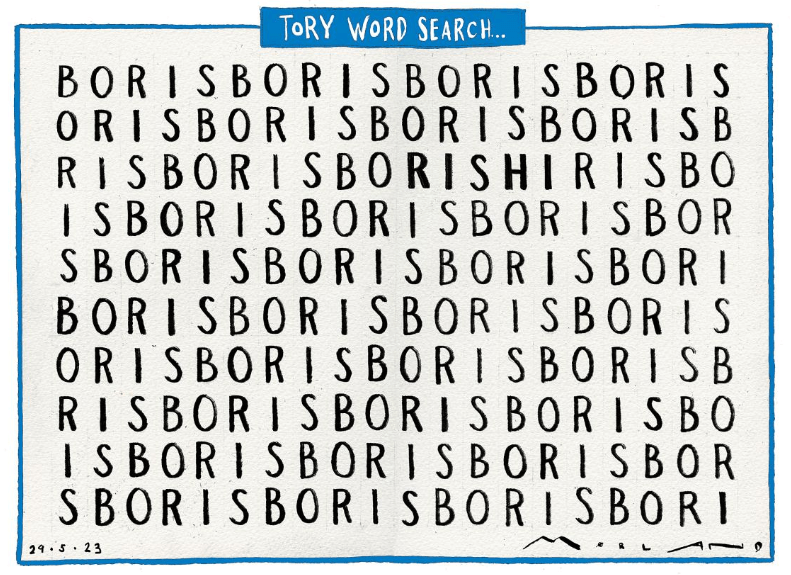
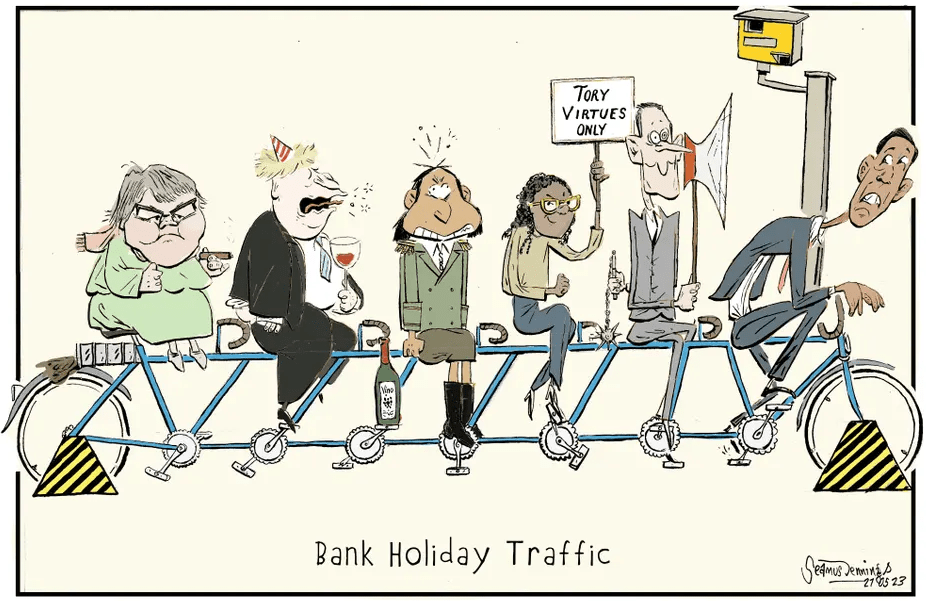
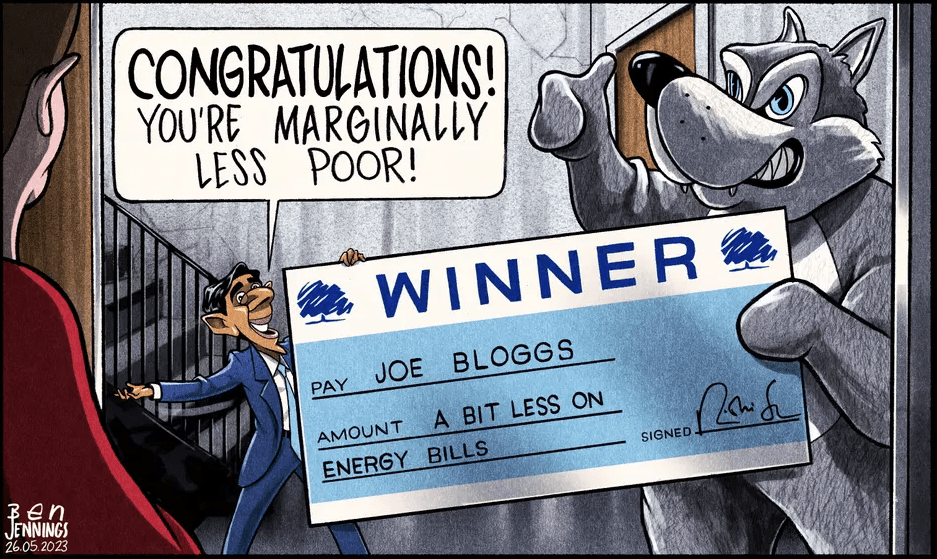
Covid inquiry: The Unvarnished Truth!

Boris Johnson promised us “a forensic and thorough going” inquiry.

For the sake of transparency and accountability, the Government’s unprecedented judicial review must fail.

If you are not angry enough already, pick up on the online  comments – Owl

Unbelievable: South West Water increases dividends by 11% as CEO set herself up as climate change champion.

For once Owl is lost for words.

Susan Davy, Chief Executive Pennon Group, is quoted as justifying the payout because: “we have delivered improvements in environmental performance, building on our sector leading 100pc water quality for our 860 miles of coastline and on track to reduce our use of storm overflows by 50pc by 2025.”

Simultaneously, she has been setting herself up as an environmental champion to lead a community response to the climate crisis, with particular reference to water supply. See what is described as her “advertorial” here: www.devonlive.com 

“….while climate change is a global issue, it has many local and community impacts, and working together with our customers and our communities holds the key to making the most difference.

“As the largest private employer and business in the region, Pennon takes its societal contribution extremely seriously….

“…We continue to invest in innovative solutions to mitigate the impacts of the drought, from repurposing ex-quarries to provide new water resources, to fixing customer-side leaks for free, launching pioneering initiatives such as Save Every Drop, and encouraging everyone to think differently about water usage…”

[Extremely seriously, how much water leaks away before it ever gets to our taps? – Owl]

South West Water pays £112m to shareholders amid sewage leak backlash

The owner of one of Britain’s biggest water companies has rewarded investors with an £112m dividend despite profits plunging and an ongoing probe into its alleged failure to report sewage leaks

By Oliver Gill, Chief Business Correspondent www.telegraph.co.uk 

Pennon Group, the FTSE 100 company that owns South West Water, said shareholder dividends would increase by 10.9pc.

The company highlighted that the dividend rise was 2pc higher than inflation, as measured by the Consumer Price Index including housing costs.

The 42.73p-a-share dividend amounts to £112m. It leaves Pennon with just £144m of cash reserves, compared with almost £2.7bn two years ago.

Pennon posted an £8.5m pre-tax loss on £797m of revenue for the year ending 31 March. Last year it made £128m in profit.

The results come as Pennon, which also owns Bristol Water, faces an investigation by the industry regulator examining whether its reporting of leaks and water use was accurate. 

Water companies must show that they are tackling leaks and keeping household water consumption down in accordance with rules laid down by regulator Ofwat.

David Black, the chief executive of Ofwat, said on Wednesday that a “thorough investigation will now be carried out and we will provide updates in due course on our findings and whether there is any further action Ofwat needs to take”.

Pennon responded to the investigation by saying that the figures were “subject to rigorous assurance processes” and signed off by a technical auditor.

Susan Davy, Pennon chief executive, said that the company’s annual loss followed “an extraordinary year for Pennon in which extreme weather patterns have tested our operational resilience”.

She added: “In a year in which the sector has been rightly challenged to clean up its act, we have delivered improvements in environmental performance, building on our sector leading 100pc water quality for our 860 miles of coastline and on track to reduce our use of storm overflows by 50pc by 2025. 

“I am also clear that one pollution is one too many, and numbers are falling as we implement sustained change.”

Aarin Chiekrie, equity analyst at Hargreaves Lansdown, said that high power and inflation-related costs were responsible for eroding Pennon’s profits.

He added: “But cashflows are getting squeezed by higher investment levels as the group aims to shore up its water supplies for the year. Unseasonably dry winter weather means the drought status in southwest England remains in place. 

“As summertime nears, it’s touch-and-go whether reservoir levels will be sufficient to keep customers’ supplies running at full flow. If not, Pennon could find itself in the regulator’s firing line.”

House prices falling at their fastest rate in nearly 14 years as buyers reel from higher interest rates

House prices are falling at their fastest rate for almost 14 years as buyers reel from the impact of sharply higher interest rates, figures showed on Thursday.

Jonathan Prynn www.standard.co.uk 

The annual rate at which prices are dropping picked up pace from 2.7 per cent in April to 3.4 per cent last month, the biggest fall since the aftermath of the financial crash in July 2009, according to lender Nationwide. Commentators said that the normal “spring bounce” seen in the London market at this time of year failed to materialise with buyers spooked by the threat of yet more interest rate pain.

The building society warned that further rate hikes from the Bank of England would “strengthen the headwinds” facing the already nervous market, although a full-scale crash is seen as unlikely. The Bank has already pushed through 12 rate increases, lifting the cost of borrowing from 0.1 per cent to 4.5 per cent since December 2021, in a bid to curb galloping inflation.

However, official figures last week showing that the Retail Price Index fell far less than expected in April to 8.7 per cent panicked City markets, which now fear the Bank will have to raise rates to as high as 5.5 per cent over the coming months.

That in turn brought turmoil to the fixed-rate mortgage market, where prices have jumped and hundreds of deals have been withdrawn.

On Thursday the average rate on a two-year deal was 5.49 per cent, up from 5.45 per cent on Wednesday, according to latest data from analysts Moneyfacts. The average five-year, fixed-rate deal rose from 5.12 per cent to 5.17 per cent, the highest since January. Meanwhile, the latest figures from the Bank of England showed the number of mortgage approvals dropping from 51,500 in March to 48,700 in April in another sign of rapidly falling confidence in the market.

Nationwide’s chief economist, Robert Gardner, said: “While consumer price inflation did slow in April, it was a much smaller decline than most analysts had expected. As a result, investors’ expectations for the future path of the bank rate increased noticeably in late May, suggesting it could peak at around 5.5 per cent, well above the 4.5 per cent peak that was priced in around late March. Furthermore, rates are also projected to remain higher for longer.

“If maintained, this is likely to exert renewed upward pressure on mortgage rates, which had been trending down after spiking in the wake of the mini-budget in September last year.”

Data from the building society also showed a month-on-month decline of 0.1 per cent in May, with the average cost of a UK home now at £260,736.

Commentators said the property market will continue to be overshadowed by heightened uncertainty over mortgages. Craig Fish, managing director at London mortgage broker Lodestone, said: “Just when you thought the market was stabilising, the inflation data emerged and triggered turmoil in the mortgage market. We were witnessing more normal levels of property activity in May, but there are now concerns about how much higher rates could go. Activity could stagnate moving forward as people take stock. We have already had some clients tell us that their property plans are on hold until things settle down.

“The hope is that as inflation drops, conditions will improve and we could see a strong end to 2023, which should continue into 2024.”

Jason Tebb, chief executive of property search website OnTheMarket.com, said: “Just as a welcome level of stability was returning to the market following the unprecedented uncertainty created by the min-budget in the autumn, something comes along to upset the apple cart.

“The inflation figures, which while moving in the right direction are proving to be more stubborn than first thought, have created volatility in the money markets, resulting in lenders increasing their mortgage pricing.”

Jonathan Hopper, chief executive of buying agents Garrington Property Finders, said: “Less than a week after the Nationwide increased its mortgage interest rates by up to 0.45 per cent, the lender’s latest House Price Index suggests the property market too has yet to settle.

“Its May data shows that average property prices fell in eight out of the past nine months, and prices are now four per cent lower than their peak of August 2022. For now, April’s fleeting price increase looks like a blip rather than the start of a rapid recovery.”

Samuel Mather-Holgate, from advisory firm Mather & Murray Financial, said: “Approvals for house purchases were down in April, and following the events of the past week, with lenders on red alert, activity in the housing market is set to dry up again, as confidence goes from boom to bust.”

All five of the  most toxic chemical cocktails found in the Exe 

Toxic chemical pollution found in river and groundwater sites across England – Westcountry Rivers Trust

Josie wrt.org.uk

A WORRYING scale of chemical pollution in England’s rivers and freshwater sites has been revealed following analysis of official Environment Agency data [1].

The research, from The Rivers Trust and Wildlife and Countryside Link, looked at the prevalence of five chemical cocktails known to have toxic impacts for wildlife. 

It also highlights the lack of official monitoring for known harmful chemical cocktails, as well as the lack of a regulatory framework to address these mixtures. 

Findings reveal that:
  • Chemical cocktails, that have been proven harmful to wildlife in scientific studies, have been found in 814 river and lake sites (out of 1,006 sites with data – 81% ) and 805 groundwater sites (out of 1,086 sites with data – 74%) across England 
  • Over half (54%) of these sites contained three or more of the five harmful chemical cocktails investigated [2]
  • Up to 101 chemicals were identified in river samples, with sites along the rivers Mersey, Stour, Colne, Thames, Trent, Yare, Irwell, Medway, Humber and Avon among those containing the highest numbers of chemicals. The actual numbers of chemical pollutants will be even higher [3]

The chemical cocktails found across the 1,619 sites contained six different chemicals in five different hazardous mixtures. These included four toxic forever chemicals PFOS, PFOA, PFBS and PFHxS, the pesticide 2,4-D and the commonly used painkiller ibuprofen (see table below for more detail).

In specific combinations these chemicals are known to have increased harmful impacts on a range of species including amphibians, fish, insects, nitrogen-fixing bacteria and algae. Identified detrimental effects included reduced growth, cell function, impacts on embryos and lower survival rates. Any potential human health implications, for example through contact via bathing or recreation, remain unknown.

Some of the sites where all five chemical cocktails were found include: The Chelt (in Cheltenham); The Derwent (in Yorkshire); The Trent (in Staffordshire); The Exe (in Devon); The Ouse (in Lewes East Sussex); the Wansbeck (in Northumberland); and the Yare (in Norfolk).

Find out how you can support a call for action at the end of the article

A group of charities, including Wildlife and Countryside Link, The Rivers Trust, Surfers Against Sewage, Buglife, WildFish, Fidra, Pesticide Action Network UK, The Wildlife Trusts, The National Trust, Whale and Dolphin Conservation and the Pesticide Collaboration, launched a ‘Chemical Cocktail Campaign’ (24 May 2023), urging the Government to take a much more ambitious approach to regulating harmful chemicals. [4]

We are supporting their calls which include asking Government to include in its forthcoming UK Chemicals Strategy: regular monitoring for chemical cocktails in rivers, and new legal protections against dangerous chemical cocktails, including requiring  assessments of potential hazardous chemical mixture impacts before any new chemical is allowed on the market. 

Dr Laurence Couldrick, CEO at Westcountry Rivers Trust, said in an interview with ITV Westcountry: “Some of these forever chemicals are going to be in our rivers…forever. Because of the nature of them they just do not degrade but we do need to stop the flow of those pollutants. There’s so much we can do, in terms of how we live as a society, what we throw down our toilets and our sinks, but also how we buy our food and manage our lives.”

A range of five known toxic chemical cocktails has been looked for in Environment Agency data. While there are other known toxic combinations (and likely  many more unknown) a narrow focus was used due to the volume of data that needed to be reviewed. All of the chemical combinations focused on cocktail impacts with the harmful and extremely prevalent forever chemicals perfluorooctane sulfonate (PFOS) and perfluorooctanoate (PFOA) . These were chosen due to how widespread they are (despite having been banned) and the need for them to be recorded under Water Framework Directive requirements, making them more visible chemical contaminants for assessment.

Rob Collins, Director of Policy and Science at the Rivers Trust, said: “We need to stop pumping poison into our rivers. Hazardous chemicals are flowing into our waters, derived from every aspect of our lives. On the small-scale from the toiletries, food packaging, clothing and other goods we use individually, to large-scale industrial, medical and food production, we are creating an ever-growing chemical cocktail in our rivers. The fact that these known toxic chemical combinations are found so widely across the country is deeply worrying. And that’s just the tip of the iceberg. Unless we act now we’ll see increasingly contaminated water, less wildlife in our rivers and ocean, and this raises implications for human health as well.”

The table below details the toxic chemical cocktails that were investigated and the number of sites they were discovered at. Alongside this, are details of the studies that have identified harm to wildlife species from these harmful chemical combinations. Please note that all of these studies were carried out in laboratory conditions, not in the field. 

The levels of these contaminants in rivers were typically much lower than in the laboratory studies, but individually, each of these chemicals are known to impact wildlife at concentrations lower than those reported in these studies. In addition it is not known how these chemical cocktails (which are binary mixtures studied in the laboratory) interact with other chemicals in a wider mixture in our rivers. [5] Their widespread presence in our rivers, knowing their damaging impacts in laboratory studies, is cause for concern.

Table 1: Chemical cocktails identified in English river sites

Table 2: Number of chemical cocktails present at river, lake and groundwater sites across England

Richard Benwell, CEO of Wildlife and Countryside Link, said:  “A harmful chemical cocktail is being stirred up in UK rivers, putting wildlife and public health at risk. Government regulates and monitors chemicals individually, ignoring the cocktail effect. But our research shows that toxic combinations of pesticides, pharmaceuticals and forever chemicals are polluting rivers up and down the country. The new Chemicals Strategy must make sure harmful substances are regulated not just for individual risks, but for their effects in combination.” 

Map 1: River, lake and pond sites in England where 1 or more of the 5 chemical cocktails were found

Map 2: Groundwater sites across England where one or more of the 5 chemical cocktails were found

Speaking at a Parliamentary event on chemical cocktail pollution (23 May), hosted by UK Youth For Nature and Wildlife and Countryside Link, the Rt Hon Philip Dunne MP, Chair of the UK Parliament Environmental Audit Committee, said: “The country’s precious waterways should be as free from pollutants as possible, yet the long-standing prevalence of harmful chemicals has meant that no river in England is in good chemical health. During the course of the Committee’s inquiry examining water quality of rivers, we were alarmed at the lack of monitoring taking place for harmful pollutants, including chemicals. We must know what we’re tackling, so monitoring and assessment is absolutely critical. The Committee concluded that annual chemical assessments should take place.

Ellen Bradley, Co-Director of UK Youth For Nature, said: “The chemical cocktail in our rivers is a recipe for disaster for nature and future generations. Everything from the clothes we wear to the medicines we use plays a part in the problem. Even the food we eat everyday is part of a broken system that is choking our rivers with harmful chemicals and leaving UK wildlife paying the price. Tougher chemical controls and curbs on agricultural pollution are vital if younger people are to see our not so freshwater cleaned up in their lifetimes.” 

As well as some chemicals being damaging to wildlife on their own, sometimes when chemicals mix together in the environment, they can cause even more harm to nature. When several chemicals are present together, their toxicity can add up or interact to produce a mixture effect. The most common mixture effect is additional, this is when the toxicity of each chemical adds up, resulting in an adverse effect even when each chemical individually is at a low (“safe”) concentration. In rarer cases it can be antagonistic, resulting in a weaker effect or synergistic, resulting in an even greater effect.  The above combinations searched for in our research are synergistic – causing multiple times the harm of the individual components. 

Far too little is known about the impact of chemical cocktails on wildlife and people. It would not be economically feasible to specifically assess and regulate all of the vast number of possible chemical combinations. But we do need to deliver additional safeguards to reduce the risk of creating dangerous chemical cocktails in our rivers.

To tackle the chemical cocktail affecting our waters and wildlife, measures are needed which reduce the number and amount of chemicals used in our daily lives and which are released  into the environment. We also need much greater understanding, monitoring  and prevention of chemical cocktails at a Government regulatory level. Key actions nature organisations are calling for in the upcoming UK Chemicals Strategy include:

Phasing out known toxic chemicals (including PFAS forever chemicals) from all but the most vital uses.

Regulating chemicals in groups (where all chemicals with similar structures would be restricted if one was found to be harmful. Preventing one damaging chemical being easily replaced by another similar chemical).

Specific measures to address the chemical cocktail effect in our rivers and ocean through: introducing a requirement to assess possible interactions with other chemicals before any new chemical is allowed on the market;  greater research into chemical cocktail impacts for wildlife and human health; and routine monitoring of waters for known dangerous combinations of cocktails.

Delivering more rigorous monitoring for chemical pollutants more widely, including through increased funding for the Environment Agency’s river monitoring programme.

Ruth Jones MP, Shadow Minister (Environment, Food and Rural Affairs), said: “The UK’s current approach on chemical pollution is failing, and these stark statistics are yet more evidence of this. We need action now to curb the chemical cocktail in our rivers. The Government must up its game and tackle the sewage pollution scandal and chemical pollution crisis together to give communities and nature the clean water they deserve.” 

Members of the public are being encouraged to sign a joint letter to the Secretary of State, Thérèse Coffey, to demand action on chemical pollution: https://theriverstrust.org/chemical-cocktail-campaign

ENDS

References
  1. Wildlife and Countryside Link and the Rivers Trust analysed data in the Environment Agency’s LC-MS, GC-MS and Water Quality Archive databases. They identified presence or absence of up to 101 chemicals across river sites within these three databases, finding that there were over 50 chemicals present at 127 river, freshwater, estuary and coastal sites. Data was analysed from between 2016 to 2022. Searching for 5 known chemical cocktails in the LC-MS and Water Quality Archive identified a total of 1,619 sites with one or more of these combinations present. The combination of PFOS and PFOA was found at the vast majority of the sites (1113 sites).
  2. In sites where at least one chemical cocktail was identified, groundwaters tend to show more of these chemical cocktails, with 96% (771) of the sites containing 3 or more of the 5 chemical cocktails, whereas 86% of river and lake sites (703) with chemical cocktails detected showed 1 or 2 of the cocktails. This may indicate a trickle-down effect, that this pollution reaches groundwaters and is stored here before a delayed release into rivers and lakes that could be months, years or even decades later. It may also reflect different monitoring of these chemicals in groundwater – with the main purpose of the Water Quality Archive data being statutory EU monitoring and the LC-MS data mainly being UK government policy. Beyond this difference it is difficult to properly understand the cause of the differences between surface and groundwater as information is not provided when chemicals are monitored for but not detected.
  3. The number of chemicals will in fact be far higher than this number, due to only a limited number of chemicals being tested for by the Environment Agency
  4. Supporters of the ‘Chemical Cocktail campaign’ include: Angling Trust, British Canoeing, Buglife, Fidra, The Institute of Fisheries Management, Pan UK, The National Trust, The Pesticide Collaboration, River Action, The Rivers Trust, Surfers Against Sewage,  UK Youth for Nature, Whale and Dolphin Conservation, WildFish, The Wildlife Trusts,  and Wildlife and Countryside Link.
  5. A liquid mixture containing two components is called a binary mixture. When a binary mixture is distilled, complete separation of the two components is rarely achieved.

Millions in Tory donations at risk as property developers hit back

Property developers that have donated millions of pounds to the Conservative Party are “on strike” amid claims the party is blocking new house building.

Archie Mitchell www.independent.co.uk

Housebuilders and developers – who in the past have accounted for around a fifth of all donations – have turned off the taps.

A Tory source told The Times: “I think you might struggle to name a developer who is currently donating.”

It comes as the Home Builders Federation claims housebuilding in England is set to fall to the lowest level since the second world war. It has accused the government of having “anti-development and anti-business” policies which threaten to dramatically slow development.

And in December the government was slammed by developers for scrapping building targets after a rebellion of backbench MPs.

Ministers watered down local housebuilding targets to avoid what would have been the first major Commons rebellion of Rishi Sunak’s premiership.

The change made a centrally determined target to build 300,000 homes a year a “starting point” or “goal”. Councils can propose building fewer homes if they faced “genuine constraints” or would have to build at a density that would “significantly change the character” of their area.

The rate of new homes being built has fallen every month since, and developers responded furiously.

Rob Boughton, who runs one of the biggest developers in the southeast, Thakeham, said MPs should be “ashamed” for protecting “a vocal minority at the cost of so many”. Mr Boughton, whose company has donated nearly £1million to the party since 2017, wrote on LinkedIn: “What happened to creating opportunity? These small-minded, selfish people just don’t get it.”

In another post, he said: “What hope do the aspiring [first-time buyers] have? Do they care about 20 to 45-year-olds in this country or not?”

And the founder of one of the country’s biggest housebuilders Redrow described the government as “anti-housebuilding”. In an interview with industry publication Building, Steve Morgan, who has given more than £1.25million to the Conservatives, said: “It’s almost like the government wants to destroy the industry.”

The pair last donated to the Conservatives last October. Another Tory source told The Times: “They [the developer donors] are on strike. And is it any surprise? What a way to spit in their f***ing face.”

The Conservative party treasurer, Graham Edwards, is chairman of one of the UK’s biggest property companies Telereal Trillium. A party spokesman said: “We have had a very healthy first half of the year for donations.”

Labour is hoping to capitalise on the government’s record on housebuilding and has set out plans to give local officials sweeping new powers to buy land cheaply and develop on it.

Party sources told The Guardian that if elected next year, they will pass a law to allow local development authorities in England the power to buy up land at a fraction of its potential cost if they want to build on it.

It will let officials buy land under compulsory purchase orders without having to factor in the “hope value” – a massive price premium granted to any land on which developers hope to secure planning permission.
Covid inquiry: Ministers avoid questions on care home deaths until after election

“The public and bereaved families have already been left waiting far too long for answers over why the Government got it so wrong and failed to protect care home residents during the pandemic.

“It’s deeply disappointing that because the Conservative ministers took so long in setting up the Covid inquiry, they now won’t be held to account over these failures until after the election.” – Daisy Cooper, the Liberal Democrats’ health spokesman.

By Daniel Martin, Deputy Political Editor www.telegraph.co.uk

Ministers will avoid questions about the deaths of thousands of care home residents during the pandemic until after the general election, the official Covid inquiry has announced.

Baroness Hallett, chairman of the inquiry, set out the timetable for public hearings on Tuesday, with the final ones not taking place until the summer of 2026.

She revealed that hearings to investigate how the care sector coped during the pandemic will not start until spring 2025.

Hearings on government procurement, expected to include the large amount of wasteful spending on unusable PPE, will begin in early 2025.

The issue of how children’s education and mental health was impacted by lockdown will not be investigated until mid 2025 at the earliest.

Rishi Sunak, the Prime Minister, has to call the next election by the end of 2024.

Lady Hallett also revealed that the public hearings on vaccines, where the Government is widely judged to have performed well, would take place from summer 2024.

It means the sessions on vaccines, which will not be as embarrassing for the Government, could well happen just before the election.

She said: “Last year, I promised I would work hard to ensure the whole of the UK can learn useful lessons from the pandemic as quickly as possible.

“Today I am providing greater clarity on our investigations and the likely end point for the inquiry’s hearings.”

Daisy Cooper, the Liberal Democrats’ health spokesman, said: “The public and bereaved families have already been left waiting far too long for answers over why the Government got it so wrong and failed to protect care home residents during the pandemic.

“It’s deeply disappointing that because the Conservative ministers took so long in setting up the Covid inquiry, they now won’t be held to account over these failures until after the election.”

Caroline Abrahams, charity director at Age UK, said: “Many families and friends of the 40,000-plus older people who died in care homes during the first wave of the pandemic are likely to be deeply disappointed by this delay.

“Care home residents were among those most grievously harmed by official decisions that were or were not made during the health emergency and it’s really important that the right lessons are learned so we can protect older people more effectively in the future.

“The worry is that as the weeks and months go by, recollections dim and it becomes harder to establish exactly what happened, and why.”

The Covid inquiry is split into six different investigations, the first three of which are pandemic preparedness, decision-making and the impact of the pandemic on health systems.

On Tuesday, Lady Hallett announced three more investigations – vaccines, therapeutics and anti-viral treatment; government procurement across the UK; and the care sector across the UK.

Details of further investigations will not be unveiled until early 2024, the inquiry said, but they would not start until mid 2025.

Future investigations will cover issues such as NHS test and trace, the effect of lockdowns on education, and the effect on children and young people.

The inquiry will also consider financial support for business, additional funding of public services, and benefits and support for vulnerable people.

The inquiry’s final modules will specifically investigate the impact of pandemic policies on inequalities in the context of public services, including key workers.

The inquiry is aiming to complete public hearings by summer 2026.

The damaging legacy of right to buy

Originally published last year this analysis is still relevant and an excellent summary of the problems facing the new council. – Owl

Tom Pollard neweconomics.org (extract)

Right to buy embedded the notion of a ​‘property owning democracy’ into the British political psyche and brought Thatcher into power in 1979 through a mass of working-class votes. At the moment, it allows council tenants to purchase their homes at a large discount: up to £116,200 cheaper in London and £87,200 elsewhere. Much of the money from this purchase is sent to the Treasury, with the council allowed to retain a portion, as long as they spend the portion on additional affordable homes in a manner approved by central government. Johnson wants to extend this policy to housing associations, who today hold the majority of affordable housing stock. Since its inception, approximately 2m sales of social housing have taken place under right to buy. To Johnson, this is a victory of greater homeownership, but this ignores the grave costs of the policy.

First, the sales of council homes have not been accompanied by investment to replace the social homes lost to right to buy. Rather, investment in new social housing has been consistently slashed since the 1980s, with government investment instead going to paying the housing benefit bill. In addition, right to buy actually disincentivises the building of new social homes. Why would councils pay to build homes, only to sell them at a discount, lose income from future rental payments and not receive the full sale receipt?

When homes are sold at a discount under right to buy, this represents a loss to public finances – an estimated £75bn over the lifetime of the policy since 1980. Extending the policy to housing associations will only extend this disincentive to more providers of social housing, slowing social housebuilding when it needs to be sped up. It is estimated that the government may have to compensate housing associations by £14.6bn in a decade if the policy is extended.

With right to buy sales far outweighing supply, there been an average annual net loss of 24,000 social homes since 1991. The government has sought to have a one-to-one replacement policy in recent years. Yet, how can a policy of one-to-one be effectively applied when right to buy discounts result in financial loss? The replacement policy has had little success. Furthermore, lost social homes don’t need to be replaced with new social homes – any home will do, according to the government. Genuinely affordable social homes may be replaced by unaffordable shared ownership properties that are easier to make viable on development schemes.

Second, the policy hasn’t straightforwardly led to higher levels of homeownership or owner-occupancy of former social homes. Research from Inside Housing showed over 40% of right to buy homes are now rented privately. Affordable social housing has turned to unaffordable private rented housing. It is no wonder that during the existence of right to buy we’ve seen ​‘generation rent’ emerge in 2011/​12, when the proportion of households in the private rented sector outstripped those in the social sector. While some social housing has been allowed to fall into disrepair, private rented properties lack even the regulation of social housing, meaning that residents live in worse quality housing with insecure tenancies, while paying higher rents.

Worse still, many of the tenants of these ​‘right-to-buy-to-let’ properties rely on housing benefit. 25% of private renters received housing benefit in 2020/​21. Right to buy has reduced the supply of social homes, meaning more people rely on housing benefit because they cannot be housed in a council house. This means a larger housing benefit bill which ends up in the bank accounts of private landlords, not councils and housing associations who would recycle it into public investment.

Third, right to buy has added to the declining perception of social housing, furthering stigma. Inherent in the policy is the idea that homeownership is a superior tenure, and that social housing should act as a stepping stone to the aspirational homeownership. With social housing in such short supply, it has become a tenure for the very poorest, as only the wealthiest social tenants can make use of right to buy. With this promotion of homeownership, the government has a vested interest in ensuring rising house prices to support their voting base, at the expense of providing housing for those in need. All of this results in prejudice against social housing and makes gathering political support for social housing difficult.

Admittedly, the government have tried to use extending right to buy as a ​‘vote winner’ before and not followed though: David Cameron piloted a similar policy back in 2018. Nevertheless, Johnson’s announcement indicates the current government’s dangerous attitude towards social housing, at a time when need for itis at its greatest. The focus remains on winning elections, instead of building a housing system that makes sure all of us can live in good quality, affordable homes.

The prevailing attitude towards social housing won’t change without pressure. At NEF, we are launching Homes for Us, a campaign for affordable and desirable social homes for the 21st century. You can help us prepare by contributing to our Social Housing Listening Campaign, which is gathering perceptions and perspectives on social housing.

River Wye health status downgraded by Natural England after wildlife review

River pollution is getting worse, but don’t worry Thérèse Coffey has a plan! – Owl

The River Wye’s health status has been downgraded by Natural England, as wildlife charities accuse the government of failing to stop farming pollution harming the waterway.

Helena Horton www.theguardian.com 

The government nature watchdog has updated the status of the river from “unfavourable-improving” to “unfavourable-declining”, meaning its condition is poor – and worsening.

The assessment shows the river, which flows for 155 miles from mid-Wales to the Severn estuary in England, has experienced declines in key species such as the Atlantic salmon and white-clawed crayfish.

Previous studies have linked its decline – the river has been pictured over the years going from clear and full of wildlife to the colour of pea soup – to intensive chicken farming on the catchment. This is because the poultry reared in the area produce large amounts of manure, which contains nutrients including phosphorus. Much of this is spread on the land, which can result in the phosphorus it contains entering the river.

The Wildlife Trusts, which manages nature reserves across the Wye catchment, has expressed concern at the downgrading of its status and urged the government to take action.

It is calling for ministers in England and Wales to place an immediate policy moratorium on any new or extended intensive livestock production units (poultry, cattle and pig) in the Wye catchment. It is also asking for farmers and supermarkets to work with nature charities to put an end to the pollution, and for farmers in the area to be rewarded for providing public goods and enabled to diversify into regenerative and sustainable methods of production which cause less pollution.

Joan Edwards, the director of public affairs at the Wildlife Trusts, said: “That the Wye is in even worse condition now will come as no surprise to the people that love and live near it. But this new admission represents a shocking failure by the agencies and authorities in Wales and England that are supposed to protect this once beautiful river.

“Wider research shows that farm pollution is the main cause of its decline – that’s why the authorities must enforce the law wherever the causes of pollution are clear. It’s time to prevent more chicken sheds from being built and ensure that all farmers are rewarded for nature-friendly, cleaner food production methods.”

Thérèse Coffey, the environment secretary, said: “The River Wye is clearly struggling and it is vital that we turn the tide on its decline. As I set out in our plan for water, we need local plans catchment by catchment, community by community to tackle issues that are affecting water quality. Bringing people together from the local communities, it is clear we have a common goal. We do all need to work together at a greater pace and with purpose to actively support our farmers and food producers to produce food sustainably and reduce pollution.”

Anyone know the whereabouts of the “unambiguously irrelevant”, relevant diaries?

The BoJo diaries seem to have mysteriously gone missing, at the last moment!

“I think the prime minister looks really slippery today. He says he wants the government to co-operate with the inquiry but the government has been withholding information the inquiry has asked for.

“One minute the government says the messages they have are immaterial; the next minute they’re saying they don’t exist. Which is it?” Wes Streeting

Failure to hand over everything requested would “make a mockery of this whole process and would be yet another insult to the millions of bereaved still waiting for justice”. Lib Dem health spokesperson, Daisy Cooper.

 “Some cover-up going on here to save embarrassment of ministers”, Bob Kerslake, a former head of the civil service.“This government will have integrity, professionalism and accountability at every level.” Rishi Sunak.

Nearly two-thirds of millennials think Tories deserve to lose election, poll says

The Conservatives’ failure to win over young voters poses an “existential” challenge to the party, Rishi Sunak has been warned, as new polling found nearly two-thirds of millennials said it deserves to lose the next election.

Aubrey Allegretti www.theguardian.com 

Research from the centre-right thinktank Onward found that millennials – which it defined as those aged 25 to 40 – think the Tories are dishonest, incompetent and out of touch. Yet despite this, it said there was hope younger voters could be attracted back to the party.

Millennials are predominantly “shy capitalists” who support lower taxes over redistributing wealth, Onward’s report said.

The report has been endorsed by former Tory vice-chair Bim Afolami. “The millennial generation is not becoming more likely to vote Conservative as its members age, this situation is worsening, and we need to better understand it,” he said in his foreword.

“This issue is existential for the Conservative party, and not just for votes at the next or subsequent elections.”

In what will make sobering reading for party bosses before the expected general election next year, a survey commissioned by Onward of 8,000 millennials found only 21% would vote Conservative should polling day be held tomorrow.

Such is their antipathy that nearly two-thirds – 62% – said the Tories “deserve to lose the next election”, with 45% saying they planned to vote Labour.

While the Conservatives have historically been less popular with younger voters, the party’s problem is getting worse.

“Millennials are the first demographic cohort not to become more rightwing as they age,” said Afolami. “They are failing to acquire many of the attributes that have traditionally moved voters rightwards: home ownership, secure and stable employment, starting families.”

About 26% of the adult population are millennials, and they are said to be the largest cohort of any generation in about half – 324 – of Britain’s 650 constituencies. However, turnout at elections is often higher among older age groups.

Areas with high numbers of younger voters tend to be clustered in cities – but also stretch to the periphery of them, to places such as Thurrock and Slough.

Onward’s report warned that there is a danger the Tories “will eventually run out of road” and that if the party did not start to win over younger voters, “it risks an electoral timebomb”.

Home-owning millennials are more likely to cite a distrust of the Conservatives to manage the economy, Onward found. It said this “suggests that the market shock caused by the 2022 mini-budget has undermined one of the traditional strengths of the Conservative brand”.

A “silver lining” for the party is that Sunak himself is far less unpopular than his party among those born in the 1980s and 90s, the thinktank’s survey found. It said that his popularity was 20 percentage points higher than the party’s.

Those “pro-Sunak, not Tory” voters, as Onward described them, are less likely to be white, probably live in urban areas, have high-level jobs and own a home. The cost of living, the NHS and the environment are top issues they share with all voters. But uniquely, they place housing and taxation much higher up the list.

“Government has not delivered on millennials’ core priorities,” found the report, titled Missing Millennials. It cited issues with housing, and a lack of family-friendly policies and jobs, and said millennials had “no time for the culture war” which senior Tories are often accused of trying to wage.

“The Tories’ opportunity for improving their stand with millennials is clear. They will need to be bold to win younger generations back,” it concluded.

Paul Arnott on the new council

With June busting out all over, as the song once sang, your district councillors have finally put an exhausting couple of months behind them.

Paul Arnott www.exmouthjournal.co.uk 

In early May every four years, East Devon electors choose 60 individuals to represent them, and after the deed is done these members spend the rest of the month organising themselves into the appropriate committees. Then, on the last Wednesday, in May we hold “Annual Council”.

This year’s happened at the Ocean in Exmouth, where I turned up with a kidney infection and a heavy cold and couldn’t wait for the evening to be over, to be frank. This saddened me because there was much to celebrate.

The first business transacted was to elect a Chair of Council. This is a critical non-partisan role, the conscience of the council, and members selected Eleanor Rylance from Broadclyst without opposition. I had then intended to say something substantial in support of proposing Sam Hawkins from Cranbrook as Eleanor’s vice chair, but felt so groggy I kept it pretty brief. Sorry Sam.

Eleanor is a Broadclyst working mother of four children from graduate to school age. She is a passionate local representative in a part of the district saturated with planning applications, often contentious. She has an Oxbridge law degree, is a bilingual translator, and is altogether a class act. And I have no doubt that if she finds me wanting as Leader I will be as remorselessly grilled as much as any backbencher!

Sam from Cranbrook is in his thirties, a qualified accountant and auditor by profession, and has had to deal with the many teething troubles of the new town. He has a forensic mind, is courteous at all times, and as his time chairing our Audit & Governance committee has shown will not hesitate from asking the most difficult of questions.

Forgive me for labouring this point but I’d emphasise again how important the appointment of a woman councillor with professional and family breadth, and a younger male councillor with auditing skills, is for East Devon. Vive la difference.

This week, then, it’s back to business full tilt. I was very grateful to be elected Leader for a fourth year, and feel confident that my Democratic Alliance group with nearly half of all members will work brilliantly with other groups for the public good.

In between coughs in my short acceptance speech at the Ocean, I simply stated where the emphasis will remain for the coming year. Homes. Environment. Economy.

These are the areas of public life we know a district council can influence (unlike pot-holes, education or adult social care which are county responsibilities). Two days after being made Leader again, I attended a meeting of the new Devon Housing Commission, where various local representatives could meet with members of the new board, chaired by excellent crossbench peer, Lord Richard Best.

Hosted brilliantly by the Cranbrook Education Centre, Lord Best was able to hear about the challenges, failures and successes of how the new town was conceived and developed. It was an excellent, non-political exchange of views.

At East Devon we are in no doubt that this must be an absolute priority. Local people of all ages are facing a crisis if trying to rent or purchase, and there is a lot of evidence of younger people moving back home.

The Kwarteng/Truss bombshell budget of last year and its immediate effect on spiking interest rates has not helped.

Our Strategic Planning Committee will push hard on all this, as will our excellent Homes and Communities Cabinet Member Dan Ledger, a genuine local in his early 30s working professionally in local government. We’ve got the A team in place – now let’s get some results.

Female representation on Devon County Council slammed

Male, pale, stale and bust! – Owl

The lack of female Devon county councillors in senior roles is coming under fire.

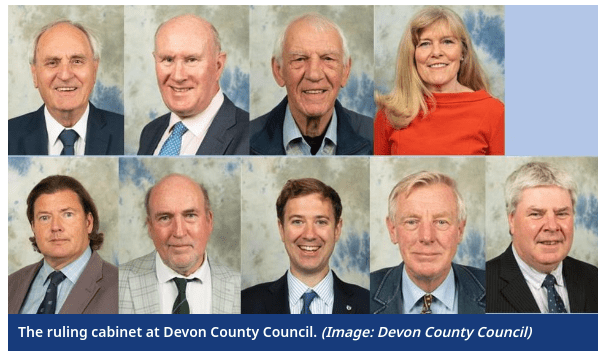
Just one of the nine members of Devon’s ruling cabinet are women, while men also occupy most of the chair and vice chair positions on various committees.

Ollie Heptinstall, Local Democracy Reporting Service www.exmouthjournal.co.uk

The council says that despite trying to promote ‘greater diversity,’ around 70 per cent of councillors are men, and parties “put forward who they feel is most appropriate” to various roles.

The issue was raised by independent councillor Frank Biederman (Fremington Rural), who voted against the appointment of chairs and vice chairs at the authority’s annual meeting on Thursday, May 25.

“A great deal has been made of this county council’s move to more [inclusivity], equality and diversity,” Cllr Biederman said.

“And it’s also our mission statement on our website. We’re rightly very proud of our diverse workforce and we’re working to help them.”

The issue was raised by independent councillor Frank Biederman (Fremington Rural).

But he added: “I don’t believe that we do that in our election of chairs and vice chairs, and that’s why I’d like to be recorded as voting against it.

“And just to remind you, we’ve just appointed 25 male vice chairs, chairs and members of cabinet, and only six of those will be female. That’s why I can’t support this.”

In response, a council spokesperson said: “All political groups at the council are asked to put forward chairs and vice chairs for our committees, proportionally to the number of seats held by each group.

“Despite Devon County Council trying to promote greater diversity in all its forms, including the proportion of women to men, the split between male to female councillors is currently around 70 per cent male, to 30 per cent female.

“Ultimately, the political groups will put forward who they feel is most appropriate to the role.”

Meanwhile, Cllr Percy Prowse (Conservative, Duryard & Pennsylvania) has been elected as the new chair of the council.

He will perform the ceremonial role for the next 12 months, which involves hosting full council meetings and representing the authority at civic functions.

Cllr Colin Slade (Conservative, Tiverton East) is his deputy.

What does a “Progressive” council look like?

Well even Labour, with only three councillors, managed to get a Vice – Chair post!

Owl has already published the principal office holders and cabinet:

Chair, Cllr. Eleanor Rylance (Democratic Alliance – LibDem)

Vice Chair Cllr Sam Hawkins (Independent Group – Cranbrook Independent)

Leader Cllr Paul Arnott (Democratic Alliance – LibDem)

Cllr Paul Hayward (Democratic Alliance – Independent)

See here for the cabinet.

Below are the Chairs and Vice-Chairs of some of the important committees. 

Remember that the committee members are chosen to achieve “political balance” amongst the political groupings, a complicated operation when it comes to rounding up or down.

The full list of Committees, Boards, Panels and Forums and links to lists of members can be found here

Scrutiny Committee

Overview Committee

Planning Committee 

Given the potential interest and impact of this committee on communities, Owl has included the full list of members, including which ward they represent. 

Whilst political balance might be achieved, it is not obvious that geographic representation will be achieved. This has always been the case.

In this case it looks as if the communities in Honiton and Seaton will have to do with near neighbours.

Strategic Planning Committee

Audit and Governance Committee

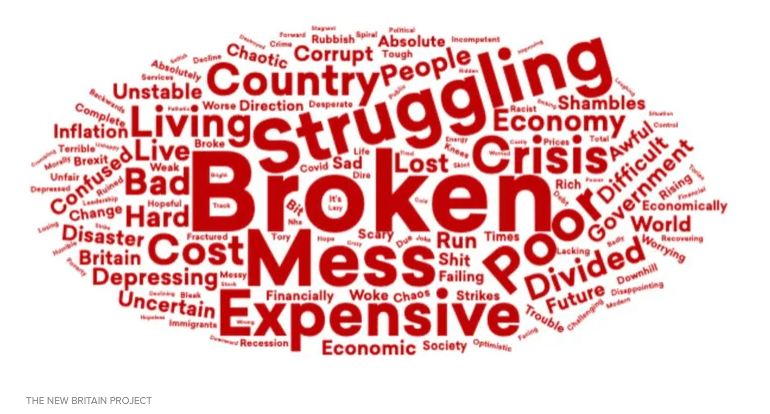
‘Broken’, ‘Struggling’, ‘Expensive’ And A ‘Mess’: What Britain Thinks About Life

People across the UK view the country as “broken”, a “mess”, “expensive”, “struggling” and in “crisis”, according to a new poll.

Ned Simons www.huffingtonpost.co.uk

A survey conducted for the The New Britain Project think-tank by More in Common and shared with HuffPost UK has captured the mood of the nation.

The poll asked 2,017 adults between 12 and 15 May to describe Britain in their own words. And the results were not positive.

Of the words picked, “broken” was the top choice, used by 162 people. In second place was “mess” with 118.

The first term rated as positive rather than negative was “rich”, in 56th place with eleven people having chosen it.

Other popular choices included “divided”, “depressing”, “confused”, “bad” and “shit”.

The results prove uncomfortable reading for Rishi Sunak who has just over a year before he has to call a general election.

Sunak’s seven months in office have been against the backdrop of soaring inflation and rolling strike action.

Labour has held a consistent poll lead for months and the results of the local elections earlier in May suggest Keir Starmer is on course to become prime minister.

The most recent YouGov poll showed Labour on 43%, ahead of the Conservatives on 25% and the Lib Dems on 12%.

In a sign that many in the Conservative Party have accepted the election is lost, almost 40 Tory MPs have already announced they will quit parliament rather than stand for re-election.

The mass exodus of Conservatives includes former deputy prime minister Dominic Raab, former culture secretary Nadine Dorries and former chancellor Sajid Javid.

Labour plans to allow local authorities to buy land cheaply for development

Labour is planning to give local officials sweeping new powers to buy land cheaply and develop on it, as part of the party’s new “pro-building” agenda.

Might be prudent for EDDC to start identifying land on the back of its local plan review. “Doing today what is right for tomorrow” is the aspiration of Clinton Devon Estates’ long term strategy. – Owl

Kiran Stacey www.theguardian.com 

Party sources say that if elected next year, they will pass a law to allow local development authorities in England the power to buy up land at a fraction of its potential cost if they want to build on it.

The new law will allow officials to buy land under compulsory purchase orders without having to factor in the “hope value” – a massive price premium granted to any land on which developers hope to secure planning permission.

Keir Starmer, the Labour leader, is already under fire for his promise to make it easier to build on the green belt. But the details of the party’s latest pro-development policy show he is willing to risk the wrath of existing land and property owners in his attempt to jump-start new building across the country.

One party source said: “We want to rebalance the power between landowners and local communities. We want local areas to capture a lot more of the value that is created when you build on land nearby. The principal is to tilt the balance of power, which right now is tilted towards landowners and not communities.”

Homeownership in England has been falling for years, as prices have risen and banks have asked for increasingly large deposits. In 2003, 71% of all homes were owned by the people who live there, but by 2021-22, that had fallen to 64%.

The Conservatives have attempted to tackle this by offering financial help for new buyers, but the impact of those schemes have been limited by falling supply.

Michael Gove, the housing secretary, has promised a series of planning reforms, but has been hampered by a set of powerful Conservative backbenchers who believe their seats are under threat because of building schemes in their constituencies.

Last year Gove bowed to pressure from those Tory MPs to drop a mandatory target to build 300,000 new homes every year, making it voluntary instead.

Since then, several local authorities have delayed or scaled back their building plans, causing analysts to slash their projections of new housebuilding over the coming years. A study earlier this year by the Home Builders Federation suggested housebuilding in England was set to fall to 120,000 a year – the lowest level since the second world war.

Labour is promising to be “the builders, not the blockers”, launching a series of pro-building policies, including a return to the mandatory 300,000 target.

As part of that, sources say the party would pass a law soon after entering government to allow local development authorities to buy up land under compulsory purchase orders without factoring in the hope value.

Hope value is the price premium attached to land on which planning permission has either been granted or on which developers hope it will be granted. An analysis by the Centre for Progressive Policy in 2018 found that planning permission inflated the price of agricultural land by 275 times, pushing it up from £22,520 per hectare to £6.2m per hectare.

Politicians from the two main parties have argued for years that hope value should be stripped out of compulsory purchase valuations. In 2018 the Tory MP Neil O’Brien called the practice of paying it “highly questionable”, in a report for the centre-right think tank Onward.

O’Brien, who is now a health minister, said: “This has made it prohibitively expensive and complex for the old ‘new towns’ model to be viable. And even where government spends taxpayers’ money on major infrastructure projects, the value of this investment is often not discounted when government buys the land for the infrastructure. The system has become unbalanced.”

Gove has taken up a version of O’Brien’s reforms, but intends to leave it up to the housing secretary at the time to decide whether to eliminate hope value from CPOs on a case-by-case basis. The reforms are part of the levelling up and regeneration bill, currently passing through the House of Lords.

A spokesperson for Gove’s department said: “It will ultimately be for the secretary of state to decide whether a compulsory purchase order can be approved and if the removal of hope value is appropriate.”

Labour argues, however, that this would leave local planning officials relatively powerless to buy up the land they believe is needed for local development schemes, and would also leave the secretary of state vulnerable to sustained lobbying from landowners.

Labour officials are still deciding on the scope of the reforms, and whether they should be passed in the “take back control” bill, which Starmer has promised will be part of his first king’s speech, or whether they should be part of a separate planning bill. They are also deciding on how best the value added by planning permission should be dispersed to local communities themselves.

Planning applications validated by EDDC for week beginning 15 May

2% tax on UK rich list families ‘could raise £22bn a year’

Similar wealth taxes in Norway, Spain and Switzerland had helped to reduce inequality and eased the cost of living crisis for some of the poorest people in those countries. 

Won’t happen because guess who is on the list? – Owl

Rupert Neate www.theguardian.com

A modest wealth tax on the richest 350 families in the UK could raise more than £20bn a year – enough to fund the construction of 145,000 new affordable homes a year – according to research by fairer taxation campaigners.

A 2% tax on assets above £10m held by all members of the Sunday Times rich list could raise as much as £22bn, according to analysis by Tax Justice UK, the Economic Change Unit and the New Economics Foundation (NEF).

The campaigners said similar wealth taxes in Norway, Spain and Switzerland had helped to reduce inequality and eased the cost of living crisis for some of the poorest people in those countries. They called on the government to carry out urgent reform of the “fundamental unfairness in the tax system which means that income from work is taxed more than income from investments, rent and inheritances”.

Lukasz Krebel, economist at NEF thinktank, said: “This year’s rich list shows that at a time when so many of us are struggling with the cost of living, the very wealthiest in society continue to thrive.

“Yet this elite group aren’t taxed as much as those of us who earn our living, leaving us with less money to invest in hospitals, schools and parks. We can share the wealth that we all create by increasing taxes on the very rich. By doing this, we can repair our public services, power our future with locally made energy from the wind and sun, and create jobs and thriving neighbourhoods for all of our families.”

The richest 250 families in the UK are sitting on combined wealth of £748bn, according to the annual Sunday Times rich list published last week, an increase from £704bn the previous year.

Those on the rich list include the prime minister Rishi Sunak and wife Akshata Murty at number 275 out of 350, with £529m, and the 32-year-old Duke of Westminster, with £9.9bn, at number 11.

The campaigners pointed out that less than a quarter of the 100 wealthiest people on the Sunday Times rich list appear in the same publication’s annual tax list celebrating those who pay the most tax.

“Because assets are generally taxed at a lower rate than income, many of the wealthiest people in the UK are likely to be paying a relatively low tax rate,” the campaigners said. “However, it should be noted that some on the list with ‘non-domicile’ status or who are fully based offshore for tax purposes may not be paying UK tax on all earnings.”

Robert Palmer, executive director of Tax Justice UK, said: “The growing wealth of those on the rich list highlights the inequality in our tax system, where those who are already wealthy from investments, rent and inheritances are taxed relatively lightly compared to those who get their income from work. It can’t be right that many working people are paying a higher effective tax rate than some of the very wealthiest in our society, especially when we are seeing falling living standards and increasing bills for the majority.

“The government must urgently bring forward reforms to fix our broken tax system, bringing in higher taxes on wealth, so that those who earn the most, and own the most, pay their proper share.”

The number of UK billionaires has increased sharply since the pandemic, from 147 in 2020 to 171 this year, with billionaires now holding about £4bn on average each. There were 15 UK billionaires when the Sunday Times first published its rich list in 1990.

In 2021, the independent Wealth Tax Commission recommended that the government introduced a one-off 1% wealth tax on households with more than £1m, which they said would generate £260bn, more than enough to cover a year’s funding of the NHS and social care spending.

A Treasury spokesperson said: “The UK’s taxes on wealth are on par with other G7 countries and our progressive system means that the top 5% of income tax payers pay half of all income tax, with millions lifted out of paying it altogether.

“We have already built more than half a million affordable homes since 2010 and our £11.5bn affordable homes programme will deliver thousands more right across the country.”

The economy is very sick, thanks to Tory policies and the hangover from Liz Truss 

Rishi Sunak has been warned the UK economy could be in recession next year as stubbornly high inflation pushes interest rates to more than 5% before the next general election.

This editorial spells out just how bad things are, (more detail here). – Owl

The Observer view on Britain’s economy: it is very sick, but there are remedies

 Observer editorial www.theguardian.com 

It has been a week of bad economic news. The latest data from the Office for National Statistics confirmed that inflation has fallen in the UK, but to 8.7%, slightly higher than had been predicted. This triggered a strong reaction in the bond markets, pushing up the cost of government borrowing to almost the same as it was in the wake of Kwasi Kwarteng’s mini-budget that tanked the markets last September.

It is a sobering reminder of the lasting legacy of Liz Truss’s brief premiership. In just 49 days, she and her chancellor undermined long-term investor confidence to the extent that the UK government, once able to borrow at interest rates of almost zero, now faces some of the highest borrowing costs of developed nations, with these costs liable to rise even further as a result of only moderately bad economic news. It means that for the first time in decades, the UK is subject to the same sorts of external market pressures on its investment, tax and spending decisions as much less affluent economies.

The British economy has been subject to the same shocks as others around the world such as the pandemic and the impact of the Ukraine war on energy and food prices. But the UK has fared far worse than its competitors as a result of long-term structural weaknesses and terrible political choices.

The UK was too reliant on financial services to drive its buoyant growth in the 2000s, creating significant regional inequality between London and the south-east, and the rest of the country. This growth masked low productivity in other sectors and an economy too dependent on consumer spending, fuelled by personal debt secured against a housing price bubble, with not enough business investment and spending on skills. These weaknesses were exposed by the world financial crisis of 2008, but instead of trying to redress these imbalances the Conservatives have made the UK’s structural issues even worse.

This is the product of their austerity policies – deep cuts to the welfare safety net, public services and national infrastructure that have not only caused immense hardship in the here and now, but have damaged the long-term productive capacity of the economy. This is evident, for example, in the skills shortages, and in the fact that the pandemic appears to have had a much bigger impact on labour participation rates as a result of people leaving employment due to long-term sickness than in other countries. The UK’s participation rate in the workforce is below where it was before the pandemic, adding to inflationary pressures.

Austerity has been made worse by the hard Brexit pursued by Boris Johnson and other Tory Eurosceptics. By sharply increasing barriers to trade, Brexit has made it more difficult for British companies to grow through exporting and has had a significant depressive effect on growth. It, too, has added to inflation, one study by the London School of Economics suggests that as a direct result of Brexit, British households have collectively spent £7bn more on their food bills than they would have otherwise done since December 2019. All this means that Britain is suffering from the second worst productivity growth in the G7. The impact of these appalling economic decisions will not dissipate when the Conservatives leave office. They will continue to affect the British economy in the long term and will take a new government years to address.

Should Labour win the next election, its shadow chancellor Rachel Reeves will face an unenviable economic inheritance. Unlike in 1997, when the economy and tax receipts were booming, Labour’s overriding focus will have to be how to restore the economy to a healthier growth trajectory in order to fund the expansion of public services and the welfare state the country so desperately needs. That will be a huge task, requiring an ambitious industrial and skills policy. Reeves set out the emerging detail of her approach in a speech in Washington last week. She was reassuringly sober about the scale of the challenge. Labour would pursue an active industrial policy, centred on a £28bn-a-year capital investment programme in greening the economy, and expanding affordable childcare and skills provision to get more people into work.

Improving the productive capacity of the economy from the laggard starting point left by a combination of austerity, Brexit and Truss’s abandoned tax cuts will not be easy. Much will depend on the detail of policy: on exactly how capital investment and extra money for skills will be spent; it is easier to spend money badly than well, and its impact on growth will be a matter of robust policy design. But Reeves is showing how much more she has to offer than the slash-and-burn approach of Truss and Kwarteng, or the acceptance of painfully high interest rates in the absence of any other plan we have seen from Rishi Sunak and Jeremy Hunt.

Britain urgently needs a period of economic renewal, and only a Labour government can deliver that.

Council leader under fire over scrutiny leads

Torbay council “appear to want to mark their own homework’”

[Torbay council political composition: Conservatives 19, LibDemes 15, Independents 2.]

Torbay Council’s new Conservative administration has come under fire from its opponents for turning the council into a “one-party state” by appointing its own members to key positions.

Guy Henderson, local democracy reporter www.radioexe.co.uk

But the Conservatives insist they are committed to engaging with the whole council and have chosen the right people for the job.

At an adjourned meeting of the full council on Friday the majority Tory party put forward its proposals for ‘scrutiny leads’ to oversee council policy in a number of key areas. Apart from one experienced Liberal Democrat councillor responsible for children’s services, the party chose four newly-elected Conservative councillors for the other key jobs.

Cllr Cordelia Law (Lib Dem, Tormohun) has the portfolio for children’s services. She said she was “extremely disappointed and saddened” at her colleague’s rejection, and said the appointments went against prime minister Rishi Sunak’s advice. She added: “They appear to want to mark their own homework using inexperienced teachers.

“This administration has not only chosen to put forward all new and inexperienced councillors, but also take the majority of lead positions on the council and give them to those new and inexperienced councillors.”

Cllr Swithin Long (Lib Dem, Barton with Watcombe) said it was traditional for the key roles to be shared more equally among parties and, he added: “Torbay Council is not a one-party state, and an impartial view would determine that these seats are shared out more equally.”

And former council leader Cllr Steve Darling (Lib Dem, Barton with Watcombe) went on: “Having the confidence that you can be held up to scrutiny results in better outcomes for your community. Choosing to exclude other members from that is not a good look.”

But council leader David Thomas (Con, Preston) insisted: “We are looking to work constructively and engaging across the whole council.”