Local Conservative Stuart Hughes “bottles out” of Sidmouth Hustings – Reform and Labour don’t respond to invite.

As is customary “Vision Group for Sidmouth” invited all candidates to take part in a hustings. Only one candidate said yes.

Denise Bickley, standing for the Liberal Democrats, said she would be delighted to take part in the hustings and will make myself available whenever you can arrange it”.

Sidmouth has a long tradition of holding hustings and Tories have “form “ for finding last minute excuses. In December 2019 Simon Jupp pulled out to go “late night shopping”. This week “Local Conservative” Stuart Hughes can’t find time in his diary which is a slap in the face for the local electorate.

He also added “it’s long days at the moment busy campaigning”, maybe he is struggling to keep up the pace as well.

In any event it doesn’t look as if accountability is high on his agenda.

So Vision Group for Sidmouth has had to cancel the event!

At the general election the voters in the new Honiton and Sidmouth constituency swung away from the Tories and voted for Lib Dem Richard Foord. Anyone reading his contributions to parliamentary debates will appreciate how passionately he is serving his constituents. This passion for caring for the community is shared by Denise Bickley. See: reflections on being a caring councillor.

Press release – 21 April 2025 – VGS cancels County Council election hustings event

The Vision Group for Sidmouth has had to take the decision to cancel its much-anticipated hustings event for the upcoming Devon County Council elections on 1st May.

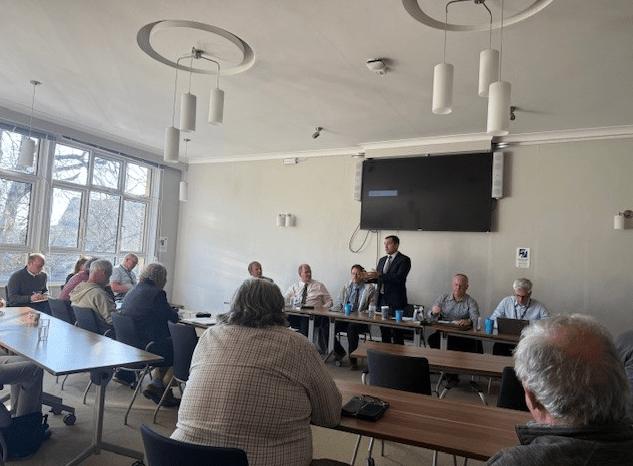
Having announced at the town council’s Annual Assembly their intention to hold the event, the VGS contacted all four candidates for the Sidmouth seat, inviting them to take part in a Q&A session in front of a live audience at the end of April.

However, only one candidate replied to the invitation positively, despite repeated efforts by the VGS to produce a full ensemble of candidates.

Denise Bickley, standing for the Liberal Democrats, said she “would be delighted to take part in the hustings and will make myself available whenever you can arrange it”.

Stuart Hughes, candidate for the Conservative Party, said “I’m having a real problem trying to sort a date for this… so it’s looking as though unfortunately I shan’t be able to attend your planned event”. His agent added that “it’s long days at the moment busy campaigning”.

Neither Suzanne Bullock of the Labour Party nor Basil Herbert of Reform UK responded to invitations to attend the hustings event, whether directly or though offices and agents.

The VGS has held hustings for both general and local elections over the past twenty years, the most recent being in June last year when all the candidates were able to take part.

As one commentator says about hustings events, “I think they are an important and traditional part of the process”.

The VGS event would have been the only such opportunity available for voters in the Sidmouth seat.

Hands up if you think Lib Dems can take Devon

It was a fun day on the campaign trail for Sir Ed Davey. It usually is.

Just over an hour after inhaling a full English, the Liberal Democrat leader led his council candidates to a bouncing pillow in a theme park, where they jumped for joy like excited schoolchildren.

Ali Mitib www.thetimes.com 

“This is bringing back memories of the election,” Davey said, before he lost his footing, bellyflopped on to the canvas and marched to the next ride at the Big Sheep theme park in Bideford, Devon.

After two minutes of waving to the cameras and petting a (fake) bear holding a honeypot, Davey’s wide smile faded. He dramatically turned to Ian Roome, the Lib Dem MP for North Devon, to discuss their chances at taking the Tory heartland in next month’s local elections.

Currently, the Tories hold 38 of Devon county council’s 60 seats, while the Lib Dems hold nine. The Conservatives have held the council for nearly 16 years, but there are hopes that Davey’s candidates can capitalise on frustrations at undelivered promises and declining local services to conquer Devon.

The county and the wider southwest are expected to prove particularly fertile ground for the Lib Dems, who predict that they will overtake the Tories in terms of the number of councils controlled to become the second biggest party. That crossover last happened briefly the year after Tony Blair’s landslide victory in 1997. At the moment, the Conservatives control 49 councils and the Lib Dems 37.

At the Big Sheep, Davey screamed and waved his arms on a solar-powered rollercoaster, joked with park staff about needing a responsible adult so he would be allowed to board the rides, and cuddled a pygmy goat.

But for the Lib Dem leader, the real fun began on the doorstep. After posing for pictures with candidates in nearby Barnstaple, he charged through the streets, leaving candidates and aides straggling behind.

Davey, who led his party to their highest ever number of seats in last year’s general election, had the demeanour of someone who feels victory is within reach.

“Ed, wait for us … He gets into canvassing mode and we just can’t stop him,” one aide said.

“I love canvassing,” Davey said on his way to the next door in a suburban street that would once have been firmly Tory. “When you’re talking to ordinary people, you get a much different view of things. It grounds you in what matters to people.

“It makes you realise the concerns that politicians become obsessed with are not the ones that matter to people. When I became leader, the party was quite upset by the Brexit debate and still wanted to talk about it the whole time, but people wanted to talk about the cost of living and the health service.”

Last year, Davey, the MP for Kingston & Surbiton, developed a reputation for stunts on the campaign trail, from bungee jumping to paddleboarding.

“This is the real campaigning,” he said, as he ticked addresses off his target sheet. “The last general election, when we were doing all these stunts, I had more conversations about Lib Dem policy than I had at any previous election, so by doing the funny stuff we had more conversations about the serious stuff. It’s a way for us to talk about our ideas.”

The Lib Dems hope to appeal to voters who feel betrayed not only by the Tories but also by Labour, who have historically had little support in the area.

At the heart of frustrations on the doorstep in north Devon are problems familiar to voters in seaside communities around the country: a rapidly declining tourism industry, long GP waiting times, delays to upgrades to the area’s hospital, and dangerous potholes.

“The message is pretty similar across the country,” Davey said. “The Conservatives have not recovered from the last election when they got their worst ever parliamentary result. What is the Conservative Party offering people? Not a lot. Their councils haven’t done that well.

“Labour hasn’t done well in government, from the family farm tax to the fuel payments, so there’s a sense that people are looking for something other than Labour and Conservatives and in many parts of the country that’s us.”

Emma Parker, 34, an office manager, was pleasantly surprised to see Davey walking up to her door.

“I thought they were Jehovah’s Witnesses for a minute,” she said, chuckling. Parker grew up in a Tory household but began supporting the Lib Dems after growing frustrated at the dire state of services in north Devon.

“I originally voted for the Lib Dems tactically because I didn’t want the Tories to win but now I trust them and feel like my morals align with them. I’ve been frustrated with the Tories for so many years because all of the broken promises they have made to people here about improving our services,” she said.

On the doorstep, Frank Biederman, 54, a Lib Dem councillor in the region for the past 12 years, radiated a quiet confidence that he has never felt before.

“There’s a bit of a spring in the step that we have as a party now,” he said. “When you see us win 72 MPs and you see an awful lot of councillors working hard to serve their communities, that encourages you. We have a shot at taking the council. It will be hard, but we need change. We need fresh ideas and impetus.”

A feeling of dread is growing among Conservative candidates in the area. With just weeks to go, Linda Hellyer, an incumbent Tory councillor, appeared dejected as she sat in a Costa Coffee in Bideford, a historic harbour town with a picturesque bay.

Hellyer, a lifelong Bideford resident, fears that Tory voters flocking to Reform because of national issues could clear the way for a Lib Dem takeover.

“I might be out of a job on May 1st. It’s really annoying that people vote on national issues when all county councillors can do is local things. I’ve been going around the doors and a lot of Labour people seem to be saying they’re reluctantly going to vote Lib Dem.

“I keep meeting people who are normally Conservative, but they’re convinced that we’re being run amok with illegal immigrants being housed by the council, and that’s not true. We don’t have anything we can do about illegal immigration here as a councillor.”

But for lifelong Tory voters, the theme of betrayal looms large. For Daisy, 55, the party’s treatment of Boris Johnson transformed her from a loyal Tory to a floating voter.

“They should’ve never voted Boris off because he did what he was expected to do, but too many people stabbed him in the back. I was a Tory voter then. They would’ve still been in if Boris were there. We may have had the new hospital by now if they were still in,” she said.

For Beverley Cheesman, 68, a long-time Conservative voter who is leaning towards the Lib Dems, the party has betrayed its base by failing to build a new identity and escape the shadow of its failures in government.

“The Tories don’t stand a chance at the moment. I don’t know who they are or what they stand for any more,” said the retired publican, who has started working part-time in a tobacconist after struggling to make ends meet on her pension.

“The Lib Dems will do well this time because people here have no faith in the Conservatives and I’ll be shocked if anyone votes for Labour here,” she added. “I don’t even know what the Lib Dems’ policies are. I just want a bit of change.”


Why do so many Tory county candidates need to re-brand themselves as “Local”?

More than half the Tory candidates in East Devon for the county elections on May 1 are describing themselves as “local Conservatives” rather than “Conservative party candidates”.

(It’s one of twelve Tory descriptions registered with the Electoral Commission)

A third of those describing themselves as “local” are clearly not.

Is the national Tory image that toxic than they feel they have to distance themselves from it? 

This attempted re-brand doesn’t convince Owl.

The leader among them is Ben Ingham. He’s been a Conservative; an Independent; an Independent who formed a coalition with the “Build.build, build” Conservative minority in EDDC; then he went back to the conservatives.

He lives on the Lympstone edge of Exmouth and is contesting the Seaton & Colyton division, so how can he possibly describe himself as a “Local Conservative”?

[Truth is there’s probably not much love for him in Exmouth party circles as he once took a pop at ousting that old stalwart Cllr Christine Channon for the Exmouth and Budleigh Coastal Division in 2021 but failed. Significantly he failed to be selected for either of the two seats in the Exmouth Division or the seat Christine Channon is vacating.]

Another “crosser of the aisle” is Stuart Hughes, a one time member of the “Monster Raving Loony” party and cabaret act. He is the councillor who, as DCC cabinet member for highways management, failed to fix the potholes when the sun was shining in 2021

He was a notorious member of the “Build, build, build” EDDC council (described as the “Blue Kremlin” in a Guardian article). In 1989 he formed the breakaway “Raving Loony Green Giant Party” and finally(?) defected to the Conservatives in 1997.

As Chair of EDDC he cancelled the May 2020 elections in a crude attempt to deny a democratic transfer of power as Ben Ingham’s coalition fell apart. This disgraceful attempt failed as did the recent attempt by the Tories in County to cancel the elections this May, 2025.

Then there is Jenny Brown of Honiton, also stressing her “local” credentials, yet set to contest Axminster.

Cunningly, the Tories added “Local Conservative” to their list of twelve descriptions registered with the electoral commission in 2019.

It’s all subterfuge. Tories  disguising  themselves as: “local people trying to do the best for their communities, after all local elections shouldn’t be about national politics”. Don’t be fooled by it.

Only two Conservatives in the rest of the county feel the need to use this description.

Here is the  list of Tory candidate in East Devon claiming to be “local”:

BROWN Jenny, Local Conservatives (Axminster)

TWISS Phil, Local Conservatives. (Feniton and Honiton)

CARTER Paul Richard, Local Conservatives (Otter Valley)

INGHAM Ben, Local Conservatives (Seaton and Colyton)

HUGHES Stuart, Local Conservatives. (Sidmouth)

CHUBB Iain, Local Conservatives (Whimple and Blackdown)

Budleigh Salterton at highest risk of illness from water pollution

This refers to swimmers needing to see a doctor.

Last year Budleigh was the eighth worst location nationally.

Swimmers have already fallen sick at Budleigh this year, according to reports logged by the Surfers Against Sewage waterborne sickness dashboard.

[And not all swimmers falling sick will have logged a report].

This is despite Budleigh’s “excellent” bathing water quality and “seaside award” flag.

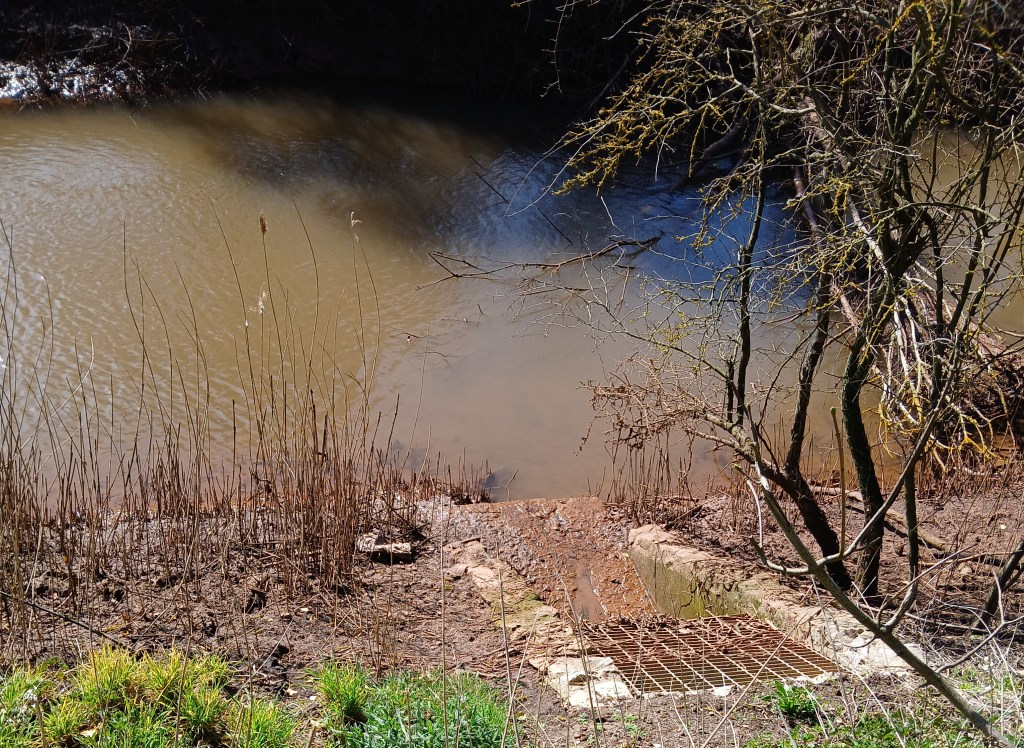
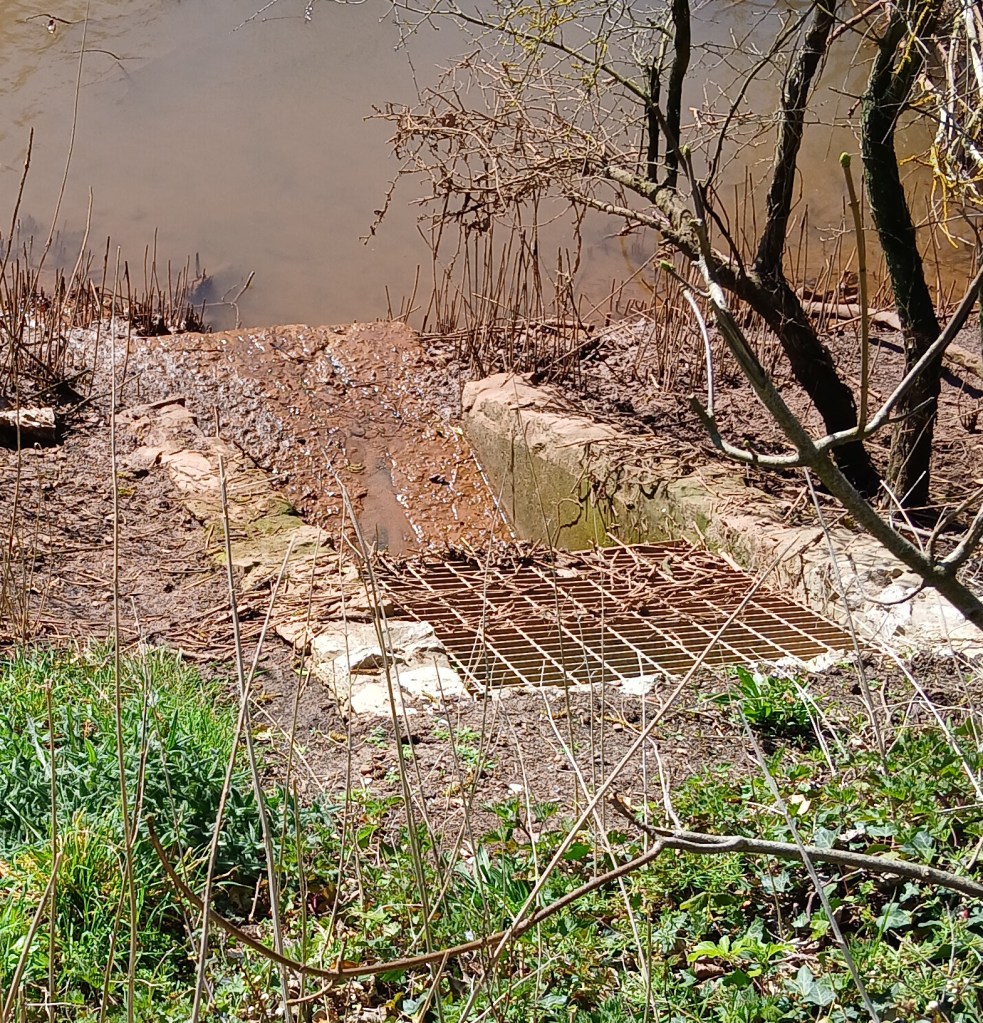
Budleigh correspondents have frequently pointed out to Owl that those parking in the Lime Kiln car park should take a look at the now stagnant Kersbrook at the side of the skateboard park with its dying trees and the clearly visible sewer emergency outfall. These correspondents point out that this water flows into the sea 100m away through a conduit under the road. Its end is visible at low tide.

Sasha Swire, perceptively, once described Simon Jupp, now a member Pennon Group’s PR team, as “Jumping Jupp Flash”. (Pennon Group is the parent company of SWW).

So, come on Simon tell the people of Budleigh what the company solution is.

Owl would also like to know whether David Reed MP is “on the same page” as Simon Jupp, his predecessor, or vice versa?

Can you trust a Tory on pollution?

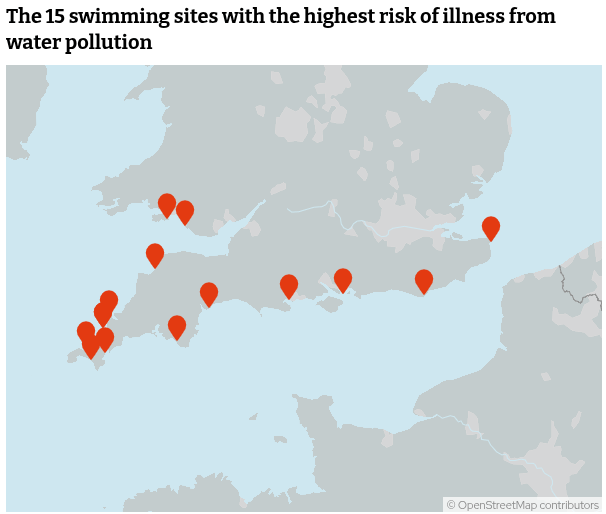
The 15 swimming sites with the highest risk of illness from water pollution 

Alannah Francis inews.co.uk

So far this year, 147 health reports have been logged by the Surfers Against Sewage waterborne sickness dashboard

The amount of sewage being dumped into UK rivers and seas is on a scale that “defies belief” and is putting public health at risk, water safety campaigners have warned.

So far this year, 147 health reports have been logged by the Surfers Against Sewage waterborne sickness dashboard. However, the link between the cases and water quality have not been confirmed by doctors.

The most commonly reported illness is gastroenteritis, an infection in the gut that causes diarrhoea and/or vomiting, followed by ear, nose and throat infections.

It comes after the number of pollution incidents recorded by water companies in England reached a 10-year high, analysis from Surfers Against Sewage (SAS) shows.

The 2,487 pollution reports last year are more than double the target set by the Environment Agency, the charity said.

SAS said it received 1,853 sickness reports through its Safer Seas & Rivers Service app last year – an average of five a day.

A total of 331 people had to see a doctor, with 79 per cent of them reporting that their doctor had attributed their illness to sewage pollution. Fifteen people reported being hospitalised, according to the report.

Where have the most sickness reports been recorded?

Ramsgate in Kent, Bantham in Devon, Gyllyngvase in Cornwall, and Rest Bay at Porthcawl, Wales, top the table for the highest number of sickness reports recorded by SAS this year, with four cases each.

Branksome Chine in Poole, Dorset has three. The rest, including Westward Ho! in Devon, Southsea East in Hampshire, and Budleigh Salterton in Devon, each have two sickness reports.

Last year Westward Ho! was the third most common location for sickness incidents, with 31 reports; Southsea East was fifth with 25 reports, Budleigh Salterton was eighth with 23; and Gyllyngvase followed closely behind with 22.

What are the most common waterborne sicknesses?

According to the latest 2025 SAS sickness dashboard data, they are:

  • Gastroenteritis – 114 cases
  • Ear, nose and throat – 20
  • Respiratory – 11
  • Skin infection – 7
  • Non-specific virus- 7
  • Eye infection – 5

The total number of cases slightly exceeds the number of sickness reports as some have more than one symptom, SAS said.

Which bathing waters were most affected by sewage discharges in 2024?

The 10 bathing sites in England most impacted by sewage discharges last year, according to analysis by SAS, were:

  • Wallasey – 2,201 discharges
  • Dart Estuary – 1,553
  • Plymouth Hoe East – 1,511
  • St Annes – 1,232
  • Steamer Quay – 987
  • Wolvercote Mill Stream – 866
  • Spittal – 782
  • Walney Sandy Gap – 774
  • Allonby – 768
  • Fleetwood – 745

‘Water pollution landed me in intensive care’

Wellbeing coach Suzi Finlayson told SAS she fell ill after swimming at Aldwick Beach in Bognor Regis in December 2023.

The charity found that one sewage overflow from Southern Water in that month, into the waters at Aldwick, had lasted 343 hours.

In January, after weeks of sickness, Ms Finlayson was diagnosed with a blood infection that had led to endocarditis, a rare and potentially fatal inflammation of the inner lining of the heart.

“I became critically ill and spent six weeks in hospital care, including intensive care, followed by six months of recovery from open-heart surgery for a mitral valve replacement,” Ms Finlayson said.

She had to close her business because of the impact on her health and the demands of her recovery.

How have the water firms responded?

A spokesperson for Water UK, the trade association for the industry, said: “We have been clear that the water system is not working and support the Independent Water Commission looking at every aspect of how the industry is regulated.

“However, no sewage spill is ever acceptable and water companies are investing £12bn to almost halve spills from storm overflows by 2030.

“This is part of the largest amount of money ever spent on the natural environment to help support economic growth, build more homes, secure our water supplies and end sewage entering our rivers and seas.”

Lib Dems “have mountain to climb” in Devon but Sir Ed is optimistic

Liberal Democrat leader Sir Ed Davey says his party has “a big mountain to climb” to take control of Devon County Council in the forthcoming election from the Conservatives but is “working hard” to make gains.

Alison Stephenson, local democracy reporter www.radioexe.co.uk 

Goating around. Sir Ed Davey (on the left) is optimistic for elections (image: LDRS)

Speaking during a visit to The Big Sheep attraction near Bideford to flag up pressures in the south west tourism industry and boost the party’s chances in the north of the county, Sir Ed said he is “optimistic” after last year’s general election when his party took six seats from the Conservatives in Devon.

The publicity attuned leader, known for his campaign trail stunts which  last year which included paddleboarding and water slides, was not holding back at The Big Sheep where he along with North Devon Liberal Democrat MP Ian Roome and seven local candidates tried out the rollercoaster, giant jumping pillow trampolines and other attractions.

Although the general election result was the best in 100 years for the Liberal Democrats,its contingent during the last term of Devon County Council was nine councillors, with the Conservatives holding 38 seats. The Tories took control from the Lib Dems in 2009.

“We feel there is some momentum behind the result we had last July and there is a lot of support coming our way,” he said. “I have been talking to some our candidates here in Devon who have been knocking on doors, really campaigning hard.

“They tend to be people who are active in the community already and are getting really good feedback with lots of lifelong Conservatives saying they are switching to the Liberal Democrats and Labour voters who have been disappointed by the government switching to us too.”

He said road maintenance in Devon is “a massive issue”, as well as social care and a lack of dentists.

“Social care is really important for the council’s finances which have not been run very well under the Conservatives. All councils are strapped, not just Devon, but Devon is one of the worst, with the massive debts they have run up in the last four years.

“The next administration is going to have a tough time sorting it out but if you listen to people and make sure you are focusing on their priorities you can do it and the Liberal Democrats are very committed to that.”

In his second visit to northern Devon in six months, Sir Ed called on the government to host an urgent south west tourism summit to address the impact of national insurance tax hikes and the cost of living crisis.

The Liberal Democrats have asked for an exemption for these sectors, which Sir Ed says will be disproportionately affected by the tax hike because they employ many seasonal workers on low wages.

“So far it has fallen on deaf ears, but we will keep campaigning,” he said.
 

Chief constable won’t be prosecuted, but remains suspended

So we are still getting one for the price of two, or is it three? 

Owl is confused about the pay status of the deputy who stepped up only to be suspended whilst being investigated for something else.

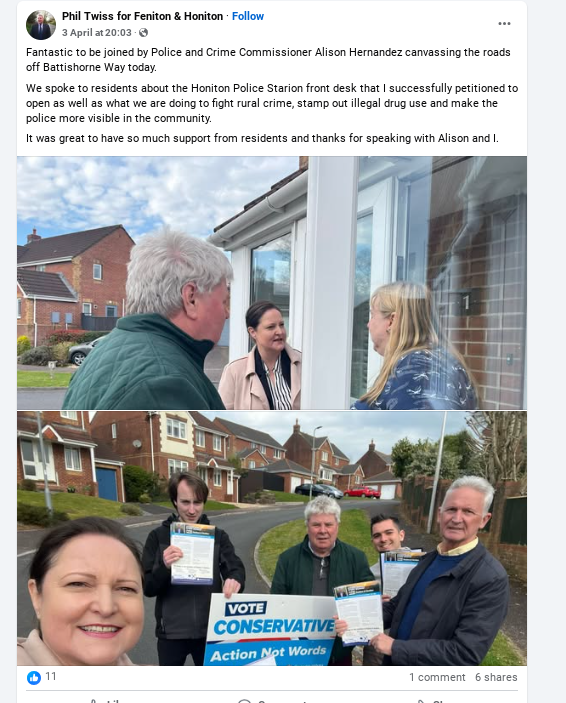
No doubt Alison Hernandez has everything under control, or is she out taking selfies with vulnerable Tory County Council candidates?

[On this photo Tim commented: “Given that she suspended a police Chief Officer for inappropriate use of an official mobile phone, I hope she hasn’t claimed for the one she is here using for party political purposes, as an official PCC phone/camera!“]

Chief constable won’t be prosecuted

Radio Exe News www.radioexe.co.uk 

Investigation into Will Kerr dropped, but he remains suspended

The suspended chief constable of Devon and Cornwall Police won’t be prosecuted over allegations of sexual offences.

Almost two years after Will Kerr was suspended, prosecutors in Northern Ireland have announced the decision, and also said he won’t face charges relating to an allegation of misconduct in public office.

Mr Kerr was a former chief constable of the Police Service of Northern Ireland and worked there for 27 years, before joining Police Scotland.

He took the top job at Devon and Cornwall Police in December 2022 but was suspended seven months later after it emerged he was under investigation for following allegations of sexual offences.

At the time he strenuously denied any allegations of criminality.

The force’s deputy chief constable Jim Colwell stepped up into the role, until he was suspended last year whilst an investigation takes place into a separate matter.

Today’s news does not mean that Mr Kerr will return to work in the short term. In light of the announcement, it is understood that the IOPC will resume its investigation into allegations of misconduct against Mr Kerr. He will remain suspended until its outcome.

Interim chief constable James Vaughan, who was appointed to the role last December, will remain in post until any outstanding matters are concluded.

Alison Hernandez, police and crime commissioner for Devon, Cornwall and the Isles of Scilly said: “I am delighted to hear that Mr Kerr is no longer under criminal investigation. This will be a significant relief to Mr Kerr and his family. It is disappointing that it has taken nearly two years to get to this decision. 

“While this is a major milestone, we await further instructions from the Independent Office for Police Conduct on any potential misconduct matters which may still need their oversight.

“The leadership of Devon and Cornwall Police remains under the stewardship of Mr Vaughan until any outstanding matters are concluded.”

Protect our right to swim – Good Law Project

Every morning, Jo Bateman checks her phone to see if the sea is closed.

Good Law Project 

Swimming in Exmouth has been vital for Jo’s mental health and wellbeing. But South West Water has shattered that routine by dumping raw sewage where she swims.

Last year the firm poured sewage out on to the beach in Exmouth 217 times, for a total duration of 2,156 hours, keeping Jo out of the water for days at a time. And there have been more than 100 dumps so far this year, with 1,115 hours of spills from January to March.

Jo says the sewage South West Water continues to dump into our waters is “disgusting:”

“It pollutes our beaches, harms nature, makes people sick – and takes away our right to swim.”

That’s why we’re backing Jo as she takes on South West Water – a company that unleashed a tide of sewage on her beach. After our Supreme Court win, she’s broadening her challenge to cover 300 days when swimming was impossible in Exmouth.

She’s fighting for transformational change – and she’s not backing down.

Best wishes,

Katrina, Good Law Project


Good Law Project only exists thanks to donations from people like you.If you would like to support us further, you can make a donation here:

Sewage is being dumped into our rivers and seas on a scale that defies belief

Our latest Water Quality Report reveals that sewage is being dumped into our rivers and seas on a scale that defies belief—and the people who should be stopping it are cashing in instead.

Surfers Against Sewage Quality Report 2025 www.sas.org.uk (Extract)

[See separate post on how “industry leader”, South West Water, was rewarded £6.7m for failure.]

While private water companies handed £1.2 billion to shareholders, they also dumped 4.7 million hours of sewage into our waterways in 2024. That’s 592,478 spills in just one year.

At the same time, water bills are rising, targets are being missed, and public trust is circling the drain. Over a quarter of adults in England are so fed up, they’ve considered not paying their water bills.

Our latest Water Quality Report lays it all bare. Read the report

Water companies are failing

Our report reveals broken promises and missed pollution targets. Billions for shareholders, while customers pay more for less. Public health at risk, with zero accountability. And a total lack of transparency from those in charge.

England

In 2024, water companies in England recorded 2,487 pollution incidents—more than double the target set by the Environment Agency. This marks the highest number in a decade, despite promises to clean up their act.

The water industry was meant to reduce pollution by 40%. Instead? We’ve seen a 30% increase.

…….Results for Wales, Scotland and Northern Ireland omitted in this extract……

People are getting sick

Our Safer Seas & Rivers Service App received 1,853 illness reports from water users in 2024 alone—that’s five people a day getting sick after entering polluted water.

  • 331 people saw a doctor
  • 79% were told their illness was caused by sewage
  • From gastro bugs to chest infections, even hospitalisations and heart surgery—the human cost is staggering.

Real people. Real impacts.

  • Suzi, a sea swimmer from Bognor Regis, ended up in critical care and needed open-heart surgery after falling seriously ill.
  • Charlie, an Ironman athlete, was left isolated and unable to train for months after collapsing from a virus caught while swimming.
  • Shelley, a carer from Scotland, was hospitalised for 5 days after contracting a diarrheal disease from contaminated water, impacting her ability to care for her son.
  • Martyn, a swimmer from Pembrokeshire, had his eye swell and close up after swimming at his local beach. He needed painkillers and antibiotics and was left unable to work or drive.
  • Ben is the director and head coach at Surfability in Swansea, which runs adaptive surf sessions for people with additional needs. He’s been forced to cancel many surf lessons due to poor water quality, reducing access to the healing power of the water for many people.

These stories are just a few of thousands. Read more shocking stories in the report.

See more stories

We’re calling for radical reform

We simply cannot trust the UK’s water industry in its current state. Our Water Quality Report calls for urgent and transformational reform of the privatised water industry. It’s time to:

✅ Put people and planet before profit

✅ Give local voices a say in how water is managed

✅ Enforce the law—no more pollution without consequence

✅ End profit from pollution—once and for all

NOW is our opportunity for real change. The Independent Commission will be finalising its recommendations for water industry reform in England and Wales in May. This is our chance to be heard.

South West Water rewarded £6.7m for failure

“Industry Leader” South West Water received a financial reward worth £6.7 million in 2019 for the promises it made to improve our water quality over the following five years. Ha, ha!

But SWW  is on track to FAIL by a wide margin

Owl thought that SWW was an “Industry Leader” in pollution but it seems, in this context, it means Industry leader in creative writing of future plans.

Now, in 2025, we are starting a new five year review period, similar promises are being made and Ofwat has again dished out a reward for SWW’s next set of plans.This time it’s worth an equivalent to £36 million. 

“The stench of the sewage scandal has become a fixture of the mainstream news in the last few years, with water companies making promise after promise to deliver record investments and hit all kinds of glittering targets. But can we ever truly believe them?” 

Extracted from Surfers Against Sewage Water Quality Report 2025 with a few additional headings for clarity.

The report continues:

Promises, promises – Price Review Plans

“Water companies in England and Wales are regulated by multiple bodies, including Ofwat, which oversees their finances and operations. Every five years, each company has to submit investment plans to Ofwat through a process called the price review (PR).

PR plans show us what each water company is promising to deliver, the level of investment needed; and how much customers will have to pay in bills over the course of the five years the PR plan runs for. 

In a functional system, that makes total sense. But in a broken industry, you learn not to trust companies to deliver on their promises. Or the regulator to hold them accountable. 

Forget the old unmet promises – look on the bright side and welcome the new

Why are the new proposals welcomed into the room so warmly, when all the unmet promises from the previous plan are still sat there in plain sight?

In 2025, PR19 ended, and PR24 began. We took the opportunity to examine the past five years of PR19 (2020-2025), to see whether water companies got anywhere near achieving what they’d pledged. 

Assessing the “industry leaders” 

In its initial assessment of PR19 plans, Ofwat identified three companies that stood out: South West Water, Severn Trent and United Utilities. 

According to the regulator, this trio offered ambitious plans that set a new standard for the water sector. So, it awarded them fast-track status. In exchange for promising to trailblaze on positive outcomes for both customers and the environment, these companies were heralded as industry leaders; given a head start on other companies to get working on their big plans, and millions in financial rewards.11 But what standard were they really setting for the industry?

South West Water (SWW) received a financial reward worth £6.7 million for its 2019 plans. 

Part of this reward was allocated because SWW promised to deliver on its proposed sector leading outcomes, like improving its environmental ratings and reducing sewer blockages. 

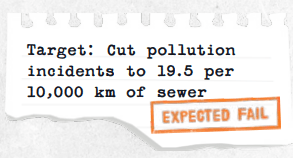
SWW pledged to reduce pollution incidents to 19.5 incidents13 per 10,000 km of sewers by 2024-25. 

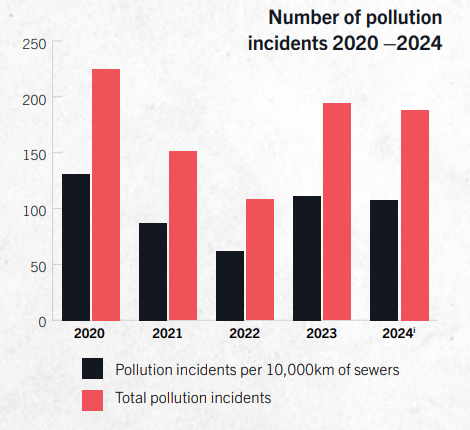
So far, it’s failed miserably. In fact, between 2022 and 2023, pollution incidents on its patch shot up by 80%. 

We can’t access official data on pollution incident reports until July 2025, but we have received unverified data from the Environment Agency through a Freedom of Information request. 

This data shows that there were 188 pollution incidents in 2024.

Assuming the length of the sewer network remained the same as the year before, this equates to 107.8 pollution incidents per 10,000 km of pipe. While this number may change once the final figures are released, our investigation suggests that South West Water is on track to fail its target – with five times more pollution incidents than they were aiming for. 

However we’ve been digging into SWW’s performance when it comes to sewage pollution over the last five years and they do not look like a water company performing exceptionally.

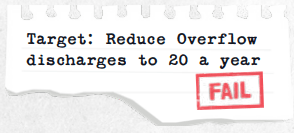
In April 2022, SWW’s Plan for Healthy Rivers and Seas14 contained a pledge to cut storm overflow discharges to an average of 20 per year by 2025. In 2024 their average discharges per overflow was 41.3, which is more than double the target. And 2025 isn’t looking much better. According to our live reporting data from Data HQ, 21% of SWW overflows surpassed this annual target by March.

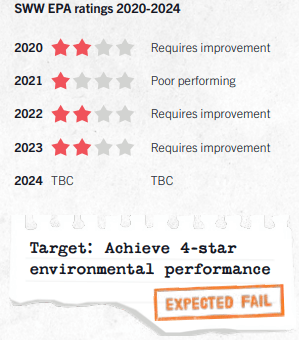
In its PR19 plans, SWW boasted it would achieve a 4-star environmental performance rating, this was one of the key performance outcomes Ofwat cited as the reason that SWW would receive a financial reward. By 2023, the latest figures we had at the time of writing, it had only managed to hit 2 stars.

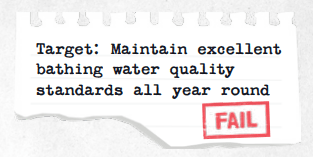
SWW states that it wants to “maintain excellent bathing water quality standards all year round, so everyone can enjoy our 860 miles of coastline, whatever the time of year”.

Last year, 3,168 sewage alerts were issued at bathing waters within South West Water’s region.

These alerts were throughout the year, with 541 alerts issued during the bathing season – May to September in England – and 2,627 alerts during the rest of the year. With such rampant pollution, we highly doubt the water quality will be anything close to excellent year-round.

The future for South West Water: a grim tide

After five years of SWW failing to meet targets, Ofwat has again dished out a reward for SWW’s next set of plans. This time it’s worth an equivalent to £36 million. 

One of those goals for the next 5 years will be familiar from last time: “The company will improve its environmental performance by achieving 4* Environmental Performance Assessment (EPA) status by 2028.” 

SWW also announced in February 2025 that it will be investing more than £700 million to reduce storm overflows across the region in the next five-year period.

The aim is to make SWW the first water company to meet the Government’s target of fewer than 10 discharges per year – an impressive 10 years ahead of deadline. 

SWW has a huge mountain to climb. 872 of its combined sewage overflows (CSOs) discharged over 10 times in 2024 (64% of their total overflows). 

And as it’s failed time and again to meet environmental targets over the past five years, how are we supposed to trust them now?

Ah! Is this why SWW has just recruited “super hero” PR expert Simon Jupp.

The local MP rejected by the electorate but with all the connections? – Owl

See this post to find Simon’s ambiguous record on “holding South West Water to account”.

Katherine Wilcox on the proposed closure of Santander in Exmouth as profits rise 14%

Dear Owl,

The proposed closure of Santander Bank in Rolle Street Exmouth, has been greeted with dismay by hundreds of customers.  Santander has claimed that the fall in the number of customers visiting the bank and the increase in online banking removed the necessity for a high street presence in Exmouth.  However, the bank’s closure will cause major disruption to many residents and surrounding areas who rely on the excellent counter service that that staff provide at the Exmouth Branch.

Many elderly and disabled residents rely on the counter service to do their banking and could not cope with an online only service.  I stood for an hour last week collecting signatures from customers who opposed the bank closures.  It was distressing to hear from these customers the devastating impact that Santander’s branch closure would have on them.

Santander, like the other high street banks in Exmouth who have stopped providing face to face customer services are failing their loyal customers for the pursuit of even more grotesque profits. Santander’s profits of 12,574 million euros in 2024 represented a 14% increase on 2023.  Not too shabby for a bank that seeks to wring maximum profit from its banking operations regardless of the personal cost to its customers.

The hands off approach taken by successive governments to high street bank closures needs to be re-examined.  Why does the government not impose a swingeing wealth tax on those banks who are closing their branches and reward those banks and building societies which remain on in our towns and cities with preferential tax rates?  If governments provided disincentives for banks to close their branches, it would be a lifeline to the millions of elderly and disabled customers who would find online banking alone extremely difficult if not impossible to manage.  Such a policy would also  help small businesses in towns and cities to operate with a local bank available for their banking requirements.

Katherine Wilcox

[Katherine is a longstanding correspondent on consumer issues.]

Today’s Sewage Pollution – the big picture!

Do we expect this every time we have a spot of rain?

https://www.sewagemap.co.uk/

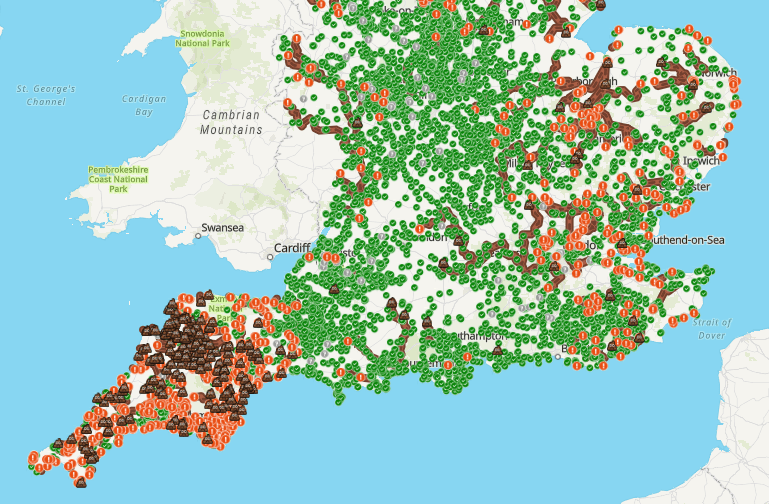
This map shows, in real-time, which river sections are downstream of sewage discharges from storm overflows.

About the Data

The data is collected through Event Duration Monitoring by individual water companies, providing near-real time data on storm overflows. The data is accessed from the Storm Overflow Hub maintained by Water UK. Storm overflows release untreated, diluted sewage into the environment. Currently, only Thames Water provide an API to historical sewage spill data. We wrote an article about why water companies need to be more transparent with environmental models and data in 

This site was created by Alex Lipp (UCL)Jonny Dawe.

Another MP for Everywhere and Anywhere – a letter from a corespondent

Dear Owl, 

The MP for Exmouth and Exeter seems to spend a lot of time concerned about what is going on in other constituencies rather than his own. 

In the last week, he has commented about Hertfordshire and Birmingham. 

https://www.facebook.com/DavidReedMP

In Hertfordshire’s last Ofsted inspection for children’s services in January 2023 they gained 3 outstandings and 2 goods.

https://files.ofsted.gov.uk/v1/file/50210577

In Birmingham City Council’s last Ofsted inspection for children’s services in February 2023 they gained 5 goods. 

https://files.ofsted.gov.uk/v1/file/50214110

In Devon’s last Ofsted inspection for children’s services in January 2020 they gained 3 inadequates and 1 requires improvement. 

https://files.ofsted.gov.uk/v1/file/50214110

The recent Ofsted inspection for children’s services was carried out last year. Apparently it has been contested. 

https://www.devonlive.com/news/devon-news/devons-delayed-ofsted-report-being-9818189

The MP for Exmouth and Exeter East’s constituents would welcome an explanation from their MP as to why the publication of this report was contested. Was it because Devon County Council’s children’s served were judged as not reaching good or outstanding in all areas?

The MP for Exmouth and Exeter East hosted an Exmouth and Budleigh Water Summit. Constituents would like to know who attended, what was discussed and what he is doing to “make sure South West Water deliver on their promises.” 

It all sounds all words and no action. 

Constituents are concerned about the increase in their water bills. Is the MP for Exmouth and Exeter East posing questions about how well the company is being run. Was the appointment of Director of Regional Development – Pennon Group PLC necessary or was it a job creation?

The MP for Exmouth and Exmouth East should be raising questions about “The revolving door between water companies, regulators and government.”

Yours sincerely, 

A constituent who would value an MP who concentrates on his constituency rather than other places in the country. 

South West Water pollute our rivers and seas – now the’re trying to flush our wallets

Richard Foord MP for Honiton and Sidmouth stands up in parliament for the people of Devon and Cornwall affected by pollution, calling South West Water “aloof, even arrogant”, “a byword for failure”.

He continued: “They are now trying to flush out constituents’ wallets, issuing bill rises of over 50% in some cases.”

He spoke on Tuesday in the Easter Adjournment Debate and  ended by saying:

“South West Water is proposing to spend £3.2 billion on infrastructure improvements, but the crying shame is that it has failed to invest in its infrastructure in years gone by. This week, we have learned that the PR side of the business is going to be joined by none other than the former MP for East Devon, Simon Jupp. He is going to speak for South West Water, having attacked it while he was a Member of Parliament.

A very different speech to the self-serving one made by David Reed MP for Exmouth and Exeter East on Monday.

Here is the Hansard transcript of his full speech:

Richard Foord Liberal Democrat, Honiton and Sidmouth  5:39, 8 April 2025

I rise to talk about South West Water and Pennon Group. I speak today for  anyone in Devon and Cornwall who has ever had to walk past a polluted stream, stay out of the sea when visiting a beach, or stare at a water bill and wonder, “How did we end up here?” South West Water, like its parent company, Pennon, has become a byword in the south-west for failure, aloofness and even arrogance. In 2024, the company dumped sewage into our rivers and seas for over 540,000 hours. These spills are supposed to happen only in exceptional circumstances; in reality, this has been regarded as a licence to pollute.

If that were not enough, South West Water is now trying to flush out our constituents’ wallets, issuing bill rises of over 50% in some cases. I should say that Ofwat ruled last December that bills can rise by 36% on average over five years, before inflation. However, that 36% rise is permitted on average bills, and many bills for residents in Devon have risen by much more.

Stuart Thompson, who lives near Aylesbeare, has found that, even though he is not connected to South West Water’s sewerage system, his annual bill is now £761, even though last year it was just £486. That is a jump of over 56%. Stuart is a cancer patient, and his immune system is weakened from treatment. To protect himself, he boils his water before drinking it, because he is conscious that South West Water had an outbreak of the Cryptosporidium parasite last year. One can understand his caution, given his weakened immunity.

When Stuart tried to ring South West Water, he found himself 178th in the queue, and that is not a one-off. Graham Long, who lives in the Blackdown hills near Honiton, also tried ringing South West Water. Like Stuart, Graham found on the first occasion that he was 106th in the queue. On another occasion he was 94th, when he tried at a quieter time he was 87th, and on a day that was quieter still he was 74th in the queue. That is absolutely crazy from a water company hiking people’s bills in some instances by 56%.

Louise Thompson from Sidmouth contacted me in disbelief about her instalments. She did get through to South West Water, and when she raised her concern about her higher bill, she was offered a reduction to £49 a month, rather than the £70.32 for which she had been billed. However, she worked out that this was because the instalments would be spread over 12 months rather than 10, so it was a cloak for no bill reduction whatsoever. Yet, since privatisation, this company has paid out more than £4.5 billion in shareholder dividends.

South West Water is proposing to spend £3.2 billion on infrastructure improvements, but the crying shame is that it has failed to invest in its infrastructure in years gone by. This week, we have learned that the PR side of the business is going to be joined by none other than the former MP for East Devon, Simon Jupp. He is going to speak for South West Water, having attacked it while he was a Member of Parliament.

Do Tory political boards also serve as markers for future development?

Tim has just posted this comment:

Owl’s reference to the political boards adorning numerous patches of local land fits with observations I made whilst moving about the area yesterday. It struck me that the blue boards for Scott and Trail may well also serve as markers for land that will be developed in the future. So, maybe Cllrs Scott and Trail can give us advance notice of the infrastructure proposals that might be appropriate.

Such boards are placed with the landowner’s permission and I’m guessing they may just be offered up for development at some time in the future.

I distinctly remember Hugo Swire getting very upset that similar boards for one of his elections were damaged at Goodmores years back. His reposte included a claim that they were on private not public land, and that the landowner had given permission. We know all know what has happened to the Goodmores Farm fields – well, apart from any infrastructure that is.

Mr Reed should perhaps look at his party’s past involvement in local planning – perhaps through the spectrum of the roles held by Cllr Stuart Hughes, a DCC councillor, a EDDC councillor and a town councillor. At DCC his portfolio included Highways – and highways includes potholes.

At EDDC he was known for planning amongst other roles- and of course his infamous “We plan everywhere” YouTube video at https://www.youtube.com/watch?v=kEeCh4d9wIw His party controlled EDDC when Goodmores was passed by planning.

Stuart was once a member of the Monster Raving Lunatic party. https://www.torbayweekly.co.uk/news/home/1543781/when-devon-became-a-loony-hotspot.html

What happened to integrity? Simon Jupp joins SWW; David Reed MP gets £5K from Exmouth Developer

The parliamentary register of interests shows David Reed received £5K, on 2 August 2024, from 3West Group, the Woodbury based developers of Goodmores Farm Exmouth!

On Monday David Reed MP asked questions in Parliament about EDDC’s failure to plan infrastructure for development of tens of thousands of homes.

CONFLICT OF INTEREST DAVID REED?

Did he declare this at the beginning or his speech in the house on 7 April [Not according to Hansard] or just assume it was OK because it’s recorded in the parliamentary register of interests, so everyone, including his constituents, are bound to know?

Like Jupp’s move to SSW’s parent company Pennon; it’s all within the rules, but it smells.

Here is David Reed’s link to his oral question.

Here is the text of his question from Hansard:

In my constituency of Exmouth and Exeter East, the Lib Dem local council is proposing to build tens of thousands of new homes with little thought for corresponding infrastructure. I have spoken to local councillors, and they believe they have no agency in this process and central Government are telling them what to do. What more can be done to ensure that local authorities are held accountable for their decisions?

Let Owl put the record straight.

Overall Housing Targets

It’s not this council that wants to build “tens of thousands” of new homes it’s the toxic consequence of an historic local plan Tory legacy and the “build at any cost” Labour Government.

It is well recorded in the “Watch” how Paul Diviani, alongside the faithful Philip Skinner, were the architects and driving force behind the EDDC “Build, build, build” strategy from 2005 to 2020. It resulted in the current Local Plan having a development target of 950 houses/year, based on an aggressive “jobs led policy on” scenario.  Where studies showed only around 580 houses/year would be required to satisfy demographic and normal migration growth trends. 

This is an uplift of 370 or 64% on what is strictly necessary and is the target that the current EDDC coalition has inherited. It is the basis on which the government thinks reasonable to set its own growth strategy.

Goodmores Farm is a good example of how a council’s hands are tied once it grants outline planning permission. Seeking outline planning permission has become common practice. In this case it was the outgoing Tory Council that granted outline permission which the incoming coalition were unable to control. For example, along the line, the targets for affordable housing fell from 25% to just 5% as the developer pleaded, successfully, that it would be “economically unviable” to proceed with the higher figure. There now appears to be £5K left for David Reed.

Here are some quotes from councillors at the time:

“The scheme won’t win awards for the layouts”

“Of all the sites, this is the runt of the litter” 

“It is everywhere houses in an everywhere town.” 

“This flagship new housing development says to many younger people seeking a first house, ‘You are not welcome here’.”

So a question for you David Reed is what infrastructure is your sponsor 3Ways Group planning?

Infrastructure

Not all infrastructure is provided by EDDC. Highways is an example; think how long has Exmouth waited for the Dinan Way extension?

The provision of adequate sewage treatment is another classic example. The problem local authorities have is that, although they are the planning authority, they can’t successfully defend an appeal against planning rejection on the grounds of inadequate sewage capacity unless supported by the Environment Agency (e.g. phosphate levels in the Axe) or South West Water.

SWW rarely claim they can’t deliver the required resources – indeed they promised new capacity for Cranbrook which never materialised.

It is also worth noting that the government of the day (Labour) insisted the planning for the new town of Cranbrook should be developer-led including the town center, schools, medical clinics etc.

Building Affordable Housing

Build enough houses and the developers will cross subsidise the building “affordables

That’s the theory but it hasn’t worked in East Devon.

Having gained planning permission on a promise to deliver a certain number of affordables, developers frequently claim later that “viability assessments” mean that they have to reduce the number.

Notorious local examples include Goodmores Farm (25% down to 5%), Evan’s Field in Budleigh (30 houses to 5) and Cranbrook. (67 houses 28% of total reduced to 44 just 18% when EDDC’s policy target is 25% in one zone, and 26% reduced to zero in another).

Who is happy to stick their election posters by the Goodmores site?

“What if”……..Simon Jupp turned up at David Reed MP’s “on the same page” meeting with SWW?

Owl would love to become a fly on the wall for such an event!

David Reed has always advocated a softer “on the same page” approach in tackling the local sewage problem with South West Water. Today, Owl posts a correspondent’s frustration at the lack of progress this approach is having.

In the light of his predecessor’s defection to take a job with South West Water’s parent company, Pennon Group (see below), this phrase takes on a whole new meaning.

Owl has heard whispers that David Reed’s second “on the same page” meeting is scheduled for this Thursday 10 April, included are: the Environment Agency, South West Water, Exmouth Town Council, Clinton Devon Estates and possibly ESCAPE (if they are on the same page) .

Definitely excluded, because they’re not “on the same page”, are EDDC, despite EDDC environmental officers having a formal role in every incident.

What if Simon Jupp, David Reed’s predecessor as Tory MP for East Devon, were to turn up?

“Hello David I’m here with the team to talk about working with communities across the region on our future development plans……….”

Can anyone in East Devon now trust a Tory on pollution?

For those not up with the background see: Simon Jupp takes job with owner of water firm he “denounced” – the https://eastdevonwatch.org/2025/04/07/breaking-simon-jupp-takes-job-with-owner-of-water-firm-he-denounced-the-whole-thing-stinks/whole thing stinks!

A correspondent wonders why David Reed’s “voice of reason” hasn’t ended sewage pollution

Owl received this letter a week ago – it now, as his predecessor joins South West Water, seems a particularly pertinent moment to publish it.

Dear Owl, 

In the run up to the general election, I had canvassers come and visit me from our three main political parties: Conservatives, Labour and Liberal Democrats. 

The canvasser on behalf of the Conservative Parliamentary Candidate for Exmouth and Exeter East understandably spoke highly of the candidate. He stated that David Reed was a former marine who had served the country and was ready to serve his constituents. 

I retained all of the election leaflets as I was determined that whoever was elected, I would hold them to account. 

David Reed’s leaflets:

They make very interesting reading in hindsight.  

“From ending sewage pollution…” I can’t see any results yet.  

*  He has answered constituent’s letters. 

*  He has met with the CEO of South West Water.

*  He has hosted a meeting at Exmouth Town Hall. 

*  He has given comments to Helen Dollimore for her to ask the CEO of South West Water at a recent select committee.

*  He has contributed to the Housing Development Planning Water Companies debate on 12th March. 

BUT HE HAS NOT ENDED SEWAGE POLLUTION!

In the Autumn, Exmouth Town Council wrote to Steve Reed, the Secretary of State for Environment for Food and Rural Affairs inviting him to Exmouth to discuss sewage. I haven’t seen anything to suggest that David Reed has followed this up, or anything in the public domain about the Secretary of State for Environment for Food and Rural Affairs coming to Exmouth. 

“Pushing back on overdevelopment …” 

*  He has contributed to the Housing Development Planning Water Companies debate on 12th March. 

*  He has written articles in the local press about it. 

*  He has wriitten on social media about it. 

31st March, 2025: “Our home cannot accept this lack of joined up thinking, and I will not let this happen on my watch.”

The MP for Exmouth and Exeter East is at a disadvantage to “influence government”  because his party is now in opposition. In the run up to the general election, I’m sure many people enlightened him and his canvassers why they no longer would vote Conservative. 

I’m certain that  many of the constituents in Exmouth and Exeter East, to the right and left of the Conservative Party are wanting their MP to end sewage and over development. 

COULD THE MP FOR EXMOUTH AND EXETER EAST ENLIGHTEN HIS CONSTITUENTS ABOUT WHAT HE IS GOING TO DO TO STOP THIS HAPPENING ON HIS WATCH?

Yours sincerely, 

An Exmouth and Exeter East constituent who would like their MP to end sewage and over development

Breaking: Simon Jupp takes job with owner of water firm he “denounced” – the whole thing stinks!

Richard Foord MP who beat Simon Jupp to take the new seat of Honiton and Sidmouth said: “The water industry is broken, and this is yet another example of just how broken the system is. Frankly, the whole thing stinks …..The revolving door between water companies, regulators and government has to come to an end.”

Jupp has scrubbed his social media profile on X, which previously contained criticism of South West Water.

Former Tory MP takes job with owner of water firm he criticised

Adam Vaughan www.thetimes.com 

A former Tory MP who called South West Water’s track record “shameful” has joined its parent company in a move that campaigners said was a case of “poacher turned gamekeeper”.

Simon Jupp, the MP for East Devon until he lost his seat in the general election, had been a vocal critic of the water firm, which serves Devon, Cornwall and small areas of Dorset and Somerset.

After thousands of people in Brixham, Devon, were told to boil their water after the discovery of a parasite in supplies last year, Jupp lambasted South West Water for “unacceptable” behaviour. He also called for a criminal investigation into sewage spilt by the firm at Exmouth in Devon. The former politician has now taken a role at the Pennon Group, the owner of South West Water.

Simon Jupp MP at Mamhead Slipway, Exmouth.

Jupp heavily criticised South West Water after a parasite was found in water supplies last year

Jupp repeatedly boasted of holding the company to account and said he would ensure its pollution was “met with the full force of the law”, adding: “I am determined to push South West Water to deliver the standards expected by local residents, visitors and businesses.” His new role is in Pennon’s regional development team, working with communities across the region.

“The water industry is broken, and this is yet another example of just how broken the system is. Frankly, the whole thing stinks,” said Richard Foord, the Liberal Democrat MP for Honiton & Sidmouth, which was created in part from the East Devon constituency Jupp once held. Foord added: “The revolving door between water companies, regulators and government has to come to an end.”

The Drinking Water Inspectorate, a water regulator, is yet to report its findings into the outbreak of the waterborne parasite cryptosporidium last May. Susan Davy, the chief executive of South West Water, recently called the Brixham incident “devastating” and apologised.

Environment Agency figures released last week showed that South West Water discharged raw sewage into waterways for longer than any other company last year. It was spilt from storm overflows for a total of 544,439 hours.

“We have got our programme in place to eliminate pollutions — that is when things go wrong on our system — to make sure we can eliminate those. And then for storm overflows, we have got our 15-year programme to take those flows out of the system so that we can reduce impacts to the environment,” Davy recently told MPs.

Since stepping down as an MP, Jupp has scrubbed his social media profile on X, which previously contained criticism of South West Water.

“This is the latest episode in the farce where politicians and regulators ditch principles and public duty to chase personal gain,” said James Wallace, chief executive of the charity River Action. “Just like the ex-head of [the water regulator] Ofwat taking a job in Thames Water, we see a gamekeeper MP turn water company poacher, conveniently wiping out past misdemeanours to suit a new narrative where the lines between public servant and private profiteer blur. This is how regulatory capture occurs.”

The Times’s Clean it Up campaign is calling for action by companies, government and regulators to tackle pollution in the nation’s rivers and seas.

South West Water declined to comment. Jupp was contacted for comment.

Should our “without fear or favour” PCC Alison Hernandez be canvassing for Tory Twiss’ re-election campaign in Honiton?

Is Phil Twiss’ campaign in such serious trouble that Alison Hernandez has to politicise her Police Commissioner role so blatantly to provide him with her selfie skills?

Phil is the outgoing County Cabinet Member for finance and the Tories will be desperate not to lose him on May Day.

But can Alison really afford to spend the time from her failing “day job”?

When Alison canvassed three years ago in the by-election called after the sad death of Val Ranger in Newton Poppleford, her presence was also called into question. Then she would seem to have been a liability as the Tory candidate tanked garnering only a paltry 113 votes.

Her success rating must surely have sunk even further since then.

There is the not insignificant issue of us having to pay for three Chief Constables just to have one in post.

The force has been subject to a series of adverse reports from the Police Inspectorate and even placed into “special measures” in 2022.

A couple of weeks ago her own office published a follow-up report, which covers the year to March 2024, identifying several ways in which the Devon and Cornwall Police force has failed to meet statutory requirements.

These include “failing to consistently notify” the police and crime commissioner’s office of complaints that require more than twelve months to resolve, and a “complete failure” to notify it of the outcomes of more serious allegations made to the Independent Office for Police Conduct.

The report also identifies a “number of wider, systemic concerns about the timeliness and quality of the force’s complaint handling, starting from the initial handling of complaints on first receipt, ongoing quality of contact with the complainant, timeliness and quality assurance of complaint investigations, and consistency and quality of outcomes”.

A couple of weeks ago she hit the air waves blaming the quality of police staff to explain the adverse report.

But Owl can reveal that this is is not the full story.

“The report also shows that her office, which handles appeals against the outcome of complaints and the way complaints were handled, itself completed only 108 such appeals during 2023-24, a third fewer than in 2022-23, and took significantly longer to do so than before.” (Source)

Perhaps things would improve if she stopped wasting her energies on these partisan, selfie, expeditions.

As you are out and about in the market towns of Devon in this election period ask yourself this question: who are you most likely to see a police officer or the Independent Police Commissioner?

10,000 new homes could come to Plymouth

“The council wants to create 1,000 new businesses, a 20 per cent increase in productivity, help 5,000 people into work, bring 50 buildings back into use and lift 3,000 people out of poverty.”

Ambitious talk, reminds Owl of our now defunct “Heart of the South West” Local Enterprise Partnership, but if it has government money?

Government officials attend cabinet meeting

Alison Stephenson, local democracy reporter www.radioexe.co.uk

Government agency Homes England wants to replicate its partnership with Plymouth across the country.

A £50 million revamp of the derelict Civic Centre is to be the centre of a project to regenerat the city centre and build 10,000 new homes.

Homes England looks likely to stump up nearly half the cash.

The homes will be delivered alongside a number of council-led projects already taking place including a community diagnostics centre at Colin Campbell Court and work on Armada Way, both costing around £30 million each.

Work will begin on the 14-storey Civic Centre tower later this year to provide a marine and green skills hub for City College Plymouth in the basement and first two floors, and 144 flats above which won’t be for students.

The college is expected to open the campus in September 2029, training up to 2,000 students a year and running 60 new courses. It wants to help create highly skilled workers and see wages rise in Plymouth, where the average salary is currently £4,000 below the national average.

Housebuilding will begin once sites have been acquired by the council and planning permission given, with areas of Armada Way, the West End and Millbay all on the wishlist for redevelopment.

The council wants to create a city centre on a scale like Manchester and Liverpool, where thousands of people live in the centre and enjoy its night-time economy and amenities. Fewer than 1,000 people live in the centre of Plymouth at the moment.

Officials from Homes England and the Ministry of Housing, Communities and Local Government who attended a council cabinet meeting this week praised Plymouth’s ambition for the city centre.

Interim chief executive officer of Homes England Eamonn Boylan told councillors he was delighted to be involved in a partnership that included the council, City College, Babcock International and the Royal Navy.

Babcock’s Devonport facility, which refits submarines, needs to attract 5,500 employees over the next 10 years to sustain its core defence workforce, and a further 2,000 construction workers to deliver an infrastructure contract.

The government recognises Plymouth’s role in defence and that more homes are needed for workers.

Mr Boylan said: “The partnership between Plymouth City Council and your other partners and the agency (Homes England) is an exemplar that we want to see replicated across the country.”

He continued: “We need quality affordable housing that meet the needs of the community, homes for current residents and homes to accommodate the predicted growth. Together we can build a better future for Plymouth, one home at a time.”

Plymouth City Council leader Tudor Evans (Lab, Ham) said he could not think of another time in the last 50 years when Plymouth had such an opportunity to “drive transformational change” and “to improve outcomes for our residents and with better homes”.

He said the city was at an “economic tipping point” with a £6 billion investment pipeline, which includes £4.5 billion for defence.

The council wants to create 1,000 new businesses, a 20 per cent increase in productivity, help 5,000 people into work, bring 50 buildings back into use and lift 3,000 people out of poverty.

“Chancellor Rachel Reeves mentioned Plymouth last week in the context of large-scale national defence, explaining how it will underpin economic growth locally and nationally, the important role we now play is on the record,” said Cllr Evans.

“This is just the beginning of realising our ambition for Plymouth. Plymouth’s time has well and truly come.”

Over the last two years, Homes England has provided funding to support Plymouth’s vision, and will acquire sites where progress has stalled, if necessary.

Cabinet members approved to acquire the freehold of the Civic Centre from developer Urban Splash for £1 and noted the funding package which includes more than £17 million of borrowing.

A £20 million grant from Homes England will be subject to the agency’s formal approval.