Freshly made up especially for you!


Freshly made up especially for you!
A series of risks to water quality include: “odour, discolouration, dissolved organics, cryptosporidium”, plus “increased microbe propagation and survivability” and increased invasive species. Each of those problems would require costly maintenance or treatment to rectify, SWW claims. – You are forewarned!
Also “ice pigging” explained in plain language and graphically illustrated.
Jasper Jolly www.theguardian.com
The owner of South West Water has warned that global heating will increase the risk of outbreaks of the parasite that caused diarrhoea and vomiting in south Devon.
Pennon Group said that “gradual and significant increasing average and high temperatures” could pose “risks to water quality and water treatment” – including the cryptosporidium parasite – in its annual report, published this week.
The parasite, which spreads from faeces, causes cryptosporidiosis, a disease that often entails fever, vomiting and diarrhoea.
The Devon outbreak has put the spotlight on the UK’s water quality, after years of scrutiny of the amount of sewage being dumped in British rivers and seas. It has also become an election issue, and the Conservative party manifesto on Tuesday promised to ban executive bonuses if a water company “has committed a serious criminal breach” and to invest in river restoration.
About 17,000 household customers of South West Water near the seaside town of Brixham in south Devon were last month advised to boil their tap water before drinking it, after more than 100 people reported symptoms.
Pennon’s report said global heating would increase the likelihood of floods from rain and rising sea levels and lead to more heatwaves and storms, all bringing higher costs.
A series of risks to water quality were also listed, including “odour, discolouration, dissolved organics, cryptosporidium”, plus “increased microbe propagation and survivability” and increased invasive species. Each of those problems would require costly maintenance or treatment to rectify.
Paul Johnston, of Greenpeace Research Laboratories, said water companies should redirect money away from shareholder dividends and executive bonuses towards increased resilience.
“Extreme temperatures will provide greater opportunities for toxic algae and pathogenic and parasitic organisms to appear in water sources and find their way into our water supply,” he said. “This is a significant risk, but blaming this all on climate change is disingenuous. The risk stems largely from our shoddy water supply and distribution system that has suffered from many years of underinvestment by water companies.”
In the latest cryptosporidium outbreak, South West Water said that it had started treatment of a tank at the hamlet of Boohay with ultraviolet light, which kills the microbes. It had previously treated a tank at nearby Hillhead.
The company has also flushed the pipes and cleaned them using “ice pigging”, which uses a slurry of ice and water to push out any dirt.
A demonstration of ice pigging (top) versus flushing with water on two pipes filled with mayonnaise.
Before parliament was dissolved ahead of the general election, the MPs’ select committee on environment, food and rural affairs wrote to Susan Davy, Pennon’s chief executive, requesting that she appear before the committee to answer questions over the outbreak.
It is unclear whether a new committee will take up the request after the election on 4 July, but Davy would also be likely to face questions about her pay. Despite giving up her annual bonus for 2023 in response to anger over sewage dumping, Davy’s total pay increased by £300,000 as share awards from 2021 vested.
Vote Conservative and crash the economy again! – Owl
Rishi Sunak has presented a £17bn tax giveaway as the centrepiece of the Conservative manifesto, an offer that was immediately condemned for being “implausible” and mainly benefiting wealthier voters.
Peter Walker www.theguardian.com
The policy programme set out by the prime minister, seen by many Tory MPs as probably the party’s last big chance to win over voters, contained few big surprises and was centred on cuts to national insurance and stamp duty, higher thresholds for child benefit and help for pensioners.
Launching the manifesto at Silverstone racetrack in Northamptonshire, Sunak accepted he faced an uphill task in convincing voters, not least after his early departure from D-day commemorations last week.
“I’m not blind to the fact that people are frustrated with our party and frustrated with me,” the prime minister said. But in cutting taxes, he added, “we are the party of Margaret Thatcher and Nigel Lawson, a party, unlike Labour, that believes in sound money”.
However, with the tax cuts costing £17.2bn a year by 2029-30 and much of the money coming from cracking down on tax avoidance and slashing the welfare bill by as-yet uncertain means, thinktanks warned there was a big risk the sums would not add up.
Hours after Sunak launched the manifesto, Labour produced its own costings, which predicted a £17.4bn annual shortfall by the end of the parliament. Rachel Reeves, the shadow chancellor, said Sunak was “cosplaying Liz Truss” and risked sparking another rise in mortgage rates.
Launching the manifesto to an audience including almost all the cabinet, Sunak announced another 2p cut to national insurance contributions (NICs) and the gradual abolition of all NICs for self-employed people.
While some Tory MPs had hoped to reset a faltering election campaign with a bolder policy, for example abolishing inheritance tax, the cuts come on top of other expensive promises, including nearly £6bn annually to increase defence spending to 2.5% of GDP.
After the manifesto was announced, some Tory MPs were despondent. “It’s not going to shift the dial,” one said. Others felt it gave them some material to work with in their local constituencies.
Sunak has repeatedly attacked Labour over its spending plans, making the much-criticised claim that this would result in £2,000 of extra taxes a household. However, his tax and spend plans are now coming under significant scrutiny – and some scepticism.
Fiscal thinktanks, as well as Labour, were particularly critical of the manifesto’s proposed funding sources for the tax cuts and other spending, including a supposed £12bn saved a year by cutting back on social security payments, and £6bn annually on cracking down on tax avoidance and evasion.
Paul Johnson, the director of the Institute for Fiscal Studies, said the manifesto could be characterised as “definite giveaways paid for by uncertain, unspecific and apparently victimless savings”.
The Resolution Foundation thinktank said financing the tax cuts was conditional on cuts to social security including potentially up to 40% of the bill for payments for people with long-term ill health, as well as huge cuts to already-impoverished councils and unprotected government departments.
“All this raises questions over whether this tax and spend package passes the plausibility test,” it concluded.
Both thinktanks also noted that the stated tax cuts would mainly help richer earners, with those on lower wages seeing much of the benefit eroded by frozen thresholds for tax payments.
An analysis of the tax changes by the Resolution Foundation said that while the 20% of richest households would gain £1,300 a year on average, someone paid £30,000 would see their tax bill fall by just £170.
At a Labour press conference in London, Reeves announced calculations that the party said showed a potential £71bn deficit across the five-year parliament. The likely effect on interest rates could, Reeves said, see an average mortgage-holder pay £4,800 more over five years.
Labour aides said Keir Starmer was likely to use this statistic repeatedly when he and Sunak are interviewed by Sky News on Wednesday evening, much as Sunak used the £2,000 statistic when he and the Labour leader debated last week.
Reeves said the manifesto plans risked “a second Tory mortgage bombshell”, and undermined Sunak’s claims to be fiscally credible: “He said he was the antidote to Liz Truss. Instead, he’s cosplaying Liz Truss by again doing what the Conservatives did in that mini-budget with £71bn of unfunded commitments.”
Labour’s costings do not include the idea of abolishing all NICs. The Tory manifesto said this was the party’s “long-term ambition”, but only “when it is affordable to do so”.
Other part-surprises in the 70-page document included a beefed-up promise on migration, in which Sunak said a government “will” halve net arrival numbers, and a promise to build 1.6m new homes over the course of the parliament.
On green policies, the manifesto continued to push back against net zero commitments, with one policy including giving the Climate Change Committee, which advises the government on emissions, “an explicit mandate to consider costs to households and UK energy security in its future climate advice”.
The manifesto also ruled out any future green levies on bills, or taxes on frequent flyers.
Sunak’s language stayed the same on the European convention on human rights, despite pressure from the Tory right to offer stronger hints that the party should promise to leave if it created barriers in deporting asylum seekers to Rwanda.
“If we are forced to choose between our security and the jurisdiction of a foreign court, including the ECHR, we will always choose our nation’s security,” he said.
Feargal Sharkey, Richard Foord and Paul Arnott comment on Susan Davy’s jackpot pay rise on “X”.
But first a word from outgoing MP Simon Jupp (March 5 2024):
“Thanks to this Conservative Government, we finally have the tools to hold South West Water to account.”
Just who is he kidding?
You are watching the last days of Rome
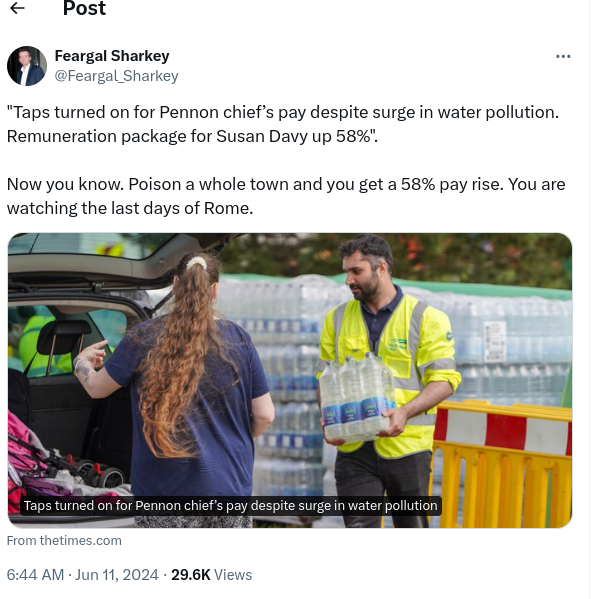
“Taps turned on for Pennon chief’s pay despite surge in water pollution. Remuneration package for Susan Davy up 58%”.
Now you know. Poison a whole town and you get a 58% pay rise. You are watching the last days of Rome.
South West Water has officially gone rogue
This is a slap in the face for billpayers. South West Water has officially gone rogue and the Govt has let them get away with it. We need to crack down on their profiteering. If you want real action to fix our water industry, then @LibDems on 4th July.

It’s time to make water companies pay for their environmental vandalism.
Disgraceful. South West Water’s Chief Exec has made a big show of foregoing £237,000 in performance bonuses this year – and then quietly taken nearly £300,000 in shares. It’s time to make water companies pay for their environmental vandalism. #VoteLibDem

And from “holding SWW to account” Tory candidates Simon Jupp and David Reed:
Nothing!
Owl has yet to find any matching comment from either of them on “X”.
But the outgoing chancellor, Jeremy Hunt, vows to do more to help six-figure earners should Tories win the general election.
Does this leave an opening for Sarah Randall-Johnson (aka “Scandal Johnson” in Private Eye) the ruthless stripper of community hospital beds?
See this post for chapter and verse on her past record.
Andrew Gregory www.theguardian.com
A former Conservative MP and influential chair of the health select committee has quit a senior NHS post, saying she felt unable “to sign off on a further cut” with the “elastic already stretched too far”.
Sarah Wollaston, a GP for two decades before she joined parliament in 2010, resigned as chair of NHS Devon on Tuesday with immediate effect. She said she was “not happy” with new plans promising “unachievable” results that would only be possible with “unacceptable consequences” for patients.
She took aim at the government over the “frankly shocking” state of infrastructure in the NHS, warning of a “shocking waste of public money” and “lost opportunities” as crumbling hospitals and GP surgeries struggle to access vital capital funds. The crisis made her “genuinely sad”, she said.
Health bosses have repeatedly warned ministers of the desperate need to replace rundown buildings in order to protect the safety of patients and staff. The maintenance backlog has increased to £11.6bn in England, the Guardian reported earlier this year.
“With regret, I have decided to resign as chair of NHS Devon,” Wollaston wrote on X. “Thank you to all the wonderful NHS, care and voluntary sector teams that are out there doing their very best in challenging circumstances. Did not feel able to sign off on a further cut; elastic already stretched too far.”
Wollaston, who was appointed chair of NHS Devon in 2021, also criticised a funding regime that she said harmed NHS organisations facing the worst pressures.
“It really makes no sense to ‘punish’ the most challenged systems with penalties on their capital budgets when access to capital is essential to improving their performance, conditions and safety. The state of our infrastructure in too many places is frankly shocking.
“The next government needs to stop the cycle of capital to revenue transfers and pay serious attention to investing in NHS infrastructure. Also need to address the shocking waste of public money and lost opportunities due to delays in accessing capital.”
NHS Devon is one of the most severely challenged healthcare systems in England, with “significant financial and performance problems”, the Health Service Journal reported.
Wollaston added: “Genuinely sad to be leaving NHS Devon but in a nutshell, not happy as chair to sign off on the financials so time for me to go. No point promising the unachievable, especially if only achievable with unacceptable consequences.”
Wollaston became the Conservative MP for Totnes in Devon in 2010. In 2019, she quit the party to join Change UK, later becoming an independent MP before losing her seat in the election that year standing as a Liberal Democrat.
In a statement, Elizabeth O’Mahony, the south-west regional director of NHS England, thanked Wollaston for her “valuable contribution”. NHS Devon’s deputy chair, Kevin Orford, was named interim chair.
If the clarity of the water matches the clarity of this report – there is still work to be done.
Just add lemon! – Owl
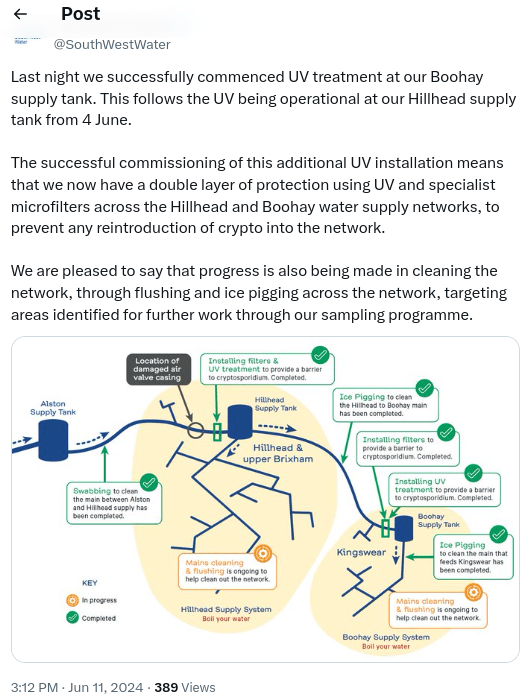
South West Water progress report:
Last night we successfully commenced UV treatment at our Boohay supply tank. This follows the UV being operational at our Hillhead supply tank from 4 June.
The successful commissioning of this additional UV installation means that we now have a double layer of protection using UV and specialist microfilters across the Hillhead and Boohay water supply networks, to prevent any reintroduction of crypto into the network.
We are pleased to say that progress is also being made in cleaning the network, through flushing and ice pigging across the network, targeting areas identified for further work through our sampling programme.
The list of candidates setting their sights of being elected by East Devon residents in the July general election have been announced.
The district council has released the names of the candidates nominated for the Exmouth and Exeter East constituency, and the newly-created Honiton and Sidmouth constituency,
The country will go to the polls on Thursday, July 4, 2024, after a general election was called in May.
Honiton and Sidmouth is one of the new constituencies that will replace East Devon at the next general election.
This follows a review by the Independent Boundary Commission for England.
Melanie Wellman, East Devon District Council acting Returning Officer, said: “We urge everyone to register to vote by the 18 June deadline to make sure their voice is heard. We want to make sure this is the highest turnout possible.”
An EDDC spokesman said: “With the election only weeks away, East Devon District Council’s election team are urging all eligible voters to register and ensure their participation in shaping the country’s future.”
Name of Candidate/Description of Candidate (if any)
Name of Candidate/Description of Candidate (if any)

The East Devon constituencies – left is the Exmouth and Exeter East constituency and right is the Honiton and Sidmouth constituency. Images: EDDC.
To register to vote or to check your registration status, visit the official government website here.
For more information from EDDC about the UK General Election, see here.
Tories turn to the “Magic Money Tree” (again). Remember Liz Truss? – Owl
The Conservative manifesto will include tax cuts, Rishi Sunak has said.
The prime minister told the BBC’s Nick Robinson: “We’re going to keep cutting people’s taxes. You’ll see that in our manifesto tomorrow.”
Becky Morton www.bbc.co.uk
Challenged over how he would fund his policies, Mr Sunak said they would all be “fully funded and costed”.
He insisted day-to-day government spending on public services would continue to increase ahead of inflation under a future Tory government.
But when pressed over whether certain departments would see cuts, he acknowledged “all governments prioritise within that”.
In the spring Budget, the government announced a 2p tax cut to National Insurance for 27 million workers – matching another reduction set out in last year’s Autumn Statement.
The Conservatives have also said they want to abolish National Insurance completely in the long term, when it is deemed affordable to do so.
The party’s manifesto, which is being launched on Tuesday and will outline what it plans to do if it wins the election, is expected to include a pledge to scrap stamp duty for first-time buyers of properties costing up to £425,000.
However, it is not thought to include anything on inheritance tax.
Asked if the Tory manifesto would promise more tax cuts, Mr Sunak said he wanted to build on the tax cuts “we have already started to deliver”.
Both the Tories and Labour have ruled out any increase to the rate of income tax, National Insurance or VAT.
However, both parties have also said income tax thresholds will remain frozen until 2028.
This means millions of people will be pulled into a higher tax band if their wages increase.
Mr Sunak said his party’s policies would be paid for by clamping down on tax avoidance, which he said would raise £6bn, as well as reforming the welfare system and getting more people into work.
However, the independent Institute for Fiscal Studies has said delivering the £12bn savings promised by the Tories by 2030 through reforming welfare “looks difficult to the extreme”.
The think tank has also warned whoever wins the next election will have to cut the scope of what the state provides or increase taxes to maintain levels of departmental spending.
Asked if he would be honest with people that his plans would also mean significant spending cuts for many government departments, the prime minister said: “No, that’s not what our plans show.”
He said day-to-day spending on public services under a future Tory government would continue to increase ahead of inflation.
But he added: “Of course, all governments prioritise within that.”
Mr Sunak said he also wanted to focus on productivity in the public sector, which he said had fallen “considerably since Covid”.
He added that increasing productivity to pre-pandemic levels would save £20bn and would make it possible to cut taxes.
Mr Sunak was also challenged over his party’s record on housing.
Asking if having your own home had got harder under a Tory government, the prime minister said: “It has got harder – and I want to make sure that it’s easier.
“And what we will do is not just build homes in the right places and do that in a way that is sensitive to local communities, but make sure that we support young people into great jobs so they can save for that deposit.”
He added that “saddling young people with higher taxes” would make it harder for them to save for a deposit to buy a house and he wanted people to “keep more of their money”.
One recent report by the Building Societies Association found first-time buyers were facing the toughest conditions in which to buy a house in 70 years.
It suggested home ownership among younger people has been in decline over the last 20 years.
Mortgage rates are relatively high compared with the last decade, and the cost of renting has also soared, making it harder for people to save.
This means first-time buyers face the double challenge of raising enough for a deposit as well as being able to afford a mortgage.
Labour’s shadow housing secretary Angela Rayner said Mr Sunak’s answer was “a damning indictment of 14 years of housing failure”.
She added: “Never once in 14 years have the Tories met their 300,000-a-year housing target, and their recent decision to appease the Tory MPs on their backbenches and abolish mandatory housing targets has seen housebuilding take a nosedive.”
Asked if record net migration figures showing 745,000 entered the UK in 2022 meant he had “lost control of the borders”, Mr Sunak said the numbers were “too high”.
But he argued that as PM he had brought in “the biggest, strictest reforms to bring down immigration that we’ve seen”.
In the interview, the Mr Sunak repeated his apology for leaving last week’s D-Day commemorations early, saying: “I hope people can find it within their hearts to forgive me.”
He asked people to “judge me by my actions”, pointing to increased investment in the armed forces and support for veterans.
Mr Sunak played down suggestions his election campaign had got off to a bad start, insisting he believed he was the right person “to build on the progress that we’ve made”.
“We’ve been through a tough few years and I do believe at this point we have turned a corner,” he said.
Her “balanced scorecard” of objectives contains so many objectives, despite all the pollution problems, she scored 46.5% of maximum, which the remuneration committee cut to 38.5% after applying its “discretion framework in respect of South West Water’s environment and pollution performance”.
Heads she wins; tails we lose. – Owl
South West Water owner’s boss should lose all bonuses after Devon parasite outbreak
Nils Pratley www.theguardian.com
Here’s a rarity: a chief executive turning down an annual bonus two years in a row out of solidarity with the suffering customers. But when the company is Pennon Group, owner of South West Water, the operation currently knee-deep in a diarrhoea and vomiting outbreak in Devon caused by polluted water, Susan Davy had little real choice. She cannot expect applause for leading “from the front” and “living our values”, as she described her decision to turn down £237,000 in cash.
In fact, the question is why she still thought it appropriate to collect £298,000 under her separate long-term share-based scheme. That award sent her overall pay up from £543,000 to £860,000, a figure that may cause stomach pain across the south-west, not just in the coastal town of Brixham, where the parasite cryptosporidium was found in the system.
A year ago, she saw the short- and long-term schemes as a job lot and waived both. If anything, the case for surrendering both elements of variable pay should have been more compelling this time because an outbreak of illness is bad even by the standards of the modern water industry. There was no explanation of the different logic in the annual report.
A deeper question is why the bonus issue even arose in the first place. Why wasn’t it automatically reduced to zero in current circumstances? The answer lies with the usual suspect – the fact the standard “balanced scorecard” of objectives for an executive includes so many elements that it is hard to miss them all. In Davy’s case, the formula spat out a ratio of 46.5% of maximum, which the remuneration committee cut to 38.5% after applying its “discretion framework in respect of South West Water’s environment and pollution performance”.
Come on though, outsiders will still be baffled as to why the committee’s discretion could be so minor (and so precise). Even ignoring the parasite outbreak, South West Water is still falling substantially short on the Environment Agency’s most important annual measure: the company got two stars, when four is the aim, under the latest industry-wide environmental performance assessment.
Nor is it the case that Pennon’s shareholders are having a better time. Yes, they got a £127m dividend even as the Devon outbreak was in full swing, but the share price has roughly halved during Davy’s four years as chief executive. Not for the first time, one must ask what is the point of these “balanced scorecards” if they produce unbalanced outcomes that miss the wider picture.
In a month’s time, Ofwat, the sector’s economic regulator, will unveil its first view of the English and Welsh water suppliers’ business plans for the next five years, including the company-by-company increases in bills to fund greater investment. Bill rises are inevitable and South West Water is looking for 30%-ish, which may be at the lower end of the industry’s range but will still come as a shock to many customers. Davy should have read the room: if it was right to turn down short- and long-term awards last year, it was right to do so again. Half measures don’t cut it.
This isn’t another column about how the next government won’t have any money. If you haven’t gathered that by now, there’s probably little value in repeating it. Whichever of the main parties forms the next government, it will need to cut spending or raise taxes or it will miss its own fiscal targets. Instead of focusing on that fact, I want to explore why.
Paul Johnson www.thetimes.com
Why is it that, with taxes at pretty much the highest level in the UK in 70 years, it can be true both that many public services are in a terrible state and that there isn’t enough money to do much about them without raising taxes even further?
That public services are struggling was set out in stark terms in a report last week from the Institute for Government. To take a few choice quotes, it says that “hospital performance is arguably the worst in the NHS’s history”, “prisons are at crisis point” and “in the last six years there have been six times the number of bankruptcy notices filed by local authorities than in the previous three decades”. You get the picture. And that’s despite the fact that public spending as a fraction of national income has shot up over this parliament and, even on present implausibly tight plans, looks set to settle at well above its long-term average.
That taxes are at their highest level as a fraction of national income in seven decades is simply a fact. They have risen by more over this parliament than over any other in that period. The only bright spot is that many of us won’t have felt that directly. The direct tax burden on average earners is, surprisingly, at its lowest level in half a century. By contrast, companies and those on high incomes have been hit hard.
What on earth is going on? A new report from my colleagues at the Institute for Fiscal Studies tries to get under the skin of this apparent puzzle.
A little bit of history is important. The story of the past half-century or so has been one of successive governments trying desperately hard to prevent the state from growing. While spending on the welfare state has risen, defence spending has fallen and fallen and fallen. We have stopped building houses and supporting nationalised industries. Through the 2010s, our government responded to the fiscal problems created by the financial crisis by cutting spending. In most other countries in western Europe tax took more of the strain than it did here. Yet by 2019, after nearly a decade of austerity, the state was still at the same size that it had reached in 2007, after a decade of a Labour government that had poured large sums into public spending.
How did all that austerity apparently achieve so little? In part because the starting point in 2010 was so difficult. Spending had spiralled as a fraction of national income as the economy had shrunk. The economy then refused to grow at anything like its previous rate. And cuts in working-age welfare and education spending as proportions of national income were offset by spending on the ever-voracious NHS. It is a striking statement of both priorities and demographic determinism that between 2007 and 2019 spending on health rose by 1 per cent of national income, while spending on education fell by the same amount.
Since 2019, public spending has rocketed. Obviously, it grew by astonishing amounts during the pandemic, but that’s not what I mean. Public spending today, after all the Covid and energy crisis-related spending has ended, is about 4.5 per cent of national income, or £124 billion, higher than it was in 2019-20. That is a colossal change. Part of that growth was planned. The Boris Johnson-led Conservative government wanted to be rather less austere than its predecessors. But most of it, about four fifths, was not anticipated.
Alongside paltry economic growth, the two biggest contributors to that unplanned growth were a jump in debt interest spending and a big increase in spending on working-age welfare, particularly as a result of rising numbers receiving health-related benefits. These increases do not look like being transient. Even on official forecasts, which imply cuts in many areas of public service spending, overall public spending looks set to remain at nearly 3 per cent of national income, or £80 billion, higher at the end of this decade than it was pre-pandemic.
On top of these pressures from debt interest and welfare spending, health spending will continue on its ever upward path. Defence spending, after 70 years of cuts, looks set to turn a corner. It will no longer be the cash cow for the burgeoning welfare state that it has been since the war. Rather than reduce the scope of the state, our politicians still want to increase it, by expanding free childcare provision, for example. And, on top of the problems created by spending cuts, various aspects of public provision have had to face up to new pressures: remarkable increases in numbers with special needs in schools, in demands on social care for children and adults and for mental health services, among others.
Put all that together with low growth and the biggest pile of public debt since around 1960 and the reasons for our fiscal travails begin to become clear. We will need a multi-faceted response. Focus on productivity in public provision and do what we can to get economic growth, for sure, but they won’t be enough in themselves. We also need to face hard questions about how to manage demands, how to decide on the scope of state action and what size of state and level of tax we are comfortable with. However much our politicians might want to avoid these questions before the election, the winners will have little choice but to confront them in its aftermath.
Paul Johnson is director of the Institute of Fiscal Studies. Follow him on @PJTheEconomist
The next government must give Windermere greater protection from sewage pollution, campaigners including the naturalist Chris Packham and the comedian Paul Whitehouse have urged in an open letter to all party leaders.
Sandra Laville www.theguardian.com
The campaign group Save Windermere, which organised the letter, says the lake has huge ecological significance, is home to rare and protected species and brings in about £750m to the economy. But the signatories, who include the Wildlife Trust, the countryside charity the CPRE and WildFish, say it is being degraded by sewage pollution from United Utilities treatment plants.
As party leaders prepare to publish their manifestos this week, Matt Staniek, the founder of Save Windermere, said greater protection for the lake was urgently needed to make sure it was looked after for future generations forever. “This is not ideological, it’s non-contentious, and it is absolutely necessary to save Windermere whilst also setting an example for the treatment of our freshwater and our natural world on a national level,” he said in the letter.
The protections for the lake are contained in the EU-derived water framework directive, but Staniek said the system failed to address the ecological, cultural and economic stability of the lake and the surrounding area despite its national significance.
The letter says: “We urge you to commit with haste to granting greater environmental protection for England’s largest lake. The mechanism used to achieve this must have legal underpinning, whilst current legislation must also be enforced. Success will be defined as the long-term recovery of the lake, with it returning to, or as close as possible to, its natural oligotrophic state.”
Last month it emerged that millions of litres of raw sewage had been illegally pumped into Windermere in February, and that United Utilities had failed to stop the pollution of it for 10 hours. It did not report the incident to the Environment Agency until 13 hours after it started.
Suspected illegal sewage dumping into the lake also took place more than 70 times in 2022, according to analysis by the academic Prof Peter Hammond, and in June that year a serious pollution incident in a beck feeding the lake left hundreds of fish dead.
The letter says Windermere has been victim to decades of pollution and exploitation resulting from inadequate investment and substandard regulation, leaving the lake unadaptable to our changing climate.
“Over the last year alone, we have seen unprecedented rainfall which has increased sewage discharging into the lake,” it says. “This, combined with the threat of drought in the summer months, leaves our lake in a precarious position and at risk of extensive algal blooms which, at worse, can cause mass fish kills and leave its waters potentially toxic to the general public.”
A United Utilities spokesperson said that phosphorus levels in the lake had been steadily declining since the early 1990s, while the lake’s four bathing waters all consistently achieved the highest “Excellent” status. “Since 2020 United Utilities has halved the amount of phosphorus that is now entering the lake from our own processes. However, the factors affecting water quality in Windermere are complex and, without targeted action by multiple sectors, we will not see the changes we all want.”
The company said it did not recognise the Hammond figures. Regarding the February pollution, it said: “This incident was caused by an unexpected fault on the third party telecoms cable network in the area, which United Utilities was not notified about and which affected both the primary system and United Utilities’ backup. As soon as we discovered this fault was affecting the Glebe Road pumping station, our engineers took urgent steps to resolve the situation and we informed the Environment Agency within an hour of the pollution being confirmed.”
Want to know what’s wrong with Britain? – Owl
The boss of South West Water’s owner has received a pay increase of £300,000, weeks after an outbreak of diarrhoea caused by a parasite in Devon’s water supply.
Jasper Jolly www.theguardian.com
Susan Davy, the chief executive of Pennon Group, was awarded £860,000 in total pay for the latest financial year, up from £543,000 the year before, according to accounts published on Monday.
The increase came despite Pennon executives agreeing to forgo bonuses for this year in recognition of the widespread outrage over sewage dumping.
Britain’s water companies have been under intense scrutiny in recent years over their environmental performance, amid disgust over the amount of raw sewage flowing into the UK’s rivers and seas.
Those concerns have been particularly relevant for customers of South West Water in Devon, after the outbreak last month of the parasite cryptosporidium, which causes cryptosporidiosis, often in the form of diarrhoea and vomiting. The parasite spreads from faeces.
South West Water customers near the seaside town of Brixham were advised to boil their tap water before drinking it. About 17,000 households were affected by the warning, with compensation of up to £265 for those still affected as of 7 June.
News of Davy’s pay increase comes amid a general election campaign in which water quality has played a prominent role.
Anthony Mangnall, who was the Conservative MP for Totnes and South Devon until the dissolution of parliament, said Davy should resign after refusing to change course on a £127m dividend. The dividend was decided last month despite the company making a £9.1m loss for the year.
“Once again South West Water have put themselves before the people,” he said. “From paying out dividends to increasing their own pay, this only goes to show that they are a company deeply out of touch with the needs and wants of the people.”
Davy’s pay rise came as she received £298,000 under a long-term incentive plan awarded in 2021, before the company had brought in changes to lower share awards if water quality was not up to scratch. That came on top of fixed pay worth £562,000.
Pennon executives did give up part of their variable pay for the year, meaning Davy’s pay was £237,000 lower than it otherwise might have been.
In a foreword to the annual report, Davy wrote: “As CEO, it’s also my job to lead from the front and champion living our values. With executive remuneration continuing to be in the media and regulatory spotlight, I recommended to the remuneration committee that the annual bonus was forgone. It’s the right thing to do.”
Gary Carter, a national officer at the GMB union, said: “Does South West Water have no shame? This scandalous behaviour has to end. It’s time Ofwat stopped water companies paying big bonuses and paying out huge dividends for such poor performances. Bosses must put their hands in their own pockets to stop pollution and sewage leaks. Customers should not have to pay for years of management failure.”
Luke Hildyard, a director at the High Pay Centre, a campaign group, said executive pay often had “little to do with performance, ability or the value to society of their work”.
He said: “Preventing intestinal parasites from flooding the tap water of your customers feels like quite a fundamental part of the job for the chief executive of a water company. It is surprising that failure to surpass this fairly minimal expectation not only nets a half-a-million-pound salary, but also a six-figure performance-related payout.”
Pennon also announced that its chair, Gill Rider, would retire after the company’s general meeting next month. She will be replaced by David Sproul, a global deputy chief executive of the accountants Deloitte from 2019 to 2021 and the current chair of Starling Bank. Sproul will receive pay of £250,000.
A spokesperson for Pennon said: “We understand the strength of feeling from our customers and the public around the issues facing the water sector. For the second year running, our chief executive, alongside other members of our executive leadership team, have therefore made the personal decision to decline annual bonus for the previous financial year.”
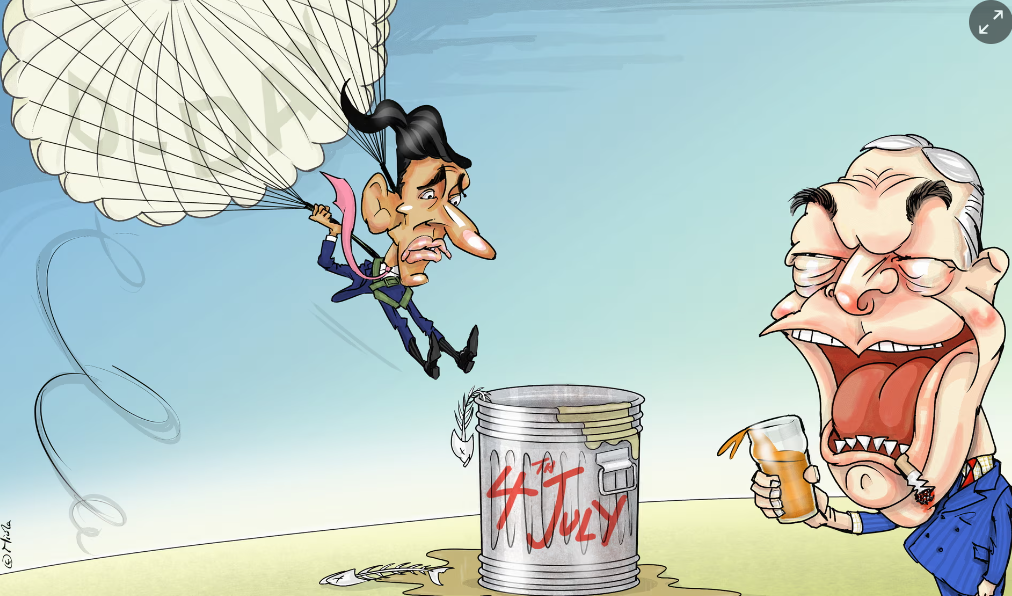
The BBC has learned that the appointment of Britain’s next ambassador to the United States has formally been put on hold because of pre-election Whitehall rules.
James Landale www.bbc.co.uk
There have been widespread reports – not denied by Downing Street – that Rishi Sunak has nominated Sir Tim Barrow, his national security adviser, for the role.
This prompted anger among some in Labour who accused the prime minister of trying to rush through the appointment before the election.
Labour shadow ministers are understood to have voiced their concerns about Sir Tim’s appointment during pre-election conversations with officials at the Foreign Office.
The row has discomfited US diplomats who do not want to get caught in a dispute between the two largest political parties of one of their closest allies.
The State Department has to give its consent to any ambassadorial appointments in Washington – known as formally as “agrément” – and it risked having to endorse Sir Tim while question marks remained over his nomination.
The appointment has now been formally frozen under civil service rules laid down to stop big decisions being taken during the pre-election period known as “purdah”.
Section “H” of the General Election Guidance for Civil Servants says “all appointments requiring approval by the Prime Minister, and other Civil Service and public appointments likely to prove sensitive… should be frozen until after the election, except in exceptional circumstances”.
It adds: “This includes appointments where a candidate has already accepted a written offer… but where the individual is not due to take up post until after the election”.
The Foreign Office said: “All Government Departments must adhere to the central pre-election guidance. Future ambassadorial appointments will be confirmed by the FCDO in the usual way.”
The row began in late April when Downing Street announced General Gwyn Jenkins, vice chief of the Defence Staff, would replace Sir Tim as national security adviser. It did not say what new role Sir Tim would take up but Mr Sunak did not deny reports he would become Britain’s top envoy in the US.
When asked by political reporters on a plane to Warsaw, Mr Sunak said “ambassadorial or diplomatic appointments are always made in the usual way” and added: “It’s entirely normal for those to be made in advance… entirely in keeping with precedent because ambassadors’ designate often go and acclimatise themselves and build relationships before they formally start”.
The current ambassador Dame Karen Pierce is expected to leave next year after her appointment was extended for another 12 months to make up for Covid-related disruption at the beginning of her term.
“I think the next ambassador will arrive in early 2025, and I will stay till then,” she reportedly told a recent diplomatic gathering at the Washington embassy.
Sources say the Foreign Secretary, Lord Cameron, had assured his Labour shadow, David Lammy, that such a significant official appointment would not be made in the run-up to the election.
But it is understood Downing Street ignored Lord Cameron’s concerns and decided to press ahead with the appointment. Whitehall sources said No 10 wanted to announce General Jenkins’ appointment as the first NSA from a military background to reinforce their commitment to security, a key Tory election theme.
It is understood that if Labour won the election, Sir Keir Starmer would revisit Sir Tim’s appointment and might instead choose another candidate. At the very least it is expected that he would begin a new recruitment process.
The extension of Dame Karen’s term until next year would give Labour the chance to choose her successor after the outcome of the US election in November is known.
There has been speculation about potential Labour nominees for the role including David Miliband, former Foreign Secretary; Baroness Ashton, former vice-president of the European Commission and Lord Mandelson, former Northern Ireland Secretary. Other names suggested have been Tom Fletcher, principal of Hertford College, Oxford and former ambassador to Lebanon, and Lord Sedwill, former Cabinet Secretary and former national security adviser.
Labour’s concern was not about Sir Tim as an individual; he is a distinguished diplomat who has served as Britain’s ambassador to Russia and the EU. The anger was prompted more by the loss of Labour’s right to make its own appointment, the belief that Downing Street was behaving inappropriately, and Sir Tim’s background as a longstanding official adviser to senior Conservative figures including Boris Johnson, Liz Truss and Mr Sunak.
The muddle over Sir Tim’s appointment could lead to some awkward musical chairs in Whitehall. General Jenkins is expected to take up his new role as NSA soon and his successor as vice chief of the Defence Staff has already been named as General Dame Sharon Nesmith.
The Liberal Democrats are to announce plans to overhaul capital gains tax to raise £5bn for the NHS, making them the first party to announce a big tax change as part of their spending plans.
Jessica Elgot www.theguardian.com
The party’s leader, Ed Davey, said the change was “making tax fairer” and the party said it would hit only the wealthiest. The party will unveil its manifesto on Monday.
The estimated £5bn raised by the tax rise would be directed into plans to recruit 8,000 more GPs in order to meet a target of a guaranteed appointment in seven days. The revenue raised would also be put into cancer treatment, speeding up waiting times for treatment to guarantee care within 62 days.
The party will say that those on lower incomes would be protected by an increase in the annual tax-free CGT allowance to £5,000, up from £3,000 in the current tax year. The proposed new system would be adjusted for inflation and there would be a targeted relief system devised for small businesses.
The policy puts health and social care at the centre of the Lib Dems’ offer at the election – where Davey has put his experience as a carer for his disabled son at the heart of his message to the public.
The Lib Dems have already announced a plan for free personal care including washing and medication for disabled and older people, funded by reversals of tax breaks for banks estimated at £2.7bn – though independent thinktanks have said the cost is likely to be higher.
Labour’s shadow chancellor, Rachel Reeves, has said her party will not make changes to CGT, though some in the party believe there is a case for an overhaul that would be a significant revenue raiser.
Several thinktanks have said that the two main parties are not being honest with the public about the state of the public finances, as Labour and the Tories have ruled out any big tax rises.
Last month the Institute for Fiscal Studies said there was a “conspiracy of silence” over necessary tax and spending choices, with the next government likely to inherit the toughest outlook for the public finances in 80 years.
The Lib Dem proposal would create three bands to be applied to taxable gains at different rates: gains between £5,000 and £50,000 taxed 20%; those between £50,000 and £100,000 taxed at 40% and those over £100,000 at 45%.
Davey said the NHS was in desperate need of a rescue package. “We are putting fixing health and social care at the heart of our party’s plans for the country,” he said. “Under this Conservative government, local health services have been decimated while hospitals crumble.
“After years of devastating tax hikes from Rishi Sunak, it would be grossly unfair to force hard-working families and pensioners to pick up the tab for Conservative failings on the NHS. That is why the Liberal Democrats will rescue health and social care services by making tax fairer, with billionaires and big banks asked to pay their fair share.”
Other big offers in the Lib Dem manifesto would be a pledge for an EU-wide scheme to allow under-35s to live and work in Europe, new paternity leave rights and a crackdown on sewage pollution.
The party is heavily targeting seats in the south-west and London commuter belt, the so-called “blue wall”, where it hopes to take votes from liberal voters disillusions with the Conservatives. Almost all the party’s target seats were held by the Conservatives, including some by senior cabinet ministers such as the chancellor, Jeremy Hunt, in Godalming and Ash, and the education secretary, Gillian Keegan, in Chichester.
“We have a plan and it’s working”
‘Members aren’t happy’: Sunak holds crunch talks with advisers over D-Day blunder
Rishi Sunak staged a full media blackout over the weekend as the Conservative Party sought to limit the fallout from his decision to leave the D-Day commemorations early.
Richard Vaughan, Chloe Chaplain, Arj Singh, Eleanor Langford inews.co.uk
The Prime Minister avoided taking part in any media questions while visiting a village fete in Great Ayton on Saturday, cancelled an arranged briefing on the same day and chose to campaign near his own constituency on Sunday morning as the party sought to limit the fallout.
The Prime Minister is understood to have spent much of the weekend locked in meetings with his closest advisers, including chief campaign strategist Isaac Levido, in a bid to work up plans to bounce back from the setback with a series of tax and economy announcements in the coming weeks.
One source close to Mr Sunak said: “We’ve still got more to come, and that’s in contrast to Labour’s empty manifesto.”
A fresh tax giveaway is believed to be among the rabbits to be pulled from the hat as the party prepares to announce its manifesto on Tuesday.
Mr Sunak is expected to be back on the road campaigning in the South East on Monday, but will only be taking a small pool of broadcast journalists, rather than allowing access to the wider media as the party aims to regain control over the election narrative.
With the row over Mr Sunak’s damaging D-Day gaffe still raging over the weekend, one of his closest political allies was forced to deny that the Tory leader would have to quit over.
Work and Pensions Secretary Mel Stride insisted that Mr Sunak would not quit the Tory leadership midway through the campaign.
But the fact Mr Stride was facing questions over whether his party leader can see the general election campaign through to polling day has left several Tories deeply concerned about the party’s prospects on 4 July.
Mr Stride dismissed the notion of the party losing its leader during the campaign, insisting Mr Sunak would “absolutely” lead the party into the election. “There should be no question of anything other than that,” he told Sky News.
Tory candidates have largely closed ranks in the wake of the D-Day bungle, claiming that the issue had barely been brought up on the doorstep with voters.
One Conservative candidate lamented Mr Sunak’s actions last week, describing it as “not the most appropriate decision”, with Tory adding: “I think the apology was the problem, everybody understood he needed to return to work but that made it a matter of judgement.”
A “Red Wall” Tory candidate conceded, “Members aren’t happy,” but played down the effect of the D-Day row on voter doorsteps.
And a minister admitted to being personally “very cross about it” but expressed surprised by how little it had been raised by voters.
Reform UK party leader Nigel Farage twice refused to disown comments that suggested Mr Sunak ducked out of the D-Day commemorations early due to his Indian heritage, sparking accusations from Labour that he was engaging in “dog-whistle politics”.
In contrast to the Prime Minister’s decision to lay low, Labour leader Sir Keir Starmer chose to campaign in the Tory heartland of Essex where he was asked about the his counterpart’s choice to leave the commemorations early.
Sir Keir said: “Clearly he’s got questions he needs to answer in relation to what happened on D-Day and at the moment he doesn’t seem to want to answer them.”
And he added: “I know what I stand for, I know why I was there on Thursday, paid my respects and saying thank you.
“And I was humbled actually, when I was there.”
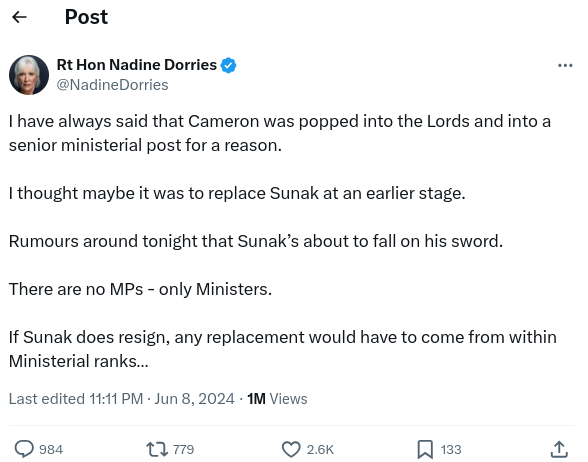
“I have always said that Cameron was popped into the Lords and into a senior ministerial post for a reason.
I thought maybe it was to replace Sunak at an earlier stage.
Rumours around tonight that Sunak’s about to fall on his sword.
There are no MPs – only Ministers.
If Sunak does resign, any replacement would have to come from within Ministerial ranks…”
[Owl thinks that might be the case as a “pro tem” Prime Minister until the election but not necessarily the case for a replacement leader of the party.]
Duty Minister refutes:
Mel Stride, the work and pensions secretary, said Sunak would not resign over the move in the middle of an election campaign. “There should be no question of anything other than [Sunak continuing to lead the party],” he told Sky News…..
…..“And I think he will be feeling this personally, very deeply, because he’s a deeply patriotic person. He will be deeply uncomfortable with what has happened.”
Labour: he needs to come out of hiding
As Sunak failed to appear in the media on Saturday or Sunday, Labour sources said the prime minister needed to “come out of hiding soon and explain how families can afford five more years of this madness”.
South West Water has taken a legal stake in a customer’s home after she withheld her bill payments in a protest over sewage dumping in rivers and the sea.
Another PR disaster in the making? – Owl
Damian Carrington www.theguardian.com
Thousands of water company customers are thought to be withholding payments but this is the first known case of a company enforcing a claim against a customer’s home.
Imogen May, of Crediton, Devon, has withheld payment since 2019 and has a £2,809 debt. South West Water won a county court judgment over the debt and has claimed an interest in May’s cottage via the Land Registry. When it is sold, the company can claim what it says it is owed.
May has also withheld payment of council tax, arguing that the funds are not spent on people’s priorities, such as environmental projects and children’s mental health services. The council is now applying for a court order to force the sale of May’s cottage.
“This is about using my place of privilege as a homeowner to push the boundaries,” she said. “It’s about necessity – unless we challenge them and show them that we’re not frightened of them, they will continue to do what they’re doing.”
“They are killing our water,” May told the Guardian. “Without our water, we are dead. I care deeply about the planet and biodiversity and I just want to inspire people to stop paying these bastards to rip us off.
“The language of money is the only thing they really understand. They can have it by all means when they spend our money on what it’s designed for. But they are openly polluting our waters and I’m done with it.”
May, who works in a bakery, has frequently taken part in environmental protests. She was arrested while blocking Lambeth Bridge in London as part of an Extinction Rebellion protest in 2019 and released without charge. Charges brought over a protest against the HS2 rail development in Buckinghamshire in 2020 were later dismissed.
May’s home is already up for sale as she had decided to downsize after her two daughters left home. She is undecided about what to do once the house is sold, “but if I am set with a choice to pay these bills or go to prison then I’ll pay the bloody bills,” she said. “I’ve promised my kids that I would not end up in prison.”
A spokesperson for South West Water said it did not comment on individual customers’ cases. “We are serious about tackling storm overflows and change of this scale takes time, ambition and increased investment, and that is why we are investing £850m in our region over two years,” he said. “We will also be the first water company to meet the government target of less than 10 spills per overflow, per year, a decade ahead of target.”
South West Water increased its annual dividend to investors to £127m in May. In the same month, 17,000 of its customers had to boil water due to contamination with the cryptosporidium parasite, which results from faecal pollution of water supplies.
Frequent overflows of sewage into rivers and the sea has become a high-profile issue in recent years. Multimillion-pound court fines have been levied against a number of English water companies over their failings, and their large debts and dividend payments to shareholders have become controversial. Thousands of customers are thought to be boycotting their payments, with bill strikes ongoing against all nine companies dealing with wastewater in England.
Julie Wassmer, of Whitstable, Kent, helped found the BoycottWaterBills.com website. She has withheld the sewerage portion of her water bill from Southern Water since 2021, totalling about £1,000.
“We know for a fact that we’ve got boycott action in all the wastewater areas,” she said. “We haven’t got a complete figure on how many people are boycotting nationally but we believe it’s thousands,” based on mailing list numbers and web activity.
Wassmer said the process for complaining to water companies was “not fit for purpose” and that the industry regulator, Ofwat, was ineffective in stemming the sewage pollution. “So there’s no chance of holding the companies to account. The whole thing is just a legalised scam and it’s only benefited the companies, the executives and their shareholders, and people are doing the only thing I think we can do, which is to withhold payment.”
She likened the widespread bills boycott to the successful anti-fracking campaigns in which she has also taken part. “There are so many different people involved and that means we’re hydra-headed and more difficult for the companies to pick us off.”
Caz Dennett, of Weymouth, started the Don’t Pay for Dirty Water campaign with Extinction Rebellion. “It seemed like an obvious action for people to take to truly demonstrate how sickening and scandalous the water company racket is,” she said. She has withheld the sewage charge part of her Wessex Water bill for 14 months and is in dispute with the company over the £940 it says she owes.
Katy Taylor, the chief customer officer at Southern Water, said: “To reduce storm overflows, we have a £1.5bn investment increasing storage capacity and finding ways to divert rain back to the environment naturally.”
A Wessex Water spokesperson said: “We agree [storm overflows] are outdated and we’re currently spending over £3m a month to progressively improve them. Subject to regulatory approval, this investment will double.”
Wassmer said: “Nationalisation appears to be the only way forward. England is the only country in the world to have a fully privatised water industry. So it’s not only a national disgrace, it’s an international disgrace.”
A poll has suggested that Reform UK’s Nigel Farage is the most popular option to succeed Prime Minister Rishi Sunak as leader of the Conservatives if Labour win the General Election.
The poll by Redfield and Wilton, conducted for The Independent, surveyed 2,000 adults on Wednesday and Thursday and showed 19% of people think Mr Farage should take over from Mr Sunak, with 22% of 2019 Conservative voters surveyed agreeing.
The poll offered six other names – Penny Mordaunt (15%), James Cleverly (6%), Kemi Badenoch (5%), Suella Braverman (4%), Priti Patel (2%) and Robert Jenrick (1%).
The largest proportion (48%) of those surveyed said they did not know who should replace Mr Sunak as leader of the Conservatives.
May you live in interesting times! – Owl

StoptheVote.org, a major tactical voting site, has TAKEN DOWN its recommendation of a Labour vote in Exmouth & East Exeter. It now says its tactical advice is ‘COMING SOON: We’re waiting until more polling is released to confirm our advice here.’
It explains: ‘We’ve manually set advice for this constituency because as an Independent was in second place last time, it is not yet clear where those supporters will go’. In other words, the old advice was based on automatically applying national trends without proper local data.
Meanwhile Electoral Calculus, the site which takes into account local information, estimates that the race is incredibly close between the Tory (32.6%), Paul Arnott for the Lib Dems (29.8) and Labour (21.4). It has reduced the chance of the Tory winning to 54%, increased the Lib Dems’ to 34%, and puts Labour’s chance on 10%.
Some facts on this constituency:
 East Devon Watch