Farmer Brown or Mr Brown? The saga continues

” …. However at last night’s meeting, committee chairman [of Ottery Town Council’s planning committee] Councillor Ian Holmes said that in an application for a replacement driveway in 2005, Mr Brown stated that he had 325 cattle and hundreds of ewes and lambs.

And he said, in 2008, in an application for a horse menage, he had 160 acres, 70 at Ware Farm, and around 80 beef cattle and around 200 lambs which wintered at the farm.

Source: http://www.exeterexpressandecho.co.uk/Concerns-raised-East-Devon-councillor-attempts/story-22966678-detail/story.html

We must now wait to see if EDDC arranges for this to be decided by officers behind those oft-closed council doors or in public by the Development Management Committee …

What was that promise about transparency made by Leader Diviani?

And can we now expect a swift re-convening of the Task and Finish Group which was supposed to look at the influence of the East Devon Business Forum (Chairman – the council’s Business Champion and erstwhile Chairman of the council’ first Local Plan Panel, planning consultant builder (and possibly farmer) Graham Brown)?

Town Council finds apparent inconsistencies and contradictions in Brown Application.

After listening to the points raised by an EDA spokesperson at the Ottery St Mary Town Council (OSMTC) Planning Committee this evening, it was agreed, by four votes to nil (with 2 abstentions) to write to EDDC expressing OSMTC’s concern at the evidence submitted by Graham Brown, and pointing out what seem to be inconsistencies and contradictions in it.

Reporters from the Herald, the Pulmans View from, and the Express and Echo were present.The Chair wryly commented,”We only need the Exchange and Mart and we’ve got the set.” He discreetly didn’t mention the Daily Telegraph.

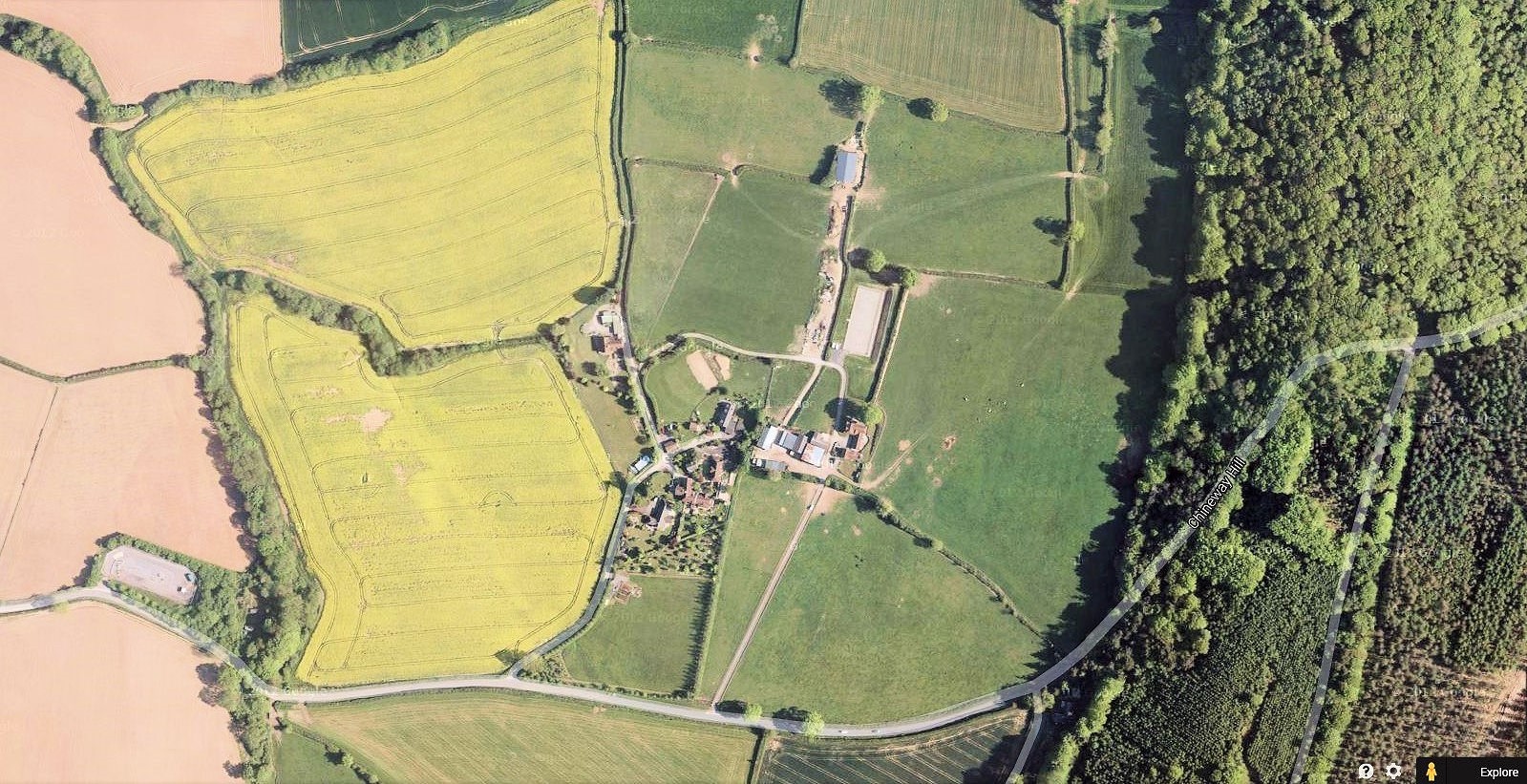
The Daily Telegraph reporters’ secret filming of an interview with Mr Brown in March 2013,took place at Ware Farm, pictured below
Ware Farm East Hill

Full story about Mr Brown’s Application is at the Western Morning News link on our previous post http://www.westernmorningnews.co.uk/Disgraced-Tory-attempts-lift-300-000-tie-farm/story-22963165-detail/story.html

Ex-councillor Brown’s facts disputed

The following press release was issued by East Devon Alliance this morning:

“Disgraced ex-EDDC councillor Graham Brown is at the centre of a new controversy over a planning application concerning his Ware Farm property in the East Devon Area of Outstanding Natural Beauty (AONB) near Ottery St Mary. This is due to be discussed at Ottery St Mary Town Council this evening. (EDDC Planning Ref: 14/2032/CPE)

He is applying for the lifting of a planning condition on his farmhouse, built by him in 2000, which says it can only be occupied by a person “solely or mainly” working in agriculture. He is apparently planning to sell the property on the open market.

In an affidavit with the application, he swears that his farming business “quickly and drastically diminished between 2002 and 2003” to such an extent that for at least ten years his farming activities have been insignificant. For this reason he says he has occupied Ware Farm in breach of the condition in the planning permission granted in 2000. Because EDDC has taken no enforcement action, he claims that, legally, the condition should be removed. This would enable him to sell the farm without restriction.
But campaigners from the East Devon Alliance claim that Mr Brown’s sworn statement appears to be seriously misleading.

They say Mr Brown’s suggestion that his farming activities “drastically diminished” after 2003 lacks credibility. Evidence discovered by EDA shows that he claimed and received 222,922 euros in farm subsidies between 2000 and 2009.

http://farmsubsidy.openspending.org/GB/recipient/GB647145/brown-g-p/
In addition Mr Brown’s own figures for farm income submitted with his application reveal he earned over £850,000 from his land between 2004 and 2013. This would seem to indicate that he was running an agricultural business during this time.***

EDA point out that Mr Brown himself contradicted his claims in his affidavit that his farming activities were minimal, when he applied for planning permissions for new construction at Ware Farm citing agricultural necessity. EDDC planning records show that :

In 2005 (05/2000/FUL) a new access road to Ware Farm was approved after Mr Brown’s agent claimed it was necessary because the farm had “expanded” and “the nature of the farming enterprise causes many movements of increasingly large machinery”.

In 2012 (12/1880/AGR) an extension to an agricultural building was approved.
In 2013 (13/0819/ AGR) the re-siting of an agricultural building was approved as permitted development because it was considered “necessary for the purposes of agriculture.”

EDA question the figures for weekly working hours spent on farming given by Mr Brown. They seem to include only his own time and not the hours worked by two men said to have been employed by him.

Mr Brown claims in his affidavit to have virtually abandoned farming by 2013 but in the EDDC list of members’ interests for 2012/13 he describes himself as a farmer, and member of the National Farmers’ Union which he represented on the East Devon Business Forum until March 2013.

EDA chair Paul Arnott commented:

“If Mr Brown’s application is successful, the protection of the AONB from speculative development will be further eroded. This is an important test case and must be ultimately decided in public by councillors in EDDC’s Development Management Committee, not as is rumoured to be the Council’s intention, by an officer’s decision behind closed doors.”

*** Using Brown GP and Ware Farm as search terms produces this link
http://farmsubsidy.openspending.org/search/?q=Brown+G+P+Ware+Farm

The story is also reported on the Western Morning News website:

http://www.westernmorningnews.co.uk/Disgraced-Tory-attempts-lift-300-000-tie-farm/story-22963165-detail/story.html

Farming in tax law

For those EDDC councillors (and officers) who may be unsure the following is quoted verbatin and without amendment from hM Revenue and Customs site:

BIM55051 – Farming in tax law: definition of farming

S9 Income Tax (Trading and Other Income) Act 2005, S996(1) Income Tax Act 2007 (ITA 2007), S36 Corporation Tax Act 2009, S1125 Corporation Tax Act 2010 (CTA 2010)

Farming is treated for the purposes of both Income Tax and Corporation Tax as a trade whether or not the land is managed on a commercial basis and with a view to the realisation of profits.

Farming is defined in both the ITA 2007 and the CTA 2010 as being the occupation of land wholly or mainly for the purposes of husbandry but excluding any market gardening.

Although for the purposes of defining farming for tax purposes no restriction is put on where the land is situated, the automatic treatment of farming as a trade is restricted to land farmed within the United Kingdom.

Three features of this definition are considered as follows:

occupation of land (BIM55055)

in the United Kingdom (BIM55095)

wholly or mainly for the purposes of husbandry (BIM55100)

Significance of definition

The definition is of significance because a number of statutory provisions apply, or refer, specifically to farming. These include:

All farming to be treated as a trade (see BIM55110), and all farming carried on by a particular person (or partnership or body of persons) to be treated as a single trade (see BIM55115).

Averaging of profits (see BIM83000 onwards).

Herd Basis (see BIM55500 onwards) (although not restricted to farming).

Restriction of loss relief where losses incurred in the five previous years (see BIM85600onwards).

Source: http://www.hmrc.gov.uk/manuals/bimmanual/bim55051.htm

Please don’t take our external auditor away! Why? We like him and our CEO wants the same auditor at both councils where he works!

From the agenda of the next Audit and Governance Committee meeting taking place on 25 September 2014 at 2.30 pm at Knowle. You could not make this up – why would EDDC MEMBERS (councillors) complain that the auditor should not change because their CEO wants the same one in East Devon and South Somerset – how would they get that information and why would they think it was THEIR problem?

The Council has been notified that the Audit Commission is intending to appoint KPMG LLP to audit the accounts of East Devon District Council from 2015/16 for two years. The appointment will start on 1 April 2015.

… Members were verbally updated of this situation at the last meeting and that the Audit Commission had a duty to consult local government bodies on the auditor appointment.

As requested by the Committee the Head of Finance did make contact with the Commission to determine the areas were a Council might consider an objection, however these did not really accord with members reasons for an objection, these being; the excellent relationship that had been formed particularly with Barrie Morris, acknowledgement of the help in improving the Council’s processes and practices and the link with South Somerset District Council who were to remain with Grant Thornton. In consultation with the Chief Executive and the Audit & Governance Chairman the Head of Finance did not make an objection to the change in auditor. ”

Source: http://eastdevon.gov.uk/250914_a_and_g_cttee_combined_agenda.pdf

Update on Knowle sale and Freedom of Information Tribunal

http://futuresforumvgs.blogspot.com/2014/09/knowle-relocation-project-latest-news.html

Can you help East Devon AONB find new offices?

Their office at the East Devon Business Centre (along with many more) is being demolished to pay for Skypark and will be replaced by a supermarket.

Says it all really.

http://www.eastdevonaonb.org.uk/index.php?mact=News,cntnt01,detail,0&cntnt01articleid=397&cntnt01origid=15&cntnt01returnid=68

And they have to be out by the end of the year, though their notice period will be waived if necessary.

That’s nice of EDDC isn’t it.

Eagerly awaited report on Five Year Land Supply..not quite yet

See Item 11 on the agenda of next week’s Audit and Governance Committee (Link to agenda given here: http://saveoursidmouth.com/2014/09/17/latest-on-eddcs-five-year-land-supply/)

The crucial importance of the Five Year Land Supply, and EDDC’s lack of a Local Plan which can not be drawn up without it, is explained here:  http://susiebond.wordpress.com/2014/09/16/the-local-plan-and-the-issue-of-appeal-successes/

District councils object to centralisation of land charges – because “stakeholders” might suffer

Why? Well, because the computerisation might go wrong and “stakeholders” would worry about that? Who is/are these stakeholders: developers and the housing market!

http://localgovernmentlawyer.co.uk/index.php?option=com_content&view=article&id=19953%3Adistrict-councils-urge-minister-to-halt-centralisation-of-local-land-charge-registers&catid=58&Itemid=26

Now, bear in mind when reading the extract below, that East Devon District Council is currently going ahead with a project to merge its IT systems with those of Plymouth and hasn’t the slightest worry that anything may go wrong!

Of particular concern to us is the impact upon the operation of the property market if there are problems with the IT system being developed to support the centralised local land charges register and the transfer of data from local authorities.”

Cllr Clarke insisted that the network was not seeking the minister’s intervention for reasons of self-interest because local authorities currently maintained local land charges registers.

Instead, he said, “it is because we believe the damage that could be caused to the operation of the housing market and thus to the national economy is so substantial should there be technical problems with an as yet untried and untested IT system that the risk is too great to be acceptable.

“The DCN believes it would be failing in its public duty if it did not draw to your personal attention the consequences that could arise if technical problems occur. If you are not persuaded that the proposals should be set aside then we would urge you to at least delay implementation until you are satisfied that all technical issues have been resolved such that there will be no adverse consequences for the smooth operation of the housing market.”

Should we be calling the Minister’s attention to the EDDC/Plymouth merger for the same reasons?

Councillor vows to challenge Police Commissioner

The Chair of the EDDC Overview and Scrutiny Committee, Littleham Councillor Tim Wood, told his Committee on Thursday 11th September that he shares the widespread frustration and dismay at the failure of the Council to pursue an enquiry into the Business Forum.

He vowed to raise the issue with the Police Commissioner Tony Hogg at the earliest opportunity.

In answer to a public question, Councillor Wood said that he had been given “very firm legal advice” that the enquiry could not be permitted to reconvene until after the Devon and Cornwall Police had completed their investigations into alleged malpractice by ex-Councillor Graham Brown.

Sidmouth citizen Robert Crick advised Councillor Wood that 18 months after the Chief Executive Mark Williams had referred the case to the police, Mr Brown has still not been charged or even questioned, despite volunteering to meet the police.

Mr Crick claimed that Mr Brown was being used as a scapegoat to prevent inquiries into deep systemic problems in the way the Cabinet and Senior Officers had been operating. It seemed that Mr Brown had done nothing illegal and the case should now be closed.

Mr Crick suggested that the legal advice given to the chair might not be impartial or independent and that a second opinion might be needed to enable the formal enquiry into the Business Forum’s dealings to proceed.

“In the interest of fairness and justice, Graham Brown should be brought in from the wilderness, and given a chance to clear his name” asserted Mr Crick.

The fourth meeting of the Business “Task and Finish Forum” was postponed at short notice in early September 2013. This formal enquiry had been launched a year before to investigate public concerns about the possible abuse of power by the East Devon Business Forum and allegations of influence behind closed doors in the production of the now discredited Local Development Plan.

It had made little progress before it was suspended a year later.

Skypark “realising the full economic potential of Exeter” …

So says Alder King, the company marketing the site on Rightmove HERE

http://www.rightmove.co.uk/commercial-property-to-let/property-47604236.html/svr/1119;jsessionid=36322F4BFF5D15AED9C64DC02D3526D9?premiumA=true

The vision for the site is to realise the full economic potential of Exeter as a major regional centre, providing a range of employment opportunities and highlighting the area as a self-sufficient new urban community. A community offering people the ability to live in a much sought-after part of the country in close proximity to where the majority of new jobs will be provided.”

Three Dorset councils in merger talks

http://www.bbc.co.uk/news/uk-england-dorset-29205950

Skypark starts to make sense but only in strategic terms, not in terms of residents needs.

What is quite shocking is that, if mergers save so much money, why was the extra tier created in the first place.

One suspects the word “localism” would have been bandied about in the 70s when it was happening, but now the buzz phrase = “economic growth and efficiency” to explain why mergers are needed.

One might then conclude that you can’t have localism AND economic growth and efficiency!

South-West house prices higher than pre-recession peak

http://www.bbc.co.uk/news/business-29218870

And the Catch-22: the more new, expensive houses we build the higher the figure climbs.

Greenfield sites, pretty locations in the countryside = high prices and little chance of affordable homes

Brownfield sites in urban areas = lower prices and greater chance of affordable homes

Developers prefer greenfield, bigger profits. No incentive to build on brownfield sites.

Recipe for disaster?

Fettering discretion in the planning process

EDDC current constitution page 196

Do be aware that you are likely to have fettered your discretion where the Council is the landowner, developer or applicant and you have acted as, or could be perceived as being, a chief advocate for the proposal. (This is more than a matter of membership of both the proposing and planning determination committees, but that through your significant personal involvement in preparing or advocating the proposal you will be, or perceived by the public as being, no longer able to act impartially or to determine the proposal purely on its planning merits.)

and page 197:

Don’t speak and vote on a proposal where you have fettered your discretion. You do not also have to withdraw, but you may prefer to do so for the sake of appearances.

 Do explain that you do not intend to speak and vote because you have or you could reasonably be perceived as having judged (or reserve the right to judge) the matter elsewhere, so that this may be recorded in the minutes.

 Do take the opportunity to exercise your separate speaking rights as a Ward/Local Member where you have represented your views or those of local electors and fettered your discretion, provided you do not have a disclosable pecuniary interest.. Where you do exercise these speaking rights:
– advise the proper officer or Chairman that you wish to speak in this capacity before commencement of the item;
– remove yourself from the Member seating area for the duration of that item; and
– ensure that your actions are recorded.

…..
Be aware that you should not speak or vote on any matter which you have discussed at Cabinet unless you have demonstrated there and can do so at the relevant planning meeting that you have not predetermined the application. …

…Do not take part in any planning meeting on a matter in which you may have been seen as advocating a proposal as a Cabinet Member.

So, we build more homes – who then buys them?

According to a report from the National Housing Federation, only an “exclusive members club” will be able to afford houses:

http://www.housing.org.uk/media/press-releases/homeownership-is-becoming-an-exclusive-members-club/

As for “affordable” homes, they should be no more than 80% of the cost of owning or renting a home on the open market.

If a home costs £200,000 and rents for £800 a nonth that would be £160,000 and £660 a month. But if a home costs £400,000 and rents for £2000 a month then that’s £ £320,000 and £1,600 a month. It is not based on what people can afford, just a simple mathematical formula.

So, why are we building more and more expensive properties in East Devon?