Devon’s natural beauty is being destroyed as it becomes national blackspot for sewage spills

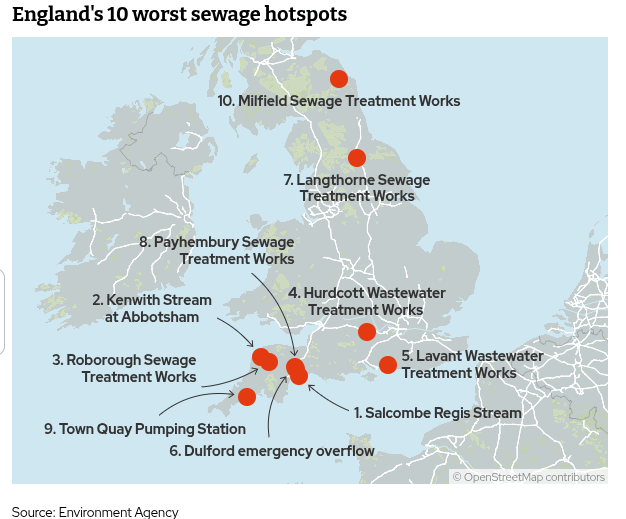
“Of the 10 most frequently used overflows, five were in Devon. Another was in neighbouring Cornwall, meaning six were in the region served by South West Water (SWW).”

How Devon’s beaches and rivers became the centre of the sewage crisis

Sewage was spilt in one village in Devon 366 times in 2024, as the county was home to five of the worst 10 pollution blackspots in England

Lucie Heath inews.co.uk 

Devon is known for its rolling hills and dramatic coastline, but locals warn its natural beauty is being destroyed by sewage pollution as the area has become a national blackspot for spillages.

Official statistics released on Thursday show untreated waste was dumped a near-record 450,398 times across England in 2024 – the equivalent of 1,234 spills per day or 51 per hour.

Sewage pollution is a problem across the country, but the issue has become particularly acute in the south-western county.

Water companies dump sewage from points in their network known as “storm overflows”, of which there are more than 14,000 across England.

Of the 10 most frequently used overflows, five were in Devon. Another was in neighbouring Cornwall, meaning six were in the region served by South West Water (SWW).

The single worst offender was a wastewater treatment plant in the village of Salcombe Regis, next to the coastal town of Sidmouth. Raw sewage was dumped at this site 366 times in 2024.

“It’s a beautiful remote part of the countryside, absolutely stunning,” said Richard Foord, the Liberal Democrat MP for Honiton and Sidmouth. “People are disgusted.”

Richard Foord on the beach at Salcombe Mouth, the worst hit spot for sewage spills in 2024 

Foord said his inbox is filled with “residents who are massively frustrated to turn up at the local beach only to find that there are signs warning them against swimming because of the sewage spills”.

“People live in my constituency because they want to be near the sea,” added Caroline Voaden, the Liberal Democrat MP for South Devon.

“People want to have their kids in the water, they want to be out on boats, on paddle boards … it’s also about the health of our ecosystem.”

The poor state of Devon’s coast hit the headlines several times in 2024.

In March, sewage was released for 12 hours at Sidmouth, where Queen Victoria spent time as a child.

In the peak of summer, no swim warnings were issued at Exmouth Beach on multiple occasions. Hundreds of residents and businesses in the town are currently suing SWW as part of a mass legal action, claiming beach closures resulted in a significant drop in trade during their crucial tourism season.

Swimmer Jo Bateman is taking separate legal action against the water firm, saying it prevented her from taking her daily swims at Exmouth Beach due to multiple sewage discharges.

Water companies typically dump untreated sewage when their systems cannot cope with an influx of rainfall, although they have also been shown to discharge illegally during dry weather.

The weather will have played a factor in the deluge of sewage hitting Devon’s rivers and beaches in 2024. The South West experienced an incredibly wet start to the year and Devon recorded its wettest February on record.

“This is not an excuse but is important context,” said Richard Price, managing director of Wastewater Services at SWW. He pointed out that the firm was one of five that reduced the number of sewage spills across its network between 2023 and 2024.

This will offer little solace to the residents of the South West who have been fighting sewage pollution for decades, but still find themselves wading through waste.

Surfers Against Sewage (SAS), the campaign group that has been at the forefront of bringing this issue to the public’s attention, was founded in Cornwall in 1990 by a group of surfers keen to sound the alarm over the terrible state of Britain’s oceans.

“The thing with the South West is the amount of coastline those counties have and how important that is as part of the place, as part of the economy, as part of what draws people to there,” said Dani Jordan, Director of Campaigns and Communities at the charity.

“It should be something that’s there for all of us to enjoy in whatever way we choose to.”

In response to the recent swell in public outrage over the sewage crisis, water companies plan to invest £104bn up to 2030 in fixing their networks. Bills will increase by an average of £30 per year across the country to pay for it.

Jordan said she wants to remain “optimistic”, but the latest statistics are a reminder of how little progress has been made on the issue to date.

“We’re campaigning for an end to sewage pollution impacting the places we swim, surf and play by 2030…we 100 per cent know that the investment they’re going to put in over the next five years isn’t going to result in an end to that,” she said.

“We have lost trust in the water companies.”

Salcombe Regis wins the “Brown Flag” award for massive 8,772 hours of sewage spills

According to the Environment Agency figures, the site with the longest duration of spills was located in the coastal village Salcombe Regis, at a massive 8,772 hours and 30 minutes. Located in east Devon, the receiving body of water is the Salcombe Regis stream, which feeds into the sea on the south coast.

However, South West Water, which manages the site, says that it is investigating the cause of this. The water utility company adds that it is aware of several unauthorised connections to the sewer network that are contributing to the high level of additional flows. This includes highway road gullies with extensive road run-off. Extract from Albert Toth www.independent.co.uk

Local LibDems win big U-turn on controversial railway plan

Liberal Democrat MPs from the South West are celebrating a transport victory after Great Western Railway (GWR) reversed its plans to introduce routine stops at Old Oak Common for trains heading to London Paddington. Following significant lobbying efforts, the railway operator has confirmed that services will now only stop at the new station when there is “good reason to do so.”

Lewis Clarke www.devonlive.com 

The decision comes as GWR prepares to expand its fleet with 26 additional trains. Critics had argued that forcing express services to halt at Old Oak Common would have added unnecessary delays for passengers travelling from the South West.

In a joint statement, the group of MPs said: “This is a huge victory for families and commuters living across our region.

“We already face significant levels of disruption on the railway network, and adding an additional stop at Old Oak Common that benefits no one would only have compounded these issues.

“It is right that this decision has been reversed and trains will now only stop with good reason.

“There is still work that needs to be done to ensure smooth journeys for people travelling from the South West, whether they are taking a short trip within the region or heading all the way to London. It’s frankly unacceptable. However, this announcement is a step towards improved services that we Liberal Democrats are determined to deliver.”

The announcement follows a briefing by the Peninsula Rail Taskforce, which had been pushing for improvements to South West rail connectivity. The Liberal Democrat MPs who signed the statement include Martin Wrigley ( Newton Abbot ), Anna Sabine (Frome and East Somerset), Tessa Munt (Wells and Mendip Hills), Cameron Thomas (Tewkesbury), Ian Roome ( North Devon ), Roz Savage (South Cotswolds), Caroline Voaden ( South Devon ), Sarah Gibson (Chippenham), Sarah Dyke (Glastonbury and Somerton), Steve Darling ( Torbay ), Max Wilkinson (Cheltenham) and Rachel Gilmour ( Tiverton and Minehead).

As part of the lobbying efforts, Martin Wrigley pressed the rail minister in a Westminster Hall debate on January 14, calling for confirmation that fast services from the South West should be allowed to pass through Old Oak Common without stopping.

South West Water leads the pack as water companies spilled sewage for a record 3.61 million hours last year. 

The average number of spills per overflow in South West Water (SWW) was 41.3 with an average duration  of 10 hours.

The total number of spills was 56,173 and these produced a total of 544,439 hours of sewage spills, the highest in the country in what was a record year for pollution. 

That’s 15% of the 3.61 million hours across the country (and there are ten companies).

Unlike most other water companies, SWW did not put most of the blame on exceptional weather through the year for water spillages from outfalls that overflow more than 60 times in a year, one of the Environment Agency benchmarks. SWW only blamed the weather for 21% of these where Anglian water claimed 89%. SWW said 37% were due to other operations reasons including maintenance; 26% due to “hydraulic capacity” and 16% were subject to “ongoing investigation”. Data from the Environment Agency 2024 report released on Thursday – see below.

The overall data showed that although the number of spills was down each spill lasted longer on average – resulting in a higher total number of hours.

“These figures are disgraceful and are a stark reminder of how years of underinvestment have led to water companies discharging unacceptable levels of sewage into our rivers, lakes, and seas,” said Environment Secretary Steve Reed.

His views were echoed by Water UK Chief Executive David Henderson: “Any sewage flowing into waterways is a disgrace. Unfortunately, it’s a system fault that we have in our network which mixes rainwater and wastewater. Nobody wants to see any spill of sewage in our waterways.” (source of the quotes www.bbc.co.uk)

Environment Agency storm overflow spill data for 2024

Environment Agency www.gov.uk

The Environment Agency has today [27 March] published water company Event Duration Monitoring (EDM) Annual Return data for 2024 showing the frequency and duration of spills from storm overflows in England.  

The data for 2024 shows a 2.9% decrease in the number of sewage spills compared to 2023. Spill durations increased by 0.2% – this is the number of hours overflows operated for compared to last year. This year’s data shows that storm overflow spill counts and duration remain unacceptably high.

[Note: The data showed that although the number of spills was down each spill lasted longer on average – resulting in a higher total number of hours. – Owl]

The data also shows that in 2024:   

  • The average number of spills per overflow was 31.8 compared to 33.1 in 2023 and 32.6 in 2020; [41.3 for SWW. These spills produced a total of 544,439 hours sewage spills, the highest in the country.]
  • 39% of storm overflows spilled less than 10 times in 2024 compared to 40.5% in 2023 and 40% in 2020; [36.6% for SWW]
  • 12.5% of storm overflows did not spill at all in 2024 compared to 13.9% in 2023 and 13% in 2020. [14.8% for SWW]

In January, the Environment Agency worked with partners to secure the largest commitment of actions and investment from water companies to clean up our waterways since privatisation. The Water Industry National Environment Programme (WINEP) sets out over 24,000 actions water companies must take over the next five years to meet their legal requirements for the environment, representing a £22.1bn investment – around £10.2bn of which will be used to improve storm overflows in England, including nature-based solutions which reduce the amount of rainfall reaching overflows.

To meet our requirements, water companies have committed to upgrading over 2,500 storm overflows – which is expected to reduce annual sewage spills by 85,000. Water companies will also install 3,500 monitors at emergency overflows sites, further protecting and enhancing 13,500 km of river.

Chair of Environment Agency Alan Lovell said: 

This year’s data shows we are still a long way off where we need to be to stop unnecessary sewage pollution. But it also provides vital intelligence that drives targeted investment. Using our Event Duration monitoring analysis, we have worked with partners to secure £10.2bn from water companies to improve storm overflows in England.

While these improvements get underway, we expect water companies to do what customers pay it to do: ensure their existing assets are maintained and operating properly.

We will continue to protect our precious water quality and resources by holding water companies to account.

The Environment Agency puts permits in place for storm overflows to ensure they are only used legally during times of rainfall and snowmelt.

We have significantly ramped up our monitoring of water companies in recent years. There is more monitoring of storm overflows in place than ever before and data-driven analytics led by our increased workforce is helping us to map discharges against rainfall more effectively.

The transparency this provides allows us to understand the scale of the issue at hand and gives the industry a clear framework to focus their investment and improvements.

It also informs our compliance and investigation work. Where significant pollution incidents occur, we work to stop the pollution as quickly as possible and then to take enforcement action where necessary. Since 2015, we have concluded 65 prosecutions against water and sewerage companies – securing fines of over £151 million. At the same time, we’re tightening the rules around storm overflows. The Water Special Measures Act will give us increased legal powers to take stronger enforcement action against environmental lawbreakers.

We recently updated our Storm Overflow Assessment Framework, which places greater emphasis on water companies to investigate, maintain and improve underperforming storm overflows. We are also updating water company permits to include spill frequency thresholds and, since January, all day dry spills – no matter how small – are now classified as pollution incidents.

Reducing the use of storm overflows is vital to achieving healthier waterways. This is a long-term process, but we have the investment, mechanisms and powers to move closer towards a cleaner future.

PCC ‘deeply disappointed’ at forces handling of complaints

Alison Hernandez claims that previous leadership has ‘simply not been good enough’ and is pleased that Chief Constable James Vaughan recognises the scale of the issue and is taking robust action ‘at pace’ to address it. 

If you keep hiring more Chief Constables it’s bound to come right in the end. – Owl

Radio Exe News www.radioexe.co.uk 

They have ‘not provided an acceptable service’

Devon and Cornwall’s Police and Crime Commissioner Alison Hernandez has said she is ‘deeply disappointed’ at forces handling of complaints from the public.

She says that, based on the scrutiny report by her office, it is clear the force has not provided an acceptable service, despite providing significant investment for improvements after an independent review into complaint handling in 2023 highlighted areas of concern.

Commissioner Hernandez claims that previous leadership has ‘simply not been good enough’ and is pleased that Chief Constable James Vaughan recognises the scale of the issue and is taking robust action ‘at pace’ to address it. 

The publication of the annual Specified Information Order report is a statutory requirement as part of the Commissioner’s role in scrutinising Devon & Cornwall Police. 

The report assesses the effectiveness and efficiency of Devon & Cornwall Police’s complaint handling from the beginning of April 2023 to the end of March 2024. It considers information provided by the force alongside analysis by the Office of the Police and Crime Commissioner (OPCC)’s Accountability and Standards team as well as complaints made to the OPCC about police complaint handling.

Complaints against the police must in the first instance be reported to the force’s Professional Standards Department. If a member of the public is unhappy with the outcome, the OPCC can then review that complaint. 

In the Commissioner’s statement of assurance which forms part of the report, she says there is no evidence of the force putting consistent measures in place to learn from complaints received, nor from complaint reviews which were upheld by her office, and says she remains ‘deeply disappointed at the service that has been provided’, adding: “I am not assured that complaint handling during this time was either efficient or effective, and as a result I require the Chief Constable to make timely, substantial and enduring improvements, and to demonstrate to me that the force is learning, both from the complaints it receives and from the complaint reviews that my office upholds.”

The Commissioner says that she anticipates that next year’s report will show an improvement in the final quarter of 2024-25 reflecting the change in leadership following the appointment of Chief Constable Vaughan.

Commissioner Hernandez said: “The scrutiny function of my office is a vital tool in holding the Chief Constable to account for delivering a safe, effective and efficient police force, which I am required to do by law.

“I want the residents of Devon, Cornwall and the Isles of Scilly to know that I will never shy away from speaking out when I feel they are not receiving the service they expect and deserve from the police force they pay for.

“It is important that we are honest and transparent in letting the public know where service is falling short and what steps are being taken to address issues that directly affect them. I will be working closely with the Chief Constable to ensure lessons are learned and lasting change is made so we can all have a police force we can trust and be proud of.”

Exeter ready to go it alone in Devon councils shake-up

“Take back control” – shut the city gates! – Owl

Guy Henderson www.radioexe.co.uk 

‘Let’s make the most of the government’s faith in us’

Exeter is ready to seize a ‘once in a generation’ opportunity to take control of its own destiny.

The city council has unanimously backed a plan for it to become a unitary authority as part of the government’s nationwide shake-up of local authorities and sent its proposals to ministers.

So far in Devon, Plymouth wants to go it alone, expanding to absorb more than a dozen parishes in the South Hams.

Torbay also wants to stay as a small unitary authority, as it is now, but concedes that it will also have to spread out to absorb other areas in order to meet the government’s target for the population of the new unitary councils.

Devon’s seven district councils, have signed up for a structure that sees Plymouth standing alone and all the rest of Devon split into two large, new authorities.

The districts’ plan includes Exeter, but the city is determined to stand on its own two feet instead, possibly extending its boundaries to bring in some neighbouring parishes. The government has indicated that it might be open to allowing some of the new councils to come in below its planned population threshold of 500,000. Exeter’s current population is just under 140,000.

Exeter’s chief executive Bindu Arjoon told a meeting of the full council that there is a ‘compelling case’ for a unitary authority based on the city.

Unlike Plymouth, which has already published a list of the 13 South Hams parishes it wants to absorb to help it reach the population target, Exeter has not drawn up a map. It says that if it needs to expand outwards, it wants to consult properly first.

Council leader Phil Bialyk (Lab, Exwick) said: “Exeter is a young city with a rapidly growing population. It is an economic powerhouse which is out-performing the UK average.”

He said a single Devon-wide authority would not work for Devon, and neither would the district councils’ ‘1-5-4’ proposal to split the county.

“That option has no logic,” he said. “It recognises that one of Devon’s cities – Plymouth – is deserving of unitary status, but Exeter is not.

“It is simply a political plan that does not address the needs of the people of Devon, and it must be rejected.”

He stressed that local town and parish councils should be included in discussions ahead of the formation of any new authority.

Cllr Zoe Hughes (Ind, Pennsylvania) added: “We deserve to stand on our own two feet, and not stand in line with a begging bowl waiting for our turn.” And Cllr Diana Moore (Green, St Davids) urged: “Let’s make the most of the government’s faith in us.

“Exeter is a generous and friendly city. I hope we can invite our neighbours to join us in shaping the city’s future in a meaningful way.”

But Cllr Michael Mitchell (Lib Dem, Duryard and St James) said the ‘elephant in the room’ was finance, and warned that the districts would be overwhelmed by the debts left behind by a disbanded Devon County Council.

“Without an overhaul of how councils are funded these changes and their associated costs are just going to establish new bankrupt unitary authorities from day one,” he said.

“This is not a decision to be imposed by the few on the many.”

Rural councils braced for bigger cuts to social care and pothole repairs

Pothole repairs, recycling services and adult social care could all bear the brunt of a wave of cuts expected to impact local authorities – with fears those in rural areas losing out the most.

Richard Vaughan inews.co.uk

Some councils are bracing for up to 11 per cent cuts to their budgets as Rachel Reeves prepares to slash local government spending.

The Chancellor is under mounting pressure to further squeeze public spending after official figures showed borrowing costs overshot forecasts as she tries to stick to her fiscal rules and keep the public finances on track ahead of the spring statement on Wednesday.

Figures from the Office for National Statistics released on Friday showed that public sector net borrowing was £10.7 billion in February, £4.2 billion more than had been forecast by the Government’s official forecaster, the Office for Budget Responsibility (OBR), and more than some economists had been expecting.

Borrowing over the financial year to date was up nearly £15 billion on the same period a year before, the ONS said, while spending was also up, prompting economists to warn the Chancellor faces increasingly “tough decisions” on the public finances next Wednesday.

Isabel Stockton, senior researcher for the Institute for Fiscal Studies (IFS), said the data “underscore the challenges facing the Chancellor as we head into the week of the spring statement”.

“Having boxed herself in with promises to meet her fiscal targets, not to raise taxes further and not to return to austerity for public services, easy or risk-free options for the Chancellor are in short supply,” Stockton said.

Reeves has ruled out introducing more tax rises, The i Paper understands, meaning spending on unprotected government departments – those outside of health, schools and defence – will bear the brunt of the spending restraint.

Fears in local government

The potential for further cuts to local government funding has prompted serious jitters within government ranks with Communities Secretary and Deputy Prime Minister Angela Rayner understood to have criticised the plans in last week’s Cabinet meeting.

A Labour MP told The i Paper: “Local government has been hammered so much. People really feel local services disappearing and that just carrying on would be really, really difficult. So that’s a real danger point for us.”

County councils believe they face deeper cuts than other local authorities – up to 11 per cent over the parliament – in next week’s Spring Statement and forthcoming spending review due to a change in how the Government will fund local authorities.

Ministers are currently undertaking a review into the funding formula for councils, and authorities representing more rural areas believe the criteria will be heavily skewed towards levels of deprivation, meaning more money will be funnelled towards urban, Labour-run local authorities.

Cllr Tim Oliver, leader of Surrey County Council and chair of the County Councils Network, told The i Paper: “They are looking at how they distribute the funding as part of their new fair funding formula. Our concern is what metrics are they going to look at?

“We saw in the Budget that some ringfenced funding, called the Recovery Grant, was based solely on deprivation, while they cut the rural services grant. So if the rumours are true [that local government funding will be cut] we could be looking at cuts of up to 11 per cent over time.”

Services struggling

Councils have warned that chronic underfunding from the Government has left many services struggling, despite record rises to council tax over the last three years, insisting several frontline services will be affected with fresh cuts.

Local authorities have statutory obligations to provide for adult and child social care as well special educational needs provision, but Oliver warned that even these areas could be cut back.

“The biggest area of demand county councils face is adult social care, which is not deprivation driven,” Oliver said. “We have statutory levels we have to deliver, but there is discretion in topping those up.”

This would mean reducing the number of hours of support for those in need, at a time when “people are also losing their benefits, so we would be severely impacting their quality of life,” Oliver added.

Road maintenance budgets would also be the first to be cut, including repairing potholes and carrying out bridge maintenance, while plans for specialist education facilities will be shelved. Efforts to increase recycling will also be hit, with money for recycling centres being cut to fill funding gaps.

“It does feel as if rural communities are being put under considerable pressure,” Oliver said. “It feels as if there are certain sectors across the country that are potentially now being left behind, and that can’t be right. There has to be equality for all types of different communities, whether those are metropolitan, town, cities or rural areas.”

Read Next

From freezing universal credit to capping benefits – more ways to cut welfare

A Ministry of Housing, Communities and Local Government spokesperson said:  “This is untrue speculation. This government is under no illusions about the financial issues facing councils and we are determined to make progress on the inheritance we’ve been left.

“That’s why we’re allocating £69 billion to council budgets across England, reforming the funding system and bringing forward the first multi-year funding settlement in a decade, so we can deliver better public services and drive forward our Plan for Change.”

Angry South Hams councillors resist Plymouth ‘land grab’

This Labour reorganisation is beginning to look like it has the potential to set neighbour against neighbour.

Oh, and don’t forget Exeter’s “Exeter Centric” option.

Exeter proposes a unitary authority which includes parts of East Devon, Teignbridge and Mid Devon in order to cover a population of between 300,000 and 350,000 (with potential to grow to 500,000) to meet the criteria. – Owl

‘Plymouth has no experience of delivering rural services’

Guy Henderson – Local Democracy Reporter www.radioexe.co.uk 

Plymouth has been accused of ‘over-stretching’ its bid to absorb 13 South Hams parishes in a major local government shake-up.

“What business does Plymouth have, pushing so far out?” Cllr Chris Oram (Lib Dem, Bickleigh and Cornwood) asked a meeting of South Hams Council. “This Plymouth plan should be robustly resisted.”

The government has begun a nationwide move to do away with district councils in favour of larger unitary authorities, and Plymouth plans to absorb part of the South Hams in a bid to hit a population target for setting up one of the new unitary councils.

The move has been condemned as a ‘land grab’ by critics.

South Hams Council says Plymouth has no idea how to provide services in rural areas, and should look west to Saltash and Torpoint instead.

Local councillors also believe the government has underestimated the complexity of restructuring Devon’s complicated council structures.

A meeting of the full South Hams Council endorsed what is dubbed the  ‘1-4-5’ option for re-organising Devon, a strategy favoured by all seven of the county’s district councils.

It would mean Plymouth standing alone, with one new council taking in South Hams, West Devon, Torbay and Teignbridge, and another containing Exeter, East Devon, Mid Devon, North Devon and Torridge.

South Hams leader Julian Brazil (Lib Dem, Stokenham) told members the 1-4-5 option would still create financial uncertainty, but was the best solution for the people of Devon.

Cllr David Hancock (Lib Dem, South Brent) said of the Plymouth strategy: “This clearly is a land grab, and we should make it quite clear that we are opposed to it. It will be to the detriment of our residents who live in the 13 parishes.

“Plymouth City Council is very urban and has no affinity with the rural parts of the South Hams.”

Cllr Nicky Hopwood (Con, Woolwell) agreed, and said: “Plymouth has no experience of delivering rural services. It has no idea about interacting with the farming community.”

Cllr Lee Bonham (Lib Dem, Loddiswell and Aveton Gifford) warned that the costs of the re-organisation would be high.

“Maybe people don’t care too much about who ruins their council,” he said. “But they will care if their costs go up and their services are reduced. We need to be honest and say that those things are likely to happen as a result of this.”

Some councillors had misgivings over the confrontational tone of the motion they were voting on, and questioned the use of the phrase ‘land grab’. They also acknowledged that some people in the 13 parishes might actually want to be part of Plymouth, and should be fully consulted.

Twenty four councillors voted in favour of the motion to back the 1-4-5 solution and resist the Plymouth expansion, with just one abstention.

The 13 parishes which would increase Plymouth’s population to 300,000 are Bickleigh, Shaugh Prior, Sparkwell, Brixton, Wembury, Cornwood, Harford, Ugborough, Ivybridge, Ermington, Yealmpton, Holbeton and Newton and Noss.

Labour councillors in a strop as County leaves “Exeter-centric” option out of ministerial submission

Jim McMahon’s invitation to Devon Council leaders to submit options for reorganisation of local government has opened a can of worms  [He is Minister of State for Local Government and English Devolution].

He obviously intended councils to work together to provide a single proposal. Read his lips:

“I am writing to you now to formally invite you to work with other council leaders in your area to develop a proposal for local government reorganisation….”

Instead he has received ten different options, with County submitting five of them. 

The five Labour councillors present at the debate to agree the final submission voted against because it failed to include an “Exeter-centric” option.

Now we wait to see what Jim McMahon, a metropolitan through and through,  makes of it all! – Owl

Labour votes against Devon’s council revamp proposals

Bradley Gerrard, local democracy reporter www.radioexe.co.uk 

Labour has vented anger over the absence of an Exeter-centric option for how Devon’s councils could be revamped.

All five Labour councillors present at a Devon County Council meeting to debate what to suggest to the government voted against the motion.

The county council has put forward five proposals ahead of the biggest changes to local councils in decades.

Cllr Yvonne Atkinson (Labour, Alphington & Cowick) said she couldn’t support the council’s proposals “for the very good reason that it doesn’t include a greater Exeter option”.

“I take issue with the fact that an Exeter option has not been put into this report,” she said at a special council meeting convened at Devon’s County Hall a day before proposals have to be submitted on Friday.

“This council has supported the Exeter local transport plan, which recognises the travel to work area, but no options reflecting this have been included.”

Cllr Atkinson complained that around 2,000 homes had been built on the border of her Exeter constituency which are technically in Teignbridge.

“That development is called south west Exeter, not north west Teignbridge, all the houses are not marketed as ‘come to Newton Abbot’, but ‘come and live in Alphington’,” she added.

She said she felt the five options proposed are “politically driven rather than sensible geographic options that reflect the feeling and identity of the people”.

However, Cllr James McInnes (Hatherleigh & Chagord), the outgoing Conservative leader of Devon County Council, said he did “not see how Exeter could stand alone” and that it needs the support of other Devon residents.

Exeter City Council wants to become a unitary council, responsible for all  services within its boundaries.

At present, the county council is responsible for some services in Exeter, and Devon’s other districts, including highways and education. It is this so-called two-tier system that Westminster wants to eradicate.

While Exeter’s population is only around 130,000 now, it has published proposals that would see that rise to between 300,000 to 350,000 by absorbing parts of neighbouring districts.

The government wants new unitary councils to cover populations of at least 500,000, but there is disagreement between the parties in Devon about how cast-iron this is.

In his letter from December, Jim McMahon MP,  minister for local government and English devolution, said: “there may be exceptions” to the 500,000 population guideline “to ensure new structures make sense for an area”.

Cllr Tracy Adams (Labour, Pinnhoe and Mincinglake), thought unitary status for an extended Exeter would be “in the best interests of the people we represent”.

She continued:“Our support is firmly for a unitary Exeter, as presented by Exeter City Council to the minister; that option was not on the table for us to vote for today at Devon County Council.”

But Cllr McInnes said the report still left room for the new administration, which will be in place after May’s elections, to tweak existing options or even to suggest new ones.

Other councillors raised fears about the cost of reorganisation, not only the price of enacting the changes, but what the long-term financial picture would look like for the new unitary councils.

Cllr Caroline Leaver (Liberal Democrat, Barnstaple South) thought the cost would be borne by council taxpayers.

“We’re not going to get money from the government,” she said.

“We know this process will result in less money for councils whatever the shape is, and the money spent on the reorganisation itself will come out of council coffers or [day-to-day spending] budgets and could impact service delivery.”

Cllr Leaver highlighted Somerset as an example of a council that had become unitary around six years ago, but that the new Liberal Democrat administration had “inherited some considerable financial difficulties”.

Conservative member Cllr Jeff Trail (Exmouth) urged councillors to put “politics aside”.

“The government has forced our hand, but we will only get one chance to make this work and so I say we should put the people of Devon before politics,” he said.

The majority of councillors at the meeting voted to propose five options for new unitary councils in Devon, with Labour’s five members present voting against it.
 

Breaking: Devon District’s “Dear Jim” letter

Here is the text of the covering letter the seven District Leader’s have, this afternoon, sent to Jim McMahon, Minister of State for Local Government and English Devolution with their interim plan for reorganisation.

In it they note that the government believes it has identified a “two-tier premium” in local government that, if eliminated, can solve the existential financial crisis in Adult and Children Social Care.

The local leaders go on to say: “We have been unable to find any evidence to support that claimed projected savings will be delivered, and are concerned that abolition of Districts to plug the financial gap is not a reality.” Indeed they estimate the cost of reorganisation to be £100m.

As Owl has recently pointed out, District Councils only account for 7% of your total council tax bill. Most of the services they deliver are essential, such as refuse collection and council housing. So even if 10% of costs could be saved it would only amount to less than 1% of your total Local Authority bill.

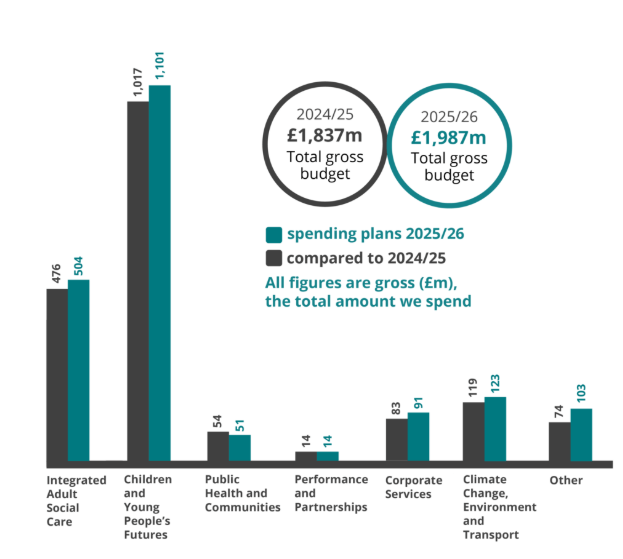
The cost of just adult social care in Devon is projected to be around a quarter of the County budget this year.

The County accounts for 73% of your council tax. In round terms the County budget is approaching £2,000m.

Breakdown of Devon County Budget

The District Leaders Covering letter

Date: 21 March 2025

Jim McMahon OBE MP

Minister of State for Local Government and English Devolution

2 Marsham Street

London

SW1P 4DF

Dear Mr McMahon,

This letter accompanies the Interim Plan being submitted here from the Leaders of 7 of the 8 Devon District Councils. We have worked very hard across a wide geography and a range of political backgrounds to develop this plan.

However, we are deeply concerned with both the process and the timetable of Local Government Reorganisation being imposed on Devon, and we are aware that you and Baroness Taylor have been advised of this by many in local government. Moreover, the specific recent context of the financial settlement, and the withdrawal of the Rural Services Delivery Grant does not instil confidence.

We heard at the Districts’ conference that government has identified a “two-tier premium” and that, in its understandable need to solve the existential financial crisis in Adult and Children Social Care, you expect savings by driving LGR through to cover this. We have been unable to find any evidence to support that claimed projected savings will be delivered, and are concerned that abolition of Districts to plug the financial gap is not a reality. If there is such evidence, we would request sight of relevant real-life examples. We feel sure that you are aware of the extreme risk using theoretical data from consultants with limited local government experience.

In Devon, the opposite of cost-saving is probable in this ‘cliff-edge’ approach to reorganisation. We estimate the true costs to be in the region of £100 million. If government is so confident that savings will be delivered, then we suggest these costs are paid to us up front to be recouped from the supposed savings in future years.

We would emphasise that efficiencies and savings can be delivered and that we are best placed to do that. Ironically, we were actively in the process of integrating services at a more strategic level particularly around waste and leisure centre provision. The inevitable upheaval of LGR has somewhat curtailed this constructive and positive action.

Given the chance, we can deliver a road map with tangible targets moving towards savings under a plan which will be less expensive to deliver and will deliver a much more resilient outcome. We share government aspirations around cost-saving but ask you that we are given the opportunity to achieve these outcomes.

As a group, we would be pleased to have the chance to meet with you for further discussion.

Yours sincerely,

 A correspondent comments on David Reed MP playing the blame game

Dear Owl, 

Like the MP for Exmouth and Exeter East, I’m an “incomer” to East Devon, so am not fully aware of what has gone on in the area over the years. 

I enjoy reading your articles in East Devon Watch as they provide background information on the political scene in our area. I found your article with the headline ‘”BUILD, BUILD, BUILD” SKINNER BACK ON THE CAMPAIGN TRAIL’ dated 17th March very informative. 

From my understanding, Mr David George Reed stood as a Conservative councillor candidate for Cheltenham Borough Council – Park Ward in May 2022. So presumably he came to our constituency in 2023, as he was selected to be Conservative Parliamentary Party Candidate for Exmouth and Exeter East in the summer of 2023. 

My husband met Mr David George Reed in Brixington in April 2024 when he handed him a leaflet as he was campaigning for Mrs Aurora Bailey, the Conservative candidate in the by-election. Mr David George Reed told my husband that he’d been selected to be the parliamentary candidate for his political party. 

I have read the MP for Exmouth and Exeter East’s Facebook post dated 13th March, that you refer to in your article. I noticed that he was keen to blame the “Lib Dems-led East Devon District Council” for the “extra housing”. He stated the obvious: “Our current sewage network in #ExmouthandExeterEast cannot cope with this.” There are many reasons why the sewage network can’t cope with the present infrastructure. Mainly because the water companies have put profit and dividends before investment in replacing sewage pipes, updating pumping stations and sewage treatment works. It was the Conservative privatisaton that has been a contributory factor to the problems we have in East Devon and across the country. It was also the former Conservative government, including the former MP for East Devon, where Exmouth was the largest town in his constituency, who voted to relax legislation on water companies. 

East Devon District Council is led by the Democratic Alliance Group which consists of Liberal Democrats, Greens and Independent Councillors. Apparently, the Democratic Alliance Group was formed because although the Liberal Democrats had the most councillors elected in May 2023, there weren’t enough of them to form a majority. I have checked East Devon District Council’s website and whilst the Leader of the East Devon District Council is Liberal Democrats, not all of the Portfolio and Assistant Portfolio holders are members of the Liberal Democrats political party. I would have thought that having campaigned on behalf of candidates to be district councillors in Brixington and Exe Valley wards, our MP would know the political situation at East Devon District Council. 

I read the article with the headline “BUILD BABY BUILD” ANGELA RAYNER WANTS TO STRIP COUNCILLORS OF PLANNING POWERS’ in East Devon Watch, dated 10th March and found this very informative. From my understanding, it appears that the former Conservative government imposed housing targets, just like the present Labour government. Apparently, the government can take over council’s planning departments if the targets aren’t met.

I was under the impression that the MP for Exmouth and Exeter East was keen to have a cross party approach to solve problems in our constituency. I presumed that this was because he recognised that having gained a majority of only 121 votes, he realised the importance of good communication skills with others, who have different political opinions to his own. The outcome of the general election in July 2024, showed that this constituency is more of less a three-way split – Conservative, Labour and Liberal Democrats. 

The day before the Exe Valley by-election, their MP stated in his Facebook post, dated 12th March. “It’s worth noticing that this by-election has come about because the former Lib Dems councillor failed to turn up and do the job he was elected to do. This unavoidable by-election is costing us all money.”

It seemed very coincidental that the MP for Exmouth and Exeter East decided to criticise the Liberal Democrats the day before the by-election and also on the same as the by-election for Exe Valley ward. Maybe after reading their Conservative MPs social media posts, voters in Exe Valley ward made up their mind not to vote Conservative in this by-election. Perhaps they decided to vote for the Reform UK candidate instead!

We don’t know what is going on in councillors’ personal lives. There were probably very good reasons why the former Conservative district councillor for Brixington ward and the former district councillor for Exe Valley ward didn’t attend meetings/stood down. I would have hoped that the MP for Exmouth and Exeter East would have been less judgmental and shown more empathy to the former councillors, who relinquished their position, irrespective of political affiliations. 

The former MP for East Devon used to criticise East Devon District Council and those in other political parties. That could have been a factor why he wasn’t elected to be the MP for Honiton and Sidmouth. 

Interestingly, in May 2024 the result of the by-election in Brixington was Conservative hold and the result of the by-election in Exe Valley ward last week was Liberal Democrats hold. 

Yours sincerely, 

An incomer like the MP for Exmouth and Exeter East

Submission Day for Rayner’s Reorg

All in the name of devolution, District Councils are to be merged into Unitary Authorities and a new second tier of local government introduced above these with elected mayors.

Jim McMahon OBE MP Minister of State for Local Government and English Devolution has invited leaders of all local authorities in Devon to submit interim plans, jointly or severely by 21 March. Ideally in consultation with neighbours.

Owl understands that the following submissions from Devon authorities will be made today:

Ten different options

County submits five options:

  • Two unitary authorities – one covering Plymouth and another covering the rest of Devon.
  • A two unitary north Devon/South Devon split, with one council for Plymouth, Teignbridge, South Hams and Torbay, and another for Exeter, East Devon, North Devon, Torridge, West Devon and Mid Devon.
  • A two unitary south west and north east split, with one council for Plymouth, South Hams and West Devon and another for Exeter, East Devon, Torbay, Teignbridge, North Devon, Torridge and Mid Devon.
  • A three unitary option of Plymouth, greater Exeter (formed of Exeter, East Devon and Mid Devon) and the rest of Devon.
  • A three unitary option, with Plymouth remaining on existing boundaries, a new unitary council formed of Exeter, East Devon, Mid Devon, North Devon and Torridge and another made up of Torbay, South Hams, Teignbridge and West Devon.

Plymouth submits a single option:

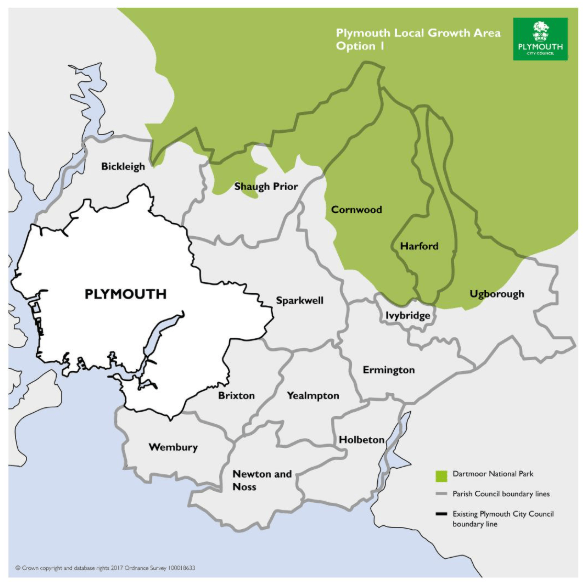
Will propose retaining its unitary status expanded into the “Plymouth Growth Area”. This option proposes extending the city’s boundaries to include 13 neighbouring parishes, approximately 30,000 additional residents. This modest expansion would create a more cohesive and efficient local government structure for the City, better equipped to meet the needs of our growing population. [Still too small to meet the current Government set population threshold of 500,000)

Plymouth Growth Area

Torbay submits three options

  • Remain a unitary authority (like Exeter Torbay’s population falls well below the government’s threshold).
  • Join the 1-4-5 proposal from the eight Districts (see below).
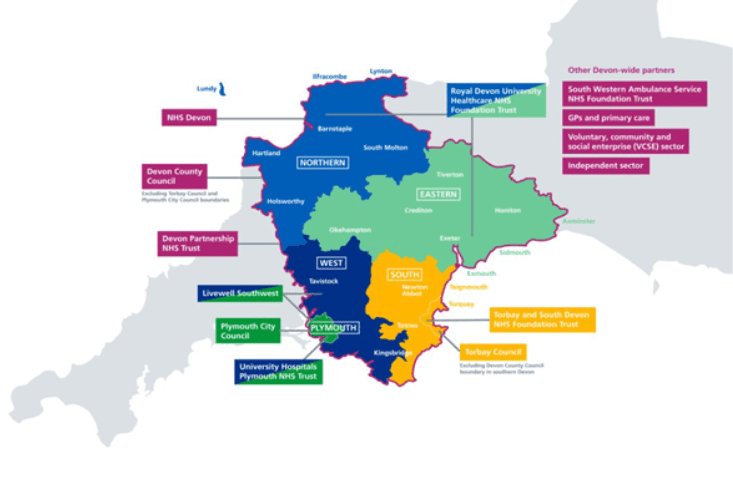
  • Expand into the NHS area (see map below – though just how fixed these boundaries are must now be open to question)

Local NHS areas

Exeter submits a single option

Proposes to become a unitary authority by including parts of East Devon, Teignbridge and Mid Devon in order to serve a population of between 300,000 and 350,000. [Son of GESP – Owl]

The seven Devon Districts submit a single option (Exeter council currently equates to a district though it has no constituent town or parish councils and has chosen to go it alone).

The seven jointly propose the “1-4-5 option” [probably the only one to answer the exam question to the letter – Owl]

This proposed two new unitary model alongside the retention of Plymouth aligns with the six criteria for unitary government, using existing district areas as building blocks and aiming for populations near 500,000 for each authority. The proposed model anticipates the creation of a;

  • Exeter and Northern Devon Authority: East, Mid, North Devon, Torridge, and
    Exeter
  • Southern Devon Authority: South Hams, Teignbridge, West Devon, and Torbay.
  • alongside
  • Plymouth City remains as a retained unitary authority

(The seven are: North Devon, Torridge, Teignbridge, West Devon, Mid Devon, East Devon, South Hams)

Never mind the chaos: Jim’ll Fix It!

 (Here’s where he’s coming from: Jim McMahon is a Mancunian born and bred and former Leader of Oldham Metropolitan Borough Council )

Tonight 19 March 6pm EDDC Extraordinary meeting to discuss response to Rayner’s Council reorganisation

The so called 1-5-4 option

The key document is this 26 page draft report. The final draft is due to be submitted on 21 March. The draft has been agreed by eight Leaders of Devon’s District Councils

In the forward the Leaders say:

We, the Leaders of seven of the district councils of Devon together with the Leader of
Torbay Council, acknowledge the government’s intent and are committed to responding
constructively to this. We have collaboratively developed interim proposals to meet the
government’s initial deadline. We propose the creation of two new unitary councils
(alongside the retention of Plymouth City unitary): one encompassing South Hams,
Teignbridge, West Devon, and Torbay, and the other uniting East, Mid, North Devon,
Torridge, and Exeter. We believe this model better serves the interests of Devon and
Torbay’s nearly one million residents rather than a single ‘mega-council’.

Despite the progress made in developing these proposals, we have significant concerns
and reservations regarding the proposed scale and timeline for LGR, particularly its
potential for financial unsustainability. The existing system, while imperfect, delivers
effective, locally tailored services and possesses established community connections
and a strong sense of place. We believe the government’s proposals fail to address the
critical funding challenges facing Devon and Torbay, notably in Adult and Children’s
Social Care, Special Educational Needs and Disabilities, and in the NHS.

This submission represents an initial framework for how two new local authorities could
be formed. There is considerable further work required to develop these proposals. We
are actively engaged in this further development, including ongoing dialogue with Torbay
Council, and are mindful of the need for flexibility and agility as the LGR process
evolves. We are committed to maintaining local distinctiveness while pursuing service
improvements and we will engage extensively with residents, partners, and
stakeholders throughout this process.

Executive Summary

This Interim Plan responds to the government’s invitation for Local Government
Reorganisation (LGR) towards a single tier. Acknowledging the English Devolution White
Paper’s intent to replace existing councils with larger unitary authorities, this
submission proposes a balanced two-unitary solution for Devon and Torbay, alongside
Plymouth City as a retained unitary authority, aiming to meet LGR objectives while
preserving local identity and ensuring sustainable service delivery.

The proposed two-unitary model aligns with the six criteria for unitary government,
using existing district areas as building blocks and aiming for populations near 500,000
for each authority. The proposed model anticipates the creation of a;

  • Exeter and Northern Devon Authority: East, Mid, North Devon, Torridge, and
    Exeter
  • Southern Devon Authority: South Hams, Teignbridge, West Devon, and Torbay.

This offers a comprehensive solution for the whole area, establishing a credible
alternative to a single ‘mega’Council whilst guarding against the creation of an
urban/rural divide.

The Interim Plan recognises that significant further work is required to develop these
proposals. A programme is set out for how this will happen through to November 2025.
This includes extensive stakeholder engagement.

[There is a feeling that the government could well change the ground rules to lower the population threshold for a unitary authority to 350K in whch case something very different may emerge. Also worth pointing out that Districts only account for 7% of your council Tax so the potential saving can’t be huge. – Owl]

The Grauniad inserts a helpful link to EDW as Martin Shaw gets Seaton Hospital on the national map and asks Wes Streeting to visit

The human cost of yet another NHS reorganisation Letters

NHS England’s abolition makes us reflect on disastrous 2012 reforms, writes Dr Michael Cohen, while Jeremy Wainman decries the dismantling of a skilled workforce, Nigel Turner explains the reorganisation cycle, and Martin Shaw invites the health secretary to visit his local hospital

Tue 18 Mar 2025

As the Labour party plans yet another costly NHS reorganisation, we should reflect on the former health secretary Andrew Lansley’s disastrous and expensive reforms in 2012 (Keir Starmer scraps NHS England to put health service ‘into democratic control’, 13 March). I worked as an NHS GP and hospital specialist for 25 years. Those of us working in the service could see where many of the major problems lay, but rather than listening to those working at the coalface, David Cameron seemed to be seduced by Lansley’s ideas.

The disastrous effects of the reorganisation were seen most clearly when the Covid pandemic struck, with respect to provision of personal protective equipment and the test-and-trace debacle. Effective public health pathways had been changed and there was no joined-up thinking whatsoever.

Now we have elderly patients fit for discharge lying in hospital beds as plans for social care reform are again kicked down the road. Patients awaiting hospital admission lie in corridors, where care is clearly substandard despite the heroic efforts of doctors and nurses. It is scandalous.

What happens if we have a new administration in four years, another reorganisation? We must stop the NHS becoming a political football and have some cohesive and effective forward planning before it really is too late.
Dr Michael Cohen
Bristol

 The cuts to integrated care boards are yet another example of short-term cost-saving measures that will weaken our economy, public services and workforce (30,000 jobs could go in Labour’s radical overhaul of NHS, 14 March). Good jobs are not just expenses; they are investments in a stable, productive society.

Beyond the numbers, there is a deep human cost. Many of those losing their jobs are the very people who worked tirelessly to keep the NHS from collapsing after years of underfunding. To reward them with redundancy rather than support is an insult. What’s even more troubling is that a Labour government, supposedly the party of workers and vulnerable people, is making these cuts instead of pursuing fairer ways to raise revenue. Rather than increasing taxes on those who can afford it, they are targeting NHS staff while ignoring the system’s deeper issues.

The NHS is inefficient, but not because of its workforce. The real causes are years of deliberate underinvestment and the unchecked power of NHS trusts, which act as bureaucratic fiefdoms obstructing modernisation.

Frontline staff today are less efficient than their predecessors, not due to lack of skill but because they are trapped in an outdated, fragmented system.

If Labour is serious about fixing the NHS, it must invest properly, break down power imbalances, and implement long-term change. Instead, it is choosing the same failed austerity playbook. The UK cannot afford to dismantle its skilled workforce under the guise of fiscal responsibility.
Jeremy Wainman
Pontefract, West Yorkshire

 When I joined the NHS as a manager nearly 35 years ago, my boss explained to me that there was a fundamental rhythm to the reorganisation of the NHS. Incoming governments, he said, centralised things, believing that they could “fix the NHS”, and then, when they discovered that they couldn’t, they decentralised again to avoid the blame. Here we go again…
Nigel Turner
London

 Matthew Weaver (How did Andrew Lansley reorganise health and create NHS England?, 14 March) misses one change that had a big impact on communities: the transfer of the ownership of many health service buildings to a company, NHS Property Services (NHSPS), charged with obtaining national market value from them. In Devon, community hospitals paid for by local donations became the property of NHSPS without anyone being informed, and wards were closed with the intention of selling sites for housebuilding.

In Seaton, more than a third of the hospital – a wing funded entirely by local people – has been empty for nearly eight years, partly because NHSPS won’t vary its rental charges to allow for new uses, despite a huge local outcry and lengthy discussions. Wes Streeting should look into NHSPS, and would be welcome in Devon to see the problems for himself.
Martin Shaw
Seaton, Devon

Devon County changes its tune on Rayner’s reorg

At the beginning of February Devon claimed it was on “the fast track” to create a single unitary authority as part of Angela Rayner’s local government reorganisation plans. But it lost  its bid to cancel the May elections and has now come up with FIVE alternative options, demonstrating quite clearly that it was never in a position to make such a claim.

Here are the county proposals, the eight district councils, have all coalesced around one idea known as the 1-5-4 proposal which will be published separately.

The government has opened a can of worms. Owl doesn’t expect them to make a quick decision.

Data ‘vital’ in council shake-up as Devon poses reorg options

Bradley Gerrard www.exmouthjournal.co.uk

Data has to be the driving force behind Devon’s upcoming local authority shake-up, according to the county council’s outgoing leader who has warned against hopes of “massive savings”.

A report outlining five potential ways that Devon’s 11 existing main councils could be merged into either two or three new, larger ones has been published, with a special meeting of Devon County Council planned this Thursday (March 20) to debate the proposals.

A sixth option of one Devon-wide council is acknowledged, but “only for benchmarking purposes” rather than being viewed as a viable option.

Cllr James McInnes (Conservative, Hatherleigh and Chagford), the outgoing council leader, said his plan is for all five options to be submitted to the government this week, with a pledge that data would be gathered over the coming months to help identify which make the most sense.

Jim McMahon, minister of state for local government, had asked councils to submit interim reorganisation plans by Friday, but Cllr McInnes said Westminster’s emphasis had changed slightly in recent weeks.

“The government has shifted its position, which I’m aware of as I wrote to Mr McMahon asking various questions, one being whether 21 March was a decision point,” Cllr McInnes told the Local Democracy Reporting Service.

“But he quite clearly said that it was not a decision point and that he merely wanted to know what we had been up to so far.”

Different strategies

The move to submit five proposals differs from the strategy of Devon’s eight district councils, which have all coalesced around one idea known as the 1-5-4 proposal.

That would see Plymouth remain a unitary council with potentially expanded boundaries compared to now, while Devon’s other councils would be merged into one of two new unitary councils.

That idea is included as one of Devon’s five suggestions.

Cllr McInnes said third parties are collating data for the county council to work out which proposal would be the most effective, and this would be shared with district councils.

“I support the principal and advantages of a unitary in terms of residents knowing who to go to and get support, or complain to, and it would be better for one organisation to oversee housing and social care, for instance, compared to it being split between two different councils now,” he said.

“But we need to use data to make sure we make the right decisions for the long-term sustainability of services.”

Fears have been raised that the government views reorganisation as a way to save money, but Cllr McInnes said that is optimistic.

“If you think how much money has been taken from local government since 2009/10, through austerity, the pandemic and now the cost-of-living crisis and the spike in inflation we’ve had, there simply isn’t the meat on the bone to make massive savings,” he said.

“I think we can make efficiencies in terms of having one front door and integrating services [that are currently split across two councils] but we cannot make savings and if someone thinks they can take millions of pounds out of local government, it’s already been done.”

The government announced in December that it wants to abolish the two-tier system of local government whereby district and county councils are responsible for different services in the same geographic area.

Devon’s five suggestions for local government reorganisation are:

  • Two unitary authorities – one covering Plymouth and another covering the rest of Devon.
  • A two unitary north Devon/South Devon split, with one council for Plymouth, Teignbridge, South Hams and Torbay, and another for Exeter, East Devon, North Devon, Torridge, West Devon and Mid Devon.
  • A two unitary south west and north east split, with one council for Plymouth, South Hams and West Devon and another for Exeter, East Devon, Torbay, Teignbridge, North Devon, Torridge and Mid Devon.
  • A three unitary option of Plymouth, greater Exeter (formed of Exeter, East Devon and Mid Devon) and the rest of Devon.
  • A three unitary option, with Plymouth remaining on existing boundaries, a new unitary council formed of Exeter, East Devon, Mid Devon, North Devon and Torridge and another made up of Torbay, South Hams, Teignbridge and West Devon.

Tory Leader Mike Goodman “shoots from the hip” and misses

Last week, the Leader of the Tories in East Devon District Council (EDDC), Mike Goodman, published a letter denigrating the conduct of Paul Arnott, the Council leader. Inevitably, Paul Arnott used his right of reply. Both letters are published below.

Owl recalls Mike Goodman’s chequered history both in Sidmouth and Surrey

He became leader of the Tory minority in EDDC after his predecessor, Phil Skinner, was kicked out in the May 2023 election. This seemed to Owl to be a surprising choice as he was a Surrey County Councillor as recently as 2022 but perhaps they had little remaining talent to choose from.

As Owl reported during the 2023 general election campaign, he was the publisher of a “fake” local newspaper, the “East Devon Echo”, receiving a formal rebuke from the Press Watchdog.

Mike Goodman has a history of previous “angry outbursts” in EDDC, and of provoking outbursts in others in Surrey (two fingers and the “f” word). 

Could his “robust” form of politics have contributed to the LibDem gain in his Bagshot patch of “True Blue” Surrey Heath in the general election?

Mike Goodman www.exmouthjournal.co.uk

Letter: Does the East Devon Council leader value democracy?

In last week’s paper, we had the leader of the Lib Dem-led East Devon District Council writing about the need to protect democracy and reminding residents about elections for Devon County Council in May.

We agree that democracy needs protecting, but I do wish he’d act in the same spirit as he writes.

However, we know he’s standing for the county and probably wants to present a good image.

Sadly, if you scratch the surface at EDDC, the good image tends to rot away – and it seems some have an eye towards the local elections in May, where both the leader and deputy leader of the council want to win more influence as part of Devon County Council.

I want to take this opportunity to highlight examples of how the leader of the council has tried to silence me as an elected representative.

Firstly, at the most recent cabinet meeting on March 5, I was called “discourteous” because I dared to ask a question.

I was elected to ask questions in a democracy.

They were two important questions, and despite both the directors and one of the portfolio holders being in attendance, they were silenced and stopped from speaking.

The first question was a clarification on the ongoing challenges and problems of the condition of council housing stock.

In November, the stock condition survey results were presented to councillors privately, and the intention was for the details to be made public.

I first raised this matter in January, and no answer has yet been forthcoming.

It doesn’t look good, does it?

The second question, which was first asked and not answered on February 25, was around the council’s plans to hike the price of some rugby and football pitch fees by up to 50 per cent.

At the budget meeting on January 15, I asked for this policy to be reconsidered.

However, when the item went to full council, the fees had not been amended, and no explanation was given.

No response to my concerns was forthcoming, either.

Democracy in action?

I think not.

This policy is totally unacceptable and goes against encouraging people to play sports.

It will hurt so many clubs in a cost-of-living crisis, and there is no justification apart from lining council coffers.

I can only hope the council reduces the fees and makes the survey of the stock condition of our council housing public, like they said they would.

Hundreds of tenants across the district know the truth, and it shouldn’t be hidden away with legitimate questions shouted down.

I agree that democracy matters, let’s see more of it within East Devon District Council.

Councillor Mike Goodman
Sidford

Cllr Paul Arnott www.exmouthjournal.co.uk

Letter: In response to Cllr Goodman’s ‘untrue’ letter

By Cllr Paul Arnott

In this week’s papers, the East Devon Conservative district councillor, Michael Goodman, who joined the Sidmouth Conservatives on relocating from Surrey to Sidmouth in 2022, mentions me. I would be grateful for the right to reply.

In essence, Mr Goodman states that officers “were silenced and stopped from speaking” when he asked two questions at a Cabinet meeting I chaired. This is untrue.

Both questions required complex answers, one confidential as he well knew, and instead of Mr Goodman being allowed to stage his own personal interrogation he was advised by me that he would receive written answers.

This is common practice, completely constitutional, and what is happening. It may be that as a Surrey councillor Mr Goodman was allowed to push officers with not a moment’s notice of his question to satisfy him. In East Devon it is more courteous than that.

I am sorry that Mr Goodman has taken your readers’ time with yet another ad hominem attack on me, and also sorry I have to bore them with a reply for the record.

Paul Arnott
East Devon District Council leader and councillor for the Coly Valley ward.

“Build, build, build” Skinner back on the campaign trail

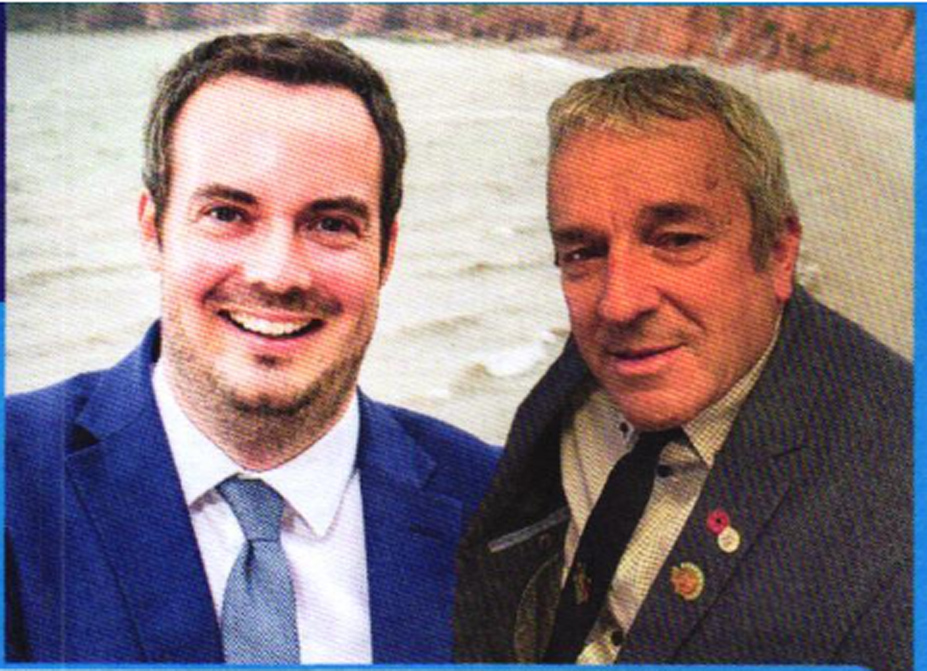
This selfie taken by Conservative David Reed MP shows him campaigning with “Build, build, build” Phil Skinner in support of the latest failure to get veteran candidate of many wards, Patsy Hayman, elected in the Exe Valley by-election.

Why is Owl surprised?

Only last week David Reed was falsely claiming that the level of housing in East Devon was down to the Lib Dem-led East Devon District Council. Here is what he wrote on 13 March, on his facebook page:

We all know that our current sewage network in #ExmouthandExeterEast cannot cope with our current level of housing, let alone the tens of thousands of extra houses that the Lib Dem-led East Devon District Council are proposing for our area.

This attribution to the Lib-Dem District Council couldn’t be wider from the mark. The real culprit is the man on his left – Phil Skinner!

Philip Skinner’s record as a primary architect and driving force behind the long standing Tory policy of building in East Devon is copiously recorded on “The Watch”. His, and his EDDC Tory colleagues’ policies, resulted in the current Local Plan having a development target of 950 houses/year. This was driven by the adoption of an aggressive “jobs led policy on” scenario.  Comprehensive studies showed only around 580 houses/year would be required to satisfy purely demographic and normal migration growth trends. 

This policy, therefore, resulted in an uplift of 370 or 64% on what is strictly necessary and is the target that the current EDDC coalition has inherited and the basis on which the government thinks reasonable to set its own growth strategy. Owl has already pointed this out to David Reed in a post last September.

Phil Skinner was also one of the drivers of the now defunct “Greater Exeter Strategic Plan (GESP)” which tried to get green field sites in East Devon to take the lion’s share of Exeter’s housing needs. It seems that there were always farmers in East Devon willing to “sacrifice” their land to this end. At the time planners confirmed that the GESP targets would over-ride East Devon’s local plan.

When the Tories lost control of EDDC, one of the first things the coalition did in August 2020 was to vote, by a massive majority, to pull out of GESP. Exeter is now having finding sites elsewhere to satisfy their needs.

To be fair, David Reed hasn’t been in East Devon all that long. Like his predecessor, Simon Jupp, he’s a “Blow in”. He still needs to read himself in before sounding off like this.

Here is puppet master Phil with David Reed’s predecessor as featured on Tory mailshots in the old Devon East constituency.

Phil Skinner was the leader of the Tories in East Devon until he was kicked out by the electorate in the May 2023 local election.

Despite this he is still pulling the strings.

District By-election: Libdem hold, Tories and Reform neck by neck, Labour last

Is this an omen for the Tories in Devon and the reason they tried to cancel this May’s County elections? – Owl

East Devon District Council – By-election 13 March 2025

Declaration of results for East Devon District Council Exe Valley Ward 13 March 2025

Name of CandidateDescription (if any)Number of votesElected?
BENNETT JulieLabour Party Candidate54 
HAYMAN PatsyThe Conservative Party Candidate137 
KING FabianLiberal Democrat256ELECTED
VANSTONE NatReform UK135 

Electorate: 2,042
Ballot Papers Issued: 582
Rejected Ballot Papers: 0
Turnout: 28.7%

Planning Bill recycles old ideas. They failed last time. What’s new this time?

The definition of insanity is doing the same thing over and over and expecting different results”

The proposed planning bill, yet to be drafted but intended to produce the “biggest building boom’ in a generation, obviously needs a lot more time and thought. Here is an example that caught Owl’s eye from the list of eight key measures announced by Angela Rayner on Monday.

Strategic Planning

“The Bill will introduce a system of ‘strategic planning’ across England known as spatial development strategies, which will help to boost growth by looking across multiple local planning authorities for the most sustainable areas to build and ensuring there is a clear join-up between development needs and infrastructure requirements. These plans will be produced by mayors, or by local authorities in some cases, and will ensure the level of building across the country meets the country’s needs.”

We have been here before with so little impact that Owl suspects that few will remember. 

Strategic planning for each of the nine English regions became formalised from the 1990s.

Regional Assemblies

1.  1999 The South West Regional Assembly (SWRA) was established in 1999. It was not a directly elected body, but was a partnership of councillors from all local authorities in the region and representatives of various sectors with a role in the region’s economic, social and environmental well-being. It was made up of 119 members.

Worth noting that there was much opposition to the formation of the South West Regional Assembly with critics saying it was an unelected, unrepresentative and unaccountable quango, and the area covered was an artificially imposed region and not natural. This opinion was based upon geography, arguing that having the Isles of Scilly and Cornwall in the same region as Gloucestershire would be comparable to linking London with Yorkshire.

Spatial strategies

2. 2004 Regional spatial strategies (RSS) to provide regional level planning frameworks for the regions were introduced in 2004. 

3. 2010 The functions of regional assemblies were planned to pass to regional development agencies in 2010 but the new Conservative/Liberal Democrat government abandoned spatial strategies and revoked regional development agencies in favour of the equally “unelected, unrepresentative and unaccountable” Local Enterprise Partnerships.

4. 2024 In April, the government abolished Local Enterprise Partnerships transferring the functions to local authorities.

What does a coherent planning system need to recognise?

In 2010 under the heading “Abolition of Regional Spatial Strategies: a planning vacuum” the House of Commons committee on Communities and Local Government put their finger on the nub of the problem:

A coherent, efficient planning system has to recognise and relate to issues from the point of view of a range of players operating at different levels: individuals, developers, community and resident groups, businesses, local authorities, and the Government. Regional Spatial Strategies (RSSs) bridged the gap between planning issues determined by local policies and concerns, and those subject to nationally-determined policy aspirations, such as housing or renewable energy. Views are mixed on the merits of Regional Spatial Strategies: opposition to them has highlighted the length and complexity of their preparation; the undemocratic nature of the bodies preparing them; the difficulty of influencing their outcomes; and the ‘top-down’ housing development targets they contained. Support for them has highlighted their comprehensive, strategic view of planning across each region and their ability to deal with controversial and sometimes emotive developments, such as waste disposal, mineral working and accommodation for Gypsies and Travellers. 

Who drives the strategic plan?

Not only do these problems remain but the government is only just starting to consider how to create the Mayoral Strategic Authorities intended to carry this forward. Bigger than counties, these will sit as a new top tier of local authority presiding over a single tier of unitary authorities created from an amalgamation of counties and districts. This process inherently presents dangers of recreating the artificially imposed regions of the abandoned regional assemblies.

Given the lack of impact these regional bodies have had since 1999 and the transfer back and forth of the strategic planning function, we have to start afresh. Where are the teams with the appropriate skills? Who now holds the local economic and social data? How long will it take and how much will it cost to produce the first spatial development strategy? We must be talking years rather than months.

In the interim where are we going? – Owl

Government press release in full (with hearty endorsement from developers)

Biggest building boom’ in a generation through planning reforms 

Ministry of Housing, Communities and Local Government www.gov.uk

  • HOMES AND KEY INFRASTRUCTURE WILL BE BUILT FASTER UNDER PLANNING AND INFRASTRUCTURE BILL
  • ENERGY SECURITY WILL BE BOLSTERED WITH CHEAPER, CLEAN HOMEGROWN POWER
  • BILL IS KEY TO DELIVERING ON OUR PLAN FOR CHANGE TO BUILD 1.5 MILLION HOMES, MAKE BRITAIN A CLEAN ENERGY SUPERPOWER AND DRIVE UP LIVING STANDARDS

Homes and key infrastructure that hundreds of thousands of hard-working people and families need will be built quicker thanks to transformative reforms to get Britain building, tackle blockers and unleash billions in economic growth.

The Planning and Infrastructure Bill, which will be introduced to Parliament today (11 March), will see significant measures introduced to speed up planning decisions to boost housebuilding and remove unnecessary blockers and challenges to the delivery of vital developments like roads, railway lines and windfarms. This will boost economic growth, connectivity and energy security whilst also delivering for the environment.

By ensuring shovels can be put in the ground more quickly and projects are freed from unnecessary bureaucracy, these measures will help deliver a building boom that will deliver a major boost to the economy worth billions of pounds, and create tens of thousands more jobs as houses and infrastructure are built. It will make Britain a more attractive prospect for investment and development with a planning process that works for the builders, not blockers.

This Bill comes alongside wider planning reforms including the new National Planning Policy Framework and is at the heart of our Plan for Change missions to deliver the 1.5 million homes this country needs alongside 150 major projects, ensure Britain can become a clean energy superpower through building the necessary infrastructure, and help to raise living standards by ensuring working people have more money in their pocket.

People living near new electricity transmission infrastructure will also receive up to £2,500 over ten years off their energy bills, ensuring those hosting vital infrastructure benefit from supporting this nationally critical mission.

Deputy Prime Minister and Secretary of State for Housing, Angela Rayner said:

We’re creating the biggest building boom in a generation – as a major step forward in getting Britain building again and unleashing economic growth in every corner of the country, by lifting the bureaucratic burden which has been holding back developments for too long.

The Planning and Infrastructure Bill will unleash seismic reforms to help builders get shovels in the ground quicker to build more homes, and the vital infrastructure we need to improve transport links and make Britain a clean energy superpower to protect billpayers.

It will help us to deliver the 1.5 million homes we have committed to so we can tackle the housing crisis we have inherited head on – not only for people desperate to buy a home, but for the families and young children stuck in temporary accommodation and in need of a safe, secure roof over their heads.

These reforms are at the heart of our Plan for Change, ensuring we are backing the builders, taking on the blockers, and delivering the homes and infrastructure this country so badly needs.

KEY MEASURES

Planning Committees

Housebuilding will be backed by streamlining planning decisions through the introduction of a national scheme of delegation that will set out which types of applications should be determined by officers and which should go to committee, have controls over the size of planning committees to ensure good debate is encouraged with large and unwieldy committees banned, and mandatory training for planning committee members. Councils will also be empowered to set their own planning fees to allow them to cover their costs – with the stretched system currently running at a deficit of £362 million in the recent year. This money will be reinvested back into the system to speed it up.

Nature Restoration Fund

A Nature Restoration Fund will be established to ensure there is a win-win for both the economy and nature by ensuring builders can meet their environmental obligations faster and at a greater scale by pooling contributions to fund larger environmental interventions. These changes will remove time intensive and costly processes, with payments into the fund allowing building to proceed while wider action is taken to secure the environmental improvements we need.

Compulsory Purchase Reform

Land needed to drive forward housing or major developments could also be bought more efficiently thanks to reforms to boost economic growth and drive forward local regeneration efforts. The compulsory purchase process – which allows land to be acquired for projects that are in the public interest – will be improved to ensure important developments delivering public benefits can progress. The reforms will ensure compensation paid to landowners is not excessive and the process of using directions to remove ‘hope value’ – the value attributed to the prospect of planning permission being granted for alternative development – where justified in the public interest is sped-up. Inspectors, councils or mayors where there are no objections, will take decisions instead of the Secretary of State. 

Development Corporations

Development Corporations will be strengthened to make it easier to deliver large-scale development – like the government’s new towns – and build 1.5 million homes alongside the required infrastructure. They were used in the past to deliver the post-war new towns and play a vital role when the risk or scale of a development is too great for the private sector. Their enhanced powers will help deliver the vision for the next generation of new towns – a new programme of well-designed, beautiful communities with affordable housing, GP surgeries, schools and public transport where people will want to live.

Strategic Planning

The Bill will introduce a system of ‘strategic planning’ across England known as spatial development strategies, which will help to boost growth by looking across multiple local planning authorities for the most sustainable areas to build and ensuring there is a clear join-up between development needs and infrastructure requirements. These plans will be produced by mayors, or by local authorities in some cases, and will ensure the level of building across the country meets the country’s needs.

National Significant Infrastructure Projects (NSIP)

The Bill will ensure a faster NSIP regime that delivers infrastructure projects faster. It will make sure the consultation requirements for projects – such as windfarms, roads or railway lines – are streamlined, and ensure the national policies against which infrastructure applications are assessed are updated at least every five years so the government’s priorities are clear. Other changes will be made to the Highways Act and the Transport and Works Act to reduce bureaucracy so transport projects can progress quicker.

The government will further overhaul the process by which government decisions on major infrastructure projects can be challenged. Meritless cases will only have one – rather than three – attempts at legal challenge. Data shows that over half – 58% – of all decisions on major infrastructure were taken to court, including windfarms in East Anglia which was delayed by over two years as a result of unsuccessful challenges.

Clean Energy

Further changes will make sure approved clean energy projects that help achieve clean power by 2030, including wind and solar power, are prioritised for grid connections. Some projects currently face waits of over 10 years. A ‘first ready, first connected’ system will replace the flawed ‘first come, first served’ approach to prioritise projects needed to deliver clean power, unlocking growth with £200 billion of investment and protecting households from the rollercoaster of fossil fuel markets, while reforming the grid queue will accelerate connections for industrial sites and data centres.

Around twice as much new transmission network infrastructure will be needed by 2030 as has been built in the past decade and Britain’s electricity grid needs a 21st century overhaul to connect the right power in the right places.   

Bill Discounts

People living within 500m of new pylons across Great Britain will get money off their electricity bills up to £2,500 over 10 years, under these plans. Alongside money off bills, separate new guidance will set out how developers should ensure communities hosting transmission infrastructure can benefit, by funding projects like sports clubs, educational programmes, or leisure facilities.   The new community funds guidance means communities could get £200,000 worth of funding per km of overhead electricity cable in their area, and £530,000 per substation.

This would mean an upcoming project like SSEN Transmission’s power line between Tealing and Aberdeenshire could see local communities benefitting from funding worth over £23 million. Developers will closely consult with eligible communities on the funds and how best to spend them, to ensure a fair and consistent approach across Great Britain.

Mark Reynolds, Executive Chair of Mace Group and Co-Chair of the Construction Leadership Council, said:  

For too long the UK’s planning systems have inhibited growth, with layer upon layer of checks and balances stifling productivity, confidence, investment and jobs. 

These proposed changes show this government is listening to industry and taking reform seriously; recognising that new homes and infrastructure are necessary to inject life into the economy. 

Our construction industry is ready to meet the challenge, and the measures highlight how mindful growth can support communities and our net-zero ambitions.

Neil Jefferson, Chief Executive of the Home Builders Federation, said: 

The swift moves to address the failings in the planning system are a very welcome and positive step towards increasing housing supply. Removing blockages, speeding up the decision-making process and ensuring local planning departments have the capacity to process applications effectively will be essential to getting more sites up and running. If the other constraints currently preventing house builders delivering more homes can be tackled, the changes made to planning will really allow output to accelerate.

Brian Berry, Chief Executive of the Federation of Master Builders, said: 

The new Planning and Infrastructure Bill is a crucial first step in getting Britain building again. In the 1980’s around 40% of new homes were built by SMEs, yet today that figure is around 10%. Small builders across the UK stand ready to play their part in delivering the homes we need, but time and time again we’ve seen barriers keeping them out of the market.

We know from research carried out by the FMB that around three quarters of small builders view the planning system as the number one issue holding back the delivery of new homes, while lack of viable and available land are also major challenges. Supporting small builders through the planning system and reducing unnecessary bureaucracy will be key to opening up small sites, and today’s announcement will be welcomed by many across the industry.

Kate Henderson, Chief Executive of the National Housing Federation, said:  

At a time when the housing crisis continues to blight lives across the country, it’s welcome to see the introduction of this bill. With more than 160,000 children in temporary accommodation, it’s never been more urgent to build the social homes we need. 

Planning reform is an essential part of solving the housing crisis, and a return to strategic planning is welcome. A focus on certainty and enabling local areas to work together to plan for the homes, jobs and infrastructure needed in communities will ensure every area benefits from growth. Measures to reform compulsory purchase orders in the bill are also welcome, and will support the delivery of affordable housing and other local infrastructure such as GPs and schools.

David Thomas, Chief Executive of Barratt Redrow, said:  

It has been clear from day one that government is serious about tackling the housing crisis, and it continues to take strong action to unlock stalled projects and reshape the planning system to deliver the high-quality homes and sustainable places the country needs.  

We share government’s ambition to build more homes, to create good quality jobs and to drive economic growth. We look forward to supporting them on this mission and will respond positively to the bold reforms set out in the Planning and Infrastructure Bill.  

Other measures included in the Bill:

  • Streamlining the process to install EV charging infrastructure to help meet our net-zero ambitions
  • A new scheme to unlock billions of pounds of investment in long duration electricity storage (LDES) to store renewable power and deliver the first major projects in four decades.
  • Changes to the outdated planning rules for electricity infrastructure in Scotland that will streamline the consent process to enable decisions to be made faster.  
  • An extension to the generator commissioning period from 18 to 27 months to reduce the number of offshore wind farms requiring exemptions when applying for licences to connect to onshore cables and substations.  
  • Allowing forestry authorities in England and Wales, including the Forestry Commission, to bring forward development proposals, on the land they manage, relating to the generation of electricity from renewable sources– and to sell resulting electricity.

The Bill builds on work the government has already carried out to get Britain building including overhauling the National Planning Policy Framework, including new and higher mandatory housebuilding targets for councils, a comprehensive modernisation of the Green Belt, and far greater support for growth-supporting development such as labs and datacentres.