‘Zombie administration’ accusation as Exeter elections cancelled

Exeter City Council faces being run by a “zombie administration” according to critics of a decision by the Labour leader of the council to request the cancellation of May elections.

By Miles Davis Devon political reporter www.bbc.co.uk

The government has invited councils affected by the reorganisation of local government – which will see all district and county councils abolished – to ask to postpone elections to focus work on a transition to new unitary authorities.

Phil Bialyk, Labour leader of the council, said cancelling the election would save money and allow staff to focus on the reorganisation.

Michael Mitchell, leader of the Liberal Democrat group on the council, said the council would now be a “zombie administration” without legitimacy.

Exeter is one of 23 councils across England known to be requesting cancellation of elections.

Bialyk told councillors he would be asking the government to cancel the May elections in Exeter at the end of a four-hour long heated debate on Tuesday.

Responding to the decision, Mitchell said: “I’m appalled we’ve got a situation where the people of Exeter are not being able to decide or renew their contract for the councillors of Exeter to carry forward the work of ECC until 2028.

“The danger is by this decision, by denying democracy at this stage, Labour are effectively creating a zombie administration made up of the walking dead – especially their eight councillors who should be standing for re-election and getting a fresh mandate on 7 May.”

Green Party councillor Tess Read said: “I think this is very disappointing news for the residents of Exeter – because there’s no justification for cancelling elections.

“It’s hard not to think this decision is politically motivated – we know that in a recent Devon County Council election Labour lost all its seats.

“Labour has eight seats to lose in this coming election in May – if it loses all those seats the Green Party is the biggest party if we take all those seats.”

Bialyk said: “I have to think about the staff – I have to think about the services in Exeter, I have to think about the capacity we need to have in order that we can get a unitary authority for Exeter and the surrounding areas.”

The government is currently considering various plans for how Devon should be carved up into new unitary authorities with elections to be held in May 2027 ahead of the new councils being launched in April 2028.

Bialyk said: “There will be elections in 2027 – that is the goal that I’m fighting for to make sure Exeter’s services are delivered in a sensible way.”

In response to accusations of being scared of losing seats, Bialyk said: “Nothing is certain – we’re convinced we’re making the right decision here.

“I’ll be judged on what Exeter looks like going forward and we will be putting forward proposals for all of that.”

Exeter Turkeys vote to cancel elections

No surprises then. 

Will reorganisation really be in place within a year and just how many councillors will they have – 39 or only nine as in the current county level divisions? (Currently Exeter City council comprises 39 councillors, representing 13 wards with three councillors per ward).

Will they have to ask for cancellation next year as well?- Owl

Exeter City Council will ask to cancel May elections

Miles Davis www.bbc.co.uk

Exeter City Council will ask the government to cancel elections that were due to take place in May.

City council members took part in a heated debate over whether to hold the elections after the government said it would consider requests for postponements from councils involved in a massive local government reorganisation.

A report prepared by the Labour-run authority said cancelling the elections would free up financial resources for “the work required to prepare for the transition to new unitary councils”.

Opposition parties were heavily critical of any possible cancellation but the council leader said he would be writing to the government to request a postponement.

In the reorganisation of local government, all district and county councils are being abolished with plans for new unitary authorities to come into existence from May 2028.

Michael Mitchell, Liberal Democrat group leader, spoke in favour of holding the election.

He said the government was offering the Labour Party in Exeter a “get-out-of-jail-free card” to avoid defeat in the elections which it should refuse.

Conservative group leader and member for St Loyes, Peter Holland, said it would be “morally and ethically wrong to cancel residents’ democratic rights”.

Diana Moore, Green Party leader, said people expected elections to take place and they were “not a privilege but a right”.

Reform member Alison Sheridan said Labour were “wiped out” in Exeter in the Devon County Council elections in 2025 and claimed Labour members were afraid of suffering the same fate in elections in May.

But postponing the elections in May “is not about denying democracy”, said Duncan Wood, a Labour cabinet member. “It is about ensuring when residents vote, they are voting for a council that will actually exist and will have the power to shape and deliver their services.”

Council leader Phil Bialyk said he had listened to the views of all councillors but wanted to request postponement to focus resources on the transition to new unitary authorities.

Members voted by 21 for, nine against and seven abstentions, to approve a recommendation to note the minister’s letter and make a response by 15 January.

The elections on 7 May would have been for 13 of the 39 Exeter City Council seats.

The council is currently controlled by Labour with 22 seats but power could have changed hands if elections go ahead.

The Green Party has seven seats and the Liberal Democrats have four, with the Conservatives, Independents and Reform UK all having two members each.

Of the 13 seats up for election in May, eight are held by Labour, two by the Greens and one each by the Liberal Democrats, The Conservatives and Reform UK.

Plymouth City Council could also have requested the cancellation of elections but chose not to.

Whatever the result of May elections, for a third of the seats in Plymouth, Labour will retain control of the council.

Unanimous opposition to Exeter election axe

What interests Owl are the comments made by Exeter City Council’s leader, Phil Bialyk (Labour, Exwick) to the reporter after the meeting. These are reported in the last few paragraphs of the article.

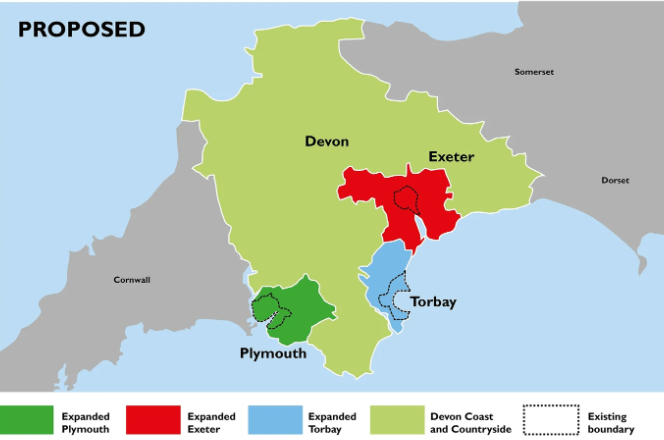
Reading between the lines he is struggling to find the effort to put together a credible bid to create a new unitary authority centered on Exeter. This bid will need to include about a third of both East Devon and Teignbridge as well as the south west corner of Mid Devon. The reason for this “take over” is to assemble a population of around the 500,000 mark, the original target set by Angela Rayner for unitary status. Exeter on its own would only reach about a quarter of this. 

Cllr. Bialyk describes this as “Exeter going solo”. That is pure spin. Were his proposal to be accepted by the government, Exeter would be only a minority part of the new authority. Cllr. Phil’s hostile takeover bid would inevitably backfire. Whatever happens in the proposed local government reorganisation. Exeter (and Labour) will lose control. 

Cross-party backing for Exeter elections to progress but some question cost and rationale of in-person meeting.

Bradley Gerrard www.devonlive.com

Unanimous opposition emerged at a Devon council against the prospect of elections in Exeter being cancelled this year.

Members of Liberal Democrat-run Devon County Council expressed an uncommon level of unanimity in the chamber on the issue, clearly expressing a view that the scheduled May elections for Labour-controlled Exeter City Council should progress as planned.

The government has invited 64 councils in England to say if they would like elections postponed this year, and has invited comments from town halls.

The ultimate decision will be made by Westminster, which made the offer to councils due to concerns from some about the pressure on local officials of running an election at a time when they are also on the cusp of a massive reorganisation.

The letter from government was addressed to leaders of councils with elections in May 2026, meaning Devon County Council does not technically appear to be a recipient.

But its leader, Councillor Julian Brazil (Liberal Democrat, Kingsbridge ), called a special meeting to debate the issue in a bid to formulate a comprehensive letter to government about its views.

You agree you are 18 or over. We use your sign-up to provide content in ways you’ve consented to and improve our understanding of you. This may include adverts from us and third parties based on our knowledge of you. Unsubscribe at anytime. More info

Devon County Council does not have any Labour councillors, and so some queried the necessity for a meeting where the party couldn’t respond to comments, while another questioned whether the whole thing could have been done on Teams.

Exeter City Council’s leader, Phil Bialyk (Labour, Exwick) sat in the public gallery watching proceedings.

“I intended to write a pretty scathing response to the minister’s letter but I wanted to hear the views of the full council,” Cllr Brazil said.

“I’m hoping we can come to a consensus which will give more strength as we will be speaking as one.”

He added that he felt that postponing elections was “instinctively the wrong thing to do”, and that the letter had also prompted further concern about the pace at which local government reorganisation is being proposed. This is the process whereby all councils will be unitary, meaning Devon’s existing system of a county council and districts will be abolished.

“Local democracy thrives on regular, timely elections, and any disruption must be justified and accompanied by full transparency,” said Conservative member Councillor Dermot McGeough ( Northam ).

“The Labour government is putting so much pressure on our council, and I don’t agree with local government reorganisation – it is total madness as the residents of Devon will pick up the bill.

“So I fully support [Cllr Brazil] here.”

Others echoed fears of “local democracy being undermined” and thousands of voters across the country potentially being “disenfranchised”.

But Reform UK’s leader, Councillor Michael Fife Cook (Yelverton Rural), while in agreement the election should go ahead, queried whether the meeting had been necessary.

“I want to draw attention to the elephant in the room, which is that we are not voting on this but just giving our words, so I believe we could have saved the public money and done this on Teams or via email,” he said.

“We have no Labour councillors here, so the likelihood that we would all probably agree that democracy is something we want to vote for was high.

“The leader of the council knows he has my support on this issue but I do worry about the cost and I’m not happy we’re spending money this way.”

Councillor Andy Ketchin (Green Party, St David’s & Haven Banks), who also represents the Newtown and St Leonard’s ward on Exeter City Council, said the Devon meeting was “like kicking a puppy”.

“Should we be here discussing an election we have no role in,” he said.

“It’s playing politics. Labour isn’t here to defend itself or make their case.”

But he criticised the prospect of the election being cancelled, claiming it wouldn’t be to save money as “Exeter, like all other councils, has been trimming its budget for time immemorial”.

“And it won’t be because it is too difficult to organise as every year there is help to run what is a well-oiled machine,” he added.

Reform’s Councillor Sue Davies (Hatherleigh & Chagford) added it would have been “quicker to do a show of hands”.

“Many in Devon will be wondering why we are having this debate given the expense incurred, but it is worth remembering that we represent the whole of the county, and as Cllr Brazil pointed out, if we have a general consensus that the prospect of postponed elections in Exeter is wrong, then that would be a good thing for the council and Devon.”

Councillor Andrew Leadbetter (Wearside and Topsham) the leader of the Conservative group, said he supported Cllr Brazil in the move to “resist the cancellation of any elections”.

“I agree we have been poorly treated by national governments of all colours, and we have witnessed, during this local government reorganisation episode, such a rush, and so I support the view to get it right and slow things down.

“On this matter alone, I stand firmly with you leader.”

Speaking to the Local Democracy Reporting Service after the meeting, Exeter City Council’s Cllr Bialyk said members of Devon County Council had “interpreted the minister’s letter for their own political reasons and I understand that”.

“They are trying to make a jibe at Labour, and Labour in Exeter in particular,” he said.

“But they are all missing the point of what the minister is asking, and also, it is the minister that makes the decision to postpone the election, not me or the city council.”

Cllr Bialyk added that all of Exeter City Council’s members would have an opportunity next week to discuss the issue, and that he would encapsulate those views in the response to government.

“But this is about capacity,” he added. “Devon County Council does not like the fact Exeter wants to go solo and become unitary, they hate it and loathe it and will put every obstacle in our way,” he said.

“They want us to be distracted but we have a lot of work to put in [ahead of local government reorganisation] as we are not already a unitary council like Plymouth.

“We have got to go from a standing start and it will use a lot of resource, and the minister’s letter talks about capacity and that’s what I intend to address.”

Exeter City Council will hold its meeting on the issue on Tuesday (13 January).

Storm Goretti exposes decaying South West Water sewage assets on Budleigh beach

A Budleigh correspondent points out that storm Goretti has changed the beach profile at Budleigh to reveal the concrete conduit outlet at the western end of Marine Parade. As described by Peter Williams, this dumps the Brook + sewage from 5 CSO’s onto the beach. See Budleigh Sewage Hotspots Map

Until around the 1970s (according to the Budleigh source) this was a prominent structure on the beach projecting some 6-9 feet above the pebbles. The end had a grill fastened to it (so say) to stop little boys from climbing into it. It is now full of pebbles and it doesn’t look in good repair.

Since then it has been mostly buried as the eastward long shore drift has built a much bigger pebble beach in front of the town, leading the Environment Agency to describe Budleigh as a “self protecting” beach. Each time there is a cliff fall to the west, more pebbles are dropped onto the beach.

[The Budleigh correspondent also says that the storm has revealed WWII “tank traps” at the bottom of Steamer Steps (big blocks of concrete)]

Whilst posting on sewage Owl wishes to add East Devon Watch’s tributes to Geoff Crawford, one of the founders of the Exmouth anti pollution campaign “ESCAPE”, who sadly passed away suddenly on December 28th. He was an inspiration and Owl understands that other members of ESCAPE will be relentless in honouring his legacy, continuing the work he started.

County to debate “turkey voters” this morning

Devon County Council to debate election delay proposal

Devon county councillors will meet this week to debate a proposal to delay this year’s scheduled elections.

Bobby Angelov www.midweekherald.co.uk

The Government’s plan to postpone elections in up to 64 local councils has sparked criticism in Devon, where it has been described as “incredibly dangerous” and undemocratic by the county council.

Councillor Julian Brazil, leader of Devon County Council, said: “Government ministers are putting political self-interest first, rather than democracy.”

The proposal, set to be debated by Devon County Council on Friday, January 9, has been justified by the Government as necessary due to ongoing local government reorganisation.

Ministers argue that delays are needed to ensure a “smooth and safe transition to new councils,” as affected authorities may be abolished or restructured in the near future.

Councillor Brazil said: “The Government says delaying elections will free up resources to work on reorganisation, but councils, in Devon, that’s Plymouth City Council and Exeter City Council, have elections almost every year.

“They are routine and resourced for, unlike reorganisation, which is rushed, wasting millions of pounds, and disrupting services.”

He warned that cancelling elections is reminiscent of anti-democratic practices elsewhere.

Cllr Brazil said: “Cancelling the opportunity for people to have their say in elections is right out of the Putin school of politics.”

Plymouth City Council has already confirmed its elections will go ahead as planned in May.

Councillor Brazil said it would be a “disgrace” if Exeter residents were denied the chance to choose their representatives.

It’s hoped there will be consensus across the groups to stand united in opposition to the Government’s proposal during the debate at County Hall in Exeter.

Councillor Jacqi Hodgson, leader of the Green and Independent Group, said: “Democracy, which lies at the heart of managing our public services can only be truly representative by a fair election process.

“Changing the rules to simply suit a government’s whim undermines public faith in politics.

“These elections in Exeter and Plymouth need to go ahead as scheduled.”

Councillor Andrew Leadbetter, Leader of the council’s Conservative group, said: “I stand firmly with Cllr Brazil on this matter and completely agree with him – the elections need to go ahead.

“There is no justification for postponing them and denying our citizens their democratic right to have a say on who runs their council.”

The full council meeting will take place at County Hall, Exeter, on Friday at 11am.

Second homes and hollowed out communities

Empty second homes are delaying Devon properties from getting gas restored

Carl Eve www.devonlive.com

Empty second homes where owners are miles away and unreachable may cause delays to gas supplies being restored.

As thousands of homes across the south Devon area continue to struggle without gas, just as the mercury drops thanks to a cold weather front, teams of workers are having to go building to building to ensure the supply can be safely switched back on.

Since January 3, when a gas main was damaged by what Wales and West Utilities called a “third party” in a field at Belle Hill, near Kingsbridge, engineers have worked around the clock to try and get supplies back to homes.

The firm said that by the evening of January 4, engineers had already visited 90 per cent of the properties affected.

The company explained that although the main repair was now finished, the process of safely restoring gas to individual properties was still ongoing.

It added that workers must visit every property twice – once to turn the gas supply off and then, when the network is ready, a second time to turn it back on and relight appliances.

However, thanks to an increase in holiday homes and second homes in parts of South Devon, this means that there is no immediate access to some residential properties.

A spokesperson for Wales and West Utilities explained today [January 5] that places like Salcombe – which, according to parish records, has 574 second homes and 299 holiday lets, 45.3 per cent of the total dwellings in the parish – the owners are not present.

They said the firm had put out a plea to local letting agencies, estate agents, and keyholders to get in touch with the firm “so that we can arrange access to any properties that they may be responsible for.”

The spokesperson said they had had a “really good response to that, so we’d have to thank people who’ve responded – but obviously it’s still important that we get to visit these properties as well as part of restoring a supply.

“What it means, we need to keep sending engineers back to these properties to try and gain the access so that we can isolate the supply.

“So that means they’re not able to be focussing on restoring supplies to other customers.

“It just delays us getting the kind of number of properties that we need isolated before we can commence the safe restoration of the properties.”

In a later update on Monday evening, a spokesperson added: “Since early this morning, our teams have been working tirelessly to restore supplies to customers impacted by the third-party damage caused to our gas main near Kingsbridge.

“We have over 100 engineers – many drafted in from elsewhere across our network – working across the areas to restore supplies as quickly as possible.

“This afternoon, we completed the restoration of supplies in Malborough. The only properties remaining are those where there has been nobody at the property when we have called. We have tried these properties on a number of occasions and have left a card with information on how to contact us. We will arrange for an engineer to call to restore the supply to those individual properties as soon as contact is made with us.

“We have also made good progress in Kingsbridge today. Our engineers have been working their way around the properties there, and they will continue to work late into this evening restoring supplies, before continuing again first thing tomorrow morning.

“In Salcombe, thanks to the positive response we have had today to our plea to access the empty properties there, we are now in a position to be able to begin commissioning the gas network. Firstly, we will need to monitor ‘no access’ properties to ensure that there are no gas escape traces within these properties. Once we are satisfied that there are no escapes, we will then be able to commence the process of restoring supplies.

“We continue to appreciate everyone’s patience as we work to restore supplies and value people’s continued support in enabling us to gain access to their properties.”

Even in January Exeter turkeys are reluctant to vote for Christmas

There seems to be a bit of foot dragging in Exeter about committing to May elections.

As Owl has already pointed out, on the basis of the County elections, Labour is set to lose any council representation outside the Plymouth enclave. In other words, it will lose control of Exeter City in the government’s proposed reorganisation even if it gets its way in absorbing some of the surrounding districts into an “Exeter based unitary authority”.

In these circumstances, one could question whether Exeter has any substantive mandate to pursue such a notion in the first place.

The press article below has some interesting quotes from County Councillors on the proposed reorganisation.

Owl’s personal view is that the proposed timescales are totally unrealistic especially given the wide divergence of view about how Devon should be carved up, the need to find suitable offices, etc. [Unless the government goes “full Surrey” and simply divides Devon north/south into just two unitary authorities with Plymouth in the western half and Exeter in the eastern half. The two cities would then be obvious site for the councils.]

Pressure mounts on Exeter ahead of  crunch election debate

Bradley Gerrard, Local Democracy Reporter www.devonairradio.com

Pressure is mounting on Exeter ahead of a deadline linked to whether the city will seek to postpone its elections.

A crunch meeting is scheduled to take place on Friday just over a mile from the city council’s headquarters about the issue, and opposition politicians have submitted a motion urging them to go ahead.


A special meeting has been called by Devon County Council, which wants all its 60 councillors to form a view about the prospect of Exeter City Council postponing elections in the city.


And Councillor Diane Moore (Green Party, St David’s), a member of Exeter City Council, has submitted a motion urging the council to honour the scheduled elections in May.


Local government minister Alison McGovern wrote to 64 councils in December stating that Westminster had been contacted by several councils that had raised concerns about their ability to run elections amid the ongoing process of local government reorganisation.


That process will see two-tier areas, such as Devon, where both county councils and district councils operate in the same geographic area, changed to unitary councils that will oversee all services in their areas.


Elections for the new unitary councils when they are formed are pencilled in for 2027, and are expected to begin operating in 2028.


“I’m pretty sure there will be cross-party condemnation [by Devon County Council councillors] of the government for meddling with democracy, which is dangerous,” Councillor Julian Brazil (Liberal Democrat, Kingsbridge), the leader of the county council, told the Local Democracy Reporting Service.


Cllr Moore sent a notice of motion today (Monday 5 January) in a bid to discuss the issue at Exeter City Council’s full council meeting next week.


It calls on the city council to “resolve to inform government that elections will take place as scheduled for Exeter City Council on 7 May 2026”.


“As the leader has been silent on the issue, I think it’s time councillors discussed it,” Cllr Moore added.


After Devon County Council’s meeting on Friday, it’s likely Cllr Brazil will write to the government to express that council’s view.


Cllr Brazil added that Friday’s meeting at County Hall could also be a platform for the wider issues of local government reorganisation, and devolution, the process through which areas are supposed to secure directly elected mayors.


“The government promised devolution in its manifesto, and not local government reorganisation, but we’re getting the latter and not the former,” Cllr Brazil added.


“Is it a coincidence that the mayoral set-up costs government money and the local government reorganisation doesn’t but does cost councils money? I don’t think so and I believe that’s why reorganisation is going ahead.”


Some areas, such as Surrey, have been told how their councils should be reorganised yet have not been informed about the prospects for directly elected mayors yet, which is something they were expecting.


In terms of scheduled elections this year, councils have complained that the process of developing reorganisation proposals has been extremely resource intensive, and that holding elections in May – just before they could be told how they have to reorganise themselves – could be problematic.


“Now that we have received all proposals, it is only right that we listen to councils who are expressing concerns about their capacity to deliver a smooth and safe transition to new councils, alongside running resource-intensive elections to councils who may be shortly abolished,” Ms McGovern’s letter said.


“We have also received representations from councils concerned about the cost to taxpayers of holding elections to councils that are proposed to shortly be abolished.


“Previous governments have postponed local elections in areas contemplating and undergoing local government reorganisation to allow councils to focus their time and energy on the process. We have now received requests from multiple councils to postpone their local elections in May 2026.”


Ms McGovern said the government “will listen” to representations from council leaders who believe postponing their local elections makes sense.


Both Plymouth City Council and Exeter City Council have scheduled elections in May 2026, and while Plymouth was quick to confirm their poll would go-ahead, there has been no formal confirmation either way from Exeter.


Cllr Brazil has criticised the notion of councils being allowed to postpone elections, and was opposed to the prospect at the county council when the former Conservative administration requested the postponement of the 2025 local elections. That request was not accepted by the government.


Exeter City Council has a full council meeting on Tuesday 13 January – just two days before it has to formally tell the government whether it wishes to postpone its elections or not.


The agenda for that meeting has not yet been published, so it is not clear whether the city council will dedicate time in that meeting to the issue of postponing the elections, although Cllr Moore’s motion is likely to force the issue onto the agenda.


Last week, a spokesperson for the city council said nothing had yet been decided about the May 2026 polls.
 

Breaking: Allison Hernandez is stepping down from the Tories – Owl wonders why

The government plans to abolish Crime and Police Commissioners when their current terms end in May 2028.

Our selfie girl says:

 “I have decided to step away from party politics and become an Independent.

“I believe it will enable me to fight to secure the policing resources we have in Devon and Cornwall – 43 per cent of which is funded by all of us through our council tax.

Why now? Has she something else in mind? – Owl

The PCC for Devon and Cornwall to serve as Independent

Bobby Angelov www.exmouthjournal.co.uk

The Devon and Cornwall Police and Crime Commissioner (PCC) has announced that she is stepping down from the Conservative Party.

Alison Hernandez, who represents Devon, Cornwall and the Isles of Scilly, will now serve the remainder of her term as an Independent, citing concerns about national changes to policing oversight and a desire to act without political influence.

Ms Hernandez, who is currently serving her third term after first being elected in 2016, said: “I have decided to step away from party politics and become an Independent.

“I believe it will enable me to fight to secure the policing resources we have in Devon and Cornwall – 43 per cent of which is funded by all of us through our council tax.

“The imminent Government white paper on policing worries me.

“Rushed timescales, work done in secret with little consultation, this feels like something being done to the police and the people, not being done with or for us.

“And the timing of the abolition of PCCs, again not planned, makes me anxious for our area.

“We cannot afford for party politics to get in the way of ensuring we all work together to get the best deal for the people of Devon, Cornwall and the Isles of Scilly.”

The change comes amid major national reforms.

In November 2025, the Government announced the planned abolition of Police and Crime Commissioners (PCCs) when their current terms end in May 2028.

Additional policing reforms are expected to be outlined in a forthcoming Government white paper.

Ms Hernandez has assured officers, staff, volunteers, and the public that the priorities set out in the current Police and Crime Plan will remain in place, and that her focus remains on representing the needs of the force area.

Her office is supported by a non-political team led by a Chief Executive, who will continue to carry out their statutory duties and hold the police service to account throughout her term.

Further information on the Government’s plans for the future of police governance is expected in the upcoming white paper.

Labour accused of cutting cash for high streets in rural areas – nil for Devon

County councils face a ‘cliff edge’ in their attempts to boost economic growth locally, authorities say.

Jane Merrick inews.co.uk

Funding to revive local communities and high streets is being drastically cut back or removed altogether in some council areas by the Labour Government, it has emerged.

The UK Shared Prosperity Fund (SPF), which was launched under the previous Conservative government, has been worth around £900m for county council areas to boost economic growth since 2022.

But that pot of money will be replaced in March by two new funding streams which will fall short for some areas and fail to reach others, forcing many authorities in largely rural areas facing a “cliff edge” for economic growth funding next year, the County Councils Network (CCN) said.

These cuts will jeopardise their ability to support small businesses and create jobs and entrench inequality between urban and rural areas, the group said.

The new schemes are Pride in Place, which is a more targeted £2m annual fund focused on certain neighbourhoods within areas, and a Local Growth Fund, which the Government has said will be diverted to 11 mayoral city regions in the Midlands and the North.

A survey of the CCN’s 38 authorities reveals real concerns over Pride in Place’s scope and amount of money available.

In many cases, Pride in Place yearly funds are less than CCN areas received via the SPF, and can only be spent in an area of the government’s choosing, and at the neighbourhood level.

Councils will not be able to spend the money on county-wide business support such as job creation.

And the Local Growth Fund, for those who receive it, will be smaller than the SPF, the CCN said.

Shropshire, Devon and West Northamptonshire councils all said they will receive no money at all under the new schemes.

One local authority said the cuts would lead to “the total collapse of the post-EU settlement for growth funding for local areas”.

No council surveyed by the CCN said Pride in Place was an adequate replacement for the SPF, which has been used over the last few years to fund “growth hubs” supporting local businesses including startups or those in emerging industries.

Nine in 10 councils were concerned their areas will not receive any money from the Local Growth Fund.

All but one area said they will be unable to continue local business support services without adequate replacement funding.

Eight in 10 areas said the ending of the SPF would have a significant impact on job creation and business support, while several were beginning to shut down growth hub programmes, with some already beginning to make redundancies.

Four in 10 respondents said their job losses could reach up to 50 people in their areas, with one even saying that it could be over 200, while seven in 10 councils say they will no longer be able to fund employment support programmes and upskilling.

Seven in 10 councils said they would no longer be able to fund high street improvements and community projects, and six in 10 said it would impact tourism.

The CCN, whose members provide more than half of England’s jobs and businesses, said cutting funding would hold back Britain’s productivity, with national economic growth already sluggish.

The group said the shift under the Local Growth Fund, targeting mayoral city regions in the Midlands and the North risked creating a “lopsided system” that prioritises urban areas at the expense of rural and county communities.

Councillor Steven Broadbent, finance spokesperson for the CCN, said: “At a time when the Government has made economic growth its key priority, it is concerning that the Government’s actions suggest it believes growth can only happen in urban and city areas, creating a lopsided system of ‘have and have-nots’. On the contrary, counties are the backbone of the English economy and vital to its prosperity.”

Councillor Rob Wilson, cabinet member for economic growth at Shropshire Council, said not receiving any money under the Pride in Place or Local Growth Fund puts the authority, local businesses and residents at a “major disadvantage”.

He added: “Over the past four years, Shropshire has used approximately £20m from the UK SPF to deliver around 60 projects including business advice, training, tourism, and cultural measures, that have benefited communities across the county. These projects will end in March, and without new funding, many cannot continue.

“Shropshire, as a rural area, already receives less funding per person compared to other more urban places, and focusing the new fund on cities will make this inequality worse.”

Councillor Simon Clist, cabinet member with responsibility for the economy at Devon County Council, said: “The end of this fund, with no replacement for large counties like ours, creates a cliff edge at precisely the moment when economic inclusion and business resilience need greater support, not less.”

Councillor James Petter, deputy leader of West Northamptonshire Council, said: “At a time when economic growth is a national priority, it is concerning that county areas currently have no equivalent replacement funding. Without a clear route forward, valuable business support and economic development activity may be difficult to sustain.”

A Ministry for Housing, Communities and Local Government spokesperson said: “We’re putting power into the hands of local communities so we can reverse years of decline.

“Through our Pride in Place Programme we’re investing to £5 billion to rebuild thriving communities across Britain, while our Local Growth Fund will empower local leaders to boost regional productivity.”

Sidmouth, Sewage, Sorted?

Lucky Sidmouth! – Owl

Sidmouth Folk Festival ‘not affected’ by sewage works upgrade

An annual music festival will not be impacted by a project to improve the area’s sewage network, a water company has confirmed.

Eve Watson, www.bbc.co.uk

South West Water said Sidmouth Folk Festival would not be affected by its £12m project to build a new storm storage tank at The Ham to reduce the impact of the town’s sewage system.

The water company presented its plans to Sidmouth Town Council and said the impact for the festival, which takes place between 31 July and 7 August, would be kept to a minimum.

Councillor Hilary Nelson, the chair of Sidmouth Town Council, said she was “grateful” to hear the work would not disrupt the event.

The Ham open space will be closed for recreational use from December until the works are completed.

Nelson added councillors were “keen to ensure that disruption to local residents was kept to a minimum and that the area would be fully restored following completion of the works, and we were grateful for South West Water’s reassurances on all these points”.

She added: “Through the Sidmouth Folk Festival we’ve been championing folk music, dance, and song by the sea since 1995, attracting tens of thousands of visitors to our beautiful seaside town.

“We’re thrilled that next year’s event can continue to build on its many years of success in creating an inclusive music community that celebrates tradition in all its many forms.”

Charlie Ford, project manager at South West Water, said: “It was great to have the opportunity to meet with Sidmouth Town Council earlier this week to discuss our plans for the area and to provide reassurance that we will not cause any impact on the Sidmouth Folk Festival.”

Lib Dems snap up another East Devon seat 

East Devon’s Liberal Democrats have taken another district council seat after winning a by-election in Seaton.

Bradley Gerrard, Local Democracy Reporter www.devonairradio.com

The contest was prompted by the decision of independent member Del Haggerty deciding to resign from East Devon District Council, as well as his from his seat on Seaton Town Council.

[Note from Owl: Del Haggerty was originally a Conservative councillor but changed to become Independent, latterly joining the governing Democratic Alliance group in EDDC.]


Stephen Hunt, a Liberal Democrat candidate, secured the seat in the by-election this week (Thursday 11 December) with 789 votes [41.3%], comfortably ahead of second-placed Simon Day, who gained 565 votes for Reform UK [29.6%].


That performance pushed the Conservatives into third place, with Karen Boyes securing 400 votes (20.9%), ahead of fourth-placed Paul K Johns, an independent candidate.


In written campaign material, Cllr Hunt, a retired managing director of a welding company, said he had more recently been a carer for his family, who have lived in the town for decades.


“I am standing to be a local councillor to give something back to the community he is proud to call home,” he wrote on his campaign material.


He said he had been a district councillor previously, and so “brings experience” to the role, including having worked to protect the environment and local wildlife, and supporting efforts to deliver affordable homes with the infrastructure needed for local people.


Cllr Hunt added that he would use his voice on the council to “campaign against sewage spills, helping protect tourism, hospitality businesses, and Seaton’s coastline”.


Around a third of eligible voters turned out for the by-election, meaning 1,919 voted for their preferred candidate out of the 6,042 residents who could have voted.


The win for the Lib Dems comes just a week after they held the Exmouth Halsdon ward, with their candidate Cllr Fran McElhone becoming a member of the district council.


It will mean the party has 21 members on East Devon District Council, one less than the council’s array of independent members.


But the council is run by a democratic alliance including Lib Dems, some independents, and Green Party members.

EA urged to review South West Water’s River Otter performance 

Honiton and Sidmouth MP Richard Foord has asked the Environment Agency (EA) to review South West Water’s performance on the River Otter, warning of high phosphate levels, repeated permit breaches and delays to treatment upgrades.

Richard Torne www.midweekherald.co.uk

In a letter to area director Mark Rice following a joint meeting on October 20, he sought clarification on phosphate sources, the condition of the river, and the decision to remove a planned Honiton sewage treatment works (STW) upgrade from the 2025-2030 investment programme.

Foord’s office told this newspaper that SWW confirmed in October that “no phosphate-reduction schemes are currently planned before 2030”, despite earlier public statements about lowering phosphate in treated discharges.

The MP has written again to SWW chief executive Susan Davy asking for a detailed plan and calling for Honiton STW’s upgrade to be completed by 2030.

ORCA data gathered from bi-weekly water tests across 12 sites indicated phosphate concentrations double below the Honiton STW, adding that they remained above safe limits downstream.

Meanwhile, Devon Wildlife Trust and Westcountry Rivers Trust studies show the River Otter has at least twice the phosphate levels of other South West rivers.

The EA attributes 70 per cent of the phosphate load in the Middle and Lower Otter to SWW, while Honiton STW has breached its phosphate permit in three of the past six months.

East Devon District Council’s November Water Cycle Study reportedly found that the Honiton STW was exceeding its dry-weather treatment capacity by about 40 per cent, noting that it requires a 73 per cent increase to support planned housing growth.

Councillors have warned that development may have to be delayed unless capacity and phosphate removal improve.

In response, SWW said it is planning a phosphate-reduction scheme at Feniton before 2030 and is delivering “targeted interventions” as part of a £125 million programme in Honiton and Sidmouth.

In a statement, the company said: “Where our assets are not performing as they should, or where they are causing environmental harm, we will act.”

Will Devon be ruled by a mayor – Even before reorganisation agreed?

Plymouth continues to plough its own furrow. – Owl

Politicians working to make it happen

A plan to secure a mayor for Devon is gaining ground as the county’s politicians furiously work behind the scenes to make a bid possible.

Bradley Gerrard, local democracy reporter www.radioexe.co.uk 

Mayors are a key pillar in the government’s bid to overhaul how local government operates, with their purpose to oversee major projects, including transport, housing and economic development.

Formally named strategic mayoral authorities, these bodies would sit above the councils in their area, and help coordinate projects that benefit residents across the county.

With Cornwall vocalising its opposition to creating a strategic mayoral authority with its neighbour, politicians in Devon are now attempting to ignite their own bid.

The route to do this looks likely to be through the Devon and Torbay Combined County Authority (DTCCA).

This entity was only formally created in February, and, somewhat ironically, pursued a non-mayoral route. It consists of Devon County Council and Torbay Council as the lead members, with Devon’s eight districts having representation through two more seats.

When the government’s reorganisation of councils was announced at the end of 2024, some thought the DTCCA could become defunct, but now efforts are being made to ensure it is the conduit through which Devon secures a mayor.

While mayors are viewed as integral to the government’s bid to reshape how local democracy works, some areas where the council reorganisation plans have been accepted, such as Surrey, have not subsequently been told when they will be able to get a directly elected mayor.

“There is a possible route to a mayor through the DTCCA,” said Councillor Paul Arnott, the deputy leader of Devon County Council who is a member of the DTCCA.

“If the CCA includes Plymouth then we can apply to go ahead of all the other places struggling to get a mayor, like Somerset, Dorset, and Surrey.”

Plymouth opted not to join the DTCCA when it was created, but the body repeatedly said the door would be left open for Plymouth to join at a later date. If the city reiterated its opposition to joining, then the DTCCA would have to investigate whether it could apply for a mayoralty to cover its existing footprint, it’s understood.

Furthermore, if Cornwall receives confirmation it can have its own mayor, then Cllr Arnott said this would add ballast to Devon’s bid for one too.

“Getting a mayor is the real game in town now,” he added.

A spokesperson for the DTCCA said both decisions to change from a non-mayoral entity to a mayoral one and to expand, would ultimately rest with the Secretary of State.

“Any potential expansion of the DTCCA and the introduction of a directly elected mayor are distinct decisions,” the spokesperson said.

“Under current legislation, the DTCCA may submit a proposal to the Secretary of State for either or both changes.

“Any proposal must set out how any decision improves the economic, social, and environmental well-being of some or all of the people that live or work in the area, as well as demonstrating that the proposals have broad public and political support.

“For any expansion, consent is required from the council of the affected local government area, in addition to approval by the DTCCA board.”

The spokesperson added that all of Devon’s councils had “previously written to government to express their strong preference for progressing with mayoral devolution at the earliest opportunity in order to unlock broader powers and funding for the area”.

“We remain committed to exploring every available option to expedite this and are actively engaging with government to understand and meet any specific requirements necessary to move forward including any public consultation obligations,” the spokesperson added.

A spokesperson for Plymouth City Council said: “The city council recently endorsed our local government reorganisation proposal, which set out how reorganisation would enable future devolution [mayoral] opportunities.

“However, any formal decisions on devolution agreements, including participation in a Mayoral Strategic Authority, will be subject to future decisions once those proposals are developed in detail.”

Exmouth is getting Budleigh Salterton’s sewage. But is the current taking it back again?

What goes around, come around

Roundabout and expensive way of “avoiding” the use of the default overflow pipe under the Otter which ends just off the Otter Head.

Is this just a piece of “pollution dilution” PR? – Owl

Tankers at Lime Kiln, Budleigh Salterton (Image courtesy: John Hamill)

Bradley Gerrard, local democracy reporter www.radioexe.co.uk

A row of tankers has been seen at an East Devon beach as maintenance on the sewer system takes place.

Residents in Budleigh Salterton spotted numerous tankers in the town’s Lime Kiln car park where South West Water has a pumping station.

In one video taken by resident Peter Williams, who has campaigned on sewage issues in Budleigh Salterton on behalf of the Otter Valley Association, around a dozen tankers can be seen.

In a post on Facebook, Mr Williams said the tankers are taking their cargo to the Maer Lane sewage treatment works in Exmouth, but raised concerns about this.

“That might sound like a good thing, but Maer Lane has been over capacity for the past two days, so it is dumping all the excess sewage into the sea, a few hundred metres off Straight Point firing range,” he said.

“And the prevailing current from Straight Point is Budleigh.”

He added that he felt South West Water’s lack of timely maintenance and upgrades at Budleigh has caused a “series of knock-on actions that just end up as one slow-motion car crash”.

Another resident, John Hamill, said the tankers were being used because the system “cannot cope”.

“Roll on another 700 houses,” he added, referencing the number of properties that could be built on one plot identified in East Devon’s emerging local plan on the outskirts of Exmouth and Budleigh.

South West Water’s WaterFit Live website showed most of Exmouth’s storm overflows activated at the time of publishing, while only one of Budleigh Salterton’s had been active in the prior 24 hours.

“Our teams are working on essential maintenance at our Lime Kilns pumping station – at times, we use tankers to control flows which helps us to protect the environment,” a spokesperson for South West Water said.

“We would like to thank residents for their patience while we complete this essential work.”

The appearance of the tankers comes less than two weeks after it emerged that Budleigh Salterton beach was at risk of losing its coveted Blue Flag Award.

The award is based on a range of criteria, but a crucial one relates to the requirement for water quality to be ‘excellent’.

But the latest Environment Agency data shows Budleigh’s water quality has fallen to ‘good’.

At the time, South West Water said there had been 100 fewer sewer spills in 2025 than last year. Plus, while sewage spills can be a contributor to poorer water quality, other factors can also be to blame, including agricultural run-off, animal effluence, or pollution from urban sources.

SWW’s website states it has invested around £3.6 million to reduce the number of spills from its storm overflows in the town, with Meadow Road storm overflow improved in March 2022, and “major work” to clean the 7.7 kilometre long rising main from Lime Kilns pumping station to Maer Lane sewage treatment works had been completed in November 2023.

It noted it was relining sewers and removing land drains to reduce the volume of water in the network, which should help reduce storm overflows. This work started in July 2024.

The Lime Kiln storm overflow had 212 spills in 2024, well above the 118 in 2023 and the 31 in 2022.

“Avant le déluge” Lime kiln line up of 21 tankers

As spotted by one of Owl’s water vole friends in Budleigh this afternoon (Monday).

Good to see South West Water following the old Scouts Code at last: “Be Prepared!”

Exe estuary takeover plan sparks fears of new charges

Ironic that a Labour Council should now be following in the footsteps  of the 9th Earl of Devon, using access and control of the tidal reaches of the river Exe to Exeter to exert their power and influence. Very feudal. – Owl

Plans for a council to take over the running of a major estuary in Devon are facing opposition from water users concerned at the possibility of new charges being imposed.

Miles Davis Devon political reporter www.bbc.co.uk

Exeter City Council wants to use a harbour revision order (HRO) to take charge of the Exe estuary, which runs from Exeter Quay down to the coast at Dawlish and Exmouth.

The council said the by-laws which currently governed the area were not fit for purpose and it wanted to make the whole of the estuary area as “safe and sustainable” as possible.

However, sailing clubs, a stand-up paddleboard group and the local MP said they were concerned about what the council might do with new powers, adding more information was needed.

There are no harbour charges for using the Exe estuary and the Exeter canal for recreational purposes at the moment, with the council charging mooring fees for visiting yachts and for some boat storage.

Ian Garcia is the commodore at Topsham Sailing Club which has been running for 140 years.

He said the main concern for him and his members was the lack of any business plan, which is not required for the HRO.

He said: “That has meant our members don’t really understand what the true impact will be from the fines or the licences or the charges that are required.

“There could be significant charges – this river is unique in that we have no commercial traffic and we’ve got a canal that costs a lot in maintenance to keep going.”

The city council previously tried to introduce an HRO in 2008 but those plans floundered and were ditched in 2014, external.

The council then set up the Exeter Harbour Board in September 2021, external to look after the river and canal and ensure its compliance with the Port Marine Safety Code.

According to Exeter City Council’s statement of accounts, external, the net cost of running the harbour was £300,000 in 2024-25.

The Labour-run council carried out a consultation on the HRO, which closed on 23 November, but critics said there had been a shortage of comprehensible information about what changes would be made.

David Reed is the Conservative MP for Exmouth and Exeter East, which covers the area on the eastern side of the estuary.

He said: “The biggest problem for me and my constituents is that this has been done behind closed doors.”

Reed said there were “safety concerns” and there was a “legitimate debate to have”, but the consultation process had been carried out “in the shadows”.

He said: “There could be charging powers. This administration may not do it, but we have regular election cycles and the next administration might want to monetize the estuary to bring more money into their council coffers.”

Exeter City Council is currently waiting to hear from the government if its bid to become an expanded unitary authority – taking in large parts of the Exe estuary – is successful.

[Comment by Owl: Beware of what you wish for! Any new “Exeter” unitary council incorporating parts of neighbouring districts would require a re-evaluation of the public franchise. The government wants to eliminate the tier of local government occupied by district councils, and in Exeter, its equivalent is the city council. The aim is to reduce councillors and bureaucracy. In any new structure, Exeter City, would, therefore, have proportionately fewer councillors. To avoid a referral to the electoral boundary commission the new franchise is  likely to be based on the existing County Council “Divisions”. Labour has NO councillors within this tier of government and is almost certain to lose control of the city in its proposed takeover of neighbouring districts. See County electoral map below.]

.

The city council said it could not comment on the concerns being raised as the responses from the consultation were currently being looked at by the Marine Management Organisation which would be deciding on whether or not to grant the HRO.

The city council has, however, put together responses to frequently asked questions, external, in which it said charges would be “reasonable and justifiable”.

Derek Johnson set up the Exmouth SUP and Paddle group to bring together stand-up paddleboard users and kayakers all around the Exmouth area, including the Exe estuary.

He said the estuary was traditionally used as a training ground for novice paddleboarders and he feared the possible imposition of any charges could make beginners take on more challenging areas of water.

The city council said there were “no plans currently to levy a fee to kayakers or paddle-boarders” but Mr Johnson says it was the use of the word “currently” that he found troubling.

He said: “I think it’s just a money grab. We just want free use of our water.”

He pointed to other areas where an HRO had been introduced, such as Portland in Dorset which now charges kayakers, windsurfers and paddleboarders, external for use of the harbour.

Mr Johnson said: “All we want is a clear yes or no, and to put it into law that we will not be charged.”

Breaking: Local Journalist with years of experience holds Exmouth seat for Lib Dems.

Fran McElhone has years of experience covering EDDC’s “goings on” under “the old guard”, has held the Exmouth Halsdon by-election for the Lib Dems.

Given her insight in local politics, her choice to join the fray as a Lib Dem speaks volumes.

Despite the national coverage, there was no breakthrough for Reform. The Conservatives came third.

Lib Dems hold Exmouth seat in by-election

Fran McElhone wins the Halsdon seat

www.radioexe.co.uk Bradley Gerrard, local democracy reporter

Lib Dem Fran McElhone, who has won the Exmouth Halsdon by-election to secure a seat on East Devon District Council (Image courtesy: Fran McElhone)

Exmouth’s Liberal Democrats have held onto a district council seat for the town’s Halsdon ward in a by-election prompted by the death of a former councillor.

Fran McElhone secured 551 votes in the by-election held on Thursday (4 December), securing the journalist and photographer a seat on East Devon District Council.

The Exmouth Halsdon seat became vacant after the death of Andrew Toye, a long-serving member of both the district council and Exmouth Town Council.

Cllr McElhone’s win means the Lib Dems remain the biggest political party on the district council, albeit there are more independent members.

The district council is led by the Democratic Alliance Group, which is made up of Lib Dems, some of its independent members, and Green Party members.

Writing on her LinkedIn profile, Cllr McElhone said it had been an “amazing team effort” to hold the seat and “continue the legacy of the late Andrew Toye”.

Outlining why she stood for the role, she said: “Because I’m motivated by social justice, want to hold authority to account, want to make sure the authority makes the fairest decisions for the people, and I want to make sure vulnerable and marginalised people are represented and protected.

“Years of covering virtually every council meeting and scrutinising over-complicated council documents stands me in good stead to now be on the council.” 

East Devon has no Reform UK district councillors, but Anthony Quinn secured the second–largest number of votes in the poll with 438 – ahead of Conservative candidate Paula Burtoft, who bagged 393 votes.

Green Party candidate Anthony Woodward came fourth with 153 votes.

Turnout was just 25 per cent of the more than 6,000-strong electorate, with 1,539 ballot papers issued.

The Exmouth Halsdon seat was also being contested for Exmouth Town Council, with Lib Dem member Suzanne Isaacs winning with 566 votes.

The running order mimicked the district by-election, with Reform’s Mr Quinn securing second place with 421 votes and the Conservatives’ Ms Burtoft placing third with 392 votes. Independent candidate Louise Doliczny came fourth with 155 votes.

Former Cllr Toye came from a “strong Liberal Democrat family”, a statement from the Exmouth and East Devon Liberal Democrats said in September. 

His father, Brian, was also previously a councillor in the Brixington ward – a seat Andrew held until 2007 – and Halsdon wards of Exmouth.

“We will all regret the premature loss of Andrew – he will leave a huge hole,” said Councillor Tim Dumper, the chair of the Exmouth and Exeter East Liberal Democrats said after Cllr Toye’s death.

“As fellow councillors in Halsdon Ward, we have worked closely together over a number of years.

“As a ward councillor, he always stood up for the interests of residents, and as someone with a strong background in politics, he was able to add considerably to debates at both councils.

Cllr Toye, who held a politics degree and had lived in Exmouth for more than 40 years, was also credited by Cllr Dumper for work that ultimately led to Exmouth Town Council winning the prestigious national award of Star Council for Climate Impact.

“However, Andrew was always more than a councillor,” Cllr Dumper said.
 

Mayoral elections postponed (again) – more time needed to bed down reorganisation

A Mayor for Devon, let alone a Mayor for Devon & Cornwall, looks a very distant prospect.

Is Owl surprised? No.

Labour accused of ‘scandalous attempt to subvert democracy’

news.sky.com 

Four mayoral elections due to take place in May 2026 are set to be postponed by two years, Sky News understands.

Elections for the new mayoralties of Essex, Hampshire and the Solent, Sussex and Brighton, and Norfolk and Suffolk will be pushed back until 2028.

The decision, first revealed by The Sun, is due to be announced by ministers today.

This is the second time elections are being delayed in these areas. Local elections due in May 2025 were delayed by then communities secretary Angela Rayner for a year in order to convert them into combined authorities led by mayors.

However, it is understood that these councils need more time to complete their reorganisation.

The news has sparked accusations Labour are delaying the elections for political purposes.

Reform UK’s head of policy Zia Yusuf said: “This is a blatant attempt to stop big Reform wins next May.

“It’s an act of a desperate government who are clinging onto power by any means necessary.

“Labour has proven time and time again that they’re not beyond denying democracy to millions of people in order to maintain their cosy status quo.”

Speaking to Mornings with Ridge and Frost, education minister Josh MacAlister said Nigel Farage should “pull the other one”.

He added the postponents in the four areas are down to the councils still having “districts and county levels to be reorganised”.

Mr MacAlister claims the government – that came to power in July last year – has only “recently” taken charge of the country and is bringing a “new set of devolution”.

The Tories’ shadow housing secretary James Cleverly said it was a “scandalous attempt to subvert democracy by a Labour government whose credibility and popularity are already in tatters”.

“The Conservatives firmly oppose this decision to delay the mayoral elections, especially when candidates have been selected and campaigning is well under way,” he added.

“Democracy is being denied yet again after the council elections cancelled by Labour this year.

“There is no credible justification for this move. The Labour government must reverse it immediately.”

The reorganisation is part of Labour’s manifesto commitment to widen devolution, which it argues will improve local economies.

The government wants to abolish the two-tier system of county and district councils and merge them together to create larger unitary authorities. It also wants more areas to have regional mayors, like Greater Manchester’s Andy Burnham.

Reform UK enjoyed success in the local elections in May, winning more than 600 seats and taking control of 10 councils stretching from Kent to County Durham. The party also toppled a 14,000-strong Labour majority in a parliamentary by-election.

The Liberal Democrats’ local government spokesperson Zoe Franklin called the postponed elections “a disgrace”.

“Democracy delayed is democracy denied,” she added. “We are fighting to end this blatant stitch up between Labour and the Conservatives over local elections.”

Worry about impact of new homes on sewer system – when will SWW come clean!

East Devon District Council strategic planning committee debated the prospective new local plan a week ago but it was dominated by public concern over sewage capacity.

Peter Williams, representing one of the largest local amenity societies, the Otter Valley Association (OVA), said: “there should be no additional housing for Honiton, Feniton, and the Fluxton catchments without extra [sewage treatment] capacity”.

“There are gaps in the evidence, unanswered questions and simple mistakes”

Bradley Gerrard www.devonlive.com

Fears over the capacity of East Devon’s sewerage system dominated public concerns amid scrutiny of the blueprint for new housing in the district.

A wide-ranging plan that identifies which areas of East Devon can be developed for housing and employment purposes all the way to 2042 underwent further scrutiny before a second public consultation.

The issue raised the most by public speakers, who were addressing the strategic planning committee as it debated the prospective new local plan, related to the likelihood of sewage infrastructure actually being improved before more homes are built.

The committee voted in favour of endorsing the latest draft of the local plan and putting it out for the second stage of consultation, which will begin later this month and end on 26 January.

The comments focused on the outcome of a so-called water cycle study, a long-awaited document that the council says is an independent assessment of the current state of the district’s sewerage system capacity, and, crucially, an indication of how that system would cope if thousands of homes were built without any sewer upgrade work.

Andrew Tyreman, who represents ESCAPE Exmouth (which stands for End Sewage Convoys and Pollution in Exmouth) said he welcomed the study but added he “disagrees with it”.

“There are gaps in the evidence, unanswered questions and simple mistakes,” he said.

“It fails to expose South West Water’s poor performance that led this council to issue a vote of no confidence in the company.”

He added that his group’s experience was that “the current network is not coping”, and that the water cycle study had not included comparisons between local areas or regionally in terms of sewage spills.

Peter Williams, from the Otter Valley Association that has around 2,000 members, said he supported the water cycle study’s conclusion that “there should be no additional housing for Honiton, Feniton, and the Fluxton catchments without extra capacity”.

He added that the group had shown, through Environment agency data, that the River Otter was in the worst 20 per cent of England’s rivers in terms of its health, largely because of untreated sewage discharges.

“Honiton is projected to have the largest proportional increase in homes [under this prospective local plan] and significant growth around it, and so Honiton would require a significant increase in capacity,” he added.

“The study says there should be no additional housing load without first addressing clear deficits in capacity, and the silver lining is that it says South West Water could remedy critical issues by bringing forward scheduled updates in Honiton to a 2030 completion.”

Mr Williams stated he wanted the council to “require South West Water to bring froward plans before housing development in the Otter catchment area”.

Watch Peter Williams putting the case to halt building

Councillor Todd Olive (Liberal Democrat, Rockbeare & Whimple), the chair of the strategic planning committee, said that was “absolutely what we will be looking to do”.

“It is exactly that measure the report looks at, the phasing and delay of development,” he said.

Later adding: “Development in the Honiton catchment will be delayed if there is insufficient water or sewage infrastructure.”

Councillor Paul Arnott (Liberal Democrat, Coly Valley), the leader of East Devon District Council, said he thought the report showed that Haskoning, the company that carried out the work, had been “trying to get blood from a stone” in terms of extracting the necessary information from South West Water.

“There was swerving, bobbing and weaving questions by South West Water to questions from Haskoning on behalf of this council,” he said.

“And follow-ups were supposed to happen but something went awry. Essentially, the clock has been running down and we have been developing our local plan when we should have had information from South West Water two or three years ago, and we have had to really push them to do so.”

Watch Cllr Arnott’s response in this clip – (So no change from the SWW attitude at the EDDC scrutiny meeting held in early Feb 2024, nearly two years ago!) – Owl

The water cycle study, commissioned by East Devon District Council and carried out by sustainability consultants Haskoning, provides independent analysis of immediate and potential future concerns over various water and water-related infrastructure issues, notably waste water treatment plants.

Concerningly, its new analysis suggests four of East Devon’s 16 waste water treatment plants are already running beyond their dry weather flow capacity permit limits, and that seven – including Maer Lane in Exmouth, Feniton and Otterton – would be doing so if house building targets in East Devon are hit without any sewer infrastructure upgrades or additions.

The water company said its plants in East Devon were not exceeding their limits, and that if they were, the company would be facing enforcement action.

South West Water added that it wanted to work with East Devon to ensure it could support the council’s housing strategy, and that it would always aim to ensure extra demand, including through housing development, could be met with improvements or additions to the sewage system.

Reimagining Devon plan approved by East Devon Council

Psst – The timing of all this looks difficult for the government. We have division and disarray stoked by Plymouth and Exeter backing a four council split separating the highly urbanised areas from the Devon “countryside”. The government is supposed to resolve this and “consult” on the final judgement by June 2026, with elections for the new councils held in May 2027 and the new councils launching in 2028. Owl assumes that the existing county council divisions would be used to elect these councillors suggesting that Labour would have little representation outside Plymouth, however you carve the turkey. All this happens in the run up to the next election.

The vision statement: “Reimagining Devon: Believe in Better”

Big changes could be coming to how councils carry out their work.

Samanta Gladkauskaite www.midweekherald.co.uk

East Devon District Council has approved a new business case for reshaping local government, developed in collaboration with six district councils under the Reimagining Devon: Believe in Better programme.

The plan responds to the UK government’s plan to simplify the structure of local services in England.

Councillor John Loudoun, deputy leader of East Devon District Council, said: “Submitting Reimagining Devon: Believe in Better marks an important step in shaping the future of local government in our county.

“Now with formal backing from East Devon councillors, our proposal will create balanced and sustainable authorities that can thrive.”

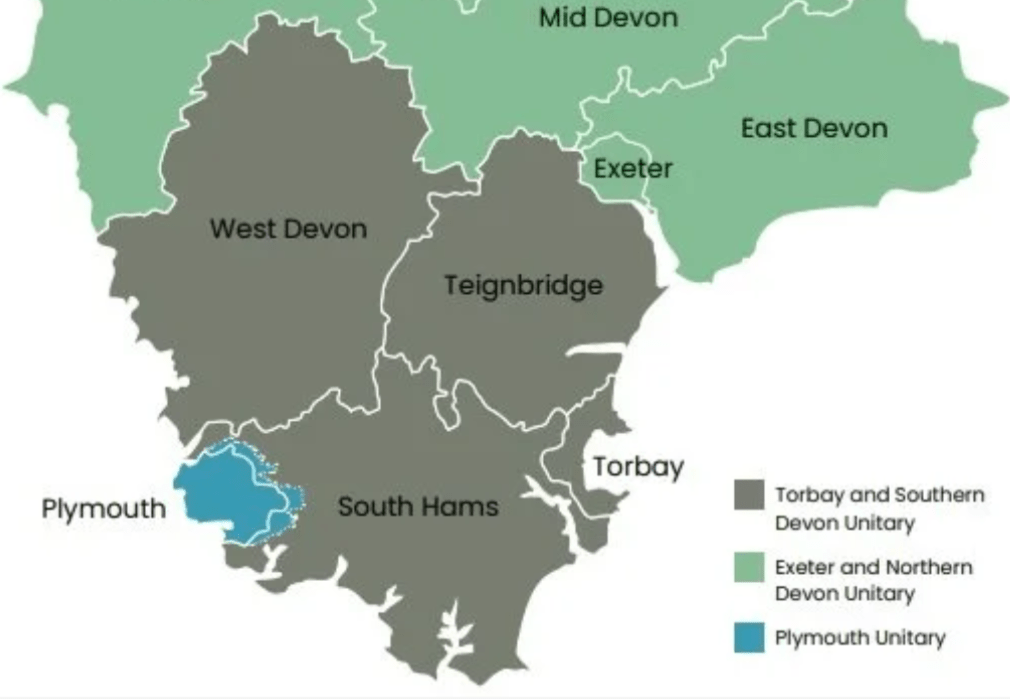
The proposal sets out the creation of three unitary authorities in Devon:

– Torbay and Southern Devon (covering South Hams, Teignbridge, Torbay and West Devon)

– Exeter and Northern Devon (covering East Devon, Exeter, Mid Devon, North Devon and Torridge)

– Plymouth City Council would remain a standalone unitary authority

A government-led public consultation is expected to take place in early 2026.

Mr Loudoun said: “We have worked hard, across political and geographic boundaries, to develop a financially sound model that reflects Devon’s unique identity and delivers accessible, high-quality services at the heart of our communities.

“My thanks go to the residents, businesses, community groups and partners who helped inform this work.

“A further consultation will take place in the new year, and I urge everyone to get involved to help ensure we build a local government structure that truly serves our communities for generations to come.”

The full proposal is available to view on the Reimagining Devon website and will be submitted to the Ministry of Housing, Communities and Local Government following council approvals.

A final decision is expected in summer 2026.

Elections for the new authority would be held in May 2027, ahead of its planned launch in 2028.