Cranbrook Morrisons to open within months – supermarket giant to create around 75 jobs

The ten year wait for Cranbrook residents will soon be over

Supermarket giant Morrisons has revealed the countdown for its Cranbrook store has begun –  opening is expected within months and around 75 new jobs.

Becca Gliddon eastdevonnews.co.uk

Earlier this year East Devon News exclusively revealed Morrisons was assessing if the current store design and layout was still right for the town.

Now we can share the retail giant has confirmed it has started fitting out the supermarket with the view to opening ‘later this year or early next’, while creating around 75 jobs locally.

Morrisons said it was about to kick-start recruitment for a host of roles at the Cranbrook supermarket, and invited those interested in working at the store to apply.

The official opening date for the Cranbrook Morrisons is yet to be announced.

A Morrsions spokeswoman told East Devon News: “We know that the residents of Cranbrook are eagerly awaiting a new supermarket in the town and are pleased to confirm that we have started fitting out our new store.

“We are looking forward to welcoming customers and expect to open it later this year or early next – as soon as we have an exact date, we will be in touch to let you know.”

The spokeswoman added: “We will be creating circa 75 jobs locally and are about to kick-start our recruitment process.”

In May this year, Morrisons said it recognised Cranbrook residents were keen for the supermarket to open and had expected to be shopping in-store by now.

At that time, the retailer was unable to give an opening date, saying it was assessing the original blueprint of the store, in a bid to assess if the design still reflected the needs of community.

Construction of the supermarket site, in the Court Royal area of Cranbrook, began in October 2022, with the district council hinting the store – and much-awaited town centre – could open to the public at the end of 2023.

The retail-ready site – complete with car park – has been fenced off to the public since its completion.

Diggers moved onto the town centre site the autumn of 2020 and East Devon District Council (EDDC) held an official turf cutting ceremony to celebrate the start of the construction.

In October 2020 EDDC announced the work would take around a year to complete, saying the town centre was expected to have a Morrisons supermarket, children’s day nursery, retail shops, residential apartments, and a new market square ready by the end of 2023.

Cranbook residents have been waiting for a town centre for more than a decade, since building began in 2012.

Anyone interested in applying for a role at Cranbrook Morrsions can visit: www.morrisons.jobs.

Breaking: Rise in sewage dumped near Blue Flag beaches – Five worst in Devon, three of them in East Devon

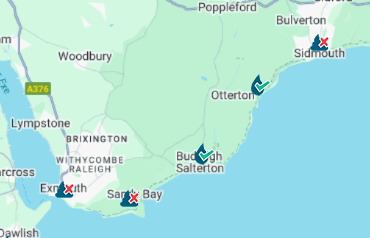
Seaton (1), Exmouth (2) and Sidmouth (4) named in “worst” five nationwide. Full data below

LibDems call for an end to sewage dumping in bathing waters by 2030

UK’s pristine Blue Flag beaches ‘under threat’ after 2,328 sewage discharges

Eleanor Langford, Tom Bawden inews.co.uk

There are calls for the UK’s most prestigious beaches to be protected from environmental damage as new data shows sewage was pumped near them for thousands of hours last year.

New research by the Liberal Democrats has revealed a significant increase in sewage discharges near England’s Blue Flag beaches, with numerous reports of people falling sick after swimming in these areas.

The party’s analysis of Environment Agency data uncovered that in 2023 alone, there were 2,328 sewage discharges near these prestigious beaches, lasting over 17,174 hours – a 55 per cent increase from the previous year.

It follows i‘s own analysis in May that revealed 20 of the country’s 33 Blue Flag sites where sewage was released in 2023 had at least 30 discharges. Nine had more than 100.

Blue Flag status is awarded to beaches that meet high environmental and safety standards. However, there are fears that the surge in sewage dumping threatens the integrity of these sites with Devon, where all the top five worst-affected sites are located, likely to be worst affected.

The most at-risk beach, according to the latest analysis, is in Seaton, where sewage was discharged 340 times last year, amounting to 4,629 hours. Exmouth and Meadfoot also ranked high among the most polluted, with hundreds of discharges reported.

Liberal Democrat environment spokesperson Tim Farron condemned the situation as a “national scandal” and criticised water companies for prioritising profits over environmental protection, noting that “families are becoming sick after swimming at our beaches”.

He urged the Government to clamp down on what he described as years of Conservative inaction, demanding an end to sewage dumping by 2030.

Environmental groups have echoed these concerns, with Greenpeace UK’s policy director, Doug Parr, warning that the UK’s beaches are “turning brown” due to unchecked sewage dumping.

Mr Parr warned that water companies would “continue to fill our waterways with human effluent at the same time as their CEO’s and shareholders fill their pockets with cash” unless action was taken.

He called for tougher legal targets, better funding for regulators like Ofwat and the Environment Agency, and a ban on dividends and bonuses for water company executives until substantial progress is made.

The Government has pledged a new Water (Special Measures) Bill, introduced in the recent King’s Speech, which aims to address the issue of sewage spills and drive investment in water infrastructure.

Key provisions include holding water company executives personally liable for illegal activities and banning bonuses if environmental standards are not met.

The bill also mandates the installation of real-time monitors at every sewage outlet, ensuring greater transparency and accountability.

It is part of a broader effort to reform the water sector and restore the health of the UK’s rivers, lakes, and seas.

Ofwat, the water regulator, recently fined three of England’s largest water companies a total of £168m for “excessive spills” and poor environmental practices.

It is the first announcement to emerge from Ofwat’s continuing investigation into water firms’ performance, amid sustained anger over the environmental damage caused by sewage leaks and the poor practices of some companies.

During the general election campaign, 19 leading green groups backed i’s Save Britain’s Rivers manifesto, which sets out five pledges the new Government must commit to in order to help the country’s rivers recover from decades of pollution.

Labour leader Sir Keir Starmer has already praised i’s campaign, but Labour is yet to back the manifesto in full despite it being supported by both the Liberal Democrats and the Green Party.

Rise in sewage dumped near Blue Flag beaches as the LibDems call for an end to sewage dumping in bathing waters by 2030

EMBARGO: 00:01 Monday 26th August www.libdems.org.uk (extract)

  • Top five worst affected Blue Flag beaches for sewage discharges in Devon
  • Staggering 2,328 sewage discharges near England’s Blue Flag beaches in just one year – up 55% on 2022
  • Liberal Democrats call for popular beaches to be protected from sewage pollution amid fears of swimmers becoming sick
 Blue Flag BeachNumber of spillsHours of spills AreaWater company
1Seaton3404649DevonSouth West Water
2Exmouth2141984DevonSouth West Water
3Torre Abbey1901682DevonSouth West Water
4Sidmouth1481681DevonSouth West Water
5Dawlish170387DevonSouth West Water

Data for sewage dumping on Blue Flag Beaches in 2022 can be found here.

Beer beach temporarily evacuated over suspected unexploded bomb

A beach on the south coast of England has been evacuated after a suspected unexploded bomb was discovered.

Piers Mucklejohn www.independent.co.uk

The object washed ashore in Beer, a seaside village in east Devon, on Sunday afternoon and is believed by some witnesses to be a shell.

It was swept back out to sea before it could be assessed by a bomb squad, the coastguard said.

Devon and Cornwall Police said they received reports of a “suspected unexploded ordnance” at 4pm and put a cordon in place, which has since been lifted.

It is understood the suspected device may have first been spotted by a metal detectorist and identified by a second person, who raised the alarm.

A nearby road was closed while police and members of the Coastguard secured the area.

An explosive ordnance disposal unit attended the scene but could not access the object because of incoming tides, HM Coastguard said.

Coastguard rescue teams will return at low tide to “reassess the situation”, the service added.

In a Facebook post, the Beer Coastguard Rescue Team warned residents not to touch the item if it washes ashore elsewhere and to call 999 and ask for the coastguard.

Martin Richards, chairman of Beer Parish Council, earlier told the PA news agency a “full squad of coastguards” was on the beach and people could not “get anywhere near it”.

He added: “A shell may have washed up onto the beach earlier on today. The beach has been evacuated.”

Saturday – Anger after another sewage alert at Exmouth beach and during Sidmouth Regatta 

Sunday – Surfers against Sewage retain warnings at Exmouth, Sandy Bay and Sidmouth

There has been an outpouring of anger after another sewage alert stopped bathing at two of Devon’s most popular beaches today [Saturday]. East Devon District Council urged swimmers not to go into the water after being warned about potential sewage danger at Exmouth and Sidmouth.

William Telford www.devonlive.com

South West Water (SWW) completed a “temporary fix” at Exmouth only last week and apologised for leaking raw sewage into the sea, preventing people from swimming. Today, the district council received a pollution risk forecast from the Environment Agency and a storm overflow notice from SWW and lifeguards ran up red flags, warning of danger.

In Exmouth, swimmers took down the beach’s Blue Flag in protest. The Blue Flag scheme awards the flags to beaches that achieve high environmental and quality standards.

Following the alerts at Exmouth and Sidmouth, people took to social media to vent their wrath at SWW. Angela Barrett Rose posted: “SWW has to be held accountable…too much nonsense going on…it’s shameful in a civilised country in the West…if this happened in Africa or India or in other very poor countries but it’s happening in one of the richest countries in the world …shocking and shameful.”

Denise Bickley wrote: “It’s Sidmouth Regatta and should have been Surf Lifesaving East Devon Championships…but we had to cancel. This is unacceptable. Please keep the pressure on SWW East Devon District Council.”

Hollie Doidge said: “Again? SWW needs to be held accountable for this.” And David Bottrell posted: “When will SWW be held accountable?

Maurice Ayling wrote: “South West Water should not be polluting our beautiful coast line like this.” And Sue Truesdale echoed: “Oh come on! I’ll dry out if I don’t get a swim soon. It’s really not good enough SWW.”

On social media, East Devon District Council said: “Unfortunately we have received pollution risk forecasts (from the Environment Agency) and combined sewer outfall storm overflow notifications (from SWW) for all our beaches today (Saturday). The lifeguards are flying red flags at Exmouth and Sidmouth and signs advising against bathing are displayed at all our beaches.

“Normally Blue Flags would not be lowered in circumstances that are prompted by wet weather. However the Exmouth flag was taken down today in protest by a group of sea swimmers, and recognising the strength of local feeling currently, we have decided to leave it down until conditions improve. We hope that if the weather continues to improve things will return to normal tomorrow (Sunday).”

SWW has put the problem at Exmouth down to a burst pipe at the Maer Road pumping station which caused raw sewage to flow into the sea. It said teams had been “working round the clock” to resolve the problem as quickly as possible.

Uproar over South West Water’s announcement for meeting with Brixham residents

There has been uproar in the Brixham community, following the announcement of a meeting by South West Water to discuss water quality. It comes after the town was hit by an outbreak of the cryptosporidium parasite in May, with at least 100 confirmed cases of the vomiting and diarrhoea bug.

But terms and conditions apply, including pre-registration! – Owl

Uproar over South West Water meeting in parasite-hit town

Mary Stenson www.devonlive.com 

When people first began reporting feeling unwell, the water company said it was carrying out tests that had come back clear and initially told customers it was safe to continue using their water as normal. Just days later, they confirmed that they had found traces of the parasite and placed large parts of the town under a boil water notice.

South West Water said cryptosporidium had entered its water supply due to a damaged air valve on private land. The boil water was gradually lifted as the network was cleaned and extra protection, including microfilters and UV were put in place.

The notice was lifted for all properties on July 8 and the UK Health Security Agency (UKHSA) said there had been no confirmed cases since then but it was reported last month that residents were still fearful of drinking their tap water.

The water company has invited residents to a meeting with a South West Water panel and South Devon MP Caroline Voaden on September 12 at Scala Hall in the town centre, which it says will answer questions about drinking water quality.

But there has been anger in the community after the meeting was announced, according to Tanya Matthews, who had symptoms during the outbreak and was among the last households to have the boil water notice lifted.

Residents have been asked to submit questions for the panel in advance, prompting concerns that not all questions will be answered. Tanya has also raised concerns about the limited capacity of Scala Hall and its distance from affected residents in Hillhead and Kingswear. She says there has also been a lack of clarity about who will be on the panel and whether it will include Susan Davy, the chief executive officer of parent company Pennon Group.

She said: “It sounds like they are going to sit and talk at us, answering the questions they choose to while we all have to remain silent?

“Then it sounds like it will be the same as the meeting they had right at the start. That is not what we want.

“We also did not want it in town as that has always been an issue. Also, by having it in town, they have excluded Hillhead and Kingswear yet again. The Scala Hall is nowhere near where the residents that were affected live. A very dirty tactic on South West Water’s part.”

DevonLive has asked South West Water about the concerns that have been raised. It now says that they will take questions on the night but has not confirmed which of its representatives will attend the meeting.

The questions we asked and the company’s answers are as follows:

Will residents have the opportunity to ask questions on the night?

“Yes. The pre-submitted questions will be prioritised, but the panel will take questions from the floor as much as time allows. We want to answer as many questions as we can”

Will South West Water be answering all pre-submitted questions?

“We have found through attending similar events with stakeholders that pre-submitted questions help to get through more questions and give equal opportunities to people for their questions to be answered. We will answer as many questions as we can.”

Why is it being held at Scala Hall?

“We explored a range of venues across Brixham and Kingswear. This venue was identified as most suitable, considering a range of factors including accessibility and availability.”

What is the venue capacity?

“The capacity of this event will be guided by health and safety. Those that have expressed an interest in the event via our website will receive an email confirmation nearer the time.”

Will chief executive Susan Davy be in attendance? If not, why not?

“The event will be hosted by an independent chair and the panel will include the local Member of Parliament, Caroline Voaden, as well as senior representatives from South West Water. The SWW representatives have yet to be confirmed.”

The meeting will be held on Thursday, September 12 at Scala Hall, with doors opening from 6pm. Spaces have to be booked online and more information can be found here.

Water campaigners are right about enforcement. Labour’s plans are still too vague 

“None of the four “initial steps” announced by the environment secretary, Steve Reed, last month are likely to cause sleepless nights in any boardroom.”

Susan Davy off the hook? – Owl

Nils Pratley www.theguardian.com

The organisers of the March for Clean Water – that’s Feargal Sharkey and River Action, supported by organisations that range from Surfers Against Sewage to the RSPB to the Women’s Institute – make an excellent point: while it’s nice that the government will bring a water bill to parliament, the initiatives revealed so far “are not nearly extensive enough to address the scale of the UK’s water pollution crisis”.

You bet. None of the four “initial steps” announced by the environment secretary, Steve Reed, last month are likely to cause sleepless nights in any boardroom. The first, to ensure companies’ funding for infrastructure investment is ringfenced, read like a description of how the regulatory system in England and Wales was always supposed to work. One fears that the second, to add the protection of customers and the environment to companies’ articles of association, will be cosmetic; directors can always be fuzzy about how they interpret their fiduciary duties.

The third would create “powerful new customer panels” to “hold water bosses to account”. Really? Surely such panels’ powers can only ever be minor compared with regulators’. The fourth would double compensation for customers when basic water services are affected but is “subject to consultation” and seems aimed primarily at rare cases in which water doesn’t flow from the taps, as opposed to being targeted at pollution.

In Reed’s defence, he said his first steps were exactly that, and his “special measures” regime will contain more. The yet-to-emerge detail on chunkier stuff, including personal criminal liability for water bosses and new powers for Ofwat to block the payment of bonuses, may carry more weight.

Behind it all, though, sits the basic imperative to ensure environmental laws are enforced, not just on sewage discharges but also on agricultural runoff. That is rightly one of the campaigners’ core demands. It comes down to the government’s appetite – or not – to back regulatory reform and fund an effective enforcement regime.

Ofwat, as the economic regulator that took a decade-plus to wake up to the size of the companies’ dividend-extraction after the leveraged buyout boom of 2004-08, naturally tends to cop most of the heat for the industry’s failures. But the Environment Agency (EA), the body overseen by Reed’s department, deserves more attention.

The agency’s long decline was reported on in depth by this newspaper in June, and a few lowlights are worth recalling. Funding for environmental protection was cut by 80% between 2010 and 2021. Just 91 people out of a workforce of 13,400 were qualified to inspect sewage treatment plants, the EA’s new-ish chief executive, Philip Duffy, told parliament in April this year. “There was a withdrawal successively in 2009 and again in 2015 from regular investigations into compliance,” he said.

The last government gave the agency funding to recruit 500 new staff, and Duffy these days is in must-do-better mode (an improvement on his predecessor’s claim, as late as 2019, that the country’s water quality was “better than at any time since the Industrial Revolution”). There is a vague sense of a corner having been turned. The investigation into sewage treatment works by the EA and Ofwat, which last month led to the latter hitting three firms with provisional fines totalling £168m, was the largest ever.

Yet the EA still looks miles away from being a muscular enforcer that can move swiftly and create fear among polluters in the style of some of its US equivalents. Does the government have a vision for such a body? If it does, hard financial commitments are required for credibility. The march on 26 October – four days before the chancellor’s budget – is well timed.

North Devon want second homes cash to stay in district not used countywide

Cash from doubling council tax on second homes in North Devon should be used to address local housing issues and not go elsewhere, that’s the view of local councillors.

Alison Stephenson, local democracy reporter www.radioexe.co.uk

Second homes cash ‘must stay in the district’

North Devon Council along with other local authorities in the county have agreed to increase property tax on second homes from next March which could bring in as much as £5 million countywide.

A report by the Devon Housing Commission recommends that this money is earmarked for addressing housing challenges and infrastructure needs across Devon.

The county’s housing crisis is believed to be exacerbated by the 11,000 second homes, as well as the rising number of empty homes and not enough affordable housing.

Councillors in North Devon welcomed the report, which they said presented an accurate and clear summary of the challenging position in Devon, but want to make sure extra funds are secured for the district.

Cllr Caroline Leaver (Lib Dem, Barnstaple South) said North Devon’s problem were significant, with only 11 per cent of people on the housing register likely to be housed this year because of a shortage of properties, and that money raised by doubling council tax should address local needs.

The council’s strategy and resources committee was told that Devon County Council receives the lion’s share of the council tax and it is for the county to decide how the money is spent, although district councils could make representations.

Cllr Leaver said: “If money is raised in North Devon and we have specific issues, the money should be spent here and not in Kingskerswell in South Devon or elsewhere. I would like to strengthen our position on that.”

The committee agreed to lobby the county council to ensure the money comes to North Devon.

The district currently has 3,673 second homes and holiday lets, which equates to seven per cent of properties, but in coastal areas like Mortehoe, Woolacombe and Georgeham near Braunton nearly 50 per cent of homes come into that category.

The council’s chief executive Ken Miles said the cash could be used collectively to solve some of the issues in the county.

“I understand the wish to get it earmarked for our district, but some of the pressures on our system are countywide and not just in North Devon.

“For example, providing accommodation in Torridge for care leavers will also benefit our care leavers. At the end of the day, it will be a political and financial issue for the county council to decide.”

The Devon Housing Commission report contains recommendations for adoption by local authorities, centre government, the proposed Devon and Torbay combined local authority and Homes England.

The recommendations for local councils include employing dedicated housing  officers to work with developers, social housing providers and across boundaries, prioritising local need over open-market demand in the planning system and increasing social rented homes and community land trusts.

The report, established by the Devon Housing Task Force made up of the 11 Devon local authorities, and supported by the University of Exeter, says the housing emergency in Devon is caused by high house and rental prices and lower incomes.

House prices are inflated by people moving from more expensive areas. Middle-aged and older people are moving in while younger people are leaving, resulting in employers having difficulties filling vacancies and key workers being unable to afford to live near their place of work.

The commission, led by Lord Richard Best, said the popularity of services such as Airbnb are responsible for properties being switched from longer-term lets, severely impacting people who need to rent.

It believes that switching from long-term to short-term lets is a key reason for the fall of 50 per cent in private lettings across the county, and by as much as 67 per cent in North Devon alone between 2019 and 2021.

“There is a real housing crisis in this county,” said Lord Best. “The problem is an acute shortage of homes affordable for the next generation.

“Homeownership is beyond the reach of first-time buyers and it is virtually impossible for those on average incomes or less to obtain a rented home that is both available and affordable. Devon is simply running out of any housing options.”

Councillors in North Devon said they were glad that Ilfracombe had been used as a case study in the report for the challenges it faced with poor quality housing, a weakness in the labour market, limited opportunities for residents and inadequate public transport.

The report says people move to the town because it is affordable because of a high number of houses of multiple occupations (HMOs) but this type of accommodation traps people in poor employment and life outcomes.
 

Temporary arrangements for Maer Road Car Park in Exmouth this Bank Holiday weekend.

East Devon District Council

 · 

Temporary arrangements for Maer Road Car Park in Exmouth this Bank Holiday weekend.

Maer Road Car Park will be partially closed this weekend to allow South West Water safe access to the Maer Lane pumping station whilst the repairs to the burst sewage main are carried out. The area of the car park shaded red, including the main entrance will be closed to the public and a temporary entrance will be available at the bottom of the car park.

There will also be up to 10 South West Water tankers parked at Estuary Coach and Lorry Park for the duration of the weekend.

The pipe repair will require continuous waste removal from the pumping station, and East Devon District Council will support South West Water during these essential works. We apologise for any inconvenience this may cause, and we will work with SWW and their contractors to minimise the ongoing disruption and ensure the safety of car park users.

Time running out for residents to comment on Clyst St Mary and Sowton Neighbourhood Plan

Clyst St Mary and Sowton Neighbourhood Plan

All comments must be received by 17:00 26th August 2024.

Regulation 14 Public Consultation Notice

In accordance with Neighbourhood Planning (General) Regulations 2012, Part 5,14 (a)-(c), notice is given that a formal pre-submission public consultation on the draft Clyst St Mary and Sowton Neighbourhood Plan (2023-2040) will start at 09:00 1st July 2024 for an eight-week period.

About the Plan

The Neighbourhood Plan (the Plan) for the parish areas of Sowton and Clyst St Mary has reviewed and revised to take account of changing opportunities and challenges.

The Plan will provide a means of guiding, promoting, and enabling balanced sustainable change and growth within the Parish for the period up until 2040.

Bishops Clyst Parish Council invites comments on the revised Plan. All responses received will be considered by the Neighbourhood Plan Review Group and the Parish Council to produce a version of the Plan which will then be submitted to the Local Planning Authority for examination by an independent examiner.

Viewing the Draft Plan and Commenting on it

The draft Clyst St Mary and Sowton Neighbourhood Plan along with other evidence base documents and comments form will be found at:

https://bishopsclyst.org.uk/neighbourhood-plan-review/

A copy of the Draft Plan may be viewed at the Parish Council Offices at Clyst St Mary Village Hall, during normal office opening hours, Monday to Wednesday 9.00am to 12.30pm. Please phone ahead to ensure the office is open on 01394 874405.

You may comment on the Plan preferably by

  • Completing the online comments form
  • Completing the paper form and submitting in the response box or posting or handing it in to the Parish Council, at the Village Hall, Clyst St Mary, EX5 1AA.

Alternatively, you may submit your written comments in any form, but you must include your name, organisation (if applicable) and postcode for these to be accepted.

All comments will be publicly available and identifiable by organisation (where applicable).

All comments must be received by 17:00 26th August 2024.

Bishops Clyst Parish Council June 2024

Draft of revised plan can be found on this link

Planning applications validated by EDDC for week beginning 29 July

Social housing rents to rise as part of UK push to build affordable homes

Social housing rents will rise by more than inflation over the next decade as part of UK government plans to boost affordable housebuilding and shore up the finances of struggling landlords.

Jack Simpson www.theguardian.com 

The chancellor, Rachel Reeves, is working on plans to introduce a 10-year formula to calculate social rent on homes that will result in rents increasing every year by the rate of the consumer prices index – which is now 2.2% – plus 1%, removing an existing cap on rises.

Reeves is expected to announce the plan at her first budget, on 30 October, alongside measures to raise taxes and cut spending.

The plan for social rent homes – those rented usually at 50% of market rate – will be welcomed by the councils and housing associations who are now facing a squeeze on their finances, which has put the brakes on housebuilding.

Bodies such as the National Housing Federation, which represents England’s housing associations, and the Local Government Association, the national membership body for local authorities in England and Wales, have lobbied for a 10-year rent settlement to give landlords more certainty over cashflows, and the confidence to invest in new stock.

The changes were designed to provide long-term certainty to landlords, a government source told the Financial Times, which first reported Reeves’s rent plan.

The deputy prime minister, Angela Rayner, has promised to achieve the biggest boost to affordable and social housing in a generation as part of a target of building 1.5m homes during this parliament.

Last month she outlined a series of housing policies to support this, including promises to soon provide “rent stability” and details of government investment.

In recent decades, councils have largely stopped large-scale housebuilding, with local authorities providing less than 2% of the new homes in the country for more than 40 years.

Housing associations, which now build the majority of social homes, have also put the brakes on development spending, instead investing in existing buildings after the Grenfell Tower fire and various scandals exposed the poor standards across their stock.

Last month, the Guardian revealed that housing associations started only 30,631 affordable homes in the 12 months to March 2014, down 22% on the year before.

The rent rise will mean consistently higher rates for some of the 3.8 million social rent households in England, who have been shielded from huge inflationary increases in recent years by government caps on rent rises.

However, this is also likely to add to the government’s housing benefit bill across the period as many social renters receive housing support.

Social landlords have seen policy repeatedly change under the previous government.

The Conservative-led coalition government initially set a 10-year rent settlement in 2012 that would lead to rents increasing by the rate of the retail prices index plus 0.5%. This was reversed in 2015 by the then chancellor, George Osborne, when he introduced an annual rent cut of 1% for four years in an attempt to reduce the housing benefit bill.

In 2020, the sector was given a five-year settlement of CPI plus 1%. However, the government later capped any increases at 7%, after the headline rate of inflation hit more than 11% in 2022.

According to the NHF, rents are now 15% lower in real terms than they were in 2015, while the cumulative rent cuts and caps have contributed to councils facing a £2.2bn black hole in housing budgets by 2028.

Andy Hulme, the chief executive of the housing association Hyde, said a long-term deal would play a critical role in attracting additional private sector investment to build more.

He added that the sector would need assurances that the government would stick to the plan, as it had been promised long-term settlements before and been let down.

A spokesperson from the Ministry of Housing, Communities and Local Government said: “Work is ongoing to fix the foundations of our housing and planning system and we will set out our plans at the next fiscal event.”

David Reed MP Meets Susan Davy. She refuses all interviews. What did he achieve?

David Reed

Today [Wednesday] I met with Susan Davy, the CEO for South West Water, and the Chief Engineering Director. I called on SWW to bring forward planned infrastructure money and to get to work with upgrading our sewage network across #ExmouthandExeterEast.

I have also been clear that their communication with customers needs to improve asap. Only by getting straight to work and engaging properly with local people will trust start to rebuild in the community. I have been given assurances on both of these points, but as always, actions speak louder than words.

Susan Davy refused any interviews with ITV or BBC. Speaks volumes – Owl

To the BBC David Reed said:

“[I] Don’t have confidence [in South West Water] at the moment. But I do believe that they have the right intentions and I think that having spoken to them today they understand the issue, the anger that’s felt in the community and they’re willing to resolve that as quickly as possible.” 

In an ITV interview David Reed said he had asked SWW to bring forward investment. He reported that they (SWW) were conducting “a four week analysis across the whole network. They will then be very willing to bring forward that engineering fund to get on with the job.”

But haven’t we heard all this before? In January Simon Jupp wrote:

“During my visit last week, I challenged South West Water on the timescales for a permanent solution and repeated my calls to speed up plans for £38m investment in Exmouth. They can’t take our town for granted again.”

[See: Hesitation, repetition, deviation. – Is Simon Jupp waving or drowning?]

So, how does Exmouth’s MP meeting with Susan Davy compare to Bodmin’s?

Labour has no real plan to fix UK rivers, Feargal Sharkey warns

Labour has no real plan to tackle the sewage crisis damaging Britain’s rivers, leading campaigner Feargal Sharkey has warned as he called for a “root and branch” review of water industry regulators.

Lucie Heath inews.co.uk

The punk rocker turned environmentalist told i the country needs a “clear, decisive strategy” to clean up its waterways, rather than “the confusing messaging” coming from ministers.

He announced plans to lead a mass rally in London in October – the March for Clean Water – to mark the end of Labour’s first 100 days in power and put pressure on the Chancellor in the lead-up to the Budget.

Sharkey will be joined by celebrities and environmental groups, including River Action, Surfers Against Sewage, British Rowing, the Wildlife Trusts and Chris Packham.

He campaigned for Labour in the run-up to the general election but is now calling for “leadership and urgency” from the Government to tackle sewage and other pollution – including agricultural run-off – in rivers, lakes and seas.

He called the Environment Agency “shambolic” and “hopeless” and urged Environment Secretary Steve Reed to “fire the board of both Ofwat and the Environment Agency”.

Sharkey added: “The simple fact of the matter is I see nothing so far that is actually showing anything resembling a strategy and a cohesive plan to deal with either the sewage crisis, the environmental crisis, the agricultural farmyard pollution or indeed the overabstraction of chalk streams.”

Charles Watson, chair and founder of River Action, which is co-ordinating the march, agreed that Labour’s plans “do not nearly go far enough to deal with the scale of the problem they have inherited”.

Labour has announced a number of policies to tackle the sewage crisis, including restrictions on bonuses for chief executives, and refunds for customers when water companies fail to spend their allotted infrastructure funding.

Ministers have also pledged to introduce a Water Bill within the next year, which will bring in automatic fines for water companies and criminal sanctions for bosses that oversee serious pollution.

However, the Government is yet to indicate whether it will increase spending to tackle water quality, for example through increased funding for the Environment Agency or for farmers to tackle agricultural pollution.

Sharkey said he was hearing a “confusing message” from ministers, with the Department for Environment, Food and Rural Affairs (Defra) promising to restrict water boss bonuses, while the Treasury has refused to reintroduce caps on banker bonuses.

He argued that restrictions on bonuses are unlikely to work “because when they did that in the City 10 years ago, everybody just doubled their salaries”.

Sharkey wants Steve Reed to announce a “root and branch” review of water company regulators Ofwat and the Environment Agency, which he said had “utterly failed both consumers and the environment”.

An independent commission should be appointed to carry out the review and report back to Parliament within the next six months, Sharkey said.

The water industry’s economic regulator, Ofwat, is responsible for making decisions on how much companies should invest in their infrastructure and how much customer bills can increase by to fund this work.

Water firms have been accused of not investing enough in their networks over a period of decades, resulting in a deluge of sewage being spilled into lakes, rivers and seas. Ofwat has been criticised for allowing this underinvestment to happen.

In response to growing public outrage over the sewage crisis, water companies have proposed investing £105bn in their infrastructure over the next five years, but have said they will need to increase bills by up to 73 per cent in order to do so.

Ofwat has provisionally approved smaller, but still significant, bill rises, that will see customer bills rise by an average of £94 over the next five years.

Sharkey said it was “outrageous” that water companies were being allowed to increase bills by this amount, and accused Ofwat of “dithering around, incapable of acting and protecting the public interest”.

He said the Government should step in and “freeze” bill increases until an independent review of the industry is carried out.

The Environment Agency is responsible for enforcing environmental laws, but the department’s funding has been dramatically cut in recent years.

Earlier this year, i revealed a significant reduction in the number of pollution events being attended by the EA, with the watchdog failing to visit 90 per cent of incidents in 2022.

“The Environment Agency we know has proved itself to be completely and utterly hopeless. It is just utterly shambolic and incapable of enforcing even existing environmental law,” Sharkey said.

Although Labour has announced a number of policies to tackle the sewage crisis, Sharkey said more needs to be done.

“We need to tear the whole thing down and start all over again. I don’t think there’s any point pretending that is not what’s going to have to happen,” he said.

i is also calling on the Government to go further, by signing up to a five-point manifesto to Save Britain’s Rivers. It calls on ministers to overhaul Ofwat and provide more funding for the Environment Agency to allow it to do its job properly.

Some of Labour’s pledges to date align with i‘s manifesto, including plans to introduce tougher fines and restrict bonuses. However, the Government is yet to meet all i‘s demands, including increased funding for the regulator and farmers.

Campaigners on the March for Clean Water are calling on the Government to back up its words with cash.

BBC Springwatch presenter and environmentalist, Chris Packham, will be joining the protest.

He told i: “I’m sick of being ripped off, fobbed off, lied to and poisoned by greedy rich bastards, inept regulators and lazy governments. Let’s spill out of the rivers and on to the streets and put the shits up them.”

Mr Watson said: “The initial noises coming out of our new Government regarding cleaning up our filthy waterways, whilst encouraging, do not nearly go far enough to deal with the scale of the problem they have inherited.

“Nothing short of wholescale reform of our failed regulatory system and comprehensive strategies to address all major sources of pollution, including sewage discharges and agricultural run-off, will suffice.”

A Department for Environment, Food and Rural Affairs spokesperson said: “We share the public’s anger on this issue and have taken immediate steps to reverse the tide on the unacceptable destruction of our waterways.

“Our Water Bill will include new powers to ban bonuses and bring criminal charges against law breakers. This is just the first step in our wider reform of the sector.

“This Government will never look the other way while water companies pump record levels of sewage into our rivers, lakes and seas.”

When is Feargal Sharkey’s March for Clean Water?

On 26 October, Feargal Sharkey will lead the March for Clean Water. It will bring together charities, environmentalists, and other organisations linked to the UKs waters.

They will include British Rowing, British Canoeing, Greenpeace, the RSPB, The Women’s Institute, The Wildlife Trusts, the Rivers Trust and River Action.

The rally will mark Labour’s first 100 days in power and take place days before Rachel Reeves is due to deliver her first Budget.

The campaigners are calling on the Government to announce the following:

  • A root and branch review of the regulation and the water industry. Sharkey says an independent commission must immediately be appointed to overhaul Ofwat and the Environment Agency;
  • A plan to address the continuous illegal dumping of raw sewage by water companies;
  • A full set of solutions to end all other major sources of water pollution, including agricultural waste and chemicals.

Environment Agency considering legal action after sewage spill at Exmouth

David Reed MP is quoted in this National Press article but readers should also remember his initial words which may explain why he has been so slow to react:

It’s easy to shout loudly about how annoyed we all are with the situation, and I completely get it- I am affected in the same way. However, to see the results we deserve will take time and perseverance.

Environment Agency considering legal action after sewage spill at Devon beach

The Environment Agency is considering legal action against South West Water after the company spilled sewage into the sea at a Devon beach.

Helena Horton www.theguardian.com 

Swimmers were told to stay out of the sea at Exmouth beach after a sewer burst on private land on Thursday next to Maer Lane wastewater treatment works.

The Environment Agency said: “As regulator, we are keeping pressure on the water company to do all it can to prevent pollution from damaging bathing water quality.

“We continue to monitor the site closely and encourage the public to check Swimfo for the latest status of bathing water quality before swimming.

“Given the seriousness of the incident, the Environment Agency is considering what legal approach to take for these pollutions on Exmouth beach.”

Clarissa Newell, regulatory manager at the Environment Agency, told BBC Radio Devon: “We are investigating and considering all enforcement options … that could be a warning, it could be the water company promises to invest in the environment they damaged or the infrastructure that caused that damage, or we go to prosecution.”

A spokesperson for South West Water said it had temporarily fixed the broken sewer pipe, adding: “We always work with all of our regulators, including the Environment Agency, and are continuing to keep them fully updated.

“We continue to work around the clock to complete this essential work. We would like to thank residents and visitors for their patience, and we are sorry for the disruption caused throughout this event.”

The company has been using tankers to transfer sewage flowing into the treatment works to reduce the spill while repairs are under way.

There have been concerns about the impact on local tourism, with reports the beach was much quieter than usual over the weekend. After the spill, yellow warning signs were erected and lifeguards used loudspeakers to warn people against going in the water.

David Reed, the Conservative MP for Exmouth and Exeter East, said: “To see Exmouth beach with so few people enjoying it on a beautiful August day is extremely depressing.

“This current event with South West Water needs to end ASAP. I’ve been clear with senior representatives from SWW that it’s their duty to provide accurate and timely updates to let locals and tourists alike know how repairs are progressing.”

Earlier this summer, businesses in the south-west reported tourism was down after the parasitic disease cryptosporidium was found in South West Water’s supply.

Dozens of people reported falling ill and people in the Brixham area had to boil their tap water for weeks until they were alerted that it was safe to drink.

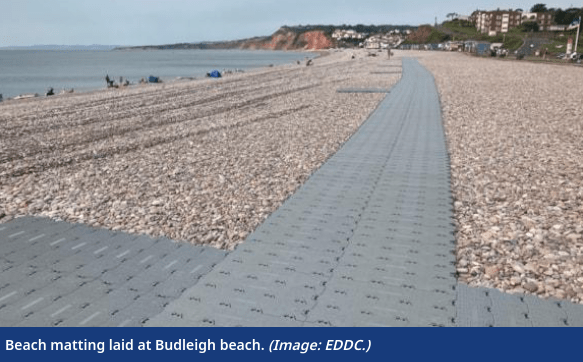
Beach accessibility scheme at Budleigh, Sidmouth and Seaton

Following a successful trial in Beer and Seaton, beaches in Sidmouth and Budleigh Salterton will now benefit from accessibility matting.  

Adam Manning www.exmouthjournal.co.uk

A scheme designed to improve beach access for residents and visitors with mobility issues has been extended by East Devon District Council (EDDC).

Following successful trials at Seaton and Beer beaches over the last three summers. It’s now a permanent feature all year round in Beer, and has been extended to the rest of Seaton beach.

The council’s StreetScene team has installed the new track matting at the eastern end of Seaton beach, Sidmouth Town beach and Budleigh Salterton beach.

The track matting creates a smooth path across the pebbles, making it easier for mobility scooter, wheelchair and pushchair users, and those who are unsteady on their feet, to access the beach.

Each beach has approximately 200 square metres of modular matting, which is made partly from recycled material.

The layouts vary at each location depending on user needs, the shape of the beach and the size of the flat area available.

The matting will remain in place until late September, before it is safely stored through the winter and returned next May.

The project is funded by: EDDC, Budleigh Town Council, Sidmouth Town Council, East Devon National Landscape Access for All Fund and EDDC’s sustainable tourism programme (via the UK Shared Prosperity Fund).

The project is aligned with EDDC’s Tourism Strategy which encourages growth through a commitment to quality, sustainability, accessibility and collaboration.

As a core value of the strategy, accessibility supports developments in East Devon’s tourism offer, by providing the same quality experience to visitors of all abilities and enabling everyone to enjoy the area’s outstanding natural environment.

Councillor Nick Hookway, portfolio holder for culture, leisure, sport and tourism, East Devon District Council, said: “I’m delighted to see that the beach track matting accessibility project is now being expanded. It is absolutely essential that every visitor to our seaside towns has the ability to enjoy a day on the beach”.

Exmouth sewage issue sparks concern over Lympstone homes plan

Plans to build more than 40 homes in a Devon village have been refused amid councillors’ concerns about failures in the sewage network.

EDDC takes action – Owl

Miles Davis www.bbc.co.uk

The 3West development company wanted to build 42 homes on fields at Lympstone.

East Devon District Council (EDDC) members said they were extremely worried the homes would be on the same sewage network as Exmouth where there have been repeated sewage leaks.

Councillors also raised concerns about the design and layout of the plans and the site being outside of a built-up area.

The beach was closed to swimmers in Exmouth on Saturday and Sunday after a sewage leak caused untreated sewage to be pumped out into the sea.

The developer 3West wanted to build 42 homes – including 14 classed as affordable – on fields on the edge of Lympstone, off Meeting Lane.

EDDC planning officers had recommended the scheme for approval.

Several members of the public spoke out against the scheme citing concerns about highways, flooding and pressure on local health and education services.

Councillors on the planning committee first voted not to approve the plans but there was then a period of confusion where they struggled to list reasons for refusal.

The meeting heard the plans would have been subject to a “Grampian condition” being put in place – a planning term which would prohibit development until a specified action has been taken, external, such as the provision of supporting infrastructure.

Following the meeting David Matthews from 3West said his firm would be considering their options going forward.

Bodmin’s new LibDem MP presses Susan Davy for action in Cornwall – Exmouth’s MP has only just joined the queue

Cornish born and bred Ben Maguire, newly elected MP for Bodmin, has already met Susan Davy and pressed her for rapid improvements in North Cornwall which he lists in detail, with regular update meetings.

He will be watching progress closely.

Nothing about acting as a “bridge” to improve customer relations.

Meanwhile Exmouth’s MP has only just joined the queue, though he has been incredibly busy, see below – Owl.

Ben Maguire MP  (text of facebook post)

I had a constructive meeting with South West Water’s Chief Exec Susan Davy.  I explained the sewage scandal in our rivers and seas is unacceptable and must now be urgently addressed with actions not words. I also raised:

🚰 The need to improve their dire comms around the St Eval water shortage and reservoir repairs and the derisory £50 compensation scheme.

🚰 The urgent need to invest in storm overflows and vital infrastructure while freezing bills until our services improve.

🚰 The rising number of domestic leaks in private gardens and on public land which need addressing.

🚰 The impact of the government’s water company reforms on consumers and the need for competition in the water industry.


I pressed Susan and her team to urgently roll out these improvement works so we do not continue to see huge amounts of sewage dumped in our rivers and seas. They have agreed to work with me to ensure rapid improvements are made across North Cornwall and meet with me regularly to update on their progress so I will be watching closely.

#Progress #EndTheSewageScandal #CleanWaterNo

[Susan Davy centre, Ben Maguire on the right]

In the meantime, Exmouth’s Action Man has had more important things to do!

Radio Exe (text of facebook post]

New Exmouth and Exeter East MP David Reed joins us in the studio for the new Devoncast, talking about how the future looks for Exmouth and the Conservatives in Devon, as well as giving us a sky-diving update!

Exmouth MP to meet SWW boss after sewage spill. Is he already too late?

David Reed wants to act as a “bridge” between disparate groups in Exmouth that are upset with the water company, and bring them together with the firm in a bid to improve relations.

But as a companion post shows, he has been pipped to the post by LibDem MP for Bodmin, Ben Maguire, who has already held substantive talks with Susan Davy, including issuing a list of demands for improvements.

David Reed has only just joined the queue to see her.

By not acting with the urgency the situation of sewage pouring down country lanes into the sea in August demanded, Has he left it too late? – Owl

Bradley Gerrard, local democracy reporter www.radioexe.co.uk

Exmouth MP David Reed is to meet South West Water’s boss after a sewage spill stopped people going in the sea for five days.

Mr Reed has requested a meeting with the firm’s chief executive, Susan Davy, in a bid to encourage it to bring forward planned infrastructure spending.

According to its business plan, the company expects to spend £2.8 billion from 2025 to 2030 on “water quality and resilience, with a pledge to fix storm overflows at beaches and eradicate pollutions”.

But Mr Reed, elected to the new Exmouth and Exeter East constituency last month, wants it to bring some of this forward.

“This is not a new issue. It’s something that has been going on for some time and it’s not good enough,” he said.

“I’ve been an MP just over a month and there has already been two sewage spills in the town, the latest of which led to the beach being closed during the vital tourist season.

“There’s infrastructure funding there and I want to see if this can be brought forward.”

Mr Reed acknowledged that there would be “no overnight fixes” but hoped he could make progress on the issue, something he campaigned on during his year-long bid to become an MP.

He added that he wanted to act as a “bridge” between disparate groups in Exmouth that are upset with the water company, and bring them together with the firm in a bid to improve relations.

Business owners have contacted Mr Reed about the impact the spills have had, with those that rely on the water and the beach particularly hard hit.

The issue near the Maer Lane treatment plant last Wednesday prompted East Devon District Council leader Paul Arnott (Liberal Democrat, Coly Valley) to  label the incident a “historic new low” for the water and sewage firm.

“Despite multiple reassurances from South West Water that they have Exmouth under control, they simply do not,” Mr Arnott said. This incident not only impacted our residents but also the tens of thousands of tourists that visit Exmouth.

“Our officers and the Environment Agency attended the site as soon as the spill was reported and took direct action to advise residents and visitors not to bathe in the water.

“I thank them for their rapid response.”

He added that the beach had been ‘red flagged’ meaning it was deemed unsafe to use.

The issue was caused by problems at Maer Road pumping station.

South West Water said it had been “working around the clock in Exmouth” to repair the burst pipe from Maer Road pumping station at Maer Lane.

“We are pleased to say that we have now completed the temporary fix, and the pipe is up and running, and we can now begin planning the permanent repair,” a spokesperson said.

“However, tankers will remain on site as a precaution. We would like to thank residents and visitors for their patience, and we are sorry for the disruption caused throughout this event.”

It added that it continued to liaise with the Environment Agency so that it could “take the appropriate steps to protect the environment and public health”.
 

Breaking: Paul Arnott, East Devon leader, on South West Water and two burning questions for government

“The time has come for direct government intervention at Secretary of State level. There are two burning questions. First, please can you reform the whole system and change the ownership of water companies urgently? Second, how can you expect any local authority to give planning permission for the homes you want when the sewage system is broken? It’s going to be a very challenging time for this new government.”

Paul Arnott (full article from local press)

Many, many years ago – 45 to be precise – I would have just received my A Level Results in Economics, History and English. It’s often said that what you learn at school proves useless in later life, but those three subjects left me with a lifelong curiosity and an active engagement in them all.

In Economics, we were taught not to blow the massive tax take from North Sea Oil on debt and to rebuild the country instead. Hmm. That didn’t happen. But more usefully it taught lessons about how infrastructure spending, well-managed, could provide many great outcomes quite apart from new houses, railways or utility provisions. Jobs and growth, for example.

History, and in particular study of the Civil War and Oliver Cromwell’s Protectorate afterwards, taught me that without a strong democracy with maximum participation a country inevitably relapses, in our case to the Restoration of the monarchy of Charles II. Having had the opportunity to be the first great Republic in the world a hundred years before America, we blew it, and let the landowners so keen on enclosing common land to increase rather than diminish their power. The arrogance of land ownership by a few wealthy descendants of that time blights what housing we can build and where to this day.

English took me to places where a sporty seventeen-year-old might not willingly go, for example to Geoffrey Chaucer, whose Canterbury Tales peppered with glorious 14th Century characters is like a time tunnel back to medieval England, much of which is around us from the Guildhall in Exeter to dozens of our churches.

This weekend, I thought of a phrase which is credited to Chaucer a lot – when chickens come home to roost. In the Parson’s Tale, he wrote that a curse coming out of the mouth of someone would often return to haunt them as (in the Old English) “a bryd that retorneth agayn to his owene nest.” And why was I thinking of that? The answer: the antics of South West Water.

In February this year, our council at East Devon decided to pass a motion of no confidence in them, for good reason. Their infrastructure was failing across the district, and there was a lot of evidence that this was the inevitable result of paying dividends to shareholders rather than investing over many years, the results of which were sewage running down high streets, burst manhole covers, failed pumping stations, ailing treatment plants – all now coming home to roost.

At the end of last week, I took the rare action of issuing a press release. It read “Many incidents both before and after that decision have fully justified the vote, but the major sewage spill at Maer Lane last night represents an historic new low. Despite multiple reassurances from South West Water that they have Exmouth under control, they simply do not. This incident not only impacted our residents but also the tens of thousands of tourists that visit Exmouth.” I could not imagine that over last weekend it would get even worse.

The time has come for direct government intervention at Secretary of State level. There are two burning questions. First, please can you reform the whole system and change the ownership of water companies urgently? Second, how can you expect any local authority to give planning permission for the homes you want when the sewage system is broken? It’s going to be a very challenging time for this new government.

“Action Man” (former Royal Marine – now Exmouth’s MP) to meet Susan Davy

At last “Action Man” does something but does “rebuilding trust” mean solving the sewage crisis or will it be nothing more than a PR exercise?

David Reed MP

To see Exmouth beach with so few people enjoying it on a beautiful August day is extremely depressing.

This current event with South West Water needs to end asap. I’ve been clear with senior representatives from SWW that it’s their duty to provide accurate and timely updates to let locals and tourists alike know how repairs are progressing.

I will also be meeting with the CEO of SWW this week to call on her to bring forward structural engineering funds, and to get on with the job of upgrading their sewage network.

Because patience has been lost, I will spend time over the coming weeks and months with representatives from SWW, local activist groups and businesses, along with local councillors to start rebuilding trust.

Now is the time for action, not words. I have campaigned extensively to have SWW clean up our water, and now that I am elected I will be doing all I can to make this happen.

#ExmouthandExeterEast