Even if plans are eventually passed, caveat emptor!
An anonymous item in The Times on 7th July states:
“My daughters recently inherited a McCarthy Stone leasehold retirement apartment in Lancashire and need to sell it to get probate and distribute the proceeds according to the late owner’s will. Some of those waiting for their share are in urgent need.
But this may take up to three years, my daughters have been told, as the new owners must be over 70 years of age, and demand from this age group is low. Until this is done they cannot distribute the assets, all the while incurring an annual service charge of about £8,500.What can they do?”
When former Prime Minister Rishi Sunak stepped out into the rain on that fateful Wednesday in May to call the General Election, I think I heard many people across East Devon breathe a sigh of relief. Finally, after a period of chaos and decline, we had a chance to pass judgement on a Conservative government that had lost its way.
Like many MPs, I went into the campaign not knowing whether I would be returned to Parliament to keep on fighting for you. No one has a divine right to be an MP – it is a role that has to be earned through hard work and public service.
Throughout the campaign, I sought to demonstrate the difference having a hard-working Liberal Democrat MP can make. I put ‘demanding better’ in relation to NHS dental services, community healthcare services and the environment at the centre of my campaign.
There is no time for a victory lap. There is far too much to do – on these and other causes that I discussed with thousands of residents on doorsteps in recent months.
We do not know what to expect from the Labour government in Westminster. The Labour Party’s manifesto did not contain many pledges, so in the weeks ahead we will see what their approach to governing will be.
My promise to you is that I will do all I can to make sure our communities get the fair hearing and the attention they deserve. I will hold Ministers to account firmly – and I will challenge them. I won’t provide opposition for its own sake; I will seek instead to advance causes that matter to you.
The first thing I did after being elected on Friday was write to Wes Streeting, the new Health Secretary, to invite him to visit Seaton Hospital and discuss how we can save the community-funded wing from being ripped away from the community that paid for it.
As your MP, I promise to work night and day to repay the trust placed in me – whether you voted for me or not. If you’d like to contact me, then you can write to me at Richard.Foord.MP@parliament.uk or through my website: http://www.RichardFoord.org.uk
My team and I will be held to the highest standards. I’ll aim always to play it straight, roll up my sleeves, and I won’t forget that I was elected to serve you.
Water companies will be forced to return money that isn’t spent on upgrading their sewerage networks to customers under new plans being unveiled by the Government, i can reveal.
In his first intervention on Britain’s sewage crisis, Environment Secretary Steve Reed said water companies will no longer be allowed to divert infrastructure funding to pay for bonuses, dividends or salary increases.
It comes ahead of a draft decision by the regulator Ofwat on Thursday over how much it will allow bills to increase to tackle to sewage crisis. Firms have proposed bill increases of up to 72.87 per cent, meaning some customers could be paying up to £726.64 on their annual water bill by 2030.
Mr Reed also revealed plans to double the compensation households receive when their water supply is disrupted and to set up new panels for customers to hold the utility firms to account.
“We will never look the other way while water companies pump sewage into our rivers, lakes and seas,” he said.
“This unacceptable destruction of our waterways should never have been allowed, but change has now begun so it can never happen again.”
Water companies are already forced to return money to customers if they fail to meet separate targets linked to environmental performance and leakages. This is done via deductions to bills in the following year, rather than cash back.
It is understood that it will be up to regulator Ofwat to decide how exactly customers will be refunded if water companies do not spend their allocated infrastructure funding. Ofwat is the sector’s independent economic regulator but takes policy direction from ministers within the Department for Environment, Food and Rural Affairs.
Campaigners are likely to welcome the early intervention from Labour during the party’s first week in power.
However, it remains unclear when the new Government plans to set in motion some of the other proposals in its manifesto to clean up the UK’s waterways, including prosecutions for water bosses and automatic fines for firms.
Labour is also yet to commit to all the policies outlined in i’s manifesto to Save Britain’s Rivers and waterways, including increased funding for the Environment Agency and for farmers so they can reduce agricultural pollution, plus a “green duty” on regulator Ofwat to place greater emphasis on the environment when making decisions over water companies’ business plans.
Tomorrow afternoon, Mr Reed will hold a meeting with water company chief executives to set out his plans for the sector, which has faced intense scrutiny for the dumping of sewage into Britain’s rivers.
The draft decision will set out how much water companies will be allowed to increase customer bills by to pay for the upgrades needed to reduce sewage pollution.
Firms have proposed bill hikes between 13.6 and 72.87 per cent over the five-year period, meaning households would be paying up to £726.64 per year for water by 2030.
Ofwat is expected to allow water firms to increase bills, and only by slightly less than they are demanding.
Mr Reed has outlined four policies the Government would introduce “to clean up the water industry to cut sewage pollution, protect customers and attract investment to upgrade its crumbling infrastructure”.
This includes plans to write to Ofwat to ask them to make sure funding for infrastructure investment is ring fenced and cannot be spent on bonuses, dividends or salary increases. This will include infrastructure investments to prevent sewage spills, among other things.
Any promised infrastructure funding that is not spent on upgrades should be refunded to customers, he said.
Last year, 11 of the 16 water companies in England and Wales were forced to give money back to customers. However, water bills have continued to rise despite firms being penalised, for example in the 2023/4 financial year, bills increased by an average of 7.5 per cent despite water companies being penalised for missing targets.
Water companies have been heavily criticised in the past for failing to spend money on their infrastructure, while paying large dividends to their investors.
Alongside restricting infrastructure spending, the Government will consult on doubling the amount of compensation customers will receive when their basic water services are affected. Depending on the circumstances, customers are typically entitled to £20 in compensation if their water supply is disrupted for 24 hours, followed by £10 for each additional day.
Ministers will also look to expand the circumstances under which customers receive compensation to include ‘Boil Water Notices’, which are issued when there are contamination concerns over drinking water in a region.
The move is likely in response to the recent parasite outbreak in Devon that saw over 100 people reporting a diarrhoea-type illness and around 16,000 homes and businesses being ordered to boil their water, with some homes affected for almost two months. South West Water was forced to pay out around £3.5million to affected customers.
Mr Reed will also order water companies to change their governing rules to make the interests of customers and the environment a primary objective.
New customer panels will be introduced with the power to summon board members and hold water executives to account, the Secretary of State said.
However, Mr Reed stressed that change will “take time” to improve Britain’s waterways and said the Government will outline further steps over “the coming weeks and months”.
It’s currently unclear when Labour will set in motion the other policies in its manifesto, including bringing criminal charges against water executives that break the law and introducing automatic and severe fines for polluting firms.
It is possible that more detail will be provided in the King’s Speech, which is scheduled for next week.
While Labour’s proposals are likely to be welcomed by campaigners, the Government is yet to commit to some of the other changes groups have been calling for to end the sewage crisis and restore our waterways.
Water companies in England and Wales have been told they will not be allowed to impose the hikes to bills they have demanded, the industry regulator has said in an interim verdict on their business plans for the next five years.
Ofwat declared that it was minded to slash, by a third, the combined increases that the 16 companies had submitted.
It left the average bill, the watchdog said, set to rise by £19 a year or 21% over the period.
Ofwat chief executive David Black said: “Customers want to see radical change in the way water companies care for the environment.
“Our draft decisions on company plans approve a tripling of investment to make sustained improvement to customer service and the environment at a fair price for customers.
A final ruling will be made in December.
As Ofwat’s report suggests, their wishes – including the 42% hike demanded by crisis-hit Thames Water – are unlikely to be fully met following final consultations on the plans at a time when the industry is under such heavy fire from many sides.
It said companies’ business plans proposed increases averaging £144 over five years.
Thames Water’s proposed increase of £191 by 2030 had been reduced to £99, Ofwat said, while Severn Trent’s proposed increase of £144 had been reduced to £93.
The industry has long been accused of prioritising bonuses and shareholder dividends over investment in key infrastructure, systems that widely date back to the Victorian era.
Now the mist has cleared, a correspondent sends Owl dramatic pictures.
According to DevonLive, the landslide came as large swathes of Devon were battered by heavy rainfall overnight and into this morning [yesterday]. One such affected area was Budleigh Salterton, between Exmouth and Sidmouth, where the cliff collapsed. The collapse will cut off parts of the beach to the west at high water, according to an eyewitness.
The coastal town was under a blanket of rain for most of Tuesday morning, up until around lunchtime and it seems it was too much for its striking red sandstone cliffs, which tower above the 2.5-mile stretch of pebble beach.
The cliff collapse took place at 11.40am, leaving behind a huge mound of sandstone with dust swirling through the dark skies and over the choppy waves crashing against the shore.
Thankfully, the beach was deserted at the time due to the adverse weather, save for one passer-by who snapped the photographs after the event. He said that the cliff collapse attracted a lot of attention after it had happened, with a number of people venturing close to the site to check out the rock fall.
Chris Stark, the former head of the UK’s climate watchdog, will head a Covid vaccine-style taskforce aimed at delivering clean and cheaper power by 2030.
The Department for Energy Security and Net Zero said the centre would work with energy companies and regulators and would be the first of its kind in Whitehall, following Keir Starmer’s plan for mission-driven government.
According to this model, ministers will focus on tackling five of the biggest challenges facing the country, one of which is clean energy.
Stark said: “Tackling the climate crisis and accelerating the transition to clean power is the country’s biggest challenge, and its greatest opportunity. By taking action now, we can put the UK at the forefront of the global race to net zero.”
Ed Miliband, the energy secretary, said: “Years of underinvestment has left our country suffering energy insecurity, with working people paying the price through their energy bills and a cost-of-living crisis. That cannot happen again.
“This new mission control centre, benefiting from the expertise and experience of Chris Stark’s leadership and bringing together the brightest and best in the national interest, will have a laser-like focus on delivering our mission of clean power by 2030.”
Stark was head of the UK’s Climate Change Committee (CCC) for six years until January. He was director of energy and climate change in the Scottish government between 2016 and 2018.
During his tenure the CCC recommended a UK net zero target for greenhouse gas emissions by 2050, which is now in law.
Stark won praise for his management of the CCC at a difficult point, when the government was briefing against many of the statutory watchdogs. Some on the right of the Conservative party would have liked to dismantle the 2008 Climate Change Act, under which the committee was set up with the mandate to advise on meeting the five-yearly carbon budgets.
Throughout his six years as chief, he maintained his steady insistence on telling the government truths it did not want to hear – on how far off-track the UK was straying from its climate goals, and how much more it would cost to delay action than to take it now.
Stark clashed with Conservative ministers at the time of his departure from the CCC earlier this year. He warned that the concept of “net zero” had turned into a political slogan used to start a “dangerous” culture war over the climate.
He said sensible improvements to the economy and people’s lives were being blocked as a result and that he would be “intensely relaxed” about losing the term.
Shaun Spiers, executive director of the Green Alliance thinktank, said the appointment would help Labour attract much-needed international investment for its plans. “This shows the government is ambitious and serious about delivering on its clean energy promises, and is really reassuring,” he said. “It’s been a very good few days [since the election] in action from Labour showing they want to get things done quickly.”
Reforms to the UK’s planning system have been a focus so far, including the lifting of an effective ban on onshore wind turbines in England, but Spiers said the government would have to look across a much wider range of issues to be successful in decarbonising electricity by 2030. “Planning is important, but it’s not the whole problem – grid connectivity is key, and there’s a need to build supply chains [for green equipment], building up skills, looking at the cost of borrowing, and attracting international investment. The appointment of Chris Stark will help with all of that.”
A marathon debate to thrash out altered plans to build a major Sidmouth retirement development on the former site of the district council offices has ended in rejection.
Revised plans for a major retirement living scheme have been rejected by East Devon planners after a lengthy debate which united residents and Councillors united in opposition, writes local democracy reporter Bradley Gerrard.
McCarthy & Stone recently put a tweaked version of its scheme in front of the district council’s planning committee, but objectors bemoaned the small number of changes made.
The size, scale and number of properties remained the same, residents claimed, and while some balconies had been removed from one side of the building in an effort to reduce fears of overlooking, a large number were still included.
The applicant’s first planning application for the former council headquarters which suffered a fire in March last year, was refused in February, and it has lodged an appeal with the Planning Inspectorate.
In assessing the revised application, residents reiterated concerns including about overlooking into nearby Knowle Gardens and Knowle Park, questioned the need for more retirement accommodation in the town, and raised fears about whether the sewage system could cope with the extra demand.
Kelvin Dent, a resident and member of Friends of the Knowle, which helps look after the area’s gardens and park, said the scale, mass and design of the scheme had “not materially changed”.
“The only change is the removal of some balconies on the west elevation and inclusion of more on the south,” he said.
“Those have made things worse, and if the committee wishes to be consistent, then I suggest the present application should be refused.”
The planning committee turned down the scheme previously because it “failed to reflect the local distinctiveness and is not compatible with the character of the site… and so will adversely affect the townscape and local landscape of Sidmouth”.
It also said the large windows and balconies on one block would “result in an unacceptable level of overlooking and overbearing impact on neighbouring properties”.
Resident Barry Kerwin felt the proposal to use a mainly surface water drainage scheme would create a “serious risk of flooding”, especially during heavy rain when local sewers were struggling to cope.
“The sewer has been cleaned and surveyed but the overflow still occurs, and if this is added, flooding is likely,” he said.
Michael Temple felt the increase in balconies on the south side of one of the buildings, the 60 windows and a central viewing platform on top of the four apartments included in the scheme, would “all look down on our secluded public gardens”.
He added it was “out of character with the gardens, the conservation area and the neighbourhood”, while fellow resident Stephen Jones bemoaned the “poor design”.
“It will not enhance the entrance to Sidmouth,” Mr Jones said.
“Stow-on-the-Wold had a great McCarthy and Stone development, although Exmouth’s is not a good example,” he noted.
“This seems to be a situation where it is an off-the-peg design, but this site must be one of the most beautiful, and any architect worth their salt would be excited by the challenge to create something for it.”
The agent, David Williams, defended the scheme, saying that for a second time, officers were recommending approval.
“This is an allocated brownfield site within the settlement boundary and the principle of substantial older person accommodation is established with a previous appeal decision,” he said.
“During the pre-application and application process, we have had detailed discussions with the council, local residents and stakeholders for nearly three years, and accordingly this scheme has evolved and been fine-tuned to provide the optimum and sustainable level of development.
He claimed the inclusion of extra care elements helped Sidmouth meet its need for housing and job creation, and that the care provision for over-sixties and over-seventies would bring “social and economic benefits via a reduction in demand on the public sector and health care services”.
McCarthy & Stone’s scheme includes 33 retirement apartments for the over-sixties and 53 extra care/assisted living homes for the over-seventies.
Also included is a care home building with staff and resident facilities and two pairs of semi-detached properties and three townhouses.
This is lower than the 113-apartment assisted living community previously planned by PegasusLife, which secured permission for its scheme after appealing East Devon’s refusal, but then never went ahead.
But Councillors firmly opposed the latest scheme, using the same reasons for refusing it as earlier in the year.
Councillors raised further concerns, including that the scheme “significantly increases the average density of residential development in an existing urban area”, meaning it would contravene part of the National Planning Policy Framework, or NPPF.
“And the NPPF says that if a scheme is not well designed it should be refused where it neglects to reflect the local design policies and government guidance on design,” Cllr Colin Brown (Conservative, Dunkeswell and Otterhead) said.
Cllr Ian Barlow (Independent, Sidmouth Town) was concerned that local NHS services couldn’t cope with a large addition of homes for elderly people, and questioned whether the town should be trying to encourage new developments for younger residents as Sidmouth’s elderly population grew.
Cllr Matt Hall (Liberal Democrat, Exmouth Withycombe Raleigh) said while the principle of development on the site was accepted, it was now about finding the “right development”.
He continued: “I think the original design and layout was far better, and I think it had far less things to be critical of.
“But I think this is overdevelopment of the site and is not in keeping with the existing urban grain, and no offence to the architect, but this is an off-the-peg design, and I don’t think it fits in or acknowledges the local character or creates something distinctive.”
Cllr Barlow proposed the motion to reject the scheme, with a debated ensuing to agree the right wording, content and reasoning.
Eventually, the Councillors agreed to reject the scheme, with one abstention from planning committee chair Olly Davey.
Two months after a parasitic outbreak in the water supply in Brixham, the final properties under a boil water notice have been told they can finally drink from their taps again.
Cryptosporidium, which causes vomiting and diarrhoea was discovered in the supply in May. To start with, South West Water denied it had anything to do with the water network and said tap water was safe to drink. The company later U-turned on that statement.
At one stage, 16,000 properties were affected, but the notice for the final 674 in Higher Brixham, Southdown, Upton Manor and St Mary’s has now been lifted.
Bottled water stations were setup in response to the incident, but these will now close. Water deliveries will also stop.
In a statement, chief customer officer Laura Flowerdew said: “A triple layer of protection is now in place including microfilters and UV at our tank and in-line microfiltration in your supply zone providing additional barriers. So you can be confident that the water is safe to drink.
“We want to let you know that now you can use your water as normal, we will be closing the bottled water stations from 9pm this evening (Monday 8 July).
“Water deliveries will also stop in the final area to be lifted from the Boil Water Notice today, we will though continue to deliver water to customers on our Priority Services Register today and tomorrow.
“We are sorry for the disruption the Boil Water Notice has brought. We are especially sorry for the distress caused to those who fell ill because of cryptosporidium and to the ones who had to care for them.”
It is hard to believe it’s only fifty days or so since Mr Sunak called a general election. Six weeks of fevered debate ensued.
In a later article I will visit the role of the polling and tactical voting companies and the distorting effect their unregulated work had on the election in which I was a candidate for Exmouth and Exeter East (EEE). For now, I will just say that a ludicrous initial prediction by the Financial Times that the LibDems would only win 3% of the vote in EEE appeared on thousands of Labour leaflets pushed through doors, even when Labour knew full well that the FT had realised their error and had revised this up to have the LibDems as possible winners! (The initial FT mistake was based on the tiny LibDem vote in 2019 when most LibDems lent their vote to Inde Claire Wright.)
In a new constituency where the question on most doorsteps was “how should I vote tactically to ensure a non-Conservative win?” this single item of outdated disinformation, promoted lavishly online too by Labour, did for the LibDems and led directly to the public quite understandably unsure who to vote for. The non-Conservative vote was then split between Labour and the LibDems and the result was a win for David Reed for the Conservatives.
David won fair and square and as Leader of East Devon District Council I have already invited him to meet our senior management to build a collaborative relationship. It is essential that the LibDem winner in Honiton, Richard Foord, now works with David on behalf of the 140,000 people who live in the district. That collaborative style is what my leadership has always been about. Despite some student politics in one part of the Labour EEE campaign, my excellent working relationship with the Labour leader of Exeter City Council remains important too.
Now, what will a Labour government mean locally? The party made the following promises in its manifesto:
· Multi-year finance settlements for local councils, and an overhaul of the business rates, with changes to the audit system
· Deeper devolution by combined authorities, with a review of governance and flexibility for those with good financial management
· A National Care Service , focusing on “home first” care
· Partnership working over hospital discharge and neighbourhood health centres
· A fair pay agreement and the professionalisation of adult social care
· An update of the National Planning Policy Framework, and an increased number of planners
· A raft of new towns, with the biggest increase in housebuilding in a generation and new planning powers for combined authorities
Readers can see that these pledges, if met, could have many implications for East Devon, from the conditions around our own adult social care challenges to, with “neighbourhood health centres”, offering a potentially brighter outlook for Seaton Hospital, whose future I helped to secure at East Devon Council by registering it as an “asset of community value”, securing the position for local providers who may with to take it on if the NHS Trust in the region ever tries to sell it.
Here in East Devon, we need to repair our social housing stock neglected by the Conservatives and build more. Will the new government understand that and, more importantly, will it work across the country collaboratively to achieve it? We shall see.
The push for electoral reform in the UK has received a shot in the arm after the “most disproportionate election in history”, according to campaigners and academics.
Longstanding reform campaigners have become uneasy bedfellows with Reform UK’s Nigel Farage in recent days after Labour secured a 174-seat majority with just 34% of the popular vote.
“This election has thrown the spotlight on to the electoral system as the result was the most disproportional on record,” said Darren Hughes, the chief executive of the Electoral Reform Society. “We have already had a growing chorus of calls for PR [proportional representation] in the aftermath.”
Farage said the first-past-the-post (FPTP) electoral system was “unfair” after Reform took 14.3% of the popular vote – making it the third biggest party by vote share – but won only five seats. The Green party received 6.8% of the vote for its four seats.
“I think these results will reinforce in people’s minds the need for reform,” Farage said.
Some experts argue that PR has produced more social democratic politics in Wales and Scotland, but others say it could also be a pathway for extremist politics, as has happened in some places in Europe.
Hughes said the major political parties and FPTP advocates could no longer use fears of the rise of extreme parties as an excuse to resist change.
“The debate around electoral reform can often focus on which parties would benefit from which voting system, but the only people the electoral system should be biased towards is the voters,” he said.
If the UK used the additional member system of PR, used for the Scottish and Welsh parliaments, Reform would have won 94 seats across the country on Thursday and the Greens 42, according to the Electoral Reform Society.
It noted that Labour and the Conservatives had received their joint lowest vote share on record, and for the first time four parties had gained more than 10% of the vote.
The additional member system is a hybrid system under which half of a tranche of MPs are elected by FPTP and the rest by a proportional list system, where parties are allocated the remaining MPs on the basis of vote share.
The Liberal Democrats under Ed Davey ruthlessly targeted resources at winnable seats rather than focusing on vote share. As a result, they won a record 72 seats, up from eight in 2019, despite a similar vote share of about 12%.
One Lib Dem insider said: “It’s not that we like first past the post. But it’s fair to say that we had to use the system in front of us and play the board that was there.”
Analysis of the results at the cross-party pressure group Make Votes Matter found that 58% of voters did not choose their MP. The group’s spokesperson, Steve Gilmore, said previous election results using FPTP had also been “disproportional and unrepresentative”.
In 2015 the Conservatives won a majority with 36.9% of the vote, and in 2017 they had to form a minority government with 42.4%. Then in 2019 they landed an 80-seat majority on a vote share increase of 1.2 percentage points.
Gilmore argued that Thursday’s result should still be seen as an outlier. “A government has been elected on a third of the vote and they’ve got two-thirds of the seats,” he said. “That is pretty extraordinary, even by the discreditable standards of first past the post.”
In a referendum in 2011, a proposal on changing the electoral system was comprehensively defeated.
Campaigners were hopeful that a Labour government could result in reform after delegates at the 2022 party conference, including from the major unions Unison and Unite, backed PR.
Keir Starmer said during his leadership campaign in 2020 that the party had to “address the fact that millions of people vote in safe seats and they feel their vote doesn’t count”. Since then his official spokesperson has said he has a “longstanding view against proportional representation”.
Insiders say there is growing support for reform among the Labour party ranks. “More progress has been made internally then at any stage before,” Gilmore said.
Martin Smith, a professor of politics at the University of York, said it was likely that self-interest would be the factor that would push the main political parties to change the voting system.
“The more the party system fragments, the more disproportionate the electoral system becomes, and that fragmentation is not going to go away,” he said. “There’s a point when both Labour and the Conservatives will see the current system as threatening their interests, and then they may start to think: ‘OK, we need to change this.’”
Saved by split votes? How the Tories ‘narrowly avoided’ finishing THIRD
For the Tories and their voters, the overriding sentiment following the devastating General Election results is to assume that things could not have gone much worse. But one polling expert’s research now begs to differ.
Tories ‘almost relegated’ to third-largest party status – here’s how
Sam Freedman, a political analyst whose own forecasts proved to be more accurate than the official Exit Poll this year, has identified just how close the blue rosettes came to a total and complete wipeout across the UK.
With all 650 seats now accounted for, the Tories ended up with a dismal 121 of them. Labour, with 412 seats in total, now have a large majority similar to that on Tony Blair’s first term in 1997. The chasm is huge, but the Conservatives are now the oppositon.
Liberal Democrats ruthlessly efficient in making gains
The surge in votes for the Liberal Democrats, who gained a whopping 63 seats an increased their Parliamentary presence to 71, had some pollsters predicting that they would push the Tories into third. Well, they weren’t far off.
In total, there were 79 Conservative seats where their vote share was outnumbered by the cumulative total of Labour and the Liberal Democrats. Only a few dozen of winning Tory tickets actuallyt had an outright majority over the two centre-left parties.
Tories to operate in opposition – largely thanks to ‘split votes’
Had one party made way for the other, or if tactical voting had been applied efficiently in these seats, the scale of the Tory defeat could have been even more humiliating – with a worst case scenario of a 42-seat return suggested by Freedman.
“For many of the seats I had staying Tory, my reasoning was that there was a split opposition, and so tactical voting wouldn’t work. In just 42 seats in England and Wales was the Tory vote bigger than the combined Labour/Lib Dem one.”
“Senior figures like Suella Braverman and Mel Stride were saved by split votes. This saved the party from complete oblivion, and left Labour with a 1997-type majority. But that will make little difference to what they can do.”| Sam Freedman
Budleigh owes its thanks to Peter for his investigative work; organising this meeting; and getting South West Water to come clean with real information and positive action. – Owl
Meeting with South West Water – Lime Kiln issues and resolution : 2nd July 2024
There have been a huge number of posts and discussions over the last 6 months, relating to the regular sewage alerts and tankering at Budleigh’s Lime Kiln sewage pumping station. In order to resolve these issues – and after several months of data collection and negotiation, we organised a meeting with senior South West Water staff and a cross-party group of local EDDC councillors and officers.
The objective was to fully understand what has been going on – and discuss a plan to resolve the ongoing issues.
Warning: The notes from the meeting are quite long, as the issues are long-standing and complex, and we believe that – after all this time – transparency is important.
Budleigh Salterton attendees
Cllr Charlotte Fitzgerald EDDC – Budleigh Salterton, Environment portfolio
Cllr Henry Riddell EDDC – Budleigh Salterton
Cllr Geoff Jung EDDC – Environment/Coast portfolio lead
Peter Blyth EDDC Beach Safety Officer
Peter Williams (Chair) Budleigh Sewage Action, Escape
South West Water Attendees
Hazel Tranchant Senior Asset Manager
Alan Burrows Head of Community Engagement
Jay Harris Regional Operations manager
Charlie Ford Projects Team
Meeting format: During the meeting, the Chair presented a slide deck of the issues relating to Lime Kiln Sewage Pumping Station, the source of around 95% of Budleigh’s current sewage discharges and alerts. Each key issue was then discussed by the group, and actions agreed.
Presentation slides shown in boxes, followed by discussion notes.
Summary of issues
Detail Section 1: Lime Kiln Emergency Overflow
Discussion and actions on Emergency Overflow (EO)
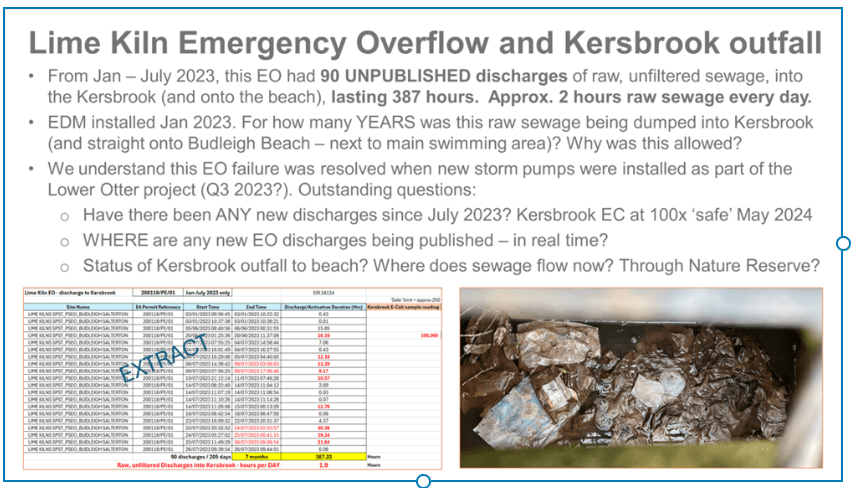
SWW acknowledged the 2023 discharge history for the EO. Until the new pumps and pipeline were commissioned in July 2023 (as part of LORP development), this EO had been discharging raw sewage into Kersbrook whenever the pumping station liquid level reached the overflow point. The level of discharges became apparent when the EDM sensor was installed in January 2023.
Comment: This use of an EO does not appear to be in line with normal EO permits, which are generally expected to be used ONLY in extreme mechanical failure conditions (eg: pump failure etc).
The positive news is that the new pump and pipeline system, commissioned in July 2023 as part of the LORP program, appears to have reduced or eliminated the use of this EO. There remains some concern that the EO could be activated in cases of severe inundation (ie: infiltration in excess of pump capacity).
Actions on Emergency Overflow (EO)
Hazel to confirm if there have been any discharges from the EO into Kersbrook, since end July 2023.
The continued high levels of E-coli recorded in the Kersbrook (eg: 27,000 on 3rd May and 18,000 on 15th May 2024), indicate a continued source of E-coli. SWW to consider how they can monitor the E-coli levels, identify the type (human, animal, etc) and determine the source. SWW to consider installation of one or more continuous-monitoring sensors to help with investigation.
Discussion and actions on Combined Sewage Overflow (CSO)
SWW confirmed that root cause of Lime Kiln overflow issues is that water ingress into the sewer system is greater than the capacity of the current Lime Kiln pumping station to push the sewage up to the Exmouth sewage treatment works (Maer Lane).
The result is that Lime Kiln CSO is currently pumping a mix of water and sewage out to Otter Mouth multiple times per day. (Note: in the period that we requested full data for, this was approx. 100 times per day, or approx 2 hours per day). This level of discharge continues even when there has been no rain for many days. This is the cause of the frequent pollution alerts shown on the SSRS app, and why so many people in Budleigh are uncertain as to whether it’s safe to swim.
SWW stated that this situation was historically ‘normal’ during Winter months (!), but that previously the volume of liquid arriving at Lime Kiln reduced to a manageable level before May. They stated that this normalisation has not happened in 2024, and that the water ingress is still inundating their system. Tankers have therefore been brought in to lower the tank levels and reduce the volume of sewage which is being discharged into the sea.
Comment: Although SWW state that they were not aware of an issue until April / May, I would point out that I posted (on Facebook) photos of a large number of tankers in Lime Kiln on 20th January 2024, and when we asked SWW what was going on, we were told then that they were lowering the level in the storm tanks. To us, this appeared unusual. We subsequently identified – and reported – exceptionally high numbers of short discharges going out of the CSO. I wrote a blog post on this, published on 18th February this year: https://fightingpoolution.com/2024/02/18/whats-really-happening-with-sewage-overflows-at-lime-kiln-budleigh/
We also raised a case (Case-0013670406) with SWW on 21st January, reporting an excessive number of CSO discharges. SWW responded on 2nd February to say they were investigating the source of excess ‘non-foul flows’. We followed up on 2nd, 8th and 13th of February as we were not satisfied with the response.
So it appears to us that SWW should have been aware of the exceptional nature of these excess flows much earlier in the year. The issue of when SWW were aware of the issue is important, as the late start means that resolution work will now be running into the Summer holiday season.
The good news however is that SWW have recently carried out a large number of underground CCTV surveys of the local sewage system in Budleigh, in an effort to identify the source of the exceptional water ingress.
SWW shared with the team their detailed (and impressive) survey mapping, along with photos of water gushing into the sewer system from the adjacent stream. In fact, the main sewer pipe runs underneath the Knowle Brook, between Brook Road / Mews and right along the side of Fore Street. The location of this sewer pipe under the stream is not SWW’s fault, but it is clear that any failure of joints or manhole covers (which actually sit IN the stream itself), can cause the sort of large-scale water ingress that we are suffering from. SWW have also identified and mapped quite a number of other specific points of ingress, including locations in Chapel Street, Rolle Street and Ryll Lane.
SWW Immediate Action
SWW put forward a plan to address the key areas of water ingress in this area, starting immediately in July. The total timeline to address these critical issues is approx. three months, but it is hoped that by addressing the major issues first, SWW could return Lime Kiln to a properly functioning pumping station within 4-6 weeks (ie: no tankers through the town and elimination of dry-weather discharges). It is encouraging to see SWW now have a detailed plan to resolve these issues.
Some of the areas which need addressing include sections of Fore Street. It is not expected that any roads will need to be dug up, as the main solution involves installing waterproof ‘sleaves’ through existing manhole covers. However, to allow the equipment to be set up, some traffic management would be needed in order to safely access manhole covers.
SWW will work with Devon Council and local councils in order to minimise any disruption, particularly as we are running into the peak summer season. All of the EDDC councillors present at the meeting raised the potential issues that this could cause, and discussed how we could balance the need to resolve Budleigh’s ongoing sewage issue, with the needs of a coastal town in the holiday season.
One of the options discussed was to start by fixing some of the major ingress sources in July, and to then review the disruption caused and the degree of improvement achieved – and if absolutely necessary, pause some of the Fore Street works until the end of the Summer holiday season.
As with any actions involving traffic management, the plans will need to go through proper consideration and permits. However, the sooner that actions start, the quicker we will have a functioning sewage system, eliminate most sewage alerts and end the stream of tankers through the town – good for locals, visitors and holiday businesses alike.
We also discussed the routing of the existing tanker lorries, and SWW will confirm whether these can be routed around the town, rather than causing a regular stream of heavy lorries blocking our main high street.
Communications for this short-term action plan: we discussed with SWW how they could provide regular updates to Budleigh residents on what they were doing, why and when. One idea was for SWW to publish this information on an easily accessible web page, so everyone can be fully informed on the plans and progress. SWW to confirm.
SWW Longer Term Action Plan
SWW accept that the above actions by themselves will not resolve all of Budleigh’s sewage issues. Whilst not the focus for this meeting, SWW did present a high-level plan for longer term, staged improvements, including:
A series of works to separate surface water from sewage pipes, reducing the volume of rainwater coming down to Lime Kiln storm pumping station and inundating the storm tanks. Some of this work is scheduled to begin in September 2024
A series of long-term improvements (through 2028+) to the pumping capacity from Lime Kiln up to Maer Lane, so that the system can cope with greater fluid volumes without having to discharge to Otter Mouth, or to require tankers to lower the sewage level. This would also require one or more interim pumping stations along the route, and possibly some upgrades to the pipeline itself. Treatment capacity at Maer Lane (Exmouth) sewage treatment works is also due to be expanded in 2028, though no additional storm tank capacity is currently planned.
SWW state that they are planning to improve the performance of the Budleigh sewage system, such that Lime Kiln sewage overflow will reach the regulator’s target of “10 discharges per year by 2030”. They stated that they will be evaluating a range of further changes to achieve this.
Comment: Although the issues at the EO appear to be resolved, the current CSO issues mean that 2024 may end up being even worse than 2023. Major improvement is therefore required. We have a concern that simply building more efficient pumping systems from all regional points, up to Maer Lane treatment works could result in large volumes of excess sewage being discharged through SWW’s expanded outfall pipe when it rains. This outfall is just 200m off Straight Point. Whilst not the subject for this meeting, we do need guarantees that any long-term plans meet the needs of our local community, and do not result in sewage plumes drifting back to Budleigh from Straight Point.
Detail Section 3: Water Quality Warnings and Communications
Discussion and actions on water-quality warnings and communication
We discussed the problems that Budleigh residents face when they want to check if – and where – it’s safe for them to swim. There is no single source which gives the current status of our bathing water – see my blog post on this issue here.
One issue is that the main Lime Kiln swimming area is located much closer to the CSO discharge outfall point than the Environment Agency’s sampling point. We therefore have no actual data on E-coli levels at Lime Kiln swimming area, which could be higher than the EA’s published data. Similarly, we have no sampling data from the Steamer Steps swimming area, which is three times further from the sewage outfall point – so it’s possible that this area could be cleaner.
We asked SWW whether they had done any sampling of the water quality at the Lime Kiln end of the beach (as they are the ones who are discharging sewage near there), but they insisted that this was the Environment Agency’s role and SWW would not be providing any sampling data.
We also, once again, asked them to improve the utility of SWW’s WaterFit app, by including a ‘History’ button to show all the recent discharges for each overflow. This is important as at present, a 1 minute discharge can ‘hide’ a previous 2 hour discharge notification. It does appear that this function is in development, but it remains unclear when they will make this feature available to the public.
We certainly feel that SWW have some way to go in order to provide transparent and actionable data, aimed at genuinely helping Budleigh’s residents.
Section 4: Final thoughts
I believe all participants found this to be a useful meeting, enabling us to speak directly about the issues and challenges.
Most of the SWW team were clear that the current situation was not acceptable, were keen to discuss the issues openly and wanted to resolve the problems. I would like to thank Hazel Tranchant for her positive commitment to the meeting and bringing together the SWW team.
We came away from the meeting with agreement on a plan which we hope will resolve the short-term issue of multiple, daily sewage discharges. Both sides committed to doing whatever they could to deliver or support a quick and effective solution, balancing the needs of the town’s summer tourist trade with the requirement to stop the sewage flows.
So when we see SWW vans or their contractors working in Budleigh over the next few months, it’s probably worth remembering that they are working to a plan to fix these issues as quickly as possible.
The meeting also highlighted the potential for an ongoing working group who can represent Budleigh’s resident water users, and hopefully ensure that future plans and issues are resolved more quickly and effectively.
PW, 2nd July 2024.
Note: The information contained in this document is presented in good faith and represents my best understanding of the facts. Should anything printed here be incorrect, please inform me as soon as possible and I will endeavour to verify and correct where necessary.
Vast swathes of the British countryside are being sprayed in pesticides containing “forever chemicals” that pollute our air, soil and waterways, and pose a threat to public health.
An analysis by the environmental group Fidra, shared exclusively with i, found that pesticides containing potentially dangerous chemicals were sprayed on the equivalent of 10.7m hectares of arable farmland in 2022 – an area roughly the size of Iceland.
The pesticides contained PFAS, or per- and poly-fluorinated alkyl substances, a group of more than 10,000 industrial chemicals that studies have linked to health problems, including cancer, infertility and developmental issues.
PFAS are known as “forever chemicals” because some can take more than 1,000 years to degrade in the environment.
i has called on the next government to get to grips with chemical pollution as part of our five-point manifesto to Save Britain’s Rivers.
Hannah Evans, project manager at Fidra, told i that limited data meant it was difficult “to truly quantify the scale” of the use of pesticides containing PFAS, but said “what we do know is deeply alarming”.
Fidra analysed data published on behalf of the Health and Safety Executive showing the use of pesticides in agricultural crop sectors across the UK.
It found the equivalent of 10.7m hectares of arable land were sprayed in PFAS pesticides in the space of one year. The data includes repeated sprays of pesticide to the same area.
“This is a direct source of environmental PFAS pollution, contributing to further contamination of soil and water sources,” Ms Evans said.
The full effects of forever chemicals on humans is still little understood, but evidence has suggested they could pose a wide range of risks.
PFAS are used in various everyday products, including cookware, stain-resistant fabrics and carpets, and water-repellent clothing. They are also found in some pesticides used by farmers to protect their crops.
PFAS are also a major source of pollution in Britain’s rivers. Not a single waterway in England or Northern Ireland has been assessed as meeting “good” chemical health, with one type of PFAS, called PFOS, responsible for around half of these failures.
There are various ways PFAS can seep into our waterways, including through pesticide use on farmland.
The chemicals can then make their way into our drinking water supply and have been found in the UK’s fish and water populations.
Fidra is one of more than 20 environmental organisations backing i’s manifesto to Save Britain’s Rivers from chemical and other forms of pollution.
The manifesto calls on the next Government to publish the UK’s long-awaited chemicals strategy, which was initially promised in 2020, but has been repeatedly delayed.
Ms Evans said UK farmers are facing “overwhelming pressure” and called on the next Government “to restrict PFAS use in pesticide”, while providing “long-term support for more sustainable solutions”.
The Rt Hon Wes Streeting, Secretary of State for Health and Social Care
Friday 5th July, 2024
Dear Wes,
RE: Seaton Community Hospital
Congratulations on your appointment as Secretary of State for Health and Social Care. There is a lot of work ahead, and I look forward to working constructively with you on a cross-party basis to ensure we protect and improve rural health services.
Now that you are in post, I would like to urgently raise the situation facing Seaton Community Hospital in my constituency. This is something which the previous Government failed to address, despite me raising the matter repeatedly privately and in Parliament.
Seaton Community Hospital is one of the many small healthcare centres that populate my rural Devon constituency. The hospital offers a wide range of services, enabling people to be treated closer to home, and is cherished by all those who use it.
However, the future of a large part of the hospital is under threat due to ongoing issues regarding the current rental arrangements – overseen by NHS Property Services, a government owned company which operates on parameters set out by your Department.
A whole wing of the hospital, which was constructed using funds raised by the local community, is at risk of being ripped away and either sold off or demolished due to NHS Devon being unable to pay the almost E300,000 a year rental cost.
This is greatly offensive to the local community – many of whom helped fundraise for its construction and feel that the building, rightly, belongs to them. To see it sold off by bureaucrats in London simply is not acceptable.
This wing was previously used to provide frontline care, until the bed provision was removed in 2017. Since then, the wing has been underutilised as the eye-watering rents prevent it being repurposed or taken over by local charities and community organisations.
To see this important hospital run down and hollowed out would be a huge blow not just for the residents of Seaton, but those right across the Axe Valley who rely on it for treatment. Something must be done before it is too late.
That’s why I am asking you to immediately commission a review of the NHS Property Services rental structure, ensuring that rents are fair and set up a new tariff to allow empty facilities that previously provided clinical services to be rented for a peppercorn sum.
As I am sure you can appreciate, the current state of limbo is deeply concerning for my constituents. With that in mind, I would also like you to invite you to come visit the hospital with myself, to meet with hospital staff to discuss how we can begin to right this wrong.
Given the urgency of the situation, I hope you can expedite this case and work with me to find a solution that protects this important local hospital for future generations.
A number of beaches across Devon have been hit with pollution warnings today (July 6). It comes after sewage was discharged into the sea following rainfall in recent days.
Charity Surfers Against Sewage (SAS) have highlighted the locations where sewage and pollution may contaminate water via an interactive map. The SAS map warns that storm sewage has been discharged at a number of beaches across Devon.
Sewage dumps are often blamed on heavy rainfall as overflows are used to prevent drains being overwhelmed. However, the side-effect is sewage ending up in the sea.
According to SAS, a sewage pollution alert means “storm sewage has been discharged from a sewer overflow in this location within the past 48 hours” and a “pollution risk forecast or incident alert” means there is potential for sewage to be in the area.
According to the Safer Seas & Rivers Service map, the following beaches in Devon have sewage pollution warnings in place as of today:
Plymouth Hoe East
Westward Ho!
Woolacombe Village
Ilfracombe Hele
Lynmouth
Sidmouth
Budleigh Salterton
Teignmouth Holcombe
Meadfoot
Surfers Against Sewage (SAS) is calling for an end to sewage discharges into all bathing waters, and high-priority nature sites, by 2030. In 2023, there were 584,001 recorded discharges across England, Scotland and Wales – an 51 per cent increase on the previous year – with sewage released into waterways for a total of 12,966,322 hours.
Swallowing water that could be contaminated with faecal matter could lead to gastroenteritis, hepatitis, giardiasis, skin rashes, amoebic dysentery, nose, ear, and throat problems, pink eye, and other respiratory illnesses. Symptoms to look out for include nausea, vomiting, diarrhoea, cramps, inflamed stomach and intestines.
23007 votes to Simon Jupp’s 16307. This is way beyond our expectations – what a testimony to Richard, everyone who worked on his campaign, and to the good sense of the voters here in the Seaton area and around the constituency. It’s the first time that Sidmouth has not had a Tory MP for 189 years!
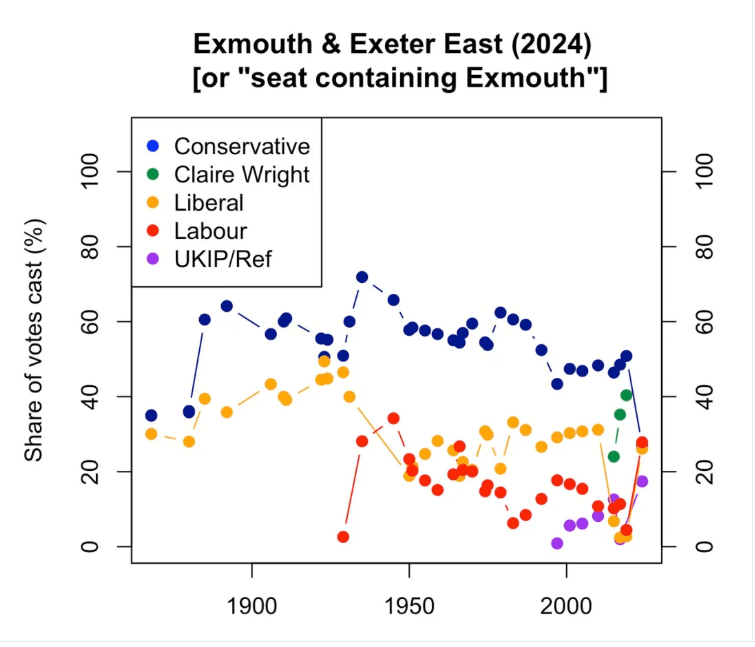
While we are celebrating Richard Foord’s tremendous victory, spare a thought for our neighbours in the Exmouth & Exeter East constituency. Here, the combined Labour and Lib Dem vote was almost 26,000, compared to a Tory vote of 14,700, but division between the opposition candidates cost them the seat. Tory David Reed held on by just 121 votes over the Labour candidate Helen Dallimore, with Paul Arnott for the Lib Dems behind them.
I strongly supported Paul, not only because he would have been an excellent MP but also because I believed he was best placed to beat the Tory. The chart below shows how the Lib Dems had consistently been the main challengers in the area before Claire Wright’s Independent campaigns – and Claire was supporting Paul. Yet many polling projections, applying oversimplified national models, were unable to take into account of the unusual situation created by Claire’s legacy, and projected Labour to beat the Tories – which Dallimore’s campaign naturally capitalised on. Meanwhile, other projections, which I shared, showed Paul winning.
The actual result shows that both parties had substantial support. Labour’s advantage in ‘tactical’ recommendations may have pushed them ahead of the Lib Dems – but not enough, since other projections suggested the Lib Dems were ahead. Thus the competing campaigns and projections proved a recipe for failure. Neither national party gave strong backing to their candidate, which added to the confusion.
The lessons are that First Past The Post is a brutal system. In Devon, where the Tories will always be strong, we need a consensus on the challenger – as we had with Richard after his by-election win. Really, we need to end the need for tactical voting by introducing Proportional Representation. Let us hope that Labour members will now push Keir Starmer to rethink his opposition to this. We also need PR to avoid the return of a Tory government in 5 or 10 years’ time.
Owl understands that yesterday social media was awash with similar outbursts of anger. The one on the “Watch” provoked a number of riposts which Owl has placed on “hold”.
On Thursday, Labour won a huge majority;63% of seats but with only 34% of the vote on a low turnout.
Locally: Exmouth & Exeter East has a Conservative MP with a wafer thin majority (121); Honiton & Sidmouth has a Lib Dem MP (previously, Sidmouth had been represented by Tories for 189 years); Devon County is Conservative controlled and we have a coalition district council, led by the Lib Dem candidate in the election.
Many may not be “overjoyed” with the election result but Labour is going to have to work with the political mix the “first past the post” system throws up.
Sir Keir Starmer surely set the right tone in his first speech: Sky news (extract)
“…When the gap between the sacrifices made by people and the service they receive from politicians grows this big, it leads to a weariness in the heart of a nation, a draining away of the hope, the spirit, the belief in a better future, that we need to move forward together.
Now, this wound, this lack of trust, can only be healed by actions, not words.
I know that. But we can make a start today with the simple acknowledgement that public service is a privilege and that your government should treat every single person in this country with respect.
If you voted Labour yesterday, we will carry the responsibility of your trust as we rebuild our country. But whether you voted Labour or not, in fact, especially if you did not, I say to you directly, my government will serve you.
Politics can be a force for good. We will show that. We’ve changed the Labour Party, returned it to service and that is how we will govern. Country first, party second……
…….And so my government will fight every day until you believe again. From now on, you have a government unburdened by doctrine, guided only by the determination to serve your interest, to defy, quietly, those who have written our country off.
You have given us a clear mandate, and we will use it to deliver change, to restore service and respect to politics. End the era of noisy performance. Tread more lightly on your lives and unite our country.
Four nations standing together again, facing down as we have so often in our past, the challenges of an insecure world committed to a calm and patient rebuilding. So with respect and humility, I invite you all to join this government of service in the mission of national renewal.”

 16 Higher Spring Gardens Ottery St Mary EX11 1HWRef. No: 24/1318/TRE | Validated: Fri 28 Jun 2024 | Status: Awaiting decision





 East Devon Watch