Planning applications validated by EDDC for week beginning 8 April

(Apologies for being a little later than usual – Owl)

Nature destruction will cause bigger economic slump in UK than 2008 crisis, experts warn

The destruction of nature over the rest of the decade could trigger a bigger economic slump in Britain than those caused by the 2008 global financial crisis and the Covid pandemic, experts have warned.

Phillip Inman www.theguardian.com 

Sounding the alarm over the rising financial cost from pollution, damage to water systems, soil erosion, and threats from disease, the report by the Green Finance Institute warned that further breakdown in the UK’s natural environment could lead to a 12% loss of gross domestic product (GDP) by the 2030s.

In a report that received input from experts across academia and government, the authors argued that “gradual, year-to year environmental degradation is as detrimental or more so than climate change”.

The continued loss of natural habitats in urban and rural areas would compare unfavourably with the financial crisis of 2008, which took about 5% off the value of UK GDP, while the Covid pandemic cost the UK 11% of its GDP in 2020.

The academics used three scenarios to construct the report: domestic risks from continued UK environment breakdown; international risks – including destruction to nature in countries which are key UK trading partners; and a health scenario, focusing on the dangers of a fresh global pandemic.

All three took into account current trends in environmental breakdown – including water and air pollution, soil health erosion and biodiversity loss – resulting in a hit to GDP worth up to 3%, or about £70bn by the late 2020s.

The report then added “acute risks” on top of these trends – including floods, droughts and wildfires – which would result in a 6% loss to GDP in the domestic and international scenarios, and a 12% hit in a health scenario, reflecting the extreme dangers to the UK economy from a renewed pandemic.

Ministers are expected to take an interest in the report amid concern over the potential dangers to the economy from nature breakdown. Environment minister Richard Benyon said the report showed that nature “underpins the health of our economy and it is under threat from a global nature crisis”.

The former Conservative MP, whose family controls a 5,600-hectare (14,000-acre) estate in west Berkshire, southern England, said the responsibility to conserve nature “lies with all sectors and sections of society, and green finance has a crucial role to play”.

He said: “The findings in this report will help people and institutions across the corporate and finance sectors understand that it is in their own interests to go further and faster for the planet to protect it for future generations.”

Shadow environment secretary, Steve Reed, blamed the government for the UK becoming “one of the most nature-depleted countries in the world”.

Saying that the UK needed “to reverse the tide of destruction”, Reed committed Labour to cleaner air and water “and growing nature-rich habitats for wildlife to thrive”.

The Green Finance Institute describes itself as the UK and Europe’s “principal forum for innovation in green finance” bringing together banks, academics, philanthropists and government bodies to develop climate-friendly policies and financial products.

The report warned that unless action is taken, UK banks will need to reduce their exposure to the worst hit industries or find themselves increasing the risk of losses from bad loans. About 50% of the extra cost will come from the loss of nature overseas that the UK relies on to provide food, natural resources and trade.

Partly funded by the government with input from the Treasury and the Department for Environment, Food and Rural Affairs (Defra), the authors also relied on advice and information from the Bank of England, Oxford and Reading universities, the UN’s environment programme, and the National Institute of Economic and Social Research.

The report said: “The impacts of biodiversity loss and environmental degradation will not be felt alone but will compound with climate risks. Both are happening at once and there are strong feedback effects between the loss of natural capital and climate change.”

The study follows a Treasury-backed review in 2021 by the Cambridge economist Sir Partha Dasgupta, who found that the world was being put at “extreme risk” by the failure of economics to take account of the rapid depletion of the natural world.

Last year, the government agency Natural England launched its Nature Returns programme to coordinate efforts across government and the private sector to explore how the UK can best use land in England “to address climate change whilst producing food and promoting thriving nature”.

The agency said it wanted “to mobilise the billions in private investment that government estimates we need to meet our national net zero commitments”.

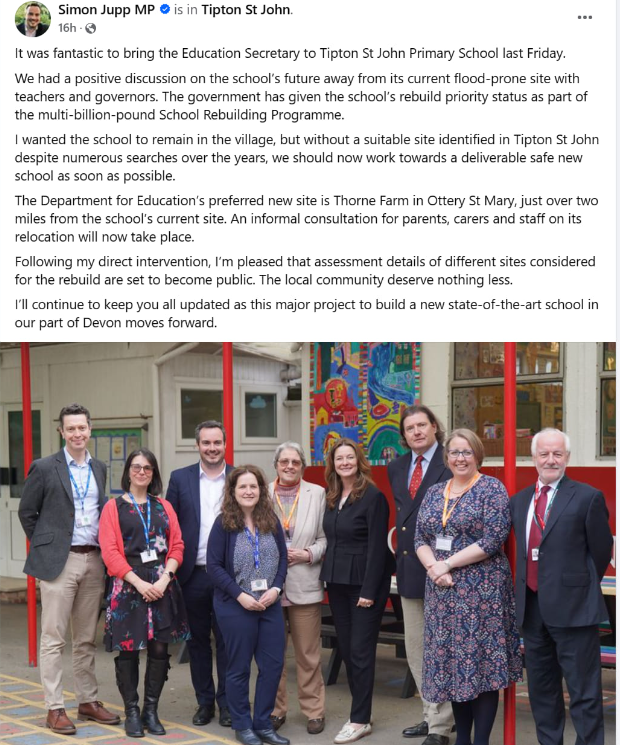
Cllr Jess Bailey unspins Simon Jupp’s claims on Tipton Primary

Claire Wright comments as well.


Jess Bailey Otter Valley Devon County Councillor facebook post:

(For Simon Jupp’s facebook boast this refers to see below – no mention of St Peter’s Budleigh Salterton during Education Secretary’s low profile visit last Friday)

“Simon Jupp’s latest social media post shows a total disregard for the community of Tipton St John.

It’s bad enough that out of the blue in January this year he ditched his commitment to the school remaining in the village, but it’s made worse by his attempts to exploit the situation for his own photo opportunities.

However, no amount of photo opportunities can disguise the fact that the Conservative government has totally failed to deliver a new school for Tipton St John for more than a decade now.  All that has happened is Tipton school has been included on a list for a rebuilding programme.

I was not invited to attend this meeting with the Secretary of State, even though I had every right to be there as the elected representative of Tipton residents at Devon County Council. I complained about my treatment to the Leader and CEO of DCC.

It feels to me that Simon Jupp is attempting to steam roller me, and therefore Tipton residents, out of the way. I am not prepared to let that happen.

I want to draw your attention to a number of key points about the consultation process:

– There will be an informal consultation by the school from 1st May – 19th June on possible relocation. Simon Jupp states on his social media post that this consultation is for ‘parents carers and staff’. That is completely misleading – crucially it’s for residents too. This is a really important point and I would urge as many people to respond as possible.

-All the reports and consultation details will be uploaded to the school’s website. They will also be uploaded to DCC’s ‘Have your Say’ website under the Education and School category. All responses to the informal consultation will go to the school.

-The school governors will meet following the informal consultation on 24th June 2024 and decide whether to proceed to a statutory consultation.

-If the governors proceed with a statutory consultation there would be a formal four week consultation which may take place from 27th June – 25th July. At this stage all the responses will go to DCC.

– DCC officers would then prepare a report for DCC cabinet (possibly for a meeting in September). The decision whether to relocate will ultimately be taken by DCC cabinet.

I also want to clarify another point. Simon Jupp claims that it was his ‘direct intervention’ that will mean the DfE report being made public during the consultation. In fact the publication of the DfE report is actually something I insisted upon as a condition of the school going out to consultation and this was then agreed between DCC and DfE counterparts.

In addition, unlike Simon Jupp, I did not feel the DfE report alone was sufficient and I felt further work was required and insisted on DCC carry out additional work. The DCC report will also be published at my insistence. Once published I will share my views on the outputs from these reports and will be interested in the views of parents and residents.”

This provoked such comments as: (first four from a long list) 

Louise Mansfield

We all know what he’s like Jess. .a glory seeker without putting any of the hard graft in himself. Thank you for your unending work behind the scenes on lots of local important issues

Jan Daly

No surprise here. Jupp is in electioneering mode for his own benefit rather than working for the benefit of his constituents.

Ann Pangbourne

Well done again, Jess. So glad to have you as our DCC representative.

Claire Louise Wright

Well said Jess. Mr Jupp is roaming all over his and Richard Foord’s constituency taking credit for anything he thinks he can get away with while blocking anyone who asks a question he doesn’t like. He then ignores communications from them too, rendering an unknown proportion of people in East Devon without an MP. He regularly posts communications to Richard Foord’s claiming to be the ‘local MP’ and we’re all familiar with what appears to be fraud over diverting Richard Foord domain names to his own website. Who knows when the election will be upon us but we all need to ensure he is voted OUT!

Simon Jupp’s “Fantastic Visit” facebook boast

Paul Arnott – Will the General Election be held in November this year?

East Devon leader Paul Arnott 

They say never meet your heroes. They might also advise not to divulge in a local newspaper column who those heroes are. But I’ll go there anyway.

As a boy, my footballing hero was a Charlton Athletic player named Derek Hales. I never met him, but his nickname “Killer” suggests that if I had, this prolific goal scorer may not really have been suitable hero/role model material after all.

Last weekend, one of my sons and the fiancée he marries at the end of May were staying with us, and suggested we watch a documentary about Ed Sheeran. Inwardly I groaned. But by the end, and his quite remarkable tribute in song to his lost friend Jamal, young Ed had shown many of the classic characteristics of the hero.

So that’s not too weird, is it? A footballer and a music star. Okay, so hopefully I’ve broken the ground to give me space to describe recently meeting an actual living hero of mine without being laughed out of East Devon. And that man is Professor Sir John Curtice of Strathclyde University.

Who, you may well say? If you search his name, many of you may go, oh, him! The fellow with the huge cranium who is present at every election broadcast or debate, generally considered the finest analyst and predictor of elections this century.

A few weeks ago, I was attending a meeting of District Council leaders in glamorous St Albans, and when I was at the reception, he checked in next to me, one of the guest speakers. He was completely charming so I thought I’d try a question out, when he thought the next general election would be. He knows this kind of thing.

Without hesitation he said Thursday 14th November 2024. I blathered, but what about May, June, July etc? He said that was pure distraction politics to encourage non-government parties to spend scarce campaign funds early. He explained that Mr Sunak would want a party conference season in October to tell a narrative around lower inflation and interest rates and that by then at least a few migrants would have been flown to Rwanda. At or shortly before the Conservative conference he’d give six weeks’ notice of a general election.

The Professor’s speech in the main auditorium later was both brilliant and funny. It went down well, even with many Conservative leaders present. He was giving it to us straight, with all sorts of charts and graphs, and he had such a lovely way about him that even Conservatives have not demurred when he stated that they have less than a 1 per cent chance of winning the next election.

Many Tory grandees have seen the writing on the wall and are preparing for life after power with good grace. Therefore, it is desperately sad that the MP for East Devon, Simon Jupp, seeking now to compete in the new seat of Honiton (leaving Exmouth behind him) against Richard Foord, is not taking a leaf from their book but is punching below the belt. After some fine journalism from David Parsley in the i newspaper, Mr Jupp was forced to admit last week after much fudging that it was his office which had bought website domain names masquerading as Richard Foord’s which, on opening, went instead to his own Conservative page. Pure Trump.

Heroically Mr Jupp blamed a full-time employee, the young man running his campaign, Oliver Kerr. There are self-evidently so many more questions to be asked, but I’ll leave that to others. Sadly, I suspect Professor Sir John Curtice would not be in the least surprised.

Another open letter to Simon Jupp – 5 questions to answer on those websites!

Nicholas Pegg writes to Simon Jupp and posts his letter on “X”:

I have written today to my MP, @simonjamesjupp, to ask him some more questions about the developing story of the bogus web links which dishonestly used the name of Lib Dem MP @RichardFoordLD to direct voters to Mr Jupp’s campaign site. (Mr Jupp did not reply to my last letter.)

To Simon Jupp, MP

House of Commons

London SW1A OAA

Monday, 22nd April, 2024

Dear Mr Jupp,

Two weeks ago today, I wrote as your constituent to ask you some questions about the unedifying affair of the deceptive web links which used the name of Richard Foord MP, your rival in the forthcoming general election, to mislead web users and direct them instead to your own campaign website. I have not yet received a reply from you.

The day before I wrote, you had made a brief statement to the BBC, saying that you were ‘not responsible for the web domains in Mr Foord’s name,’ but offering no further detail. Eleven days later, on April 18th, it emerged that your campaign manager, Oliver Kerr, had registered the domain names in question. On the same day, you gave a further statement, in which you said: ‘The individual responsible has apologised for making an error of judgement, without my knowledge or approval, and no longer owns the website domains in question.’

Given that this falls short of being an adequate explanation of the incident, I am writing again to ask you five questions.

1. Could you please explain exactly when you became aware that the web domains had been purchased by Mr Kerr? Let’s work on the assumption that when the story first broke, it would probably have occurred to you to check with your campaign team before making your initial statement.

2. Could you please explain the reason for the 11-day silence between your statement that you were ‘not responsible’ and your second statement, which finally identified the culprit?

3. Were the purchases of the misleading web domains paid for by Mr Kerr out of his own pocket, or was he reimbursed from your campaign funds, constituency funds or party funds? Given that the misuse of funds is a serious issue, I would naturally find the latter hard to believe – but then again, other headlines over the last week have made for quite a read.

4. While it is reassuring to know that the website deception was carried out, in your words, ‘without my knowledge or approval’, you are doubtless also aware that Richard Foord’s constituents have been targeted on several occasions by ‘newsletter’ style campaign leaflets which misleadingly describe you as ‘local MP Simon Jupp’. Are you able to confirm that all of these misleading mailshots were also distributed without your knowledge or approval?

5. Since the start of this year, you have found time amid your urgent casework to publicise your visits and your support for local services and businesses in Cullompton, Colyton, Higher Wiscombe, Axmouth, Luppitt, Upottery, Honiton, Seaton, Beer, Branscombe, Broadhembury, Dalwood and Axminster, all of which are in Mr Foord’s constituency, not yours. Did you carry out these visits and photo opportunities without your own knowledge or approval?

Mr Jupp, I’m sure you will agree that you owe a full explanation to your constituents, as well as to Mr Foord’s constituents, and to the country. We all look forward to hearing from you.

Yours sincerely,

Nicholas Pegg

UK Tories set for total wipeout — if Brits can finally grasp tactical voting – POLITICO

Slick campaigns promise to help voters boot out Conservative MPs. But will they really work?

Sceptics say British voters just aren’t clued up enough on the finer points of the country’s system to get tactical voting really firing. 

By John Johnston www.politico.eu

LONDON — Britain’s Conservatives look set for an election pasting this year. But anti-Tory campaigners want to make sure it’s a knock-out blow.

As a general election looms, a host of flashy campaigns are springing up trying to convince Brits to vote tactically. Under the U.K.’s winner-takes-all system, that means asking voters in tight seats to hold their nose and cast their ballot for a candidate with the best chance of knocking out a Conservative, even if that candidate wouldn’t be their first pick.

A flood of sophisticated online tools, backed up with data from expensive polling campaigns, are promising to help show voters where they can use their tactical edge.

There’s just one problem: sceptics say British voters just aren’t clued up enough on the finer points of the country’s system to get tactical voting really firing.

“This will be the ninth general election I’ve worked on in one capacity or another, and I think certainly for most of them, if not all of them, there has been talk of this being the tactical voting election,” says Joe Twyman, director of polling firm Deltapoll.

Indeed, polling shows British voters continue to lack an awareness of the basic information needed to make tactical voting work. A survey carried out by Deltapoll last year found just 52 percent of voters could correctly identify the winning party in their local area. That dropped to 19 percent when asked who came in second.

The proportion of voters who knew both of those facts, plus the margin of victory in their seat, and lived in a constituency where tactical voting could actually make a difference, was just one percent, Deltapoll found.

After much hype about tactical voting in previous elections, Twyman reckons it could “again be a case of the dog that failed to bark.”

That won’t stop determined campaigners from trying to give the Conservatives a kicking.

Getting clued-up

Organized tactical voting has been around in the U.K. since at least 1997, when a campaign group called GROT — an acronym for Get Rid Of Them — first sent leaflets through the post trying to build an anti-Conservative coalition. Political scientists still hotly debate how big a role tactical voting really played in the 1997 election. But the Liberal Democrats, Britain’s center-left third party, racked up an extra 28 seats that year as Tony Blair’s Labour romped home.

Advocates see parallels between 2024 and 1997, where poll after poll shows deep dissatisfaction with a Conservative government long in power — and where they believe voters could be tempted to set aside party loyalty and vote for anyone who can oust a Tory in a tight race.

Best for Britain is one of the groups hoping to make tactical voting matter at this election — and it’s got a clear aim in doing so.

As one of the loudest backers of a second Brexit referendum back in the day, the campaign group has since restyled itself. It’s hoping to build a coalition of progressive MPs keen to bolster ties and push for a better trading relationship with the European Union.

The group has run tactical voting campaigns in the last two elections and it’s now putting the final touches on a new high-tech platform. As well as a clear voting recommendation, this year’s tool will try to address some of the knowledge gaps voters face.

It’s promising information on voting deadlines, the types of photo ID that will and won’t be accepted at polling stations, and key stats on things like local crime rates and hospital waiting lists.

“It’ll tell you where to place your vote tactically to have the best chance of either voting out the incumbent Conservative or beating the Conservative challenger,” the group’s chief executive Naomi Smith explains.

Smith says much of the analysis will be driven by sophisticated multi-level regression (MRP) polling. The group, she says, is planning to conduct a major survey and provide their recommendation as close to polling day as possible, while still allowing enough time for postal voters to get the advice.

But the campaigns boss admits they’ll also be injecting some human takes too. “Where there is an incumbent who we’d define as a progressive MP, they will get the recommendation rather than what the data might say,” Smith says.

‘Deep-rooted problems’

Best for Britain is just one of several campaigns set to launch their own tactical voting tools in the run-up to this year’s vote. Expect major ad campaigns and media voices like former TV host-turned-anti-corruption-warrior Carol Vorderman deployed to try and raise the public’s awareness of the practice.

Yet some see the push for tactical voting as a depressing sign of how Britain’s first-past-the-post electoral system can force voters into making choices they wouldn’t normally want to.

Jess Garland at campaign group the Electoral Reform Society says the practice exposes “deep-rooted problems” with the U.K.’s way of choosing governments. “Voting should be about choosing the candidate you most agree with rather than head-scratching over who has a realistic chance of winning,” she says.

Tory candidate for Exmouth & Exeter East, David Reed, as negative and misinformed as Simon Jupp

Cllr. Joe Whibley writes in the Exmouth Journal:

In response to Mr Reed, prospective parliamentary candidate for Exmouth and Exeter East, and his missive regarding working with South West Water I have a couple of points of note.

I welcome his intention to try and work with South West Water, but suggest that he is clearer in his knowledge of the workings of local government. To suggest that East Devon’s planning department is somehow culpable is to completely misunderstand or misrepresent planning law EDDC cannot legally turn down a planning application on the grounds of sewage infrastructure. If South West Water say they can accommodate any new development, East Devon are forced by law to accept that even if we know there is some doubt.

As an example, if Mr Reed were to look at the planning officers recommendations for the redevelopment of the Devoncourt Hotel, he will see an example of this. I am saddened that they have suggested the committee may wish to grant permission for this, but any representations about this will need to be on things other than South West Water’s position_

Might I suggest that if Mr Reed wishes to be a successful local candidate and ultimately MP, he moves away from the behaviour of his predecessor Mr Jupp. His constant criticism of the district council, despite the best efforts of people to work collaboratively has proved incredibly obstructive and in the interests of nobody.

Cllr Joe Whibley

East Devon District Council

Businessman says he could bring “creativity” to PCC role

A businessman and accountant who has watched politics from afar is hoping to become the next police and crime commissioner for Devon and Cornwall.

Alison Stephenson, local democracy reporter www.radioexe.co.uk

PCC candidate for the Liberal Democrats Steve Lodge. (Image courtesy: Liberal Democrats)

Steve Lodge, 53, from Tiverton thought about standing as a MP, but says his financial background and governance experience – he has been vice chair of the Federation of Small Businesses in Mid Devon – together with his knowledge of business, are suited to the commissioner role.

And the fact that he has no background in policing, he believes, is a good thing, enabling him to bring “creativity, innovation and acumen to the job, without any baggage”.

Mr Lodge, who is standing as the Liberal Democrat candidate in the election, runs a marketing and communications agency and has been in business for 25 years. Before that he was an accountant at IBM and Marconi.

“I watched politics from afar. I am a life long Lib Dem voter, but never really considered myself going into that area and I was concentrating on my business,” he said. “I now have the opportunity to step back a bit and it feels like time for a change.”

Bumping into Lib Dem Richard Foord, MP for Tiverton and Honiton and Lib Dem leader Sir Ed Davey during a PR job at Tiverton High School sealed the deal.

“I was inspired by them to make the world a fairer place, and thought that’s something I would like to do.”

Mr Lodge is one of three candidates, along with incumbent commissioner Alison Hernandez, and former diplomat and civil servant Daniel Steel.

The job of the PCC is to hold the police service to account and to scrutinise their performance. It pays more than £88,000 a year, with elections taking place every four years.

Mr Lodge wants to see “a proper return to community policing” with more bobbies on the beat, and to bridge the gap between the police and the public as he says “trust has been eroded”.

He wants what he called ‘fairer funding’ and ‘smarter spending’ so police have the resources to fight crime, and to support rehabilitation and restorative justice.

He said national police funding levels were the same last year as in 2011. “You have to question how the police can work properly with this amount of underfunding,” he said.

Mr Lodge believed he could “add value” to the new police and crime plan in 2025 and wants more of a multi-agency approach.

He said many people, charities and local authorities, who do “fantastic work” on crime prevention and in areas like mental health, who are unsung heroes.

He feels the police needed “to be more joined up”. All the force could do is to respond to crime and teach rookie officers the basics, he said.

The biggest issue right now “hands down,” is anti-social behaviour, he believes.

“It’s something I am hearing when I knock on every door. In Truro, shopkeepers are subject to verbal abuse. People think they can just walk in and steal what they like.”

He continued: “If we can provide common sense to politics and to being the police and crime commissioner, we will resolve a lot of the problems we have currently.”

Looking through documents from 2012, when the police and crime commissioner’s office was set up, he saw something on youth crime which made a lot of sense but hadn’t been implemented.

“It was created by the Conservatives and it said for every pound you spend on youth crime you save the country £2.50. If I could walk into bank with £1 and come out with £2.50 I would be a happy man, but what happened? Investment in youth crime was slashed. Investment in the police was slashed.

“If we invest properly in our public services, we will deal with the issues we have, but for some reason politicians just don’t see it.”
 

Former diplomat says ‘community policing will be top priority’ if he’s elected

A Plymouth born-and-bred former diplomat is hoping his resilience and experience of working in some of the most challenging areas of the world will make him a good fit for the role of Devon and Cornwall police and crime commissioner.

Alison Stephenson, local democracy reporter www.radioexe.co.uk

Daniel Steel (image courtesy: Plymouth Labour)

Daniel Steel is one of three candidates standing for election on Thursday 2 May. He is the Labour and Co-operative Party representative.

The others are Conservative Alison Hernandez, who has been police and crime commissioner (PCC) for the last eight years, and Tiverton businessman Steve Lodge, for the Liberal Democrats.

The job of the PCC is to hold the police force to account and to scrutinise their performance. It comes with a salary of more than £88,000 and elections take place every four years.

Mr Steel, 31, says he has public service running through his veins. His father was in the Royal Navy and he has always wanted “to do his bit.”

“My values come from my dad, it has what has motivated me my whole life. I want to put back more than I take out.”

He has served in countries such as Afghanistan, where he says his resilience and leadership were forged.  He also dealt with challenging issues around refugee displacement, human trafficking and modern slavery whilst working at the Foreign Commonwealth and Development Office.

“I spent a lot of my career so far working in difficult and dangerous places,” he said.  “It allowed me to see what it looks like when the rule of law breaks down.  I fundamentally believe that the rule of law is the bedrock of our society and democracy.

“When you look at the alternatives of violence and chaos you see in lots of other places, we are really lucky that in the UK we have strong government systems and governance in our country.”

Mr Steel, who has had to give up his job as a civil servant because he is standing for office,  hopes that Labour will form the government following the next general election but he says in the meantime the police and crime commissioner role is a chance to implement the party’s mission.

“One of Labour’s key aims is to take back the streets, with 13,000 more officers and police community support officers (PCSOs). I was shocked that in Devon, Cornwall and the Isles of Scilly we only have 177 PCSOs. That’s one per 10,000 residents. It’s why we don’t have the community policing we expect and deserve as the public.”

Devon and Cornwall had almost double the number of PCSOs (346) in March 2015, a year before Ms Hernandez took over as commissioner. Many subsequently became police officers.

“If I am elected, my number one priority on day one is to re-establish community policing.  Too many police officers unfortunately are having to work behind desks because the force does not have the right mix of staff.

“Alongside the acting chief constable and the senior team, I would be looking how we can increase police staff to free up officers so they can be working on the streets, not on spreadsheets.”

Mr Steel, who lives in Plymouth, said members of the public he had talked to linked problems of anti-social behaviour and burglaries directly with a lack of visible police presence.

And a business organisation in St Austell was paying a private security firm in the town centre to keep crime down, he said.

“It’s not the fault of police. It’s a result of all political decision making by the Conservative government and police and crime commissioners. Policing was cut to the bone and the force has lost years of valuable experience from those officers who went during the cuts.”

Mr Steel has also pledged to tackle violence against women and girls, prevent youth crime and reduce reoffending, boost crime prevention and victim support, and back a crackdown on illegal sewage dumping.

A few years ago, he was the victim of a knife crime and said the traumatic experience had stayed with him. He says it has given him the ability to empathise with victims of serious crime.

“I see the role as being a representative for victims, the accused and members of the public to try and bring a public prospective into the police.”

He said he had made a career out of bringing people together.

And he added that his work as a diplomat was similar to being a politician: “I have represented the UK and spoken on its behalf with ministers and other diplomats around the  world to make sure I was delivering for the UK’s people.

“The PCC is a challenging role but an important one. It which covers an enormous region. We are diverse in terms of population, rural, urban, different politics and I will be acting in a fair and even handed way and do my best to serve the residents across the region, however they vote.

“I can reassure the public that I will be making the tough calls and asking the tough questions. The cost of policing is becoming more and more of a burden on the taxpayer, for me it’s about how we use those resources efficiently to make sure they are working.”
 

How much will water bills rise across the country?

The water industry has been engaged in long-running discussions with regulators over investment plans that will result in price rises for households over the next five years.

“The public should not put another penny of their money anywhere near these water companies. 

“Water regulator Ofwat has already written to them. The water companies confirm it. For 33 years, we have paid them all of the funding and all of the money they’ve needed to fix this kind of plant.

“It should have been fixed decades ago. They didn’t fix it. The question we should be asking is where has our money gone? What happened to it? When do we get a refund? And how dare they have the audacity to now demand that bill payers pay them a second time for a service we didn’t even get the first time round.”

“Customers cannot be penalised for sins of the past”. Feargal Sharkey (April 13)

Helen Cahill www.thetimes.co.uk

The utility operators published their proposals in October to outline how they would reduce leakage, pollution and sewage spills across their networks between 2025 and 2030 and how the investments would affect people’s bills.

Ofwat has told companies to bill customers only for new investments, rather than putting right “past failings”. The watchdog has been reviewing the individual business plans and will report its decision on the proposals from each company in June.

Severn Trent

Severn Trent is seeking to raise £1 billion to help to fund expenditure of £12.9 billion over the five-year period, with customers’ bills to increase from an annual average of £379 to £518. The London-listed company, which has about 4.2 million customers in the Midlands, has pledged to reduce leakage by 16 per cent, with spillage from storm overflows to be reduced by 30 per cent. The operator is also planning to bring down pollution levels by 30 per cent.

United Utilities

United Utilities has set out proposals to spend £13.7 billion to increase the value of its regulatory capital by 8.7 per cent per year across its operations in Cheshire, Cumbria, Lancashire, Merseyside and Greater Manchester.

The FTSE 100 company is targeting leakage reduction of 25 per cent by 2030 and has committed to reducing floods in homes and businesses by 30 per cent.The number of pollution incidents from its network are set to fall by 25 per cent by 2030, with spillages from its wastewater systems forecast to drop by 27 per cent.

United Utilities is poised to increase average yearly bills for its customers by 14 per cent from about £455 to £518.

Pennon Group

Pennon has earmarked an additional £2.8 billion of capital investment in its water and wastewater networks, which it says represents a doubling of its investment from 2020 to 2025.

The FTSE 250 group owns South West Water, Bournemouth Water and Bristol Water and its total expenditure is set to reach £4.5 billion by the end of the decade.Pennon aims to reduce leakage by 19 per cent and to “eradicate pollutants” by the end of the decade.

The average household bill for customers of South West Water would rise by 23 per cent from £504 a year to £620 for both water and wastewater services.

Pennon increased its dividend by 8.3 per cent from 12.96p a share to 14.04p, despite a slide in profit in the half-year to the end of September. Ofwat levied a £2.15 million fine on the company for dumping sewage into rivers and the sea off Devon and Cornwall.

‘Dirty secret’: insiders say UK water firms knowingly break sewage laws

Just when you thought we had plumed the depths…..Owl

Whistleblowers say UK water companies are knowingly failing to treat legally required amounts of sewage, and that some treatment works are manipulating wastewater systems to divert raw sewage away from the works and into rivers and seas.

Rachel Salvidge www.theguardian.com 

It is well known that water companies are dumping large volumes of raw sewage into rivers and seas from storm overflows but an investigation by the Guardian and Watershed Investigations reveals that the industry’s “dirty secret” is bigger, broader and deeply systemic.

By law, every wastewater treatment works must treat a minimum amount of sewage as stipulated in their environmental permits. Four whistleblowers have told Watershed that a large proportion regularly fail to do so and are not reporting it to the environmental regulator.

The insiders say the amount of sewage reaching a works is being “manipulated at the front end” by “flow trimming”, which can be done a number of ways including by “manually setting penstocks to limit the flow”, by “dropping weir levels” and by “tuning down pumps at pumping stations”. The diverted raw sewage makes its way into ditches, rivers and seas.

One industry insider says they “have personally surveyed works and found valves operated and diversion pipes installed so that part of the flow arriving is deliberately diverted to an environmentally sensitive stream, rather than into the works, so that the works passes compliance of sanitary parameters.

“I have spoken to staff who have carried out surveys to inform investment plans, who have found that the controls of terminal pumping stations have been deliberately altered so that they pump only a reduced proportion of the flow figure they were designed to pump, in the knowledge that this was a breach of flow compliance. This continues.”

The insider adds: “I have spoken to [people at] other water companies who confessed that flow compliance is a dirty secret of the UK water industry, which environmental regulators know about (although perhaps not the scale) and have turned a blind eye due to resourcing constraints.”

The raw sewage that is diverted away from the works either flows directly into ditches, rivers, lakes and seas, or backs up in the sewer network and finds its way out into the environment via storm overflows. Flow trimming, along with ingress from groundwater and an underlying fundamental lack of capacity at many sewage works, which have not been updated to meet population growth or changing weather patterns, are responsible for the widespread sewage pollution seen around the UK.

“It is an enormous scandal that many who work in the industry know about, but nobody wants to talk about,” said the whistleblower. “Water companies report their overall compliance with wastewater rules as good, but dig a little deeper and you’ll see that lots of treatment works are failing to deal with the amount of sewage they are legally meant to treat.”

The insider says non-compliance is widespread across the UK, and that they are aware of works where as much as 30% of the sewage they are expected to handle goes straight into the environment without treatment.

“Some operators, with or without the support of their chain of command, are deliberately reducing the flow of sewage into the treatment works by either dropping the levels of weirs so that sewage flows out into the environment, or by cutting back the flows at pumping stations. This way they can say they are treating a greater proportion of the sewage they receive because they are now receiving less into the works,” says the whistleblower.

“Sadly there are many incentives for water companies, rogue teams or staff to do this, including reduced cost of pumping and treatment, and treatment works that were struggling to comply appearing to be passing, with the resulting regulatory performance rewards leading to staff bonuses and increased dividends to shareholders – with very little risk that the manipulation will be found or anyone prosecuted.”

A second insider says it is “almost standard practice to control penstocks by hand to set it at a limit to reduce the flow”, adding that the problem “stems from sweating the assets … There are a lot of undersized, overcapacity sewage treatment works out there … and I’ve rarely seen a works where all the assets are working, there’s usually something out of service.

“Spilling to the river saves millions of pounds that they should be spending on assets. Lots of storm tanks are sized to meet 30-year-old permits, and there are sites with no storm capacity at all.”

A third insider says they have seen evidence of flow trimming at works owned by two different water companies.

“Operational teams on site look for a workaround, often in the full knowledge of what they are doing, and in full knowledge of all the stakeholders, from the project manager all the way up to the person holding the purse strings. Other times it’s done without knowing the implications … no one knows the true scale of what’s happening across the country.”

According to a fourth whistleblower, it is possible to identify instances of flow trimming in a company’s figures “but no one truly looks into the data, they won’t look at the detail”.

England’s water companies declined to comment, but the industry body Water UK says: “We recognise the current level of spills is unacceptable and we have a plan to sort it out. Between 2025 and 2030 water companies in England and Wales want to invest £96bn to ensure the security of our water supply in the future and significantly reduce the amount of sewage entering rivers and seas. We now need the regulator Ofwat to give us the green light so we can get on with it.”

Ofwat says water and wastewater companies’ environmental performance is “simply not good enough” and that the industry regulator is “acutely aware of the damage this does to our natural resources and to public trust.

“However, where companies fall short, Ofwat acts – over recent years, we have imposed penalties and payments of over £300m and in November 2021 we announced our biggest ever investigation into all water and wastewater companies in England and Wales, with live enforcement investigations into six companies.

“This is specifically investigating whether companies are treating as much sewage at their wastewater treatment works as they should be, and how this could be resulting in sewage discharges into the environment at times when this should not be happening.”

The Environment Agency is also investigating. A spokesperson says: “We will always pursue and prosecute companies that are deliberately obstructive or misleading, including on issues around flow compliance. We are conducting our largest-ever criminal investigation into potential widespread non-compliance at thousands of sewage treatment works.”

Geraint Weber of the regulator Natural Resources Wales says: “We expect water and sewerage companies to comply with the conditions of their environmental permits. Where non-compliance is identified we won’t hesitate to take action using the full range of enforcement powers available to us.”

Nathan Critchlow-Watton of the Scottish Environment Protection Agency says: “Sepa assess Scottish Water’s compliance with authorisation conditions at wastewater treatment works through site inspections, investigating events and incidents, sampling discharges, assessment of operator data and Sepa’s programme of environmental monitoring. We are not aware of any evidence of deliberate misreporting of overflow data by Scottish Water or other operators.”

A Scottish Water spokesperson says: “We are not routinely required by licence to assess and report whether we are passing the appropriate pass forward flow at our pumping stations and overflows and at wastewater treatment works. We set out to be compliant across all aspects of our licences and are not aware of any instances where we deliberately manage flows to spill early.”

Northern Ireland Water and Welsh Water declined to comment.

Jupp’s dodgy website has serious consequences 

We now know that in January Oliver Kerr, Jupp’s campaign manager, bought at least one of the following web addresses richardfoord.uk, richardfoord.co.uk and richardfoord.comt. In fact all three web addresses were purchased on the same day. Until 8 April, all linked directly to Mr Jupp’s website.

The purchase of these sites and subsequent automatic linking to Simon Jupp MP’s website has serious consequences for people trying to contact Richard Foord MP.

As is detailed below, Richard Foord, in only two years as an MP, has built up an enormous case load of work helping constituents. Deliberately impeding access to your MP seems to Owl to be pretty serious stuff.  It cannot be waved away as a bit of over exuberant electioneering – we are months away from that.

Oliver Kerr may have thought it a “bit of a prank”. But deliberate deceits of this kind lie at one end of a spectrum the other end of which is inhabited by scammers, phishers  and fraudsters. The people who try to divert you into divulging your personal details into bogus accounts, fraudulent services, websites etc.

This is why this particular deceit must be roundly condemned. 

Richard Foord’s casework passes 10,000

Richard Foord MP on “X

·

Apr 13

Last week, my team and I finished our 10,000th piece of casework on behalf of local residents. As an MP, working on big issues like health and sewage might make newspaper headlines – but most of what I do is helping individual constituents with challenges they’re facing.

That can be anything from reporting issues with social housing, helping with delays to pension and benefit payments, or raising potholes with the County Council.

My team and I are here to help with any problems you may be having, whether they be big or small.

Dodgy web sites and campaign manager – More questions for Simon Jupp to answer

When the story of the “misleading” websites first broke about ten days ago, Simon Jupp  told the BBC he was “not responsible for the web domains in Mr Foord’s name”. 

Readers of the “Watch” will know that Simon Jupp is an arch equivocator and his statements are always worth “deconstructing”. What they don’t say may reveal more than what they do say.

What Jupp didn’t say at the time was:

I do not know who did this

This is not an action that I would ever sanction.

I will try to find out who did this and get it taken down meanwhile I must apologise to Richard Foord.

Until Wednesday, repeated requests for Simon Jupp to answer questions such as these and provide a full explanation have been met by silence.

It was not until Richard Foord revealed who purchased at least one the domains that either Oliver Kerr, Jupp’s campaign manager, or Jupp broke their silence. (Richard Foord deployed the powerful tool of making a data request of the domain registration company, Nominet) 

Kerr’s apology issued only after he has been uncovered doesn’t look in the least bit sincere. 

Neither does Jupp as he now comes over all “crocodile tears” saying:: “The individual responsible has apologised for making an error of judgement, without my knowledge or approval, and no longer owns the website domains in question.

“That is the right thing to do and I am glad he’s apologised and reflected on his actions.”

But are we really meant to believe that in the intervening ten days Jupp and his campaign manager didn’t talk or joke about this?

Now that we know that the purchaser was Jupp’s campaign manager it also raises the question as to whether or not Jupp does have some responsibility, despite his denial. Presumably Jupp appointed Kerr.

If Simon Jupp really is sincere that Kerr overstepping his remit is unacceptable then he should sack him immediately.

The original inews article also claims Oliver Kerr is employed by the Independent Parliamentary Standards Authority. If this is correct then a further question arises: is Kerr’s “error of judgement”, his lack of integrity, transparency and accountability in coming forward until caught “red handed” compatible with any continuing  role in that organisation?

Project is working to bring salmon back to the River Sid

Charles Sinclair, River Sid Catchment Group 

Looking down from a bridge over the River Sid into the fast flowing waters below, I am delighted if I see the glimmer of a fish swimming against the stream.

Our river is a historical home for trout and salmon. Fish like these in our river are natural treasures and people are working towards restoring the natural populations.

Trout and salmon hatch in the headwaters of rivers, leaving the river to spend most of their adult life at sea, then returning to rivers to complete their life cycle. Salmon will travel vast distances; some UK salmon cross the Atlantic to feed in Greenland waters before returning to the UK to spawn. Sea trout spend much of their adult life at sea within a few miles of the mouth of their spawning river.

Brown trout are the same species as sea trout but do not leave the river system in their lifetimes. Due to the years spent at sea, sea trout are larger, stronger and many times more fertile than a brown trout. They make a more significant contribution to the wild population in a river.

Young trout feed on the invertebrates, enjoying the small bugs like mayfly and caddis fly larvae in particular. Young fish are next up in the food chain; an abundant population of fish will mean many more of the top predators, kingfishers, herons and otters. Bringing back migratory fish to the Sid will help restore the abundance of wildlife that is so important in the valley.

The Sid Valley’s upstream geology feeds different sized stones and gravels into our river producing high-quality spawning grounds for trout and, once upon a time, salmon. An Environment Agency expert describes the River Sid as having a ‘wonderful fish habitat’.

A volunteer group is monitoring river fly species throughout this year and the populations are quite good, but the trout population is low, and there are no salmon. We have severely damaged the access for fish within our river, access they need to spawn, feed, shelter from predators and find safe places in flood conditions.

The River Sid has many weirs and rock ramps, many more per mile than the average UK river. These are important to slow the river down and help prevent flooding, but they are also an impediment to fish migration.

At least six are impassable for fish, with many more lesser obstacles. Between Fortescue and the end of the Byes there are sixteen, mainly boulder weirs. The Wild Trout Trust estimates there is a ten percent restriction on fish passage at each obstacle. The cumulative impact means that only two fish in ten will be able get to the best spawning grounds above Fortescue.

The biggest impediment to fish passage is School Weir in the Byes. Built in the 1970s and nearly three metres in height, it is one of the highest weirs in the South West of England. It is a completely impenetrable barrier to sea trout and salmon that wish to return to their spawning ground.

A fish rescue at School Weir used to be carried out by the SVA, fish were netted and carried above the weir. This had to be discontinued but fish have been seen trying to jump School Weir as recently as 2022. Sea trout are spawning in the very short section of river below School Weir instead but this is a wholly unsuitable habitat for young trout.

The River Sid Catchment Group, with the Sid Valley Biodiversity Group, is hoping to get a fish passage reinstated at School Weir and modify other obstructions to allow easy fish passage up and down the river. This builds on work already undertaken by other agencies in the town over the years. The Environment Agency is also keen to see improvements on the Sid.

We will be presenting our plans for consultation in the forthcoming Sidmouth Biodiversity Festival in June. We look towards a future where the river is rich in wildlife and clean water is a given.

Tories hold three quarters of worst-hit seats for sewage spills

Three quarters of the 100 constituencies worst hit by sewage spills last year are held by Conservative MPs.

Adam Vaughan www.thetimes.co.uk

Environment Agency data showed that discharges of raw sewage into seas and rivers doubled in duration last year to a record 3.6 million hours.

Among the top 100 constituencies in England worst affected by the dumping, which typically happens when sewers are overwhelmed by heavy rainfall, 75 were held by Tory MPs. Three of the seats were held by the Liberal Democrats, and the rest by Labour.

Rishi Sunak’s seat in Richmond, North Yorkshire, was the tenth worst on the list. Yorkshire Water spilt sewage for almost 42,000 hours from storm overflows in the constituency. The water company was the second worst nationally last year for sewage discharges, with almost 78,000 across its region. Water companies have blamed the high spills on wet weather.

Torridge & West Devon, held by the Tory MP and former attorney-general Sir Geoffrey Cox, was the worst-affected seat in England. South West Water, which last year reported a half-year profit of £85.9 million, was responsible for almost 100,000 hours of spills in the constituency, a 65 per cent increase on 2022.

The Liberal Democrats, who conducted the analysis, said Tory MPs would face a “reckoning at the ballot box” from Conservative voters angry over sewage pollution. The party has made the state of rivers and seas a top campaigning priority before the general election. Sir Ed Davey, the leader, seized on the issue after crediting it with helping the Liberal Democrat Sarah Green win the by-election in Chesham & Amersham, Buckinghamshire.

Almost all of the seats in England saw an increase in the duration of sewage spills last year. With the ground saturated after persistent rainfall, sewage treatment plants regularly reached capacity and sewer networks suffered from “infiltration” as groundwater seeped into pipes.

Several of the badly affected constituencies are held by ministers, including Central Devon where the work and pensions secretary, Mel Stride, is MP and where South West Water released sewage for more than 60,000 hours. North East Cambridgeshire, held by the environment secretary, Steve Barclay, had a smaller duration of spills, about 8,000 hours, but a 182 per cent increase in how long each lasted.

Other cabinet ministers with constituencies in the top fifth of those worst affected include Richard Holden, Gillian Keegan, Chris Heaton-Harris, Mark Harper, Michelle Donelan, Victoria Atkins and Lucy Frazer. Collectively, seats held by cabinet ministers had about 265,000 hours of spills last year.

“These figures show the worst-hit areas by soaring levels of sewage dumping are held by Conservative MPs, including Rishi Sunak’s own constituency,” Tim Farron, the Liberal Democrat environment spokesman, said. “It shows Conservative ministers are turning a blind eye to rivers and beaches being ruined by filthy sewage dumping in their own backyards.”

Water companies have now paid out a total of £78 billion in dividends since privatisation in 1991. The Financial Times found firms in England and Wales had paid £2.5 billion in dividends since 2021. Barclay wanted to ban dividends for firms which broke the law on water pollution, but the Treasury rejected the idea.

The findings on spills echo a Times analysis of earlier data, which showed that out of 79,467 sewage releases in marginal constituencies in 2022, more than 39,000 were in Conservative seats. Marginal seats are those won in the 2019 general election by less than 10 per cent, and are considered crucial to the outcome of an election expected later this year.

The issue of water quality has been elevated in recent weeks by a series of celebrity protests, with the former Undertones singer Feargal Sharkey and the actor Steve Coogan protesting at Windermere over sewage discharges.

The Conservative Party has not responded to requests for comment.

Pothole damage prompts legal action by Devon motorist

Ministers in London talk about sums spent on pothole repairs, but on the ground in Devon we are not seeing it. Why cut NI if we have to spend greater sums making up for crumbling infrastructure? I admire Stephen’s approach: “I’m doing this to help others” – Richard Foord MP on “X”.

Philippa Davies www.exmouthjournal.co.uk

A man whose car was damaged by a deep pothole in the road is making a legal claim against Devon County Council for the repair costs.

Stephen Lee from Beer incurred a bill of £466.63 after damaging a wheel and tyre of his car on the badly potholed Seaton Road near Southleigh in December.

He made a claim for compensation from the council, through its official application process, but it was rejected.

He has now lodged a claim through the Small Claims Court on the basis that Devon County Council has failed in its legal duty of care to maintain the roads properly.

Mr Lee says he’s taking this action to make a stand on behalf of all motorists in Devon who’re having to put up with the poor state of the highways: “I can afford the money but I’m doing this as a matter of principle to help others.”

The council had refused to pay compensation because its legal department didn’t consider that the authority would be held liable for the damage to Mr Lee’s car. He was told that, although the council has a duty to maintain the highways, it cannot reasonably be expected to prevent or respond immediately to all defects.

But in his legal claim form, Mr Lee states: “My claim is that the council have a duty of care to maintain the roads so that they remain safe.”

He told the Herald: “They say ‘we’re short of money’, and I know other counties are as well, but the problem is that they haven’t invested the repair money properly in the past, they’ve just patched up, they’ve not done preventative maintenance.

“If they’d drilled along the side of the road, dug down and put in concrete, it would have protected the surface from water penetration from underneath.

“My argument is this: these things happen and the council are notified about it and they try to get it fixed as soon as possible, but the problem is that this has been going on for years, they do a cheap cosmetic repair but have historically failed to invest in preventative maintenance and the state of the roads now is that they’re dangerous.”

After having his compensation claim rejected Mr Lee returned to the scene of the pothole incident he had reported to the county council, and saw that the relevant section of road had been recently ‘patched up’ – but there was another large pothole right next to it that had been ignored.

He said: “The real point of those photos is that the system is not working – they’ve done the repair but left other holes in the same immediate vicinity.

“The roads in Devon are the worst I’ve seen anywhere, and I’ve driven all over the country.”

Mr Lee lodged his small claim on Friday, April 12. He is claiming a total of £529.67 – the cost of the repairs, plus interest, plus the court fee of £50. Devon County Council has 28 days to respond.

Majority of money to fix potholes not available until the end of the decade!

Release £8.3bn HS2 money for potholes now, DfT urges Treasury

The vast majority of the money isn’t available to spend until the end of the decade. Only £300 million for the first two years has so far been allocated.

Ben Clatworthy www.thetimes.co.uk

HS2 money that was redirected to fix potholes should be made available sooner to fix crumbling roads, officials have said.

Ministers have pledged to resurface 5,000 miles of road using £8.3 billion of cash that would have been spent on the new HS2 line north of Birmingham.

However, the vast majority of the money isn’t available to spend until the end of the decade. Only £300 million for the first two years has so far been allocated.

The Times understands that the Department for Transport (DfT) is urging officials at the Treasury to unlock the funds earlier, allowing work to begin sooner. At present the money will be spent over an 11-year period.

“If we were going to go by the letter of HS2 funding, that means all of our funding comes towards the back end of the decade,” a DfT official said. “We don’t think that’s a particularly helpful way of doing things. We’ve had a conversation with the Treasury over what that looks like.”

Last month, an annual report into the state of the carriageways said that local roads are heading to “breaking point”, with less than half of the network now deemed to be in a good condition.

More than 100,000 miles of road, representing more than half the network, have less than 15 years’ structural life remaining, according to the Asphalt Industry Alliance (AIA), which collects data from local authorities.

It said the continued decline in conditions is “reflected by the cost of tackling the backlog of carriageway repairs, which has increased to a new record high of £16.3 billion”. A one-time catch-up would take ten years to complete.

After weeks of speculation over the soaring costs of the scheme, Rishi Sunak announced in October at the Tory party conference in Manchester that the northern leg of HS2 would be axed.

The decision was criticised by leaders in the north of England, including Andy Burnham, the mayor of Greater Manchester, and Andy Street, the mayor of the West Midlands.

Sunak insisted that the £36 billion saved by not building phases 2a and 2b of the high-speed line would be injected into more than a hundred transport schemes across the UK as part of a new Network North programme.

Announcing in November the £8.3 billion for roads, Mark Harper, the transport secretary, said: “Today’s biggest-ever funding uplift for local road improvements is a victory for all road users, who will enjoy smoother, faster and safer trips as we use redirected HS2 funding to make the right long-term decisions for a brighter future.”

Local highway authorities were given an extra £150 million last year. They will receive a further £150 million this year, with the rest of the funding allocated through to 2034.

A source close to Harper said the DfT and Treasury discussions formed part of the “usual dialogue of government”, adding: “We have already paid the first tranche of money into local authorities’ bank accounts and work is under way.

“It’s absolutely usual for us to be talking to the Treasury, especially about such a large amount of money. These are normal conversations.”

The AIA report found that across England and Wales, local authorities would need an extra £1.22 billion each year to maintain road networks to their own targets. It amounts to £7.2 million per authority.

Rick Green, the AIA chairman, said the extra Network North money was welcome but is “clearly not going to be enough to halt the decline” in the quality of local roads.

A spokeswoman for the DfT said: “Local highway authorities are responsible for maintaining their road networks but we are supporting them with the biggest-ever increase in funding, with £8.3 billion of reallocated HS2 funding over the next ten years — enough to resurface the equivalent of over 5,000 miles of roads across the country.

“As is the usual process, we will provide further detail on future years’ funding in due course.”

Simon Jupp admits campaign staffer set up websites in Lib Dem rival’s name

The domain “richardfoord.uk” was bought by Oliver Kerr, who works part-time as Mr Jupp’s campaign manager, and is paid by taxpayers to also work for the Independent Parliamentary Standards Authority.

Works for the Standards Authority.You couldn’t make it up! – Owl

“The Office of Mr Jupp has acted deceitfully, and without integrity. This behaviour has no place in Devon.” Richard Foord MP

Ten days ago incurious Simon Jupp told the BBC he was “not responsible for the web domains”. – Owl

David Parsley inews.co.uk

A Conservative MP has admitted that one of his campaign staffers registered web domains in the name of a Lib Dem rival that directed voters to the Tory’s own campaign website, i can reveal.

As i reported earlier this month, web domains that purported to link to sites connected to Liberal Democrat MP Richard Foord actually directed people to the campaign website of Tory Simon Jupp.

Mr Jupp and Mr Foord have both seen their constituencies abolished under boundary changes and are fighting a tight race in the new seat of Honiton and Sidmouth, in Devon.

While the website links were disabled, following the discovery of what the Lib Dems called a “deceit”, Mr Foord asked Nominet, the UK’s registrar for website domain names, to investigate who was behind the ruse.

An email sent from Nominet to Mr Foord on Thursday revealed the name of the person who bought at least one of the domains, while the Lib Dems believe the same person was responsible for at least one of the other two.

The web addresses richardfoord.uk, richardfoord.co.uk and richardfoord.com were, until 8 April, all linked directly to Mr Jupp’s website.

Nominet found richardfoord.uk was bought by Oliver Kerr, who works part-time as Mr Jupp’s campaign manager, and is paid by taxpayers to also work for the Independent Parliamentary Standards Authority.

It is understood that Mr Foord believes Mr Kerr also bought the .com address, as it was purchased at the same time as the .uk domain.

Nominet has offered Mr Foord the opportunity to report the matter to its dispute resolution service, and said it would investigate if a complaint was made.

He is now preparing to bring the matter to the attention of Parliamentary Commissioner for Standards and will also write to Mr Jupp to ask for an explanation.

Mr Foord – currently MP for Tiverton and Honiton – told i: “This is a new low for the Conservative Party. Just this week, we have seen Conservative MPs caught in a honeytrap, trapped in a flat, and now a local Conservative MP seeking to trick the public with an online trap.

“In my time as MP, many people in mid and east Devon who have needed help have been able to contact me through my website. Yet we now find out that the office of Simon Jupp attempted to divert the public with dishonest election campaign tactics.

“In the Army you learn about integrity – it’s a core value in our Armed Forces. These values of honesty and integrity should be key to all those in public life too.

“The Office of Mr Jupp has acted deceitfully, and without integrity. This behaviour has no place in Devon.”

Mr Jupp, currently MP for East Devon, claimed he was not aware that Mr Kerr had bought the websites in Mr Foord’s name.

“The individual responsible has apologised for making an error of judgement, without my knowledge or approval, and no longer owns the website domains in question,” Mr Jupp told i. “That is the right thing to do, and I am glad he’s apologised and reflected on his actions.”

Mr Kerr said: “I would like to apologise to Richard Foord for buying these website domains. I bought them independently. I wasn’t asked to buy them by anyone.

“I regret my actions and no longer own the website domains in question.”

According to political forecasting website Electoral Calculus, Mr Jupp has a 54 per cent chance of winning the Honiton and Sidmouth seat, while Mr Foord is on 45 per cent.

Web domains are inexpensive to buy and easy to direct to any website as long as no one has already bought the name.

For example, domain names ending in .uk can cost as little at £10 a year, with the first year coming in at less than £1. A .co.uk domain will cost around the same amount and a .com address tends to be a little more expensive at around £18 a year.

Once the web domain name is owned it is a simple process to redirect it to any other website already in existence.

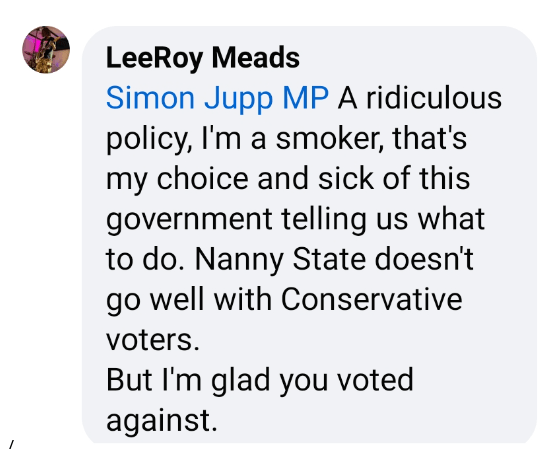
Simon Jupp, arch equivocator – the “smoking vote” (and other examples)

When asked on social media how he voted on “the ridiculous smoking law”, Simon Jupp replied:

“Hello. I did not vote for it as I’m concerned about the impact on retail workers and the difficulty of implementing the policy. I’m not a smoker, I don’t like smoking at all – but I have concerns about the plan.”

The questionnaire replied:  “…….I’m glad you voted against.” (See below)

As Owl reported yesterday Simon Jupp didn’t vote for the “law” but neither did he vote against it. In fact he sat on the fence and ABSTAINED.

Readers will recall another classic equivocation which he trots out regularly:

“I would never vote to pollute our water.” 

Which leads to the “Sixty-four thousand Dollar” question: how should we “read” Simon Jupp’s statement on the misleading website links:

Mr Jupp told the BBC he was “not responsible for the web domains”

Fulsome Tributes to John Hart from political opponents: Claire Wright, Richard Foord MP and Paul Arnott

Richard Foord MP on “X”

John and I may disagree on a lot, but I cannot fault his willingness to speak truth to power. He has [been] vocal on the issues facing Devon, not holding back or pulling his punches towards Conservative bosses in Westminster.

Claire Wright on “X”

I spent 8 years working with John Hart. We were political opponents and had a few run ins, but he was fair and decent, always telling me in person why he wasn’t going to support a motion… but sometimes he did I wish him a long and happy retirement

Cllr Paul Arnott on “X”

I was at a Team Devon meeting of all Devon district leaders today when John let us know of his news. His chairing of Team Devon was a fine example of cross county and party co-operation. Thanks John. It’s been great to work with you.