Tory party fined £10,750 by Electoral Commission for not accurately reporting non-cash donations

The Conservative party has been fined £10,750 by the Electoral Commission for failing to accurately report non-cash donations worth more than £200,000.

Peanuts for a party with questionable attitudes to donations. – Owl

www.theguardian.com

The donations related to an employee who had been seconded to the party by a donor. The commission said:

“The party under-reported non-cash donations, in the form of an employee seconded to the party by a donor between April 2020 to December 2023. The non-cash donations were under reported by more than £200,000, when the seconded employee went from part-time to full-time work at the party.

The party also reported late a single non-cash donation relating to the same seconded employee, in December 2023.”

Louise Edwards, director of regulation and digital transformation at the commission, said:

“Our investigation into the Conservative and Unionist Party found a number of donations inaccurately reported or reported late. The political finance laws we enforce are there to ensure transparency in how parties are funded and to increase public confidence in our system, so it’s important donations are fully and clearly reported.

Where we find offences, we carefully consider the circumstances before deciding whether to impose a sanction. We take into account a range of factors before making our final decision, including proportionality.”

Potholes: Roads in England and Wales at ‘breaking point’

John Hart last month: “They’ve given us an extra £6.6m this year but that is a drop in the ocean,”

“Last year they gave us £9.5m and, I hate to say it, but £7m of that went in inflation.

“We’ve got a backlog that’s getting bigger because we cannot cope with what we’ve got.”

Roads in England and Wales are at “breaking point” due to potholes, with repairs at an eight-year high, according to a new report.

https://www.bbc.co.uk › news › uk-england-68598875

The Asphalt Industry Alliance (AIA) said councils were expected to fix two million potholes in the current financial year.

That is up 43% on the previous year and the highest annual total since 2015-16.

Ministers highlighted their pledge to provide £8.3bn of extra funding over 11 years for road improvements in England.

The AIA’s annual report found that 47% of local road miles were rated as being in a good condition, with 36% adequate and 17% poor.

The survey also found that average highway maintenance budgets increased by 2.3% in the 2023-24 financial year compared with the previous 12 months.

But the impact of rising costs due to inflation meant local authorities “effectively experienced a real-terms cut”.

Meanwhile, the amount needed to fix the backlog of local road repairs has reached a record £16.3bn, up 16% from £14bn a year ago.

AIA chairman Rick Green said: “Local authorities have a bit more money to spend this year but the impact of rising costs due to inflation means they have actually been able to do less with it.

“Couple this with the effects of the extreme weather we are increasingly facing, and the result is that the rate at which local roads are suffering is accelerating towards breaking point.”

Depending on their size, potholes can cause significant damage to vehicles and pose a danger motorists, cyclists and pedestrians.

Although small potholes rarely cause major accidents, if a vehicle hits a lot of them over time, it can lead to damage to the tyres, suspension and steering system.

In Daventry, Northamptonshire, signs have appeared from an apparently fed-up driver welcoming people to “Pot Hole City” and “Pot Holy Island”.

While on the Isle of Man, a woman has planted daffodils in potholes, hoping the “guerrilla gardening” will hammer home the problem.

In October 2023, the government announced it would provide the £8.3bn of extra funding for local road improvements.

This was part of the Network North strategy to use money saved by scrapping the planned extension of HS2 north of Birmingham.

Mr Green said: “There’s still a mountain to climb when it comes to fixing our local roads.

“While it’s great that English local authorities should be getting more money from the government through its Network North funding, it’s clearly not going to be enough to halt the decline.”

AA president Edmund King added: “Our breakdown data shows that 2023 was the worst year for potholes for five years.

“Arguably the road network is a local council’s biggest asset, but not enough planned investment and repairs are being made to make streets safer and smoother for drivers and those on two wheels.”

A Department for Transport spokesperson said the £8.3bn spending pledge was evidence the government was “taking decisive action to resurface roads and fix potholes”.

They added: “In addition, we have made £150m available for local authorities right now meaning funding for most authorities has increased by almost a third compared to last year, with a further £150m to follow in the coming financial year.” 

Exmouth developers in stalemate with Cornwall Council over affordables

New homes boarded up in Cornish village in planning row

Completed new homes in a Cornwall village have been boarded up and left empty after a planning stalemate, according to developers.

By Rebecca Ricks www.bbc.co.uk

Michael Wight and Adele Fulner the directors of Bridge View described the situation as ‘soul destroying’

[The company and its directors are registered at an address in Exmouth]

Bridge View claimed council delays and abnormal costs have left it unable to deliver 33 homes in Calstock, including affordable housing.

Parish councillor, Dorothy Kirk, said it was “a tragic situation where everybody loses”.

Cornwall Council said it was working with stakeholders to find a solution.

‘Expensive and difficult’

A document published by the council in January 2024, stated there were 160 households on the waiting list for homes in the parish.

Ms Kirk, said: “I hope somehow we can rescue it.

“We have to find a solution, end of. I don’t want Calstock to be deprived of homes, I don’t want to see the developer lose everything.

“It’s been a long, expensive and difficult journey. We have to have houses for local people.”

The new homes at Bridge View were granted planning permission in 2018.

Bridge View in Calstock was originally given permission to build 33 homes, 15 of which were set to be affordable housing

One of the directors, Michael Wight, said his firm had allocated £2.8m, for 15 affordable homes but claimed council delays then cost the firm £1.2m in interest.

He accused the council of “weaponising” legal planning agreements and “strangling the business cash flow” by blocking the sale of completed homes.

The council said issues with the development had been “ongoing for several years” and that it had “done all in its power to work with the company”.

Mr Wight said the abnormal costs included the need to build a second road, a more complicated drainage system and a large retaining wall, the wall understood to have cost about £750,000.

Coupled with the interest from the delays, he said their affordable homes budget was “eroded”.

He told the BBC that in November 2023 the affordable housing operators backed out, after delays, and realising the “magnitude” of possible maintenance to the large wall.

The firm showed the BBC evidence that no new affordable housing operator wanted the homes and as a result they could not fulfil planning conditions.

They received one offer from RentPlus, a rent with the option to buy model, but the firm was not within the council’s approved list as it was considered an intermediate operator.

The developers appealed against one of Cornwall Council’s refusals with the inspector ruling in favour of the council but said the costs associated with the site were abnormal.

The developers said the latest submission for amendments was submitted to the council in April 2023, but the planning department did not provide a response until January 2024, longer than the expected 13 weeks.

They said that delay alone cost the firm £880,000.

The funding for the site expired in October 2023 and by March, in a stalemate with the council, the site was mothballed.

Adele Fulner, another director of the firm, said it was a “complex situation”.

“I’m sorry it hasn’t worked out the way we wanted it to,” she said.

“I feel like we could have fought harder to make it happen and for that I apologise.”

A family-run business, the firm said this was their biggest build to date and they felt the outcome had been “soul destroying”.

Workers at the site have now boarded up the windows as the site is expected to be returned to the lender

Cornwall Council said it was: “Committed to working with developers that have been granted planning permission to ensure that a housing development, and the agreed number of affordable housing homes, are delivered in line with the planning permission.”

It said it “must adhere” to planning policies, including neighbourhood plans” and was actively working to secure the delivery of the development and affordable housing.

Lib Dem wins ‘primary’ over Greens in South Devon with 78% of the votes

Labour didn’t take part but got 2%.

Organisers of a campaign to unite voters from across the political spectrum against the Conservatives in South Devon have hailed it as a success, calling it “democracy in action”.

Bradley Gerrard, local democracy reporter www.radioexe.co.uk 

What they are caling the ‘South Devon Primary’ aimed to encourage voters of various political parties – except the Tories – to back a single candidate at the next general election following town hall meetings and hustings’ events.

Liberal Democrat Caroline Voaden emerged as the clear winner from the process, securing 78 per cent of 1,072 votes cast.

‘South Devon’ will be a new constituency at the general election, comprising Conservative MP Anthony Mangnell’s current Totnes patch with some other areas. It will be the first time a constituency has been called South Devon since  1885 and had only ever been held by Conservatives and Whigs.

For this primary, Green candidate Robert Bagnall won 20 per cent of the vote, while Labour, which didn’t put a candidate forward in the event, achieved two per cent.

The result suggests that Lib Dem and Green activists in the new South Devon seat are willing to back Ms Voaden.

Anthea Simmonds, one of the South Devon Primary organisers, said there had been “universal” support for the process by those who attended.

“The feedback from people has been amazing, and they felt it was a very grown-up and professional debate,” she said.

“Caroline was very professional, and on top of relevant facts and figures, and there was lots of enthusiasm, including from people who wouldn’t ordinarily vote Lib Dem.”

Ms Simmonds said people had told her they thought the process would mean that “their vote was going to count for once”.

She continued: “At the end of the meetings, I go round and ask people for their thoughts and it was universal – people thought it was fantastic to see democracy in action and said they would definitely be getting behind the candidate that emerged as the winner from the primary.”

The Totnes constituency has been Conservative for a century. The last MP for the area not to be a Tory was Henry Vivian, for the Liberals, in 1923, although the boundaries were slightly different to the existing Totnes seat and forthcoming South Devon one.

Sitting MP Anthony Mangnall was not invited to take part in the South Devon Primary. At the general election in 2019, Mr Mangnall secured 53 per cent of the vote.

Ms Simmonds said South Devon Primary was funded by its founders without official political party affiliation.

“This wasn’t organised by people who belong to political parties, but done to meet a need which relates to frustration and despair with the electoral system, and it caught people’s imagination,” she said.

“People were coming out on a rainy Saturday afternoon to sit and talk about politics with people like them.”

Planning applications validated by EDDC for week beginning 4 March

Tory minister refuses to say if party has received new £5m donation from Frank Hester

A Cabinet minister has refused to confirm whether the Conservatives have taken another £5 million donation from Frank Hester, the businessman accused of making racist remarks about MP Diane Abbott.

www.independent.co.uk 

Mark Harper also declined to comment on “hypotheticals” when pressed repeatedly on whether the party will accept more cash from the top donor.

Reports emerged this week that Mr Hester may have offered £5 million more, which has not yet been published by the Electoral Commission.

Sky News presenter Trevor Phillips asked Mr Harper today (17 March): “Has the Conservative Party received another £5m from Frank Hester?

The transport secretary replied: “I’m not involved in donations.”

What are the rules on accepting donations? Owl asks Sir Humphrey:

Under the PPRA rules political parties must declare all donations over £500.

Under these rules anything less than £500 is not a donation for the purpose of declaration.

So Sir Humphrey, what constitutes a “donation”?

A donation is money, goods or services given to a party without charge or on non-commercial terms, with a value of over £500.

Sir Humphrey, are there any restrictions on receiving donations?

Donations have to be permissible donations and from an identifiable source, impermissible donations must be returned within 30 days.

Sir Humphrey, what is a permissible source? Can any old rogue or business make a donation?

A permissible source includes:

  • an individual registered on a UK electoral register, including overseas electors and those leaving bequests
  • a UK-registered company which is incorporated in the UK and carries on business in the UK

And PPRA?

Don’t ask.

Sir Humphrey, will it keep us squeaky clean if we say: “All our donations are declared in the proper way”?

Undoubtedly!

Ed Davey: ‘We need a cross-party agreement on social care’

Rishi Sunak and Keir Starmer have been challenged to sign up to cross-party talks finally resolving the impasse over social care, as part of a Liberal Democrat plea to “grasp the nettle” after years of failure.

Michael Savage www.theguardian.com

Ed Davey, the Lib Dem leader, said that his party would include in its forthcoming manifesto a promise to attend cross-party talks on social care after the election. He called on both the Tories and Labour to do the same in a bid to agree a financial package that helps the NHS and deals with the high costs some face.

“We’ve got lots of ideas to bring to the table,” Davey told the Observer. “But we’re only going to ultimately solve this if we have a cross-party consensus. It’s just been knocked out for far too long. We need to do it right this time. We cannot wait.

“Come to the table. Put in your manifestos – everybody – that you will take part in cross-party talks after the election for a cross-party agreement on social care. We can therefore come up with something that will stand the test of time. This is a long-term policy with a massive impact on the NHS. There are issues on how it’s financed and we’d have to all agree on that, too. I don’t think there’s any other way of doing it. I just hope Sunak and Starmer will respond positively. Let’s grasp the nettle. Let’s crack it.”

Several pledges to deal with the huge social care costs faced by many families have been made in recent years, with both Boris Johnson and Theresa May promising solutions that were never implemented. Private cross-party talks before the 2010 election also broke down.

It comes after the main parties were recently told to “grow up” by Sir Andrew Dilnot, whose government-backed commission proposed a cap on social care costs more than a decade ago. He said there had been “no serious addressing” of the state of the care system by Labour or the Conservatives heading into the election campaign.

Davey said he had been disappointed by suggestions that Labour wanted to “park” the issue until well after the election. He said that some of the ideas he would bring to the talks would be a special national minimum wage for care workers and more help for family carers. “They actually save the taxpayer huge amounts of money,” he said. “They want to do it. If you gave them a bit of extra support, such as a bit of respite care, it’d be more sustainable. More would do it and they’d be able to do it for longer.”

Davey was speaking ahead of this weekend’s Lib Dem spring conference. He said that there was now the real chance of a “once in a generation” election that saw a complete Tory collapse.

He said that his party’s hopes were growing that both the chancellor Jeremy Hunt and levelling up secretary Michael Gove could be unseated. Both cabinet ministers have seats in Surrey, part of the “blue wall” of previously safe Tory heartlands that the Lib Dems have been focusing on under Davey.

The Lib Dems have been stagnant in the polls at around 10% for some time, with some criticising the party for being overtaken by Reform UK, the successor to the Brexit party. However, Davey said Reform was only a threat to the Tories and byelection victories showed his targeted campaign was working. He said he felt a “moral responsibility to make sure we beat lots of Conservative MPs”

“I’ve noticed over my time that if leaders focus on vote share across the whole country and ignore seats, they perform badly at the election,” he said. “I am not going to do that. If you have a strategy that is focused on the seats where you can win, and you don’t allow yourself to be taken off by criticism, frankly, I think we will do what we need to do. We’re going to play an absolutely central role in removing the Conservatives.”

He denied the criticism he had received over the Horizon scandal had hampered his leadership. He was criticised after it emerged he had initially refused to meet Alan Bates, the former postmaster and campaigner fighting for justice, when he was Post Office minister during the coalition government.

“Liberal Democrat leader in election year gets attacked by the Conservative press shocker,” he said. “It’s a huge miscarriage of justice and we need to play our part in getting justice for the postmasters. They need exoneration, they need compensation. The inquiry needs to learn the lessons and we need to change things big time.”

We Need a Constitution 

moneyversusdemocracy.

We Should Learn From Ireland

This post is meant for those who agree that we need a proper entrenched constitution, not just a muddle in which the government can avoid addressing the challenges we face, and shut down dissent in order to retain the trappings of power.

Creating a constitution from scratch is a huge task, but it seems to be required in our case. We can learn from the Irish experience. When the Irish Free State was formed in 1922, it was still tied somewhat to Britain. It formed its own constitution which drew heavily from the Westminster system. By 1934 Éamon de Valera decided it was time to review the constitution. He had two objects in mind, to finally cut the ties with Britain, and crucially providing that any future amendment would be done in a controlled manor. Any change can only be agreed by a national referendum. This constitution came into effect in 1937 following a plebiscite. It has lasted 86 years without coming into difficulties. There have been 32 amendments reflecting great changes in the economy and society, many of which de Valera did not foresee.

The wording of the constitution is particularly clear and the office of the parliament( Oireachtas) issues loads of citizen information.

What I am suggesting is that we examine each article of the Irish constitution and see whether and how far it could be included in the British constitution. Having done that we should compare that with the Cabinet Manual which is the government’s view of what the constitution is, and how things should be done.

I have set out my ideas in a bit more detail in a document (59Kb) which I can email you on request. Please email me on davidsmith658howard@gmail.com.

I am currently working on my own. I am 82 and am in not very good health. I need support. I welcome any constructive comment on errors of fact, on the process etc. Any wholly unhelpful comment will simply be ignored at this stage.

  • Do you want your comments to remain anonymous?
  • Can you assist with any aspect of the drafting? If so would this be as part of a small group?
  • Should we attempt to inform mainstream media at this stage? If so can you help?
  • Do we need a better website? Could you help with this?

David Smith

Sunak has ‘given up’, says Davey as he urges Lib Dems to ‘smash blue wall’

[Also reported in Simon Jupp’s and David Reed’s essential on-line reading: “The Mail Online”:

Sir Ed Davey sets his sights on Tory seats in southern heartland: Lib Dem leader will today urge members to knock on five million doors and ‘bring the Blue Wall tumbling’]

“Smash the blue wall”

Sophie Wingate www.independent.co.uk

Sir Ed Davey has told the Liberal Democrats spring conference that the Prime Minister “sounds like he’s already given up” and that setting the general election date is “pretty much the only thing left that Rishi Sunak controls any more”.

The Lib Dem leader said the Tories “no longer represent British values of decency, tolerance and the rule of law”, as he challenged members to “smash the blue wall” at the national vote.

The Lib Dems are using the gathering in York to prepare for a further push into traditional Conservative strongholds, particularly seeking to win over voters in the south and south-west of England.

Sir Ed rallied members to “make this a once-in-a-generation election” as he argued that his party was the only one to offer “transformational change”, while the Tories and Labour were just “tinkering around the edges”.

Mr Sunak this week ruled out holding an election on May 2, indicating that he would send the country to the polls in the latter half of 2024.

The party that brought us Boris Johnson, Suella Braverman and Lee Anderson, proudly funded by a man who made the most appalling racist and sexist comments – the Conservatives no longer represent British values of decency, tolerance and the rule of law

In his speech on Sunday, Sir Ed said the election date was “pretty much the only thing left that Rishi Sunak controls any more”.

“He certainly doesn’t control his party. Certainly not his Cabinet. Certainly not the healthcare crisis or the economy,” he said.

“In fact, the Prime Minister sounds like he’s given up.”

Sir Ed accused the Prime Minister of “outrageously running down the clock” and “squatting” in Downing Street “while the crises facing our country just get worse and worse”.

The Tories were overseeing “political, economic and financial instability” because they had “been consumed by the most damaging, never-ending soap opera in British political history”, the Kingston and Surbiton MP said.

“And Tory MPs have given us another episode this weekend, with plots for yet another prime minister – a fourth in less than two years,” he added.

It comes as Mr Sunak faces reports that some Conservative MPs are plotting to replace him before the election, and criticism over his handling of the emergence of alleged racist remarks about an MP by major Tory donor Frank Hester.

Addressing the racism row, Sir Ed said: “If this week’s news has shown anything, it’s that we must also cap donations to political parties.

“So that even the wealthiest racists cannot buy power and influence over the Conservative Party.

“The party that brought us Boris Johnson, Suella Braverman and Lee Anderson, proudly funded by a man who made the most appalling racist and sexist comments – the Conservatives no longer represent British values of decency, tolerance and the rule of law.”

Sir Ed urged Mr Sunak to call a national vote immediately, saying the Lib Dems were “up for the fight” and “the country can’t wait a moment longer to see the back of this terrible Conservative Government”.

“We can make this a once-in-a-generation election,” he said.

“In so many parts of the country, only we can beat the Conservatives. And we must.”

He argued the case for having more Lib Dem MPs in Parliament, saying: “The mess our country is in demands not a plan to tweak things, but a plan to transform everything.

“Tinkering around the edges won’t come close to solving anything, and yet that’s what both the Conservatives and Labour are offering. They’re both trying to cloak themselves in the costume of change, but they’re both really saying ‘keep things the same’.

“The Liberal Democrat approach is so different, because we don’t just want to change things on the surface – paper over the cracks but leave the foundations to crumble underneath – we want real change”.

He said that would only happen “if we change our political system”, as he called for proportional representation to replace the first-past-the-post set-up.

Repealing the Fixed Term Parliaments Act was “a shameless act of Conservatives rigging the system in their favour”, he added.

Sir Ed also made the crisis in the NHS and social care central to his conference address, setting out “big, bold reforms” to ensure people could see a GP, NHS dentist or pharmacist when they needed to.

“Investing wisely in community services, to save lives and save money in the long-run, instead of just throwing cash at crisis after crisis with nothing to show for it,” he said.

He called on all parties “to include in their manifestos a cast-iron commitment to finally hold cross-party talks on social care to finally forge the agreement that has been kicked down the road for far too long”.

The Lib Dems won 11 seats at the 2019 general election, but have since gained formerly Conservative constituencies across southern England in a series of by-elections.

These have included Chesham and Amersham in Buckinghamshire, Frome in Somerset and Tiverton and Honiton in Devon.

But some polls suggest the far-right Reform UK party has overtaken the Lib Dems in popularity across the UK.

Tory Party chairman Richard Holden said: “Sir Ed Davey’s vacuous ramblings told the country nothing about what the Lib Dems stand for. Just like Sir Keir Starmer’s Labour Party, they can’t say what they would do, because they don’t have a plan.

“A vote for the Liberal Democrats would mean going back to square one under a Sir Keir Starmer-led Labour Government – and that will inevitably mean more borrowing and more taxes on working people.”

National Grid’s net-zero vision: £60bn and an ‘electrical spine’

Britain’s power network will need £60 billion investment in new offshore wind farms if it is to hit the government’s target to decarbonise the electricity system by 2035.

Are we having a good experience with privatised utilities delivering timely investment in infrastructure? – Owl

Caroline Wheeler www.thetimes.co.uk

National Grid, the FTSE 100 company which is responsible for keeping the lights on, will unveil its plans on Tuesday.

It intends to connect up to 86 gigawatts (GW) of offshore wind by 2035, which on a windy day is enough to meet peak demand. It says 20,000 jobs will be created annually, of which 90 per cent will be outside the southeast of England.

The plans will, however, raise fears of hundreds of new pylons spoiling the countryside.

National Grid receives about £20 a year from each household bill as part of a transmission charge. These payments will finance the network upgrade.

Demand for electricity is set to rise by nearly two thirds over the next decade as people’s everyday lives, from increased smartphone usage to running an electric car, place more demand on the network.

To meet the government’s net-zero target, thousands of miles of new cabling will be required to move electricity from the sea and on to homes and businesses.

National Grid’s ESO division (electricity system operator) has recommended the creation of an “electrical spine”: onshore cables that will move a huge volume of power between Peterhead in Aberdeenshire and Merseyside.

Although the route is yet to be determined, the cable is expected to run down the east coast then through the central belt of Scotland to the northwest of England.

In addition three offshore links connecting windfarms in Scotland to those on the east coast of England will be recommended to “innovatively connect up the turbines offshore”.

Fintan Slye, the ESO executive director, said: “Great Britain’s electricity system is the backbone of our economy and society and must be fit for the future”. He said the company had to take “swift, co-ordinated and lasting action” to meet the net- zero target.

Up until now offshore wind farm developers have built individual connections to the shore. This approach was both criticised by affected communities and created bottlenecks, resulting in wind farms being paid to turn off turbines.

The ESO said this was now untenable as ministers pursued a near fourfold increase in offshore wind capacity to 50GW by the end of this decade. At present 14GW comes from wind although offshore capacity, from 130 projects at all stages of development, stands at 100GW.

Its aim is to reduce construction costs and minimise disruption after opposition from communities, notably Conservative constituencies in Suffolk.

Campaigners there argue that plans for onshore substations, as well as new connections between Suffolk and Kent, and an interconnector to the Netherlands, could cause long-term damage to ecology and tourism.

This year Ralph Fiennes, the actor, who was born in Ipswich, called for a halt to plans for “acres of steel and concrete in areas of profound natural beauty”.

Under National Grid’s plans, which seek to answer some of the concerns from residents, three times more undersea cabling could be laid than pylons. This will include 900km of upgrades to the existing network, a new 3,800km offshore network and a new 1,600km onshore network which could be overhead or underground.

Last year gas accounted for 32 per cent of Britain’s electricity generation, ahead of 29 per cent from wind and 14 per cent from nuclear. The last coal-burning plant, at Ratcliffe-on-Soar in Nottinghamshire, is due to close in September. Britain is set to have the second-largest offshore wind fleet by 2035, with 20 per cent of global capacity.

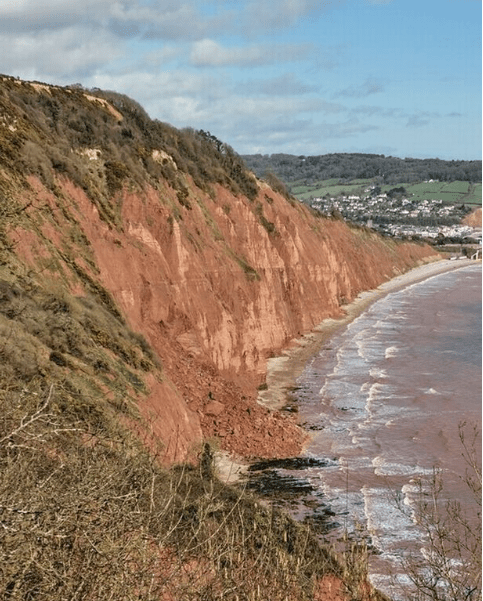
Rocks the size of cars collapse in huge Sidmouth cliff fall

A famous East Devon cliff has collapsed – again. Another huge cliff fall took place in Sidmouth today with visitors and local residents describing rocks the size of cars coming down onto the beach below.

Olivier Vergnault www.devonlive.com

Exmouth coastal scientist Vicky Walkley was sitting on a bench enjoying the view of the coast when she heard a loud rumbling noise. She looked at the famous red cliff below and saw it collapse onto the beach. She said the cliff fall happened today (Sunday March 17) at around 2pm.

The latest collapse has happened at the Jacob’s Ladder end of the beach. The incident was caught on video, which can be viewed at the top of the article.

Vicky said: “The rocks and debris entirely covered the full width of the beach in seconds, which really highlights how dangerous it is to walk next to unstable cliffs like these.

“Even after the main cliff fall had stopped, debris kept on falling. About 10 minutes after the dust settled, a huge rock the size of a car then came crashing down the cliff and rolled along the beach. Luckily there was no one on this part of the beach at the time but if there had been, it could have been tragic.”

The latest cliff fall in Sidmouth (Image: Vicky Walkley)

As a coastal expert with more than a decade’s experience Vicky is familiar with what can trigger cliff falls – even though such incidents remain very difficult to predict.

She explained: “As a coastal scientist for 11 years, I have been working on projects to help the government and local councils assess and predict coastal erosion. Cliff falls are very difficult to predict, they can happen at any time – not just in stormy weather with big waves, but also on calm sunny days like today.”

She added: “All the heavy rainfall we’ve had this winter acts to lubricate the joints in the rock and increase the likelihood of cliff falls. Warm sunshine can also heat the rock, causing it to expand – this can trigger cliff falls too.

“The effects of climate change, including rising sea levels and wetter winters, are likely to accelerate the rates of cliff erosion in future, so it’s important that everyone is aware of these risks when visiting the coast.”

Sidmouth’s cliffs are notorious for crumbling with cliff falls previously taking place at both East Beach and Jacob’s Ladder. In September at the East Beach end of the town, footage captured a “waterfall of earth” coming tumbling down. In October there was another incident at the other end past Jacob’s Ladder.

Trees legal battle in the High Court next week

The outcome will be known in three to six weeks

A judicial review to decide whether Plymouth City Council acted legally when it chopped down more than 100 trees on Armada Way in a late-night operation last March will be heard in the High Court in London next [this] week.

Alison Stephenson, local democracy reporter www.radioexe.co.uk

The case, set for Tuesday and Wednesday, has been brought by protester group Save the Trees of Armada Way (Straw).

It will argue that the council, at the time under Conservative control, used an emergency order to fell the trees as part of a redevelopment plan without full scrutiny.

It will also claim the authority failed to get proper advice to carry out an environmental impact assessment, did not take account of nesting birds and that a report on the consultation was biased.

The hearing was delayed after the now Labour run council tried and failed twice to get the case thrown out. It said the original decision is now “academic” as  there are new plans for Armada Way. The court, though, said the applications were “misconceived”.

Costs to the taxpayer so far from the clean-up operation after the trees were remove, together with subsequent legal costs, are understood to be close to £300,000.

London-based Goodenough Ring Solicitors, acting on behalf of STRAW, are holding more than £28,000 pledged by the public to fight the case through a Crowdjustice campaign.

The firm said that the results of the judicial review would not be known for three-to-six weeks.

It said a further legal action by its client is being considered, alleging a consultation on new plans for Armada Way last October and November failed to provide enough details on the cost.

It was revealed in January that scheme is now likely to cost £37 million, compared with original redevelopment plans of around £13 million.

A spokesperson for Goodenough Ring said a letter before that stage of legal action began had been sent to the council, but a decision had not been taken yet on whether to proceed as it depends on the outcome of next week’s hearing.

In a statement, Straw said: “It’s disappointing that not only are Plymouth City Council still defending what they did last March, but that this hearing did not happen months ago, as it should have.

“Plymouth City Council have been wasting time and taxpayers money, kicking the can down the road, but we are pleased that the hearing is finally happening. I think the people of Plymouth deserve to know if their council has acted unlawfully or not.

“Obviously we hope to win and we hope that this action will send a strong message to all councils that the unnecessary destruction of our trees and green spaces is simply not on.”

A spokesperson for Plymouth City Council said: “The judicial review is based on a decision made by the previous council administration. Following the election last May, the new council leader withdrew that decision when he first took office. Therefore, the original decision, which is subject to the judicial review, was not implemented any further.

 “While we remain hopeful that the judge will agree, it is important to remember that the legal hearing does not impact the current plans to regenerate Armada Way.

“Our city deserves to have a better city centre – a city centre that rivals others across the country and one where people want to live, work, visit, shop and do business in.”

The plan includes more than 200 trees, which is more than previously on Armada Way.

‘Do not swim’ warnings in place at 28 beaches hit with sewage – Saturday

A recently updated sewage map by Surfers Against Sewage (SAS) has revealed that nearly 30 beaches across the South West currently have pollution or sewage warnings in place. Beauty spots such as Exmouth, Sidmouth and Budleigh Salterton as well as Portreath, and Ilfracombe are just a few of the areas where warnings are in place as swimmers are urged to avoid entering the water.

Carl Eve  16/03/2024 www.devonlive.com

The majority of the incidents have been laid at the door of “storm sewage” which has plagued beaches across the South West in recent weeks due to heavy downpours.

The main contributing factor to polluted beaches is urban runoff, which sees fertilizers, pesticides, oil, and untreated human and animal waste entering waterways, such as rivers. They then eventually end up at our beaches.

Swallowing water that could be contaminated with faecal matter could lead to gastroenteritis, hepatitis, giardiasis, skin rashes, amoebic dysentery, nose, ear, and throat problems, pink eye, and other respiratory illnesses. Symptoms to look out for include nausea, vomiting, diarrhoea, cramps, inflamed stomach and intestines.

Beaches currently marked as pollution risks

Sidmouth Town

Pollution Alert: Storm sewage has been discharged from a sewer overflow in this location within the past 48 hours. Rock pools to the west, overhanging cliffs to the east, Sidmouth Town beach compromises 900m of legally protected pebbles broken up by rock groynes and backed by a promenade and the town. Two sewer overflows are located at Sidmouth, one discharges through a long sea outfall some 600m out to sea while the other discharges into the River Sid, just under 400m to the east.

Budleigh Salterton
Pollution Alert: Storm sewage has been discharged from a sewer overflow in this location within the past 48 hours.
Part of the Ancient World Heritage Coastline, Budleigh Salterton is a 2km stretch of resort beach with red cliffs at the western end and the River Otter Estuary at the eastern end backed by a promenade and town. There are three sewer overflows in the area, one discharges directly onto the beach, another 400m east and another that discharges 1.3km away into the sea.

Dawlish Town
Pollution Alert: Storm sewage has been discharged from a sewer overflow in this location within the past 48 hours.
Dawlish Town is on the south coast of Devon. It is a sandy beach resort approximately 650m wide and close to the town and cliffs. There are five sewer overflows covered by the Safer Seas Service here within 650m off the beach which can operate in heavy rainfall.

Teignmouth Holcombe
Pollution Alert: Storm sewage has been discharged from a sewer overflow in this location within the past 48 hours.
A small sand and rock beach located at the base of tall red cliffs, Holcombe is an isolated beach backed by cliffs and a railway line. A sewer overflow discharges into the Holcombe Stream 40m upstream of the beach.

Meadfoot
Pollution Alert: Storm sewage has been discharged from a sewer overflow in this location within the past 48 hours.

Slapton Sands Torcross
Pollution Alert: Storm sewage has been discharged from a sewer overflow in this location within the past 48 hours.
Slapton Sands Torcross is on the south coast of Devon. It is a remote shingle beach, approximately one kilometre wide, backed by Slapton Ley Nature Reserve.

Mill Bay
Pollution Alert: Storm sewage has been discharged from a sewer overflow in this location within the past 48 hours.
Mill Bay Beach is a privately owned beach on the East Portlemouth side of the Salcombe Estuary. The beach can be reached by the local ferry or by car. It is a sheltered beach and is popular with families.

Hope Cove
Pollution Alert: Storm sewage has been discharged from a sewer overflow in this location within the past 48 hours.
Hope Cove is on the South coast of Devon. It is a remote sand and rock beach, approximately 370 metres wide, surrounded by cliffs. There are two sewer overflows which discharge into the sea here which can lead to a temporary drop in bathing water quality especially after heavy rainfall.

Mothecombe
Pollution Alert: Storm sewage has been discharged from a sewer overflow in this location within the past 48 hours.
A traditional family beach, Mothecombe is a remote, sandy beach backed by cliffs and sand dunes. The beach is split into 2 parts with one being private with limited access and the other being free. There are no sewer overflows directly on the beach at Mothecombe however a number of urban areas (Ermington, Ivybridge etc.) can discharge into the River Erme whose estuary Mothecombe is located in.

Plymouth Hoe East
Pollution Alert: Storm sewage has been discharged from a sewer overflow in this location within the past 48 hours.
A small shingle and rock city beach, Plymouth Hoe East is a narrow strip below a promenade and Plymouth Hoe. There is a sewer overflow that discharges SW of the beach and a number more in the surrounding area that support the city of Plymouth. .

Kingsand
Pollution Alert: Storm sewage has been discharged from a sewer overflow in this location within the past 48 hours.
Kingsand is on the south coast of Cornwall. It is a sand and shingle beach resort, approximately 200 metres wide, close to the village of Kingsand. The Environment Agency carried out additional monitoring in the Kingsand Stream between 2010 – 2015, and made recommendations for further improvements to protect and improve the bathing water quality.

Seaton (Cornwall)
Pollution Alert: Storm sewage has been discharged from a sewer overflow in this location within the past 48 hours.
A mixture of grey pebbles and coarse sand forms this remote beach surrounded by gently sloping cliffs. It is located at the entrance to the Seaton Valley Country Park and is one of the few beaches in the area to offer great surfing conditions. There are a few sewage overflows from local sewage treatment works discharging upstream into the River Seaton which meanders across the beach.

Millendreath
Pollution Alert: Storm sewage has been discharged from a sewer overflow in this location within the past 48 hours.
Millendreath is a small, sandy beach backed by cliffs and hills with a stream flowing across it. A sewer overflow from the Plaidy pumping station discharges off the rocks to the West of the beach and another from the urban area can discharge through the stream.

East Looe
Pollution Alert: Storm sewage has been discharged from a sewer overflow in this location within the past 48 hours.
A small sand and rock beach resort located at the mouth of the River Looe, East Looe is close to the town of Looe and so gets very busy. No sewer overflows discharge directly onto the beach here, however several discharge into the River Looe Estuary and catchment upstream.

Readymoney Cove
Pollution Alert: Storm sewage has been discharged from a sewer overflow in this location within the past 48 hours.
Readymoney is a small, sandy, remote beach located at the mouth of the River Fowey. It is in a cove sheltered by tall cliffs between St Catherines Castle and the medieval part of Fowey. A sewer overflow discharges 100m from Readymoney beach and others discharge into the Fowey Estuary.

Pentewan
Pollution Alert: Storm sewage has been discharged from a sewer overflow in this location within the past 48 hours.
Pentewan, located on the south coast of Cornwall, is a privately owned sandy beach resort, approximately 1.1km wide. There is an emergency sewer overflow from the Pentewan pumping station that discharges to the St Austell River 250m from the beach. Within the Pentewan bathing water catchment there are four emergency sewer overflows that discharge into the St Austell River at least one and a half kilometres upstream of the bathing water.

Porthluney
Bathing not advised due to poor annual classification.
A sheltered and sandy beach popular with swimmers, it is backed by the grounds of Caerhays Castle. There is a ban on motorised watercraft here to maintain the peace and quiet.

Swanpool
Pollution Alert: Storm sewage has been discharged from a sewer overflow in this location within the past 48 hours.
Swanpool is a pebble and sandy beach resort approximately 140m wide and backed by the Swanpool Nature Reserve. There is an emergency sewer overflow from the Queen Mary Gardens pumping station that discharges to the sea approximately 420m east of the bathing water.

Perranuthnoe
Pollution Alert: Storm sewage has been discharged from a sewer overflow in this location within the past 48 hours.
A small, rural, sandy beach with some rock and shingle areas. Cliffs and a quaint village back the beach. There are no sewer overflows discharging directly at Perranuthnoe, however, there are a number in the nearby Mounts Bay that may affect bathing water quality here. We receive sewage discharge alerts here from the Perranuthnoe pumping station overflow.

Long Rock
Pollution Alert: Storm sewage has been discharged from a sewer overflow in this location within the past 48 hours.
The second of four beaches enclosed in Mounts Bay, Long Rock beach is a one kilometre stretch of sand backed by sea defences. Within the catchment area of Heliport beach there is a sewer overflow that discharges into the Ponsdale Brook, 130m upstream of the beach, three that discharge into Trevaylor Stream and four more sewer overflows that discharge into the sea east and west of the beach.

Portreath
Pollution Alert: Storm sewage has been discharged from a sewer overflow in this location within the past 48 hours.
Portreath is large beach with soft fine sand, with shingle below the shoreline and is popular with families. The harbour wall is popular with experienced surfers for its vortex surf break. On the left-hand side, the beach has a small stream running down to the sea. A few hundred metres off the coast is the huge Gull Rock, which as the name suggests is something of a haven for seabirds of all kinds. Portreath is a popular family beach which, like many beaches on the north Cornish coast, is attracts surfers and in particular bodyboarders. The beach backs onto the small town offering most facilities including several shops, toilets and cafes. The sewage from Redruth is pumped to a sewage treatment works (STW) at Kieve Mill to the northwest of Camborne. The treated sewage is then discharged to the sea at North Cliffs approximately three and a half kilometres to the southwest of Portreath.

Instow
Bathing not advised due to Poor annual classification.
Instow has been classified as Poor for five consecutive years, meaning it has been de-designated and permanent advice against bathing is in place. Instow is a pretty and sandy beach that tends to get very busy during the summer. Calm waters, protected from swell by sandbanks at the mouth of the Taw estuary, make this a good choice for families. There are also shops and cafes in the village, which is directly behind the beach.

Ilfracombe Hele
Pollution Alert: Storm sewage has been discharged from a sewer overflow in this location within the past 48 hours.
Hele beach is a small, sand and shingle cove just to the east of Ilfracombe. It is located in an Area of Outstanding Natural Beauty and is sheltered from the prevailing winds. A sewer overflow discharges to the sea some 280m to the east of the beach. Other overflows from Ilfracombe urban area may also affect water quality here.

Dunster North West
Bathing not advised due to Poor annual classification.
A large pebble and sand resort beach backed by Chalets, Dunster North West faces into the Bristol Channel and is just east of the popular seaside resort of Minehead.

Burnham Jetty North
Bathing not advised due to Poor annual classification.
Just to the north of the rivers Brue and Parnett estuaries, Burnham Jetty North is a large, sand and mud, gently sloping beach resort backed by sea defences with a large tidal range. Although there are no sewer overflows discharging directly onto the beach, there are several within the catchment area that discharge into the rivers. More overflows from the surrounding urban area may also affect bathing water quality here.

Weston-super-Mare Uphill Slipway
Bathing not advised due to Poor annual classification.
Uphill Slipway is a sandy beach resort next to the mouth of the River Axe. It has a large tidal range and areas of mud are exposed at low tide. It is just south of the popular seaside resort of Weston-super-Mare. A sewer overflow discharges into the sea at the southern end of the beach while sewer overflows from the surrounding urban area discharging into the River Axe and may affect water quality especially after heavy rainfall.

Weston Main
Bathing not advised due to Poor annual classification.
Located close to the popular seaside town of Weston-super-Mare, Main beach is a large stretch of sand with a pier. Two sewer overflows discharge directly into the sea here – one at the northern extent of the beach and one 2km to the south. The bathing water quality may also be affected by discharges from the surrounding urban catchment area.

Weston-super-Mare Sand Bay
Bathing not advised due to Poor annual classification.
A sand and shingle beach resort, approximately 5km wide and backed by sand dunes. There is a saltmarsh at the northern end, and Sand Point Headland is a Site of Special Scientific Interest (SSSI). The outfall from Weston-super-Mare STW discharges to the sea at Black Rock 5km south of Sand Bay.

‘Negative budgets’: cost of living crisis could lose the Tories dozens of seats

Rishi Sunak has been warned that scores of his most vulnerable seats risk being lost over an increasingly neglected cost of living crisis raging in marginal constituencies across the UK.

Michael Savage www.theguardian.com 

The seats held by Iain Duncan Smith and justice secretary Alex Chalk are among 85 Tory constituencies with a critical number of voters whose monthly outgoings are now higher than their income.

The new research comes amid concerns that falling inflation has led to the cost of living crisis dropping down the political agenda, despite households being left with energy bills far higher than they were three years ago and a widening group of people struggling to make ends meet.

The issue of “negative budgets” – where a family’s outgoings are no longer covered by their income – has become a key concern of Citizens Advice, which has been carrying out detailed research on the phenomenon.

While the problem is affecting a wider group of people, the group says there are now more far-reaching political implications for both main parties should they fail to consider radical action.

Its constituency-level research identified 85 seats won by the Tories in 2019 where the MP’s majority is smaller than the number of people with a negative budget.

It is also true of the 100 most marginal seats across Britain overall. It mirrors the regular Opinium polls for the Observer, which continue to suggest that the NHS and the cost of living are by far the most important issues heading into the election later this year.

Citizens Advice said that about 5 million people were affected by negative budgets, while a further 2 million were staying out of the red by cutting their essential spending on things such as meals, energy, and seeing friends and family, to unsafe levels.

The Conservatives have said that they are tackling the cost of living crisis by making two cuts to national insurance, a move they say saves the average worker more than £900 a year from April. However, higher earners save more than those on low incomes.

While Labour has focused many of its attacks on the cost of living, it has been criticised for not producing specific policies to tackle it in the short term, beyond vowing to handle the economy better than the Tories and pursuing economic growth.

Clare Moriarty, a former senior government official who now leads Citizens Advice, warned that falling inflation did not stop the cost of living being the critical factor for voters this year.

“For most of our history, Citizens Advice has seen people in moments of crisis,” she said. “But now, more and more people are stuck in a quicksand of hardship. What would’ve been a shocking level of living standards just a few years ago has sadly become the everyday reality for many in our society.

“Our advice can be life-changing, but our advisers can’t tackle the scale of this challenge alone. Falling inflation doesn’t mean this problem is over. For example, energy bills are still 48% higher than they were three years ago.

“Voters up and down the country want to hear what the next government will do to tackle plummeting living standards. But so far, politicians haven’t done enough to give them hope that any party has a plan to really turn the tide on the issue.”

 Lord Swire co-chairs trade organisation that “opened doors” for Frank Hester

A trade organisation that Lord Marland chairs with another Tory grandee, Lord Swire, opened doors for Hester’s healthtech company, The Phoenix Partnership (TPP), to expand internationally.

goodlawproject.org 

Tory Peer, Lord Marland, who claimed Frank Hester ‘is not a racist’ because he does business abroad, heads a trade organisation which lists The Phoenix Partnership as a ‘strategic partner’ and a ‘platinum’ sponsor for its summits.

Lord Marland was one of the first to jump to Frank Hester’s defence in the immediate fallout of the Guardian’s shocking revelations about his racist comments. On Wednesday, the Tory peer claimed in an LBC interview that his Party’s largest ever donor, “is not a racist” because “he does a lot of business in Jamaica, he does business in Malaysia, in Bangladesh and places like that”.

It’s an unconvincing line of argument to say the least. You might wonder why he’s even running it. And it now turns out that a trade organisation that Lord Marland chairs with another Tory grandee, Lord Swire, opened doors for Hester’s healthtech company, The Phoenix Partnership (TPP), to expand internationally.

The non-profit Commonwealth Enterprise and Investment Council (CWEIC), lists TPP as a strategic partner and platinum sponsor of its annual trade summits.

And along with sponsorship funding, Frank Hester has given it glowing testimony: “We have grown our business across Asia, Africa and the Americas, through CWEIC’s flagship events and with the full support of their exceptionally capable team.”

According to a CWEIC brochure, the benefits of becoming a strategic partner include “the opportunity to influence Government policy and decisions as a collective voice by engaging directly with senior government leaders and policy makers”.  

The CWEIC has also taken on as a strategic partner Life Partners, a firm run by Zoe Ley, who made obscene profits from brokering a huge PPE deal through the Government’s unlawful VIP Lane.

“In Toryland, nothing ever happens without a reason”, said Jo Maugham, Executive Director of Good Law Project. “Everyone is buttering everyone else’s bread. And, with the proceeds of his vastly lucrative DHSC contracts, Frank Hester is operating a very large dairy”.

But not everyone who has been involved with the CWEIC has been as keen as Lord Marland to defend Hester. Another big Tory donor, Mohamed Amersi, was on the board of the organisation up until the new year. On Thursday, Amersi took to LBC to brand the way the Conservative Party has handled the Hester scandal as “an absolute disgrace” and warn Rishi Sunak that he is “holding the cheque book back” ahead of the next election.

We approached The Phoenix Partnership, Lord Marland and the Commonwealth Enterprise and  Investment Group for comment.

Lord Marland said: “The Commonwealth Enterprise and Investment Council (CWEIC) is a not for profit organisation with an official mandate from Commonwealth Heads of Government to promote trade and investment throughout the 56 member countries. CWEIC is a networking organisation and has no interest in and does not promote transactions.

“Many governments and businesses have sponsored CWEIC events for which we are very grateful”.

Back in September 2023, we were the first to raise the alarm about the money flowing back and forth between Frank Hester and the Government – exposing the £137m worth of hidden contracts his company received through the Department of Health and Social Care. And since then, we have shone a light on the close relationship he has with the Prime Minister – from helicopter rides to cosy conversations about AI.

And with reports emerging that the Conservative Party is sitting on another £5m donation from Hester, we’re continuing our investigations into the level of his influence over the most senior Government figures.

‘Glimmer of hope’ for local news as Surrey publication given charitable status

A local news website conceived over a pint and named after a mythical creature has become the first in the UK to be given charitable status, providing a “glimmer of hope” to the future of local journalism.

Alexandra Topping www.theguardian.com 

The Guildford Dragon News has become the UK’s first charitable public interest news provider after a six-month application process that experts hope will provide a lifeline to the decimated local news industry.

“It would be fantastic if we’re successful and this leads the way for other similar news publications to also become sustainable,” said the Dragon’s editor, Martin Giles, who has worked – unpaid – seven days a week for the title for more than a decade.

The move could mark a step-change in an industry that has veered from crisis to life support. Figures published last month by Press Gazette show that in the 15 years leading up to 2022, revenue at the main regional publishers plummeted by more than 80%, when adjusted for inflation.

The number of local journalists scrutinising councils, interviewing MPs and keeping track of local developments fell from 13,000 to 4,000, which MPs and experts have said is having a devastating effect on the scrutiny of local democracy.

“The local newspaper as it existed in the 1950s has been dying for years, but it’s comprehensively dead now. There’s a very real crisis and that is a very real problem for democracy,” said Jonathan Heawood, the executive director of the Public Interest News Foundation, a charity that funnels donations into public interest journalism.

While more than 4 million people in the UK live in “news deserts” without adequate local journalism, the awarding of charitable status to the Dragon provided a “glimmer of hope”, he said.

Tom Murdoch from the law experts Stone King, which advises the Charitable Journalism Project (CJP) campaign, said the publication could now benefit from a range of traditional tax breaks, and attract donors who can also get tax relief on money handed over to support public interest journalism. “This decision accepts a public interest news definition that is charitable,” he said. “That is huge progress, it’s a doorway to sustainability.”

Government reaction to the struggles of local news has been muted. It rejected proposals, made in the 2019 Cairncross review, to extend charitable status to many struggling local news outlets, arguing they would be banned from supporting political parties, stopped from being for-profit, and that much journalism does not work “only for the public benefit”. They also dismissed calls for an arms-length, state-funded organisation supporting public service, on the basis it would damage press freedom.

Despite this, a new wave of local and hyper-local websites are rising up from the rubble of local news. The Bristol Cable is member-funded, while in Glasgow, two nonprofit outlets – Greater Govanhill and the Ferret – have come together to open the UK’s first community newsroom. Social Spider Community News, which has six London-based publications, is a social enterprise that is now breaking even.

“We are trying to find a way to save local journalism while keeping it free to access, as we consider it to be a public service,” said Social Spider’s editor, James Cracknell, who has spent his career in local news including a stint at Reach, which recently cut about 10% of its workforce.

Others are going down a commercial route. Reader-funded local news outlet Mill Media is expanding after being valued at £1.75m by a group of investors including the former New York Times boss Mark Thompson.

The Guildford Dragon News – which was conceived over a moan about the state of local news coverage by Giles and a former chief sub of the Surrey Advertiser in the local pub – has more modest short-term ambitions. It has already had a significant local impact – after one story about events at a local parish council all but one councillor stood down.

Giles hopes to raise £70,000 to pay for one and a half members of staff, so Guildford’s council meetings and coffee shop openings can be covered more comprehensively.

He explained that the name of the publication came from a legend of a dragon who had protected a local prehistoric site. “That’s why I’m so keen on sustainability because I’m not going to be around for ever. In the future I want the news to still be available to people in this community,” said Giles. “We like to think we also have a protective role over the area.”

Simon Jupp come clean about trains to Paddington facing a decade of disruption

Is Simon Jupp, Private Parliamentary Secretary to the Secretary of State for Transport, Mark Harper, privy to a file marked “sensitive do not disclose before election”? 

Plymouth Sutton and Devonport MP Luke Pollard has claimed the government’s plan to build the station at Old Oak Common for High Speed 2 services would result in disruption and longer journeys for passengers travelling from the South West to the capital on the Great Western line, including weekend closures.

Should mitigation involve an upgrade to the Waterloo line?

Fears new HS2 station will cause massive trains delays to South West

Carl Eve www.plymouthherald.co.uk 

Rail passengers in the South West could face a “decade of disruption” because of the Government’s ‘hidden’ plans to build a new High Speed 2 rail station alongside the Great Western mainline in west London, a Plymouth MP has claimed.

In a letter to the Secretary of State for Transport Mark Harper MP, Plymouth Sutton and Devonport MP Luke Pollard has claimed the government’s plan to build the station at Old Oak Common for High Speed 2 services would result in disruption and longer journeys for passengers travelling from the South West to the capital on the Great Western line.

Mr Pollard also warned that the construction of Old Oak Common would inevitably involve a large number of weekend closures of the line between Reading and London Paddington which would “significantly damage the rail service” to the South West and Wales – and asked if the Government had not made the potential damage known publicly ahead of a General Election.

The Minister’s office has not denied the new station was to be built but has insisted construction work would be “taking place many years in the future.” They added that there would be efforts to minimise disruption, and cited side-benefits to the South West such as the reopening of the Tavistock to Bere Alston railway using the scrapped HS2 funds.

However in his letter to Mark Harper MP, Secretary of State for Transport, Mr Pollard claimed the potentially considerable disruption appeared to have not been fully communicated with the travelling public in the South West of England and Wales, the areas which will be affected.

He said he had continually argued since being elected that journeys between Plymouth, the far South West and London needed to be shorter, as it would provide a real benefit to the region in terms of productivity and the regional economy. Noting that the HS2 service itself would offer “little benefit” to the South West and Wales, he added that the new station would in fact cause “significant disruption” instead.

He revealed in his letter that he had met with Network Rail and Great Western Railway about the mainline and was left concerned that the combination of projects will not only offer little benefit to the South West and Wales, but would add “considerable extra time to our journeys and cause significant economic disruption”.

His detailed letter raises five key areas of concern, the first being that GWR trains to and from London Paddington could be forced to stop at Old Oak Common, adding unnecessary minutes to every journey, which he claimed had “zero appetite” in the South West.

Secondly he highlighted the “build timetable” could involve a “large number of weekend closures” of the line between Reading and London Paddington. He questioned what was the currently predicted number of weekends which could be affected and how long this could go on for, saying that it could “severely damage the transport” links to the South West and effectively “risk creating the impression that the South West is closed for business”, hitting the region’s tourism industry as well as the regular commuters and business travellers.

The third area of concern Mr Pollard asked the transport minister to address was the weekend closures would “add significant extra journey time should trains be able to run to London Euston or London Waterloo”. He asked how may trains services would be able to run to those stations during the track closures.

He revealed that he had “heard estimates of 30 minutes extra to London Euston and 45 minutes extra to London Waterloo” and asked if these estimates were accurate.

His fourth concern was the potential changes to the funding of Network Rail’s renewals work “could mean speed restrictions” on the GWR mainline “that will further slow rail journeys”.

His fifth concern that the combination of delays caused by the construction of Old Oak Common mainline station and the delays to journeys once it finally opens would “significantly increase journey times from the South West and Wales to London”.

The sixth and final concern he raised was that the Department for Transport had “not communicated the aggregate effect of these changes” – effectively they had not publicly announced the considerably longer rail journeys and considerable delays to stakeholders in Wales and the South West” adding ominously that “there is little public understanding of the decade of disruption these plans will cause”.

Concluding his letter to the minister, Mr Pollard said he believed the department was about to approve changes that would “significantly damage the rail service between London Paddington and the South West and Wales – and no-one knows about them.”

He asked Mr Harper: “Is this a deliberate policy? Have you decided not to reveal details ahead of a General Election?”

Luke Pollard MP, Member of Parliament for Plymouth Sutton and Devonport, told PlymouthLive: “Ministers appear to be hiding plans that will deliver a decade of disruption on the railway from voters in the south west.

“Without proper mitigation, the government’s plans to build a new station at Old Oak Common in West London will result in a decade of disruption for passengers in the south west.

“It is clear to me that they are seeking to hide this disruption until after a General Election. We need Ministers to come clean about their plan now and what mitigations they are planning.”

A DfT spokesperson said: “The disruption referred to in this letter relates to construction work taking place many years in the future. While Network Rail and train operating companies are responsible for communicating with passengers and ensuring there are alternative travel options during works, we are always open and honest about the disruption caused during construction of infrastructure projects and what mitigations are in place to address this.

“As well as the new interchange at Old Oak Common referred to in this letter, thanks to reallocated HS2 funding we will see more investment into local transport improvements such as the reopening the rail line between Plymouth and Tavistock and reintroducing passenger services to Wellington and Cullompton.”

The DfT suggested that each point raised in Mr Pollard’s yet would be responded to in more detail, and explained how the disruption issues raised related to construction work which would be taking place many years in the future. The department maintained that it was not standard to publicise closures and mitigations this far in advance as it is not fully known what the situation will be at the time.

They added that Old Oak Common would provide “enhanced connectivity” for services from the West of England, Cornwall and South Wales to the North by creating an interchange between HS2 and Great Western Services, while connections to central, East and Southeast London would be realised through Elizabeth Line services calling at the station.

They added that the department was working with Network Rail, HS2 Ltd, and train operating companies to minimise the impacts of disruption. The reallocated HS2 funding would be invested in local transport improvements including reopening stations and reintroducing rail passenger services to Wellington and Cullompton, reinstating five miles of track and a new station at Tavistock to connect it with Plymouth. The department said the Levelling Up Fund would also deliver a new station on the Okehampton Line and would ‘transform’ rail services in mid Cornwall with a £50m contribution to the Mid Cornwall Metro scheme.

Edited photos could mean local Tories can no  longer be viewed as a trusted source

Adopting AFP standards they could be ”compared to North Korea”.

Kensington Palace has been compared to North Korea by a news agency executive, who said the Prince of Wales’s household was no longer viewed as a trusted source.Phil Chetwynd, the global news director of Agence France-Presse (AFP), said the photograph of the Princess of Wales and her three children – released to mark Mother’s Day and later revealed to have been edited – had “clearly” violated the agency’s rules. (Source www.telegraph.co.uk)

Last July we had the “Stitch – up” where numbers attending David Reed’s selection were “inflated”. A little bit of double counting going on?

Then in February a sharp eyed correspondent Spotted, Simon Jupp, MP for everywhere and nowhere, engaging with either his Mum or “Ann from the Office”. In “The Camera never lies”.

UK government overturns plans to phase out badger cull

The government has U-turned on its plans to phase out the badger cull, with proposals to exterminate the vast majority of some local populations across much of south-west and central England.

Will they go for our Beavers next?

“For what it’s worth, I think there are more important things than beavers,” They are not essential. Thérèse Coffey.

“There is no sense in reintroducing beavers into small chalk streams, or any other form of stream in Dorset…..As I understand it, they had to be culled in Scotland, because they broke out of the area given to them.Richard Drax MP Conservative, South Dorset – Owl

Helena Horton www.theguardian.com 

Ministers plan to introduce controversial targeted culling, also known as “epidemiological culling” or “epi-culling”, whereby populations of badgers can be reduced to almost zero in some areas where cattle are deemed to be at high risk of contracting bovine TB (bTB).

Tom Langton, an ecological consultant and badger expert, said: “Sunak now wants all the badgers dead.” He said the consultation launched by the government on Thursday included “chilling plans to kill 100% of badgers in bovine TB affected areas, an increase on the limit previously imposed since culling started in 2013”.

The cull, which has failed to get support of eminent scientists over more than a decade and has caused some badger populations to go locally extinct, was initially going to be phased out under plans announced by the then environment secretary, George Eustice, in 2021. After campaigning from farming unions, the government has announced it will continue to issue licences to shoot badgers.

Langton criticised the proposed introduction of epi-culling, saying it “is based on a single ‘model’ trial in Cumbria where over 1,100 badgers were shot dead between 2018 and 2022, but where a published report states no demonstrable benefit was achieved in terms of reduced TB breakdowns in cattle herds. It is also based on incompetent misunderstandings by government scientists of their own findings and the misbriefing of their minister.”

It is believed ministers wish to create a point of difference with the Labour party, which has said it would stop the cull, in an attempt to retain seats in rural areas. Recent polling by the Country Land and Business Association shows the majority of Conservative MPs in the most rural areas are at risk of losing their seats to Labour and the Liberal Democrats in the upcoming general election.

Langton said: “This looks like a last-chance grab at getting widespread culling back in place so it is difficult for Labour to scrap it.”

Ministers say that they do plan to end culling eventually, but have not given an end date. They said problem areas included “much of south-west and central England, where there are high levels of infection in cattle and where evidence suggests badgers are part of the problem in the spread of disease to these herds” and that culling will continue in these targeted areas until the disease situation has been deemed to have improved, after an annual review by the UK’s chief veterinary officer. When this happens, culling will stop and badgers will be vaccinated to end the disease.

The government cites peer-reviewed evidence from the first 52 areas where badger culling was conducted, which shows a reduction in rates of bTB breakdowns in cattle by 56% on average after four years of culling. But independent scientists have challenged this analysis, highlighting the presence of so many different variables and the absence of any scientific control.

Peter Hambly, executive director of the Badger Trust, said: “The UK government needs to protect our native wildlife while focusing on dealing with the scourge of bTB where it matters: within the cattle herd. This approach is best for cattle, farmers, taxpayers, wildlife and the wider community.

“We urge individuals, communities, and stakeholders to work together to tackle this disease, which importantly can only be done by demanding its accurate management. The UK government appears only to listen to stakeholders with vested interests and is fixated on a badger-focused policy that affects all of us and our right to nature. We must speak up to protect it.”

Steve Barclay, the environment secretary, said: “Bovine TB has taken a terrible toll on farmers, leading to the loss of highly prized animals and, in the worst cases, valued herds.

“There are no easy answers in the battle against TB, but badger culling has proved highly effective and needs to remain a key part of our approach. Our strategy has led to a significant reduction in this insidious disease, which we will continue to cull in areas where the evidence confirms it is required, as well as making use of vaccinations.”

On comments about Sunak’s attitude to badgers, a government spokesperson said the aim of the new policy was not to remove all badgers, but to lower the badger population to reduce infection, and that full extinction would not happen.

No compelling examples of what levelling up has delivered, watchdog finds

  • Just over 10% of promised funds actually spent and making a difference on the ground
  • PAC warns of lack of transparency and waste of public resources in funding approach

From the detail:

The Public Accounts Committee (PAC) found that 71 projects granted funding in the first round of bids had been due to spend the money by the end of this month, but that at least 60 had been delayed into the next financial year.

MPs also criticised Gove’s department for changing the rules for applying for levelling up funds part-way through the bidding process, meaning councils wasted scarce public funds.

They found that 55 councils had spent an average of £30,000 bidding for funds that they could not win because of government rule changes – squandering roughly £1.6m.

PAC Press Release:

committees.parliament.uk 

The Government is unable to provide any compelling examples of what Levelling Up funding has delivered so far. In a report published today, the Public Accounts Committee (PAC) warns that councils have been able to spend just a fraction of the Government’s promised Levelling Up funding, with only just over 10% of the funds provided to reduce inequality under the Levelling Up agenda actually spent and making a difference on the ground.

The PAC’s report finds that, of £10.47bn in total funding from central government, which must be spent between 2020-21 and 2025-26, local authorities have been able to spend only £1.24bn from the Government’s three funds as of Sept 2023. Furthermore, only £3.7bn had been given to local authorities out of the total allocation by the Department for Levelling Up, Housing and Communities (DLUHC) by December 2023.

In evidence to the PAC, DLUHC cited project-specific issues and the impact of the pandemic and inflation for a lower-than-anticipated level of spending to date. The PAC is calling for six-monthly updates from DLUHC, both on the amount of money released to and spent by councils, and on the progress of projects themselves.

The report finds that more impactful bids to funding lost out due to optimism bias in favour of so-called ‘shovel-ready’ projects. Yet, the report raises concerns that not enough was done by DLUHC to understand the readiness of schemes and the challenges facing local authorities before funds were awarded. This also means that DLUHC has had to extend the deadline for successful bidders for earlier funds to spend their money. Round 1 of Levelling Up Funding was awarded to ‘shovel-ready’ projects that were supposed to be completed and delivering for local people by March 2024 – but 60 out of 71 of these projects have had to extend to 2024-25, with further delays in other schemes likely.

The PAC’s inquiry also found a worrying lack of transparency in DLUHC’s approach to awarding funds, with rules for accessing funding changing while bids were still being assessed, which was also not communicated in advance to councils. 55 local authorities therefore bid under changed rules with no chance of being successful in Round 2, with an average bid for grants like Levelling Up costing around £30k. This approach wasted scarce public resources, and the report calls on DLUHC to set out the principles it will apply and the decision-making process for awarding future Levelling Up funds.

Chair’s comment

Dame Meg Hillier MP, Chair of the Committee, said:

“The levels of delay that our report finds in one of Government’s flagship policy platforms is absolutely astonishing. The vast majority of Levelling Up projects that were successful in early rounds of funding are now being delivered late, with further delays likely baked in. DLUHC appears to have been blinded by optimism in funding projects that were clearly anything but ‘shovel-ready’, at the expense of projects that could have made a real difference. We are further concerned, and surprised given the generational ambition of this agenda, that there appears to be no plan to evaluate success in the long-term.

Our Committee is here to scrutinise value for money in the delivery of Government policy. But in the case of Levelling Up, our report finds that the Government is struggling to even get the money out of the door to begin with. Government has not helped the situation by changing the rules for funding mid-process, wasting time and money and hindering transparency. We will now be seeking to keep a close eye on DLUHC’s progress in unclogging the funding system. Citizens deserve to begin to see the results of delivery on the ground.”