Community hospital supporters with long memories will recall that in 2017, Devon Health Scrutiny Committee refused to refer the closure of beds in Seaton, Honiton, Ottery and Oakhampton to the Secretary of State. Tory councillors, mostly from East Devon, blocked the referral, the last chance to keep our hospitals as they were supposed to be when local communities paid to build them. This is the background to the new crisis in Seaton, and now also in Okehampton.
Today, the Committee refused by 8-5 to refer the closure of Teignmouth Community Hospital to the Secretary of State, with Tory councillors once again blocking the decision and Lib Dem, Labour and Independent councillors voting for. And this is the last time they will have the chance to refer any decision – the Government has abolished scrutiny committees’ powers to refer, from 31 January. No reason has been given, but it’s pretty clear that they are just removing the last vestiges of local democratic accountability. Another reason to vote them out later this year!
Health Scrutiny backs Seaton again
Devon’s Health Scrutiny Committee once again urged Devon NHS and NHS Property Services to come to an agreement with the Seaton Hospital Steering Committee today, after Jack Rowland, Marcus Hartnell and I addressed them. Seaton Hospital supporters were out in force.
In October 2022 Simon Jupp “united” behind Liz Truss. As a result he was also “newly promoted” as a PPS to right-winger Simon Clarke when he became Secretary of State for Levelling-up, Housing and Communities.
So where does “our” Simon, the self confessed “libertarian”, stand on the leadership question?
Simon Clarke advised to lie down by Tory MP after calling for Sunak to quit
Simon Clarke has been told it would be “good advice” to head to a dark room, lie down and sort himself out, after he called on Rishi Sunak to quit as Conservative leader or risk a Tory “massacre” at the general election.
The postal affairs minister, Kevin Hollinrake, said Clarke’s intervention on Tuesday night was a sign of the “panic” that is brewing in some factions, but said it was not a view held by the wider parliamentary party.
We now learn that Hinkley C could be delayed to 2031 and cost up to £35bn, (at 2015 prices).
So is it time to ask the question again and has anyone heard from our Local Enterprise Partnership (LEP) lately? Especially as the government has new plans for “mini nukes”. – Owl
Hinkley Point C could be delayed to 2031 and cost up to £35bn, says EDF.
The owner of Hinkley Point C has blamed inflation, Covid and Brexit as it announced the nuclear power plant project could be delayed by a further four years, and cost£2.3bn more.
The plant in Somerset, which has been under construction since 2016, is now expected to be finished by 2031 and cost up to £35bn, France’s EDF said. However, the cost will be far higher once inflation is taken into account, because EDF is using 2015 prices.
The latest in a series of setbacks represents a huge delay to the project’s initial timescale. In 2007, the then EDF chief executive Vincent de Rivaz said that by Christmas in 2017, turkeys would be cooked using electricity generated from atomic power at Hinkley. When the project was finally given the green light in 2016, its cost was estimated at £18bn.
“Like other major infrastructure projects, we have found civil construction slower than we hoped and faced inflation, labour and material shortages, on top of Covid and Brexit disruption,” said Stuart Crooks, the project’s managing director, in a message to staff.
Crooks said: “Running the project longer will cost more money and our budget has also been affected by rising civil construction costs. It is important to say that British consumers or taxpayers won’t pay a penny, with the increased costs met entirely by shareholders.”
EDF had previously said that the first reactor unit at the nuclear site would be due to be complete by June 2027, with a 15-month buffer period which was likely to be used – putting its completion at September 2028, and a further year for the second unit. It costs were estimated between £25bn and £26bn, and this was later revised up to £32.7bn in February 2023.
EDF gave three scenarios, ranging from becoming operational is 2029, to delays pushing this back to 2031.
It said that the cost of completing Hinkley will be between £31bn and £34bn, although if completion is delayed to 2031 costs would rise to £35bn.
In December it emerged EDF’s partner in the project, China General Nuclear, had halted funding for Hinkley. The move came after the government took over CGN’s stake in Hinkley’s proposed sister site, Sizewell C in Suffolk, stripping the Chinese state-owned company of its role in the project.
The latest financial estimates are based on accounting in 2015 figures, meaning the total cost of the project could be far higher when inflation over the last decade is factored in. Hinkley’s ballooning costs have proved controversial with French taxpayers, which are picking up the tab.
Hinkley Point C and Sizewell C are expected to herald a new era of nuclear plants touted by the government.
Last year the government launched a delivery body, Great British Nuclear, with the aim of accelerating the development of new nuclear projects. Earlier this month ministers set out plans for out for the “biggest nuclear power expansion in 70 years”.
However, the Hinkley Point C delay will add to concerns over project delays and costs, as well as skills in an industry earmarked to deliver a quarter of the national electricity demand by 2050.
Crooks wrote: “Dome lift happened 24 months later than we had planned when we began in 2016. Of that delay, 15 months was due to the global pandemic. So, beyond Covid, we’ve lost nine months since we started. That’s not perfect, but for the first nuclear plant to be built in Britain since 1995, it’s not bad.”
Crooks said that project was “well past the halfway mark” and “many risks are now behind us”.
Now a leading councillor is calling for what she calls the ‘deception’ to be stopped.
There are calls for closer scrutiny of large house-building projects to make sure builders keep their promises.
Teignbridge councillor Jane Taylor (SD Alliance, Kerswell-with-Coombe) will ask fellow councillors to support her when she speaks at a procedures committee next week.
She wants more transparency in the planning process, particularly around Section 106, the mechanism through which developers pay for community projects in return for permission to build.
She says that while councillors make decisions based on what is in front of them, the end product often ‘looks nothing like’ the approved application.
“It may change beyond recognition by a process of amendments,” she says in a motion to the procedures committee. Planning officers may be able to agree amendments without the planning committee ever seeing the proposal again.
Cllr Taylor adds: “This is a well-established practice by developers which enables the plans to be passed and then amended so that the maximum profit can be achieved.
“It is called value engineering. I call it deception and it’s time it stopped.”
She claims the council is aware of the process, but goes along with it for fear of the consequences if they don’t comply.
She goes on: “It is no secret that this council, along with many others, has an unhealthy dependency on the money provided by major housebuilders.
“It is time to draw the line and take the first steps to breaking the cycle and distancing ourselves from this unhealthy relationship by sending a clear signal to developers.
“We will not be bartering to build houses. Submit, approve, build. We will no longer be engaging in planning ping pong.”
The motion says that any variation to planning conditions on all developments of 20 homes or more must be brought to the planning committee and not dealt with by officers.
Newly-released fly-tipping figures have been challenged by East Devon District Council (EDDC) as giving a distorted view of the actual situation.
The authority has reassured residents that it investigates every single report of fly-tipping. StreetScene officers visit all tips on council controlled sites to check for evidence of those responsible and arrange rubbish removal.
Where evidence is found or if the tip is on private land, EDDC’s Environmental Health team will carry out an investigation and take enforcement action where possible.
In 2022/23 even though there were 399 reported fly-tips, there was enough evidence for it to be referred to EDDC’s Environmental Health team on 23 of these occasions – 10 of which were investigated further.
The year 2022/23 was the first year since 2018 that no enforcement action was taken for fly-tipping. EDDC has seen a significant reduction in the numbers of fly-tips which have justified further investigation. So far, in 2023/24, it has served two fixed penalty notices for fly-tipping offences.
The Government requirement for all councils to provide information for the ‘fly tipping league tables’ only provides a very small amount of information of how a local authority is managing public spaces for their areas.
In an article last year, The Country Land and Business Association said:
“Yet despite the overall decrease in incidences, these figures fail to reflect the full scale of the crime, as increasing reports of fly-tipping on private rural land are not included. Two-thirds of all farmers and landowners have at some stage been a victim. But hundreds of thousands of offences on private land are going unrecorded, as farmers often have so little faith in the ability of the police or council to deal with fly-tipping that they simply bear the cost of removing rubbish themselves.”
The figures recently published shows that the fly-tipping in East Devon is declining but the council is aware that landowners and farmers are finding increasing amounts on their land.
Councillor Geoff Jung, EDDC’s portfolio holder for Coast, Country and Environment said:
“We have seen a big drop off in the number of fly-tips where evidence of responsibility is found, so we are looking at other ways to obtain this.
“These figures provided by Government gives a very distorted view of a council’s performance.
“I can reassure our communities that all fly-tips reported to the council are investigated and dealt with. If they are on council-controlled land they will be removed and where sufficient evidence exists, enforcement action will be taken.
“I would urge any resident who witnesses fly-tipping to contact the council on the East Devon App so our officers can follow it up.”
“What is needed by Government is an overall strategy on dealing with illegal dumping of waste on both public and more importantly private land.”
Before we proceed to the next business, I would like to make a brief statement. The link between Members of Parliament and our constituents is special and fundamental to the democratic life of the country. As we enter the general election year, many hon. Members are expecting boundary changes. Some will contemplate standing for constituencies that they do not currently represent. I have received a number of representations from hon. Members from all parts of the House about colleagues involving themselves in their constituencies. I thought it would be helpful to remind the House of some important rules and conventions regarding constituency representation.
First, Members usually deal with individual cases relating only to their own constituencies. When a Member is contacted by someone seeking assistance who is not her or his own constituent, the normal expectation is that the person should be referred to the relevant constituency Member. Secondly, when a Member intends to visit another constituency other than in a private capacity, they should make every reasonable effort to inform the Member representing that constituency before they do so. That applies equally to ministerial visits. The ministerial code states that the Ministers intending to make an official visit in the United Kingdom must inform, in advance and in good time, the MPs whose constituencies are to be included in the visit. I should add that, although the ministerial code does not apply to shadow Ministers, they should adhere to the same protocol if visiting constituencies.
Thirdly, when issues relating to another constituency are raised in the House, the Member concerned should, where possible and when time permits, inform the other Member involved in advance. That applies equally to the tabling of written questions.
Hon. Members have a duty to look after the constituents who elected them to this place. Boundary changes do not take effect until the next election. We must observe the convention of not involving ourselves with another Member’s constituency until that time. More generally, I understand that the political temperature will rise as we get closer to an election. I urge all hon. Members to continue to treat each other with courtesy and respect in the remaining months of this Parliament. The election seems to have started a little too early.
Leader of East Devon District Council Paul Arnott writes.
On Monday this week the government’s offshore petroleum licensing bill passed its second reading. In essence, this puts wind back in the sails of the oil and gas companies who wish to suck every last drop of fossil fuel from the North Sea.
The government was determined to push this through, which resulted in protests from Chris Skidmore MP resigning his ministerial position rather than have to vote for it, and other abstentions. We can’t be sure of Simon Jupp’s position as he was not present at the vote, but real guts was shown by Alok Sharma MP. He turned up and abstained, a touch choice which will have cost his political career a great deal.
I have often written that despite not being from a Conservative background myself, I have many friends who are, and I am always ready to offer praise from to politicians from all backgrounds. Alok Sharma is a highly significant, centrist Conservative (one of the few left) who served as President for the International Panel on Climate Change having previously served as Secretary of State for Business, Energy and Industrial Strategy from 2020 to 2021 and Secretary of State for International Development from 2019 to 2020. He knows his stuff.
At last year’s Dubai conference, the government promised to phase out oil and gas, the conference agreeing that no new oil and gas licences should be granted if the world is to limit global heating to 1.5C above pre-industrial levels. All agreed that going beyond this would cause climate catastrophe, ruining the lives of millions.
Yet the Conservatives are so in thrall to the right-wing climate-change-sceptic chunk of the party that almost immediately they nominated Lord David Frost, fresh from his leaving the country in a tough spot as a result of his bullish Brexit negotiation, to sit on the House of Lords select committee on environment and climate change. In this the party shows that it is ripping itself apart, wasting valuable time in the process.
You may remember Donald Trump wondering if inhaling disinfectant into lungs might cure Covid-19. Sir David Frost’s displayed Trumpian intelligence in the House of Lords last year, when he said that rising global temperatures due to the climate crisis were “likely to be beneficial” in the UK, because it would mean fewer people would die from cold temperatures.
He seemed not to have a clue that warming changes weather systems, increasing storms and flash floods as well as sea level rises, as all of us have seen happening before our eyes in the last year. He seems not to be aware of places in East Devon like Exmouth where every flood now causes a sewage crisis to. Not theoretical, but here and now.
I need hardly add that Lord Frost is also a trustee of the Global Warming Policy Foundation, which opposes a number of net zero environmental policies funded by wealthy Conservative donors. And of course, it is well known how close oil and gas companies have been to the party for many years.
Never mind the “culture wars”, all the distracting nonsense about “wokeness” being injected into the nation’s bloodstream ahead of a general election. This climate battleground within the Conservatives between Alok Sharma thinking of the future and Lord Frost thinking of his chums in well-funded and convenient denial is the real frontline for the soul of a once great party. And the nation.
In East Devon, this foolishness from the government regarding climate change is a daily challenge. Change please, and soon.
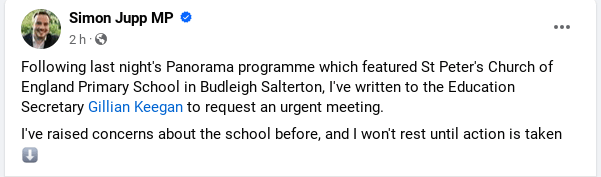
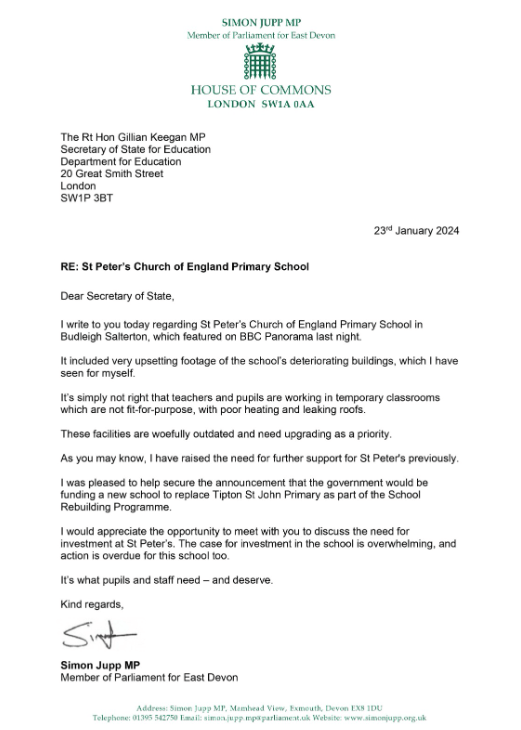
Surprise, surprise, yesterday, 23 January 2024, Simon Jupp wrote to the education Secretary about the state of St. Peter’s primary in Budleigh Salterton. This was prompted by the Panorama exposé rather than the letter an exasperated Head Teacher, Steve Hitchcock, wrote to him nine months ago in March 2023.
It raises questions about whether Simon Jupp has only been putting effort into those communities with deserving cases such as Tipton, that will lie within the new constituency boundaries of Honiton and Sidmouth, leaving the rest of his constituents to fend for themselves.
As Owl has pointed out, Simon is abandoning 78% of his current constituents. If he was such a good constituency MP why would he do this?
1.30 pm, Wednesday, before Health Scrutiny Committee at 2.15
Campaigners from TEIGNMOUTH, where the hospital has been under threat for some time, and SEATON, where NHS Devon announced 3 months ago that they were intending to hand back a wing to NHS Property Services for disposal, will be joined this time by campaigners from OKEHAMPTON, where a ward space is now also being handed back.
Richard Foord, MP for Tiverton & Honiton which includes Seaton, has written a letter to be read out at the Committee.
Campaigners are now asking: Which community hospital, paid for by a local community, will be under threat next?
The ICB have revealed to Seaton campaigners that they originally looked into using the Brownfield Land Fund to obtain public funding for demolishing part of the hospital and building houses.
The Committee will be considering reports on Teignmouth and Seaton – the report on Seaton includes NHS Devon’s proposal for Okehampton.
Speakers from the 3 communities will address the Committee.
Richard Foord MP has written to the Committee
CONTACT: Professor Martin Shaw, Secretary, Seaton Hospital Steering Committee 07072 760254
Last week at St Peter’s primary, Budleigh Salterton, the temperature in the 1960’s “sheds” dropped below 7C.
Hettie, 10, said: “When it’s so, so cold, you start shivering, so your writing goes really wobbly when you’re actually writing it because our hands are shaking so much.”
Last March, Head Teacher, Steve Hitchcock, sent a letter to the DfE, his MP Simon Jupp, and the parents at the school. He rehearsed the problems in education today and proposed solutions. He started: My community of headteachers has been meeting with our local Conservative MP for many years, and we sound like a broken record.
In 2010 Michael Gove cancelled the “Building Schools for the Future” programme introduced by Labour in 2004
Is Simon Jupp AWOL, gaining face recognition in the new Honiton and Sidmouth constituency which doesn’t include Budleigh? Tipton isn’t the only primary with long standing problems.
Schools in urgent need of repair have told Panorama they are struggling to keep children warm in buildings that are “not fit for purpose”.Watch on BBC iplayer(UK only)
At one primary in Devon, temperatures are so low that children keep gloves and coats on during some lessons.
The head teacher says despite parts of the school being seemingly impossible to heat, he has been told it does not qualify for extra money for repairs.
The Department for Education (DfE) says pupil and staff safety is “paramount”.
According to the government’s own figures, the average primary in England needs £300,000 worth of maintenance or upgrades, while the average secondary school needs an estimated £1.5m.
BBC Panorama’s investigation reveals what some of that damage and decay means for pupils and teachers who experience it every day. We found:
A secondary school in Dumfries and Galloway where draughty windows are stuck together with sticky labels
Another in North Yorkshire that teaches some lessons in marquees in a playground, because two-thirds of its building became unusable after the discovery of potentially dangerous concrete, known as Raac
A further secondary school in Essex that has a no-go area after a Raac problem led to the discovery of asbestos
A primary school in Greater Manchester that has faced multiple evacuations because of flooding and worrying levels of potentially explosive sewage gas
At St Peter’s Church of England Primary School in Budleigh Salterton, Devon, some children work in unheated modular buildings – nicknamed “the sheds” – which were built in the 1960s and were supposed to be temporary.
St Peter’s has three classrooms that its head teacher describes as “just sheds”
Just last week, temperatures in the “sheds” dropped below 7C – even with all the heaters on. Workplace regulations say classrooms should be at least 16C.
“I’m really cold. I have to wear gloves and it’s really hard to use a pencil or a pen when you’ve got your gloves on,” said Sebastian, who is eight.
Hettie, 10, said: “When it’s so, so cold, you start shivering, so your writing goes really wobbly when you’re actually writing it because our hands are shaking so much.”
Last year, a National Audit Office (NAO) report on school conditions said about 24,000 school buildings were “beyond [their] original design life” – that’s more than a third of the entire school estate in England.
It also found about 700,000 children were having to learn in “a school that the responsible body or DfE believes needs major rebuilding or refurbishment”.
The NAO’s report also highlighted the scale of the Raac crisis across the school estate in England.
The funding of school maintenance can be complicated. Different responsibilities are shared between central government, devolved administrations, local authorities and the schools themselves.
The Welsh and Scottish governments say they don’t have figures for their backlogs of school maintenance. Northern Ireland says its bill has been growing for 15 years and is now estimated at about half a billion pounds.
The DfE says £5.3bn is needed each year to maintain schools in England, but it has only been allocated about £3bn by the Treasury.
After a survey, St Peter’s was given an A grade for the condition of its buildings
With a £2bn shortfall, the backlog of repairs is growing fast.
In 2021 the government published results of a conditions survey of almost every school in England and graded them in four categories.
St Peter’s in Budleigh Salterton was rated grade A, which means it had been assessed as in the best condition.
Steve Hitchcock is head teacher at St Peter’s, which is left putting the little funding it has into maintaining its “sheds”
“It’s farcical,” said head teacher Steve Hitchcock. “We have three classrooms that are just sheds, that are just not fit for purpose.”
A report from MPs on the Public Accounts Committee at the end of last year noted that schools in the north of England generally appeared to be in worse condition than those in the south.
At Russell Scott Primary School in Denton, Greater Manchester, head teacher Steve Marsland empties out buckets of water collected from leaks around the school whenever it rains.
In 2015, the school underwent a multi-million pound refurbishment to its 150-year-old building. But Carillion, the company contracted to carry out the repairs, left the school with a catalogue of new problems, including faulty fire doors.
Carillion has since gone bankrupt, with debts of more than £7bn, and the school has been left battling issues old and new, including flooding, roofs leaking and heating failures for nearly a decade.
“Since 2015, we’ve had to close the building six or seven times for various issues,” said Mr Marsland.
“We’ve actually abandoned the building for explosive levels of sewer gas.”
Back in 2004, the Labour government’s solution to repairing schools was billed as the biggest school-building investment programme since the Victorian era.
It was called Building Schools for the Future and aimed to rebuild or refurbish every secondary school in England over a 15-20 year period.
But this programme was cancelled in 2010, by the coalition government and then-education secretary Michael Gove. A separate programme for primary schools was also cut back, but not cancelled.
Sam Freedman was Mr Gove’s adviser at the DfE in 2010. Speaking to Panorama, he said he now felt the decision to cut the Building Schools for the Future programme had been rushed.
He also said if the programme had not been cancelled he thinks most of the issues impacting the school estate today, including Raac, would have been “picked up earlier” – because every secondary school in England would already have been structurally assessed.
In a statement, a DfE spokesperson said the government had compiled the largest and most comprehensive survey of school building conditions in Europe – the first of its kind – to “significantly” improve the condition of the school estate, targeted where it was needed most.
The spokesperson added that £15bn of capital funding had been allocated since 2015 for essential maintenance and improvements, including £470m in 2023 “to address school buildings in need of immediate support as quickly as possible”.
In addition, the School Rebuilding Programme, which began in 2021, commits the government to rebuilding 500 schools in England, both primary and secondary, over the next 10 years.
In Wales, the government says it spent £2.3bn over the past 10 years rebuilding and refurbishing schools.
Meanwhile, the Scottish government provided £1bn of funding to the Learning Estate Investment Programme (LEIP), which started in 2019.
However, in England, three years in, only four schools have been rebuilt and, according to the NAO, the government is already behind on its plans.
Emma Wilson, author of last year’s NAO report, said the DfE “has made much slower progress than initially expected with the school rebuilding programme. Both in terms of getting those schools on contract and ready for the build and also doing the construction itself, which will inevitably have impact on the rest of the schools that are following in the queue behind them.”
The DfE told Panorama that progress with the School Rebuilding Programme had been hampered by global events like the war in Ukraine.
In the meantime, St Peter’s is left putting the funding it has into maintaining its cold and leaky sheds.
And at Russell Scott Primary, Mr Marsland is still laying out plastic containers when it rains.
In 2022, he received a letter from the Secretary of State for Education, saying that the school would be rebuilt, but he has been waiting since then for news of when the work will start.
When Panorama contacted the DfE, it said the school will have “a detailed programme plan to review” by the end of January 2024 and will be more “deeply engaged” by the department from that point onwards.
“You get used to every problem and you deal with it, and deal with it, and deal with it. So it becomes second nature and just normalised, which is the issue,” Mr Marsland said.
“I should have been retired, I’m 65 now. But I can’t leave the school in this way until it’s rebuilt. Until I see a digger on the foundations being being laid for a new school… I’ll be going nowhere.”
Alerts for Exmouth, Sandy Bay, Budleigh Salterton, Sidmouth, Beer and Seaton all say “there has been a sewage discharge into the sea from here. South West Water is responsible for this spill”.
The app says:
“Exmouth’s started at 10pm on Jan 21.”
“Sandy Bay’s began at 05:35 on Jan 22.
“Budleigh Salterton’s began at 22:05 on Jan 22.
“Sidmouth’s began at 23:25 on Jan 21.
“Beer’s began at 23.25 on Jan 21.
“And Seaton’s sewage discharge began at 05:50 on Jan 22.”
There are three types of alerts on the Surfers Against Sewage app, a sewage discharge alert, means there has been a sewage discharge from a combined sewer overflow within the past 48 hours. pollution risk alert’ which means’ bathing is not advised’ and a pollution incident alert which means there has been a confirmed incident alert.
Water bosses responsible for illegally dumping raw sewage “should be in the dock” for the damage caused to the UK’s waterways, Labour’s Shadow Environment Secretary has insisted.
Steve Reed has warned executives of the major water companies that Labour will go after them personally with criminal sanctions if they continue to allow illegal “toxic” discharges to pollute the country’s rivers and seas.
Currently the firms themselves can be held liable for pollution but individual executives rarely are.
The Shadow Cabinet minister claimed that the Conservative Government has “turned a blind eye” to sewage dumping because of “a cosy relationship” with “the polluting water industry”.
Speaking exclusively to i as part the Save Britain’s Rivers campaign, Mr Reed accused water firms of “corruption” and vowed to legally pursue chief executives if they fail to clean up the mess being left in the country’s waterways.
“Last year, we had the highest level of illegal sewage discharges in history. And that means you’ve got toxic, raw sewage swilling through our rivers, our lakes and into our seas and lapping up onto our beaches. And the public are quite rightly furious about this,” he said.
Mr Reed highlighted the case of United Utilities, which was accused last year of downgrading pollution incidents, including dumping raw sewage into the World Heritage Site Lake Windermere. The move enabled the firm to increase its bills for customers by £5.1m, according to a BBC Panorama documentary. United Utilities denies the allegations.
Asked if water bosses should be in court over the illegal dumping of sewage, Mr Reed said: “The reason I want to begin personal criminal liability is because I think they should. I do think they should, but this government has just sat back and let them get away with it.
“And you have to ask why? What is this cosy relationship that exists between the Conservative Government and the polluting water industry?”
Labour has vowed to immediately place water companies in “special measures” if it forms a government, and will block the payment of bonuses to water executives if they are found to have overseen illegal sewage dumping. The bosses of the worst offending companies will then be held personally criminally liable and firms will be stripped of powers to self-monitor their own water outlets.
Water companies receive permits that allow them to discharge sewage into rivers, lakes and coastal areas during times of exceptional rainfall to prevent their infrastructure from becoming overwhelmed.
However, firms have faced repeated accusations of dumping sewage outside the parameters of of these permits, which is illegal.
Criminal charges can be filed for breaches of these permits, but such cases are lengthy and expensive, meaning that the Environment Agency (EA) often relies on civil penalties. The Government recently increased the maximum fine that water companies can face in civil cases from £250,000 to £250 million.
For the most severe cases, the EA does pursue criminal charges, but these have resulted in fines levied against water companies, not custodial sentences for executives.
For example, Southern Water was fined £90m as part of a criminal investigation that concluded in 2021 that found the firm was responsible for thousands of illegal raw sewage discharges that polluted rivers and coastal water around Kent.
The EA has in the past urged courts to impose jail sentences on water company executives when serious cases of pollution are proved. However, the Crown Prosecution Service would have to consider the public interest when deciding whether to charge executives with criminal offences, and weigh how likely they would be to secure a conviction.
Mr Reed told i that the threat of losing bonus payments and possibly ending up in court will “focus the minds of water bosses”.
“It will make sure they comply with the law, and that means making sure you put in place a serious plan to bring in the investment that we need to get the water infrastructure fixed,” he said.
The dumping of sewage has become a major political issue as people across Britain have become increasingly aware of how often untreated waste is being released into our waters through points known as “storm overflows”.
This awareness is partly due to increased monitoring; in December water companies hit a Government-imposed target of installing monitoring equipment at 100 per cent of these storm overflow points for sewage spills, up from just 7 per cent in 2010.
Mr Reed, the MP for Croydon North, also pledged to look at the “revolving door” between regulators Ofwat and the Environment Agency and the water companies.
An investigation last year found that at least six senior current industry staff members have been identified as moving jobs between regulators including Ofwat and the EA and water firms such as Southern, Northumbrian and South West Water.
Mr Reed also raised the Conservatives’ attempts to scrap so-called nutrient neutrality regulations that protect waterways from overdevelopment in a bid to build more housing. He suggested it was an example of the Tories turning a “blind eye” to water pollution to appease big developers, many of whom are Conservative Party donors.
“Looking at the nutrient neutrality issue, who is one of the biggest sources of donations to the Conservative Party? It’s developers. And who is the government trying to lower environmental standards to benefit? It’s developers. Well, there’s a cosy relationship.”
He said the Government is “as aware as anyone” about the problem, but has failed to prevent it because the Conservatives have a “far too cosy relationship with the water companies”.
It comes as Labour has published figures that show water bosses have paid themselves a staggering £25m in bonuses since the 2019 election, despite accusations of widespread failure in the system.
“There’s £25m I’ve identified that could be spent on improving infrastructure by not paying it as bonuses and incentives to water bosses who are overseeing law breaking. I don’t think the public should be charged a penny more. While there is that amount of corruption – and I do think it’s corruption – in the system.
“If you’re knowingly breaking the law and covering it up to make more money for yourself and your company, that is corruption.”
The Conservatives have been approached for comment.
A large cohort of county MPs – including 44 Conservatives and seven former cabinet members within this group – have written to the Prime Minister urging his government to provide an emergency injection of funding for councils to prevent major reductions to local services.
The government is currently consulting on its final Local Government Finance Settlement, to be published next month. This will confirm how much funding councils in England will receive in 2024/25.
It follows November’s Autumn Statement, which provided no new funding for local authorities despite the County Councils Network (CCN) highlighting its members were under extreme financial pressure and set to overspend this year by £650m, with these councils facing a total £4bn funding deficit over three years. To compound this, the announcement of the National Living Wage has left those 37 councils over £230m worse off next year.
With local authorities now setting out significant service reductions in their budgets next year, the 46 MPs who have signed the letter say they are ‘exceptionally concerned’ that residents will be faced with a ‘double whammy’ of reductions in services and higher council tax rates in order for councils to deliver a balanced budget.
The group of MPs, include former Local Government Secretary of States Robert Jenrick and Greg Clark, as well as prominent former cabinet members such as Priti Patel, Therese Coffey, Damien Green, and Brandon Lewis. They also include former local government ministers Neil O’Brien, Heather Wheeler, Kit Malthouse, and Jake Berry.
They have called for the government to provide emergency funding for councils to prevent substantial cuts to local services, or worse, some authorities facing financial insolvency and unable to deliver a balanced budget in 2024/25.
In the letter, co-ordinated by CCN and the County All-Party Parliamentary Group (APPG) they say ‘There is still an opportunity to rectify the situation and ensure MPs are able to support the vote on the Local Government Settlement within the House of Commons in early February.
‘We would therefore urge you to do all you can to use the Final Local Government Finance Settlement to provide additional funding for local government to ensure that the councils in our areas can continue to provide the services that our residents depend upon on a regular basis.’
…’As a fellow MP for a county area, we are sure that you will find the prospect of residents in county and rural areas being impacted in such a way at this time concerning.’
Read CCN’s consultation response to the provisional Local Government Finance Settlement here.
Out of the £650m projected overspend, 45% is down to pressures in children’s services, 25% is down to costs in adult social care, and 20% is attributable to rising demand in school transport services for SEN pupils. The signatories urge government to prioritise any additional funding to these three areas.
Following the letter being submitted, the CCN and the County APPG say they are having ‘constructive’ discussions with Downing Street but are urging the government to rectify the situation and announce additional funding as soon as possible.
Cllr Ben Bradley MP, Chair of the County All-Party Parliamentary Group, said:
“County and unitary councils across the country are currently setting out their budgets for next year, with many proposing substantial reductions to highly valued local services as well as tightening of eligibility for care services. With council tax set to rise again this year, residents face a double whammy. No council leader will take any pride in taking this action, but they simply have no choice after the Autumn Statement left them in a significantly worse position.
“The extent of the impact can be reduced if councils are given an emergency injection of funding, and 46 MPs have signed our letter calling on the government to intervene and protect local services. The fact that we have two former Local Government Secretaries, seven former cabinet members, and support from all three main parties shows the strength of feeling on this issue, particularly amongst my Conservative colleagues.
“I’m the privileged position of being both a council leader and MP and so I can see both sides. The Autumn Statement put more money in people’s pockets and I understand that the public finances are tight, but councils provide important local services that millions rely on each day. We have had constructive dialogue with Downing Street, but we are urging the government to rectify the situation as soon as possible so colleagues in the Parliamentary party are able to support the vote for the final Local Government Finance Settlement next month.”
Cllr Barry Lewis, Vice-Chair of the County Councils Network, added:
“We county leaders pride ourselves on being financially prudent and not afraid to make the difficult decisions but this year we find ourselves under financial pressure like never before. We desperately need government support to stave off the extent to which we will have to make unpalatable reductions to services.
“It is encouraging that an unprecedented number of county MPs, including those from all parts of the country, share our same concerns over the funding shortfall we face. We have had constructive discussions with ministers, but we now hope the government listens to our joint campaign and provides emergency resource later month.”
The County Councils Network (CCN) is the national voice for England’s county councils. It represents 21 county councils and 17 county unitary authorities. Collectively, they represent 25 million people, or 47% of the country’s population. For more information click here.
Rishi Sunak facing renewed pressure over plans to ‘max out’ North Sea oil
Rishi Sunak is facing further attacks on his plans to expand oil and gas exploration in the North Sea this week. The Offshore Petroleum Licensing Bill – to be debated in the Commons on Monday – has already triggered widespread protests, including the resignation of Chris Skidmore, a former Conservative energy minister.
The bill aims to boost fossil fuel extraction by establishing a new system under which licences for North Sea oil and gas projects will be awarded annually.
Green groups and analysts are lining up to criticise it. UpLift, which campaigns for green energy, pointed out that the bill, which the government says will “max out” the UK’s reserves, will actually result in only a 2% rise in North Sea gas output. “The remaining 98% of gas demand will come from existing North Sea fields,” its analysis finds.
It adds that just one 1.3 gigawatt windfarm would generate more than enough electricity to offset the gas that would be lost if no new licences were awarded under the bill.
“Sunak, like his predecessor Liz Truss, is obsessing over oil and gas, but dithering on renewables and insulation which will boost UK energy security and lower bills,” said Tessa Khan, executive director of UpLift. “And it’s making people in this country colder and poorer.”
This point was backed by Bob Ward, policy director at the Grantham Research Institute on Climate Change and the Environment. “Investments in new North Sea developments will not make a significant difference to energy bills; they will have relatively high operating costs; and they will make it more difficult for the world to halt climate change.”
By contrast, investing in clean British energy and electrifying the economy, with heat pumps and electric vehicles, would reduce dependence on insecure and expensive fossil fuels, Ward added.
A new report by a group of leading economists including Nicholas Stern, criticises the government for allowing too much investment to continue to flow into unsustainable economies such as the development of new oil and gas fields and the construction of homes and offices that are not energy efficient or climate-resilient.
“Investing in the opportunities afforded by the global transition to an efficient, resilient and inclusive economy needs to be a bigger part of restoring productivity and output growth for the UK to gain a competitive lead in the innovative markets of the 21st century,” they state.
These criticisms follow a letter from the all-party parliamentary group for climate change which says: “Just last month, as the UK’s second warmest year on record concluded, the UK joined other countries in signing the UAE consensus at Cop28 and thus pledged to transition way from fossil fuels.
“However, this bill is diametrically opposed to that agreement. Instead of honouring the promises we’ve made to our allies and partners at Cop28 this bill further weakens any claim the UK makes to be a world leader in tackling climate change.”
For his part, Skidmore said before his resignation that he could not vote for legislation that “clearly promotes the production of new oil and gas” and would show that the UK is “rowing ever further back from its climate commitments.”
Of the 20 areas with the largest increase in older private renters during 2011 and 2021, ten are coastal areas that are among the poorest local authorities in the country.
High rental prices are forcing older tenents to uproot and move to deprived communities with already overstretched public services, an analysis of census data has revealed.
Indepen/dent Age, a charity supporting pensioners in hardship, compared data from 250 English local authorities in the censuses of 2011 and 2021, and discovered widespread migration over the decade from richer to poorer areas for those aged 65 and over.
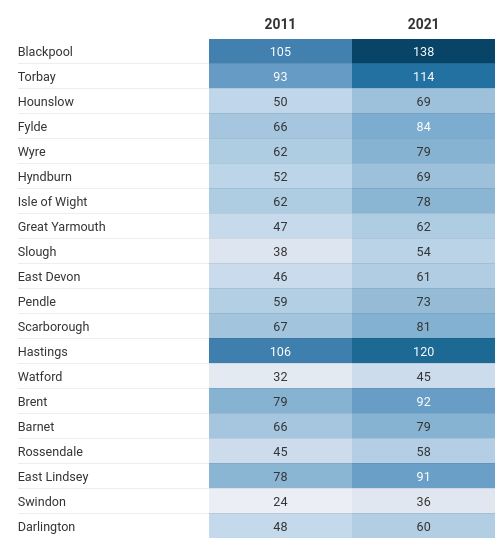
Of the 20 areas with the largest increase in older private renters during this period, ten are coastal areas that are among the poorest local authorities in the country. The area with the biggest rise is Blackpool — officially the poorest town in England — where 138 out of 1,000 older households were renting in the latest census compared to 105 in 2011.
This is followed by Torbay in Devon (114 per 1,000 compared to 93 in 2011), Hounslow in west London (69 instead of 50), and the Lancashire coastal areas of Fylde (84 up from 66) and Wyre (79 up from 62). Overall, Blackpool has the highest percentage of renting pensioners in England, with 14 per cent of all older people living in the private rented sector.
The areas with the most rapid decrease in older renters are the most expensive, dominated by London boroughs. This exodus is because of years of rising rental prices in these areas, which made them ever-more unaffordable, combined with an exodus of landlords who are facing higher taxes.
The biggest decrease of older renters was in the City of London, with 43 out of 1,000 households aged 65 and over renting in 2021 compared to 89 in 2011. This is followed by Camden, down from 92 to 69 between the two censuses, Westminster (157 to 135), Lambeth (73 to 57) and Hammersmith and Fulham (73 to 57).
Harlow in Essex was the local authority with the smallest percentage of older residents in the private rental sector in England, at 2 per cent.
Tenants have faced years of rent increases, particularly in London, as landlords sell up and property becomes unaffordable for many existing renters to buy. In the last year, as landlords’ mortgage rates went up, there have been double-digit rent rises for tenants in most regions.
Some tenants have reported being forced to compete with more than a dozen others for a room, submit personal statements for properties, queue and pay well over the odds to secure the room. However, Joanna Elson, chief executive of Independent Age, said there has been little attention given to how this phenomenon affects older people and the communities they move into.
In a report to accompany its research, Independent Age said older private renters are almost three times more likely to be in poverty than those who own their home mortgage-free.
“Older private renters living on a low income desperately need more protections. If they are forced to move out of the towns they know because of high rent, it is likely they will be cut off from friends and family and move into areas where access to services, including the NHS can be harder, which can lead them to experience worse health outcomes.
“This is not just a disaster for them, but a disaster for our society as a whole. None of us want to live our later years isolated, in poor quality housing or have our freedom to choose where we live taken away. Yet this is becoming a reality for a growing number of older people in financial hardship in the private rented sector, and it looks set to increase.”
Statisticians at Hamptons believe 11.5 per cent of all retirement-age couples will be in the private rental sector by 2033 if current trends continue compared with 5.7 per cent in 2022, a rise from 402,963 to 1,003,382, following an analysis of the English Housing Survey. As well as placing a strain on resources in some areas and driving up rental prices, Hamptons said the trend could also mean smaller amounts of inheritance being passed down the generations in future, creating more problems for already-squeezed younger people.
Stella Creasy, Labour and Cooperative MP for Walthamstow
As we sip our pints of wine, clutching our blue passports, we could be forgiven for taking a deep breath when told of the benefits of Brexit. Yet this could become increasingly hard to do, as the promise to maintain or even enhance our environment now that we have left the EU is being broken.
While no campaign bus was ever emblazoned with promises of foul rivers and polluted soil, post-Brexit it is becoming clear that the “conserve” in Conservative doesn’t extend to our natural world. European directives previously accounted for 80% of our laws in this area – creating shared standards we helped write to prevent contamination, reduce emissions and preserve habitats. By working collectively, we could also ensure no country was economically harmed because no border can stop pollution.
When we left the EU, ministers repeatedly pledged not to water down environmental policy post-Brexit. Michael Gove assured us that there was “no future for the United Kingdom in trying to lead some sort of race to the bottom”. But these siren words were used to justify giving the government sweeping powers under the Retained EU Law Act, andto do away with any meaningful parliamentary scrutiny of its future regulations.
As we saw with the fight to protect nutrient neutrality laws, the Tories wanted to allow nitrates and phosphates to be pumped into rivers on the basis this would facilitate housebuilding, something no other country abiding by these rules had found to be necessary. Although this was successfully resisted, new research shows how, post-Brexit, we are increasingly falling behind rather than leading the way when it comes to protecting our own habitat.
Air pollution laws are weaker, chemicals prohibited in the EU are being used here and our carbon emissions strategy is leading to leakage of jobs and gas. Against scientific advice, the UK has chosen to allow thiamethoxam to be used here, even though Michael Gove pledged to use his Brexit freedoms to ban all such bee-killing neonicotinoids.
The EU has also banned the release into our sewers or surface water of chemicals that disrupt the hormonal systems in our bodies; the UK regulator decided the risk of harm wasn’t big enough to merit such action. Applications to use chromium trioxide – a carcinogenic chemical known to increase the risk of lung and throat cancer – are now more likely to succeed here, as our health and safety guidelines don’t meet the EU’s common framework. The impact is not just on our natural world or our health but also on jobs and growth. Companies operating in both the UK and the EU face paperwork from two different regimes – as the smaller market, it’s not hard to see why business is going elsewhere.
The government’s act wrote into law that we could not strengthen laws if doing so could “increase the regulatory burden”. When I and colleagues from across the political spectrum – from Conservative peers to the trade unions and charities – warned this would, inevitably, lead to the watering down of our environmental standards, ministers told us we were scaremongering. Now the EU progresses towards stronger protections on sewage, fast fashion, protections of habitats and “forever chemicals”, while our government goes the other way.
The situation in which we now find ourselves was not inevitable. Voting to leave the EU was a decision we made as a country. It has happened and reversing it would involve decades of debates and division that all those now struggling with the damage it has caused don’t have. However, it is an active choice by this government to use Brexit as permission to treat anything involving international collaboration as unjustifiable – whether on employment rights, consumer protection or the environment.
If we want our kids to breathe clean air and our farming and food production to be safe, we need a government that recognises that there is merit in collaboration: the benefits of dynamic alignment of our environmental regulations, cross-border climate crisis action and the north seas energy cooperation to help cut the cost of renewable energy and make reducing emissions a shared priority across the continent. Pints of wine and blue passports will be of no benefit at all if our water is too dirty and our health too poor to enjoy them.
“Fresh out of the jungle and ready to share his insights, we are honoured to announce that the incredible Nigel Farage will join us as a keynote speaker.” Matt Fiddes
Westminster has a way of sniffing out the weirdos, loud mouths and fantasists, writes Alan Rusbridger [In the Independent], which is why I want to see the Cheeky Chappy’s bum on the green leather seats of the Commons — forced to do the hard work of a proper constituency MP, instead of posturing and gaslighting from the sidelines.
Nigel Farage and a whole host of celebrities are coming to Tiverton this Spring. Matt Fiddes, who was Michael Jackson’s bodyguard, and is now a business guru who founded Matt Fiddes Martial Arts, has arranged several events being held in the Hartnoll Hotel.
Mr Farage will be in Tiverton on Friday, March 8. Other stars who have booked to make appearances in the town include spoon bending supremo Uri Gellar, singer Michelle Heaton, businesswoman Caprice and entrepreneur Jessen James.
Matt said: “Fresh out of the jungle and ready to share his insights, we are honoured to announce that the incredible Nigel Farage will join us as a keynote speaker.
“As a prominent British personality, broadcaster, and former politician, Nigel has an illustrious career that includes leadership roles in the UKIP party and later the Brexit (Reform UK) party.
“Nigel Farage’s wealth of experience spans almost 50 years, making him a seasoned expert in the game of politics.
“With a deep understanding of the political landscape, he has not only led major political movements but also hosted the widely acclaimed radio show, “The Nigel Farage Show.” Currently, he continues engaging and informing as a GB News presenter.
“This is an unparalleled opportunity to gain insights into the intersection of health and wealth from a distinguished figure who has navigated the complexities of politics for decades.”
Tickets are free and being snapped up fast and are available via the MF.Club website for members
Water firms in both the north and south of the country are resorting to deploying tankers to transport sewage when there are burst sewers or treatment plant failures.
While it is common practise for waste to be transported in this way when there are problems, some experts argue that recent incidents – such as the 240 sewage trucks a day that were being driven through Exmouth, Devon, over the New Year weekend – are contributing to a “bigger debate” about the state of Britain’s water infrastructure.
They say it raises question over whether Britain’s creaky sewers can cope with challenges including climate change, population growth and underinvestment.
One campaigner accused water companies of having to use tankers due to failures to invest in their network, describing the trucks as “a pipeline of sewage that they’re running through our streets and towns”.
Over the past year, several water companies have faced infrastructure failures that have forced them to dispatch a large number of tankers to deal with or prevent major sewage spills.
In June, roughly 100 tankers were sent to the Fylde Coast, near Blackpool, to remove millions of litres of contaminated water from the sea after a burst pipe at a nearby wastewater treatment works caused a huge pollution incident.
Over the summer, more than 200 tankers full of sewage sludge were driven to the town of Camberley in Surrey and left there for six months after Thames Water’s treatment plants reached critical capacity.
And earlier this month irevealed that 240 truckloads of sewage per day were being sent to an overflowing pumping station in Exmouth, Devon as South West Water dealt with a burst sewer nearby. Some of the waste ended up being pumped directly into the sea as the site struggled to deal with the volume of sewage.
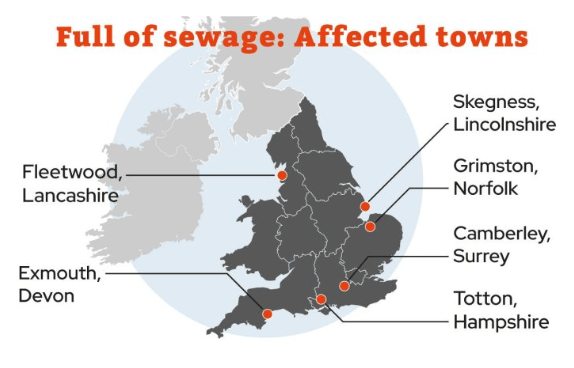
Other incidents involving a large number of tankers have been reported in places including Skegness and Totton. Meanwhile, some residents told i tankers have become a daily occurrence where they live due to continuing network capacity issues.
They said the tankers have caused endless issues for residents, including bad smells, increased traffic and noise.
Mark Dye, from Grimston in Norfolk, said sewage tankers have become a common part of life in the village since he moved there in 2021.
Mr Dye, a campaigner for the Gaywood River Revival campaign, said locals had gotten used to sewage “bubbling” out of manhole covers during wet periods, when the waste system is struggling to deal with heavy rainfall. Anglian Water has been dispatching tankers to the town during periods of heavy rainfall to take away excess water.
While Mr Dye said this solution is preferable to “sewage on the roads”, he said the tankers have created new problems for the village.
“If they are sat right outside your house they are loud, noisy, unsightly… they’re terrible for the roads,” he said.
“It’s literally like having a lorry parked outside your house all night long and every so often the bloke will really rev the engine because they’re pumping.”
He said: “When we live here in the summer it’s like living in the South of France. It’s absolutely beautiful. You’ve got this beautiful chalk stream and all the wildlife around here… But in the winter all these villages have been under siege, we’ve been besieged, because Anglian Water have been doing the same thing for years and so tankers have become the norm.”
Anglian Water said the tankers are a “temporary solution for a much more complicated problem”, which is caused by excess water getting into their leaky system during prolonged periods of wet weather.
The water company said it is working with the local council and the Environment Agency “to come up with a further plan of work and decide jointly how best to prevent these problems happening in the future”.
But Mr Dye said the tankers cannot be described as “temporary” when they have been around for years and questions whether Anglian Water is planning to make the level of investment needed to end their use.
“Anglian Water knows what the issues are, they’ve known for years, and they’ve still not done anything to sort it,” he said.
People living in Exmouth have also become accustomed to the regular presence of sewage trucks on their streets.
This is because the town is home to a treatment centre for “sludge”, which is a byproduct of the wastewater treatment process that can be turned into fertiliser for agriculture.
While it is common practice for water companies to transport sludge from smaller wastewater treatment plants to places like Exmouth, the town has been forced to contend with an exponential rise in the number of trucks since 2020 due to problems at two of South West Water’s other sludge treatment centres in Devon.
Data provided by the water company to a local campaign group, End Sewage Convoys and Poollution Exmouth (Escape), shows the number tankers driving to the town’s treatment work has increased from 94 in the first quarter of 2018 to 460 in the first quarter of 2022.
Escape said this latter figure amounts to around 14 vehicle movements every working day as tankers travel in and out, meaning some local residents have a tanker passing their home every 34 minutes.
This was before a burst sewer resulted in up to 240 tankers per day temporarily being driven to Exmouth over the New Year period.
Geoff Crawford from Escape told i the tankers create various issues for the town, including increased traffic, safety concerns and a bad smell. He criticised South West Water for not investing more in its infrastructure to prevent this from happening.
“The way that I describe it is that instead of laying pipes, which are a long-term solution, they’re taking a short term view on this and they’re basically running a pipeline above ground. The tankers are effectively a pipeline of sewage that they’re running through our streets and towns,” he said.
South West Watersaid: “To clarify, the tankers used in Exmouth are to transport sludge which is not sewage but is instead the separated solids from it. We are not transporting raw sewage from other areas to be treated at Exmouth.
“Tankering is part of the day to day running of wastewater treatment as it ensures that sludge can be transported to one of our sites that can properly treat it. We transport this to Exmouth because it is one of our largest sites and can carry out the treatment needed.”
Experts told i that a certain level of tanker usage by water companies is to be expected and should not be considered a problem, particularly when it comes to the transportation of sludge.
But Dr Ben Surridge, senior lecturer in environmental science at the University of Lancaster, said their use in other circumstances, such as during periods of heavy rainfall, “speaks to this bigger debate about the state of our wastewater and indeed our water infrastructure”.
Many critics blame firms for failing to invest in their infrastructure, much of which was built during the Victorian era.
Research published recently by academics at Imperial College London found that just 1 per cent of the sewers in England and Wales were replaced or rehabilitated between 2000 and 2008.
At this rate, it would take 800 years for this to happen for all the sewers in England and Wales, which is a concern as much of the infrastructure was built with a lifespan of 60-80 years.
However, some experts caution against reading too much into the recent high-profile sewage tanker incidents.
Water companies are not required to report when they use sewage tankers, meaning it is unclear whether their use is increasing.
Professor Stephen Smith, an engineering expert at Imperial, said major incidents such as the ones in Exmouth or Camberley remain “very, very rare”.
“There’s lots of challenges going ahead – increasing urbanisation, climate change, population growth – and the industry is adapting to those situations,” he said.
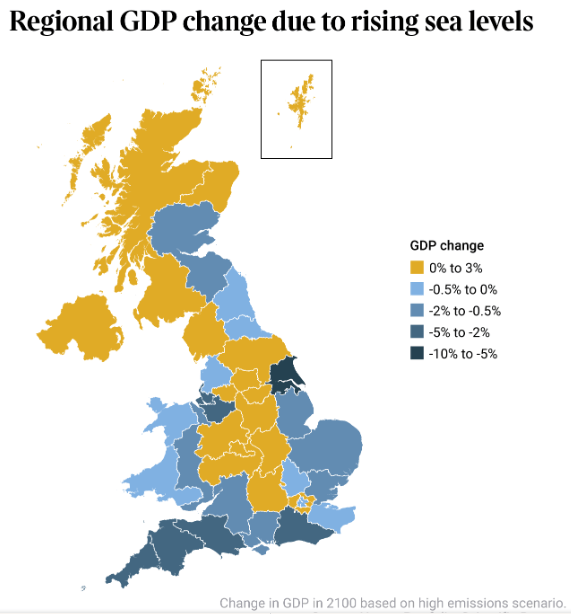
Rising sea levels could cost the British economy more than £100 billion by the end of the century, as floods cause “catastrophic” damages to some of Europe’s coastal regions.
Sea levels have already increased by 20cm globally since the start of the twentieth century, increasing the risk of flooding from surges during storms and high tides.
Dutch and Italian researchers have estimated the cost of future swelling seas, predicting that GDP in Britain and the European Union will be €872 billion smaller in 2100 than in a counterfactual world without rising sea levels. Overall, GDP would be down 1.3 per cent.
The researchers expect Britain be face a loss of €121 billion, or 1.1 per cent of GDP.
However, the impact on some coastal areas will be far higher, as much as 21 per cent in the north of Italy and north of Poland. “A 20 per cent loss of GDP is catastrophic. It is not something you recover from, really,” said Ignasi Cortés Arbués at Delft University of Technology, who led the study published on Thursday in the journal Scientific Reports.
Britain is close to the European average in terms of damages. Cortés Arbués said Lincolnshire and surrounding areas would likely suffer the biggest impact in the UK. Lincolnshire’s coastal transport infrastructure is expected to be badly affected, causing knock-on economic effects for the rest of the agriculture-rich county.
The estimated economic impact for the UK and EU’s 27 member states is something of a worst case scenario.
The researchers also assumed no new coastal defences or other adaptation measures were taken after 2015. But planners are already exploring how defences such as the Thames Barrier will need to be upgraded later this century.
The researchers defended taking a gloomy view. “This is a stress test of what the economy can do, based on what we do have today,” said Theodoros Chatzivasileiadis, also at Delft University of Technology. The study authors also pointed out that they had not factored in “tipping points” in glaciers and ice sheets around the world, which could lead to faster collapse and greater sea level rise than expected.
The estimated damages were calculated by looking at different sectors, from transport to agriculture. While the economic impact of rising seas has been explored in the past, it has not been looked at such a granular regional level before.
“This study is useful for showing how the increasing threat from climate-induced sea level rise plays out in an economically uneven way. While the hit to national GDP may or may not be high in particular countries, their data reveals that within those overall national figures, particular coastal regions and sectors may be particularly badly hit,” said Professor Chris Hilson at the University of Reading, who was not involved in the research.







 12 The Laurels Flightway Dunkeswell Devon EX14 4RSRef. No: 24/0081/FUL | Validated: Thu 11 Jan 2024 | Status: Awaiting decision
 East Devon Watch