MP condemns ‘arrogant and evasive’ Post Office chief

The chief executive of the Post Office has been criticised following his “arrogant and evasive” performance in front of a cross party panel of MPs looking into the Horizon scandal.

He still doesn’t get it – what planet is he on? – Owl

Richard Vaughan inews.co.uk

Nick Read, who took over as head of the Post Office in 2019, came under fire after he failed to provide the Business and Trade Committee with answers over the tragedy that shattered the lives of thousands of subpostmasters.

Labour MP Kevan Jones, who was among the first MPs to campaign on behalf of the postmasters, told i: “It was an arrogant and evasive performance. Serious questions need to be asked as to whether he should remain in his role.

“The victims of this scandal will be watching his response and think the Post Office has an uncaring attitude and they don’t care – it has form on this.”

Mr Read drew frustration from MPs as he repeatedly refused to give his opinion on how the scandal was handled by his predecessors at the Post Office.

The businessman insisted that he had not “seen any evidence” that Post Office executives had misled ministers, the courts or Parliament at any stage.

Asked whether he believed the Post Office prosecuted the innocent knowing the case to be flawed, he said: “I sincerely hope not. But I have not had evidence to that effect.”

He also refused to say whether he thought Paula Vennells, the former Post Office CEO, who was forced to hand back her CBE last week, had misled Parliament in 2015 when she appeared before the same committee.

Asked if he would have said in 2015 that prosecutions against subpostmasters were sound, given he now was able to go back and read board minutes and documents from the period, he replied: “I don’t think I can give you a straight answer on that … I don’t think it’s my place to judge that.”

Instead, he repeatedly said it was for the public inquiry to look back at the scandal and how it was handled by former executives.

“My job is to make sure that redress is speedily delivered to our victims and most importantly that I run the Post Office of today. That is my job,” he insisted. “My job is not the investigative role that is being played by Sir Wyn, that is clearly his job. He initiated an independent inquiry. It’s now a statutory inquiry.”

His comments came after wrongfully convicted subpostmaster Jo Hamilton told the committee she felt as if she had been “gaslit” by the Post Office, which made her believe she had committed offences.

“They convinced me that it was all my fault and I wasn’t tech savvy at all,” she said.

Mr Byrne responded to Mr Read, telling him: “You have left us, I think, fairly shocked actually.

“You’ve not been able to supply the committee with key events in the timeline, such as when the Post Office first knew that remote access was possible.

“You’ve told us that you haven’t kept evidence safe about what money was paid to you inappropriately and therefore is owed back.

“And you can’t estimate the scale of compensation.

Scotland’s head of prosecutions, Lord Advocate Dorothy Bain KC, apologised to those prosecuted in the Horizon scandal who were “failed” by the justice system – as she said 54 people may have been affected north of the border.

Richard Foord puts the Prime Minister on the spot

He asks a very reasonable question but gets an evasive reply.

Photo of Richard FoordRichard Foord Liberal Democrat Spokesperson (Defence)

There are times when a Government need to take military action without the approval of Parliament, including for operational security or the element of surprise. However, last week’s strikes were signalled very plainly in the media. The strikes could have been debated, voted on and supported by this House in advance of action. Tomorrow, I will table a Bill that would require parliamentary approval for the engagement of UK armed forces in armed conflict, even if it is retrospective. Will the Prime Minister support it?

Photo of Rishi SunakRishi Sunak The Prime Minister, Leader of the Conservative Party

As I said, it was necessary to act with speed to allow our armed forces to maintain the vital security of their operations and to ensure their effectiveness. I believe that that is in accordance with the convention on the deployment of military force. As I said previously, we must maintain the prerogative powers that allow the Executive to act in such emergencies, but I am here in Parliament to explain the action in full and take responsibility for it.

Lib Dem Richard Foord launches general election campaign

This is what a real constituency MP looks like – Owl

The Liberal Democrat MP Richard Foord launched his bid to be the next MP for Honiton & Sidmouth on Saturday (January 13) with a promise to fight for rural NHS services and be a voice for residents across East Devon. 

Philippa Davies www.midweekherald.co.uk 

He will be standing against Simon Jupp, the current MP for East Devon, who is now campaigning for election to the new Honiton & Sidmouth constituency. Mr Foord is the sitting MP for the Tiverton & Honiton constituency, which will no longer exist under the constituency boundary changes.

At his campaign launch in Ottery St Mary on Saturday, attended by more than 50 people, Mr Foord laid into the Conservatives for ‘letting down’ rural communities and criticised his Conservative opponent for ‘sitting back and toeing the party line’, while highlighting his own commitment to always speak out on local issues. 

At the rally Mr Foord was joined by Claire Wright, the former independent candidate for East Devon who received the support of more than 24,000 people at the last General Election, and former Devon County Councillor Martin Shaw – both of whom are supporting his election campaign. 

Mr Foord spoke about his focus on supporting rural health and social care services, cracking down on water companies to end the sewage scandal, and supporting the environment through protecting the countryside and biodiversity. 

When the launch event finished many supporters headed straight out to start knocking on doors and delivering leaflets for his campaign. 

Speaking after the launch, Richard Foord said: “At the next election, the choice facing people in our corner of Devon is plain. They either get a hardworking local champion fighting their corner, or yet another Conservative MP who is content to defer to the party whips and toe the party line. 

“Our country is in dire need of change. We have an NHS crumbling before our very eyes, our rivers and beaches are awash with sewage, and our rural market towns are at risk of becoming hollow shells of their former selves, as businesses and services wilt away. 

“The Conservatives have shown time and again that they simply do not care about areas like ours. They continue to take us for granted, preferring to funnel funding into the Midlands and North in a desperate attempt to shore up their ‘red wall’ seats. 

“My campaign is focused on showing people the real difference a hardworking local MP committed to fighting their corner can have. This is something we’ve seen since my election last summer – with new announcements secured in relation to Tiverton High School, and a pledge of the opening of a railway station at Cullompton.  

“I am humbled to have the support of people like Claire Wright and Martin Shaw, who have been real champions for our towns and villages. The message is plain: the only way to change things for the better is to vote Liberal Democrat and kick out this out-of-touch Conservative Government.” 

Simon Jupp, MP for East Devon, said: “I am proud to be standing where I live, something my Liberal Democrat opponent simply can’t say. My campaign was launched on May 3rd last year in Honiton and I have been knocking on doors across the new Honiton & Sidmouth constituency since March. I have opened a campaign office on Honiton’s high street, not far from the former Liberal Democrat office they closed days after winning the by-election. I’m fighting for every vote, because I care about where I live.”

Anyone wishing to find out more about Richard Foord or support his campaign can do so by visiting http://www.RichardFoord.org.uk 

The 14 Cabinet ministers and Tory big beasts set to lose seats at next election

Not to mention the “little beasts”; the “small fry” and “the minnows”. – Owl

[The poll referred to plays down the impact of tactical voting which Owl thinks could be large in the South West.]

The Conservative Party is on track to lose 196 seats at the next election, with multiple Cabinet ministers and senior MPs set to be unseated, new polling suggests

Eleanor Langford inews.co.uk

A survey by YouGov calculates that, if a general election were held today, Labour leader Sir Keir Starmer would win 385 seats – a 120-seat majority over the Conservatives.

The poll of 14,000 people, revealed by The Telegraph and commissioned by the Conservative Britain Alliance, also indicates that the party is on track to lose almost all the “Red Wall” seats it gained in 2019.

Chancellor Jeremy Hunt and Defence Secretary Grant Shapps are among the 14 Cabinet ministers and senior Tory MPs who could lose their seats.

YouGov, who conducted the poll, has questioned some of The Telegraph’s analysis of their data, especially regarding the assumption that Reform UK voters would return to Conservatives if the party did not stand.

Polling from the group in October found that only 31 per cent of Reform UK voters would be willing to vote Conservative if Reform UK were not standing in their constituency.

Jeremy Hunt

Losing to: Lib Dems
Constituency: Godalming and Ash

The Chancellor’s current seat of South West Surrey has been largely abolished under new boundaries, but Jeremy Hunt has announced he will stand in the newly formed constituency of Godalming and Ash.

Mr Hunt has faced close competition from the Liberal Democrats in his current seat, where the party won 38.7 per cent of the vote to his 53.3 per cent in 2019.

Under the latest YouGov poll, Mr Hunt is now predicted to narrowly lose to the Lib Dems in his new constituency also, taking 32 per cent to his opponent’s 35 per cent.

If the Lib Dems are victorious, Mr Hunt would become the first Chancellor to lose their seat while in the post.

Penny Mordaunt

Losing to: Labour
Constituency: Portsmouth North

Commons Leader Penny Mordaunt, who garnered international attention for her sword-carrying role at the coronation, has held her seat since 2010.

Considered a swing seat, it was held by Labour from 1997 to 2010 but now looks likely to return to the party.

Despite winning with a 15,780-vote majority at the last election, Ms Mordaunt is predicted to see her vote share to fall from 61.4 per cent to 33 per cent, giving victory to Labour, who are set to win 36 per cent of voters.

Grant Shapps

Losing to: Labour
Constituency: Welwyn Hatfield

Grant Shapps, the Defence Secretary, took his current seat from Labour in 2005, and most recently held it in 2019 with a majority of 10,955.

But Labour looks set to regain the seat, taking 40 per cent of the vote to Mr Shapps’s 31 per cent – a swing of 21.2 for Labour.

Responding to the YouGov poll on Monday, Mr Shapps said he was “absolutely” confident the Conservative Party could turn things around despite the dire projection.

“The reason I think we can turn it around is because at least people know we have got a plan and we are working to it. There isn’t a plan under Labour,” he told Times Radio.

Gillian Keegan

Losing to: Lib Dems
Constituency: Chichester

Despite having a solid majority of 21,490 – the largest of any Cabinet minister on this list – Education Secretary Gillian Keegan is still considered at risk.

The Liberal Democrats came second in seat in 2019, and are predicted to narrowly win at the next election with 33 per cent of the vote compared to Ms Keegan’s 31 per cent.

Chichester has been considered a safe seat for the Conservatives, having been held by the party since 1924.

Alex Chalk

Losing to: Lib Dems
Constituency: Cheltenham

Cheltenham was held by the Liberal Democrats between 1992 and 2015, when it was won by Alex Chalk, who is currently Justice Secretary.

With a razor-thin majority of 981, Mr Chalk was always going to be considered at risk, and he looks set to lose to the Lib Dems at the next election.

The poll predicts they would win 42.6 per cent of the votes, with just 30 per cent going to Mr Chalk.

Victoria Prentis

Losing to: Labour
Constituency: Banbury

Attorney General Victoria Prentis, who has been MP for Banbury since 2015, is set to narrowly lose to Labour. Ther poll shows Sir Keir Starmer’s party would overturn her 16,813 majority, winning 34.2 per cent to the Tories’ 33.7 per cent.

Reform UK is set to take 7 per cent of the vote, meaning Ms Prentis could keep the seat if the Tories can take some of their supporters.

Johnny Mercer

Losing to: Labour
Constituency: Plymouth Moor View

Johnny Mercer attends Cabinet in his capacity as the Minister for Veterans’ Affairs and has been the MP for Plymouth Moor View since 2015.

His seat was previously held by Labour from its creation in 2010, and the party looks set to unseat the incumbent.

He is predicted to win 33 per cent of the vote to Labour’s 40 per cent, but the constituency will also see a significant Reform UK presence, with the party winning 11 per cent of voters.

Simon Hart

Losing to: Labour
Constituency: Caerfyrddin

Simon Hart, the Chief Whip and a close ally of Mr Sunak, will see his current Carmarthen West and South Pembrokeshire seat abolished under the boundary review, and he has been selected to stand in the new seat of Caerfyrddin.

Based on current polling, Labour is on track for a major victory, winning 40 per cent of the vote to his 27 per cent.

Lucy Frazer

Losing to: Lib Dems
Constituency: Ely and East Cambridgeshir

Culture Secretary Lucy Frazer will see her South East Cambridgeshire seat abolished at the next election, and will instead stand in the new constituency of Ely and East Cambridgeshire.

She is set to lose that battle to the Liberal Democrats, who came second to her in 2019, with the party winning 33.6 per cent of the vote compared to the Conservatives’ 31 per cent. Reform UK is predicted to take 8 per cent of the vote.

David TC Davies

Losing to: Labour
Constituency: Monmouthshire

David TC Davies, the Welsh Secretary, will stand in the new seat of Monmouthshire after his current Monmouth constituency is abolished.

He is facing the prospect of a significant loss to Labour, with YouGov polling suggesting the party is on track to take 41 per cent of the vote to his 33 per cent.

Alister Jack/John Cooper

Losing to: SNP
Constituency: Dumfries and Galloway

Scotland Secretary Alister Jack has announced he is standing down from his Dumfries and Galloway seat at the next election, but his successor John Cooper looks set to lose the seat to the SNP.

The seat has been a three-way battleground since its creation in 2005, having been held by Labour for 10 years, the SNP for two years and, Mr Jack since 2017.

Sir Iain Duncan Smith

Losing to: Labour
Constituency: Chingford and Woodford Green

Sir Iain Duncan Smith, a senior Conservative MP and former leader of the party, has been MP for the seat in north-east London since 1992.

But his time in Parliament could be brought to an end after three decades, with Labour set for a landslide victory. Sir Iain last held the seat with a majority of just 1,262 and he is set to win 31 per cent of the vote at the next election to Labour’s 50 per cent, according to the poll.

Lee Anderson

Losing to: Labour
Constituency: Ashfield

Lee Anderson, the plain-spoken Deputy Chairman of the Conservative Party first won his seat from Labour in 2019 when he unseated Gloria de Piero.

Prior to his victory, Ashfield, in Nottinghamshire, had been consistently held by Labour since 1979, and the party is predicted to win it back. Mr Anderson’s vote share is set to fall from 40 per cent to 23 per cent, with Labour taking the seat with 38 per cent of the vote.

Sir John Redwood

Losing to: Lib Dems
Constituency: Wokingham

Sir John Redwood, a veteran MP and former minister, has represented the “Blue Wall” seat since 1987, and it has only ever been won by Conservative MPs.

But that could be all about to change, with the seat in Berkshire a key target for the Liberal Democrats. The party is predicted to win with 37 per cent of the vote to Sir John’s 31 per cent.

The UK has an accountability problem — just look at the Post Office

“The UK landscape is littered with similar hybrid bodies which are fundamentally unaccountable. Universities that pay top management like businesses, but don’t run like businesses. Privatised water monopolies that have spent years illegally dumping sewage into our water, killing fish and making people sick. Their executives are part of the apparatchik class and so is the regulator, Ofwat.”

Camilla Cavendish www.ft.com

The Post Office scandal was uncovered not by officialdom but by dogged, independent-minded heroes. These included journalists at the BBC, Computer Weekly and Private Eye; an engineer who blew the whistle at Fujitsu; several MPs; and Alan Bates, the sub-postmaster whose determination to get justice is now legendary. These people, now celebrated in an ITV drama that has pushed the issue to the top of the nation’s agenda, were up against a self-serving apparatchik class which despises the little people, is adept at covering its tracks and is an increasing feature of modern Britain.

The number of postmasters affected, and the vindictive way in which the Post Office pursued them, makes it especially shocking. But we have seen the same pattern in other tragedies where public or quasi-public bodies either fail to join the dots or actively conspire in cover-ups. The deaths of babies at Morecambe Bay hospital were uncovered by a father, James Titcombe, who was repeatedly fobbed off in getting answers about why his baby died. The sexual abuse of girls in Rotherham was revealed by The Times, despite extensive obfuscation by Rotherham council. Failings in the care of Baby Peter Connelly, who died under the noses of social workers, were brought to light by Kim Holt, a paediatrician who was suspended for her pains by Great Ormond Street. 

One of the reasons the Post Office saga took so long is that it was a state-owned entity which was also independent. It wasn’t accountable to anyone, and even part-funded the postmasters’ representative body, effectively muzzling it. The management culture assumed that many sub-postmasters, who were self-employed, were on the take — a view executives felt was confirmed when the Horizon software appeared to show high levels of fraud. It was protected by Whitehall, whose officials encouraged a succession of ministers not to meet Bates.

The UK landscape is littered with similar hybrid bodies which are fundamentally unaccountable. Universities that pay top management like businesses, but don’t run like businesses. Privatised water monopolies that have spent years illegally dumping sewage into our water, killing fish and making people sick. Their executives are part of the apparatchik class and so is the regulator, Ofwat.

A striking feature of this cadre is how they move from job to job around the system despite, in some cases, egregious failings. The NHS is littered with overpromoted managers who get recycled from one hospital trust to another. Paula Vennells, Post Office chief executive between 2012 and 2019, was in post when failings in the Horizon software became unavoidably evident, yet she continued to preside over prosecutions until 2015. The MP James Arbuthnot, who forced Vennells to agree to the external review of Horizon that helped to break the scandal open, has described an appalling level of management groupthink — and malice. Yet in 2019 Vennells went on to another job on the circuit, chairing a large NHS trust. And Fujitsu, the technology company behind Horizon, which has so far been untouchable, has won £5bn more in government contracts since its software was found not to be robust by the High Court in 2019.

This is how the system operates. Individuals may occasionally be caught out, but the machine just rolls on. Indeed, any government that is minded to abolish arms-length bodies discovers that it can’t — they are often statutory. The level of effort and political capital you would need to expend trying to get rid of any of them is too much for the average minister. 

This serves no one, including the brilliant young people who are recruited into the civil service. They arrive with great hopes of serving the nation, and are then trapped in meetings where no one knows much about the people they are supposed to serve. I have met health department officials who have never been inside a hospital or care home. I’ve met quango heads who hire management consultants rather than talk to customers. It’s not surprising we are so bad at procurement: the Fujitsu contract being an example.

What can we learn from the Post Office heroes? First, that momentum depends on spotting patterns. Bates’s determination to find others in similar trouble was a stroke of genius. Second, the importance of meticulous record-keeping. Arbuthnot, who became involved 15 years ago because one of his constituents was a sub-postmaster, has an office overflowing with paper relating to this fight. Third, that investigative journalists like Nick Wallis can crystallise a complex story, hard to understand. Fourth, that tenacity is essential because the system aims to wear you down and tire you out.

For all those on the other “side”, all the good officials, this saga shows the importance of keeping an open mind. Not everyone who claims to be a victim is genuine: I learnt this in years of campaigning on the family courts. But many real victims can also be initially hard to believe. They can be crazed with anxiety, or have a frustratingly vague handle on the chronology of events. Listening to them and extracting their stories takes time — something MPs are rather good at. True whistleblowers are also marked out by the fact that they rarely want fame or honours: what they want is justice. The contrast could not be greater with the senior executives who will spend any amount of taxpayers’ money, and condemn any number of ordinary people to misery, to avoid admitting mistakes.

The postmasters will be exonerated. But Fujitsu should be paying the compensation. And future ministers should consider meeting a few “troublemakers”: they might learn something.

The updated National Planning Policy Framework: key planning and housing changes

Shortly before Christmas, on 19 December 2023, the Government published its long-awaited revisions to the National Planning Policy Framework (“NPPF”), following a year-long process of consultation. The revised NPPF sets out the Government’s planning policies and how these will be applied.

The biggest change is that the revised NPPF introduces various reforms to housing delivery. The revised NPPF also includes new drafting on protection from “out of character” residential development, Green Belt alterations, energy efficient building improvements and allocation of agricultural land for development.

www.burges-salmon.com 

The key changes are set out below:

1. Reforms to housing delivery

The Government’s intention with these changes is to increase the delivery of new housing, by giving local planning authorities a strong incentive to update their Local Plans, amidst a supply shortage in many areas of the country.

Changes to the five-year housing land supply and delivery requirements

  • Under the previous version of the NPPF, all local planning authorities in England were required to continually demonstrate a deliverable five-year housing land supply.

The updated NPPF states that local planning authorities will not need to meet this requirement as long as their adopted plan is less than five years old, and that it identified “at least a five year supply of specific, deliverable sites at the time that its examination concluded”.

  • There is also a reduced requirement for some local authorities with an ‘in-progress’ Local Plan, i.e. where a Local Plan has been consulted on (under Regulation 18 or 19) or submitted for examination.

If the draft Local Plan includes a policies map and proposed housing allocations towards meeting housing need, those authorities will only have to demonstrate a four-year housing land supply. This particular change only applies for two years from the publication date, until 19 December 2025.

As a result of these changes, it is estimated that 40% of local planning authorities will no longer be required to demonstrate a five-year housing land supply.

The reason that this is important is because if a local authority cannot demonstrate a five-year housing land supply, then in the process of decision-making, the presumption in favour of sustainable development applies.

That presumption means that planning permission should be granted for sustainable development (unless the application of NPPF policies to protect assets or areas of particular importance provide a clear reason for refusal, or the adverse impacts significantly and demonstrably outweigh the benefits). This presumption (also known in shorthand as the “tilted balance”) changes the exercise of assessment that the decision-maker must carry out, and in general terms increases the prospect of planning permission being granted.

This means that those authorities who are no longer required to demonstrate a five-year housing land supply will be better protected against unplanned or speculative development, because the “tilted balance” will not apply.

Practically, the changes provide an incentive to local planning authorities to keep their Local Plans up to date so that they do not continually need to demonstrate a five year land supply.

Changes to the assessment of housing supply

Under the previous version of the NPPF, all local planning authorities were required to build a buffer of 5% (by default), 10% or 20% into their calculations on five-year housing land supply. In the updated NPPF, the 5% and 10% buffers have been removed but the 20% buffer has been retained, where delivery falls below 85% of the requirement over the previous three years.

In addition, historic oversupply can be accounted for in the five-year housing land supply calculation and further guidance on this will follow. The expectation is that the removal of 5% and 10% will simplify the five-year land supply calculations for local authorities. There is a concern, however, that their removal will reduce a key incentive for local authorities to keep delivering housing supply and maintain accountability where delivery exceeds the 85% threshold.

Greater flexibility for local authorities in assessing local housing need

New text has been added to the NPPF at paragraph 60, clarifying that the overall aim of local authorities, in the context of delivering homes, should be to “meet as much of an area’s identified housing need as possible”.

Under paragraph 61, the revised NPPF also states that the standard method for calculating housing need, to establish the number of homes required, is now considered as an “an advisory starting point”. Under the previous NPPF, the standard method was not classified in this way and there was no similar explanatory text.

As a result of these changes, local authorities have greater flexibility to plan for fewer or higher number of homes than the standard method indicates, and where there are specific local circumstances that justify an alternative approach to assessing housing need, that is now explicitly supported.

Alteration of Green Belt boundaries

New paragraph 145 of the revised NPPF provides that local authorities may choose to (but are not required to) review and alter Green Belt boundaries (in the event that they consider that they cannot meet housing need) during the plan-making process, where exceptional circumstances are fully evidenced and justified.

The changes do not explicitly describe how Green Belt boundaries are expected to interface with housing supply and do not represent a substantive change to the policy position.

Support for specific categories of housing

  • Retirement housing need assessment – new paragraph 63 has been added into the revised NPPF which requires local authorities to assess a local need for retirement and care housing provision. Local authorities are then required to reflect this need in their policies. These changes reflect a specific concern identified by the Government; the consultation paper makes clear that they are prioritising sufficient housing supply for an ageing population, and in this context drafting has been included to explicitly and specifically support the provision of that housing.
  • Support for small sites – at paragraph 70(b), the revised NPPF requires local authorities to support (through policies and in their decision making) small sites to come forward for community-led development for housing and self-build and custom-build housing. This reflects an objective of the Government to give greater confidence and certainty to small and medium sized builders, with a view to diversifying the housing market.
  • Support for community-led development – the revised NPPF provides that local authorities should support the development of exception sites for “community-led development” on sites that would not otherwise be suitable as rural exception sites. This reflects the Government’s ambition to emphasise the role of community-led development, with a view to supporting locally-led housing.

The inclusion of express support for these categories of development should, in time, filter down into increased support for each category in Local Plan policies and local planning authority decision-making.

Protection against out of character residential developments

New paragraph 130 of the revised NPPF provides that a significant increase in the average density of residential development in an existing urban area may be inappropriate if it will result in developments which are “wholly out of character with the existing area.”

The effect of this change is to enable authorities to describe “out of character” circumstances in the process of preparing design codes and plan-making.

Support for mansard extensions

The NPPF provides that authorities should “allow mansard roof extensions on suitable properties” where their external appearance “harmonises with the original building”. This reform will offer the ability to enable new housing by extending upwards as long as these extensions are in keeping with the local character and context, particularly in conservation areas.

2. Energy efficiency of buildings

New paragraph 164 in the NPPF requires local authorities, in determining planning applications, to give “significant weight” to the need to support “energy efficiency and low carbon heating improvements” through adaptation of buildings. This represents strong in-principle policy support for energy efficiency.

When assessing applications for energy efficiency improvements, it is important that heritage protection is considered. Paragraph 164 in the revised NPPF provides for this by stating that where the proposals would affect conservation areas, listed buildings or other relevant designated heritage assets, local planning authorities should also apply the relevant policies, set out in detail in Chapter 16 of the NPPF.

3. Allocation of agricultural land for development

At paragraph 181, the revised NPPF requires local authorities to consider the availability of agricultural land used for food production when allocating sites for development. Where significant development of agricultural land is demonstrated to be necessary, areas of poorer quality land should be preferred to those of a higher quality.

It is important that developers take an evidence-based approach towards determining the condition of agricultural land, before a development scheme is proposed. This amendment means that the availability of land used for food production is now explicitly a part of that exercise.

4. Other general changes

  • Planning conditions on design and materials – new paragraph 140 of the NPPF encourages planning authorities to use planning conditions to require clear and accurate drawings/details of a scheme’s design and materials. This is intended to provide greater certainty for those implementing a planning permission on how to comply with the permission.
  • Integration of “beauty” – the latest NPPF revisions mean that “beauty” now features heavily as a consideration across policy. However the NPPF itself does not include substantial detail on how to assess beauty; this exercise will primarily be the role of design codes.

Concluding thoughts

The primary effect of the changes to the NPPF will be to disapply the presumption in favour of sustainable development (or “tilted balance”) for a variety of local authorities, by not requiring them to demonstrate a five-year housing land supply. The absence of the “tilted balance” will reduce the number of planning permissions which would otherwise be granted due to the lack of housing land supply.

The authorities excluded from the requirement include those with up-to-date Local Plans (within the last five years) and those who are partway through the Local Plan process, with significantly advanced plans. The latter category of authorities are only excluded temporarily, for a two-year period, enabling those authorities time to finalise and adopt updated Local Plans.

Excluding a large number of authorities from this requirement may reduce the amount of unplanned development in those authority areas, and authorities are incentivised to retain those benefits by updating their Local Plans. However the NPPF in itself does not address the hurdles which authorities face in undertaking the process of updating their development plans.

This update was co-written by Matthew Tucker and Sofiya Yerokhina. Should you have any queries about the changes to the NPPF or planning generally, please do not hesitate to contact either Matthew or Gary Soloman.

South West Water ‘not honest’ about drought preparations, watchdog claims

South West Water has been accused of not being honest with the government about its drought preparations after parts of the country almost ran out of water in 2022, it has emerged.

Helena Horton www.theguardian.com

The Environment Agency (EA) told the water industry regulator Ofwat that SWW was “not honest” with regulators about the risk a drought posed to the company’s water supplies and was inadequately prepared for the heatwave.

People in Devon and Cornwall were affected by months of hosepipe bans as reservoirs ran dangerously low during the dry spell in 2022. Three of SWW’s reservoirs fell to record lows during the drought.

The agency said the company showed complacency before the drought and “a lack of understanding of their own supply system”.

Documents obtained by Greenpeace’s investigations website Unearthed under freedom of information laws revealed the environmental watchdog’s scathing assessment of the water company’s drought preparedness. “SWW were not honest, open and transparent with regulators about their drought projections and potential risks to security of supply,” the EA wrote in a July email to Ofwat. The email said “SWW acted too late” in response to the drought, and that this “presented a genuine risk of loss of supply in west Cornwall”.

The EA said the company had a misunderstanding of its own supplies and thought it had so much water that it could pipe it to other regions. The agency told Ofwat SWW that showed “a lack of understanding of their own supply system, considering themselves as a potential water donor in the future, only to find the reverse is true”. The company’s latest plan states that it needs to close a gap of more than 200m litres of water a day by 2050 to meet demand.

Water was so scarce in 2022 that drastic saving measures banning all non-critical use were almost put in place. This would have meant a ban on ponds and swimming pools being refilled, people washing their cars and non-residential buildings being cleaned.

No new reservoirs have been built in the UK since the water industry was privatised in 1989, and some water companies have added to their profits by selling off existing facilities. Water companies have paid out £72bn in dividends since privatisation, borrowing £56bn and increasing bills by 40%.

The EA told Ofwat that new water sources need to “be considered, applied for and permitted during the drought instead of planned in advance”.

Megan Corton Scott, a political campaigner for Greenpeace UK, said: “South West Water have failed in tackling the sewage crisis, failed to prepare for drought, failed to even understand their own supply system and failed to be honest with the regulator, but they did succeed in raising shareholder dividends at the end of last year.

“Rishi Sunak promised tough enforcement and a more resilient water infrastructure. Given this platform of incompetence and blatant money grabbing, how long can the government stand idly by and let this company continue to control such a critical part of the nation’s resources?”

A spokesperson for SWW said: “We strongly reject any suggestion that we were not adequately prepared for the risk of drought or that we did not operate in good faith with the regulators.

“Despite facing a once-in-a-generation drought in the south-west, no customer went without water supply and we successfully maintained a robust supply of water to over 3.5 million customers and 10million visitors to the region.”

The company was fined over illegal dumping of sewage last year after investigations by the EA.

Last week, the owner of SWW, Pennon Group, bought Sutton and East Surrey Water in a deal worth £380m.

Somerset Council cuts: Everything we know about planned savings

More on the state of rural Britain today – Owl

Somerset Council declared a financial emergency in November 2023, meaning major cuts to services are expected

Somerset Council has said it needs to find £100m to avoid going effectively bankrupt.

The council has found £35.2m of proposed savings.

They include shutting five of the county’s 16 recycling centres, ending council funding for public toilets and CCTV, cutting highway maintenance and closing two tourism visitor centres.

Subsidies for bus services will be reviewed and so will support for the county’s theatres, including Taunton’s Brewhouse Theatre’s £119,000 a year grant.

The council could save £165,000 by pulling funding for Yeovil Recreation Centre sports facilities including the county’s only public athletics track and hockey pitches which are home to Yeovil and Sherborne Hockey Club.

By Ruth Bradley www.bbc.co.uk

Cuts to services totalling £35m have been proposed, as well as a possible 10% increase in people’s council tax bills.

On 20 February, the authority will vote on its budget for 2024/25.

Here we answer some key questions on what we know so far.

Why is the council in financial trouble?

Somerset Council declared a financial emergency in November 2023.

It had been expecting an estimated budget gap for 2024/25 of £42m but said in November that the forecast had increased to £100m.

The council said the costs of delivering services, particularly adult social care, were rising significantly faster than income.

It has also blamed national factors such as inflation and higher interest rates.

It is trying to avoid effectively going bust and being served a Section 114 notice, as has happened to other authorities like Birmingham City Council.

The council would lose the ability to commit to new spending and take decisions if it was issued with the notice.

Somerset Council is in its first year of operation, having been formed in April 2023 from a merger of four district councils and Somerset County Council.

It says this has also caused problems as it has come to light that all the previous councils managed their budgets in different ways.

Which services could be cut?

The council has found £35.2m of proposed savings.

They include shutting five of the county’s 16 recycling centres, ending council funding for public toilets and CCTV, cutting highway maintenance and closing two tourism visitor centres.

Subsidies for bus services will be reviewed and so will support for the county’s theatres, including Taunton’s Brewhouse Theatre’s £119,000 a year grant.

The council could save £165,000 by pulling funding for Yeovil Recreation Centre sports facilities including the county’s only public athletics track and hockey pitches which are home to Yeovil and Sherborne Hockey Club.

A petition against this has gathered thousands of signatures.

A contract with the RNLI to provide beach lifeguards at Burnham-on-Sea and Brean could be stopped saving £35,000 a year.

Also, three parks could be left open overnight to save money on contractor costs to lock them, prompting concerns over vandalism and safety.

Will I have to pay more council tax?

As well as cutting services to save money, Somerset Council is looking to increase its income.

It is proposing a 9.99% rise in its share of council tax bills, although the council needs the government’s permission to increase council tax by more than 4.99%.

On an average Band D property, council tax would rise by £163.80 a year under the plans.

This excludes projected rises for fire, police and any imposed by town or parish councils on their portions of the bill.

Somerset Council is hoping parish and town councils will step in to pay to keep some services running but that would likely lead to those smaller authorities needing to increase their share of council tax, meaning higher bills for residents.

There would also be increases in fees and charges, including for parking, and the council is planning to take £36.8m from its reserves.

Is the council asking the government for help?

Somerset Council said it had been in talks with Department for Levelling Up, Housing and Communities (DLUHC) for some months.

It is asking for permission to increase council tax by 9.99%, which the council said would bring Somerset’s charges more in line with other unitary councils and bring in an extra £17m a year.

The council is also asking for something called a capitalisation direction, which is when the government gives permission for capital money to be spent on day-to-day costs.

Capital can be from selling buildings and other assets, and would normally need to be spent on other capital projects.

The council is asking the government for a capitalisation direction of £20.8m.

Or, if the request to increase council tax is not granted, then for a capitalisation direction of £37.9m.

What if the government does not help?

If the DLUHC does not grant either dispensation, the council said it will not be able to balance the 2024/25 budget.

It said it would then be unable to avoid issuing a Section 114 notice, effectively making it bankrupt.

If that happened then the government would appoint commissioners to run the authority.

How can local residents have their say?

A spokesperson for Somerset Council said: “We understand there will be concerns. To be clear, no decisions have been made and will not be until the budget is set at full council on 20 February.

“Somerset Council, and councils up and down the country, are in an unprecedented position due to the rising costs faced by local authorities across the country, largely driven by costs of social care.

“If we cannot set a balanced budget, government commissioners will do it for us, without the local knowledge or concern about the longer-term.

“These are not things that we would ever want to be considering.

“We want hear people’s views. Please take part in the council’s budget consultation which runs until 22 January.”

One by one, England’s councils are going bankrupt – and nobody in Westminster wants to talk about it

A new financial year looms. The government is reportedly in the mood for pre-election tax cuts; the opposition talks of iron fiscal discipline. And all around us, a familiar disaster grinds on: constant increases in demand on our most crucial public services, which the financially blitzed councils charged with providing them simply cannot meet. 

John Harris www.theguardian.com

The result is a story that speaks volumes about Westminster’s state of contorted denial: increasing numbers of our cities, towns and counties now face municipal bankruptcy, but no one in any position of national power and influence seems to want to talk about it.

The dire predicament of councils all over England now invites an obvious question: at what point might we collectively realise that hundreds of local crises now add up to a national catastrophe? Our political culture is too Westminster-focused to follow the stories and join the dots; the dreaded term “local government” still causes eyes to glaze over. But all over the country, the picture is now the same, and things are rapidly nearing the point of complete breakdown.

Up until last year, the handful of councils that had issued section 114 notices – a reference to the part of the Local Government Finance Act of 1988 that covers insolvent local authorities – were mostly mired in stories of financial mismanagement. Then came the fall of Birmingham city council, tipped into bankruptcy late last year by its mishandling of an equal-pay claim and a £100m IT project. By that point, a longstanding fear was becoming inescapable: that whatever the faults and flaws of particular council leaderships, a systemic crisis was about to break. The proof arrived when Nottingham city council hit the skids amid talk of a grimly familiar gap between local revenues and the sheer cost of constantly trying to patch up our fraying social fabric.

Nearly one in five council leaders in England now say they are likely to declare bankruptcy in the next 15 months. The latest places to sound warnings about financial collapse include Stoke-on-Trent, Middlesbrough, Somerset, Bradford and Cheshire East. The recently announced 6.5% increase in funds the government gives to councils will barely touch the sides. In both deprived and affluent parts of the country, the millions being cut from local services echo the fiscal savagery of George Osborne’s austerity. This time, however, there is a crucial difference. After long years of endless savings, cuts now automatically entail no end of cruelties, which is why the new Labour leader of Stoke city council has been talking about “unpalatable decisions that will hurt our sense of what is right and wrong”.

How we got here is hardly a mystery. The money councils receive from central government underwent a real-terms cut of 40% between 2010 and 2020. Inflation has put even more holes in their finances, and the pandemic caused a sudden halt to the cashflows received from car parks and leisure centres. Meanwhile, councils have to endlessly deal with the kind of social wreckage that decisions taken in Westminster and Whitehall leave in their wake. If poverty increases, so does the load placed on local social workers, not least those who deal with children’s care. When the mainstream education system pushes kids with special needs out, council budgets take another hit. A great deal of what councils are faced with is defined by one of the deepest stupidities of austerity: the fact that the hollowing out of early intervention schemes – Sure Start is probably the best example – means that people’s problems only get picked up when they reach crisis point, and therefore dealing with them is even more expensive.

As of 2013, councils have been allowed to keep more of the money they receive from local business rates – which was good news for more affluent places, but another burden placed on the kind of areas where such revenues are paltry at best. This unfairness has festered, but even comparatively wealthy areas are now feeling the pinch. Hampshire, for example, now faces a financial gap of £132m. There are plans for the withdrawal of all funding for homelessness services. Street lights are going to be switched off between midnight and 5am. There will be cuts to buses, and school crossing patrols. An estimated 4,000 people are going to be asked to contribute more to the costs of their social care.

Perhaps the most vivid element of our councils’ shared calamity centres on libraries, museums, leisure facilities, parks and what little remains of youth services. As these things are hacked back to prevent the collapse of social care, people will be pushed even further into a dystopia of rusty swings, shut-down swimming pools and the eternal complaint that there is nothing for kids to do – the everyday social reality that has all but defined the last 14 years, and now looks set to get even worse. This is why the neglect of councils’ predicament by both the media and Westminster politicians leaves a huge part of our national condition unreported: if you want to understand why so many voters feel exhausted and jaded, this is a significant reason.

Which brings us to the immediate political future. If – when? – the Labour party wins the forthcoming election, it will not make much progress if it leaves this wreckage to carry on piling up. Its own councillors, moreover, will be among the loudest voices immediately calling for help – but so far, there have been precious few signs that any will be forthcoming. Keir Starmer recently visited Leicester, where he was asked about the Labour-run city council’s fears of bankruptcy and the prospect of deep local cuts, and what he might do in response. His reply reflected that deep-seated belief that voters associate Labour with reckless profligacy, and so any calls to spend money had to be loudly resisted. “We’ll have to live within the constraints of an economy that’s been badly damaged in the last 14 years,” he said. “So I’m not going to make promises I can’t keep.”

The reason he sticks to that line might be understandable, but that does not mean it will survive contact with reality. One Labour council leader I spoke to last week talked about an inevitable shift in his party’s position. “They’re going to be faced with more section 114 notices, and more councils really struggling, so they’re going to have to find some money from somewhere,” he said. “They’ll have to do something.”

That day, I noticed, shadow ministers were hyping up a supposed watershed battle about whether children should be subject to compulsory teeth-cleaning. There, perhaps, is yet another example of the howling gap between the small horizons of our politics and a national crisis that is about to explode.

UK council could go bust due to £60m hole in special needs spending

To put the £60m in context: since 2020, Devon’s total running overspend on the SEND service – effectively debt – has risen to around £127 million, a figure projected to increase to £153 million by March 2024. The amount is more than the county has in reserves. Source.

Bournemouth, Christchurch and Poole council featured in this article is not an isolated example, there is one much closer. -Owl

Chaminda Jayanetti www.theguardian.com 

A council has warned that it could in effect become insolvent this year because of the huge financial deficits it has racked up on special education needs, in the latest development in the local government funding crisis.

Most councils in England have overspent their budgets on special education needs and disabilities (Send) since 2015, when the government extended the age range of young people who qualify for Send support without providing councils with the necessary funding. These deficits have fed into councils’ overall education budgets – known as the dedicated schools grant (DSG).

Bournemouth, Christchurch and Poole (BCP) council has accumulated a combined deficit of around £60m on its DSG budget in recent years and says it cannot eradicate it without making unacceptable cuts to Send services and mainstream school budgets. Moreover, a recent BCP council report warned that its financial solvency is at imminent risk because of government accountancy rules.

Normally, education deficits impact on councils’ overall financial health. However, because so many councils have been overspending their education budgets, since 2020 the government has put in place a “statutory override” under which these deficits are excluded from assessments of councils’ financial health – in effect placing them “off the books”.

This override, which has already been extended once, is set to run out at the end of March 2026 – just inside the 2025-26 financial year.

“When the statutory override falls away, the accumulated DSG deficit will be greater than the council’s total reserves and the council will technically be insolvent,” the BCP council report says. “If the deadline is not extended, then it is expected that the council’s director of finance would need to issue a section 114 notice in December 2024 as it would not be possible to set a balanced budget for 2025-26.”

Since 2018, eight councils in England have issued section 114 notices, signalling they do not have the resources to balance their budget – effectively declaring themselves bankrupt.

So far none of these have been due to the crisis in Send education, but BCP council’s report shows how the end of the statutory override could trigger more council insolvencies – potentially before the override actually runs out.

The Local Government Association, which represents councils across England, said: “We continue to call for the government to write off all high-needs deficits as a matter of urgency to provide certainty and ensure that councils are not faced with having to cut other services to balance budgets through no fault of their own or their residents.”

Adam Sofianos, who lives in the BCP area, told the Observer that while it was a “comparatively smooth” process to get an education, health and care plan (EHCP) – which details the legally required provision for Send children – for his neurodivergent son in 2021, the system is now disintegrating. “Because there’s no funding for extra staff, the experience now is much worse. The school has only one full-time Send team member to support 600 children. It’s a similar story in most schools across the country: the work has increased, but the workforce hasn’t,” he said. “We’re currently seeking referrals to identify additional needs, but this is a much longer process now.” He also rejected recent claims that Send demand was rising because middle-class parents see EHCPs as a “golden ticket”.

“An EHCP is not a golden ticket or a free pass. It’s a lifeline. It’s a safety net that protects a Send child in their school journey.”

A government spokesperson said: “We are working with councils who are affected by deficits from the dedicated schools grant to ensure they can move to a more sustainable position in the future.

“Councils are ultimately responsible for their own finances, but we remain ready to talk to any concerned about its financial position.

“We recognise councils are facing challenges and that is why we have announced a £64bn funding package to ensure they can continue making a difference, alongside our combined efforts to level up.”

Simon Jupp urges voters to look at his track record

Simon Jupp’s background has always been a bit of a mystery. In this media interview he reveals a bit more.

In particular he declares he is  “a One Nation Conservative who focuses on support that people need and also caring, compassionate conservatism”. He also adds; “I’m also, to a point, a libertarian as well…..” 

He confirms that he has been campaigning in the new Honiton and Sidmouth constituency since last March. (Owl has seen many reports that this has been a lonely experience). Tough luck Exmothians!

He also lists his “record” which looks a lot like “jumping on bandwagons” to Owl who is not impressed, having commented on most of them on the “Watch”.

East Devon MP Simon Jupp urges voters to look at his track record

Will Goddard www.sidmouthherald.co.uk 

The Conservative candidate for the newly created Honiton and Sidmouth seat, Simon Jupp, says he will be “fighting for every single vote” at the next general election, writes Will Goddard. 

The 38-year-old, who is currently MP for East Devon, will face Lib Dem Tiverton and Honiton MP Richard Foord for the new constituency, which will contain parts of both of their existing seats.  

Both have small majorities. Richard Foord won a by-election by 6,144 votes  after the resignation of disgraced Tory Neil Parish in 2022, and Simon Jupp won East Devon by 6,708 votes at the 2019 general election.  

Hot on Mr Jupp’s heels with over 40 per cent of the vote in 2019 was independent Claire Wright, who is endorsing Mr Foord’s campaign. 

East Devon has always been Conservative-held, as had Tiverton and Honiton before the 2022 by-election. 

Mr Jupp, who lives in Sidmouth, said: “I’m currently the only candidate who lives in the constituency.  

“I think that in order to represent an area, you need to live there and on polling day be able to vote for yourself. 

“I’ve been out campaigning since last March and I’m out every single week because I live here, I care about this area, and I really want to continue to serve the people to the best of my ability. 

“Talk is cheap, action is more important. Look at my track record of what I’ve done for the current East Devon constituency. 

“I hope people can make up their own mind that I take action where it’s needed, I stand up for our area because I live here and regardless of anyone’s political persuasion, I will help them.  

“That’s what being a good MP is about. There’s nothing more rewarding in this job than when you can actually make a difference and help people, or you’re successful in a campaign.” 

Mr Jupp, a former broadcast journalist and a political special adviser, describes himself as “proudly a One Nation Conservative”. 

He continued: “I believe in personal responsibility, and I want to give people the opportunity to get ahead in life without having to rely on the state, but given the right tools to succeed.  

“I have a different background to an awful lot of my colleagues in that I never went to university.  

“I left college, I worked in a supermarket, worked in a department store and I come at it from a view that I think Conservative policies help people on their way without interfering too much in their lives.  

“But if you need help it should be there for you, and that’s why I hold weekly surgeries in the constituency to make sure that people know what support is out there. 

“I’ve always been a One Nation Conservative who focuses on support that people need and also caring, compassionate conservatism.  

“I’m also, to a point, a libertarian as well because during covid I disagreed with the government on a number of policies relating to vaccine passports and things like mandatory vaccination, because fundamentally the government shouldn’t control what you put in your body.” 

If elected, Mr Jupp says he with focus on local healthcare, housing for local people, sewage spills and more.  “I’ve got a six-point plan,” he said.

“[Firstly] it’s about protecting and improving local healthcare.  

“We’ve seen for example, Ottery Hospital transformed from being half-empty to almost completely full of services, some of which have moved from the RD&E into the community, and I want to see more of that.  

“That includes safeguarding Seaton Hospital. The wing that’s currently empty there needs to be put to good use. Demolishing it would cost two years’ worth of rent. It doesn’t make any sense. 

“Seaton Hospital needs to be held in the same regard as other community hospitals and protected for future generations who pay for it.  

“We know we’ve got, and have done since covid, an increase in second homes and holiday lets.  

“These bring people to the constituency, which is fantastic for tourism, but there isn’t a balance at the moment with the need for local housing for local people.  

“That’s why I talk about quite a lot the idea of when you reach a certain quota of holiday lets or second homes you should be able to then instruct new developments to be as a percentage, say 25 per cent, for local people only in perpetuity.  

“Otherwise, we don’t have people to work in the towns in which we live, and we end up having ghost towns and I don’t want that. I want sustainable communities for the future.  

“And then there’s the environment. We’ve seen a historic lack of investment from South West Water.  

“That tide is changing with £30 million announced for Sidmouth, Tipton St John and Axminster to improve various different schemes in those towns.  

“We pay the highest sewerage bills in the country… and we’ve not had our fair return. South West Water need to up their game and clean up their act. 

“Securing investment, be it private or government investment, is key to growth. We cannot afford to lag behind or be forgotten in our part of Devon. 

“Getting the funding over the line to replace Tipton St John Primary, making sure that Exeter Airport had the support it needed during the pandemic, getting the levelling up funding for Exmouth… have been really big key asks of mine. 

“Another thing that I hear a lot on the doorstep is about local policing. They want visible policing.  

“We know that crime isn’t particularly high in our areas, let’s keep it that way by making sure that police are visible by increasing the number of police enquiry desks. 

“They should have never been closed in the first place and it’s really, really key that we get more of those open, especially in tourism areas like Sidmouth. We’ve got Honiton’s police enquiry desk reopening very soon. 

“People enjoy this area because it’s kept so beautifully. An awful lot of that is down to our farmers who do an amazing job of being the custodians of our countryside.  

“And they want to produce food, not fill out just endless forms all the time.  

“I hold regular farmers’ forums and stand up for our farmers in Parliament, I have held debates and pushed the DEFRA department in the right direction, focusing on our food resilience, our national food security. 

“Covid showed us that buy local, support local was the way forward. I want that to continue.” 

A general election must be called by the prime minister at some point this year. 

If you want somebody to be a little bit thick, a West Country accent does the trick

Indigenous west country people are stereotyped as “Thick” in this report about advertising. – Shocking! Owl

[Probably why you don’t hear many Devonians speaking “broad”]

Channel 4 has recently commissioned a report on how Class and Social Grade are portrayed in the advertising industry entitled: Mirror on Class

It found:

“Our audit also highlighted that accent and manner of speech are often used as stereotypical signifiers of class in ads. This is a technique commonly acknowledged by media professionals, highlighting how the class issue we have in the ad industry is infiltrating our creatives and reinforcing negative biases – something we’ll go into more later in the chapter.”

“What we do is we borrow from lazy stereotypes. When you’re writing an ad for example, there’s some lazy stereotyping around accents – always put a Scottish voice on a bank ad because [the stereotype says] they’re really tight. If you want somebody to be a little bit thick, West Country accents. If you want to signify dirty-handed working class, stick a Brummie in it.”

Dorset Tory councillor Bill Pipe ‘breached code of conduct’

A DORSET councillor has been admonished for his behaviour towards a senior, female, officer.

Tory councillor Bill Pipe, who represents Lytchett Matravers and Upton, has been told to send a letter of apology and to undertake diversity and inclusion training.

Trevor Bevins www.bournemouthecho.co.uk

He will also be offered a mentor to provide ongoing guidance and support.

Cllr Pipe admits mimicking the accent of the officer and said he was astonished that she had been offended and intimidated by what he saw as “merely jovial banter.”

He denied telling a homophobic joke, making a comment about a visible panty line and saying he wanted to know where the officer parked so he could ‘nick the parking space. The investigating officer agreed that these allegations could not be substantiated.

A panel of three decided that Cllr Pipe had breached the council’s Code of Conduct and protocols for dealing with officers, bringing the council into disrepute.

Chair Cllr Susan Cocking said the panel had been appalled at the lack of respect shown,  which she said, amounted to harassment and bullying.

“This was offensive and not acceptable under any circumstances – no one should be subject to such treatment,” she said.

Cllr Pipe, who had his council pass withdrawn in the summer when the investigation started, and is only allowed in council buildings when accompanied, said after the hearing that he was genuinely remorseful and had not realised his actions would cause offence, having gone on for what he said was eight or nine years, without complaint.

He said he failed to understand why the officer had not raised it with him, the chief executive or her line manager, at the earliest opportunity if she was offended.

“Had I known my doing this would offend, or belittle her, I would have stopped immediately and apologised… had she come to me and said not to do it I wouldn’t have carried on,” said Cllr Pipe.

“I thought she was taking it in the spirit it was meant – a happy, jovial way. It’s pretty sad it’s got to this state.”

He revealed that he is now being treated for depression, but said after the hearing that it was unlikely the finding would alter his decision to stand for council again at the May elections.

The council has no powers to bar any councillor found to breach code of conduct rules from office, apart from for proven criminal activity.

Dorset Council said: “Cllr Pipe remains a councillor. He is entitled to attend council meetings and has access to do so.

“Standards committees have no ability to suspend or dis-bar councillors.”


Environment Agency accused of ‘scandalous neglect’ over chicken excrement entering River Wye

The Environment Agency faces new allegations of neglect of the River Wye after a project by a conservation group found effluent and contaminated waters at free-range egg farms flowing directly into watercourses in the catchment.

Jon Ungoed-Thomas www.theguardian.com 

Out of 47 sites visited in England and Wales in the Wye catchment, 19 had drains running from the poultry units to a nearby watercourse. Many of the farms had drains excavated within a few metres of the sheds.

Charles Watson, chair of River Action, the charity that obtained details of the advisory visits to free-range egg farms under freedom of information laws, said: “These documents show a large number of intensive egg production farms have been allowing the excrement of hundreds of thousands of chickens to run off, without any proper mitigation, straight into the river system.

“This is in clear breach of the regulations, and the bodies protecting the environment have largely been in denial while this has been going on. There has been scandalous neglect over the years.”The River Wye has been blighted by poultry pollution, with hundreds of new production units approved in the last two decades to feed the nation’s huge demand for chicken meat and eggs. The condition of the River Wye was downgraded last May after campaigners warned its ecosystem has been devastated by intensive poultry production.

The advisory visits to the farms were conducted by the Wye and Usk Foundation, which works to improve the ecology of the River Wye. The visits were conducted in partnership with free-range egg farmers, including suppliers to Noble Foods, owner of the free-range egg brand the Happy Egg Company.

In an email to Environment Agency officials sent in February last year, the Wye and Usk Foundation said that drainage water from the farms was “a pollution risk and should not be directed to watercourses”. It added that the issue was “very common and one that we have found very difficult to address”.

The charity was seeking guidance on how the run-off should be treated. The Wye and Usk Foundation is working with farmers to better protect the River Wye catchment from effluent and agricultural run-off.

Simon Evans, chief executive of the Wye and Usk Foundation, said: “The Wye and Usk Foundation works with farmers and the wider supply chain to solve the problems afflicting our rivers. Many of the challenges we are trying to resolve are the legacy of historic poor planning decisions, such as when the planners have insisted the units be located too close to watercourses. In some cases, the solutions are not obvious and require careful consideration along with guidance from regulators. Noble has been actively engaged in helping to find and fund solutions on the farms that supply them, and their support is driving the progress that is being made to resolve the issues.”

River Action is taking a judicial review against the Environment Agency over allegations it had failed to protect the River Wye from agricultural pollution. It is claimed the agency has failed to prevent the spreading of excess organic manure or properly apply the rules.

Ricardo Gama, a solicitor at Leigh Day, which is representing River Action in the judicial review due to be heard next month at the high court in Cardiff, said: “River Action’s ultimate goal is that the agency takes a strong hand and actually starts enforcing these rules.”

An Environment Agency spokesperson said: “We recognise the River Wye is under pressure, which is why we are already offering a wide range of support to farmers around the river to speed up their transition to more sustainable practices. We work closely with groups like the Wye and Usk Foundation, who provide advice to farmers.

“In the Wye catchment, we carried out 493 farm inspections and issued 285 improvement actions from 1 April to 31 December 2023. These inspections targeted high-priority catchments such as protected habitats, and those where intelligence indicated rule breaches and pollution.”

A spokesperson for Noble Foods said: “Over the last three years [we] have been working hard with our producer base in the Wye and Usk region. We are supplied by family-run farms in the region, which represent less than 5% of the total poultry flock in the area. We are encouraging our producers to embrace nature-based solutions, such as wetland pools, as part of our work with the Wye & Usk Foundation.”

Gary Ford, chief executive of British Egg Industry Council (BEIC), said: “BEIC is committed to complying with legal requirements and ensuring that egg production does not adversely impact the local environmental infrastructure.

“BEIC is funding a number of independent research projects in this subject area. The initial evidence suggests that the impact of free-range farming is likely to have a minimal, if any, direct effect on the increased phosphate levels in the Rivers Wye and Usk.”

Rhian Jardine, head of development planning at Natural Resources Wales, said: “[Welsh Water] has published data which indicates that rural land use is contributing to 72% of phosphorus loading of the upper Wye. We will use all the resources at our disposal to prevent pollution. We also recognise that we can’t reach lasting solutions alone. Everyone has a role to play.”

Questions over unusual plot to unseat Devon Tory MP

A plan is afoot for opposition parties to work together.

This will cause “a flutter in the dovecote” – Owl

Devon Live www.devonlive.com

With a General Election looking likely in 2024, political parties in South Devon are planning to work together to unseat Totnes MP Anthony Mangnall. The South Devon Primary group aims to choose one candidate between them at the next general election.

The group includes key members from the Liberal Democrats, Labour and Green Parties. They expect to stage sessions in town halls across the constituency for the public to ask questions of the three progressive candidates and vote for whomever they think is best placed to win the seat.

They will be asking voters to unite behind this single candidate when the general election is called and for the losing opposition parties to refrain from campaigning. They say it is the best way to unite any ‘anti-Conservative’ vote.

But it raises questions. In a leader column in our sister print title the Herald Express, the editor asks what would happen if a minority party candidate, such as a Green, were to be voted the people’s champion.

Read the full column below

A campaign group which seemingly has a dual purpose – one to unify opposition voters, the other to boot the Conservatives out of Totnes – is forging ahead in its quest by organising a series of town hall meetings across South Devon.

The group, South Devon Primary, says after these seven town halls, where members of the public will be able to quiz selected opposition candidates and then vote at each location on who they think fared best, a combined tally of all the votes cast will produce a ‘people’s champion’.

It then asks all opposition voters to unite behind this single candidate when the General Election is called and for the losing opposition parties to refrain from campaigning, although their candidates will remain on the ballot paper.

It says only by uniting the fragmented opposition vote can the Conservatives, who have held the new South Devon (formerly Totnes) seat for nearly a century, be ousted.

It says recent Lib Dem and Labour by-election victories were a result of this approach.

But it does raise questions.

What if a minority party candidate, a Green, is voted the people’s champion?

Would the Lib Dems or Labour be prepared to give up on South Devon, the former particularly could have a realistic chance of winning without any help, to support a fringe party candidate?

And would enough voters be willing to cross political tribal lines to support a candidate representing a party they might not have any faith in on the national stage?

This challenge to the political status quo asks a lot of voters – and political parties, too.

It is also worrying that only the Lib Dems, Labour and Green candidates will be invited to pitch to the public as South Devon Primary says it is ideologically opposed to the Reform Party’s principles.

That’s as may be but surely that’s a matter for voters to decide? After all, democracy is principally about unfettered choice, not stacking the decks.

Nevertheless, it will be interesting to see how well-subscribed the town hall meetings are as we monitor this experiment to engage voters and force political change.

South West Water accused of dumping tanker loads of sewage at seaside resort

Zoom meeting between South West Water and the residents of Exmouth reported nationally.

Alex Ross www.independent.co.uk

The chief executive of an embattled water company has apologised to customers after it transported millions of litres of raw sewage through a coastal town in tankers before disposing of it at an overflowing pumping station.

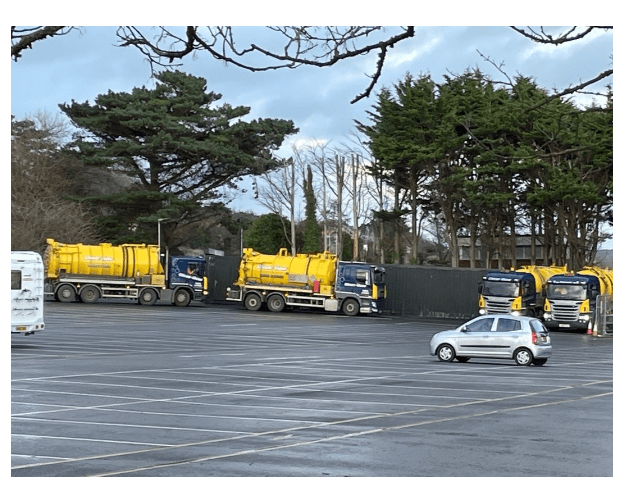
Up to 250 journeys were made every day by tanks moving sewage through Exmouth (Escape)

South West Water (SWW) is facing the anger of residents of Exmouth, east Devon, who say the company’s “deplorable” actions led to the overspilling of more raw sewage into the sea just a short distance from the town’s popular sandy beach.

The situation in the seaside resort triggered an investigation by the Environment Agency, which also warned swimmers not to go into the sea until 8 January.

Geoff Crawford, the founder of End Sewage Convoys and Pollution Exmouth (Escape), said the water company had put its financial interests ahead of the environment, and had left the town “on edge” over sewage pollution.

He added: “People weren’t aware of the problem, but then the convoy of tankers moving raw sewage through the town really brought it home, then there was the notification of overspilling into the sea and the closure of the beach.

“There is a general anxiety across the town. It’s clear sewage was sent to an overflowing pumping station and dumped into the sea.”

Susan Davy, chief executive of the company, told a special meeting with councillors and other angry locals on Thursday evening: “It’s my job to ensure we walk in the shoes of our customers, and for the residents in and around Exmouth we haven’t done that, and I’m sorry.

“That’s not to say that my team and I don’t care – we do. But it’s right that I take responsibility and accountability for South West Water’s actions. For disturbing the community and having an impact on the environment I’m truly sorry.”

Mains Burst what happened?

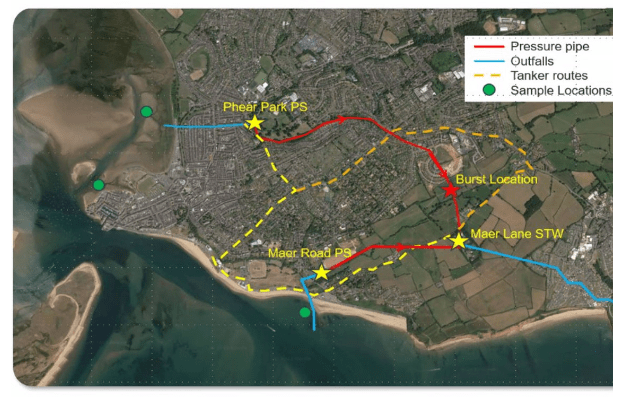
A South West Water map of the local area and tanker routes (South West Water)

One resident claimed there had been an unprecedented number of reports of people and dogs falling ill since the spills.

Dan Wilson, a town and district councillor, said after years of failure by South West Water, if he had been in charge, he would resign.

Asked whether she would stand down, Ms Davy said she was confident the company had the right team in place, after managers outlined plans for £38m of investment in infrastructure over the coming years.

SWW has already faced criticism for pollution during a drive by the government to cut the number of illegal spills. It was fined £2.15 million last year for issues across Devon and Cornwall.

Last week, John Halsall, chief operating officer of the firm, issued a “heartfelt apology” to residents in a video posted on the company’s website, but denied the company had “caused environmental impact” by sending sewage to an overflowing pumping station.

The issue began when flooding on 30 December forced the transportation of waste in tankers from a Phear Park Pumping Station to Maer Road Pumping Station.

The lorries had previously been taking the waste to Maer Lane Sewage Treatment Works due to a burst in a pipe linking the sites.

But the flooding, plus a promise not to send tankers through a village, led to the decision to use Maer Road Pumping Station as the destination for up to 240 sewage-filled vehicle journeys a day.

Only after a “brief period of time”, according to Mr Halsall, said to be four days, did the company redirect the lorries back to the treatment works.

Mr Halsall said: “In the end we had to say, and apologise to local [village] residents and say we’ve got no choice, we just need to tanker through the village and that’s what happened.”

But for the campaigners in Exmouth, that decision came too late after, they say, more sewage was added to the overflow coming from Maer Road Pumping Station into the sea.

Mr Halsall told the meeting he offered a sincere apology for the disruption. “I know exactly what it feels like – I’ve seen the tankers and the mess.

“When the rising main burst, it was pouring with rain and we were up against it. I’m genuinely sorry for the tankering and the first burst.”

He said pollution from the first burst did affect beaches but it was less clear whether the second one caused material pollution, saying the company had chosen “the least worst” option.

Asked whether in hindsight the decision was wrong, he said he was not sure they would do anything differently.

There were no visible indicators the main was vulnerable to bursting or required replacement, he said.

At the start of January, the Environment Agency told the BBC that SWW informed it “that for operational reasons they were having to tanker waste to another pumping station that was already overflowing”.

In a statement to The Independent, a spokesperson said: “South West Water has now resolved the issue and their pumping station is back in operation. We take all pollution incidents extremely seriously and are currently investigating this case.”

Mr Crawford, who swims in the sea of Exmouth to help with anxiety, said data published online by SWW showed waste overflowed from Maer Road Pumping Station for several days during the tanker deliveries. The current reading shows the last overflow was for 10 minutes on 5 January.

He said: “We are trying to capitalise on this to push SWW to make the necessary improvements to its network to ensure this never happens again.”

In the video message, Mr Halsall said the use of tankers was to reduce the environmental impact caused by the burst pipe.

He added: “On no occasion have we created additional environmental impact as a result of the tankering.

“Now, in the spirit of transparency, have the bursts caused environmental impact? Unfortunately, yes they have… as soon as we started tanking the environmental impact stopped.”

An SWW spokesperson told The Independent that an installed temporary pipe meant tankers were no longer needed to move sewage across the town.

They added: “We would like to again thank local residents for their continued patience whilst the works are taking place and we are sorry for any inconvenience this has caused.”

Does Simon Jupp smell the sweet scent of fear?

Just under a year ago, in February 2023, Simon Jupp announced he was abandoning 78% of his current constituents as he jumped ship to become the Tory candidate for the new seat of Honiton and Sidmouth.

By June he was “on manoeuvres” on Richard Foord’s turf, trying to gain “face recognition”.  

As Claire Wright wrote on “X” : After months of claiming credit for @RichardFoordLD work, Simon Jupp lodges actual formal complaint against Richard for raising in Parliament, the tragic case of #Ottery victim of the #HorizonScandal

This prompted a number of comments including: “The absolute shameless politicising here is by @simonjamesjupp who has done sod all for Ottery or East Devon whilst openly campaigning in his new target seat. How many times did he raise Horizon before the TV programme made it an issue? #ToriesBrokeBritain

Row after accused Devon subpostmaster’s death raised in Parliament

Lewis Clarke www.devonlive.com 

Two rival MPs clashed over the case of a former Ottery St Mary resident who died before being cleared of false accusations in the Horizon scandal.

The Horizon scandal refers to the faulty IT system used by the Post Office, which wrongly showed shortfalls in the accounts of thousands of subpostmasters, leading to some being prosecuted, sacked, or bankrupted.

Richard Foord, the Liberal Democrat MP for Tiverton & Honiton, who has announced he will be standing as the candidate for the newly formed Honiton & Sidmouth seat in the next general election, raised the issue during a question session to the Parliamentary Under-Secretary of State for Business and Trade, Kevin Hollinrake.

Mr Foord said: “Russell Ward-Best from Ottery St Mary was accused of stealing £17,000. He avoided prosecution by resigning, and another sub-postmaster I represent paid the alleged shortfall to avoid prosecution. Russell Ward-Best was declared bankrupt and died before he was found innocent and cleared. Will the Minister comment on financial redress for all sub-postmasters and their families, including those who were not prosecuted?”

Mr Hollinrake expressed his sympathy for Mr Ward-Best and his family, and said they should be able to get compensation through the historic shortfall scheme, which is designed to reimburse subpostmasters who suffered losses due to the Horizon system.

He said: “That scheme is there to put Mr Ward-Best, if he were still with us, back to where he would have been had this detriment not occurred, and that can take into account things such as bankruptcy. That money would then be paid to his estate, which would then flow through to his family. The same compensation is available, despite Mr Ward-Best very sadly no longer being with us.”

However, the exchange sparked a furious reaction from Simon Jupp, the Conservative MP for East Devon, who is also vying for the Honiton & Sidmouth seat. He accused Mr Foord of politicising the death of Mr Ward-Best, and said he hoped he had informed the family beforehand to avoid further hurt.

He took to X (formerly known as Twitter) to write: “Earlier in Parliament, Richard Foord shamefully tried to politicise the death of a former Ottery resident in a question regarding the Horizon scandal. I hope he had the courtesy to inform the family beforehand to avoid further hurt. I’m making a formal complaint to the Speaker.

“Richard is not the MP for Ottery St Mary, but is launching his campaign there. I understand you may not know this, given you are quite far away, but nothing excuses this shameless politicising from a sitting MP from your party.”

This is not the first time the two sitting MPs have exchanged fiery words. In December, Mr Foord referred to Mr Jupp as ‘member for Exmouth ’ in a debate, to which Mr Jupp demanded an apology, saying: “He referred to me as the MP for Exmouth, but my constituency also includes Sidmouth and I should be referred to as the MP for East Devon. He has done this politically in local newspapers and leaflets.

“I seek an apology for my constituency being named incorrectly, and a promise from the hon. Gentleman that he will not do so again.”

Mr Foord did not respond to Mr Jupp’s request.

Spend or save – Jeremy Hunt unable to tell Martin Lewis how public can help economy 

Jeremy Hunt was unable to tell Martin Lewis whether the public should save or spend money to help the economy.

Holly Patrick www.independent.co.uk

The chancellor was grilled by the MoneySavingExpert founder on his eponymous ITV show broadcast on Tuesday (9 January).

Mr Lewis pressed Mr Hunt on whether a “good citizen” should spend money to boost the economy or save to keep inflation down.

“I pride myself on always giving people direct answers to questions, but I’m not going to answer that one… that is very, very individual,” Mr Hunt responded.

UK builder Taylor Wimpey warns of tough market despite drop in mortgage rates

Britain’s Taylor Wimpey (LON:) on Thursday said the housing market remained uncertain in the near term, reflecting a cautious stance ahead of the key spring selling season.

uk.investing.com 

Britain’s housing sector is hoping to see some relief as mortgage rates appear to have peaked with markets betting on Bank of England rate cuts later this year, but wider economic challenges have dented hopes of a robust recovery.

Taylor Wimpey joined mid-cap rival Persimmon (LON:) in underscoring challenging trading conditions in 2024 despite signs of the housing market slowdown easing and refrained from providing any forecast on 2024 profits and build targets.

“Looking ahead, it is encouraging to see a reduction in mortgage rates, however, in the short term, the market remains uncertain and the planning backdrop extremely challenging,” CEO Jennie Daly said in a trading statement.

Shares in the company fell 0.5% in morning trade.

The company reiterated its 2023 operating profit expectations for the year ending Dec. 31 2023.

Taylor-Wimpey said its year-end order book, a key measure in gauging short-term sales performance, excluding joint ventures stood at 1.77 billion pounds ($2.3 billion), compared with 1.94 billion pounds a year earlier.

Analysts at Hargreaves Lansdown (LON:) said in a note that the message from Taylor Wimpey and Persimmon was that the market remained tough: “Like so much else these days, an awful lot is hanging on the future path of interest rates”.

Taylor Wimpey, which also has a minor presence in Spain, said it built 10,438 homes in Britain, including joint ventures, in 2023, within its target range.

The group’s finance director Chris Carney told analysts on a call that the company expects the first-half average selling price to be similar to the 320,000 pounds average reported a year ago.

The company expects underlying build cost inflation of about 4% on completions in the first half of 2024.

Jake Berry took on Ian Hislop – it didn’t end well

On ITV’s ‘Peston’ the two clashed over the Government’s response to the Post Office scandal

Ian Hislop is one of life’s good guys. As the long-serving editor of Private Eye, he has been relentless in his commitment to uncovering the truth about the Post Office scandal. This deserves real recognition.

Jordan Tyldesley inews.co.uk 

The Post Office scandal shows that journalists like Hislop are vital in an environment where powerful people think they can ride roughshod over the Alan Bateses of this world – decent people thrust into the spotlight and forced to fight against a powerful establishment that will crush anything or anyone when necessary. Under his editorship, Private Eye pursued the biggest miscarriage of justice in modern British history for more than a decade.

Compare that, if you will, to Tory MP Sir Jake Berry who recently used his social media platform to ask the public an utterly inane question about the strategic timing of supermarkets stocking Easter eggs.

Last night on ITV’s Peston the two clashed over the Government’s response to the scandal. Hislop raised an important question: why did it take an ITV drama to spur politicians into action?

After Hislop made the argument that executives involved in the Post Office during its time of complete and utter failure should have to pay their bonuses back, Berry proudly asserted: “One thing we do control is their massive taxpayer-funded pensions. We do have control of that and we can pass an emergency piece of legislation – a parliamentary pardon – why can’t we do the same thing with their pensions?” Bish, bash, bosh.

Hislop exasperatedly replied: “Well, why couldn’t you do it so long ago? The fact that it takes an ITV drama and suddenly [the sub-postmasters and mistresses], having been told their entire campaigning lives, ‘this is very difficult … you’ll have to go in front of a judge… this is very, very expensive … oh, this morning it isn’t, tomorrow we’ll pass legislation and you’re all exonerated.’ I mean it is absolutely fatuous.”

It is frightening that good, honest, innocent citizens can be dragged to Hell and back by our institutions and yet elected representatives, on the whole, only spring into action when it becomes politically embarrassing. What, then, if ITV hadn’t made this drama? Must we all rely on Toby Jones for justice? The delayed response to this unfathomable wickedness is not just shameful but chilling.

Another crucial question from Hislop was: “Why did you give [Paula Vennells] a CBE in 2019?” It is bewildering how someone can oversee such cruelty on an industrial scale and then be bestowed our nation’s supposedly finest honour. We need more Hislop’s in the media and beyond. People who are willing to upset the status quo. A willingness to challenge authority and ask the questions that really matter.

Let the Post Office scandal be a watershed moment in Britain: we’re mad as hell and we’re not going to take this any more.

[Video clip below, you may need to unmute and rewind]