Devon and Cornwall police tenth worst force in England and Wales

An in-depth inspection of all 43 police forces in England and Wales across eight criteria  in 2021/22 shows shocking results for Devon and Cornwall.

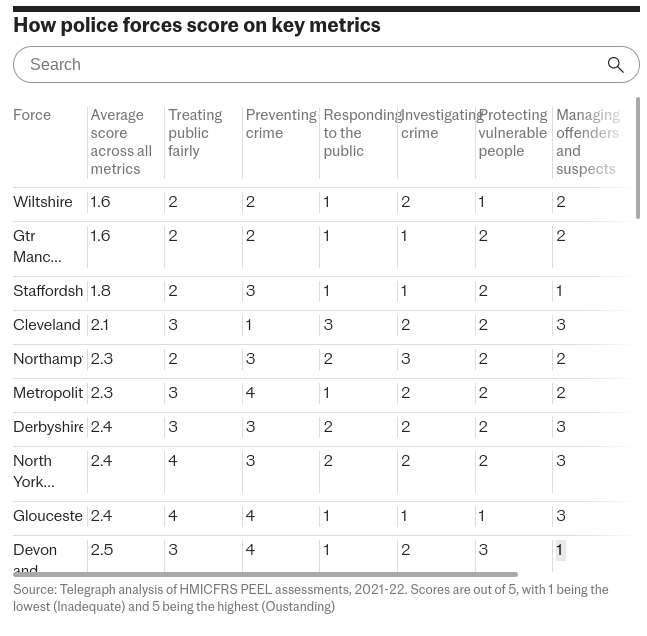
Devon and Cornwall police rank tenth worst on these measures with an average across all metrics of 2.5. Scores are out of 5 with 1 the lowest and 5 the highest. Wiltshire scored worst with an average score of 1.6 and Humberside the best with an average of 4.8.

Devon and Cornwall scored badly in responding to the public, and managing offenders and suspects, with a score of 1. It only got a 2 for investigating crime, and strategic planning and value for money. 

Step forward Conservative Hernandez who was first appointed commissioner in 2016!

Where’s the congratulatory selfie?- Owl 

Half of police forces not investigating crime properly

Charles Hymas, Home Affairs Editor www.telegraph.co.uk

More than half of police forces are failing to investigate crime properly, according to official watchdog reports.

Of the 43 forces in England and Wales, 22 were judged by inspectors to be “inadequate” or “requiring improvement” in investigating crime – the two worst performance ratings.

They face an investigation by His Majesty’s Inspectorate of Constabulary next year into the failings that have caused the proportion of crimes solved to plummet to record lows.

Forces have missed leads that could have solved burglaries, thefts and assaults, and failed to arrive at crime scenes promptly to recover evidence or catch suspects, according to the reports.

The watchdog told The Telegraph that many forces faced “real challenges in answering and dealing with emergency calls in a timely manner” and that an “unacceptably low” number of crimes was being solved following investigations.

“If the police are to rebuild public trust and confidence, it is vital that forces work quickly to rectify these issues and provide the high level of service that the public deserves,” said a spokesman for the inspectorate. “We intend to carry out a thematic inspection of police investigations in 2024.”

Home Office figures show that just one in 18 offences reported to police led to a suspect being charged in the year to June 2023, compared with one in six a decade ago.

The explanation for those figures is provided by in-depth inspections of all 43 forces in 2021/22 across eight criteria. In particular, these assessments cover their effectiveness in investigating crime and responding to the public including how quickly officers are despatched to crime scenes after 999 calls.

Humberside emerged as the best force in Britain across the eight criteria, followed by South Yorkshire, West Yorkshire, Durham and Leicestershire.

The six worst in 2021/22 were Wiltshire, Greater Manchester, Northamptonshire, Staffordshire, Cleveland and the Met, three of which are in special measures. Greater Manchester was taken out of special measures in October last year.

Find out how your local force performed with our search tool below.
Responding to the data, a Home Office source said ministers expected a “zero tolerance” approach to all crimes by police, with forces having agreed in September to follow up “every line of enquiry for all crimes – without exception”.

The source said: “Since March, there have been record-ever numbers of police and over half a billion pounds extra invested. These extra resources must deliver a significant increase in the number of crimes solved.”

It comes as new figures reveal police abandon investigations into four crimes every minute without tracking down the perpetrators.

Forces gave up on investigations into 2,306,623 reported crimes in the year to June – including hundreds of thousands of violent offences and burglaries – marking an increase of nearly 13 per cent on the previous year

The official Home Office figures, seen by the Daily Mail, are equivalent to more than 6,300 every day on average, or one every 14 seconds.

No force rated ‘outstanding’

Forces are ranked on metrics including looking after their workforce, providing value for money and treating the public with respect, but when judged on investigating crime alone the ratings fall.

They scored worse on these metrics than other criteria such as preventing crime, treating the public with fairness and respect, and value for money.

Not a single force was rated as “outstanding” in either investigating crime or responding to the public. Outstanding is the top of five levels of performance, which then go through good, adequate, requiring improvement and inadequate.

Three forces were ranked inadequate for investigating crime, with 19 judged as “requiring improvement”. Eight were assessed as “inadequate” in responding to the public, and a further 17 found to be “requiring improvement”.

The Telegraph analysis was based on inspections from 2021/22, covering all 43 forces over the same period to allow a fair comparison.  The performance of five forces – the Metropolitan Police, West Midlands, Devon and Cornwall, Staffordshire and Wiltshire – is of such concern that they are currently in special measures.

So far, nine forces have had updated ratings after further inspections for the 2023-25 period. Of these, five are deemed to have got worse at investigating crime, including Thames Valley, Surrey, Merseyside, Durham and West Midlands, which has declined to inadequate. Only one – Greater Manchester – improved.

Six have had their scores for responding to the public worsen, including Suffolk and Surrey, whose ratings dropped from “adequate” to “inadequate”. Greater Manchester jumped from “inadequate” to “adequate”.

The National Police Chiefs’ Council said all forces strived to deliver the best possible service and the inspections showed most were “performing well”.

A spokesman said: “However, whenever a force falls short in a certain area, we will work with them, alongside His Majesty’s Inspectorate, to ensure that the necessary improvements are made.”


Newton Abbot general election will be “two-horse race”

The Labour Party’s decision to put Newton Abbot on its list of ‘non-priority’ general election constituencies has been welcomed by the man who wants to wrest the seat from the Tories.

Guy Henderson, local democracy reporter www.radioexe.co.uk

Lib Dem Martin Wrigley, who leads Teignbridge Council, will stand at the  election expected in 2024, aiming to unseat Tory MP Anne Marie Morris.

In the autumn, Labour published a list of seats where it isn’t planning to campaign vigorously, including Torbay; Honiton and Sidmouth; Tiverton and Minehead; Torridge and Tavistock and North Devon.

Now it has updated the list, with all the remaining Devon seats apart from those in Plymouth, Exeter and Totnes among them. It means they are among 211 seats which Labour does not consider to be its key battlegrounds.

The Lib Dems, with Mr Wrigley as their candidate, came second to the Tories in Newton Abbot at the last general election, and Mr Wrigley said the two parties would face off again.

He said: “This constituency will be a two-horse race between the Liberal Democrats and a desperately out-of-touch Conservative party.

“With our local health services at breaking point, local rivers being destroyed by sewage and hardly any local crimes being solved, people have told me it’s time for change.

“The Conservative party is too busy fighting amongst themselves to govern this country. They are taking people here for granted and failing to deliver for our communities.

“Enough is enough.”

Mr Wrigley came second to Ms Morris in the 2019 election, the last time the whole country went to the polls. The Conservative MP had a majority of 17,501 and Labour candidate James Osben finished third.

Weather changes causing chaos for UK flora and fauna, says National Trust audit

The disappearance of reliable seasonal patterns is causing chaos for the flora and fauna of the UK, a long-running annual audit of the impact of weather on nature has found.

Steven Morris www.theguardian.com

Extreme weather events, from storms and pounding rain to searing heat and drought are putting huge pressure on animals, plants and the environment, the report from the National Trust says.

The conservation charity is urging politicians to prioritise “urgent action” to protect nature and people from future climate shocks and says parties should commit to making changes in their manifestos for the next UK general election.

Ben McCarthy, the head of nature and restoration ecology at the National Trust, said: “The shifting weather patterns we’re seeing, particularly the warmer temperatures, is continuing to upset the natural, regular rhythm of the seasons. This loss of predictability causes chaos for the behaviours of animals in particular, but can also impact trees and plants.”

The National Trust gave a long list of species that have suffered in the last 12 months, including oak trees, which are increasingly vulnerable to the oak processionary moth, whose caterpillars infest them. The lack of prolonged cold snaps in recent years means the moths have spread northwards from their traditional home in the Mediterranean.

Another troublemaker doing well is the heather beetle, which is killing off swathes of the heathland plant in some areas. A drone survey of Dunwich Heath in Suffolk revealed a 60% loss in heather.

The warmer winters means hibernators such as dormice are emerging from their torpor too early and using up vital energy stores. It is also leading to red deer rutting later, meaning calves are born in the summer rather than the spring, with insufficient time to grow and put on fat reserves to survive.

According to the trust, some of the rare lichens and liverworts that grow in the temperate rainforest at Lydford Gorge, on the edge of Dartmoor in Devon perished because of the lack of water last winter.

But then water voles were driven from flooded burrows when the torrential rains have come in, putting them at increased risk of cold, hunger and predation.

McCarthy, said: “These baseline changes that we’re seeing are really worrying and what we should be taking more notice of, particularly when combined with extreme weather events, which makes things even more challenging.

The autumn storms, Babet and Ciaran, caused havoc, knocking down trees including a 260-year old Cedar of Lebanon at Charlecote Park in Warwickshire and eroding river banks and beaches.

One of the consequences of the storm just coming to light is the possible impact on the population of the shags, the seabirds that look similar to cormorants that live and breed on the Farne Islands in Northumberland. There are hardly any birds in the winter roosts on the islands, with a number of dead birds being washed up on the islands. It is thought Babet disrupted their ability to feed and led to starvation.

There were scraps of bright news. Record-breaking numbers – at least for recent years – of choughs were spotted in Cornwall with a 60% increase in the number of chicks on 2022. The elegant crow is a symbol of Cornwall but became extinct and is back on the rise.

At Formby in Merseyside, rangers recorded the first emergence of natterjack toadlets since 2020 in May with approximately 150 counted across the site.

The rare black oil beetle was spotted at Kinver Edge in Staffordshire for the first time in nine years. The sandy soil there suits burrowing insects such as solitary bees, whose nests and eggs the oil beetle feeds on.

Persistent rain in July and the warm, wet conditions that continued into the autumn were ideal for waxcap grassland fungi. One, the dark velvet fanvault was found at Hardcastle Crags in West Yorkshire, the first record of it in the UK.

Butterflies and moths on the whole seem to have had a better year than expected, considering last year’s drought. Staff noted record-breaking numbers of the Heath fritillary butterfly on the Holnicote Estate on Exmoor in Somerset.

But the charity’s audit, which it has been carrying out for 15 years, makes gloomy reading overall.

“We need to see more action from politicians, particularly as we enter this election year, to ensure tackling the nature and climate crisis is a top priority,” said McCarthy.

“We want to see parties commit to accelerating progress on nature restoration, increase support for nature-based solutions to climate change and to put climate adaptation at the heart of their manifestos, so the UK can be better prepared for the weather extremes we will increasingly experience.”

Government to reintroduce the pint of champagne!

What every hard pressed family needs! Cheers – Owl

Johnson’s imperial measurements plan scrapped – but pints of champagne will return

Champagne and other wines will be sold in pints for the first time in decades under a new Government plan to take advantage of Brexit freedoms.

Hugo Gye inews.co.uk

The range of bottle sizes which can legally be sold in the UK’s shops will be expanded some time next year, the Department for Business and Trade has said.

It will include the return of the pint of champagne, which is said to have been Winston Churchill’s favourite measure.

But the Government has stopped short of a post-Brexit overhaul of the measurements system in general, after nearly 99 per cent of those responding to a consultation said they wanted to stick with the metric system.

Proposals to remove the requirement to display metric measurements on most products, or allow retailers to display imperial measurements more prominently, have now been abandoned.

The proposals made by Boris Johnson were denounced at the time as “nostalgia”.

The sale of pints of champagne, which became illegal when Britain joined the EU, has long been championed by Brexiteers such as Sir Jacob Rees-Mogg – although some champagne houses have said they will not start selling their products in new bottle sizes after the regulations change.

Under the new rules, it will be legal to sell still and sparkling wines in 200ml, 500ml and 568ml sizes – the latter being the equivalent of a pint in metric terms – as well as the more usual full and half bottles.

There will be no obligation on producers or retailers to stock the new sizes, and the regulations do not apply to pubs or restaurants, which operate under a different set of rules.

Business minister Kevin Hollinrake said: “Innovation, freedom and choice – that’s what today’s announcement gives to producers and consumers alike. Our exit from the EU was all about moments just like this, where we can seize new opportunities and provide a real boost to our great British wineries and further growing the economy.”

Nicola Bates, the head of WineGB, added: “We welcome the chance to be able to harmonise still and sparkling bottle sizes and we are happy to raise a glass to the greater choice that allows UK producers for domestic sales.”

After the UK entered the EU in the 70s, most measurements were legally changed to metric although a number – including pints in pubs and miles on road signs – remained in the traditional imperial system.

Some Brexit campaigners have previously argued that the ability to use more imperial measurements is one of the major benefits of leaving the European single market.

But when Mr Johnson launched the consultation in May 2022, Labour MP Angela Eagle accused ministers of “attempting to weaponise nostalgia for a time few can remember and even fewer wish to return to”, while Tory backbencher Alicia Kearns said: “Not one constituent, ever, has asked for this.”

Tories accused of overseeing ‘pothole pandemic’

Sixty-three claims for pothole-related damage were made by motorists every day last year, the Liberal Democrats have said.

Dominic McGrath uk.news.yahoo.com

The party has called for road maintenance budgets to be fully-restored by the Government, accusing the Conservatives of overseeing a “pothole pandemic” on English roads.

Data from 85 local authorities in England, obtained by freedom of information requests, shows that compensation paid to motorists reached £1.77 million in 2022/23 – a slight rise on the previous year.

The Liberal Democrats said that the number of pothole claims has grown significantly in the last year, with 23,042 in 2022/23 compared with the 13,579 recorded the previous year.

Housing and Communities spokeswoman Helen Morgan said: “This Conservative Government has overseen a pothole pandemic on our roads. It’s now become almost impossible to drive in some parts of the country without having to swerve to avoid potholes.

“This has led to thousands of drivers having to claim for damage to their vehicles or even personal injury caused by crater-filled roads.

“The Government is firmly to blame for this failure to maintain our roads properly after having slashed funding for local road repairs.

“Cash-strapped councils are being left without the funding to maintain roads properly while having to shell out thousands of pounds in pothole payouts.

“Local authorities need to have their highway maintenance budgets urgently restored so that we can end this vicious cycle of pothole payouts and poorly maintained roads.”

A Department for Transport spokeswoman said: “We are investing an extra £8.3 billion to resurface roads across the country, the biggest ever funding increase for local road maintenance.

“This is enough to resurface more than 5,000 miles of roads and is on top of the more than £5.5 billion that we have already invested in highway maintenance.”

Only active public investment will cure Britain’s ills 

Observer editorial www.theguardian.com 

The economy will end the year on the brink of recession and it is not hard to see why. After 13 years of Conservative misrule that reached its nadir last year during Liz Truss’s brief tenure as prime minister, the country is crawling towards a light that flickers dimly. Even the so-called recovery since Truss’s calamitous mini-budget has proved a mirage. Official figures on Friday showed that the economy shrank in the summer, when previous estimates told a story of modest growth. The signs are already flashing red for a further contraction in the autumn and winter months.

If a technical recession – one that charts a decline in gross domestic product (GDP) across a six-month period – comes to pass, it will reveal that Rishi Sunak’s mix of income tax rises and public sector cuts have backfired, as many experts said they would, leaving the UK worse off in almost every way possible.

The average family has very little spare cash with which to pay bills and afford a celebration at Christmas. A government devoid of ideas has sapped the life out of the private sector in the same way that its dogmatic adherence to austerity has hobbled investments in much-needed public services. Companies are reluctant to invest in the UK after more than a decade of stop-start planning that accompanied one of the most disastrous economic decisions that parliament was in a position to make – leaving the EU’s single market and customs union. Neither the Bank of England nor the Office for Budget Responsibility, the Treasury’s independent forecaster, have changed their minds about the huge hit to the UK’s trade and investment from Brexit.

A recession won’t trigger the usual dramatic rise in unemployment or a major spike in company failures. It will feel more like a prolonged period of stagnation.

For some Tory backbench MPs a long period of zero growth may seem more palatable than maintaining alliances with our European trading partners, but the situation leaves Sunak’s administration with only meagre resources to tackle the great issues of the day.

In every direction the government turns, there is a neglected area of the public sector desperate for support from Whitehall. And these public services, which provide the backbone of the economy and, never let it be forgotten, allow private firms to operate, don’t just need cash. They need an administration that is prepared to rethink how those services might be provided in a digital world, with the added complication that digital advances exclude millions of people from the community of users. But this rethink cannot rely on yet more doses of privatisation, as we show has happened in the care sector, where analysis of official data by the Observer reveals a dramatic rise in the number of centres providing care for vulnerable children that are fully or partially controlled by investment companies.

We have a housing crisis that depends on private sector property developers building the homes Britain needs, when it is clear they will only drip feed properties into areas at a pace that maintains prices.

There is a shortage of dentists in large parts of the country following the almost total collapse of dentistry inside the NHS for anything other than the most dire emergencies. Hospitals remain hampered by strikes, while the health ministry conducts a war with junior doctors. US health firms are waiting in the wings to capitalise on the public’s growing distrust of health services provided by the state, as they did in the 1990s when John Major’s privatising government chipped away at the NHS.

A programme for new hospitals announced by Boris Johnson has gone the same way of so many Johnsonian promises, while school repairs, despite a succession of ministerial pledges, are delayed again and again. Local councils are going bust at an alarming rate as they confront the spiralling costs of adult and children’s services, many of which they are legally obliged to provide. It’s true that the first batch of councils to declare themselves technically bankrupt – Tory and Labour – had made investments that went sour, or, like Birmingham, embarked on costly legal action.

But for the many councils warning that they too are likely to declare themselves bust, the theme is solely about budgets knocked sideways by the impact of inflation and the rising number of people – children and adults – falling into the arms of council officers when there is nowhere else to turn.

Britain needs an activist state that takes on some of the heavy lifting in the search for ways to provide public services, and without simply pouring extra cash into tired old systems and processes, often dating back several decades.

This level of engagement is anathema to the current Tory party, as it is in other areas of public policy. The Tories cannot see any other solution than a private one, even when it is clear that the corporations hungry for deals with the state are interested only in short-term profits, and not the long-term health of the economy.

Call for action over river pollution

 South West Water has been urged to do more to protect Devon’s vulnerable rivers from sewage and pesticide spills.

Guy Henderson, local democracy reporter www.radioexe.co.uk

Officials from the company and the Environment Agency faced questions from South Hams Council’s overview and scrutiny committee over issues ranging from pollution and water quality to household water bills and nationalisation.

Council chairman Guy Pannell (Lib Dem, South Brent) said the number of discharges of untreated sewage into the River Avon at Diptford had risen to 119 in 2022 from 83 last year.

The Avon had been ‘named and shamed’ by the Wildlife Trusts as being among the country’s 20 rivers most at risk from human and farm sewage, pesticides and fertilisers.

”The Wildlife Trusts chief executive described it as a national disgrace,” said Cllr Pannell.

“I feel very ashamed that my beautiful river is being called a national disgrace.”

And Cllr Matt Steele (Lib Dem, Ivybridge East) said there had been only two days in the past two months when there had been no sewage ‘dumps’ into the River Erme.

“Residents are incensed by seeing sewage flowing through the centre of Ivybridge,” he said.

South West Water’s director of external liaison Alan Burrows told councillors: “No pollution is good pollution.” And he said the company had learned from previous cases.

Serious pollution incidents had fallen, he said, and SWW was aiming for zero by 2025.

Pollution from storm overflows was also reducing, he claimed, and the South Hams had good quality bathing waters.

Clarissa Newell, the Environment Agency’s area manager, said there had been a huge improvement in water quality in the last 20 years, and the district’s bathing waters were the best they had ever been.

“The South Hams is in a really good position for quality of water,” she said. 

Cllr Pannell asked what measures SWW was taking to address water shortages such as the one which caused a hosepipe ban last summer, and  if the company had plans for new reservoirs.

Mr Burrows said there were new resources such as a desalination plant and new water mains in Cornwall. Water from a new reservoir in Somerset could be pumped anywhere in the network. He also said households could be encouraged to use less water.

Cllr Pablo Munoz (Lib Dem, Ivybridge West) asked why, when SWW’s parent company Pennon was paying billions of pounds to shareholders, westcountry households paid the highest water bills in the country.

The company’s director of asset management Mark Worsfold said shareholders expected a return on their investment.

He went on: “If we didn’t give them their dividend, they wouldn’t give us their money, and we wouldn’t be able to fund our investment programmes. They would take their money and put it somewhere else where they would get a higher return.”

Councillors asked if the water industry should be nationalised again rather than being in private hands, but Mr Burrows pointed out that if that happened, it would have to compete for funding alongside education, the NHS, social housing and other government budgets.
 

Seasonal Greetings from Owl

(And one from South West Water as reported by the BBC)

South West Water (SWW) is urging people to give “the region’s sewers a fat-free Christmas” by not pouring greasy substances down drains.

In 2022, bosses said the utility dealt with more than 7,000 blocked sewers – with more than 20% of them caused by greasy substances being poured down drains.

SWW said the substances could clog up pipes and, if left unchecked, could cause waste to back up into homes.

Andrew Blake, project manager at SWW, said: “It’s important to ensure that festive roasting juices, gravies, sauces, and creams are not being poured into the sewers.”

He said: “The Christmas season can be challenging for our sewers due to the increased fat and food waste generated by food businesses and households accommodating more guests.

“While we want everyone to enjoy themselves, we also want to encourage kitchen staff and householders to be mindful of what they’re putting down their drains.

“By changing your practices, you can easily help prevent blockages and avoid damage to properties, sewers and the environment.”

A Christmas Carol: an update by Mike Temple

A Christmas Carol: an update (31.12.21)
(from Fables for Our Times – Mike Temple)

Once in Little-Britain City
Lived a Tory known as Scrooge.
Stranger he to Truth and Pity
But his assets were quite huge;
His cash was tax-free, stashed offshore.
He didn’t care about the Poor.

He cut their benefits and “credit”,
Ignored the homeless at his door;
“Want” was “humbug” (yes, he said it).
His friends grew richer than before.
Bob Cratchit was this Tory’s stooge,
Kept on low pay by the said Scrooge.

Bob Cratchit on his low wage went
To nearby Food Banks every week.
He spent so much on heat and rent
His prospects did look very bleak,
While for his son called Tiny Tim
The future really did look grim.

At Xmas-time Scrooge went to bed
But didn’t sleep a wink at all;
He’d drunk a lot and was well fed
But saw a Ghost upon the wall
Who oped his cloak, and what Scrooge saw
Were kids called “Ignorant” and “Poor”.

This Ghost was from the Tory Past,
From just about three years ago;
The kids were mean, also low-classed
And marked with misery and woe.
They looked at Scrooge as if to say:
“Your policies turned out this way.”

Next night our Scrooge was sleeping when
The Ghost of the Time-Present came
Who showed the children once again –
It was indeed a crying shame –
The kids were hollow-eyed and thin
With little flesh, just bone and skin.

The third night’s Ghost from Future Time
Brought on the double-act once more,
Both skeletons – it was a crime
And done by those who’d made them poor.
The “Poor” kid now was Tiny Tim
And millions more were just like him.

Reform UK to challenge Tories in every seat at general election

Simon Jupp, who is self-isolating from those living in the real world, won’t know which way to turn.

Tories could face a Canadian style wipe-out.  – Owl

Harry Yorke www.thetimes.co.uk 

The leader of Reform UK has privately given his senior team “cast-iron guarantees” that general election candidates will not be told to step aside for Tory opponents in a move that could split Rishi Sunak’s vote in key seats.

Richard Tice has offered written assurances to key party figures that they will fight the Conservatives right up to polling day.Reform has already selected candidates for 440 seats and intends to stand in all constituencies bar those in Northern Ireland.

It fought the 2019 general election as the Brexit Party, led by Nigel by Farage, changing its name afterwards

It posed a significant threat to Boris Johnson’s chances of winning a majority — until Farage decided to stand down 317 candidates to help ensure Jeremy Corbyn did not secure the keys to Downing Street. While Farage said he had put country before party, it caused significant anger among many Brexit Party candidates and supporters.

Tice, who took over as leader from Farage — currently Reform’s honorary president — has vowed not to repeat the move next year. He has given “concrete” assurances in writing to members of his top team and several parliamentary candidates who have been recently recruited. They include Ann Widdecombe, the former Conservative minister who is now Reform’s spokeswoman on immigration, and Ben Habib, its co-deputy leader.

The commitment was intended to convince many of the party’s high-profile figures that it is serious about fighting a major campaign at the next election. Several, including Habib and Widdecombe, are former Brexit Party MEPs who have rejoined in recent months after the promises were made.

Tice told The Sunday Times: “In the 2024 election year we will be ready whenever it comes, spring, summer or autumn. We will be standing in seats everywhere in England, Scotland and Wales. Many, including Tory MPs and commentators, still don’t believe us, but I have news for them: you are seriously underestimating our intent to have a massive impact in this coming election.”

The disclosure of Tice’s tactics poses another major headache for Sunak, whose party trails Labour by as much as 20 points in the polls and appears increasingly to be heading towards a landslide defeat.

Reform, meanwhile, is polling at around 9 per cent, with Conservative MPs concerned the rival party threatens to erode their vote share still further.

While Reform’s current polling numbers suggest it will not take seats directly from the Tories, it could steal enough Conservative votes to hand dozens of tight marginals to Labour. This has already been demonstrated in two recent by-elections in mid-Bedfordshire and Tamworth, where the number of votes cast for Reform was greater than the Labour majority.

A recent analysis by the pollster More in Common suggests support for Reform at the ballot box could cost the Tories 35 seats. These are likely to be pro-Brexit areas in the north and Midlands. Reform’s popularity is expected to grow in the new year, amid mounting speculation that Farage is preparing to return to frontline politics after his widely publicised stint on I’m a Celebrity … Get Me Out of Here!.

Farage and Tice have been speaking regularly since the former’s return from Australia and over Christmas are expected to discuss Farage’s “future role” in Reform. Tice is to hold a press conference on January 3, setting out Reform’s plans for the coming months, with Farage this weekend remaining tight-lipped about whether he will attend.

Tice is expected to use the event to ratchet up his attacks on the Conservatives while also seeking to appeal to pro-Brexit voters in “red wall” seats, who remain reluctant to return to Labour.

“Our view is that the toxic Tories are done and they are finished, and we will attack them mercilessly,” a senior Reform figure said. “But we are also now turning our guns onto Labour and the weaknesses of Keir Starmer. People will notice a significant stepping up and a shift in the way we attack the main two parties.”

Since taking over Reform, Tice has insisted publicly there will be no repeat of the concession made to the Conservatives in 2019. However, to convince former Brexit Party figures to rejoin, a senior source said he had made written commitments to each of them individually. This includes promising that all major decisions relating to the election campaign will be subject to consultation and not made unilaterally.

“[The decision to stand down candidates in 2019] has caused a great deal of hurt and upset among many of our Brexit Party people up and down the country,” they added. “You carry the scars with you, as the leadership team. Richard recognises how important that loyalty is and he isn’t doing that again. Keir Starmer is not Jeremy Corbyn, there is no threat of a Labour-SNP coalition, there is less chance of them overturning Brexit.”

Widdecombe added: “The situation is completely different now. In 2019 if we had not stood down Labour could have won and there was a real chance that Brexit could have been overturned. This time Brexit has been done — at least legally. Yes, Starmer will do some things that we don’t like, but the Conservatives are doing that anyway.”

Similar reassurances have been made to a number of parliamentary candidates and party staff. In several instances, these commitments were given after candidates said they had been contacted by Tory MPs they are due to stand against, who urged them to consider contesting another constituency instead.

Tice has made clear internally that no concessions will be granted and that the party will contest 630 seats across the UK, excluding Northern Ireland. He wrote in the Telegraph following the Mid Bedfordshire and Tamworth by-elections in October that he was “delighted to have made the difference by stopping the Tories from winning not one but both by-elections in their ‘safe’ seats”. Labour took both.

Reform has already recruited about 440 candidates, with 220 attending a training day in Wakefield in November. Reform intends to have confirmed the remaining 190 by the end of February.

The party is also stepping up its programme of events for the coming election year. Tice is due to host a Welsh conference in Port Talbot, home to one of the biggest steelworks in the world, on February 4, with Reform holding its national spring conference in Doncaster three weeks later.

Senior party figures believe that if Farage does return to the front line, the party’s popularity will continue to grow. This, one predicted, could lead to an electoral wipeout akin to that suffered by the Progressive Conservative Party in Canada, which, in 1993, after a decade in power, lost 167 seats and was left with just two MPs.

They insisted that, unlike in 2019, the government’s alleged failings on Brexit and failure to pursue “genuine” conservative policies mean that Reform was determined to remove the Tories from power.

“My gut feeling is if Farage was properly engaged, 8.5 per cent [in the polls] would become 13 per cent overnight,” they added. “You do that to the Tories and you are looking at a Canadian wipeout. That’s exactly what we want.”

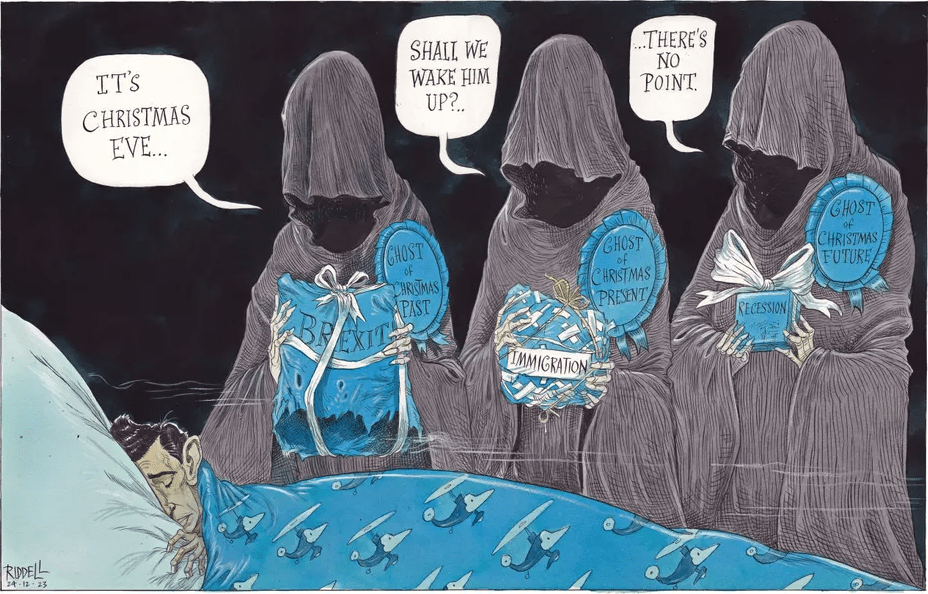
Is Rishi Sunak on the same spreadsheet as the rest of us?

“Economic optimism is increasing, consumer confidence is increasing, growth estimates are being raised.” (Six months ago)

UK economy on brink of recession after growth falls

Economic growth performed worse than expected this year, with official figures for the last two quarters showing the UK is on the brink of a recession.

Mehreen Khan www.thetimes.co.uk

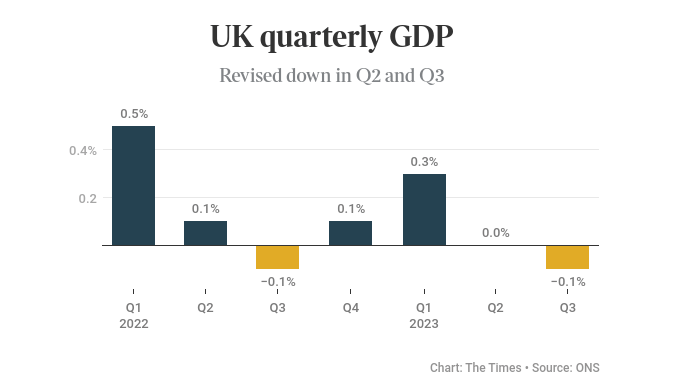
The Office for National Statistics (ONS) cut its initial growth estimates for gross domestic product (GDP) to a fall of 0.1 per cent in the third quarter, from a first calculation of 0 per cent, and said the second quarter’s 0.2 per cent expansion was revised down to 0 per cent.

The downgrades confirm the weak growth performance of 2023 when the economy was hit by the impact of steadily rising interest rates and high inflation for most of the year. The figures also show how close the UK could have come to a formal recession, which is marked by two consecutive quarters of negative growth. Another three months of falling output would confirm a recession at the end of the year.

The downgrades mean that the economy has expanded by 0.3 per cent so far this year, down from economists’ projections of 0.6 per cent, and the economy overall is 1.4 per cent larger than pre-pandemic levels.

Jeremy Hunt, the chancellor, said the country’s growth outlook was “far more optimistic than these numbers suggest”. He said: “We’ve seen inflation fall again this week, and the Office for Budget Responsibility expects the measures in the autumn statement, including the largest business tax cut in modern British history and tax cuts for 29 million working people, will deliver the largest boost to potential growth on record.”

The UK is on course to post growth of about 0.2 per cent to 0.4 per cent in the final quarter of the year, with economists expecting better consumer spending and a recovery in the growth-driving services sector to ensure a recession is dodged heading into 2024.

In the three months to September, the output in the services sector, which makes up around three quarters of the entire economy, fell by 0.2 per cent, with declines in household spending and business investment in the third quarter. There was positive news for households, whose disposable incomes rose by 0.4 per cent when stripping out the impact of inflation, continuing from the 2.3 per cent expansion recorded between April and June.

Thomas Pugh, an economist at professional services firm RSM, said there was still a “significant risk” of a formal recession at the end of the year if weak growth projections for the fourth quarter disappoint.

“The economy will continue to stagnate through most of 2024, though, only returning to sustainable growth in the second half of the year,” Pugh said.

The ONS said its revisions were driven by analysis of the latest monthly VAT data and its regular business surveys, which “show the economy performed slightly less well in the last two quarters than our initial estimates”.

Darren Morgan, director of economic statistics at the ONS, said: “The broader picture, though, remains one of an economy that has been little changed over the last years. Later returns from our business survey showed film production, engineering and design and telecommunications all performing a little worse than we initially thought.”

Samuel Tombs, chief UK economist at Pantheon Macroeconomics, said he expected growth to hold steady in the final three months of the year, “before then rising at an average quarter-on-quarter rate of 0.3 per cent during 2024”.

Water firms race to meet deadline for sewage monitors by end December

South West Water has met the deadline. So it’s going to get worse before it gets better! – Owl

The milestone of almost 100 per cent monitoring on storm overflows is likely to mean the number of spills will look worse when new figures are published next March, potentially posing a headache for ministers in the run-up to an election.

Adam Vaughan www.thetimes.co.uk

England’s era of sewage spill blindspots has drawn to a close. Water company data released to The Times shows that by the end of December, monitoring will be in place for all bar one of the 15,000 pipes that act as relief valves for England’s sewer network.

Known as storm overflows, the pipes are designed to release raw sewage into rivers and seas only during heavy rainfall to avoid it backing up into homes. Water companies face a legal deadline of December 31 to install “event duration monitoring” equipment to track when the discharges stop and start during overflows.

Environmental information regulation requests revealed that six of England’s nine main wastewater companies were still striving to install the final monitors this month. The other three, Southern Water, South West Water and Severn Trent, had all met the deadline.

By mid-December Wessex Water had five remaining and Northumbrian Water had 11. Another three companies had one monitor each to complete. These five said the final monitors would be in place by the end the month.

The not-for-profit operator Welsh Water, which maintains more than 100 storm overflows in England, could not guarantee the remaining unmonitored overflow pipe would be ready in time. This outstanding pipe is in Hereford, located by a busy A-road, and the monitor work will require temporary three-way traffic lights that are not yet in place.

A spokesman for Water UK, which represents the industry, said: “England is the first country in the world to achieve full monitoring of all 15,000 of its storm overflows. This information will allow the sector to target investment at those sites that most urgently need improvements.”

The trade association said that the installations were only a “first step” and that its members were planning to spend £11 billion by 2030, which it hoped would mean 140,000 fewer spills a year.

The milestone of almost 100 per cent monitoring on storm overflows is likely to mean the number of spills will look worse when new figures are published next March, potentially posing a headache for ministers in the run-up to an election.

Data showed there were 300,000 ­releases of raw sewage, lasting 1.7 million hours, in the previous year. The government said the figure, which was a small reduction on the year before, was only down because it had been a dry year. This year has been wetter and there are now more than 600 extra monitors than when the last statistics were published, implying an increase.

The spills are one of the most visible examples of water pollution, and have been the target of campaigners angry at rivers being spoiled. While discharges are only meant to happen during rainfall, there is growing evidence that companies are illegally spilling on dry days.

The government has set targets for water companies for the 2030s to curb the spills, with 2050 being the deadline for effectively ending spills for good. The Times’s award-winning Clean it Up campaign has called for earlier targets and faster investment to tackle the problem affecting British waterways.

Good luck with letting the train take the strain

Due to planned engineering works, no trains will be servicing the line between London Paddington and Reading on either Christmas Eve – Sunday, December 24 – or Wednesday, December 27.

www.southwalesargus.co.uk

Network Rail is set to begin work on the new HS2 station at Old Oak Common.

Services are not scheduled to operate on Christmas Day or Boxing Day. 

Tickets for trains travelling towards Devon and Cornwall on Friday, December 22 and Saturday, December 23 are already almost sold out. 

The following changes are being made to the London Paddington services while the work is ongoing:

  • Most GWR services start or terminate at Reading instead of London Paddington;
  • Limited GWR and Elizabeth line train services will run between Reading and Ealing Broadway;
  • Connecting Underground services will run from Ealing Broadway into central London;
  • Customers travelling to or from central London can do so using London Underground’s District or Central line services at Ealing Broadway, as the Elizabeth line will not be in operation between Ealing Broadway and London Paddington;
  • South Western Railway will accept GWR tickets on these days between Reading and London Waterloo, as will Chiltern Railways between Oxford and London Marylebone. 

Passengers are also advised that no Heathrow Express services will run during this time. Customers travelling to Heathrow Airport from central London should use the Piccadilly line instead. 

Operators have said anyone who needs to travel on Sunday, December 24, or Wednesday, December 27, should allow plenty of time to reach their destination as journey times will be significantly longer than normal.

Great Western Railway say services will also finish earlier than usual on Sunday December, 24 and all journeys will need to be completed by approximately 10.30pm. 

People who do need to travel on these dates are advised to travel before 9.30am. 

For the latest information, please click here

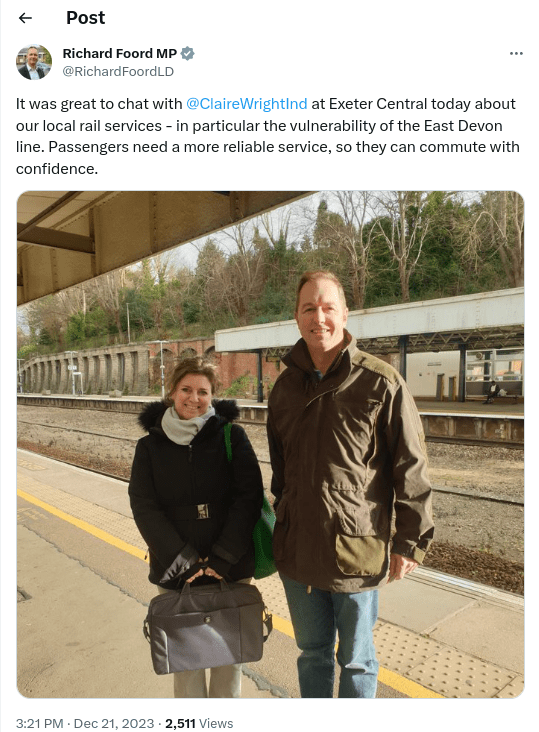
Local MP has a chat with Claire Wright

“It was great to chat with @ClaireWrightInd at Exeter Central today about our local rail services – in particular the vulnerability of the East Devon line. Passengers need a more reliable service, so they can commute with confidence.”

Richard Foord of course, not Simon Jupp. Simon is becoming increasingly isolated.

MP calling for improvements on Exeter-Waterloo railway line

Adam Manning www.midweekherald.co.uk

Liberal Democrat MP Richard Foord has called for urgent work to be undertaken to improve the Exeter-Waterloo railway line in the wake of flash flooding, which saw services between Exeter and Yeovil junction cancelled for ten days. 

Speaking in Parliament this week, Tiverton & Honiton MP Richard Foord raised the issue with Rail Minister, Huw Merriman, and asked for the line to be dualled between Chard Junction and Axminster, and a passing loop at Whimple would allow trains to pass. 

In response to Mr Foord’s calls, the Minister committed to reviewing the proposed project and said he would take extra steps to reduce disruption for people living in East and Mid Devon.

Bad weather saw huge levels of rainfall, which triggered a landslide near Crewkerne. This caused train services to be cancelled for more than a week, as there is only a single track on this section of the route.   

This was not the first time this route has been blocked following heavy rain. In November 2022, the service between Exeter-Waterloo had to terminate at Axminster for several days due to a landslip near Honiton. 

Mr Foord said: “Everyone living in our corner of Devon knows just how well-used our rail services are. They offer a vital commuter link to Exeter and London, as well as being a gateway to the wider West Country for tourists and visitors. 

“However, we’ve seen multiple issues in recent years that have caused many trains to be cancelled or delayed. In particular, the fact that there is only a single track between Chard and Axminster throttles capacity, meaning that one minor issue can derail services for everyone. 

“Solutions could include dualling the line, or adding a passing loop, so that services can move back and forth more easily. We also need to see greater investment in flood defences along our railways, to avoid more damaging landslips that can block the line. 

“I am glad that the Minister agreed to look into these proposals, which would benefit our communities and everyone who regularly uses rail services. I will continue to push for the signal to go green, so that this much-needed work can begin.” 

Richard Foord calls for Govt to tackle Devon’s broadband ‘not-spots’

Liberal Democrat MP Richard Foord is calling for more to be done to tackle so-called broadband ‘not-spots’ in East Devon.

Adam Manning www.midweekherald.co.uk

Speaking in Parliament, Richard Foord MP highlighted the case of two communities who have been left lagging behind on broadband – Northleigh and All Saints residents say they struggle to get even a basic internet connection. 

The Honiton MP said that it was rural areas in East Devon where speeds were the slowest, clocking in at almost half the UK average. 

Communities such as Sidmouth, Axminster, and Seaton rank in the worst 10% of the whole country for broadband. Even places like Honiton, where speeds are notionally better, the average connectivity is still in the worst 30% in the country. 

Highlighting the impact this patchy connectivity has on people’s ability to access things like online banking, to work from home, and stay in touch with loved ones, Richard Foord is now calling for the Government to step-up efforts.  In Parliament, Richard called on the Minister to get people online with speeds that bring people into the 2020s. 

Richard Foord MP said: “It’s a scandal that rural towns and villages like ours are being left struggling to get even basic broadband access, all while urban areas surge ahead. 

“In recent years we’ve seen so many banks close branches on our high streets, forcing people to rely upon online banking to manage their finances. There’s also been a rise in online bookings for travel, particularly when it comes to our railways.  

“But all of this isn’t possible if you cannot get a reliable connection. For far too long, people in our part of the world have been neglected by this Government, which seems out-of-touch with some of the challenges we face on a daily basis.  

“Devon is tired of being left at the back of the queue. That’s why we need to see real action to fix this situation and to help our communities get online, ensuring that the South West – and East Devon in particular – catches up with the rest of the country.” 

Council blunder sees payments taken before Christmas

East Devon District Council has apologised after the premature withdrawal of some council tax payments this month. The authority has blamed a ‘technical glitch’ which meant a payment was taken on Friday rather than on December 27.

Daniel Clark www.devonlive.com 

The council has said that they understand the financial impact this may have on households, especially at this time of year. They said: “We sincerely apologise for any inconvenience caused.”

For residents who do not have enough money in their account to cover the payment. EDDC, suggests they contact their bank and ask them to stop and/or reverse the transaction. If the banks do this the funds should appear back in their account on the same day, and they should avoid any fees.

A statement issued on Friday said: “ East Devon District Council deeply regrets the inconvenience caused to our residents due to an unforeseen error which has resulted in the premature withdrawal of some council tax payments this month.

“On Friday, December 22, a technical glitch occurred in our payment processing system, causing some residents to experience an early debit of their council tax payment. The normal date for payments (the 25th of the month) should have meant the 27th December was the date banks would have taken payment. We understand the financial impact this may have on households, especially at this time of year and we sincerely apologise for any inconvenience caused.

“Where the payment has been made by a resident’s bank and the loss of funds causes hardship, residents should contact their bank and ask for the payment to be reversed under the direct debit indemnity, EDDC will then make contact with residents in the new year to arrange for payment of the instalment.

“For residents who do not have enough money in their account to cover the payment. EDDC, suggests they contact their bank and ask them to stop and/or reverse the transaction. If the banks do this the funds should appear back in their account on the same day, and they should avoid any fees.

“If it is too late to contact the bank and fees are incurred due to this error, residents are asked to provide evidence of the fees incurred and email these to counciltax@eastdevon.gov.uk and the council tax team will look to recompense the fees incurred.

“For those who experience financial difficulties from this error, our financial resilience team will be dealing with emergency requests on the mornings of the 27 and 29 December. To submit a request for financial support, please click on the council website.

“The council wants to assure residents that steps are being taken to prevent the recurrence of such incidents and East Devon District Council remains committed to helping anyone affected by this error.”

NHS given warning about infection control as Covid cases rise

The most recent figures showed one in 24 people in England and Scotland had Covid on 13 December, up from one in 55 two weeks before.

Matthew Weaver www.theguardian.com

The Royal College of Nursing has warned of an increase risk of Covid among hospital staff and patients due to the NHS’s failure to follow World Health Organization advice about infection control during a current spike in cases.

The most recent figures showed one in 24 people in England and Scotland had Covid on 13 December, up from one in 55 two weeks before.

On Tuesday, the WHO expressed concern about a new subvariant of Omicron, labelled JN.1, after its rapid spread in the Americas, western Pacific and European regions. To tackle the increase, the WHO advised that all health facilities “implement universal masking” and give health workers “respirators and other PPE”.

Now the RCN has written to the four chief nursing officers in England, Wales, Scotland and Northern Ireland asking why this guidance has not been introduced across the NHS.

The letter, seen by the Guardian, points out that existing guidance in the national infection prevention and control manual (NIPCM) does not mandate hospital staff to use masks. It also leaves decisions about respirators to local risk assessors.

The RCN says this guidance to UK hospitals is “inconsistent” with WHO advice.

The letter by Patricia Marquis, the RCN’s director for England, calls for urgent revision to the NIPCM guidance to ensure the “universal implementation” of masks and respirators for health workers.

Marquis wrote: “I am mindful of the current unsustainable pressures on the health service, with … a rise in cases and hospitalisations with Covid-19, alongside other respiratory viruses in general circulation. I am concerned that without proper protections ill-health and sickness will continue to rise in nursing staff and impact on their ability to deliver safe and effective patient care.”

She added: “We are also concerned about the increased risks to patients from hospital-acquired respiratory infections.”

Marquis also raised the issue of ventilation in hospitals. She said: “We also have concerns about the adequacy of ventilation in general ward and outpatient areas within hospital buildings and believe that action must be taken to assess and improve this.”

In Tuesday’s update, the WHO said the global health risk posed by JN.1 was “low” based on the available evidence. But it added: “Despite this, with the onset of winter in the northern hemisphere, JN.1 could increase the burden of respiratory infections in many countries.”

It also pointed out that Covid “is not the only respiratory disease circulating. Influenza, RSV and common childhood pneumonia are on the rise”.

The UK Health Security Agency, which is responsible for the guidance, has been approached for comment.

Christina Pagel, a professor of operational research at University College London, suggested JN.1 was likely to cause a wave of infections second only to that recorded in England in March 2022, which was driven by the Omicron variant.

“After a quieter 2023, it’s a sign that we can’t just assume that Covid has gone away or can’t cause us significant issues any more,” she said, adding as many people had not been eligible for recent booster programmes, they had not had a Covid vaccination for two years.

“This will likely mean they feel sicker [if they do catch Covid] and also [have an] increased risk of long Covid too,” Pagel said. “Given we’ve got millions of leftover vaccines from the autumn booster campaign, why not try to put them in people’s arms instead of the bin and open them out to the general population?”

‘Christmas stink’: UK’s traditional festive swims face rising tide of sewage

Long-established Christmas seaside swimming locations have been flooded with sewage over the last year, prompting concern that swimmers could fall ill.

Aletha Adu www.theguardian.com 

They would not be able to claim compensation, as Tory MPs earlier this month blocked a Lib Dem amendment that would have allowed anyone who got sick as a result of illegal sewage dumping to claim from water companies.

During the festive season, swimmers traditionally wear cheery fancy dress as they plunge into the sea at beaches from Eastbourne, Sussex, to St Ives, Cornwall.

Statistics analysed by the Lib Dems have found that this year, festive swimmers will be using beachfronts where 4,574 hours of sewage has been spilled. Between the 32 event locations analysed by the party, almost 1,000 sewage spills were found to have occurred this year.

The former party leader Tim Farron said there needed to be a ban on sewage dumping in swimming areas.

In Sale, Greater Manchester, swimmers attending a Boxing Day charity event will be exposed to waters that have had 94 sewage discharges nearby. On the same day, an event in Cirencester, Gloucestershire, will expose swimmers to waters in which there have been 67 sewage discharges lasting a total of 405 hours over the last year.

A New Year’s Day swim location in Saunderfoot, Wales, has had 1,244 hours worth of sewage pumped into nearby waters this year.

At Brighton, which holds a festive swimming event, Southern Water fails to even monitor sewage, leaving revellers oblivious to the water quality.

Two years ago, outdoor swimmers in Oxfordshire were forced to cancel their Boxing Day swim after Thames Water announced a sewage dump on Christmas Day.

Farron, now the Lib Dem’s environment spokesperson, criticised the “Christmas stink” left by Conservative ministers. He expressed fears swimmers who could be made ill by the sewage, with no compensation from water companies after Conservatives blocked a proposed new law in parliament earlier this month.

MPs rejected the amendment, tabled by Farron, to the victims and prisoners bill by 267 to 27, a majority of 240, with the Lib Dem MP calling the result an “absolute disgrace”. He said Conservative MPs had “yet again voted to let water companies off the hook.

“This is a real Christmas stink for so many hoping to enjoy their traditional festive swim. The freezing cold water should be the only thing swimmers worry about, not sewage floating by them,” Farron said.

“It’s disgusting that our coastlines and lakes have been polluted by this foul habit. There needs to be a ban on sewage discharges in swimming areas. When will Conservative ministers finally clamp down on profiteering water firms who are destroying our environment?

“It was shocking to see Conservative MPs block plans to compensate swimmers made sick by sewage. Not only are they letting them pump sewage into waterways, but they are also content for swimmers to get sick.”

A report from the marine conservation charity Surfers Against Sewage found 1,924 cases of people getting sick because of suspected sewage pollution over the last year, nearly triple the number of cases reported in the previous year.

The shadow environment secretary, Steve Reed, accused the government of turning a “blind eye to corruption and cover-ups” in the water industry.

He was referencing a BBC Panorama report that examined sewage releases into waterways by companies deemed to have good environmental ratings. It found United Utilities, a water company in the north-west of England, wrongfully downgraded 60 incidents to the lowest possible category, meaning they officially caused no environmental harm.

The environment secretary, Steve Barclay, insisted the government was taking a tougher approach to monitoring and penalties, and said spills from storm overflows were worse in Labour-led Wales.

A spokesperson for the Department for the Environment, Food and Rural Affairs said: “This year 96% of our bathing waters met minimum standards with 90% now ranked as ‘good’ or ‘excellent’ – up from just 28% in the 1990s.

“Our Plan for Water is delivering more investment, stronger regulation, and tougher enforcement to clean up our waterways and bathing waters, including £1.7bn of this being used to tackle storm overflows to cut over 10,000 discharges by 2025.”