Rishi Sunak accused of misleading public over Tory campaign questionnaire landing on doorsteps

If you were expecting a Christmas Card from Rishi you will be disappointed. He’s sending out “questionnaires” instead.

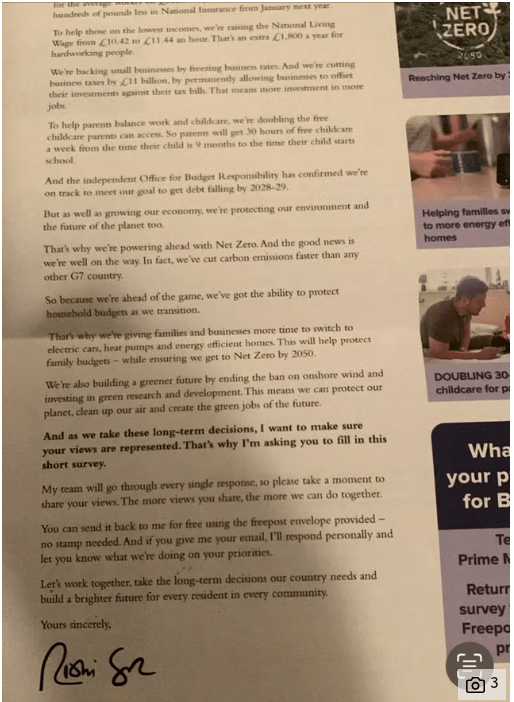
Rishi Sunak has been accused of misleading the public after a “PM survey” asking voters probing questions, including who they backed at the last election, proved to be a marketing ploy by the Conservative Party

Kate Devlin www.independent.co.uk

With a general election expected next year, households are being sent a survey giving voters the opportunity to “share your views with the prime minister”.

But the small print says the information will be used by the Tory party for campaigning, rather than by the government to improve the country.

The leaflets, branded potentially misleading and “routine party propaganda”, ask who voters backed at the last election and who they would prefer as prime minister – Mr Sunak or Sir Keir Starmer.

It is delivered alongside a letter headed “Rishi Sunak Prime Minister”, which twice asks: “What are your priorities for Britain? Tell the prime minister”.

Sir Alistair Graham, the former chair of the Committee on Standards in Public Life, said the survey “has the potential to mislead people that it has come directly from the prime minister.

“It is being unfair to the electorate, really, and is rather cheeky in that it sounds to me like routine party propaganda.”

One page of the ‘PM survey’ being sent to households (Supplied)

The Liberal Democrats accused Mr Sunak of “desperate stuff”.

“No doubt some people will think they are speaking to the prime minister, not Conservative Party headquarters,” Lib Dem MP Sarah Olney said.

“This is desperate stuff from a prime minister on his way out. Using the prime ministerial office name to try to win back angry voters is not going to change a thing. The small print makes clear what this is, a last-ditch attempt for the Conservative Party to cling onto power, and nobody is buying it.”

People are encouraged to return the questionnaire in a prepaid envelope headed “PM survey”.

In his letter, Mr Sunak also tells those who fill it out that “my team will go through every single response”. The questions do include asking people to set out some of their priorities, including on the economy.

The letter is signed by the prime minister (Supplied)

But they are also asked how they voted at the last election and the one before that. Households are also asked how likely – on a scale of 0 to 10 –they would be to vote Tory at the next election, which could be called in a matter of months.

And they are asked, putting politics aside, who as a person they would prefer as prime minister – Keir Starmer, Rishi Sunak or unsure.

The Conservatives declined to comment but it is understood that the party views the survey as standard campaign material.

No 10 has been approached for comment.

Tory donor’s firm paid for Sunak’s £16,000 one-way helicopter trip to Leeds

Why take a train when someone will pay for a helicopter? – Owl

Rishi Sunak took a £16,000 one-way trip to Leeds on a helicopter courtesy of a firm owned by Frank Hester, the Tory megadonor, taking the total for the prime minister’s donor-funded air travel to more than £100,000 this year.

Rowena Mason www.theguardian.com 

The prime minister once again showed his fondness for short-haul air travel as he took a helicopter from Battersea to Leeds Bradford airport last month – a journey of about 90 minutes. The quickest train from London to Leeds takes about 2 hours and 13 minutes, and costs in the region of £60 off-peak.

Sunak registered the trip as paid for by The Phoenix Partnership (TPP), which as a group has won more than £135m of NHS and government contracts to supply IT since April 2020.

Labour said it was the fourth helicopter ride taken by Sunak that was funded by wealthy Conservative party donors who have been paying tens of thousands of pounds to allow the prime minister to avoid public transport or long car journeys. His regular private air travel has also raised questions about the prime minister’s commitment to tackling the climate crisis.

Hester, who is sole owner of the company, made a £5m donation to the Conservatives earlier this year – the joint biggest gift by a living donor. TPP has previously said it was “unequivocally apolitical”.

Jo Maugham, the director of the Good Law Project, said: “None of us can look into Mr Hester’s mind to see what motivates him to make these generous donations to Mr Sunak and his government of vast sums of money and a helicopter ride. What is beyond doubt is that he has made an enormous fortune from contracts given to him by the government.”

Sunak has long been criticised for taking flights and helicopters for short trips, including an RAF chopper from London to Dover, despite the trip being just over an hour by train.

Emily Thornberry, the shadow attorney general, said: “Yet again we have the prime minister asking a Tory donor to pay thousands of pounds for a luxury helicopter just so he doesn’t have to spend two hours on a train with the general public.

“If it seems like it happens every month, that’s because it usually does. Four different donors this year for four different helicopters, to go with the two he normally uses at taxpayers’ expense. If he spent half as much time thinking about the country’s cost of living as he does about his own options for flying, we would all be a damn sight better off.”

During the visit, which was in the same constituency as TPP’s main office, Sunak visited a jewellery maker and was later mocked on social media for having used a hammer sideways – even though he was told to do so by the instructor.

TPP supplies software to about 2,700 GP surgeries in England as well as support services to allow them to hold medical records for patients electronically.

Downing Street and TPP have been approached for comment.

Hospitals ‘falling to bits’ as NHS in England faces record £12bn repair bill

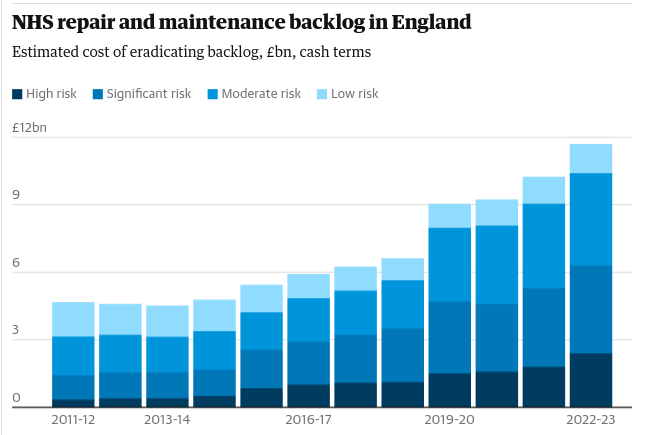
The NHS in England has a record repair bill of almost £12bn, new figures show, with ministers needing to find more than £2bn for urgent maintenance to prevent catastrophic failure.

Michael Goodier www.theguardian.com 

The annual report on the condition of the health service’s estate said on Thursday that the cost of improving rundown buildings and decrepit equipment was two and a half times larger than in 2011-2012, when it stood at £4.7bn.

The cost of the “high-risk” backlog – situations where the need to repair or replace facilities and equipment must be urgently addressed to prevent serious failure, significant injury or major disruption to clinical services – rose by almost a third to a record £2.4bn. This was £0.3bn in 2011-2012.

However, investment to reduce the backlog fell in the last year from £1.41bn to £1.38bn, a fraction of what is needed to restore the NHS estate back to acceptable levels of risk. The stark figures cover a time prior to the health service becoming embroiled in the crumbling concrete crisis which initially hit school buildings.

Sir Julian Hartley, the chief executive of NHS Providers, said that “too many NHS buildings are quite simply falling to bits”, and that we need “a step change in the government’s approach to planning and funding essential capital investment in the NHS”.

He said: “The eye-watering cost of trying to patch up creaking infrastructure and out-of-date facilities is mounting at an alarming rate.

“Mental health, hospital, community and ambulance services are crying out for much-needed funding for critical projects to overhaul ageing estates and to give patients and staff the safe, reliable conditions they need.

“We should be planning for how to transform the NHS estate as well as addressing urgent maintenance challenges.”

The costs of the “high-risk” backlog have risen by 31% in 2022-2023, while the overall repair bill has risen by 13.6% in the same period. The level of investment only covered 11% of the cost.

The hospital with the largest high-risk backlog was Airedale general, where it would take £335.2m to fix all of the serious safety and maintenance issues. Airedale is part of the NHS programme to remove reinforced autoclaved aerated concrete (Raac) from its buildings. Raac is a lightweight construction material that is susceptible to structural failure.

There were 42 hospital sites confirmed to contain Raac as of October, 18 of which had joined the national Raac programme since May, meaning the cost of any repairs needed was excluded from the latest figures.

However, the maintenance crisis is broader than one single issue. Charing Cross hospital in London had the second-largest high-risk backlog, with £173.7m worth of repair work needed.

But it did not appear on the government’s list of hospitals with Raac. Neither did St Mary’s hospital in London, Croydon university hospital or Wycombe hospital, which had the third, fourth and fifth largest high-risk backlogs respectively.

The Health Service Journal recently reported that Doncaster Royal Infirmary, some of which dates back to the 1930s, had been testing contingency plans for a “full or partial site closure” because of the problems it faces with parts of its infrastructure.

In 2021, a leak from a water pipe got into the electricity supply for the women and children’s hospital. This knocked out power cables for an entire wing of the hospital, started several fires and forced staff to evacuate premature babies and mothers who were in labour.

Siva Anandaciva, the chief analyst at the King’s Fund, said the government’s failure to build the “40 new hospitals” Boris Johnson promised in 2019 “has left parts of the NHS estate in such a poor condition they pose serious risks to staff and patients”.

In September Julian Kelly, NHS England’s deputy chief executive, told MPs on the Commons public accounts committee that the NHS had “examples all the time where hospitals are having to shut units, decant patients into other spaces, where we are losing [operating] theatres … which limits our capacity to treat patients”.

Rory Deighton, the director of the NHS Confederation’s acute network, said: “The growing cost of the high-risk maintenance needed to prevent catastrophic failures or major disruption to clinical services is particularly worrying.”

NHS trust bosses regarded the “urgent” need for more capital investment as the NHS’s top funding priority, he added.

Separate figures show the NHS was badly hit by the rise in the cost of energy due to Russia’s invasion of Ukraine. The service spent £1.2bn on energy costs in 2022-23, up by 53% on the year before, despite using less energy overall (down by 1.7%).

A Department of Health and Social Care spokesperson said: “We have invested significant sums to upgrade and modernise NHS buildings so staff have the facilities needed to provide world-class care for patients, including £4.2bn this financial year.

“Trusts are responsible for prioritising this funding to maintain and refurbish their premises, including the renewal and replacement of equipment.

“This is on top of the £3.7bn made available for the first four years of the new hospital programme and a further £1.7bn for over 70 hospital upgrades across England alongside a range of nationally funded infrastructure improvements in mental health, urgent and emergency care and diagnostic capacity.”

Christmas is coming, and the GESP is getting fat.

Extract from CPRE December newsletter:

As we head into the festive season, a spectre has risen Jacob Marley-like, clanking its chains. The Greater Exeter Strategic Plan, whose obituary was published as recently as 30 October, seems to have leapt straight back out of its grave.

GESP was an ambitious plan for the zone around Exeter including East Devon, Mid Devon and Teignbridge, which was declared technically dead when East Devon pulled out. But now we hear news of three new ‘towns’: 8,000 houses just east of Exeter (East Devon), another 1,000 in Alphington/Marsh Barton (Teignbridge) and 1,100 in East Cullompton as part of the planned 5,000 intended for the Culm Garden Village (Mid Devon).

We look forward to the plans to expand the networks of schools, post offices, police stations, reservoirs, GPs, dentists, pharmacists and the RD&E.

And how many of these homes will be priced for genuine local need? An important CPRE study shows that fewer than 10,000 social homes and fewer than 18,000 ‘affordables’ were built in Devon – in the last 30 years! More on this in the next Newsletter.

Devon and they potholes

The Daily Mail carries a report that drivers in Devon have submitted claims amounting to more than £1million for vehicle damage caused by potholes in just eight months, but the council has paid out less than five per cent of the claims.

A total of 966 vehicle damage claims have been submitted to Devon County Council since April this year with the value totalling £1.1million.

The figures were obtained by Councillor Frank Letch (Lib Dem, Crediton), who was seeking information on the number of potholes the county is dealing with.

Cllr Letch said the figures showed that 28,801 reports of potholes have been made by members of the public in this financial year alone, and that the council had identified 1,505 potholes for repair.

Devon County reports:

We’re receiving an extra £6.663 million for highway maintenance this financial year.

The money is a share of the Government’s £8.3 billion investment in roads over the next 11 years using funds redirected from the cancelled HS2 rail line extension to Manchester.

The initial schemes prioritised to start in the coming weeks are mostly minor routes and residential roads across the county.

The funding will also accelerate patching and pothole repairs across Devon’s 8,000 mile road network – the biggest of any authority in the country. The aim is for the repair schemes to be completed this financial year……

Derriford Hospital long ambulance waits revealed

The Tories have forgotten, and taken for granted, Devon and Cornwall for too long.

All they seem to be interested in is closing beds. – Owl

Long ambulance waits and “hours lost” mark a worrying situation for Derriford Hospital chiefs in a new report.

David Dubas-Fisher www.plymouthherald.co.uk 

The latest Integrated Performance Report by the University Hospitals Plymouth NHS Trust board, held on December 1, noted a series of performance indicators which showed worrisome figures relating to some waiting times – but also a plan for new development and enlargement of the hospital after it secured funding.

In April PlymouthLive reported that according to the NHS’s own figures, Derriford Hospital had some of the longest accident and emergency waiting times in the country, with more than 24 percent of people arriving at the hospital having to wait more than 12 hours before being admitted, discharged or transferred.

But the latest set of performance indicators in the 574-page long report, suggests that while in April the “ambulance handover lost hours” sat at 3,350, it has risen steadily to 5,108 in August, 6,359 in September and 8,906 hours in October. With a “national target” of 76 percent, Derriford is languishing with its latest figures at 54.1 percent.

The report also notes that the number of patients who wait 12 hours or more in A&E has increased from 1,491 in April to 1,774 in October.

In it’s ‘responsive’ metrics for Urgent and Emergency Care, it noted how ambulance handover delays had increased to alarming levels. In April this year it stated that 3,350 hours had been lost against a ‘trajectory’ of 2,393. By September this year that had risen to 6,359 hours lost, against a trajectory of 3,039. However, the figures had sky-rocketed during October when 8,906 hours had been lost, against a trajectory of 3,554.

The report went on to state that the trajectory had been “assigned to us by our regulators and represents the improvement required to allow SWAST to achieve their Categrory-2 response time target. It broadly represents a 60 percent improvement at UHP (University Hospitals Plymouth) on previous volumes of lost hours due to handover delays. This is currently off trajectory and review of improvements actions is in progress.”

According to weekly figures recently released by the NHS on Monday, November 27, the average handover time at University Hospitals Plymouth NHS Trust was four and a half hours. That was the longest average wait at any trust in the country last week.

Things improved slightly at the trust on Tuesday when handover delays were four hours six minutes. On Wednesday it was four hours, on Thursday three hours 44 minutes, on Friday four hours six minutes, on Saturday ‘just’ two hours 12 minutes, and on Sunday three hours two minutes.

That compares with Great Western Hospitals NHS Foundation Trust where the average was two hours 34 minutes, and at University Hospitals of North Midlands NHS Trust it was two hours 30 minutes, both also on the Monday.

University Hospitals Plymouth NHS Trust also had the worst record for making patients wait for over an hour in ambulances. A total of 377 arrivals by ambulance had a handover delay of over an hour. That works out as 63 percent of arrivals. That’s up from 57 percent the previous week.

A Department of Health and Social Care spokesperson said: “We have prepared for winter earlier than ever before and we are making good progress in cutting both A&E waits and ambulance response times.

“Compared to the same time last year, ambulance handover delays have fallen by 28 percent, thousands more 111 calls are being answered within 60 seconds, and there were nearly 1,500 more hospital beds available.

“We know there is more to do and that’s why we’re working to get 800 new ambulances on the road and create 5,000 extra permanent hospital beds, on top of 10,000 hospital at home beds already rolled out, to free up hospital capacity and cut waiting times.”

A spokesperson for University Hospitals Plymouth NHS Trust said: “As the Major Trauma Centre for the southwest peninsula, we receive some of the most acutely unwell patients by air and road ambulance and continue to face pressure across the health system. It’s important to note that the data reflects seasonal changes and we expect to see higher demand for our services as we head into the winter months, which we have been preparing for.

“We understand patients and their families will be concerned about long waits and we have a relentless focus on getting patients to the right place at the right time to reduce ambulance waits.

“In addition to our clinical management of patients, we have introduced a number of measures which to help alleviate the pressure on the Emergency Department including; investing in more staff, expanding our Same Day Emergency Care service until 2am, (with plans to extend to 24 hour opening), and creating additional beds in both the hospital and community.

“Finally, we would always ask the public to choose well this winter and there are some things you can do to help ease the pressure on the Emergency Department:

  1. If your relative is in hospital and ready to go home, please collect them as soon as you can to get them safely home.
  2. Please use your local pharmacy, GP, and Urgent Treatment Centre if appropriate.
  3. Think 111 – If you think you, or someone you care for, needs to attend an emergency Department (ED), call 111 or visit www.111.nhs.uk, first. “

Labour’s prospective parliamentary candidate for Plymouth Moor View Fred Thomas has rounded on the Government after Derriford Hospital revealed its long waiting times for ambulance handovers.

He said: “After 13 years of Tory neglect, the NHS desperately needs a Labour Government to resuscitate it. The last Labour Government reduced waiting times by using the private sector, increasing staff numbers and spreading good practice. We did this before. We will do it again.

“We will train more GPs and bring back ‘family doctors’ for those with ongoing needs, Labour will double the number of district nurses and train 5,000 more health visitors. This will allow far more patients to be seen in the comfort of their home and provide a route to catching problems early and setting healthy habits. We must fix these problems in primary care that are driving avoidable footfall to the A&E.

“There can be no doubt the staff at our hospital continue to work in incredibly challenging conditions doing their best for us but without the staffing and bed resources they need to care for our people the way they would want to, or in a way patients deserve. We don’t clap NHS workers on a Thursday night anymore, but we probably should.”

Last month, Plymouth Moor View MP Johnny Mercer, in his opinion piece for PlymouthLive, said he understood locals “continued frustrations with your health services in Plymouth” saying each week he heard from “distressed constituents who are filed onto waiting lists”.

His concerns were highlighted when in May 2022 he revealed he had been admitted to Derriford Hospital and was left sitting on a chair in a hospital corridor for 21 hours in excruciating pain thanks to a herniated disc in his neck. He praised health staff and hospital chief Ann James, but claimed that not enough was being done to meet demand.

At the time he stated: “I have promised a new hospital by 2027, and that is my defining objective as the member of Parliament for Derriford. I also accept that the government has spent £20 million on the emergency department that is being developed as we speak.

“But whatever is being done is not being done fast enough, or at enough scale to meet the demand, and so I intend to meet with both local and national healthcare leaders to express these views and make it clear that the situation must improve in the near-term.”


Ofgem plans £16 household charge to help energy firms recover £3bn in bad debts

The energy watchdog has set out plans that would result in households paying an extra £16 on top of their energy bills to help suppliers recover almost £3bn in bad debts from customers struggling to pay bills.

Mark Sweney www.theguardian.com 

Ofgem said the one-off extra charge, which would be levied at £1.33 a month on bills paid between April next year and March 2025, was to “protect the market and consumers” after figures showed energy debt had hit a record £3bn.

The level of bad debt, which refers to the amount of money owed by customers that is unlikely to realistically be repaid, has soared because of increases in wholesale energy prices and the wider cost of living crisis putting pressure on household finances.

“We know that cost of living pressure is hitting people hard and this is evident in the increase in energy debt reaching record levels,” said Tim Jarvis, the director general for markets at Ofgem.

“The record level of debt in the system means we must take action to make sure suppliers can recover their reasonable costs, so the market remains resilient, and suppliers are offering consumers support in managing their debts.”

Ofgem, the energy regulator for Great Britain, said this one-off move would be less costly to consumers than if suppliers were forced out of business.

When wholesale energy prices began to rise in 2021, and soared dramatically after Russia’s invasion of Ukraine last year, about 30 energy companies went out of business.

Ofgem said this led to every UK energy customer being charged an extra £82 to cover the costs of making sure that households were not cut off.

The regulator said the consultation on the proposal would include the energy industry, consumer groups and the public.

“The proposals set out today are not something we take lightly,” Jarvis said. “However, we feel that they are necessary to address this issue. This approach will ensure the costs are recovered fairly, without penalising a particular group of customers.”

The proposed plan does not include passing extra costs on to customers who use prepayment meters. This is because they operate on a top-up system so PPM customers do not build the same debt level as credit customers.

Ofgem said that other industry sectors already “commonly make provisions” within their prices for bad debt costs and that the energy sector could do so within the price cap mechanism to “ensure these costs are recovered as fairly and efficiently as possible”.

Since the beginning of the year the energy price cap, the regulated cost of the average annual dual-fuel bill in Britain, has fallen from £2,500 to £1,928 from January 2024.

“The price cap has helped to protect consumers from a volatile gas market,” Jarvis said. “However, it remains a blunt instrument in a changing energy sector, and the way it works may need to change in the future, so customers continue to be protected.”

Government warned over recruitment of care workers from ‘red list’ countries

The government is potentially draining countries of vital medical staff, despite committing not to do so – and has been warned it should come up with a plan to change direction and help the countries in question.

Tim Baker news.sky.com 

The independent Migration Advisory Committee (MAC) has released its annual report on the state of the UK’s immigration system.

It comes at a particularly prescient time, as the government struggles with the issue following the revelation that net migration is at its highest ever level.

Sky News Monday to Thursday at 7pm. Watch live on Sky channel 501, Freeview 233, Virgin 602, the Sky News website and app or YouTube.

One of the highlighted areas in the report is the health and social care sector.

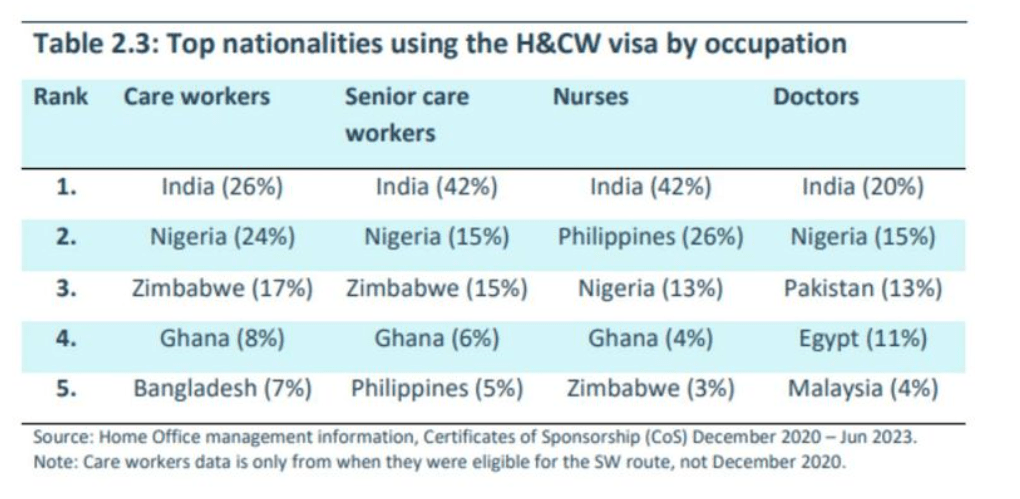
The MAC report describes how roughly 35% of doctors and 20% of nurses recruited to the UK are from “red list” countries, as described by the World Health Organization (WHO).

Under WHO rules, employers and recruitment agencies must not actively recruit health and social care personnel from “red” countries.

The list is also part of the government’s own code of practice for recruiting in the sector.

Countries on the “red list” include the likes of Bangladesh, Pakistan, Nigeria, Zimbabwe, and Ghana.

Health workers leaving these regions are reportedly “having a negative impact” in their domestic sectors.

The report says it is possible that “social media algorithms” are resulting in UK recruitment adverts being seen by those in red list countries – and it recommends the government “consider careful planning within the UK to reduce reliance and consequent negative effects on red list countries”.

The MAC report also highlights how low-paid foreign care workers are propping up the UK sector – seemingly without a government plan to deal with it.

Current high-levels of foreign recruitment have been precipitated by the addition of the care workers and home workers on the Shortage Occupations List – meaning people entering from abroad can be paid less.

Image: The number of people applying for a health and care worker visa by country. Pic: MAC

In 2021, 31,800 people applied for a health and care worker visa to work in the UK. From October 2022 to September 2023, this number was 144,000.

The report says the committee previously recommended this “to potentially alleviate some of the difficulties in the short-term whilst funding issues were addressed”.

But none of the other 19 steps they recommended to help address the underlying causes of workforce difficulties have been adopted.

The report also highlighted another issue – that people entering the UK on health and social care visas had been able to bring in dependents with them, such as children.

In 2021, 31,500 dependent visas were applied for on this route – this rose to 173,900 from October 2022 to September 2023.

However, the government has now said that it will be closing this dependent route off.

The MAC report says that, when calculating the benefit to the economy of hiring cheap labour from abroad, the cost of schooling migrant children and other impacts on the state’s purse are “generally ignored” – and cheap foreign labour is not necessarily “almost costless” when compared to “addressing the underlying pay issue”.

The government said this month that it will be reforming the Shortage Occupations List.

Spreaker This content is provided by Spreaker, which may be using cookies and other technologies. To show you this content, we need your permission to use cookies. You can use the buttons below to amend your preferences to enable Spreaker cookies or to allow those cookies just once. You can change your settings at any time via the Privacy Options. Unfortunately we have been unable to verify if you have consented to Spreaker cookies. To view this content you can use the button below to allow Spreaker cookies for this session only.

Another sector with low pay is migrant nurses – who get 18% lower wages than domestic counterparts when accounting for factors like age.

This is possibly down to those arriving in the UK having to start on the lowest pay band – a factor which may contribute to the NHS “reliance” on immigration.

Sky News has contacted the Home Office for a response.

Cheshire East council says it faces bankruptcy due to HS2 link cancellation

A council in one of the wealthiest parts of the UK has warned it faces potential bankruptcy due to the “devastating” impact of cancelling the northern leg of HS2.

Josh Halliday www.theguardian.com 

Leaders of Cheshire East council in north-west England said the authority had spent £11m preparing for the high-speed rail link, and this would now have to be written off. Most of this money – £8.6m – had been funded by borrowing and would now have to be funded from the council’s already stretched revenue budget.

As a result, the council, which is a unitary authority covering Crewe and Macclesfield, could be forced to trigger a section 114 notice, in effect declaring bankruptcy, according to a report by council officers.

Nearly one in five council leaders in England have said they are likely to declare effective bankruptcy within the next year due to a lack of government funding. One in four councils in Scotland said they faced the same prospect.

Labour-run Nottingham city council last month became the fourth authority in the past year – and the eighth in six years – to declare effective insolvency.

Cheshire East council said it faced “direct and devastating impacts” from Rishi Sunak’s decision to abandon HS2 north of Birmingham. It said these impacts were not mitigated by the government’s “network north” proposals which were released to quell widespread anger from political and business leaders over the axing of HS2.

The report submitted to a full meeting of Cheshire East council on Wednesday said it was seeking a “fair and equitable deal to compensate for the losses to the council and the opportunity cost to the borough” of Sunak’s decision.

The council, which reported a forecast £18.7m shortfall in its budget earlier this year, has already introduced a number of cost-saving measures, including charges for green bins, cuts to library opening hours and closing its headquarters.

The council’s Labour leader, Sam Corcoran, has met the rail minister, Huw Merriman, who “agreed that a dialogue between the council and government would continue”, the meeting was told.

The Conservative group leader, Janet Clowes, added that there was “very much a cross-party Cheshire East remonstration with government”.

She said: “I accept that it’s my government, if you like to put it that way, but we have a really good case to bring forward and we have a right to expect more in terms of the response that we can get as how those monies are now going to be allocated. Because Crewe deserves it, as does the rest of Cheshire East that was set to benefit indirectly from being the gateway to the north.”

The mayor of Cheshire East, the Liberal Democrat Rod Fletcher, said he wanted to take the “unusual step” of speaking on the issue as he was a retired railway operating manager. “I was personally devastated,” he said of the cancellation.

A Department for Transport spokesperson said: “Cheshire East is set to receive significant additional support from a new £4.7bn fund to transform local transport across the North and Midlands, as well as a £110m uplift of over 11 years for local road maintenance.

“This is on top of a funding boost of more than £2.2m for bus services in the area as well as the extension of the £2 bus fare cap to the end of 2024 – all part of our Network North plans using redirected HS2 funding to benefit more people in more places, more quickly.”

Council apologises after palm tree felling

Locals furious at ‘total destruction’

Torbay Council has apologised for cutting down 40 iconic palm trees in a Torquay seaside park without telling anybody.

Guy Henderson, local democracy reporter www.radioexe.co.uk

Tree felling at the Italian Gardens in Torquay (image: Guy Henderson)

A social media outcry followed the felling of the much-loved palms in the Italian Gardens near Torre Abbey Sands, and the story has hit the national headlines. Some comments described the cull as ‘total destruction.’

Now the council’s parks and gardens company SWISCo has said sorry.

In a statement released on Wednesday, the company said: “You may have seen or heard about the work taking place and that we have removed some palm trees.

“We want to apologise for not adequately communicating with you about those plans in advance, and we should have shared our plans earlier and more widely.

“In our enthusiasm to deliver, we raced ahead and failed to let you know that we were going to be making a start on the scheme, so causing this breakdown in communication.”

Consultation over the restoration of the gardens in time for their 100th anniversary next year began in 2019, but the pandemic and budget pressures meant the work was delayed.

SWISCo says the trees were showing ‘signs of advanced decline.’ None was in its prime after years of battering from the seafront weather, the company claims.

The trees were cabbage palms, which have a lifespan of 50 to 70 years. Most were around 50 years old, having been planted in the 1970s.

SWISCo’s statement continues: “Of late, the quality of the gardens had diminished and they were looking far from their best. With the 100th anniversary of the gardens being next year, now felt the right time to make improvements.”

The new garden will feature 1,600 new plants from 12 different species, including some replacement palms. Palm trees did not feature in the gardens when they were first planted in 1924.

“As work continues in the new year, we will be sure to share with you how it is developing with updates on both our website and Torbay Council’s,” said the statement.

Plymouth council set to spend millions on housing crisis

Homes will be bought by Plymouth Council at a cost of £10 million to help ease the city’s housing crisis.

Alison Stephenson, local democracy reporter www.radioexe.co.uk 

The council’s cabinet has agreed to borrow money to purchase around 50 properties to use as temporary homes.

It will also be bidding for a grant of between £3 million and £5 million from Homes England.

Demand for temporary accommodation in the city has more than doubled with the number of households requiring homes rising from 160 to 413 (158 per cent).

Many families are now live in B&B establishments and short stay holiday lets as there are no homes available.

Like other cities, Plymouth is facing a homelessness crisis brought about by  the cost of living and the economic impact of the pandemic.

These have significantly affected the housing market and people’s ability to meet day-to day bills such as rent, mortgage, utilities, food and travel. Inflation and the lack of affordable housing has resulted in further demand for housing and homelessness services.

The council needs to find £2.4 million to support homeless people and says it can make savings of more than £1 million a year if it buys properties.

Cabinet member for housing and communities Cllr Chris Penberthy (Lab, St Peter and the Waterfront) said it would ease pressure on families and have less impact on children.

“We have done the sums. An average family in temporary accommodation costs £23,000 a year. Once we have figured in all the costs, we can make savings of £16,000 and provide them with a temporary home which is exactly that and not a stop-start solution like B&Bs. This will give them something more stable.

“We are putting our money where our mouth is in terms of how we treat people.”

Councillors heard how 366 children currently live with their families in temporary accommodation, including 83 children in B&Bs and 35 under fives. B&B stays are limited to two weeks, so families are being moved around.

Children are being moved away from friends and schools, have to share rooms with siblings and parents, and often have nowhere quiet to do homework or revise for exams.

Cllr Penberthy said many families are finding themselves in a situation they have never experienced before because of section 21 ‘no-fault’ eviction notices from landlords who have decided to sell up. Many of these people were working and not claiming benefits.

A shortage of homes to rent meant that there are up to 100 enquiries for each one that becomes available.

He said he did not want anyone to suffer in silence. “We know people are saying they can manage and there will be something else, but it’s not like that any more. I want them to come to us. Please don’t be afraid or ashamed. Come to us as quickly as you can and we can begin to plan together.”

Council leader Tudor Evans (Lab, Ham) saidthe rise in people coming through the council’s doors for help is “alarming.” He said the authority’s action in allocating the £10 million was “proportionate and timely” and it would give hope to hardworking staff. “This money will help our staff to help people,” he said.
 

Plymouth councillor quits Tories in shock move

A Conservative councillor has quit the group and gone independent, causing the gap between the Plymouth’s governing party and their rivals to widen further.

Carl Eve www.plymouthherald.co.uk

The May this year the local elections in Plymouth saw the city change from blue to red, with Labour accruing a total of 31 seats, against the Conservatives 18, after it lost five seats. Two months later, Labour went on to celebrate securing two more seats with by-election victories. This led to Labour having 33 seats and the Conservatives 16 seats.

However, Plympton Erle Councillor Andrea Loveridge, elected to her seat representing the Conservatives in May 2016 and re-elected in May 2021, has now revealed she no longer has confidence in her party and has announced she will now represent residents as an Independent.

In a statement released on her Facebook page and provided to PlymouthLive, Cllr Loveridge said: “It’s with a heavy heart, and after careful, consideration, and reflection that I have decided to part ways with The Conservative Party and take a leap of faith as an Independent.

“Unfortunately, I have lost confidence with the Conservative Party going forward and as an Independent member it will provide me with the flexibility to engage in open dialogue, collaborate across political spectrum and focus on issues that matters within the constituency, which I am honoured to serve. This means I will be working with former Conservative Cllr Terri Beer in Plympton Erle Ward, together we will be a voice for our community and face issues together within the constituency”.

Cllr Loveridge will now sit as an independent member, in addition to both former Conservative councillors Maddi Bridgeman and Stephen Hulme who have previously become independents. According to Plymouth City Council’s website, Cllr Loveridge has chosen to not join the Independent Group, which currently is represented by former Conservative councillors Patrick Nicholson and Terri Beer.

In response to Cllr Loveridge’s move, Cllr Terri Beer, said: “This is amazing news as we are now on the same page and can both continue our hard work for the community in Plympton Erle.

“Behind the scenes Andrea and I have been working on many projects but things started to become difficult with her in a main party. Being Independent with me is the best possible outcome.

“We are also very close and good family friends and because of this strong bond we will work extremely well together as one.”

The current situation at Plymouth City Council is now:

  • Labour – 33
  • Conservative -15
  • Green – 2
  • Free Independents – 2
  • Independent Group – 2
  • Independent – 3

BUST!

From an East Devon Correspondent:-

Sadly, it comes as no surprise to so many local people that the new homes element of Burrington Estates will cease trading and has gone BUST! For far too long advisors have predicted a financial fragility attached to this particular company (which is one of around 30 subsidiary companies flying under the Burrington Estates Group banner).

Even before EDDC planners were cajoled into recommending approval of the hugely ambitious growth masterplan for the refurbishment of Winslade Park, Clyst St Mary to provide an innovative Live, Work, Play environment, warning bells were ringing within the local community regarding the vulnerability of a company that is dependent on debt to finance its acquisition and build programme.

Indeed, from the onset, Burrington Estates freely admitted to EDDC planners that in order to make the refurbishment of the Winslade Park commercial offices complex financially viable, Burringtons would require the granting of planning permission for approximately 40 homes on an adjacent green, agricultural field (which was outside of the EDDC Local Development Plan to 2031, the local Neighbourhood Plan and the Built-Up-Area Boundary of the village), together with another 40 x 4.5- storey apartments on a brownfield car park. Crucially, approval of these two new Winslade Park residential areas would significantly increase the value of the overall assets of the Company, thus enabling them to borrow even more for further acquisition and building projects.

Apparently, Burrington Estates have now ceased trading with a pre-tax loss of £14m – but where has all the investment money gone? Sceptics working in financial fraud may suggest that many development companies have little or no intention of ever completing such building projects and merely use the planning approvals as a means to increase their borrowing capacity?

With local planning authorities desperate to keep pace with Government- imposed 5-year housing numbers, at the same time as some individuals attempting to accelerate their professional and political careers, it is ‘open season’ for property developers to ‘dangle the carrot’ of large-scale developments to tempt decision-makers to bathe in the potential future kudos!

Unfortunately, our local communities have already seen property developers’ promises being broken (e.g. thousands of housing in the new town of Cranbrook -but no town centre – plus significant housing numbers in Axminster – but no promised vital ring-road infrastructure) – but there is nothing to gain from stating the obvious that local communities warned EDDC planners that this would likely occur in future – but their warnings were not heeded, leaving too many communities the losers. Yes, local people were legally consulted for their views – but the decision-makers ignored their warnings, preferring to adopt an authoritarian stance of ‘we know better’ and local people are NIMBYS! Around 500 objections were submitted to the Winslade Park masterplan (many highlighted Burrington’s flawed business model and advised caution to protect the community).

Unfortunately, the current, national financial climate has put extreme pressure on everyone within our society; many financial failures are being attributed to the effects of the worldwide Covid pandemic and the Ukraine War and certainly those catastrophes have played a major part – but are they the root cause? If we all continuously borrow money and never pay off our debts – then at some stage – we should expect to ‘crash and burn’!

The future for Winslade Park is impossible to predict and extremely complicated! The Company states that it will sell off undeveloped sites- so what will be the impact of the ‘winding-up’ of Burrington Estates on the two sizeable residential proposals of approximately 80 units, that to date show no sign of developmental progression? Will Burrington Estates proceed to build these two approved sites to completion themselves – or prefer to sell the sites with residential planning permission to another developer to pay off their debts?

So many questions remain unanswered – will the conditions imposed by EDDC be thrust upon another new developer, if the two residential areas are sold off by Burrington Estates? Surely, it is unworkable to impose conditions on a different developer, who will not own the adjoining land where the conditions have previously been imposed? To mitigate against any losses to the community, the two residential planning permissions incorporated conditions for the primary school to access the refurbished swimming pool, for enhancement to the sports field facilities (to include new changing rooms/toilets/social facilities), for renovation/improvements to the cricket pavilion and tennis courts, for the provision of community access to a large public open space for leisure purposes and for the building of new additional, significant car parking areas to avoid Winslade users overflowing into nearby residential areas or blocking the village car parks and streets– but to date none of the aforementioned have been provided – so what will become of these promised community facilities?

To outsiders, the commercial/employment aspects of the refurbishment of both Winslade Manor and Winslade House appear to be successful (although the renovation of the two large employment areas within both Clyst and Brook Houses seems to have significantly slowed recently?) – Or are the plush, office interiors and the fine-dining experiences just window-dressing, aiming to encourage further investment, whilst masking the reality of the true worth of the commercial side of business?

Many of us are experiencing daily bombardment by telephone/online scammers lying in wait for us to make mistakes during bouts of lack of concentration, so the important lesson we must all learn is:-

– If it sounds too good to be true – then it probably is?

If you dive into crocodile-infested waters – then at best you will lose a limb or two – but at worst you will be devoured whole! Top predators are successful at what they do, there is no room for naivety – the stakes are far too high!

Hopefully, there will be acceptable answers to this Winslade Park conundrum that will benefit our local communities and not destroy them!

However, what would be totally unacceptable is if (with such colossal financial losses) any Burrington Estates’ directors/shareholders/investors have already ‘creamed off’ and stashed huge personal profits, which will see them this Christmas sipping pina colada cocktails on a tropical island, wearing Versace designs, whilst driving Ferraris or Lamborghinis, whilst East Devon residents are swaddled in blankets, endeavouring to save energy and avoid visiting local food banks!

. . . .. . Now that scenario would be a very bitter pill to swallow for the average East Devon resident!

Second homeowners could be be charged double council tax

Nearly 200 homeowners in Mid Devon could see their council tax double next year as part of changes to how second properties are charged.

Alex Richards www.devonlive.com

The government’s Levelling Up and Regeneration Act gives councils the option to charge second homeowners double council tax to provide a small boost to their finances.

A second home is defined as one that is substantially furnished and periodically occupied, but is not the owner’s sole or main residence. Mid Devon District Council has 194 properties ranging across all council tax bands that could attract the premium from April next year.

“We will be writing to all those who may be affected so that they are aware of the change regarding their billing,” a council spokesperson said.

The advance warning is aimed at giving second homeowners the chance to sell their properties if they don’t want to pay the higher fee, or alternatively rent them out or make them their main residence.

Linked to these changes is the ability for councils to define a home as empty after just one year of it being unoccupied, rather than two years under previous rules.

Empty properties can also be charged double council tax, with even higher, staggered premiums possible if they are empty for more than five years or more than 10 years .

Mid Devon has 203 empty homes, and so could also be charging some of these a 100 per cent council tax premium once they have been empty for a year.

The proposed charges will be put to the full council in February to be ratified. Bath & North East Somerset made the headlines last month after deciding to hike council tax charges for second homes.

Other authorities in Devon are also looking to increase their charges once they are able to, with East Devon District Council proposing such a move. More than 11,000 homes in Devon are considered to be second homes, according to the county council.

Camberley residents ‘should get free water bills’ after sewage tanks stench

More than 200 tankers of raw sewage were driven to a Surrey town and left there for six months, causing a “nightmare” for residents after all of Thames Water’s 360 treatment plants reached critical capacity.

Thames Water has told councillors in Surrey it had had no choice. Either they moved the sewage to storage tanks in Camberley, emptied it into rivers causing massive pollution, or left it in tankers on the roadside which could have exploded, causing a major national incident.

Yuk! – Owl

Chris Caulfield www.getsurrey.co.uk

More than 200 tankers of human poo were shipped in to Camberley from across Surrey, Hampshire and London, saving Thames Water millions in potential pollution fines and its sewage trucks from “exploding”.

This comes at the expense of 11,600 residents who got nothing in return, save for a summer of vile stench, a committee heard.

Chiefs from the utility firm were called in to Surrey Heath Borough Council to answer questions as to how 12,000 cubic metres of raw untreated sewage and sludge was left to fester in the heat – forcing thousands of people to stay inside with their windows closed during the summer.

The committee also challenged water bosses over pledges they thought had been made on compensation to Camberley residents who “bore the cost” so the company, which recorded a total revenue of £2.3 billion last year, could profit.

Councillors said they were led to believe Thames Water would contribute towards a playground as a goodwill gesture to children who had been forced to stay indoors, with committee chair, Councillor Rob Lee, going as far as to say Thames Water should offer “a year’s free water bills” to those affected.

Thames Water’s representatives said they never made a firm commitment to contribute to any scheme. The company claims they have made organisational improvements since.

The committee heard that Thames Water could not have made any offers of goodwill as the people attending the meeting did not have the power to do so.

In the end, Thames Water’s leadership offered to let staff have a charity day to support building a local project that never got off the ground.

The sewage started being shipped into Camberley Sewage Works in February this year and by March the two 6,000 cubic metre tanks were “completely full”.

At the time, the committee heard, odour suppression was in place but it wasn’t 24/7 and didn’t cover the entire tank, which also suffered from maintenance issues.

By June, the council began to receive formal complaints. Initially the council was told the problem was due to blockages and drainage.

It took until the middle of July for Thames Water to publicly admit it was a holding tank with a “large quantity of sewage sludge within it”. It would remain untreated until the beginning of August with the tanks finally cleared and cleaned of waste on September 25.

Speaking to the committee was operations director James Bentley.

He apologised “unreservedly” and said: “We didn’t get everything right in that process and we’re not here to pretend that we did.” He said the firm should have put in odour controls in place and communicated with residents much sooner.

He said: “We had been experiencing a very extreme sludge event…where our system across the whole of the Thames Water estate, was overloaded.

“Not only with liquid sludge but also with cake which is the solid material when we process sludge and remove a chunk of the water from it.

“That system was overloaded on the liquid and solid side.” Thames Water staff told the meeting it left them with no choice but to put liquid sludge into reserve tanks.

Mr Bentley said: “It has to go somewhere, it cant just be discarded into the environment. We have to store it until we are able to treat it.

His colleague added: “If we didn’t move the sludge we’d have pollution trucks potentially exploding, and that’s why we’d done it.”

Cllr Rob Lee said: “You act in the shareholders best interest, you don’t intend to cause a substantial sewage leak unless its a commercially managed one, you don’t intend to cause a Heath and Safety Executive incident, so what you did was you moved the sludge to Camberley.

“So the people that bore the cost of that were the residents of Camberley, substantially through the summer, through their loss of enjoyment and I think it’s understanding the loss position those residents bring.

“They are your customers, they pay you money, and they missed out substantially on the enjoyment of their summers. Raw sewage smell around your home is pretty different to that in a treatment plant as that is your job.

“You need to consider a gesture of goodwill to residents. A starting point is a year’s complimentary water bill.

“It clearly saved Thames Water in material terms millions if not tens of millions of pounds, so I think we need to start exploring that avenue.”

The two hour meeting concluded with the Thursday, November 28 executive partnerships select committee agreeing to formally ask for a “decision maker who has the ability to sign off on compensation” to appear before the next meeting, in March.

The council’s executive team will also write to regulators Ofwat, MP Michael Gove and the environment secretary to ask them to consider the wider sense of pollution and whether Thames Water diverted the risk of fines by increasing the air pollution in Camberley.

Thames Water apologises to MPs for ‘confusion’ over £500m loan

Water companies were sold with no debt when they were privatised in 1989. In fact, they were given a £1.5 billion green dowry by the Government. Since then, they have taken on borrowing of £60.6 billion, diverting income from customer bills to paying dividends and interest payments. – Owl

Sandra Laville www.theguardian.com 

Thames Water has apologised to a House of Commons committee for causing confusion by describing a £500m shareholder loan as equity.

One MP called the complex financial structure of Thames Water an “absolute shambles”, as senior executives were pulled in to explain themselves.

Thames Water’s chair, Sir Adrian Montague, said the company was facing a “seminal moment” as Ofwat for the first time suggested special adminstration for the company was an outcome the regulator would not shirk from.

Ian Byrne, a Labour MP and member of the environment, food and rural affairs committee, said: “69% of the nation wants the water industry nationalised. I think after listening to this, it will be 100% … the whole structure is an absolute shambles.”

He added that the situation reminded him of Carillion, the collapsed construction company.

Thames Water, which provides water to about 25% of the population in England, is struggling with debts of £18bn and is seeking an injection of £1.5bn of cash from shareholders to turn itself around.

The company was recalled to give evidence to MPs on Tuesday after describing part of the shareholder money – £500m – as equity rather than debt.

Montague, the chair of Thames Water and its parent company, Kemble Water Limited, said he was sorry if the management had caused “confusion” when it described the shareholder contribution as equity when it was a convertible loan charging 8% interest.

But he said he stood by the phrase. “In July we described the shareholder contribution of £500m as equity. That’s a description that has been fiercely challenged. We stand by what we said. If we were not clear enough in unpacking the different elements of that … I’m sorry if we caused any confusion,” he said.

Montague told MPs Kemble relied upon dividends paid by Thames Water to secure its future. Ofwat is investigating dividends of £37.5m paid to the parent company in the six months to 30 September to see whether Thames Water has breached the conditions of its licence.

Montague said: “It is not obligatory for Thames Water to pay these dividends … Thames Water has paid dividends to put Kemble in a position where it can service its debt. If Kemble was allowed to go into default, our concern from Thames’s perspective is that that would derail the possibility of us delivering further equity from shareholders.”

Barry Gardiner, a Labour MP, said although promises of change had been made, its holding company was behaving the same as Macquarie. Macquarie, the Australian bank that previously owned Thames Water, has been heavily criticised for building huge debts at Thames Water to pay dividends to shareholders.

“It’s the bill payer that ends up paying for whatever trouble the holding company gets itself into, in exactly the same way as Macquarie did,” said Gardiner.

Thames Water is seeking a 40% increase in customer bills to pay for new investment in its treatment works, pipes and sewage outflows, as it faces huge problems over rising pollution incidents, infrastructure failings and continued raw sewage discharges into the environment.

Executives admitted on Tuesday that if Ofwat rejected its business plan and the bill rises it has asked for, the company would be left in huge difficulties.

Given refusing the plan was likely to lead to Thames Water collapsing, something that Ofwat would not contemplate, Gardiner told the Ofwat chief executive, David Black: “They have got you by the short and curlies, haven’t they?”

But Black told MPs the regulator would act if it had to and put the company into administration. “We have never seen a water company fail but that remains a possibility,” said Black. “If we have to take steps that lead to the failure of the parent company then we are prepared to do so.”

Gove to slash housebuilding targets for green belt

Local councils will no longer be forced to set aside greenfield land to meet their future housing needs, under a new planning system to be announced by ministers.

Oliver Wright www.thetimes.co.uk

In a move that industry sources have claimed would be “disastrous”, Michael Gove will allow local authorities to reduce the number of houses to be built if development would significantly alter the character of their areas or impinge on the green belt.

Councils will also be given an exemption from building new homes on prime agricultural land.

The reforms, which could be announced as soon as Thursday, are designed to appease rebel Conservative MPs who have warned that opposition to housebuilding in their constituencies will cost them their seats at the next election.

But critics have warned that they amount to a “nimby’s charter” that will lead to a continuing shortage of housing in the areas of greatest need.

Under the previous system local authorities were required to set aside and designate enough land to meet their future housing needs for five years in a local plan even if the proposals were opposed by local residents.

Councils that failed to do so risked having new developments forced upon them by the planning inspectorate under a “presumption in favour of sustainable development”.

But under the changes councils will be able to set local plans with fewer homes if they can demonstrate to the planning inspectorate that meeting the target would damage the character of an existing area or require building on the green belt.

Ministers argue that the changes will, in the long run, allow more homes to be built because local councils will be incentivised to produce realistic plans for their areas that have broad democratic consent.

However, developers fear that the rules will be exploited by opponents of new housing to block sites from being built on, significantly reducing land supply in areas where demand is greatest.

“This will be disastrous,” said one senior industry source. “Under the old system there were strong incentives for councils to produce realistic plans to meet their future housing needs. Under this system there will be next to nothing to stop councils effectively imposing a moratorium on building the homes that we need.”

As part of the package of measures due to be announced by the government, Gove is expected to argue that the government will prioritise brownfield and higher-density development in inner-city areas. He will also make it harder for planning committees of local councillors to block developments that have been approved in principle by local planning officers.

A government source said: “We are reforming the planning system to put local plan-making at its heart. This will allow communities to take back control of housing in their area, while supporting much-needed development in brownfield and inner-city sites.

“We are on track to see a million new homes completed this parliament and are accelerating our plans in Cambridge, central London and the heart of Leeds.”

The government will also point to measures in the autumn statement designed to speed up the planning process. Under the new system local authorities will be able to charge an additional fee for accelerated planning decisions but would be forced to refund all planning charges if it failed to meet faster timelines.

Government sources said there had been more than 26,000 responses to a consultation on the proposed changes, which will form part of a new national policy planning framework (NPPF).

It follows weeks of negotiations with rebel Tory backbenchers, who last year forced ministers into a U-turn on plans for mandatory housing targets.

They said that the new plan would strike the “right balance” between the rights of existing residents with concerns about new development and the need to increase housing supply.

Labour is expected to condemn the proposals. “This is formal confirmation that this government prioritises party management over doing what it takes to get Britain building again,” said a Labour source.

The former Northern Ireland secretary Theresa Villiers, who led the backbench rebellion against the existing planning rules, said she hoped the new plan would respect “local democratic input”.

“The government has a longstanding commitment to ensure the voice of local communities continues to be heard in relation to what is built in their neighbourhood,” she said.

“We all recognise how important it is to build the homes we need. It is possible to do that whilst still respecting local democratic input, for example by focusing on high-density delivery in urban city centre sites. Once it is published, I’m sure the new NPPF will be carefully scrutinised by all sides of the debate.”

‘Toothless’ sewage watchdog fails to visit 90% of toxic water spills in England

The Environment Agency failed to visit 90 per cent of toxic water spills last year, including more than 60 per cent of the most serious incidents, i can reveal.

Lucie Heath inews.co.uk

Freedom of Information data obtained by the charity WildFish, and shared with i, shows there has been a significant drop off in in-person inspections of water pollution since the Covid-19 pandemic, despite an increase in the total number of incidents being investigated by the watchdog.

Inspectors were rarely turning up in person to investigate incidents such as sewage discharges and pollution run-off from farms and motorways into England’s waterways.

Campaigners and politicians told i the environmental regulator was “toothless” and blamed the Government for overseeing the decline of Britain’s rivers, lakes and coastal waters.

They accused the Environment Agency of “pretending pollution isn’t there” and called for a complete overhaul of the regulatory process for water.

It comes as BBC Panorama claimed that one water company United Utilities wrongly downgraded the severity of more than 60 of its own pollution incidents last year in a move that saw the cases wiped from its official records.

The downgrades were reportedly signed off by the Environment Agency without inspectors attending any of the incidents. United Utilities denies the allegations.

Now i can reveal the extent to which the Environment Agency has scaled back in-person inspections of water pollution across the country since the Covid-19 pandemic.

Pollution incidents are divided into four categories from category one (most serious) to category four (little to no impact). Incidents are given an initial categorisation when reported, but these can be changed after inspection.

In 2022, Environment Agency inspectors attended just 2,060 (10.7 per cent) of the water pollution incidents reported to them that were initially classified in categories one to three.

This included 161 visits (35 per cent) to category one incidents, 861 (23 per cent) category two visits and 1,038 (7 per cent) category three visits.

Unsurprisingly, the number of Environment Agency visits to water pollution incidents dropped off significantly during the Covid-19 pandemic. However, the latest figures show that visits remained at this level in 2022 despite the ending of lockdowns.

In-person visits were down almost 50 per cent in 2022 compared to 2019, despite a 10 per cent increase in the number of incidents being investigated by the Environment Agency.

The figures also show that pollution spills caused by water companies were being visited at a rate below the average, with the Environment Agency visiting just 5 per cent of these cases in 2022, including 36 per cent for category one, 15 per cent for category two and three per cent for category three.

Guy Linley-Adams, Solicitor at WildFish, said: “Sadly, this just shows that the Environment Agency has continued the decline in its performance that began in the early 2000s. You can’t deal with pollution by just pretending it isn’t happening, refusing to see it.

“However, fault lies both with Agency managers, but also with politicians of both main parties, who have hamstrung the Agency with the Regulators’ Code and other such deregulatory nonsense over years, starved it of cash and refused to let it take on polluters to protect rivers, lakes and coastal waters. The very best you can say about the Agency is that it is now charged with presiding over the managed decline of the aquatic environment in England”.

It comes as water companies continue to come under scrutiny for the amount of sewage being dumped into Britain’s rivers, lakes and coastal waters, with water companies reporting over 384,000 discharges of raw sewage in 2022.

Water companies have been permitted to discharge untreated sewage into water bodies during exceptional circumstances when their pipes are at risk of becoming overwhelmed, but investigations have shown this has become common practice.

Stuart Singleton-White, head of campaigns at the Angling Trust, described the Environment Agency as “toothless”.

He said the regulation of the water sector is “completely broken” and that it was “time to sweep away the current system”.

Labour’s shadow Environment Secretary Steve Reed said the Government has “wilfully turned a blind eye to corruption at the heart of the water industry” and said his party will “strengthen regulation to make sure every single water outlet is monitored”.

Labour will table a motion in the House of Commons on Tuesday to call on the Government to give the water regulator Ofwat powers to ban the payment of bonuses to water bosses whose companies are found to cause pollution.

An Environment Agency spokesperson said: “We take our responsibility to protect the environment very seriously and will always pursue and prosecute companies that are deliberately obstructive or misleading.

“We assess and record every incident report we receive – between 70,000 and 100,000 a year. We respond to every incident and attend those where there is significant risk, and we are increasingly able to use off-site data checks and technology from a range of different monitoring sources to assess them.

“We are strengthening our regulation of the water industry by expanding our specialised workforce, increasing compliance checks and using new data and intelligence tools to inform our work. We will also soon have new powers to deliver civil penalties that are quicker and easier to enforce.”

New homes builder to cease trading after £14m loss

The new homes element of Burrington Estates is set to cease trading but the wider Burrington Estates Group, however, is unaffected, including the company’s interest in Exeter’s Winslade Park.” Complicated – Owl

South West new homes builder Burrington Estates is to cease trading after making a £14m pre-tax loss. The Exeter-headquartered company, which builds and sells houses across the West Country and Midlands, will complete the projects it is working on, sell off undeveloped sites and wind up the business.

William Telford www.devonlive.com

Directors blamed “increasingly difficult trading conditions” and an uncertain UK housing market, partly fuelled by rising interest rates. They also put the blame on the cost-of-living crisis and the war in Ukraine. The new homes element of Burrington Estates is set to cease trading but the wider Burrington Estates Group, however, is unaffected, including the company’s interest in Exeter’s Winslade Park.

David Jervis, director, said: “After looking at a range of options for the future of the business, including its ownership and markets, the directors reluctantly agreed in 2023 that the business would complete its committed project to its recognised high standard and would thereafter cease trading and commence an orderly wind down of the business. The directors would like to thank all its customers, supply chain, staff and funders for their continued support during this period.”

Burrington Estates will become the fourth major regional construction firm to cease operating in the past two years. Midas Group Ltd, Henry W Pollard and Sons Ltd and Brady Construction Services Ltd have all gone under as the construction industry continues to be hit by economic difficulties.

Burrington Estates, which employed about 70 people, was set up in 2011 by Mark Edworthy and Paul Scantlebury and has completed more than 600 homes in the region, including current schemes in Exeter, Tiverton and Bude. It purchased The Ship, Plymouth’s former home of The Herald and Western Morning News, in 2015, much of which is currently being offered for let as small business space.

It also developed landmark business sites at Sky Park and Sky Park II, in Exeter; West Park, in Wellington; Roundswell, in Barnstaple; Oak Tree, in Newton Abbot; and Plymouth’s Eurotech Park. These were transferred to ONYX Business Parks Ltd, when subsidiary Burrington Business Parks rebranded in May 2023, and appear to be unaffected by Burrington Estates’ winding up.

In 2021, Burrington Estates embarked on ambitious growth plans boosted by a £15.5m investment from main shareholder BGF Group Plc to expand its residential portfolio .In January 2022 Burrington Estates secured a £28m funding package from Paragon Development Finance to support its Winslade Park development in Exeter.

In August last year, Mr Edworthy and Mr Scantlebury stepped down and Mr Jervis became group managing director, having joined in 2019 to head the new Midlands division. Burrington Estates’ highest paid director was paid £279,333 and a pension contribution of £16,000 in 2021.22.

Plymouth’s Eurotech House and the former Good Companions site in the city centre have been put on sale. Both are still being advertised, the former for £850,000.

Newly published accounts for the 18 months from January 2021 to June 2022 show Burrington Estates sold 36 properties and had a turnover of £29,522. But it made an operating loss of £9,031,000 and a pre-tax loss of £14,345,000.

Burrington Estates Group, a holding company, is dependent on cash generated by more than 30 subsidiary companies and funding from ultimate parent company BFG, which has now recognised it won’t be repaid in full and reserved the right to amend its support. Mr Jervis said the company was hit by “increasingly difficult trading conditions”.

In his strategic report, he highlighted “increased uncertainty in the UK housing market” driven by interest rate hikes and a fall in house prices “triggered by economic uncertainty and reductions in attractive mortgage deals for buyers”. He also blamed supply chain problems and delays caused by the planning system.

He continued: “In addition, the cost of finance for the group rose significantly due to the significant and numerous increases in UK commercial lending rates.” He said this was key as the company was dependent on debt to finance its acquisition and build programme.

He said that as a result the company was unlikely to be able to settle or refinance all its loans from shareholders and would seek a “managed closure” of the business. The accounts showed about £73m was owed to creditors, most of which was loans and borrowings, and was in breach of loan covenants and had to therefore replay its main lender immediately.

New artwork set to be unveiled at Honiton train station

Councillor Eleanor Rylance, chair of East Devon District Council, said: “We are delighted to showcase the creativity of local young people and celebrate the remarkable natural environment which surrounds Honiton.”

Adam Manning www.midweekherald.co.uk 

New artwork and a town map are to be unveiled at Honiton station by the Mayor of Honiton, Councillor Helen Hurford.

The unveiling will take place on Wednesday, December 13 at 12.30pm.

The project has been led by the Friends of Honiton Station and has seen attractive new artwork installed on the inside of the station’s footbridge and a shed on Platform 1.

In addition, an illustrated town map has been placed in the station forecourt. The project is the brainchild of Friends’ member East Devon and Honiton Town Councillor Jenny Brown.

Honiton Primary School pupils created the new artwork on the station footbridge during workshops with artist Alistair Lambert at Thelma Hulbert Gallery (THG), Honiton Museum and the Blackdown Hills National Landscape.

The workshops were part of THG’s Honiton Hippo project for the national Wild Escape campaign. Local families also created animals to add to the artwork during workshops at the gallery and in the St. Paul’s area of Honiton over the Easter holidays.

Local artist Brittany E Lakin created the artwork on both sides of the Platform 1 shed.

The £6,700 project has been made possible thanks to funding from South Western Railway, Honiton Town Council and grants organised by the Devon & Cornwall Rail Partnership from CrossCountry Trains and the Community Rail Development Fund, a joint initiative of the Department for Transport and the Community Rail Network.

Cllr Jenny Brown said: “I am thrilled to see the unveiling of this vibrant, colourful artwork. This project would not have been possible without the strong partnership that has been created over the past few years with our stakeholders, who are always very receptive of our ideas.

“I hope as commuters and visitors to Honiton walk past it, they will take the time to enjoy these latest additions.”

Martin Long chairman of the Friends of Honiton Station said: “Honiton station is important to so many people, and we are very proud of it, and all that it tries to do. We believe that the station is the perfect venue to promote and develop community-based art. To that end, we have been delighted to work with a range of partners to bring even more exciting artwork to our station.”

Councillor Eleanor Rylance, chair of East Devon District Council, said: “We are delighted to showcase the creativity of local young people and celebrate the remarkable natural environment which surrounds Honiton.”