Boris Johnson’s No 10 was toxic, sexist and devoid of humanity, says Helen MacNamara

Boris Johnson oversaw a “toxic” culture of sexism and complacency at No 10 during the Covid crisis, according to scathing evidence given by a former top civil servant to the public inquiry.

Anyone going to vote for this lot again? – Owl

Adam Forrest www.independent.co.uk

Helen MacNamara, the former deputy cabinet secretary, said she could not recall “one day” on which Covid rules were followed in No 10 or the Cabinet Office – claiming that “hundreds” of officials and ministers broke the guidelines.

She also criticised an “absence of humanity” in No 10 and revealed that officials there were “laughing at the Italians” who were overwhelmed in the early stages of the crisis – with Mr Johnson expressing a breezy confidence that the UK would sail through the pandemic.

The former top civil servant also said Mr Johnson did nothing to stop ex-No 10 adviser Dominic Cummings’s misogynistic behaviour after it emerged that Mr Cummings had labelled her “that c***” and said he would “handcuff her and escort her” from Downing Street.

It came as:

  • Mr Johnson asked if Covid could be killed by blowing a hairdryer up the nose, according to new evidence from Mr Cummings
  • The former PM is said to have told Mr Cummings to “dead cat” Covid because he was “sick” of the subject
  • It emerged that it took seven months to install hand sanitiser at the door between No 10 and the Cabinet Office
  • The health secretary at the time, Matt Hancock, was accused of having “nuclear” overconfidence, pretending to be a cricketer batting off challenges
  • Mr Cummings’s Barnard Castle trip “blew a hole in public confidence”, the government’s behavioural expert said

Ms MacNamara said that on 13 March, a little over a week before the first lockdown, she warned Mr Cummings and others in Mr Johnson’s office that the country was “absolutely f***ed” and “heading for a disaster” in which thousands of people would die.

She said her earlier warnings in January and February did not register with the PM, and that in early Covid meetings, Mr Johnson was “very confident that the UK would sail through”.

The former top official said there had been a “jovial tone” and that “sitting there and saying it was great and sort of laughing at the Italians was just … it felt how it sounds”.

Referring to the culture of rule-breaking within the government, Ms MacNamara said: “Actually, I would find it hard to pick one day when the regulations were followed properly inside that building,” referring to both No 10 and the Cabinet Office.

The former top civil servant also told the inquiry: “I’m certain that there are hundreds of civil servants, and potentially ministers, who in retrospect think they were the wrong side of that line.”

In written evidence, Ms MacNamara said that there was “very obvious sexist treatment” that saw women overlooked and undermined in both No 10 and the Cabinet Office. “The dominant culture was macho and heroic,” she wrote.

She said there was a “toxic culture” when asked about Mr Cummings’s August 2020 messages referring to her, which read: “We cannot keep dealing with this horrific meltdown … while dodging stilettos from that c***.”

“It’s horrible to read,” she responded. “But it’s both surprising and not surprising to me.” She said she was disappointed that Mr Johnson did not do more to stop such “violent and misogynistic language”.

Ms MacNamara also suggested that a lack of diversity among top officials in Mr Johnson’s government had led to the deaths of women from domestic violence. She cited confusion about whether women could access abortion during the lockdown, closing fertility treatment services, and failing to make provisions for victims of domestic abuse.

Asked if he had cleared out the “misogyny” at No 10, Mr Sunak said on Wednesday: “My Downing Street is a place where I think people are not just happy to work … that’s very much the culture that I want to create here. And I believe we have done.”

In the bombshell new written evidence from Mr Cummings that emerged on Wednesday, the former No 10 strategist claimed that Mr Johnson had circulated a YouTube video – since taken down – of a man blowing a special hairdryer up his nose.

Describing it as a “low point”, Mr Cummings said the then PM asked the government’s chief scientific adviser and chief medical officer what they thought of the idea – which was dismissed as having no foundation.

Mr Johnson also told Mr Cummings in the autumn of 2020 that he wanted him to “dead cat” Covid – find another big story to distract the public – because he was “sick” of the issue. The adviser told the PM that this would not work.

Mr Cummings said Mr Johnson had to be stopped from going to see the Queen on 18 March – five days before the first lockdown. “I was desperate, and said something like, ‘If you’ve got Covid and you kill the Queen, you’re finished.’”

Mr Cummings claimed that Carrie Johnson had exacerbated Mr Johnson’s indecisiveness. But he also said that Mr Johnson himself had sometimes blamed her unfairly for U-turns that were “NOT her fault”.

He also repeated a suggestion that Mr Johnson was working on a book about William Shakespeare during a two-week holiday in February 2020 rather than focusing on the pandemic.

In a further sign of the farcical situation in Downing Street, Ms MacNamara revealed that it took seven months to get a hand sanitiser station installed by the door between No 10 and the Cabinet Office. She condemned Mr Johnson’s “following the science” mantra, since many at No 10 didn’t understand what the science was.

The ex-official also said that the UK was already on the back foot when Covid hit, because of Brexit. She criticised the “monomaniacal” way Mr Johnson’s team focused on Brexit, and then the 2019 election, at the expense of planning.

She was also scathing about the then health secretary Matt Hancock’s performance, after Mr Cummings referred to him as a liar. Backing up the claims, the former deputy cabinet secretary said she had lost confidence that “what he [Mr Hancock] said was happening was actually happening” in the NHS.

Ms MacNamara suggested that Mr Hancock had displayed “nuclear levels” of overconfidence. She recalled a “jarring” episode in which the health secretary adopted a cricket batsman’s pose – an attempt to suggest that he would simply “knock away” questions about big Covid issues.

The former civil servant, who now works for the Premier League, made headlines when it emerged that she had provided a karaoke machine for a lockdown event in No 10 in June 2020 and was later fined for her part in the leaving do, which she called an “error of judgement”.

She told the inquiry she “definitely wasn’t partying in No 10” – but conceded that there should have been an admission that rules were broken, something Mr Johnson denied.

“My profound regret is for the damage that’s been caused to so many people because of it, as well as just the mortifying experience of seeing what that looks like and how rightly offended everybody is in retrospect,” said Ms MacNamara.

Meanwhile, Dr David Halpern – the chief executive of the Behavioural Insights Team, also known as the “nudge unit” – told the inquiry that Mr Cummings’s infamous Barnard Castle trip was “atrocious”. He said: “It blows a hole in public confidence if you break the rules and then try to wriggle out of it.”

Dr Halpern said it was a “mistake” to have used the term “herd immunity” in the early stages of the pandemic. He revealed that the No10 communications director at the time, Jack Doyle, had given him the “hairdryer treatment” for using the term “cocooning” in reference to shielding older people.

Storm Ciaran chaos in Sidmouth as vehicle swept into sea

A vehicle has been swept away by crashing waves along Sidmouth Esplanade this evening (November 1) as Storm Ciaran batters Devon. Multiple eyewitnesses reported that they have seen a vehicle – believed to be a pick-up truck – has gone into the sea.

Molly Seaman www.devonlive.com

The Met Office issued yellow weather warnings for rain and wind today, which will remain in place until tomorrow (November 2). An amber warning for wind will then come into effect from tomorrow (November 2). The Met Office has warned of strong winds that could reach up to 85mph in some coastal areas.

DevonLive understands that there is currently an ongoing emergency incident along Sidmouth Esplanade and that the road has been closed. Devon and Cornwall Police says an unattended vehicle has gone into the sea along the seafront.

Major building firm collapses as huge works abandoned

A construction company involved in some of Devon and Cornwall’s most high-profile building projects has ceased trading with immediate effect. Brady Construction Services Limited says it has “made the difficult decision” due to the company’s financial position.

Paul Greaves www.devonlive.com

The firm, which has offices in Plymouth and Bodmin in Cornwall, has been working on a number of big projects. They include the building of new homes at the former Palace Hotel site in Torquay.

The firm’s website stopped functioning on Wednesday afternoon and photos at the Palace Hotel site show it is currently locked.

Accountancy firm Bishop Fleming has confirmed the latest developments. It says in a statement: “Brady Construction Services Limited has ceased all trading activities with effect from 30 October 2023 and is scheduled to enter liquidation next week.”

Luke Venner and Malcolm Rhodes of Bishop Fleming LLP have been instructed by the directors of Brady Construction Services Limited to assist with the convening of a meeting of the company’s creditors to be held on 9th November.

Malcolm Rhodes, senior restructuring manager of Bishop Fleming said: “Brady Construction Services Limited has ceased trading on Monday, 30 October and will enter liquidation shortly. Notices will be going out to all creditors later this week, ahead of the meeting on Thursday 9 November.

“Creditors will further receive information about the process, which will provide them with an opportunity to register their claim.”

An automatic reply from Brady Construction to an enquiry by DevonLive provides some more details. It says: “Having taken independent advice on the company’s financial position and options, Brady Construction Services Limited have made the difficult decision to cease trading with immediate effect and instruct Bishop Fleming LLP as regards a creditors’ voluntary winding up process.”

It is not known at this stage whether creditors will be left out of pocket or how may jobs will be lost.

Brady Construction was working on the Palace Hotel site on behalf of the Singapore-based Fragrance Group, which is investing an estimated £150m in Torbay.

In 2022, it was reported that Brady took had taken over the building of the hotels after Midas Group Ltd announced it was about to go into administration.

In Plymouth, the family-run firm worked on the £13m Teesra House apartment block. It has also worked on projects in Cornwall.

Cheer as government U-turns over ticket office closure

No mention of “selfie man” in this article – Owl

Tories like it just as much as other parties

Devon politicians across party lines have cheered the government’s U-turn on proposals to close hundreds of train ticket offices.

Bradley Gerrard, local democracy reporter  www.radioexe.co.uk 

Conservative leader of Devon County Council, John Hart, said his authority voted against the closures, while Tiverton and Honiton MP Richard Foord (Lib Dem) said he had raised the issue multiple times in parliament.

A public consultation on the proposals to shut 974 ticket offices attracted 750,000 responses, with almost all comments being objections, according to the organisations managing the survey.

Transport secretary Mark Harper said the government had asked train operators to withdraw their proposals, given the strength of feeling.

Although only around 12 per cent of train tickets are purchased at ticket offices, Devon’s more elderly and rural population tends to use ticket offices more frequently than the national average, according to the county council.

“Devon County Council voted unanimously to oppose the closures and lobby strongly for them to be retained,” Mr Hart said.

“Devon is a very rural county with a higher than average number of older people who often rely on this service.

“Our cabinet member [for transport], Andrea Davis, who chairs the Peninsula Transport board, has also been very vocal in making our views known to the rail operators and ministers. This is a sensible, commonsense decision.”

Meanwhile Mr Foord, who wrote to South Western Railway and Great Western Railway about the potential impact for his constituency, said the U-turn was a “big win” for community campaigners.

“The scrapping of plans to close our local ticket offices is welcome news as we know how helpful they are to elderly and vulnerable passengers, and the huge benefit that ticket office staff offer rail users,” he said.

“The question is, why did it take the government so long to act? The damage that these changes would have caused was visible from space.

“The public backlash showed a strength of feeling that makes it plain this decision should have been made ages ago.”The proposals had been made by the rail industry as a way to reduce costs, given that government financial support (£13.3 billion) now outweighs passenger revenue (£6.5 billion) as the main income source following the pandemic. 

 Luke Pollard. who represents Plymouth Sutton and Devonport, said: “Only a government as out of touch as this one would think closing every railway ticket office was a good idea. Today’s U-turn is a victory for the travelling public, who have put up with poorer services and cancellations in exchange for steeply rising fares.

I fought hard to stop the Government closing the ticket office at Plymouth station. We now need to watch for stealth closures, staff cuts and reduced hours in ticket offices across the south west.”

Planning applications validated in EDDC for week beginning 16 October.

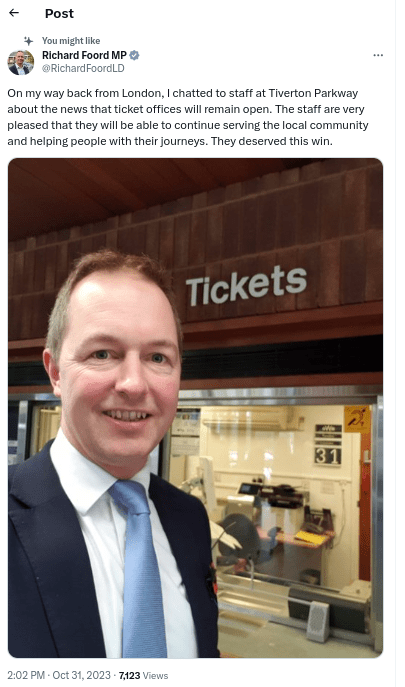
Step forward the real MP for Tiverton, Feniton and Honton, Richard Foord

On my way back from London, I chatted to staff at Tiverton Parkway about the news that ticket offices will remain open. The staff are very pleased that they will be able to continue serving the local community and helping people with their journeys. They deserved this win.

Exmothians why does you MP, Simon Jupp, spend so much time out of your constituency?

Why does Simon seek credit for saving ticket offices outside his constituency? What about Exmouth?

Urgent works at crumbling Exmouth sea wall

Raises the question as to how committed the Government and “other Agencies” are to fund the long term protection for Sidmouth, given these new demands.

Owl has picked up rumours of backtracking.

In March EDDC reported that changes [improvements] to the scheme have been made possible by changes in the UK Government funding calculator, plus extra contributions from the town, District, County Councils, and other Government Agencies. However, there remains an estimated funding gap of £1.75m which is being underwritten by East Devon District Council (EDDC) to enable the project to progress these important works without delay. – Owl

Anita Merritt www.devonlive.com

Urgent action is being taken to protect Exmouth’s seawall ahead of the latest forecasted storm after large cracks have appeared. Problems were first detected a few weeks ago when cracks were visible in the seawall in front of Sideshore which is home to a watersports centre and Mickey’s Beach Bar & Restaurant.

A marine contractor was appointed to assess what work was required, but East Devon District Council (EDDC) has confirmed the cracks have increased following recent bad weather. With the Met Office having issued a severe amber weather warning for wind ahead of Storm Ciarán – which is set to unleash strong gusts and heavy rain across Devon – measures are being undertaken to try and reduce the impact of further weather damage.

The affected area has been fenced off and access to some sections of the beach could also be restricted. The yellow weather warnings for both wind and rain are set to remain active both tomorrow, November 1, and the following day, November 2.

Councillor Geoff Jung, EDDC’s portfolio holder for Coast, Country, and Environment, said: “Last weekend, large seas and high tides worsened the situation, with large cracks appearing in the promenade and revetment wall. With Storm Ciaran approaching, we are concerned about possible further damage and a failure of the seawall.

Exmouth’s crumbling seawall (Image: EDDC)

“To minimise the impact of the storm, large plant and heavy earth moving equipment arrived at the site from 10am yesterday, October 30. This machinery will move and compact sand, wrapped in geotextile to create a temporary barrier to lessen the impact of waves until the storm passes.

“Some geotextiles will be placed on top of the sand and held down with large concrete blocks too. While the operation is carried out, sections of the beach will need to be restricted.

Exmouth’s crumbling seawall (Image: EDDC)

“Following this, further assessments of the damage and the required repairs will be made, and medium and long-term solutions will be proposed. In the meantime, fencing has been erected to keep people off the affected section of the promenade. The situation will continue to be monitored and if necessary, the footway and cycle way may need to be temporarily closed.”

Eight shocking revelations from Cummings and Cain at the Covid inquiry

These are the key things we learned on the most compelling and foul-mouthed day of the Covid inquiry so far:

Matthew Weaver www.theguardian.com 

  • Boris Johnson suggested ‘Covid is nature’s way of dealing with old people’

Sir Patrick Vallance, the UK government’s chief scientific adviser during the pandemic, noted that Johnson favoured “older people accepting their fate and letting the young get on with life”. As the prime minister was resisting reimposing restrictions in December 2020, Vallance wrote: “He [Johnson] says his party ‘thinks the whole thing is pathetic and Covid is just nature’s way of dealing with old people – and I am not entirely sure I disagree with them’.”

  • Dominic Cummings said vulnerable people were ‘appallingly neglected’

The prime minister’s top adviser was asked about how much No 10 considered ethnic minority groups, domestic abuse victims and others in the run-up to imposing a national lockdown. Cummings said: “I would say that that entire question was almost entirely appallingly neglected by the entire planning system.” He added: “The Cabinet Office was essentially trying to block us creating a shielding plan.”

  • Cummings frequently called for the sacking of Matt Hancock and other cabinet ministers

In May 2020, he warned Johnson about the health secretary: “Hancock is unfit for this job. The incompetence, the constant lies, the obsession with media bullshit over doing his job. Still no fucking serious testing in care homes his uselessness is still killing God knows how many.” By August 2020 Cummings told Johnson he was creating the perception that he was “happy to have useless fuckpigs in charge”. He claimed Hancock was a “proven liar”. And he accused Simon Stevens, the chief executive of the NHS in England, of “bullshitting”. He also said Gavin Williamson’s position as education secretary was not sustainable after a U-turn over teacher-assessed exam grades.

  • Cummings used misogynistic language to denigrate the deputy cabinet secretary, Helen MacNamara

He claimed MacNamara’s propriety and ethics teams “waste huge amounts of time”. In a WhatsApp message to the No 10 communications director, Lee Cain, he said he would “personally handcuff her and escort her from the building”. He added: “I don’t care how it is done but that woman must be out of our hair – we cannot keep dealing with this horrific meltdown of the British state while dodging stilettos from that cunt.” Cummings suggested moving MacNamara to the communities department where she could build “millions of lovely houses”. Cummings denied his comments were misogynistic. “I was much ruder about men,” he told the inquiry.

  • Johnson urged Cummings to end an ‘orgy of narcissism’

When Cummings was asked to leave Downing Street in November 2020, he complained to Johnson about briefings from those close to his then fiancee, Carrie Symonds. Johnson told him: “You speak of briefings from team Carrie. She hasn’t briefed anyone and my instructions to all were to shut the fuck up.” The PM also accused Cummings of briefing that Symonds was shaping lockdown policy. He said: “This is a totally disgusting orgy of narcissism by a government that should be solving a national crisis. We must end this.”

  • Cummings was unrepentant about his trip to Durham at the height of lockdown.

He confirmed the day of the Barnard Castle trip was his wife’s birthday. But he added: “The handling of it was a disaster and caused huge pain to a lot of people that I very much regret. But in terms of my actual actions in going north … I acted entirely reasonably and legally, and did not break any rules.” Cummings appeared to regret little about his time at No 10, apart from the language in his messages. His last words to the session were: “I should apologise for my terrible language.” WhatsApp messages shared with the inquiry showed Mr Johnson claiming that his adviser had never told him he had gone to Durham. In messages dated 19 July 2021, Johnson said: “Cummings a total and utter liar. He never told me he had gone to Durham during lockdown … He never told me. I then tried my very best to defend him.”

  • Cain tried to resist Sunak’s ‘eat out to help out’ scheme in the summer of 2020

The former director of communications at No 1o told the inquiry the then-chancellor’s scheme “made absolutely no sense whatsoever”. He said it undermined the government’s message about Covid. He told the inquiry: “What are we signalling to the public? … Go back out, get back to work, crowd yourself on to trains, go into restaurants and enjoy pizzas with friends and family – really build up that social mixing. Now, that is fine if you are intent on never having to do suppression measures again – but from all the evidence we are receiving … it was incredibly clear that we were going to have to do suppression measures again.”

  • Cain said it was a ‘huge blunder’ to ignore Marcus Rashford’s campaign on free school meals

He blamed the mistake on the lack of diversity in government. In his written evidence to the inquiry, Cain said: “I remember asking in the Cabinet room of 20 people, how many people had received free school meals. Nobody had – resulting in a policy and political blind spot. This was a huge blunder. The PM (to some degree understandably) said we needed to draw a line in the sand on public spending commitments, but this was clearly not the place to draw that line – something the PM was told by his senior team of 20 people.”

Was Simon Jupp amongst MP alleged to have lobbied Johnson to prioritise economy over protecting elderly?

Evidence heard at the Covid inquiry yesterday hints at the pressure from the party on the PM.

“Vallance’s diary also recounts how then chief whip Mark Spencer told a cabinet meeting in December 2020 that “we should let the old people get it and protect others”. He said that Johnson then added: “A lot of my backbenchers think that and I must say I agree with them”.”

Then we have this evidence of Simon’s priorities, see: MP Simon Jupp goes full ostrich in the face of the Omicron wave when he was on record as tweeting ‘I don’t support Plan B. … I won’t vote for these measures.’

And we all know of his lobbying in support of the hospitality sector in general and support for “Dr Death’s” “eat out to help out”. – Owl

Boris Johnson favoured ‘older people accepting their fate’, Covid inquiry hears

Pippa Crerar www.theguardian.com (Extract0

Boris Johnson told senior advisers that the Covid virus was “just nature’s way of dealing with old people” and he was “no longer buying” the fact the NHS was overwhelmed during the pandemic, the pandemic inquiry has heard.

In a WhatsApp message sent to his top aides in October 2020, the former prime minister said he had been “slightly rocked” by Covid infection rates and suggested he was, as a result, unconvinced that hospitals were on the brink despite public warnings from NHS chiefs and frontline staff.

The former chief scientific adviser, Sir Patrick Vallance, in his diaries described a “bonkers set of exchanges” in a meeting from that August. He noted that Johnson appeared “obsessed with older people accepting their fate” and letting younger people get on with their lives during the pandemic.

Another note from Vallance, after a meeting in December 2020, hinted at the power wielded by the right of the Conservative party during the pandemic: “PM told he has been acting early and the public are with him (but his party is not).

“He says his party ‘thinks the whole thing is pathetic and Covid is just nature’s way of dealing with old people – and I am not entirely sure I disagree with them. A lot of moderate people think it is a bit too much.’”

Vallance’s diary also recounts how then chief whip Mark Spencer told a cabinet meeting in December 2020 that “we should let the old people get it and protect others”. He said that Johnson then added: “A lot of my backbenchers think that and I must say I agree with them”.

Johnson, despite Covid infection numbers going up at that time, told the meeting that he wanted to move to tier 3 restrictions instead.

The documents emerged during a bruising session of the Covid inquiry for the former prime minister, with the former senior aides Lee Cain and Dominic Cummings questioning in evidence his suitability for the role during the pandemic.

Cummings had previously, in July 2021, claimed that Johnson was not prepared to impose lockdown restrictions to stop the spread of Covid in autumn 2020 because “the people who are dying are essentially all over 80”…..

More than 4,000 English flood defences almost useless, analysis finds

Steve Reed, Labour’s shadow environment secretary, said: “The Conservatives’ sticking-plaster approach to flooding has left communities devastated and cost the economy billions of pounds.”

Brace, brace, brace for storm Ciarán, especially if Thérèse Coffey looking the wrong way! – Owl

Josh Halliday www.theguardian.com 

More than 4,000 of England’s vital flood defences are so damaged they are almost useless, including hundreds in areas battered by Storm Babet.

Nearly 800 critical assets – defined as those where there is a high risk to life and property – were in a “poor” or “very poor” condition in the 10 English counties worst affected by last week’s historic downpours.

The analysis will add to growing anger from flood-hit communities who have accused the authorities of being ill-equipped and complacent in the run-up to Storm Babet.

It comes as Britain braces for yet more heavy rain and flooding this week ahead of the arrival of Storm Ciarán, which is set to bring strong winds and heavy rain when it arrives on Thursday.

Parts of Britain faced further severe downpours at the weekend, hampering the recovery from the devastating floods that left at least seven people dead, hundreds homeless and scores of properties damaged.

MPs and residents across England and Scotland have demanded a review of the protections in place in the aftermath of Storm Babet, which overwhelmed defences and caught forecasters off-guard.

Steve Reed, Labour’s shadow environment secretary, said: “The Conservatives’ sticking-plaster approach to flooding has left communities devastated and cost the economy billions of pounds.”

Extreme weather events are becoming more likely and frequent due to climate breakdown, and have caused food shortages and price increases.

An analysis of Environment Agency data obtained by Unearthed, the investigative arm of Greenpeace UK, showed that 4,204 of England’s most important flood defences were in a poor or very poor condition in 2022. This accounts for about one in 15 of the total.

Across the country, 856 were judged very poor, meaning they had “severe defects resulting in complete performance failure”, essentially rendering them useless.

The remaining 3,348 were in poor condition, meaning they have defects that would “significantly reduce” their performance.

In the 10 English counties worst affected by Storm Babet, spanning from Suffolk to Northumberland, 646 were in a poor condition and 135 were judged to be very poor.

The Environment Agency, which owns and maintains more than half of the flood defences in England, said inspections from the latest financial year showed an improvement, from one in 15 being in disrepair to one in 20.

It added that contingency plans will be put in place if required when critical defences are found to be in poor condition.

Paul Morozzo, Greenpeace UK’s senior climate campaigner, said: “Our crumbling flood defences are a symbolic and literal demonstration of the government’s failure to tackle the climate crisis.

“Storm Babet was a sobering reminder that the climate crisis is on our doorstep and that the cost – both in terms of lives lost and damage caused – is huge.

“Without bold action to cut emissions as fast as possible, extreme storms and flooding will become more common and more intense. And without the necessary investment and upgrades, our flood defences will continue to fail.

“By rowing back on its climate commitments and failing to ensure we have infrastructure needed to mitigate its impacts, the government has all but given up on the communities it is supposed to protect. This is a shameful dereliction of duty and will cost votes in the coming election unless Sunak wakes up and has the guts to change direction.”

The Environment Agency, which is a non-departmental public body sponsored by the Department for Environment, Food and Rural Affairs, aimed last year to repair scores of its flood defences leaving only 30 in poor or very poor condition. In reality, 1,766 remained in that category.

The environment secretary, Thérèse Coffey, suggested last week that the Met Office and the Environment Agency had been caught off-guard by Storm Babet because the rain came in from the east.

She also said it looked as if her department “may not be hitting” its target of protecting 336,000 properties by 2027.

The Met Office has said the 18 to 20 October period was the third-wettest independent three-day period in England and Wales since 1891. The Midlands provisionally recorded its wettest three-day period on record.

Defra said it was investing £5.2bn between 2021 and 2027 to protect properties from flooding and that more than 96,000 buildings were shielded from Storm Babet.

An Environment Agency spokesperson said: “We maintain approximately 76,000 flood assets across England, 95% of which we would expect to function as designed during a flood, which is an increase on the previous year.

“We prioritise maintenance where there is significant threat to lives and livelihoods, which was supported by a £200m investment between April 2022 and March 2023 to ensure our assets were winter ready.”

‘People will die anyway’: Pressure on Boris Johnson over Covid messages

Boris Johnson asked why damage was being inflicted on the economy during the pandemic “for people who will die anyway soon” in a meeting with Rishi Sunak, the Covid inquiry was told on Monday.

Ben Quinn www.theguardian.com (Extract)

At the start of what is set to be a bruising week for the former prime minister, with former political aides and senior civil servants to give evidence on his government’s handling of the pandemic, the diary of a former private secretary revealed the damaging remarks made in March 2020.

The note was from a meeting during which Johnson was believed to have said: “We’re killing the patient to tackle the tumour. Large ppl [taken to mean large numbers of people] who will die, why are we destroying economy for people who will die anyway soon.”

Imran Shafi, the official who wrote the memo, told the inquiry he thought it was Johnson who made the comments. It came after a series of diary entries and WhatsApp messages suggested the low regard in which the former Tory leader was held by senior advisers…..

The extraordinary WhatsApp messages that reveal the ‘chaos’ of Boris Johnson’s government

A series of scathing WhatsApp messages sent between Boris Johnson’s top team have accused the former prime minister of making it “impossible” to tackle Covid, as he created chaos and changed direction “every day”.

Archie Mitchell www.independent.co.uk

The extraordinary messages sent between the likes of Dominic Cummings, Lee Cain and Simon Case reveal the strong disquiet among Mr Johnson’s advisers, with Mr Case, the cabinet secretary and top civil servant, at one point declaring: “I am at the end of my tether.”

The ex-PM’s top officials also branded him “weak and indecisive” and referred to him as a “trolley”. Chief scientific advisor Sir Patrick Vallance, meanwhile, said Mr Johnson was “all over the place” and “so completely inconsistent”.

The WhatsApp messages and diary entries, shown to Mr Johnson’s former principal private secretary Martin Reynolds at the official Covid inquiry, laid bare the chaos behind Downing Street’s response to Covid.

In a bombshell three hours of testimony about his time as Mr Johnson’s PPS, Mr Reynolds was asked about everything from the government’s preparedness for the pandemic to his own role in the Partygate scandal of lockdown-busting events.

The ex-top civil servant, since dubbed “Party Marty”, apologised “unreservedly” for sending an email to more than 100 Downing Street staff inviting them to a “bring your own booze” garden party during lockdown.

And he admitted the government’s readiness to tackle Covid was “grossly deficient”, and that officials were operating “without a proper playbook”.

The inquiry was shown extraordinary WhatsApp exchanges and notes taken around the time of key decisions being made.

In one diary entry, Sir Patrick wrote: “Number 10 chaos as usual.

“On Friday, the two-metre rule meeting made it abundantly clear that no-one in Number 10 or the Cabinet Office had really read or taken time to understand the science advice on two metres. Quite extraordinary.”

In other entries Sir Patrick described how he felt scientists were “used as human shields” by ministers.

On 19 September 2020, when a potential “circuit-breaker” lockdown was up for discussion, he wrote: “Johnson is all over the place and so completely inconsistent. You can see why it was so difficult to get an agreement to lock down the first time.”

And in a devastating exchange of messages between Mr Case, the cabinet secretary, and Mr Cummings, who was Downing Street’s chief of staff at the time, Mr Johnson was described as “creating chaos”.

Mr Case said: “I am at the end of my tether. He changes strategic direction every day (Monday we were all about fear of virus returning as per Europe, March etc – today we’re in ‘let it rip’ mode because the UK is pathetic, needs a cold shower etc.)

“He cannot lead and we cannot support him in leading with this approach. The team captain cannot change the call on the big plays every day. The team can’t deliver anything under these circumstances.”

Piling in to the other cabinet ministers, he said: “A weak team (as we have got – Hancock, Williamson, Dido, No10/CO, Perm Secs), definitely cannot succeed in these circumstances. IT HAS TO STOP! Decide and set direction – deliver – explain. Gov’t isn’t actually that hard but this guy is really making it impossible.”

Mr Cain replied: “Totally agree. Am already getting lots of despairing messages from people in meetings with him. And he’s careering around on WhatsApp as usual creating chaos and undermining everybody. “

In another exchange shown to the inquiry, Mr Cummings accused Mr Johnson of going “full trolley mode”, referring to his tendency to veer between issues.

Pressed toward the end of the session on his now infamous BYOB email, Mr Reynolds said: “I would first like to say how deeply sorry I am for my part in those events and for the email message, which went out that day.

“And I would like to apologise unreservedly to all the families of all those who suffered during Covid for all the distress caused.”

David Mackintosh trial: Developer said he ‘would fund campaign’

A property developer said he would fund a prospective Conservative MP’s election campaign, a trial has heard.

By Matt Precey www.bbc.co.uk 

Howard Grossman is alleged to have made the remark at a fundraising dinner for David Mackintosh, who went on to win Northampton South in 2015.

Both men are accused of concealing the true source of political donations.

Mr Grossman, from Hertfordshire, and Mr Mackintosh, from Northampton, both deny the charges.

The court previously heard how in 2014, nine donations totalling £39,000 were paid into Mr Mackintosh’s political fighting fund by a string of donors, when the source of the money was Mr Grossman.

The former chairman of Northampton South Conservative Association (NSCA), Suresh Patel, was cross examined on the fifth day of the trial at Warwick Crown Court.

He described a fundraising dinner at the Carlton Club which he and Mr Mackintosh attended in December 2014 along with two dozen others.

‘I was used’

Mr Patel, 66, said he had never met Mr Grossman before this event and alleged the Bushey based businessman told him “I’ve said to David I’ll fund his campaign” after Mr Mackintosh introduced them.

It was “one of the worst fundraising events I’ve ever been to in my life. I felt like I was used” he recalled.

Mr Patel said he was asked at short notice to attend and collect ticket money off the guests but was subsequently told Mr Grossman would gather the money instead and transfer it to the Northampton South “fighting fund”.

Mr Grossman’s defence counsel, Neil Hawes KC, challenged Mr Patel about his attendance at the opening of Northampton’s bus station in 2013 which Mr Mackintosh was closely involved in as the then leader of Northampton Borough Council.

Mr Grossman was also there alongside the then owner of Northampton Town Football Club, David Cardoza, Mr Hawes said.

Mr Hawes continued: “At the bus station opening I suggest you were approached about a donation (by Mr Grossman).”

“No-one approached me,” Mr Patel answered.

‘Never, never ever’

The barrister also asked whether the planned redevelopment of Northampton Town’s Sixfields stadium was politically important?

He asked if he knew Mr Grossman was connected to 1st Land Ltd, the company involved in the Sixfields work, at that stage.

“No idea,” was the answer.

Mr Hawes put it to Mr Patel that it was he who suggested to Mr Grossman that he would have to use third parties to make any donations to Mr Mackintosh, because of his close involvement in the Sixfields project.

“Never, never ever. I don’t believe in doing things like that,” said Mr Patel.

Mr Mackintosh, of Station Road, Northampton, and Mr Grossman, 61, of Caldecote Gardens, Bushey, Hertfordshire, are both charged with two offences under the Political Parties, Elections and Referendums Act 2000.

Both are accused of failing to ensure NSCA was provided with the correct information as to the source of donations, which were made between January and September 2014.

The trial is scheduled to continue on Monday.

England’s ‘broken’ housing system becoming a problem councils cannot avoid

Bankruptcy, Ernest Hemingway once wrote, comes gradually, then suddenly. For years, England’s dysfunctional housing market was a distant concern for most district councils in the relatively affluent home counties; now, unexpectedly, it is in their faces, out of control and threatening to overwhelm them.

Patrick Butler www.theguardian.com 

Hastings, a coastal district in East Sussex, has warned it could become effectively insolvent this year as the housing crisis rips through. High house prices, soaring rents, housing benefit cuts, a 120% year-on-year rise in evictions, shortages of social housing and a shrinking, volatile, local private rented sector have created a perfect storm.

It expects to spend £5.6m – almost a third of its £17m net budget this year – picking up the pieces, providing emergency housing for more than 1,000 homeless people. By contrast, in 2019, it spent just £730,000 supporting 170 people. A homelessness service that ticked over relatively uneventfully for years could now break the council.

The crisis is so acute that earlier this year Hasting borough council’s Labour leader, Paul Barnett, even appealed to local residents with spare rooms to consider letting them to homeless people. The council hopes to buy 50 homes to house homeless families and has longer-term plans to build more social housing, but this seems too little and too late.

“The financial difficulties that we are facing are a result of national housing crisis. The system is broken, and as a result is forcing many of our residents out of secure accommodation into temporary housing provided by the council,” Barnett said in a statement this week.

His point is that the housing whirlwind crashing through councils such as Hastings is structural. The town may be an outlier but the crisis is national, affecting scores of authorities all feeling the effects of a “seismic shift” in housing affordability caused by rising demand and shrinking supply.

The shift is driven by many things: demographic change, the long-term erosion of social housing and housing benefit levels, the failure to build sufficient new homes, the growing impossibility of home ownership for many, the rise in “no fault” evictions and the defunding of local authorities.

The consequence is human pain and social disruption. Stephen Robinson, the Liberal Democrat leader of Chelmsford city council, said a pensioner recently presented as homeless at the council’s housing office, facing eviction after their rent was raised by £200 a month. But in the main it deals with familieswho have been priced out of the area and placed in temporary housing, often miles away in Ipswich or Peterborough.

The imminent closure of Home Office-funded hotels for Afghan asylum seekers in the coming weeks could exacerbate the housing problem. Robinson said this was a relatively tiny part of the risk facing the council: “Most of the 465 households we have in temporary accommodation are local families in work, or who have lost a job.”

Andrew Baggott, the Tory leader of Basildon borough council in Essex, said that radical solutions were needed, including regulation of the private rented sector to keep rents affordable, long-term government investment in social housing, and an increase in local housing allowance to reflect local rent levels.

Asked whether a government long-wedded to the idea of a deregulated housing market and a smaller benefits bill would listen to such demands, he replied: “Times change. Any government that does not change with the times is not fit for purpose, by definition.”

Crackdown on ‘permanent’ Exminster holiday homes

Some people have been living there for more than a decade

Councillors have voted to take action over five unauthorised homes in Exminster, despite being warned that doing so could make people homeless.

Guy Henderson, local democracy reporter www.radioexe.co.uk

Teignbridge’s planning committee was told that holiday accommodation at Pottles Barn had been used as permanent housing for years. In fact, they heard, seven of the 12 units had been used permanently for more than 10 years, making them exempt from council action.

But the other five haven’t been used as long, and now the council is demanding they return to holiday use.

Planning permission for holiday occupancy was granted in 2007, when the council decided the rural location was ‘unsustainable’ for permanent homes.

In 2019 the council was alerted and the owner of the barns was contacted. An application to remove the holiday-only condition was refused in 2021.

A report said: “Whilst seven of the units may be immune from enforcement action, this does not mean the remaining units should also be allowed to become lawful permanent residential dwellings.”

Enforcement action would mean the occupants would have to leave and “this could result in a number of occupants becoming homeless.”

Instead there will be a ‘breach of condition’ notice with no right of appeal, which will still mean occupants have to find new homes within 12 months.

Agents for the owners of Pottles Barn said national planning policies had changed since 2007, and might now allow a change of use. The owners had been approached by local people looking for small and affordable homes.

Committee chairman Colin Parker (Lib Dem, Buckland and Milber) said: “It’s a shame that we have got to this situation. All those years that people were living there, and it shouldn’t have happened.

“It is difficult to say that some people can stay there and some can’t.”
 

Biggest private children’s homes in England made £300m profit last year

Fee income for 20 largest operators – many private equity-owned – soars as councils struggle to meet costs

The biggest private providers of children’s homes in England made profits of more than £300m last year, as concern mounts over the conditions some children are being placed in and the spiralling costs for councils.

Michael Savage www.theguardian.com 

Fee income for the 20 largest operators of independent children’s homes totalled £1.63bn last year, a 6.5% increase on the previous year. And 19% of that – £310m – was recorded as profit, according to an independent analysis. Half of the top 20 providers have some private equity or sovereign wealth fund ownership.

Council spending on privately-run children’s homes in England has more than doubled in six years. In 2021-22, spending on independently-run residential care for vulnerable children increased by 11% on the previous year.

This comes with the number of children in care at its highest level since before the pandemic: 82,170 in England. There are also concerns among councils over the indebtedness of some of the main providers.

The report was commissioned from Resolution Consulting by the Local Government Association (LGA), which worried that increasing fees were putting council budgets under immense pressure. The report also raised concerns about financial transparency in the sector, given a significant rise in mergers and acquisitions.

One company to increase profits last year was Your Chapter Holdings. Accounts out this month show profits rising from £1.7m to £2.2m. The company was formerly called Care 4 Children but changed its name after criticisms over the care it provided.

Just last month, Ofsted warned that Your Chapter had failed to sufficiently improve one home, which it had deemed “inadequate”. It stated: “There are serious and/or widespread failures that mean children and young people are not protected or their welfare is not promoted or safeguarded.”

A spokesperson for the provider said: “We strive continuously to improve and to provide the best possible care and education for the children and young people in our care.”

Katharine Sacks-Jones, chief executive of the Become charity for children in care and young care leavers, said: “There are serious questions to ask when we have a care system in crisis, a chronic shortage of homes for children, local councils struggling and private providers making ever-increasing profits. We know children in private provision are more likely to be placed away from their local area and the people and places that matter to them.

“Children in care, who have experienced significant trauma, must not be seen as a commodity. This is public money that should be spent on providing a system where children get the support and stability they need.”

Local authorities report spending £12.8bn on children’s social care in 2022-23, compared with £6.6bn in 2012-13. Senior figures fear children’s social care is affecting all other areas of spending.

“What matters most for children who can’t live with their birth parents is that they feel safe, loved and supported, in homes that best suit their needs,” said Louise Gittins, chair of the LGA’s children and young people board. “While many providers work hard to make sure this is the case, it is wrong that some are making excessive profit from this.

“As the report shows, spending on residential care placements for children has increased dramatically in recent years as councils have sought to find the best homes for record numbers of children in care, while mergers and acquisitions have seen some large independent providers grow significantly. Yet while councils are having to divert more and more money away from early help services and into homes for children in care, the largest privately-run companies continue to bring in huge profits.”

The Children’s Homes Association said it shared these concerns, particularly at levels of debt carried by large private equity providers, but that this did not reflect the sector as a whole.

“The majority of our members are micro or small providers that achieve small margins to ensure the viability of their organisations, and critically are not carrying significant levels of debt,” it said. “The independent sector consistently provides care at a significantly lower cost than local authorities. This, combined with caring for a higher-need cohort of children and young people, demonstrates value for money.”

‘Disastrous’ homes plans for Devon town thrown out

Plans for 63 homes on the edge of Ottery St Mary have been rejected for the third time. The development was voted down after a lengthy discussion that saw several residents and local councillors raise concerns.

Bradley Gerrard www.devonlive.com

A key focus of the near two-hour debate by East Devon councillors centred on whether Sidmouth Road, which would provide access to the site, could adequately deal with increased traffic, and whether a proposed footpath was adequate to keep pedestrians safe. The three-hectare site is classified as good quality, or Grade 2, agricultural land, a factor several objectors highlighted as a reason to reject the application.

Residents also complained that the site was outside the agreed local plan that guides where future houses should be built, that it could be seen from a large area, including from the nearby Area of Outstanding Natural Beauty, and that Ottery St Mary’s primary and secondary schools are oversubscribed.

ALD Developments, the firm behind the scheme that would have been half affordable housing, had sought to appease concerns about the roads after the scheme was last rejected in 2021. It proposed a priority scheme that would mean traffic heading towards Ottery would give way to vehicles leaving the town, and had attempted to ensure adequate pedestrian access.

But objectors claimed that the width of the road meant it wasn’t possible to provide safe access for pedestrians and cyclists. John Pearson, a highway consultant for 40 years, said that in this case, the “constraints are insurmountable. It’s never good to squeeze in sub-standard solutions,” he said.

“The evidence is clear that the footway width is well below guidance, and that the remaining carriageway width prevents anything larger than a car from passing a non-motorised vehicle safely.”

Highways officers from Devon County Council acknowledged that a small section of the proposed footpath was below statutory guidance, but only by eight centimetres, and that it was safer than the current situation on this stretch of Sidmouth Road where no pavement existed.

Richard Grainger, Ottery St Mary mayor, said there had been “hundreds of objections” to the plan from residents. “This application has already been rejected – correctly – twice and I really feel that there is no grounds for bringing it back to this committee,” he said.

Devon County Council councillor Jess Bailey (Independent, Otter Valley) said it was the first time in two and a half years that she had needed to attend East Devon’s planning committee in person, which showed how “exceptionally bad” the application was.

“I would go so far as to say that if it is approved, it would be disastrous for Ottery,” she said. “I disagree with the decision by Devon County Council’s highways officers to withdraw their objections, and my greatest concern is for pedestrians along the proposed substandard pavement.”

In mitigation, Graham Cridland, the agent for ALD Developments, said his client had “worked hard to address all the previous reasons for refusal”.

“We’ve done a great deal of work on specific mitigation measures and all the statutory consultees, such as Devon highways and Natural England, support the application and so there should be no legitimate reason for refusal,” he said.

Wendy Ormsby, East Devon District Council’s development manager, said that the planning committee had to consider the authority’s requirement to demonstrate that it had five years’ worth of land supply for future development.

Given this figure stood at 4.28 years, Ms Ormsby said the council had to assess whether some of its concerns about the development significantly and demonstrably outweighed the benefits of delivering housing.

However, councillors voted against the plans, citing the loss of agricultural land, its overwhelming impact on the landscape, and that there had been no mechanism to secure the affordable housing or published efforts about mitigating the impact on nearby Pebblebed Heath, a special area of conservation.

Torbay Council leader says ‘rebels should face by-election test’

Duo say they can serve the bay better outside the Tory ranks

Torbay Council’s Tory leader has called on two of his former party colleagues to face by-elections after defecting from the Conservative ranks.

Guy Henderson, local democracy reporter  www.radioexe.co.uk 

Rebels Katya Maddison and Patrick Joyce, who were voted on to the council as Conservatives in May, have resigned from the party ranks to set up their own Prosper Torbay group.

The decision means the Tories have lost their overall majority.

Cllr Maddison (Shiphay) and Cllr Joyce (Wellswood) said they felt they would be better able to serve the interests of Torbay residents by being outside the Conservative group.

They are calling on the Tory administration to focus on supporting local High Streets and tackling the problems of homelessness and housing.

Their statement said: “There’s a lot of good stuff going on in Torbay with devolution and big capital projects lining up, but if history has taught us anything it’s that the devil is in the detail, and we would encourage the administration to be focused on that too.

“We want to be free to challenge projects while they’re still being formulated so we can avoid the fiascos of the past.”

Council leader David Thomas (Con, Preston) said: “I am really disappointed that they don’t want to remain within the group. One thing is for certain – Katya, Patrick and I have not had a huge blazing row where we have all fallen out with each other.”

And, he said, there would be questions for the pair to answer from the people who elected them in May.

“Are they going to their communities for a by-election?” he asked. “I think they should.

“It was only five months ago that they stood and were elected on a Conservative ticket, and a lot of people will have been voting for a manifesto and a certain direction of travel.

“They stood on that manifesto, and yet in five short months they want to do something different.”

Cllr Thomas said the new administration’s focus on ‘delivering’ big projects across Torbay would have town centres and High Streets at their heart.

There is potentially around £200 million to be spent, with the council’s new regeneration partner having access to £100 million in investment and the £100 million we have from the government.

“The opportunities to do something are just coming on line now,” he added. “We are well aware of the problems in the town centres. We are not blind to them.”

The change shifts the balance of power on Torbay Council significantly. Up until today there were 19 Conservative councillors, 15 Liberal Democrats and two Independents, giving the Tories an overall majority of two.

However, with 17 Conservatives, 15 Liberal Democrats, two Independents and two Prosper Torbay councillors, the overall majority is gone.

It would now be possible in theory for the 19 non-Conservative councillors to launch a vote of no confidence in Cllr Thomas, but that seems highly unlikely.

“I’m very disappointed that they think they can do things better on their own,” said Cllr Thomas. “But I hope they will continue to support what we are looking to bring forward.”

35 ways in which the Levelling Up and Regeneration Act will change planning

Your reading for the weekend! – Owl

The government announced on 26 October that the bill had now received royal assent.

www.planningresource.co.uk 

The bill was first published in May 2022, prior to its first reading in the House of Commons, alongside its explanatory notes. Since then, both parliamentary houses have debated its provisions and made a number of amendments to the legislation. The final version of the bill was agreed earlier this week following the conclusion of the stage known as “ping-pong”, which refers to the term for the to and fro of amendments to Bills between the House of Commons and the House of Lords.

According to the 2022 explanatory notes, “changes to planning procedures will begin to take place from 2024, once the Bill has Royal Assent and associated regulations and changes to national policy are in place”. 

In a blog post, Nicola Gooch, partner at law firm Irwin Mitchell, said that, while getting royal assent is a “big achievement, there is a still a lot of work left to do… bringing the provisions in LURA into effect will require a huge raft of further consultations, detailed technical work and secondary legislation”.

Indeed, according to consultancy Lichfields, “most of the sections [in the Act] directly related to development management and plan-making have not commenced and will require secondary legislation”. 

While the final version of the Act is yet to be published, and secondary legislation has not yet been enacted, here are 35 things you need to know about how the new laws are intended to change the planning system.

1. Local planning authorities will be required to have a design code in place covering their entire areas. The bill’s original explanatory notes say that the legislation will require “all local planning authorities to have a design code in place covering their entire area”.

The document states: “The area-wide codes will act as a framework, for which subsequent detailed design codes can come forward, prepared for specific areas or sites and led either by the local planning authority, neighbourhood planning groups or by developers as part of planning applications. This will help ensure good design is considered at all spatial scales, down to development sites and individual plots.”

2. A new levy will replace section 106 planning obligations and the Community Infrastructure Levy. On “infrastructure”, the document confirms that the Bill will replace the current section 106 and the Community Infrastructure Levy (CIL) regimes with a new Infrastructure Levy.

It says that the rates and thresholds of this new levy will, as with the existing CIL regime, be set in charging schedules “and set and raised by local planning authorities (rather than nationally), meaning that rates are tailored to local circumstances and deliver at least as much onsite affordable housing”.

The notes add: “Charging schedules must have regard to previous levels of affordable housing funded by developer contributions such that they are kept at a level that will exceed or maintain previous levels. All schedules will be subject to public examination.”

There will also be “a process to require developers to deliver some forms of infrastructure that are integral to the design and delivery of a site”.

A government amendment to the Bill, agreed at committee stage, will allow money raised by the levy to be spent on additional matters as well as affordable housing and infrastructure.

The government later proposed a further amendment to the bill designed to strengthen its provision of affordable housing and permit authorities to disapply the levy in cases where they consider it will make development “unviable”. 

3. A new requirement will be placed on local authorities to prepare infrastructure delivery strategies. The Bill also places “a new duty on local authorities to prepare infrastructure delivery strategies to outline how they intend to spend the levy”. This is to “make sure that infrastructure requirements and levy spending priorities are considered carefully”, the notes say.

4. More weight will be given to local plans, neighbourhood plans and spatial development strategies proposed by mayors or combined authorities. Under the “democracy” heading, the notes say that local plans, neighbourhood plans and spatial development strategies proposed by mayors or combined authorities “will be given more weight when decisions are made on applications so that there must be strong reasons to override the plan, providing communities more certainty”.

Meanwhile, local plans, minerals and waste plans, supplementary plans and neighbourhood plans will all be required to “take account” of  new local nature recovery strategies. 

5. The scope of local plans will be limited to ‘locally specific’ matters, with ‘issues that apply in most areas’ to be covered by a new suite of national policies. The document says that the Bill “requires each local planning authority to prepare one local plan, with the content limited to locally specific matters such as allocating land for development, detailing required infrastructure and setting out principles of good design”.

It adds: “General policies on issues that apply in most areas (such as general heritage protection) will be set out nationally and contained in a suite of National Development Management Policies (NDMPs), which will have the same weight as plans so that they are fully taken into account in decisions. Local plans will not be able to repeat these.

NDMPs will be subject to consultation in “all but exceptional circumstances”, but will not be subject to parliamentary approval, despite repeated attempts by the House of Lords to insert such a provision. 

6. Ministers will have to have regard to climate change when preparing NDMPs. Although the government rejected an amendment originally tabled in the House of Lords which would have required ministers to “have regard to climate change when preparing planning policy”, it accepted a watered-down version of the provision. 

Instead, the agreed-upon amendment which will form part of the final Act, will require the drafting of policies that are to be designated as NDMPs to “have regard to the need to mitigate, and adapt to, climate change, taking into account the range of climate scenarios and risk relevant to the policies being developed.”

7. The ‘duty to co-operate’ will be dropped, and time limits prescribed for different stages of plan preparation. The notes also say that the Bill makes “several other changes to improve the process for preparing local plans: new powers will enable the introduction of ‘Gateway’ checks so that issues are identified earlier during plan preparation, and allow time periods to be prescribed for different parts of the plan preparation process, enabling delivery of a time-bound end-to-end process; digital powers in the Bill will allow use of more standardised and reusable data, and there will be a new requirement for local planning authorities to produce a consolidated policies map of the full development plan for their area, improving the clarity and transparency of plans; and the ‘duty to co-operate’ contained in existing legislation is being repealed”. 

Earlier this year, the government published a consultation on its proposed implementation of these plan-making reforms, which set out further details about the timetable authorities will be expected to follow when preparing their local plans. 

8. There will be a new power for planning authorities to quickly create ‘supplementary plans’ for some or all of their areas. In addition, the notes continue, local planning authorities “will have a new power to prepare ‘supplementary plans’, where policies for specific sites or groups of sites need to be prepared quickly (e.g. in response to a new regeneration opportunity), or to set out design codes for a specific site, area or across their whole area”.

9. Groups of authorities will also be able to produce voluntary spatial development strategies on specific cross-boundary issues. “Groups of authorities” will also be allowed “to collaborate to produce a voluntary spatial development strategy, where they wish to provide strategic planning policies for issues that cut across their areas (echoing the powers conferred on some mayoral combined authorities already)”, the notes say.

10. The EU processes of environmental impact assessment and strategic environmental assessment will be replaced by ‘environmental outcomes reports’. Under “environment”, the notes say: “A new system of Environmental Outcomes Reports will replace the EU processes of Environmental Impact Assessment and Strategic Environmental Assessment whilst retaining the UK’s obligations under the UN Aarhus and Espoo Conventions.”

The notes say that the Bill, now the Act, introduces an “outcomes-based approach that will allow the government to set clear and tangible environmental outcomes which a plan or project is assessed against”. This will “allow decision-makers and local communities to clearly see where a plan or project is meeting these outcomes and what steps are being taken to avoid and mitigate any harm to the environment. These outcomes will be set following consultation and parliamentary scrutiny but will, for the first time, allow the government to reflect its environmental priorities directly in the decision-making process.”

11. A ‘simpler to prepare’ alternative to neighbourhood plans will be introduced. Under “neighbourhoods”, the notes say that the Bill introduces “a new neighbourhood planning tool called a ‘neighbourhood priorities statement’, providing communities with a simpler and more accessible way to set out their key priorities and preferences for their local areas. Local authorities will need to take these into account, where relevant, when preparing their local plans for the areas concerned, enabling more communities to better engage in the local plan-making process.”

Alongside this, the notes add, the Bill will “prescribe in more detail what communities can address in their neighbourhood plans and amend the ‘basic conditions’ to ensure neighbourhood plans are aligned with wider changes to the planning system”.

12. A ‘street votes’ system will permit residents to propose development on their street and hold a vote on whether planning permission should be given. The original version of the draft legislation included “placeholder for a substantive clause which will introduce a ‘Street Votes’ system that permits residents to propose development on their street and hold a vote on whether it should be given planning permission”. The document says: “This will provide a positive incentive for neighbours to consider the potential for development, especially in areas of higher demand, and support a gentle increase in densities through well-considered, well-designed and locally supported proposals.”

The government later amended the bill to make provision for “street vote development orders”, replacing the placeholder clause in earlier versions of the bill, and further clarified how these orders will work in practice.

The amendment confers “regulation-making powers relating to the preparation and making of an order, including provision for independent examination and a referendum”. Development granted by a street vote development order will also be subject to the Community Infrastructure Levy.

A further amendment, conferring a new “regulation-making power on the secretary of state to specify or describe development to be excluded from the remit of street vote development orders” was later agreed

13. Decision-makers will face a new duty to act in line with the development plan and national policies. On “the planning application process”, the notes say the Bill will impose “a new duty on decision-makers to make planning decisions in accordance with the development plan and national development management policies unless material considerations strongly indicate otherwise”. The document says that this is to “increase certainty in planning decisions”.

14. A new route will be created to allow the Crown to apply directly to the secretary of state for determination of nationally important development. Further, the notes say that the Bill will “speed up the process of dealing with applications for nationally important Crown developments in the planning system”, including through “a new process for nationally important and urgent developments, and a new route which allow the Crown to apply directly to the secretary of state for determination of nationally important development”.

15. ‘Loopholes’ preventing planning enforcement will be closed. Under “enforcement”, the notes say that the Bill “amends and strengthens the powers and sanctions available to local planning authorities to deal with individuals who fail to abide by the rules and process of the planning system”.

This includes “facilitating enforcement action by closing existing loopholes which can be exploited to prolong unauthorised development, allowing more time for the investigation of breaches, introducing enforcement warning notices, making the enforcement timescales that currently apply more consistent, and increasing fines”.

16. Registered parks and gardens will get the same level of planning protection as listed buildings. On “protecting heritage”, the notes says that the Bill will “make changes so that designated heritage assets, such as registered parks and gardens, World Heritage Sites, protected wreck sites, and registered battlefields, enjoy the same statutory protection in the planning system as listed buildings and conservation areas”.

17. The compulsory purchase order system will be changed. According to the explanatory notes, the Bill “streamlines and modernises Compulsory Purchase Orders (CPO) and grants the power to local authorities to use CPO for regeneration purposes”. These changes “would empower local decision-making and improve transparency regarding local authorities’ power to acquire brownfield land compulsorily for regeneration in their area”, the notes say. The measures include changes to publicity requirements around CPOs and how inquiry procedures are held.

The government’s amendment 412D will allow ministers to disapply the “hope value” of land obtained via a compulsory purchase order – and see landowners compensated for just the existing use of their land – for schemes that include affordable housing, health or education provision. 

18. Urban development corporations’ planning powers will be revised, and a new type of corporation introduced. The notes explain that, currently, there are four types of development corporation: “The New Town Development Corporation, the Urban Development Corporation, the Mayoral Development Corporation and the locally-led New Town Development Corporation”. The document says: “Each model reflects the time and circumstances when they were introduced, and thus have varying powers and remits.”

This Bill “makes provision for a new type of locally-led Urban Development Corporation, with the objective of regenerating its area and accountable to local authorities in the area rather than the secretary of state”, the notes say. It also “updates the planning powers available to centrally and locally-led development corporations, so that they can become local planning authorities for the purposes of local plan-making, overseeing neighbourhood planning and development management. This is to bring them in line with the Mayoral Development Corporation model.” The Bill also “amends the process for establishing locally-led New Town Development Corporations, [removes] the cap on the number of board members and [removes] the aggregate limits to borrowing”.

19. Planning authorities will get the power to instigate auctions to take leases on vacant high street properties. The notes confirm a new measure, heavily trailed by the government prior to the publication of the Bill, to give “local authorities powers to instigate auctions to rent vacant commercial properties in town centres and on high streets, for leases from one to five years to attract new tenants”. The notes say these new powers “can be exercised at the discretion of local authorities, based on their local context and need, but only on properties which have been vacant for over 12 months”.

20. A council tax premium on second homes can be introduced. The Bill introduces a “discretionary council tax premium on second homes and changes the qualifying period for use of the long term-empty homes premium”, the notes say. The document says that “local authorities may levy a premium of up to an additional 100 per cent on council tax bills for second homes and for empty homes after one year (as opposed to two years which is the current requirement)”. The government will consult on exemptions to this, the notes add.

21. A new route will be created for upper-tier councils to combine without the consent of lower-tier authorities in their areas. The notes say that, at present, “the available model for establishing a combined authority is primarily designed for urban areas”. To address this, “the Bill creates a new model for a ‘combined county authority’, which is made up of upper-tier local authorities only”. 

The notes explain that the “main difference between combined county authorities and combined authorities is the membership: a combined county authority must include one two-tier county council and at least one other upper-tier county council or upper-tier unitary authority (i.e. district councils cannot be members and do not consent to the forming of a combined county authority), whereas a combined authority has to include all the local authorities within the area it is to cover (i.e. in a two-tier area, the county council and all district councils must be members, and consent to the forming of the combined authority)”. 

The Bill “also includes measures to enable local authorities to move into directly elected leadership governance models more quickly to support devolution deals”, the notes say.

22. New measures intended to make land ownership more transparent will be introduced. The notes say that the Bill “includes measures that will facilitate a better understanding of who ultimately owns or controls land in England and Wales”, supporting a 2017 housing white paper commitment by “collecting and publishing data on contractual arrangements used by developers to control land, such as rights of pre-emption, options and conditional contracts”.

23. The secretary of state will gain new powers to control changes to street names. The Bill grants a power to the secretary of state “to set out the process to secure consent on any proposed changes to a street’s name”. The notes say: “This will ensure all local authorities follow the same process for changing street names and that they cannot do without the consent of those who live on the street.” 

The measure follows moves by some councils to change street names considered to be offensive in the wake of the 2020 Black Lives Matter protests. A survey by the Guardian in January 2021 found that 30 statues, plaques and other memorials had been altered or removed following the protests. Some 130 Labour-led councils across the UK plus the mayor of London had commissioned reviews of their monuments, buildings or street names, the newspaper said.

24. Planning application fees will be raised by more than one-third. The government intends to increase planning fees for major and minor applications by 35 per cent and 25 per cent respectively, subject to consultation, the companion document to the Bill said.

It adds: “We will seek to bring forward powers to charge developers and promoters for statutory consultee advice in certain circumstances.”

The existing performance framework for planning authorities will be expanded to measure performance across a broader range of quantitative and qualitative measures, the document says. It also repeats previous government promises to develop a planning skills strategy for local planning authorities.

Earlier this week, the statutory instrument which would provide for the proposed fee increase was approved by both parliamentary houses and will now proceed to the committee stage. 

However, MPs refused to accept an amendment proposed in the House of Lords which would have allowed councils to set their own application fees. 

25. The emphasis of the National Planning Policy Framework will shift to guiding plan-making. Policies in the current National Planning Policy Framework (NPPF) that are intended to guide decision-making will be stripped out to form the basis of the promised National Development Management Policies that will take precedence over local plans as the primary policy guide for decision-making, the companion document to the Bill says. A draft version of the NPPF revisions was published in December 2023.

26. Tools to force developers to complete schemes will be made easier for authorities to use. The Act will make it easier for planning authorities to issue completion notices to developers to require them to complete their projects. And it will introduce commencement notices which will be required when a scheme with planning permission starts on site, which it says will address “perceptions of ‘land banking’ and slow build-out by larger developers”.

27. Benefit to the public purse will become a factor in authorities’ land allocation decisions. Planning authorities will be able to partially base their land allocation decisions on the option price of sites offered to them by developers, under legislation promised by the Bill to enable the piloting of “Community Land Auctions”.

“Landowners will be able to submit their land into an allocation process as part of an emerging local plan, offering the local planning authority an option on the land at a price set by the landowner,” the companion document to the Bill says.

“The local authority will allocate land based on both planning considerations and the option price,” it continues. “It will then auction the development rights onto a successful bidder once land is allocated in the adopted plan. The difference between the option price offered by landowners, and the price offered to develop allocated land, will be retained by local authorities for the benefit of local communities”.

28. Powers to require developers to engage with communities pre-application will be made permanent. For decision-making, the Act will also enable pre-application engagement with communities to be required before a planning application is submitted, removing the sunset clause, making the powers that currently expire in 2025 permanent.

The companion document also promises new guidance on community engagement in planning, “including the opportunities which digital technology offers”. But it adds that any new digital engagement tools “will sit alongside existing methods of engagement (such as site notices and neighbour letters)”.

29. Councils will have the power to decline to determine applications from applicants who have been slow to implement previous permissions across their entire authority areas. In December 2022, the government amended the bill to include new Clause 67, to allow “local planning authorities in England to decline to determine applications for planning permission in cases where an earlier permission has not been implemented or the development has been carried out unreasonably slowly”.

This provision was later extended, via amendment 261A, to cover the whole council area, rather than a particular site. Authorities will therefore be able “to refuse to determine an application for planning permission in certain cases where there was a previous application relating to land within the authority’s area and the development was not begun or has been carried out unreasonably slowly”.

30. Provisions to allow councils to benefit financially from land allocations will be introduced. The amendments make temporary provision for the piloting of “community land auctions”, which will allow landowners to “grant options over land…with a view to the land being allocated for development in the local plan”.

The participating local planning authority will then have the power to “exercise or sell” the option, allowing it to capture “some of the increased value that would result from allocation for development”.

The difference between the option price and the post-allocation price could subsequently be used by authorities to “support development of the area”.

Authorities will be permitted to take into account the “financial benefits arising from options” when making decisions about the local plan.

However, the government also amended the bill to make clear that authorities cannot be forced to pilot controversial community land auctions (CLAs) and will have to “actively volunteer”. 

31. Statutory consultees can charge for advice related to Nationally Significant Infrastructure Project applications. The secretary of state will be given the power to make regulations permitting “certain public authorities to charge fees for the provision of advice, information or other assistance in connection with applications for development consent orders”.

This will also apply to changes to Development Consent Orders for NSIPs and “other prescribed matters to do with nationally significant infrastructure projects”.

32. New duty on councils to grant sufficient permission for self- and custom-build housing and include pre-existing unmet demand for this housing when calculating their current level of demand. Amendment 68 revises section 2A(2) of 2015’s Self-build and Custom Housebuilding Act. The revised clause says local planning authorities must give sufficient permissions for self-build and custom housebuilding on serviced plots to meet the demand for such development in their area over a given period. 

The explanatory notes for the amendment say the government’s intention is that planning permissions will only qualify towards meeting demand for self-build and custom housebuilding as set out in the 2015 Act if they are actually designed for this purpose. The revised wording deletes a subsection, which proponents of the sector argue allows councils to count any planning permission that ‘could’ be used for self-build and custom housing, even if it was for market housing. 

A separate provision, introduced by amendment 281CC, “provides that the demand for self-build and custom housebuilding in an authority’s area in a particular 12-month base period should be treated as including any demand from an earlier 12-month base period which has not been met within the time period allowed for complying with the duty to meet that demand”. 

A further amendment, number 281CB, will allow the secretary of state to “specify descriptions of planning permissions or permissions in principle that will count as development permissions for the purpose of a local planning authority complying with its duty to meet the demand for self-build and custom housebuilding in its area”. 

33. The legislation makes provision for registration of short-term rental properties. Amendment NC119 adds a new clause to the bill requiring the secretary of state “to make provision by regulations requiring or permitting the registration of specified ‘short-term rental properties’”.

The amendment sets out that a “short-term rental property” means (a) a dwelling, or part of a dwelling, which is provided by a person (‘the host’) to another person (‘the guest’) (i) for use by the guest as accommodation other than the guest’s only or principal residence, (ii) in return for payment (whether or not by the guest), and (iii) in the course of a trade or business carried on by the host, and (b) any dwelling or premises, or part of a dwelling or premises, not falling within paragraph (a) which is specified for the purposes of this paragraph”.

The amendment says that the secretary of state “must consult the public before making the first regulations under this section”.

34. The secretary of state can allow planning inspectors the power to conduct proceedings “wholly or partly remotely”. Tabled by DLUHC junior minister Baroness Scott of Bybrook, amendment number 285B inserts a new clause that will confer a “power on the secretary of state to require or permit a person who takes part in certain proceedings relating to planning, development or the compulsory purchase of land to do so wholly or partly remotely”.

The amendment’s explanatory note states that the power could be “exercised by a person appointed by the secretary of state and it is intended that the Planning Inspectorate will be appointed for this purpose”.

According to the amendment, this could apply to “any inquiry, hearing, examination, meeting or other proceedings…which relate to planning, development or the compulsory purchase of land”.

However, councils will not be given the same right, after MPs blocked an amendment which will have allowed virtual committee meetings. Housing minister Rachel Maclean told the Commons that ministers hold the “strong view” that one of the “core principles” of local democracy is that citizens can attend council meetings “to interact in person with their local representatives”, and MPs voted against the amendment. 

35. The secretary of state can ask authorities to reimburse the government for local plan advice costs. An amendment to the bill, number 216A, will allow the secretary of state to “require a local planning authority to reimburse the secretary of state for expenditure incurred in connection with appointing a person to provide observations or advice on a proposed local plan or to pay any fees and expenses of that person”.