Water companies want £156 bill rise to fund upgrades

How much has been milked from water companies since privatisation?

Average household bills have risen 40% above inflation since 1989.

Water firms have also accrued £54bn in debt since privatisation – but paid out dividends to shareholders of £66bn, according to an analysis by The Guardian newspaper last year, with 20% of bills going towards servicing debt or paying out dividends on average. (Sky news July) – Owl

Water companies want bills to increase by £156 a year by 2030 to pay for upgrades and reduce sewage discharges.

By Vishala Sri-Pathma www.bbc.co.uk

The increase would allow infrastructure spending to almost double to £96bn and fund the construction of 10 new reservoirs, the water industry says.

But the proposals come amid public anger at the amount of sewage being discharged into rivers and seas and continued cost of living pressures.

Water industry regulator Ofwat has been asked to approve the plans.

If given the green light, water companies say the “record-breaking investment proposals” will secure the country’s water supply in the long-term.

Industry body Water UK said it is planning the “most ambitious modernisation of sewers since the Victorian era” and by the end of the decade said it could reduce leaks by a quarter compared with 2020.

It also said it would cut sewage spills into waterways by more than 140,000 each year by 2030. Water companies spilled sewage into rivers and seas more than 300,00 times in 2022.

The cost of the upgrades will be spread over decades, but if the regulator approves the plans the average annual bill will go up by £84 in 2025 rising to £156 extra by 2030.

While Environment Secretary Therese Coffey broadly welcomed the investment plans, she said Ofwat should ensure customers do not “pay the price for poor performance”

The regulator, she said, “should use the full powers we have given them on behalf of consumers”.

Ms Coffey added: “Now is the time for water companies to step up and deliver lasting changes for future generations.”

Last week Ofwat ordered water companies to pay back £114m to customers through lower bills after missing key targets.

The regulator said firms were “falling short” on performance measures around leaks, supply and reducing pollution.

The regulator said in its assessment that not one company reached the highest measure of performance.

Dŵr Cymru, Southern, Thames, Anglian, Bristol, South East and Yorkshire Water fell into the lowest category of “lagging” and the remaining 10 were rated “average”. None were considered “leading”.

If water companies fail to meet the targets it sets, Ofwat restricts the cash that they can take from customers.

All but five of the water providers reviewed will have to give money back to customers by reducing their bills in 2024-25, rather than each bill payer getting a lump sum refund.

Tory swing voters switch to Labour after Sunak’s green retreat, poll finds

Almost nine in 10 voters who intend to switch their support from Conservative to Labour candidates in the next general election believe that “green growth” is important for the future of Britain’s economy, according to a poll.

Jillian Ambrose www.theguardian.com 

Carried out by pollsters Opinium, the survey found that 82% of all respondents backed the growth of Britain’s green industry to boost the economy, in the same week that the prime minister announced a series of U-turns on the government’s green commitments in an attempt to create a dividing line with Labour before the election.

The survey of more than 5,000 adults found support for the green economy was even stronger among swing voters who supported the Conservatives in 2019 and are now planning to switch to Labour, at 88%.

The survey was carried out between 8 and 20 September, when the prime minister confirmed a major about-turn on the government’s climate commitments. Rishi Sunak said the UK would push back the ban on selling new petrol and diesel cars and the phasing out of gas boilers. He also plans to dilute energy efficiency standards.

Business leaders and green groups criticised the move for undermining Britain’s green economic agenda, while senior members of the Conservative party raised concerns that Sunak’s gamble may cost the Tories voters in the upcoming election.

When asked which of the chancellor’s five “priority sectors” of the economy were most likely to encourage growth overall, twice as many people thought green industries would have the biggest positive impact on overall growth than any other sector, including life sciences, digital tech and advanced manufacturing.

Growing investment in renewable energy was backed by 71% of respondents, according to the poll, which was commissioned by trade association Renewable UK. Only 40% of respondents agreed that the Tory party had even partially delivered on this commitment. Renewable UK is expected to reveal the findings of the poll at an event at the Conservative party conference.

The Conservative MP, Alok Sharma, president of the Cop26 climate change conference in Glasgow in 2021, said: “The prime minister’s recent call for the UK to embrace the incredible opportunities of green industry with even greater enthusiasm is clearly backed by people across the country.

“However, attracting inwards green investment does require further action and I therefore look forward to the government’s promised response in the autumn statement to the US’s Inflation Reduction Act which is hoovering up many billions of pounds of private sector investment and causing some companies to think about prioritising expanding in the US ahead of the UK,” he said.

Sunak’s green U-turn came just weeks after the government’s annual renewable energy auction failed to secure bids from any offshore wind developers. Greenpeace described the outcome as “the biggest disaster for clean energy policy in the last eight years” because it risked jeopardising the UK’s plan to triple its offshore wind power capacity by 2030, and cast doubt on Britain’s climate targets.

Nathan Bennett, a director at Renewable UK, said the polling demonstrates “very clearly that people see the success of green industries as vital to the UK’s economic growth”.

“Although we welcome the prime minister reiterating his support for green industries in his net zero speech, this has to be backed up with tangible measures to make the UK a more attractive market for green investment or we will see factories and jobs which could have been in the UK go overseas,” Bennett said.

“This polling shows not only that there is a wealth of public support for new incentives to secure renewable energy projects and manufacturing, but that people be would disappointed if we fail to secure these investments,” he said.

Killer oyster virus on River Exe for first time

A herpes virus which can be lethal to Pacific oysters has been confirmed in Devon’s River Exe for the first time.

www.bbc.co.uk

The government confirmed it had defined a “containment area” covering the river’s tidal waters and coastal zone.

Samples were taken from the site after a shellfish farmer reported “unusual mortalities”.

The Fish Health Inspectorate (FHI) said there was no risk to other marine life or humans.

Chris Evans, lead inspector at the FHI told the BBC they took samples from the site in August which tested positive for the oyster herpesvirus-1 microvariant among Pacific oysters.

The “containment area” means these oysters, which are labelled as an “invasive species” by some conservationists, cannot be moved to places where the disease has not been recorded.

“Farmers can still sell Pacific oysters for human consumption as they normally do because the risk of the disease transferring through that route is very minimal,” Mr Evans said.

The virus is spread through the movement of oysters, shipping movements, or even people not cleaning their boots, he said, with no known link to contamination or dredging.

He added: “Oyster herpes virus microvariant is what we call a listed disease.

“So the government wants to place controls and stop the spread of it, because it has the potential to impact upon not only oysters, but also businesses operating in the coastal zone.”

He said outbreaks can lead to “upwards of about 90% mortality”, impacting farmers who “lose a significant amount of stock” and leading to economic damage.

“When I worked on an oyster farm myself it was horrible to see the amount of stock die,” he added.

“There’s no treatment for it.”

Mr Evans said the first known occurrence of the virus was in Kent in 2009.

It then spread along the coastline to areas including Essex and Poole Harbour, and is also present in Jersey.

This was the first time the virus had been recorded in the Exe, although the Teign has been classed as a “containment area” since 2015, he confirmed.

Once an area is designated, it remains for as long as it is listed, and it is a “warm water disease”, Mr Evans said.

His team monitors the coastline to try and keep it free from the virus, working closely with farmers on biosecurity measures, and raising public awareness of containment zones.

Martyn Syvret of Aquafish Solutions, is establishing a pilot oyster farm within the containment zone on the Exe.

He said: “This disease can create large scale mortalities and has an economic impact.

“Being a disease-free area means farms can only buy seed from certain hatcheries, whereas having the virus means they can buy more cheaply from French hatcheries.”

He added: “The French industry is putting a lot of resource into developing new strains of Pacific oysters that are less susceptible to the virus.”

‘Disappointment’

David Jarrad, chief executive of the Shellfish Association of Great Britain, said: “I think it is sad.

“But it’s not surprising as oyster herpes is endemic in other European countries.”

He stressed the virus only affects Pacific oysters, adding: “Any oysters on the market are, of course perfectly safe to eat.

“It hasn’t been found anywhere else over recent years, which we had hoped was a good thing, so this was a disappointment to see that is has now been found in the Exe,” he added.

More than 50 ‘overlooked’ towns to receive £20m over 10 year to regenerate high streets

From our “overlooked” region the nearest this levelling up gets is a solitary mention of Torquay! – Owl

More than 50 “overlooked” UK towns will each be given £20 million over a 10-year period to help regenerate high streets and tackle anti-social behaviour.

Natalie Chalk inews.co.uk 

The Prime Minister said the long-term vision for towns, backed by £1 billion of investment, was about putting “funding in the hands of local people” to improve their communities.

The announcement made on Saturday will see 55 towns, including seven in Scotland and four in Wales, given a £20 million endowment-style fund – each to be spent over the course of a decade.

It is set to be used on local priorities such as reviving high streets, tackling anti-social behaviour, improving transport, boosting visitor numbers and growing the local economy.

The investment in towns such as Grimsby in Lincolnshire, Wrexham in Wales and Dumfries in Scotland comes on the eve of the Conservative Party conference in Manchester.

Prime Minister and Tory leader Rishi Sunak said: “Towns are the place most of us call home and where most of us go to work.

“But politicians have always taken towns for granted and focused on cities.

“The result is the half-empty high streets, rundown shopping centres and anti-social behaviour that undermine many towns’ prosperity and hold back people’s opportunity – and without a new approach, these problems will only get worse.

“That changes today. Our Long-Term Plan for Towns puts funding in the hands of local people themselves to invest in line with their priorities, over the long-term. That is how we level up.”

As part of the investment, the towns will set up a town board, bringing together community leaders, employers, local authorities and the local MP, to help deliver a plan for consultation.

The Department for Levelling Up, Housing and Communities (DLUHC) said the town boards would be able to use a suite of regeneration powers while deploying the new funding.

Officials suggested more private sector investment could be unlocked by auctioning empty high street shops, reforming licensing rules on shops and restaurants, and supporting more housing in urban centres.

They said research showed communities want to see more green spaces created and market days established to enhance town centres, with policing hotspots implemented to make public spaces safer.

Levelling Up Secretary Michael Gove said: “We know that in our towns the values of hard work and solidarity, common sense and common purpose, endeavour and quiet patriotism have endured across generations.

“But for too long, too many of our great British towns have been overlooked and undervalued.

“We are putting this right through our Long-Term Plan for Towns backed by over £1 billion of levelling up funding.

“This will empower communities in every part of the UK to take back control of their future, taking long term decisions in the interests of local people.

“It will mean more jobs, more opportunities and a brighter future for our towns and the people who live and work in them.”

Ministers have promised central government support for the town boards as they formulate their vision.

A Towns Taskforce, sitting in the Department for Levelling Up and reporting directly to the Prime Minister and Mr Gove, will help them develop their plans and advise on how best to take advantage of government policies, unlock private and philanthropic investment and work with communities.

DLUHC said towns had been allocated funding according to the Levelling Up Needs Index, taking into account metrics covering skills, pay, productivity and health, as well as the Index of Multiple Deprivation, to ensure funding goes directly to the towns which will benefit most.

Mr Gove’s department said the Government would work with local councils and the devolved administrations to determine how towns in Scotland and Wales will benefit from funding and powers under the proposals.

Officials said they “look forward” to working with a restored executive, with powersharing currently collapsed in Stormont, to determine the approach for providing support to Northern Ireland’s towns.

The full list of 55 towns benefiting from £20 million of funding:

  • Mansfield
  • Boston
  • Worksop
  • Skegness
  • Newark-on-Trent
  • Chesterfield
  • Clifton (Nottingham)
  • Spalding
  • Kirkby-in-Ashfield
  • Clacton-on-Sea
  • Great Yarmouth
  • Eston
  • Jarrow
  • Washington
  • Blyth (Northumberland)
  • Hartlepool
  • Spennymoor
  • Darwen
  • Chadderton
  • Heywood
  • Ashton-under-Lyne
  • Accrington
  • Leigh (Wigan)
  • Farnworth
  • Nelson (Pendle)
  • Kirkby
  • Burnley
  • Hastings
  • Bexhill-on-Sea
  • Ryde
  • Torquay
  • Smethwick
  • Darlaston
  • Bilston (Wolverhampton)
  • Dudley
  • Grimsby
  • Castleford
  • Doncaster
  • Rotherham
  • Barnsley
  • Scunthorpe
  • Keighley
  • Dewsbury
  • Scarborough
  • Merthyr Tydfil
  • Cwmbran
  • Wrexham
  • Barry (Vale of Glamorgan)
  • Greenock
  • Irvine
  • Kilmarnock
  • Coatbridge
  • Clydebank
  • Dumfries
  • Elgin

Additional reporting by Press Association

The Tory party conference is starting to look more like a wake

The Conservatives gather in Manchester this weekend, giving them an opportunity to celebrate 13 years in power. Yet there is a risk the event might take on the air of a wake.

John Curtice www.independent.co.uk

The party finds itself on average 18 points behind Labour in the polls, little better than its position 12 months ago after Liz Truss was displaced as prime minister by Rishi Sunak. Meanwhile, YouGov’s data suggests that Mr Sunak’s initial personal popularity has largely disappeared, leaving him barely any more popular than his party.

In short, the Conservatives appear to be heading unwaveringly on a course that leads towards heavy defeat in an election that is now at most little more than a year away.

But why do they find themselves in this position – and thus need to engineer a radical change in the public mood if they are to be in power after the next election? Some potentially valuable clues are to be found in the answers to two questions included in a poll conducted by the Public First agency for the Conservative-inclined Onward think tank at the beginning of August.

The company asked voters first of all what they thought the main achievements of the Conservatives had been over the last 13 years.

The most widely acknowledged by far was securing early access to a Covid vaccine – picked out by 40 per cent. Meanwhile, around one in five reckoned Brexit and gay marriage could be added to the list (though Conservatives themselves were keener on the former than the latter). Nothing else was selected by many more than one in ten.

Then, Public First asked what the party’s main failures were. Top of the list, again on 40 per cent, was too little effort on the NHS. At the same time, between a quarter and a third identified the cost of living, Liz Truss’ handling of the economy, high levels of immigration, and lockdown parties. In addition, Brexit was the one subject that appeared on both sides of the ledger. The list of failures is rather longer than the list of perceived achievements.

There is also clear evidence in the polls that those who voted Conservative in 2019, and who think that things have gone badly, are less likely to say they would vote Conservative again than those Tory supporters who think rather better about how things have been going. In short, the perception of failure is associated with defection.

For example, on health, the British Election Study’s big internet panel shows that just 45 per cent of those who voted Conservative in 2019 and who think the NHS has gotten a lot worse say they would vote Conservative again. In contrast, three-quarters of those who feel the NHS has gotten better say they will vote for the party again.

Trouble is, 2019 Conservative voters are twice as likely to think the health service has gotten a lot worse than they are to believe it has got better.

Similarly, on the economy, the same study shows that only around a half of those 2019 Conservatives who think the economy has gotten a lot worse now say they will vote Conservative – compared with three-quarters of those who are less critical of the state of the economy.

And nearly two in five 2019 Conservatives think the economy has gotten a lot worse.

Fortunately, for the Conservatives, very few of their supporters have changed their mind about Brexit – though only one in three of those who have, and would now vote to rejoin the EU, would back the party again.

However, on immigration the story is different. Whether or not 2019 Conservative voters think immigration has gone up or down makes relatively little difference to whether they would vote Conservative again. According to the recent polling conducted by Redfield & Wilton for the UK in a Changing Europe think tank, the difference is no more than five points.

The picture is much the same in respect of “illegal” immigration, on which the prime minister has placed so much emphasis with his pledge to stop the boats.

While Conservative supporters are particularly keen to see immigration reduced, the government’s perceived failure to do so is not something that is dissuading them from voting Conservative again.

Meanwhile, collectively the polls conducted since the government’s latest attempt to appeal to its core voters by slowing the implementation of some net zero measures has had – at most – no more than a marginal impact on the party’s standing in the polls.

The message is clear. If the Conservatives are to regain their lost support, they need to crack the hard nut of solving Britain’s fiscal and economic crisis – a weak economy, an inflationary spiral, and poorly functioning public services. That means cutting NHS times as well as halving inflation. Trying to focus voters’ attention elsewhere, such as on so-called “wedge issues” like immigration and net zero, is unlikely to be enough.

John Curtice is professor of politics, Strathclyde University, and senior research Fellow, National Centre for Social Research and ‘The UK in a Changing Europe’. He is also co-host of the ‘Trendy’ podcast

Labour party picks its ‘winnable’ seats

Five Devon constituencies feature on leaked ‘non-priority’ list (including Honiton and Sidmouth).

So the “progressive alliance” vote is now less likely to be divided in Honiton and Sidmouth, not good news for the chicken runner! – Owl

The Labour Party won’t plough resources into trying to beat Tory Kevin Foster in Torbay at the next general election, according to a leaked document.

The bay is one of five of Devon’s parliamentary constituencies to appear on the list of ‘non-priority’ seats for the party. The others are Honiton and Sidmouth; Tiverton and Minehead; Torridge and Tavistock and North Devon.

Guy Henderson, local democracy reporter www.radioexe.co.uk

It means the party has effectively conceded that it can’t win in much of Devon, however well it is doing in the national polls.

The county’s political map will change significantly the next time the country goes to the polls, when existing boundaries for a number of constituencies change, along with some of their names.

The Totnes constituency, for instance, will be known as South Devon to reflect the fact that it includes towns such as Brixham, Dartmouth and Kingsbridge.

There will also be changes elsewhere in the county, where unfamiliar names on voting papers will include Honiton and Sidmouth; Exmouth and East Exeter; Tiverton and Minehead and  Torridge and Tavistock.

The list indicates Labour doesn’t think five seats are winnable, and therefore will not receive large amounts of central campaign funding.

Labour is currently leading in national opinion polls. The decision not to focus on the five leaked seats means more vigorous Labour campaigning could be expected in Central Devon; Exeter; Exeter East and Exmouth; Newton Abbot; Plymouth Moor View; Plymouth Sutton and Devonport; South Devon and South West Devon.

The next general election has to take place by 28 January 2025. While no official announcement has been made, it is considered possible that the election could take place on Thursday 2 May next year.

Currently Devon has two Labour MPs – Sir Ben Bradshaw (Exeter) and Luke Pollard (Plymouth Sutton and Devonport) – one Liberal Democrat – Richard Foord (Tiverton and Honiton) and nine Conservative MPs.

They are Selaine Saxby (North Devon), Kevin Foster (Torbay), Simon Jupp (East Devon), Anthony Mangnall (Totnes), Anne Marie Morris (Newton Abbot), Sir Gary Streeter (South West Devon), Mel Stride (Central Devon) and Johnny Mercer (Plymouth Moor View) and Sir Geoffrey Cox (Torridge).
 

‘We are a political project’: how HS2’s costs have spiralled out of control

Should the enormous engineering feat of HS2 become Rishi Sunak’s white elephant, these could be its expensive tusks.

At what was once a staging post but now looks like the end of the line, Old Oak Common, two brand new tunnel boring machines are to be buried underground, unused, ready for action – a mere £40m of kit that may never now drill the route’s last six miles east into central London.

Gwyn Topham www.theguardian.com 

As a percentage of HS2’s outlay, a sunk £40m barely scrapes into the decimal points. A high-speed rail network originally budgeted at £32.7bn to link London, Manchester and Leeds in 2012 was revised up to £55bn in 2015. It remains at the current £71bn only due to savage pruning and a wilful refusal to update the price over years of runaway inflation.

HS2’s precarious future was underlined when the prime minister again on Thursday repeatedly refused to answer questions about building north of Birmingham – and talked up the merits of the Old Oak Common development.

The future station there will knit together Elizabeth line and Great Western main line services with HS2 trains arriving underneath, in the yawning 850m-long box already largely excavated in west London.

But only six high-speed train platforms will be available – fewer than at Euston – severely limiting any possible services to Manchester, the connection regarded even by supporters as the bare minimum for HS2 to make economic sense.

Developers at Old Oak Common are clear: the job of HS2 Ltd, and the contractors they supervise, is to deliver according to the government’s mandate – no matter how much that might be delayed, rejigged, gold-plated or cast into uncertainty.

Others working on the line are less diplomatic and restrained. “We’re a political project first and a construction project second,” says one senior manager.

HS2 and its contractors have had to accept a pause in construction to central London, announced by the transport secretary, Mark Harper, in March – just two months after the chancellor, Jeremy Hunt, had committed to running the trains to Euston.

Under current plans, the two state-of-the-art tunnel boring machines under construction in Germany will be buried in an antechamber under Old Oak, to avoid jeopardising other crucial engineering work, while they await the go-ahead to Euston. It is not impossible to resume tunnelling under central London once trains or passengers start using the station – simply exponentially more difficult, disruptive and, again, expensive.

At Rickmansworth, Buckinghamshire, HS2’s biggest work site nestles just inside the M25, with purpose-built plants producing bespoke concrete segments for two of the most significant civil engineering works: the giant Colne Valley viaduct and the 13km tunnels through the Chilterns.

Acute inflation in construction – with labour scarce after Brexit and Covid and the cost of materials such as steel sent soaring by the war in Ukraine – left managers here with stark decisions. Buying a batch of steel reinforcements that had arrived in Liverpool at three times the normal price had to be set against the even greater cost of delaying tunnelling.

Both of these landmark projects also illustrate how other billions have clocked up. The tunnels, an early expensive concession to MPs in Conservative marginals, are extended with additional noise mitigation structures at the portal – a couple of hundred yards away from the constant roar of motorway traffic.

The tunnel ventilation shafts popping up at Chalfont Saint Peters and every few miles through the Chilterns will be artfully designed to look like barns and farmyards. A further redesign demanded by councils has come at another £3m cost, according to HS2.

The 3.4km length viaduct across the Colne Valley lakes – themselves partly human-made after quarrying and dredging – is built with special V-shaped concrete supports. It is designed to resemble a stone skimming across the surface of a lake – and make the construction palatable to the local authority, with a concrete finish that might not look out of place in a kitchen worktop.

There may well have been a cheaper way. But the environmental mitigations and cosmetic demands – largely from local Tory councils and politicians, ordering extravagant side dishes and then railing against the final bill – are, as one weary HS2 manager put it, simply the cost of building infrastructure in an island crammed with private property.

Prof Andrew McNaughton, who was technical director of HS2 from 2009 until 2017, concurs that costs have spun out of control, and the construction overdesigned – but believes a reset can put it back on track.

Two other factors, in his view, have piled on cost: the way contracts have been shaped and the excessive number of managers. Giving liability to the contractor has encouraged “designing for the worst possible case, deeper foundations, sinking more piles into the ground – these things add up”.

Meanwhile, McNaughton says, the project is being overseen by not just HS2 Ltd, but hundreds of Department for Transport employees and “development partners” from engineering consultancy firms: “You end up with this white-collar army out of proportion to what you see anywhere else in Europe.”

Although HS2 Ltd’s staffing and salaries appear excessive – with more than 40 employees earning more than £150,000 per annum and chief executives paid more than any other public official – McNaughton says that the bigger impact is the “creation of bureaucracy”: slowing down decisions and the signoff of designs, breeding uncertainty and piling on cost.

Nowhere has that been more evident than Euston station itself, where the estimated HS2 bill has ballooned to nearly £5bn, mired in indecision and uncertainty, according to the National Audit Office.

Meanwhile, arguments that were long deemed settled in parliament have been re-opened, with suspicious degrees of political expediency – from the review promised by Boris Johnson when vying for the party leadership in 2018, to the quiet axing of the Golborne Link through 1922 Committee chair Sir Graham Brady’s constituency last year, to Sunak’s pre-election jockeying now.

For Northern mayors, who united in saying this week that stopping HS2 at Birmingham would be “an international embarrassment and a national outrage”, the added danger is the threat to work on Northern Powerhouse Rail, which was to be built upon Phase 2. Potential offers to divert funds into conventional rail – with yet more redesign and delay costs – might prove equally contentious: the price tag for the TransPennine route upgrade is running three times over budget.

At the other end of the planned line, near Euston, where the majority of people displaced by HS2 once lived, is a mothballed construction site: a “scar on London”, according to Mark Reynolds, the infuriated chief executive of contractor Mace. While the prolonged indecision at the height of government continues, Camden has a “a hole in the ground which is splitting apart and blighting our communities”. As a local councillor, Danny Beales, put it: “All this pain, for no long-term gain, is not acceptable.”

Tide sweeps through banks into Otter Estuary

A Correspondent writes:

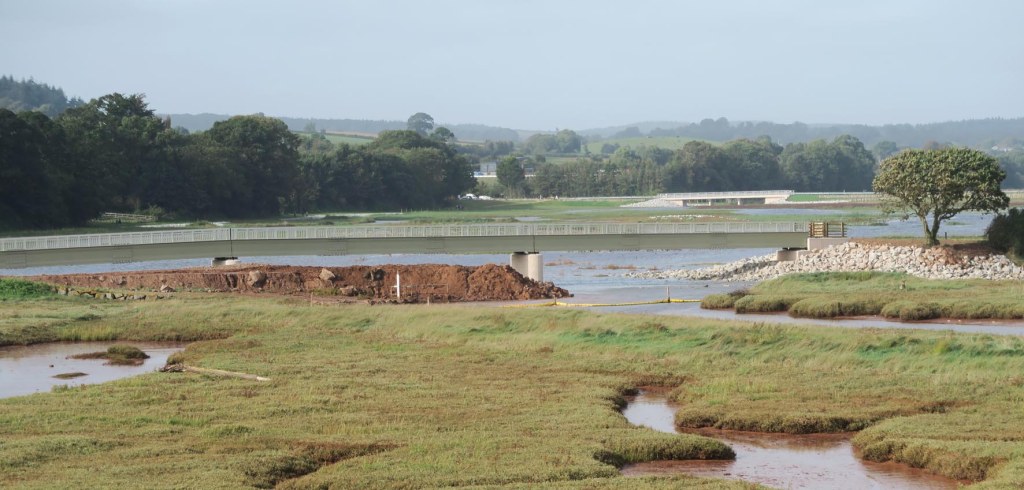
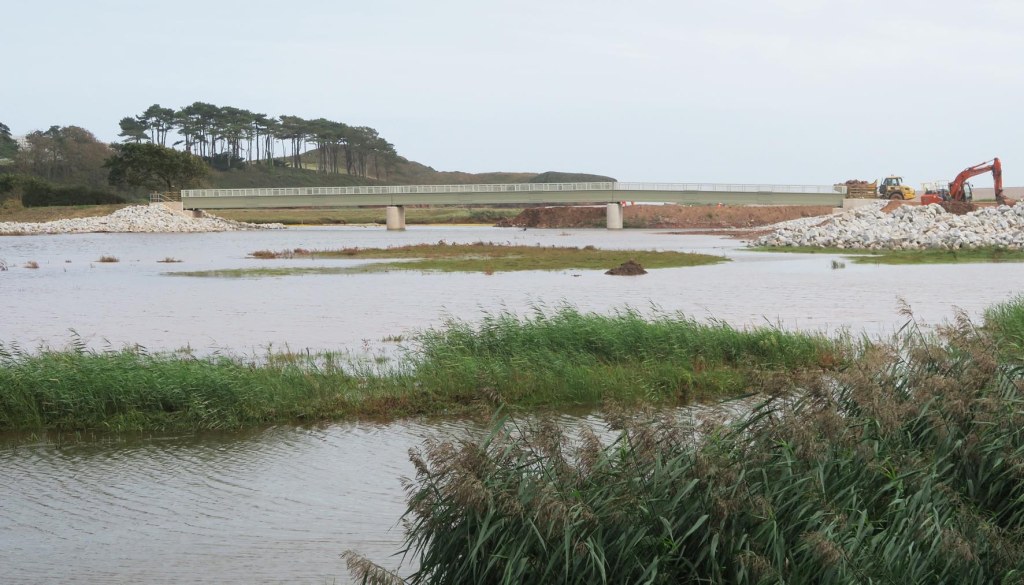
This week the Otter Estuary was reconnected to sea for the first time in 200 years as a section of the historic embankment next to the lime kiln car park was removed. 

At the beginning of the nineteenth century Lord Rolle started to plan a grand scheme for the River Otter below Otterton and East Budleigh. This part of the estuary, through which the river meandered, was  called the “Runnie”. The Runnie used to flood freely at high tide. The section just above, and including, what is now the lime kiln car park was called the “Salmon Pool” and formed a harbour for coasters and yachts. 

Plans to build a series of embankments were drawn up by the renowned Devon surveyor and civil engineer James Green. (James Green built many fine bridges in Devon including Otterton Bridge).

The aim was to reclaim land for agriculture and, by straightening and canalising the river along the eastern bank, to increase its navigability.

Work started around 1810, finishing with modifications and extensions around 1815. Local legend has it that the work was carried out by French prisoners of war but this is not supported by historical work on contracts carried out in the Clinton Estate archive.

Over the years the banks have been “overtopped” many times by flood water sweeping down the valley and sections have been swept away a number of times by flood tides. The first breach occurred during a particularly damaging storm of 1824. Major breaches also occurred in the fifties and the latest in 2018, requiring major repairs. 

Over two hundred years, the once productive reclaimed land now lies below the level of the river bed. It has become saline and difficult to drain. Navigability was never restored as shallow draft boats could no longer drift upstream at high tide in a wide estuary and beach as they did before . 

As it happens, this deliberate breach has occurred just before the equinoctial spring tides. These are tides with a greater than average range. On Saturday and Sunday, high tide will be 4.7 m. So we don’t have to wait to see what happens.

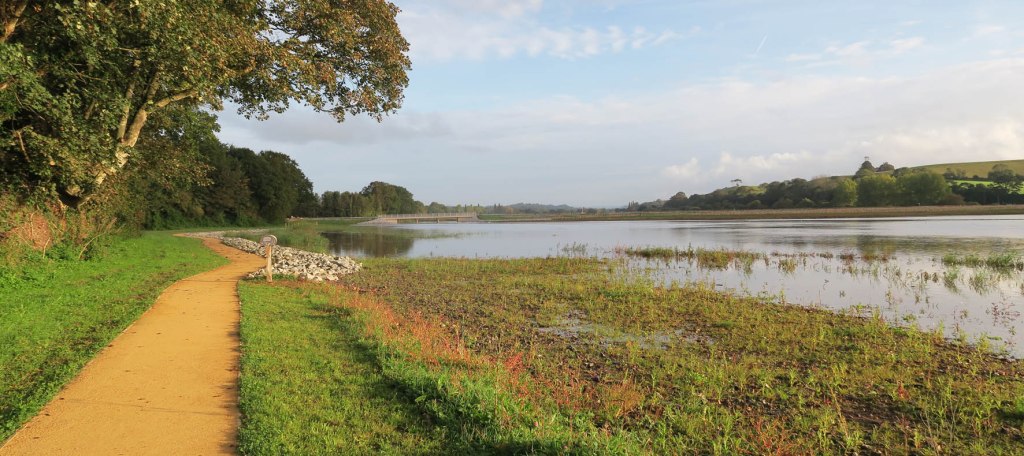
At this level there is expected that some water will cover parts of the new footpaths. And, indeed this was witnessed above South Farm Road. 

Here are some images of this historic moment:

The start of the breach, about one third of the intended 70m gap created, looking north from the beach

Partial breach looking south

Saturday flood tide looking north towards elevated South Farm Road

Tide over footpath north of South Farm Road

Looking south towards estuary mouth

Why do right wingers have such a “thing” about motor cars?

According to The Daily Mail, the Prime Minister is hoping to gain support from drivers by announcing a ‘Plan for Motorists‘ at the Tory conference early next week. 

Today’s Daily Express headline reads: Tories declare war against drivers is over!

Pro-motorist measures might include limiting council powers to impose 20mph zones and levy fines from traffic cameras and ensuring motorists get access to bus lanes for a minimum period.

Not only do we all need to reduce our dependency on cars but this policy would represent increased central “Whitehall” control over what should be devolved issues for decision making.

Neighbourhoods and communities have rights as well as car owners. Who has declared war?

Owl has often speculated that this obsession with motor cars may have resulted from Tories overdosing on, or being force fed, “Wind in the Willows” in their sensitive years. Resulting in an association with the entitled Mr. Toad, owner of Toad Hall who possessed large amounts of money but not much brain. Toad became mesmerised by automobiles, belching smoke, sound and fury, when his horse-drawn gypsy caravan was forced off the road. – Poop Poop. 

It didn’t end well for him.

Or perhaps car ownership in Britain is seen as a manifestation of “freedom” in the way that the right to bear arms is in the US.

PS Unlike “Winnie the Pooh”, the “Wind in the willows” doesn’t feature an Owl!

How a thinktank got the cost of net zero for the UK wildly wrong

Imagine demanding an “honest” debate over the cost of net zero in a report full of errors that even a schoolboy would be embarrassed about. Then imagine getting coverage of your report in the Sun, Times, Daily Mail, Daily Express and Spectator. (Not that difficult. – Owl)

Simon Evans www.theguardian.com 

Sound impossible? Well, let me tell you how Civitas, one of the thinktanks housed at 55 Tufton Street in London, did exactly that, and nearly got away with it.

On Wednesday, Civitas published a pamphlet on net zero by Ewen Stewart, whose consultancy, Walbrook Economics, works on “the interaction of macroeconomics, politics and capital markets”.

Stewart is also a climate sceptic, having written in 2021 that human-caused warming is a “contested theory”. Along with Civitas, 55 Tufton Street also houses the climate-sceptic lobby group the Global Warming Policy Foundation and its campaigning arm Net Zero Watch. These groups previously attempted to spark an “honest debate about the cost of net-zero” in 2020.

The Civitas report claims to offer a “realistic” £4.5tn estimate of the cost of reaching net zero emissions by 2050 and says “the government need to be honest with the British people”.

This estimate is much higher than the figure produced by the government’s official adviser, the Climate Change Committee (CCC), which has said that reaching net zero would require net investments of £1.4tn by 2050. Note the difference between Civitas’s “costs” and the CCC’s “net investments”. The CCC also found that reaching net zero would generate savings in the form of lower fossil fuel bills worth £1.1tn, resulting in a net cost of £0.3tn.

In his report for Civitas, Stewart adopts the well-worn climate-sceptic tactic of simply ignoring these savings. He also ignores what the Office for Budget Responsibility has called the potentially “catastrophic economic and fiscal consequences” of unmitigated climate change.

The report was timed to follow hot on the heels of Rishi Sunak’s big climate speech, in which he called for an “honest” approach to net zero that ends “unacceptable costs”.

Unfortunately the report’s author has confused power capacity in megawatts (MW) with electricity generation in megawatt hours (MWh). As a result, he presents a distinctly unrealistic “£1.3m per MWh” figure for the cost for onshore wind power. The true number is around £50-70/MWh – more than 10,000 times lower. He then compounded his embarrassment by mixing up billions with trillions.

Nevertheless the report got supportive coverage in the Daily Mail. A piece by the paper’s deputy political editor had a headline that claimed net zero “could cost households £6,000 a year”. At the Sun, the story also landed on the deputy political editor’s desk, and also inspired an editorial denouncing “dishonest rhetoric” on net zero.

In the Spectator, the climate-sceptic commentator Ross Clark hedged his bets a little, given the many errors in the report, but argued: “There is no reason to suppose Civitas’ figures will turn out to be right … But they are an important contribution to a debate.”

The Daily Telegraph and the Times – both of which have experienced teams of specialist energy and environment reporters – declined to give news coverage to the Civitas report. The Times, however, did give a prominent comment slot to Tim Knox, the former director of Civitas’s neighbours, the Centre for Policy Studies . The paper failed to mention his association with the report, which acknowledges on one page that it would not have been possible without him.

The Daily Express gave space to another Tufton Street thinktank to weigh in, with the Taxpayers Alliance also writing a comment in support of Civitas’s work.

Despite the report’s errors, the Tufton Street playbook had, at this stage, worked flawlessly, laundering a set of embarrassingly wrong numbers into the nation’s newspapers and giving the likes of the rightwing gossip blog Order Order the chance to promote them.

By lunchtime on the day after the report’s publication, however, its many errors had become the subject of viral tweets on X, previously known as Twitter, piling pressure on Civitas to respond.

An extremely hastily issued “update” on the Civitas website says: “There has been criticism on social media of two paragraphs on page 47 of this report, where capacity and output are confused. These paragraphs will be amended and updated. The author is happy to acknowledge this and correct the report.”

It then adds: “The fact remains that we are facing a huge bill for net zero that is many times more than official estimates.”

Stewart could easily have avoided this embarrassment. After seeing an embargoed copy of the report, I had emailed him pointing out the error over units the day before it was published. He never responded.

The update from Civitas ignored the many other problems with the report, including areas where it included costs for doing the same thing twice.

It is littered with assertions unencumbered by facts or evidence. It states, for example, that it is “not unreasonable to assume” that net zero would add £403bn to the cost of food.

Actual evidence that the impacts of climate change and high fossil fuel prices has added an estimated £11bn to UK food bills in 2022 alone, on the other hand, is conveniently ignored.

Similarly, Civitas cites a 2019 report from the Faraday Institute to claim that net zero could result in 114,000 job losses in the car industry, while ignoring the same report’s finding that, on the contrary, a well-marshalled shift to electric vehicles could support 246,000 jobs in the sector.

As well as ignoring the savings from net zero in terms of lower fossil fuel bills, the Civitas report sidesteps the costs of unmitigated climate change – and ignores the cost of business-as-usual.

This amounts to assuming that the UK could continue to get energy from fossil fuels for free, as well as being able to replace old gas boilers, cars with internal combustion engines and fossil-fuelled power stations as they retire with new fossil-fuelled infrastructure without ever having to pay for it.

At the time of writing, only one newspaper – the Times – had acknowledged any of these issues, albeit only half-heartedly. It has added a note to the Knox comment piece that repeats Civitas’s assertion that only two paragraphs of its report were in error. All of the other uncritical coverage remains.

Plymouth calls for voted ID to be scrapped

Voter ID should be scrapped and the money spent on encouraging more people to get interested in local democracy. That was the verdict of one of Plymouth city councillor this week.

Alison Stephenson, local democracy reporter www.radioexe.co.uk

Cllr Bill Stevens (Lab, Devonport) said considering only 38,000 out of 158,000 people eligilble to vote in person in this May’s local elections did so, effort should be spent “make it easier not harder” for people to vote.

The 32 per cent turnout in the city was slightly lower than the last comparable elections and 86 people who came to vote didn’t bring the correct ID.

New identifcation rules were introduced this year following a case of electoral fraud in Tower Hamlets in London. They have proved controversial, with critics claiming it favours older voters and addresses a problem that doesn’t exist.

The change means extra administration work for electoral staff. In Plymouth, additional funding of £60,000 has been allocated by the government to promote voter ID ahead of the next general election.

Assessing the impact of voter ID on Plymouth residents and the council, members of the audit and governance committee said they couldn’t fault the elections’ team and the low turnout was not down to voter ID.

Cllr Stevens said: “I have no criticism of the approach of our staff, this is not about them doing a shoddy job. Just the opposite; it’s about the government shoving this on us. Efforts should go into targeting those who don’t vote. All we are doing is making it harder for them, we are going in the wrong direction.

Councillors said voter ID was not a new concept internationally and it has been in place in Northern Ireland for some time.

“I understand the argument as what happened in Tower Hamlets was monstrous and in Northern Ireland there is a history of electoral malpractice but we don’t have it here in Plymouth,” added Cllr Stephens.

Cllr Lee Finn (Con, Budshead) said the campaign was well run and communicated. “We councillors have a lot of work to reach people who made it clear why they didn’t want to vote. We have to take some responsibility for the low turnout.”

Cllr Alison Raynsford (Lab, St Peter and the Waterfront) said postal voting should be promoted to make it easier for people to vote.

Councillors were told that many people are oblivious to voter ID rules as they only participate in general elections so there will need to be another media campaign.

Nature crisis: One in six species at risk of extinction in Great Britain

Numbers of the UK’s most precious animals and plants are still falling, as a countrywide nature-loss crisis continues, State of Nature report finds.

Report author and University of Sussex environmental-biology professor Fiona Matthews said: “We need a lot more investment [in nature].

“There is a belief in government that things can just magically happen for free.”

By Victoria Gill and Kate Stephens www.bbc.co.uk

Loss of nature is outpacing investment and effort to tackle it, conservation organisations say.

Their State of the Nature report found 16% of 10,000 mammals, plants, insects, birds and amphibians assessed were threatened.

They include UK wildlife icons such as the turtle dove and hazel dormouse.

The government has said it is committed to “increasing the amount of habitat for nature to thrive”.

But conservation organisations say more investment and a shift to much more wildlife-friendly farming and fishing are urgently needed.

Busy roads often block migration paths for common toads, making it difficult for them to reach breeding ponds

The 203-page document was produced by more than 60 organisations, including wildlife conservation groups, government agencies and academics.

Its analysis of decades of research paints a grim picture – natural spaces and the wildlife that depends on them are in decline.

Nida al-Fulaij, from the People’s Trust for Endangered Species, told BBC News: “The main takeaways from this report are alarming.”

And she explained how thousands of studies used in the report examined the abundance or distribution of UK wildlife.

‘Bleak outlook’

“Where we can, we count species year after year,” Ms Fulaij said.

“Another way to measure how a plant or animal is faring is to repeatedly examine a site and ask, ‘Is the species here or not?'”

Plants and animals monitored since the 1970s have declined in abundance by an average 19%.

And this trend suggests a bleak outlook for much of the country’s native wildlife, conservation scientists say.

This should make everyone “sit up and listen”, Royal Society for the Protection of Birds (RSPB) chief executive Beccy Speight said.

Restoring nature would also help to tackle the climate crisis.

“We need to move far faster as a society towards nature-friendly land and sea use,” Ms Speight said.

“Otherwise, the UK’s nature and wider environment will continue to decline and degrade, with huge implications for our own way of life.”

Responding to these calls for action, the government said it was investing in its “30-by-30” pledge, to protect 30% of land for nature by 2030.

“At the start of this year, I published our comprehensive Environmental Improvement Plan,” Environment Secretary Therese Coffey said, “setting out how we will create and restore at least 500,000 hectares [2,000 sq miles] of new wildlife habitats.”

The government also highlighted investments including:

  • a £40m Species Survival Fund
  • £750m for woodland and peatland restoration

But RSPB conservation-science head Prof Richard Gregory told BBC News: “We’d need more to achieve the goal of 30 by 30.

“The task ahead of us to recover nature in the UK is large and complex – we are really talking of billions of pounds and not millions to change systems and tackle the drives of decline.

“That investment would return a huge amount for society in time and save huge future costs if we allow the environment to continue to decline and degrade.”

Since 1970, the report says, of the 2,890 species in Britain’s “priority group”:

  • 58% fell in number
  • 19% increased
  • Almost 1,500 UK native species of plants and animals are now threatened with extinction
  • Most of the important habitats for UK nature – including woodland, wetlands and wildflower meadows – are in poor condition
  • Only about 11% of UK land is within protected areas – and not all are well managed for nature and wildlife
  • None of the seafloor around the UK is in “good condition”, because of damage from fishing gear

In the North Pennines, Nic and Paul Renison have transformed the way they farm, to create more space for nature, dividing their 400 acres (160 hectares) into small pastures and moving their cows into a new field each day.

“The idea is that it’s like the buffalo on the plains – they move every day, then the pasture gets 60 days to recover,” Nic said.

With the help of the Woodland Trust, they have also planted wildlife-friendly hedgerows to create wildlife “corridors” throughout their farm.

“The more you do, the more nature you attract – it gets addictive,” Paul said.

All five of the UK’s resident owl species can now be found on the Renisons’ farm and 50 different bird species are breeding there, a recent survey revealed.

In England, an estimated 70% of land is farmed.

And studies suggest nature-friendly farming can boost production.

In one large-scale study in central England, turning over land from crops to wildlife habitat increased yields, probably by boosting the abundance of insects that pollinate those crops.

But the Nature Friendly Farming Network said more investment would be needed “to support all farmers in restoring nature and acting on climate change”.

But the report also found “targeted conservation”, concerted efforts to restore habitats and protect species, had worked well:

  • The number of species in a marine protected area (MPA) in Lyme Bay, Devon, had significantly increased since trawling was banned, in 2008
  • 600 sq km (150,000 acres) of the Cairngorms, in the Highlands, had been restored for woodland-dependent wildlife
  • The RSPB’s Hope Farm, in Cambridgeshire, had provided a research and demonstration site, showing how crop yields could been increased along with bird numbers

Report author and University of Sussex environmental-biology professor Fiona Matthews said: “We need a lot more investment [in nature].

“There is a belief in government that things can just magically happen for free.”

But while she acknowledged the great work from thousands of volunteers, funded work was needed too.

“I often see a press release for £1m for this or that – but it is a drop in the ocean for what is actually required to tackle this issue,” Prof Matthews said.

‘It’s A Yes Or A No’: Rishi Sunak Monstered on radio over HS2

“Decisive” Rishi Sunak repeatedly dodged H2S questions in excruciating interviews, suggesting that making sure the roads are free of potholes: “That’s priority number one.” (Orders of magnitude cheaper too, although levelling up on this in Devon has never seemed to be anywhere near “priority number one”, let alone dualling the A303 , electrifying the railway west of Bristol or improving the limited capacity of the single track west of Salisbury. None of which would come near HS2 “levelling up investment”. – Owl)

For the last decade at least, prime ministers have traditionally done a big regional broadcast round before their party conference. 

2023 is no exception as the Tories gather for their conference in Manchester starting on Sunday.

Yesterday, the PM did an hour of quick-fire interviews starting with BBC Radio York at 8 a.m. … BBC Radio West Midlands at 8.08 a.m. … BBC Radio Manchester at 8.15 a.m. … BBC Radio Shropshire at 8.22 a.m. … BBC Radio Tees at 8.30 a.m. … BBC Three Counties Radio at 8.38 a.m. … BBC Radio Cornwall at 8.45 a.m. … and finally BBC Radio Berkshire at 8.52 a.m. He then sat down for 15 (15!) back-to-back TV interviews with political editors from the BBC regions and nations.

They didn’t go well, including his grilling on Spotlight on sewage.

Archie Mitchell www.independent.co.uk

Rishi Sunak has blamed the pandemic for Britain’s failing railways as he refused 12 times to rule out scrapping HS2’s northern leg in a series of excrutiating interviews.

The prime minister said Covid-19 caused everyone to “stop travelling on the rail network”, which has made running train services “very difficult”.

Challenged on why he had “failed the North’s railway passengers so badly” – amid anger over plans revealed by The Independent to scale back the much-heralded high-speed rail line – he replied: “There have obviously been challenges on the rail network more generally. And it’s across the country because of the pandemic.”

In the excruciating round of interviews with local BBC radio hosts, Mr Sunak refused repeatedly to commit to building the high speed rail network north of Birmingham – and instead suggested fixing potholes was “priority number one”.

The PM said there were “spades in the ground” on phase one of the project, but refused to say whether he was committed to phase two, whichThe Independent revealed Mr Sunak and Jeremy Hunt are considering scrapping to save cash.

The prime minister repeatedly highlighted his focus on building better connections between northern towns and cities, investing in local transport such as bus services and making sure potholes are filled.

But, asked for a “yes or no” answer on whether he would scrap HS2’s northern leg, the PM said: “I am not not speculating on future things.”

And challenged over the state of Britain’s rail infrastructure by BBC Radio York, Mr Sunak blamed problems with train services on the pandemic.

Presenter Joanita Musisi highlighted operators being stripped of their franchises and being taken into state control. She said: “Why have you failed the North’s rail passengers so badly?”

Mr Sunak replied: “There have obviously been challenges on the rail network more generally.

“And it’s across the country because of the pandemic, and the government ploughed in billions and billions of pounds to keep our services running.

“When you have a pandemic and everyone stops travelling on the rail network that makes life very difficult and people can understand that.”

The Railway Industry Association (RIA) on Monday pointed to Department for Transport (DfT) figures showing that from April 2022 to March 2023, overall rail passenger numbers were the same as in 2012, when the UK Government first confirmed support for HS2.

RIA chief executive Darren Caplan said: “One of the reasons cited by critical politicians for scrapping HS2 Phase 2 is that passenger numbers are significantly down and people will not travel by train in future.

“This is plain wrong… today’s passenger levels are already significantly higher than when the business case for HS2 was approved, and have been growing back strongly since the pandemic.”

Speaking to BBC West Midlands, he said “what is important” is “that we are investing in the transport that they use every day”. Mr Sunak said the government is working to make sure roads are free of potholes and that bus services are “reliable and frequent”.

In a brutal exchange with BBC Radio Manchester’s Anna Jameson, she said: “We are straight talking people in the North. It is a yes or a no, are you scrapping the HS2 line between Birmingham and Manchester.”

Mr Sunak said: “Like I said, I’m not not speculating on future things. We have spades in the ground right now and are getting on.”

Ms Jameson said: “Is it under review?”

He said: “The government is always making sure that we get value for money out of everything we do but that’s just a statement of the obvious.

“But I think what people also should know, because I know there’s a lot of focus on this one thing, but actually what are the journeys that people use most in Greater Manchester or across the north? It’s in their cars right now getting to work taking their kids to school making sure that the roads are free of potholes.

“That’s priority number one.”

An exasperated Ms Jameson said: “We are not talking about potholes, the main story right now across the country is people want to know about the future of HS2 and still now you can’t give me a yes or a no. You are the main in control. You have the keys. You can tell us now if it is happening.”

Mr Sunak said: “My point to you is that the vast majority of the journeys that people make are in their cars, making sure that we make sure our roads are well maintained is really important.”

She interrupted: “But we are talking about trains, we are not talking about cars.”

In one of the biggest political stories of the year, The Independent revealed Mr Sunak was in secret talks – dubbed Project Redwood – with his chancellor to scrap the second phase of the project.

Former chancellor George Osborne and ex-deputy PM Lord Heseltine described the proposal as a “gross act of vandalism”, which would end up being a case of “economic self-harm”.

After the story broke on 14 September, Downing Street repeatedly stone-walled before ministers accepted talks over the most dramatic decision in years to stop a £34bn infrastructure spend were taking place.

The story has prompted unprecedented fallout, with two former prime ministers attacking Mr Sunak amid a cascade of criticism and cabinet divides. Boris Johnson and David Cameron were joined by ex-chancellor Philip Hammond in urging the PM not to cut the high-speed rail route.

Devon’s mobile library services given a reprieve

An example of the constructive use of scrutiny – Owl

County councillors who voted to axe the service back in the summer have been told to think again before taking the books-on-wheels service off the road for good.

Guy Henderson, local democracy reporter .www.radioexe.co.uk

Stephen Fry, Michael Rosen and Michael Morpurgo are among the high-profile writers who backed a county-wide campaign to save the service, and nearly 9,000 people have signed a petition.

Now members of a county council scrutiny committee have voted to send the decision back for a re-think.

“Let’s not kid anybody,” said Cllr Ian Roome (Lib Dem, Barnstaple North). “It’s a cut in services because we want to reduce the budget. It would be detrimental for our rural communities.”

The county council’s cabinet decided in July that it would not be cost-effective to replace its four ageing mobile library vans after hearing that the vehicles were nearing the end of their serviceable lives and would cost up to £800,000 to replace.

But the decision was ‘called in’ for a second debate amid a public campaign to save the mobile service.

“I am failing to grasp why we are cutting a service which is still being used,” said Cllr Roome.

The scrutiny committee was told demand for mobile libraries had dwindled over the last 10 years and a number of village stops had been removed as a result. Devon already has 50 static libraries as well as online resources and community schemes.

July’s cabinet meeting also pledged £25,000 to make sure vulnerable users could access alternative services.

But John Smith of Coldridge Parish Council told the meeting the service should be a ‘flagship’ for the county, and the ’misconceived’ closure would affect thousands of people.

Cllr Jacqi Hodgson (Green, Totnes and Dartington) said axing it would be “a massive retrograde step” and Cllr Rob Hannaford (Lab, Exwick and St Thomas) warned colleagues: “When it’s gone, it’s gone, and that will be a really sad day for Devon.”

Cabinet member for libraries Cllr Roger Croad (Con, Ivybridge) said July’s decision had been one of the saddest he had ever made.

But, he said, the number of people using mobile libraries was declining sharply, and online alternatives and volunteer book deliveries were available.

“It is not my intention to remove people from books, or books from people,” he said. 

Cllr Jerry Brook (Con, Chudleigh and Teign Valley) added: “It’s about value for money, not only for library-users but also for the rest of the people in this county.

“How many of the people who signed the petition actually use the mobile libraries? If we were to ask nearly 800,000 residents in Devon if this is value for money, I think the answer might be quite interesting.”

After a series of votes on amendments, members eventually agreed to send the matter back to the cabinet, asking it to reconsider its decision to axe the libraries.

Cabinet members will be asked to get  precise figures on leasing rather than buying new vehicles, and reducing costs through crowdfunding or sponsorship.

They will also be asked to make sure alternative provision of library services is in place before any services are taken away.

Councils ‘on their knees’ as they face record £3.5bn funding shortfall

Councils are facing a record cash shortfall of more than £3.5bn in the coming year with jobs and services facing cuts, according to an analysis.

Rowena Mason www.theguardian.com 

Data compiled by Unison, the trade union, found there were 114 councils in England, Scotland and Wales – almost a third – facing shortfalls of more than £10m. It said 15 councils were likely to be in the red by more than £40m next year.

Top of the list is Birmingham city council, with a £164m shortfall, followed by Thurrock council with a gap of £157m, both of which in effect recently declared themselves bankrupt.

Other authorities with severe cash shortfalls are Hampshire county council, on £82m, Sheffield city council, on £72.7m, and Bradford city council, on £72m.

Unison found the data from freedom of information requests as well as examining publicly available information. The research found that 86% had a predicted budget gap, with just 14% saying they were on course to balance the books.

It warned that the situation was likely to worsen as the cumulative funding gap is predicted to rise even further to more than £7bn in 2025/26.

The union said many local authorities were already considering job cuts as well as scaling back community services such as waste collection, libraries and leisure centres. Others may sell land and buildings or dip further into reserves.

Christina McAnea, the general secretary of Unison, said many councils were “on the brink”.

“Communities rely on their local authorities for all manner of essential services, such as waste collection, road repairs and parks and other open spaces,” she said.

“But councils are on their knees. Ministers seem to care very little about public services and local government has been hit hard over very many years.

“Essential services can’t run on thin air. Staff levels have already been cut to the bone in desperate attempts to balance the books.

“Yet more service cuts and job losses are sadly inevitable across the country unless the government intervenes with the lifeline of significant extra funding. Not just for those on the brink, but to councils everywhere.”

Unison highlighted Woking council, where 350 workers have been put on notice of possible redundancy as it seeks to cut 60 positions, and Kirklees council, which has plans to axe 250 jobs between October and next March.

Hampshire is reviewing its school crossing patrols, putting up to 45 jobs at risk, while Kent is considering the closure of 37 children’s and youth centres across the county.

Following the analysis, Unison called on Jeremy Hunt, the chancellor, to provide extra grant funding in the autumn statement to help with the immediate challenges, warning that local authorities and their communities would no longer be able to cope.

A spokesperson for the Department for Levelling Up, Housing and Communities, said: “Local authorities have seen an increase in core spending power of up to £5.1bn or 9.4% in cash terms on 2022-23, with almost £60bn available for local government in England.

“We stand ready to speak to any council that has concerns about its ability to manage its finances or faces pressures it has not planned for.”

The local government finance settlement for 2024-25 is set to be published later in the year.

‘Stinky’ slurry tank to get a lid!

Residents plagued by years of ‘putrid’ stink and noise from a plant on the outskirts of Exeter that turns pig slurry into renewable energy can look forward to the slurry tank being covered by a lid designed to contain its smells.

Guy Henderson, local democracy reporter www.radioexe.co.uk

The anaerobic digester near Clyst St Mary (image courtesy: East Devon District Council)

But they will also have to put up with more traffic after East Devon District Council’s planning committee passed a fresh application from the company that runs the plant.

Gorst Energy originally received permission to put a lid on the giant anaerobic digestion tank in 2018, but hasn’t done so yet. The permission lapsed and the company applied again.

It also asked to more than double the amount of crops it can converted into energy for the National Grid.

The digester, which is next door to a pig farm, takes the farm’s slurry along with specially-grown crops to be broken down by bacteria in a large tank. The resulting gas creates energy.

Cllr Steve Gazzard (Lib Dem, Exmouth Withycombe Raleigh) ‘reluctantly’ proposed approval of the plans, adding: “I can’t think of a reason to refuse this.”

A previous application was turned down on appeal because of its effect on the residents of a nearby bungalow, but Gorst Energy has since bought the bungalow and uses it as part of the site.

The land is in open countryside opposite Westpoint, around 500 metres east of Clyst St Mary. Gorst Energy says its proposal will increase efficiency and create more low carbon energy for consumers. There were no objections from the Environment Agency, environmental health officers or highways authorities.

Speaking on behalf of Clyst St Mary residents, Gaeron Kayley said the plant was causing ‘misery’ and there had been ‘literally thousands’ of fruitless complaints to the Environment Agency over the years.

Cllr Mike Howe (Ind, Clyst Valley) said the dome lid should have been installed three years ago when permission was first given. 

“They chose not to do it then because they don’t care about the residents being affected around them,” he said. “Local residents have had enough.

“I have been dealing with this site for over 10 years, and we have not been able to get any enforcement action on noise or smell. There is no control.”

Cllr Ian Barlow (Ind, Sidmouth Town) told the meeting: “This isn’t about being green, it’s about making money.” And Cllr John Heath (Ind, Beer and Branscombe) said the noise from the plant was ‘a form of psychological torture’ for its neighbours.

David Manley, representing Gorst Energy, pointed out that the planning inspector had already said the changes could be made without causing nuisance, and there were already stringent controls around its operations.

Darren Stockley of its parent company Ixora Energy said the changes would bring additional benefits and around £4 million a year to the local economy.

“We take very seriously any complaints about noise, odour and traffic,” he said. “We do all we can to engage with the community. We also try to act on any concerns raised to us.

“And the last 18 months have shown just how important reliable, renewable, local energy is rather than having to rely on Russia and Norway.”

Members agreed by a majority to approve the plans subject to a number of conditions.

The decision to demolish the Mast Quay flats is a rare triumph for planners

The decision by the Royal Borough of Greenwich to say enough is enough and order the demolition of 204 homes at the Mast Quay development in south-east London casts a spotlight on one of the most unequal battles in the public realm – between major developers and town hall planners.

Robert Booth www.theguardian.com 

And it is one that often enrages the public. Greenwich’s gambit has cheered community groups who say they are feeling increasingly powerless to challenge, even with the help of the planning system, the might of developers.

And it comes after the unauthorised demolition of the Crooked House pub in Staffordshire – another dramatic example of a property owner allegedly ignoring planning officers’ wishes.

Pulling down the Mast Quay buildings in Woolwich would be “pretty extreme”, said Sebastian Charles, the chair of the Law Society’s planning and environmental law committee. The government’s planning inspectorate now appears likely to be asked to consider whether the apartments, as built, warrant planning permission. It could be a high-stakes ruling.

For more than 75 years, since the Town and Country Planning Act of 1947 came into effect, development in this country has relied on both sides playing by the rules. After permission for a building is granted, most significant design changes must be checked with the planners. It is a negotiation and it relies not only on trust, but on there being enough planners to respond.

And if developers err from the plans, there are currently very few officials to stop them – which partially explains why Greenwich only very belatedly appears to have spotted the problems at Mast Quay II.

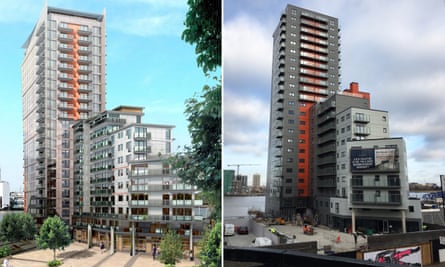
Composite image comparing the plans that were granted permission with what was built

The plans that were granted permission (left), and what was built (right) Composite: royalgreenwich.gov

To a large degree, developers are self-policing. Often they borrow large sums of money to build. Lenders need to know they are not throwing money into investments that risk being pulverised over a planning row. So checks are normally made within a project team.

But even large councils only have a handful of planning enforcement officers – six would be a large number, according to the Royal Town Planning Institute. Most of their work is reacting to complaints about a neighbour’s domestic extension breaching planning consent, or a hedge or a tree being pulled down, said Richard Blyth, the head of policy practice and research at RTPI.

That leaves little time for “proactive enforcement” – like checking if the 23-storey building going up by the Thames looks like the visualisations. Last year, an RTPI survey of 103 councils found that 90% had an enforcement backlog and 80% said they didn’t have enough enforcement officers for the workload.

And in an era when major councils like Birmingham are going bust, planning enforcement is a low priority. Unlike granting permissions, there are no fees attached. Every pound spent policing the developers has to come from central council funding, Blyth said.

Official figures on enforcement suggest either developers are increasingly conforming to planning law or the reach of planners is declining. In 2015-16 more than 5,000 enforcement notices were issued, but by 2022-23 that had fallen to less than 3,600, according to the Department for Levelling Up, Housing and Communities.

The battle at Mast Quay II now has months to run. In the meantime, the renters who live there face unwelcome uncertainty.

With Rosebank, Britain appears willing to leave climate plans in tatters

Two months ago the Swedish energy giant, Vattenfall, stopped work on its giant North Sea windfarm. Subsequently no company bid for the next tranche of offshore windfarm licences because the government hasn’t done its market setting sums properly. Development of offshore (and onshore) wind is key to meeting net zero.

Today, it’s “drill baby drill” for oil and gas in the Rosebank field off Shetland. Where the company can offset costs against energy windfall tax already levied, gaining a massive subsidy from the tax payer. 

Lifetime emissions from the site will take a huge chunk out of the UK’s climate plans with oil produced over its lifetime equivalent to more than half of the UK’s remaining carbon budget for total fuel supply.

As a consequence, everything else we do will have to “decarbonise” even more quickly if we are to meet our legally binding net zero targets.

Make any sense to you?

In his latest weekly column Simon Jupp says we need to forge a credible path to Net Zero and good progress has been made. – Owl

Matthew Taylor owww.theguardian.com

Just 24 hours before the UK gave the go-ahead to develop the UK’s biggest untapped oilfield off Shetland, the world’s leading energy analysts reiterated that no no new oil and gas exploration should take place if the world was to limit global heating to 1.5C above pre-industrial temperatures.

That stark warning seems to have been ignored by ministers who, after a week in which they have rowed back on the UK’s net zero commitments and scrapped their own home energy efficiency taskforce, are accused of leaving the UK’s climate plans in tatters.

The range of opposition to the proposed Rosebank field has been building for the past 18 months.

Alongside the International Energy Association, the government’s own climate advisers at the Climate Change Committee said pushing ahead with the new fossil fuel development in the face of overwhelming scientific evidence was “utterly unacceptable”. And the UN secretary general, António Guterres, added his voice calling on governments to halt new licences for oil and gas exploration and development.

On the ground, climate scientists and academics have joined MPs and religious leaders as well as 200 charities and civil society groups to raise their opposition.

But the UK government seems intent on pushing ahead, with ministers repeatedly saying the new oilfield is needed for energy security adding that it will help people struggling with the cost of living crisis.

However, experts point out that last year 75% of the UK’s oil production was exported. They say the same is likely to happen with fossil fuels from any new development.

No oil is expected to be produced from Rosebank until 2027 and, wherever the oil ends up, experts say it will be sold on the international market at the going rate, meaning it will have no little or no impact on the cost of living crisis or energy security.

Tessa Khan, executive director of campaign group Uplift and a climate lawyer, said: “Rosebank is a rip-off. It’s another case of the government allowing foreign companies to profit, while the costs are put on British people who worry about the world we are handing on to our children.”

Campaigners say that if the government were serious about improving energy security and tackling the cost of living crisis they would press ahead with domestic renewable energy and home insulation.

The Rosebank project is three times bigger than the controversial Cambo field that was put on hold in 2021 and has the potential to produce 500m barrels of oil, which when burned would emit as much carbon dioxide as running 56 coal-fired power stations for a year.

Analysis from GlobalData reveals lifetime emissions from the site would take a huge chunk out of the UK’s climate plans with oil produced over its lifetime equivalent to more than half of the UK’s remaining carbon budget for total fuel supply.

Khan said: “As we’ve heard repeatedly, our world can no longer sustain new oil and gas drilling. And when we’re witnessing scorching temperatures, wildfires, devastating flooding and heatwaves in our seas, it could not be clearer that this is a decision by the prime minister to add more fuel to the fire.”

The Labour party had said it would ban any new oil and gas extraction in the North Sea. However, to the dismay of campaigners, it says it would not revoke any North Sea oil and gas licences granted by this government.

Hannah Martin, co executive director of Green New Deal Rising, said if Labour took a strong stand now it could still put a stop to the Rosebank development: “This position does not make sense, and there is still time for Keir Starmer to put himself on the right side of history and show leadership by committing to revoking Rosebank’s licence.”

Despite today’s announcement opponents of the Rosebank scheme are not giving up.

“There are strong grounds to believe that the way this government has come to this decision is unlawful and we will see them in court if so,” said Khan. “We shouldn’t have to fight this government for cheap, clean energy and a livable climate, but we will.”