Not-so-cuddly Lib Dems laser focused on target list of seats

The Lib Dems election battle plan will focus their finite effort on a limited number of “winnable” target seats.

These are likely to include Tory seats in the South West like Honiton & Sidmouth and Exmouth & Exeter East, but the list is secret and still evolving! 

Stand by and watch this space! – Owl

Peter Walker www.theguardian.com 

Asked to sum up voters’ general impression of the Liberal Democrats, one pollster at their conference ventured “cuddly”. Well, yes and no. For all their comforting woolliness, England’s perennial third party is arguably building the UK’s most ruthless and focused election-fighting machine.

To an extent, this is not news: of the 20 biggest byelection swings since 1945, four have been Lib Dem wins under Ed Davey since 2021, a product of ultra-disciplined messaging and a more-is-more attitude to leaflets and canvassing.

What is new, and could potentially play a big role in the next general election, is the way the party has extended this infrastructure nationally, and how it is choosing to prioritise finite resources.

The Lib Dems’ approach is, at its heart, to worry much less about winning votes and focus entirely on winning seats. If you are a Lib Dem candidate and your constituency is not on the target list? Basically, you’re on your own.

The trigger was the 2019 election, written off even by the Lib Dems as a “car crash”, but one which has provided them with insight and an almost paradoxical sense of opportunity.

Giddy pre-election forecasts of 100-plus MPs crashed to a final tally of 11. But at the same time, then leader Jo Swinson, who lost her own seat, added more than 1.4m votes to the party’s 2017 total, a 55% increase. Lib Dem candidates came second in 91 constituencies, 80 of these to a Conservative, a springboard for the current fight in blue wall seats.

After Davey replaced Swinson, he and his team set about rebuilding a fragmented party machinery, making it streamlined and aimed entirely at the goal of more seats.

Helmed by Dave McCobb, a Hull councillor who is the party’s much-respected election coordinator, a strategy emerged from the byelections in which a group of senior officials, McCobb among them, would begin by simply knocking on lots of doors and asking people what concerned them.

This generated clear local messages, which could also be used nationally: sewage from the Chesham and Amersham byelection; ambulance waiting times in North Shropshire.

Every three months, the 50 Lib Dem activists members who have recorded the most voter interactions over that period join a call with McCobb, Lib Dem president, Mark Pack, and others to update them on how the messages are landing.

While the Lib Dems are targeting a handful of Labour-held seats, the preponderance of contests with Tory candidates means policies and priorities are heavily based on tempting over former Conservative voters who have grown weary of the party’s dramas.

This means a relentless national focus on issues such as sewage, the NHS and the cost of living, with more traditional Lib Dem fare such as electoral reform still in the draft manifesto but relegated to a lower “tier” and barely discussed.

All of this is then directed at identifying seats where enough disillusioned Tories and tactically-voting Labour supporters can be tempted to the Lib Dem side.

As a candidate in a target constituency you get money, resources, and floods of volunteers from other areas. If you are not; well, you get asked to send volunteers elsewhere and wished the best.

The list is not fixed. It is determined by a mix of polling and a metric based largely on legwork. The overall aim is, as one official put it, to give voters the impression of “winning momentum”.

There is, however, one thing no one will talk about, even privately: how many seats it could secure. The broad view seems to be that fewer than 30 would be regarded as a huge disappointment; more than 40 a triumph.

Thirty would double the party’s current tally. More than 40 would be approaching the glory days of 2005 and 2010. Will it happen? No one really knows. But if it does not, it will not be for want of effort.

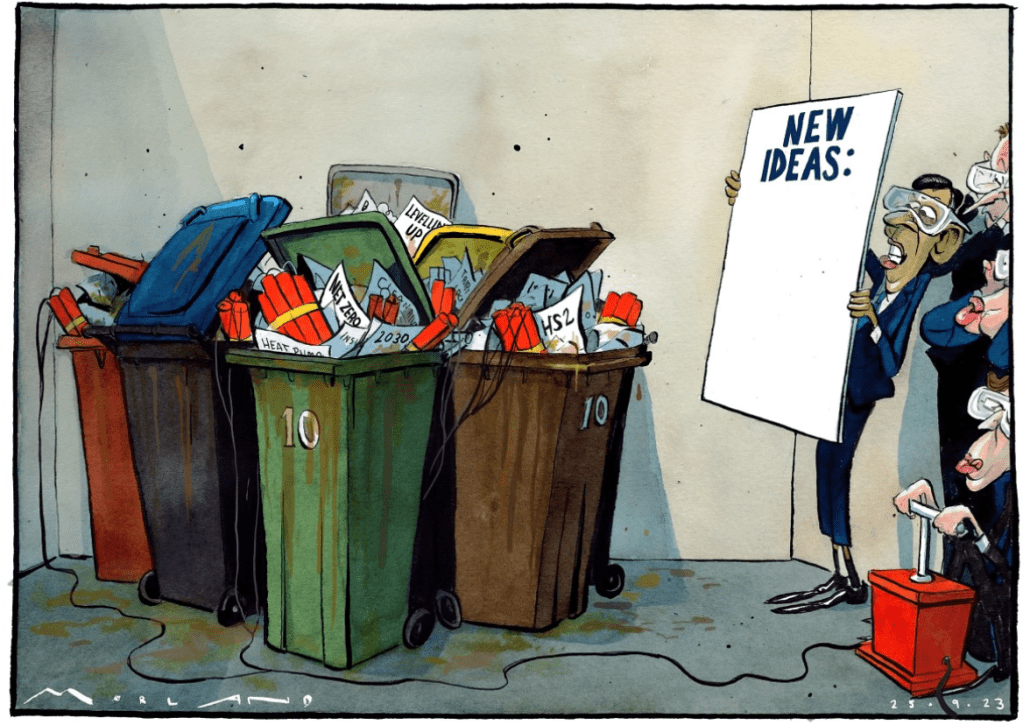
Speaker’s fury at Sunak over HS2 and net zero announcements could lead to parliamentary reform

“There is no clearer illustration of Rishi Sunak’s weakness than the fact that the Prime Minister is flailing around making policy shifts after putting Parliament into recess. He’s running scared of his divided Party with piecemeal plans that don’t stand up to scrutiny.” Shadow Leader of the House of Commons Lucy Powell

Jane Merrick inews.co.uk

Ministers could be prevented from making major policy announcements when the House of Commons is not sitting after Rishi Sunak’s U-turn on net zero and possible scrapping of the northern leg of HS2.

The Prime Minister sparked fury from the Commons Speaker Sir Lindsay Hoyle last week when he revealed during recess that he was pushing back the date of the ban on new petrol and diesel cars from 2030 to 2035.

Sir Lindsay is also expected to issue a similar rebuke if, as expected, Mr Sunak scraps or delays the HS2 Birmingham to Manchester leg after growing concerns about spiralling costs.

The Speaker has no powers to recall Parliament under these circumstances, and can only do so on instruction from the Government.

But a spokeswoman for Sir Lindsay said any change in the rules on recall could be made by Parliament, following consideration by the Commons Procedure Committee.

If Mr Sunak makes a second major policy announcement while the House is in recess, it is likely to fuel calls for the Procedure Committee to look at changing the rules on recall.

The Labour Party has said it would always put Parliament first when significant decisions were being announced if they were in government, but a source said a possible rule change to protect future parliaments could be looked at.

Sir Lindsay wrote to Mr Sunak expressing dismay that MPs had not had the opportunity to debate the net zero U-turn.

A spokeswoman for the Speaker’s Office said: “If the Government doesn’t proactively explain its policy on HS2, Mr Speaker will do what he can to ensure the House gets to consider it at the earliest opportunity.”

This could involve the granting of an Urgent Question when the Commons returns after the current conference break on 16 October.

Asked about the issue of recall, the spokeswoman added: “It is a matter for the House to determine any change in the recall rules, probably after consideration by the Procedure Committee.”

Shadow Leader of the House of Commons Lucy Powell said: “There is no clearer illustration of Rishi Sunak’s weakness than the fact that the Prime Minister is flailing around making policy shifts after putting Parliament into recess. He’s running scared of his divided Party with piecemeal plans that don’t stand up to scrutiny.

“Whilst the Conservatives trash our democracy and damage the standing of Parliament, Labour respects the role of MPs in holding the Government to account on behalf of the public.”

‘I’d like to begin by declaring my fondness for Exmouth’

Paul Arnott

I’d like to begin this article with a declaration of my fondness for Exmouth. The reason why may become clear in a few paragraphs time.

I first came as a small boy on holiday in the late 60s. When I was a student in Exeter in the early ‘80s I’d jump on the train at St James’ Station just behind the football ground and head for the sands. I used to love running along the beach in those long-lost days when I was a competitive sprinter. It was bliss.

Cut forward 40 years and I find myself working with a terrific bunch of East Devon District Officers, Councillors and members of the public trying to secure a genuine vision for an improved town centre and seafront. It’s going to be hard work, but the single difference I hope I have made is to make sure that all decision-making committees are held in public, and that the District Council runs open and fair consultation events to capture the wishes of the local people.

We get a few moans, and that’s fine, but at the end of the day I can look at the work we are currently doing and say that it is open, transparent and engaging. Well-informed Exmouthians know this was not always the case.

However, like every community on Earth, Exmouth has also been afflicted by what, when I was young, we might call wickedness. Not in general of course. The community is wonderful. But in the area of child sex abuse there have been a number of cases in recent years leading to criminal convictions.

Last week the Newsquest titles reported that “a sex offender has been jailed after he joined a notorious Exmouth paedophile in a plan to abuse a 14-year-old boy.”

The report went on to say that Benjamin Holt had become embroiled with a former theatre manager Gareth Weeks. Holt attempted to set up meetings with a 14-year-old boy to have sex. Holt asked the boy to commit sexual acts on him and was in the process of setting up a meeting at which they were to have sex but the intended victim realised that he was in danger and backed out.

Police had discovered evidence of this after arresting 55-year-old Weeks in Exmouth for having sex with another 14-year-old. In 2020, Weeks was jailed for 15 years. Holt has just been jailed for 3 years.

In the earlier case, Weeks, of Bassetts Gardens, Exmouth, admitted two counts of sexual activity with a child, meeting a child following grooming, inciting a child to sexual activity, arranging or facilitating a child sex offence, breach of a Sexual Offences Prevention Order, and making, taking and distributing indecent images of children.

He was jailed for 15 years and certified as a dangerous offender by Judge Timothy Rose. Notably, he had already been jailed for child sex offences in 1993 and 2012 but was still able to join an amateur theatre in Devon as a volunteer. He was still helping to organise shows until his arrest.

Sadly, Judge Timothy Rose has since passed away. I noted his name in the Weeks case from 2020 because he had also presided over the trial of Exmouth councillor, John Humphreys, on even graver charges, resulting in an historic sentence of 21 years.

At East Devon, I and a number of other councillors have laboured against much obstruction since Humphreys’ sentence in August 2021 to understand the truth about his case – who knew what and when? That work will continue until we know the full story.

More new-build houses worth over £40m to be demolished at Darwin Green in Cambridge

More than 80 new-build homes – worth over £40 million – will be knocked down and rebuilt, after more defects were discovered.

Oh dear! – Owl

ITV News www.itv.com 

Foundation issues were found at dozens of houses at the Darwin Green development in Cambridge – as developers admitted in June that 36 properties need to be demolished.

Now, that number has more than doubled to 83.

It was revealed in documents submitted to Cambridge City Council, as developers, Barratt and David Wilson Homes Cambridgeshire, applied for permission to demolish the homes.

They said tiles and other materials will be salvaged where possible, and concrete and brick will be crushed on site and reused.

At a city council meeting earlier this month, planning officers said they did not believe permission for the demolition work would be given before the end of October.

The Darwin Green estate is still being built and when completed, it will be made up of around 1,500 homes.

The homes sell for at least £575,000 each, with some selling for as much as £850,000.

Developers said in June that it was a “small number” of unoccupied homes that “did not meet its usual high standards”.

At the time, one councillor said people’s “lives and dreams” had been “shattered”, while another called for an independent inquiry.

Lib Dem conference: Ed Davey pounds Tories in election warm-up speech

“They know precisely who they are targeting, and where: the Tories, primarily in the south west and south east of England.”

“The party won’t publicly confirm how many seats it is focusing on at the next general election.

But expect it to be in the ballpark of 30 to 40.”

There is a survivor elation vibe to the Liberal Democrats.

Eight years on from their near death experience after the years of coalition government with the Conservatives, they’ve rediscovered their mojo.

By Chris Mason www.bbc.co.uk

And they know precisely who they are targeting, and where: the Tories, primarily in the south west and south east of England.

It is this more focused tilt at seats they hope to be winnable that gives the Lib Dems an outsized influence on the political psyche.

Yes, they are possessed of 15 MPs – just 2.3% of Parliament’s total – but a string of by-election victories over the Conservatives has given dozens of Tories a blast of the heebie-jeebies.

Oratorical arithmetic doesn’t tell you everything about a political leader’s approach, but sometimes it can tell you rather a lot.

By my reckoning Ed Davey referred to the Conservatives 27 times in his party conference speech here in Bournemouth.

Mentions of Labour? Just three.

Senior party figures describe their last general election campaign and performance as a “fiasco”.

The party got 3.7 million votes, an 11.5% share, and 11 seats, one fewer than in 2017.

Sir Ed’s critique has long been that the party spread itself way too thinly at the 2019 election, when his predecessor Jo Swinson talked of winning hundreds of seats.

To win seats under Westminster’s so-called first-past-the-post system, parties need geographically concentrated areas of support, not a smattering of votes in lots of places.

Breadth – driven by hubris – is now seen as an enemy.

The party won’t publicly confirm how many seats it is focusing on at the next general election.

But expect it to be in the ballpark of 30 to 40.

Recent council elections and by-elections have tempted party strategists to increase the number, but they do so with the shadow of 2019 loitering on their shoulder.

With a political focus on the Conservatives, and a geographical focus on plenty of places that voted for Leave in the EU referendum, the Lib Dem comfort foods of old are off the menu.

And little wonder: given their targeting, little wonder the Lib Dem leadership is not vociferously focused on bashing Brexit and putting up taxes.

The party’s long-standing commitment to putting a penny on income tax has been lobbed off Bournemouth Pier.

And while some activists here are desperate for the party to be far more full-blooded in its condemnation of Brexit, the leadership are allergic to the idea, detecting little appetite to focus on it from those they seek to woo.

Instead, there will be a relentless focus on the NHS, the cost of living and sewage in rivers and the sea.

The messaging will no doubt be tweaked from one place to the next, but these are seen as the touchstone issues in the places that matter for the Lib Dems.

Party staff are well aware of the observation of the elections guru Professor Sir John Curtice – who has pointed out that opinion polls suggest the Liberal Democrat national share of the vote remains glued at pretty much the same level it was at the last general election.

Their approach – their hope – is that this shouldn’t matter, if they maintain that targeted geographical and political focus on the places they can actually win.

The challenge they face is assembling the muscle to campaign in 30 to 40 places at the same time – rather different from throwing the entire resources of the party at a single by-election campaign.

‘Where the coast goes, England follows’: Tories risk ‘tidal wave’ if they ignore seaside towns, says thinktank

Rishi Sunak must commit to levelling up England’s struggling seaside towns, or risk a political “tidal wave” at the next general election, a Conservative thinktank has warned.

Time and tide has run out for that on repeated occasions. – Owl 

Heather Stewart www.theguardian.com 

In a report entitled Troubled Waters, the thinktank Onward shows that communities set within 5km of England’s coast are poorer, sicker and more crime-ridden than their inland neighbours – and calls for a £500m regeneration package.

Grim statistics highlighted in the report include the fact that early, preventable deaths are 15% more likely in coastal areas than inland, crime rates are 12% higher and average disposable incomes £2,800 lower.

Seaside areas voted heavily for Brexit in 2016, with 83% of coastal seats voting leave, compared with 66% inland. These constituencies also heavily backed Boris Johnson’s “get Brexit done” message at the 2019 general election.

The report points out that coastal areas have tended to swing convincingly behind the winning party in recent polls – and could be poised to turn against the Tories.

“Where the coast goes, England follows. For nearly four decades, seaside towns and cities have backed the eventual election winners,” said the report’s author, Jenevieve Treadwell.

“Onward’s research exposes the growing gap between declining coastal communities and the rest of England. Unless the government fully embraces coastal areas in its levelling up agenda, they risk a tidal wave against them at the next election”.

Shadow levelling up secretary Angela Rayner blamed the plight of coastal areas highlighted in the report, on, “thirteen years of neglect and mismanagement by the Tories”.

“Our plan to make Britain a clean energy superpower will see a clean energy jobs boom in coastal communities and provide building blocks for a more sustainable future,” she added.

Onward highlights three underlying factors behind coastal deprivation: the decline of traditional industries such as fishing and shipbuilding, the seasonality of local economies, and the older populations in these areas.

“The fate of industrial communities along the coast mirrors those in manufacturing-intensive towns inland facing pressures from privatisations and globalisation,” the report says.

Tourism in traditional English seaside destinations has also faced long-term decline since affordable air travel arrived in the 1980s.

While these are longstanding trends, the gap between coastal areas and the rest of England has continued to widen in recent years – with inland economies growing more rapidly since the 2008 financial crisis.

Many seaside areas have struggled to attract investment over that period, and have often been left heavily reliant on seasonal tourism – which tends to have a relatively low-paid workforce.

By analysing detailed income data, Onward shows the stark differences that emerge, even over short distances. In Great Yarmouth, on the east coast, the average income is £23,600 a year, but just over 10km inland it jumps to £33,800.

The average worker in Workington, on the Cumbrian coast, earns £25,000; but less than 10km inland at Cockermouth the average is £34,200.

Coastal towns also have “some of the worst health outcomes in the country,” the report points out – as highlighted by England’s chief medical officer, Chris Whitty, in his annual report two years ago.

Blackpool, in Lancashire, is what the report calls “an extreme example of coastal health challenges”, with the rate of preventable deaths for under 75-year-olds 88% higher than the average across England.

Not surprisingly, coastal neighbourhoods also tend to have more claimants of unemployment and other benefits than inland areas, because of “higher rates of poor, sick and elderly people”, the report says.

Other challenges include the fact that crime and antisocial behaviour tends to spike in seaside towns during the summer, the report shows – potentially overwhelming the local police force.

In Brighton, for example, nearly half of neighbourhoods have crime rates above the regional average. In the area surrounding the city’s Churchill shopping centre, there were more crimes than residents in 2021.

Even in coastal areas where deprivation is less apparent, Onward suggests high rates of second home ownership can lead to a lack of affordable housing for local people, with knock-on effects for businesses looking for staff.

The thinktank calls for the government to adopt a comprehensive package of policies to regenerate coastal areas. These include creating a coastal economy transformation programme worth up to £500m.

Onward suggests this could be modelled on the Biden administration’s Recompete Pilot in the US, which is investing in economically deprived areas. It suggests giving local bodies powers over infrastructure, planning and skills as part of the scheme.

Other policies the thinktank calls for include extra funding for coastal police forces to help them cope with the summer surge in crime and higher taxes on second homes left standing empty for long periods.

A spokesperson for the Department for Levelling Up, Housing and Communities said: “We are spreading opportunity and prosperity across the UK as part of our ambitious long-term levelling-up programme.

“Since 2012 we have invested over £229m through the coastal communities fund to run 359 projects throughout the UK’s rural and coastal communities helping to create jobs and boost businesses.

“We have also allocated around £1bn from the levelling-up fund to 50 projects in coastal communities.”

Affordable Homes Programme review: 4% social rent homes delivered so far

Another government failure to provide essential housing. – Owl

Homes England’s Affordable Homes Programme (AHP) has delivered fewer than a third of its completions target so far, with just 4% for social rent #UKhousing

“The NAO described the AHP as a poorly designed scheme marred by inadequate oversight, of which the targets set were unachievable and, ultimately, it was a programme that lacked the necessary incentives to deliver homes in areas of highest need or unaffordability.”

[The Affordable Homes Programme is a scheme that provides grant funding to contribute towards the cost of building affordable housing. Over £7.39 billion of funding has been made available through Homes England from April 2021 to help pay for the construction of up to 130,000 new homes outside of London by March 2026. ]

by Stephen Delahunty www.insidehousing.co.uk 

According to a Homes England-commissioned review, 102,300, or 79%, of the programme’s completions target of 130,000 had been approved by March 2021. 

The majority of these, around 60,000, were allocated via the continuous market engagement (CME) route, with the rest through strategic partners. 

A total of 34,780 have been completed, 96% of which have been for affordable homeownership and affordable rent. Just 4% were for social rent.

At the same time, there have been 59,300 starts. All housing starts funded by the programme are to be achieved by March 2023, and all completions by March 2025.

The reviewers were asked to look at what housing had been delivered, the programme’s impacts, and which lessons can be learned at this point in the AHP.

Strategic partners promised to shake up the way social housing development was funded and move from piecemeal to programme-based handouts.

The long-term approach shifted the AHP away from the usual CME form of funding that had been in place. Under this, providers approached the government on a project-by-project basis.

As CME was seen as cumbersome and inefficient, for years, housing associations have been calling for a longer-term funding plan for development to replace it.

But the report found that fixed grant rates, which are an element of the strategic-partner model, made delivery challenging, given the wider inflationary pressures affecting the costs of development over the programme period.

The reviewers found that “most organisations with grant-funded schemes are confident they will meet delivery targets”, but there was some uncertainty on time and delivery, particularly for social rent, due to issues around land values and scheme-specific viability.

The report found that there has been a relative lack of strategic ‘added value’ in the strategic-partner model, beyond funding certainty and scale. Most delivery partners said it was unclear what this added value was at this point in the programme.

One respondent to the review said: “The rhetoric around strategic partnerships was never quite matched by the delivery. 

“That initial bit that was strategic approach to grant funding, has been very successful … [but what we had] was a better grant programme under strategic partnerships, rather than a more strategic relationship.”

The Department for Levelling Up, Housing & Communities forecast that it would spend £20.7bn on new grant-funded homes through three rounds of the AHP between 2015 and 2023.

Views on the effectiveness of programme management and administrative requirements were polarised. For both issues, respectively, around half of partners felt the process worked well, the other half did not.

This evaluation of the AHP contains similar criticisms to a National Audit Office (NAO) review in September last year. 

The NAO described the AHP as a poorly designed scheme marred by inadequate oversight, of which the targets set were unachievable and, ultimately, it was a programme that lacked the necessary incentives to deliver homes in areas of highest need or unaffordability.

In its quantitative analysis, this new review found that delivery had not been concentrated in places with more-pronounced affordability pressures.

On modern methods of construction (MMC), the report found the AHP had a limited effect on supporting the use of MMC, as no targets were established, and no incentives were put in place on grant rates or approvals to support delivery.

The report makes a number of recommendations that include an investigation into how the strategic-partner model affects the competition for land, and the effects on land values as they relate to affordable housing delivery.

The report also calls for greater transparency in reporting and greater flexibility of tenure.

In its foreword to the report, Homes England said the recommendations had already been incorporated into the latest round of the AHP.

Tory MP moonlighting in Seaton quiz

Martin Shaw, September 26, 2023 seatonmatters.org

Simon Jupp is MP for Exmouth and the surrounding area. His constituents have long complained that he failed to oppose the dumping of sewage in their rivers and on their beaches. But he’s not paying attention to their concerns – instead he’s moonlighting as a quiz compère in Seaton! Why? Simon thinks that he’ll lose if he stands in the new Exmouth seat in the general election, so he’s pitching for the new Honiton seat, of which Seaton is a part.

If Simon isn’t prepared to spend his time representing his constituents he should stop claiming his MP’s salary. And people in Seaton should take note – if Simon’s prepared to dump Exmouth because it’s no longer of use to him, he’ll do the same to Seaton if we give him the chance. Remember Hugo Swire? He used to be Seaton’s MP. Then they changed the boundaries and he did the dirty on Seaton’s hospital beds. Thank God we’ve got a decent, devoted MP, the Liberal Democrat Richard Foord, who’s standing for us again. Let’s send Simon back where he belongs

PS What’s the Gateway doing acting as a propaganda tool for failed Tory MPs?

www.ticketsource.co.uk/whats-on/devon/seaton-gateway-theatre/fundraiser-quiz-night-with-simon-jupp-mp/e-ebgevz

Cutting more of the ”green crap”: Government to delay new environmental building rules

The government is delaying putting into effect new environmental laws forcing developers to improve countryside and wildlife habitats, the BBC has learned.

By Claire Marshall & Malcolm Prior www.bbc.co.uk 

Biodiversity Net Gain (BNG) was meant to become a mandatory part of the planning system in England in November.

But government sources told the BBC it will now not be introduced this year.

Environmentalists have lamented the delay. The government said it was still committed to the policy and would soon announce a new implementation date.

The Wildlife Trusts called the delay “another hammer blow for nature”.

BNG policy was approved as part of the 2021 Environment Act. The rules are designed to ensure developers leave the natural environment in a measurably better state than it was beforehand.

The delay comes after weeks of political uncertainty on environmental policy, with the government looking to throw out “nutrient neutrality” pollution rules and to water down policy on achieving net zero.

The UK Green Building Council (UKGBC), an industry body that promotes sustainable development, said any delayed implementation of BNG would “hurt green businesses and development”.

Richard Benwell, CEO of environmental coalition group Wildlife & Countryside Link, said net gain had “already been pared back to the bare minimum to offset the habitat harm caused by new development”.

He added that a delay “could strike at the foundations” of the scheme.

The Home Builders Federation said developers “have embraced the principle of biodiversity net gain” but that there were “significant gaps” in government guidance.

Neil Jefferson, the federation’s managing director, said that would “not only prohibit local authorities’ abilities to effectively manage this new requirement but inevitably lead to further delays in the planning process”.

“We need government to deliver on its requirements so that industry can provide these huge environmental benefits alongside desperately needed new homes,” he said.

Philip Box, UKGBC’s public affairs and policy advisor, added: “Businesses from across the industry and our membership have raised concerns regarding any potential delay.

“This would be exceptionally damaging for them in terms of projected work pipelines, investment, supply chains, and related job roles.”

As part of planning permission, under the new rules developers will have to agree to delivering a biodiversity gain, on or off site, set at a minimum of 10%.

Habitats and wildlife impacted by development would be given a biodiversity value using a government-developed metric ‘calculator’: from native hedgerows and hay meadows, which support dozens of species and merit a high unit value, down to less habitat-rich cropland, and derelict land, which would be awarded a low value.

Sue Young, head of land use planning for The Wildlife Trusts, said they had wanted any gain to be set at 20% and said any delay now would “cause uncertainty for developers and could affect the quality of schemes”.

“Attempts to delay or weaken rules for biodiversity net gain would deliver yet another hammer blow for nature from the current UK government,” she added.

Georgia Stokes, CEO at Somerset Wildlife Trust, added: “It feels unnecessary for there to be a delay and we’re quite shocked that that’s where we’ve ended up. We need the government to take action.”

Government ‘fully committed’

Meanwhile, the Local Government Association (LGA) has called on government to confirm what funding council planners will be given when BNG finally becomes law.

A survey earlier this month by the Royal Town Planning Institute found more than 60% of public sector planning departments were unable to confirm they would have the necessary resources and expertise in place to deliver the scheme.

Darren Rodwell, environment spokesperson for the LGA said: “Councils are concerned about the impact of further delays on their ability to effectively implement BNG.

“Councils urgently need confirmation of go-live dates, essential guidance and definitions and a clear timetable of funding in order to employ additional staff and invest in the expertise and capacity.”

A spokesman for the government said it had already committed more than £15m to help local councils prepare and recruit new specialists to deliver the scheme.

He added: “We are fully committed to biodiversity net gain which will have benefits for people and nature. We will set out more details on implementation timings shortly.”

Torquay traders say parts are ‘on the verge of disaster’

Council urged to fast-track support

Some Torbay traders say action is needed as they claim the area’s three town centres are on the verge of disaster.

Guy Henderson, local democracy reporter www.radioexe.co.uk

Torquay trader Cllr Ras Virdee (Lib Dem, St Marychurch) told Torbay’s full council last week wasn’t surprised to read an article in a national newspaper  about the state of trade in the centre of Torquay.

In the piece, one business owner described this summer as the worst in 14 years for business, with the town looking ‘deserted’. Another estimated that without support from the government at least a third of the remaining businesses would shut down in the next 12 months.

In a written question to the full council, Cllr Virdee asked: “In light of this, over six months ago, Torbay Council agreed in the 2023-24 budget for £100,000 to be allocated to introduce a new role within the council to act as a force for positive change in our town centres.

“Can you please explain why no appointment has been made?”

Cllr Chris Lewis (Con, Preston) recruitment had not yet begun as the new Conservative administration on the council took time to identify the specific challenges facing the town centres of Torquay, Paignton and Brixham.

“There is a commitment to ensure that this budget is used to support vibrant and sustainable town centres in Torbay,” he said.

“It’s not about recruitment. It’s about looking to see what the priorities are.

“We are not against having a town centre manager for the bay, but that has not been a priority for us in the midst of a lot of issues we have got in the town centres – anti-social behaviour and a lot of other things we are trying to clear up.

“But it is still on the list of things we have to do.

I’m going to make big decisions in the long-term interests of our country –

even if they’re difficult – Rishi Sunak

Some days ago our decisive PM declined to back the northern link of HS2.

Since then there has been intense speculation but no decision.

Anyone know what is going on? – Owl

Three days ago!

Builder erects sculpture of council leader as Wiltshire planning row turns ugly

Most leaders have to wait until after they’ve died for the statues and monuments of them to go up. But all the Trowbridge town council leader, Stewart Palmen, needed to see his likeness in stone was a planning dispute.

Vivian Ho www.theguardian.com 

An angry builder in the middle of a three-year spat with local authorities has erected a stone gargoyle-like carving of Palmen on a roof in Trowbridge.

The sculpture of Palmen’s face, with his signature half-moon spectacles and the bushy beard he wore in his council photo, shows the council leader sticking out his tongue with a pointed expression in his stone eyes.

Photo Stewart Palmen

The sculpture, which is around a foot tall, sits perched on the corner of the building at the heart of the dispute, looking down a street in central Trowbridge, a parish with the population of just over 37,000.

Palmen suspected that the builder, 71-year-old Michael Thomas, had put up the sculpture “to wind me up”. “But I’m quite proud of it,” Palmen, 61, said. “I live just around the corner so I quite like it.”

The grotesque – a carving of monstrous features with no functional architectural purpose, as opposed to a gargoyle, which is a statue with a spout to convey water away from the sides of a building – went up about three weeks ago after nearly three years of dispute between Thomas and planning authorities.

Thomas had begun work in 2020 to convert the former one-storey pizza shop on Newtown into a three-storey building, telling neighbours that he was turning the shop into a multiple-bedroom house, Palmen said.

But Thomas had not applied for planning permission. Council enforcement asked him to stop work and apply for permission, but his application was rejected because of the size of the project and the fact that it was in a conservation area, Palmen said.

Thomas appealed against the decision but his appeal was rejected, and though he was ordered to return the building to its original state, he instead began work to convert it into two stories.

Thomas returns on 27 October to magistrates court, where he could face a heavy fine.

“He seems to have taken this all very personally and believes that I have set out to stop him from building his project and turned all the neighbours against him,” Palmen said.

Thomas, who could not be reached for comment, told the Wiltshire Times that the council doesn’t “follow the rules”. “They make them up as they go along,” he said. “If council officers are not following the rules, why should I?”

“I am going to carry on building against their order and allow them to take me to court,” Thomas said. “I am not afraid of going to jail, I have been jailed twice before and I’m told that these days they have toilets and televisions so I don’t think that it will be a hardship.”

Depending on what the enforcement team decides at his court date next month, the grotesque could stay up, should Thomas gain planning permission. If it does not, Palmen said he’d like to buy it off of Thomas. “It would be nice in the garden.” he said.

Planning applications validated by EDDC for week beginning 11 September

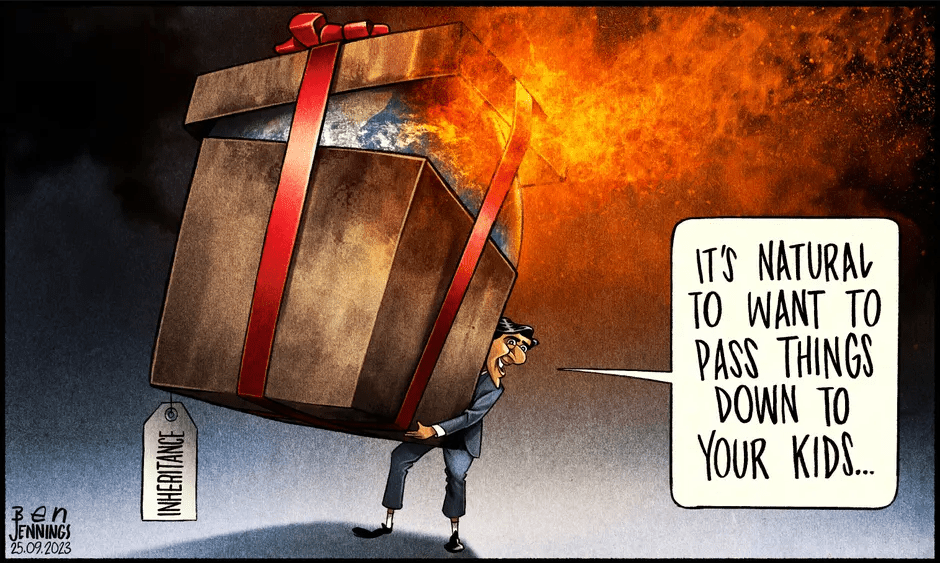
With talk of cutting inheritance tax, Rishi Sunak is beginning to look like a Liz Truss tribute act

Threatened by an electoral defeat, what’s a multi-millionaire Prime Minister to do?

Read the letter from Daren Jones, MP, Shadow Chief Secretary to the Treasury below, spells it out!  – Owl

For something that hardly affects anyone, and is in any case paid only after one passes away, inheritance tax appears to hold a strange fascination for the Conservative mind. It is as though there is something in the psyche that refuses to accept the maxim “You can’t take it with you.”

Editorial www.independent.co.uk 

Scrapping inheritance tax is an old favourite, and is often floated when ministers are searching for an eye-catching initiative that could, they believe, help them to win a looming, somewhat difficult, general election. Sometimes, as now, it smacks of desperation.

Taxes on the estate of the deceased are certainly unpopular, if not macabre, and every so often the Tory spin machine will seek to capitalise on this resentment and put out the notion of abolishing the levy, or radically increasing the threshold at which it must be paid. This is indeed happening again now, as Rishi Sunak seeks to create more “dividing lines” between his government and the opposition.

The recent retreat on net zero is another textbook example of this strategy. There was no pressing need to smash the cross-party consensus on climate change; it was merely an attempt to confect a policy contrast for short-term electoral gain. Many more (almost arbitrary) populist policy proposals for the next Tory manifesto will be set out as campaigning gathers pace, and we have no doubt that migration, trans rights, and other “culture war” issues will be ruthlessly exploited. Whatever else, the British general election of 2024 promises to be an unusually dirty and bitter affair.

Perhaps because what used to be called death duties impinge on people’s lives only rarely – a fact that no one is complaining about – inheritance tax is widely misunderstood. Only 3.7 per cent of estates are affected, the equivalent of some 27,000 families in all. Where a couple is involved, the effect of a relatively high basic threshold (£375,000) combined with spousal exemptions means that they can pass on as much as £1m to their descendants entirely tax-free. That threshold should be viewed in the context of the value of the average UK home – £288,000.

There are also additional reliefs applicable to farms and businesses that are passed on; and increasingly, personal pension pots are being used as highly tax-efficient methods of avoiding taxes on bequests.

As ever, the rich can get richer by playing the system – and the super-rich, with access to lawyers and offshore trusts, can get away with paying zero tax. When an individual dies before the age of 75, funds remaining in their pension escape income tax entirely – there is income tax relief when the money is paid into the pension, and no income tax when it is taken out. Furthermore, any funds that remain in someone’s pension when they die (at any age) are not subject to inheritance tax.

In other words, a vast swathe of personal wealth is simply ignored by the state. The present set-up is extremely generous to the descendants of the already wealthy – a group concentrated in London and the South East who, unsurprisingly, tend themselves to be older “baby boomers” as well as Conservative voters.

Abolishing inheritance tax would deprive the Exchequer of some £6bn – one of the smaller tax takes, but a significant one. It seems an odd move when vital infrastructure schemes such as HS2 are being mutilated for a supposed lack of funds.

There’s little reason to think that getting rid of inheritance tax would raise the economic growth rate as effectively as capital investment. It would certainly create an even less equal society, adding in particular to disparities in housing. There is no case for raising the threshold. But some cuts in inheritance tax seem to be on the cards, as far as No 10 is concerned.

This is entirely consonant with the other story doing the rounds in the media, which is that the Conservatives will extend the “triple lock” on increases to the state pension. Once again, this is a measure that benefits the old at the expense of the young, and exacerbates the intergenerational divide that is scarring society.

It is also consistent with the easing of our CO2 emissions targets, which will affect those growing up now rather than their parents and grandparents. “Culture war” issues and Euroscepticism are additional sharp dividing lines, as much between generations as between classes. In this context, it hardly seems surprising that Labour beat the Conservatives by 43 percentage points among 18- to 24-year-olds at the last election (or that Sir Keir Starmer seems quite keen on enfranchising 16- and 17-year-olds).

Mr Sunak seems to be following an undeclared “core vote” strategy, seeking to consolidate the Conservative baseline vote – say about 30 per cent of the electorate – with the hope that an improving economy next year will add a few more percentage points and deprive Labour of a majority.

That may be Mr Sunak’s best hope, realistically, but it also means that he isn’t even trying to reach out to the wider electorate – the young and hard-pressed families who expect to inherit little, if anything, from their elders. Talk of prioritising unfunded tax cuts for the rich, along with significant and indefinite guaranteed increases in the state pension, is also inconsistent with the government’s claim to be pursuing a strategy of fiscal responsibility.

Only a few days ago, the chancellor, Jeremy Hunt, declared that it would be “virtually impossible” to cut taxes before the election. The country may well wonder why it got rid of Liz Truss for her recklessness a year ago if Mr Sunak, once thought so responsible and fair-minded, is just going to recycle her policies. The prime minister should think again.

Devon’s dangerous nightmare potholes need to be addressed

Prospective Tory candidate slams DCC record on highway maintenance – no it’s not ultra loyalist Simon Jupp (nor whatshisname for Exmouth and Exeter East)! – Owl

Devon County Council has been warned it is building up huge financial problems for the future by failing to maintain its road network. It’s been urged to make a special bid for Government funding to tackle its backlog of road repairs – or face ‘unmanageably high’ bills in a few years’ time.

Lewis Clarke www.devonlive.com

Drivers have become highly critical of the poor state of the county’s network of 8,000 miles of road – the largest network in the country. Devon County Council does have the largest road network in England.

The council will invest £66 million in highways and bridge maintenance in 2023/24. But concerns have been raised over the fact some rural roads are ‘dangerous to drive’.

Prospective parliamentary candidate Ian Liddell-Grainger says special efforts must be made to implement a wide-ranging programme of improvements. Mr Liddell-Grainger, who intends to contest the new Tiverton and Minehead parliamentary constituency for the Conservatives, has slammed the Conservative run Devon County Council and said the longer the problem was neglected the more serious would be the eventual outcome.

“From the point of view of road safety alone the county council must start addressing this issue urgently because quite frankly many stretches of Devon’s roads are now dangerous to drive,” he said.

“Tourists arriving from other parts of the country must be horrified to find themselves negotiating fracturing surfaces and massive potholes and although local drivers are probably resigned to all that as a fact of life it doesn’t hide the fact that substandard road surfaces can frequently be a contributory cause of accidents.

“Doing nothing is not an acceptable option. Any road engineer will tell you that if road surfaces are allowed to deteriorate past a certain point they can no longer be patched or repaired, they have to be rebuilt, which is a hugely expensive operation.

“If Devon County Council allows that point to be reached it will clearly be left with unmanageably high bills which are bound to impact massively on what it has available to spend on other services.”

In response, a DCC spokesperson said: “Road maintenance investment is a national issue. The backlog of carriageway repairs in England and Wales has reached £14.02 billion, and in Devon it is over £200 million. The Government’s additional £9.4 million announced at the Spring Budget to help tackle this has been very welcome.

“But given that Devon has 8,000 miles of roads, the largest road network in England, with more than half of these categorised as Unclassified and having evolved over time in rural areas, this only partially addresses the sheer scale of the challenge. These challenges are further compounded by inflation, and more frequent severe weather events.

“Despite these pressures, our Highways and Traffic Management Service has continued to focus on reviewing and improving current working practices to increase efficiency and reduce disruption.

“This has been highlighted in benchmarking data from the National Highway and Transport Network (NHT) which shows us to be an efficient highways authority which strives to squeeze the maximum from our limited resources while also taking a national lead on carbon efficiency.

“We are investing £66 million in highways and bridge maintenance in 2023/24, this includes the additional £9.4 million from Government and a further £500,000 from our own efficiency savings.”

Rishi Sunak’s rollback on green targets gets thumbs up from Trump

“I always knew Sunak was smart, that he wasn’t going to destroy and bankrupt his nation for fake climate alarmists that don’t have a clue,” Donald Trump

Donald Trump calls Rishi Sunak ‘smart’ for easing climate targets

Annabelle Dickson www.politico.eu

LONDON — British Prime Minister Rishi Sunak’s easing of green policies has won the backing of Donald Trump.

In a post on his Truth Social media account late Saturday, the former U.S. president congratulated Sunak for announcing last week that he is paring back his green pledges.

Sunak has confirmed a major roll-back of several key U.K. green policies, including easing the transition to electric vehicles and shifting a date for a ban on sales of new petrol and diesel cars from 2030 until 2035. He also promised there would be more time to transition to heat pumps.

“I always knew Sunak was smart, that he wasn’t going to destroy and bankrupt his nation for fake climate alarmists that don’t have a clue,” Trump wrote.

Trump, who is leading the polls in the contest for the Republican Party’s 2024 presidential nomination, said the U.S. “keeps rolling merrily along, spending Trillions of Dollars trying to do that which is not doable, while at the same time breathing in the filthy and totally untreated air floating over our once great Country from China, India, Russia, and Parts Unknown.”

Sunak argued last week that continuing with the current climate policies risked “losing the consent of the British people — and the resulting backlash will not just be against specific policies, but against the wider mission itself, meaning we might never achieve our goal.” But Sunak insists he is still committed to reaching net zero by 2050.

Trump added: “Congratulations to Prime Minister Sunak for recognizing this SCAM before it was too late!”

Coogan and Vorderman back tactical voting calls at Lib Dem conference

The Liberal Democrats have kicked off their annual conference with a call for people to vote tactically in the general election to remove Conservative MPs, until proportional representation makes this unnecessary.

Peter Walker www.theguardian.com 

Gathering in Bournemouth for their first autumn get-together since 2019, a conference rally heard video addresses from Carol Vorderman and Steve Coogan. Neither are party members but they said people should vote in a way to ensure Tory candidates lost.

The Lib Dems have benefited significantly from traditional Labour voters and even disenchanted Conservatives switching their support to overturn big Tory majorities in a string of recent byelections.

Coogan, the actor and comedian, told the rally that while he normally voted Labour, he would switch to the Lib Dems in the marginal Lewes constituency where he lives to try to oust the incumbent Tory, health minister Maria Caulfield.

“I’m not a member of the Lib Dems, and despite the beard and the fleece I generally vote Labour,” Coogan’s video said. “But where I live in Lewes, the candidate best placed to kick the Tories out is the Lib Dem candidate, so I vote for them.”

He backed proportional voting rather than the current method of first past the post, which Coogan called “an electoral system that robs millions of people of their vote”.

Vorderman, the former Countdown co-presenter, already works with a tactical voting website called Stop the Tories.

She told the rally: “We desperately need to end a system where only marginal seats matter, end a system which delivers parliaments that fail to accurately reflect votes cast and end a system where only the winner’s votes count.

“It doesn’t deliver parliaments that properly reflect the will of the nation. It has to change. But how do we get there? Well, in my opinion, the first step is tactical voting.”

The introduction of proportional representation (PR) is a longstanding Lib Dem aim, and one the party is closely associated with. It hopes to use the conference – following three years in which it was scuppered first by Covid and then the Queen’s funeral – to set out more policies before an election very likely next year.

Plans being debated include a proposal for a £5bn a year guarantee of free care packages for all in England, set out by the leader, Ed Davey, before the conference.

One policy formally adopted on Saturday commits to a doubling of statutory shared parental pay from just over £172 a week to £350, and increasing the amount of time it can be claimed from 37 weeks to 46 weeks.

However, as well as the videos about PR, the conference-opening rally included other trusted Lib Dem favourites, such as criticism of the government’s record on sewage discharged into rivers and the sea.

In another crowd-pleaser, Davey posed with one of the party’s ubiquitous election props – a giant clock with the slogan “Time’s up for Rishi Sunak”, used after the local elections in May.