Services outsourcing firm to drop health care and concentrate on commercial cleaning

“Mitie has published its second profit warning in two months after the outsourcing company’s customers continued to reduce spending due to rising costs and economic uncertainty.

The company also said it would withdraw from its healthcare business, which provides home care for the elderly. The £128m cost of writing off the business drove Mitie to a £100m pre-tax loss for the first half of the year. …

… Mitie put its healthcare division under review in September and will now look for a company to take over the business or allow its contracts to wind down. Local councils have been seeking price cuts from the loss-making business, prompting Mitie to conclude it was unviable.”

https://www.theguardian.com/business/2016/nov/21/mitie-withdraws-healthcare-second-profit-warning-shares

One-third of doctors say they have not heard about projected NHS cuts!

Are they all working so hard they have no time to read newspapers?

“The BMA, which today reveals the £22billion spending shortfall, said a survey found two-thirds of doctors had no input in the plans and a third had not even heard of them.

Its council chairman Dr Mark Porter added: “Given the scale of the savings required, there is a risk these plans will be used as a cover for delivering cuts… starving services of resource and patients of vital care. It is extremely concerning that the majority of doctors have not been consulted on the plans, particularly as ministers have been so keen to insist that all ­stakeholders would be involved.”

The Lib Dems demanded an urgent £4billion cash injection for the NHS and social care services to stop the crisis getting worse. Health spokesman Norman Lamb said: “NHS and care services are on the precipice as we approach the winter months.

“Waiting lists are growing, deficits hit record levels this year and staff are under unsustainable pressure.

“In social care, thousands of people are seeing services withdrawn and 15-minute visits have become the norm as councils struggle to make ends meet.”

A report by health think-tank the Kings Fund blasted the secrecy surrounding the Sustainability and ­Transformation Plans, which are being finalised by health chiefs around the UK.

Cheshire and Merseyside is one of the largest affected areas. Three hospitals could be axed and “merged” on to a single site to plug its black hole. Birmingham and Solihull trusts face a £712million ­shortfall, putting services at risk of closure.

Somerset’s two main hospitals in Yeovil and Taunton may merge key departments including cancer and maternity wards. In Berkshire, Oxfordshire and ­Buckinghamshire, bosses are planning to cut the staff payroll by £35million to help meet a £479million deficit.

It is a similarly depressing story in most other regions as Tory austerity continues to batter services, morale and patient safety.

But NHS medical director Professor Sir Bruce Keogh insisted: “We are talking about steady incremental ­improvement, not a big bang, tackling things doctors and nurses have been telling us for years.”

The Department of Health added: “The NHS already has its own plan, designed by NHS leaders, which sets out how we can transform services and improve standards of care in building a more responsive, modern health system.”

http://www.mirror.co.uk/news/uk-news/secret-plan-22billion-nhs-cuts-9299803

Daily Telegraph says street protests could reduce NHS bed losses

The Labour Party has a national day of action on Saturday 26 November 2016.
Devon has a county-wide non-political protest (“Draw a Red Line”) on Saturday 3 December midday Bedford Square, Exeter (see above for information)

Hospital closures planned to shore up NHS finances could be derailed if enough people take to the streets in protest, a health service chief has said.

Chris Hopson, leader of England’s hospitals sector, said public unrest and opposition by local MPs could scupper so-called Sustainability and Transformation Plans (STPs), which are billed as crucial to the long-term viability of the health service.

On Monday the respected think tank The King’s Fund heavily criticised health bosses for trying to organise the sweeping closure of hospitals and NHS units in secret, moves which it said could put lives at risk.

Yesterday Mr Hopson, Chief Executive of NHS Providers, said architects of the schemes were so far failing to engage local communities, which “have the ability to sink plans they don’t support”.

“It’s very difficult for the NHS to proceed with wholescale change if you’ve got people out on the streets marching with placards and banners and saying “don’t do this”,” he said.

“Fundamentally you can’t make big changes to service provision without taking local people with you.”

The plans follow an admission in May that the provider sector overspent by a historic £2.45 billion in the last financial year.

The country has been divided into 44 areas, with each ordered to come up with a proposal that both closes the gap and caters for booming patient demand.

So far the plans involve the closure of one of five major hospitals in South West London, an A&E unit in the North East of England, the loss of almost 600 beds in Devon and the possible closure of two A&E units in St Helens and West Lancashire.

Mr Hopson yesterday said unit closures were too widely being regarded as a “silver bullet” to make the “overambitious and undeliverable” plans conform to tight budgets.

“We have become obsessed by the money and not got the public engagement right,” he said.

“We are also trying to do it too quickly.”

But Sir Bruce Keogh, the NHS medical director, has this week there was “plenty of time” for the public to shape the changes.

NHS cuts on EDDC scrutiny agenda – 24 November 2016, 6 pm

The full consultation document begins on page 9:

Click to access 241116-scrutiny-agenda-combined.pdf

Ottery St Mary NHS cuts public consultation meeting, 29 November, King’s School, 6 pmh

There will be a public meeting at the King’s School in Ottery St Mary on Tuesday 29 November, to consult residents on plans to shut 72 community hospital beds in Eastern Devon – and on introducing a new model of care on looking after more people in their own homes.

Last year NEW Devon Clinical Commissioning Group made a decision to shut all the general medical beds at Ottery Hospital as well as Crediton and Axminster. We now have 15 temporary stroke beds at Ottery but they are set to transfer to the RD&E in due course.

The CCG was not planning to hold a meeting in Ottery but myself, Cllr Elli Pang and Ottery Town Council all wrote requesting that a meeting be held in the town to update people on the new model of caring for people in their own homes and what plans there are for the hospital.

The meeting at the King’s School is from 6-8pm on Wednesday 29 November.

http://www.claire-wright.org/index.php/post/public_meeting_in_ottery_st_mary_to_debate_plans_to_shut_more_community_hos

The REAL-LIFE Devon NHS cuts

“The proximity of North Devon district hospital to Anne-Marie Wiles’ home – it is less than five minutes away – is crucial.

Her twin sons, Jed and Peirce, were given just six months to live after being born with multiple complex health needs. They are now doing well, aged 16, thanks in large part to the efforts of a loving family, but also the dedicated staff at the hospital in Barnstaple.

“I intentionally live opposite the hospital because when the boys stop breathing there is not enough time to call an ambulance,” said Wiles. Jed has been resuscitated three times at the NDDH and both have been nursed countless times at the Caroline Thorpe children’s ward.

“If these services end then my boys will for certain die once they become ill,” said Wiles. “I am fearful of losing my children.”

She is one of thousands who have joined marches, written to local MPs, organised benefit gigs, signed petitions over the Wider Devon STP – sustainability and transformation plan – which is proposing radical changes to healthcare in the county.

If the plan comes to fruition in its present form, 600 community and acute beds across this sprawling, largely rural county will be gone within five years.

Cherished community hospitals at Honiton in the east – nicknamed the Honiton Hilton because it so beloved – Okehampton in central Devon and Paignton and Dartmouth in the south would go. There have been howls of protest everywhere – but nowhere more than in and around Barnstaple.

Here there is deep alarm that the plan may lead to the shutting down of maternity, neonatology and paediatric services as well as triggering the loss of other departments, including A&E. The Royal Devon and Exeter hospital is 50 miles away – an hour and 10 minutes by car down a winding road if conditions are good, much more if not.

Tina Day’s son, Jaiden-Lee, was born at the NDDH with a collapsed lung and spent a week in the special care baby unit for a week before developing type 1 diabetes. “It terrifies me if services like maternity and A&E are re-located. People will die, guaranteed,” said Day.

John Tate claimed his wife and daughter would both have died had the NDDH not been near. “My daughter had her umbilical cord wrapped around her neck. She had breathing problems and was trapped head down. This caused my wife life-threatening problems. An emergency cesarean saved their lives. Both would have died if Barnstaple was not there.”

Crystal Steinberg said the closure of the maternity department would make her think twice about having a second child. She underwent an emergency caesarean section because her unborn baby, Dylan, was in distress. “I do not want to be stranded at the side of the road while my uterus ruptures and my baby and I die.”

It is not just mums who are worried. Tracy, 46, suffers from a mental health condition that leaves her suicidal. “I have been to A&E three times this month after being picked up by police.” Should the A&E close she believes she would be held in a cell or have to head to Exeter. “I’d have no way of getting there but to walk or hitch. Both are a scary.”

Jacob Egan, seven, was so concerned when he got wind of the proposals that he dictated a letter to Theresa May. He has brittle asthma, which can result in severe attacks, and has been admitted to the NDDH around 10 times.

“Dear prime minister,” he said. “Just think about it, every time any child in our area of north Devon needed to go to hospital they would have to go to Exeter. Exeter is a long distance away and if your heartbeat stopped you couldn’t just wait for a train or car to get you there.”

At the heart of the plan is a “new model of integrated care” that will “reduce reliance on bed-based care and enable people to live healthy independent lives for longer, closer to where they live”. In other words the idea is to look after people at home rather than in hospital.

According to the latest draft of the report, which is up for consultation, every day more than 600 people in Devon are medically fit to leave hospital beds but do not.

The plans argues change must take place. Health and social care services in Devon are likely to be £557m in deficit in 2020/21 if nothing is done, the plan says. It also says the system as it stands isn’t working. The 95% standard for patients being seen in A&E within four hours is not being met – the Devon system is currently achieving 91.6%.

Devon’s demographics also have to be taken into account. There are more elderly people here than in other parts of the UK – in one area of Torquay almost one in 10 are aged over 85. Some need a lot of care – in north, east and west Devon, 40% of people use almost 80% of health and social care.

Angela Pedder, lead chief executive for the plan, said she understood people’s concerns. “But if we sit back and say let’s just let things happen, that’s a much bigger risk not just for the whole of Devon.

“We have to be pro-active. We have responsibilities to make sure the service is safe and sustainable two, five, 10 years down the line. That’s what we’ve got to plan for. That’s the framework we are trying to put in place.”

Politicians, activists and patients are not impressed.

The East Devon Tory MP Hugo Swire said: “We are in danger of putting the cart before the horse. Until we can absolutely ensure that we have got social care right, we should not look at unnecessarily closing community beds.”

Jan Goffey, the mayor of Okehampton, called the proposals cruel and claimed the NHS was being “dismembered”. If the people who actually live in Barnstaple are worried, those that live even further north – and so even further from Exeter – are even more concerned.

Sarah Vander, who runs a shop in the cliff-top village of Lynton, 20 miles north-east of Barnstaple, said her mother had been saved from a stroke and her husband from a diabetic hypo – a drop in blood glucose level – because they got to the NDDH quickly. “We are incredibly remote and we must be able to rely on the excellent services of NDDH otherwise the simple fact is, people will die unnecessarily.”

The seaside town of Ilfracombe, 12 miles north of Barnstaple, suffers a double whammy. The town is isolated and some areas are deprived: life expectancy in central Ilfracombe is 75 compared with 90 in parts of east Devon.

Rebecca McGarry, from Ilfracombe, the mother of daughters aged two and three, said she felt sick thinking about the prospect of losing services. Both her children have received excellent treatment in Barnstaple including for severe croup, which makes it difficult for them to breathe.

McGarry’s husband is a carer and needs the car for work so she often has to take her children to the hospital on the bus. “I honestly don’t know how we would manage if these appointments were moved even further away. The idea that such a remote region should lose these vital services is totally absurd. People will lose their lives if these closures do happen.”

https://www.theguardian.com/society/2016/nov/18/nhs-cuts-in-devon-if-these-services-end-my-boys-will-for-certain-die

Two tier social care: rich and cared for or poor and neglected, says Conservative council leader

“A Conservative council leader says dozens of social care providers are cancelling contracts with local authorities and instead offering their services solely to wealthy private clients.

Izzi Seccombe, who is the Local Government Association’s spokesperson for social care, said the chancellor needed to take urgent action in the autumn statement to tackle a growing crisis in the sector.

She told the Guardian that a failure by Philip Hammond to plug a multibillion-pound financial black hole would result in elderly and disabled people no longer receiving help to get dressed, showered and fed.

“The challenge is we are underfunded and the concern is that if we cannot bridge those gaps with some funding through the autumn statement, we will not be able to address the needs of people who are vulnerable,” said Seccombe, the Tory leader of Warwickshire county council. She said people would instead have to turn to their GPs or local hospitals for help, resulting in a larger cost to the taxpayer in the long run.

Her comments come alongside a written warning to Hammond that councils across England and Wales are facing a £5.8bn funding gap by 2020. A document submitted by the LGA suggested there would be a serious squeeze on spending for social care, children’s services, homelessness, local parks and libraries. …”

https://www.theguardian.com/society/2016/nov/18/care-providers-shunning-local-authorities-tory-councillor-claims

“Promised £8bn extra for NHS is not enough, says hospitals boss”

Theresa May will have to rip up the government’s financial plans for the NHS and commit more than the promised £8bn extra by 2020, a hospitals boss has said.

Chris Hopson, the chief executive of NHS Providers, said ministers must come up with a new plan to fix the health service’s crumbling finances or risk it becoming unable to function properly.

In a submission to the Treasury before next week’s autumn statement, NHS Providers, which represents 96% of NHS trusts in England, says a rethink is necessary because the calculations underlying the government’s £8bn pledge are flawed.

It says demand for care is rising faster than envisaged in the blueprint drawn up by NHS bosses in 2014, the Five-Year Forward View, and social care has deteriorated.

Hopson said: “Some of the key assumptions in the Five-Year Forward View, on which the current financial and NHS delivery plans for this parliament are based, have turned out to be wrong. There is now a clear and widening gap between what is being asked of the NHS and the funding available to deliver it.

“The NHS simply cannot do all that it is currently doing and is being asked to do in future on these funding levels.”

Andrew Lansley, the health secretary from 2010 to 2012 in the coalition government, recently said the NHS needed a “Brexit bonus” of £5bn on top of the £8bn already pledged, given the widespread public demand for higher NHS funding revealed by the EU referendum.

NHS Providers does not specify how much more it wants invested. But Hopson said more than £8bn was justified because “demand for care is a lot higher, social care is in a much worse state, general practice is turning out to be more unstable, and the starting point for the deficit among hospital, mental health, community and ambulance trusts has turned out to be much larger.”

He said the overall health budget would go up by only £4.5bn by 2020, not the £8bn ministers pledged last year, because money was being taken from key areas such as public health in order to give the NHS its promised increase. Independent experts agree £4.5bn is the true increase that healthcare will get.

The NHS’s inability to deliver the £22bn of savings it had promised to make by 2020 – a target that had always been “too ambitious” – further underlined the need for more money to be found before the end of this parliament, said Hopson.

May has been under pressure recently over her repeated claims that the government is giving the NHS £10bn more, and more than the NHS England chief executive, Simon Stevens, asked for in 2014. Sarah Wollaston, the Conservative chair of the Commons health select committee, and other members of the committee wrote to the chancellor Philip Hammond to say the claims were untrue. Labour has asked the UK Statistics Authority to rule on whether the £10bn claim is justified.

Jeremy Hunt, the health secretary, has subtly distanced himself from the £10bn figure and said the NHS will need a lot more money after 2020, at the end of its unprecedented decade-long budget squeeze.

Ministers have already told Stevens that the NHS will not receive a funding boost in the autumn statement. But NHS and local council leaders hope the chancellor may find some extra money to prop up the ailing social care system.

“NHS funding increases from next year onwards are not enough to maintain standards of care, meet rising demand from patients and deliver essential changes to services,” said Richard Murray, director of policy at the King’s Fund thinktank.

“If additional [NHS] funding is not forthcoming later in the parliament, the government will need to be honest with the public about the impact on quality of care and access to services.”

The Department of Health did not respond directly to Hopson’s comments. A spokesman said: “This government has taken tough economic decisions that have allowed us to invest in our NHS, which is meeting record patient demand whilst improving standards of care. We have prioritised funding for the NHS with £4bn extra this year.”

https://www.theguardian.com/society/2016/nov/17/promised-8bn-extra-for-nhs-is-not-enough-says-hospitals-boss

Sidmouth meeting on NHS bed and services cuts – 9 December 2016 7.30 pm

OUR FUTURE CARE!

Sid Valley patients and carers invite all residents to a public meeting in the Parish Church, Sidmouth Church Street,
on Friday 9th December at 7.30 pm

The Consultation (ending 6th Jan)
“YOUR FUTURE CARE”
proposes closing 600 hospital beds all over Devon, including at Honiton, Okehampton, Seaton, Exmouth, Barnstaple, Exeter and Sidmouth.

Beds have already gone from Axminster, Ottery St Mary, Budleigh Salterton and Torrington – without consultation

Let us talk about this urgently with friends, family, clubs, churches, WI groups, etc. and bring ideas from all in our valley to the meeting on 9th December

For more information call 01395 519292

Health transformation “fantasy”: For Norfolk read Devon and the rest of the country

“… In Norfolk and Waveney, the latest Sustainability and Transformation Plan (STP), under guidance from NHS England, has only been seen by a small group of health chiefs.

It has been kept from MPs, councillors, NHS staff, GPs, unions and some hospital board members.

An initial version of the plan was published in June, which warned there would be a deficit of £440m by 2020 in the NHS and social care budget, if action was not taken.

The plan proposed keeping patients out of hospital by expanding community and social care, but little detail has been given so far about what that action might be or how they hope to save a proposed £160m.

The full STP plans have been published in several areas of the country, but Norfolk and Waveney STP is following NHS England guidance by not making their proposal public yet.

Managing director of Norfolk County Council Dr Wendy Thomson, who is leading on the STP, said their plan was “at an earlier stage in its development compared to many others around the country.”

““Plans are not yet at the point where they have clear messages about things the public want to know”
Dr Wendy Thomson, Norfolk County Council
“Plans are not yet at the point where they have clear messages about things the public want to know,” she said.

“As service plans are developed, EDP readers can be assured that changes will be subject to the right public engagement and statutory consultation.” The Norfolk and Waveney STP is expected to be published in late November, but it is understood there will still be little detail in the document about what health chiefs propose to do with Norfolk an Waveney’s health system to plug the financial blackhole.

North Norfolk MP and former health minister Norman Lamb said there would be little hope of the getting the public involved in the plans if they were presented as a “fait accompli”.

He said he supported the idea of saving money by having more people being cared for in the community and joining up health and social care, but said the idea that hundreds of millions of pounds could be saved through STPs was fanciful.

“It is in the realms of fantasy to imagine this is achievable,” he said. “I don’t think when it is published people will get that excited about it. It will not say anything significant in terms of detail of changes. What lies beyond that is much more disturbing for many.”

Jeff Keighley, Unison regional organiser, said STP leaders should have consulted the public “at the earliest possible opportunity”.

Although the union said it was not against “sustainable transformation”, Mr Keighley said he was concerned the proposals would not be sustainable.

“If they had found a wonderful way of saving this money by enhancing the services it would be amazing – and they would have not been keeping it a secret,” Mr Keighley said. …

… What’s happening in other areas

Some councils have objected so strongly to the lack of public involvement they have ignored NHS England’s demand to keep the documents private until a later stage and have published them on their websites.

The plans on how local NHS areas will move forward over the next five years focus on several key themes.

These include cutting costs, moving care closer to home, putting a greater emphasis on preventing people becoming ill in the first place and concentrating services in a smaller number of units or hospitals.

Some argue this will enable increased access to consultants around the clock and make the best use of specialist NHS staff and resources. There are also plans to streamline back-office functions.

So far, more than a dozen plans have been published or leaked. Here are details from some of the key ones:

•The plan for Durham, Darlington, Tees, Hambleton, Richmondshire and Whitby set out how either Darlington or North Tees could lose their emergency department, with one becoming a “specialist emergency hospital” and another becoming a “local hospital”.

The plan says this will drive up standards, ensure a seven-day consultant presence with at least 16 hours per day consultant specialist access. More than 75% of patients could be assessed by a specialist consultant on admission and 100% assessed within 12 hours by a consultant.

Consolidating these services, together with other departments, could save millions of pounds, the plan said.

•The south-west London document outlines plans to cut the number of acute hospitals on the patch from five to four. Currently there are five hospitals at Croydon, Epsom, St Helier, St George’s and Kingston.

The plan says: “The only site which we believe is a ‘fixed point’ is St George’s Hospital in Tooting since it provides hyperacute stroke, major trauma and other services which are serviced by highly-specialised equipment and estates, which would be very expensive to re-provide elsewhere in south-west London.”

The document says reduction in sites is necessary to provide seven-day services with enough doctors and consultants – one of Health Secretary Jeremy Hunt’s main aims.

“We are very unlikely to be able to deliver services that meet clinical quality standards across five acute hospital sites. In particular, clinicians do not believe that we will be able to recruit or pay for sufficient workforce to deliver seven-day services at five acute sites.”

•In Birmingham and Solihull, the plan states that by 2021 there could be a deficit of £712 million across the health and care sector if nothing is done to address issues in the local health economy.

It says it will establish a single “lead provider” for maternity care and look to “immediately” implement a shared service for back-office functions across its four main acute providers and create a centralised laboratory for routine pathology work.

There are currently two main providers of maternity care – Birmingham Women’s Foundation Trust and at the Heart of England.

Plans to merge Birmingham Women’s and Birmingham Children’s Hospitals by next year have already been announced while University Hospitals of Birmingham and Heart of England FT announced in September the intention to create a “single organisation”.

•North-west London’s draft STP, seen by the Health Service Journal (HSJ) last month, aims to “consolidate acute services on to five sites” from the current nine.

Two London councils – Ealing and Hammersmith and Fulham – have said they cannot agree to a plan that assumes Charing Cross Hospital will be downgraded.

Stephen Cowan, leader of Hammersmith and Fulham council, said: “At the heart of the STP is an acceptance that Charing Cross Hospital will be demolished and replaced with significantly downgraded facilities, with the capital receipts from the sale of much of the hospital’s land intrinsic to the delivery of the STP. 1/8We are 3/8 strongly opposed to this, and therefore the STP.”

•The Cheshire and Mersey plan includes the downgrade of at least one A&E department along with a major consolidation of elective care.

The A&E at Macclesfield hospital would become a minor injuries unit. According to the Health Service Journal (HSJ), there will be a formal “major service review” at Southport and Ormskirk Hospital Trust, and the document includes options that could reduce the number of 24-hour A&E departments across three acute trusts.

•The north central London document sees officials over the next year examining whether some key services “would benefit from consolidation or networking”.

These services include maternity, out-of-hours emergency surgery, orthopaedics, mental health crisis care and dermatology.

http://www.edp24.co.uk/news/health/bid_to_transform_nhs_in_norfolk_and_waveney_and_save_160m_in_realms_of_fantasy_1_4774673

Is the “Success Regime” really that successful?

From a correspondent:

“I just took a look at the CCG document “Devon Pre-Consultation Business Case” and found the following:

This document says that NHS England has four tests for service reconfiguration, one of which is “Clear, clinical evidence base”. This seems to come from an NHS England document “Planning, assuring and delivering service change for patients” which says the same thing and says that they are “set out in the Government Mandate to NHS England” however I cannot find anything referring to this in “The Government’s mandate to NHS England for 2016-17” and I can’t find any other similar document.

So “Clear, clinical evidence base” seems to have been made up by NHS England, which does go on to say:

“Service reconfiguration must be evidence-based and this evidence should be publicly available during the consultation and decision making stages.

A clear clinical evidence base

This ensures service reconfiguration proposals are underpinned by clear clinical evidence and align with clinical guidance and best practice. Commissioners should oversee the development of the clinical case for change, as part of the outline case. Medical directors and heads of clinical services of any providers involved can help build the clinical evidence base.”

Indeed this document could be very useful as it is some sort of blueprint for what CCGs need to do – and therefore something we can compare the CCG’s plans to.

NEW Devon CCG’s “Clear, clinical evidence base” is the following:

“The clinical evidence is clear that prolonged hospital stay increases long term physical and psychological dependence”

“The clinical evidence is clear that prolonged hospital stay increases long term physical and psychological dependence” a second time

“The Case for Change sets out clearly the evidence on gaps in existing services which we aim to address through the proposed changes. As part of this diagnostic work clinicians have undertaken a detailed review of care models for four groups of high-impact patients, who currently use significant resources in the community. This is based on identifying good practice both nationally and locally. In particular, the development of services in North Devon following development of community health and social care teams to be a single point of co-ordination for people with complex needs and a reduction in community hospital facilities”

Whilst I have not read in detail the N Devon documents that have been circulated, as far as I can tell the N Devon experience cannot genuinely to be considered to be a positive reference, and in any case the evidence linked to in the CCG documents is not “clinical evidence” but is instead a subjective survey of patients asking them whether the administration of their home visits (i.e. bookings, turning up on time) was satisfactory and says NOTHING (and I mean that in absolute terms – nada, zilch, zero, absolutely nothing) about whether the treatment was clinically effective or indeed as clinically effective as hospital care.

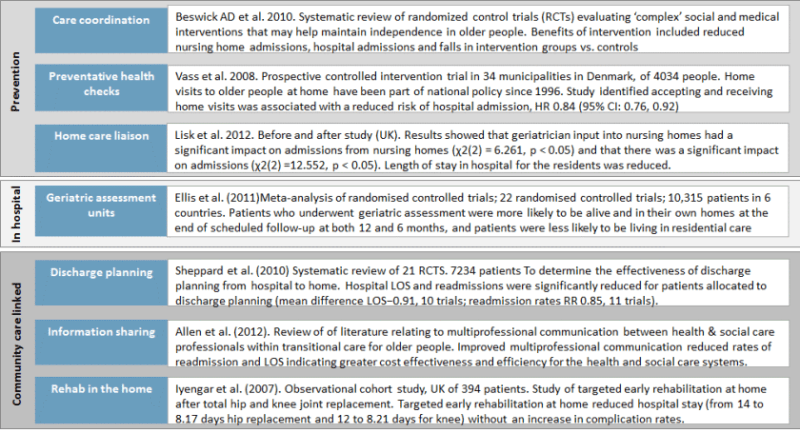
On page 89 there is a table which does provide some anecdotal clinical evidence, but there are no links to the underlying evidence (though we might be able to find it to verify that they have used it correctly if we search for it):

img_1340

However the only evidence above directly relevant to their home-care proposals relates only to one specific type medical condition (total hip and knee replacement), and they then seem to have made a leap of faith that they can apply this to every medical condition which currently results in a stay in hospital beyond the point that hospital medical care is needed.

So it would seem that one target for “consultation feedback” is whether the CCG has met the requirements set by NHS England for a “Clear, clinical evidence base” that shows that their proposals are 1) effective and safe when considered alone, and 2) are at least as effective and safe as hospital care.

Another target for “consultation feedback” is to look at all the other areas defined by NHS England that the CCG has to meet, and see whether they have in fact done so.”

“Elderly failed by ‘shameful’ care system”

“Age UK and the Alzheimer’s Society criticised both the quality of care and the way it was rationed as they published fresh evidence on the state of the care sector.

It includes figures that suggest the number of older people not getting help has risen by nearly 50% since 2010. …

… three pieces of research showed:

There are now an estimated 1.2 million over-65s going without help for care – nearly one in eight of all older people

Some 300,000 of them have difficulty with three or more tasks, including dressing, bating and going to the toilet

Councils agreed to help under half the 1.3 million people who approached them for care last year

The BBC identified 11 councils that rejected more than 75% of applications
Where home care was provided “serious problems” were identified in the way dementia patients were treated

Staff said they had not been given enough training to cope with the complex needs people had

Families reported examples of poor care, including loved ones not being given medication, being left in dirty clothes for days and going missing after homes had not been properly secured

Caroline Abrahams, of Age UK, said she was “extremely worried” about the “shameful” state of the care system.

“The sad irony is that it would be far more effective as well as infinitely more humane to give older people the care and support they need,” she said. …

…Councillor Izzi Seccombe, of the Local Government Association, said: “Unless social care is properly funded, there remains a growing risk to the quality and safety of care, and the ability of services caring for our elderly and vulnerable to meet basic needs such as ensuring people are washed and dressed or helped out of bed.”

http://www.bbc.co.uk/news/health-37992488

38 Degrees petition: “Save Community Hospital Beds in East Devon”

Already at close to 1,000 signatures:

https://you.38degrees.org.uk/petitions/save-community-hospital-beds-in-east-devon

Facebook page:
https://www.facebook.com/events/779686012163579/

Telegraph: “Secret plans to shut hospitals could put lives at risk, say doctors”

“STEALTH NHS plans for sweeping closures of hospitals and accident and emergency departments are “potentially catastrophic” and could put lives at risk, leading doctors have said.

The warning came as a major report by the King’s Fund lambasted health officials for ordering the suppression of proposals that will affect millions of people.

The respected think tank suggests the plans – being drawn up behind closed doors in every part of England – may be doomed to fail patients.
Secrecy about the process, combined with “breakneck” timescales and a lack of funding for new services means patients could bear the brunt of brutal cuts, they suggested.

Two weeks ago, The Daily Telegraph disclosed that half of NHS leaders are planning bed cuts, with one third intending to close accident and emergency departments.

It follows orders to produce “sustainability and transformation plans” (STPs) to tackle the greatest financial crisis in the history of the NHS and meet unprecedented patient demand.

On the critical list:

Some of the plans floated so far

♦ South West London: closure of one of five major hospitals
♦ North West London: closure of two A&E units
♦ North East: Darlington Memorial Hospital or North Tees Hospital to lose A&E unit
♦ Devon: cuts to almost 600 beds, with the loss of maternity and paediatric services from north Devon site
♦ Cheshire and Wirral: downgrade of at least one A&E department
♦ St Helens and West Lancs: possible closure of two A&E units

The country has been split into 44 areas, with each told to produce proposals to balance the books and change the way care is delivered.
NHS leaders have pledged to shift more care into the community, and to strengthen GP services, in efforts to boost health.

But cost-cutting has now taken precedence in many of the plans, the head of the King’s Fund warned. Today’s report criticises NHS England for telling local leaders not to publish plans until the details have been checked by senior officials.

In recent days, increasing numbers of NHS bodies and councils have broken ranks, publishing or leaking documents that set out plans for major changes to their services, arguing that the public deserves honesty.
The plans issued so far warn of the closures of whole hospitals as well as A&E and maternity units.

The King’s Fund criticised health officials for keeping patients in the dark, warning that the public has been “largely absent” from debate.
As well as telling local NHS managers not to publish their proposals, health officials also told them to block Freedom of Information requests seeking the information, the report says.

“National NHS leaders wanted to be able to ‘manage’ the STP narrative at a national level – particularly where plans might involve politically sensitive changes to hospital services,” the report says.

Local managers in the study said the approach was “ludicrous” and meant that controversial plans were being drawn up with no local involvement – which was likely to end in a “massive fight.”

Dr Tajek Hassan, president of the College of Emergency Medicine, said: “Secretly producing plans without involving those who are – or should be – at the heart of the NHS; the patients, is wholly unacceptable and will not result in effective or sustainable services.

“Transparency is also needed to address the current speculation regarding the potentially catastrophic closure of emergency departments, which – if true – would only add to the substantial difficulties emergency medicine faces and put lives at risk.”

Chris Ham, chief executive of the King’s Fund, said the NHS had been told by Government that “we don’t want too much noise” about the controversial plans.

Sir Bruce Keogh, the NHS medical director, said changes were needed to meet the needs of the country’s ageing population, and to ensure specialist care was available round the clock.

“We are talking about steady incremental improvement, not a big bang. If we don’t, the problems will only get worse,” he said. ”

http://digitaledition.telegraph.co.uk/editions/edition_1mboe_2016-11-14/data/239163/index.html

“Virgin Care”: like a measles rash all over the country, including Devon

Want to know where Virgin Care operates? Look here:

Explore our services

Plenty of those red dots in Devon – with at least a dozen locations operating in East Devon.

It is currently advertising 24 job vacancies in Devon including Locality Pathway Coordinator”, Health Visitor, Speech Therapists and several mental health practitioners.

Owl thinks the contract to run many, many more Devon services is ready and waiting until that pesky bed closure “consultation” is over with …

“Fears that secretive NHS reforms will put savings before patients”

“Widespread bed cuts, closures of accident and emergency units and even shutting hospitals have been proposed by NHS bosses

A “secretive” plan to reorganise the NHS risks failing patients, a report warns.

Widespread bed cuts, closures of accident and emergency units and even shutting hospitals have been proposed by NHS bosses who are often more focused on saving money than improving care, the King’s Fund think tank says.

Simon Stevens, head of NHS England, has conceded that managers in many areas are not up to the job of implementing his vision for the health service and is warned today that it risks failure in most of the country.

Mr Stevens is attempting to undo Andrew Lansley’s 2012 NHS reforms without the need for another structural reorganisation, and has divided England into 44 areas where local bosses have been told to come up with “sustainability and transformation plans (STPs)” to move care closer to home.

He insists that doing more in local clinics will keep older people with long-term illness out of hospital. The report published today endorses that aim, but says that STPs are the “right thing being done badly”. Short-term savings are being prioritised over long-term improvements as the NHS faces a £22 billion black hole by 2020, it says.

Plans have been drawn up behind closed doors with patients “largely absent” and with little input from frontline staff, the King’s Fund says. Uncertainly over accountability for the plans is hampering the ability to get anything done, it adds. Chris Ham, chief executive of the fund, estimated that a third of plans were likely to succeed, a third had little hope and the rest would need more help.

“I don’t think the deliverability of STPs is something we can be confident about,” he said. “If STPs do not work then there is no plan B.”

Katherine Murphy, chief executive of the Patients Association, said the plans were “more about saving money”, adding: “They cannot axe services in a secretive way and expect the public to be happy.”

Professor Ham said that cutting hospital services was unlikely to work without money for local clinics to replace them. “GPs and district nurses are under massive pressure. It’s unrealistic to expect them without more staff and resources to take on more of the workload,” he said.

About a quarter of the plans have now been published or leaked and many include centralisation or shutting hospital units or cutting beds. In southwest London, one of Epsom, St Helier, Kingston and Croydon hospitals would be shut entirely.

Taj Hassan, president of the Royal College of Emergency Medicine, said that shutting A&E units would be “potentially catastrophic” and put lives at risk. “Furtively producing plans without involving patients is unacceptable,” he said.

Mr Stevens has acknowledged problems, telling NHS bosses last week that councils might need to take over from health service managers. “In some parts of the country the reality is we are short of leadership that is capable of engaging in the task ahead,” he said.

Sir Bruce Keogh, medical director of NHS England, insisted the plans would be “making it easier to see a GP, providing more specialist services in people’s homes, speeding up the diagnosis of cancer and offering help faster to people with mental ill health”.

He conceded that “to realise these benefits some communities might need to make choices about where to put resources and the NHS will need to be clear with the public about the options” but argued: “Claims of secrecy have been overtaken by the fact that we’ve asked that all STPs are now published over the next few weeks.”

Analysis

Most patients would agree that it makes more sense to keep elderly patients well at home rather than letting them tip into crisis and have to go to hospital (Chris Smyth writes).

In essence, this is what Simon Stevens’s “sustainability and transformation plans” are trying to achieve: getting the local NHS to pay more attention to preventing illness, improving mental health and working with social care.

Of course, it is not quite that simple. Nothing brings patients out on to the streets faster than plans for hospital closures. When Theresa May met Mr Stevens for the first time, she warned him not to use the threat of closures as a weapon to try to prise extra cash out of the government.

Often, there are good clinical reasons for shutting poorly performing units. But when so much emphasis is put on saving money, many in the NHS understandably fear this will mean cost-cutting masquerading as better care.

Among the possible cuts…

Southwest London One of St Helier, Epsom, Kingston or Croydon hospital to shut.

Northeast Stockton or Darlington could lose A and E.

Devon Cut 600 hospital beds and A and E, maternity, stroke and children’s services are deemed “not sustainable”.

Northwest London Ealing and Charing Cross hospitals to be downgraded.
Merseyside Merger of four Liverpool hospitals.

Cheshire Downgrade Macclesfield A and E.”

Source:Times (paywall)

Don’t ask NHS employees or patients what’s wrong – ask consultants (in secret)

“NHS plans that could lead to hospital and A&E closures have been kept secret from the public and barely involved frontline staff, a thinktank has said.

NHS England has told local health leaders not to reveal the plans to the public or the media until they are finalised and have been approved by their own officials first, according to published documents and a new analysis by the King’s Fund.

The national body even told local managers to refuse applications from the media or the public to see the proposals under the Freedom of Information Act.

Local managers accused NHS England of being intent on “managing the narrative” about the plans.

The sustainability and transformation plans (STPs), some of which have been published or leaked, could see some hospitals, A&E units or maternity units close, and other services merged.

The proposal for Cheshire and Mersey includes the downgrading of at least one A and E department, while in south-west London the number of acute hospitals could be cut from five to four.

In north-west London there are plans to reduce the number of sites offering a full range of services, while Birmingham and Solihull’s STP proposes a single “lead provider” for maternity care.

NHS England and some health experts say the changes will improve patient care and are necessary to fulfil the plan of the health secretary, Jeremy Hunt, for full seven-day services. Opponents argue they are just a way of cutting services.

Some councils have objected so strongly to the lack of public involvement that they have ignored NHS England’s demand to keep the documents private until a later stage and have published them on their websites.

The report from the King’s Fund, based on a review of plans and interviews with local managers, says NHS England set very tight timescales, which is partly to blame for patients and doctors being shut out.

Expensive management consultants have been brought in but clinical teams and GPs have often been only “weakly engaged in the process”, it says.

The report says: “It is clear from our research that STPs have been developed at significant speed and without the meaningful involvement of frontline staff or the patients they serve … Patients and the public have been largely absent from the STP process so far.”

One local manager said of the lack of public involvement: “I’ve been in meetings where I’ve felt a little bit like, you know, where are the real people in this?” Another described the secrecy demanded by NHS England as “ludicrous”.

The report says: “As well as the timeline creating a barrier to meaningful public engagement, national NHS bodies had also asked STP leaders to keep details of draft STPs out of the public domain. This included instructions to actively reject Freedom of Information Act requests (FoIs) to see draft plans.”

On management consultants, the report says some leaders “felt that STPs had ‘created an industry’ for management consultants – and questions were raised about why money is being invested in advice from private companies instead of in frontline services”.

However, the King’s Fund said STPs still offered the “best hope” of improving health and care services.

Sustainability and transformation plans are ‘least bad option’ for NHS
Chris Ham, chief executive of the thinktank, said: “The introduction of STPs has been beset by problems and has been frustrating for many of those involved, but it is vital that we stick with them.

“For all the difficulties over the last few months, their focus on organisations in each area working together is the right approach for improving care and meeting the needs of an ageing population.

“It is also clear that our health and care system is under unprecedented pressure and if STPs do not work then there is no plan B.”

Ham said it was a “heroic assumption” to say out-of-hospital services and GPs could take on more of the work currently done by hospitals, given how under pressure they were.

He said there was “mixed evidence at best” that moving services closer to home improved care.

The NHS medical director, Prof Sir Bruce Keogh, defended the plans. “Advances in medicine mean it is now possible to treat people at home who would previously have needed a trip to hospital. It also means those with the most serious illness need to be treated in centres where specialist help is available around the clock,” he said.

“So this is not a moment to sit on our hands. There are straightforward and frankly overdue things we can do to improve care. We are talking about steady incremental improvement, not a big bang. If we don’t, the problems will only get worse.”

http://www.theguardian.com/society/2016/nov/14/patients-and-staff-shut-out-of-nhs-transformation-plans-says-thinktank?CMP=Share_iOSApp_Other

“GP defends plans to cut hospital beds across eastern Devon” – or does he?

Another example of post-truth journalism, this time from the Sidmouth Herald. Under the above quoted headline, this is what the GP ACTUALLY says:

I share the concern that there won’t be enough provision in the community – that would be my number one concern. We can only reduce beds when we see corresponding change in the community. The timescale will centre on getting the services in place.

“I understand the huge financial pressures within the system, but it’s not in anybody’s interest to do it badly. Getting it wrong will inevitably cost the system a lot more. Moving our services in that direction is the right thing to do and trying to make sure we get the capacity right is very important. It will be a disaster if we do not.”

Dr Mejzner admitted there will always be people who require non-acute hospital care, but argued this could be provided in remaining community hospital beds, or with private sector contracts in nursing and residential homes.

He stressed the importance of responding to the public consultation to inform decision-making and raise issues that might have not been previously considered.

The GP added that if respondents do not agree with any of the four options presented – which each propose bed cuts – it is important that they state why the proposals are wrong in order to help health bosses determine the main concerns and issues.”

http://www.midweekherald.co.uk/news/gp_defends_plans_to_cut_hospital_beds_across_eastern_devon_1_4770586

Does that sound like he defends current bed cuts?

We have no system in place, and very little chance of getting it in place in a largely rural community where the costs will be very high and suitably qualified staff are difficult to find and will become more so with immigration controls.

North Somerset and Bath: Goodbye NHS, hello Virgin Healthcare

Set to commence on April Fool’s Day next year

“Sir Richard Branson’s health firm, Virgin Care, has won a £700m contract to deliver 200 types of NHS and social care services to more than 200,000 people in Bath and north-east Somerset.

The contract, which was approved on Thursday, has sparked new fears about private health firms expanding their role in the provision of publicly funded health services.

Virgin Care has been handed the contract by both Bath and North East Somerset NHS clinical commissioning group and Conservative-led Bath and North East Somerset council. It is worth £70m a year for seven years and the contract includes an option to extend it by another three years at the same price.

It means that from 1 April Virgin Care will become the prime provider of a wide range of care for adults and children. That will include everything from services for those with diabetes, dementia or who have suffered a stroke, as well as people with mental health conditions. It will also cover care of children with learning disabilities and frail, elderly people who are undergoing rehabilitation to enable them to go back to living at home safely after an operation.

NHS campaigners warned that the history of previous privatisations of NHS services in other parts of England may mean the quality of care patients receive drops once Virgin takes over.

“This is obviously part of a big push by Virgin to dominate the supply of community health across England. The experience so far from NHS outsourcing is that companies struggle to deliver the level of service that patients need and make a profit,” said Paul Evans, co-ordinator of the NHS Support Federation, which monitors NHS contracts being awarded to firms such as Virgin.

“In too many instances outsourced healthcare has resulted in care being compromised to cuts costs. Patients need secure services that they can trust and rely on,” Evans added.

The collapse of the £725m UnitingCare contract in Cambridgeshire meant Virgin’s newly acquired contract would be the most lucrative ongoing deal for providing NHS care, he said.

Eleanor Jackson, a Labour member of Bath and North East Somerset council, told the Mirror she was “horrified” by the decision. “Make no mistake about it, what has happened here is the beginning of the privatisation of the NHS in this country. Woe betide you getting ill in this area if you are old, disabled or have learning difficulties in the next seven years. It is just a horrifying decision,” she said.

There are concerns that handing the work to Virgin Care will take important income away from the many local NHS, voluntary, charitable and housing bodies that currently provide some of the services. They include the Royal United hospitals Bath NHS foundation trust, Great Western hospitals NHS foundation trust and the Avon and Wiltshire mental health partnership NHS trust. Charities affected include Age UK’s Bath branch and the Alzheimer’s Society.

Virgin will also run the urgent care facility at Paulton community hospital, which is 12 miles from Bath, and subcontract a number of other services to other providers, including the provision of dementia and end of life care and a “hospital from home” service for recently discharged patients.

“I am pleased that we can now start the process of transferring services. Following extensive consultation with local people and a very rigorous procurement process, the CCG board is assured that Virgin Care is the right organisation to deliver the personalised and preventative care that local people have asked for,” said Dr Ian Orpen, the clinical chair of Bath and North East Somerset clinical commissioning group.

“We will be working closely with the council and our new partners, Virgin Care, over the coming months to ensure that services and staff are transferred across safely on 1 April 2017 and to minimise disruption to the care and support that people currently receive.”

A spokesman for Virgin Care said: “We are really pleased to have been chosen by the council and CCG to deliver more joined-up care for people across Bath and north-east Somerset. We have a strong track record over the last decade of overseeing integration and improvement of NHS services across England and we’re looking forward to working with the many outstanding professionals, and a range of great partners, to provide and oversee high quality, easy-to-navigate services which are shaped by the people who use them.”

http://www.theguardian.com/society/2016/nov/11/virgin-care-700m-contract-200-nhs-social-care-services-bath-somerset