“Electoral register loses estimated 800,000 people”

“An estimated 800,000 people have dropped off the electoral register since the government introduced changes to the system, with students in university towns at highest risk of being disenfranchised, the Guardian has learned.

… Overall 1.8% of voters are estimated to have dropped off the register across the population and figures compiled by the Labour party found the register had shrunk more dramatically in areas with a high population of students, such as Canterbury, which has seen a 13% drop, and Cambridge and Dundee West, both with an 11% fall.

Gloria De Piero, the shadow minister for electoral registration, said the data revealed an alarming reduction in students on the register, which is likely to raise fears that election results could be swayed by missing blocks of like-minded voters. …”

http://gu.com/p/4ga5d

10 million people may be missing from the electoral roll

… “As the Smith Institute report on individual voter registration, published on the eve of the switch, highlighted, as many as 10 million people are likely now to be missing from the electoral register. That figure is equivalent to 20% of the electorate and more than the votes the Labour party received at the general election.

There are good reasons why updating an ageing system was needed, not least to increase the accuracy of the electoral roll. And faith in the democratic process does rely on the system being free from voter fraud. However, it is also reliant on elections reflecting the views of the whole population. But rather than taking their time on such a sensitive and important issue the government has rushed ahead and ignored a weight of evidence.

Left by the wayside was the views of the independent Electoral Commission, which argued strongly that another year was needed to vastly improve the completeness of the register. Instead, hundreds of thousands of people in our major cities are now being disenfranchised – half a million in London and 100,000 in Glasgow, estimates suggest.

The attitude in parliament towards such an impact demonstrates a laziness in understanding coupled with a cavalier approach to the democratic rights of citizens. For example, Eleanor Laing MP (the former shadow minister for justice) told the BBC that “if a young person cannot organize the filling in of a form that registers them to vote, they don’t deserve the right to vote”.

Whilst such comments should stick in a democrat’s craw, the impact of the change is even harder to swallow. Groups often overlooked by the government are most likely to slip off the register altogether – young people, students, ethnic minorities and those renting privately. All too conveniently for the government, such groups are less likely to vote them back in. Furthermore, not only will this lead people being denied the opportunity to have a say over who governs them but it is also likely to skew the wider electoral system too.

The upcoming boundary review of parliamentary seats will now be based on an even more incomplete electoral roll. As those who are excluded are more likely to be found in cities, there is likely to be disproportionately fewer MPs representing urban areas than the population should demand. Want to see who that will benefit? Just take a look at a map of the last election.

Such facts make it hard not to believe that the government has played fast and loose with people’s democratic rights for political gain. The challenge now is to shame government into upping its game to get more people registered. Failure to do so will make it hard to accept any future boundary review based on an electoral roll so tarnished.

More seriously still, rather than improving the electoral system the disenfranchisement of millions will take us backwards on our democratic journey. ”

http://www.democraticaudit.com/?p=19033it.com/?p=19033

“In defence of scrutiny”

Article by Baroness Smith, House of Lords

“At this time of the year, we often reflect on the past and make plans for the future. For politicians, it is particularly poignant as we look back over the first eight months of the only wholly Conservative government for 18 years and consider what the future holds.

Already, the true character of the government is evident. The Lobbying Bill – or rather, ‘Gagging Bill’ – introduced by the Coalition set the tone, by making it much harder for charities and campaigning organisations to get their messages across. But the Conservatives have now taken this aversion to challenge and scrutiny to a level that I thought was lost with the court of Charles I.

We’ve had had the review of constituency boundaries, where the Prime Minister took the unprecedented step of instructing the Boundaries Commission on how many constituencies there should be. As he seeks to reduce the number of MPs however, Mr Cameron continues to appoint Life Peers at faster rate than any of his predecessors.

Changes to voter registration have also been rushed in, contrary to Electoral Commission advice – meaning many thousands of people could lose the right to vote. No prizes for guessing which political party is expected to gain from this.

Then there’s the Trade Union Bill, which seeks to decimate the Labour Party’s funding base whilst making no commensurate changes that would impact on the Conservative’s sources of income.

And now, smarting from a defeat in the House of Lords on plans to slash tax credits for working families, the government is using a review by Lord Strathclyde as a Trojan horse to blunt Peers’ powers of scrutiny over secondary legislation.

So what did the Lords do that was so terrible? We dared to suggest that perhaps the Chancellor hadn’t got this right, declined to pass a Statutory Instrument, and gave the government the opportunity to pause and think again. Mr Osborne took full advantage of this and promptly scrapped his planned changes. After months defending his flagship policy, he realised what many others had from the start – that taking away thousands of pounds from the lowest-paid was neither good policy nor good politics.

Had the Lords not asked Ministers to think again, two million families would have had a very different Christmas. Indeed, that whole debate showed the Lords at its best – doing the quiet, unglamorous work of marking the government’s homework; going through legislation line-by-line, tweaking and improving; and from time to time asking the government to reconsider.

Since the beginning of this Parliament, Peers have scrutinised 60 pieces of legislation over hundreds of hours. We’ve had 42 votes and defeated the government 23 times. (MPs have voted close to 150 times during the same period.) At no point have we stopped a policy that the Conservatives were elected to implement; and crucially, 16 of the defeats were on Bills that started in the Lords and so had no prior scrutiny or approval from the Commons. A fair few of the Bills were in fact, half-baked.

On the day back in July when we broke for summer recess, I wrote another blog for Huffington Post on the votes we’d won by that point. Since then, we’ve won thirteen more.

We’ve amended the Childcare Bill to increase flexibility for parents and ensure the regulations derived from it are properly debated on. In the Energy Bill, we’ve voted to broaden the purposes of the Oil and Gas Authority, change the UKs climate budget’s metric to give greater certainty to Green investors, and block cuts to onshore wind subsidies. And in the Enterprise Bill we’ve voted to ensure the Green Investment Bank maintains its green purposes after privatisation, and supported pub owners in requiring pub companies to offer a market rent only option to tied tenants.

We also suggested that the early introduction of Individual Electoral Registration be halted, to prevent one million people dropping off the register, and called for 16 and 17 years olds to have a vote in the EU referendum. Although on both occasions, the government subsequently defeated us.

Finally, and in addition to our ‘help’ to Mr Osborne on tax credits, we also provided the opportunity for Lord Chancellor Michael Gove to reverse his ill-fated policy on criminal courts charges, which he duly did.

All of this doesn’t add up to a major attack on democracy. It is the job of Parliament to scrutinise the actions of the Executive – a job that becomes all the more vital when Mr Cameron is reported as telling Ministers to: “use statutory instruments wherever possible to get legislation through”.

During thirteen years in office between 1997 and 2010, Labour was defeated over 500 times in the Lords. We didn’t like it but we just got on with the job. No government likes to be told they’ve got something wrong, but the current Prime Minister needs to learn that scrutiny, transparency and challenge is fundamental to a healthy democracy. And, as the Chancellor will no doubt confirm, it can sometimes even be his friend.”

Baroness Smith of Basildon is Labour Leader in the House of Lords

http://www.huffingtonpost.co.uk/baroness-smith/house-of-lords_b_8911780.html

Votes versus seats in the 2015 general election

“Disproportionality is the degree of mismatch between parties’ shares of votes and their shares of seats, with measures of disproportionality usually calculated for national elections. This year’s general election was criticised by many as the least proportional ever. Chris Hanretty acknowledges that on some measures, this is a valid claim, but demonstrates that calculating a measure for local disproportionality gives a better sense of how the mismatch varied across England, Scotland and Wales. …

… constituencies in the South West also have high levels of local disproportionality – in part because of a large number of wasted votes for UKIP, but more because of the failure of the Liberal Democrats in what was previously a successful hunting ground.”

http://www.democraticaudit.com/?p=18360

Strong support for proportional representation voting

“A large majority of the public support the principle of proportional representation in parliament – that the number of seats given to parties should reflect the number of votes cast.

New polling seen by the Independent shows that voters are increasingly unhappy with Britain’s First Past the Post (FPTP) electoral system, with a majority also in favour of changing it.

Under FPTP the number of seats each party gets can vary wildly compared to the votes cast because large numbers of votes end up being discarded and not counting towards the result. …

… “First Past the Post as a system for electing MP’s is simply unfair and no longer fit for purpose. It has led to a narrow and unrepresentative politics, which in turn has turned people off from voting and politics as a whole,”

http://www.independent.co.uk/news/uk/politics/proportional-representation-a6774976.html

New electoral roll: Electoral Registration Officer spins and spins!

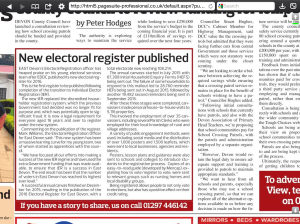
In this week’s local ” View from …” papers there is a terrifically gross puff job from Mark Williams, CEO and Electoral Returning Officer at EDDC about his success in getting more people on the electoral roll this year.

image

He particularly mentions that 35 canvassers personally visited 5,116 homes after they did not return original forms.

Recall that, last year, Mr Williams was hauled before a Parliamentary Committee because he had “lost” more than 6,000 voters from an earlier electoral roll, despite numerous developments, including Cranbrook, having added many voters.

http://www.exeterexpressandecho.co.uk/East-Mid-Devon-district-council-chief-executives/story-24538976-detail/story.html

At the time he said that it was his personal preference NOT to send out canvassers (citing the danger of sending them out at night in rural areas). His preference was to telephone people, though he was rather hazy on how he got their telephone numbers.

It should also be noted that no figures ars given for the new total number on the electoral roll compared to last year.

See more comprehensive reports by Owl here:

https://eastdevonwatch.org/2014/11/17/the-missing-6000-plus-voters-where-does-the-buck-stop-does-it-stop-at-all-is-there-even-a-buck/

Tory MP says we shouldn’t vote until age 25 when our brains are mature enough

http://www.dailymail.co.uk/news/article-3326549/Under-18s-shouldn-t-vote-brains-immature.html

This is as well as the Tory MP who says we shouldn’t give the vote to 16 and 17 year olds because it might cause child abuse:

http://www.dailymail.co.uk/news/article-3326549/Under-18s-shouldn-t-vote-brains-immature.html

Best not to let them become soldiers, then. Or pay tax when they work – they would be too immature to understand what it was being spent on, such as a private jet for the Prime Minister.

“Forget loyalty to your party – everyone should be a floating voter”

… “I’ve never understood people who treat politics as if it were football. In football, you support the same team from birth to death, through thick and thin; no matter how hopeless they become, you never abandon them for a superior rival.

In a voter, though, that kind of blind devotion is bizarre. If the party you normally vote for starts propagating ideas you oppose, then you’re entirely free – indeed, you’re wise – to dump them and back a rival.

Voters owe no loyalty. Give me the turncoat over the ideologue any day. You can’t trust ideology: it does your thinking for you.

Our democracy would be healthier if everyone were a floating voter.”

Michael Deacon, Daily Telegraph
http://www.telegraph.co.uk/comment/11980291/Forget-loyalty-to-your-party-everyone-should-be-a-floating-voter.html

Tory Lords win vote to deny nearly 2 million people a vote so boundaries can be redrawn to favour their party at elections

“The Government narrowly avoided another humiliating House of Lords defeat, winning the vote by just 257 to 246.

Peers rejected a Lib Dem bid to block an accelerated transition to individual voter registration.

“Ministers should be ashamed,” said Lib Dem peer Lord Tyler, who tried to kill the plans with a ‘fatal motion’.

The Tory plan to switch to a new method of registering voters from the end of this year had been criticised by the independent Electoral Commission, as nearly two million people have not signed up.

Labour has warned it will prevent huge numbers from voting and will skew the forthcoming review of Parliamentary boundaries, which will be based on the new electoral register.

Labour peer Lord Willis said: “This risks excluding millions from their democratic right to vote.”

http://www.mirror.co.uk/news/uk-news/conservative-peers-could-cost-two-6718620

Register to vote online

If you have not registered to vote, it can be done quickly and easily online. If you do not register to vote by 1 December 2015 you will not be able to vote in any by-elections elections or in May 2016 when some council seats in parts of the country are up for election.

https://www.gov.uk/register-to-vote

Lords asked to block Conservative plans to disenfranchise up to 1.9 million voters

Tory plans to wipe 1.9m names off the electoral register are set to be blocked by a House of Lords revolt, following advice from Britain’s voting watchdog. Liberal Democrat and Labour peers are poised to vote to halt Government plans to slash the electoral roll ahead of next May’s elections for local councils, the Scottish Parliament and London Mayor.

Despite warnings from the Electoral Commission about the dangers of disenfranchising legitimate voters, ministers believe many of the names are bogus and have speeded up by 12 months plans to “modernise” the system with individual registration. The independent watchdog has now issued a briefing note urging peers to vote against the Government next Tuesday, in what will be the second crunch clash between the Commons and the Lords, after the row over tax credits cuts.

The note, seen by The HuffPost UK, states that acting before the outcome of its annual canvass of voters before the outcome of “means the Government has acted without reliable information on how many redundant entries will be removed at the end of this year and how many eligible electors will need to re-register ahead of May 2016.”

“Taking into account…the scale and importance of the polls scheduled for next May, we continue to recommend that the end of transition should take place in December 2016 as currently specified in legislation” It concludes: “We therefore recommend that Parliament does not approve this order.”

HuffPost UK understands that both Labour and the Lib Dems will order a three-line whip to ‘annul’ the Tory statutory instrument on the changes – and with an in-built anti-Tory majority they are set to win the day.

Labour’s Lord Kennedy has today tabled an amendment to Lib Dem peer Lord Tyler’s motion to annul the legislation, “on the grounds that it goes against the advice of the Electoral Commission”. In his Labour conference speech last month Jeremy Corbyn warned: “We know why the Tories are doing it. They want to gerrymander next year’s Mayoral election in London by denying hundreds of thousands of Londoners their right to vote.”

The new Individual Electoral Registration (IER) process will particularly affect those in rented accommodation and urban areas, who are less likely to register, and students, because universities and colleges no longer ‘block register’ students living in halls of residence.

Campaign groups have complained that in areas such as Hackney in London, one in four voters could lose their rights to be on the electoral roll. But writing for Huff Post UK, Cabinet Office minister John Penrose said that the changes would bring Britain into line with ‘every other serious democracy in the world’.

In its briefing note, the Electoral Commission makes clear that it would be wiser to stick to original plans to complete the reforms by December 2016 rather than December 2015. “The earlier timetable puts the greater onus on electors as they will need to take action in order to ensure they are able to remain registered and participate in the May 2016 polls,” it says.”By contrast, the later timetable puts the greater responsibility on EROs (Electoral Registration Officers) to identify and take steps to remove redundant or inaccurate entries.”

Ministers usually accept the advice of the independent watchdog and in September decided to fully adopt its recommendations to change the question in the EU referendum.

Source: Huffington Post UK online, today

Voter removal: claims of gerrymandering and assault on democracy

“The Conservatives’ changes to electoral registration will disproportionately remove people from the electoral register in poorer areas of the country, an analysis suggested. Over twice as many voters will be removed from the register in the ten poorest areas in the UK compared to the richest areas outside London.

The capital, a Labour stronghold, will also be disproportionately affected by the shift to Individual Electoral Registration (IER), because of the high proportion of people who live in private rented housing there.

The Government is moving Britain’s electoral register from a system of household electoral registration to an individual one. But groups, including the Electoral Reform Society and Hope Not Hate, have warned that the way the change is being made could lead to underrepresentation in poorer areas.

In Britain’s ten poorest areas an average of 6.2 per cent of people on the electoral register are expected to be removed when the system changes – with the figure as high as 22.9 per cent in areas like Hackney where people who rent their homes live. By comparison only 2.96 per cent of voters will fall off the register in the ten leafiest and richest areas outside the capital, the study, conducted by Hope Not Hate, found.

Most worryingly, underrepresentation now could be made permanent because the new boundaries for parliamentary constituencies will be decided on the electoral register as it stands on 1 December 2015. The Government wants to base the new boundaries – which are expected to favour the Conservatives – on registered voters rather than actual population levels. This means that missing voters in poorer areas – usually safe Labour – could lead to entire constituencies disappearing and reappearing in rich areas – usually safe Conservative. This would shore up the in-built advantage the Conservatives have under the current electoral system.

The Labour-facing campaign group Momentum announced on Sunday it was launching a mass voter registration campaign to try and sign as many people up to the register before 1 December so that the boundary review would reflect the population as accurately as possible. The campaign is supported the TSSA, a railway workers’ union. Sam Tarry, the union’s national political officer, described the boundary review as a stitch-up.

“The Tories want to gerrymander the electoral boundaries – taking away millions of working people across Britain’s chance to be counted,” he said. “It’s a blatant, anti-democratic stitch-up designed to keep them in power for as long as possible.

“Over the next few weeks we will work in communities across the country – going out and talking to people face to face, to ensure every citizen’s voice is heard and will count.”

Katie Ghose, the chief executive of the Electoral Reform Society, said the Government’s move was a “worrying issue for our democracy”.

“The fact that 1.9 million people risk being excluded by the government’s wrong-headed early shift to complete individual voter registration – against Electoral Commission advice – is a scandal. We should be looking at automatic registration, as happens in many other countries – otherwise millions of people could lose their voice,” she told the Independent.

“The government appear to be prioritising cutting the number of MPs while continuing to allow the Lords to grow out of all proportion – a seriously worrying issue for our democracy.

“We call on the government to listen to the experts and to delay the early shift to IER, so that those 1.9 million people aren’t excluded. Crucially though, we need a registration revolution in this country, alongside real democratic reform, to ensure political equality.”

Officials also point out that some people not covered by the new IER list may be data errors rather than real people still living at that address.

The Cabinet Office said it would work with local authorities to make sure as many people were registered as possible and added that individual voter registration was a vital reform to Britain’s political system.

“Individual electoral registration is absolutely key to tackle election fraud. We are working with local authorities to remove ghost voters who don’t exist or have moved on, to make sure we have a clean and fair electoral roll. ” John Penrose, Minister for the Constitution, said.

“This system has been tried and tested in Northern Ireland for over a decade, where there were once serious concerns about electoral fraud.

“The answer to under-registered groups like young people or expatriates is not to stuff the electoral rolls – and potentially the ballot boxes – with the names of people who don’t exist, but instead to run a vigorous and energetic voter registration campaign. Which we will do.”

The boundary review was due to go ahead before the 2010 general election but was blocked by the Liberal Democrats in response to Conservative MPs blocking House of Lords reform.”

http://www.independent.co.uk/news/uk/politics/the-tories-are-removing-twice-as-many-people-from-the-electoral-register-in-britains-poorest-areas-a6701446.html

Two weeks to find 1.9 million voters

PLEASE try to identify and get the missing voters registered – we know from bitter experience we can’t leave this to our Electoral Registration Officer – who had to appear before Parliament to explain why he “lost” around 6,000 voters in East Devon prior to the last election

In December, up to 1.9m people will be deleted from the voting register.

The way we register to vote is changing. Councils have been transferring everyone from the old voting register to the new one, but they haven’t finished the job. The government originally planned to give councils until December 2016 to re-register the missing voters. But over the summer they announced that they would speed up the process. Anyone who hasn’t been transferred to the new register will be deleted in December – that’s up to 1.9m people.

Why are the government rushing the job? In April, the new voting register will be used to work out new constituency boundaries for the 2020 election. Anyone who is removed from the register in December won’t be counted. That means areas with lots of voters who haven’t been transferred will get fewer seats in Parliament.

Tell your MP to sign EDM 333 to save the missing voters

http://act.unlockdemocracy.org.uk/ea-action/action?ea.client.id=1810&ea.campaign.id=43126&ea.url.id=474963

These changes will be passed on November 2nd without even a vote in the House of Commons – unless enough MPs request a debate by signing an Early Day Motion.

Please write to your MP to ask them to sign EDM 333.

Change how we vote or comment on one-party corruption and waste

Petition:

http://action.electoral-reform.org.uk/ea-action/action?ea.client.id=1754&ea.campaign.id=2875

and/or email your comments on the post below to:

ers@electoral-reform.org.uk

“10 weeks to save democracy”

’10 Weeks To Save Democracy’ Before 2 Million People Are Wiped Off Electoral Register’

…”Two million people could be dropped from the list by the end of the year if they don’t identify themselves as a “genuine voter”, thanks to the government’s “rushed” changes to registration rules, according to anti-extremism group HOPE Not Hate.

The changes – which could happen without people realising – represent a loss of voting rights on a scale that is “almost inconceivable”, the group claims.”

…”Nick Lowles, HOPE Not Hate Chief Executive, said: “Originally there was another year to get all these people verified. Instead of which we are about to see the greatest disenfranchisement in British history.

“The scale of it is almost inconceivable. And the situation is actually going to get worse in the next few days as students return to university and have to register individually.

“There are just 10 weeks left to save democracy,” he said.

The two million who could be removed would join an existing eight million ‘missing’ voters, people who are eligible to vote, but don’t according to HOPE Not Hate.

The total of 10 million ‘missing Britons’ is the equivalent of losing the entire population of London, Birmingham, Leeds, Glasgow and Sheffield combined from the electoral roll.

Earlier this year the then-Labour leader Ed Miliband warned that nearly a million people have already “disappeared” from the register. Labour said the figure was a result of what it called the “hasty” way the Government introduced individual voter registration.”

http://www.huffingtonpost.co.uk/2015/09/09/missing-voters-electoral-register-individual-electoral-registration-_n_8110676.html

“Tories accused of ‘shameful abuse of power’ over electoral roll changes”

The London Evening Standard published this article today. Of course, we know all about this in East Devon, as our Electoral Returning Officer (EDDC CEO Mark Williams) “lost” around 6,000 local voters before the last elections in May 2015. Coincidentally, these were exactly the kind of voters referred to below – ” …young people, private sector tenants, ethnic minorities and those from more socially deprived communities — who traditionally are less likely to vote Conservative — are most likely to be affected.”

The full text of the article:


Tens of thousands of Londoners could disappear from the electoral roll and lose their right to vote in next year’s mayoral and London Assembly elections, it was claimed today.

Ministers were accused of a “shameful abuse of power” after they brought forwards changes to the electoral registration system which critics claim could undermine the democratic outcome of key elections in the capital.

The Liberal Democrats said that up to two million voters across the country could be effectively disenfranchised with Londoners particularly at risk since the capital has such a large and transient population. Young people, private sector tenants, ethnic minorities and those from more socially deprived communities — who traditionally are less likely to vote Conservative — are most likely to be affected.

The Government, however, has insisted it is focusing on cleaning up the register which under the old system included many “ghost” voters who should no longer be included.

Lib-Dem MP Tom Brake, who has tabled a rejection motion in the House of Commons, said: “This is clearly going to lead to a very large number of people being disenfranchised and it’s very hard not to believe that there’s some political motivation behind it because the people most likely to be affected are probably not Conservative supporters.”

Lib-Dem London Assembly member Caroline Pidgeon added: “The Government is blatantly ignoring the independent electoral commission in pursuit of narrow party advantage. It is a shameful abuse of power.

“Removing nearly two million UK voters will leave gaping holes in the electoral register, especially in many parts of London. It will undermine the democratic outcome of next year’s Mayor and London Assembly elections.”

The Government brought forward the new system by a year to December 2015, even though the electoral commission advised ministers to spend another year transferring voters on the old household-based register to the new individual register.

Critics have warned that as the cleaned-up register will form the basis of the boundary review of parliamentary seats due to begin next year it will also result in fewer inner-city seats, which would favour the Conservatives.

A Cabinet Office spokesman said: “The transition to Individual Electoral Registration has been a huge success. Now we need to remove up to two million entries on the electoral registers which are inaccurate or out of date.”

In a letter to The Guardian, Cabinet Office minister John Penrose said: “It is absolutely untrue that anyone will accidentally find themselves unable to vote because of the change to individual electoral registration. Completing the transition this December will mean that all boundaries are based on the most accurate registers.”

“I’m afraid that people who oppose this will make the voting registers less accurate, and elections less fair with higher risk of fraud. People will conclude that they’re trying try to hang on to the existing system simply because it gives them an inbuilt party-political advantage, and that they’re putting this ahead of what’s right and fair.”

http://www.standard.co.uk/news/politics/tories-accused-of-shameful-abuse-of-power-over-electoral-roll-changes-a2925551.html

Email address for Pickles investigation into electoral fraud

Where to send evidence for Pickles investigation of electoral fraud:

electoral.fraud.review@cabinetoffice.gov.uk

Source: http://www.markpack.org.uk/133947/eric-pickles-hunts-for-evidence-of-electoral-fraud/

Pickles article on election fraud

Sir Eric Pickles, who is launching the biggest-ever investigation into electoral fraud in Britain, warns in an article for The Daily Telegraph that the authorities are “turning a blind eye to criminal conduct”.


By Peter Dominiczak, Political Editor7:35PM BST 12 Aug 2015
Electoral fraud is being ignored in the same way that child sex abuse allegations have been because politically correct police forces and councils fear offending ethnic minorities, the Government’s anti-corruption tsar says today.
Sir Eric Pickles, who is launching the biggest-ever investigation into electoral fraud in Britain, warns in an article for The Daily Telegraph that the authorities are “turning a blind eye to criminal conduct”.
It comes after Lutfur Rahman, the mayor of Tower Hamlets in east London, was earlier this year removed from office after he was found guilty of electoral fraud.
Sir Eric compares the lack of action on allegations of electoral fraud to the scandal of local authorities and police forces ignoring claims of child sex abuse in towns across Britain.
Many of those allegations concerned Asian gangs targeting vulnerable young girls.
The law must always be “applied equally and fairly to everyone”, Sir Eric warns.
“In Tower Hamlets, police and council staff failed to tackle intimidation – often in foreign languages – both inside and outside polling stations,” Mr Pickles writes.
“Just as we have seen with child sexual exploitation in places like Rochdale and Rotherham, institutionalised political correctness can lead to the state turning a blind eye to criminal conduct. But the law must be applied equally and fairly to everyone.
“Integration and good community relations are undermined by the failure to do so.”
He adds: “The problems go deep – despite years of warnings of misconduct in Tower Hamlets, the state watchdogs gave the borough’s electoral system a gold-star rating for integrity in inspection reports. We still have a series of tick-box inspections of town hall returning officers that are as ineffectual and useless as those once practised by the now-abolished Audit Commission.”
Sir Eric, who was Communities and Local Government Secretary until David Cameron’s last reshuffle, said that the Government is “no longer prepared to turn a blind eye to Britain’s modern day rotten boroughs”.
His review will report by the end of the year and will examine what steps are necessary to stop voter registration fraud and error, postal voting fraud, impersonation, intimidation and bribery.
Sir Eric raises concerns that the London mayoral elections next year could be mired by voter fraud.
“Despite the fact there are London elections next year, a sizeable minority of those voters signed up in Tower Hamlets remain unverified and could be fakes,” he writes.
“In Hackney, the situation is even worse, with almost a quarter of the electorate unverified and potentially non-existent. We urgently need to clean up these registers. Across the country, electors from abroad are not properly checked to ensure that they qualify to vote when they register.
“Fraudulent registration is frequently tied to illegal immigration, as illegal migrants sign up to make it easier to get credit or a mobile phone. Such illegality feeds through to further crimes, such as benefit and housing fraud.”
Theresa May, the Home Secretary, earlier this year set up a major inquiry into child abuse following revelations about the crimes committed by Jimmy Savile as well as disclosures about abuse in Derby, Oxford and towns across Britain.
There were also a series of allegations about a Westminster paedophile ring.

http://www.telegraph.co.uk/news/politics/conservative/11799673/Eric-Pickles-Political-correct-officials-ignoring-electoral-fraud-just-like-sex-abuse.html

Pickles: Whitehall in denial about election fraud

Pickles: Whitehall in denial over election fraud (Guardian, D Mail, Mirror, Tel)

The former Local Government Secretary Sir Eric Pickles has warned Whitehall that it is in denial about the scale of election fraud in Britain.

“The British system is among the world’s most trusted democracies, but it is essential that it remains so.

Financial and electoral sleaze go hand in hand,” he commented as it was announced that he will now carry out a review of the issue, and consider whether any new powers are needed.

http://www.theguardian.com/politics/2015/aug/13/uk-election-fraud-whitehall-in-denial-says-eric-pickles

Teflon coating – 2

From P Freeman, comment on earlier post:

I learned today from a FoI to the Electoral Commission that our ERO / RO has not fulfilled his responsibilities in another area, specifically ‘How many people tried to vote on polling day and were found not to be registered?’.

Most other ERO/RO have provided this information, but a few including East Devon’s RO/ERO have not.

See https://www.whatdotheyknow.com/request/east_devon_may_2015_elections_re?nocache=incoming-691871#incoming-691871 .