Revealed: ‘Big Six’ energy firm bosses paid enough in 2022 to power 23,000 homes for a year

Energy bills may finally be dropping but bosses at the UK’s largest energy suppliers were paid enough last year to power 23,000 homes for an entire year, it can be revealed.

Matt Mathers www.independent.co.uk

Executives, board members and other high-level employees of the ‘Big Six’ gas and electric companies received £58m in salaries, bonuses and fees, analysis of their 2022 accounts shows. The average annual household energy bill up until the end of June was £2,500.

The disclosure comes as energy firms have raked in record profits – fuelled by Russian president Vladimir Putin’s illegal invasion of Ukraine on 24 February last year – while households still face huge bills.

Campaigners said that energy companies should be using their bumper profits to help their customers to improve the energy efficiency of their homes.

Gas and electricity costs have started to come down with decreasing wholesale prices but household bills remain well above average and are likely to remain so for years to come, economists have warned.

The typical household energy bill for a home in the UK was £2,500 until the end of last month, due to the government’s energy price guarantee that caps the unit cost of gas and electricity. Prices are set to fall from July as the energy price cap is lowered to £2,074 but for many bills will remain unaffordably high.

The government has introduced several other support schemes to help households and businesses cover the cost of powering their homes – funded by billions of pounds of extra borrowing.

But much of that help has ended and groups representing businesses previously warned that some companies could have to downsize or fold when the changes begin to bite.

Centrica, which owns British Gas, paid 11 people £6.5m last year. CEO Chris O’Shea personally raked in £4.5m – just under £700,000 of which came in the form of a bonus payment. Kate Ringrose, Centrica’s outgoing CFO, was paid just over £1m in salary and bonus.

Just two of the Big Six firms supplying UK homes with gas and electricity are owned by parent companies that are based in Britain.

E.ON, the German-headquartered firm, which has 5.5 million UK customers and took over Npower in 2019, paid 25 people more than £18m.

Chairman and CEO Leonhard Birnbaum took home €5.4m (£4.7m), more than £2m of which was a bonus. Chief operating officers Thomas König and Patrick Lammers were paid a total of €3.3mn (£2.89mn) and €2.4mn (£2.17m) respectively.

EDF (Électricité de France) is a French state-controlled energy generation and supply company that had nearly 700,000 UK customers in 2018.

Its annual report for 2021-22 said the group’s “key management and governance personnel” were paid a total of €12.5 million (£10.9m) in salaries and bonuses. It did not give a full breakdown of how this amount was distributed.

SSE, which has its headquarters in Perth, Scotland, paid 14 people £10.1m last year. CEO Alistair Phillips-Davies received £4.5m in salary and bonus while finance director Gregor Alexander and chief commercial officer Martin Pibworth were paid £3.1m and £2.5m respectively. SSE sold its domestic energy business to Ovo in January 2022.

Iberdrola, the Spanish utilities company that owns Scottish power, paid just 16 people £11m last year. Executive chairman José Ignacio Sánchez Galán was paid €6.3m (£5.5m) while CEO Armando Martinez received €250,000 (£220,000). Four other board members received around €500,000 (£441,000).

In 2018 Scottish Power said it became the first UK energy company to generate all of its electricity from renewable sources.

Jamie Peters, a campaigner at Friends of the Earth, said: “These figures illustrate the stark injustice that while millions of people struggle to afford to heat and power their homes, the bosses of the companies cashing in on the energy crisis are taking home huge pay packets and eyewatering bonuses.

“Raking in mega-profits through continued fossil fuel exploitation is something that should have been consigned to the history books decades ago.

“Private companies have a responsibility to align their business models with global climate targets, as well as to their customers who deserve clean and affordable energy. This starts with proper investment in cheap, homegrown renewable power and improving the energy efficiency of our heat-leaking homes.”

A spokesperson for SSE said: “We know it is vitally important to protect households from future energy price shocks and that’s why through our Net Zero Acceleration Programme we are investing £7m a day in critical low-carbon infrastructure that will help the UK achieve energy independence from those seeking to weaponise energy, and keep prices down in the long term.

“In doing so, we are currently building more offshore wind than anyone on the planet, creating thousands of green jobs and pioneering new energy technologies.

“ With this in mind, SSE’s executive remuneration policy – updated regularly and approved by shareholders at our AGM in July – aims to set a competitive, but not excessive, total remuneration package against appropriate benchmarks in order to encourage strong performance against delivery of this net zero-focused strategy.”

Centrica, E.ON, EDF and Iberdrola were contacted for comment.

Jeremy Hunt, the chancellor, in his Budget earlier this year updated plans for Great British Nuclear, which he said would provide “opportunities across the nuclear supply chain to help provide up to one-quarter of our electricity by 2050”.

Great British Nuclear is being created as the agency to establish “a secure energy future” in Britain following Russia’s invasion of Ukraine and the subsequent effects on energy prices globally.

Critics called on the government to act on the plan – announced over a year ago – more quickly.

At the end of March the government updated its Net Zero Strategy, which also included measures to improve energy security and bring down household bills.

The government previously said its plans would “scale up affordable, clean, homegrown power and build thriving green industries in Britain”.

Babylon Health faces legal headache over AI claims

A British technology firm hailed as the future of healthcare by former Health Secretary Matt Hancock could face legal action after its collapse in the US.

Adam Luck www.dailymail.co.uk

Babylon Health, which has 100,000 NHS patients, is being sold off after losing nearly all of its value since founder Dr Ali Parsa floated it for £3 billion on the New York Stock Exchange in 2021.

Last month, Jersey-registered Babylon announced that London-based AlbaCore Capital would take over its assets without shareholders’ approval and that it was also calling in administrators in the UK. 

Parsa, a former refugee, saw his net worth soar to £825 million after investors were attracted by his promise to revolutionise healthcare by using artificial intelligence (AI).

This included a controversial chatbot, which claimed to be able to diagnose illnesses, despite repeated criticism from senior health experts. Parsa also claimed that the company had designed software that ‘turns Alexa [Amazon’s virtual assistant] into a doctor’. But one unnamed investor is now understood to have assembled a UK legal team over claims surrounding Babylon’s technology.

David Watkins, an NHS consultant and arch-critic of Babylon, said: ‘The investor is considering legal action in relation to the company’s AI, and I have been asked to speak to their legal counsel.’

Last year, Babylon and the NHS agreed to terminate two long-term contracts due to ‘challenging global and macroeconomic conditions’.

The company, however, insists it will continue to run its GP@Hand app contract in Hammersmith & Fulham, which lets patients make virtual appointments. Hancock previously said he wanted GP@Hand to go nationwide.

Filings with US authorities reveal that Parsa received £5.6 million in pay and perks for 2022. In March, he claimed Babylon’s 2022 accounts showed ‘continuous improvement’ and predicted profitability by 2024 despite losses of £409 million in the three years up to and including 2022. Babylon has been repeatedly approached for comment.

Some links in this article may be affiliate links. If you click on them we may earn a small commission. That helps us fund This Is Money, and keep it free to use. We do not write articles to promote products. We do not allow any commercial relationship to affect our editorial independence.

Pupils in England sent to churches and village halls as crumbling schools close

Pupils across England are being taught in church and village halls, temporary classrooms and remotely at home, as crumbling school buildings are ordered to shut because of to safety concerns, an investigation has revealed.

Sally Weale www.theguardian.com 

In some cases, where an entire school has been forced to close, hundreds of pupils are split across neighbouring schools to take their lessons, while others are sent home to resume online learning, as they did during the pandemic.

After the immediate crisis of finding alternative accommodation, pupils and teachers can find themselves in temporary classrooms for months, if not years, while school and local authorities try to come up with a long-term solution.

The findings reveal the disruptive impact that school closures because of unsafe buildings have on pupils, whose education has already been interrupted by Covid. They also come just days after a highly critical report by the public spending watchdog, the National Audit Office, said an estimated 700,000 children are being taught in unsafe or ageing school buildings that needed major repairs.

It also revealed that more than a third of school buildings were past their estimated design lifespan, and specialists were carrying out urgent checks on almost 600 schools at possible risk of structural collapse because of crumbling concrete, with many more schools unaware of the danger lurking in their buildings.

Ministers admitted earlier this year that 39 schools had partly or fully closed since 2019 owing to unsafe buildings, including structural and general condition problems, such as roofing and boiler failures.

A freedom of information request by the Liberal Democrats has now revealed the location – though not identity – of each school, and how pupils have been affected. They say the true number of affected schools may be far higher, as schools are not obliged to report building-related closures to the Department for Education (DfE).

In one school in Hertfordshire, which had to close its entire site permanently in February 2022, all pupils were sent home to study remotely for three weeks. Face-to-face lessons resumed in a church hall for some children while others went to neighbouring schools, a situation that continued for three months, after which pupils were moved into temporary classrooms while waiting for a long-term solution.

In another case, an Essex school, which the Liberal Democrats have matched to local reports of King Edmund School in Rochford, closed in November 2022 after traces of asbestos were found in the rubble of a demolished building. Pupils were sent home to learn online for two months while the site was made safe.

And a school in Sunderland, identified in local reports as Burnside Academy in Houghton-le-Spring, closed in March 2021 because of pumping and drainage issues. Pupils were bussed to neighbouring schools for almost eight months, then returned to lessons in temporary classrooms until the school reopened earlier this month.

In other examples, two mobile classroom blocks at a school in North Somerset were declared unsafe within nine months of each other, while pupils at one Devon school took classes in the local village hall for a week and a half after their school was forced to close temporarily in June 2022.

The Liberal Democrat education spokesperson, Munira Wilson, called on ministers to clear the backlog of repairs so parents could be certain their child’s school was safe. “Each shut school is a concrete sign of years of Conservative neglect of our school buildings.

“Conservative ministers should apologise for the months of disruption that thousands of pupils have had to their learning. Whilst successive Conservative prime ministers cut capital spending on education, pupils have been forced to study at home, in church halls or were bussed miles to other schools.”

The DfE has been contacted for comment but previously said: “We are investing in 500 projects for new and refurbished school buildings through our school rebuilding programme. On top of this, we have allocated over £1bn since 2015 for keeping schools safe and operational, including £1.8bn committed for 2023-24.”

Ofwat bars failing water firms from paying bonuses out of bills

Water company bosses’ bonuses will no longer be funded by household bills when a firm has failed on environmental and customer performance, the regulator has confirmed.

Shutting the stable door after the horse has bolted. – Owl

Adam Vaughan www.thetimes.co.uk

The move by Ofwat comes after half the chief executives at wastewater firms in England waived their bonuses over sewage pollution, including Sarah Bentley, the boss of crisis-hit Thames Water until her unexpected resignation this week.

The body responsible for the economic regulation of the privatised water and sewerage industry first mooted in March the idea of ensuring leaders of poorly performing companies are only paid bonuses by eating into water sector profits and dividends.

After receiving more than 25,000 to its consultation, the biggest engagement yet, it has confirmed the new rules will be enacted.

“Customer trust is damaged when executive bonuses are not aligned to water company performance,” said David Black, Ofwat’s chief executive. “We are pleased that a number of companies and chief executives have already responded to our concerns with respect to last year.”

Black said that in future executive directors’ bonuses would be reviewed and, where expectations were not met, the new powers would be used to protect customers. Remuneration committees that award bonuses to water bosses will now have to take full account of performance for customers and the environment.

The scorecard on water firms’ environmental performance last year will not be published until the middle of next month. However, Alan Lovell, chairman of the Environment Agency, has told The Times it will show that their 2022 record was “simply not good enough”.

Among the water bosses yet to have given up their bonuses is Louise Beardmore, who received a £727,000 bonus as chief executive of United Utilities, the worst company in England for sewage spills last year. Others include Severn Trent’s Liv Garfield, whose previous bonus was £597,000; Anglian Water’s Peter Simpson (£337,651); Wessex Water’s Colin Skellett (£189,500); and Northumbrian Water’s Heidi Mottram (£130,000).

The move by Ofwat comes as campaigners protested outside a water sector awards event in Birmingham on Thursday. The government has this week been preparing for a potential temporary nationalisation of Thames Water, which is struggling under £14 billion of debt.

Surfers Against Sewage campaigners put on sewer rat costumes and held a cheque showing the £1.4 billion in dividends paid out by water companies last year, as they protested outside the Water Industry Awards 2023.

“The greed of water company executives comes at a terrible cost to the health of both the environment and people. They swim in cash while we’re swimming in sewage,” said Izzy Ross, campaigns manager at the group.

Exmouth and Cranbrook are you being neglected whilst Simon Jupp goes on manoeuvres?

Simon Jupp is making no secret of his visits outside the bounds of his constituency. No doubt these visits are to gain “name recognition” having opted to abandon Exmouth to be the conservative candidate in the new Honiton and Sidmouth constituency. 

There is a convention, almost universally observed on all sides of the House of Commons, that Members deal with personal inquiries only from their own constituents.

By convention Members intending to visit another constituency, other than on a purely private or personal matter, should inform the relevant Member. Guidance has been given from the Chair and has been set out in Rules of behaviour and courtesies in the House of Commons, issued by the Speaker and Deputy Speakers.

The need for these extra-mural visits looks unconvincing. Jupp is a PPS in transport.

But as we all know rules and conventions are not something that seem to bother modern conservatives.

Here are some recent visit examples:  

June 9 Simon Jupp MP on Twitter:

“I had a really valuable opportunity to discuss the future of pharmacies with constituent Ian Morton who owns Morton’s Pharmacy in #Axminster today. I will continue to work with local pharmacies as they are offered additional government funding to help free up GP appointments.”

Yesterday, 30 June he tweeted:

“We all hate dodgy Wi-Fi! Fast & reliable internet is vital for everyday life & local businesses. I met with @Wildanet in #Axminster to discuss their roll-out of full-fibre broadband in the town. I’m working with them to put forward #EastDevon areas without proper broadband. 

Does someone need to raise a red card?

More Tory fratricide: Rishi Sunak is “uninterested” in the environment

So says Zac Goldsmith in his ministerial resignation letter (Minister of State for energy, environment and climate).

Tory Toff Zac Goldsmith is a supporter of Boris Johnson who recently handed him a peerage (Baron of Richmond Park). He was the serving minister identified by the privileges committee as one of those, alongside Jacob Rees-Mogg and Nadine Dorries, undermining the procedures of the House of Commons.

Goldsmith’s resignation and withering criticism comes, some say, instead of an apology.

Goldsmith says he was happy to apologise but his resignation has been a long time coming for the reasons he has given.

Is the Prime Minister and, by association, the Government guilty as charged ?

The evidence looks convincing to Owl.

Here is an extract of what Goldsmith has to say (full indictment below): 

“Only last week you seemingly chose to attend the party of a media baron rather than attend a critically important environment summit in Paris that ordinarily the UK would have co-led.

Worse still, we have effectively abandoned one of the most widely reported and solemn promises we have made on this issue: our pledge to spend £11.6bn of our aid on climate and environment.”

And here is what another Lord had to say this week::

Lord Deben [John Gummer, former Secretary of State for Environment], the outgoing chair of the CCC [Climate Change Committee], said the UK had “lost the leadership” on climate action shown at Cop26 in 2021 and done “a number of things” – such as greenlighting a new coal mine and new oil and gasfields in the North Sea – that were “utterly unacceptable”.

He said the committee’s confidence that the government would meet its shorter-term carbon-cutting goals by 2030 was even lower than last year, despite the publication of a new green strategy by ministers. “We’ve slipped behind, and other people have moved ahead,” he said. “This is not a report that suggests satisfactory progress.”

Greenhouse gas emissions have been falling by just under 3% a year, but this will need to double over the next eight years.

The committee warned that the UK could no longer expand any of its airports without closures or shrinking of capacity elsewhere but the government seems not to have accepted this.

Public charging for electric vehicles is more costly than it need be, and the government is expecting transport emissions to be higher than was previously admitted, according to the CCC’s latest annual report, published on Wednesday, entitled Progress in Reducing UK Emissions: 2023 Report to Parliament.

The report also found:

  • The number of homes receiving energy efficiency improvements under the government’s Energy Company Obligation scheme more than halved, from 383,700 in 2021 to 159,600 in 2022, according to the report. At least 1m to 2m homes should be upgraded each year to meet net zero.
  • Homes are still being built that will need to be retrofitted with low-carbon heating and efficiency measures, because the government has not yet brought in its promised future homes standard.
  • No decision on whether to use hydrogen for home heating will be made until 2026, leaving households and boiler companies in limbo.
  • Emissions from transport have remained stubbornly high as the government has “made a political choice” to allow an increase in road traffic, instead of encouraging people on to public transport.
  • There is no coherent programme to encourage people to change their high-carbon lifestyles.
  • There is no clear policy to decarbonise steel production, or emissions from other heavy industries.

Zac Goldsmith’s resignation letter in full

Dear prime minister,

I became involved in politics above all because of my love and concern for the natural environment. We depend on nature for everything, and we are degrading the natural world at an astonishing speed. Logically, there is nothing more important.

So when you asked me to stay on as minister for the international environment, I of course accepted. I did so with a view to guarding the progress we had seen in recent years on the international environment, and to building on a record of international leadership that has been so warmly welcomed around the world.

The past four years have been an exhilarating experience for me, and I will forever be grateful that I was put in a position where I could do more for the environment than I thought possible in a lifetime.

I’m proud that in recent years the UK has played a critical, indeed defining role – leading powerful coalitions of ambition and securing world-changing commitments over a very wide range of environmental issues.

And even if in the highly polarised political environment here in the UK there is an unwillingness to acknowledge it, that leadership has been recognised and appreciated by civil society and governments around the world.

As a direct consequence of our environmental leadership, we have seen countries previously ambivalent towards the UK stepping up to support us on numerous unrelated issues. We often find ourselves invited to regional environmental summits as the only “outsider” country present.

It is the UK that civil society routinely turns to for help advancing their cause. In many respects, the UK has become the single most important voice for nature globally.

I believe we can be proud of our record. At Cop26 we secured unprecedented commitments from countries, philanthropists and businesses that – if delivered – will put the natural world on the road to recovery. At the time, WWF said “Nature truly arrived at Cop26”.

The Tropical Forest Alliance said “we’ll look back and realise that this was the day we finally turned the tide on deforestation”. Forbes called it a “Paris moment” for forests. In Glasgow, with strong support from the then prime minister, we were able to achieve far more than any of us ever thought possible.

Since then, the UK has been the driving force behind successful global efforts. We led calls to protect 30% of the world’s land and ocean by the end of this decade, a goal that was agreed at the Biodiversity Cop in Montreal last year where the UK did more than almost any other country to make it a historic success.

Separately we helped galvanise agreement for a new global treaty on plastic pollution. And it was our team of negotiators who – more than any other – secured an agreement for the creation of new laws to protect the high seas.

Our G7 negotiators meanwhile persuaded the main donor countries to align their aid spending not only with the Paris goals, but with nature too.

We have created world-class funding programmes like our new biodiverse landscapes fund, which is creating vast wildlife corridors between countries, providing safe passage for wildlife and jobs for people living in and around the corridors; and our new blue planet fund, which is supporting marine protection, coral and mangrove restoration, and efforts to stop plastic pollution and illegal fishing.

These and other funds are world-class and have leveraged a wave of financial support from other countries and philanthropists.

It has been my privilege to grow our wonderful Blue Belt programme so that today it fully protects an area of ocean significantly larger than India around our overseas territories.

The UK has been able to win arguments internationally in part because we were taking action at home. I won’t pretend we have gone nearly far or fast enough, but there is no doubt that since 2019 we have made meaningful progress.

We strengthened our environmental laws, provided more funding for nature, committed to more protected areas, more action on plastic pollution, and the UK is one of the only countries with legal targets to reverse biodiversity loss.

We have committed to restore our peatlands and plant trees on an unprecedented scale and we are transforming our land subsidy system to support the environment. We have also taken steps to address our international environmental footprint, including new laws stopping the import to the UK of agricultural commodities grown on illegally deforested land.

We also made progress on animal welfare. The government signed off an ambitious action plan for animal welfare, which would have represented the biggest shake up of animal welfare in living memory.

As minister responsible I was able to translate it, bit by bit, into law. We increased sentencing for cruelty from six months to five years, we recognised in law the sentience of animals, enacted and extended the ivory trade ban, introduced measures to break the pet smuggling trade and banned glue traps.

Before you took office, you assured party members, via me, that you would continue implementing the action plan, including the kept animals bill and measures like ending the live export of animals for slaughter, banning keeping primates as pets, preventing the import of shark fins and hunting trophies from vulnerable species.

But I have been horrified as, bit by bit, we have abandoned these commitments – domestically and on the world stage. The kept animals bill has been ditched, despite your promises. Our efforts on a wide range of domestic environmental issues have simply ground to a standstill.

More worrying, the UK has visibly stepped off the world stage and withdrawn our leadership on climate and nature. Too often we are simply absent from key international fora. Only last week you seemingly chose to attend the party of a media baron rather than attend a critically important environment summit in Paris that ordinarily the UK would have co-led.

Worse still, we have effectively abandoned one of the most widely reported and solemn promises we have made on this issue: our pledge to spend £11.6bn of our aid on climate and environment.

Indeed the only reason the government has not had to come clean on the broken promise is because the final year of expenditure falls after the next general election and will therefore be the problem for the next government, not this one.

This is a promise, remember, that has been consistently repeated by prime ministers in the past four years, including by you, and for good reason.

It is the single most important signal of intend [sic] for the dozens of small island and climate-vulnerable states on an issue that is existential for them. These states, remember, have equal sway in the UN where we routinely seek their support on other issues.

That same promise was also used successfully by the UK as leverage to persuade G7 countries to follow suit, and breaking it would not only infuriate them, along with those small island states in the Commonwealth and beyond – it would shred any reputation we have for being a reliable partner.

Prime minister, having been able to get so much done previously, I have struggled even to hold the line in recent months.

The problem is not that the government is hostile to the environment, it is that you, our prime minister, are simply uninterested. That signal, or lack of it, has trickled down through Whitehall and caused a kind of paralysis.

I will never understand how, with all the knowledge we now have about our fundamental reliance on the natural world and the speed with which we are destroying it, anyone can be uninterested.

But even if this existential challenge leaves you personally unmoved, there is a world of people who do care very much. And you will need their votes.

Every survey and poll – without exception – tells us that people care deeply about the natural world, about the welfare of other species, about handing this world in better shape to the next generation. And as these issues inevitably grow in importance, so too will the gap between the British people and a Conservative party that fails to respond appropriately.

It has been a privilege to be able to work with so many talented people in government, in particular my private office, and to have been able to make a difference to a cause I have been committed to for as long as I remember.

But this government’s apathy in the face of the greatest challenge we have faced makes continuing in my current role untenable.

With great reluctance I am therefore stepping down as a minister in order to focus my energy where it can be more useful.

Zac Goldsmith

Have we reached the “Great Stink” moment?

Comments:

To be pedantic, Cruikshank was motivated in this instance by an outbreak of Cholera. This caricature, believe it or not, is over twenty years before the Great Stink finally caused Parliament to act, and that only because they couldn’t bear conditions within the Houses of Parliament, the Thames stank beyond belief.

and:

 Privatisation of water was going to lead to wonderful things they said .We may pay more initially ,but these privatised companies would invest heavily in infrastructure ,fix leaks and our bills would fall.

They invested in themselves and pumped crap into our rivers and seas ,whilst laughing all the way to the bank.

Same with the privatised railways ,they would invest and our train fares would eventually fall.

I have a letter somewhere from one of the transport ministers after a few years of privatisation saying how wonderful our railway system would become ,with eventually cheaper travel and a wonderful integrated public transport system.

Yes privatisation ,just like Brexit ,worked out really well.

Redevelopment measures in Exeter agreed

A major redevelopment of Exeter’s Water Lane is a step closer after the city council decided it could force a small number of people out of their homes to make it happen.

Opens up potential for 1,500 new homes on brownfield land. Would this have happened if East Devon had continued as a member of the Greater Exeter Strategic Plan (GESP)? – Owl

Ollie Heptinstall, local democracy reporter www.radioexe.co.uk

 Tan Lane, Exeter (Image courtesy: Google Maps)

The council’s ruling executive has agreed to use its compulsory purchase order (CPO) powers to secure land on a largely brownfield site, if necessary, to make way for up to 1,500 new homes.

It has also decided to hand over a section of council land at its Exton Road recycling depot to create an extra underpass under the railway line on Tan Lane for electric buses, pedestrians and cyclists.

It forms part of the council’s collaboration with a land promoter – the Water Lane Development Management Company – to redevelop the area on the west bank of the Exeter Ship Canal.

The site is one of the city council’s ‘Liveable Exeter’ areas, which it says is “arguably the most exciting large scale brownfield regeneration opportunity in the city,” adding it has been part of development plans for over a quarter of a century.

Explaining the measures, director of city development Ian Collinson told an executive meeting that legal protections included in the agreements means there is “limited, if any risk to the council, both financially or legally.”

He said it is part of a “strategic approach” to use some of their powers to help move the redevelopment project forward.

Councillors were told the proposed new underpass would be a “really key piece of infrastructure,” with a report adding: “The existing [one] isn’t really fit for purpose and if this route can be made safe for pedestrian and cyclist use, whilst also opening up the potential for electric buses, the opportunity should improve the accessibility and permeability of the area.”

However, council leader Phil Bialyk (Labour, Exwick) asked for assurances that help would be offered, if needed, to tenants at Casting House, one of the buildings in the redevelopment site which could be bought under the CPO.

He said there are four privately-rented apartments in the building, adding: “We don’t want to see any section 21 [notices] going on, whereby people are ousted with no alternatives.”

Mr Collinson replied by saying CPOs are a “last resort” and that the developer will negotiate to ensure residents are given “proper notice and proper consideration.”

He added: “We’ll be looking over the shoulder, if you like, of Water Lane DMC to make sure that everything possible is being done to protect those people and ensuring that they are dealt with in a considered way.”

Cllr Martin Pearce (Labour, Duryard & St James), portfolio holder for homelessness prevention, says help will be made available to the affected residents quickly, “because this is a public document now. They know there’s a potential that their property’s going to be up for sale.”

How the government plans to address the NHS staffing crisis – from shorter degrees to extra medical school places

Shorter medical degrees, apprenticeships, and £2.4bn in funding are among the radical plans being put forward to solve NHS England’s severe staffing crisis

‘They should have done this a decade ago’. Wes Streeting MP, Labour’s Shadow Health Secretary.

Don’t expect overnight results. – Owl

Megan Baynes news.sky.com 

The long-awaited NHS workforce plan is due to be published in full on Friday, outlining how the service will address existing vacancies and meet the challenges of a growing and ageing population.

It has been hailed as a “once-in-a-generation opportunity” to put staffing in the service on a sustainable footing over the next 15 years.

Staffing vacancies currently stand at 112,000, with fears shortfalls could grow to 360,000 by 2037.

The additional funding will help train “record numbers of doctors, nurses, dentists, and other healthcare staff” in England, with plans to employ 300,000 extra staff in the coming years. The funding works out at approximately £21,000 per vacancy.

Other plans include consulting with the General Medical Council and medical schools on the introduction of a four-year medical degree – one year less than the five it currently takes to complete – which, alongside a medical internship, would mean students could start work six months earlier.

Student nurses will also be able to take up jobs as soon as they graduate in May, rather than waiting until September as they do at present.

With demand for healthcare staff rising around the world, the Long Term Workforce Plan will set out a path to double medical school training places to 15,000 by 2031, with more places in the areas of greatest need.

More places will also be offered through degree apprenticeships so staff can “earn while they learn”, gaining a full degree as they work towards a full qualification. One in six (16%) of all training for clinical staff will be done this way by 2028 – including more than 850 medical students.

Officials say the plans set out, along with new retention measures, could mean the health service has at least an extra 60,000 doctors, 170,000 more nurses, and 71,000 more allied health professionals in place by 2036/37.

Flexible working and pension reforms for staff

The NHS workforce plan comes at a time when large parts of the health service are striking over the staffing crisis, and levels of pay.

The NHS plan aims to reduce reliance on expensive agency spend, which would cut the bill for taxpayers by around £10bn between 2030 and 2037.

The plan will focus on the retention of staff, with better opportunities for career development, improved flexible working options, and government reforms to the pension scheme, which is hoped will keep 130,000 staff working in NHS settings longer.

Amanda Pritchard, NHS chief executive, said: “As we look to adapt to new and rising demand for health services globally, this long-term blueprint is the first step in a major and much-needed expansion of our workforce to ensure we have the staff we need to deliver for patients.

“We will take practical and sustained action to retain existing talent, we will recruit and train hundreds of thousands more people and continue to accelerate the adoption of the latest technology to give our amazing workforce the very best tools to provide high-quality care to millions of people across the country each day.”

The NHS will mark its 75th anniversary on 5 July. The prime minister argued the workforce plan was a significant moment in its history.

Rishi Sunak said: “On the 75th anniversary of our health service, this government is making the largest single expansion in NHS education and training in its history. This is a plan for investment and a plan for reform.”

The chancellor, Jeremy Hunt, added: “Our plan will end the reliance on expensive agency staff, while cutting waiting lists in the coming years and building an NHS which can match up to the scale of tomorrow’s challenges.”

‘They should have done this a decade ago’

Wes Streeting MP, Labour’s Shadow Health Secretary, responded to the publication of the NHS workforce plan.

He said: “The Conservatives have finally admitted they have no ideas of their own, so are adopting Labour’s plan to train the doctors and nurses the NHS needs.

“They should have done this a decade ago – then the NHS would have enough staff today.”

Spreaker This content is provided by Spreaker, which may be using cookies and other technologies. To show you this content, we need your permission to use cookies. You can use the buttons below to amend your preferences to enable Spreaker cookies or to allow those cookies just once. You can change your settings at any time via the Privacy Options. Unfortunately we have been unable to verify if you have consented to Spreaker cookies. To view this content you can use the button below to allow Spreaker cookies for this session only.

Mr Streeting added: “Instead, the health service is short of 150,000 staff and this announcement will take years to have an impact.

“Patients are waiting longer than ever before for operations, in A&E, or for an ambulance.

“The Conservatives have no plan to keep the staff working in the NHS, no plan to end the crippling strikes, and no plans to reform the NHS.”

E.coli found in Blackpool sea at three times the safe level after sewage leak, campaigners say

E.coli has been found in the waters around Blackpool at three times the level considered safe for bathing, campaigners say.

The EA has said it will not publish the results of its testing at the site because it considers the leak an “abnormal” event.

That will do a lot for confidence! – Owl

Steve Robson inews.co.uk 

It comes after i revealed on Wednesday that water quality tests results are being kept secret from the public following a massive sewage leak earlier this month.

Bathers have been warned not to swim along 14 miles of the Fylde coastline following the spill, which took place as a result of a cracked pipe at a United Utilities (UU) wastewater plant.

Neither the water company nor the Environment Agency (EA) has given a timeframe for when the water will safe to bathe in again, despite concerns over the effect on health and tourism in the area.

Normally, the public is able to check the water quality of bathing sites via a regularly updated online government website.

But the EA has said it will not publish the results of its testing at the site because it considers the leak an “abnormal” event.

This can include pollution that is “not likely to occur more than once in four years on average”, according to an EA customer services officer.

Frustrated at the lack of information, Gary Lovatt, a local resident and fishing enthusiast, decided to carry out his own water sampling tests using kit provided by the Surfers Against Sewage charity.

Mr Lovatt received training on how to use the kit from Tim Harris, an expert water quality consultant who previously worked for United Utilities and now trains up “citizen scientists” around the country.

The Aquagenx testing kit changes colour to give a straightforward positive or negative result for E.coli, and can then be sent off to a lab to establish the level of bacteria present.

Mr Lovatt’s test from 14 June, two days after the first sewage leak near Blackpool, was positive for E.coli and lab results showed 830 CFUs (colony forming units) per 100ml.

The government considers anything under 1,000 CFUs safe for bathing.

However, Mr Lovatt’s test on 27 June, around a week after United Utilities admitted there was second release of sewage due to its burst pipe, was also positive for E.coli and lab results showed 3,519 CFUs per 100ml.

Mr Harris said the latest result shows E.coli at more than three times the “acceptable” level for bathing and that this would pose “a real risk to human health”.

It comes after i revealed last year how some of the UK’s most popular wild swimming spots are awash with dangerous levels of bacteria.

At Conham River Park near Bristol, volunteers repeatedly tested the water quality of the River Avon from July to October last year, in partnership with Wessex Water.

They found levels of bacteria consistently above the minimum standard and in one sample taken in August 2021, E.coli levels in the river were registered at 20,000 CFUs per 100ml of water.

The EA says it is continuing to take its own samples but won’t be sharing the data publicly while the pollution incident is ongoing.

“It’s great that the Environment Agency are here and carrying out tests, but they’re not letting the public know [about their results],” Mr Lovatt told i.

“It’s like there’s a big gap of information there, they need to let people know what’s going on.

“I just wanted to know myself. Based on my results I definitely won’t be going in the sea.”

Asked about Mr Lovatt’s result, Mr Harris told i: “It’s a single result and you can read into a single result to a certain extent.

“There’s been a clear deterioration since the first test, the result is a lot higher.”

Asked about the risk of the latest E.coli result, Mr Harris added: “A person of good health, with a good immune system, might get an upset stomach for up to 48 hours.

“It would cause sickness and diarrhoea. “The risk is really for older people, those with weaker immune systems or younger children, they could get particularly ill.”

Caroline Thompson is among a group of local residents who regularly swim in the sea along the Fylde Coast and want water companies to stop pumping sewage into the water.

She thinks the EA should be sharing the latest water quality results so that the public has a better understanding of the current situation.

“I don’t think it’s acceptable, as a sea user and member of the general public I think we deserve to know exactly what is going on with the water,” Ms Thompson told i.

Asked about water sampling results on Wednesday, the EA said: “We have ramped up monitoring along the Fylde Coast to support the assessment of this incident’s impact and the samples we are collecting in the affected waters will form part of our robust investigation which is underway.

“In line with the Bathing Water Regulations, routine bathing water sampling used for long-term assessment of quality has been temporarily suspended to avoid giving an unrealistic classification for normal bathing conditions.

“Our Swimfo website continues to keep local residents informed of the latest bathing water advice, including where and when to swim.”

The EA has been contacted for further comment following the latest E.coli results.

A spokesperson for United Utilities said queries regarding water quality results needed to be directed to the EA.

In the latest statement issued last Friday, United Utilities said engineers are working “24 hours a day” to build a new overground pipe to bypass the one that has fractured.

“When the bypass pipe is up to full flow, Fleetwood wastewater treatment works will be able to run at its full capacity,” the firm said.

“Until then there remains a risk that any further rainfall could lead to further operation of storm overflows this weekend.”

A Blackpool spokesperson said: “There is currently a no bathing advisory notice in place across eight beaches on the Fylde Coast following a pollution incident which United Utilities announced on 13 June.

“It is the responsibility of the EA to determine if bathing is advised or not and to carry out official sampling of the bathing waters. The classification of bathing waters is decided over a four-year period taking many samples. It is also the responsibility of the EA to lift the advisory notice when they deem it safe to do so and we strictly follow this procedure.

“Whilst you can’t currently bathe or paddle in the sea, all of Blackpool’s attractions are very much open including its beaches, piers, The Blackpool Tower, the Pleasure Beach and all the other great things that people come to Blackpool to enjoy.

“We very much look forward to being able to welcome people back into our water to enjoy the sea as well as all the other attractions. We are asking people to follow our social media channels for the latest information.”

DIY water testing on the rise

A spokesperson for WaterSafe UK, one of the largest distributors of water quality testing kits in the country, said an increasing number of people are wanting to carry out tests themselves.

“Some people do it for peace of mind, some people do it because they have a particular concern, maybe if they want to go swimming,” they said.

“I think the awareness has increased around how unclean rivers are and that has made people a little bit more cautious.

“During Covid, a lot of people started to go into their rivers, or swimming outdoors or using paddleboards so in that sense awareness has increased in the last few years.”

WaterSafe UK sells a bacteria kit like the one used by Gary Lovatt that gives a simple Yes-No result on whether water contains E.coli.

“If it’s positive, then potentially you could send it to a lab to be tested if you wanted and find out exactly how many bacteria are in there,” the spokesperson added.

“You need to follow the instructions on the kits, but as long as you are doing it carefully they are reliable.

“You don’t need to be an expert.”

First known avocet chicks hatch in Devon

In the Devon bird world a major success is being celebrated after the birth of avocet chicks was recorded for the first time ever in the county. East Devon’s Seaton Wetlands breeding programme effort was awarded with the birth of the two chicks yesterday, June 26.

Anita Merritt www.devonlive.com

Two avocets were seen foraging in the brackish lagoon of Black Hole Marsh on the Axe Estuary in spring, before a pair were seen mating on the lagoon in late May, settling down to brood eggs on an island by the beginning of June. East Devon District Council’s Countryside Team has been keeping a very close watch on the nest site and the adult birds, both in person and remotely, while the eggs were incubated.

Staff and volunteers at Seaton Wetlands were sworn to secrecy until the chicks successfully hatched due to there being so many factors that could adversely affect a nesting attempt.

Cllr Paul Arnott, East Devon District Council’s leader, said: “This administration has been steadfast in its support for nature and its protection. We understand the importance of caring for wildlife and their natural homes, so we continue to invest in our treasured nature reserves around East Devon.

“We are absolutely delighted to see our efforts are paying off with the breeding of this iconic wetlands species, and would like to thank all the staff and volunteers across East Devon who have made this possible.”

Avocets are very conspicuous birds, with both males and females vividly marked with pied black and white plumage, long pale blue legs and a thin upturned bill. They chose to nest on an island with little vegetation cover. Both birds maintained a high state of vigilance to see off would-be predators, of which there are many on the Local Nature Reserve.

East Devon District Council’s countryside manager, James Chubb, said: “With the female sitting tight on the eggs, the male would stand like a sentry on the northern tip of the island. Anything smaller than a Canada goose was seen off.

“We’ve a lot of crows here too and they weren’t even tolerated in the air above the nest. While the Countryside Team could keep alert for intentional or reckless human disturbance, it was all down to the birds to protect themselves from natural predators.

“We kept the water levels on the lagoon as high as possible during incubation to provide protection from animals such as foxes or stoats.”

Black Hole Marsh was created in 2008 with support from the Environment Agency as part of East Devon District Council’s ambitious Seaton Wetlands complex of nature reserves and setting out the District Council’s commitment to nature recovery at a very early stage.

Cllr Geoff Jung, East Devon District Council’s portfolio holder for Coast, Country and Environment, said: “Strategic plans to attract avocets have long been in place. During that time, winter records of these birds have been regular in most years. Fifteen years on, it is now a magical sight to witness them breeding.

“Because the lagoon was entirely man-made, it was designed to provide excellent bird feeding opportunities whilst giving good views from the hides and vantage points, too. The assortment of islands with differing vegetation all point towards the central island hide accessed via a wooden causeway, surrounding you with birds when you are in this hide.”

Visitors are welcomed to visit Seaton Wetlands to see the avocets’ progress for themselves.

England’s water companies are ‘environmentally insolvent’, study says

England’s water companies are “environmentally insolvent” because they do not have the financial means to raise the £260bn needed to deal with their sewage spillages, academic research has found.

Rowena Mason www.theguardian.com 

The report, by Prof Richard Murphy of the Corporate Accountability Network and Sheffield University, recommends nationalisation without compensation and raising the necessary funds through government ISAs for the public and higher charges for heavy water users.

His findings come as fears mount over water companies’ high debts, with particular concern about the future of Thames Water. The UK’s largest water company, which serves 15 million customers in London and the south-east, is in emergency talks with the water regulator Ofwat, ministers and government departments amid concerns about its ability to continue operating given a potential £10bn hole in its finances.

Murphy’s report looks at the accounts of nine major water companies, including Thames, and concludes that their estimate that they need £10bn over seven years to end sewage discharges is inadequate. It also says the environment department’s tally of £56bn over 27 years is an underestimate. Instead it finds a House of Lords assessment that the problem requires £260bn of investment more accurate.

The research says the accounts of the nine water and sewage companies show they have been investing less than £4.6bn between them a year on average over the last 20 years. It also found that all of this investment has been paid for with borrowed money and none appears to have been funded by their shareholders, who over that same period took all the profits the companies made out of them by way of dividends, leaving nothing for reinvestment.

Murphy calculates that the net value of the companies is £13bn.His “sustainable cost accounting” analysis suggests that without price increases the water industry will lose almost £16bn a year paying to deal with sewage, largely because of increased interest costs.

“As a result, we think that these companies are environmentally insolvent. That is because we do not think they will be able to raise the finance to ensure that they can meet their contractual commitments to deliver clean water without polluting our rivers and beaches,” the report said.

“To address this issue we suggest that the companies be nationalised without compensationWe suggest that to raise the required capital to fund clean water the government should issue new bonds to be made easily available to the public paying competitive interest rates. These should be tax free like ISAsTo cover some of the costs we suggest progressive water charges.”

Murphy said businesses that can only make money by polluting the planet and the country in which its customers live cannot survive.

“That why England’s water companies should be nationalised now. They are environmentally insolvent. They can only pay their way by filling our rivers with sewage. That has to stop.”

The government has not ruled out temporary nationalisation of Thames Water in the same way that some rail companies were taken into public hands. Labour has also not ruled out nationalising water companies, although Ed Miliband, the shadow energy secretary, said on Thursday that the party was cautious about the idea.

A spokesperson for Water UK, which represents the nine companies, said: “In England private investment has brought more than £190bn into an industry that was previously starved of cash while improving water company efficiency by over 70%. Meanwhile water bills remain lower, in real terms, than they were a decade ago.

“Nationalising private water companies without compensation would have a profound effect on the pensions of almost 6 million people across the country with household losing, on average, around a £1,000 each.

“Water companies across the UK, and around the world, are facing profound challenges including the impacts of climate change and population growth. Regardless of the ownership model these national and global challenges remain the same.”

Breaking: Nadine Dorries and Jacob Rees-Mogg accused of interfering with Partygate probe

Former ministers Nadine Dorries and Sir Jacob Rees-Mogg have been accused of waging a co-ordinated campaign to interfere with a Commons investigation into Boris Johnson.

Sinister! – Owl

By Becky Morton and Chris Mason www.bbc.co.uk

The ex-PM quit as an MP after a committee found he misled Parliament over Covid breaches at No 10.

In a new report, the committee accused the allies of Mr Johnson of mounting “vociferous attacks” on its work.

Other Tories criticised include Dame Priti Patel and Lord Zac Goldsmith.

The former home secretary and current Foreign Office minister are among seven MPs and three peers identified as attacking the committee.

The others were Tory MPs Mark Jenkinson, Sir Michael Fabricant, Brendan Clarke-Smith and Dame Andrea Jenkyns and peers Lord Cruddas and Lord Greenhalgh.

The report, by the cross-party Privileges Committee, said “unprecedented and co-ordinated pressure” was placed on committee members, which although it did not affect the outcome of the inquiry, raised significant security concerns.

It said comments on social media and TV amounted to a “co-ordinated campaign to interfere with the work of the committee”.

The committee said it was particularly concerned by attacks mounted by experienced politicians, including Lord Goldsmith, Sir Jacob and Ms Dorries.

It added that two of the individuals mounting “the most vociferous attacks” used their own TV shows as a platform to do so.

Ms Dorries hosts a show on TalkTV, while Sir Jacob has one on GB News.

The report highlighted comments made by Ms Dorries on TalkTV, when she described the committee as a “kangaroo court”, as well as Sir Jacob calling it “a political committee against Boris Johnson” on GB News.

It also referenced tweets by Mr Jenkinson and Mr Clarke-Smith, who said there had been a “witch hunt” against Mr Johnson.

An email campaign instigated by the Conservative Post website, urging Tory MPs on the committee to stand aside and describing the investigation as “deeply flawed, biased and unfair”, was highlighted in the report as an example of “selective pressure” on committee members.

Lord Cruddas and Lord Greenhalgh, who lead the Conservative Democratic Organisation (CDO) which is linked to Conservative Post, were among more than 600 people who contacted committee members using the email template.

Lord Cruddas said it was “factually incorrect” that the emails came from the peers.

The CDO is a vocal supporter of Mr Johnson and grew out of the unsuccessful campaign to give Tory members a vote on reinstating him after he resigned as prime minister.

The report said it would be for the House of Commons to consider what further action, if any, should be taken. It will be debated by MPs on Monday 10 July.

Sir Jacob has previously defended his actions, saying it was “perfectly reasonable” for MPs to challenge the findings of the committee.

Mr Clarke-Smith said he was “shocked and disappointed” to be named in the report, adding that it raised “serious questions about free speech”.

Mr Jenkinson and Sir Michael also defended their previous comments about the investigation.

The committee’s report said free speech was “at the heart of parliamentary democracy” but some politicians had interfered with disciplinary proceedings set up by the Commons in an “unacceptable” way.

It suggested abuse of committee members could deter others from serving on the committee in the future.

The row prompts a big debate at Westminster – the tussle between freedom of expression and the capacity of a committee of MPs to examine the conduct of a colleague without feeling their own integrity is being questioned by doing so.

In short, the committee is pleading for MPs to be responsible in the manner and tone of their criticisms, with some wondering who would want to serve on the committee in the future if they felt they would face such an onslaught again.

Others say privately it is ridiculous to limit the capacity of MPs to criticise fellow MPs, pointing out the committee is not and should not be treated like a court of law.

Labour’s shadow Commons leader Thangam Debbonaire called on Prime Minister Rishi Sunak to “personally condemn” the MPs named in the report and accept the committees conclusions.

Commons leader Penny Mordaunt said the fact a debate had been scheduled on the report showed “how seriously the government takes these matters”.

She added that it was “vital” that MPs were prepared to serve on the Privileges committee.

Both Labour and the Liberal Democrats said Lord Goldsmith should be sacked as a government minister.

The Lib Dems also pointed out that four of the individuals named in the report – Dame Priti, Sir Jacob, Sir Michael and Dame Andrea – had recently been put forward for honours by Mr Johnson.

It called for an investigation into whether there was any “collusion” between Mr Johnson and the MPs – and to commit to revoking their honours if there was.

Mr Johnson announced he was resigning as an MP days before the committee published its initial findings, branding the investigation a “kangaroo court”.

The year-long inquiry found Mr Johnson made multiple deliberately misleading statements to Parliament about lockdown parties at Downing Street.

It ruled he should have been suspended for 90 days had he remained in the Commons.

The sanction, which was lengthy by recent standards, would likely have triggered a by-election in Mr Johnson’s constituency.

The cross-party privileges committee has seven members, four of which are Tory MPs, two are Labour and one is from the Scottish National Party.

The report is worth a read, here are some example quotes from the Annex. – Owl

Ministerial utterances on water: “essential for our health and wellbeing”

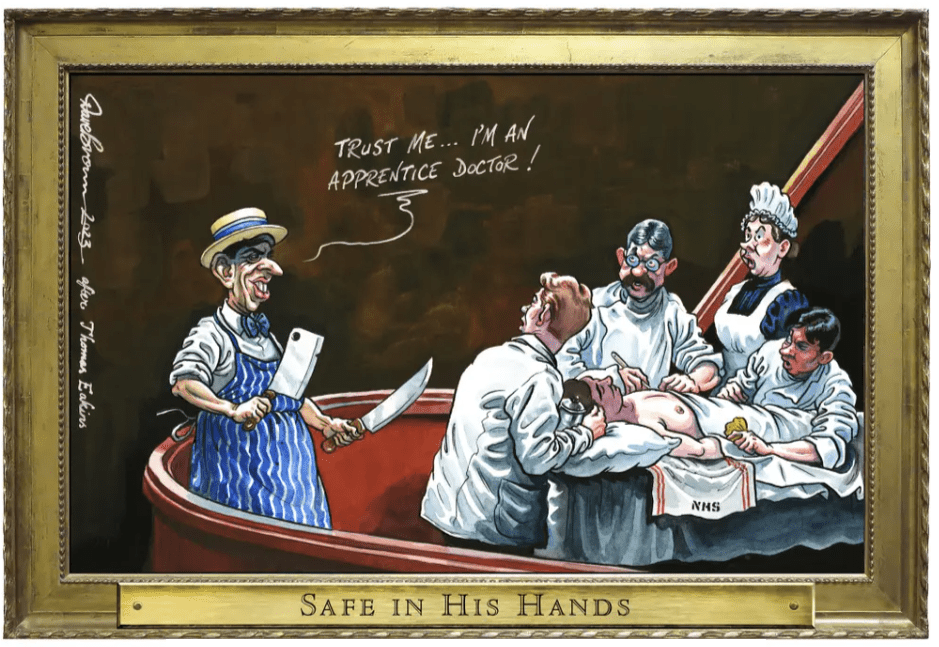
But is it “safe in our hands” to quote an old Tory slogan? – Owl

Rebecca Pow The Parliamentary Under-Secretary of State for Environment, Food and Rural Affairs

Water is what makes life possible on our planet, and it is essential for our health and wellbeing, as well as for our economy, including the production of food and clean energy. The Government are taking significant steps to ensure that the water industry is delivering the outcomes that bill payers expect and deserve. Water companies have invested £190 billion since privatisation in 1989. In April, the Government published the plan for water, bringing together more investment, stronger regulation and tougher enforcement capacity for regulators in relation to those who pollute.

Richard Foord MP tells minister to “get a grip”

Richard Foord Liberal Democrat Spokesperson (Defence)

We have seen bonuses and dividends put ahead of investment in infrastructure or maintaining sufficient reserves. Our area of Devon and Somerset is covered by South West Water; the company has paid out £112 million in dividends this year, despite having just £144 million in reserves, which is £2.5 billion less than it had two years ago. This week, a water firm chief executive officer has resigned, but no Conservative Minister has ever taken responsibility. When will a Conservative Minister finally take responsibility and get a grip, or step aside?

Rebecca Pow The Parliamentary Under-Secretary of State for Environment, Food and Rural Affairs

As the hon. Gentleman knows, Ofwat has announced new measures to enable it to take action against water companies that do not link dividend payments to performance. That is just not happening. I think he needs to look again at some of the stats he has just quoted, because I think they might relate to the wider Pennon Group. I have just visited South West Water to have a really forensic look at its systems and how it delivers water. That is what we do with our water companies. It is Ofwat’s job to hold water companies to account, and it has just got measures through the Treasury so that it has another £11.3 million to tackle enforcement.

The state we’re in: Fears growing that collapse of Thames Water could have domino effect

Failures in privatised: Rail Companies, Electricity Suppliers and now Water Companies. 

Where and when will it end? – Owl

“Whitehall was on Wednesday night drawing up contingency plans to nationalise swathes of Britain’s water industry as the country’s biggest supplier teetered on the brink of collapse.

Officials are laying the groundwork for the emergency nationalisation of Thames Water as investors refused to give the company a £1bn lifeline…..

Fears are growing that the collapse could trigger a domino effect across the industry, which is laden with £60 billion of debt built up during years of lower interest rates.” (Extract from Telegraph)

Exmouth beats Exeter to first-name rights

A new parliamentary constituency featuring parts of the current East Devon and Exeter seats will be called ‘Exmouth and East Exeter’.

The new boundary follows the increasing urbanisation of the eastern side of East Devon.

Might the Tory “build, build, build” policy result in the loss of a previously “safe” seat? – Owl

Ollie Heptinstall, local democracy reporter www.radioexe.co.uk

The Boundary Commission has published its final recommendations for a shake-up of England’s map for general elections, which aims to give each MP roughly the same number of voters.

 New borders marked by red line (image courtesy: Boundary Commission)

The changes will give Devon a total of 13 MPs – up one on the existing 12 – although one will be split across Devon and Somerset in a new ‘Tiverton and Minehead’ constituency.

There will also be a newly titled ‘Honiton and Sidmouth’ seat, which current East Devon MP Simon Jupp has announced he will contest at the next election, while the commission has now recommended a new neighbouring seat is called ‘Exmouth and East Exeter’.

The current Exeter constituency has an electorate of just over 80,000, higher than between the 69,724 and 77,062 allowed under the new national proposals.

It will remain largely unchanged, but three wards – Pinhoe, St Loye’s and Topsham – will join the new seat with Exmouth, Cranbrook, Budleigh Salterton and surrounding areas.

Previously Priory had been included, but this was met by opposition from Labour and the Tories. City council leader Phil Bialyk was against the idea, while East Devon MP Simon Jupp said: “The Priory ward is categorically part of Exeter city, with residents identifying themselves as living in Exeter.”

On the new seat being called ‘Exmouth and East Exeter’, the Boundary Commission’s report says: “We noted that there is significant support for changing the name of the Exeter East and Exmouth constituency to Exmouth and Exeter East.

“We noted that the population of Exmouth surpasses the combined population of the three Exeter wards. We therefore revise our proposals and change the name of the constituency to Exmouth and Exeter East.”

It “acknowledged the logic” of renaming Exeter as ‘Exeter West’, but concluded “the constituency, apart from minor readjustments, is otherwise unchanged from the existing constituency and we saw no support for this proposal.”

Subject to MPs adopting the recommendations, the new seats will be contested at the next general election.

South West Water to increase water charge from £480 to £588 (22.5%)

The Times article quoted in this post includes a table listing the water price increase proposals announced so far. These include SWW.

Owl understands these increases have to be approved by Ofwat

Remember there is also a sewage disposal charge (on the basis of what goes in also goes out, or at least 90% of it. Many a slip ….etc.)! – Owl