South West Water pollute our rivers and seas – now the’re trying to flush our wallets

Richard Foord MP for Honiton and Sidmouth stands up in parliament for the people of Devon and Cornwall affected by pollution, calling South West Water “aloof, even arrogant”, “a byword for failure”.

He continued: “They are now trying to flush out constituents’ wallets, issuing bill rises of over 50% in some cases.”

He spoke on Tuesday in the Easter Adjournment Debate and  ended by saying:

“South West Water is proposing to spend £3.2 billion on infrastructure improvements, but the crying shame is that it has failed to invest in its infrastructure in years gone by. This week, we have learned that the PR side of the business is going to be joined by none other than the former MP for East Devon, Simon Jupp. He is going to speak for South West Water, having attacked it while he was a Member of Parliament.

A very different speech to the self-serving one made by David Reed MP for Exmouth and Exeter East on Monday.

Here is the Hansard transcript of his full speech:

Richard Foord Liberal Democrat, Honiton and Sidmouth  5:39, 8 April 2025

I rise to talk about South West Water and Pennon Group. I speak today for  anyone in Devon and Cornwall who has ever had to walk past a polluted stream, stay out of the sea when visiting a beach, or stare at a water bill and wonder, “How did we end up here?” South West Water, like its parent company, Pennon, has become a byword in the south-west for failure, aloofness and even arrogance. In 2024, the company dumped sewage into our rivers and seas for over 540,000 hours. These spills are supposed to happen only in exceptional circumstances; in reality, this has been regarded as a licence to pollute.

If that were not enough, South West Water is now trying to flush out our constituents’ wallets, issuing bill rises of over 50% in some cases. I should say that Ofwat ruled last December that bills can rise by 36% on average over five years, before inflation. However, that 36% rise is permitted on average bills, and many bills for residents in Devon have risen by much more.

Stuart Thompson, who lives near Aylesbeare, has found that, even though he is not connected to South West Water’s sewerage system, his annual bill is now £761, even though last year it was just £486. That is a jump of over 56%. Stuart is a cancer patient, and his immune system is weakened from treatment. To protect himself, he boils his water before drinking it, because he is conscious that South West Water had an outbreak of the Cryptosporidium parasite last year. One can understand his caution, given his weakened immunity.

When Stuart tried to ring South West Water, he found himself 178th in the queue, and that is not a one-off. Graham Long, who lives in the Blackdown hills near Honiton, also tried ringing South West Water. Like Stuart, Graham found on the first occasion that he was 106th in the queue. On another occasion he was 94th, when he tried at a quieter time he was 87th, and on a day that was quieter still he was 74th in the queue. That is absolutely crazy from a water company hiking people’s bills in some instances by 56%.

Louise Thompson from Sidmouth contacted me in disbelief about her instalments. She did get through to South West Water, and when she raised her concern about her higher bill, she was offered a reduction to £49 a month, rather than the £70.32 for which she had been billed. However, she worked out that this was because the instalments would be spread over 12 months rather than 10, so it was a cloak for no bill reduction whatsoever. Yet, since privatisation, this company has paid out more than £4.5 billion in shareholder dividends.

South West Water is proposing to spend £3.2 billion on infrastructure improvements, but the crying shame is that it has failed to invest in its infrastructure in years gone by. This week, we have learned that the PR side of the business is going to be joined by none other than the former MP for East Devon, Simon Jupp. He is going to speak for South West Water, having attacked it while he was a Member of Parliament.

Do Tory political boards also serve as markers for future development?

Tim has just posted this comment:

Owl’s reference to the political boards adorning numerous patches of local land fits with observations I made whilst moving about the area yesterday. It struck me that the blue boards for Scott and Trail may well also serve as markers for land that will be developed in the future. So, maybe Cllrs Scott and Trail can give us advance notice of the infrastructure proposals that might be appropriate.

Such boards are placed with the landowner’s permission and I’m guessing they may just be offered up for development at some time in the future.

I distinctly remember Hugo Swire getting very upset that similar boards for one of his elections were damaged at Goodmores years back. His reposte included a claim that they were on private not public land, and that the landowner had given permission. We know all know what has happened to the Goodmores Farm fields – well, apart from any infrastructure that is.

Mr Reed should perhaps look at his party’s past involvement in local planning – perhaps through the spectrum of the roles held by Cllr Stuart Hughes, a DCC councillor, a EDDC councillor and a town councillor. At DCC his portfolio included Highways – and highways includes potholes.

At EDDC he was known for planning amongst other roles- and of course his infamous “We plan everywhere” YouTube video at https://www.youtube.com/watch?v=kEeCh4d9wIw His party controlled EDDC when Goodmores was passed by planning.

Stuart was once a member of the Monster Raving Lunatic party. https://www.torbayweekly.co.uk/news/home/1543781/when-devon-became-a-loony-hotspot.html

What happened to integrity? Simon Jupp joins SWW; David Reed MP gets £5K from Exmouth Developer

The parliamentary register of interests shows David Reed received £5K, on 2 August 2024, from 3West Group, the Woodbury based developers of Goodmores Farm Exmouth!

On Monday David Reed MP asked questions in Parliament about EDDC’s failure to plan infrastructure for development of tens of thousands of homes.

CONFLICT OF INTEREST DAVID REED?

Did he declare this at the beginning or his speech in the house on 7 April [Not according to Hansard] or just assume it was OK because it’s recorded in the parliamentary register of interests, so everyone, including his constituents, are bound to know?

Like Jupp’s move to SSW’s parent company Pennon; it’s all within the rules, but it smells.

Here is David Reed’s link to his oral question.

Here is the text of his question from Hansard:

In my constituency of Exmouth and Exeter East, the Lib Dem local council is proposing to build tens of thousands of new homes with little thought for corresponding infrastructure. I have spoken to local councillors, and they believe they have no agency in this process and central Government are telling them what to do. What more can be done to ensure that local authorities are held accountable for their decisions?

Let Owl put the record straight.

Overall Housing Targets

It’s not this council that wants to build “tens of thousands” of new homes it’s the toxic consequence of an historic local plan Tory legacy and the “build at any cost” Labour Government.

It is well recorded in the “Watch” how Paul Diviani, alongside the faithful Philip Skinner, were the architects and driving force behind the EDDC “Build, build, build” strategy from 2005 to 2020. It resulted in the current Local Plan having a development target of 950 houses/year, based on an aggressive “jobs led policy on” scenario.  Where studies showed only around 580 houses/year would be required to satisfy demographic and normal migration growth trends. 

This is an uplift of 370 or 64% on what is strictly necessary and is the target that the current EDDC coalition has inherited. It is the basis on which the government thinks reasonable to set its own growth strategy.

Goodmores Farm is a good example of how a council’s hands are tied once it grants outline planning permission. Seeking outline planning permission has become common practice. In this case it was the outgoing Tory Council that granted outline permission which the incoming coalition were unable to control. For example, along the line, the targets for affordable housing fell from 25% to just 5% as the developer pleaded, successfully, that it would be “economically unviable” to proceed with the higher figure. There now appears to be £5K left for David Reed.

Here are some quotes from councillors at the time:

“The scheme won’t win awards for the layouts”

“Of all the sites, this is the runt of the litter” 

“It is everywhere houses in an everywhere town.” 

“This flagship new housing development says to many younger people seeking a first house, ‘You are not welcome here’.”

So a question for you David Reed is what infrastructure is your sponsor 3Ways Group planning?

Infrastructure

Not all infrastructure is provided by EDDC. Highways is an example; think how long has Exmouth waited for the Dinan Way extension?

The provision of adequate sewage treatment is another classic example. The problem local authorities have is that, although they are the planning authority, they can’t successfully defend an appeal against planning rejection on the grounds of inadequate sewage capacity unless supported by the Environment Agency (e.g. phosphate levels in the Axe) or South West Water.

SWW rarely claim they can’t deliver the required resources – indeed they promised new capacity for Cranbrook which never materialised.

It is also worth noting that the government of the day (Labour) insisted the planning for the new town of Cranbrook should be developer-led including the town center, schools, medical clinics etc.

Building Affordable Housing

Build enough houses and the developers will cross subsidise the building “affordables

That’s the theory but it hasn’t worked in East Devon.

Having gained planning permission on a promise to deliver a certain number of affordables, developers frequently claim later that “viability assessments” mean that they have to reduce the number.

Notorious local examples include Goodmores Farm (25% down to 5%), Evan’s Field in Budleigh (30 houses to 5) and Cranbrook. (67 houses 28% of total reduced to 44 just 18% when EDDC’s policy target is 25% in one zone, and 26% reduced to zero in another).

Who is happy to stick their election posters by the Goodmores site?

“What if”……..Simon Jupp turned up at David Reed MP’s “on the same page” meeting with SWW?

Owl would love to become a fly on the wall for such an event!

David Reed has always advocated a softer “on the same page” approach in tackling the local sewage problem with South West Water. Today, Owl posts a correspondent’s frustration at the lack of progress this approach is having.

In the light of his predecessor’s defection to take a job with South West Water’s parent company, Pennon Group (see below), this phrase takes on a whole new meaning.

Owl has heard whispers that David Reed’s second “on the same page” meeting is scheduled for this Thursday 10 April, included are: the Environment Agency, South West Water, Exmouth Town Council, Clinton Devon Estates and possibly ESCAPE (if they are on the same page) .

Definitely excluded, because they’re not “on the same page”, are EDDC, despite EDDC environmental officers having a formal role in every incident.

What if Simon Jupp, David Reed’s predecessor as Tory MP for East Devon, were to turn up?

“Hello David I’m here with the team to talk about working with communities across the region on our future development plans……….”

Can anyone in East Devon now trust a Tory on pollution?

For those not up with the background see: Simon Jupp takes job with owner of water firm he “denounced” – the https://eastdevonwatch.org/2025/04/07/breaking-simon-jupp-takes-job-with-owner-of-water-firm-he-denounced-the-whole-thing-stinks/whole thing stinks!

A correspondent wonders why David Reed’s “voice of reason” hasn’t ended sewage pollution

Owl received this letter a week ago – it now, as his predecessor joins South West Water, seems a particularly pertinent moment to publish it.

Dear Owl, 

In the run up to the general election, I had canvassers come and visit me from our three main political parties: Conservatives, Labour and Liberal Democrats. 

The canvasser on behalf of the Conservative Parliamentary Candidate for Exmouth and Exeter East understandably spoke highly of the candidate. He stated that David Reed was a former marine who had served the country and was ready to serve his constituents. 

I retained all of the election leaflets as I was determined that whoever was elected, I would hold them to account. 

David Reed’s leaflets:

They make very interesting reading in hindsight.  

“From ending sewage pollution…” I can’t see any results yet.  

*  He has answered constituent’s letters. 

*  He has met with the CEO of South West Water.

*  He has hosted a meeting at Exmouth Town Hall. 

*  He has given comments to Helen Dollimore for her to ask the CEO of South West Water at a recent select committee.

*  He has contributed to the Housing Development Planning Water Companies debate on 12th March. 

BUT HE HAS NOT ENDED SEWAGE POLLUTION!

In the Autumn, Exmouth Town Council wrote to Steve Reed, the Secretary of State for Environment for Food and Rural Affairs inviting him to Exmouth to discuss sewage. I haven’t seen anything to suggest that David Reed has followed this up, or anything in the public domain about the Secretary of State for Environment for Food and Rural Affairs coming to Exmouth. 

“Pushing back on overdevelopment …” 

*  He has contributed to the Housing Development Planning Water Companies debate on 12th March. 

*  He has written articles in the local press about it. 

*  He has wriitten on social media about it. 

31st March, 2025: “Our home cannot accept this lack of joined up thinking, and I will not let this happen on my watch.”

The MP for Exmouth and Exeter East is at a disadvantage to “influence government”  because his party is now in opposition. In the run up to the general election, I’m sure many people enlightened him and his canvassers why they no longer would vote Conservative. 

I’m certain that  many of the constituents in Exmouth and Exeter East, to the right and left of the Conservative Party are wanting their MP to end sewage and over development. 

COULD THE MP FOR EXMOUTH AND EXETER EAST ENLIGHTEN HIS CONSTITUENTS ABOUT WHAT HE IS GOING TO DO TO STOP THIS HAPPENING ON HIS WATCH?

Yours sincerely, 

An Exmouth and Exeter East constituent who would like their MP to end sewage and over development

Breaking: Simon Jupp takes job with owner of water firm he “denounced” – the whole thing stinks!

Richard Foord MP who beat Simon Jupp to take the new seat of Honiton and Sidmouth said: “The water industry is broken, and this is yet another example of just how broken the system is. Frankly, the whole thing stinks …..The revolving door between water companies, regulators and government has to come to an end.”

Jupp has scrubbed his social media profile on X, which previously contained criticism of South West Water.

Former Tory MP takes job with owner of water firm he criticised

Adam Vaughan www.thetimes.com 

A former Tory MP who called South West Water’s track record “shameful” has joined its parent company in a move that campaigners said was a case of “poacher turned gamekeeper”.

Simon Jupp, the MP for East Devon until he lost his seat in the general election, had been a vocal critic of the water firm, which serves Devon, Cornwall and small areas of Dorset and Somerset.

After thousands of people in Brixham, Devon, were told to boil their water after the discovery of a parasite in supplies last year, Jupp lambasted South West Water for “unacceptable” behaviour. He also called for a criminal investigation into sewage spilt by the firm at Exmouth in Devon. The former politician has now taken a role at the Pennon Group, the owner of South West Water.

Simon Jupp MP at Mamhead Slipway, Exmouth.

Jupp heavily criticised South West Water after a parasite was found in water supplies last year

Jupp repeatedly boasted of holding the company to account and said he would ensure its pollution was “met with the full force of the law”, adding: “I am determined to push South West Water to deliver the standards expected by local residents, visitors and businesses.” His new role is in Pennon’s regional development team, working with communities across the region.

“The water industry is broken, and this is yet another example of just how broken the system is. Frankly, the whole thing stinks,” said Richard Foord, the Liberal Democrat MP for Honiton & Sidmouth, which was created in part from the East Devon constituency Jupp once held. Foord added: “The revolving door between water companies, regulators and government has to come to an end.”

The Drinking Water Inspectorate, a water regulator, is yet to report its findings into the outbreak of the waterborne parasite cryptosporidium last May. Susan Davy, the chief executive of South West Water, recently called the Brixham incident “devastating” and apologised.

Environment Agency figures released last week showed that South West Water discharged raw sewage into waterways for longer than any other company last year. It was spilt from storm overflows for a total of 544,439 hours.

“We have got our programme in place to eliminate pollutions — that is when things go wrong on our system — to make sure we can eliminate those. And then for storm overflows, we have got our 15-year programme to take those flows out of the system so that we can reduce impacts to the environment,” Davy recently told MPs.

Since stepping down as an MP, Jupp has scrubbed his social media profile on X, which previously contained criticism of South West Water.

“This is the latest episode in the farce where politicians and regulators ditch principles and public duty to chase personal gain,” said James Wallace, chief executive of the charity River Action. “Just like the ex-head of [the water regulator] Ofwat taking a job in Thames Water, we see a gamekeeper MP turn water company poacher, conveniently wiping out past misdemeanours to suit a new narrative where the lines between public servant and private profiteer blur. This is how regulatory capture occurs.”

The Times’s Clean it Up campaign is calling for action by companies, government and regulators to tackle pollution in the nation’s rivers and seas.

South West Water declined to comment. Jupp was contacted for comment.

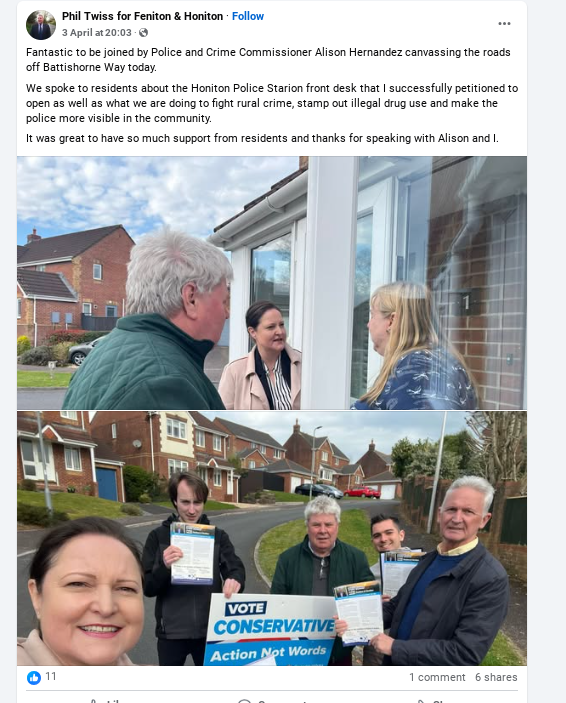
Should our “without fear or favour” PCC Alison Hernandez be canvassing for Tory Twiss’ re-election campaign in Honiton?

Is Phil Twiss’ campaign in such serious trouble that Alison Hernandez has to politicise her Police Commissioner role so blatantly to provide him with her selfie skills?

Phil is the outgoing County Cabinet Member for finance and the Tories will be desperate not to lose him on May Day.

But can Alison really afford to spend the time from her failing “day job”?

When Alison canvassed three years ago in the by-election called after the sad death of Val Ranger in Newton Poppleford, her presence was also called into question. Then she would seem to have been a liability as the Tory candidate tanked garnering only a paltry 113 votes.

Her success rating must surely have sunk even further since then.

There is the not insignificant issue of us having to pay for three Chief Constables just to have one in post.

The force has been subject to a series of adverse reports from the Police Inspectorate and even placed into “special measures” in 2022.

A couple of weeks ago her own office published a follow-up report, which covers the year to March 2024, identifying several ways in which the Devon and Cornwall Police force has failed to meet statutory requirements.

These include “failing to consistently notify” the police and crime commissioner’s office of complaints that require more than twelve months to resolve, and a “complete failure” to notify it of the outcomes of more serious allegations made to the Independent Office for Police Conduct.

The report also identifies a “number of wider, systemic concerns about the timeliness and quality of the force’s complaint handling, starting from the initial handling of complaints on first receipt, ongoing quality of contact with the complainant, timeliness and quality assurance of complaint investigations, and consistency and quality of outcomes”.

A couple of weeks ago she hit the air waves blaming the quality of police staff to explain the adverse report.

But Owl can reveal that this is is not the full story.

“The report also shows that her office, which handles appeals against the outcome of complaints and the way complaints were handled, itself completed only 108 such appeals during 2023-24, a third fewer than in 2022-23, and took significantly longer to do so than before.” (Source)

Perhaps things would improve if she stopped wasting her energies on these partisan, selfie, expeditions.

As you are out and about in the market towns of Devon in this election period ask yourself this question: who are you most likely to see a police officer or the Independent Police Commissioner?

10,000 new homes could come to Plymouth

“The council wants to create 1,000 new businesses, a 20 per cent increase in productivity, help 5,000 people into work, bring 50 buildings back into use and lift 3,000 people out of poverty.”

Ambitious talk, reminds Owl of our now defunct “Heart of the South West” Local Enterprise Partnership, but if it has government money?

Government officials attend cabinet meeting

Alison Stephenson, local democracy reporter www.radioexe.co.uk

Government agency Homes England wants to replicate its partnership with Plymouth across the country.

A £50 million revamp of the derelict Civic Centre is to be the centre of a project to regenerat the city centre and build 10,000 new homes.

Homes England looks likely to stump up nearly half the cash.

The homes will be delivered alongside a number of council-led projects already taking place including a community diagnostics centre at Colin Campbell Court and work on Armada Way, both costing around £30 million each.

Work will begin on the 14-storey Civic Centre tower later this year to provide a marine and green skills hub for City College Plymouth in the basement and first two floors, and 144 flats above which won’t be for students.

The college is expected to open the campus in September 2029, training up to 2,000 students a year and running 60 new courses. It wants to help create highly skilled workers and see wages rise in Plymouth, where the average salary is currently £4,000 below the national average.

Housebuilding will begin once sites have been acquired by the council and planning permission given, with areas of Armada Way, the West End and Millbay all on the wishlist for redevelopment.

The council wants to create a city centre on a scale like Manchester and Liverpool, where thousands of people live in the centre and enjoy its night-time economy and amenities. Fewer than 1,000 people live in the centre of Plymouth at the moment.

Officials from Homes England and the Ministry of Housing, Communities and Local Government who attended a council cabinet meeting this week praised Plymouth’s ambition for the city centre.

Interim chief executive officer of Homes England Eamonn Boylan told councillors he was delighted to be involved in a partnership that included the council, City College, Babcock International and the Royal Navy.

Babcock’s Devonport facility, which refits submarines, needs to attract 5,500 employees over the next 10 years to sustain its core defence workforce, and a further 2,000 construction workers to deliver an infrastructure contract.

The government recognises Plymouth’s role in defence and that more homes are needed for workers.

Mr Boylan said: “The partnership between Plymouth City Council and your other partners and the agency (Homes England) is an exemplar that we want to see replicated across the country.”

He continued: “We need quality affordable housing that meet the needs of the community, homes for current residents and homes to accommodate the predicted growth. Together we can build a better future for Plymouth, one home at a time.”

Plymouth City Council leader Tudor Evans (Lab, Ham) said he could not think of another time in the last 50 years when Plymouth had such an opportunity to “drive transformational change” and “to improve outcomes for our residents and with better homes”.

He said the city was at an “economic tipping point” with a £6 billion investment pipeline, which includes £4.5 billion for defence.

The council wants to create 1,000 new businesses, a 20 per cent increase in productivity, help 5,000 people into work, bring 50 buildings back into use and lift 3,000 people out of poverty.

“Chancellor Rachel Reeves mentioned Plymouth last week in the context of large-scale national defence, explaining how it will underpin economic growth locally and nationally, the important role we now play is on the record,” said Cllr Evans.

“This is just the beginning of realising our ambition for Plymouth. Plymouth’s time has well and truly come.”

Over the last two years, Homes England has provided funding to support Plymouth’s vision, and will acquire sites where progress has stalled, if necessary.

Cabinet members approved to acquire the freehold of the Civic Centre from developer Urban Splash for £1 and noted the funding package which includes more than £17 million of borrowing.

A £20 million grant from Homes England will be subject to the agency’s formal approval.
 

Randall Johnson stands down as County Councillor – Rejoice!

Sarah Randall Johnson, dubbed “Scandal” Johnson by Private Eye, has announced through the Midweek Herald that she will be standing down from Devon County Council after 30 years as a councillor.

She will be remembered for two “achievements”: her pursuit of “development led” growth during her nine years from 2001 to 2011 as Leader of East Devon District Council (EDDC); and  her pursuit of closures of community hospitals as Chair of the Devon Health and Adult Care Scrutiny Committee.

In 2017 Owl’s predecessor wrote about how her political career stalled in County after her defeat in the District by Claire Wright, despite having been a District Leader for nine years:

“Randall-Johnson was Diviani’s predecessor as Leader of EDDC (until being ignominiously trounced by Claire Wright in local elections) but has failed to rise to such a dizzy height again at DCC (and may – or may not – have scuppered her chances of ever doing so with her recent behaviour).

Until her recent appointment as Chairman of the Health Scrutiny Committee she had to content herself with appointments to the DCC Pensions Board, East Highways and Traffic Orders Committee, East Devon Locality (County) Committee and the Devon and Somerset Fire and Rescue Authority.

And few of us can forget that she was the unsuccessful “Cameron’s Cuties” competitor for the Tory Totnes seat won by Sarah Wollaston.”

Taking a longer view of her chequered political career, Owl would also give her full credit for galvanising the opposition to, and eventual defeat of, her style of conservatism in East Devon. 

Her nine years coincided with a rising feeling that EDDC, under her leadership, lacked transparency, accountability and was rotten at the core. 

For example, between 2004-13 EDDC subsidised a lobby group of developers and landowners, the East Devon Business Forum, that had a disproportionate influence on planning policy and decisions in the district.

In 2005 she oversaw a key appointment, that of Karime Hassan as Corporate Director (he had come from Exeter City Council in 2002). Together they set up the Exeter and East Devon Growth Point, the forerunner to the creation of the Greater Exeter Strategic Plan (GESP). 

They also foisted unpopular regeneration plans across the seaside towns: Exmouth (Ocean bowling alley and Elizabeth Hall), Budleigh (Longboat), Sidmouth (Knowle) and Seaton (Tesco and others). Furthermore, EDDC started devising a local plan based on high population growth assumptions and imposing significant housing in inappropriate areas from Cranbrook to Feniton.

These decisions taken on Randall Jonson’s watch haunt us today.

In February 2011 Karime Hassan rejoined Exeter City Council as the Director of Economy and Development after about six months of sharing his time between Exeter and East Devon before, controversially,  being appointed both Chief Executive and Growth Director of Exeter City Council in 2013.

It was in 2012, a year after Sarah Randall Johnson was rejected by the voters, that Graham Brown, former Chair of the said Business Forum, was caught on camera and named offering to obtain planning permission for cash in a nationwide Telegraph sting. After a lot of prevarication Brown resigned in 2013. A formal investigation was kicked into the long grass. We now know something very similar happened one year later, when the first alerts over safeguarding with regard to John Humphreys were made at County in 2014. John Humphreys was convicted of historic rape and jailed in 2021. 

As a result, across the District, like minded individuals from disaffected groups coalesced to form the East Devon Alliance in 2013. Its aim was to hold EDDC to account and encourage and support independent candidates to stand for election. Candidates signed up to a set of core beliefs and the Nolan principles. 

Ultimately this grass roots movement bore fruit. In 2011 the EDDC Tory councillors numbered 43, in 2015 it fell to 36 and in 2019 their majority was wiped out as their numbers fell further to 19 (out of 60). Although a minority they formed a coalition which fell apart within the year and the Tories finally lost control in 2020.

Part of this opposition was the creation of blog sites to publicise these “goings on” in EDDC, in the absence of effective scrutiny. The Sidmouth Independent News (SIN) started in 2012 and the broader based “East Devon Watch” followed in 2014. 

Letter from Martin Shaw: Seaton’s hospital was left vulnerable to proposals

Midweek Letters www.midweekherald.co.uk

Councillor Sara Randall-Johnson tells your reporter that she regrets that more wasn’t done to improve health outcomes during her eight years as chair of the Devon Health and Adult Care Scrutiny Committee.

She blames NHS waiting lists on the Covid lockdowns, but they were already ballooning before the pandemic, as a result of the cuts to the NHS by the Conservative government which she supported.

Cllr Randall-Johnson will always be remembered in Seaton for her 2017 vote to block government scrutiny of the decision to strip our community hospital of its beds, which sealed the fate of our campaign.

This left the hospital, paid for by local donations, vulnerable to the new proposals to partially demolish it which came in 2023 – which we are still working to overcome.

Martin Shaw
Seaton

Has Labour gone “full Tory” on planning reforms? – Owl

UK housebuilders ‘very bad’ at building houses, says wildlife charity CEO

Housebuilders in the UK are failing to supply much-needed new homes not because of restrictive planning laws, but because they are “very bad” at building houses, the head of one of the UK’s biggest nature charities has warned.

Fiona Harvey www.theguardian.com 

“There’s planning permission today for a million new houses,” said Craig Bennett, chief executive of the Wildlife Trusts. “So why aren’t they being built? Why is it that volume housebuilders in this country are actually very bad at building houses, even when they’ve got planning permission?”

Ministers have boasted of their swingeing reforms to the planning system – in a bill that passed its second reading last week – claiming they will clear the way for the 1.5m new homes promised in the Labour manifesto.

But Bennett believes this hope will be in vain because the government is missing the point. “[The reason so few homes are built] is because they [the large housebuilders] love to hold land and wait for the prices to up. A lot of the way that a lot of housebuilders in this country make money is through speculation around land prices, as much as it is about building houses.”

Housebuilders rejected Bennett’s analysis. Steve Turner, an executive director of the Home Builders Federation, said: “Housebuilders deliver a range of high-quality environmentally friendly house types to meet all budgets, and customer satisfaction levels are at an all time high. The myth of land banking has been demolished time and again by independent experts. Housebuilders’ only return on investment is selling homes, and having purchased land and navigated the costly and bureaucratic planning process there is absolutely no reason not to build and sell.”

Bennett will mark five years in April as head of the Wildlife Trusts, a confederation of 46 independent organisations which together boast 2,600 nature reserves (“about 1,000 more than McDonald’s has restaurants”) and 944,000 members. Before that, he headed Friends of the Earth.

The Wildlife Trusts, as a charity, are careful to avoid being party political, but within Charity Commission guidelines there is still scope for civil society groups to take issue with the politicians of the day.

And planning regulation – and the supposed conflict between development and environmental protection – has become a political flashpoint. Green groups have accused the Labour government of “scapegoating” nature and fomenting culture wars, after Rachel Reeves, chancellor of the exchequer, called for businesses to “focus on getting things built, and stop worrying about the bats and the newts”. The prime minister, Keir Starmer, has also weighed in, ridiculing the presence of “the distinguished jumping spider” for allegedly halting new homes in Kent.

The government’s combative rhetoric has been informed, Bennett believes, not by careful consideration of the UK’s infrastructural deficits, but by a mixture of a “misinformation bubble”, in which top ministers have absorbed some prejudices of the previous Conservative government, and a belief that they need to set up an enemy to fix on.

Reeves was sounding “more Liz Truss than Liz Truss” on the growth issue, he added, referring to the former Tory prime minister who espoused anti-green rhetoric more often heard from US rightwing politicians. He blames Morgan McSweeney, the prime minister’s chief adviser, for a fixation on the Reform party, which threatens Labour in seats across the “red wall”.

Reform’s leaders, Nigel Farage and Richard Tice, have been vitriolic in their condemnation of environmentalists, green concerns over nature and “stupid net zero”, as described by Tice. But Bennett pointed to a survey of 4,000 people’s attitudes towards green issues, which found that Labour voters who were thinking of switching to Reform were overwhelmingly positive towards the Wildlife Trusts. “There’s a lot of the kind of Reform voters who care passionately about this. People who live in the Westminster bubble assume that what the party leadership are doing is what the voters are doing. It’s quite different.”

He has extended invitations to Farage, Tice and the Reform party to meet and discuss these issues. So far, they have not been taken up.

Bennett argues that new housing could sit alongside nature, if housebuilders were given greater direction by the government and built affordable homes instead of the larger and more expensive “executive” homes that deliver higher profits. But he said the poor construction of many new houses, and the failure of developers to build in harmony with nature and incorporate green space, were among the reasons people rejected them.

Bennett added that charities such as the Wildlife Trusts created economic growth while improving society. “We’re now employing 3,700 people across the UK in those communities,” he said. “I get a bit fed up at times when politicians talk about charities as if we’re just like small little things. We are actually really significant employers.” Bennett added that in many areas, wildlife charities “underpin the local economy”, providing tourism opportunities, flood management and employment.

Labour disparaged nature at its peril, Bennett said, arguing that all voters cared about nature on their doorstep. He said: “I see people from every demographic, political [party] or age. The one thing that unites us is how much we care about our local environment, and care about local nature, and want to see it in a better state.”

Lack of candidates forces local Tories to undertake taking intensive parachute training

Owl is hearing from a variety of sources that a number of local Tory candidates are having to be parachuted into county “divisions” well away from their home territory to give reform a run for their money in May’s county elections.

So far the list of those who have successfully completed their “jump” includes:

Brian Bailey of Exmouth set to contest Broadclyst (Currently EDDC councillor for Exmouth, Littleham)

Jenny Brown of Honiton set to contest Axminster (Currently EDDC councillor for Honiton St. Michael’s)

Ben Ingham of Exmouth/Lympstone (in many ways the most experienced jumper of them all) set to contest Seaton (Currently EDDC councillor for Woodbury and Lympstone)

Rayner’s Reorg: who picks up the tab for Devon’s £210m Send deficit?

[This figure includes Plymouth, Torbay unknown]

Nearly 20 councils in England ‘at risk of insolvency’ due to Send costs

Patrick Butler www.theguardian.com

Nearly 20 councils have warned publicly that they are at risk of insolvency because of multibillion-pound debts caused by years of overspends on special educational needs support, the Guardian can reveal.

Overspending on special educational needs and disability (Send) services in England is forecast to grow by nearly £2bn over the next 12 months, a Guardian investigation shows.

Councils will see mounting special educational needs and disabilities (Send) deficits rise by 54% on average, with some anticipating accrued debts to increase by millions of pounds every month as they struggle to cope with soaring demand.

Many councils are forecasting Send deficits of millions

Send deficit or surplus by council in England, £m

[Deficit for Plymouth is £-47.7m]

The deficits – currently totalling £3.4bn – will hit £5.2bn in 12 months. At least 18 councils have warned explicitly that the debts put them at risk of insolvency unless the government intervenes, with council estimates suggesting even more could go bust.

“The deficits are pushing councils all over England to the financial brink. The clock is ticking, and councils are being left in limbo with significant uncertainty over the future of services,” said William Burns, social care policy adviser for the Chartered Institute of Public Finance and Accountancy (Cipfa).

Mass defaults on Send deficits would cause chaos and damage other local services, said Cipfa, because councils that declare effective bankruptcy would be forced to drastically rein in spending in all areas, not just local schools. It estimates that as many as 75 councils are at risk.

The spiralling debts were kept off council books by Tory ministers using an accounting fix called a “statutory override” but this ends on 31 March 2026, when the debt returns to town hall balance sheets. Ministers must now decide whether to clear the debt, or extend the override until the deficits can be cleared safely.

The Send deficit ballooned under the last government, triggered by rapid increases in the cost of meeting education and health care plans (EHCPs) which give children and young people up to the age of 25 the legal right to school support from local authorities for conditions such as autism, and speech and language difficulty.

In 2015, 240,000 EHCPs were in place in England, more than doubling to 576,000 in 2024, according to Department for Education (DfE) statistics. Insufficient special needs capacity in state schools, and the high costs of Send placements in private specialist schools, have been driving overspends.

A government insider said: “Those [council] forecasts can only have been based on the failing Tory system that we will change. Tackling the chaos that the Tories left in our Send system is a major priority for [the education secretary] Bridget Phillipson, so we can give every child the opportunity to get a brilliant education.”

A Guardian investigation shows at least 101 English councils – over two-thirds of the total – spent more than their allocated Send budget during the past year, with 18 councils breaching their annual allocations by evermore than £30m.

Nearly nine out of 10 English upper-tier councils – of the 131 that responded in full to the FoI – will have an accumulated deficit on their high needs budgets by the end of next March, with one in four (32 out of the 131 who responded in full) now predicting debts of more than £50m and 15 debts of £100m or more.

Leeds city council, which covers the chancellor Rachel Reeves’s Leeds West and Pudsey constituency, has forecast its accumulated Send deficit will soar from £17.5m to £50m by the end of the next financial year, and warned the increase will put it at “serious financial risk”.

Hampshire county council, which has England’s largest forecast deficit at £312m, is projecting its debt to rise by £111m over the next year. In its budget reports, the council said that if the override was removed and the debt became a part of the organisation’s deficit, “a section 114 notice would become inevitable”.

Middlesbrough, one of England’s most deprived authorities, said its forecast Send deficit will rise by more than a quarter to £26m over the next 12 months. In council papers last month, it called this “a critical risk to the council’s financial viability, given that it will wipe out the council’s general fund reserves”.

The average forecast accumulated deficit across the councils covered by the analysis is £40m by the end of March 2026, with 112 forecasting their accumulated high needs deficit will worsen over the next 12 months.

A Department for Education spokesperson said: “The evidence is clear that the Send system has been on its knees for years – with too many children not having their needs met and parents forced to fight for support.

“It will take time, but as part of our Plan for Change we are thinking differently about what the Send system should look like, to spread opportunity, restore the confidence of families up and down the country and deliver the improvement they are crying out for.”

Consequences of rebranding  “Areas of Outstanding Beauty “ as utilitarian “National Landscapes”

Reduced funding and ambiguity over protection – Owl

East Devon environment budget cut by £50k as demands get tougher

Bradley Gerrard, local democracy reporter www.radioexe.co.uk 

Cash for an organisation that helps the environment in East Devon has been slashed by £50,000, just as government targets become more demanding.

East Devon National Landscape (EDNL), which oversees environmental initiatives in the district, will have £686,000 in the next 12 months, down seven per cent on last year.

EDNL supports environmental schemes, including tree planting, making the outdoors more accessible, and supporting farmers, all of which are aimed at protecting and promoting biodiversity and helping to hit net zero targets.

Dan Wynn, the manager of EDNL, told East Devon District Council’s overview committee that the council had been the host organisation for the national landscape – previously known as Area of Outstanding Natural Beauty, or AONB – since 2002.

“There has been a policy change from government to strengthen the duty we have,” he said, continuing:  “This means there is a change in expectations of what protected landscapes need to deliver.”

He said the National Landscape sits wholly in East Devon District Council’s boundary and that it shared its responsibilities with the Department for the Environment, Food and Rural Affairs (Defra) and Devon County Council.

He added that EDNL has to create nearly 2.7 hectares of new habitat by 2042 outside existing protected sites, as well as increasing tree canopy cover by 807 hectares in the next 25 years.

This year’s funding had supported around 62 projects, including community-led schemes, such as planting hedgerows at Sidmouth arboretum, a woodland  management initiative in Axmouth, and a water quality group in Lympstone.

It also paid for beach matting, which makes it possible for wheelchairs to go onto beaches, while improvement works had been carried out at Exmouth’s nature reserve.

Some councillors who also sit on the planning committee noted the competing demands of expanding the National Landscape at a time when pressure is rising to build more homes. Almost 1,000 new properties a year are likely to be needed in East Devon.

Cllr Roy Collins (Independent, Honiton) said some recent decisions to identify sites for housing had been partly in or extremely close to National Landscape land.

Cllr Brian Bailey (Conservative, Exmouth Littleham) added that the government’s planning policy seemed to be less in favour of protecting designated land.

“It seems to be going the other way and we have numerous planning applications where under the previous rules, we knew where we were, but now it is National Landscapes, you can build on them, and that’s encouraged by the government,” he said.

Mr Wynn acknowledged the issue.

A public consultation about EDNL’s plan for 2025 to 2030 runs until Friday 18 April.

The EDNL encompasses councils, government departments, and charities and voluntary organisations, including the Devon Wildlife Trust, Jurassic Coast Trust, National Farmers’ Union and Natural England.
 

I will not allow poor planning to destroy what makes our area so special – David Reed MP

Dear David, why not “put your money where your mouth is” by “cleaning up your own backyard” first? That is something you do have the power to do, rather than wring your hands over the plight of “developer led” Cranbrook whose residents were abandoned by the Tories for years. It’s not until your party lost power locally that any progress has been made.

You might also take a more robust line with South West Water. – Owl

PS You’re beginning to sound as if your needle’s stuck in a groove.

See: “Build,build, build Skinner back on the campaign trail” (earlier this month) and “David Reed MP says we have to build at scale without proper joined up thinking” (last September”)

[David Reed campaigning with “Build, build, build” Phil Skinner a few weeks ago]

David Reed MP for Exmouth & Exeter East www.devonlive.com

I love our county and this part of the world. I cherish the open green spaces, rolling hills, stunning coastline, and beautiful waterways. I’m also captivated by the rich history of our villages and towns, which have thrived for millennia.

Change is inevitable, but it must be managed responsibly. While we must adapt to modern times, we should preserve our collective past, which gives us a sense of grounding and helps us avoid repeating the mistakes of previous generations.

I’ve spent a lot of time in Cranbrook, both during the run-up to the General Election and since being elected. I’ve studied how the town was designed and, more importantly, what infrastructure was promised to support the growing population and surrounding areas. This includes roads, schools, medical services, supermarkets, community centres, and sewage treatment works.

I’ve been shocked by how much of this promised infrastructure remains undelivered. I’m equally dismayed by how hard the people of Cranbrook have had to campaign for basic amenities like a supermarket. This is unacceptable, and we should never put any community in this position again.

The not-so-new Labour Government has pledged to build 1.5 million new homes during this Parliament, likely by 2029. However, there is no clear plan to ensure that the infrastructure required to support these homes is delivered in parallel. On top of that, the Government is undertaking significant local government reorganisation, and further stripping power from local communities and limiting their ability to voice concerns.

As I’ve said many times, I’m not against housebuilding. But I am against developments that fail to deliver the necessary infrastructure. And I oppose mass housebuilding that erodes the beauty and history of our wonderful county.

So, what does this mean for us? Each local council with planning authority is required to create a local plan. This plan identifies land available for development, and the local council works with central government to deliver housing. In our case, the Liberal Democrat-led East Devon District Council (EDDC) has proposed building tens of thousands more homes in the Exmouth and Exeter East constituency. However, in their 270-page local plan, only two pages are dedicated to infrastructure. Worse still, the process for submitting feedback on the local plan is so convoluted that it almost seems designed to discourage public engagement.

I will finish this article as I began. I love our home. I will not allow poor planning and headline-grabbing targets to destroy what makes our area so special. We are temporary custodians of this land, and I want it to be protected and enjoyed by future generations. I will continue to fight and push back whenever I see a lack of joined-up thinking or when housing developments are planned without the necessary infrastructure to support them.

Devon’s natural beauty is being destroyed as it becomes national blackspot for sewage spills

“Of the 10 most frequently used overflows, five were in Devon. Another was in neighbouring Cornwall, meaning six were in the region served by South West Water (SWW).”

How Devon’s beaches and rivers became the centre of the sewage crisis

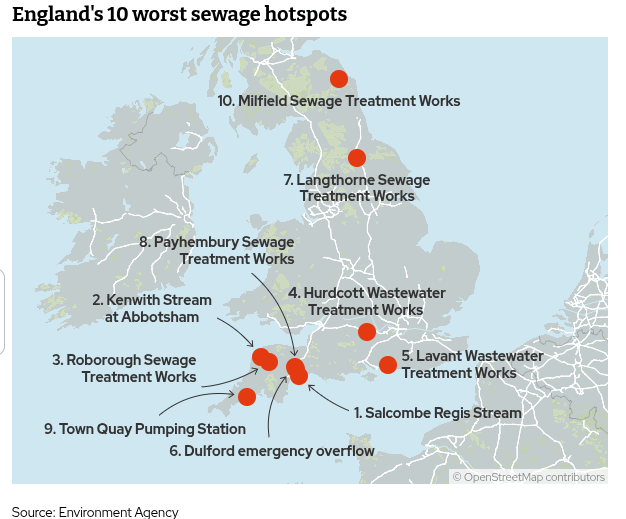
Sewage was spilt in one village in Devon 366 times in 2024, as the county was home to five of the worst 10 pollution blackspots in England

Lucie Heath inews.co.uk 

Devon is known for its rolling hills and dramatic coastline, but locals warn its natural beauty is being destroyed by sewage pollution as the area has become a national blackspot for spillages.

Official statistics released on Thursday show untreated waste was dumped a near-record 450,398 times across England in 2024 – the equivalent of 1,234 spills per day or 51 per hour.

Sewage pollution is a problem across the country, but the issue has become particularly acute in the south-western county.

Water companies dump sewage from points in their network known as “storm overflows”, of which there are more than 14,000 across England.

Of the 10 most frequently used overflows, five were in Devon. Another was in neighbouring Cornwall, meaning six were in the region served by South West Water (SWW).

The single worst offender was a wastewater treatment plant in the village of Salcombe Regis, next to the coastal town of Sidmouth. Raw sewage was dumped at this site 366 times in 2024.

“It’s a beautiful remote part of the countryside, absolutely stunning,” said Richard Foord, the Liberal Democrat MP for Honiton and Sidmouth. “People are disgusted.”

Richard Foord on the beach at Salcombe Mouth, the worst hit spot for sewage spills in 2024 

Foord said his inbox is filled with “residents who are massively frustrated to turn up at the local beach only to find that there are signs warning them against swimming because of the sewage spills”.

“People live in my constituency because they want to be near the sea,” added Caroline Voaden, the Liberal Democrat MP for South Devon.

“People want to have their kids in the water, they want to be out on boats, on paddle boards … it’s also about the health of our ecosystem.”

The poor state of Devon’s coast hit the headlines several times in 2024.

In March, sewage was released for 12 hours at Sidmouth, where Queen Victoria spent time as a child.

In the peak of summer, no swim warnings were issued at Exmouth Beach on multiple occasions. Hundreds of residents and businesses in the town are currently suing SWW as part of a mass legal action, claiming beach closures resulted in a significant drop in trade during their crucial tourism season.

Swimmer Jo Bateman is taking separate legal action against the water firm, saying it prevented her from taking her daily swims at Exmouth Beach due to multiple sewage discharges.

Water companies typically dump untreated sewage when their systems cannot cope with an influx of rainfall, although they have also been shown to discharge illegally during dry weather.

The weather will have played a factor in the deluge of sewage hitting Devon’s rivers and beaches in 2024. The South West experienced an incredibly wet start to the year and Devon recorded its wettest February on record.

“This is not an excuse but is important context,” said Richard Price, managing director of Wastewater Services at SWW. He pointed out that the firm was one of five that reduced the number of sewage spills across its network between 2023 and 2024.

This will offer little solace to the residents of the South West who have been fighting sewage pollution for decades, but still find themselves wading through waste.

Surfers Against Sewage (SAS), the campaign group that has been at the forefront of bringing this issue to the public’s attention, was founded in Cornwall in 1990 by a group of surfers keen to sound the alarm over the terrible state of Britain’s oceans.

“The thing with the South West is the amount of coastline those counties have and how important that is as part of the place, as part of the economy, as part of what draws people to there,” said Dani Jordan, Director of Campaigns and Communities at the charity.

“It should be something that’s there for all of us to enjoy in whatever way we choose to.”

In response to the recent swell in public outrage over the sewage crisis, water companies plan to invest £104bn up to 2030 in fixing their networks. Bills will increase by an average of £30 per year across the country to pay for it.

Jordan said she wants to remain “optimistic”, but the latest statistics are a reminder of how little progress has been made on the issue to date.

“We’re campaigning for an end to sewage pollution impacting the places we swim, surf and play by 2030…we 100 per cent know that the investment they’re going to put in over the next five years isn’t going to result in an end to that,” she said.

“We have lost trust in the water companies.”

Salcombe Regis wins the “Brown Flag” award for massive 8,772 hours of sewage spills

According to the Environment Agency figures, the site with the longest duration of spills was located in the coastal village Salcombe Regis, at a massive 8,772 hours and 30 minutes. Located in east Devon, the receiving body of water is the Salcombe Regis stream, which feeds into the sea on the south coast.

However, South West Water, which manages the site, says that it is investigating the cause of this. The water utility company adds that it is aware of several unauthorised connections to the sewer network that are contributing to the high level of additional flows. This includes highway road gullies with extensive road run-off. Extract from Albert Toth www.independent.co.uk

Local LibDems win big U-turn on controversial railway plan

Liberal Democrat MPs from the South West are celebrating a transport victory after Great Western Railway (GWR) reversed its plans to introduce routine stops at Old Oak Common for trains heading to London Paddington. Following significant lobbying efforts, the railway operator has confirmed that services will now only stop at the new station when there is “good reason to do so.”

Lewis Clarke www.devonlive.com 

The decision comes as GWR prepares to expand its fleet with 26 additional trains. Critics had argued that forcing express services to halt at Old Oak Common would have added unnecessary delays for passengers travelling from the South West.

In a joint statement, the group of MPs said: “This is a huge victory for families and commuters living across our region.

“We already face significant levels of disruption on the railway network, and adding an additional stop at Old Oak Common that benefits no one would only have compounded these issues.

“It is right that this decision has been reversed and trains will now only stop with good reason.

“There is still work that needs to be done to ensure smooth journeys for people travelling from the South West, whether they are taking a short trip within the region or heading all the way to London. It’s frankly unacceptable. However, this announcement is a step towards improved services that we Liberal Democrats are determined to deliver.”

The announcement follows a briefing by the Peninsula Rail Taskforce, which had been pushing for improvements to South West rail connectivity. The Liberal Democrat MPs who signed the statement include Martin Wrigley ( Newton Abbot ), Anna Sabine (Frome and East Somerset), Tessa Munt (Wells and Mendip Hills), Cameron Thomas (Tewkesbury), Ian Roome ( North Devon ), Roz Savage (South Cotswolds), Caroline Voaden ( South Devon ), Sarah Gibson (Chippenham), Sarah Dyke (Glastonbury and Somerton), Steve Darling ( Torbay ), Max Wilkinson (Cheltenham) and Rachel Gilmour ( Tiverton and Minehead).

As part of the lobbying efforts, Martin Wrigley pressed the rail minister in a Westminster Hall debate on January 14, calling for confirmation that fast services from the South West should be allowed to pass through Old Oak Common without stopping.

South West Water leads the pack as water companies spilled sewage for a record 3.61 million hours last year. 

The average number of spills per overflow in South West Water (SWW) was 41.3 with an average duration  of 10 hours.

The total number of spills was 56,173 and these produced a total of 544,439 hours of sewage spills, the highest in the country in what was a record year for pollution. 

That’s 15% of the 3.61 million hours across the country (and there are ten companies).

Unlike most other water companies, SWW did not put most of the blame on exceptional weather through the year for water spillages from outfalls that overflow more than 60 times in a year, one of the Environment Agency benchmarks. SWW only blamed the weather for 21% of these where Anglian water claimed 89%. SWW said 37% were due to other operations reasons including maintenance; 26% due to “hydraulic capacity” and 16% were subject to “ongoing investigation”. Data from the Environment Agency 2024 report released on Thursday – see below.

The overall data showed that although the number of spills was down each spill lasted longer on average – resulting in a higher total number of hours.

“These figures are disgraceful and are a stark reminder of how years of underinvestment have led to water companies discharging unacceptable levels of sewage into our rivers, lakes, and seas,” said Environment Secretary Steve Reed.

His views were echoed by Water UK Chief Executive David Henderson: “Any sewage flowing into waterways is a disgrace. Unfortunately, it’s a system fault that we have in our network which mixes rainwater and wastewater. Nobody wants to see any spill of sewage in our waterways.” (source of the quotes www.bbc.co.uk)

Environment Agency storm overflow spill data for 2024

Environment Agency www.gov.uk

The Environment Agency has today [27 March] published water company Event Duration Monitoring (EDM) Annual Return data for 2024 showing the frequency and duration of spills from storm overflows in England.  

The data for 2024 shows a 2.9% decrease in the number of sewage spills compared to 2023. Spill durations increased by 0.2% – this is the number of hours overflows operated for compared to last year. This year’s data shows that storm overflow spill counts and duration remain unacceptably high.

[Note: The data showed that although the number of spills was down each spill lasted longer on average – resulting in a higher total number of hours. – Owl]

The data also shows that in 2024:   

  • The average number of spills per overflow was 31.8 compared to 33.1 in 2023 and 32.6 in 2020; [41.3 for SWW. These spills produced a total of 544,439 hours sewage spills, the highest in the country.]
  • 39% of storm overflows spilled less than 10 times in 2024 compared to 40.5% in 2023 and 40% in 2020; [36.6% for SWW]
  • 12.5% of storm overflows did not spill at all in 2024 compared to 13.9% in 2023 and 13% in 2020. [14.8% for SWW]

In January, the Environment Agency worked with partners to secure the largest commitment of actions and investment from water companies to clean up our waterways since privatisation. The Water Industry National Environment Programme (WINEP) sets out over 24,000 actions water companies must take over the next five years to meet their legal requirements for the environment, representing a £22.1bn investment – around £10.2bn of which will be used to improve storm overflows in England, including nature-based solutions which reduce the amount of rainfall reaching overflows.

To meet our requirements, water companies have committed to upgrading over 2,500 storm overflows – which is expected to reduce annual sewage spills by 85,000. Water companies will also install 3,500 monitors at emergency overflows sites, further protecting and enhancing 13,500 km of river.

Chair of Environment Agency Alan Lovell said: 

This year’s data shows we are still a long way off where we need to be to stop unnecessary sewage pollution. But it also provides vital intelligence that drives targeted investment. Using our Event Duration monitoring analysis, we have worked with partners to secure £10.2bn from water companies to improve storm overflows in England.

While these improvements get underway, we expect water companies to do what customers pay it to do: ensure their existing assets are maintained and operating properly.

We will continue to protect our precious water quality and resources by holding water companies to account.

The Environment Agency puts permits in place for storm overflows to ensure they are only used legally during times of rainfall and snowmelt.

We have significantly ramped up our monitoring of water companies in recent years. There is more monitoring of storm overflows in place than ever before and data-driven analytics led by our increased workforce is helping us to map discharges against rainfall more effectively.

The transparency this provides allows us to understand the scale of the issue at hand and gives the industry a clear framework to focus their investment and improvements.

It also informs our compliance and investigation work. Where significant pollution incidents occur, we work to stop the pollution as quickly as possible and then to take enforcement action where necessary. Since 2015, we have concluded 65 prosecutions against water and sewerage companies – securing fines of over £151 million. At the same time, we’re tightening the rules around storm overflows. The Water Special Measures Act will give us increased legal powers to take stronger enforcement action against environmental lawbreakers.

We recently updated our Storm Overflow Assessment Framework, which places greater emphasis on water companies to investigate, maintain and improve underperforming storm overflows. We are also updating water company permits to include spill frequency thresholds and, since January, all day dry spills – no matter how small – are now classified as pollution incidents.

Reducing the use of storm overflows is vital to achieving healthier waterways. This is a long-term process, but we have the investment, mechanisms and powers to move closer towards a cleaner future.

PCC ‘deeply disappointed’ at forces handling of complaints

Alison Hernandez claims that previous leadership has ‘simply not been good enough’ and is pleased that Chief Constable James Vaughan recognises the scale of the issue and is taking robust action ‘at pace’ to address it. 

If you keep hiring more Chief Constables it’s bound to come right in the end. – Owl

Radio Exe News www.radioexe.co.uk 

They have ‘not provided an acceptable service’

Devon and Cornwall’s Police and Crime Commissioner Alison Hernandez has said she is ‘deeply disappointed’ at forces handling of complaints from the public.

She says that, based on the scrutiny report by her office, it is clear the force has not provided an acceptable service, despite providing significant investment for improvements after an independent review into complaint handling in 2023 highlighted areas of concern.

Commissioner Hernandez claims that previous leadership has ‘simply not been good enough’ and is pleased that Chief Constable James Vaughan recognises the scale of the issue and is taking robust action ‘at pace’ to address it. 

The publication of the annual Specified Information Order report is a statutory requirement as part of the Commissioner’s role in scrutinising Devon & Cornwall Police. 

The report assesses the effectiveness and efficiency of Devon & Cornwall Police’s complaint handling from the beginning of April 2023 to the end of March 2024. It considers information provided by the force alongside analysis by the Office of the Police and Crime Commissioner (OPCC)’s Accountability and Standards team as well as complaints made to the OPCC about police complaint handling.

Complaints against the police must in the first instance be reported to the force’s Professional Standards Department. If a member of the public is unhappy with the outcome, the OPCC can then review that complaint. 

In the Commissioner’s statement of assurance which forms part of the report, she says there is no evidence of the force putting consistent measures in place to learn from complaints received, nor from complaint reviews which were upheld by her office, and says she remains ‘deeply disappointed at the service that has been provided’, adding: “I am not assured that complaint handling during this time was either efficient or effective, and as a result I require the Chief Constable to make timely, substantial and enduring improvements, and to demonstrate to me that the force is learning, both from the complaints it receives and from the complaint reviews that my office upholds.”

The Commissioner says that she anticipates that next year’s report will show an improvement in the final quarter of 2024-25 reflecting the change in leadership following the appointment of Chief Constable Vaughan.

Commissioner Hernandez said: “The scrutiny function of my office is a vital tool in holding the Chief Constable to account for delivering a safe, effective and efficient police force, which I am required to do by law.

“I want the residents of Devon, Cornwall and the Isles of Scilly to know that I will never shy away from speaking out when I feel they are not receiving the service they expect and deserve from the police force they pay for.

“It is important that we are honest and transparent in letting the public know where service is falling short and what steps are being taken to address issues that directly affect them. I will be working closely with the Chief Constable to ensure lessons are learned and lasting change is made so we can all have a police force we can trust and be proud of.”

Exeter ready to go it alone in Devon councils shake-up

“Take back control” – shut the city gates! – Owl

Guy Henderson www.radioexe.co.uk 

‘Let’s make the most of the government’s faith in us’

Exeter is ready to seize a ‘once in a generation’ opportunity to take control of its own destiny.

The city council has unanimously backed a plan for it to become a unitary authority as part of the government’s nationwide shake-up of local authorities and sent its proposals to ministers.

So far in Devon, Plymouth wants to go it alone, expanding to absorb more than a dozen parishes in the South Hams.

Torbay also wants to stay as a small unitary authority, as it is now, but concedes that it will also have to spread out to absorb other areas in order to meet the government’s target for the population of the new unitary councils.

Devon’s seven district councils, have signed up for a structure that sees Plymouth standing alone and all the rest of Devon split into two large, new authorities.

The districts’ plan includes Exeter, but the city is determined to stand on its own two feet instead, possibly extending its boundaries to bring in some neighbouring parishes. The government has indicated that it might be open to allowing some of the new councils to come in below its planned population threshold of 500,000. Exeter’s current population is just under 140,000.

Exeter’s chief executive Bindu Arjoon told a meeting of the full council that there is a ‘compelling case’ for a unitary authority based on the city.

Unlike Plymouth, which has already published a list of the 13 South Hams parishes it wants to absorb to help it reach the population target, Exeter has not drawn up a map. It says that if it needs to expand outwards, it wants to consult properly first.

Council leader Phil Bialyk (Lab, Exwick) said: “Exeter is a young city with a rapidly growing population. It is an economic powerhouse which is out-performing the UK average.”

He said a single Devon-wide authority would not work for Devon, and neither would the district councils’ ‘1-5-4’ proposal to split the county.

“That option has no logic,” he said. “It recognises that one of Devon’s cities – Plymouth – is deserving of unitary status, but Exeter is not.

“It is simply a political plan that does not address the needs of the people of Devon, and it must be rejected.”

He stressed that local town and parish councils should be included in discussions ahead of the formation of any new authority.

Cllr Zoe Hughes (Ind, Pennsylvania) added: “We deserve to stand on our own two feet, and not stand in line with a begging bowl waiting for our turn.” And Cllr Diana Moore (Green, St Davids) urged: “Let’s make the most of the government’s faith in us.

“Exeter is a generous and friendly city. I hope we can invite our neighbours to join us in shaping the city’s future in a meaningful way.”

But Cllr Michael Mitchell (Lib Dem, Duryard and St James) said the ‘elephant in the room’ was finance, and warned that the districts would be overwhelmed by the debts left behind by a disbanded Devon County Council.

“Without an overhaul of how councils are funded these changes and their associated costs are just going to establish new bankrupt unitary authorities from day one,” he said.

“This is not a decision to be imposed by the few on the many.”