Plans to scrap a scheme to build 12 ‘genuinely affordable’ homes for local people in Brentor are on hold following concerns residents haven’t been consulted properly.
“This report, to put it mildly, is cobblers.” Indy Cllr Terry Pearce
West Devon Borough Council (WDBC) said the proposal for three open-market, four shared ownership and five affordable homes reflected a major development in the Dartmoor National Park which could not be justified by affordable housing demand.
The plan dates back five years when, in March 2017, the council was awarded £247,620 from the government’s community housing fund. WDBC used a portion of this for the feasibility and scheme design at Brentor.
Demand for the development was assessed by surveys including one in April this year which revealed only six households were deemed to be in need.
This equated to five one-bed properties and one two-bed home. A report to the council’s hub committee on Tuesday 1 November said no one under 55 had completed the survey and therefore there was no evidence of future housing need for family-sized accommodation.
But independent councillor for Mary Tavy, Terry Pearce, disagreed. He read extracts from an email he had received which said: “This report, to put it mildly, is cobblers.
“I filled one in, my son filled one in. None of us is over 55. What, with this and the questions that they asked, I can only conclude that the whole exercise was designed from the beginning to stitch us up and justify West Devon Borough Council walking away.”
Cllr Pearce suggested people were increasingly disappointed by the local authority on this issue.
“There’s a lot of lack of trust now and confidence in the authority after what’s happened over a period of 15, 16 years.
“You know, the question now being asked is why was the original housing development not to take place when all the plans were drawn up? The architect’s plans and everything detailed and we’re just sitting there.
“I’ve asked that question, the parish council have asked that question and we’ve not been given a proper answer at all.”
But director of place and enterprise for WDBC, Chris Brook, denied any deliberate attempt to scrap the project.
“I too would be really emotional about it and cross and frustrated,” said Mr Brook. “And I think that’s totally justifiable and understandable.
“But there is a big difference between being unhappy with the outcome, which is entirely as it says in the report, and considering that the outcome is in some way contrived to achieve an alternative motive or outcome, which isn’t the case.
As the council believed a case for affordable housing could not be justified on the site, it was recommended it did not progress the Brentor scheme further.
However, following questions and debate it was agreed a decision on whether to scrap the scheme or continue to pursue it would be made at another meeting.
HM Inspectorate of Constabulary and Fire and Rescue Services looked at 11,277 police officers and staff across eight forces, examined 725 vetting files, considered 264 complaint and misconduct investigations, and interviewed 42 people.
They found cases where criminal behaviour was dismissed as a “one off”; applicants with links to “extensive criminality” in their families were hired as police officers; warnings a prospective officer could present a risk to the public were ignored; officers transferring between forces despite a history of complaints or allegations of misconduct; and basic blunders that led to the wrong vetting decisions.
The report found that some staff had criminal records, some were alleged to have committed serious crime, some had substantial undischarged debt, and some had relatives linked to organised crime.
Some 131 cases were identified where inspectors said vetting decisions were “questionable at best” – and in 68 of those, the inspectors disagreed with the decision to grant vetting clearance.
Matt Parr, Inspector of Constabulary, said: “It is too easy for the wrong people to both join and stay in the police.
“If the police are to rebuild public trust and protect their own female officers and staff, vetting must be much more rigorous and sexual misconduct taken more seriously.
“It seems reasonable for me to say that over the last three or four years, the number of people recruited over whom we would raise significant questions is certainly in the hundreds, if not low thousands… it’s not in the tens, it’s at least in the hundreds.”
Mr Parr said that the pressure to meet the government’s target to hire 20,000 new officers by March next year “cannot be allowed to act as an excuse” for poor vetting.
“The marked decline in public trust for policing is undoubtedly linked to the prevalence of some of these dreadful incidents we’ve seen in recent years, and you should have a higher standard of who gets in and who stays in if you’re going to look to reduce those kinds of incidents,” he added.
The report was commissioned by Priti Patel when she was home secretary, following the murder of Sarah Everard.
Ms Everard was killed by serving Met Police officer Wayne Couzens, who used his police warrant card under the guise of an arrest to kidnap her in March 2021.
Female officers subject to ‘appalling behaviour by male colleagues’
The review did not look into the specifics of Couzens’ recruitment but its findings raise questions about whether improved security checks would have prevented him from getting a job with the Metropolitan Police.
The investigators also found an “alarming number” of female officers said they had been subject to “appalling behaviour by male colleagues”.
Among its 43 recommendations, HMICFRS said improvements were needed in the standards used for assessing and investigating misconduct allegations, as well as in the quality and consistency of vetting.
It also said that better guidance was needed on conduct in the workplace and definitions of misogynistic and predatory behaviour.
Home secretary ‘disappointed’
Home Secretary Suella Braverman said it was “disappointing that HMICFRS have found that, even in a small number of cases, forces are taking unnecessary risks with vetting”.
“I have been clear that culture and standards in the police need to change and the public’s trust in policing restored.
“Chief constables must learn these lessons and act on the findings of this report as a matter of urgency.”
National Police Chiefs’ Council chairman Martin Hewitt said: “Chief constables, supported by national bodies, will act on these recommendations and put the problems right because we cannot risk predatory or discriminatory individuals slipping through the net because of flawed processes and decision-making.
“The confidence of the public and our staff is dependent on us fixing these problems with urgency, fully and for the long term. Police chiefs are determined to do that.”
Peter Knight, who currently heads up the firm’s operation in north-east Scotland, will be in the driving seat from December – replacing Mike Watson after he resigned from the role.
He will be responsible for around 1,000 employees and over 300 bus services during a challenging time for the company, which has faced significant criticism for delayed and cancelled buses throughout Devon.
Earlier this year Exeter councillors called the city’s bus service ‘not fit for purpose,’ while Stagecoach was summoned to a public inquiry last week which will decide whether action should be taken against the company following a number of complaints from users.
The result of the traffic commissioner’s hearing will be known in the next few weeks. Sanctions could involve compensation for passengers in the form of free bus travel at weekends for a certain period of time, though the inquiry also heard that fares are likely to increase soon.
Stagecoach has blamed staff shortages for the problems, including a struggle to fill driver vacancies, and a drop in passenger numbers compared to before the pandemic leading to swathes of timetable alterations.
However, Mr Watson said in his final appearance at Exeter’s highways and traffic orders committee earlier in the month that the amount of ‘lost mileage’ on the Exeter bus network has “much improved” – falling to three per cent after previously being nine per cent a year ago.
Mr Watson added that further service changes which came into force yesterday [Sunday, 30 October] will mean “we eliminate our lost mileage.”
But the changes have been criticised by many, with some routes and services being cut, although the frequency of selected routes will go up. Stagecoach has said the changes are necessary to focus resources on the highest demand.
An ‘enhanced partnership’ is also being set up in the coming weeks so that Devon County Council and local bus operators can improve services.
On his appointment, Mr Knight said: “I’m looking forward to getting out and about and meeting our drivers and customers, as well as key stakeholders such as Devon County Council, and continuing our important work to re-build from some of the challenges we have faced coming out of the pandemic.
“I believe there are some great opportunities ahead as we look to move more people out of their cars and onto public transport, and I am determined to deliver a good and reliable bus service for our communities in the south west.”
The MP was suspended by the Conservative Party after it emerged he will spend what could be weeks in the Australian jungle instead of in parliament.
Families of those who died during the pandemic have launched a petition demanding ITV remove him from the reality TV show.
The deputy chair of his local association also angrily attacked the MP’s decision, saying, in reference to the programme’s notorious “bushtucker trials”: “I’m looking forward to him eating a kangaroo’s penis. Quote me. You can quote me that.”
Mr Hancock has spent months trying to rehabilitate his reputation after he was forced to resign when it emerged he had broken his own social distancing rules to carry on an extramarital affair with his aide.
But he is now facing an extraordinary backlash over his decision to jet halfway around the world.
One former minister told The Independent that, in the wake of the controversy, he assumed Mr Hancock would not seek re-election.
Another accused him of “burning bridges behind him… I very much doubt he intends to stand [again].”
Tory MP and former children’s minister Tim Loughton went further and suggested his local party should deselect the “absolute prat”.
He said he was “disgusted” that Mr Hancock had “put himself and a so-called celebrity career” ahead of serving his constituents.
“The least he deserves is having the whip withdrawn from him, and if his local constituency have got any sense they might deselect him as well,” he added.
It was particularly wrong for Mr Hancock to be abroad at a time when MPs were working hard to help constituents through the cost of living crisis, he told Times Radio.
In a statement Mr Hancock’s local Tory association agreed, accusing him of a “serious error of judgement”.
Lobby Akinnola, from the Covid-19 Bereaved Families for Justice Campaign, said: “Matt Hancock isn’t a ’celebrity’, he’s the former health secretary who oversaw the UK having one of the highest death tolls in the world from Covid-19 whilst breaking his own lockdown rules.
“The fact that he is trying to cash in on his terrible legacy, rather than showing some humility or seeking to reflect on the appalling consequences of his time in government, says it all about the sort of person he is.”
A spokesperson for Rishi Sunak, who declined to give Mr Hancock a ministerial role last week, said the prime minister “believes that at a challenging time for the country, MPs should be working hard for their constituents in the House or in their constituencies.”
Mr Sunak is unlikely to watch the programme, they added.
Allies of Mr Hancock said he would use his appearance to promote his work on dyslexia.
One said there were many ways to do the job of an MP and appearing on the most-watched programme on TV would “show the human side of those who make [political] decisions”.
He added that the show’s producers had agreed that Mr Hancock can communicate with his staff if there is an urgent matter in his constituency.
SNP MP Pete Wishart said: “It speaks volumes that Matt Hancock would rather be stranded in a remote jungle eating kangaroo testicles than spend a moment longer on the Tory benches at Westminster, as Rishi Sunak’s government lurches from one crisis to another.”
Shadow health minister Andrew Gwynne said: “To be fair to Matt Hancock, I’d sooner eat wallaby anus than be a Tory MP too.”
I’m A Celebrity... is not the only television show Mr Hancock is due to appear on in the next few months. He has also been signed up for Celebrity SAS Who Dares Wins, which is due to air on Channel 4 next year.
Tory MP David Simmonds: “I wish him luck, I hope it’s OK. But I don’t think it’s the best use of his time when his constituents in the UK have need of an MP to represent them.”
Verita Consulting Ltd have been appointed by East Devon District Council (EDDC) to carry out an independent investigation into the actions of the council following the allegations, criminal charges and subsequent conviction of John Humphreys.
This investigation has been commissioned following a decision by Council on 28 September 2022 to appoint an independent body to look at this. The aim of the investigation is to understand the actions of staff and Councillors in the handling of matters relating to former councillor John Humphreys, and to recommend any improvements required for the Council going forward.
The council have agreed a terms of reference for its investigation which can be viewed on this page.
Mr Humphreys was a former mayor of Exmouth and was an East Devon District Councillor from 2007 to 2019. He was imprisoned for 21 years after being convicted in August 2021 of sexually assaulting two teenage boys in the early 1990s and early 2000s. Mr Humphreys was made an Honorary Alderman by EDDC in December 2019. The Council voted to remove his honorary title following his conviction.
If anyone wishes to submit evidence, written statements or to request a meeting with the investigation team in the context of the terms of the reference of this investigation, please write to Verita through their confidential email channel at:SpeakToUs@verita.net (Owl emphasis)
If the contribution is outside of the scope of the investigation agreed by councillors at EDDC, please get in contact with Devon and Cornwall Police.
It is anticipated that a report on the investigation will be delivered to the council in early 2023.
10. This investigation will primarily focus on the actions of EDDC management and its officers and Councillors.
11. Relevant external stakeholders may contribute to the investigation on a voluntary basis strictly in relation to the issues set out below.
12. The aims of the investigation are to:
establish what information was known by EDDC Councillors and officers about Mr Humphreys and any investigations into the allegations against him
understand the EDDC decision-making processes in considering Mr Humphreys’ continued position as a Councillor after his arrest
determine the extent to which the EDDC considered whether Mr Humphreys presented any safeguarding risks to children in the context of his party political and Councillor roles
examine what, if any, safeguarding measures were put into place following the 2016 arrest and assess the effectiveness of their implementation and monitoring
describe the process by which the EDDC bestowed the honour of Honorary Alderman on Mr Humphreys
determine whether the EDDC complied with its own policies and procedures in making this decision
review the decision-making processes deployed by EDDC following Mr Humphrey’s conviction to remove his honorary title and to review its actions in the handling of this matter
determine whether any improvements could be made to EDCC’s safeguarding and governance arrangements in light of the findings of the investigation
report on any other significant issues that arise in the course of the investigation that bear on its terms of reference
When Suella Braverman resigned as home secretary just under two weeks ago for breaching the ministerial code, she made a series of claims to Liz Truss, the then prime minister, about her conduct.
A statement released on Monday to the home affairs select committee (HASC) appears to contradict some of those claims, leaving outstanding unanswered questions which could yet have a bearing on her political survival.
Did she mislead the public by claiming to have reported her mistake ‘rapidly’?
Last week, Braverman said that as soon as she realised the mistake she had made in sending a government document to a colleague, she reported it.
“As soon as l realised my mistake, I rapidly reported this on official channels, and informed the cabinet secretary,” she wrote.
Her new account casts doubt on the claim that she reported the mistake “rapidly”. Braverman said that she sent the email at 7.25am and realised at 10am that it had gone to the wrong person in error after reading their reply.
She says her first response was to reply to that person at 10.02am asking them to ignore the message and delete it – she did not inform anyone about the leak at that point.
She says she then attended a Home Office meeting for about an hour, and then went to the Commons to meet two constituents. At 11.50am in the Commons she met the then chief whip, Wendy Morton, who already knew about the mistake, and the Tory MP Andrew Percy, who said a member of his staff had received the email in error.
Percy told Morton about the Braverman email because he thought that potentially this was a serious breach of security. Braverman says at this point she decided not to attend PMQs as planned and to instead return to her office to report the error.
Did she mislead the public by claiming she resigned because she had sent the leaked document to an MP?
The original letter implies that she resigned because she passed a draft text of a written ministerial statement to Sir John Hayes, a Tory MP who is a close political ally of Braverman.
“Earlier today, l sent an official document from my personal email to a trusted parliamentary colleague as part of policy engagement, and with the aim of garnering support for government policy on migration.”
As Braverman admitted on Monday, she was only found out because of a second mistake; she copied in the wrong person, with the result the email went to another MP, not Hayes’s secretary.
Was the information within the briefing market-sensitive?
Braverman says in her letter the document that she passed on to Hayes “did not contain any market-sensitive data as all the data contained in the document was already in the public domain”.
At a lobby briefing on Monday the prime minister’s spokesperson backed the Braverman version. He said his understanding was that the document “wasn’t in any way market-sensitive”.
But on the day she was sacked as home secretary, lobby journalists were briefed by No 10 that she had leaked market-sensitive information.
Sources who have seen the document insist it did contain market-sensitive information because it related to visa quotas in particular industries which could affect share prices of specific companies in specific markets.
Has she discussed with Rishi Sunak all six occasions when she forwarded information from her official email address to her personal email address?
Monday’s letter says that on six occasions between 15 September and 16 October she sent documents from her government email account to her personal email account, each of which is alleged to be a breach of the ministerial code. The seventh occasion, on 19 October, was the incident that led to her resignation.
An appendix to her HASC letter says when she breached the rules on these six occasions but gives varying detail about the actual material within the emails.
One was a briefing on “recent protest activity and public disorder”; another says it was for a “virtual meeting that was subsequently cancelled”.
The Labour party has said it remains unclear whether she discussed any or all of the six breaches with Sunak and if not, why not?
Liberal Democrat MP for Tiverton & Honiton Richard Foord has called on the Government to bring forward an urgent plan to improve cancer care in the light of new revelations.
1,281 local people had to wait more than two weeks to see a cancer specialist after a GP referral, new analysis of NHS data by the Liberal Democrats has found. While the NHS target is for 93 per cent of patients to see a cancer specialist after a referral, patients at Royal Devon University Healthcare NHS Foundation Trust this was the case for just 59.84 per cent of patients.
Liberal Democrat MP for Tiverton & Honiton Richard Foord has called on the Government to bring forward an urgent plan to improve cancer care in the light of these revelations. Nationwide, 108 NHS trusts missed the two-week cancer referral target. 62,360 people had to wait more than two weeks to see a cancer specialist after a GP referral in August alone.
Commenting Richard Foord MP said: “It is deeply upsetting that so many people across our part of Devon are being let down. Early cancer diagnosis is crucial, and yet too few are able to see a specialist in good time. The government has failed to come up with a proper plan to help people as targets for waiting times are missed month after month. This is not the fault of our hardworking NHS staff, but instead of central Government.
“From ballooning ambulance waits to understaffed hospitals, this Conservative government been running the NHS into the ground. It’s just not good enough and people here deserve better. We need an urgent plan to improve cancer care and save our local health services. More inaction is not an option.”
More than a third of UK hospitality businesses, including pubs, restaurants and hotels, could go bust by early next year as energy bills surge and bookings fall, according to a new survey.
Sadly an acute example of the economic mismanagement by the government. – Owl
With nearly all businesses saying they face higher energy costs and food price inflation, 35% of respondents to a quarterly hospitality industry survey said they expected to be operating at a loss or to be unable to continue trading by the end of the year.
More than three-quarters of operators, 77%, reported a decrease in diners and drinkers, and 85% expected the situation to worsen, according to a joint report by UK Hospitality, the British Beer and Pub Association (BBPA), the British Institute of Innkeeping (BII) and Hospitality Ulster.
The trade bodies said the survey revealed the “stark situation facing hospitality businesses, with many on the brink due to the cost of doing business crisis.
“The vulnerability of the sector due to soaring energy costs, crippling rises in the cost of goods and dampening consumer confidence is on full display in this survey and, if urgent action isn’t taken, it is looking incredibly likely that we will lose a significant chunk of Britain’s iconic hospitality sector in the coming weeks and months.”
Hospitality businesses, many of which were hit by months of enforced closure under government pandemic lockdowns, experienced a bounceback in trading this summer as people enjoyed the ability to socialise more freely.
However, the recovery has been limited by the surging cost of food and shortages of labour, particularly for skilled roles such as chefs, which have led to hefty pay inflation.
Some pubs and hotels have already closed or said they are shutting down for the winter because they cannot deal with the high costs.
The hospitality sector is still recovering from Covid-19 pandemic lockdowns and is being hit by rising inflation directly – through increased staff, energy, food and drink costs – and indirectly, as consumers have less money to spend on going out.
More than half of Britons have said they plan to cut down on non-essential spending, according to the latest survey by the credit and debit card operator Barclaycard, as the key Christmas trading period when most businesses make their profits nears.
Three fifths of those cutting back say they will reduce meals out. Almost a third of Britons are taking packed lunches into work instead of buying food on the go.
A ‘second Cranbrook’ as a new town on the edge of Exeter is among the plans for new homes as part of the East Devon Local Plan. The new development could include up to 8,000 new homes along with a range of community facilities and amenities.
As part of the new draft Local Plan for East Devon, a new community has been identified as the best way to meet the required targets for housing growth, Housing provision will be made for at least 18,920 dwellings to be delivered in the plan area in the plan period by 2040, with at least 4,070 new homes should be affordable.
Councillors on Tuesday are set to recommend endorsement of the draft local plan which outlines plans for further housing growth across the district over the next 20 years. The Strategic Planning Committee are recommended to approval the plan for consultation.
The preferred site for the new town would span land north of the A3052 near Crealy Adventure Park to the A30 near Exeter Airport. The indicative boundary would see it spread towards Farringdon in the east, and out towards Westpoint to the west. To the north, it would run towards the junction between the A30 and Exeter Airport, and across the farmland between the sites.
Option 1 – the preferred option – for a new town in East Devon
An alternative location to be consulted on, but the second favourite, is a site which spans from the edge of Clyst St George to the west, to Woodbury Salterton to the east. The boundary of the site would head towards the edge of Woodbury to the south, while to the north, would run as far as land next to Crealy Adventure Park and the Cliff Hill Training Ground.
The plan would focus new development on the western side of the district, including a new settlement and other major strategic development close to Exeter, as well as promote significant development at the Principal Centre of Exmouth and the Main Centres of Axminster, Honiton, Ottery St Mary, Seaton, and Sidmouth to serve their own needs and that of the wider surrounding areas.
It would plan to support development at the Local Centres of Broadclyst, Budleigh Salterton, Colyton, Lympstone, and Woodbury that meets local needs and those in the immediate surroundings, and allow limited development to meet local needs at the Service Villages of Beer, Branscombe, Broadhembury, Chardstock, Clyst St Mary, Dunkeswell, East Budleigh, Exton, Feniton, Hawkchurch, Kilmington, Musbury, Newton Poppleford, Otterton, Payhembury, Plymtree, Sidbury, Stoke Canon, Tipton St John, Uplyme, Westclyst, West Hill and Whimple.
Cranbrook is not addressed in this local plan as a Cranbrook specific plan was adopted in autumn 2022 and the Cranbrook Plan will oversee its development until this local plan and the Cranbrook Plan are superseded by a new plan or plans that will be produced, probably in the late 2020s or early 2030s. A further 5,514 homes are already allocated in that document.
Here are all the proposed allocations for housing sites across East Devon as part of the Local Plan.
THE NEW TOWN
Local plan policy will provide for a second new town in East Devon on land in close proximity to the City of Exeter. This scale of proposed development will help ensure that a wide range of services and facilities will be provided at the new town with sufficient monies generated to support substantive infrastructure provision.
Amongst other key facilities this scale of development will be appropriate to ensure that a secondary school is planned and built to serve the new town with potential capacity to also support needs generated from surrounding areas. A new town will be a long time in the planning and it is unlikely that any new homes will be completed until around 2030. The second new town will, therefore, see most of its development happening outside of the life of this local plan and potentially running beyond the mid-point of the 21st Century.
TOPSHAM
Land at/close to Exeter, to the south of Junction 30 of the M5 offers an exciting opportunity for new mixed use development. This land lies to the east of the M5 Motorway and offers scope to accommodate a suggestion of approximately 580 new homes.
This land suggested for development abuts, to the south, land in the City of Exeter that is currently being built out for housing development. There are a range of sites and land parcels in the city itself between the city boundary with East Devon and Topsham that are being developed or have planning permission. Any development in East Devon should be seen within, and planned within, the context of city development as well.
AXMINSTER
The currently adopted local plan allocates a strategic site to the east of the town as an urban extension and this includes provision for an Axminster relief road. A masterplan envisaged the delivery of up to 850 houses, a school, employment land and a distributor road. However, there are very significant viability issues concerning the delivery of the relief road which would require in the region of £15million of public money to deliver. It is very unlikely that such funding will become available, and it is not recommended that the new local plan includes policy for a relief road to the east of Axminster because we cannot demonstrate that it could be implemented.
· Land east of Lyme Road and Pestaller Farm, Beavor Lane – This site is allocated for 293 dwellings and 1 hectare of employment land. This is a preferred allocation
· Land east of Chard Road – It is allocated for 2 hectares of employment land. It is a preferred allocation for employment use only.
· Land west of Chard Road. This land is proposed for 150 dwellings and 0.6 hectares of employment land. This is a preferred allocation.
· Land east of Musbury Road. This land is proposed for 168 dwellings and 0.6 hectares of employment land. This is a preferred allocation
· Land at Axminster Carpets. This land is allocated for mixed use redevelopment to retain the existing employment use and accommodate 50 dwellings plus additional employment uses.
· Scott Rowe Building, Axminster Hospital, Chard Road. This land is allocated for 10 dwellings. This is a preferred allocation.
· Land at Lea Combe, Field End. This land is allocated for 9 dwellings. It is a preferred allocation
· Great Jackleigh Farm. This land is allocated for 270 dwellings and 1 hectare of employment land. This is a ‘second choice’ site.
· Land east of Lyme Close. This land is allocated for 100 dwellings and 0.4 hectares of employment land. This is a ‘second choice’ site.
EXMOUTH
Exmouth is by some way the largest town in East Devon and it contains the greatest number and range of services and facilities, it has been categorised as the only Tier 1 settlement. There are strategically positive reasons why Exmouth could be a good future location for growth and development but it is also greatly constrained by areas of environmental importance and sensitivity.
· Land on the north-eastern side of Exmouth – this land on the north-eastern side of Exmouth is proposed for a mixed-use development to provide around 258 new homes and 1 hectare of employment land.
· Land at Douglas Gardens will form a small-scale residential extension on the southern side of Exmouth to accommodate around 44 new homes.
· Land close to Littleham will form a small-scale residential extension on the southern side of Exmouth to accommodate around 45 new homes
· This land south of Courtlands Lane will form a small-scale development on the northern side of Exmouth to accommodate around 12 new homes
· Land on the northern eastern side of Exmouth is proposed for a mixed-use development to provide 410 new homes and 1.6 hectares of employment and community uses land
· Land east of Liverton Business Park is allocated for employment uses and will form an extension to the existing business park and extends to around 3 hectares in size.
· Land to south of St John’s on the eastern side of Exmouth is proposed for proposed for 150 new homes and 0.6 hectares of employment land.
· Land at Courtlands Cross is proposed for 100 new homes and 0.4 hectares of employment land
HONITON
The well connected and central to East Devon location of Honiton, and the fact that the town has a good range of existing facilities and services supporting a large surrounding hinterland, points to it being a good location in principle for further development. However, the town is heavily constrained by the AONBs and its outstanding landscape setting.
Whilst Honiton has many attributes that would point to it being a good location to look for a higher level of growth, particularly for new housing development, there are significant constraints on the outward expansion of the town
· Land on the western side of Hayne Lane, Gittisham, Honiton. The site is proposed for 5.5 ha of employment land and will form an extension to the existing Heathpark Industrial Estate
· Land to the West of Combe Garden Centre, Gittisham, Honiton. The site is proposed for 9.1 ha of employment land and will form an extension to the existing Heathpark Industrial Estate
· Land at Heathfield, East of Hayne Lane, will form a smallscale residential extension on the West of Honiton to accommodate around 79 new homes.
· Land to the north and south of King Street, will form a small-scale development in the centre of Honiton to accommodate around 40 new homes.
· This land is the Former Millwater School at Bottom Road, Littletown, which will form a small-scale development in the south part of Honiton to accommodate around 30 new homes
· Land adjacent to St Michaels Church, will form a smallscale residential extension on the southern side of Honiton to accommodate around 30 new homes.
· Land at Ottery Moor Lane, will form a small-scale residential extension on the northern side of Honiton to accommodate around 21 new homes.
· Land at Middle Hill, Church Hill, will form a small-scale residential extension on the southern side of Honiton to accommodate around 10 new homes.
· Land at Hurlakes, Northcote Hill, will form a small-scale residential extension on the eastern side of Honiton to accommodate around 30 new homes.
· Land south of Northcote Hill, will form a medium-scale residential extension on the eastern side of Honiton to accommodate around 100 new homes.
– Land to the west of Hayne Lane for around 100 homes
– land at Hayne Farm at Hayne Lane for around 31 homes.
OTTERY ST MARY
Ottery St Mary is located fairly centrally in the District, with good transport links to Exeter. It is outside of the AONB’s, and, whilst it doesn’t have a train station, it does have good bus links and access to the strategic road network Expansion to the north, south and east is heavily constrained by the narrow approach roads to the town, the extensive Conservation Area and settings of Grade 1 and 2* listed buildings, and the floodplain of The River Otter. Land to the west of the town is relatively unconstrained and there is potential for westward expansion.
· Land at Barrack Farm, on the western side of Ottery St Mary, is proposed for a mixed-use development to provide around 70 new homes and 1.25 hectare of employment land.
· Land, which lies west of the town, adjacent to the sports centre and school, will provide 90 new homes
· Land which lies north and south of Salston Barton, is proposed for 20 houses
· Garden site on the eastern side of the town at Slade Road is proposed for 8 houses.
· Land lies south of Strawberry Lane and is proposed for 60 houses.
· Land at Gerway Farm, off Sidmouth Road, is proposed for 40 houses
SEATON
The population and range of community facilities and services in Seaton make it an appropriate place to locate a relatively large amount of housing and employment development. The amount of development should be limited to an extent, as new residents will need to travel elsewhere to access some strategic facilities which are lacking in Seaton (train station, secondary school, swimming pool).
· Land at Barnards Hill Lane is allocated for around 40 dwellings. In order to ensure no adverse effect on the integrity of the Beer Quarry and Caves SAC, suitable avoidance/mitigation/compensation measures will need to be identified.
· Land off Harepath Road is allocated for around 100 dwellings and 2.2 hectares of employment land. The employment land is located in the field immediately north of the existing Harepath Road Industrial Estate.
· Land at Clay Common is allocated for around 7 dwellings.
SIDMOUTH
Social and economic factors make Sidmouth a suitable place to locate a relatively large amount of development, with a reasonably large population and a range of jobs, community facilities and services in the town. However, the outstanding natural environment – AONB to the west, north, and east, and the sea to south – presents a major constraint to the amount and location of new development.
· Land south west of Woolbrook Road, to the north west of Sidmouth, is proposed for 127 new homes and 0.51 hectare of employment land.
· Land west of Two Bridges Road, Sidford. The proposed allocation is land to the east of the site only with a reduced site area at a much lower capacity than the original submitted site. The site would form a small-scale development to the north of Sidford to accommodate around 30 new homes.
· Peak Coach House, (Numbers 1-3 Belfry Cottages), Cotmaton Road, to the south west coastal fringe of Sidmouth, is proposed for 11 new homes.
BROADCLYST
Whilst an allocation of around 175 dwellings would represent a sizeable expansion to the village, this is not considered unreasonable to accommodate given the village’s strategically attractive location and relative insensitivity of the sites proposed.
· Land at Heathfield (Southeast of Woodbury View), Broadclyst, is proposed for 15 new homes.
· Land west of Whimple Road, Broadclyst, is proposed for 136 new homes and 0.54 hectare of employment land.
· Land to east of Town End, Broadclyst, is proposed for 24 new homes and 0.1 hectare of employment land (Site is adjacent to Brcl_12).
BUDLEIGH SALTERTON
The exceptional landscape quality and coastal location of Budleigh Salterton constrains its potential for development. Furthermore, there is limited potential for employment growth to address the existing lack of opportunities for local employment, although it is close to Exmouth with good bus links.
· Land adjacent to Clyst Hayes Farmhouse – Small parts of this site are a ‘second choice’ site for 50 new homes and 0.2 hectares of employment land.
· Land at Barn Lane are proposed as a ‘second choice’ allocation for 82 new homes and 0.3 hectares of employment land.
· Budleigh Salterton Community Hospital is allocated for 20 new homes. This is a preferred allocation.
COLYTON
The good level of services and facilities in Colyton suggest that it would be a good location in principle for some growth, although the majority of sites currently available for development are considered to be unsuitable. There is an outline planning permission for up to 72 new homes on previously developed land to the north west of the town (the Ceramtec site).
· Land at Hillhead is proposed for 25 new homes on the northern part of the site as a preferred choice with a further 24 on the southern part of the site being considered as a 2nd choice site.
LYMPSTONE
Taking into account the opportunities and constraints, the village is considered a suitable location for a low to moderate level of growth in the Local Plan.
· Little Paddocks, 22 Underhill Crescent, Lympstone, is proposed for 14 new homes.
· Land at Meeting Lane, Lympstone, is proposed for 131 new homes and 0.52 hectare of employment land.
· Land north west of Strawberry Hill, Lympstone, is proposed for 46 new homes and 0.18 hectare of employment land.
· Land off Grange Close, Lympstone, is proposed for 6 new homes
WOODBURY
The wide range of local facilities and services in Woodbury make it an appropriate place for development to meet local needs and those of immediate surrounds. The current relative lack of jobs in Woodbury provides justification for employment land to be delivered alongside housing.
· Land at Gilbrook (Wood_10) is allocated for around 60 dwellings and 0.24 hectares of employment land.
· Land south of Broadway (Wood_16) is allocated for around 67 dwellings and 0.27 hectares of employment land.
· Land east of Town Lane (Wood_20) is allocated for around 28 dwellings and 0.11 hectares of employment land.
BEER
· No allocation sites have been identified in Beer
BRANSCOMBE
· No allocation sites have been identified in Branscombe.
BROADHEMBURY
· Land opposite the Village Hall, is a ‘second choice’ allocation for 10 homes.
CHARDSTOCK
· – Land off Green Land, Chardstock, is proposed for 30 new homes and 0.12 hectare of employment land.
CLYST ST MARY
· Land north of Sidmouth Road, Clyst St Mary, is proposed for 37 new homes and 0.15 hectare of employment land.
· Land at Bishops Court Lane, Clyst St Mary, is proposed for 35 new homes and 0.14 hectare of employment land.
· – Land at Bishops Court Lane, Clyst St Mary, is proposed for 30 new homes and 0.12 hectare of employment land.
DUNKESWELL
· Broomfields, Dunkeswell, is proposed for 43 new homes and 0.17 hectare of employment land.
EAST BUDLEIGH
· No allocation sites have been identified in East Budleigh
EXTON
· Land west of Oaklands is allocated for around 17 dwellings.
· Land north and east of Exton Farm (Wood_28) is allocated for around 33 dwellings and 0.13 hectares of employment land
FENITON
· Land and buildings at Burland Mead in Feniton is allocated for around 42 dwellings
HAWKCHURCH
· Norton Store, Hawkchurch, Axminster, is proposed for 38 new homes and 0.15 hectare of employment land.
KILMINGTON
· Land east of George Lane, is a preferred allocation for 37 homes.
· Land to the west and south west of the Old Inn, is a ‘second choice’ site for 5 new homes.
· Land to the east of and off Whitford Road, between Ashes Farm and The Beacon Chapel, is a preferred allocation for 10 homes.
MUSBURY
· Part of this site is allocated for 15 new homes with employment uses on a small part of the site fronting the A358, as provided for in the Baxter’s Farm Development Brief. This is a preferred allocation
NEWTON POPPLEFORD
· No allocation sites have been identified in Newton Poppleford.
OTTERTON
· Land east of Hayes Close – is a ‘second choice’ allocation for 10 homes.
· Land adjacent to the North Star – is a ‘second choice’ allocation for 8 new homes
· Land at Hayes Lane – part of this site is a ‘second choice’ allocation for 5 new homes.
PAYHEMBURY
· No allocations are proposed for Payhembury
PLYMTREE
· No allocations are proposed for Plymtree
SIDBURY
· Land South of Furzehill, Sidbury, is proposed for 38 new homes.
STOKE CANON
· No allocations are proposed for Stoke Canon
TIPTON ST JOHN
· Land South of Otter Close Tipton St John is a ‘second choice’ allocation for 45 homes. But in the event that land is allocated in Ottery St Mary for the relocation of the primary school in Tipton St John, then this potential allocation would not be taken forward.
UPLYME
· No allocations are proposed for Uplyme
WESTCLYST
· No allocation sites have been identified in Westclyst
WEST HILL
· Land adjoining Wind Mill Lane is allocated for around 26 dwellings and 0.1 hectares of employment land.
· Land north and east of Eastfield is allocated for around 25 dwellings and 0.1 hectares of employment land
WHIMPLE
· Land at Station Road in Whimple is proposed for 33 new homes.
A co-host of a popular podcast describes the government as:
“A pile of old sh*t” and a “load of f*cking w*nkers.”
“They are just rich, entitled little pr*cks, all of them. And I don’t think they have any idea — especially the current one — of how anybody lives …”
Owl has the link to listen below.
From Politico London Newsletter: Sunak has his work cut out if he wants to convince struggling Brits he’s in touch with their concerns when his new economic plan is revealed. On the latest episode of the “Shagged, Married, Annoyed” podcast (one of the top 10 most popular podcasts in Britain), co-host Rosie Ramsey laid into Sunak and said the government was “a pile of old sh*t” and a “load of f*cking w*nkers.”
On Sunak himself, she said: “They are just rich, entitled little pr*cks, all of them. And I don’t think they have any idea — especially the current one — of how anybody lives … Don’t get me wrong, they’re always going to be of a different ilk — politics and MPs and whoever is prime minister — they’re always going to have been middle class or upper class. Currently it’s another level.” Listen here from around 36 minutes.
Suella Braverman, the home secretary, has said she “never ignored legal advice” on keeping asylum seekers at an overcrowded immigration centre. In a Commons statement, she claimed she never blocked proposals for asylum seekers to be housed in hotels (despite reports quoting multiple sources claiming she did). But Braverman also seemed to accept that the overcrowding at the Manston immigration centre was partly her responsibility, because she said she refused to “prematurely release thousands of people into local communities without having anywhere for them to stay”. (See 5.27pm.) She also outraged charities representing refugees by saying that asylum seekers were staging an “invasion” of the south coast of England. (See 6.43pm.) Some Tory MPs strongly backed her stance in the Commons, and while others are privately alarmed at what she is doing at the Home Office, they did not speak out in the chamber this afternoon. Braverman’s performance may boost her standing in her party in the short term, but it is unlikely to quell allegations that she mishandled the situation. These are from ITV’s Robert Peston.
“South West Water admitted they had allowed sewage to be pumped into the sea, saying it was a ‘controlled release’ and they had to do this because of heavy rainfall, to stop sewage backing up into people’s homes.”
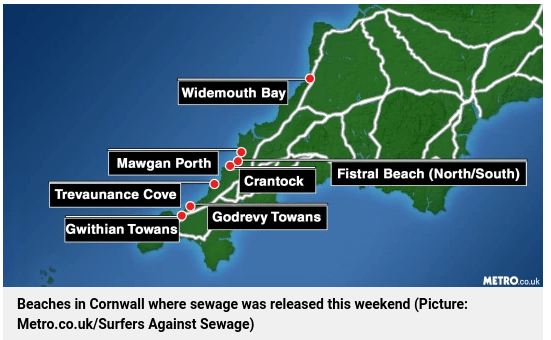
The picturesque view of a popular Cornish cove turned to something much more disgusting this weekend when raw sewage was released into the ocean.
Trevaunance Cove in St Agnes usually boasts turquoise – or at least greeny blue – seas, but on Sunday the vista became almost entirely brown.
Some blue could still be seen towards the edge of the sewage slick, however, demonstrating that the colour change was not down to the sky being overcast but due to contamination of the water.
A local surfer shared footage of the grim sight with surfing magazine Carve, who posted footage online saying it was ‘Unbelievable. A dad just got out this arvo and said to his three-year-old “Best wash the sewage off…”
‘It is still stinking. No way am I surfing in that.’
Another video posted online showed brown liquid pouring out of a pipe at St Agnes, captioned ‘sh*t pouring into the sea’.
South West Water admitted they had allowed sewage to be pumped into the sea, saying it was a ‘controlled release’ and they had to do this because of heavy rainfall, to stop sewage backing up into people’s homes.
But they denied the brown colour was entirely due to sewage, saying they believe it was also due to ‘mud in the water dislodged by the heavy rain flowing into the area from a nearby stream and runoff from agricultural land’.
Many responded to say how saddened they were by the images, tagging in South West Water to demand they stop the practice.
One woman wrote: ‘This breaks my heart. I’ve played with my kids on this beach.’
Another said: ‘@SouthWestWater how DARE you. Can you imagine what this does to our marine life, let alone humans who choose to swim at this time of year. Shame on you. What have you got to say for yourselves?’
Water companies are banned from dumping raw, untreated sewage into our seas and rivers, but they get around it with an exception.
After heavy rainfall, they are legally allowed to release wastewater in order to stop the sewer system becoming overwhelmed.
These ‘storm overflows’ are only supposed to happen in ‘exceptional circumstances’.
But Surfers Against Sewage reports that they are occuring at an ‘alarming rate’.
Writing in Metro.co.uk in August, former Green Party leader Caroline Lucas blamed a lack of investment in the water network, lax regulation and cuts to funding for the Environment Agency, claiming that privatised water companies had ‘utterly failed’.
She said data suggests the amount of sewage pumped into UK waterways has increased by 2,553% in the past five years.
Surfers Against Sewage, an environmental group who monitor the waste dumping, warned that there were eight locations where sewage had been released at beaches in Cornwall this week alone: Gwithian Towans, Godrevy Towans, Trevaunance Cove, Crantock, Fistral North and Fistral South in Newquay, Mawgan Porth, and Widemouth Bay near Bude.
Their warning for Trevaunance Cove at St Agnes reads: ‘Pollution Alert: Storm sewage has been discharged from a sewer overflow in this location within the past 48 hours.
‘Trevaunance Cove is a small sand and rock beach set in a picturesque cove surrounded by high cliffs, also home to SAS HQ! A reasonable amount of sand is exposed at low tide and it is possible to walk over the rocks to the neighbouring Trevellas, while at high tide the whole beach is covered.
‘Two sewer overflows discharge into the Trevaunance Stream, 70m and 750m upstream from the beach. Other discharges from the surrounding urban area may also affect bathing water quality especially after heavy rainfall.’
A South West Water spokesperson told Cornwall Live: ‘This year the South West has seen the dramatic changes in weather patterns presented by climate change, as demonstrated in August when the region was declared in drought. Through these changes we are now experiencing more extreme weather patterns than ever before and this year the South West saw one of the driest and hottest years on record.
‘As well as prolonged periods of extremely hot weather, we have seen heavy localised rainfall which hasn’t been able to permeate into the dry ground, meaning significant volumes run into our network, which can cause our storm overflows to trigger.
‘Following heavy, localised rainfall this morning (October 30), a permitted storm overflow triggered at Trevaunance Cove in St Agnes, Cornwall. Storm overflows are designed to release excess storm water into rivers and seas when a prolonged rainfall occurs to prevent the risk of sewage backing up and flooding homes and public spaces by allowing a controlled release.
‘We continue to increase investment in the region’s infrastructure as part of our continued commitment to protecting and enhancing the natural environment.’
But a spokesperson later told Metro.co.uk: ‘While the storm overflow at St Agnes triggered briefly on Sunday following heavy rain, this was a short duration spill and is unlikely to have caused the level of discolouration shown in the video.
‘On this occasion, we believe there were other factors which contributed to the discolouration, such as mud in the water dislodged by the heavy rain flowing into the area from a nearby stream and runoff from agricultural land.
‘We continue to increase investment in the region’s infrastructure as part of our ongoing commitment to protecting and enhancing the natural environment.’
Construction of a garden building Rydon Chase Rydon Lane Woodbury Devon EX5 1LBRef. No: 22/2308/FUL | Validated: Thu 20 Oct 2022 | Status: Awaiting decision
Hospitals and care homes have not received a single penny of a £500m emergency fund promised by the government to prevent the NHS becoming overwhelmed this winter, the Guardian has learned.
Ministers announced they were injecting the cash into the health and social care system last month, to help get thousands of medically fit patients out of hospital into either their own home or a care home as soon as possible in an effort to better prepare the NHS for the coming months.
“At the moment, one of the key challenges is discharging patients from hospital into more appropriate care settings to free up beds and help improve ambulance response times,” Thérèse Coffey, the then health and social care secretary, said on 22 September. “To tackle that, I can announce today that we are launching a £500m adult social care discharge fund for this winter.”
However, the Guardian has been told that none of the funding has materialised. Senior health and social care sources described the government’s failure to release the promised cash as “inexplicable” and “outrageous”.
More than 13,000 of the 100,000 NHS hospital beds in England currently contain “delayed discharge” patients, which has led to A&E units becoming heavily congested and long delays in ambulance handovers. As a direct result, thousands of 999 patients are suffering potential “severe harm” every month because ambulances are stuck outside hospitals.
The revelation comes after Coffey, demoted to environment secretary this week by the new prime minister, Rishi Sunak, took to Twitter on Tuesday to trumpet her 50 days in charge of the NHS and social care. “Huge thanks to my great ministerial team [at the Department of Health and Social Care],” she wrote. “We achieved a lot together in seven weeks.”
The £500m adult social care discharge fund was intended to relieve pressure on hospitals by ensuring that patients whom doctors have judged well enough to leave can be safely discharged either to their home or into a care home.
Ministers said the £500m was going to help hospitals, care home operators and providers of domiciliary care services, which mainly assist frail elderly people who live at home with tasks such as eating, dressing and getting out of bed.
“The local NHS will be working with councils with targeted plans on specific care packages to support people being either in their own home or in the wider community,” Coffey said when announcing the cash injection last month. “That £500m acts as the down payment in the rebalancing of funding across health and social care as we develop our longer-term plans.”
The NHS Confederation, which represents the health and care system in England, Wales and Northern Ireland, called on the new health and social care secretary, Steve Barclay, to make it an “immediate priority” to release the cash.
“Leaders across the NHS and local authorities are yet to see a single penny of this investment or any official detail on how it will be allocated,” said Matthew Taylor, the chief executive of the NHS Confederation.
“Currently, only two-fifths of patients in hospital are able to leave when they are ready to do so, including due to problems accessing social care, yet health leaders still do not know how and when the £500m will be released to the system. So close to winter, this is unbelievable.
“We have a new prime minister who health leaders hope will bring stability to the government and unblock the policy paralysis that has consumed Whitehall. Vital public services and the communities they serve are currently paying the price of this political chaos.
“Without the immediate release of the adult social care discharge fund, the prospect of a winter crisis for the NHS is extremely high and so the government really does need to act now.”
Labour MP Wes Streeting, the shadow health and social care secretary, said: “The NHS is facing the biggest crisis in its history and the chaos in the Conservative party is preventing them from fixing it.
“Even the sticking plasters promised to the NHS and care homes to get them through the winter haven’t been delivered.”
The Guardian has approached the Department of Health and Social Care for comment.
“If we’re really saying that in the sixth richest country in the world that our Prime Minister can’t be bothered to get there because he’s busy, what about all of those prime ministers in countries that are absolutely on the front edge of the climate emergency right now?” – Caroline Lucas MP
Boris Johnson ‘planning to attend Cop27’ as criticism of Rishi Sunak climate summit snub grows.
Boris Johnson is reportedly planning to attend Cop27, as criticism of Rishi Sunak’s snub of the key climate event grows.
Downing Street confirmed this week the new Prime Minister will not be in Egypt for the summit, as he was prioritising the autumn budget instead.
That decision has been widely denounced, with claims it shows a ‘lack of leadership’ on such a significant global issue.
And now The Observer claims that Mr Johnson is planning on going instead, though in what capacity is not yet clear.
It comes just days after Mr Johnson ruled out joining the race to replace Liz Truss, abandoning a second attempt at running the country three months after he was ousted by his own MPs.
Attendance at the climate conference has been contentious, with former PM Liz Truss advising King Charles against going despite his well-known interest in environmental campaigns. Though she has since resigned, her successor Mr Sunak has upheld this advice to the new monarch.
Instead, the King will host a reception at Buckingham Palace for business leaders, NGOs and experts ahead of Cop27, it has been confirmed.
The reception is seen as a compromise between the Palace and Downing Street, allowing the King to still show his solidarity with the battle against climate crisis.
Ed Miliband, Labour’s shadow secretary of state for climate change, said it was an “embarrassing reflection” of the government’s failure to deliver on its Cop26 commitments. “This is a massive failure of climate leadership,” he added.
And speaking on Sunday, Green Party MP Caroline Lucas said the decision was “disgraceful”.
Asked about reports Mr Johnson could attend the summit, she told the BBC’s Sunday With Laura Kuenssberg programme: “I think this is probably about the first decision that Boris Johnson has made that I might support.
“If it embarrasses Rishi Sunak to reverse his disgraceful decision and actually get there himself, all and good.
“I’m not suggesting necessarily that Boris Johnson is doing it for the good of the planet, I suspect a great deal of self-promotion is going in there as well, but let’s take it, let’s have him go there.
“It is absolutely so wrong that Rishi Sunak is not going because the UK is still the holder of the Cop presidency, symbols matter.
“If we’re really saying that in the sixth richest country in the world that our Prime Minister can’t be bothered to get there because he’s busy, what about all of those prime ministers in countries that are absolutely on the front edge of the climate emergency right now?”
When asked about reports of Mr Johnson’s alleged attendance at the summit, a Downing Street spokesperson said: “The Government is absolutely committed to supporting COP27 and leading international action to tackle climate change and protect nature.
“The UK will be fully represented by senior ministers, including the Foreign, Business and Environment Secretaries as well as COP President Alok Sharma.
“They will be working to ensure that countries continue to make progress on the ground-breaking commitments made at COP26 in Glasgow.”
A fresh round of BBC cuts is due to be announced on Monday, with sources telling the Guardian it will herald the end of most local radio stations as truly distinctive standalone outlets.
Plans under consideration include cutting the number of weekday shows on each BBC local radio station to two, leaving just a breakfast show and a lunchtime programme. Output during the afternoons and evenings would consist of shows broadcast on multiple local stations across large swathes of the UK or nationally.
Weekend output, with the exception of sport coverage, would also be largely run on a regional basis – spelling the end for many of the unique shows now airing on local stations.
Although the BBC has trumpeted the success of its 39 English local radio stations as being at the heart of their communities – especially during the pandemic, and in a recent round of interviews with Liz Truss – they are facing two key challenges.
One is the enormous financial impact of the real-terms freeze to the licence fee and the challenge of rampant cost inflation. The other is the shift in audiences, with BBC bosses wanting to redeploy staff from radio stations with ageing, declining audiences to make content for younger, growing audiences online.
The plans would be confined to stations in England, as the devolved nations have their own teams and management structure.
Any such changes are likely to result in dozens of job losses, rounds of voluntary redundancies and presenters having to reapply for their jobs. Some well-known local hosts are likely to lose their jobs in the process or have to take up joint producer-presenter roles.
BBC bosses will set out their plans in detail this week, with staff invited to calls from Monday onwards to hear “proposals to reshape BBC England into a full multimedia service”.
A BBC spokesperson told the Guardian: “We announced back in May that we would be introducing greater programme sharing between our 39 BBC local radio stations in England. This will enable us to increase investment in local digitised services.
“We will be sharing more information on these plans very shortly – and our own staff will of course hear about any proposed changes first. Our local services are trusted by millions of people and our plans are designed to ensure we keep pace with audiences in a fast-changing world.”
The latest cuts follow previously announced plans to end regional TV news bulletins for Oxford and Cambridge.
Last month, the BBC’s director general, Tim Davie, warned MPs that the corporation was being forced to cut costs because of the decision to freeze the licence fee. Speaking to the digital, culture, media and sport committee he said: “We are under very significant pressure, due to the decision to keep the licence fee flat, which we didn’t want.”
But, he added: “We need to continue to invest and grow our local offer. I think it is an absolute key strength of the BBC.”
The BBC told the government it will face a £285m gap in its income by 2027 because of the licence fee freeze. Last month the BBC announced deep cuts to its World Service output involving the loss of about 382 jobs in an attempt to save £28.5m.
As part of the plans the corporation will stop producing radio output in 10 languages, including Chinese, Hindi and Arabic. BBC Persian will also end its audio broadcasts aimed at Iran.
There will also be a change in focus for the World Service’s English-language radio output, with more time dedicated to live news and sport programming at the expense of standalone programmes.
The latest listening figures, released last week, showed BBC radio now accounts for 46.7% of all radio listening in the UK, compared with commercial radio on 50.9%.
While the BBC continues to maintain dozens of distinct local stations at substantial cost, the big commercial groups have gone for a different strategy.
They have combined dozens of once-distinct local radio stations under national brands such as Heart and Capital, providing the bare minimum of local output to meet requirements set out by media regulator Ofcom. Despite complaints about the loss of local identities, the new outlets perform well with audiences and tend to boost listening figures.
The BBC’s existing licence fee agreement runs out at the end of 2027 and discussions are under way about what could replace it.
Former PM Liz Truss had thrown doubt on the aim, saying she wanted to scrap “Stalinist” housing targets.
But Mr Gove – who returned to cabinet after Ms Truss’s resignation – told the BBC he wanted to build more homes, both for ownership and to rent.
He added that new developments should have the consent of local communities.
The minister also warned meeting the target would be “difficult” due to the economic circumstances.
“We need to be straight with people: the cost of materials has increased because of the problems with global supply chains and also a very tight labour market means that the capacity to build those homes at the rate we want is constrained,” he said.
Asked about Ms Truss’s past comments on housing targets, Mr Gove said: “The top-down housing targets that… Liz was referring to are part of a broader and different calculation from the 300,000 in the manifesto.
“My view is that what we do need is a fair way of allocating housing need that takes account of changes in population.”
He said new developments should be “more beautiful”, have the consent of the local community, be accompanied by the right infrastructure and protect the environment.
During the interview on Sunday with Laura Kuenssberg, Mr Gove also avoided saying whether the government would raise benefits in line with inflation.
He said there would be “tough decisions” but that the prime minister’s “instinct” was to help the vulnerable.
Speaking to the same programme, former Conservative Chancellor Philip Hammond – who originally set the target – said he would be “very surprised” if the government did not increase benefits in line with inflation.
The UK is experiencing what many have described as a housing crisis, with millions living in sub-standard conditions and long waiting lists for council houses.
However, building more homes has proved a headache for Conservative prime ministers.
In 2017, then-chancellor Mr Hammond set the target of building 300,000 homes a year by the mid-2020s and the party recommitted to the aim in its 2019 manifesto.
However, Boris Johnson’s efforts as prime minister to increase building by forcing local councils to accept new housing developments in certain areas had to be paused after a backlash from his own MPs, one of whom warned it would see the south of England “concreted over”.
Earlier this year, former housing secretary Robert Jenrick said the government would “miss their 300,000-homes-a-year manifesto pledge by a country mile”.
In the Conservative leadership campaign over the summer, Ms Truss hinted she would scrap the target, telling The Telegraph “I want to abolish the top-down Whitehall-inspired Stalinist housing targets – I think that’s the wrong way to generate economic growth.”
During the contest, Mr Sunak’s team also said he did not believe in arbitrary or top-down numbers for housing.
In May, Mr Gove himself appeared to cast doubt on the target.
He said the government would do all it could to meet the figure, but added that it would be “no kind of success simply to hit a target if the homes built are shoddy, in the wrong place, don’t have the infrastructure and are not contributing to beautiful communities”.
“Arithmetic is important, but so is beauty, so is belonging, so is democracy,” he had said.
However, when asked by Laura Kuenssberg if the government was still committed to the 300,000 figure, Mr Gove said: “Yes.”
He also confirmed that he would be continuing with previously announced legislation to tackle rogue landlords, saying: “These chancers are leaving people in dire circumstances.”
THE LAST-DITCH ATTEMPT FOR CLYST ST MARY’S WINSLADE PARK BATTLE!
Calling all East Devon oracles and wise feathered friends for much-needed advice in answering, seemingly, irresolvable questions!
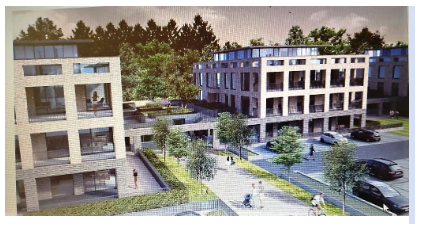
Residents have had to overcome continual, stumbling blocks, submissions of erroneous information, widespread lack of empathy and immeasurable anxiety, leaving innumerable questions still unanswered – but, now, (quite rightly) the Planning Committee on 25th October 2022, recommended a site meeting to allow attendees to make a final decision on these controversial 40 four-storey towering blocks in this East Devon village (Planning Application 21/2217/MRES). However, planning protocol only allows for the elected planning attendees at the site meeting having a decision-making vote on this application – so those unable to attend the site meeting are unable to vote on the ultimate resolution!
After umpteen local objections (including from the Parish Council and District Councillor),with a recommendation of refusal from a revered planning barrister, with submissions of verifiable, explanatory documentation to create balance and defend against the Developer’s slanted opinions – is it not disrespectful that the site meeting is being planned whilst the elected Clyst Valley Ward representative is absent on a brief holiday – since he is the sole Councillor who knows the problems, solutions and Clyst St Mary village inside out? However, crucially he has objected to the flats being too tall and too near to the protected woodland, which goes against the planning officer’s recommendation of approval?
Is it reasonable to expect (even with staff shortages!) that correct, balanced information is given to a decision-making Committee? The Officer’s Report published the wrong Location Plan (instead erroneously displaying the approved Zone A site for 38 homes on a green field, that was recently granted permission for viability purposes to finance the entire Winslade Park masterplan); there were out-dated photographs, apartment heights measured without proposed increased ground levels, omissions in distances from the flats, elevated road and parking spaces to the nearest receptors’ boundaries, (preferring to exclusively provide discriminatory Developers’ data, which had been selected to compliment an approval recommendation to Committee)?
Councillors’ legitimate concerns were ‘batted away’ by the Lead Planner at the meeting, who seemed to ‘not be aware’ of proven, detrimental issues that might risk and affect the officer’s approval recommendation– we are all aware that EDDC needs to ‘bolster’ the lapsed 5-year housing quotas – but are decisions being guided at any cost to existing residents?
Do members of the public have to tolerate being in a forum of political battles, sarcasm and inappropriate comments between elected Planning Committee Members from opposing political spectrums, during their discussions on such major contentious applications, when important decisions are so critical to so many East Devon residents’ lives?
Is the planning authority concerned about staff shortages and the costs of an Appeal if they refuse this application? An Inspector’s decision may not be as ‘cut and dried’ as the Committee may be led to believe?
Should a complaint be registered for allowing a highly irregular planning committee procedure, that permitted supplementary, but unverified, new images from the Developers to be viewed by Committee, (after the Developer had already exhausted his allocated time, which gave him advantage for strengthening bias by assessing the mood of the meeting, when public objectors were only allowed an initial 3-minutes maximum restrictive ‘influential window’?
Such breaking with planning protocol, resulted in the Lead Planning Officer being subjected to the onerous task of warning Councillors that such images should not be given any credence or decision-making weight?
Will such justifiable complaints result in worsening an already bad situation for residents by ‘fuelling the fire’ of undisciplined party differences, resulting in displeasing some impartial elected attendees who might agree with the residents call for a refusal?
EDDC appears to be a local authority that does not allow members of the public to contribute at a Planning Committee site visit (even if their gardens are required for access for such visits)? On the other hand, will the Developers be present, giving them (yet another) opportunity to further promote their development alongside the planning officer’s recommendation – but without being challenged – so virtually this would be an inequitable tribunal – a one-sided argument?
Without any severe frosts, our treasured, deciduous woodland has retained its foliage! Consequently, to date, Committee attendees will be unable to view the sparse winter screening evident for 6 months of the year – but, fortunately, they have received residents’ winter photos that were lacking in the Officer Report images?
We take little comfort from an elected member’s patronising suggestions at 25th October planning meeting, that existing residents can all plant fruit trees in our gardens to screen the Developers’ 40 x four-storey development from our homes! So far, we have failed to yield any positive results when searching for tree suppliers who can provide approximately 15-metre fruit tree specimens that are capable of screening these towering flats within the limits of most of our lifetimes – and we may also require the use of an extendable cherry-picker for harvesting any fruit from such insurmountable heights!
If site attendees recommend an approval, many Clyst Valley Road homes will require the complete re-arrangement of their entire gardens, their al fresco dining, their outdoor leisure activities and, quite honestly, their entire lives – because we spend as much time outside in the gardens as indoors and (like others) our outdoor spaces are intrinsically important to us.
All we ask for is a fair, impartial planning system that is balanced and works for everyone – developers and residents alike – but we don’t see this happening with this application- and so we must continue to make our voices heard – whether we will succeed in improving this inappropriate design or fail in our final last-ditch attempt – remains to be seen!


 28 The Signals Feniton Devon EX14 3UPRef. No: 22/2357/FUL | Validated: Fri 21 Oct 2022 | Status: Awaiting decision

 East Devon Watch