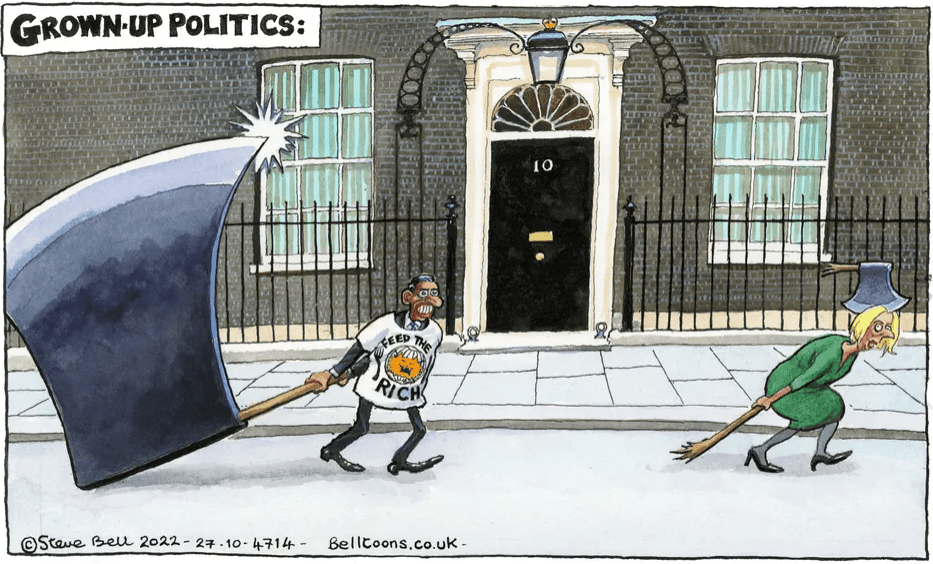
“Leaky Sue”: ‘delete and ignore’ email (shred before reading, safer – Owl)

Not to be confused with “Chatty Liz” and her hacked mobile.

Suella Braverman is ‘first-rate’, says Michael Gove as he is confronted with her ‘delete and ignore’ email.

Adam Forrest www.independent.co.uk 

Rishi Sunak was right to reappoint “first-rate” Suella Braverman as home secretary, said Michael Gove, confronted with an email she sent asking someone to delete a message that broke security rules.

The levelling-up secretary defended the prime minister’s controversial decision to bring Ms Braverman into cabinet only six days after she was sacked for a security breach.

Asked if the PM was right to hand her the role, Mr Gove told Sky News: “Yes. Suella is a first-rate, front-rank politician. She has acknowledged the mistake that has been made.”

The senior Tory figure added: “She is a valued member of the cabinet, and someone whom I admire a lot,” later telling the BBC that the prime minister thought “she deserves a second chance”.

Ms Braverman has claimed that she told top government officials about her mistake after sharing a sensitive government document via her personal email.

Appearing on Sunday with Laura Kuenssberg, Mr Gove was confronted with a leaked email showing that Ms Braverman had asked a recipient to “delete the message and ignore” at around 10am, hours before officials were eventually told at midday.

Mr Gove said the request to ignore and delete the email was “standard practice” and would be “quite proper” – going on to claim that Ms Braverman was “absolutely” a politician of integrity.

He added: “I am satisfied, more than satisfied, that in resigning, accepting responsibility, apologising, and then in being assured by the cabinet secretary and the prime minister that Suella coming back into office was the right thing, that Suella is now in a position to do the work that she is dedicated to doing.”

Labour’s shadow home secretary, Yvette Cooper, said the “delete and ignore” email “adds to the serious list of questions we have about this reckless reappointment of Suella Braverman”.

She told Laura Kuenssberg: “There was obviously the initial breach of the ministerial code, the security lapses involved, but now questions about whether she gave an accurate description of what happened.”

Mr Gove also denied that Ms Braverman had rejected legal advice from top officials on overcrowding at an asylum processing centre in Manston in Kent and the need to transfer people to hotels.

The home secretary was advised weeks ago that migrants were being held for unlawfully long periods at the centre because of the failure to transfer them, multiple sources told The Sunday Times.

Charities told The Independent that asylum seekers were held at the facility for several weeks when it was intended to hold people only for 24 hours, with outbreaks of diphtheria and scabies reported amid the “inhumane” conditions.

“The situation at Manston is not what it should be,” Mr Gove told Sophy Ridge on Sunday. “But it’s important to stress that the home secretary did not ignore or dismiss legal advice. The home secretary was balancing a number of competing imperatives.”

Asked if conditions were “humane”, the minister said: “Yes… We want people to be in appropriate accommodation as quickly as possible. The situation is not perfect, everyone acknowledges that. We have more than 2,000 people there at the moment.”

The Liberal Democrats have called on the government to publish the legal advice reportedly ignored by Ms Braverman that the government has been illegally detaining thousands of asylum seekers.

Andy Baxter from Prison Officers’ Association, who represents staff at Manston processing centre, said Ms Braverman should resign over the issue, telling LBC Radio conditions at the overcrowded facility were “Dickensian”.

Former Home Office adviser Claire Pearsall told LBC she did not think Ms Braverman could survive the week, given the gravity of the Manston-related accusations. “I don’t see how she can stay in position if legal advice is being ignored on something as serious as this.”

Former Tory chancellor George Osborne said No 10 had already calculated and accepted that Ms Braverman would “blow up” as she continues faces flak over her security breach and handling of aslyum seekers.

He told Channel 4’s The Andrew Neil Show: “I think they probably made a calculation in Downing Street that she’s going to blow up – and that’s fine by them because, you know, she’s no fan of theirs and they’re no fan of hers.”

Meanwhile, Mr Gove admitted that the Conservatives owed the public an apology for installing Ms Truss as leader, calling her tax cuts “a holiday from reality”.

The levelling-up secretary said Mr Sunak had been “vindicated’ on the big economic matters after Ms Truss took a “wrong turn” on unfunded tax cuts.
Finance, property and mining: the money behind Sunak’s £460,000 leadership bid

Rishi Sunak’s Conservative party leadership bid was bankrolled to the tune of almost £500,000 by City figures including a multibillionaire hedge fund manager, a spread betting tycoon, and intriguingly, a close friend and policy adviser who masterminded his campaign.

Rupert Neate www.theguardian.com

Sunak, 42, who together with this heiress wife has a £730m fortune, received a total of £458,570 in donations as well as gifted office space and the use of a private jet for his failed – but then eventually successful – bid to lead the Conservative party and become prime minister.

He received more money than any of the other contenders in the race, ahead of Liz Truss who collected £424,000, and in excess of the £300,000 spending limit put in place by the Conservative party.

Chris Rea, industrialist

Sunak’s single biggest backer was Chris Rea, a little-known Northern Irish businessman. Rea, who runs the manufacturing company Aesseal, donated £100,000 according to the register of members’ interests. He gave £50,000 on 28 July, followed by another £50,000 on 9 August.

Rea, who has been confused by some with the Road to Hell rocker, has been a long-time donor to the Conservatives including £25,000 in 2008 and £100,000 during the 2010 election campaign.

Rea told the Guardian that he chose to donate to Sunak because he was “horrified at the prospect of Liz Truss actually implementing her promises as I am numerate and it was clear to me that it would be bad for the UK”.

He said Sunak did not solicit the donation, but he did call him and invite him to a “thank you dinner in London” after Sunak lost initially to Truss.

Rea insisted there had not been and “never will be any conversations about any policies that will benefit me personally or Aesseal”.

“Frankly neither I nor the business need any help, and I and we are more concerned about what we can give to society than what society can do for us,” he added.

Michael Farmer, ‘Mr Copper’ hedge fund manager

Michael Farmer, a former Tory party treasurer, prominent Brexiter, hedge fund boss and metals trading multimillionaire known as “Mr Copper”, donated £38,470 including, as Sunak described it, “use of a plane during my campaign for leadership of the Conservative party”, a gift in kind valued at £23,470.

Farmer, 77, who made most of his estimated £150m via his Red Kite group of hedge funds, is one of the largest donors to the Conservatives, giving at least £6m over past last 10 years. He was Tory party’s co-treasurer from 2011-2015 and made a life peer in 2014.

Farmer, one of the world’s most influential commodity hedge fund traders, donated £300,000 to the Vote Leave campaign in 2017 and said Brexit would be a “bright new beginning” for Britain. He also donated £100,000 in 2011 to the No to AV campaign, which opposed replacing first-past-the-post voting with a transferable vote system.

He was an early public backer of Sunak, saying in July that the now prime minister was “a serious man” and said his plan to apply fiscal “discipline now and allowing some generosity later is the right way to handle the current economic difficulties”.

Farmer, who campaigns for “a culture that values family life” and became a Christian “literally overnight when he was 35”, shot to public attention in 2013 when it was revealed he had paid for his son George to join Oxford University’s notorious Bullingdon club, the male-only dining club that David Cameron, George Osborne and Boris Johnson attended.

George Farmer is now chief executive of Parler, the rightwing social media app that Kayne West – who changed his name to Ye last year – has said he is buying after he was blocked by Twitter for making antisemitic posts.

George is married to Candace Owens, the outspoken US rightwing political pundit. They tied the knot at the Trump Winery in Virginia in 2019 with a string of famous US and UK rightwing guests including the former UK Independence party leader Nigel Farage. George stood unsuccessfully for Ukip in the 1999 European parliament elections.

Nick Leslau, property developer

The second-largest donation came from Yoginvest Ltd, a company controlled by the multimillionaire property investor Nick Leslau, which donated £50,000. Leslau, who is estimated by the Sunday Times rich list to have a fortune of about £400m, owns big stakes in Alton Towers, Warwick Castle and Thorpe Park.

Leslau, who donated £20,000 to the Conservatives through Yoginvest in 2019, said in 2020 he would not give any more money to the Tories after the government banned commercial landlords from evicting shop and restaurant tenants struggling during lockdowns. “I think the flippancy with which the property industry has been treated has been narrow-minded,” he told the Times.

Mick Davis, mining tycoon

Sir Mick Davis, also a former Tory party treasurer and ex-boss of the mining company Xstrata, gave Sunak £25,000, and said last week any MP backing Johnson’s bid to return to No 10 was “delusional”. Davis has donated almost £6m to the Conservatives over the years. In 2011 he was revealed to be one of the people funding the jetset lifestyle of Adam Werritty, a friend of the former minister Liam Fox whowho posed as an official adviser in a scandal that let to Fox’s resignation.

Will Harris, PR boss

Office space in a Grade II-listed building near Westminster, worth £3,195, for advisers running his campaign was provided by Bridge Consulting Ltd, the home of PR firm Bridge F61. The firm, which has boasted on its website “We can make you rich, we can make you famous”, was co-founded by the the Tory marketing guru Will Harris, part of the team that devised the slogan “The future’s bright, the future’s Orange” for the mobile phone firm.

Harris, who says he campaigned for Michael Howard in 2003, the year he became leader of the Tory party, boasts on his website that working for political clients is akin to a “frantic T20 Blast”. “Despite a shared love of Jaffa Cakes and cans of Coke Zero, business campaigners rarely start their day at 5.45am with the morning media briefing, and I don’t see that changing any time soon.”

Eleanor Shawcross, political adviser

Another £20,000 came in from Eleanor Shawcross, a policy adviser who helped run the campaign from the headquarters in Dean Trench Street. She is expected to be rewarded with the job of head of the No 10 policy unit or possibly chief of staff.

She was among the staff who lined up to welcome the new prime minister as he walked through the door of Downing Street on his first day in the role.

Her donation was made in the name Eleanor Wolfson. She is married to Simon Wolfson, the chief executive of the clothing chain Next, who has given hundreds of thousands to the Tories, and was granted a peerage in 2010.

She is the daughter of William Shawcross, who has written several books on the royal family and former chair of the Charity Commission, and is a non-executive director at the Department for Work and Pensions and was deputy chief of staff to George Osborne when he was chancellor.

She met Lord Wolfson, who is 14 years her senior, while working for Osborne. The couple married in 2012 and have two children, one of whom was born prematurely and spent weeks in neonatal intensive care – she is on the board of the Winncott Foundation, which works to improve neonatal care.

Shawcross previously worked for the Bill and Melinda Gates Foundation and the Blavatnik school of government at the University of Oxford.

Michael Spencer, financial entrepreneur

Michael Spencer, the billionaire founder of the broker Icap, donated £25,000. However, the long-term Conservative backer who has given more than £5m to the party and as treasurer from 2006-2010, initially backed Penny Mordaunt with a £25,000 donation. The day after she was eliminated he donated to Sunak, and then later when Truss appeared to be winning he donated the same amount to her campaign.

In her first days in office he praised her as “one of the most pro-business” leaders the country has ever had.

Liz Truss’s phone ‘hacked by Putin spies who obtained top secret information’

Liz Truss’s mobile phone was hacked by agents presumed to be working for Russia’s Vladimir Putin during the Tory leadership race, according to reports.

Andy Gregory www.independent.co.uk

Opposition parties have demanded an urgent investigation into whether the then foreign secretary’s phone was breached by Russian spies this summer and, if so, why the matter was kept from the public.

In his position at the time as outgoing prime minister, Boris Johnson is alleged to have been informed of the hack immediately and agreed with his cabinet secretary Simon Case on a “total news blackout”.

The hackers are claimed to have gained access to sensitive information, including discussions with foreign officials about the war in Ukraine and details about arms shipments.

Messages between Ms Truss and her future chancellor Kwasi Kwarteng, in which the pair were critical of Mr Johnson, were among a year’s worth of message which were compromised, leading to a potential risk of blackmail, it is claimed.

The phone has now been placed in a locked safe at a secure government location, one individual told the Mail on Sunday, which cited unnamed sources with knowledge of the incident in its report.

“This caused absolute pandemonium,” another told the newspaper, accusing Mr Johnson and Mr Case of suppressing the matter.

“It is not a great look for the intelligence services if the foreign secretary’s phone can be so easily plundered for embarrassing personal messages by agents presumed to be working for Putin’s Russia.”

Ms Truss reportedly changed her mobile number of 10 years shortly before entering Downing Street.

Labour’s shadow home secretary Yvette Cooper said: “There are immensely important national security issues raised by an attack like this by a hostile state which will have been taken extremely seriously by our intelligence and security agencies.

“There are also serious security questions around why and how this information has been leaked or released right now which must also be urgently investigated.

“It is essential that all of these security issues are investigated and addressed at the very highest level and we need to know that the government recognises the gravity of this and the importance of fully protecting our national security.”

Liberal Democrat foreign affairs spokesperson Layla Moran called for “an urgent independent investigation to uncover the truth”, adding: “Was Liz Truss’s phone hacked by Russia, was there a news blackout and if so why?

“If it turns out this information was withheld from the public to protect Liz Truss’s leadership bid, that would be unforgivable.”

Tobias Ellwood, chairman of the Commons Defence Committee, told Sky News: “I have seen these reports. I don’t know the value or the sources and so forth. It is something for the sister committee, the Intelligence and Security Committee I think to investigate further.”

The government said it would not comment on an individuals’ security arrangements, but a spokesperson added: “The government has robust systems in place to protect against cyber threats.

“That includes regular security briefings for ministers, and advice on protecting their personal data and mitigating cyber threats.”

Reports on the hacking come as Rishi Sunak is resisting demands to launch an inquiry into Suella Braverman for her security breach.

He reappointed her as home secretary just six days after she was forced out after sharing a sensitive document with a Tory backbencher from a personal email without permission.

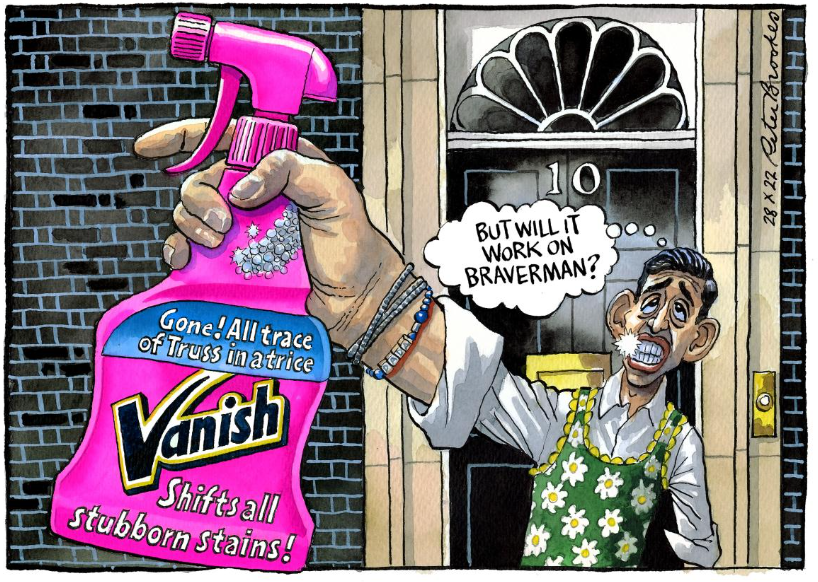
“Leaky Sue” the story that isn’t going away

Rishi Sunak is facing a crunch vote on the release of documents related to his controversial decision to appoint Suella Braverman as home secretary, as the prime minister comes under growing pressure.

Question is: how comfortable are the security agencies going to be in sharing secrets with her?

[And now we learn of Liz Truss’ mobile phone being hacked]

Adam Forrest www.independent.co.uk 

Labour has vowed to table a “humble address” that could force the government to share the security and risk assessments regarding Ms Braverman’s admitted security lapse.

Sir Keir Starmer’s party has demanded that Mr Sunak clarifies what he knew about Ms Braverman sharing documents from her own email account, and whether she may have leaked market-sensitive data.

Yvette Cooper, the shadow home secretary, said the prime minister and home secretary “cannot keep running away from these questions”, stating: “Our country’s security is too important for this Tory chaos.”

She added: “Labour will use every parliamentary mechanism open to force the government to come clean over [Ms Braverman’s] reappointment, to get answers, and to require detailed documents to be released to the intelligence and security committee.”

The humble address motion, set to be put forward on the next opposition day, would be binding, meaning that if Labour can win support from enough Tory rebels, the Sunak government will be forced to reveal the relevant documents.

Tory MPs have questioned the new prime minister’s judgement in handing Ms Braverman a key role as he attempted to shore up support for his leadership bid from the right of the party.

Veteran Tory MP Roger Gale told The Independent: “He did not do himself any favours, and it’s a shame he reappointed Suella Braverman. It took the shine off [a reshuffle] that everybody felt, ‘Yeah I can live with that.’”

Ms Braverman was reappointed only six days after she was fired by Mr Sunak’s predecessor Liz Truss for breaching ministerial rules by sending a sensitive government document from her personal email.

Several officials have disputed Ms Braverman’s claim to have reported her mistake to the cabinet secretary Simon Case as soon as she realised – with sources telling the BBC on Saturday that she had initially been “in denial” about the breach.

Ms Braverman is understood to have sent sensitive documents to her ally Tory MP John Hayes, but accidentally also copied in another MP who informed the party’s chief whip before the details were passed on to Mr Case.

According to The Sun, Ms Braverman leaked details about a “growth visa” planned by Ms Truss. Opposition parties have called on Mr Sunak to clarify whether Ms Braverman leaked market-sensitive data, since any details regarding growth plans could affect Office for Budget Responsibility forecasts.

Mr Sunak has resisted Labour and Lib Dem demands to launch a Cabinet Office inquiry into Ms Braverman’s breach of the ministerial code. Conservative MP Caroline Nokes has backed opposition calls for an investigation, and former Tory chair Sir Jake Berry described the breach as “really serious”.

Labour MP Chris Bryant told LBC that Tory ministers had said Ms Braverman would “have to go” because “they believe she is a threat to national security”. One Tory MP told the i: “I am afraid I agree with Keir Starmer, that this is a grubby deal.”

Removal vans were seen taking Mr Sunak’s belongings into Downing Street on Saturday, as the new PM and his family moved back into the same flat above No 10 that they used to occupy when he was chancellor.

As he struggles to draw a line under the row, Mr Sunak has hired ITV News chief Amber de Botton as his new director of communications. Unlike a civil servant, Ms De Botton – who has also worked at Sky News – will be able to give political advice to ministers.

Meanwhile, Sir Keir said on Saturday that it was not “a real laugh to crash the economy” as he argued that the country does not need a “comedian” as prime minister.

He was asked about countering his image as a “dull” politician in an interview with Mumsnet founder Justine Roberts, and said he found “the whole discussion pretty tedious to be honest”.

Sir Keir said: “We actually had a comedian with Boris Johnson, and it really didn’t go very well. And then we had Liz Truss. I don’t think it was a real laugh to crash the economy with that kamikaze budget.”

Peter Brookes – The Times

Developer donation from new homes built in Honiton boosts annual farming event

New homes built in East Devon have helped boost the farming community through a developer donation to Honiton Agricultural Show.

Becca Gliddon eastdevonnews.co.uk

Taylor Wimpey, who is building new homes in the town, has given a cash gift to the agricultural show and pledged to sponsor Honiton Band when it performs at the 2023 event.

Marcelle Connor, Honiton and District Agricultural Association secretary, said: “We can’t thank Taylor Wimpey enough for their support.

“The housebuilder’s contribution to this year’s event helped us host live music and make the event that bit more special for all of our guests.”

The developer said its donation was made as part of its ‘ongoing commitment’ to working with the local community.

Richard Plant, Taylor Wimpey Exeter spokesman, said: “We were delighted to be able to support this year’s Honiton Agricultural Show by sponsoring the Honiton Band so that they could perform throughout the event.

“This has grown to be one of the largest one-day agricultural shows in the country and it’s been a pleasure to support such a special local event.”

Traditionally, the annual agricultural show, set out on a140-acre site, is held on the first Thursday in August.

The show showcases the best of the region’s farming, produce, crafts and rural skills.

The agricultural show is an annual event.

This is what voters really think of Rishi Sunak

The bad news for Rishi Sunak is that voters do not think he is a fresh start, just the latest version of Tory chaos. He can hardly blame them.

Andrew Grice www.independent.co.uk 

Focus groups conducted by Labour show the public think Sunak had to make Suella Braverman home secretary to appease parts of his party with whom he disagrees. Sunak is seen as a rich man who, in a typical comment, “doesn’t get what it’s like for us”. Two out of three people want a general election now, in line with The Independent’s petition, according to Labour’s private polling.

The good news for Sunak: there is another side to the public opinion coin. Research for the centrist Tory think tank Onward shows that a majority of the 2019 Tory voters the party has lost are “don’t knows” rather than people who now back Labour or other parties. The Tories have lost four times as many voters than Labour has gained. If the Tories could win back the “don’t knows”, they would be within touching distance of Keir Starmer’s party.

Onward argues that the key is to revert to economic interventionism and social conservatism of the 2019 Tory manifesto. Indeed, Sunak is talking up the manifesto, in the hope of uniting his fractious MPs and repelling the growing calls for an election by insisting the Tories still have a mandate.

Sunak’s most immediate headache is the economy. Treasury sources tell me its latest predictions for the economy could leave Jeremy Hunt with a £50bn black hole to fill in his autumn statement on 17 November. However, I suspect they are painting it blacker than it is, in the hope the spending cuts and tax rises don’t look quite so bad on the day.

Whatever the real picture, Sunak and Hunt desperately need every ounce of growth they can muster to reduce government debt. Sunak is a 2016 Brexiteer, but a pragmatic – rather than ideological – one. Hunt was a Remainer who fully accepts the Brexit decision, but does not have Liz Truss’s zeal of the convert. So they know there is one thing they could do to boost growth: confront the elephant in the room by revisiting Boris Johnson’s threadbare Brexit deal.

While ministers point to global economic problems, the frictions and barriers of the Brexit deal are a unique drag anchor on UK trade, competitiveness, prices and the business investment needed to secure growth. Trade in goods with the EU has become cumbersome, costly and bureaucratic, while regulatory barriers hinder much of the trade in services.

The public’s reaction to changing Johnson’s deal might be less hostile than Sunak imagines. Onward found that Brexit was the second most cited issue by the Tories’ lost voters when asked where the government had most gone wrong, after political scandals.

Polling for the Tony Blair Institute for Global Change found that six out of 10 people believe Brexit has worsened the UK economy, including over a third of Leave voters. A majority of people, including Leavers, overwhelmingly support a better-functioning relationship with the EU, with 77 per cent backing closer trade and border arrangements.

Pro-Europeans in both the Tory and Labour ranks are setting Sunak a test. They accept this generation of politicians is not going to reverse Brexit, but say the prime minister must now make it work. They say there are many measures, short of rejoining the single market or customs union, which would help British companies and stop more of them moving to the continent.

In a speech at Oxford University on Thursday night, Peter Mandelson argued that Sunak’s “biggest test” is whether he can “put the nation’s need to work with the EU to solve problems before his party’s desire to seek confrontation with Europe at every turn”. The former business secretary and EU trade commissioner said: “He [Sunak] is not going to be able to confront the challenges facing Britain without first taking on those who won’t face up to the reality of our post-Brexit economic and trade choices and the importance of building a stable relationship with the EU.”

Although Starmer is often accused of ignoring the Brexit elephant to avoid handing the Tories ammunition, Mandelson suggested that might be changing, given the Labour leader’s strong belief in a partnership between government and business. “Labour is not going to reopen the original Brexit decision,” he said, “but nor should it be held hostage to its terms because we know that Britain needs to exploit trade opportunities in Europe more fully if we are to start growing again.”

Sunak would probably agree, in private. The question is whether he has the courage and political space to confront the hardline Brexiteers in his party. His decision to reappoint Braverman, the darling of the European Research Group, suggests not. But he has a golden opportunity: the “Singapore-on-Thames” version of a low tax, low regulation Brexit Britain has been discredited by Truss’s disastrous premiership.

For his party’s sake (to deliver growth) and the country’s (given the dire state of the public finances), Sunak cannot afford to be a prisoner of the right. He will need to bite the Brexit bullet.

Councils forced to buy 40,000 mirrors to put in polling stations as a result of voter ID laws

The Government is making councils buy 40,000 mirrors to put inside polling stations in order to comply with its own laws requiring voters to show ID, i can reveal.

Hugo Gye inews.co.uk 

The new laws will make it obligatory for everyone who wishes to vote to show their face to a member of staff at the polling station so it can be checked against their passport, driving licence or another firm of identification.

A provision in the legislation designed to protect the sensibilities of people who cover their face for religious reasons states that each station must have an area set aside with a “privacy screen” and mirror, where voters can show their face in private and then assemble their headwear.

It has now emerged that this will involve the purchase of a new mirror for every one of the 40,000 polling stations in the UK ahead of the local elections scheduled for next May.

Minister Andrew Stephenson said in a response to a written parliamentary question: “We estimate that one mirror will need to be purchased for each polling station and assume that there are 40,000 polling stations based on the 2019 elections.”

The requirement was criticised by Labour and electoral campaigners. MP Luke Pollard, who obtained the response, said: “At a time when families are struggling to access public services, making councils buy 40,000 mirrors is a howling waste of public money. This Government cannot be trusted to look after taxpayers’ money.”

Darren Hughes, of the Electoral Reform Society, added: “This is yet another result of the Government’s warped priorities when it comes to our elections. Instead of encouraging more people to vote, they’re putting up barriers instead. Now, ministers find themselves faced with finding solutions to the problems their own ID policy has created for voters.

“It’s vital people’s needs are addressed when attending a polling station, but it’s not just the lack of mirrors and privacy booths that will deter voters but the unnecessary requirement to show photo ID instead.”

Ministers have previously estimated that the cost to taxpayers of buying new equipment to comply with the law will be a total of around £2m.

A spokesman for the Department for Levelling Up, Housing and Communities said: “We are implementing voter identification in a way that works for all voters, including those with protected characteristics. Money for any new equipment will be provided by central government.”

UK councils slashing services to meet £3.2bn budget shortfall

Libraries and children’s centres are closing and home pick-ups for young disabled people being cancelled as councils try to meet a £3.2bn budget shortfall next year.

Rowena Mason www.theguardian.com 

With inflation and energy prices eating into budgets, local authorities across the UK are facing a record black hole that is unlikely to be plugged by central governmentas the Treasury is seeking to squeeze spending to make up for a £30-50bn shortfall in the public finances.

The trade union Unison collected data from 391 councils, compiled through freedom of information requests and financial statements, and found that almost nine in 10 have a predicted budget gap in the 2023/24 financial year.

Unison said its data shows the biggest budget shortfall of £80m next year is being faced by Birmingham city council, which lists Liz Truss’s mini-budget as one of the contributing factors in its worsening finances.

In the last few days, the numbers have worsened in several major council areas. Edinburgh council reported this week it is also facing a £80m black hole, up from £70m last month, with the Labour local leader warning of “probably the worst cuts I’ve seen in my time in this council”.

Kent county council said it was increasing its projected overspend to £70m, up from £50m just three months ago, with its Conservative council leader telling colleagues: “We’ve never been looking at a projected set of pressures on this scale; no one should doubt the gravity of the situation.” It said not a single department would be immune from cuts.

In Lancashire, the council said this week that its project shortfall has almost trebled, from £30.5m to £87m – even bigger than Birmingham. It is looking at cost-cutting measures on everything from cutting the grass less often to spending less on children’s home placements.

Unison’s investigation found that waste collections, leisure centres, nurseries and other vital services are already being cut in some local authorities in England, Scotland and Wales as they prepare for a tough year ahead. The data suggested the cumulative funding gap is to worsen to more than £5.28bn in 2024/25.

Some of the current and impending cuts include:

– Wirral Council shutting nine libraries by the end of this month, with two being handed to community and church groups

– Gateshead Council looking at closing two leisures centres deemed “unaffordable” as it grapples with a £6.5m shortfall

– Leeds city council cancelling Bonfire Night events in six locations next month to save £200,000 of non-essential spending at a time of budget pressures

– Hillingdon council, covering Boris Johnson’s constituency, planning to close all three of its nurseries, which provide more than 100 childcare places across the borough

– Hampshire County Council planning to scrap a transport scheme that take thousands of disabled children to school to save £1m. Home pick-ups would be replaced with drop-off points

– Norfolk county council planning to reduce access to recycling centres by closing them on Wednesdays, with its Tory council leader warning he had never dealt with funding reductions on this scale, to plug a £60m gap

The Local Government Association has warned Jeremy Hunt in a letter that the £3bn-plus shortfall facing councils will lead to cuts, particularly as inflation has worsened since the last local government finance settlement was announced. “Without immediate additional funding, councils will face increasingly stark decisions about which services to stop providing as rising costs hit budgets. This means not just isolated closures of individual facilities but significant cuts to services people rely on, including those to the most vulnerable in our society,” it said.

On Thursday, the Welsh Local Government Association (WLGA) also said its councils were facing pressures “on a scale never seen”, with “painful cuts” to come.

Christina McAnea, the general secretary of Unison, which represents 600,000 local government workers, said: “Cash-strapped councils are having to resort to ever more desperate measures after years of austerity just to keep services going. Now the government looks set to make their predicament infinitely worse with emergency cuts to spending after the mini-budget fiasco.

“Local communities cannot be the ones to pay the price for the government’s grotesque mismanagement of the economy. The new prime minister and chancellor ​must sort the crisis in local government funding, and give councils the cash they need to save services.”

Asked about the £80m shortfall at Birmingham, which is the biggest local authority, council leader Ian Ward said: “Like councils across the country, we are currently working up budget proposals for 2023/24 and everything possible will be done to safeguard the vital services that people across Birmingham rely on.

“As the Local Government Association has made clear, soaring inflation, energy prices and ‘National Living Wage’ pressures are putting council services at risk, while the cost of living crisis, made worse by the Tories crashing our economy, means increased demand for support and services.

“This is a perfect storm for local government and without government action, councils will have no choice but to significantly cut local services. So, if the government is truly committed to levelling up, then the chancellor’s autumn statement on 17 November must not signal a return to austerity.”

A government spokesperson said further details of spending will be set out in the autumn statement in November.

“We recognise councils may be concerned about their budgets in the face of the difficult economic times we are in and we continue to work very closely with them to understand the impact inflation may have,” the spokesperson said.

“This year alone we have made an additional £3.7bn available to ensure councils have the resources they need to deliver vital public services.”

Number of affordable rental homes for those on housing benefit drops by a third in five months

Five of the nine regions (the East, East Midlands, South West, West Midlands, and Yorkshire and the Humber), had fewer than one in 10 affordable one-bed properties.

Adele Robinson news.sky.com

The gap between housing benefit and the actual cost of private rent has risen by 40% in just five months, Sky News has learned.

Figures from the homeless charity Crisis and Zoopla show that affordable homes in England, for those on housing allowance, have declined by more than a third.

It means only 8% of private rental properties, on average, are now affordable to those on housing benefit.

Around 1.7 million households in England currently rely on Local Housing Allowance (LHA) to pay their private rent.

The statistics, which were given exclusively to Sky News, show that for a one-bedroom property households now face gaps, or shortfalls, of over £950 a year on average.

People living in two and three bedroom homes are having to find more than £1,500 and £2,300 (respectively) a year extra on top of their housing benefit.

Crisis chief executive Matt Downie said: “This isn’t a sort of prediction of things getting worse, it already is worse.

“We know that rough sleeping is going up. We know the councils have nowhere to put people.

“And unless, in the November financial statement, the government increases housing benefit in line with inflation, just like they’re talking about for other benefits, this is this is going to be catastrophic.”

Housing benefit levels have been frozen since early 2020 and are based on rents from 2018-2019.

Since then private rental rates have been rising at the fastest rate on record.

Mr Downie describes it as a “false economy”.

He added: “Once somebody becomes homeless, they cost far more to the state and they have to be put in temporary accommodation or helped in other ways.”

The new figures show the poorest households in England are being almost completely priced out of the rental market.

Nicole Hamilton, 27, is living with her two-year-old son Logan in emergency accommodation in London after fleeing domestic violence. She has been staying in a one room flat for months because she’s been unable to find an affordable rental.

The single mother works full time as a project manager but still needs housing allowance to pay rent.

That allowance, however, does not cover the local rents for a two bedroom property in the area where her son attends a childcare setting, and where her family live.

On the morning Sky News visited Nicole she had called the police out at 4.30am because somebody who looked like they were “on drugs” had been hammering on her front door trying to gain access while her son slept.

“I think it’s a bit unsafe,” she said, “I don’t really like it… the thing that is stressful at the moment is they don’t know how long I’m going to be here.”

“(Estate agents) also hear that I’m a single mum I’m on benefits, even though I work full time …and my income is good, but because I use benefits as part of the system to help pay my rent nobody is interested.”

The private rental market has become saturated due to an increasing supply and demand issue.

Rising mortgage rates, changes in tax and legislation have pushed more landlords out.

Renters are also signing up for longer lets which means less stock available.

Inflation and the cost of living have meant that the widening gap between private rent and housing allowance is predicted to get worse.

Cllr David Renard, housing spokesperson for the Local Government Association, also called for the freeze on housing allowance to be lifted, as well as greater support for authorities.

“Councils need more resources in terms of being able to fund homelessness services and to recruit the necessary housing officers to provide that support.

“So local authorities are very short of resources these days because of the increased demand.”

The Department for Levelling Up, Housing and Communities released a statement saying: “Our Renters Reform Bill will deliver a fairer deal for renters, empowering them to challenge unjustified rent increases.

“During the pandemic we increased Local Housing Allowance significantly, benefiting over one million households by an average of over £600 a year. This is alongside our Energy Price Guarantee which will save households on average £700 this winter with an extra £1,200 of cost-of-living support for the most vulnerable.”

London saw the most drastic fall in affordable properties, almost halving since April.

The North East, which Zoopla says is the region with the highest proportion of one-bed properties available, has just a quarter of affordable one-beds.

London is second worst with 13%.

According to Crisis, five of the nine regions (the East, East Midlands, South West, West Midlands, and Yorkshire and the Humber), had fewer than one in 10 affordable one-bed properties.

Citizen scientists play key role in helping Devon fish populations thrive

Fish populations could thrive in East Devon thanks to the Lower Otter Restoration Project (LORP). Local residents have been taking part in an ongoing ‘citizen science’ project with the East Devon Pebblebed Heaths Conservation Trust and Clinton Devon Estates, helping to carry out fish surveys that form part of the Project PACCo (Promoting Adaptation to Changing Coasts) environmental monitoring work in the Lower Otter Estuary.

Lewis Clarke www.devonlive.com

LORP is a landscape-scale climate adaptation scheme to address the impact of climate change, by returning the Lower Otter estuary and flood plain to a more natural condition. Its benefits include the re-creation of 55 hectares of intertidal habitats, including mudflat and saltmarsh which provide a home for numerous rare and endangered native and migratory species.

Along with the Saâne Valley in Normandy, France, the estuary is one of two pilot sites where 100 hectares of coastal wetland will be restored under Project PACCo. The aim of PACCo is to demonstrate that it is possible for coastal communities to deliver a range of benefits for people and the environment, by adapting pre-emptively to climate change. Led by the Environment Agency, this project lasting over 3 years has a budget of €25.7m, of which €17.8m in funding has been provided by the European Regional Development Fund, via the Interreg France (Channel) England Programme. The project is also part-funded by the Environment Agency.

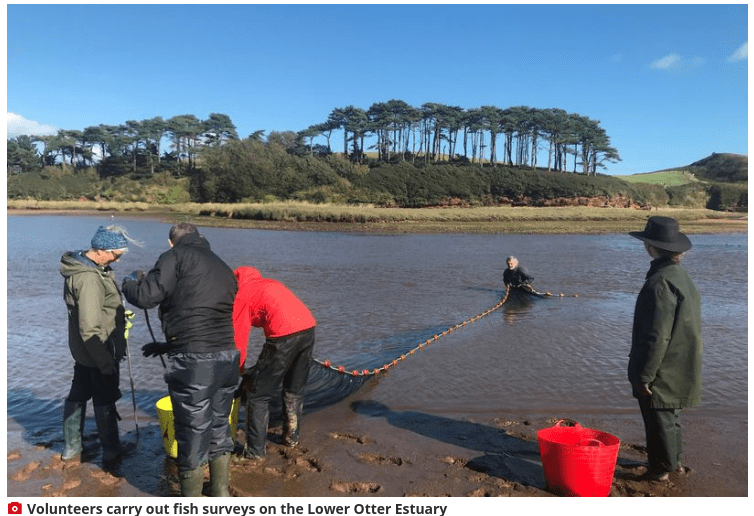
Fish surveys carried out on the Lower Otter Estuary

Fish surveys carried out on the Lower Otter Estuary

Volunteers have recently returned to the estuary and saltmarsh areas of the River Otter to continue gathering important baseline data, under the watchful eye of marine fisheries management consultant and marine lead for the Institute of Fisheries Management (IFM), Steve Colclough, a recognised UK expert in the field.

This data will be used as a baseline from which to inform how fish will hopefully thrive in the new saltmarsh area that will be created in 2023, when the embankment of the estuary is breached, as part of the LORP and PACCo schemes.

Steve said the signs are positive. In the latest survey, carried out in late July, similar species of fish were identified at the site, but were smaller, as this year the monitoring was taking place earlier in their life cycle. “It’s what we expected to find, but what this did demonstrate was that they had spent the whole summer in this environment and shows how critically important the area is as a marine nursery ground,” said Steve, who led another monitoring session at the end of September.

Steve continued: “Sadly, we have removed 80 percent of saltmarshes around western Europe over the past 200 years through land claim and sea defence work. Now we have the exciting potential, through this restoration project, to create a new saltmarsh as it was two centuries ago.

“The baseline data we have gathered so far suggest fish will thrive, but it’s not just beneficial for the fish and other wildlife. A new piece of saltmarsh is ten times as good as a piece of woodland for sucking carbon out of the atmosphere.”

Steve first joined volunteers working with the East Devon Pebblebed Heaths Conservation Trust/Clinton Devon Estates last September, when the initial two-day monitoring was carried out on the River Otter, which was also designated a Marine Conservation Zone in 2019.

Volunteers using intertidal netting

Volunteers using intertidal netting

Over two days they netted a number of fish species, including mullet, bass, pollock, plaice and an abundance of common gobies. During several training sessions, Steve has taught the volunteers the importance of estuarine areas to fish populations, how they use tidal flows to feed in intertidal habitats and how to identify certain fish species. They were also shown how to safely deploy both fyke and seine netting to catch fish for measuring.

Steve said the monitoring has also shown the strength of ‘citizen science’ in helping advance scientific study. As it has grown in popularity, he says the government is now seriously looking at providing additional support for projects moving forward.

Steve added: “These are local people who care about their local environment and you get a real sense of their commitment. The East Devon Pebblebed Heaths Conservation Trust and Clinton Devon Estates have a long-range plan to carry on this survey work themselves, now they have the trained volunteers to do it. The IFM will continue to support such citizen science programmes going forward.”

Patricia Hitchcock, who lives in Budleigh Salterton, spotted the opportunity for volunteers on social media. She and her husband Brian fish from a canoe off their local beach and she was keen to do what she could to help the local fish population thrive. “I have really enjoyed learning new skills and it’s very much ‘hands on’ too which I prefer,” said Patricia, who has taken part in all the sessions so far, and will join the next survey this month. I like the social side too, meeting new people. They call me the scribe as I write down all the figures for the fish count and then transfer them to a spreadsheet for Steve.”

Established in 2014, LORP is a partnership between landowner Clinton Devon Estates, the Estate’s East Devon Pebblebed Heaths Conservation Trust, the Environment Agency and Kier.

Kendal Archer, PACCo Environmental Project Manager for the East Devon Pebblebed Heaths Conservation Trust said that the embankment breach is a key element of the overall LORP and PACCo projects. “It will recreate significant areas of intertidal habitat, which it’s hoped will result in increasing numbers, and maybe species, of fish using the Lower Otter estuary as a nursery and for feeding and shelter,” said Kendal. “Increasing the fish population in this way has a wider importance for wildlife, birdlife and biodiversity as a whole, as well as the socio-economic fabric of the area.

Kendal also paid tribute to the volunteers who had joined the project, adding: “Citizen science formed an important part of the fish monitoring and will continue to do so.”

Other aims of the project include maintaining and securing existing public footpaths, some of which form part of the South West Coast Path, and working with tenant farmers from Clinton Devon Estates to adjust existing land use to make the project possible.

Vulnerable people in supported housing ‘victims of terrible crimes’, says report

England’s supported housing sector is a “complete mess” that is failing communities at the expense of the taxpayer and making residents “victims of terrible crimes at the hands of staff”, according to a scathing select committee report.

Jessica Murray www.theguardian.com 

The report found loopholes had turned the sector into “a licence to print money” for unscrupulous providers and that there has been “a complete breakdown of the system, which calls for immediate action from government”.

After a year-long investigation into “exempt accommodation”, a type of supported housing for vulnerable people with a broad range of needs, the cross-party levelling up, housing and communities (LUHC) committee called on the government to implement urgent reforms, including national standards and compulsory registration.

“We were absolutely shocked and appalled,” said the Sheffield MP Clive Betts, the chair of the LUHC committee. “As 11 MPs, we’re generally pretty experienced, we’ve been in public service a long time, and I think this was as bad as anything we’ve ever seen.”

The committee heard evidence residents were being “raped and sexually harassed by their landlords under threat of eviction” and “staff were assaulting residents and asking them for sexual acts in return for money, food or better accommodation”.

The report, published on Thursday, said residents had been forced to carry out work, such as tiling a bathroom, “for nothing or for a pittance”, and staff and landlords were selling drugs to residents.

There have also been instances of residents dying of drug overdoses or being murdered by fellow residents.

The Guardian recently reported that organised crime groups were taking millions of pounds of taxpayers’ money by buying properties and setting them up as supported accommodation to receive higher housing benefit rates but providing little to no support for the vulnerable tenants.

“We would describe the system of exempt accommodation as a complete mess,” the report states. “The current system offers a licence to print money to those who wish to exploit the system.”

Exempt accommodation, which is paid for through housing benefit, is set up to support people with a range of needs including refugees, care leavers, the formerly homeless, people with alcohol and drug addiction and those who have recently been released from prison.

It is exempt from locally set housing benefit caps to cover higher costs of maintenance and insurance.

The report criticised the government for failing to collect data on how many exempt accommodation claimants there were or how much taxpayer money was being spent on it, saying “successive governments have been caught sleeping”.

Crisis, a charity for people experiencing homelessness, estimates the number of households living in exempt accommodation grew to 156,868 from 2016-2021, a rise of 65%. A report from Prospect Housing estimated the annual cost in 2020-21 to be £816m, but the committee suggested it could be much higher.

“This issue has been ignored unacceptably. It’s happening all over the country,” said Betts. “We’re seeing people set their own rents, charge what they want and then provide nothing for it but bad accommodation.”

The report calls for urgent reforms, including national minimum standards for support and housing, extra powers for local councils, compulsory registration of all providers and the creation of a national oversight committee to mend “patchwork regulation”.

As part of their inquiry, committee members travelled to Birmingham, which has become a national hotspot for exempt accommodation. The number of claimants in the city rose to nearly 22,000 earlier this year.

The Birmingham MP Preet Gill, who campaigned to shut down a poor-quality exempt accommodation property in her constituency, said “the government needs to urgently get on with the job” of tackling the issue.

“For years I have been sounding the alarm about the explosion of the exempt accommodation sector in Birmingham, which has become a magnet for rogue operators, exploiting vulnerable residents and visiting misery on our area,” she said. “I am delighted the select committee has endorsed many of the reforms we have been campaigning for.”

Sharon Thompson, the Birmingham city council cabinet member for housing and homelessness, said the report reflected what the council “has been saying for a long time”.

“The government has finally woken up to the scale of the problem and, based on this report, they must now commit parliamentary time to bringing in new legislation,” she said.

The Department for Levelling Up, Housing and Communities said: “It is unacceptable that unscrupulous landlords are trying to profit at the expense of vulnerable people and we are bringing forward a package of measures to stop them in their tracks. This is backed by a £20m investment to drive up quality in the supported housing sector and protect the most vulnerable in society.”

East Devon’s cash saving £2 parking is back

East Devon District Council’s winter deal where car parking costs £2 all day is back. Running until the end of March 2023, you can park all day at any council car park for just £2.

Daniel Clark www.devonlive.com

The annual winter car parking deal comes at the right time with Christmas just around the corner giving people even more reason to shop local and support their High Street. By reducing car park charges across the district, the council hopes it will help to boost trade over the winter, especially during the typically quieter months of January and February.

Although a printed ticket may not display an expiry time of midnight, it will still be valid for the whole day. You are able to park in multiple locations throughout the whole day as all East Devon car parks across the district are eligible.

Cllr Jack Rowland, EDDC portfolio holder for finance, said: “The car park charge of £2 all day that applies from November 1 through to the end of March next year is great value in these difficult times and I hope that many residents and visitors will take advantage over the next five months and also help our local businesses.”

A spokesperson for East Devon District Council added: “It is hoped that residents and visitors will be able to take advantage of exploring what East Devon has to offer with no time constraint on their stay. From the myriad of local shops to the array of cafes and restaurants, our £2 all day parking ticket gives you the perfect opportunity to enjoy a full day out this winter.”

Scrapping farm nature payments may worsen English river pollution up to 20%

Weakening or scrapping the nature-friendly farming payment schemes could increase river pollution by up to 20%, an analysis has found.

Helena Horton www.theguardian.com 

The payments are due to replace the EU’s area-based payments scheme, in which farmers are paid for the amount of land they manage. The new system would instead pay land managers to provide “public goods” such as enhanced nature and clean rivers.

Liz Truss’s administration made reviewing the upcoming schemes a priority in the few weeks of her premiership, and government sources said the intention was to remove nature restoration from the programme.

However, Sunak’s government appears less hardline on this issue, and sources at the Department for Environment, Food and Rural Affairs (Defra) said a review of the schemes, originally planned for this week, was likely to be delayed, with few if any substantive changes from the original plan.

Removing incentives to create wetlands around waterways and increase biodiversity could mean rivers become more polluted. Every single river in England is polluted beyond legal limits, and 86% are deemed not to be in “good ecological condition”. According to the Environment Agency, agriculture is the reason for 40% of water bodies in England failing to meet good status, due to pollution from animal manures and slurries, the use of chemicals such as pesticides and fertilisers, and soil running off fields, especially in wet weather.

Government analysis, compiled by the water pollution campaign group River Action, has also found that a current localised nature-friendly payment scheme, Countryside Stewardship, reduced river pollution by 2%. However, its impacts are very localised; measures such as the planting of winter crop cover and the creation of ponds to retain runoff can reduce nitrate pollution by 10%, phosphates by 16% and sediment by 20%. This scheme was expected to be brought into the new payments system but strengthened, with further financial benefits for farmers who work across river catchment areas, meaning these local benefits could become more widespread.

Charles Watson, founder and chairman of River Action, said: “Removing the payments that reward these vital environmental measures would leave England’s rivers in an even more polluted and degraded state than they already are.

“The public is looking to the government to sort out this appalling issue and it is abundantly clear that more measures, not fewer, are needed to clean up England’s rivers, protect our wildlife and ensure communities can safely enjoy their local watercourses.”

Farmers and environmentalists have warned that the retained EU law bill, which had its second reading in parliament this week, could also threaten the country’s rivers.

The same government analysis found that regulation and good practice leads to a 7-8% reduction in phosphorus, nitrate and sediment pollution across Britain. The regulations referred to are ones which are enshrined in retained EU law, which the new bill could scrap.

What a time to be a fracker Simon!

What a time to be a fracker. No sooner had they ordered fresh geological surveys, drill bits, hard hats and barbed wire, than their hopes have been dashed. 

[But the ban on building new on-shore wind farms remains, despite them being the cheapest and quickest way to increase sustainable power generation. No logic to Tory thinking. – Owl]

Rishi Sunak has reinstated the fracking ban – but the damage of the Truss era is done

Editorial www.independent.co.uk 

In his first policy U-turn, announced as a response to a question from Green Party MP Caroline Lucas, Rishi Sunak has restored the moratorium on extracting shale gas that formed part of the 2019 election manifesto. Mr Sunak has made many errors of judgement in his brief but meteoric rise to power, but on this he deserves lavish praise.

Of course, there is a political aspect to the change of tone and policy. The fracking policy affected areas such as Lancashire, Yorkshire and Somerset which had plentiful supplies of marginal parliamentary constituencies as well as shale gas. Whether justified or not, residents feared that fracking would produce earthquakes and devastate house prices, as well as cause noise, traffic and noxious fumes during and after development.

The voters in these areas are disinclined to believe in assurances from fossil fuel companies that fracking is “safe”. Jacob Rees-Mogg declared that he’d be happy for it to take place in his back garden, but of course no such licence has been applied for that affects the Rees-Mogg estate.

In itself, the new ban will leave fossil fuels in the ground, help contain greenhouse gas emissions and will make it marginally easier to meet the Cop26 targets on climate change.

Symbolically, the revived ban is a clear signal that the Sunak government is at least somewhat more serious about climate change than Liz Truss was, and that is welcome. How far it will be followed by other measures designed to deal with the transcendent issue of our items is less clear.

Investing in green technology, insulating Britain’s stock of older, draughty homes and generating more power from renewables will cost public money, one way or another. There is little sign, for example, that the ban on new onshore wind turbines will be lifted or new solar farms encouraged. That investment will soon repay itself in cheaper energy supplies and stronger energy security, but the pressures on public spending are well-known and the Tories seem to have a visceral aversion to any change to rural land use (whether farmers and landowners agree or not).

They are certainly not acting like there is a climate emergency, or indeed a man in the Kremlin determined to “weaponise” energy. Britain is better off and safer with green energy, underpinned by a steady base load of nuclear power and a rapid run-down on fossil fuel usage. The UK is in a strong position to be something like what Boris Johnson called, albeit with typical hyperbole, “the Saudi Arabia” of wind.

Such confusions about policy are damaging to investment, whether in fossil fuels or renewables. Before the fall of Mr Johnson, they had no hope of being able to extract shale gas from Britain’s (or more accurately England’s) apparently plentiful reserves. Indeed, one of the few pieces of advice offered in public by Mr Johnson to his successor was that fracking wasn’t really worth it.

Then came the arrival of the impetuous Liz Truss, enthusiastically abetted by Mr Rees-Mogg, and her bold move to reverse the ban imposed by her predecessor. She often added that fracking would not be permitted without local support, but the method by which that would be measured and obtained was opaque. However, her intent was plain.

In one of her last legislative acts as prime minister, with a substantial injection of incompetence and confusion, she forced through her policy; it contributed significantly to her demise.

The damage is done, however, and the Sunak administration has been gifted the worst of all worlds. The voters in areas targeted for seismic action cannot trust the Tories to keep their promises on fracking, no matter how sincere Mr Sunak sounds. The energy industry, both fossil and renewable, is left with a development and pricing regime that they cannot rely on for the long term – the Conservatives are liable to change their minds, and Labour would reverse much of the policy framework they have created, such as it is.

The vast investments the energy companies have to make – especially in the nuclear sector – demand long-term security. A cross-party consensus on the future of energy would help, but it remains as distant a prospect as nuclear fusion or, for that matter, unrestricted fracking.

Plymouth City Councillors join forces for independent group

Three senior Plymouth councillors including the former Tory leader have joined forces to form a new independent group. Nick Kelly, Terri Beer and Chaz Singh are the founding members of the Independent Alliance Group on the city council, which is currently in a state of no overall control following Cllr Kelly’s recent departure from the Conservatives.

Philip Churm www.plymouthherald.co.uk

They say the new group will allow them to represent residents on the various city council committees, with Cllr Kelly explaining: “We share common beliefs and values, and simply want the very best for Plymouth’s residents and businesses.” Ousted as leader of the council earlier in the year following a vote of no confidence, Cllr Kelly left the Conservative group in acrimonious circumstances this month.

He claims he resigned after being deselected by the Tories, accusing senior members of the party of pursuing an “ongoing vendetta” against him. The Plymouth Conservatives, in a statement reported by PlymouthLive, responded by saying Cllr Kelly had been suspended pending an investigation following “several serious and different complaints and allegations made formally to our group executive team.”

His departure leaves the 57-seat council with 28 Conservatives, 24 Labour members, three Independents and two Green Party councillors. Cllr Terri Beer, last year’s lord mayor, resigned from Plymouth’s Tory group days after Kelly was replaced as leader by Cllr Richard Bingley in March.

She said of the new group: “Despite coming from very different backgrounds, we have a strong sense of fairness and equality.” The new alliance’s third member, Cllr Chaz Singh, a former deputy lord mayor, has been an independent member for three years since resigning from the Labour group in 2019.

He said: “We feel liberated that we can do the very best for Plymouth and our residents, and not be concerned about going against any national party policies or having disciplinary action taken against us. We are truly independent.” Cllr Kelly has opened the door for other councillors to join the group and claims that since leaving the Conservatives he has been “inundated with people urging me to stand as an independent and form an alliance.

“Previous councillors and councillor candidates have contacted me in the past few days wanting to stand and be part of this alliance in May 2023 [when the next elections will be held]. We already have enough candidates to stand in each of the 19 wards.”

He added: “This is something new and exciting, although a lot more work and planning will now start to truly offer the residents of Plymouth a real and credible alternative to the mainstream parties.”

Stop Revolving Door Payouts to Conservative Ministers: £16,876 for Raab

Kerching! One rule for them another one for us. – Owl

The Liberal Democrats have called on sacked and newly reappointed Conservative ministers to forego their redundancy payments, following the reshuffle announced by Rishi Sunak.

By Joseph Kennedy thehighlandtimes.com 

Conservative turmoil has led to huge numbers of former ministers being able to claim payouts, with the two reshuffles carried out since July potentially costing taxpayers hundreds of thousands of pounds.

Ministers who were sacked just months ago but have now been reappointed are still able to claim thousands of pounds each in redundancy pay, as long as they have been out of a ministerial post for at least three weeks.

For example Dominic Raab, who was sacked by Liz Truss in September but reappointed as Justice Secretary today, would be eligible to receive £16,876 despite only being out of a ministerial job for seven weeks.

Steve Barclay, who was reappointed as Health Secretary after being sacked in September, would also be entitled to the same full redundancy payout.

The Liberal Democrats have called the arrangement a “farce” and said this “revolving door bonus” should be returned to the Treasury to help struggling families with the cost of living.  

Liberal Democrat Cabinet Office Spokesperson, Christine Jardine said:

“It beggars belief that while families are struggling to pay their bills, many retiring Conservative ministers are set to receive thousands of pounds, some of them after just a few weeks in the job. 

“The Conservatives have trashed the economy, and now expect the British people to endure even more hardship to clean up their mess.

“What staggering unfairness, for the Ministers who got us into this financial mess to be rewarded with  taxpayers’ cash.

“Perhaps most egregious of all is the revolving door bonus for ministers who got a payout just months ago and have now already been reappointed.

“It is a complete farce.

“These payouts should be stopped, and the money should be spent on helping the many people who are struggling under Conservative misrule.”

So much for Sunak’s promise to restore “integrity” – the Braverman taint

Suella Braverman accused of ‘multiple’ breaches of ministerial code by former Tory chair

Andrew Woodcock www.independent.co.uk

Fresh questions were tonight being asked about Rishi Sunak’s decision to bring Suella Braverman back into government as home secretary, after a former Conservative party chair claimed she had been involved in “multiple” breaches of the ministerial code.

Jake Berry, who was chair when Liz Truss sacked Ms Braverman last week, said that she was responsible for a “really serious breach” relating to confidential government discussions of cybersecurity.

And he challenged Mr Sunak’s claim that the home secretary had confessed to breaking the code, telling Talk TV that “the evidence was put to her and she accepted the evidence, rather than the other way around”.

Mr Berry’s shock intervention adds to pressure on the new PM, who is already facing accusations of failing to deliver on his promise of “integrity” in government by granting Ms Braverman “impunity” for her misdemeanour.

And it suggests that Mr Sunak may face efforts to destabilise his new regime by members of the Truss administration, like Mr Berry, who he sacked after coming to power this week.

Ms Braverman was reappointed home secretary on Tuesday just six days after Liz Truss sacked her for sending cabinet papers to unauthorised people via her private email – and just hours after Mr Sunak promised that his administration would have “integrity, professionalism and accountability” at every level.

Labour leader Sir Keir Starmer accused the prime minister of doing a “grubby deal” with the leading right-winger in return for her support in the Conservative leadership contest, which effectively scuppered Boris Johnson’s hopes of a sensational comeback.

Concern over Ms Braverman’s return is understood to have been raised by the head of the civil service, Simon Case, who initially advised Ms Truss that her actions amounted to a breach of the code.

Neither Mr Sunak nor Downing Street denied that Mr Case had advised against the appointment, though the PM’s official spokesperson said he “did not recognise” reports that the cabinet secretary was “livid” at being overruled.

Announcing her resignation last week, Ms Braverman admitted she made a “mistake”, which she described as a “technical infringement” of the ministerial rules.

But questions remain about why she sent the document to fellow right-wing MP Sir John Hayes and how she accidentally copied in an aide to another MP, who sounded the alarm.

Mr Berry told Talk TV: “From my own knowledge, there were multiple breaches of the ministerial code.

“It was sent from a private email address to another member of parliament. She then sought to copy in that individual’s wife and accidentally sent it to a staffer in parliament.

“To me that seems a really serious breach, especially when it was documents relating to cybersecurity, as I believe. The cabinet secretary had his say at the time. I doubt he’s changed his mind in the last six days, but that’s that’s a matter for the new prime minister.”

Asked if Ms Braverman had “put her hands up” to the breach, Mr Berry replied: “I wasn’t in that meeting, but as I understand it, the evidence was put to her and she accepted the evidence, rather than the other way around.” The FDA union, representing top Whitehall mandarins, said any civil servant would expect to face “the harshest of penalties” for such a breach of security, including losing their security clearance.

“Standards matter, and the clear signal from her appointment is that ministers can act with impunity if it suits the prime minister,” said the union’s general secretary Dave Penman.

“This sends the country and the civil service a worrying message about how the new government will approach standards and national security.”

Meanwhile, Downing Street signalled that Mr Sunak had ditched a Truss plan to allow overall immigration to rise in the hope of stimulating economic growth by filling vacancies in shortage occupations.

A spokesperson said the new PM will stick to the pledge in the 2019 Conservative election manifesto that overall numbers will come down over the course of the parliament.

The change – which will make it more difficult for chancellor Jeremy Hunt to convince the Office for Budget Responsibility he can fill a £40bn hole in the national finances – sparked speculation that it was part of a deal with Ms Braverman in return for her support in the leadership contest.

Ms Braverman had clashed with Ms Truss over migration, after declaring a personal ambition to get net numbers down below 100,000 a year, in contradiction to the then PM’s plans.

But Mr Sunak’s press secretary denied the pair discussed the home secretary’s job when they spoke ahead of Ms Braverman’s dramatic declaration in his favour on Sunday, insisting the issue had only come up when he was allocating cabinet roles on Tuesday.

At Prime Minister’s Questions in the Commons, Sir Keir told MPs: “We can all see what’s happened here – he’s so weak, he’s done a grubby deal trading national security because he was scared to lose another leadership election.

James Cleverly defends Rishi Sunak’s appointment of Suella Braverman

“There’s a new Tory at the top, but as always with them, party first, country second.”

And the SNP’s Westminster leader Ian Blackford accused Mr Sunak of doing a “sleazy backroom deal” with Ms Braverman to help “shore up” right-wing support in his battle with Boris Johnson.

Mr Sunak retorted that he was “delighted” to have Ms Braverman in his cabinet.

“The home secretary made an error of judgement but she recognised that,” the new prime minister told the Commons. “She raised the matter and she accepted her mistake.”

Ms Braverman was later accused of “running away” from scrutiny after she left the Commons chamber rather than respond to an urgent question from Labour about the leak.

Shadow home secretary Yvette Cooper has written to Mr Case demanding an investigation “into the extent of this and other possible security breaches”.

And she told MPs that Ms Braverman had “breached core professional standards and has now run away from accountability in this house”.

But Home Office minister Jeremy Quin, who stood in to answer the question on the home secretary’s behalf, insisted it would not be “proper” for Mr Sunak to order an investigation into actions which took place under Ms Truss.

Mr Quin told MPs that it was the PM’s intention to appoint a new independent ethics adviser, after two resigned under Mr Johnson.

But asked whether they would then investigate Ms Braverman, he replied: “Events in the last administration would not properly be part of the remit of a new independent adviser.

“That was a matter that was dealt with by the previous administration. We have a new administration and the home secretary has been appointed to her post.”

Even in the absence of an ethics adviser, it is within Mr Sunak’s power to instruct the government’s ethics and propriety team to look into alleged misbehaviour by a minister. However, the Cabinet Office confirmed that no such request has been made.

The general secretary of the PCS union, which represents many Home Office staff, said: “It beggars belief that a minister who lost her job just days ago for breaching ministerial rules can be welcomed back into government as if nothing happened.”

And Liberal Democrat leader Sir Ed Davey branded Ms Braverman “leaky Sue” and said her return to a highly sensitive post after such a breach was “inexcusable”.

“She’s responsible for MI5, she sits on the National Security Council, she sees some of the most highly confidential issues, both relating to crime and to our defence,” Sir Ed told the News Agents podcast.

“For her to apparently be so light and easy with copying to people who don’t have that level of clearance, I think is genuinely shocking.”

Exeter Uni lead £8.7m project to understand coastal water health risks

A new £8.7 million project seeks to understand the health risks posed by coastal waters due to climate change. The impact of climate change on health risks due to pathogens in the environment, specifically in our coastal waters, will be investigated by a new £8.7 million (€10 million) Horizon Europe project developed by the University of Exeter’s European Centre for Environment and Human Health and led by the Basque Centre for Climate Change (BC3).

Lewis Clarke www.devonlive.com 

The BlueAdapt project involves 12 institutes from across 10 countries in Europe, bringing together an interdisciplinary team of researchers including microbiologists, epidemiologists, economists, climate scientists and policy specialists. The project will focus on a wide range of pathogens including antimicrobial resistant bacterial pathogens which are becoming increasingly hard to treat with antimicrobial drugs commonly known as antibiotics.

The Covid-19 pandemic illustrated that there is need for a much better understanding of environmental pathogens. The project will help future pandemic preparedness by identifying when and where pathogens may evolve and what the risk factors for environmental transmission to humans are.

Dr Tim Taylor, senior lecturer in environmental and public health economics at the University of Exeter’s European Centre for Environment and Human Health who coordinated the bid said: “Our coastal waters are important to our society in terms of providing space for recreation, food to our tables and supporting a range of industries. It is important we understand how bacteria and viruses will respond to changes in our climate and society – so we can better plan for the future. Through a series of case studies, BlueAdapt will focus in on change in different areas of Europe and look at different options for responding to these emerging threats.”

Professor Will Gaze who leads the environmental demission of antimicrobial resistance research unit at the University of Exeter’s European Centre for Environment and Human health said: “Antimicrobial drug resistant infections are predicted to be the leading cause of death by 2050 and the role of the natural environment in the evolution and transmission of antimicrobial resistant pathogens is increasingly being recognised. With partners including those at Bangor University in Wales and the University of Galway in Ireland we will use a combination of experimental evolution and sophisticated modelling approaches to better understand the effects of climate change on risks posed by pathogens and antimicrobial resistance in the environment”.

Prof Marc Neumann, research professor at BC3 and BlueAdapt’s principal investigator explains: “BlueAdapt presents a unique opportunity for us to investigate emerging disease risks in our coastal waters. We hope to be able to improve the understanding on how bacteria and viruses in coastal zones will respond to changes in our climate and how this in turn may impact the health of the European population. We will investigate policy responses, including early warning systems, and estimate expected benefits of adaptation actions.”

BlueAdapt is a partnership between the Basque Centre for Climate Change, University of Exeter, Charles University, University of Warsaw, University of Galway, Deltares, CMCC, EuroHealthNet, Bangor University, Istituto Superiore di Sanita, University of the Basque Country and ThenTryThis.

BlueAdapt is funded under European Union’s Horizon Europe research and innovation programme under Grant Agreement No 101057764 and by UKRI/HM Government.

Charity founded by Jeremy Hunt paid 66% of income to chief executive

A charity founded by the chancellor, Jeremy Hunt, paid more than £110,000 – two-thirds of its income – to his former political adviser Adam Smith, who lost his job over a lobbying scandal.

Nice work if you can get it! – Owl

Rowena Mason www.theguardian.com 

Patient Safety Watch, which was set up to research preventable harm in healthcare, paid Smith as its sole employee and chief executive about 66% of its income in the year ending January 2022.

Hunt part funds the charity but it also solicits donations from the public on its website.

It was established in 2019 to conduct research, but appears to have produced no papers since then. A message on its website says: “We have an ambitious research programme looking into a wide variety of patient safety issues. We will publish details of our forthcoming research on these pages.”

However, the page for reports says: “Our reports will be published here – please check back soon for our first piece of research.”

Its main output appears to be a blog and publishing newsletters from Hunt in his capacity as founder and trustee of the charity. The annual accounts explain that the charity chose not to publish its research – some of which has been completed – while the NHS remained under significant Covid-related pressure and it would do so “when the climate is right”.

Smith resigned as an adviser to Hunt in 2012, when Hunt was culture secretary, after the Leveson inquiry, over a scandal in which he had exchanged messages with a lobbyist for Rupert Murdoch’s News Corp. The company was seeking permission for a takeover of BSkyB (now Sky) at the time, with Hunt in a quasi-judicial role.

When Smith stepped down, he said he acted without the authority of his boss and that he had allowed an impression to form of an over-close relationship between News Corp and the Department for Digital, Culture, Media and Sport.

Smith is now employed by Hunt as a parliamentary aide, having returned to work for him in 2020.

Smith’s £110,000-£120,000 salary, first reported by the Civil Society publication, represents more than two-thirds of the charity’s annual income of £164,400 for the financial year ending January 2022. Its annual accounts report that £106,000 of its income came from donations and legacies, and a further £58,400 from other trading activities.

The accounts show that its only employee received remuneration of £47,232 in 2020, and that this more than doubled to £113,600 in 2021. Its 2022 accounts refer to a salary band of £110,000-£120,000.

The three trustees of Patient Safety Watch do not receive remuneration. The trustees are Hunt, a charity worker James Titcombe, and a chartered accountant David Grunberg.

Hunt and Patient Safety Watch did not respond to a request for comment.