Police commissioner blocked from devolution discussions

Alison Hernandez thinks it’s ‘obnoxious’ that she’s not included in the conversations about devolving powers from Westminster, considering her remit covers the whole of the region in question. See report below.

Her job could be swallowed up by an elected mayor who will sit at the head of a  large strategic authority covering around 1.5 million residents – if the government approves the concept of a combined Devon and Cornwall authority, one of a number of devolution proposals.

Despite this protestation, who might be in a prime position to argue and promote her case to become that Mayor?  – Just musing, Owl.

PS the case for delaying May’s county council elections is predicated on there being an “oven ready” (to quote a favoured political phrase) devolution plan – not several plans.

Alison Stephenson, local democracy reporter www.radioexe.co.uk 

Police commissioner for Devon, Cornwall and the Isles of Scilly Alison Hernandez is miffed that she has been left out of discussions about making the south west a superpower authority.

And she fears that the Isles of Scilly will get neglected if Devon and Cornwall take the lead in a large strategic body.

She’s told the panel that scrutinises her work that she finds it “obnoxious” that she’s not included in the conversations about devolving powers from Westminster, considering her remit covers the whole of the region in question.

The police and crime commissioner’s role is to hold the chief constable to account for the performance of the force, and includes driving initiatives, pushing for funding and setting the police budget.

But the commissioner’s job in the future could be swallowed up by an elected mayor who will sit at the head of a  large strategic authority covering around 1.5 million residents – if the government approves the concept.

Cornwall, however, has made it clear it will resist merging with Devon and wants to retain its identity.

Devon’s biggest authorities, by contrast, including the county council, and Plymouth and Torbay unitary councils, are generally for it, although not all councillors are on board. The eight smaller districts don’t much like the idea of being abolished.

Ms Hernandez told the Devon and Cornwall Police and Crime Panel on Friday that her office had made representations to the government, pointing out that she might be the person who knew the most about Devon, Cornwall and the Isles of Scilly.

She said councillors on the panel might also want to take that thought back to their leaders.

“I also want to say that the Isles of Scilly is a place, and everyone who is talking about a mayor for Devon and Cornwall needs to be respecting the Isles of Scilly.

“I police it with the chief constable operationally, and I make sure we have the right resources in place – and one of the things for me is I am worried about the neglect of the Isles of Scilly in the conversations.”

She said she is “quite excited” by the government pressing ahead quickly with local government reorganisation, but the public has to be aware there would be cost implications as “governance costs money”.

“As someone who covers that whole area, having less people to have to speak to to get something done would be an efficiency and would make it more effective,” she said.

She praised Cornwall which she said is “such a joy and a pleasure to work with because it is “so proactive”.

“They are on my case every five minutes. The one next to that which is very vocal is Plymouth. Everyone else is much more silent,” she said.

Devolution transfer powers, funding and decisions normally held by central government to local authorities.

Plymouth City Council leader Cllr Tudor Evans (Lab, Ham) said it makes sense to have a south west peninsula authority, as the two counties share many of the same issues and responsibilities, and would be ” a strong voice” in Westminster.
Unitary Somerset permitted to hike council tax by 7.5%

Millions face council tax rise of more than 5%

Millions of households in England are facing council tax rises above the normal limit, after the government allowed six areas to bypass a 5% cap on increases.

Sam Francis www.bbc.co.uk

Usually local authorities with social care duties can only raise council tax every year by up to 4.99% without a referendum, while others can increase it by up to 2.99%.

But Deputy Prime Minister Angela Rayner has confirmed that Bradford Council will be allowed an increase of 10%, while Newham and Windsor and Maidenhead will all be allowed a 9% rise – Birmingham, Somerset and Trafford can increase their bills by 7.5%.

Rayner said the increases were crucial to “prevent these councils falling further into financial distress”.

She said: “We recognise the importance of limited increases in helping to prevent these councils falling further into financial distress – but we have been clear this must be balanced with the interests of taxpayers.”

The government blocked several councils from raising taxes above 4.99%, including Hampshire, which had asked to be allowed a 15% increase.

A statement on local government funding, external also confirmed that councils will have access to more than £69bn this year – a 6.8% increase in cash terms compared to 2024-25.

The agreement means no council will see a reduction in core spending power.

More than £2bn of this will come from direct grant funding above revenue received from council tax.

The announcement also confirmed councils will get extra money to manage the cost of increases to employer National Insurance contributions.

The top-up brings additional funding for next year to around £2bn, on top of £1.3bn announced at October’s Budget.

Specific allocations to mayoral combined authorities remain at zero, meaning they are expected to generate funding through other means.

Local Government Association chair Louise Gittins said council finances remain “extremely challenging” and the extra money next year “still falls short of what is desperately needed”.

She said: “This financial year therefore remains extremely challenging for councils of all types who now face having to increase council tax bills to bring in desperately needed funding next year yet could still be forced to make further cuts to services”.

She called for a “more sustainable future funding system” as well as “significant and sustained increases in overall funding” for councils in the upcoming spending review.

Police tax to rise next year

We will all need to save a few more coppers to pay for our coppers and the near doubling of  the cost of the office of the police and crime commissioner over the past eight years. Not to mention the “One for the price of Three” Chief Constables.

Despite trousering a fair bit of the second home windfall tax that Owl thinks should have been used to provide social housing.

Panel agree 4.99 per cent increase

Alison Stephenson, local democracy reporter www.radioexe.co.uk

Residents of Devon, Cornwall and the Isles of Scilly will pay an extra £13.70 on their council tax bills for policing for the next year.

The Devon and Cornwall Police and Crime Panel supported a 4.99 per cent in the police precept – the element of the council tax which part-funds the service.

It means that Band D households will pay £28.82 a month from April 2025 over 10 months instead of £27.45.

The budget for policing is being boosted by £6 million from additional council tax of second homes, some of which will be used to tackle anti-social behaviour and extend a ‘street focus’ campaign in Torquay.

Police and crime commissioner Alison Hernandez told the panel on Friday that taxpayers’ money and the council tax windfall would stop the force cutting services, with police officer numbers maintained at the highest ever level of 3,610, extra patrols under a ‘hot spot policing’ initiative continuing, and more enquiry offices opening in Ivybridge, Tavistock, Exeter and Liskeard.

Her police and crime plan has a focus on tackling burglary and shoplifting, and reducing violence and anti-social behaviour.

Ms Hernandez said the force needs to save £6.5 million in the next financial year, a third of which is expected to be made by reducing senior roles to put more bobbies on the beat.

Interim chief constable James Vaughan, who is heading the service whilst chief constable Will Kerr remains suspended announced plans to put at least 60 constables back on the frontline across the two counties as he believes the force is “top heavy.”

It is to be subject to a “rank review”.

The force could also get additional officers as the government doubles national funding for neighbourhood policing.

Mr Vaughan said visible policing is strong in Devon and Cornwall and he is determine to build on it.

He said he will drive urgent performance improvements to enable the force to come out of “enhanced monitoring” by His Majesty’s Inspectorate of Constabulary and Fire & Rescue Services

Whilst the force has improved call handling and how it manages violent and sexual offenders, it is in special measures for the way it records crime and its standards of investigations.

A salary allowance of around £55,000 has been kept in the budget for  a deputy police and crime commissioner. Ms Hernandez hasn’t decided whether to reappoint someone into the role, following the resignation of Mark Kingscote in December after just five months into the job.

She said the force is facing challenges from staff pay rises and from not having all the forthcoming employers’ national insurance increase funded by the government.

Starting salaries for police officers have risen from £19,000 to £30,000 since she was first elected in 2016.

And she told the panel that the cost of paying three chief constables is “an eyewatering” £70,000 a month.

As well the main postholder Will Kerr, who was suspended in July 2023 over allegations of sexual offences in Northern Ireland, which he strongly denies, acting chief constable Jim Colwell was suspended in November over claims that he used his work mobile phone for personal messages.

He is being investigated by the Independent Office for Police Conduct (IOPC) for alleged breaches of professional standards.

Former Dorset chief constable JamesVaughan was hired to lead the force shortly after.

Both Mr Colwell and Mr Kerr continue to receive full pay of roughly £180,000 a year each.

Ms Hernandez is looking into whether Mr Colwell can revert to his substantive post of deputy chief constable, now Mr Vaughan is in post, to save on payments.

She told the panel that policing “remained unaffected by the turbulence” but good work such as the victim support service and improvements in call handling had been overshadowed by “unprecedented times” and the absence of police leadership.

Panel members questioned whether the second homes windfall should have been used to reduce the amount people pay for policing in their council tax, and why the costs of the office of the police and crime commissioner had just about doubled from £1.6 million to £3 million annually in eight years.

Cllr Chris Penberthy (Lab, St Peter and the Waterfront, Plymouth) said the office takes taxpayers’ money that could be used on policing.

Ms Hernandez said more rules around police misconduct panels were costly and this accounted for an extra £200,000 in her office budget for next year.

Personal note from Owl

It will be obvious to readers that posts on East Devon Watch have been few and far between over the past couple of months. The reason is that Owl has been caring for a family member undergoing intensive chemotherapy with its associated and debilitating side effects. 

Despite this, Owl has maintained a watching brief, especially regarding local government reorganisation and what should be the upcoming County Council elections in May.

Owl will try to keep readers up to date on local matters of real significance.

Urgent warning after sewage discharged at Exmouth nature reserve

Just as the BBC announces that our water bills will rise by 32% this year, due to front loading of the average 23% over five years, excluding inflation, and the withdrawal of the £50 government subsidy. – Owl

Shannon Brown www.devonlive.com

Sewage has been discharged at the Maer Local Nature Reserve in Exmouth and members of the public have been urged to avoid contact with flood water in the area. East Devon District Council has advised people to take care when walking in the area after sewage was spilled in the area, which is popular with dog walkers.

It comes after severe weather in the South West, with heavy rain causing flooding and travel disruption to the region. Sewage discharges are common after periods of bad weather and Surfers Against Sewage maps shows numerous sewage spills in the South West.

East Devon District Council said: “Please be aware that following a sewerage discharge onto the Maer in #Exmouth, we strongly advise:

“Dog walkers to please keep your pets away from the floodwater and surrounding areas. Residents and visitors to avoid contact with the floodwater and exercise caution if walking nearby.

“We are actively monitoring the situation and the Environment Agency is also aware. Thank you for your understanding and cooperation.

“EDDC is in contact with South West Water and the Environment Agency who are managing the issue.”

Tourists WILL pay more to park in Devon hotspots

‘It’s only fair that visitors who use our services should pay towards them’

Holidaymakers visiting South Devon tourist hotspots like Salcombe and Dartmouth will, after all, have to pay more to park than local people.

Guy Henderson – Local Democracy Reporter www.radioexe.co.uk

After months of sometimes acrimonious debate, South Hams Council has finally decided to go ahead with a two-tier parking strategy.

Charges will go up across all the district’s car parks, but locals will be able to apply for a £5 permit which will give them a discount every time they park.

Councillors heard that putting up fees for the first time since April 2021 will generate much-needed income for the council as it tries to balance its books in the face of ever-dwindling support from central government.

But some town councils and business groups have warned that putting up fees and making holidaymakers pay more than local people will put people off coming to the South Hams and spending money.

Cllr Nicky Hopwood (Con, Woolwell) described it as a ‘tourism tax’, to which council leader Julian Brazil (Lib Dem, Stokenham) responded: “They have a tourism tax on the continent, but people still go there!”

Members voted by a majority to go ahead with the new system, saying it would be reviewed at a later date to make sure it is working properly.

Cllr John Birch (Lib Dem, Totnes) said the council had to find ways of raising money to pay for essential services in the face of an ‘all-out attack’ on its finances by the government.

“If we throw this out, we will be in a very difficult position,” he said.

Cllr Hopwood said she was worried about the potential impact on local businesses, and also thought South Hams residents should be able to register for their discounts free of charge rather than paying five pounds.

She said the proposals were ‘nonsensical’.

Summing up, Cllr Brazil said: “It’s a small increase, and we think it’s only fair that visitors who come here and use our services should pay in some way towards those services.”

Our Otter beavers, John Varley comments in the Guardian

In response to a Guardian article published on 12 Jan claiming that Downing Street has blocked plans to release wild beavers in England because officials view it as a “Tory legacy”.

John Varley, CEO of Clinton Devon Estates had this letter published yesterday. 

Your article suggests the government has decided not to authorise the release of beavers into the wild. I am afraid it is too late. Here in east Devon we’ve had families of beavers living wild on the River Otter for a number of years. Our estate was part of the first “beaver trial”, along with partners in the Devon Wildlife Trust and the University of Exeter, after a small number were sighted in the wild on our land. After the trial, the beavers were allowed to remain – there are more than 170 of them now, and they are expanding their range across and beyond the original catchment.

The beaver is a remarkable rodent, and can help water quality, biodiversity and “slowing the flow” to help prevent flooding. It can also be a bit of a nuisance. It has had a few negative impacts on local farming activity, highway and property flooding. And a few precious trees owned by local residents have been felled. If the policy is not to release them into the wild, will someone from Defra get in touch to arrange collection of ours, please, before they move to surrounding counties?
John Varley
CEO, Clinton Devon Estates

Note: A government spokesperson said: “This story is categorically untrue. The government is working with Natural England to review options on species reintroduction, including beavers.”

PS John Varley doesn’t strike Owl as a “natural” Guardian reader, so maybe he saw it on EDW.

More evidence Labour doesn’t “get” the countryside

The rewilding of beavers is down to Independent Claire Wright’s tireless campaigning over ten years ago when beavers first appeared in the Otter. This view from “No 10” is dangerous nonsense. – Owl

No 10 blocks beaver release plan as officials view it as ’Tory legacy’

Downing Street has blocked plans to release wild beavers in England because officials view it as a “Tory legacy”, the Guardian can reveal.

Helena Horton www.theguardian.com

Natural England, the government’s nature watchdog, has drawn up a plan for reintroductions of the rodent, which until about 20 years ago had been extinct in Britain for 400 years, having been hunted for their fur, meat and scent oil. Beavers create useful habitats for wildlife and reduce flooding by breaking up waterways, slowing water flow, and creating still pools.

The reintroduction plan was signed off in recent weeks by the environment secretary, Steve Reed, who passed it to No 10. But there it was blocked by senior Downing Street officials, who were not in favour of the policy as they view it as a “Tory legacy”, sources said.

The former Conservative prime minister Boris Johnson was keen on reintroducing beavers, promising in his 2021 conference speech to “build back beaver”. He also tried to get permission for his father, Stanley, to release the rodents on his Exmoor estate.

Natural England executives are furious that years of painstaking work to bring the beaver back to Britain’s rivers has been undone, the Guardian understands. Campaigners for a natural history GCSE recently said this had been blocked too because it was seen by Labour officials as a Tory idea.

Representatives of leading nature charities including the National Trust, Amphibian and Reptile Conservation Trust and the Mammal Society have written to Reed asking him to push the policy through so beavers can be released across England.

They said: “The continued absence of a formal wild release licensing system is preventing much-needed progress in restoring this species to our landscapes and catchments, and realising their full potential as a nature-based solution.”

Rob Stoneman, the director of landscape recovery at the Wildlife Trusts, said: “The UK is suffering from a freshwater crisis – polluted rivers, floods, and the threat of drought – at the same time as experiencing the appalling effects of the nature and climate crises. These are all linked and would benefit hugely from a cheap, natural solution: beavers. It’s high time we freed the beaver and let them supercharge landscape recovery in the UK – it’s extremely frustrating that wild beaver licences have been blocked.”

Currently, after licensed and unlicensed releases, there are about 1,500 beavers in Scotland and 600-800 in England. Beavers are legally released by wildlife agencies in Scotland but it is still illegal for anyone to release them in England, where they have to be kept in pens. The plan would allow conservationists to release beavers into the wild on their land, rather than in captivity, so they could live free and repopulate England. Under the plan, licences would be granted to appropriate schemes.

A five-year government study found that illegally released beavers on the River Otter in Devon were boosting wildlife and having a positive impact on the local area, so the rodents were given permission to stay.

Prof Richard Brazier, who has conducted much of the beaver research in England, said: “From our research over the last 10 years and the wider research around beaver reintroduction globally, the overwhelming consensus on the impacts of wild-living beavers is hugely positive. It is high time that we humans recognised that we need their help and did so by launching the coherent, national-scale strategy on beaver reintroduction that is desperately needed to recover nature and build resilient ecosystems across England and Wales.”

The National Trust is pushing to be allowed to release beavers on some of its properties. Ben McCarthy, its head of nature conservation, said: “We have been in constructive discussions with Defra and Natural England about a wild release programme for several years. One such site we feel could work really well for a wild release would be some of the land we care for at Purbeck Heaths in Dorset, which is part of the 3,331 hectares (8,231 acres) “super national nature reserve”.

“Feasibility studies have shown that Little Sea, a freshwater lake surrounded by dense vegetation, is a highly suitable site for beavers, with plenty of room for them to gradually spread across the landscape, increasing biodiversity and improving waterways due to their natural behaviour of dam building and tree coppicing to help create nature-rich wetlands.”

The National Farmers’ Union has campaigned against the release of beavers, arguing they could flood fields. However, many farmers support their release and say any of the impacts could be managed such as by moving the animals away from the farm to a more appropriate area.

Martin Lines, the chief executive of the Nature Friendly Farming Network, said: “There’s a lot of evidence showing the benefits [beavers] bring, and getting this right could deliver significant savings in mitigating flooding, holding water in the landscape to help farmers during drier periods of the year, and helping to tackle the challenges of climate change and nature loss.

“It’s critical that the government releases the licensing framework to ensure beavers are being reintroduced responsibly in the right places and the process is being managed to achieve the best outcomes for both nature and food production.”

A government spokesperson said: “This story is categorically untrue. The government is working with Natural England to review options on species reintroduction, including beavers.”

Did your councillor vote in favour of asking to postpone May’s elections?

Cited reasons for postponing elections include work pressure on County staff and that newly elected councillors would have to work out how to abolish their “institution”.

Strike you as somewhat spurious?

All the effort maintaining the electoral rolls falls on Districts and the responsibility of running elections lies with the returning officers, not with County.  

Any amalgamation of County and District responsibilities, staffing and office accommodation will take years to complete so why shouldn’t the electorate choose new councillors they think are best fitted to make these momentous decisions and decisions during transition?

This Labour government might just be daft enough to be taken in.  Owl

How did your local representative vote?

Bradley Gerrard, local democracy reporter www.radioexe.co.uk 

Devon’s county councillors voted in favour of asking the government to allow it to postpone May’s local elections for a year whilst the future structure of councils becomes clearer.

Jim McMahon, the minster for local government and devolution, told councils  last month that any request to delay polling “must set out how postponing the election would enable the council to make progress with reorganisation and devolution”.

The government has set out plans to abolishing the existing structure of county and district councils, replacing them with larger ‘unitary-style’ councils and overarching ‘strategic’ areas run by elected mayors.

Some people who want to delays May’s election suggest organising a ballot at the same time as re-engineering how local government is organised would put staff under too much pressure, and mean the first job of new councillors would be to work out how to abolish the institution they have just been elected to.

At an estimated £1.5 million for Devon, it is also costly.

But opponents claim Devon County Council’s move is a sign of its Conservative administration trying to hold on to power for longer, in spite of the council facing issues such as an inadequate Ofsted rating for its children’s services department and a large financial deficit in its special education needs and disabilities (Send) provision.

A request for a recorded vote was made at Devon’s full council meeting last week, meaning every councillor who attended had the way in which they voted written down for the record. Votes are most often carried out with just a show of hands.

The vote was 37 for and 12 against. Ten councillors were not present at the meeting and the chairman – presently Councillor John Hart (Conservative, Bickleigh & Wembury) does not vote in such situations unless a deciding vote is required.

Devon County Council consists of 38 Conservative councillors, nine Liberal Democrats, four independents. six Labour, two Green Party and one non-aligned member.

So, how did your county councillor vote?

The councillors who voted FOR applying to postpone May’s elections?
Councillor    Ward    Party
ADAMS, Tracy    Pinhoe & Mincinglake    Labour
ATKINSON, Yvonne    Alphington & Cowick    Labour and Cooperative Party
BERRY, John    Cullompton & Bradninch    Conservative
BULLIVANT, Phil    Newton Abbot North    Conservative
CHESTERTON, Richard    Tiverton West    Conservative
CHUBB, Iain    Whimple & Blackdown    Conservative
CRABB, Paul    Ilfracombe    Conservative
CROAD, Roger    Ivybridge    Conservative
DAVIS, Andrea    Combe Martin Rural    Conservative
GILBERT, Rufus    Salcombe    Conservative
HANNAFORD, Rob    Exwick & St Thomas    Non-aligned
HARTNELL, Marcus    Seaton &Colyton    Conservative
HAWKINS, Jonathan    Dartmouth & Marldon    Conservative
HELLYER, Linda    Bideford East    Conservative
HENDERSON, Paul    Chulmleigh & Landkey    Independent
HUGHES, Stuart    Sidmouth    Conservative
KHAN, Sarah    Ashburton & Buckfastleigh    Conservative

LEADBETTER, Andrew Wearside & Topsham    Conservative
MASKELL, Pru    Braunton Rural    Conservative
MCGEOUGH, Dermot    Northam    Conservative
MCINNES, James    Hatherleigh & Chagford    Conservative
MORRISH, James    Holsworthy Rural    Conservative
PEART, Ron    Kingsteignton &Teign Estuary    Conservative
PROWSE, Percy    Duryard & Pennsylvania    Conservative
RADFORD, Ray    Willand & Uffculme    Conservative
RANDALL JOHNSON, Sara    Broadclyst    Conservative
SAMUEL, Lois    Okehampton Rural    Conservative
SANDERS, Philip    Yelverton Rural    Conservative
SAYWELL, Andrew    Torrington Rural    Conservative
SCOTT, Richard    Exmouth    Conservative
SELLIS, Debo    Tavistock    Conservative
SLADE, Colin    Tiverton East    Conservative
TRAIL, Jeffrey    Exmouth    Conservative
TWISS, Phillip    Feniton & Honiton    Conservative
WHITTON, Carol    St David’s & Haven Banks    Labour
WILTON LOVE, Jeffrey      Bideford West & Hartland    Conservative
YABSLEY, Jeremy    South Molton    Conservative

  The councillors who voted AGAINST applying to postpone May’s elections?

Councillor    Ward    Party
AVASHIN, Marina    Wonford & St Loyes    Labour
AVES, SU    St Sidwells & St James    Labour Party and Cooperative Party
BAILEY, Jess    Otter Valley    Independent
BIEDERMAN, Frank    Fremington Rural    Independent
BRADFORD, Janet    Newton Abbot South    Independent
BRAZIL, Julian    Kingsbridge    Liberal Democrat
CONNETT, Alan    Exminster & Haldon    Liberal Democrat
DEWHIRST, Alistair    Ipplepen and the Kerswells    Liberal Democrat
HODGSON, Jacqi    Totnes & Dartington    Green Party
LEAVER, Caroline    Barnstaple South    Liberal Democrat
ROOME, Ian    Barnstaple North    Liberal Democrat
THOMAS, Dan    South Brent & Yealmpton    Liberal Democrat
 

Devon and Cornwall should combine under mayor, says Exeter MP

The only person elected to lead a combined Devon and Cornwall public authority is……………… Alison Hernandez if I’m not mistaken!

Steve Race MP – be careful what you wish for! – Owl

PS He also seems to be backing two horses, neither corresponding with the Tory County proposal.

Devon and Cornwall should combine under mayor, says Exeter MP

Steve Race supports city’s unitary bid too

Guy Henderson, local democracy reporter www.radioexe.co.uk 

Exeter’s status as one of the south west’s economic powerhouses must be protected as part of the impending local government shake-up, the city’s MP has said.

Labour’s Steve Race supports bringing together Devon and Cornwall as part of the reorganisation announced in a government white paper before Christmas.

Most Cornish MPs don’t want anything to do with Devon, but Mr Race says it’s the way forward.

He told a meeting of Devon Chamber on Friday that many people in Cornwall travel to Plymouth to work, shop or enjoy leisure facilities, and the Tamar isn’t the barrier many people suggest.

He also wants Exeter to go ahead with its plans to become a unitary council with control over its own affairs.

He said the planned shake-up is “the biggest transfer of power, responsibility and funding into regional local government that we have had in a generation.”

The government wants to devolve power into a network of ‘strategic authorities’ across the country. It would mean scrapping district councils, many of which fear local communities would be left without a voice due to the sheer scale of the new authorities.

The new councils would use devolved powers and funding for things such as education, transport, health and housing.

Larger ‘strategic’ authorities could sit above unitaries, and a Devon and Cornwall ‘peninsula’ one would cover 1.8 million residents.

But “district councils are toast” he told the business group.

Mr Race favours unitary councils for Exeter and Plymouth and suggests two ‘Devon coastal’ ones could result too,  covering the north and south of the county.

The over-arching Devon and Cornwall strategic authority, if it happens, would be led by an elected mayor.

“I’m really excited about it,” he said. “Exeter has a £6 billion economy and deserves a seat at the top table. It deserves its own say over its own city and its own growth.”

Earlier, in the House of Commons, Mr Race said the white paper could pave the way for Exeter’s future success.

He said: I welcome the huge opportunity for cities such as Exeter, which is also held back by Tory-run Devon County Council.”

And he asked local government minister Jim McMahon: “Can the minister confirm that devolution and reorganisation will work hand in hand to help Exeter, a key economic growth city, to retain, enhance and expand its historic self-governance, and to unleash its economic potential as an equal partner in a strategic authority?”

Mr McMahon replied: “Absolutely.”

Devolution in Devon – a flurry of activity

From developer led enterprise partnerships through BoJo’s “catchup ketchup” to Labour’s metro mayors.

In truth we’re further away from true devolution than ever as councils try to respond to the devolution paper published a few days before Christmas.

English Devolution

“We will change our politics, so that decisions are made with communities, not done to them.” Angela Rayner: in her introduction to the English Devolution White Paper. (Published December 16)

Owl thinks we are not making progress towards gaining what the person on the street thinks devolution means: viz more cash for the regions. 

To start with the government proposals are not on a scale that would enable strategic issues such as transport to be addressed.

The elephant in the room is that devolution funding is not discussed in the white paper. So forget more cash. The devolved authorities will be on their own. And as for decisions being made with, rather than imposed on, communities this claim is simply laughable. 

The imposed removal of district councils of necessity places greater distance between the local voter and the local decision maker. Furthermore, the government is offering to postpone the May elections for those councils seeking the “fast track” for reorganisation. 

Our own Tory county council has wasted no time in becoming one of 13 Tory councils that a LibDem source has accused of “bottling it” on facing the electorate in  May. Hanging on for another year or so is democracy denied. Devon hasn’t yet reached the criterion of having a fully fledged “devolution” plan, let alone an agreed one.

As might be expected Labour Plymouth, already a unitary authority, wants to go it alone though expanded to take over parts of the South Hams (to cover the extent of the freeport), despite having only half of the target population. They have, however, hedged their bets by agreeing that the only sensible ambition is to create a large, strategic authority covering the geography of Cornwall, Devon, Plymouth and Torbay. Note that this falls way outside the population targets for metro mayoral entities set by the government and  Cornwall, as ever, seem firmly set against the idea.

At the same time Labour Exeter has also launched its bid to go it alone, despite having only a quarter of the 500,000 population target set by the government.

In Owl’s view these bids are based on cherry picking self interest because, if granted, they would leave the rural areas to pick up the bill for such things as maintaining the county’s extensive road network. It’s an example of Labour’s urbanised view of the country they now run. The key difference between city and country is that rural areas lack a comprehensive public transport system.

Into this mix we have the EDDC view, reported in full below, that the most sensible way to follow the government’s template is to divide the county into two, with Plymouth being absorbed into the western half and Exeter into the eastern half.

History of devolution since 2012

(Extensively documented on East Devon Watch)

Local enterprise partnerships, carving the country up by a secret bidding process, were set up in 2012. Ours formally fizzled out on April Fool’s day 2024, completely unnoticed by most commentators including Owl, never having got anywhere near its goal of doubling the local economy in twenty years.

Boris Johnson’s “magic sauce” the “catchup ketchup” vanished without trace.

Any guess as to how long it will take to create this new carve up? By the end of this parliament?

Safe to say none of these local proposals are anywhere near ready for implementation.

East Devon could be merged into Exeter unitary authority

Bradley Gerrard www.midweekherald.co.uk

Devon should be split into two large local authorities with Exeter and Plymouth put into one of each, according to a proposal by East Devon District Council.

The proposal specifically suggests that East Devon, Mid Devon, North Devon and Teignbridge district councils should create a unitary council with Exeter.

It added that a second unitary, that would include Plymouth, should be created, implying that Torbay, South Hams, West Devon and Torridge could be merged into this one.

This idea was backed by East Devon’s full council and will be sent to the government today (Friday 10 January), although it could be quickly dealt a blow given Jim McMahon, the minister for local government and devolution, has suggested Exeter might be able to go it alone.

Blizzard of meetings

Cllr Paul Arnott (Liberal Democrat, Coly Valley) said there had been a “blizzard of meetings” since deputy prime minister Angela Rayner last month announced the biggest shake-up of local government in 50 years. It will essentially abolish county and district councils in favour of larger, unitary authorities.

Unitary councils are responsible for all the services in their area, unlike the two-tier system that exists in much of Devon now, where the county covers some services and the districts others.

Devon’s councils have been racing to respond to the government’s devolution white paper.

While Friday’s deadline only appears to be relevant to councils that would need to postpone elections to “submit a clear commitment to devolution” – such as Devon County Council – Devon’s districts have sought to get their views into government anyway, believing this might allow them to have greater influence over their own fate.

“We feel it was worth at least one of the councils who could be involved in the proposed unitary council that we would be in, putting the idea out there as a recommendation, as something to aim for,” Cllr Arnott said.

Cllr Jess Bailey (Independent, Otter Valley) asked whether the other councils that East Devon is proposing it could merge with had echoed the suggestion.

“Have they included this proposal in their equivalent meetings on this issue?,” she asked.

Cllr Arnott acknowledged they hadn’t, but that they were aware of East Devon’s move to do so.

He added that the leaders of the other councils had “had chats about it being possible”, and that he wanted East Devon, as the largest district, “to try and show that extra bit of leadership”.

Various concerns were raised about a larger unitary council covering half of Devon, notably that such an authority could be more distanced from local communities, and that the expected efficiencies – both financial and in terms of how services are delivered – may not be realised.

Cllr Brian Bailey (Conservative, Exmouth Littleham) felt councils were being “dictated to” by the government, albeit acknowledging it had been “elected fairly and squarely”.

He continued: “In this white paper [from the government], there is no mention of residents or the lack of services.

“We need to get in the door and then alter the thinking of the creation process.”

Finally Richard Foord’s view can found here:

MP raises fears about ‘skills drain’ amid council restructures

Breaking: Deputy police and crime commissioner resigns

Are you keeping up at the back? – Owl

The deputy police and crime commissioner for Devon, Cornwall and the Isles of Scilly has resigned, five months after his controversial appointment.

Alison Stephenson, local democracy reporter www.radioexe.co.uk

Former Torbay Conservative councillor Mark Kingscote was hired by police and crime commissioner (PCC) Alison Hernandez last July to assist her whilst she dealt with leadership issues in the force.

The police and crime panel, which scrutinises her work, didn’t back Mr Kingscote’s appointment at July’s confirmation hearing.  They said the formed the view that he didn’t “have sufficient experience that he would be unable to work on behalf of all residents of Devon, Cornwall and the Isles of Scilly…[or] meet the minimum requirements of the post.

They recommended he shouldn’t get the £59,000 a year job, but Ms Hernandez appointed him anyway.

Just months later, he has gone.

Ms Hernandez said in a letter to panel members that Mr Kingscote had resigned “due to personal circumstances”.

She hasn’t disclosed what those circumstances are, but in a letter to police and crime panel members, Ms Hernandez wrote: “I am particularly grateful for his assistance on scrutinising our estates’ plans, attending public and civic engagement events, the police museum and many other matters.”

She is not expecting to recruit another deputy in the near future.

When selecting Mr Kingscote, in the face of the strong recommendation of the police and crime panel against the appointment, Ms Hernandez claimed her deputy had “a unique set of skills” including working with people with complex mental health needs over his 30-year career in the NHS.

She said he would focus on issues such as anti-social behaviour issues in Torbay, while she concentrated on the leadership of an organisation “in dire straits”.

At the time of Mr Kingscote’s appointment, chief constable Will Kerr had been suspended over allegations of serious sexual assault in Northern Ireland, which he strenuously denies. Deputy chief constable Jim Colwell stepped up automatically to act as chief constable, but then was himself suspended in November last year over claims he misused his work phone.

Both the permanent chief constable and the acting chief constable are now subjects of separate investigations by the Independent Office of Police Conduct.

Last month Ms Hernandez appointed former chief of Dorset police James Vaughan as interim chief constable, saying the move would be welcomed by residents, police officers and staff.

Ms Hernandez has the power to appoint a deputy without the panel’s support but apologised to the panel after informing journalists of the appointment before notifying them.

The police and crime commissioner’s office says it will not comment about Mr Kingscote’s resignation as it is “a staff matter”.

Chair of the police and crime panel Cllr Sally Haydon (Lab, Plymouth City Council) said she is” surprised and disappointed, given all the motions we went through at the time”.

But she maintained the view she expressed last July that she would rather the deputy PCC’s salary be spent on “more bobbies on the beat”.

The role was expected to run for 12 months, with the option of extending it until 2028, when elections are next held for the police and crime commissioner, which is a political appointment. Ms Hernandez, a Conservative,  was elected last year for the third time.
 

Police force forking out three police chief salaries

Minister not happy about Devon & Cornwall’s “one for the price of three” police chief costs – Owl

A Home Office minister has criticised the decision to pay three people a chief constable salary of £180,000 after two force bosses were suspended, calling it “not a good use of public money.” Lord Hanson of Flint voiced his concerns at Westminster after being informed about the upheaval at the top of Devon and Cornwall Police.

Nick Lester, PA Chief Lords Reporter www.devonlive.com

The police and crime commissioner for the force area had applied to the Home Office for a special grant to cover the escalating wage bill, Parliament heard. This comes amid worries over the length of time it takes for the Independent Office for Police Conduct (IOPC) watchdog to investigate cases.

Chief Constable Will Kerr was suspended in July last year following the launch of an inquiry into “serious allegations of sexual offences” against him, which he has denied. He was replaced by Acting Chief Constable Jim Colwell, who was suspended last month pending an investigation into potential gross misconduct over claims he used his work mobile phone to exchange messages of a “personal nature”.

Former Dorset chief constable James Vaughan was recently appointed as interim boss of the Devon and Cornwall force. Amid the ongoing investigations, all three are being paid a chief constable salary.

According to The Telegraph the Chief Constable role commands a salary of roughly £180k a year, meaning it would cost at least £540,000 to pay for all three of them simultaneously, as Devon and Cornwall Police must do. The BBC has reported that former Chief Constable Will Kerr, currently under investigation, is on a salary of £197k, or £16,400 a month.

Raising the issue in the House of Lords during a question on the work of the IOPC, Tory former minister Baroness Blackwood of North Oxford said: “A situation has arisen in Devon and Cornwall where not one but two chief constables have been suspended on full pay pending investigation.

“I understand that the Police and Crime Commissioner has made an application for a special grant in order to cover the costs of full pay for three chief constables and as we have just heard the IOPC can take its time in these investigations. Can the minister say what approach he intends to take in this and similar situations going forward? “.

In response, Lord Hanson stated: “I do not have that information in front on me. I will report back to the police minister. I am not aware of the particular request from the Police and Crime Commissioner, but I will, if she will allow me, follow it up with my colleague the police minister and write to her.”

He further added: “Self-evidently having three salaries for a chief constable is not a good use of public money.” Earlier, non-affiliated peer Lord Mackenzie of Framwellgate, a former chief superintendent, expressed one of the main complaints about the IOPC was the length of time investigations take. He noted: “Clearly this is causing some concern.”

Lord Hanson continued: “It is absolutely vital that investigations are done speedily, on time, are publicly accountable and their recommendations are implemented.” He revealed that the Government would be publishing police reform plans in the New Year, which would cover a range of issues including standards and the IOPC.

A spokesperson for Police and Crime Commissioner Alison Hernandez told The Telegraph: “She’s getting hacked off with politicians stating that this is somehow her fault. We have a situation where these men were accused of improper conduct and she, a woman, has taken action, yet she is getting the blame.”

Reforming the water sector: MPs launch new inquiry

committees.parliament.uk 

The Environment, Food and Rural Affairs (EFRA) Committee is today (Thursday 19 December) launching a new inquiry, Reforming the Water Sector, to scrutinise the breadth of issues confronting the water sector. 

The inquiry comes at a time when water companies are facing strong criticism for their environmental, financial and customer satisfaction performance, and a backlash for paying out large dividends to shareholders and bonuses to company executives. 

The water sector faces important concerns such as weak resilience of water supply systems and future water security, while the UK’s water supplies are affected by a number of threats including agricultural and sewage pollution.  

MPs will run this piece of work as a long-term inquiry which will see them take evidence in the coming months on a range of issues including the financial stability of the water sector, support for vulnerable consumers, water security, sewage overflows and agricultural pollution, and emergency responses to flooding, outages and drought. 

The Committee will hold the first evidence session of this inquiry in January, where it will consider the impact of Ofwat’s final determination on how much water bills will be permitted to rise over the next five years. It will then take evidence from some of the worst performing water companies to determine what has gone wrong in the sector and how the Government can make improvements.  

This new inquiry will examine the Government’s work taking place in this area, including the progress of the Water (Special Measures) Bill, and the work of the Government’s Independent Commission into the water sector, which is expected to report in mid-2025. 

Chair comment

(The Rt Hon Mr Alistair Carmichael, Orkney & Shetland, Lib Dem) 

“Over the past few years we have seen a strong backlash to water companies’ failings. Companies have breached environmental rules over sewage discharges while paying out huge dividends to shareholders, and big bonuses to executives, even as they have taken on ever more debt.  

“In this inquiry our Committee will investigate the deep-rooted problems underlying the industry. The experience of sewage discharged into our rivers and seas, supply outages and outbreaks of contamination in domestic water supplies have all fed a deep dissatisfaction with the current performance of water companies.

“Our inquiry will delve into the complex structuring of water companies’ finances, examine the challenges of upgrading the sector’s aged infrastructure, and investigate the real impact people are feeling from increases to their water bills. 

“We need a water system that is fit for the future. The Government and the regulator Ofwat urgently need to restore public confidence in the sector.” 

Ofwat rolls over and concedes 98% of South West Water’s consumer price hike

Having proposed a 10% cut in their July draft decision!

So with one bound Susan Davy wins the jackpot! – Owl

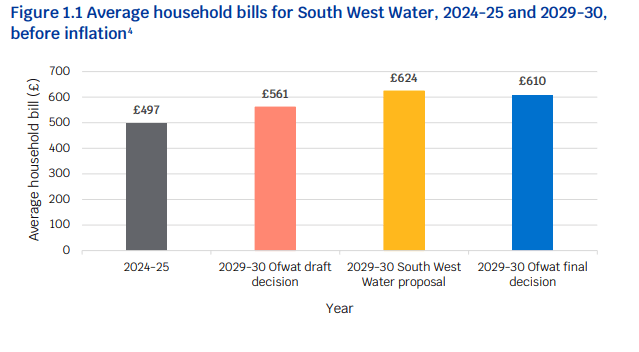
As already reported by Owl, Ofwat has greed to let South West Water (SWW) hike its annual charges to customers from an average of £497 in 2024/5 to £610 by 2029/30, an increase of  £113 or 22.7% at FY 24/5 prices (i.e. excluding inflation). 

The regulator had originally proposed a much smaller increase of £64 or 12.9% in July but has been persuaded by SWW to change their minds. The final result is that Ofwat managed to shave only £14 or 2.2% from what SWW had proposed.

Note the figures above do not take into account the £50 per household government contribution in the South West area, which will be removed for 2025-26 onwards.

Significant changes from the draft decision for South West Water are:

 • Ofwat increased their day-to-day expenditure allowances by £181 million to £2.3 billion for the South West area, and £43 million to £573 million for the Bristol area. This mainly reflects additional allowances for energy costs, business rates, bioresources growth and network reinforcement. Allowances for energy costs and business rates will be adjusted at the end of the price control period to reflect actual changes in prices. 

• Ofwat increased their allowances to invest in new infrastructure and resources, by £106 million for the South West area and £17 million for the Bristol area. This mainly reflects better evidence provided by the company for its cost estimates and the need for investment. It also follows an increase in requested expenditure for the South West area, mostly driven by increased regulatory requirements. For both areas, Ofwat increased allowances for preventing raw water deterioration. This allowance also rises for investing in water interconnectors to improve resilience in the South West area. 

• Ofwat changed some of their performance targets and financial incentive rates. This follows updated performance data for 2023-24, which Ofwat has taken into account in setting targets that are both stretching and achievable. For the South West area, Ofwat increased stretch on water quality contacts, as it is currently a relatively poor performer on this measure. 

Ofwat says that they will continue to hold South West Water to account against its targets for improved service for customers and the environment and expect it to report on its performance every year. If the company does not deliver the expected outputs and outcomes, this will be reflected in lower bills for customers. Where it delivers a better level of performance, it will be allowed to collect more, to reflect the additional benefits to customers it has created.

Download Ofwat’s overview of South West Water’s final determination

NB the Office for Environmental Protection (OEP) has just found that Ofwat was failing to comply with the law as the regulator was not cracking down hard enough on water companies. The notice served said Ofwat was “failing to take proper account of environmental law with regards to duties on sewerage companies and its duty to make enforcement orders” and “failing to exercise its duty under environmental law to make enforcement orders”. – Owl

Richard Foord:  South West Water must be held to account on pollution

This week will see MPs debating a new law concerning the water industry.

Richard Foord MP

The Water (Special Measures) Bill is designed to give water company regulators new duties and powers to address pollution, poor financial management, and poor outcomes for customers.

The Bill will enable the government and regulators to block the payment of bonuses for water company executives, enable automatic and “severe” fines, and ensure the monitoring of every sewage outlet.

I am working on an amendment alongside Liberal Democrat colleagues to strengthen the Bill, which is still too weak in places.

South West Water has been fined millions of pounds for various environmental offences in the last few years, including for causing the deaths of thousands of fish in the River Axe.

There have been illegal sewage spills and breaches of environmental permits, as well as sewer collapses.

Ofwat’s annual performance report found that South West Water reported an 80 per cent year-on-year increase in serious pollution incidents with a whopping 111 such incidents per 10,000 km of sewer, during 2023-24.

Despite the eye-watering fines and the increase in reports of pollution, South West Water’s total dividend payout for 2024 was an incredible £126.9 million.

This was higher than the previous year’s payout of £111.7 million.

SWW chief executive, Susan Davy, now earns £860,000 after collecting a £298,000 shares bonus last year.

Ms Davy had “foregone” an annual bonus which would have been worth £237,000 in cash and shares, but still picked up the £298,000 long-term performance award.

So much for water company bosses being made to give up their bonuses following poor performance!

Much of this money would be more appropriately spent on essential repairs to the sewage network.

Last week I invited Susan Davy into Parliament to explain sewage spills along our coast – and the lack of transparency in SWW’s monitoring of such pollution.

I was disappointed that Ms Davy argued against monitoring spills on volume rather than on length of time.

Environmental groups tell me that this would be an easy measure to introduce, as well as being more revealing.

I consider that water companies should be made to introduce this increased transparency.

Water companies have been permitted to dump enormous volumes of sewage because the Conservative Government did not equip the regulators – the Environment Agency and Ofwat – to do their jobs properly.

We owe it to all those who enjoy spending time in our rivers and seas – and to our precious marine life – to get this Bill right, and I am working on it!

Watchdog warns Defra and Ofwat they could face court over sewage dumping

So could the water companies – but who will have to foot the bill for clearing up the mess from this scandalous failure? – Owl

The government, its water regulator and the Environment Agency could all be taken to court over their failure to tackle sewage dumping in England after a watchdog found failures to comply with the law.

Helena Horton www.theguardian.com 

An investigation by the Office for Environmental Protection (OEP) found Ofwat, the Department for Environment, Food and Rural Affairs (Defra) and the Environment Agency (EA) all failed to stop water companies from discharging sewage into rivers and seas in England when it was not raining heavily. The OEP was set up in 2020 to replace the role the European Union had played in regulating and enforcing environmental law in the UK.

The law permits water companies to spill sewage only during exceptional circumstances such as extreme weather, but in reality human waste is routinely dumped in waterways even when it is not raining. Sewage is spilled into rivers and seas because in the UK there are combined sewage overflows (CSOs) into which water runoff from roads, sewage from homes and businesses, and “grey water” such as that from baths and washing machines all combine.

When this volume becomes too much and risks backing up into people’s homes, it is instead spilled into rivers and the sea. Water companies have failed over the years to update their sewage systems to stop this from happening, and the regulator and government both have legal duties to ensure the companies spill sewage only under extreme circumstances.

Helen Venn, the chief regulatory officer at the OEP, said: “The core issue identified in our investigation is the circumstances in which the regulatory system allows untreated sewage discharges to take place. We interpret the law to mean that they should generally be permitted only in exceptional circumstances, such as during unusually heavy rainfall. This is unless an assessment of the CSO concludes that the costs to address the issue would be disproportionate to the benefits gained.

“We will decide next steps when we have considered the responses to these decision notices. That could include court action.”

The OEP investigation followed the submission of a formal complaint two years ago by the campaign group WildFish.

Guy Linley-Adams, the in-house solicitor for WildFish, said: “What the OEP’s announcement has clarified is that much of the storm sewage pollution that is plaguing English rivers would not be occurring had government and regulators done their jobs properly. The Environment Agency must secure compliance with the 1994 regulations, which means it needs urgently to review the unlawful permits it has given to water companies to bring them into line with the law.”

Defra, Ofwat and the EA have each been sent a notice by the OEP outlining the findings and saying what steps each needs to take to put matters right. They have two months to respond and confirm whether they will take the steps required; if they do not do so, the watchdog could take them to court.

The investigation found Defra failed to comply with the law by drafting guidance for water companies and regulators that did not reflect the true legal extent of their duties not to stop sewage being spilled, and failing to make enforcement orders when waste was being dumped.

It also found Ofwat was failing to comply with the law as the regulator was not cracking down hard enough on water companies. The notice served said Ofwat was “failing to take proper account of environmental law with regards to duties on sewerage companies and its duty to make enforcement orders” and “failing to exercise its duty under environmental law to make enforcement orders”.

Ofwat is due to announce on Thursday how much water bills can rise by over the five years from next April.

The EA failed to comply with environmental law in three different ways, according to the OEP investigation. These include failing to take proper account of environmental law in devising guidance relating to permit conditions, setting permit conditions that were insufficient to comply with environmental laws and failing to exercise permit review functions in relation to discharges from CSOs. This meant the agency was found to be too lax in allowing water companies to spill sewage; they could not do so without a permit issued by the agency and the EA was allowed to review or revoke these if they were being inappropriately used.

An EA spokesperson said:“We recognise regulation of the water industry needs to improve, which is why we are transforming our approach with more people, powers and data alongside better training for our staff. This is ensuring we have a water system fit for people and the environment. We’ve also made significant progress in addressing the issues identified by the OEP and are consulting on updates to our permitting approach and regulatory framework for storm overflows.”

A spokesperson for Ofwat said: “We are actively taking steps to remedy the issues the OEP has identified. We will continue to prioritise our enforcement investigation into all wastewater companies which started in 2021 to ensure that companies are meeting their environmental obligations.”

A Defra spokesperson said: “For too long, water companies have pumped record levels of sewage into our rivers, lakes and seas. In just 5 months, this Government has acted decisively to refresh outdated guidance to make extremely clear our expectations around storm overflows. We welcome the OEP’s acknowledgement that this government is rectifying the issues identified. We will carefully consider the OEP’s allegations of breaches before formally responding in due course.

“Furthermore, we’re placing water companies under special measures through the Water Bill, which includes new powers to ban the payment of bonusses for polluting water bosses and bring criminal charges against lawbreakers. We’re also carrying out a full review of the water sector to shape further legislation that will transform how our water system works.”

The government has also announced that water companies will be forced to double compensation for customers who experience tap water outages, sewage floods, boil water notices or low water pressure. Consumers will be automatically paid up to £2,000 under the new scheme.

This year, tens of thousands of homes in Brixham were left without clean drinking water after the parasite cryptosporidium was found in the supply. Many were told to boil water before using it for a month. Water companies have been accused of failing to properly compensate those who face these disruptions to their supply and damage from sewage flooding their homes.

Labour and Whitehall’s Metropolitan ideas on devolution show little understanding of rural communities

The Devolution White Paper claims, without evidence, that there is an appetite for reorganisation. “Fewer politicians, with the right powers, will streamline local government to focus on delivering for residents. We will deliver this process as quickly as possible, including through legislation where it becomes necessary to ensure progress.” …..”New unitary councils must be the right size to achieve efficiencies, improve capacity and withstand financial shocks. For most areas this will mean creating councils with a population of 500,000 or more” [i.e. something bigger than half of Devon]

Not obvious to Owl that increasing the separation between the local electorate and politicians making local choices achieves devolution.

As today’s Guardian editorial puts it: 

“Such streamlining could bring some benefits. Most people don’t grasp the different duties of the various government tiers (in rural areas this usually includes parish as well as district and county councils). But disrupting local democracy is not a thing to be done lightly, especially when public trust in politics is widely understood to be fragile. Organisational change directs huge amounts of energy inwards and there is no good evidence that larger councils are more effective. Ministers should be mindful of the towns and villages where a district council is the most visible elected body – and may also be different, politically, from the surrounding county. When larger councils are under colossal strain due to long-term underfunding of their social care obligations, there are benefits to keeping some services separate.”

Owl will have more to say on this in due course

Devon’s district councils and county council could merge

Miles Davis www.bbc.co.uk

Devon County Council is expected to be merged with the eight district councils in the county

Devon County Council and the county’s eight district councils are expected to be merged into some form of a new unitary authority in the biggest shake-up of local government for decades.

It is not yet clear what will happen to Plymouth City Council and Torbay Council, which already stand apart with unitary status.

Elected mayors will be introduced in areas covering multiple authorities with the possibility of Devon and Cornwall being combined, following the announcement by Angela Rayner, Secretary of State for Housing, Communities and Local Government.

The government said it wanted to “streamline” local councils while critics have said the change could undermine local decision-making.

The local government picture is complicated in Devon with district councils and Exeter City Council responsible for areas like housing, local planning and waste collection and the county council responsible for highways, adult social care, children’s services and public health.

In Plymouth and Torbay the unitary authorities are responsible for all aspects of local government.

Devon County Council and Torbay Council, but not Plymouth City council, are already working together on a Combined County Authority (CCA) set up earlier in the year to have more control over areas such as skills training and public transport.

The measures in the English Devolution White Paper include proposals to create “strategic authorities” in the hope of “bringing together councils over areas that people live and work in”.

Councillors in Cornwall have said they do not want to share powers with Devon or any other larger south west region.

Paul Arnott, leader of East Devon District Council, said devolution would not cut costs

Paul Arnott, the Liberal Democrat leader of East Devon District Council, the largest district council in Devon, said he and other leaders were in favour of devolution but this had been badly managed.

He said: “This is being rushed, it hasn’t been consulted on and it risks throwing the baby out with the bathwater.

“District councils do a lot of good stuff already whether it’s protecting communities from the sea, emptying your bins, it’s your planning authority.

“They do a lot and I’m not convinced at the moment that the government really understand that in the ambition to push devolution down through the country they may actually be losing really well organised district councils.”

James McInnes, Conservative leader of Devon County Council, said it was “a big thing” for the district and county councils to think they might be “swept away”.

He said: “I’d prefer for us to find a way forward than have it be done to us by government.”

McInnes said all council finances were under “extreme pressure” and any move to unitary status would be “a distraction”.

He said: “I hope we can continue talking to each other and agree a way forward that will be right for the residents of Devon.”

McInnes said he was in regular talks with leaders in Cornwall, Torbay and Plymouth and that a strategic authority for Cornwall and Devon was a possibility – although he would prefer that to be led by a strategic board, rather than an elected mayor.

A map shows the district councils and the unitary authorities in Devon

A map shows the district councils and the unitary authorities in Devon

Devon County Council, run by the Conservatives, is the largest authority with a population of more than 800,000, external, according to the 2021 census, and employs about 5,000 people, external.

Populations of district council areas, external range from the smallest of about 57,000 in West Devon to the largest of just over 150,000 in East Devon with about 130,000 people living in the Exeter City Council area.

Labour-run Plymouth City Council has a population of about 265,000, external and about 2,500 employees, external while Conservative-led Torbay Council has a population of about 136,000, external and employs about 1,000 people, external.

Angela Rayner, Secretary of State for Housing, Communities and Local Government, said the policy would “see communities, people and places across England begin to take back control over the things that matter to them”.

She said every region of England would be covered by new “strategic authorities”, similar to the regions that currently have elected regional mayors.

Rayner said having directly-elected mayors would avoid duplication and give cities and regions a bigger voice.

East Devon council gets funding to sort River Axe pollution

East Devon District Council said the £4m would help improve the water quality in the River Axe.

It said the fund would also help with plans for 1,000 homes due to be built nearby in the next 15 years.

Archie Farmer www.bbc.co.uk

The authority said a range of factors, which included agriculture run-off and new homes built in the area, contributed to the pollution in the river.

It said the funding would be used to “upgrade sewage treatment plants and septic tanks, as well as measures to prevent flooding” and “wetlands will also be constructed and water saving measures on council homes will be introduced”.

Councillor Paul Arnott, council leader, said “it will help us to unlock much needed new homes in Axminster” and “it will help us to act on our recent Declaration of a Nature Emergency, external“.

“The River Axe is of national importance for its biodiversity but has been in a very poor condition due to the phosphates that have been pouring into its waterway and harming the wildlife it supports.

“This funding will help us to address this urgent situation, enable delivery of the local plan and start to clean up one of East Devon’s most important rivers for wildlife.”

Councillor Todd Olive, portfolio holder for Strategic Planning at the council, said: “Nutrient pollution is an urgent and complex problem across England, where increased levels of nitrogen and phosphorous from a variety of sources – including both homes and agriculture – can have serious consequences for natural habitats and wildlife.

“While helpful in unlocking housebuilding projects currently blocked due to this pollution, first and foremost this funding will help protect our natural world, which is so crucial to East Devon in so many ways.”