‘We’ve got our future back’: elation for Frome residents as Acorn pulls out of Saxonvale regeneration site

Can it really be that a developer is sensitive to public opinion, gets the message their plan is not what the community wants, and pulls out in less than 24 hours after gaining planning permission?

Where does that leave LibDem controlled Somerset council? 

Wrong footed? – Owl

frome.nub.news

Frome residents have gone from despair to elation within 24 hours after an unpopular housing developer backed out of development a town centre site.

The Saxonvale site has been the subject of two competing proposals for its regeneration – one from the Bristol-based Acorn Property Group, the other from the locally-based Mayday Saxonvale.

Following a six-hour meeting on Wednesday afternoon (July 31), Somerset Council’s executive committee announced it would be selling the site to Acorn – prompting outcry and scatching criticism from local residents and politicians.

Less than 24 hours later, Acorn announced it was withdrawing from the project – leaving the door open for the more popular Mayday scheme to be implemented.

Acorn issued the statement confirming its withdrawal to the Local Democracy Reporting Service shortly after 3pm on Thursday afternoon (August 1), shortly before the same statement was posted on its social media channels.

A spokesman said: “Acorn Property Group prides itself in working with local communities to provide much needed regeneration through residential-led schemes.

“Further to the meetings on July 31, 2024, it has become abundantly clear that in this case, despite our best endeavours to work with all the stakeholders, the local community does not wish to work with Acorn, and on that basis we have decided to withdraw from the process.

“Acorn wishes Frome and the local community the best of luck going forward in developing this wonderful site in whatever way they choose to take the matter forward.”

The withdrawal of Acorn does not automatically mean that the site will be sold to Mayday Saxonvale, and Somerset Council has not provided a time-scale for how soon a final decision would be taken on the site’s future.

Officers indicated on Wednesday afternoon (July 31) that selling the site on the open market (rather than an unconditional sale to either Mayday or Acorn) would not lead to the site being redeveloped quicker.

Responding to Acorn’s departure, Somerset Council leader Bill Revans said: “We note the decision from Acorn Property Group and will now carefully consider our next steps.”

Councillor Steve Tanner, leader of Frome Town Council, added: “We are aware of the statement Acorn have made that they have withdrawn their bid for Saxonvale.

“We have spoken with Somerset Council about this and they have indicated that they are currently considering their options.

“We will remain in touch with Somerset Council and await further information.”

Damon Moore, one of the directors at Mayday Saxonvale, told The Guardian on Thursday (August 1): “We’ve got our future back. It’s extraordinary.”

Councillor Shane Collins, the Green councillor for the Frome East division, added: “This is unprecedented news. In nine years of being a councillor, I’ve never heard of a developer pull out due to community feeling.

“This shows the power of community in Frome. Fantastic news, from the depths of depression yesterday to elation today.”

Somerset Council’s next executive committee meeting will take place in Taunton on Monday morning (August 5); however, the agenda for this was published before the Saxonvale decision was issued, and therefore cannot be altered.

The next executive meeting after this – and therefore the soonest this matter could be publicly discussed again – will be on September 2.

Angela Rayner’s Housing Targets – “suck it and see” sums with tenuous link to needs and affordability

Housing targets imposed on local planning authorities is an emotive subject. 

Persuading local residents to accept these targets is made all the more difficult when these targets are set in ways that are difficult to understand and not obviously linked to local demographic needs or solving affordability issues.

Angela Rayner’s proposed method seems to fail on all counts.

As readers can see below the method is deceptively simple.

Take 0.8% of the current housing stock and multiply it (“uplift” in the jargon) by a number derived by dividing average house prices over the last three years by annual earnings. 

Why 0.8%?

Well it seems to get the overall answer the Secretary if State wants and it’s easy to calculate, but Owl can’t see any link to demographic or economic growth needs. The more you have already, the more you need in the future. [Lichfields below attempt a rationale].

And the affordability “uplift”?

Well that comes from an underlying assumption that idealised market conditions apply and that increasing supply will reduce prices. It is highly questionable that this assumption holds for second and retirement home hotspots such as Devon and Cornwall. In any event, the market is controlled by a small number of developers who are unlikely to build at such a rate as to reduce prices.

For some reason you don’t start counting until that ratio exceeds four then you “uplift” the number you first thought of by 15% for each “excess” unit above four. You can then apply a cap if the number gets too big!

Curiously, the method (if it survives consultation) will be “mandatory” but the results are not “binding”.

Does it distribute new development where it is needed and will it address the shortfall of affordable and social housing?

Here are local examples of what this calculation yields locally compared to the existing method (source)

(Note some 26 councils, including some in Devon,  do not have comparable figures because under the current system they have a joint plan with one or more neighbouring authorities or have recently been involved in local government reorganisation.)

Here is how Lichfields explain it:

A new Standard Method: Stocking up?

Among the changes proposed by Government (much trailed in the media) is a new Standard Method (SM). If adopted, it will provide the kinetic force that drives the boost to housing delivery that the Government is seeking.

The SM for local housing need has a long history (see our chronology here). Under almost constant review since it was formally introduced in 2018, it has proved very difficult to change; attempts at its revision (or indeed abolition) have generated controversy and hit the buffers.

The current SM is based on a four-step approach for each local authority area (LAA)[1]:

  1. Using the 2014-based household projections, take the 10 year average growth rate (with the current year being the base year);
     
  2. Apply an uplift, based on the latest median workplace-based affordability ratio (formula set out in national guidance);
     
  3. Apply a cap, where appropriate. Where the strategic policies for housing in the current plan are less than five years old, cap the need (from steps [1] and [2]) at 40% above the current plan requirement. Where more than five years old, cap the need at 40% above whichever is higher of the current plan requirement or household projections; and
     
  4. [For the 20 largest urban areas nationally] – apply a further 35% uplift to step [3].

At the time of writing this generates a national total of around 305.7K net additional homes per annum, of which around 99K is in London. Against this current local need, the aggregate of local housing targets (or requirement figures) in adopted Spatial Development Strategies and Local Plans is 231K; a level around which the supply of extra homes has broadly aligned since 2017[2].  

The proposed new SM adopts a two-step approach for each LAA:
 

  1. Take 0.8% of the current housing stock of the area;
     
  2. Apply an uplift, based on a three-year average of the median workplace-based affordability ratio, with an increase of 15% for every unit above four.

At the time of writing, this generates a national total of around 371.5K net additional homes per annum, of which around 80.7K is in London. Outside the capital, compared to the current SM, 90% of LAAs areas will see an increase in their LHN figure, and 69% will see an increase of over 200 homes per annum.

You can access the specific numbers for each District in England direct from the Government-produced spreadsheet or via our interactive map.

Beyond the individual numbers, what can we say about the proposal? 

Mandatory but not binding

A lot of political debate about the SM has conflated it with the term ‘housing targets’ and revolved around what adjective should be used to describe it: is it advisory, a starting point, mandatory or binding?

The NPPF proposals suggests the proposed SM would be:
 

  • mandatory in that it should be the basis for establishing need in Local Plans,                                                                                                                                                                                                 with no provisions – exceptional or otherwise – for using a different method;
     
  • not binding in that it is not the same as the housing requirement (or target) in the local plan, which is to be set on the basis of the presumption in favour of sustainable development (NPPF para 11 a) and b)). Local Plans may be justified in providing for less housing than needed in their area if there are areas or assets of particular importance that restrict development or if the adverse impacts of meeting need would significantly and demonstrably outweigh the benefits.

The mandatory element and a 0.8% stock-based starting point means a small number of locations (perhaps more remote areas or towns that have experienced de-industrialisation) will see high estimates of need alongside very low (or even negative) levels of household growth. In these locations, providing new housing as a flat percentage of stock may in some instances give rise to housing market displacement (similar to that which afflicted some areas of housing market renewal in the 1990s) or may prove not to be deliverable. Previously, such areas might have cited the NPPF’s provision for ‘exceptional circumstances’ and sought to rely on an alternative needs assessment; now, if they are to conclude that it would be inappropriate to set a housing requirement that meets the SM figure in full (and if there are not nationally-designated protection policies), it will be necessary for them to explain how adverse impacts of planning for those needs in full will significantly and demonstrably outweigh the benefits under the ‘tilted balance’.

A stock-based approach

The Government’s big proposal is to shift from measuring housing need based on demographic projections to one that starts with the current number of homes in an area.

We first explored the potential of this approach in our review of possible Standard Method reforms in 2020 and elements of it appeared as a 0.5% ‘floor’ in the so-called ‘mutant algorithm’ of August                                            

The advantages of a stock-based method advocated by Government might be said to be that it:

  1. Remains relatively simple, using national and freely-available statistics that are produced consistently for all local areas, are robust and updated regularly;
  2. Uses inputs that are stable over the medium to long term (including using smoothed averages where appropriate);
     
  3. Avoids the circularity and volatility of household projections, whereby:
    1. Repeated iterations of ONS population and household projections fluctuate based on trends, making it difficult to plan
       
    2. Low rates of housebuilding lead to low levels of household growth (by migration or household formation) in an area, which is then perpetuated by trend-based projections
       
    3. Addresses the fact that even a big uplift for acute affordability in such an area is unlikely to makes a significant impact if it is applied to a small rate of household growth (a big % uplift to a small number is still a small number).
       
  4. Ensures that at least 300,000 homes can realistically be achieved, with this number being at the minimum end of what experts believe is necessary to address affordability and need for affordable homes over the long term;
     
  5. Ensures the SM genuinely ‘boosts’ housing supply, across all parts of the country, as per the original intention of the policy.

In the context that the ’tilted balance’ of the  NPPF presumption may be invoked in some cases (where the ‘harms’ of development are weighed against the benefits of new housing) it will be important – in applying a stock-based method – for it to be clear how the numbers associated with that approach in each area are consistent with securing the benefits that new housing will bring, absent the usual demographic starting point. 

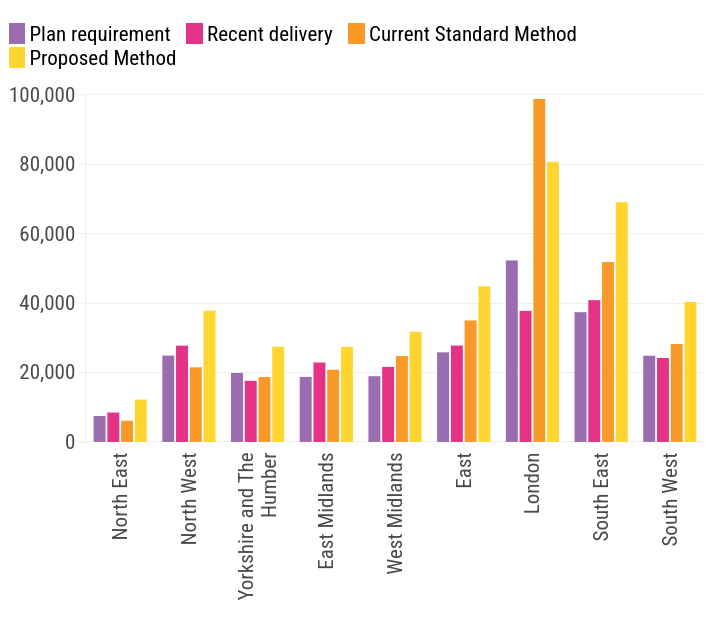
Higher than past delivery, current local targets, and the current standard method, in every region[3]

Within the headline national increase, the proposed SM would see boosts in every region (see Figure 1). It is double the current North East’s need figure[4] and 76% higher than the figure in the North West. The need would be in the order of 20 – 70% higher than recent rates of housing delivery[5] across all regions except London (where the need figure is well over double). Some individual LAAs will see very marked increases, particularly where the demographic trends in the period 2009-14 (the recessionary period which informed the current SM’s demographic starting point) were very low[6]. A consistent criticism of the current SM was that it under-cooked housing need in many parts of the midlands and north, where local plans were often already aiming to provide for more homes, often for economic and ‘levelling up’ reasons.

Figure 1 Regional Breakdown of Housing Target and Delivery Data

Source: MHCLG / Lichfields analysis

But if the regional story is interesting, it is the type of planning issues it generates that tells us what kind of challenges the new method will introduce and some indication of how many homes the proposed method – alongside the envisaged changes to the NPPF might generate.

Targets and Constraints

We have correlated the housing target and delivery data with four ‘types’ of LPA area, to explore what this tells us about the impact of the numbers in combination with proposed new NPPF policies:
 

  • Category 1: London (the area covered by the Mayor’s London Plan).
     
  • Category 2: LPAs where their administrative area is mostly built-up and/or constrained with a significant amount of Green Belt. This is in the context that the NPPF proposes to make brownfield development within settlements acceptable in principle and – most significantly – to compel reviews of the Green Belt and for ‘Grey Belt’ to be capable of development in situations where there is no five year land supply or the Housing Delivery Test (HDT) result is below 75%.
     
  • Category 3: LPAs where the administrative area is mostly built up and/or constrained by other national constraints (e.g. national landscapes) for which there is no fundamental change of policy.
     
  • Category 4: LPAs in the rest of England – i.e. areas which are unlikely to have fundamental other national policy constraints.

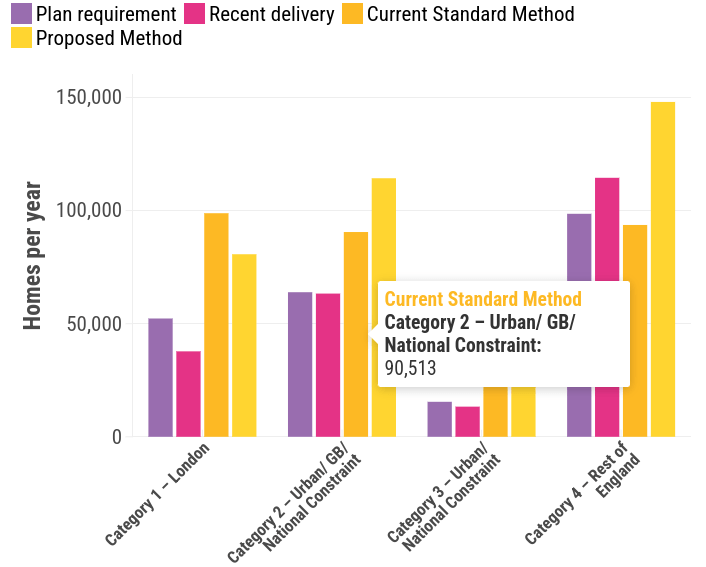
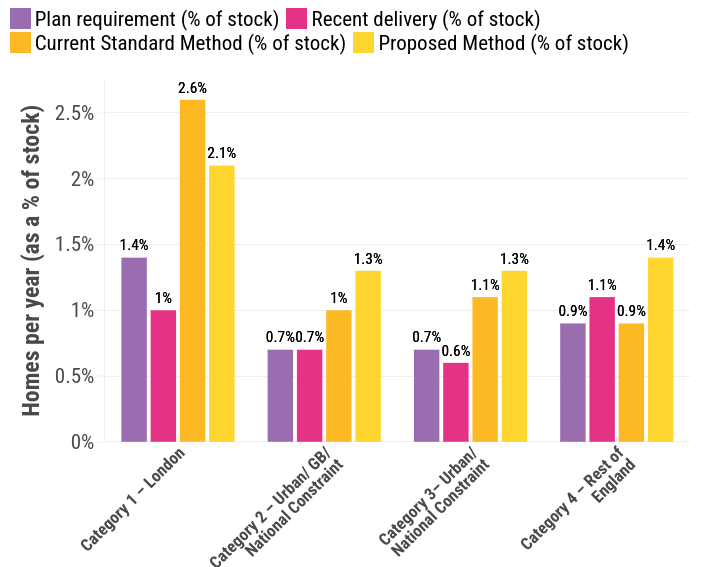
The housing target and delivery data is cascaded through these four categories by absolute annual numbers (Figure 2) and as a percentage of housing stock (Figure 3).

Figure 2 Housing Target and Delivery Data by LPA Type (Dwellings per annum)

Source: MHCLG / ONS / Lichfields analysis

Figure 3 Housing Target and Delivery Data by LPA Type (Dwellings per annum as % of Housing Stock)

Source: MHCLG / ONS / Lichfields analysis

This analysis shows that:
 

  1. London has been delivering at 38% of the current SM (at circa 38K dpa), below its London Plan target[7], but its recent delivery (1.0% of current stock) is relatively high compared to other constrained areas. The proposed SM rate is down, from 2.6% in the current method, but at 2.1% is still stretching. One can contemplate that some proposed NPPF changes to policy on Green Belt review might drive higher targets and delivery, but it is untested whether London will meet needs in full – achieving even the current London Plan targets (of 53.2K) by end of the current London Plan target period would be an achievement.
     
  2. LPAs that are predominantly urban and/or constrained by Green Belt have existing local plan targets and recent rates of housing delivery at around 70% of the current SM and a stock growth rate of just 0.7%, reflecting that Green Belt constraints (and the absence of up-to-date local plans) have tended to suppress delivery. The proposed SM represents a 26% uplift compared to the current formula, but in combination with the NPPF proposed change to policy on Green Belt and renewed focus on cross-boundary working, there must be expectation that a far greater proportion of needs will be met. If future plans saw, say, 85% of the higher proposed need effectively planned for (up from 70% of current need now), this would deliver an extra 30-35,000 homes each year at a rate of stock growth of 1.09%.
     
  3. The other areas LPAs that are predominantly built up and/or constrained by other national protections currently see the lowest rates of planned growth (0.7% of stock) and represent a relatively small total share (6-8%) of housing need. It is unlikely their rate of housing delivery will change much as a result of the proposed NPPF or revised SM.
     
  4. Across the Rest of England, Local Plan requirements and recent rates of delivery have been above the current SM (at c.115K per annum); they would be stretched by the new proposed SM (at c.148K) but would – if met in full – still be at 1.4% of stock, similar to the rate that the London Plan has been targeting. On its face, that ought to be achievable, and its contribution to total housing need would increase to c.40% from 30% currently (but its share of recent housing delivery has been punching above its weight, at around half).

Will this achieve Government ambitions for 1.5m?

In combination, one can see how the proposed Standard Method, in combination with proposed NPPF revisions (particularly on duty to cooperate and Green Belt review) has the potential to unlock planning constraints to housebuilding in many locations that have so far capped local plan targets, and to stretch delivery in less constrained areas where current targets are largely already met. 300K per annum looks readily achievable based on the policy platform set out, in the context that rates close to 250K have been achieved in the recent past, despite the challenges in London and in the areas where around a third of local housing need in England has been locked up in areas where local plan coverage is lower than average and where Green Belt has constrained development, and where rates of stock growth have been consequentially low.

Over the course of an economic cycle, the level of housing delivery will fluctuate with the market, but overall rates of delivery will be a significant function of the amount of land released by the planning system, which is shaped by the targets that are set via a housing need methodology and the national policies of the NPPF that direct how much need is actively planned for in local plans. The Competition and Markets Authority (CMA) found that: “The planning system is exerting a significant downward pressure on the overall number of planning permissions being granted. Over the long-term, the number of permissions being given has been insufficient to support housebuilding at the level required to meet government targets and measures of assessed need.”

In December 2020, we said the current Standard Method was a method that “with a fair wind, [is] a recipe for maintaining (just) current national rates of housing delivery [of around 230K], but seem unlikely to get England over the 300K hurdle.” In February 2023, we said that the then proposed changes to the NPPF could lead to a fall to 156K.

The hiatus in plan making in combination with the recent housing market downturn looks set to see rates of house building at 170-190K this coming year (a fact the Secretary of State highlighted in her Parliamentary statement) and recovery will be gradual. Looking ahead, based on our analysis of the four categories above, we can conclude that the new method alongside the NPPF is readily consistent with achieving an annual run rate of the 300,000. Getting to that by the end of the Parliament is eminently realistic but would nevertheless be an achievement with which the Government could be justifiably pleased, given past rates of delivery and its starting point.

But what about the 1.5m ambition? Even setting aside the practical and market challenges, the new method and policy framework as currently proposed seems unlikely to get there.  This is because it is not proposed to be calibrated to achieving an accumulating 300K pa target over five years.

Until Local Plans are in place[8], housing supply in most areas will be monitored against a target (the SM) that is refreshed each year, with any shortfall from that year wiped clean. This means that the under-delivery against 300K in initial years will not be added to the annual requirement for future years in most places. Therefore planning decisions focused on future delivery will be made based on what is needed to achieve the annual target for five years from that rolling date, not the beginning of the Parliament. Although a worsening affordability due to prior under-delivery in early years might nudge the Standard Method figure up slightly, it is unlikely to be sufficient to ‘make good’ the annual shortfall of 100-150K that will accumulate in the short term. It might be that some simple adjustments to the NPPF or the PPG to fix the base date of the five year housing land supply calculation in areas without Local Plans is a way of resolving this inconsistency. 

Annex: Chronology of the standard method

The introduction of the National Planning Policy Framework (NPPF) in 2012 saw the responsibility of determining local housing needs and housing requirements fall to local planning authorities, having previously been established within Regional Spatial Strategies. Whilst guidance on how housing needs should be assessed was published in 2014, authorities adopted a broad range of assumptions and approaches, and establishing housing need quickly became one of the most time-consuming and costly parts of the plan-making process. The idea for a simple, standardised approach was first mooted in 2016, and has evolved over the last eight years as follows:

  • March 2016 – the Local Plan Expert Group reports to Communities and Secretary and to the Minister of Housing and Planning that key issues facing plan makers include authorities struggling with a complex local plan process and housing needs not being met. The LPEG recommended a shorter, simplified, standard methodology for assessing housing need, which amended the planning practice guidance (PPG) to (1) provide greater clarity on the starting point (based on household/population projections), (2) set a clearly defined market signals uplift (based on either 10%, 20% or 30% uplifts, depending on the affordability ratio) and (3) confirm how to factor affordable housing needs (a further 10% increase to housing needs if required). It was suggested that economic-led factors were removed from the housing need assessment process, but plan-making authorities could include these in the housing requirement if appropriate;
     
  • February 2017 – Government publishes the White Paper ‘Fixing our broken housing market’ and responds to LPEG report confirming it will consult on a standard method for assessing housing needs;
     
  • September 2017 – Government publishes ‘Planning for the right homes in the right places’ consultation which includes proposed standard method as follows; (1) baseline, based on household projections over a 10 year period; (2) uplift for affordability [formula-based]; (3) cap, where applicable, depending on current plan age. At the time, Government estimated this would yield 266,000 homes nationally (of which 72,000 in London). Elements of this stemmed from the LPEG recommendations, but there were differences;
     
  • November 2017 – the Autumn Budget confirms that the Government aims to deliver 300,000 homes a year by the mid-2020s;
     
  • July 2018 – a revised NPPF is published which requires local authorities to use the ‘standard method’ for informing strategic policies, unless exceptional circumstances justify an alternative approach. It is introduced into the PPG in September 2018.
     
  • September 2018 – the ONS publishes 2016-based household projections which indicate substantially lower household growth nationally than the previous 2014-based projections (which underpin the standard method). This significantly undermines the ability of the standard method to achieve 300,000 homes per year nationally. The Government almost immediately consults on changes to the standard method to confirm that the 2014-based projections will continue to be the starting point, in order to support the aspiration to deliver 300,000 homes per year. This consultation also suggested that, in the long-term, government would review the formula and establish a new method by the time the next projections were issued;
     
  • August 2020 – Government consults on proposed changes to the standard method which introduces some amendments to the standard method, including amending the baseline (being the higher of either 0.5% of stock or household projections) and amending the affordability uplift (to also take into account 10-year change). This yields 337,000 homes a year nationally. The proposal proved controversial and was dubbed the ‘mutant algorithm’
     
  • December 2020 – The Government backtracks and instead retains the existing method but with a ‘fix’ to incorporate a 35% uplift to the 20 largest urban areas within the standard method which brings the total annual number to around 300,000, but with concerns about whether or not those numbers can be achieved;
     
  • April 2021 – Government formally withdraws the changes consulted on in August 2020, instead stating that it will retain the existing approach and the additional 35% uplift in the 20 largest urban areas;
     
  • December 2023 – a revised NPPF is published which adds that the outcome of the standard method is an ‘advisory starting point’ for establishing a housing requirement, but continues to state that there may be ‘exceptional circumstances’ which justify a different approach but that this alternative should still reflect demographic trends and market signals. It also states that there is no need for the 35% uplift to be redistributed if needs cannot be met in the urban areas.

[1] As explained in the Planning Practice Guidance here at ID2a-001 through to ID2a-016 Revision Date 20 02 2019
[2] See statistics of net additional dwellings here
[3] With the exception of the current Standard Method in London, due to the 35% urban uplift; the proposed figure is 80.7K compared to 98.8K currently, but 73.2K excluding the urban uplift.
[4] Although this is lower than current Local Plan targets in the region.
[5] Based on net housing additions in the three years 2020/21 to 2022/23.
[6] By way of example, Redcar & Cleveland has a current standard method figure of just 45 per annum (just 0.06% of its current stock) which would increase to 642 under the new method; its recent rate of net additions has been 425dpa.
[7] A trend explored by the London Plan Review earlier in 2024. There are some inconsistencies over housing delivery figures in London, as explored by the Review; DLUHC Net additions are used for the purposes of this analysis.
[8] Less than a third of Local Plans are up to date and less than five years since adoption.

Fresh call for action over Teign sewage

Teignbridge joins the list of local authorities headed by EDDC calling for action from South West Water. – Owl

Guy Henderson – Local Democracy Reporter www.radioexe.co.uk

Another Devon council has called for South West Water (SWW) to tackle the quantity of sewage entering streams, rivers and local bathing waters.

The motion – passed unanimously by the full Teignbridge Council – calls for the company to provide full details of the steps it is taking to keep sewage out of the Teign estuary, together with timescales and costs for the work.

It follows hot on the heels of a South Hams Council resolution demanding a face-to-face meeting with SWW chief executive Sue Davy. During that debate, council leader Julian Brazil (Lib Dem, Stokenham) said he would not happy until a water company executive somewhere in the UK went prison for polluting waterways.

Teignbridge Council took on board a motion signed by nine councillors demanding action.

They said that SWW had spent £54 million on the Buckland treatment works at Newton Abbot in 1991, aiming to end the practice of releasing sewage into the estuary, but it still went on.

Cllr Chris Clarance (Ind, Shaldon and Stokeinteignhead) said: “I believe we owe it to our residents to press South West Water for answers and solutions to the current appalling situation.”

Cllr Jackie Hook (Lib Dem, Bushell) added: “They are not performing as they should be, so it is right that we challenge them.”

And Cllr Andrew McGregor (SD Alliance, Bishopsteignton) added: “We need to be a lot more vocal. The level of sewage is potentially ruining our tourist industry.”

South West Water says reducing storm overflows is its top priority, and it welcomes ‘robust scrutiny’ from councils.

Can Labour to be trusted on environmental protection?

First we had “Build houses now, fix pollution later” which has particular resonance in East Devon, now no one is sure how many “illegal” sewage discharges are needed before triggering a criminal investigation of a water company’.

Was Feargal Sharkey jumping the gun when he endorsed Helen Dallimore’s (Labour) candidacy for Exmouth & Exeter East, given the proven record of local Lib Dem Richard Foord? – Owl

PS Labour’s consultation on housing development is seeking Exeter to increase its housing target by 26.9%, East Devon by 28.3%, Mid Devon by 65% and Teignbridge by 48.7%. When and where will South West Water provide the necessary increase in sewage treatment infrastructure capacity?

Water firm bosses to face criminal charges over ‘persistent’ sewage dumping – the most boring and weak announcement from Steve Reed

Steve Reed has confirmed that water bosses will face criminal charges over sewage dumping – the most boring and disappointing announcement to date.

Isabella Boneham www.nationalworld.com 

To make matters worse, Reed said that water bosses will face criminal charges over “persistent” and “severe levels of illegal sewage dumping”. So is it okay if they do it now and again? It is okay if a water firm dumps huge amounts of sewage but then doesn’t do it again for a while?

Victoria Derbyshire pressed on this yesterday (Sunday 28 July) during an interview with Reed and he wasn’t able to answer how many times they are able to illegally discharge sewage until they get charged. It is tiring hearing politicians time and time again making promises about toughening up on the water industry, yet coming out with ambiguous plans that do not seem to be a harsh crackdown at all.

Reed would not say what level of sewage dumping it would take for charges to be brought and that is worrying. It will be interesting to see what his meaning of “persistent” is – and how much sewage will have to be dumped on UK rivers and beaches before they decide to enforce a criminal charge. Water firms should be held accountable every time they dump sewage illegally.

Reed also said that Labour will “ban their multimillion pound bonuses while they are overseeing these failures” – so their ludicrous bonuses can continue, again, if the water firm only discharges sewage now and then?

The ludicrous bonuses should be stopped completely. The government should renationalise the water industry and put it back under the power of the people and public ownership. Here Reed is letting the mega rich off the hook – it is disappointing and angering.

Water firms have already been fined thousands for pollution incidents and yet sewage dumping continues. Fines haven’t worked. A criminal charge after “persistent” sewage dumping also is not going to work, and the scandal will continue.

Mr Reed also said Thames Water wouldn’t be re-nationalised. There is no tough stance on the water industry. If a water firm is inevitably collapsing due to their own financial mismanagement, the customer’s shouldn’t have to pay, their bills should not have to go up – instead the firm should be taken into public ownership without any shareholder buy-out costs.

All words, no action and ambiguous statements. It is disappointing, but not surprising. Levels of sewage dumping will have to get to the point of “persistent” for a water firm to face a criminal charge and that means we will all continue to see the joys of more raw waste flushed into our waterways. A good start Mr Reed.

The West Country Rivers Trust CEO,  Dr Laurence Couldrick, shares his thoughts on the latest Environmental Performance Assessment.

Dr Laurence Couldrick shares his thoughts on the latest Environmental Performance Assessment Report from the Environment Agency. wrt.org.uk

You might think that privies and cesspools may be a thing of the past, but with more and more stories about our failing water and sewage systems, you could be forgiven in thinking we are heading backward not forward in time.

On 23 July 2024, the Environment Agency published its Water and Sewerage Companies in England: Environmental Performance Assessment Report (EPA) 2023.

Within the report, the EA rated the nine water companies in England from one star to four stars, as it has since 2011. This year, three water companies reached the maximum four EPA stars due to ongoing improvements. Will this spur others on to improve, including our region’s main provider, South West Water (SWW), which remained at two stars from 2022?

The EA certainly hope so and Alan Lovell, Chair of the Environment Agency, said in his foreword to the report:

“…My over-riding sense is one of frustration and disappointment. The results we see are, yet again, simply not good enough…
“…With additional resources in place, a focus on transparent inspection and regulation, tightened EPA metrics and new legal powers, we are bringing stronger regulation to this sector in the coming year. We shall continue to drive for improved performance.”

Local issues

In terms of our local water company, SWW, it is the only firm failing numeric permit conditions and classed in the bottom (red) category for discharging treated wastewater via sewage and water treatment works. Regarding total pollution incidents from sewerage assets, there has been an increase to 1,902 with no water company achieving target (green), the first time for any metric since the EPA began – but SWW is highlighted as continuing to perform significantly below target and rated ‘red’.

In addition, SWW failed to meet all requirements within planned deadlines under the Water Industry National Environment Programme (WINEP) EPA metric for planned environmental improvement schemes, joining two other firms at the ‘amber’ level.

It is still one of the lowest performing companies and in need of improvement and this is a massively disappointing position. The trust works closely with SWW to try and improve our rivers by working with farmers and improving sections of rivers so it is devastating to see pollution incidents continuing to degrade the environment. Whilst work is scheduled to deal with a lot of these negative impacts it is vital we work together to ensure we build resilience within our system.

Call for smart change

Alongside these local impacts, and according to the report, more than 90% of serious pollution incidents were caused by four water companies – Anglian Water, Southern Water, Thames Water and Yorkshire Water. We could turn a blind eye as they aren’t in our patch, but we all need to bolster the work to be done across the country to address the infrastructure, climate and societal issues hindering the water sector’s ability to fully ensure our rivers are healthy and our water access is sustainable. This is why we support our national Rivers Trust to keep pressure on the sector to push for smart change.

The report did include some positive EPA metric notes such as all water companies performing better than target (green) for satisfactory sludge use and disposal; the best results for self-reporting of all pollution incidents since reporting began; and all achieving green under the Supply Demand Balance Index (SDBI).

The EA has secured an additional £55m of funding from government and water company permits to invest in 500 staff in dedicated enforcement teams and new digital systems to identify the root cause of issues. It cites it will conduct 4,000 inspections a year of water company permitted sites by the end of March 2025, rising to 10,000 a year by the end of March 2026 and 11,500 a year by the end of March 2027. It is expected the evidence gathered through these inspections will inform future performance assessments, investment plans and proactive enforcement.

Act positive for constructive and sustainable change

So in summary, despite the findings still painting an overall bleak picture, with a new government, the culmination of the price review from regulators Ofwat on the horizon, and policies in the Environment Act and Environmental Improvement Plan to deliver, this is the time to act positive and keep chipping away for constructive and sustainable change.

Dr Laurence Couldrick, Chief Executive Officer

Fail, fail, fail! Warning lights flash as South West Water scrapes the bottom of the EA environmental performance review  for 2023 

For 13 years South West Water have failed to meet their pollution “incident” targets.

That’s every year since the Environment Agency started reporting on Environment Performance metrics, worse than any other water company. 

South West Water has 12 non-compliant discharge sites  for treated wastewater. It’s amongst the worst three companies and it’s performance is declining.

South West Water is one of two companies whose investment targets in water quality schemes are not within planned deadlines. Ofwat determines what the water companies can charge us for investment. If these deadlines are not being met where has our money gone?

According to the report in the Plymouth Herald: Pennon Group, which owns South West Water, insists that

“delivering improvements in our environmental performance remains our top priority”.

Below, Owl posts the Chair’s forward to the Environment Agency’s environmental performance report 2023 who expresses “frustration and disappointment” with extracts from the key sections that catalogue South West Water’s failings. “The results we see are, yet again, simply not good enough.”

The Chair also says: “Lack of investment in assets over a long period and particularly the last decade means that problems have often been addressed reactively.”

And adds: “But it is not just about money. The culture within some water companies can also perpetuate poor practices. For example, some simply do not understand the root cause of their problems and incidents are not reported in a timely manner.”

Fine words, but are the Environment Agency doing enough? Or are they still a toothless “paper tiger”? – Owl

Water and sewerage companies in England: environmental performance report 2023

A summary of the environmental performance of the 9 water and sewerage companies operating in England. www.gov.uk 

1. Chair’s foreword

It is with a mix of emotions that I write this foreword to the 2023 performance report containing the Environmental Performance Assessment (EPA). My over-riding sense is one of frustration and disappointment. The results we see are, yet again, simply not good enough.  

The good news is that three companies achieved the maximum four EPA stars compared to one in 2022 – Severn Trent Water, Wessex Water and United Utilities. Credit to Severn Trent for achieving this for the fifth year running. But the performance of most companies lags far behind. We are seeing polarised performance as shown by the number of serious pollution incidents. Over 90% were caused by four water companies – Anglian Water, Southern Water, Thames Water and Yorkshire Water. This is unacceptable.   

Improvements will not happen overnight. Lack of investment in assets over a long period and particularly the last decade means that problems have often been addressed reactively. We welcome Ofwat’s draft determination for the next five year control period which should allow investment in many of the critical pieces of infrastructure needed to meet legal requirements. We will play our role in ensuring that the companies deliver these projects.  

But it is not just about money. The culture within some water companies can also perpetuate poor practices. For example, some simply do not understand the root cause of their problems and incidents are not reported in a timely manner – this is vital for improving transparency and trust across this sector. We know that with a changing climate, the country is going to experience more extreme weather patterns, increased rainfall and more rapid drought. Water companies must ensure that assets are resilient enough to withstand these challenges. We will not take ‘bad weather’ as an excuse for poor environmental performance.  

We take our responsibility to protect the environment very seriously. The regulations are clear, and we enforce them robustly. We have taken tough action against companies breaking the rules and have several serious investigations in progress. But we need to go further. 

We have agreed with the Department for Environment, Food and Rural Affairs (Defra), our sponsor department, a major increase in Environment Agency inspections of water company assets to provide assurance that they are meeting the requirements. We will carry out 4,000 such inspections this financial year and over 10,000 next year.  To support this, we are investing in our digital systems, regulatory tools and increasing our enforcement activity. You can find the full list of our commitments in our business plan 2024 to 2025. We will ensure that the findings of these inspections are made public. And we are working closely with Steve Reed MP, Secretary of State, on new legislation to strengthen our legal powers and penalties for pollution.

We have worked with companies to review their first drainage and wastewater management plans. These will ensure companies change to proactive investment in asset health and maintenance, to reduce risks and put headroom into their systems to deal with future challenges like climate and population growth. 

Since 2011 the EPA and wider reporting have provided an independent and objective comparison of water and sewerage companies’ performance As the regulator we constantly tighten EPA targets – which has been fundamental in driving better performance.  If the tighter standards we now apply had been in place in 2011, water companies would only have achieved 11 stars in comparison to the 25 they achieved in 2023.  Whilst this shows some improvement over that time, current performance is still a long way from meeting our expectations. We are reviewing the EPA to strengthen and broaden the metrics from 2026. 

With additional resources in place, a focus on transparent inspection and regulation, tightened EPA metrics and new legal powers, we are bringing stronger regulation to this sector in the coming year. We shall continue to drive for improved performance.

Alan Lovell, Chair of the Environment Agency

2. Performance facts for 2023

For 2023, the main performance facts for the sector are that:

  • 5 water companies are rated as requiring improvement (2 stars) in our EPA, 1 is rated as good (3 stars) and 3 achieved 4 stars – all water companies should be able to achieve 4 stars
  • there was a small improvement in star ratings with some water companies meeting our metric targets consistently in this EPA period so far (since 2021) – however the majority continue to underperform as they are not getting the basics right, such as minimising pollution incidents and achieving permit compliance
  • the number of serious pollution incidents (category 1 and 2) increased to 47, remaining unacceptably high and not trending towards zero – mainly due to the performance of 3 water companies, resulting in a very polarised performance picture across the sector
  • for the serious pollution incident EPA metric, Northumbrian Water and Severn Trent Water had zero incidents, however 4 water companies performed significantly below target (red) – numbers are dominated by serious pollution incidents from the assets of Anglian Water, Southern Water and Thames Water, with Yorkshire Water also rated red
  • total pollution incidents from sewerage and water supply assets (category 1 to 3) increased to 2,174 – the second consecutive annual increase and highest number recorded since 2019
  • total pollution incidents from sewerage assets increased to 1,902 with no water company achieving target (green), the first time for any metric since the EPA began in 2011 – Southern Water and South West Water continued to perform significantly below target (red) with Anglian Water also rated red
  • self-reporting of all pollution incidents by water companies was 84%, and 93% for just pumping stations (PS) and sewage treatment works (STW) combined – this was the best since the EPA began however 3 water companies performed below target (amber) including a notable deterioration by Southern Water
  • 98.8% of STW and water treatment works (WTW) were compliant with numeric permit conditions for discharging treated wastewater – although 6 water companies achieved target (green), the poor performance of 3 water companies, including South West Water (the only red water company), means the sector is not improving
  • for the satisfactory sludge use and disposal EPA metric, all water companies performed better than target (green)
  • for the Water Industry National Environment Programme (WINEP) EPA metric 99.2% of planned environmental improvement schemes were completed – 3 water companies failed to meet all requirements within planned deadlines (Thames Water rated red, Anglian Water and South West Water rated amber)
  • for the Supply Demand Balance Index (SDBI) EPA metric all water companies achieved target (green)

4. Pollution incident performance

Pollution incidents lead to the release of harmful substances into air, land or water, and some can cause significant harm to the environment. We categorise all incidents based on their impact. Incidents are assessed as having a major (category 1), significant (category 2), or minor (category 3) impact on the water environment. Please refer to our EPA metric guide for more information……

  • there were 1,902 sewerage pollution incidents, compared to 1,658 in 2022 – this is the worst performance since 2019 with 8 water companies having an increase compared to the previous year
  • no water company achieved our EPA target (green), the first time for any metric since the EPA was introduced in 2011 – and a disappointing decline from the previous 2 years when we reported 4 water companies achieved green in each of those years
  • 3 water companies performed significantly below target (red) for this EPA metric – Anglian Water for the first time, Southern Water for the fifth year in a row and South West Water for all 13 EPA reported years
  • 6 water companies performed below target (amber) for this EPA metric
  • if all water companies had achieved green EPA status in this metric there would have been at least 764 fewer sewerage pollution incidents and less environmental harm
  • most of the incidents were from foul sewers (670), followed by STW (487) and PS (472)

5.1 Discharge permit compliance (numeric)

This section is about water company compliance with permits to discharge treated wastewater from STW and WTW (not storm overflows). As part of the EPA we assess compliance with conditions in these permits that set numeric limits for pollutants in the discharges….

Compliance for the sector is not improving. It is a statutory obligation to comply with permits. Our WISER performance expectation for 2020 to 2025 sets out that water companies should have a plan in place to achieve 100% compliance. In 2023:

  • 98.8% of STW and WTW were compliant, compared to 99.0% in 2022, 98.7% in 2021, 99.2% in 2020 and 98.7% in 2019
  • out of 3,800 STW and WTW permitted discharge outlets there were 45 non-compliant sites compared to 38 in 2022, 49 in 2021, 31 in 2020 and 49 in 2019 – no water company achieved 100% compliance with their permits
  • South West Water performed significantly below target (red) with 12 non-compliant sites (96.2%) – a disappointing decline in performance from green status and 2 failing sites in 2022, and showing inconsistency in recent years
  • Anglian Water had the most non-compliant sites (13) performing below target (amber) alongside Northumbrian Water (3)
  • 6 water companies achieved target (green) for this EPA metric – of these Severn Trent Water, Thames Water, Wessex Water and Yorkshire Water have been consistently green in this EPA period so far (since 2021)
  • there would have been at least 16 fewer non-compliant sites if all water companies had achieved green EPA status

7.1 Water Industry National Environment Programme (WINEP)

In 2019 Ofwat set the prices that water companies could charge their customers between April 2020 and March 2025. As part of that price review (PR19) we developed and published a WINEP for each water company. Our expectation for all planned schemes (including asset improvements, investigations and monitoring) to be completed to agreed timescales and specification was not met by all water companies. The EPA WINEP metric assesses completion of all improvement schemes and most investigation schemes…….

For the financial year ending March 2024 (cumulative progress for years 1 to 4 of the WINEP) for WINEP schemes in the EPA:

  • 5 water companies are rated as requiring improvement (2 stars) in our EPA, 1 is rated as good (3 stars) and 3 achieved 4 stars – all water companies should be able to achieve 4 stars
  • there was a small improvement in star ratings with some water companies meeting our metric targets consistently in this EPA period so far (since 2021) – however the majority continue to underperform as they are not getting the basics right, such as minimising pollution incidents and achieving permit compliance
  • the number of serious pollution incidents (category 1 and 2) increased to 47, remaining unacceptably high and not trending towards zero – mainly due to the performance of 3 water companies, resulting in a very polarised performance picture across the sector
  • for the serious pollution incident EPA metric, Northumbrian Water and Severn Trent Water had zero incidents, however 4 water companies performed significantly below target (red) – numbers are dominated by serious pollution incidents from the assets of Anglian Water, Southern Water and Thames Water, with Yorkshire Water also rated red
  • total pollution incidents from sewerage and water supply assets (category 1 to 3) increased to 2,174 – the second consecutive annual increase and highest number recorded since 2019
  • total pollution incidents from sewerage assets increased to 1,902 with no water company achieving target (green), the first time for any metric since the EPA began in 2011 – Southern Water and South West Water continued to perform significantly below target (red) with Anglian Water also rated red
  • self-reporting of all pollution incidents by water companies was 84%, and 93% for just pumping stations (PS) and sewage treatment works (STW) combined – this was the best since the EPA began however 3 water companies performed below target (amber) including a notable deterioration by Southern Water
  • 98.8% of STW and water treatment works (WTW) were compliant with numeric permit conditions for discharging treated wastewater – although 6 water companies achieved target (green), the poor performance of 3 water companies, including South West Water (the only red water company), means the sector is not improving
  • for the satisfactory sludge use and disposal EPA metric, all water companies performed better than target (green)
  • for the Water Industry National Environment Programme (WINEP) EPA metric 99.2% of planned environmental improvement schemes were completed – 3 water companies failed to meet all requirements within planned deadlines (Thames Water rated red, Anglian Water and South West Water rated amber)
  • for the Supply Demand Balance Index (SDBI) EPA metric all water companies achieved target (green)

4. Pollution incident performance

Pollution incidents lead to the release of harmful substances into air, land or water, and some can cause significant harm to the environment. We categorise all incidents based on their impact. Incidents are assessed as having a major (category 1), significant (category 2), or minor (category 3) impact on the water environment. Please refer to our EPA metric guide for more information……

  • there were 1,902 sewerage pollution incidents, compared to 1,658 in 2022 – this is the worst performance since 2019 with 8 water companies having an increase compared to the previous year
  • no water company achieved our EPA target (green), the first time for any metric since the EPA was introduced in 2011 – and a disappointing decline from the previous 2 years when we reported 4 water companies achieved green in each of those years
  • 3 water companies performed significantly below target (red) for this EPA metric – Anglian Water for the first time, Southern Water for the fifth year in a row and South West Water for all 13 EPA reported years
  • 6 water companies performed below target (amber) for this EPA metric
  • if all water companies had achieved green EPA status in this metric there would have been at least 764 fewer sewerage pollution incidents and less environmental harm
  • most of the incidents were from foul sewers (670), followed by STW (487) and PS (472)

5.1 Discharge permit compliance (numeric)

This section is about water company compliance with permits to discharge treated wastewater from STW and WTW (not storm overflows). As part of the EPA we assess compliance with conditions in these permits that set numeric limits for pollutants in the discharges….

Compliance for the sector is not improving. It is a statutory obligation to comply with permits. Our WISER performance expectation for 2020 to 2025 sets out that water companies should have a plan in place to achieve 100% compliance. In 2023:

  • 98.8% of STW and WTW were compliant, compared to 99.0% in 2022, 98.7% in 2021, 99.2% in 2020 and 98.7% in 2019
  • out of 3,800 STW and WTW permitted discharge outlets there were 45 non-compliant sites compared to 38 in 2022, 49 in 2021, 31 in 2020 and 49 in 2019 – no water company achieved 100% compliance with their permits
  • South West Water performed significantly below target (red) with 12 non-compliant sites (96.2%) – a disappointing decline in performance from green status and 2 failing sites in 2022, and showing inconsistency in recent years
  • Anglian Water had the most non-compliant sites (13) performing below target (amber) alongside Northumbrian Water (3)
  • 6 water companies achieved target (green) for this EPA metric – of these Severn Trent Water, Thames Water, Wessex Water and Yorkshire Water have been consistently green in this EPA period so far (since 2021)
  • there would have been at least 16 fewer non-compliant sites if all water companies had achieved green EPA status

7.1 Water Industry National Environment Programme (WINEP)

In 2019 Ofwat set the prices that water companies could charge their customers between April 2020 and March 2025. As part of that price review (PR19) we developed and published a WINEP for each water company. Our expectation for all planned schemes (including asset improvements, investigations and monitoring) to be completed to agreed timescales and specification was not met by all water companies. The EPA WINEP metric assesses completion of all improvement schemes and most investigation schemes…….

For the financial year ending March 2024 (cumulative progress for years 1 to 4 of the WINEP) for WINEP schemes in the EPA:

  • 99.2% (3,481 out of 3,508) met requirements within planned deadlines
  • Thames Water performed significantly below target (red) due to 19 water quality schemes not meeting requirements within planned deadlines (93.4%)
  • 2 water companies performed below target (amber) due to water quality schemes not meeting requirements within planned deadlines – Anglian Water (99.6%, 3 schemes), South West Water (98.8%, 5 schemes)
  • 6 water companies met all requirements (100%, green) within planned deadlines – of these Northumbrian Water, Severn Trent Water, United Utilities, Wessex Water and Yorkshire Water have been consistently green in this EPA period so far (since 2021)

FliRt Covid variant: Expert warns of South West summer rise

A leading UK infections expert has warned people in Devon and Cornwall to take Covid-19 precautions this summer.

BBC News www.bbc.co.uk

Prof David Strain, from the University of Exeter’s Medical School, said Covid rates in the South West were likely to increase over the summer holidays as more people came to the area and mixed with the population.

It comes as a new group of variants of Covid have emerged, collectively nicknamed as FLiRT, external.

Prof Strain said the Covid Medicines Delivery Unit (CMDU) in Exeter was running a “very active service” and “all the indicators say numbers were going up.”

‘Good barometer’

He said one of the ways data could be gathered on the increase in Covid cases was from high-risk patients contacting the CMDU.

“We are still running a very active service for many people who are vulnerable or who, if they caught Covid, would get a deterioration of other illnesses,” he said.

“We see our referrals going up and that is a really good barometer of what is going on in society.

“These people who are very aware of the risks contact us.

“Our referrals, when they go up from two a day to 20 a day, we know there is more Covid out there.”

Prof Strain said the “new variant” and “waning immunity” were also contributing factors to Covid spreading in the region.

“[FLiRT] escaped the immunity that antibodies from the initial vaccine has given us, which means, unless you had the updated vaccine in autumn last year, you probably don’t have the antibodies that will reduce your risk of catching it,” he explained.

The virologist added the old vaccine was “still giving really good protection against severe illness” but that protection was “starting to wane”.

He said he was not “suggesting we need to be back in masks” but advised people who were feeling unwell to “get a test and try not to go out if you can”.

‘Rates go up’

Prof Strain said: “In many regions of the country, Covid rates fall in the holidays.

“Paradoxically, we have seen in the last couple of summers rates go up here because of more mixing and people coming down, bringing virus from all over the country.

“Particularly the more vulnerable, mature adults are now presenting to hospital with Covid very similar to what we were seeing after the first and second waves. All the indicators say numbers are going up.

“I think all of us know somebody who has tested positive recently, and that’s only the people that are testing.

“The big issue is that we still don’t know how many people have got Covid without any symptoms at all.”

Pressurised overflow could be discharging up to 3,660 l/hour of sewage, hourly, at Otter Head Budleigh

Latest from Geoff Crawford Escape (End sewage convoys and pollution, Exmouth), commenting on a letter from Budleigh District Councillor Henry Ridell’s latest letter to Susan Davey, CEO South West Water. This letter was written with the help of Peter Williams and the full text is reproduced below.

(That’s a 10 tonne road tanker very two hours 24/7 – Owl)

Full text:

Geoff Crawford

Cllr Henry Riddell, well written Henry and this suggests that you have a clear understanding of the Budleigh issues. It’s important that that is the case as SWW are adept at pulling the wool over people’s eyes who are not properly informed. Because you clearly understand the situation you are more able to counter the misinformation and call for real change and action as you have.

You should also be aware that EACAPE met with EA last week and we learnt that the outfall from Lime Kiln is actually pumped (one of only seven pumped overflows in the south west). What this means is that the repeated one minute overflows which seem quite short and insignificant are actually one minute every hour pressurised overflows that effectively empty the sewage tank into the sea. So one minute bursts of up to 61 litres per second (to be confirmed) every hour.

SWW seem to be deliberately doing this to empty the tank as the pumps up to Maer Lane cannot cope with the ingress and the tankers only suck out at a much lower rate. The interim solution (last six months) seems to be to pump out to the sea but not to inform bathers of the volume of that pumping.

If you meet with Susan Davey or more likely a subordinate, you should raise this with them also.

SWW are on their back foot at the moment, it’s important to keep the pressure so thanks for doing that and best of luck.

Original letter from Henry Ridell:

Susan Davy,  South West Water Limited, Peninsula House, Rydon Lane, Exeter  EX2 7HR       

25th July 2024          

Dear Susan Davy,

Thank you for your letter dated 7 July 2024, I have several points that need further clarification and action.

Your statement about reducing storm overflows by around 30% in 2022 is misleading and exacerbates the trust issues that many in our community have with SWVs’. The reduction in 2022 was largely due to lower rainfall, not operational improvements. This is evident from the 2023 figures, where discharges in Budleigh tripled in quantity and doubled in hours compared to 2022. Such statements do little to rebuild trust when the data suggests otherwise. It makes it challenging to believe claims of being on track to meet targets. Figures I have quoted can be found here: fightingpoolution.com.

Regarding the meeting with SWW colleagues on 2 July in Budleigh Salterton, there were several short-term actions discussed that require updates:

I. Emergency Overflow (EO) Actions:

O        Hazel was to confirm if there have been any discharges from the EO into Kersbrook since the end of July 2023.

O        The continued high E-coli levels in Kersbrook (27,000 on 3 May and 18,000 on 15 May 2024) suggest a persistent source of contamination. We need SWW to monitor these levels, identify the type (human, animal. etc.), and determine the source. Installing continuous-monitoring sensors should be considered to aid this investigation.

2. Resolving Water Ingress at Lime Kiln:

O        Immediate actions to fix major ingress sources in July were discussed, with a review to follow on the impact and disruption. We emphasized the importance of minimizing disruption during the peak holiday season and possibly pausing some works if necessary.

Proper traffic management plans need to be in place to avoid prolonged inconvenience. The sooner these actions commence, the quicker we can achieve a functioning sewage system, reducing sewage alerts and tanker traffic through the town, benefiting locals and visitors alike.

•         We also need confirmation on whether tanker lorries can be routed around the town to prevent regular blockages on our main high street.

3. Communication  Plan:

SWW agreed to provide regular updates to Budleigh residents on the actions being taken, including the rationale and timelines. A proposal was made for SWW to publish this information on an accessible web page. Confirmation on this is needed.

4. Sampling and WaterFit App:

o         We requested sampling of water quality at the Lime Kiln end of the beach, but were informed this is the Environment Agency’s responsibility. Given SWW’s role in discharging sewage near this area, we urge SWW to provide relevant sampling data.

o         We also suggested an improvement to the WaterFit app by including a ‘History’ button to display recent discharges for each overflow. While this feature is reportedly in development, we need clarity on when it will be available to the public.

Although the EO issues seem resolved, the ongoing CSO problems suggest that 2024 could be worse than 2023 without significant improvements. We are concerned that simply upgrading pumping systems to Maer Lane treatment works could result in larger volumes of sewage being discharged through SWW’s expanded outfall pipe during rainfall, potentially affecting Budleigh Salterton beach water quality.

To ensure the long-term plans meet the community’s needs, we request an independent review of the modelling data to confirm there will be no significant negative impact on Budleigh’s water quality, especially at Steamer Steps.

During subsequent meetings with SWW engineers, we have experienced inconsistent plans for dealing with the water ingress in the high street. Despite the promising discussions, I am not holding my breath for a timely solution. Just a week ago, SWW engineers dug up part of the bottom of the high street on a Friday afternoon and left it open all weekend, causing significant traffic problems. This kind of disruption further erodes trust and emphasizes the need for a more reliable and coordinated approach.

1 would like to invite you to visit Budleigh Salterton to meet me and discuss these matters in person. Your presence and engagement would demonstrate your commitment to rebuilding trust and addressing the concerns of our community. I believe this would be a significant step towards finding a solution that benefits everyone involved.

Thank you for your attention to these matters. I look forward to your prompt response and ongoing collaboration to address these critical issues.

Yours sincerely,

(Signed) Henry Riddell

East Devon District Councillor, Budleigh and Raleigh Ward, henry.riddellaeastdevon.gov.uk

Rockfish restaurant planned for Budleigh

What has happened to the “Coming soon” Topsham enterprise? – Owl

Celebrity chef Mitch Tonks has landed his plans to bring his Rockfish brand to Budleigh Salterton.

Bradley Gerrard, local democracy reporter www.radioexe.co.uk

The restaurateur, who just weeks ago secured permission to turn Sidmouth’s Drill Hall into one of his trendy fish eateries, has now been given the go-ahead  for Budleigh’s Longboat Cafe site.

Mr Tonks plans to extend the existing building by way of a retractable roof and wall design between the cafe and the adjacent shelter.

The glass walls and roof panels that can be opened or closed will create an outside seating area .

While there were no objections from any formal bodies, one by Cllr Melanie Martin (Independent, Budleigh and Raleigh) meant the proposal had to be debated by East Devon District Council’s planning committee last week.

Cllr Martin said: “The cafe as it stands provides affordable refreshments for residents and visitors to Budleigh, and it is accessible to all.

“If the cafe was to be replaced by a chain restaurant, there would be a number of people who could not afford to eat here.”

She also feared there would be “an increase in odours, noise levels and disturbance to neighbouring residential properties”.

But her fellow ward councillors, Charlotte Fitzgerald and Henry Riddell disagreed and supported the proposal.

Cllr Fitzgerald said Rockfish “would fill a gap in the Budleigh Salterton tourism economy that would place it well to compete with other nearby seaside towns”, while Cllr Riddell said the design was “sensitive to the area” and that it would be an upgrade to the existing structure “which currently has an enforcement notice”.

“It is also nice to see that the original Longboat building is retained,” he added. “I am sure that Rockfish will be a welcome addition to our town.”

On the Rockfish website, the Budleigh plan is pitched as ‘coming soon’, and will be the chain’s first seafood cafe, as opposed to its other sites which are restaurants or takeaways.

NHS finances so dire that whole service may collapse, says spending watchdog

A number of National Audit Reports were paused during the election “purdah”. The report on the NHS has just been released – it’s truly shocking. – Owl

NHS financial management and sustainability 2024 – NAO report www.nao.org.uk 

Downloads

NHS finances so dire that whole service may collapse, says spending watchdog

The NHS’s finances are so dire that the whole health service may break unless it receives a massive cash injection, Whitehall’s spending watchdog has warned.

Denis Campbell www.theguardian.com 

Years of underfunding have left the NHS in England so cash-strapped that it cannot treat patients quickly enough, and the rising tide of ill-health will make matters worse, the National Audit Office (NAO) said.

The NAO does not specify how much extra funding the health service needs to get it back on its feet and ensure trusts that provide care can balance their books. But a leading thinktank recently put that figure at £38bn more a year by the end of this parliament.

Its grim conclusions raise serious questions about whether Keir Starmer’s government can fulfil its ambitious pledges to rescue the NHS, and again meet key waiting time targets on surgery and A&E care, without spending significantly more money.

A growing number of NHS bodies have overspent in recent years despite their best efforts to avoid doing so, the watchdog said in a strongly worded report published on Tuesday.

But it warned that, based on current funding trends, the situation is likely to get worse – and that the NHS needs a significant budget boost so it can cope with the increasingly sick population. Cases of cancer, heart disease, dementia and other killer diseases are due to rise sharply in the near future.

“When we consider how the health needs of the population look set to increase, we are concerned that the NHS may be working at the limits of a system which might break before it is again able to provide patients with care that meets standards for timeliness and accessibility,” the NAO said.

“There is a wider question for policymakers to answer about the potential growing mismatch between demand for NHS services and the funding the NHS will receive. Either much future demand for healthcare must be avoided, or the NHS will need a great deal more funding, or service levels will continue to be unacceptable and may even deteriorate further.”

Strikes by various staff groups over the last 18 months, rampant inflation, more staff sickness and the increasingly decrepit nature of much of the NHS’s estate have exacerbated it not getting the cash it needed to perform properly in recent years, the NAO added.

Health trust bosses have “enormous concern” at the likelihood that the service is likely to exceed its budget by as much as £3bn this year, because it was given too little money in the first place, said Matthew Taylor, the chief executive of the NHS Confederation.

“Despite their best efforts to balance the books, cuts to services and frontline clinical teams are now a reality in some areas. Unless the new government can act quickly, unfortunately these risks will grow and we will see a further deterioration in key areas, including waiting lists.”

The government blamed the previous Conservative administration for leaving NHS finances in such a parlous state.

“The NHS is broken,” said a Department of Health and Social Care spokesperson. “Not only has this government inherited the worst economic circumstances since the second world war, but also an NHS in deficit.

“Getting the NHS back on its feet is our priority, but it will take time.”

The DHSC pointed to Ara Darzi’s urgent investigation into the state of the NHS, and 10-year “radical reform” plan that will follow, as proof of its commitment to improving the service.

Build houses now, fix pollution later, Labour to tell developers

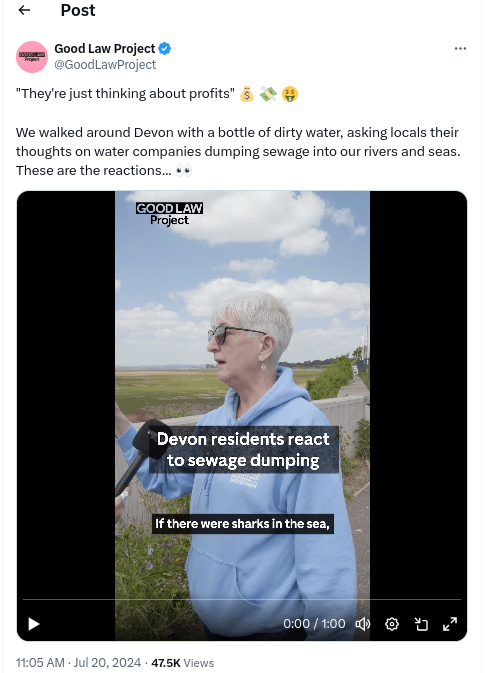
As the Good Law Project walk around Devon (Exmouth) with a bottle of dirty water, asking locals their thoughts on water companies dumping sewage into our rivers and seas. These are the reactions.

[The Good Law Project are backing Jo Bateman in her case against South west Water]

Build houses now, fix pollution later, Labour to tell developers

Leave it to developers and it will never happen. – Owl

Developers will be able to start building housing projects that risk polluting rivers and work out how to deal with the problem during construction, under plans to unblock 160,000 homes.

Chris Smyth www.thetimes.com

Labour has begun the process of changing environmental protections after blocking Conservative attempts to rip up “nutrient neutrality” rules before the election.

Angela Rayner, the deputy prime minister, and Steve Reed, the environment secretary, have told environmental groups that current rules are “not working” and that they want to find ways of restarting housing developments that have been put on hold.

Natural England effectively imposed a moratorium on a string of projects two years ago by ruling that developments in designated areas would only be allowed if the builders could show they would not increase levels of phosphorus or nitrogen in waterways. These can reduce the oxygen in the water, causing the deaths of invertebrates, which in turn reduces food supplies for protected bird species.

Last year Labour defeated the Conservative government’s attempt to allow councils to set aside these rules, saying it would mean the loss of environmental protections. That prompted Tory accusations that the party would struggle to take the decisions needed to hit its target of building 1.5 million homes.

Now Reed and Rayner have written to environmental groups saying the rules need to change. “When it comes to the planning system’s role in providing the nature and housing we need, we know that the status quo is not working,” they said.

“We want to use the value gained from enabling development to proceed quickly and smoothly to support nature recovery — and to do so in a way that gives everyone involved greater certainty.”

Under the proposed model, developers would be allowed to begin work and agree mitigations during construction, rather than beforehand. This could see them, for example, agreeing to fund the creation of new wetland areas elsewhere to offset pollution from new homes.

Labour said new homes could only be occupied once the mitigations were in place, arguing that this would speed up development without compromising the environment.

“We will only legislate if we are confident that it achieves these outcomes,” Rayner and Reed wrote, insisting that they wanted proper consultation with environmental groups.

Changes to the nutrient neutrality rules are expected to come in the planning bill announced in last week’s King’s Speech. This is likely to become law next year and Labour ministers hope that this will kickstart the 160,000 homes that the Homebuilders Federation estimates have been put on hold because of the current rules.

“Nature recovery remains a top priority alongside the need to overhaul the planning system, grow the economy and reach net zero,” Rayner and Reed wrote. “This is not a matter of choosing one of these priorities over another. Sustained economic growth depends upon a healthy natural environment.”

The Conservatives are likely to accuse Labour of hypocrisy, but ministers insist that the Tory solution was defective and that they can find a “win-win” solution for home building and the environment.

Labour is relying on a housebuilding boom to kickstart the economy and allow more cash for public services, and has already announced the return of mandatory housing targets for councils. Detailed changes to planning rules are expected to be set out before the end of the month to ensure that new developments can begin immediately.

Alison Hernandez makes not just one, but two controversial appointments 

Lord Hogan-Howe, who faced repeated calls to resign when head of the Met., is now providing “strategic and tactical advice” to Devon and Cornwall Police. And her old buddy Mark Kingscote (see this 2017 EDW post) as Deputy Commissioner against the advice of a scrutiny committee, in a repeat of 2017. Although she eventually did a U-turn in 1017! – Owl

Lord Hogan-Howe is giving Devon and Cornwall Police “strategic and tactical advice”

Ben Woolvin www.bbc.co.uk

A former top police officer has been appointed as an adviser to Devon and Cornwall Police following the suspension of its Chief Constable.

Police and Crime Commissioner (PCC) Alison Hernandez told councillors at a Police and Crime Panel on Friday in Plymouth that Lord Hogan-Howe, the Metropolitan Police Commissioner from 2011 to 2017, would help in a strategic and tactical way.

She said the decision was taken after Chief Constable Will Kerr’s suspension in July 2023 when he was accused of serious sexual offences, which he denies.

Ms Hernandez added she was not expecting any result from the investigation into Mr Kerr “any time soon”, but was hopeful a decision would be made this year.

Last year, the Police Ombudsman for Northern Ireland said it was investigating “allegations of serious sexual offences” made against Mr Kerr, who used to be an Assistant Chief Constable for the Police Service of Northern Ireland.

In June, the Ombudsman said its investigation had been completed and a file had been submitted to the Public Prosecution Service for Northern Ireland.

Ms Hernandez said Public Prosecution Service for Northern Ireland had told her they would give her another update in September.

Mr Kerr, who strenuously denied “any allegations of criminality” when the investigation was launched, has been suspended on full pay for nearly 12 months.

‘Gee things up’

Ms Hernandez said following Mr Kerr’s suspension, Devon and Cornwall was struggling with “all of the things you would expect to be the bread and butter of a police force”.

She reminded councillors of the concerns raised by inspectors about the quality of its investigations and the time taken to respond to calls and attend incidents.

Philip Hackett, an independent councillor at Torridge Council, asked the PCC to explain why taxpayers in Devon and Cornwall were “paying for someone who was suspended and may be suspended for some time”.

Ms Hernandez said she was expecting to make a decision regarding the role of Chief Constable “at some point this year”.

She said that Lord Hogan-Howe was giving “strategic and tactical advice” to her and the acting Chief Constable Jim Colwell.

“We want to see what we can do to gee things up, create that pace, and see what more we could be doing,” she said.

In a separate development, Ms Hernandez said she was making Mark Kingscote a Deputy Commissioner.

Mr Kingscote is a retired NHS mental health support worker who used to be a Conservative councillor in the same ward as Ms Hernandez in Torbay.

The panel voted to recommend the PCC did not appoint her chosen candidate as he did not meet the minimum requirements for the role, but Ms Hernandez said she would not accept the recommendation.

Defending her decision, Ms Hernandez said she felt it was the right move to bring in Mr Kingscote, especially during Mr Kerr’s ongoing suspension.

She said: “I’m excited to be able to appoint Mark Kingscote today and he will help me on developing my street operational focus on tackling anti-social behaviour.

“He’ll help build capacity in the leadership team while we’ve got the absence of a chief constable and the police are having their performance issues,” she added.

See also Radio Exe

Action is needed to tackle Devon’s “housing emergency”, new report warns

Your weekend’s reading!

(See bottom of post for an interesting reference to Cranbrook) – Owl

Devon is “running out of housing options” and urgent action is needed to tackle the dramatic numbers of families priced out of markets having to be placed in temporary accommodation, a new report warns.

Kerra Maddern news.exeter.ac.uk

Members of the Devon Housing Commission say the housing crisis in Devon is having consequences for public services and the economy; and creating extra challenges for hard-pressed care and health services.

They have called for central and local government, with social housing partners, to redouble efforts to provide more truly affordable homes for the people of Devon.

In order to get more homes in the right places there needs to be better resourcing of planning departments, special measures for rural and coastal communities and a county-wide Development Corporation for major developments.

The report also recommends homebuyers over pension age should get an exemption from Stamp Duty. This could also help solve issues in the county by helping older people find a “right-sized” property.

The Government should also introduce a new planning use class for all short-term/holiday lettings and local authorities should be able to limit them in areas where growth is proving detrimental to the community.

The Housing Commission – which has been established by the Devon Housing Task Force, is a partnership between the ten local authorities across Devon, including Torbay and the County Council – and is supported by the University of Exeter.

Their report calls for the Government to press ahead with the registration of short-term lettings and for district councils in Devon and Torbay Council to take advantage of the new opportunity to double Council Tax on second homes [following the lead taken by EDDC – Owl]. This extra Council Tax could help the funding needed to address housing challenges.

The report outlines how the housing emergency in Devon is caused by high house and rental prices and lower incomes in Devon. House prices are inflated by those moving from more expensive areas. Middle-aged and older people are moving in while younger people are leaving. This leads to employers having difficulties filling vacancies and key workers being unable to afford to live near their place of work.  

Lord Richard Best, Chair of the Commission, said: “There is a real housing crisis in this county. The problem is an acute shortage of homes affordable for the next generation. 

“Homeownership is beyond the reach of first-time buyers and it is virtually impossible for those on average incomes or less to obtain a rented home that is both available and affordable. Devon is simply running out of any housing options. 

“This is best illustrated by the dramatic rise in numbers of people, particularly children, that councils have had to place in temporary accommodation, and the consequent, alarming increase in costs borne by Devon’s local authorities. This represents a real emergency.” 

Commissioners found in some areas of Devon the amount of privately rented housing has declined by substantially more than elsewhere, partly because long-term lettings for locals have been switched to short-term Airbnb-style lettings for tourists. 

But the report says “significant inroads” could be made in easing shortages and delivering affordable homes at the scale required.  

The report calls for a new Devon-wide Housing Strategy that sets out goals and a roadmap to achieve them over the next decade and beyond. There should be a successor body to the current Devon Housing Task Force comprising representatives of Devon’s local authorities to monitor progress and work with the proposed Devon and Torbay Combined County Authority (CCA). This new authority should sponsor a new Development Corporation to act as a Master Developer to acquire land and raise private finance, reducing reliance upon housebuilders.

Other recommendations include:

  • Councils should make maximum use of the Rural Exception Sites model and demonstrate flexibility in enabling village schemes for local people, including by sometimes permitting a small minority of homes to be sold in return for a very modest land cost for the affordable housing.
  • Government should permit the imposition of a stricter timetable for action where planning consent is granted but development has stalled.
  • Local authorities should be given greater discretion to call in any significant development using permitted rights to avoid inferior standards, to impose stronger prior approval requirements, and to allow the levying of developer contributions.
  • The Government should introduce the measures to improve the private rented sector contained in the earlier Renters (Reform) Bill including ending “no-fault” evictions and creating a landlords’ ombudsman.

Chair’s Summary    

The words “housing crisis” are not what the general public (or Westminster politicians) usually associate with the beautiful county of Devon. However, as the evidence accumulated by the Devon Housing Commission shows, there is indeed a real housing crisis in this county. The problem is an acute shortage of homes affordable for the next generation.    

This is not just about homeownership being beyond the reach of first-time buyers (even of those with incomes well above the average), the problem now covers rented homes as well. It is virtually impossible for those on average incomes or less to obtain a rented home that is both available and affordable. Devon is simply running out of any housing options.

This is best illustrated by the dramatic rise in numbers of people (particularly of children) that councils have had to place in temporary accommodation, and the consequent, alarming increase in costs borne by Devon’s local authorities. This represents a real emergency.

What has caused this dire situation?

Of course, there is a nationwide problem of acute shortages of somewhere to live that is decent, secure and affordable. However, affordability is a particular problem in Devon, where house prices are higher and incomes are lower than the national averages.

First, becoming a homeowner in Devon is particularly difficult because house prices are inflated by those moving from in more expensive areas, principally from London and the South East. Middle-aged and older people are moving in while younger people are leaving. This creates difficulty recruiting to vacancies across Devon and means key workers cannot afford to live near their place of work.

Second, the availability of affordable rented housing is more constrained in Devon than most places. The amount of social housing available from councils and housing associations is proportionately half as much as for England. Historically, Devon has not built enough affordable homes and current trends show that the position is getting worse. The county is not keeping up with national levels of affordable housing delivery. The already low level of social housing has been further depleted by Right to Buy sales at substantial discounts. While governments have hoped that sales of council housing will be replaced by new social housebuilding, in reality this has not happened.

Third, in some areas, the amount of privately rented housing has declined by substantially more than elsewhere, partly because long-term lettings for locals have been switched to short-term Airbnb-style lettings for tourists.

Fourth, Devon has an older population profile and more family-size properties are occupied by one or two people: the phenomenon of under-occupation is an even bigger issue than for England as a whole.

Fifth, rurality and the physical aspects of Devon make new building problematic in many places. The geography and topography of the county restrict opportunities. Narrow country roads and steep hillsides make construction more difficult. In addition, more of Devon than of most counties is protected by designations of National Parks, National Landscapes, and Sites of Special Scientific Interest.

Although new development is best suited to urban areas with brownfield sites, Devon is predominantly a rural county. This adds special obstacles to meeting housing need. Normal planning conditions present extra barriers to rural development. Moreover, existing residents often oppose any development, even where this is designed to meet local needs.

Sixth, Devon also contains many coastal towns which bring their own challenges. Properties designed for a tourist market of yesteryear can attract landlords who let sub-standard properties to those on Housing Benefit. The fashions for holiday destinations have changed, leaving a legacy that requires investment in regeneration.

Seventh, Devon is now unusual in terms of local government structures. Although our Commission’s work has not embraced the city of Plymouth, which is a unitary authority with a substantial population (265,000), the rest of Devon has eight District Councils and the Unitary Authority of Torbay, in addition to the County Council. These ten local authorities compare with the single authority for Cornwall and two, for example, for Somerset, Dorset and Wiltshire.

Devon’s structures enable democratic decisions at a more local level but produce some logistical hazards. In relation to planning functions, it would be hard for every local planning authority in the County to employ a full complement of expert planning staff even if funding was sufficient (which it is not). Furthermore, many planning decisions cross adjacent local government boundaries.

How can all these issues be addressed?

This is a difficult moment to be calling for the building of more new homes to meet Devon’s acute shortages. Housebuilders are not keen to develop while market conditions are being hit by higher interest rates and increased costs; local authorities are facing severe financial constraints; housing associations are running out of capacity to expand their work. However, with an emphasis on affordable housing for rent and shared ownership (for those on average incomes and below), there are some positive steps that could make a significant difference.

At the strategic level, the Commission is recommending a Devon-wide Housing Strategy that sets out goals for the County with a roadmap to achieve them over the next decade and beyond. We recommend a successor body to the Housing Task Force comprising representatives of Devon’s local authorities to monitor progress and work with the proposed Devon and Torbay Combined County Authority (CCA). The CCA represents an important opportunity to coordinate Local Plans across the County, covering transport and infrastructure alongside housing provision. These arrangements would facilitate enhanced working relationships with central government and with its agency, Homes England.

We also recommend a county-based initiative for the recruitment, retention and career progression for planning staff across the County. This would assist the resourcing of planning departments and support cross-boundary working.

Central government could help ease the crisis in a number of ways: by allowing planning fees to fully recover costs; by taking forward measures in the previous Renters (Reform) Bill for greater security and higher standards in the private rented sector; by committing to an ongoing affordable housing programme through Homes England that prioritises social rented homes and allows flexibility between new builds and the regeneration of existing buildings; by sharing more of the cost of temporary accommodation in the short-term, by providing opportunities for councils to acquire and improve properties which will be available long-term for social rent; and by introducing the necessary measures for local authorities to limit further growth in short-term lettings.

For rural areas, greater use of Rural Exception Sites would make possible more affordable homes that revitalise local communities. Landowners may need incentives to make these sites available at minimal cost: to this end, developments (in some cases Community Land Trusts will be the solution to delivering homes), should be supported by local authorities and national government through a relaunched Community Housing Fund.

For coastal areas, refurbishment of outdated tourist accommodation can meet local needs. Proactive enforcement of standards can also drive up quality in the private rented sector.

As a major recommendation, the Commission would like to see the proposed Combined County Authority sponsoring a new Development Corporation. This would act as a Master Developer on behalf of the County, Torbay, and the District Councils. It would acquire land, capturing its value, raise private finance, and implement a Master Plan for all major, strategic developments. It would end the current reliance upon the volume housebuilders.

In conclusion, the Commission recognises the size of the task ahead. However, we believe that with the engagement of Devon’s local government and local communities (and appropriate input from central government), significant inroads could be made in easing shortages and delivering affordable homes at the scale required.

I wish all concerned every success in this endeavour and sincerely thank the Commissioners, Devon’s Housing Task Force, the County Council and our sponsor, the University of Exeter (in particular through the work of Matt Dodd and David Hancock) for making possible this worthwhile initiative.

Richard Best

Lord Best, Chair, Devon Housing Commission [Extensive careeer housing including, leading  the Joseph Rowntree Foundation and Joseph Rowntree Housing Trust,  from 1988 to December 2006.] 

Interesting snippet on Cranbrook

Owl is still dipping into this 112 page report and has found this insight into Devon’s population and the significance of the “exception ward” of Cranbrook. Something the “Old Guard” Tories created by their “build,build, build” policy, then abandoned; but picked up by the “New Guard” (coalition).

Extract from chapter four:

Devon is also ageing at a faster rate than the rest of England. The average age in England increased by one year between the census of 2011 and the census of 2021 whilst, apart from Exeter (with no increase) only East Devon increased in line with the England average. The presence of the Cranbrook development has kept the rise in average age in East Devon in check: Cranbrook is a new town with a very low average age which impacts the overall East Devon profile. The average age in the Cranbrook ward in 2021 was twenty-nine compared to the average age of fifty in East Devon as a whole, making Cranbrook the “youngest ward” in the county. East Devon, with four of the top ten oldest wards, includes Sidmouth town which, with an average age of fifty-nine, is the oldest in Devon.

Devon’s population is older than England’s, but, crucially, it is also ageing at a faster rate. It is important to understand what is driving this before exploring the impacts on housing. During  2012 and 2020, the overall population of Devon rose at a faster rate than England and the South West, with the East Devon and Exeter populations increasing at the highest rate. This can be attributed to the growth of the university in Exeter during this period (see Chapter Three) as well as developments such as Cranbrook.

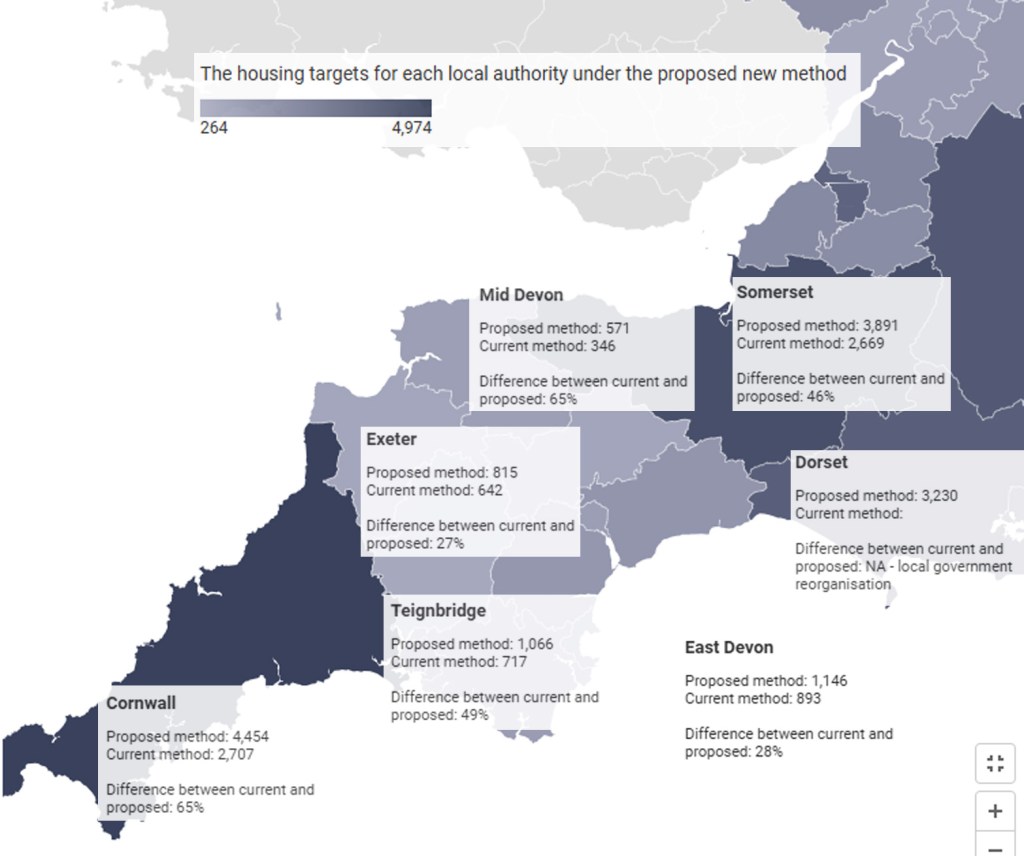
Woah, South West Water! “Freak accident” and “third parties”. Explain! – Owl

According to this report of a meeting between South West Water (SWW) and Teignbridge Council’s overview and scrutiny committee, SWW are trying to deflect the blame for the cryptosporidium outbreak.

It is being described by them as a “freak accident”, the responsibility of a “third party”.

Accounts suggest that the crypto bug got into the water through “a faulty valve in the network”.

We don’t know what sort of valve this is, but valves are mechanical devices that can fail.  So a fundamental consideration should be that they are installed in such a way, and situation, that they “fail safe”. They also need to be monitored and maintained. Surely these are SWW responsibilities?

SWW don’t look to have been any more transparent at this scrutiny meeting than with their meeting with EDDC in February.

Consumers need a much fuller explanation of what went wrong if confidence is to be restored. – Owl

Bug infection was ‘freak accident’ claims South West Water manager

Guy Henderson, local democracy reporter www.radioexe.co.uk 

Fault lays elsewhere, councillors told

An incident which led to thousands of South Devon households being told to boil their drinking water for weeks on end has been described as ‘an absolute freak accident’.

A faulty valve in the network between Brixham and Kingswear allowed cryptosporidium into the water system, exposing people to the risk of catching a bug which causes vomiting and diarrhoea.

Ian Lake, head of developer services for South West Water (SWW), told Teignbridge Council’s overview and scrutiny committee: “South West Water was not the reason for this. It was a third party.

“An investigation is being undertaken, but it was in my humble opinion an absolute freak accident that occurred.”

The alarm was raised in May, and 17,000 households across Brixham, Kingswear and parts of Paignton were advised to boil their water. SWW set up depots to distribute free bottled water to people affected by the incident, and delivered supplies to vulnerable households.

It was only a week ago – almost two months after the first reports – that the final ‘boil water’ notice was lifted for the last affected homes closest to the water works.

Mr Lake was among SWW officials attending the meeting to answer questions about water issues in Teignbridge.

Head of community engagement Alan Burrows said there had been “emotive conversations” around sewage spills and water quality, but SWW was on track to hit stringent targets to cut the number of incidents.

He pointed out that the water company was to blame for only 12 per cent of pollution spills, with the rest coming from sources including farms and factories.

His figures showed that fewer than half the storm overflows into the River Teign catchment area currently meet government standards, but millions of pounds is being invested to fix the others.

Cllr John Radford (SD Alliance, Kerswell with Coombe) said: “I don’t see any confidence going forward. A lot of promises have been made, but they have never been kept.”
 

Owl is pausing for reflection

Owl has been posting daily for four and a half years and will now pause to reflect on how East Devon Watch should respond to the new political scene.

It has been an eventful time with Owl covering key events including: 

the pandemic in all its phases; 

Ben Ingham’s “last stand” and the changing of the guard in East Devon including the eventual retirement of EDDC’s Chief Executive, Head of Paid Services, Director of Planning and Returning Officer, Mark Williams;

the “Rainbow” coalition inspired by Eileen Wragg and led by Paul Arnott;

Sasha Swire’s “Secret Diary”;

the First Million Hits; 

Alderman John Humphreys’ conviction and sentence for historic child rape, and “who knew what and when”; 

the fall from grace of “Tractor Porn” Neil Parish and the election of our first LibDem MP Richard Foord; 

the short, damaging, history of three Tory Prime Ministers and a lettuce; 

the funding crisis in local government;

Various “goings on” in other neighbouring councils;

the sewage crisis from denial to acceptance;

the 2024 election which saw Conservative reduced to the lowest number of MPs in the party’s history and the LibDems winning the most seats for 100 years.

sadly, Owl has also had to record the deaths of Val Ranger and Sandra Semple both of whom had been significant “agents for change” in East Devon.

East Devon Watch has now become a fantastic archive of more than 19,000 articles, dozens of which are read every day.

As a reader, if you have any views, email them to: eastdevon.owl@gmail.com

Devon and Cornwall Police ‘inadequate’ at investigating crime

Alison Hernandez is still lagging rather than leading – how did she manage to get re-elected with such a miserable record? – Owl

Bradley Gerrard, local democracy reporter www.radioexe.co.uk 

The Devon and Cornwall Police service has been assessed as ‘inadequate’ at investigating crime in a critical report that says not enough offenders are being brought to justice.

The region’s police and crime commissioner Alison Hernandez now says she will challenge its leaders to improve the poor outcome in such a critical function.

HM Inspectorate of Constabularies and Fire & Rescue Services (HMICFRS) says the standards of the force’s investigations “have deteriorated” because of understaffed and inexperienced teams investigating serious offences, while the service “still has work to do” in leadership and force management.

In a review of 66 cases, only 47 had an investigation plan, and it found some in which had “significant failings and victims had been let down”.

Inspectors also noted “serious concerns” about how the force manages investigations, adding that it is in “regular contact” with the acting chief constable on this issue.

Ms Hernandez welcomed the inspectors reports saying the service is good at preventing crime, and noted that data since the inspection showed improved performance in other areas, including how it manages offenders.

But she said she “shares HMICFRS’s concerns relating to crime investigation standards.”

She continued: “For several months, my recently formed accountability and standards team have been examining how files are prepared for court and how data is collected and used by the force,” she said.

“Their findings chime with those of His Majesty’s Inspector.

“The public must be confident that when they report crime the evidence and information they supply is correctly recorded and used so perpetrators are brought to book and victims receive the justice they deserve.”

She added that despite record investment in policing in Devon and Cornwall, she would be “challenging the force’s leadership to improve significantly in this area”.

In the report, Andy Cooke, HM chief inspector of constabulary, said he had “concerns about the performance of Devon and Cornwall police in keeping people safe, reducing crime, and providing victims with an effective service”.

However, the force hit back at some aspects of the report “due to the inspection being based on historical data, some of which is over a year old and does not accurately reflect improvements the force has made”.

They claimed positive feedback is evident in the force’s management of offenders and registered sex offenders, although this is still rayted as “requires improvement”.

The inspector said “considerable improvement” had been made in how the service treats people who contact it.

“Since our previous inspection, the force has made significant efforts to improve in the areas we highlighted as causes of concern or areas of improvement, which is recognised,” Mr Cooke said.

“However, despite those improvements, more is required to place the force in a position where it is consistently providing a good standard of service to its local communities.”

Acting chief constable Jim Colwell said: “I am pleased that the Inspectorate has acknowledged the good work that goes on in our neighbourhood teams every day, which is a reflection on the hard work of our officers, staff and volunteers.

“We are committed to delivering community policing with competence, compassion and common sense, which is why we remain the second safest force area in the country, and this has been clearly recognised by the Inspectorate.”

Ms Hernandez echoed this, saying the force has “one of the lowest crime rate areas.. But it is extremely disappointing that the force is letting too many victims down, whether with poor response times or a delayed investigation,” she added.

However, Mr Cooke said while aspects of crime investigation oversight had improved: “the force has understaffed and inexperienced teams investigating serious offences.

“There are delays in crime allocation and supervision, with many investigations lacking a detailed investigation plan or effective supervision.

“The force needs to improve in this area to achieve better outcomes for victims of crime.”

Decon and Cornwall Police said it has made considerable progress since the last inspection, such as review creating  more resilient teams to give more support to victims and ongoing work to address a national shortage of detectives.

“I fully acknowledge that we still have work to do to ensure that our investigations are completed to the high standards that the public would expect of us – particularly when it comes to serious and complex crimes,” acting chief constable Colwell added.

“We have made progress since the last inspection, but I recognise there is still much more to do if we are to deliver a better level of service to our communities and reduce some of the pressure on our colleagues.”

HMICFRS said it had altered its inspection process, meaning that this latest report could not be compared with the previous one.

The old system used to grade nine areas of policing, rather than eight under the new system.

Of those, two were rated inadequate (investigating crime and responding to the public), two require improvement (managing offenders, and leadership and force management), three are adequate (police powers and public treatment, protecting vulnerable people, and developing a positive workforce) and ‘preventing crime is ‘good’.

Mr Cooke praised the force for supporting neighbourhood policing teams, but raised a concern that they are “frequently being diverted to manage other demands, and this is affecting the service the force provides in this important area of policing”.

The inspector added that force now has the highest number of officers for some time.

“Although some of these officers will be less experienced, this presents a good opportunity for the force to make progress,” Mr Cooke added.

Instability at the top the force may also have been a factor in the outcomes of the report, with chief constable Will Kerr remaining suspended after more than a year.

Mr Cooke noted that operating with a temporary senior leadership team “hasn’t been easy”, and that the force is “one of the largest policing regions in England and Wales.

“The infrastructure of both Devon and Cornwall presents challenges in how the force can use resources to improve services in the areas we have identified,” he said.

Polluting water firms’ bonuses revealed – and how much you’re paying for them

Water companies are set to increase their bills across England and Wales by an average of £94 in the next five years, as the under-fire firms try to improve failing infrastructure.

Adam Forrest inews.co.uk

The water giants are under huge pressure to invest money in the creaking sewage system, following public outrage over the amount of waste getting pumped into the nation’s rivers, lakes and seas.

These companies are allowed to spill untreated sewage from storm overflows during periods of intense rainfall to prevent their systems from becoming overwhelmed.

i revealed on Wednesday that the Government will force the water firms to return money that is not spent on upgrading their sewerage networks to customers.

The bill increases approved by regulator Ofwat are less than a third of what the water companies had asked for. Water bosses had been keen to impose even larger hikes on customers to help pay for upgrades.

It comes despite huge bonuses for the companies’ chief executives over the last year – with some enjoying hundreds of thousands of pounds in top-ups, which took some of their annual pay packets to more than £1m each.

Here i has set out how each water company contributed to polluting rivers last year, how much bills are set to increase – and how much they have paid out in bonuses:

United Utilities

United Utilities performed worst out of any water company last year in terms of sewage pollution, according to the Environment Agency, with 45.4 spills per storm overflow and more than 650,000 hours of monitored spill events in 2023.

Customers’ bills at United Utilities are set to increase by 21 per cent by 2030, from £442 to £536 – up by £94.

The company’s chief executive Louise Beardmore got a £420,000 annual bonus in 2023/24 – part of an overall pay packet of more than £1.4m.

It is down slightly on previous chief executive Steve Mogford’s £426,000 bonus the previous year, which was part of his £2.2m pay packet.

BILLS: Set to rise by 21 per cent

CEO BONUS: Down by 1.4 per cent

South West Water

South West Water, owned by Pennon, had 43.4 spills per overflow and 317,285 total hours of sewage spills. The company is facing a legal challenge over spills on the Devon coast.

Meanwhile, South West Water bills are set to increase by 12 per cent by 2030, from £497 to £561, up by £64.

The company’s chief executive Susan Davy was in line to receive a total pay packet of £860,000 in 2023/24 – up from £543,000 the previous year.

But she opted not to take a bonus for a second year running, amid criticism of pollution levels. The £298,000 she received under a long-term incentive plan was diverted to a company scheme for shareholders.

BILLS: Set to rise by 12 per cent

CEO BONUS: No change.

Yorkshire Water

Yorkshire Water had the third highest level of spills in England and Wales last year, with 35.9 spills per overflow and 516,386 hours in total.

Yorkshire Water’s bills are set for a 25 per cent increase by 2030, from £430 to £537 – up by £107.

Chief executive Nicola Shaw saw her basic pay increase from £515,000 to £585,000 in 2023/24. She was awarded £371,000 as part of the company’s short-term “executive incentive plan”.

She had opted to forgo her bonus the previous year, amid criticism of the company’s performance over sewage.

BILLS: Set to rise by 25 per cent

CEO INCENTIVE: £371,000.

Welsh Water

Welsh Water had 35 spills per overflow in 2023 for its operations in England, according to the Environment Agency. They accounted for 23,354 hours of spills in total.

Bills are set to increase by 29 per cent increase by 2030 from £466 to £603 – up £137.

Welsh Water’s CEO Peter Perry received a £91,000 bonus in “annual variable pay” in 2023/24, part of his £489,000 pay packet. He had refused a bonus the previous year, amid public outcry over the state of Britain’s rivers.

BILLS: Set to rise by 29 per cent

CEO BONUS: Up from zero to £91,000.

Wessex Water

Wessex Water had 32 spills per overflow in 2023, with 372,341 hours of spills, watchdog figures show.

Customers are set for a 2 per cent reduction in their bills by 2030 from £508 to £497.

The company’s chief executive Colin Skellett decided to forgo any bonus in 2023/24, amid criticism over pollution. He received a £120,000 bonus the previous year. His basic pay of £290,000 remained unchanged.

BILLS: Set to decrease by 2 per cent

CEO BONUS: Down from £120,000 to zero.

Southern Water

Southern Water saw average spills of 30.7 per overflow in 2023, spilling for 317,285 hours in total.

Customers’ bills for the company, owned by the Australian conglomerate Macquarie, are set to increase 44 per cent by 2030, from £420 to £603 – up by £183.

The company’s chief executive Lawrence Gosden received a £183,000 bonus for 2023/24, having declined a bonus the previous year. His total pay packet – including base salary, bonus and pension benefits – rose from £427,000 to £764,000.

BILLS: Set to rise by 44 per cent

CEO BONUS: Up from zero to £183,000.

Northumbrian Water

Northumbrian Water recorded 30.1 spills per overflow over the course of 2023, spilling for 280,029 hours in total.

Customers’ bills are set to increase by 11 per cent by 2030 from £415 to £460, which is up by £45.

Chief executive Heidi Mottram received a bonus of £234,000 in 2023/24 – up from £215,000 the previous year. Her overall pay packet rose from £781,000 to £842,000.

BILLS: Set to rise by 11 per cent

CEO BONUS: Up by 8.8 per cent

Thames Water

Thames Water, the embattled giant of the UK water industry, is teetering on the edge of collapse, with negotiations with Ofwat still ongoing.

It saw 27.9 spills per overflow, for a total of 196,414 hours. Thames Water bills are set to increase 23 per cent by 2030 from £436 to £535, up £99.

Chief executive Chris Weston took a £195,000 bonus 2023/24, with his total annual pay packet being £437,000.

Previous boss Sarah Bentley opted to refuse her bonus last year, as the company was heavily criticised for sewage pollution.

BILLS: Set to rise by 23 per cent

CEO BONUS: Up from zero to £195,000

Severn Trent

Severn Trent performed second best of the water companies for average spills, averaging only 24.9 spills per overflow.

Earlier this year the company was fined £2m for allowing huge amounts of raw sewage to discharge into the River Trent.

The company’s bills are set to rise by 23 per cent by 2030, from £403 to £496, up by £93.

Bills for Hafren Dyfrdwy (Severn Dee) customers, part of Severn Trent in Wales, are set to rise by 32 per cent by 2030, from £396 to £524.

Severn Trent’s chief Liv Garfield was handed a £584,000 bonus for 2023/24, up from £358,000 the previous year. Her overall pay packet rose slightly to almost £3.2m.

BILLS: Set to rise by 23 per cent

CEO BONUS: Up by 63.1 per cent

Anglian Water

Anglian Water performed best out of any water company when it comes to sewage spills, averaging 22.2 spills per overflow, spilling for 273,163 hours in total.

The company charges for customers are set to increase by 13 per cent by 2030, from £491 to £557, up by £66.

The company’s chief executive Peter Simpson took bonus and deferred bonus payments of £455,000, down from £517,000 the year before.

BILLS: Set to rise by 13 per cent

CEO BONUS: Down by 12 per cent


A Correspondent comments on the rejected Knowle, Sidmouth, development plan

Even if plans are eventually passed, caveat emptor!

An anonymous item in The Times on 7th July states:

My daughters recently inherited a McCarthy Stone leasehold retirement apartment in Lancashire and need to sell it to get probate and distribute the proceeds according to the late owner’s will. Some of those waiting for their share are in urgent need. 

But this may take up to three years, my daughters have been told, as the new owners must be over 70 years of age, and demand from this age group is low. Until this is done they cannot distribute the assets, all the while incurring an annual service charge of about £8,500. What can they do?

Anonymous