Tories now the party of the 1 percent

Labour has 99% chance of winning next election, says polling guru John Curtice

The party of the 1 percent (chance): Though Labour has been consistently riding 20 points clear of its rivals, Tory strategists still insist the polls will narrow dramatically in the heat of the election campaign. But Curtice says the chances of a Tory turnaround are fractional, adding that Keir Starmer’s party also stands a far better chance of forming a government in the event no one wins a majority. “The Labour Party will be in a much stronger position to negotiate a minority government than the Conservatives because, apart from possibly the DUP, the Conservatives have no friends in the House of Commons,” he said. Happy Easter! London Politico Playbook

“I see no crisis” just raise productivity 5% to meet the challenge. Millionaire Sunak on local government funding

What bubble is our Prime Minister living in?

Is he totally detached from the everyday life of ordinary people? – Owl

Sunak denies ‘crisis’ in local government funding despite bankruptcy warnings

Pippa Crerar www.theguardian.com 

Rishi Sunak has denied there is a “crisis” in local government funding despite warnings that well-run councils are on the brink of bankruptcy and local services at risk without more support.

The prime minister admitted that councils faced “challenges”, in particular with inflation, which has significantly outpaced recent cash injections, at the cross-party liaison committee.

The Local Government Association has warned that councils are starting this financial year in a “precarious position” financially, and having to scale back or close a wide range of local services.

It has calculated that English town halls need an extra £4bn over two years just to maintain services at current levels, or risk a financial crisis, against a backdrop of significant spending cuts since the Conservatives came to power 14 years ago.

Clive Betts, the chair of the levelling up, housing and communities committee, asked whether there was a crisis, to which Sunak responded: “I wouldn’t characterise it that way.

“Of course there are challenges, particularly with inflation, which is why … the overriding economic priority of the government was to bring inflation down because that will help local councils with their finances too, as well as helping families up and down the country.

“And if you look at what’s happened from central government to local government over this parliament, since 2019, the grant in cash terms has more than doubled.” However, Betts pointed out this was in the context of a 30% cut in councils’ spending power since 2010.

Tuesday’s committee appearance was Sunak’s last before local council elections on 2 May, in which the Tories are expected to face a wipeout.

In a wide-ranging session, the prime minister promised that the public could “safely assume” the pensions triple lock would remain in place throughout the next parliament if the Tories win the election, after Jeremy Hunt confirmed it would be in the party’s manifesto.

The triple lock has become a hallmark of successive Tory governments since it was announced in 2010 but there has been a debate about its long-term future due to its costs. Sunak, however, insisted it was affordable.

Sunak suggested that while public spending would continue to grow in real terms, public services must become 5% more productive. “I do think it’s right that we focus on productivity to get more out of the investment we’re putting in to public services,” he said.

“To give just one statistic – public sector productivity is around 5% lower today than it was before the pandemic. So, no one is asking anything heroic; it’s just a return to where we were. Obviously the private sector has managed that.”

There was a heated row over the government’s flagship Rwanda deportation scheme, with Sunak objecting to the Scottish National party MP Joanna Cherry’s question about whether he was proud of telling Tory MPs to vote against an amendment preventing Afghans who had supported British forces from being deported to Rwanda.

“I really disagree with that characterisation,” he said, adding that in light of recent debates in parliament about MPs’ intimidation, “I actually think characterising like that is deeply unhelpful.”

The prime minister refused to say if the government had finally found an airline willing to fly asylum seekers to Rwanda, suggesting it would be subject to commercial confidentiality.

Responding to other questions, Sunak declined to give a date for when defence spending would hit the 2.5% of GDP target. He also said the UK would continue to push Israel to allow more aid into Gaza, particularly by land.

He acknowledged concerns that the UK had backed the UN security council’s Gaza ceasefire resolution even though it did not explicitly condemn Hamas’s actions. But he added that “whilst not perfect”, the UN’s position was “close enough” to the UK’s position that it should support it.

In a lighter moment, the prime minister gently mocked his predecessor Liz Truss’s claim that the “deep state” had brought her down. Asked whether he was a member of the deep state, he replied: “I probably wouldn’t tell you if I was.”

South West Water make bold assertions – do they stand scrutiny?

“The increase in the storm overflow spills this year can be accounted for by the amount of named storms and weather warnings in 2023.” (South West Water) .

“Can be accounted for” – Is an assertion that needs detailed justification.

Average rainfall in 2003 was unexceptional. As Feargal Sharkey keeps saying, and said so forcefully yesterday on BBC’ ‘s “World an One”, water companies can legally only discharge overflows in “exceptional” conditions. Named storms are not necessarily exceptional.

Increased housing development without the concomitant increase in capacity to carry away and treat the waste water is also a significant underlying factor. (Increased connections increases revenue.)

“We were one of the first water companies to have all our storm overflows monitored meaning we know exactly what is happening, when and where, allowing us to target investment and make changes where it matters most.” (South West Water)

But what about the unmonitored emergency overflows?  See what comes out of them here.

And do they really know what is going on? These freedom of information requests suggest not. 

“We will also be the first water company to meet the Government target of less than 10 spills per overflow, per year – a decade ahead of target.” (South West Water)

What evidence exists to back up such an assertion, are they just targets? We have yet to see any detailed, funded, plans.

Anyway this addresses only spill frequency, there is also the matter of quantity. You could reduce the spill frequency to only once a year just by leaving the sluice gates open! – Owl

Sewage spills from storm overflows in the South West in 2023

Adam Manning www.exmouthjournal.co.uk

New figures from the Environment Agency show South West Water spilled sewage into the sea for 530,737 hours this year.

The figures relate to England’s storm overflows, which dump untreated sewage into rivers and the sea, usually during heavy rainfall to stop sewers backing up and which are now all monitored by water companies.

The number of hours of sewage spills from monitored storm overflows for South West Water:  was 530,737 hours in 2023. Up from 290,271 hours in 2022.

The average duration of sewage spills from monitored storm overflows for South West Water: was 9.1 hours. Up from 7.7 hours in 2022.

The total number of sewage spills from monitored storm overflows for South West Water was 58,249. Up from 37,649 in 2022.

The average spills per monitored storm overflow was 43.4 up from 28.5 in 2022.

South West Water said: “We care about our 860m of coastline, our regions 100% bathing water quality, which we have successfully maintained for 3 consecutive years and protecting the environment now and in the future.

“We were one of the first water companies to have all our storm overflows monitored meaning we know exactly what is happening, when and where, allowing us to target investment and make changes where it matters most.

“We are serious about tackling storm overflows and change of this scale takes time, ambition, and increased investment – and that is why we are investing £850m in our region over 2 years.

“The increase in the storm overflow spills this year can be accounted for by the amount of named storms and weather warnings in 2023. It’s clear we need to redesign our systems, which we are already doing.

“We will also be the first water company to meet the Government target of less than 10 spills per overflow, per year – a decade ahead of target.”

Figures published by the Environment Agency show there were 464,056 spills in 2023, up 54% from 301,091 in 2022, which the organisation said was partly due to England experiencing its sixth-wettest year on record.

The company behind South West Water and Bristol Water has abandoned its ambition to reach a four-star environmental performance rating in 2024, blaming ‘current operating conditions’. South West Water delays environmental performance target

The latest data shows nationally, the duration of sewage spills had more than doubled from 1,754,921 hours hours in 2022, to 3,606,170 hours in 2023.

Both the frequency and duration of spills were also up on 2020 levels, which saw comparable amounts of rainfall, although the number of monitored storm overflows had also increased in that time.

United Utilities had the highest average number of sewage spills per storm overflow of any water company in England last year, at 45.4, followed by South West Water (43.4) and Yorkshire Water (35.9).

South West Water has become the focus of attention in East Devon over the past few years with environmental campaign group ESCAPE Exmouth being very vocal on the issue. 

Water companies say they are investing in tackling pollution from storm overflows and sewage infrastructure, but have faced criticism over profits, bonuses and the way the businesses are managed.

Beaches rated as excellent can be hit by pollution from storm overflows after bad weather, causing warnings against swimming to be issued on multiple occasions. This is the case in Exmouth where the beach is often classed as ‘not safe to swim’ after heavy rain.

Data also show none of England’s rivers are in good overall health and (23%) are classed as in poor or bad overall condition, according to an assessment based on the combination of their chemical pollution and “ecological” state, which measures the health of aquatic plants, fish and insects.

All English rivers are failing on chemical health and just 15% of stretches of waterway are in a good ecological state, according to a recent report from the Rivers Trust based on official data gathered in 2022.

Figures from the Environment Department (Defra) show that wastewater is responsible for 36% of pollution affecting rivers and lakes, while 40% is down to runoff of pesticides, fertilisers, slurry and soil from farming.

Average 2023 rainfall in South West not exceptional, beware the spin

Peter Williams comments on ESCAPE

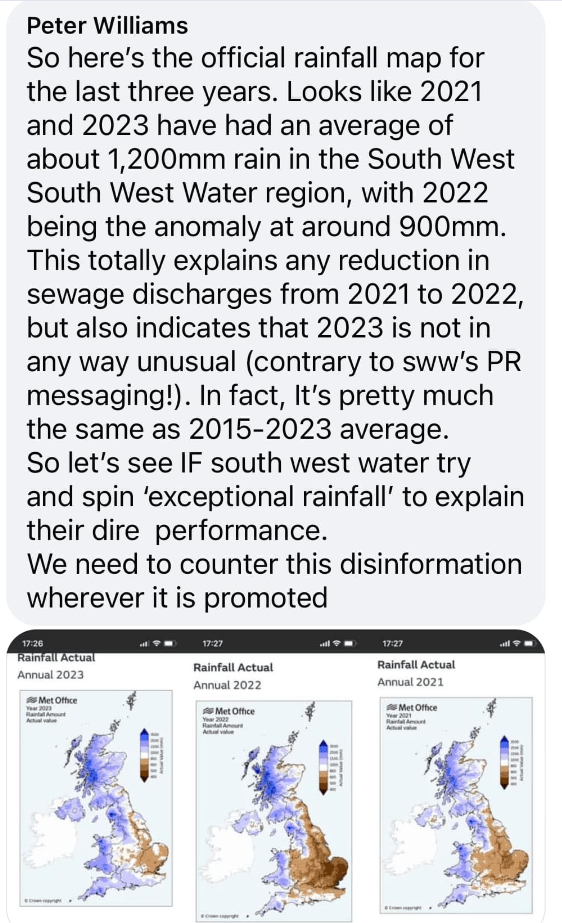
So here’s the official rainfall map for the last three years. Looks like 2021 and 2023 have had an average of about 1,200mm rain in the South West South West Water region, 2022 being the anomaly at around 900mm. This totally explains any reduction in sewage discharges from 2021 to 2022, but indicates that 2023 is not in anyway unusual (contrary to SWW’s PR messaging!). In fact, it’s pretty much the same as 2015-2023 average. So let’s see IF South West Water try and spin “excess rainfall” to explain their dire performance.

We need to counter this disinformation wherever it is promoted.

Peter Williams

4m hours of raw sewage discharges in England in 2023, data expected to show

More than 4m hours of raw sewage discharges poured into rivers and seas last year, a 129% increase on the previous 12 months, new figures are expected to reveal on Wednesday.

Sandra Laville www.theguardian.com 

Total discharges from the 14,000 storm overflows owned by English water companies that release untreated sewage into rivers and coastal waters increased by 59% to 477,972, making 2023 the worst year for sewage spills, according to an early estimate of the Environment Agency figures seen by the Guardian.

Senior industry sources were preparing for the government to turn its guns on water companies after the record year of discharges. The Environment Agency said it was setting up a whistleblowing hotline for people who work in the industry to report any activity that concerns them.

The heavy rainfall over the autumn and winter is likely to be blamed by the industry for the huge rise. Storm overflows are supposed to be used only in extreme weather but for many years they have been used routinely, discharging raw sewage even on dry days in some cases. The academic Peter Hammond has shown how water companies are routinely using storm overflow discharges in their water management.

This year, for the first time every storm overflow has been fitted with a monitor, known as an EDM, but the scale of the rise in discharges is beyond what full monitoring would be expected to provide.

The scale of releases into waterways comes as rivers in England are at crisis point, suffering from a toxic cocktail of raw and treated sewage pollution, chemical toxins and agricultural runoff.

The revelations will put pressure on the water industry and the government, whose plans to tackle storm overflows have been criticised for not going fast enough. The plan aims to eliminate only 40% of raw sewage overflows into rivers by 2040 and discharges would continue being released into waterways until 2050.

In the last few weeks ministers have engaged in a flurry of announcements in anticipation of the shocking data on record sewage spills.

These included an announcement of a £180m plan to fast-track action on sewage discharges, in the face of criticism not enough is being done.

The water industry wants to invest a record £96bn to the end of the decade to tackle sewage discharges, leaks and the impending water supply crisis but has been criticised for passing the costs on to customers for investment that should have been carried out years ago.

The regulator Ofwat has to decide whether to allow companies to increase water bills to pay for the investment. Some customers will face huge bill rises to pay for vital infrastructure work. Thames Water is seeking to raise bills the highest of any company, by 40 per cent. Ofwat is the ultimate arbiter of whether the industry will be allowed to pass the cost directly on to customers as they seek to tackle years of underinvestment and the pressure of extreme weather from climate change.

When the full data from every storm overflow in England is released by the Environment Agency on Wednesday, some rivers and seas are likely to be shown to be suffering hugely from sewage pollution.

As well as total discharges increasing from just over 301,000 in 2022, the average discharge per storm overflow has increased to almost 35, a 52% increase, suggesting huge surges in spills into some waterways.

More than 60 discharges a year from a storm overflow should spark an investigation by the Environment Agency. The agency is in the middle of a criminal investigation into potentially illegal discharges by water companies and the regulator Ofwat is investigating six firms for widespread illegal sewage dumping from treatment works via storm overflows.

Industry insiders said groundwater ingress into pipes is to blame for some of the scale of the discharges.

Figures from the Met Office show 2023 had four individual months within the top 10 wettest on record and the UK recorded its sixth wettest October since 1836 last year.

Met Office assessments said Storm Babet in the autumn brought the third wettest three-day period on record for England and Wales. In November Storm Ciarán was an exceptionally powerful storm, comparable to the Great Storm of 16 October 1987. Rainfall in the autumn of last year was 410mm, which is 122% of the 1991-2020 average.

Defra has been approached for comment.

Pay more for food if you want to cut sewage spills

Consumers should pay extra for food so farming becomes more sustainable and better for the environment.

Alison Stephenson, local democracy reporter www.radioexe.co.uk 

That’s just one of the ways to help improve water quality suggested at a special policy development committee of North Devon Council, where members of the public were invited to ask questions of a panel of experts.

Another suggestion is for councils to ask developers to clean up their act so that waterways don’t become polluted.

The meeting at Petroc College followed public concerns about sewage spills. Representatives attended from South West Water, the Environment Agency, North Devon Biosphere, Surfers Against Sewage, Westcountry Rivers Trust, North Devon Surfing Reserve and members of the farming and angling communities.

South West Water has committed to having no more than 10 spills from its 1,342 storm overflows a year by 2030, which is 20 years ahead of the government’s target.

The company, which reported 38,000 sewage spills in England in 2022, is investing £2.8 billion into improving water quality with a pledge to fix storm overflows at beaches and eradicate pollution.

But people from SWW told the meeting the company is only responsible for 30 per cent of water quality issues. Agricultural and surface water run -off from developments accounts for a large proportion of the problems.

Experts said all the data currently being collected, including from “citizen scientist” volunteers who have water testing equipment from Westcountry Rivers Trust, should not become a “data fog” but be used intelligently to inform solutions.

Exmoor farmer Robin Milton, who is also an independent North Devon councillor for Bishops Nympton, said when he was growing up he saw salmon and brown trout in the local rivers, but not any more.

He said 50 years of the government’s “cheap food policy” meant farmers had been free to do what they liked with their land, with limited regulation of chemicals which end up in the rivers.

Policies are changing to ensure farming is sustainable and protects the environment, but this means consumers having to pay more for food to make it a viable option for farmers, he said.

He said councils like North Devon would be tested on their commitment to biodiversity, which requires developers to leave the natural environmental in a better state than when they arrive. It is an opportunity to improve the environment and water quality through the planning process. Residents were asked to hold councillors to account over this.

Director of asset management at South West Water Mark Worsfold said developers should be encouraged to come up with ‘nature-based sustainable drainage solutions’ (SuDs) to reduce surface-water flooding and river pollution.

He said they work with Plymouth City Council on such projects and want more councils to come forward.

One resident said after reporting fish deaths in the River Torridge and signs of chemical pollution he was told by the Environment Agency that it was not of “major impact”.

Bruce Newport from the Environment Agency said they deal with the worst incidents first and there was are “simply not enough resource” to do any more.

The EA is investing in better technology and 500 more employees in the regulation department and would be much more effective at monitoring rivers in the future, he said.

North Devon’s beaches are currently rated excellent, with the exception of Hele Bay, Ilfracombe, but its rivers and streams are a different picture. The meeting heard that out of 98 bodies of water, 83 had failed to meet good ecological standards.

Residents asked for year-round testing of bathing waters, of which there are 151 in South West Water’s area. Right now they are tested from May to September.

Director of external liaison at South West Water Alan Burrows said wet wipes are still ending up in water courses following heavy rainfall, despite a campaign  to only put “pee, poo and paper” down the loo.

“The system was not designed for this. It’s like putting diesel in a petrol car. It’s a foreign body and they are causing a significant amount of problems on our network, for homes and the environment”

Animals in rivers and seas consume wet wipes which can result in them suffocating or starving to death.

This article was amended on 26 March to remove a reference to SWW monitoring half its overflows and being ahead of target on the rest. The company says it monitors all overflows.

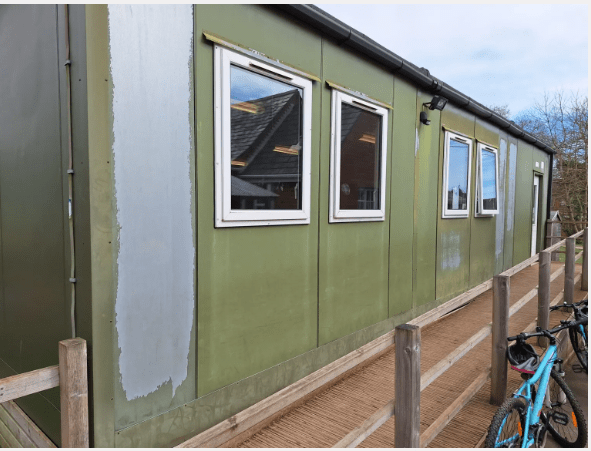
St Peter’s, Budleigh, features in: “England’s schools crisis: Missing teachers, leaky roofs, and budgets crunched” – National Press

Quite recently, Simon Jupp MP, for everywhere and nowhere, promised great  things:

23rd January 2024 I won’t rest until action is taken for St Peter’s Primary School in Budleigh | Simon Jupp MP

Yet here we are with St Peter’s, Budleigh, back in the National News. Was it all just “piss and wind”?

Is Jeremy Hunt scraping the barrel to find more tax cuts before the election? Or handouts like free childminding for those earning £100,000? – Owl

Schools will be plunged into “crisis” unless they quickly receive more cash to fix crumbling buildings and help plug teacher shortages, unions and headteachers are warning.

Connie Dimsdale inews.co.uk

Primary school children are being taught in “sheds” and there is no money for replacement classrooms or to fix roofs that leak in the rain, they say.

Meanwhile, the staff recruitment and retention crisis has deepened, with schools struggling to fill teaching posts across the board, leading to larger classes and low morale.

School leaders are demanding “urgent action” from the Government to avoid a breakdown in the education system and are warning of deteriorating pupil behaviour.

“We’re worried about a potential crisis ahead of us. If we don’t get the support we need then it’s over the horizon,” Pepe Di’lasio, head of Wales High School, Rotherham, and incoming general secretary of the Association of School and College Leaders (ASCL), told i.

Additional disruption to children’s education is threatened by the prospect of a new wave of teacher strikes, with balloting already under way for both of the big two classroom teacher unions.

There are likely to be further calls for industrial action this weekend as the Easter teaching union conference season begins, with the profession more stretched than it has been for years.

The Department for Education (DfE) says school funding is rising to its “highest level ever in real terms per pupil” next year.

However, i has interviewed leaders of the four main teaching unions who have painted a bleak picture as their members run out of patience. Some are saying the “crisis” is already here.

Daniel Kebede, general secretary of the National Education Union (NEU) – the largest teachers’ union – said schools were on the verge of “grinding to a halt” and needed urgent change.

England’s school system would no longer be able to meet its statutory obligations to young people “en masse” – particularly for children with special educational needs and disabilities (SEND), he told i.

Schools are legally required to meet children’s education, health and care plans (EHCP) – but headteachers say their resources are stretched as more children are getting ECHPs while real-terms funding has decreased. This leaves schools with no budget to cover the extra cost.

Physical conditions are another key issue, with classrooms leaking in the rain and headteachers relying on charity for urgent repairs.

Last year, concerns around reinforced autoclaved aerated concrete (RAAC) forced thousands of pupils to return to remote learning, after the Government ordered the urgent closure of school buildings at risk of collapse.

Mr Kebede told i the RAAC crisis was only the “tip of a very big iceberg” – and even that is “far from resolved”.

He added: “Whether it’s faulty windows, inefficient heating systems, not enough classrooms, children taught in Portacabins for extended periods – the school estate is in a general dire state repair beyond just the crumbling concrete.”

Primary school children taught in ‘sheds’

Steve Hitchcock says temporary classrooms have become permanent

Steve Hitchcock, head of St Peter’s C of E Primary School in Budleigh Salterton, Devon, said his pupils have been taught in “sheds” for years, because new classrooms cost up to £700,000.

His school was on a list to get new classrooms built, but was told in recent years that the list “no longer exists” due to cutbacks in capital funding.

This means the temporary classrooms – which were “more like sheds” – have become permanent, he told i.

“I’m throwing good money to keep really bad classrooms going,” Mr Hitchcock said. “Heat just goes out through the doors because the windows and the walls are not insulated.

“There’s always stuff going wrong with them; we’ve had problems with the toilets and the sewage. We’ve had problems with the stanchions rusting away and the walkways needed to be reclad.”

Mr Hitchcock was on a list for new classrooms – but it ‘no longer exists’ due to funding cuts

He said he had spent “tens of thousands of pounds” on upkeep for the classrooms, which could have been invested elsewhere.

The school also needs new roofs on two buildings, new carpets in most classrooms, new lighting, and a new heating system.

All the repairs needed would cost up to £200,000, which is unfeasible as the school gets just £7,000 of capital funding from the Department for Education each year.

But Mr Hitchcock has to make cutbacks each year, recently opting out of Devon’s library service, meaning 500 books were returned to the council.

Instead, the school will rely on donations from the local community, as it has done in the past to raise funds for urgent repairs.

“We don’t have enough money each year to make ends meet so we’re constantly having to make cutbacks,” he told i. “I say this every year but I can’t believe how we’re still able to make cutbacks – what else is there left to trim?”

Children are cold in winter and hot in the summer

Schools are also warning of severe staff shortages, a record number of pupils missing from education, and increasingly poor behaviour.

New Government figures released last week revealed that the unauthorised absence rate in England’s schools increased from 2.1 per cent in 2021/22 to 2.4 in 2022/23, compared to just 1.4 per cent during 2018/19, the last school year before the Covid pandemic.

Meanwhile the independent National Foundation for Educational Research said the “critical state” of teacher supply in England was posing a “substantial risk” to the quality of education that children receive.

Emmanuel Botwe, headteacher at Tytherington School in Macclesfield, said his school was “desperate” to recruit for several positions, and his senior leaders were worried staff could leave due to low pay.

“Something needs to be done urgently,” he told i. His school – like many others across the country – requires urgent funding to pay for leaky classrooms, to repair buildings that are not fit for purpose, and to pay salaries that attract and retain staff members.

Mr Botwe said he was struggling to recruit teachers “across the board” rather than just traditionally scarce subjects like maths, computer science and physics.

Finding modern foreign language teachers has become “incredibly difficult” due to fewer people taking languages at university. The school is also finding it difficult to recruit support staff such as cleaners, IT technicians and teaching assistants.

“We recently lost an IT technician to a firm in America, because they could double his salary with him working at home,” Mr Botwe told i.

Patrick Roach, general secretary of the NASUWT union, said schools faced “deep-rooted problems” with infrastructure, teacher shortages, behaviour issues, post-pandemic absenteeism and an under-funded SEND (special educational needs) system.

“We are seeing a significant crisis where teachers and headteachers are doing their utmost to keep things going but that is almost becoming impossible,” he told i.

“If this were to continue for much longer, we’re going to be seeing even more children impacted and even more futures limited, if not ruined.”

The results of a fresh NASUWT strike ballot over pay and workload is due soon. And a strike ballot by the NEU over pay and funding closes on Thursday.

Mr Kebede said state-educated children risked being “sold short” by teacher shortages, large class sizes, burnt-out staff members and classes due disrupted by the behaviour issues that had worsened since the pandemic.

Behaviour problems were becoming “much more pronounced” in schools – and this “cannot be detached from the crisis in funding”, he said.

“There has been an increase in pupil need, a reduction in support staff and greater class sizes,” he added, saying that the Government had “failed to invest in post-pandemic recovery” and in young people’s social, emotional and mental wellbeing.

Rising absence rates were also indicative of a “crisis in engagement”, which Mr Kebede argued was linked to “high-stakes testing and a very narrow curriculum”.

Paul Whiteman, general secretary of the NAHT school leaders’ union, said nearly every problem facing schools was underpinned by “a decade of real-terms funding cuts”.

“The constant churn in political leadership and a lack of a clear and consistent strategy certainly has not helped the situation either,” he said.

“Since I became general secretary of the NAHT in 2017, I have seen eight education secretaries and four prime ministers. Schools need continuity, investment, and a long-term plan.”

The DfE points to “a world class education system, where standards continue to rise with 90 per cent of schools now judged to be Good or Outstanding last year, up from 68 per cent in 2010”. But its comparison fails to take account of changes to Ofsted’s school inspection regime over that period.

“Children are internationally recognised as the ‘best in the west [sic]’ at reading,” a DfE spokesperson added.

“To ensure standards remain high, school funding is rising to £60.7bn next year, the highest level ever in real terms per pupil, and we have implemented the highest pay award in 30 years for teachers as well as taking steps to support teacher wellbeing and ease workload pressures.

“What’s more, we’ve invested over £15bn since 2015 to improve our school buildings, and in just a matter of months we have completed our identification programme and confirmed how we will fund removal of RAAC from our schools and colleges for good.”

Simon Jupp desperate to catch up with Richard Foord’s “Good News” on banks

Two local MPs with two different approaches.

One announced, four months ago, the opening of a much needed banking hub and explains the value of working together to achieve real change for our towns and villages.

The other makes the announcement that a banking hub will be “opening soon” an opportunity to provide a “photo op”.

Only one can be elected to represent the new Honiton and Sidmouth, which would you choose? – Owl

25 November 2023 Richard Foord MP opens Axminster’s new banking hub

It was a huge privilege to open the new Community Banking Hub in Axminster yesterday alongside the town mayor.

Our communities have seen bank after bank shutting high street branches, so these hubs are vital to ensure people can continue to access cash and full banking services.

The success of this project proves that, working together, we can achieve real change for our towns and villages. I will be pressing for progress on a banking hub in Sidmouth and to protect access to cash locally.

If you agree we need more local banking hubs, then sign my petition and show your support: www.tivandhonlibdems.org.uk/campaigns/community-banking

25 March 2024 (Four months later) Simon Jupp MP announces Sidmouth’s banking hub is opening “soon” (without cash machines).

Sidmouth’s banking hub is nearly ready to open!

I popped in this morning to catch up with the new manager, Janet, who will be opening its doors to the public very soon. The builders have done a superb job and the hub looks cracking, including the advice room.

It was also good to meet some of the bank staff who will be based in the advice room on this daily rota:

Monday: NatWest

• ⁠Tuesday: Santander

• ⁠Wednesday: HSBC

• ⁠Thursday: Lloyds

• Friday: Barclays

If you’ve got any questions about the new banking hub, please drop me a line at simon.jupp.mp@parliament.uk.

As a local Sidmouth resident, I can’t wait to see it up and running.

Water giant Pennon blames rain for poor pollution performance

Pennon Group has flagged a dip in operational performance due to heavy rain and a string of storms across the UK.

“The wrong sort of rain”. Of course! – Owl

Guy Taylor www.cityam.com

A 50 per cent increase in annual rainfall in the South West, coupled with 10 named storms since September 2023, impacted headline performance for the company’s wastewater pollutions and use of storm outflows.

Pennon operates South West Water, Bristol Water and Bournemouth Water.

Between August and February, the UK was hit by at least one storm per month. December brought three, followed by Henk, Isha and Jocelyn in January.

The water utility firm said “significantly increased wastewater flows” had hit operational performance but it still expected to retain its two star rating from the Environment Agency, although it has pushed back its ambition to hit a four star rating from 2024 to 2025.

It is combatting the difficulty with 78 interventions at storm overflow sites, which it said would improve water quality at 49 of 151 nearby beaches.

It comes after a year of up and downs for Pennon. The group swung to a pre-tax loss at the half year mark as high energy prices and hot weather bumped up costs and amid growing scrutiny of the water industry.

Shares are down over 20 per cent in the last 12 months.

Investors were cheered by the the announcement of an £380m acquisition of Sutton and East Surrey Water.

However, that deal is now facing a probe by the UK’s Competition and Markets Authority (CMA), with the watchdog concerned it could “prejudice Ofwat’s ability” to compare water enterprises.

The acquisition came amid mounting concerns over gains at the UK’s privatised water monopolies, which have been accused of dishing out excessive payouts while presiding over severe leakages.

Pennon said today progress in the CMA’s review was continuing “as expected,” with potential for clearance in summer 2024.

Jo Bateman the documentary, filming to start April

South West Water – be afraid, be very afraid! – Owl

Swimmer suing water firm over Devon coast sewage set to star in documentary

A woman who is taking South West Water to court over pollution at her local swimming spot in Devon is set to star in a documentary about her fight against the sewage issues blighting Britain.

David Parsley inews.co.uk

Jo Bateman, who claims she is prevented from enjoying a daily swim in the sea at Exmouth due to sewage spills, is preparing to face the water company in court – and her battle has caught the eye of independent filmmaker Pip Piper.

Mr Piper, whose previous work includes personal stories about the Tour de France and independent record shop owners, is set to begin filming in April. He hopes to release the film in independent cinemas across the country and secure a television broadcasting deal.

“This is a really important film to make as it is about how the issue of sewage being dumped in our seas has an impact on real people. In this case, Jo,” Mr Piper told i.

“It is a David and Goliath story, and we know how that ended.”

Ms Bateman said she was “excited and nervous” about the documentary, but added she was “willing to do anything” to get the message about “the illegal dumping of sewage into our rivers and seas out there”.

“I met Pip just a couple of weeks ago, and it was clear he was really keen on making films that are very personal but also have a much wider campaigning message.

“In that first meeting, he said he’d go away and think about it, and that it may or may not happen, but within just a week or so he came back to me and said he’d got a team together and we would begin filming in April.

“We’ll be making a pilot initially to get the interest of funders, cinemas and television broadcasters. It’s incredibly exciting and while I am a bit nervous I think it’s so important to get something like this made.”

Mr Piper said the “film will follow Jo’s journey” and highlight wider environmental issues. He added that it will “resonate with all who this affects. That’s all of us, by the way.”

His latest work Chasing the Sun – which is directed by two-time Bafta winner Michael B Clifford – follows a group of amateur cyclists and explores how cycling can “transform lives and help save the planet”. It is being shown in independent cinemas across the UK from 18 April.

In January i revealed that Ms Bateman, a retired NHS physiotherapist, was suing South West Water because its regular sewage spills have prevented her from taking her daily swims in the sea at Exmouth, which she claims helps with the treatment of her depression.

Ms Bateman, who is claiming compensation of £379.50, has submitted an action to the Small Claims Court, alleging the illegal sewage spills have affected both her physical and mental wellbeing.

She has detailed 54 instances when she believes the water company illegally dumped sewage into the sea during 2023. Ms Bateman is claiming the company’s pollution of the Exmouth coast has led to what is legally known as a loss of amenity, which means she must prove she has been injured.

In January, South West Water transported millions of litres of sewage to what the Environment Agency called a “failed pumping station” just 200m from Exmouth’s sandy beach. The move was described by a local campaign group as “wilful pollution” by the company.

South West Water declined to comment but previously said it was “investing record amounts to reduce the use of permitted storm overflows across the region, including circa £38m earmarked for Exmouth up to 2030”.

Tories’ fiscal targets damage economy, say think tanks

Jeremy Hunt and Rishi Sunak’s self-imposed fiscal targets are “not fit for purpose” and have led to a series of government spending decisions that have constrained economic growth, three influential think tanks have warned.

Jack Barnett www.thetimes.co.uk

The fiscal targets have incentivised politicians to cut public investment sharply to balance the public finances, worsening the UK’s economic downturn over the past 15 years, according to the Resolution Foundation, the Institute for Public Policy Research (IPPR) and the National Institute for Economic and Social Research (NIESR).

Under the rules, the government must reduce the UK’s debt stock as a share of gross domestic product in five years and keep annual borrowing capped at 3 per cent of output.

After the budget this month, at which the chancellor cut national insurance by 2 percentage points, the Office for Budget Responsibility (OBR) said he had a margin of only £8.9 billion against his fiscal targets: the second smallest margin since the UK fiscal watchdog was set up in 2010. Fiscal rules were first introduced by Gordon Brown when he was chancellor in 1998 and have been tweaked by successive governments since. They are designed to keep government borrowing in check and ensure that the debt stock does not become unsustainable.

Economists have criticised the fiscal regime for stifling growth and steering governments towards implementing austerity policies like those seen after the 2008 financial crisis. The OBR said last week that real-terms day-to-day spending per person would be 8 per cent lower in the coming years compared with when the plans were set out in October 2021.

https://www.datawrapper.de/_/i3iPc/ Carsten Jung, senior economist at the IPPR, a left-leaning economic think tank, said: “Fiscal rules were introduced to constrain politicians from making bad spending decisions. The evidence now suggests they are also constraining them from making good ones.”

Ben Caswell, a senior economist at NIESR, Britain’s oldest independent economic think tank, said: “During economic downturns, these rules disproportionately favour reductions in investment expenditure as they demand improvements in the debt-to-GDP ratio within a relatively short timeframe. This can hinder an economic recovery and limit potential long-run growth.”

James Smith, research director at the Resolution Foundation, an economic think tank focused on living standards, said that the targets had “encouraged £26 billion of growth-sapping cuts to public investment”.

The UK’s debt-to-GDP ratio has risen to nearly 100 per cent from about 35 per cent in 2007, its highest level since the 1960s, largely thanks to a sharp increase in government spending to soften the shock of the financial and Covid-19 crises. Weak economic growth and a sharp rise in debt interest spending caused by central banks globally lifting borrowing costs to tame inflation have crystallised the ratio at that level. Other countries in the G7, including Japan and Italy, have large debt-to-GDP ratios.

The foundation estimates that cuts to public spending in the coming years represent three quarters of the expenditure reductions instituted by David Cameron and George Osborne in the aftermath of the financial crisis. Smith said: “The fiscal rules should not be ditched, but they need to be overhauled. The next government can start by removing public investment from the target and then fixing them for a five-year parliament to stop politicians ‘gaming’ the rules to continually put off the difficult decisions.”

The European Union recently changed its fiscal rules to exclude “quality assured” investment spending.

There is speculation that Labour, if it wins the general election, which must be held by January 2025, will tweak the fiscal rules to release money for public services. Sir Keir Starmer, the Labour leader, has said that every policy in its manifesto would be fully costed.

A Treasury spokesperson said: “The government set a clear fiscal strategy at autumn statement 2022, introducing new fiscal rules to set a credible path to get debt falling. Thanks to our responsible action with the public finances we are on track to meet our fiscal rules, with debt falling in the final year of the forecast with a larger buffer than last spring. Our rules provide sustainable growth and stability, reducing borrowing and debt so the economy can withstand shocks, and we are delivering over £600 billion of planned public investment over the next five years.”

£100,000 a year ‘doesn’t go as far as you might think’, claims Chancellor

The Chancellor appeared to double down on his assertion that £100,000 a year is “not a huge salary” for people in his constituency after opposition critics accused him of being out of touch.

Nina Lloyd www.independent.co.uk 

Jeremy Hunt said the sum “doesn’t go as far as you might think” in South West Surrey, but appeared to rule out a review of childcare funding to benefit higher-earning parents in this Parliament.

Mr Hunt was derided over the weekend for making the claim in a post on X about conversations he had been having with residents as part of his work as an MP.

What sounds like a large salary – when you have house prices averaging around £670,000 in my area and you’ve got a mortgage and childcare costs – it doesn’t go as far as you might think

Asked whether he regretted the post, he told Sky News’ Sunday Morning with Trevor Phillips: “What sounds like a large salary – when you have house prices averaging around £670,000 in my area and you’ve got a mortgage and childcare costs – it doesn’t go as far as you might think.

“We weren’t able to afford to fund childcare for people on the higher salaries but I was simply saying that’s something I’d love to be able to look at in the next parliament.”

The UK’s median gross annual earnings for full-time employees was £34,963 in April 2023, according to the Office for National Statistics.

Labour said his claim revealed how “desperately out of touch” the Tory Government is with working people.

“The overwhelming majority of working people in this country would dream of earning that, yet they are all being made to pay the price of 14 years of Tory failure,” shadow paymaster general Jonathan Ashworth said.

“It is staggering for the Chancellor to complain about mortgage costs when it was the Conservatives who crashed the economy with their kamikaze budget and sent mortgage costs through the roof.”

Surrey county councillor Paul Follows, who is set to stand as the Liberal Democrat candidate against Mr Hunt in the seat of Godalming and Ash at the general election, said: “Perhaps this is the case when you are a multi-millionaire who can funnel £100,000-plus into his own campaign without breaking a sweat – but it’s a great deal more than the national or local average and a massive indicator as to why the cost-of-living crisis impacting residents across the country seems to have missed him totally.”

In his spring Budget, Mr Hunt announced an increase in the threshold at which the high-income child benefit charge starts from £50,000 to £60,000 from April.

He also said that partial child benefit would be paid where the highest earner has a salary of up to £80,000.

Working parents can receive free childcare for youngsters aged three and four.

To qualify, the majority must earn more than £8,670, but less than £100,000 per year under current rules.

“More of  the same” from the Conservative Party candidate for Exmouth & Exeter East

A letter from a correspondent.

Dear Owl,

As a resident in the new constituency it was very informative to watch prospective parliamentary candidates on Politics South West [yesterday] being interrogated by Martin Oates, political journalist. 

David Reed – Conservative Parliamentary Party Candidate for Exmouth and Exeter East 

Noah Law – Labour Parliamentary Party Candidate for St Austell and Newquay 

Ruth Gripper – Liberal Democrats Parliamentary Party Candidate for Truro and Falmouth

Being a registered voter for the new Exmouth and Exeter East constituency, watching the programme gave me an insight into what we can expect if David Reed, the Conservative Parliamentary Parliamentary candidate is elected for this constituency. He had an uncanny resemblance to our existing MP without the beard. He recited the same lines as what we’ve heard existing Conservative MPs recite: 

“We have a plan and we are sticking with it.” 

“We’ve had a pandemic and a war in a Ukraine.” 

Will the constituents of the new Exmouth and Exeter East constituency benefit from “More of the Same”?

Yours sincerely,

A Voter in the new Exmouth and Exeter East constituency

Rental surge in rural areas putting pressure on English councils, warns report

England’s largest councils today call for the next government to set out a long-term plan for housing, as a new report reveals a dramatic rise in rural renting over the last decade.

Summary

“Constant tinkering of the planning system over the last decade has led to unstable and un-coordinated planning system.” 

Need to increase housing delivery of all tenures, with the report finding that schemes such as Help to Buy and First Homes have led to fewer properties for social rent being built than otherwise would have been.

Councils should also give autonomy to local councils to set their own thresholds and types of affordable housing that are most needed in their area as part of their Local Plans

Report recommends that the next government introduces ‘strategic planning’ back into the system. Such an approach would alleviate local concerns about overdevelopment and a dearth of infrastructure in some areas.

“This report does not suggest that we alleviate these issues by concreting over our countryside. Instead it sets out a number of important yet easily deliverable recommendations that, taken together, could accelerate the delivery of new homes of all tenures where there is most need.

Press release

County Councils Network

The new research from the County Councils Network shows that the number of households in private and social rent has increased by over half a million in county and rural areas over the last decade, outpacing the increase in renting in London and the country’s other major cities.

Seen as the traditional location of home ownership, shire counties have seen a decrease in people purchasing homes over the last ten years, with house prices locking more and more people out of ownership. This has led to more people entering the rental market, including those in social rented accommodation – adding to pressure on local housing.

Download Housing in Counties here.

Warning that the planning system is a ‘state of flux’, councils are calling for the next government to set out a long-term plan for housing. This should include a renewed emphasis on delivering homes of all tenures, a greater focus on social housing, and a review of key policy areas, such as Right to Buy. In the short-term, the government should also pass the Renters’ Reform Bill as soon as possible to give extra protection to renters.

The report provides a ten year long deep-dive into housing trends  into 38 county and rural areas which home 25m people in England, and finds:

  • Households renting either privately or through a social housing via a registered social landlord or a local authority in rural and county areas has increased by 19% between 2011 and 2021, a total of 550,000 extra households. This is higher than anywhere else in the country, including London and England’s major cities. Rented properties – both social and private – make up almost one third (31%) of all housing in counties now.
  • There has been a dramatic rise in private renting in county areas and rural areas, with 450,000 extra households renting in 2021 compared to 2011 – a 31% increase, which is higher than London’s increase of 25%. Almost half of this increase (45%) were households in the South East and the East of England, suggesting more and more people have been priced out of London to the surrounding counties.
  • At the same time, there are almost 200,000 fewer households who purchased a property in county areas over the last ten years, suggesting affordability is a worsening issue in rural and county locations.
  • Property prices in county areas are the most unaffordable in England outside of London, with the average price now over £309,000. Despite strong wage growth over the last eight house prices have risen at a faster rate – and the average county property price is now 11.1 times higher than average annual wages.
  • County communities face these challenges despite councils in those county and rural areas overseeing 606,000 extra homes delivered between 2018 and 2023, higher than the rest of the country combined. Of these, 42,000 were affordable homes – more than double than the rest of the country combined. However, England has not delivered the government’s stated target of 300,000 homes a year in any 12-month since the pledge was made in 2019.
  • This rise in renting and unaffordability of properties has numerous impacts on county and rural councils. Waiting lists for council housing in those areas has increased by 10% between 2018 and 2023 (an increase of 40,000 households), temporary accommodation use is up by 52% over the last five years (an increase in over 6,000 households) and homelessness has risen 18% over the last three years (an increase of 4,500 people).

The report argues that despite best intentions, constant tinkering of the planning system over the last decade has led to unstable and un-coordinated planning system for local authorities to work with. With a general election expected to take place this year, councils are calling for stability and for the next administration to set out a long-term plan for housing, with local government a key player in discussions.

This long-term plan should include increasing housing delivery of all tenures, with the report finding that schemes such as Help to Buy and First Homes have led to a less properties for social rent being built than otherwise would have been. Therefore, both these policies should be reviewed.

The report recommends that any future national planning policy should promote the delivery of homes all tenures, rather than a focus on houses. This is especially true for large sites, which are more prevalent in county locations and city outskirts.

Councils should also give autonomy to local councils to set their own thresholds and types of affordable housing that are most needed in their area as part of their Local Plans, in recognition that different areas have differing needs.

The study also recommends that the next government introduces ‘strategic planning’ back into the system. This would bring together both planning and infrastructure authorities in 20 county areas in England where both types of council co-exist, in order to collaboratively plan for housing, infrastructure and employment in tandem and across a wider area. The report suggests that such an approach would alleviate local concerns about overdevelopment and a dearth of infrastructure in some areas, further removing a blockage to housing delivery.

Cllr Richard Clewer, Housing and Planning Spokesperson for the County Councils Network, said:

“It is widely accepted that the housing crisis is one that is worsening, with rising unaffordability locking hundreds of thousands out of getting onto the property ladder. This new data reveals the impact of this in rural and county areas: with the rise in people renting in these places outpacing even London and the major cities, whilst home ownership rates have gone into decline.

“This growing unaffordability impacts on council services too, tipping more people onto local authority housing waiting lists, into homelessness, and into temporary accommodation where costs are increasingly becoming exorbitant.

“This report does not suggest that we alleviate these issues by concreting over our countryside. Instead it sets out a number of important yet easily deliverable recommendations that, taken together, could accelerate the delivery of new homes of all tenures where there is most need.

“These challenges are in part due to a planning system that has been in a state of flux for a long time. The next government should set out a long-term plan for housing, incorporating the recommendations we have put forward and with councils a key consultee, ensuring buy-in from the sector.”

South Hams calls to stop Devon devolution

South Hams district councillors have called for a halt on the proposed Devon and Torbay devolution deal process until after the general election, whenever it comes, and county elections in May 2025.

Alison Stephenson, local democracy reporter www.radioexe.co.uk

Cllr John Birch (Lib Dem, Totnes) said the deal is “more of a power grab than devolution”  but the government is “on its last legs” and the political picture may look different both nationally and locally by the middle of next year.

The district councillors made the call as part of their response to the consultation on the deal and also raised concerns over lack of voting rights for the districts and the “extra layer of bureaucracy” which they said would “hamper the improvements of local services.”

The proposed county combined authority or CCA will be decided later this year, led by Devon County Council and Torbay Council, and could be implemented before Christmas. It will sit above the county council, district and parish councils.

It aims to give more power to local authorities on adult education, skills and transport and more cash for more affordable homes. With the deal comes £16 million to be spent by April next year, but future funding is unknown.

South Hams Council supports devolution in principle but has criticised the deal. Cllr Jacqi Hodgson (Green, Dartington and Staverton) said the council should say no to the deal now.

“What’s the point of kicking it into the long grass? More money will be wasted,” she said.

“The government has sucked the money out of us and under this deal is offering it back in dribs and drabs with strings attached.

“It is curtailing how we work. A lot of what is being offered cuts across us as a housing authority and Devon as an education authority. It’s muddling up and messing up local authorities in a way that is not necessary.”

But council leader Julian Brazil (Lib Dem, Stokenham) warned members not to “throw their toys out the pram and storm off” but to take a neutral view and keep their negotiation powers to get a better deal.

“Let’s take a mature position. We need devolution and I would be amazed if there were any councillors who didn’t believe in it. This may be first tiny step but we can influence it to get the kind of devolution we want.”

Cllr Nicky Hopwood (Con, Woolwell) is concerned where it leaves the South Hams, as Plymouth is not going to be part of deal.

“We share a joint local plan with Plymouth. Does it mean we will get nothing for housing, because we do relatively well now with Homes England?”

She said it isn’t right that Torbay Council gets three seats on the CCA as districts like East Devon are bigger than Torbay.

The eight district councils in Devon will share two seats and won’t be able to vote on major decisions, although the hope is that issues will be agreed by consensus rather than going to a vote.

Cllr David Hancock (Lib Dem,  South Brent) said local authorities which had adult education devolved to them had increased the number of people going through the system by 50 per cent and that meant better trained employees, better jobs and pay.

He said the skills’ budget would help the 20 per cent of people who are digitally illiterate to access services such as internet banking.

“I am positive about the adult education budget being devolved to the CCA. We need to show the government what a difference we can make to local residents and then we can ask for more and more again. This isn’t a great revolution into the promised land, but we need to keep going until we have got a genuine devolution.”

The consultation on devolution for the county ends on Sunday.

‘Under no circumstances can we let the Tories win here’, says Labour candidate, in big boost to Richard Foord’s Lib Dem campaign

Writes Martin Shaw seatonmatters.org

Readers will remember that Labour decided some time back not to fight for our new Honiton & Sidmouth constituency in the General Election. Because of this, Labour will only be standing a ‘paper’ candidate, who has now been selected by the national party (because the party is not seriously contesting the seat, local members did not make the choice). Labour has announced that the candidate is Jake Bonetta (above), a former councillor, and in a big boost to Richard Foord’s Lib Dem campaign, he has written to all local Labour members to tell them that ‘Under no circumstances can we let the Tories win the seat, bringing them one MP closer to forming the next Government.’

Jake says that (rather than campaigning here) Labour members should join the campaign to win a seat in Plymouth: ‘our top priority must always be on our nearest “battleground seat”, Plymouth Moor View … we will be travelling [there] at least once a fortnight during the long campaign. .., it’s a great opportunity to continue supporting our Party in the seat that matters most, nearest to us. For those of you who can’t make canvassing in Plymouth Moor View, there will be plenty of opportunities to get involved in their campaign from home.’ 

Jake’s message is very responsible and should be welcomed by everyone who wants Richard Foord to be returned. Labour activists helped Richard win in the 2022 by-election, as he acknowledged, and could play a significant part in helping ensure that he, rather than the Tory carpetbagger, wins in the General Election.

England won’t adopt EU river pollution rules for pharma and cosmetics firms

New EU rules which introduce “polluter pays” principles to get pharmaceutical and cosmetic companies to pay for the pollution they cause in rivers will not be adopted by the government in England, as campaigners say the country is falling behind.

Helena Horton www.theguardian.com

Lawmakers in Europe have signed off on an update to the urban waste water treatment (UWWT) directive, which is to further tighten restrictions on pollution. More nutrients from agricultural waste and sewage will have to be removed from waterways under the new rules. It also for the first time applies standards to micropollutants such as chemicals from pharmaceutical waste.

The update also introduces a crucial measure called “extended producer responsibility”, which means cosmetic and pharmaceutical companies will be asked to contribute to the cost of treating wastewaters if they are causing chemical pollution. The EU has specifically said it wishes to implement a “polluter pays” principle. This means costs for cleaning chemicals out of waterways will be partially covered by the responsible industry, rather than by water bills or public budgets. The new rule will require the most polluting industries to pay at least 80% of the cost for micropollutant removal.

The EU said this would “lead to cleaner rivers, lakes, groundwater and seas all around Europe”.

Chloe Alexander, a senior campaigner at the CHEM Trust, said: “The UK must urgently mirror EU measures to make polluters pay to remedy the problems they cause, as well as to ban the use of harmful chemicals at source, before they harm our health and pollute our environment. Currently, the UK public and environment continue to be exposed to a growing number of harmful chemicals that are getting banned in EU countries.

“The British public should not have to foot the bill for the huge potential costs of cleaning up our environment from chemical pollution caused by poor chemical management.”

England and Wales could end up lagging behind when it comes to water pollution, as other parts of the UK will adopt extra regulations on micropollutants. Northern Ireland, under the Windsor framework, has to adhere to urban waste water treatment updates as it is obliged to have some of the same environmental rules as the Republic of Ireland. The Guardian understands that the Scottish government is proposing to adopt similar regulations to UWWT as it is trying to keep regulations in line with the EU so the country could more easily rejoin the bloc in the event of Scottish independence.

Michael Nicholson, the head of environmental policy at the Institute for European Environmental Policy, said: “If the updated EU law on wastewater treatment comes into force in the next few months, as is likely, this would be a major step forward in tackling pollution from cosmetic and pharmaceutical products which enter our rivers and seas and endanger public health and aquatic life alike. It would also open up a significant divergence with the approach taken to clean wastewaters in the UK. The UK should take note and strongly consider following suit.”

The new rules will also introduce systematic monitoring of microplastics in the inlets and outlets of urban wastewater treatment plants as well as in the sludge, and there will be monitoring of “forever chemicals” such as PFAS. There are no plans for England to introduce any such compulsory monitoring at present.

Libby Peake, a senior policy analyst at Green Alliance, said: “The UK government acted quickly to ban some microbeads from wash-off cosmetics in 2018 and was rightly applauded for it. But that ban, which the government still refers to as world-leading, contained some gaping holes that plenty of microplastics continue to slip right through.

“In fact, the partial ban covers less than 10% of intentionally added microplastics. People will be surprised to learn that all sorts of cosmetics – lipstick, suncream, and so on – can still legally contain plastics in the UK, as can medicinal products, paints, detergents, and fertilisers. The EU is moving to ban a far greater range of these insidious plastic particles, and the UK should quickly follow suit.”

A UK government spokesperson said: “We already have a polluter pays principle in law under the Environment Act. Many of our statutory schemes also equal or go beyond EU targets.

“On top of this we are taking tough action to hold polluters to account, quadrupling water company inspections, fast-tracking £180m investment to cut sewage spills and changing the law so that polluters face unlimited penalties from the Environment Agency, which are quicker and easier to enforce.”

Bristol, Devon, Wiltshire and Bracknell Forest agree new deals to cut high-needs deficits 

Devon to get £95m in instalments until 2031/2032.

Four more local authorities have reached deals with the Department for Education to reduce their high-needs deficits but five council areas have seen their payments put on hold.

Does Westminster understand the needs of the regions? – Owl

www.tes.com 

Bristol, Devon, Wiltshire and Bracknell Forest have had plans accepted to reform their high-needs provision and bring down cumulative deficits on their Dedicated Schools Grant (DSG) under the government’s Safety Valve programme.

But the DfE has said the Safety Valve agreements with Bath and North East Somerset, Cambridgeshire, Dorset, Hillingdon and Norfolk are currently under review, with payments suspended until revised agreements are reached.

Under the programme, the DfE agrees to pay areas additional cash through the DSG if local authorities reform their high-needs provision, with the aim of tackling existing deficits caused by high-needs spending.

SEND: Councils’ high-needs funding deficits

Devon is forecasting a maximum DSG deficit of £153.4 million at the end of 2023-24, rising to a high of £160.9 million for 2025-26.

But the council is forecasting that this maximum DSG deficit will have reduced to £95 million by 2031-32 after action is taken.

The Safety Valve agreement sets out that the DfE will pay Devon County Council £95 million in additional DSG payments in instalments between this year and 2031-32 to help it get rid of its deficit.

The DfE will pay Bracknell Forest £16 million, Bristol £53.8 million and Wiltshire £67 million.

Action plans to reform high-needs provision differ between local authorities, but all four of the new agreements include action to improve early intervention and expand local special educational needs and disabilities (SEND) provision.

The agreements state that they are subject to review if DSG funding levels change from what was assumed, if there are significant changes to national SEND policy, if there is insufficient progress on reducing DSG deficit or if councils are awarded extra capital funding.

The review process for the five areas now under review will assess the impact of their changes in circumstances since the agreements were made.

The agreements for Hillingdon and Dorset were subject to review if they were awarded additional capital funding support. While Norfolk, Cambridgeshire and Bath and North East Somerset’s agreements were subject to review if free school bids were successful.

Other areas with large deficits

The bailout programme is part of a range of government measures aimed at reforming support for pupils with SEND amid rising costs. Concerns have been raised that these measures will aim to “effectively ration education, health and care plans (EHCPs)”.

Tes reported earlier this year that five areas were in negotiations to make Safety Valve agreements with the DfE. These were Bournemouth, Christchurch and Poole (BCP); Cheshire East; Wiltshire; Devon; and Bracknell Forest.

It was subsequently reported that Bristol was also in negotiations. BCP saw its proposals, which would balance the DSG within 15 years, rejected by the DfE last week.

The council remains in discussions with the DfE about joining the Safety Valve programme.

BCP chief executive Graham Farrant said: “We always knew the council’s recent Safety Valve proposal challenged the DfE’s criteria, and we have acted with integrity in making clear that we will not sign up to a deal that would see our services fall below the statutory requirements as set by government.”

A spokesperson for Cheshire East Council said conversations were continuing with the DfE and the Department for Levelling Up, Housing and Communities to establish support in SEND transformation and how the high needs deficit will be resolved.

For the latest education news and analysis delivered directly to your inbox every weekday morning, sign up to the Tes Daily newsletter

WASPI women pension calculator – check if you’re entitled to up to £3k

[Women Against State Pension Inequality]

Yesterday, Owl reported that the Institute for Public Policy Research estimates that the government’s  Rwanda policy could cost £3.9bn over 5 years. That is more than the £3.6bn it would cost to give all the WASPI impacted women £1,000 compensation each.

At the moment the Department for Work and Pensions (DWP) are saying that a payment less than this would be “consistent” with prior payments. (Another way of saying that £1,000/ head is unaffordable.)

Matt Davies www.inyourarea.co.uk

A landmark ruling yesterday means millions of women impacted by changes to the State Pension age could be set for compensation of up to £3,000. On March 21, the Parliamentary and Health Service Ombudsman (PHSO) said the DWP had failed to adequately inform thousands of women about the change, throwing retirement plans into disarray.

It affects women born between 1950 and 1960, with some told about the change to their pension age less than a year prior to them turning 60 (the age they thought they’d retire). It means they didn’t have enough time to alter their financial plans, the ombudsman found, with the report saying the 3.6 million impacted women should have received a letter informing them up to four years earlier.

It’s almost ten years since the Women Against State Pension Inequality (WASPI) launched its campaign, with the report coming after a five-year investigation into alleged failures at the DWP. The PHSO said it believes ‘we have explained our thinking about where on our severity of injustice scale the sample complainants’ injustice sits’, and ‘we would have recommended they are paid compensation at level 4 of the scale’.

If you are a woman born between April 1950 and April 1960, you can use the interactive tool in the original article to see when the ombudsman says you should have been notified of the pension changes.

This level of compensation would be £1,000 to £2,950, according to the PHSO website. It says: “A case at level four will involve the person affected experiencing a significant and/or lasting impact, so much so that to some extent, it has affected their ability to live a relatively normal life. In these cases, the injustice will go beyond distress or inconvenience, except where this has been for a very prolonged period of time.”

The PHSO used a severity of injustice scale to decide upon a payment it believes is appropriate and proportionate. It has six levels, with the PHSO advising a Level 4 payout of £1,000 to £2,950 to recognise the ‘significant’ and ‘lasting impact’ suffered. If the Government agrees, it could result in a cost to the taxpayer of £3.5bn to £10bn.

However, the DWP said Level 3 (less than £1,000) would be ‘consistent’ with prior payouts, but the Government has not yet confirmed any level of compensation. WASPI campaigners have demanded ‘a proper compensation package’ at Level 6 (£10,000 or more), meaning a possible bill of £36bn for the Government. The PHSO said it had asked Parliament to intervene and hold the DWP to account.

In its discussions with the DWP, the PHSO said: “Because of what DWP has told us during this investigation, we have reason to believe it will not take steps to put things right. Complainants have also told us they doubt DWP’s ability or intent to put things right. Given the urgent need for justice, we are presenting our report to Parliament. We are asking Parliament to intervene and identify a way to provide appropriate remedy. We think this will be the quickest way to put things right.”

MORE ON PENSIONS

Rebecca Hilsenrath, the chief executive of the PHSO, said: “The UK’s national ombudsman has made a finding of failings by the Department for Work and Pensions in this case and has ruled that the women affected are owed compensation. DWP has clearly indicated that it will refuse to comply. This is unacceptable. The department must do the right thing, and it must be held to account for failure to do so.

“Complainants should not have to wait and see whether DWP will take action to rectify its failings. Given the significant concerns we have that it will fail to act on our findings and given the need to make things right for the affected women as soon as possible, we have proactively asked Parliament to intervene and hold the department to account. Parliament now needs to act swiftly and make sure a compensation scheme is established. We think this will provide women with the quickest route to remedy.”