South West Water were using tankers to transport flows from Budleigh to Maer Lane sewage treatment works. I understand from South West Water, with whom I remain in touch about.
Simon Jupp at last night’s debate – more on the debate later

South West Water were using tankers to transport flows from Budleigh to Maer Lane sewage treatment works. I understand from South West Water, with whom I remain in touch about.
Simon Jupp at last night’s debate – more on the debate later
The context behind today’s expected budget announcement of tax cuts. – Owl
NHS funding faces the biggest cuts in real terms since the 1970s, an influential analysis shows, amid growing pressure on Jeremy Hunt to prioritise public service funding over tax cuts in the budget.
Denis Campbell www.theguardian.com
It comes as the Guardian has learned that the chancellor is planning to clamp down on the NHS’s annual £4.6bn bill for agency workers who cover for doctor and nurse shortages at the frontline.
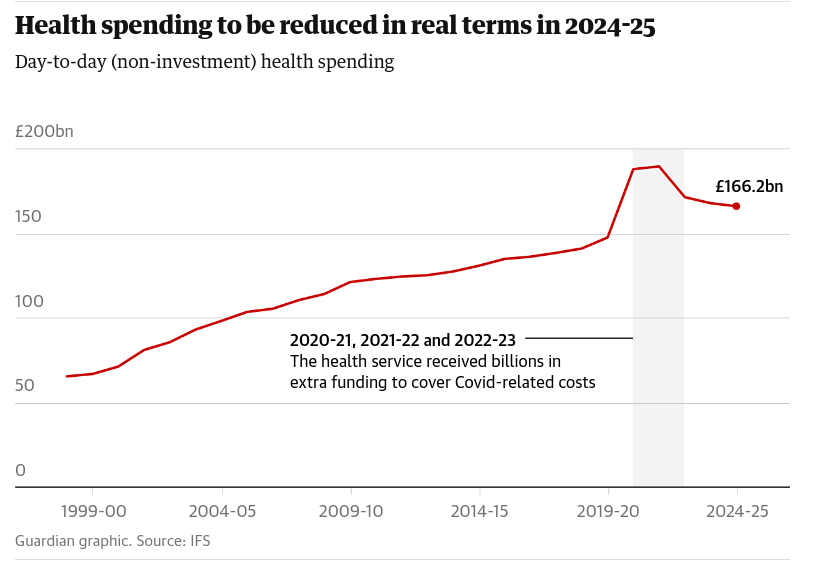
Health spending in England is due to suffer a 1.2% cut – worth £2bn – in the new financial year starting next month, despite the NHS facing extra costs from continuing pay strikes and the expansion of its workforce, according to an analysis by the Institute for Fiscal Studies (IfS).
The health budget, almost all of which the NHS gets, is to go from £168.2bn in 2023-24 to £166.2bn in 2024-25, after adjustment for inflation, in 2022-23 prices.
Without a government rethink the reduction in funding will force the NHS to cut staffing numbers, staff pay, the services it provides to patients or all three, the thinktank warned.
Its intervention comes as Hunt is considering cutting billions more from his public spending plans to pay for further reductions in either income tax or national insurance in this week’s budget.
Economists have calculated that such a move would mean taking as much as a fifth out of budgets for certain “unprotected” departments across the five-year parliament covering areas such as justice, home affairs and local government.
There were also reports on Monday night that the chancellor was looking to give motorists a £5bn boost by extending the “temporary” 5p-a-litre cut in fuel duty by another year.
The level of public sector spending pencilled in for the next parliament could mean cuts equivalent to those undertaken by David Cameron’s government during the years of austerity from 2010 to 2015. That has prompted warnings that the next government would not be able to implement them, and would be forced either to raise taxes or borrow more to fund emergency spending.
The Liberal Democrats said the plan to cut the NHS budget was “scandalous”. Doctors’ leaders warned it would harm patients. And hospital bosses said they would struggle if it went ahead because the estimated £2bn cost of 15 months of strikes have left their finances in a perilous state.
Sarah Olney, the Lib Dem’s Treasury spokesperson, said: “What this Conservative government is doing to our NHS is nothing short of scandalous. They have left health services shockingly underfunded and it is patients who are bearing the brunt of their neglect.”
She urged Hunt to cancel the planned cut in the budget he will present to MPs on Wednesday.

Meanwhile, hospital doctors voiced alarm that, with the NHS already in “an eternal crisis” in which it cannot meet the growing demand for care, pressing ahead with the planned cut could be “terminal” and would harm patients.
Dr Tim Cooksley, the immediate past president of the Society for Acute Medicine, said: “On this background, rumours of a funding cut could be the final straw for many colleagues and would undoubtedly cause severe harm to large numbers of patients.
“There is consensus that the situation in the NHS has never been so challenging. Funding is only part of the solution but a crucial one. A reduction at this stage could be a terminal event.”
David Phillips, an associate director at the IFS who carried out the analysis, said: “Existing [government spending] plans entail real-terms cuts of around 1.2% in [NHS] day-to-day spending [in 2024/25] – the largest reduction since the 1970s following the 1976 IMF crisis, except for the last two years as temporary funding related to the Covid-19 pandemic expired.
“A real-terms reduction in health spending would require some combination of reductions in staffing, pay and service provision.”
Phillips also disclosed that the government had to give the Department of Health and Social Care an emergency injection of £4.4bn of extra Treasury funding during the course of the current financial year to ensure that it – and the NHS – did not bust their budgets. The DSHC had not publicised that.
The NHS is thought to have received about £4bn of the £4.4bn, which was to cover staff pay rises, the costs of industrial action, schemes to help the service cope with winter and also its share of the health surcharge that migrants, or their employers, pay to cover the cost of their NHS care.
The DHSC’s budget for 2023-24 was originally due to be £164.2bn. However, it rose to £168.2bn as a result of ministers giving it what health economists call an “in-year bung” of about £4bn, to avoid a shortfall.
The department was and remains due to be handed a budget of £166.2bn for 2024-25. However, the £4.4bn top-up received this year meant that, as a result, next year’s budget was on course to be £2bn less than this one, prompting the IfS’s intervention, Phillips explained.
Julian Hartley, the chief executive of NHS Providers, which represents health service trusts, said: “These figures will ring alarm bells for trust leaders who are already struggling to provide patient care in a hugely challenging financial environment.
“Fifteen months of strike action have landed the NHS with an eye-watering bill due to income lost from delayed operations, scans and procedures and providing cover for striking staff.
“With worries that industrial action looks set to continue into the next financial year, trust leaders are rightly worried that these costs could continue to mount. Given the extra pressure industrial action is putting on NHS budgets, it’s vital the Treasury funds trusts’ strike costs in full.”
Hunt also plans to announce a clampdown on the money the NHS gives to employment agencies – £4.6bn across the UK and £3.5bn in England alone – as a result of a Treasury review of productivity across the public sector. He is set to cap the amount the service as a whole can hand them.
Wes Streeting, the shadow health secretary, labelled the chancellor “hypocrite Hunt” because the DHSC last year raised the annual cap for such spending by £450m. Streeting also pointed out that in 2015, when Hunt was the health secretary, he announced a similar crackdown on agencies which charged “extortionate hourly rates which cost billions of pounds a year”.
Streeting said: “Taxpayers are paying a heavy price for 14 years of Conservative failure.
“The Conservatives refused to train the doctors and nurses our NHS needs, leaving the health service to rely on rip-off recruitment agencies. Then they forced doctors and nurses out on the worst strike in the history of the NHS, leaving patients waiting longer and taxpayers picking up the bill.
“Expecting hypocrite Hunt to fix the mess he’s made is like expecting the arsonist to put out the fire they’ve started – it’s not going to happen.”
The DHSC was approached for its response.
“There is no sense in reintroducing beavers into small chalk streams, or any other form of stream in Dorset. Beavers dam rivers.”
(In fact he doesn’t want them anywhere!).
Can you ever really trust a Tory on environmental issues? –
Richard Drax MP Conservative, South Dorset during the debate on farming in the House of Commons at 4:21 pm on 4 March 2024.
From Hansard:
“My next topic is slightly off farming, but it relates to it, and that is the reintroduction of beavers. There has been a report of a beaver being released illegally in the constituency of my hon. Friend the Member for West Dorset. That is causing concern. I believe that reintroduction has been experimented with in Scotland to a large degree. If we are to re-wild, I suppose there is some sense in putting beavers in large rivers, but there is no sense in reintroducing beavers into small chalk streams, or any other form of stream in Dorset. Beavers dam rivers. They would be protected, no doubt, by every organisation that would want to protect them. Farmland would then flood. As has been proven in Scotland, beavers do not hang around and say, “This is my home.” They breed and move elsewhere and do the same in other rivers. As I understand it, they had to be culled in Scotland, because they broke out of the area given to them. Can the Government please look not only at the illegal releasing of beavers into rivers, if that is happening—it has not been proven yet—but the legal release? There is an emphasis on re-wilding. While we all want to see wild animals, there is a proper place and location for each species.“
John Halsall is the man who led the South West Water’s team responding to questions raised by councillors at the EDDC scrutiny meeting on 1st February.
He is SWW’s Chief Operating Officer, in effect second in command to the CEO with the day to day running of the business “at his fingertips” so to speak. He is also on the Board. He should, therefore, have been in a position to answer pretty well any question councillors threw at him, especially the twelve they had given him in advance. By the same token, he knows all about any “inconvenient facts” SWW would rather we didn’t know about.
Owl described SWW’s approach to the committee at the time as “evasive” and is not surprised that subsequently the full council passed a vote of “no confidence in SWW”.
John Halsall has now written to apologise to the people of Exmouth for the disruption caused by sewer mains bursting. But questions around SWW’s strategic failure to invest remain.
As with the Post Office “Horizon” scandal, when confidence in an organisation has been lost, an apology is a start but not a sufficient response to regain that confidence.
SWW, and indeed all water companies, have a long way to go.
Exmouth is not the only place suffering in East Devon.
What is “the long-term solution for Exmouth”, see “Does SWW have a cunning plan?” We need full transparency. – Owl
Adam Manning www.exmouthjournal.co.uk
South West Water says it is ‘sincerely sorry’ for the current issues surrounding the burst sewer pipe in Phear Park.
In December last year, a series of bursts were found on the pipe between the Plumb Park housing estate and Maer Lane Sewage Treatment Works.
The burst occurred due to the condition of the pipe, which was unexpected because it was not known to have deteriorated and had only burst once in the previous 20 years.
Due to the condition the pipe was found to be in, South West Water decided to replace the entire section. This is roughly 500-metres long and is due to be completed by the end of this month.
To address the initial burst, a temporary overland pipe to bypass the damaged section. After this, three further bursts on other parts of this section of pipe were spotted on February 13.
While repairing or putting in sections of overland pipe to bypass the burst, tankers were bought in to take flows from Phear Park Pumping Station to Maer Lane Sewage Treatment Works. That work is now complete and the overland pipe runs from Plumb Park to Maer Lane. The tankers have now been stood down, but a small number in the area as a precaution.
The 500-metre section of pipe which runs from Plumb Park housing estate to Maer Lane Sewage Treatment Works is now being repaired. Since 2008, replacement and relining work has been carried out to the other section of this main, which runs from the housing estate to Phear Park Pumping Station. This means that the entire main from Phear Park to Maer Lane Sewage Treatment Works will have been upgraded when the repair is completed.
They say that they are now ‘working on a long-term solution for Exmouth’.
John Halsall, chief operating officer of South West Water said: “I’d like to take the opportunity to sincerely apologise to anyone who has been affected and to explain what issues we have faced and what steps we are taking to ensure this doesn’t happen again. There has been some misunderstanding about the work at times.
“We really appreciate that the tankering caused disruption for customers in the area and we are sincerely sorry for that. This was the least worst option available to us but we understand it was far from ideal.
“We have been in regular contact with the Environment Agency throughout the duration of the works and we have been keeping them updated on our progress. We have also been providing updates to the council, the local MP, local media and customers. We know how much it means to everyone to get the information they want, when they want it. Different people are interested in different aspects of this repair and so it is very difficult to update everyone, all the time, but we are working as hard as we can to keep everyone informed and we know we can do better.
“Once again, I would like to reiterate how sorry I am personally to local residents for the ongoing issues in Exmouth and I really appreciate their continued patience. I would also like to thank all of our operational teams who have worked hard in an extremely challenging situation, and who continue to work hard on the long-term solution for Exmouth.”
Richard Foord, MP for Tiverton & Honiton
By the time you read this, it’s possible you might have heard the Chancellor of the Exchequer Jeremy Hunt present the Government’s budget for the year ahead. Writing as I am before he gets to his feet, there is talk of what tax cuts he will make.
Tax cuts anticipate a General Election like a blackbird’s song predicts daybreak. Neither lasts very long afterwards! What is lacking though is a sense of just how bad things are right now for those who continue to depend on public services.
Local health services are being pushed to the brink. Community Hospitals like the one in Seaton are threatened with being divided and even disposed of. NHS dentistry is decaying before our very eyes. To my mind, there are several things the Government could do right now to help the economy and society in Devon and beyond.
The Chancellor could permanently cut the rate of VAT for tourism and hospitality businesses. This would boost vital businesses in tourist hotspots like ours – allowing them to stay afloat and generate taxes to support other vital services.
A low VAT rate levied on a pub that continues to trade is better for the Treasury than a high VAT rate levied on a landlord who is driven out of business. The permanent VAT cut I propose contrasts with the temporary cut that has been proposed by some Tory MPs. They seem not to have spotted that the VAT rate on hospitality businesses has leapt up and down like a yo-yo at the hands of this Conservative Government.
Secondly, the Chancellor ought to cancel the planned real-terms cut to the NHS. Failing to increase the NHS budget in line with inflation would remove around £1.3bn from services that are already struggling. We need to invest in people’s health: recruit more GPs, boost the number of dental appointments, and cut the long waits for urgent cancer care. People who are well can work, contribute to society and pay taxes.
Finally, Government must stop handing out tax breaks to big banks. It must stop allowing energy firms to rake in bumper profits off the back of rising energy costs too. This would generate billions extra to invest in our communities.
People are tired of the chaos and mismanagement this Conservative Government has presided over. People tell me they are ready for a change, and here in Honiton & Sidmouth, the way to get that is to vote Liberal Democrat, so we can send this obstreperous Government off the pitch and enjoy the dawn of a new day.
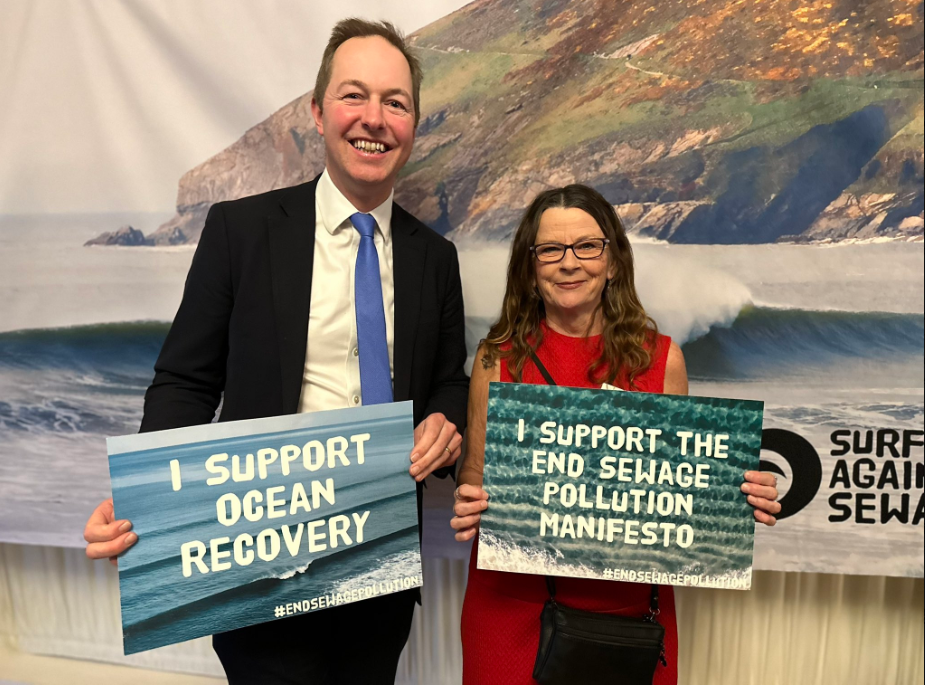
Jo Bateman attended as part of the Surfers Against Sewage campaign.
4 March Richard Foord:
Tonight, I hosted @WaterWaysProtct and @sascampaigns in Parliament. No Minister was present, though he was invited.
We need the Govt to take this issue seriously – with more powers and resources, as well as duties, so the regulator can enforce the law.

What Richard Foord will have done is collect first hand information for Today’s “Westminster Hall” debate that Simon Jupp is kicking off at 4.30pm.
Do the Tories really care about pollution? – Owl
Regulators have accused water companies of “genuinely shocking” behaviour, gaming a self-monitoring system and demonstrating a “culture of complacency”.
Adam Vaughan www.thetimes.co.uk
The comments from the heads of the Environment Agency and Ofwat mark an escalation of rhetoric from the water sector’s regulators.
Philip Duffy, chief executive of the Environment Agency, singled out sewage pollution incidents by Southern Water and Severn Trent, which were recently fined £330,000 and £2 million, respectively.
He said they were “genuinely shocking, shocking cases of pollution of our rivers, that shouldn’t be happening in a well-regulated industry”.
In Southern Water’s case, more than 2,000 fish were killed after a pump failed and sewage was released into a stream that feeds into the River Hamble in Hampshire. Severn Trent, meanwhile, was responsible for a “reckless failure” in allowing 260 million litres of sewage to be spilled illegally into the River Trent, a judge concluded.
Duffy said that “time and time again” promises made by water firms to the Environment Agency and Ofwat hadn’t been kept. “Infrastructure that should have been maintained to a certain level hasn’t been maintained to that level,” he said.
Under Duffy’s leadership, the Environment Agency is preparing to increase the number of inspections of water companies from less than 1,000 in the current financial year to 4,000 next year and more than 10,000 the year after. He said the measures were needed because the system of companies monitoring themselves, introduced in 2009, “had been gamed a bit”.
“The times of day the samples were taken, the way the samples were taken, gave a misleading positive impression,” he said. Duffy also said he was “really worried” about chemical pollution in rivers, specifically the “forever chemicals” PFAS and PFOS which have been linked to serious health harms including increased risk of cancer.
David Black, the chief executive of Ofwat, said that water companies needed to restore public trust by implementing improvements and showing greater transparency.
“We need to see a change of culture,” he told a conference held by the Water Report on February 29. “I think the water sector has demonstrated a culture of complacency in the face of significant challenges, such as climate change, resource scarcity and population growth, and this has led to stagnating performance.”
However, Black said he was pleased the water industry was beginning to “respond in a meaningful way to the challenges it faces”. He cited the £96 billion water firms have proposed spending between 2025 and 2030. Ofwat has to decide this summer whether to approve the spending, despite it requiring a 31 per cent increase in household water bills over the period.
The Times’s Clean it Up campaign has been calling for stronger governance of the water sector and more resources for regulators to do their job.
In recent weeks the government has vowed to ban bonuses for bosses of water companies that commit criminal acts of pollution. Chief executives have received £26 million since 2019 and, while some voluntarily waived their bonuses last year amid public anger, five still took them.
However, it has emerged that the government has rowed back on a plan by the environment secretary, Steve Barclay, to block dividends at water firms with a poor environmental record. “The government has no plans to block water company dividends over illegal pollution events,” Gareth Davies, exchequer secretary to the Treasury, wrote in a message to industry last week. Labour is understood to have no appetite for such a dividend ban.
David Henderson, chief executive of Water UK, the industry body, said a dividend ban would have been disastrous. “If you want to break the system, and get terrible environmental performance, that’s the way to do it,” he said when asked if a ban would harm investment in the sector.
Henderson said there “still a lot to do” in improving the state of rivers but he was hopeful the sector would tackle the problem. “Performance has not been where it should have been,” he admitted. “We have failed, in some parts quite acutely, to keep up with public perceptions of what is needed.”
Despite what many see as the inevitability of an overall Labour victory nationally when voters go to the polls, history suggests that non-Conservative votes are likely to be spread between Labour, the Liberal Democrats and the Green Party in what in the future will be the South Devon constituency.
Polls indicate that the Conservative candidate could win with as little as 34 per cent of the vote.
Totnes pulls together to oust Tory MP
Mario Ledwith www.thetimes.co.uk
For decades, the market town of Totnes in Devon has been almost entirely under the control of the Conservatives, making it one of the safest seats in the country. Without a sudden change in Britain’s voting system, polls show that things may well stay that way in the near future, despite the dismal poll ratings for Rishi Sunak’s party.
So, with no sign of reform on the horizon, campaigners in the constituency representing what they describe as the “progressive vote” have decided to take matters into their own hands. Giving themselves the sole task of unseating the Tories, the group has launched a series of events aimed at crowning a single candidate who can successfully compete at the forthcoming general election.
Those behind the so-called South Devon Primary believe that selecting a “People’s Champion” is the only way of securing victory.

Attendees showed their appetite for change on a question and answer board
Despite what many see as the inevitability of an overall Labour victory nationally when voters go to the polls, history suggests that non-Conservative votes are likely to be spread between Labour, the Liberal Democrats and the Green Party in what in the future will be the South Devon constituency.
Polls indicate that the Conservative candidate could win with as little as 34 per cent of the vote. The campaigners say that they have decided to act because Britain’s first-past-the-post voting system is “no longer fit for purpose”, having been developed when there were only two main parties.
In response, Anthony Mangnall, Totnes’s Conservative MP, has accused those hoping to anoint a unity candidate of seeking to “restrict democracy”.
Although rare on the mainland, electoral pacts have been a feature of elections in Northern Ireland. Under such agreements, unionist parties have joined together to select one candidate to prevent a republican party from winning. The Totnes concept differs in that it is an unofficial endorsement, separate to the parties’ own campaigning, with losing candidates remaining on the ballot.
The successful candidate from the South Devon Primary will be chosen through voting at seven town hall events across the constituency over the next fortnight. The first of those took place on Saturday in Totnes, a town of 9,000 residents whose independent spirit came to national prominence in 2012 when they united to block Costa Coffee from opening a branch.
As nearly 300 people packed into its Civic Hall and a further 160 gathered outside a pub where the primary was being live-streamed, hopes rippled at the prospect of upsetting the electoral status quo.
Those who had gathered were hoping to hear pitches from the Labour, Lib Dem and Green candidates, with a vote for the candidate deemed most likely to win an election being submitted at the end.
However, as the event neared, it was clear that the attempt to reshape the town’s voting framework had stumbled. Labour, which has not yet chosen a candidate, did not send anybody to speak up for the party. Those in attendance had to focus instead on the pledges of Caroline Voaden, the Lib Dems’ prospective candidate, and Robert Bagnall, the Greens’ prospective candidate.
The organiser of the South Devon Primary and the sitting Conservative MP give their views to Times Radio
The organisers — Anthea Simmons, Simon Oldridge and Ben Long — told the audience that they themselves were not members of any political party. Addressing the elephant in the Civic Hall room, Oldridge said of the lack of Labour representation: “It’s disappointing and frustrating. We would love to see their candidate here.” He added: “The vast majority of people want to get behind someone for a change.”
Simmons told the room that she was an “ex-tribal Tory” who had voted for the party in 2015 before growing disillusioned. “We need better democracy,” she said. “It’s time to see off these Tories.”
The candidates began the two-hour session by introducing themselves and stating why they were the best person to defeat Mangnall. They drew laughs, applause and some awkward glances during long-winded responses as George Monbiot, the event chairman, Guardian columnist and environmental activist, tried to steer proceedings. He hailed the event as “groundbreaking”.
Perhaps inevitably, the candidates agreed on the need for proportional representation. Other areas of consensus included tackling second-home ownership, Airbnbs, assisted dying and taking utilities, such as water companies, out of the private sector.
Voaden acknowledged that ultimately neither the Lib Dems nor the Greens would be making government policy after the election, but she insisted that MPs could stand up for local issues on the opposition benches.
The constituency will be slightly redrawn during this year’s vote and will be known as South Devon, rather than Totnes. At the 2019 general election, Mangnall won the seat with 53.2 per cent of the vote, compared with 28.8 per cent for the Lib Dem candidate and 17 per cent for Labour.
Outlining her reason for attending the event, Voaden said: “I am here because I don’t want to be represented in Westminster by a Tory MP for a minute longer and by an inept, corrupt and cruel government lost in the political wilderness.”
The South Devon Primary will announce its unity candidate when voting is completed after its seventh event. Voaden, who said she was in politics because she was passionate about proportional representation and opposing Brexit, appeared confident that she would get the nod when the votes are counted in Brixham this month. “I do not want to be standing there on election night on that platform by Anthony Mangnall’s smug face because he has won this election by a thousand votes. Visualise how that will feel.”
Tories promised post-Brexit freedoms would be used to reduce regional inequality in England but have failed to deliver.
“The Tories’ begging-bowl approach to levelling up forces leaders to spend time, effort and taxpayers’ money bidding for uncertain and tightly ringfenced pots of money. This sticking-plaster approach won’t give local leaders the tools they need to drive growth in their local area and live up to their best potential.” (Justin Madders, the shadow levelling up minister).
Is Exmouth’s Gateway project really the most pressing way of spending money in the town? – Owl
Kiran Stacey www.theguardian.com
Less than a fifth of the projects approved by Michael Gove to improve towns across England have been completed, the government has admitted, in the latest sign of the problems facing his levelling up agenda.
Responses from Gove’s department to freedom of information requests show that fewer than 20% of the projects sanctioned under the £3.6bn towns fund were on track to be finished by the end of February. Fewer than half will have been completed by the next election, even if it is held in November, the figures show.
The data is the latest example of how difficult the Conservatives have found it to meet the promises the party made at the last election to use post-Brexit freedoms to reduce regional inequality in England.
The Guardian revealed last year that councils were having to scale back or freeze levelling up projects because of soaring costs and that Gove’s department was handing back nearly £2bn of housing money after struggling to find projects to spend it on.
Jack Shaw, a local government expert who uncovered the figures, said: “Given this was a flagship policy priority at the last general election, the expectations on the government to deliver new infrastructure in places that have historically been ignored were high.
“Inflation and interest rates have prevented some projects from making progress, but the government has also failed to respond to those changes and has instead asked places to reduce their ambition. Come the election, current evidence suggests the government will have failed its pledge to ‘level up’ communities.”
The towns fund was announced immediately after the last election, with Gove promising it would give “underinvested towns the much-needed funding and support to get going on their long-term plans”.
The fund was a key plank in his levelling up plan to improve infrastructure outside London and major cities. Projects include a new investment zone around Blackpool airport, an industrial centre in Grimsby and the regeneration of Bedford’s train station.
Since then, however, high inflation has eaten into large parts of Gove’s budget and made it increasingly difficult to complete building projects. The Guardian reported last year that at least £500m had been lost from levelling up projects because of rising costs, with leisure buildings, high streets, museums and public spaces all being hit.
Many councils have stalled or reduced their plans as a result of higher costs, and some say they have found it a lengthy and bureaucratic process to get Whitehall officials to approve their alterations to the original plans.
A report by Thurrock council last November showed the authority struggling under the pressures of higher inflation.
The council was due to spend £22.8m on improving Tilbury town centre, including a new community hub, a youth centre, new cycle paths and a new jetty. In November local officials warned there had been “significant cost price inflation” since the plans were submitted, forcing them to review the entire scheme to make sure the council did not overspend.
The report added: “There has been a significant delay in the confirmation of the business cases due to the need for further reassurance and assessment work on governance by [the levelling up department] and the commissioners.”
The figures unearthed by Shaw show that out of 973 towns fund projects, only 154 are due to have been completed by the end of February. By the end of November, that figure rises to 385, just 40% of the total.
More than 170 projects are due to finish in March 2026, the official deadline given by Gove for spending all the towns fund money. A few are scheduled for completion after that date, but officials indicated this could be because they were relying on other sources of funding to finish the projects.
The Department for Levelling Up, Housing and Communities said: “All of the money which was allocated from the towns fund is on track to be spent by March 2026 as planned, with more than 100 projects already completed. The rate at which projects are being completed is entirely consistent with the delivery timeframes we have set out.”
Labour said the problems were a further indication of the issues with ministers in Westminster trying to dictate how local authorities across the country spend their money.
Justin Madders, the shadow levelling up minister, said: “The Tories’ begging-bowl approach to levelling up forces leaders to spend time, effort and taxpayers’ money bidding for uncertain and tightly ringfenced pots of money. This sticking-plaster approach won’t give local leaders the tools they need to drive growth in their local area and live up to their best potential.”
Good question for an “excellent quality 3 star” beach.
Detailed analysis of latest Environment Agency testing data shows the water in Budleigh may not have been fit for swimming for around 30 days in the 150-day May to September sampling season. That’s about 20% of the time. Does that measure up to an “Excellent” rating?
What is the message for all year round bathers?
Well if it’s not safe during the summer during heavy rain and for 48 hours after, as this analysis concludes, probably pretty crap most of the time! [Including as we go to press]- Owl

Petercrwilliams fightingpoolution.com
One of the most frequent questions we hear is “Is it safe to swim off the beach at Budleigh?” In this post, we’ll take a look at the water quality data, and offer some guidance on how best to check before you swim – Summer and Winter. Note: we are not providing advice on whether it is safe for anyone to swim on any given day!
Firstly, it’s the role of the Environment Agency (not South West Water), to regularly test bathing water during the Summer months, and to categorise all designated bathing beaches from the results. In particular, each sample is tested for the levels of E-Coli and Enterococci present in the water. High levels of these bacteria in bathing water can – and do – cause sickness and diarrhoea to swimmers and other beach users, so there are defined thresholds, above which, bathing is ‘Not Advised’.
At the end of each bathing season, the EA look back over all the samples taken in the last 4 years and, depending on the % of samples tested which are worse than the POOR level, the beach is assigned a star rating of Excellent, Good, Sufficient or Poor. Budleigh currently has an ‘Excellent’ rating, though as can be seen in the chart below, we are very close to slipping down into the ‘Good’ category.

Budleigh Water quality trend. If the blue ‘Actual’ average moves above green line, we slip down to ‘Good’ status. Chart (c) Environment Agency 2023
It’s probably important to consider that the water rating is more a measure of how many bad water days we get, rather than the cleanliness of the water on the majority of ‘normal’ days. This may reassure some swimmers who worry that the water may always be quite polluted.
We can do that by analysing the results of the EA water samples taken, and seeing the bacteria concentration levels of each of the 63 samples taken over the last four years, from very cleanest (left hand side of chart below), through pretty toxic (right hand side).
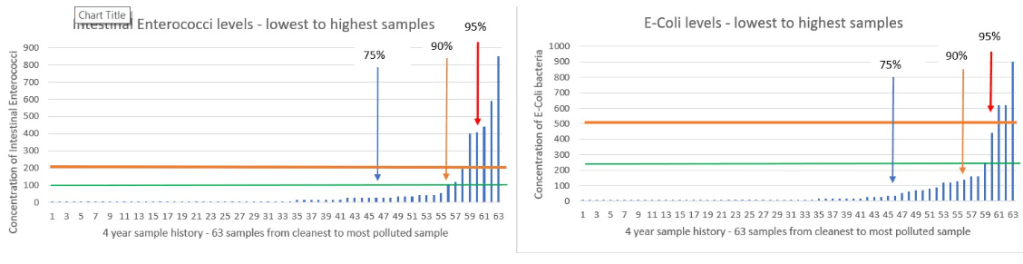
Majority of days (80%+) have ‘Very Low’ to ‘Low’ levels of pollution.
Below Green line shows water is EXCELLENT, but above Orange line – water quality is POOR
This clearly shows that the water really is pretty clean on around 80% of days in the May-Sept period, BUT it also shows just how highly polluted the water can get (up to 3 times worse than the ‘Poor’ level) after incidents of pollution or high rainfall.
So how do the EA sample Budleigh’s bathing water?
The chart below shows how the 2023 daily forecasts compare with the subsequent water quality measured from the samples. For each day of the season, RED in the first column identifies any days when the EA declared a Pollution Risk forecast. BLUE in the second column shows the 20 days when a water sample was taken, and Red or Amber in the third column shows if any of those samples were subsequently found to be POOR.

What this shows is that whenever the EA sampled the water within 48 hours after an EA declared ‘Pollution Risk’ day, the subsequent sample showed E-coli or Enterococci levels close to or greater than POOR levels.
This suggests that the water may not have been fit for swimming on around 30 days in the 150-day sampling season. That’s about 20% of time. That’s appears worse than the ‘Excellent’ rating would indicate.
One possible reason why our figures look worse than the official rating, is IF the EA suspend normal sampling if a Pollution Forecast is active. Although this possibility would appear to make a mockery of the whole sampling process (as they would only then sample the water when they were pretty sure it was ‘clean’!), there does seem to be scope for them to do this within the regulations. Looking at the pattern of testing days in the chart above, there are a couple of occasions when the sampling pattern suggests that this could have happened. To find out IF the EA have ever suspended or changed the sampling dates, we’ve raised an Information Request on EA to ask that question.
What the sampling results do show is that the Pollution Forecasting system appears to be a good indicator of when not to swim – but perhaps prudent to wait 48 hours before going back in after a Warning, rather than just 24 hours.
So during the bathing season, the EA Pollution Forecast, via the LoveBudleigh web site, is probably the best indicator of whether it’s safe to swim. But what about the other 7 months of our swimming year?
The most useful tool outside of the season is probably the Surfers Against Sewage app, SSRS. This takes input from all of the local sewage overflow sensors, and it produces an alert for the beach IF any of these sewage overflows registers a prolonged discharge (the actual time threshold is specific to each sewage overflow point). It’s also of note that there appear to be significantly more sewage discharges by South West Water outside of the sampled bathing season.
What SSRS does not take into account is any agricultural pollution coming in from the River Otter, which is a significant contributor to the water quality. That’s why we want the EA to extend their pollution forecasting and water sampling to all year round. In the meantime, do download and use the ‘SSRS’ app, for all ‘out of season’ swimming. However, it’s probably also prudent to avoid times when the river has been particularly high after heavy rain – and certainly avoid the area by the river mouth and brook outfalls.
Next time, we’ll take a look at where on the beach the Environment Agency take their samples, and why this might either under- or over-estimate the cleanliness of the water – depending on where you decide to swim.
Latest poll damning
Support for the Conservative Party has plunged to the lowest level since 1978 with just a fifth of British voters now backing Rishi Sunak’s party, according to a new poll.
Archie Mitchell www.independent.co.uk
The bombshell survey, showing the Conservatives as 27 points behind Sir Keir Starmer’s Labour Party, would spell electoral oblivion for Mr Sunak’s party if replicated at a general election.
The Ipsos poll, published on Monday, shows Mr Sunak could hold on to as few as 25 seats – 351 fewer than Boris Johnson won in 2019 – in what would be a historic defeat.
It also predicts Sir Keir could secure as many as 537 seats – 340 more than Jeremy Corbyn managed at the last election and equating to a landslide which would eclipse Sir Tony Blair’s 1997 win.

Calculus election predictor using Ipsos data based new constituency boundaries
The survey showed support for the Tories at just 20 per cent, the lowest since 1978 when Ipsos started tracking the poll. Ipsos is a multinational market research firm and the poll is the latest in its monthly independent Political Monitor.
It comes just weeks after a Tory bust-up over a series of secretive polls trying to discredit Mr Sunak, including one poll that warned of a Tory wipeout unless he was removed as leader.
In the latest survey, Labour’s support has dropped to 47 per cent from the 49 per cent it had in January.
Meanwhile, the Liberal Democrats were backed by 9 per cent of the electorate, while support for both the Green Party and Reform UK was at 8 per cent – double what it was in January.
Ipsos’s previous lowest score for the Conservatives was 22 per cent, recorded by John Major in December 1994 and May 1995, only a few years before Sir Tony’s election win.
The slump in Conservative support follows a series of bad headlines for Mr Sunak at the start of 2024, with confirmation that the UK had entered a recession at the end of last year, two large by-election defeats in Wellingborough and Kingswood and an Islamophobia row over comments by now-suspended Tory MP Lee Anderson.
There is also public frustration at near-record NHS waiting lists and record high net migration, with Mr Sunak failing on four of his five key pledges to voters including to “stop the boats” and grow the economy.
Ipsos head of political research Gideon Skinner said: “The historical comparisons continue to look ominous for Rishi Sunak and the Conservatives. The Ipsos Political Monitor series started in the late 70s and has never recorded a Conservative vote share this low.”
He added that individual support for the PM is also heading downwards, with Mr Sunak’s approval rating hitting -54, a record low.
“Combined with Labour taking leads on issues of economic credibility to go with their traditional strengths in public services, this means the Conservatives face big challenges across a number of fronts if they are to turn the situation around,” Mr Skinner said.
In a further worrying sign for the Conservatives, Labour is now seen as having a lead on which party would best manage the economy, compared with October when the parties were neck and neck.
The public also believe Labour’s Rachel Reeves would make the best chancellor, with just a fifth satisfied with the job Jeremy Hunt is doing.
It will pile further pressure on the government to come up with an offering in Wednesday’s Budget, with right-wing Tories clamouring for tax cuts while others want Mr Hunt to ensure better funding for public services.
The poll was based on a survey of 1,000 British adults between February 21 and 28.
 9 Garrett Close Seaton EX12 2FERef. No: 24/0401/TRE | Validated: Fri 23 Feb 2024 | Status: Awaiting decision46 Arcot Park Sidmouth EX10 9HURef. No: 24/0400/GPD | Validated: Fri 23 Feb 2024 | Status: Awaiting decisionKnapp House Pound Lane Uplyme DT7 3TTRef. No: 24/0398/FUL | Validated: Fri 23 Feb 2024 | Status: Awaiting decisionHogsbrook Farm Woodbury Salterton Exeter EX5 1PYRef. No: 24/0397/FUL | Validated: Fri 23 Feb 2024 | Status: Awaiting decision45 Sid Park Road Sidmouth Devon EX10 9BRRef. No: 24/0402/FUL | Validated: Fri 23 Feb 2024 | Status: Awaiting decisionThe Old Sorting Office 52 – 54 High Street Budleigh Salterton EX9 6NBRef. No: 24/0396/DOC | Validated: Fri 23 Feb 2024 | Status: Awaiting decisionBarafundle Bunts Lane Seaton Devon EX12 2HYRef. No: 24/0390/FUL | Validated: Thu 22 Feb 2024 | Status: Awaiting decisionLand South Of Park Lodge Talaton Road FenitonRef. No: 24/0378/PIP | Validated: Thu 22 Feb 2024 | Status: Awaiting decision34 Raleigh Road Ottery St Mary EX11 1TGRef. No: 24/0392/FUL | Validated: Fri 23 Feb 2024 | Status: Awaiting decisionCrossway House The Street Musbury Devon EX13 8AURef. No: 24/0376/TCA | Validated: Wed 21 Feb 2024 | Status: Awaiting decision5 Parkhayes Woodbury Salterton Devon EX5 1QSRef. No: 24/0375/FUL | Validated: Wed 21 Feb 2024 | Status: Awaiting decision29 Cranford Avenue Exmouth EX8 2QARef. No: 24/0372/FUL | Validated: Wed 21 Feb 2024 | Status: Awaiting decision86 High Street Honiton EX14 1JNRef. No: 24/0365/DOC | Validated: Tue 20 Feb 2024 | Status: Awaiting decision38 Cranford Avenue Exmouth Devon EX8 2QARef. No: 24/0370/DOC | Validated: Tue 20 Feb 2024 | Status: UnknownMillers Farm Shop Gammons Hill Kilmington Devon EX13 7RARef. No: 24/0363/FUL | Validated: Tue 20 Feb 2024 | Status: Awaiting decisionThornfield Tytherleigh Devon EX13 7BGRef. No: 24/0355/VAR | Validated: Mon 19 Feb 2024 | Status: Awaiting decisionPasslands Membury Axminster EX13 7TERef. No: 24/0350/FUL | Validated: Mon 19 Feb 2024 | Status: Awaiting decision67 Bicton Street Exmouth Devon EX8 2RURef. No: 24/0359/DOC | Validated: Mon 19 Feb 2024 | Status: Awaiting decisionHolly Farm Alston Axminster EX13 7LGRef. No: 24/0360/R77 | Validated: Mon 19 Feb 2024 | Status: Awaiting decisionLindridge Elsdon Lane West Hill Devon EX11 1UBRef. No: 24/0352/FUL | Validated: Thu 22 Feb 2024 | Status: Awaiting decision3 Hill Court Hillhead Colyton Devon EX24 6NJRef. No: 24/0346/FUL | Validated: Thu 22 Feb 2024 | Status: Awaiting decisionChurch Terrace Cottage Dunkeswell Honiton EX14 4QZRef. No: 24/0348/FUL | Validated: Mon 19 Feb 2024 | Status: Awaiting decisionChurch Terrace Cottage Dunkeswell Honiton EX14 4QZRef. No: 24/0349/LBC | Validated: Mon 19 Feb 2024 | Status: Awaiting decisionPeppercorn Cottage Brampford Speke EX5 5HGRef. No: 24/0336/TCA | Validated: Tue 20 Feb 2024 | Status: Awaiting decision11 Mill Lane Branscombe EX12 3DSRef. No: 24/0321/FUL | Validated: Thu 22 Feb 2024 | Status: Awaiting decisionSouthlands Gardens King Street HonitonRef. No: 24/0325/FUL | Validated: Tue 20 Feb 2024 | Status: Awaiting decisionCoverstructures House Exeter Road Ottery St Mary Devon EX11 1RERef. No: 24/0282/VAR | Validated: Thu 22 Feb 2024 | Status: Awaiting decision5 Dunsford Close Exmouth Devon EX8 2HWRef. No: 24/0266/FUL | Validated: Thu 22 Feb 2024 | Status: Awaiting decision4 Swains Road Budleigh Salterton EX9 6HZRef. No: 24/0262/FUL | Validated: Tue 20 Feb 2024 | Status: Awaiting decisionBrackenrigg Cathole Lane Yawl Devon DT7 3XDRef. No: 24/0216/FUL | Validated: Wed 21 Feb 2024 | Status: Awaiting decisionNorwood Blackhorse Broadclyst EX5 2FTRef. No: 24/0208/FUL | Validated: Wed 21 Feb 2024 | Status: Awaiting decisionTwistgates Farm Upottery Devon EX14 9PERef. No: 24/0195/FUL | Validated: Fri 23 Feb 2024 | Status: Awaiting decisionTimbervale Sowton Exeter EX5 2AGRef. No: 24/0097/FUL | Validated: Thu 22 Feb 2024 | Status: Awaiting decisionLand At Ford Farm WoodburyRef. No: 24/0043/PIP | Validated: Mon 19 Feb 2024 | Status: Awaiting decisionGilletts Farm Yarcombe Devon EX14 9AZRef. No: 23/2759/FUL | Validated: Mon 19 Feb 2024 | Status: Awaiting decision
Scandalous spending tracker
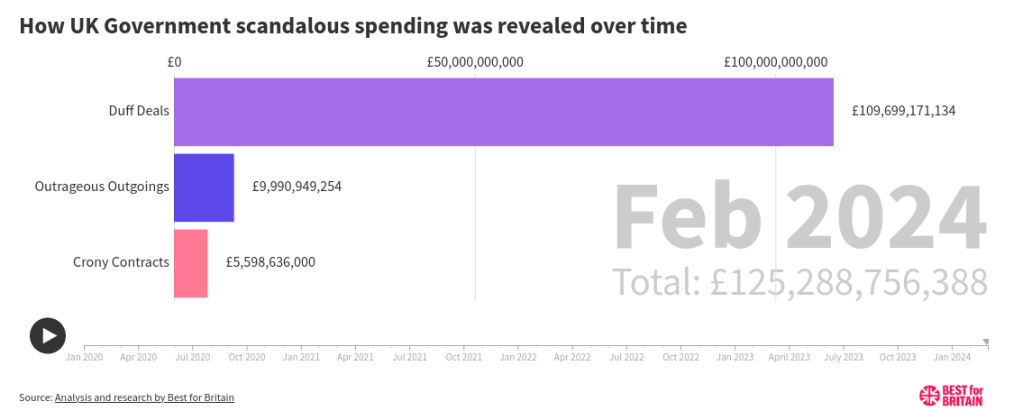
That’s right, the UK Government has scandalously spent £125,554,393,254 since 2019.
As Chancellor and now Prime Minister, Rishi Sunak has had responsibility for government spending for almost all of this period.

Posted by Best for Britain www.bestforbritain.org
It’s easy to become numb to the scale and frequency of the Government’s fiscal ineptitude and dodginess, and all at a time when ordinary people struggle to pay bills and public services are crumbling.
The total does not include the catastrophic hit to public finances from the Government’s Brexit deal which has crippled businesses, slowed economic growth, and is estimated to be costing around £100bn per year. Similarly, the total does not include the titanic economic cost of the disastrous mini-budget which increased bills for mortgage payers across the country and which ended Liz Truss’ premiership after 6 weeks.
It does, however, include figures like the devastating £290m sunk on the Government’s cruel, unworkable and unlawful Rwanda Deal. It also includes a whopping £2.3bn spent on cancelled parts of HS2, and £50m spent on a new helicopter for top Tories.
We’ll keep it updated as new revelations come to light so check back to get the latest eye-watering figure. What’s clear is that every day this government remains in power is more money wasted. Find out what we’re doing about it at GetVoting.org.
The total figure is an estimate using publicly available data. You can find the full list of scandalous spending along with sources here.
We’ve categorised each entry as either a Crony Contract (such as giving government contracts to Conservative chums), a Duff Deal (like blowing billions on stuff that doesn’t work) or an Outrageous Outgoing (including spending silly money on interior design).
Make sure you keep up to date, join Best for Britain’s mailing list and be the first to hear about our work and campaigns.
Does this government reinforce success? Invest in preparedness for the next pandemic? Of course not. – Owl
It changed the treatment of Covid-19 patients across the globe, saved thousands of lives by pinpointing cheap, effective drugs during the pandemic, and earned Britain widespread praise from international groups of scientists.
Robin McKie www.theguardian.com
But now government support for the UK Recovery programme is to end. In a few weeks’ time, central financing for the programme will halt. The scheme will only be able to continue thanks to funding from a group of US-based philanthropists.
The move has dismayed senior scientists who say it is another worrying example of the UK’s life sciences sector being short-changed by government. “We knew Recovery had huge potential and that was realised in a very short period during Covid. But now that dream is being unrealised,” said Prof Peter Horby, one of the co-founders of Recovery.
And it is not just the value of Recovery that has been ignored as the pandemic has ended, added Horby. “Britain did some of the world’s best clinical trials, vaccine development, and genomics work, but a lot of that has just been thrown away or starved of investment. Yet we badly need to be alert to the dangers of future pandemics.”
Recovery – the Randomised Evaluation of Covid-19 Therapy – is a drug-testing programme that, at the height of the pandemic, involved thousands of doctors and nurses working with tens of thousands of Covid-19 patients in hospitals across Britain. Trials were carried out in intensive care units and wards crammed with seriously ill patients.
“In day-to-day, regular clinical medicine, it’s absolutely critical to work out the difference between what you think might work, what actually works – and what doesn’t,” said Prof Martin Landray, Recovery’s other co-founder. “Recovery did exactly that.”
The programme managed to pinpoint four effective medicines, while conclusively showing that eight overhyped drugs were not. For example, the anti-malarial drug hydroxychloroquine – widely touted by Donald Trump as a Covid-19 treatment – was shown to provide no help for patients. By contrast, dexamethasone, a cheap treatment for inflammation and arthritis, was found to reduce deaths by a third among patients on ventilators in ICUs. No other nation came close to matching these achievements.
“Other countries, including Canada and the US, have made it clear they are extremely envious of what Britain did with Recovery and are preparing to spend considerable sums in setting up similar schemes – at a time when we seem to be losing interest collectively in the programme. And I think that is a shame,” added Landray.
Recovery in the UK will survive thanks to Flu Lab, an American philanthropic organisation dedicated to battling the future flu epidemics, with the programme being extended to investigate new treatments for flu as well as Covid under the new deal.
The decision by the UK government not to continue to support Recovery comes against a worrying background, which has seen Britain fall badly behind other countries in conducting clinical studies, where new medicines are tested on volunteers to make sure they are safe and work, and to monitor any side effects. The Swiss firm Novartis recently scrapped a large trial of a cholesterol drug in Britain, for example.
“We’ve been dropping down the league table when it comes to doing trials so that we are now below Italy, Poland, France and many other countries. The state of the NHS is part of the problem but it is nevertheless worrying,” said Horby.
“I welcome the government’s ambition for the UK to become a scientific superpower but if you look at what is happening today, we seem to be heading in the wrong direction.”
This point was backed by Landray, who warned that it was crucial the UK was prepared for the arrival of future pandemics. “You don’t get ready to fight the next war by disbanding the army just because it’s peacetime,” he told the Observer.
Jeremy Hunt has given over £100k to local Tory party in effort to retain seat
Jeremy Hunt has been forced to contribute more than £100,000 of his own money to his constituency Conservative party to bolster his chances of re-election, official records show, amid warnings that he is set to lose his seat.
Aletha Adu www.theguardian.com
Hunt’s Godalming and Ash constituency is a target seat for the Liberal Democrats, and a Survation poll projects that he is on course to become the first chancellor in modern times to lose at a general election.
Electoral Commission records show that he has given £105,261 to the South-west Surrey Conservative association over the last five years.
The chancellor’s personal donations to the association under the last three Conservative prime ministers stand in stark contrast to the total £4,447 he gifted under the leadership of Theresa May and David Cameron.
The most recent accounts for Hunt’s local association have warned that its “balance sheet is at a less than satisfactory level”. A note stated that members’ annual subscriptions were due to increase this year.
Donations to the chancellor’s association were down by almost 50% in 2021. South West Surrey received only £42,693 in donationsthat year, down from over £80,000 in 2020.
A Labour source said: “This tells you everything you need to know about the state of the Conservative party, with the chancellor seemingly spending more time dishing out personal cheques to prolong his political career than fixing the economy his government has wrecked.
“And on the same day the chancellor is talking about clamping down on money being wasted, he might want to look at how he is spending some of his own money.”
Hunt said on Sunday: “I hope to be chancellor after the election.” However, the poll in his constituency shows the Lib Dems on 35% of the vote, the Tories on 29% and Labour on 22%. When local voters were asked to outline the issues that would determine how they would vote, health and the NHS was top, while only 4% said tax was a key issue.
Daisy Cooper, the deputy leader of the Liberal Democrats, said: “It’s no wonder that Jeremy Hunt is on the brink of his losing his seat when people across Surrey are furious they can’t get GP appointments, that their hospitals have been left to crumble, and water firms are still allowed to pollute their rivers.
“In the chancellor’s own back yard, food bank demand is surging after his government failed to get a grip on the cost of living crisis. Liberal Democrats are fired up in Surrey to oust Conservative MPs who have taken people for granted.”
Correspondence with Karen Crawford, Exmouth resident and year round swimmer, reveals how South West Water (SWW) could be “gaming” the much trumpeted tougher regulations to their, but not our, advantage.
Water companies now have to fit emergency discharge monitors (EDM) on combined sewer outfalls to report spills and their duration (not volume). This will be a metric which politicians will use to demonstrate that our rivers and bathing waters are “improving” and water companies will use to award bonuses and avoid penalties.
SSW claim that they are investing £38m in Exmouth and Sandy bay to reduce pollution.
It seems that, so far, an impressive £14m has been invested in upgrading the main Exmouth discharge pipe out to sea from Sandy Bay/Straight Point.

Do you remember seeing this strange floating structure off Straight Point in 2022?
This means that much more treated water can be discharged in normal circumstances and raw sewage in times of overload. Possibly four times as much.
However, improvements to the Maer Lane treatment works are only at an initial or “concept” stage for starting in 2028. I.e.there will be no increase in treatment capacity until at least then, realistically a lot, lot later. And we continue to build more houses.
Meanwhile, SWW is giving priority to upgrading the pumps at surrounding sewage pumping stations. These are tanks used to collect local sewage which is then pumped to the treatment works. Improving the pumps means they will be able to reduce the discharges at 5 or 6 EDM sites by increasing capacity to send more sewage directly out to sea through the trunk main. So 5 or 6 potential discharges could be reduced to a single, combined one, instead.
Remember, SWW committed to building treatment works for the new development locally at Cranbrook but changed their mind and used Countess Weir. Now, Maer Lane and Countess Weir have no spare capacity at all. Both treatment works discharge at the first sign of rain.
So investing in increasing the pipe capacity from Maer Lane into the sea and upgrading the pumps at pumping stations, is a quick win for the government and SWW but doesn’t do anything for us or the environment.
Sandy Bay has already gone from “Excellent” to “Sufficient” bathing water quality in just a few years.
It all seems a bit topsy-turvy to Owl who would have thought that the first priority would be to increase treatment capacity.
The wildlife charity WWF-UK shelved a report that warned how intensive chicken production is devastating the River Wye, the Observer can reveal.
Jon Ungoed-Thomas www.theguardian.com
Since 2018, the charity has received more than £6m in donations from the supermarket chain Tesco, which has faced action from campaigners over the decline of the Wye because many of the intensive poultry farms in the river’s catchment area are in its supply chain.
The charity was due to publish a report on fixing the food system, which included the impact of intensive chicken farming on the river. One source claimed the proposed 2022 report was pulled after concerns were raised about the potential fallout.
WWF said this weekend the report failed to meet its rigorous standards and the decision was not linked to any partnership.
But a source with knowledge of the decision said: “Shelving the report was completely the wrong thing to do. They didn’t want to rock the boat. The attitude was: ‘We’re going after a partner. What’s the point?’”
WWF’s partnership with Tesco ran from 2018 to 2023 and focused on tackling environmental impacts in the food system. The supermarket provided funding in the range of between £500,000 and £2m for each year of the partnership.
In the summer of 2022, WWF, which has been concerned about the effects of global food production on wildlife and ecology, was scheduled to publish a report on fixing the food system called “Feeling the Bite”. It warned that about a million species were threatened.
The hard-hitting report said in the UK and around the world “how we eat is driving a food production system that is destroying the planet”. It warned that a “broken” food system was putting an impossible strain on nature.
As well as highlighting the threat globally to Asian elephants and the maned wolf in South America, it documented the plight of the River Wye as a case study.
It warned that the increase in phosphate-rich manure produced by poultry farms was causing deadly algae blooms that “suffocate plants and fish, and leave birds such as kingfishers and dippers without food”.
The report was set to be published in 2022 but, the source claims, it was proposed that publication be deferred and the Wye case study removed amid concerns that environmental campaigners would highlight WWF’s partnership with Tesco.
A decision was later taken to shelve the report in its entirety. The source said that once the Wye case study had been removed, it raised questions about the report’s overall strength.
Tesco said this weekend it did not have any involvement in the report or the decision for it not to be published.
Dave Lewis, the former chief executive of Tesco, is chair of the board of trustees at WWF. The charity said he also had no involvement in the project or the decision-making surrounding it.
Natural England announced in May last year it had downgraded the condition of the River Wye to “unfavourable – declining”.
Tesco has faced criticism over its role in supporting an unsustainable supply chain in the Wye catchment.
Charles Watson, founder and chair of the charity River Action, which raises awareness of river pollution, said the boom in poultry production in the Wye catchment area had been fuelled by demand from Tesco, as well as other supermarkets. He said: “Tesco’s logo is stamped all over the Wye.”
WWF has agreed a number of corporate partnerships in recent years, including with Aviva, HSBC and the consumer goods company Reckitt. The charity’s corporate donations and income totalled £16.7m in the year to 30 June 2023, out of a total income of £94m.
A WWF spokesperson said: “We are a science-led organisation and on reviewing drafts of the report, we concluded that it did not meet our rigorous standards. The decision not to proceed with this report was not connected to any individual case study within it or our relationships with partners.
“We are deeply concerned by the devastating impact that pollution is having on the UK’s rivers, particularly the Wye, and have taken the government to court over its failure to act on river pollution. We continue to work to drive action to tackle the food system’s impacts on the environment, both in the UK and overseas.”
A Tesco spokesperson said: “This report was not part of our work with WWF and we were not involved in its development, nor any decisions about publishing it. The work of our partnership with WWF was aimed at tackling the biggest environmental impacts of our food system, including helping to protect water quality and biodiversity in supply chains.
“We’re committed to playing our part in protecting the River Wye, alongside other actors across the food industry, and have worked closely with local stakeholders since 2019 to tackle water pollution in the area.
“We’re also providing multi-year funding for a number of water catchment projects.”
A pensioner from Exeter who illegally dumped 7,000 tonnes of waste on farmland in East Devon has been jailed for failing to clear the land.
Roger Baker, aged 80, of Marsh Mill Court, Exeter, was convicted in August 2018 of dumping 7,514 tonnes of waste at Pynes Farm, Poltimore, in East Devon and ordered by magistrates to remove it all to a permitted site by September 2019.
Earlier this month Baker was jailed for six weeks after the Environment Agency checked the site and found Baker had repeatedly ignored a court order to clear the waste.
After pleading guilty to failing to comply with a Regulation 44 notice to remove the waste to a permitted site, Exeter magistrates sentenced Baker to six weeks’ in jail, and ordered him to pay costs of £4,731.
Baker was told he must remove the waste on his release from prison.
Following the hearing, Richard Tugwell, an officer for the Environment Agency, said: “Baker showed a flagrant disregard for the environment and repeatedly ignored the court order requiring him to remove the waste.
“The court made it clear it still expected Baker to remove the waste after he is released from prison.”
After a conviction for dumping more than 7,000 tonnes of waste near Exeter, Baker was jailed for continually ignoring a court order to remove the waste.
A case brought by the Environment Agency, Exeter magistrates heard on February 7, 2024, that five years on, Baker still had not removed any of the waste.
A spokesperson for the Environment Agency said: “An officer from the Environment Agency went to the site last month and found all the waste still in place with little sign Baker had any intention of complying.”
Open the spreadsheet and pour out the coffee Rishi, this could be a long session! – Owl
Jeremy Hunt and Rishi Sunak will spend the weekend scrambling to piece together Wednesday’s Budget after being warned of a £2bn black hole in their original plans.
Arj Singh inews.co.uk
The Chancellor and Prime Minister were dealt a blow on Wednesday night when the Budget watchdog said their draft proposals were £2bn more expensive than allowed by the Government’s “headroom” – the amount of spare cash against a promise to get debt falling in five years.
They have since been working to repackage the Budget amid intense pressure for tax cuts that can drive economic growth and help the Conservatives close the opinion poll gap to Labour in an election year.
The pair were hoping for better news when the Office for Budget Responsibility (OBR) delivered another key forecast late on Friday night, and were due to spend the weekend piecing together a near-final package before Wednesday.
Treasury sources have admitted that the process of pulling together the Budget had been “hard” amid a backdrop of weeks of gloomy forecasts from the OBR, which left Mr Hunt’s headroom before policy decisions of just £13bn, £6bn of which the Chancellor wants to hold in reserve to reassure markets.
It means Mr Hunt is deciding between a 1p cut to either income tax or national insurance – a smaller tax cut than he offered in the Autumn Statement – with hopes of a 2p cut or the unfreezing of some tax thresholds fading.
The Chancellor is still considering aping Labour’s policy to scrap the controversial “non-dom” tax status as he considers a range of measures to raise money to make the Budget add up.
Mr Sunak on Friday hinted at a cut to national insurance, which dropped from 12 per cent to 10 per cent in January after the Autumn Statement.
Asked if there could be further reductions in the tax announced on Wednesday, the Prime Minister said: “The Chancellor and the UK Government chose to cut national insurance; there were lots of reasons for that, but first and foremost it is a tax on work.
“I believe in a country and society where hard work is rewarded – that’s something that’s really important to me … and all the people in the Government, and cutting national insurance is rewarding hard work.”
The free-market Institute for Economic Affairs (IEA), a think-tank influential among right-leaning Tory MPs, said the UK’s “stagnating” economy was a “disaster” for living standards and should be the “priority” in the Budget.
IEA executive director Tom Clougherty called for the scrapping of stamp duty, although this has been ruled out by Mr Hunt.
Mr Clougherty said: “If there is fiscal headroom for tax cuts, priority should be given to reforms that could have a meaningful growth effect.
“The Chancellor could make some helpful changes to corporation tax and business rates at limited cost to the Exchequer.
“The real prize, though, would be the abolition of stamp duties. There would be a fiscal hit from abolishing Stamp Duty Land Tax, but the distortions it causes in a tight housing market are so destructive that the cost is clearly worth bearing.”
Mr Clougherty also warned against abolishing non-dom status, claiming it would risk “unintended negative consequences too – with little fiscal upside”.
He added: “I hope this speculation doesn’t indicate a last-minute scramble to keep to the fiscal rules.
“Tax policy should be made for the long term – not on the fly in response to a rolling (and changeable) five-year debt forecast.”
In his latest newsletter Simon Jupp announces that he will be leading a parliamentary debate on Tuesday.
Richard Foord seems to have got there first.
He will be hosting an event in the fringes of the House of Commons on Monday. His guests will include the End Sewage Pollution Coalition, which includes the Rivers Trust, British Canoeing, the Angling Trust, River Action, Swim England, Surfers Against Sewage and the Women’s Institute. So it might be more productive.
This follows up his tabling of a bill in January to hand over responsibility for collecting and reporting data on the number and duration of spills to the environmental regulator.
Owl fears the debate Simon Jupp will lead will seek once again to divert attention away from the government’s record of privatisation, lax regulation and underfunding of the regulator and place all the blame on the water companies.
Here is Owl’s summary of the first debate at the end of February last year:
Simon Jupp led the debate. Unfortunately his fellow Tories from Devon followed his lead, especially Anthony Mangnall (Totnes) and Kevin Foster (Torbay). [Though to give Anne Marie Morris (Newton Abbot) her due, she did try to rise above this.]
They let SWW off the hook from the start:
For example, here is how Simon Jupp opened the debate:
….In recent years, a spotlight has been shone on storm overflows and CSOs. Water tourism is booming across our region, including windsurfing in places such as Exmouth and Sidmouth in my constituency. However, there is another reason why people have finally started talking about the issue: the Conservative Government have put in place a plan to improve our water, giving us all an opportunity to hold water companies to account.
People finally talking about the issue of sewage because the Tories have a plan? Really!
……Of course, in a perfect world, we would stop sewage spills completely and immediately. Sadly, that is virtually impossible in the short term; because of the pressure on our water infrastructure, we would risk the collapse of the entire water network, and the eye-watering costs involved mean we would need not just a magic money tree, but a whole forest.
No short term solution because it would cost? Why so little investment over the years?
Here is Owl’s summary of the second debate last September:
A second debate on South West Water’s record was hurriedly arranged to take place before MPs break up yet again.
As a consequence of verbose schoolboy debating antics from the proposer, Mr Liddell-Grainger MP (Bridgwater and West Somerset), and nothing new from the Minister replying to him, the debate ran out of time and lapsed.
Owl’s take
The Tories are still in denial over the consequences of privatisation and the effect austerity cuts have had on regulators, trying to blame everyone else.
 East Devon Watch