Oh the irony of it! Simon – look behind you! 

What was lurking just a few metres away from the hospitality tent on Friday when Simon Jupp, Rebecca Pow, Minister for Nature, and assembled dignitaries were toasting the new “King’s nature Reserve”?

Are they going to continue to “look the other way”?

Read the full story in Simon Jupp’s facebook post and subsequent comments. – Owl

Simon Jupp on facebook wrote:

How lucky are we to live here? East Devon is a beautiful part of the world, and we should do all we can to protect our natural environment.

It was great to welcome the Minister for Nature, Rebecca Pow MP, to Budleigh Salterton last Friday for a fantastic celebration of Pebblebed Heaths National Nature Reserve being extended into wetlands created by the Lower Ottery Restoration Project (LORP).

The multi-million-pound investment into our local environment through the LORP is already paying dividends, with greater protections for biodiversity and a more resilient ecosystem.

To top it off, the expanded nature reserve is part of the “King’s Series” celebrating the coronation of His Majesty King Charles III. He has good taste!

Thank you to Natural England and Clinton Devon Estates for a great celebration, and for their important work in helping to take care of East Devon’s precious environment.

This post received these comments:

Karen Powers

Truly a fantastic achievement. Please Don’t let SWW ruin this nature reserve with their secret raw sewage dumping via the unreported Emergency Overflow (EO) back door. Graphic photos and videos have been released to EA but SWW are already trying to clean away the evidence. Escape have been reporting the Lime Kiln EDM as potentially faulty since November 2023. There is never a spill more than 1-2 minutes. SWW deny any faults and say it’s working as expected. I predict that now the back door (EO) will hopefully be closed the spills will start to be reported via the Lime Kiln EDM? Perhaps SWW wanted to hold back any publicity about poollution at this site before the opening?

Geoff Crawford

Hi Simon, pity SWW were reported to EA this morning for potentially illegally dumping sewage and all sorts of stuff there via an un reporting EO. Exactly why ESCAPE – End Sewage Convoys And Poollution Exmouth are asking you to lobby government to make SWW report on ALL overflows. It’s great that You and Rebecca POW want to protect this environment and nature reserve. Let’s see that action, report on ALL overflows, EOs and CSOs and prove your words by actions. Don’t let it look like you looked the other way.

Fran Swan

Geoff Crawford

Absolutely!

And please Simon Jupp MP, open transparency and let this comment remain!

Planning applications validated by EDDC for week beginning 5 February

Exmouth residents plan protest at South West Water roadshow

South West Water will be hosting a ‘roadshow’ at Exmouth Town Hall (Tuesday) and members of the public are planning a protest outside.

Adam Manning www.exmouthjournal.co.uk 

They are holding a demonstration outside the Town Hall at 1.30pm, which the group behind it say is ‘to make it very clear to SWW that we simply don’t accept the damage they are doing to us, to our environment, and to our tourism. Enough is enough’.

A Facebook group called ESCAPE (End Sewage Convoys And Poollution Exmouth) is open for members of the public to join and find out the latest on sewage pollution in Exmouth and Budleigh.

A spokesman for the protest said: “Please come and demonstrate with us. SWW needs to be held to account, and they need to see just how unhappy we are with their actions (or, more accurately, their INactions).”

In response to this, South West Water said: “The opinions of our customers matter to us greatly. We are listening and know we have more to do. The purpose of events like our Community Roadshow in Exmouth tomorrow is to hear directly from customers and have the opportunity to discuss any concerns they may have.

“We are investing to help deliver improvements in our environmental performance, and will continue to do all we can to protect our region’s seas and rivers.”

SWW are hosting a series of coastal community roadshows across the region to share latest business plan with customers and to demonstrate how we’re investing record amounts in making improvements right across the South West.

In Exmouth, they will be explaining to residents how the water and wastewater systems work and explaining more about the plans we have for Exmouth and the surrounding areas.

The event is fully booked, representatives of the water company will be at Exmouth Town Hall, St Andrews Road, EX8 1AW from 2pm-6pm.

Everything you wish you never needed to know about sewage fungus

The smelly, nasty bacteria that spells bad news for rivers is flourishing in the UK. Here is how to spot it and what it means.

Leana Hosea www.theguardian.com 

What is sewage fungus?

It is slimy, murky brown, smells bad, and fills river enthusiasts and anglers with gloom.

But it is probably useful to know that sewage fungus, so called because of its fungal-shaped mass of filaments, is not fungus at all, but is primarily made up of several species of bacteria, most commonly Sphaerotilus natans, Beggiatoa alba, Carchesium polypinum, and Flexibacter species. By the time you see its characteristic slimy, floating fronds, it will contain some fungi and algae, too, and it always spells bad news for the river in which it is spotted and for any unfortunate wildlife living there.

Where do you find it and where does it come from?

Sewage fungus flourishes in waterways polluted with high levels of nutrients and organic matter.

Sewage discharges are a common source of this kind of pollution, but these microorganisms can also be carried into waterways from animal slurry and even from effluent from paper mills. Last month, a Devon farmer was fined £6,000 for polluting a stream with slurry, with thick sewage fungus visible for more than a mile downstream, the Environment Agency reported. A study by Oxford University found that sewage pollution, whether treated or untreated, was the primary reason for increased sewage fungus in rivers.

Is it dangerous?

Sewage fungus can reduce oxygen levels in water, suffocating aquatic life. So it can, for example, smother fish eggs and prevent them from hatching. In severe cases, a river may not be able to support invertebrates as a result. Mass fish deaths have taken place in watercourses plagued by the fungus, which can then affect the whole food web. Even when sewage fungus is removed it can have a long-term effect on river health and it can take time for life in the river to recover.

Underwater view of sewage fungus growing in a stream polluted from slurry and dung from a dairy farm. 

Does it pose a significant danger to human health? Dr Anne Jungblut, a microbiome expert from the Natural History Museum, says it is a mould, and so could contain human pathogens. “It’s the level of danger of the junk in the kitchen plughole, which wouldn’t be good to eat. If there’s a lot of it in the river you wouldn’t want to swim there, as it’s an indicator there’s likely to be sewage, which could have E coli in it and that is dangerous,” he said.

Some of the UK’s most prized landscapes are blighted with sewage fungus. It has taken hold in Lake Windermere and has been spotted on the picturesque River Wye, as well as on a public footpath in Surrey after sewage overflowed from a Thames Water treatment works.

Is it getting worse?

The more sewage releases there are, the greater the probability of an increasing growth of sewage fungus. In 2022, 389,165 sewage spills were reported in the UK, discharging for a staggering 2.4m hours.

“It is very hard to tell if the situation is getting worse, as there is so little research in this area,” says Dr Michelle Jackson, whose study for the University of Oxford found that sewage pollution was worse than agricultural runoff for rivers. “Although water companies have to report outbreaks downstream of treatment works, they only use a simple visual inspection.”

A citizen science survey project by the Rivers Trust reported 322 instances of sewage fungus in rivers across the UK and Ireland, which represents 9% of the surveys taken. The Environment Agency says river health has been improving since the Industrial Revolution, but that is a low bar and new and emerging pollutants are replacing those from older industries. Add to that increased pressure on the wastewater system from a growing population, underinvestment in outdated infrastructure, and stresses from climate breakdown, and it is clear that changes need to be made if rivers and the wildlife they support are to be restored to health.

How can sewage fungus be tackled?

Outbreaks will increase unless water quality improves. To better monitor sewage fungus, Oxford University has developed an AI model to detect where the bacteria are growing, even before they become visible. ​​The method uses imaging techniques and machine learning to identify sewage particles and sewage fungus in water samples. The researchers say this could act as an early detection system for spotting harmful outbreaks, acting as “a canary in the coalmine” to limit pollution buildup and halt species decline.

Dr Dania Albini, a co-author of the research, wants to see improvements to wastewater plants, along with more regulations. “These efforts are crucial in safeguarding the integrity and safety of our rivers – fundamental elements of both ecosystems and human wellbeing,” she said when the report was published late last year.

But until there is action to target the sewage discharge problem, people may have to get used to the sight of the insidious fungus and its slimy fronds in the UK’s waterways.

Sewage spills are a stinker for Tories in marginal seats

Battleground seats held by the Conservatives have the highest number of sewage spills of any marginal constituencies, The Times has found.

George Willoughby, Adam Vaughan www.thetimes.co.uk 

The figures show how exposed Tory MPs are to attacks over the party’s record on water pollution. Seats won in the 2019 general election by a margin of less than 10 per cent will be crucial when people next vote.

The Times can reveal that of the 79,467 sewage spills in marginal constituencies in 2022, over 39,000 were in Conservative seats, more than those held by any other party. Labour marginal seats were second at little more than 26,000.

The Liberal Democrats have made sewage one of their top campaign issues, with Sir Ed Davey, the party leader, saying Tory voters were “very, very angry” over spills.

Since being appointed last September, Steve Reed, the shadow environment secretary, has also concentrated on water quality, saying the “sewage scandal” was a result of “Conservative failure”.

Polling of 6,000 adults by Survation found that 56 per cent of people would consider raw sewage discharges when they voted in the next general election. The number for those who voted Tory in 2019 is 51 per cent, whereas for Labour voters it is 66 per cent.

The high number of spills in Tory-held marginal seats appears to be a ­result of the party’s gains in “red wall” areas in 2019. About 25,000 spills in 2022 were in marginal constituencies the party gained from Labour. About 14,000 sewage discharges were in marginal seats the Tories held in 2019.

The Welsh constituency of Carmarthen East & Dinefwr, held by Jonathan Edwards, the former Plaid Cymru MP who is now an independent, had the most sewage spills of all marginal seats, with 7,103 dumps. Edwards holds a 4 per cent majority.

The Arfon constituency, held by Plaid Cymru, had the second most spills for a marginal seat, followed by three Tory consituencies: Ynys Môn, North West Durham and Aberconwy.

The drier weather last year is believed to have led to a slight fall in the number of sewage spills.

Discharges happen mostly during heavy rain when sewer capacity is overwhelmed. Sewage releases are often a result of geography and water company infrastructure. Having a high number of spills in their constituency can leave MPs ­vulnerable to criticism, however.

The Lib Dems attribute their victory in the 2021 Chesham & Amersham by-election to their concentration on polluted local chalk streams. One of the marginal seats in the party’s sights is Cheltenham, held by Alex Chalk, the justice secretary, with a majority of 981.

Tim Farron, the Lib Dem environment spokesman, said the Tories’ failure to tackle the sewage crisis would cost them seats at the next election. “Lifelong Conservative voters are planning to vote Liberal Democrat for the first time because of this,” he added.

Labour is yet fully to set out its stall on how it would tackle water pollution. The Tories recently pinched one of the party’s headline ideas: ending self-monitoring of water companies.

Rebecca Pow, an environment minister and MP for Taunton Deane, said: “We have a plan and it’s already in place. The water companies have to be taken into account.”

Reed said: “This Conservative government has meekly sat back … while toxic sewage pollutes our waterways.”

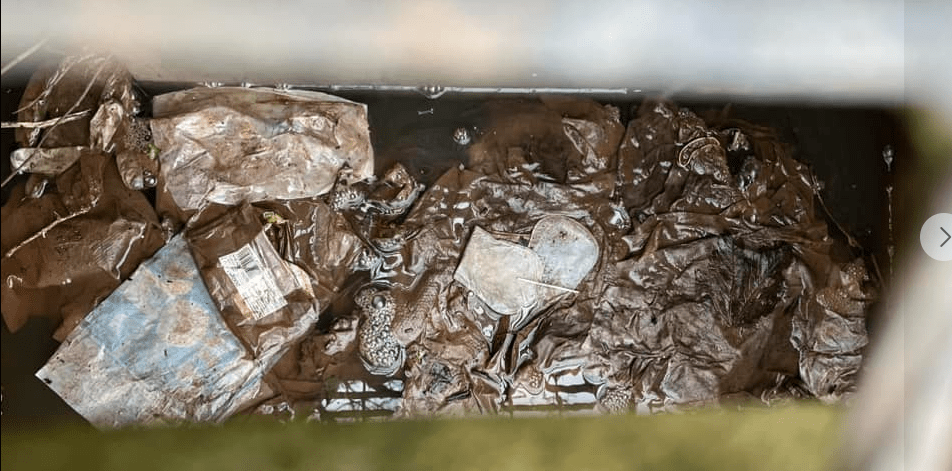
Seriously yucky – image of what comes out from “Unmonitored & Secret” Budleigh emergency sewage overflow

(and into the sea)

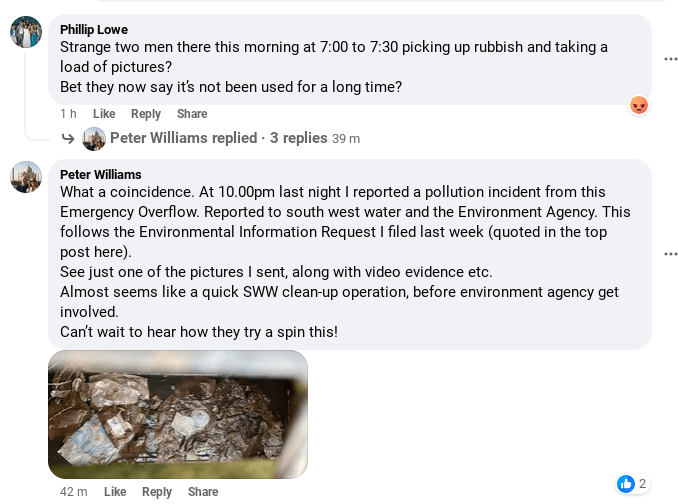
Peter Williams, whose freedom of information request kicked this whole “thread” off, has posted today a comment on the ESCAPE  (End Sewage Convoys and Poolution in Exmouth Facebook page.)

(A link had been made to Owl’s post yesterday).

In this post he includes one of his “evidence images” – not for the squeamish. – Owl

Vibrant new town centre is taking shape in Devon

Almost two decades ago, the concept of “Cranbrook” kicked off with a dedicated EDDC planning team and high hopes. This planning team created a viable community plan but was dissolved, on government instruction, with all the time and effort wasted.

The new town, built on Grade I agricultural land, ended up being a pioneer of “hands-off, developer-led” community planning. The private sector knows best.

But given the chance, developers will build on every available inch. It is extraordinary that EDDC and DCC have now had to buy land to plan for, and provide, essential infrastructure.

One of the main reasons for building a large town on a greenfield site was to provide “affordable” homes for local people. Where are the numbers we need?

It is probably the biggest legacy problem that the the Coalition led EDDC has had to tackle since ousting the Tories. – Owl

Will Goddard www.devonlive.com

A masterplan to give Cranbrook a town centre is now to be drawn up more than a decade since construction began on the new East Devon settlement in 2011.

A high street is slowly emerging in the new town, with a supermarket, children’s nursery and shops with a town square currently being built and due to be complete this year.

These will be the first completed developments in the town centre since the Cranberry Farm pub was opened in 2017.

Now, after a public consultation with over 1,700 responses, and East Devon District Council (EDDC) and Devon County Council having bought more land, a masterplan for the town centre is to be devised by EDDC by the end of this summer.

Cllr Olly Davey (Green, Exmouth Town) praised suggestions made by members of the public, which included having a leisure centre and a health and wellbeing hub, access to the town centre on foot, and good public transport.

He said: “Thank you to the residents of Cranbrook who clearly stepped up and filled in the consultation and enabled us to move forward with confidence that we are reflecting the views of residents on this occasion.

“Personally, I was very pleased to see the support there was for active travel and the desire to see better public transport, plenty of walking and cycling provision, as well as the kind of priorities as they saw it, being the leisure centre and health and wellbeing and so on.”

Cllr Kim Bloxham (Independent, Cranbrook) added: “Cranbrook town centre has been a long time in the making.

“I think I can say no more than please can we get on with it.”

Cranbrook is expected to eventually have 8,000 houses and a population of 20,000. This would make it the second largest town in East Devon and one of the biggest in the county. It has a population of over 6,700 as of 2021.

A second new 8,000-home town is also on the way for East Devon. It will be built on land south of Cranbrook between Exeter Airport and Crealy Theme Park, with 2,500 homes expected by 2040.

Gove to give seaside councils powers to curb Airbnb lets

Michael Gove is targeting Airbnb and other property rental websites with laws that could curb the number of short-term holiday lets in England’s tourist hotspots. 

This proposal has been on and off the government agenda over the past year. 

It will take secondary legislation to enact which may or may not need parliamentary approval. Whether the government has time to fit this in the timetable before the election is a moot point.

So Owl is filing this away as just another interesting Tory “promise”.

Oliver Gill www.thetimes.co.uk

Owners will need to seek planning permission before renting out their properties through the likes of Airbnb, under new legislation to be announced this week.

The housing secretary is acting amid fears that locals in English seaside towns are “being shut out of the housing market”, while traditional B&Bs and hoteliers are being undercut by private rentals.

Going forward, anyone letting out their property for more than 90 days must first apply for planning permission and sign up to a government registration scheme, under changes to short-term letting laws, say industry and Whitehall sources. The new rules would apply to a “main or sole home” and could also apply to second homes.

The default position will be that permission will be granted. But new laws will devolve the decision to councils, empowering local authorities to remove “permitted development rights” in areas where there are large numbers of short-term lets.

Making a change of use planning application costs about £450, experts said. Current laws allow for the setting up of a registration scheme. Changes to planning laws will require secondary legislation.

Gove’s decision to press ahead with the plans is likely to anger some in his own party. When they were first mooted a year ago, Sir Simon Clarke, his predecessor as housing secretary, said they were “anti-business”. Jacob Rees-Mogg, a former business secretary, called the proposals “misplaced”. But sources close to Gove were last night about forging ahead with restricting holiday lets.

A government source said: “Short-term lets play an important role in the UK’s thriving tourism sector, but in some areas, too many local families and young people feel they are being shut out of the housing market and denied the opportunity to rent or buy in their own community.

“So the government is taking action as part of its long-term plan for housing. That means delivering more of the right homes in the right places, but also giving communities the power to decide. This will allow local communities to take back control and strike the right balance between protecting the visitor economy and ensuring local people get the homes they need.”

The housing secretary has previously attacked a proliferation of second homes in English tourist locations as turning seaside towns into “permanent Airbnbs”.

Gove has insisted that he is not against allowing people to let out their holiday homes. But he has expressed concern that second-home owners letting through Airbnb are benefiting from a competitive advantage compared with a local bed and breakfast or small hotel.

Airbnb is understood to be supportive of Gove’s changes to planning laws, which apply only to England. It is thought that this is because the new laws provide clarity and are less stringent than in Scotland and Wales.

Laws in Scotland already require short-term lets to be licensed. From April, local authorities in Scotland will be able to apply to charge double council tax for second homes, including those used as holiday lets. Rules are also more onerous in Wales where council tax of up to 300 per cent can be levied on second homes.

The American technology giant has, however, pushed for the registration scheme to be applied to short-term lets of any period, rather than for anyone renting out their property for more than 90 days a year. This is because it would prevent property owners from sidestepping the rules by moving their listing to another website every 90 days.

Amanda Cupples, Airbnb general manager for northern Europe said: “Many communities have legitimate concerns about housing. Airbnb is not the cause of England’s housing challenges, but we do want to work hand in hand to address the challenges that people face.

“A national registration scheme, alongside planning powers for councils to effectively manage any local impacts where they do arise, will be a positive step forward. New rules will help give authorities reliable data to understand and respond to the activity taking place in their communities.”

Related articles


Previous ChapterNext Chapter

Shocking Headlines: Stall Post Office payouts so Tories can limp into election

According to an exclusive interview in the Sunday Times,  Henry Staunton Post Office Chair, (from 2022) and sacked by Kemi Badenoch, said: 

He was instructed by a senior civil servant to stall on compensation payments to Horizon victims so the government could “limp into the election” with the lowest possible financial liability.

Source www.thetimes.co.uk

“Unmonitored & secret” Budleigh emergency sewage overflow pictured

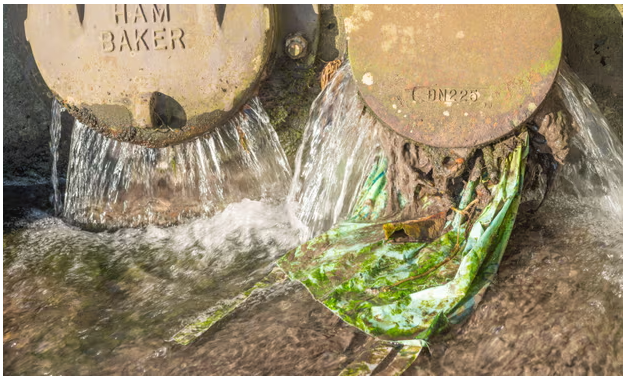
A correspondent has sent Owl a photo of the “unmonitored” emergency overflow (EO) pipe flowing directly under the footpath from the sewage pumping station in Budleigh’s Lime Kiln car park and discharging into the Kersbrook.

This EO featured in two recent posts.

The first referenced a freedom of information request  (FOI) from an individual, Peter Williams, and the second was a comment from a shocked correspondent in response.

Peter Williams submitting the FOI through the “What do they know” open website on 10 February 2024 said: “I have video and photo evidence that this EO has discharged sewage and related items, including sanitary pads, into the Kersbrook channel and from their to the beach through a culvert.” He went on to ask questions about the frequency and duration of discharges and whether or not the public and environment agency had been informed.

This EO is not marked on SWW “WaterFit LIve” maps nor is it marked on the Rivers Trust maps yet is only 100m from the sea. 

In the head to head “question time” in Newton Poppleford, Simon Jupp said, in answer to questions on sewage:

“Now, what has the government done? For the first time ever, we have 100 per cent monitoring of storm overflows.”

Not so hasty Simon – WE DO NOT HAVE 100% MONITORING of discharges onto our beaches.

PS. What goes in the rivers also ends in the sea and we have no live monitoring of sewer outfalls into rivers. – Owl

Local press report on Jupp and Foord going head-to-head in Newton Poppleford

A comprehensive press account:

At least one MP will lose his job.

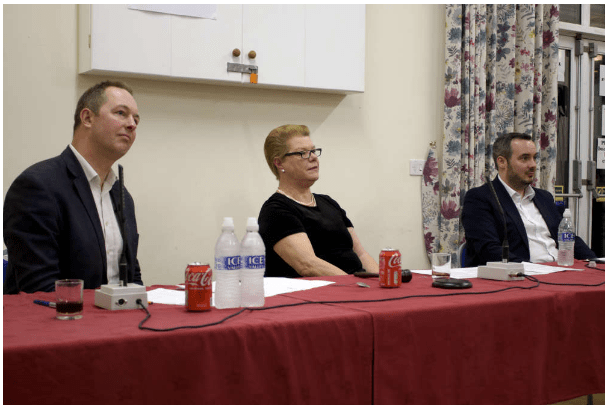
Richard Foord (left) and Simon Jupp, separated by the debate’s chairperson (image courtesy: LDRS/Alfie Richardson)

Will Goddard, local democracy reporter www.radioexe.co.uk

Two MPs vying for the same new Devon seat have gone head-to-head in a public debate. 

Conservative MP for East Devon Simon Jupp, and Liberal Democrat MP for Tiverton and Honiton Richard Foord, will both contend the new Honiton and Sidmouth constituency at the next general election. 

In a packed cricket pavilion in Newton Poppleford on Thursday, the Question Time-style debate, hosted by the parish council, proved civilised and courteous, with one member of the public saying the pair were both “jolly nice chaps” and the area would be lucky to have either as their next MP. 

But the politicians did clash on some local and national issues raised in audience questions. 

Asked about the current state of the country, Mr Jupp said: “It is very difficult at the moment.  

“We know that there are several issues… that have not gone in the right direction. Not all of that is down to government. 

“We are working really, really hard to solve these problems within the confines of what we can do as government.  

“Whether it’s getting a GP appointment or getting an NHS dentist, we know at the moment it’s impossible to get an NHS dentist in this part of East Devon and that’s why we’ve announced a plan in the last week to try and incentivise NHS dentists back into the profession.  

“I want to see the fruit of that labour. We are doing as much as we can and working really, really hard, but some of these problems are not of our own making.” 

In response, Mr Foord laid the blame at the feet of former prime minister Liz Truss. 

He said: “I’m afraid that some of the very hard work that was put in by Liz Truss in her very short premiership has damaged this country and our economy.  

“We saw interest rates shoot up and that has meant mortgage rates have gone through the roof.  

“I’d been in parliament for all of four months when Liz Truss stood up at the despatch box and got her chancellor Kwasi Kwarteng to list off what her government was going to do.  

“It was obvious to me, sitting on the opposition benches, that what they were prescribing for the rest of us was rotten, completely rotten. The idea of scrapping the 45p rate of income tax, for example, was only going to serve the privileged few and was going to do nothing for public services in this country. 

“And we’re seeing some of these terrible, tragic decisions playing out in our locality. I think about in my own constituency, Seaton Hospital, which is threatened by having a whole wing ripped away from it, potentially sold off and demolished for housing.  

“These are the sorts of decisions that we’ll never sort out by writing a few letters locally. We need a competent government in Westminster addressing these problems nationally.” 

Another series of questions put to the duo were centred around the NHS. 

Mr Jupp spoke about how he believed the NHS Devon ICB (integrated care board) needed overhauling, and highlighted his work in calling for more local hospice funding and menopause care. 

He said: “I think people are right to be angry and disappointed with health services in parts of the country, including around here.  

“We are, of course, trying to tackle the problems. We’ve got the only Nightingale hospital in the country still operating and bringing down waiting lists.  

“It’s no good blaming Westminster for everything when it comes to the NHS. An awful lot of our services are commissioned locally, and I’m afraid our ICB, as it stands, does not have my confidence. 

“I think that we need an overhaul of our ICB because it’s in special measures and it’s not working. 

“I think that it’s very easy for politicians to say this, that and the other. But if we can take the politics out of it, we can take the heat out of it and put patients first.” 

Mr Foord criticised this approach, saying NHS problems should be sorted out by the government at a national level. 

He said: “Cross-party consensus is what governments on the rack tend to plead for. When the government is on the ropes, they say, come on, come and share our pain.  

“This government deserves to be criticised. This government is making decisions… that are detrimental to the health service and are detrimental to the health of people in this country, in this county, and in this community. 

“I frequently hear many, many Conservative MPs and government ministers laying the same charge: the responsibility lies with the local, it lies with that local authority, with that district council, with that ICB. 

“And yet when you actually take on a bird’s-eye view, you find that they’re all at it. You find that all 39 ICBs are apparently failing, or perhaps all of the local authorities. It’s their responsibility.  

“The reality is that the government is on the hook for this and we need, I’m afraid, big serious change to sort things out.” 

Sewage dumping was also raised at the debate. Mr Foord called for the government to do more on the issue, while Mr Jupp spoke about what he was doing in the local area to tackle sewage-related problems. 

Mr Foord said: “What we have seen is companies that have been very happy to use this very basic utility as a cash cow and to extract very large dividends for shareholders without the concomitant investment in sewage infrastructure.  

“I think we do have to go back to good regulation by government, because what we have seen is a regulator in Ofwat that has no teeth, and it is government’s responsibility to give the regulator proper powers as well as duties. 

“What we have seen in recent years, in fact since 2008, is that water companies have been able to monitor the sewage themselves and that for me is a nonsense.  

“You need a regulator to monitor sewage discharges and that’s why I introduced the Water Quality Monitoring Bill in parliament in January and I’m pleased that since then the government has, I think, caved under pressure… to talk about moving that responsibility for water quality monitoring away from water companies and to put it in the hands of the regulator.” 

Mr Jupp branded the regions’ water and sewage provider as “shameful” and decried what he saw as its “environmental vandalism”. 

He said: “South West Water have historically underinvested in our area, and we’re seeing the fruits of that failure.  

“We saw it in Exmouth at the start of January. We’re seeing it this week again in Exmouth with the same pipe bursting. It is totally and utterly unacceptable.  

“Now, what has the government done? For the first time ever, we have 100 per cent monitoring of storm overflows. Those are the sewage pipes that have been there for decades.  

“So we know the scale of the problem. It lifts the lid on the scale of underinvestment that we are seeing.  

“I live in Sidmouth, a stone’s throw from the beach, I care about this. I want them to clean up their act and our water.  

“We have got investment coming. I want it more quickly, I want to see thorough plans delivered. 

“South West Water must pay for their failure and there is an awful lot more they need to do.” 

The new Honiton and Sidmouth constituency will include parts of both MPs’ old seats. 

Both also currently have small majorities. Simon Jupp took East Devon for the Tories by 6,708 votes in the 2019 general election, and Richard Foord won a by-election in Tiverton and Honiton for the Lib Dems in 2022 with a majority of 6,144. 

What could make this race even tighter is that Claire Wright, who was hot on Mr Jupp’s heels when she gathered over 40 per cent of the vote in East Devon as an independent in 2019, has endorsed Mr Foord’s campaign. 

A general election must be called by the prime minister at some point this year. 

Richard Foord thanks Newton Pop on social media. Simon Jupp stays silent

Richard Foord posted:

Thank you to everyone who came to tonight’s discussion in Newton Poppleford. There were some great questions. I look forward to another opportunity to set out my stall ahead of the next election. Stellar chairing by Susan; a well-run event all round.

He also posted:

If you were unable to make it last night, or want to watch how the discussion went, you can find it at: https://fb.watch/qfax5Hd3hK/

Owl can find no reference to the “Question Time” on any of Simon Jupp’s social media accounts or on his web page. Not even a thank you to his constituents for hosting it.

Latest example of the Tory “blame someone else” game

The Government’s “minister for common sense” has appeared to blame “everybody who voted for lockdown” for the British economy’s dip into recession.

Cabinet Office Minister Esther McVey made the claim during an appearance on BBC Radio 4’s Any Questions, as she faced questions about who voters should hold responsible for the lack of growth.

She said: “I think everybody who voted for lockdown aided what we’re going through now. I absolutely do.”

The remarks prompted audible gasps from some members of the audience.

Owl expects to hear many more of these before the election.

Deputy mayor resigns from Tories he says are ‘political pygmies’

There are now no Conservatives left on St Ives Town Council in Cornwall after deputy mayor Kenny Messenger resigned as a Tory councillor at a meeting last night (Thursday, February 15), saying that the party he once loved is now “full of political pygmies”. He left the party four months after the town’s mayor Johnnie Wells also ditched his Conservative connection.

Lee Trewhela www.cornwalllive.com

Cllr Messenger told the mayor and fellow councillors: “As you will recall, I announced at our September meeting that I was one more farce, fiasco or disgrace away from resigning as a Conservative councillor.

“Well, all three have happened in one email from the Conservative Party on January 18. It says we are allowing three million Brits who emigrated 15 years ago to vote in the next General Election. That, in my opinion, is gerrymandering the election system, to get elected through the back door. For God’s sake, lose gracefully. So it is with regret and a lot of soul searching that I announce my resignation as a Conservative councillor.”

He added: “The party I joined in 1976 was full of political giants and well-respected individuals. Today’s party is full of political pygmies who are not fit to lace the boots of politicians of all parties from the 1970s, ’80s or ’90s. People like Grant Shapps is a Cabinet minister of all trades and a master of none. They think more about themselves than their constituents.

“I have decided enough is enough. I haven’t taken this decision lightly, but next year I will be seeking re-election as an Independent.” Cllr Messenger made his resignation speech in front of Cllr Linda Taylor, Conservative leader of Cornwall Council., who was present at the meeting.

His resignation from the Tories came after the town’s mayor Johnnie Wells resigned from the party at a council meeting in September to cheers and claps from other councillors and members of the public.

Cllr Wells, who has continued as an independent member of St Ives Town Council, said: “I just feel that for me, in St Ives and for Cornwall, an independent role is better. Being a Conservative was becoming an issue. It was putting up more barriers than it was taking down. People would kind of shut off to you pretty quickly, so it was becoming more of a hindrance than a help.”

Cllr Messenger responded to his colleague’s resignation at the time, telling his fellow councillors: “As the last Tory standing, I resign … wait for it … I resign as the Tory group leader because I can’t be a leader of myself. All joking aside, I respect and admire the Mayor’s decision to become an Independent during the rest of his term of office.

“I am hanging on by the skin of my teeth being a Tory councillor, because I believe the Tory Government and Tory Cornwall Council have become deluded and out of touch with reality, and living in cloud cuckoo land.”

“Question Time” for Richard Foord and Simon Jupp 

Owl’s take on the evening.

This was a civilised debate ably chaired by the Parish Council Chair, Susan Tribble.

It lasted just over two hours and covered subjects ranging from flooding, sewage and river pollution, through housing, education and ending with health.

Local services and infrastructure are crumbling around us. The problem that Simon Jupp faced is how to bat the questions away when the government has run out of ideas. 

He had two options: keep repeating the mantra that money is being spent and the plans are working (arguments that don’t really stand scrutiny as indicated by comments from remote viewers in the “chat box”. See also today’s post on failure to deliver “river restoration fund”); or simply lay the blame on someone else. He deployed both with some style.

Neither line of argument is very convincing from a member of a party in power and controlling events for the past 13 years. The conservatives’ failure is to come up with any credible change agenda.

Richard Foord’s closing remarks (paraphrased by Owl) after the final question on Health:

I want to respond specifically to comments Simon [just] made on the need for cross-party consensus. Cross-party consensus is what governments on the rack tend to plead for. When the government is on the ropes they say: come on, come on and share our pain.

This government deserves, deserves to be criticised.

All politics is about power. This government is making decisions about the health service that are detrimental to the health service and detrimental to the health of people in this country, in this county, and in this community.

I want to link this back to something Simon said on a couple of occasions attacking East Devon District Council for shameful incompetence and the same sort of charge made against our ICB. [Integrated Care Board, the NHS organisations responsible for planning health services for their local population.]

Sitting on the opposition benches of the House of Commons I frequently hear many, many conservative MP and government ministers laying the same charge that the responsibility lies with the locals: with that local authority, with that district council, with that ICB. When you look at it from a “bird’s eye” view you find they are all at it, for example all 39 ICBs are apparently failing or all the local authorities, it’s their responsibility.

Politics is about power; we cannot separate this from [the problems] in the health service. The government is on the hook for this and we need big serious changes to sort these things out. 

These final remarks from Richard Foord when Simon, in his reply, had proposed something along the lines “let’s work together to find a solution” summarises his frustration.

Is this the new Tory rallying cry, being stuffed through our letter boxes? 

“Together we’re making progress”.

[PS. Owl was astounded to hear Simon Jupp blame everything from the lack of social housing and the annual target to build 900 on EDDC pulling out of GESP (the Greater Exeter Strategic Plan). Perhaps people have short memories, but Owl’s view of GESP is that it provided an opportunity for East Devon landowners to “offer up their land” to meet Exeter’s needs. This provided an easy “win win” option for Exeter which has consistently failed to find a five year land supply. Owl notes that since pulling out of GESP a lot more development has been planned within the city and to its western side.]

And thanks to the parish council for organising and hosting the event.

No sign of river clean-up fund after 15 months

Did Simon Jupp apologise for this in Thursday’s “Question Time” in Newton Poppleford? – Owl

A key fund at the heart of the government’s plans to clean up rivers has not been established 15 months after it was promised.

The water restoration fund was first pledged by Thérèse Coffey when she was environment secretary. She said it would redirect millions of pounds of raised from fines headed to the Treasury to pay to improve polluted waterways instead.

Thérèse Coffey when she first announced the restoration fund – Marigolds added for H&S reasons by Owl

Adam Vaughan www.thetimes.co.uk

However, the fund does not exist, there is no timetable for its establishment and The Times can reveal that steering groups to establish it have not yet even met.

Ministers have repeatedly cited the fund as evidence that they are taking water pollution seriously. Coffey said it would that ensure money was “channelled directly back into the rivers, lakes and streams where it is needed”.

Her successor as environment secretary, Steve Barclay, recently said: “The money raised from penalties imposed on water companies will go towards restoring and protecting our waters.”

The government has introduced unlimited fines for water polluters, up from a previous cap of £250,000. The expectation is that penalties will be in the tens of millions of pounds.

Although those sanction powers were established in December, however, there is no sign of the fund to channel the millions of pounds into cleaning rivers plagued by sewage and agricultural waste.

That has raised questions over what will happen to any money raised from penalties before the fund is up and running. It is unclear whether in the interim money will go to the Treasury as before, or be kept in some form of holding fund.

Philip Dunne, the Conservative MP and chairman of the environmental audit committee, said the fund was “crucial” to the “restoration of river health”. He said the committee was looking for confirmation of the launch of the fund and details of the projects it would support.

The Department for Environment, Food and Rural Affairs (Defra) has officially given no indication of when the fund will be launched, but the Times understands the plan is that it be some time in the next financial year.

“We’ve been involved in discussions and invited to join steering groups to ensure they head in the right direction, but those groups have not yet met,” said one river conservationist.

The idea is that any actual restoration or improvements will be carried out by local charities and green groups, and paid for with money disbursed by the fund.

Ali Morse, water policy manager for the Wildlife Trusts, a network of local charities, said: “Setting up this fund means that fines will no longer get absorbed into government coffers, and are instead allocated, in a formal and transparent manner, to projects that will improve the water environment. It’s a huge opportunity for nature.”

She said it was imperative the fund was established as soon as possible, given the severe difficulties facing UK waters. “The fund isn’t about ‘making up’ for the damage caused by polluters — companies must do that — it’s about making further improvements to the environment,” she said.

Tessa Wardley, director of advocacy at the Rivers Trust, said: “There has been much discussion but not a huge amount of action — yet. They have promised additional funding for catchment based approach, new approach to catchment planning and a water restoration fund. None of these have been set up yet.”

A Defra spokesman said: “We are putting into the fund all the fines levied against water companies for polluting the environment since the Plan for Water launched last year. Further details will be set in due course.”

The Times is demanding faster action to improve the country’s waterways. Find out more about the Clean It Up campaign

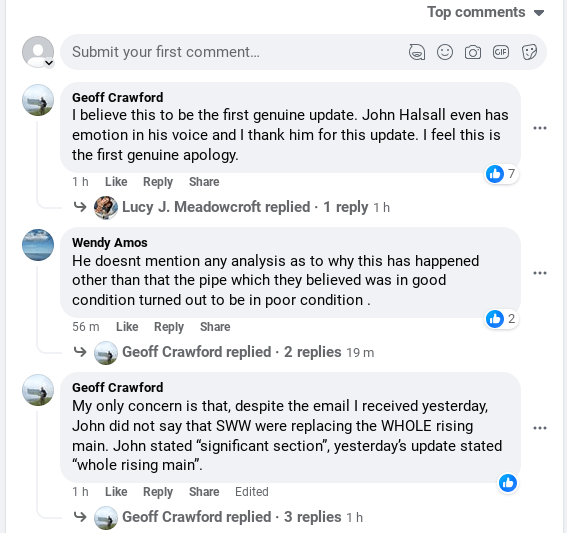
Breaking: SWW takes to YouTube to apologise and explain Exmouth’s latest sewer bursts

From ESCAPE facebook page

Geoff Crawford

I believe this to be the first genuine update. John Halsall even has emotion in his voice and I thank him for this update. I feel this is the first genuine apology.

[Geoff also draws attention to apparent discrepancies in statements from Stuart Madsen-Pilcher  (head of public affairs) referring to replacing the whole rising main and John Halsall’s statement referring to just replacing a 400m section.]

EDDC councillors so incensed by SWW that council will debate six actions next Wednesday

Council meeting Wednesday 21 February at 6pm

In summary the proposals are to:

Declare no confidence in SWW systems and processes

Request that the Leader write publicly to the Chief Executive of South West Water to inviting them to make five commitments.

Further request that the Leader copy correspondence to our local MPs to encourage them to support our efforts to engage South West Water, and to lobby government to take three actions.

Resolve that Strategic Planning Committee evaluate what planning policy measures are required to respond to any sewage capacity issues that might be identified by the upcoming Water Cycle Study,

Further resolve that the results of the Water Cycle Study and any resulting measures recommended by Strategic Planning Committee be actively publicised to residents and brought to the attention of South West Water

Instruct that Strategic Planning Committee, or another committee if this is considered more appropriate by officers, considers a standing item to annually review progress on any recommendations made by the Water Cycle Study.

Details of Motion received: 1 February 2024

Motion Proposed: Cllr Todd Olive Motion Seconded: Cllr Geoff Jung Motion

Signed: Cllrs Olly Davey, Nick Hookway, Paul Arnott, Richard Jefferies, Paula Fernley, Matt Hall, Marianne Rixson, Yehudi Levine, Anne Hall, Charlotte Fitzgerald, Sarah Jackson, Chris Burhop and John Heath 

The full text of the motion is set out below.

East Devon District Council,

Noting widespread concern among East Devon residents regarding the state of local and national sewage infrastructure,

Recognising with grave concern significant disruption to the functioning of Exmouth’s sewage network due to a series of major pipe failures in December 2023, and noting extensive disruption to residents resulting from tanker movements and repair works as a result,

Alarmed at the failure of South West Water to advise East Devon District Council of sewage overflows in Exmouth over the same period, leading to reports of people and pets falling ill from exposure to untreated human waste during sea swimming,

Stressing that these issues affect all East Devon residents, whether coastal or inland, and noting that in 2022, the last year for which full data is available:

  • I. all five of South West Water’s worst-performing East Devon consented overflow outlets by hours of spill, and four of the five worst-performing outlets by number of individual spills, were located inland,
  • II. sewage overflows from South West Water outlets in East Devon ran for over 20,000 hours, with over two-and-a-half thousand individual spills,
  • III. four South West Water outlets in East Devon spilled for over a thousand hours each, with the worst-performing outlet spilling for 1966 hours, or nearly a quarter of year,
  • IV. five South West Water outlets in East Devon spilled over a hundred times, with the worst-performing outlet spilling on more than two in every three days on average, and
  • V. twenty-six of thirty East Devon District Council wards experienced a spill, meaning over 82% of East Devon’s population lived in a ward affected by untreated sewage overflows,

Noting with alarm that constraints and actions identified in a 2010 Water Cycle Study regarding sewage infrastructure capacities have not been actioned, including:

  • I. The construction of a new Wastewater Treatment Works to serve the new community at Cranbrook,
  • II. Improvements to existing treatment works at Maer Lane and elsewhere to facilitate new development and population increases in view of contemporary capacity limits, and
  • III. Improvements to existing treatment works at Otterton and Sidmouth to improve river water quality,

Emphasising the importance of East Devon’s coasts and rivers to our area’s outstanding natural environment, and the intrinsic aesthetic, cultural, and existence value of this to our residents, and considering the substantial contribution that these natural assets make to our local economy via tourism, as recognised by our 2022 Tourism and Cultural Strategies,

Expressing concern that a failure to properly control sewage overflows into rivers and associated phosphate pollution is actively undermining efforts by East Devon District Council and others to promote ecological recovery, biodiversity, and nature restoration, and indeed is counter­productive for South West Water’s own efforts to improve the environmental quality of river catchments,

Mindful of the large number of comments and concerns raised by residents in the 2022-23 Regulation 18 consultation on the emerging East Devon Local Plan regarding the capacity of local sewage infrastructure,

Recalling concern expressed by Members at South West Water’s perceived failure to properly and appropriately respond to consultations on planning applications for new development in areas known to experience frequent sewage overflows,

Concerned at the lack of engagement by South West Water with East Devon District Council officers and the Coast Country & Environment Portfolio Team, including through a failure to follow-up on actions agreed between senior South West Water executives and the Portfolio Team at the November 2023 Beachwise Forum and a failure to include the District Council in consultations with relevant Town and Parish Councils,

Noting that central government funding for the Environment Agency, the relevant regulatory authority, had been cut by over half in real terms between 2009/10 and 2021/22, and

Conscious of the need for East Devon District Council to address these issues on account of its responsibilities to the environment, environmental health, and as the Local Planning Authority, while noting with frustration that many legal powers of investigation and enforcement are reserved to central government and under-funded, under-staffed statutory regulators:

  • 1. Declares that it has no confidence in South West Water’s existing systems and processes for proactively managing and investing in East Devon’s sewage infrastructure;
  • 2. Requests that the Leader write publicly to the Chief Executive of South West Water to invite the company to:
    • a. commit to involving the District Council in discussions with Town and Parish Councils regarding ongoing and upcoming works on South West Water infrastructure,
    • b. jointly convene a regular liaison group bringing together senior staff from South West Water and East Devon District Council, together with relevant East Devon Cabinet members, to proactively monitor and respond to ongoing developments and issues,
    • c. proactively and transparently engage with East Devon District Council’s Planning Policy team and processes on an ongoing basis to ensure that the emerging Local Plan can deliver development without exacerbating existing issues with storm overflows and capacity constraints, and in tandem with network improvements,
    • d. more broadly, to commit to working with East Devon District Council’s planning officers to help manage development pressures on infrastructure and respond to community concerns, to responding to requests for consultation and providing relevant data, to accepting invitations to Planning Committee meetings to discuss applications whenever possible, and taking other relevant steps, and
    • e. commit to actively engaging with East Devon District Council’s Beach Safety Officer and Environmental Health team to proactively advise of overflow discharges in the interest of public safety;
  • 3. Further requests that the Leader copy correspondence to our local MPs to encourage them to support our efforts to engage South West Water, and to lobby government to:
    • a. revisit weak legislation allowing water companies until 2038 to reduce phosphate pollution in rivers from sewage overflows by only 80%, with a view to requiring more immediate action in the short- and mid-term to reduce storm overflows and ameliorate capacity issues,
    • b. resist a request by South West Water to raise bills by over 20% by 2030, before inflationary increases, until demonstrable action on sewage spills has been taken to reduce spills towards South West Water’s own 2025 targets, and
    • c. restore Environment Agency funding to 2009/10 real-terms levels, and properly fund other environmental regulators, to ensure that polluting activities are fully and robustly monitored, investigated, and where necessary enforcement action taken;
  • 4. Resolves that Strategic Planning Committee evaluate what planning policy measures, including spatially and/or temporally limited moratoria on development, are required to respond to any sewage capacity issues that might be identified by the upcoming Water Cycle Study at the earliest possible opportunity following its receipt;
  • 5. Further resolves that the results of the Water Cycle Study and any resulting measures recommended by Strategic Planning Committee be actively publicised to residents and brought to the attention of South West Water as the body responsible, including through the proposed liaison group if and when it is implemented; and
  • 6. Instructs that Strategic Planning Committee, or another committee if this is considered more appropriate by officers, considers a standing item to annually review progress on any recommendations made by the Water Cycle Study.

Flat as a pancake

These are the five foundations I know can build a better, more secure, more prosperous future that this country deserves.

  • We will halve inflation this year to ease the cost of living and give people financial security.
  • We will grow the economy, creating better-paid jobs and opportunity right across the country.
  • We will make sure our national debt is falling so that we can secure the future of public services.
  • NHS waiting lists will fall and people will get the care they need more quickly.
  • We will pass new laws to stop small boats, making sure that if you come to this country illegally, you are detained and swiftly removed.

These are five pledges to deliver peace of mind, so that you know things are getting better, that they are actually changing.

That you have a government working in your interests, focused on your priorities, putting your needs first.

And I fully expect you to hold my government and I to account on delivering those goals.

Rishi Sunak January 2023

“A picture is worth a thousand words.”

The economy is as flat as a pancake