Exmouth sewage warning after pumping station incident – live updates

The public have been urged not to enter the water at Exmouth beach following a pumping station incident. Officials from the Environment Agency (EA) are currently monitoring the situation.

Toby Codd www.devonlive.com

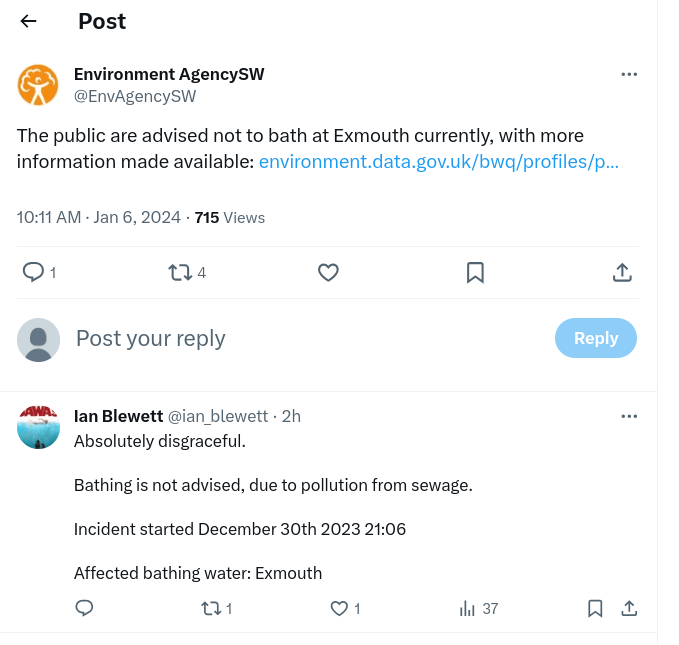
Officials say that bathing is not advised due to pollution from sewage. The EA said in a post on X (formerly known as Twitter) at 10.11am this morning (January 6): “We are aware of the issue at Exmouth pumping station.

“We are investigating what has happened. Officers have attended site and are closely monitoring activity, as well as working with South West Water to ensure the pumping station is back in operation as quickly as possible.”

Exmouth sewage crisis hits national press

Water firm drives 240 truckloads of sewage a day through town ‘to pump into sea’

Statement: “All the pumps at Maer Road are working as expected” challenged by photo evidence.

David Parsley inews.co.uk

South West Water has been accused of dumping millions of litres of raw sewage into a popular Devon beach resort after sending 240 tankers a day to an overflowing pumping station.

At the height of the problems last weekend, 18,000 and 10,000 litre tankers full of sewage were being transported through the East Devon tourist town of Exmouth for 24 hours a day from Friday until New Year’s Day, i has learned.

Since 11 December, the water firm has been dealing with two major pipe bursts in the town, which has led to untreated sewage being taken by a convoy of trucks to the Maer Road Sewage Pumping Station, just 200 metres from Exmouth’s two miles of sandy beach.

Campaigners say that due to the stormy conditions in the past week, the station has been overflowing and had a damaged outfall pipe and a failed pump. Some of the additional waste brought to the site has been seen making its way into a nearby brook that flows directly to the pipe that discharges it into the sea 40 metres from the nearby beach.

Geoff Crawford, the founder of Escape (End Sewage Convoys And Pollution Exmouth), believes South West Water should have taken the sewage to a treatment works less than a mile away and its decision not to “indicates that they knew the sewage would go almost straight into the sea and didn’t care”.

Mr Crawford told i: “They appear to have wilfully polluted the sea with millions of litres of untreated sewage and, as far as we are aware, none of these faults have been reported to Environment Agency by South West Water.”

South West Water, which has apologised for the ongoing disruption, claims that it was prevented from taking the sewage to the nearby Maer Lane Sewage Treatment Works because of flooding on the roads. But i has seen video evidence filmed at the same time the sewage was being transported that suggests the roads were clear.

An investigation by i has also found that at least one of South West Water’s pumps at the station was not working while it was emptying up to 240 tankers of sewage into the site for three days up to New Year’s Day.

The faulty standby pump was one of three, and would have been required in stormy conditions, such as those experienced in Exmouth and across the country during Storm Henk.

When asked about the faulty pump, a spokesman for South West Water initially said that “all the pumps at Maer Road are working as expected”.

However, after asking a worker on the site if a pump on the back of a truck was new, he told i: “No, that is the broken pump we just took out.”

Presented with this comment and photo evidence of the faulty pump, South West Water altered its statement.

The water company’s spokesman said: “The pump you saw was a faulty standby storm pump being removed.

“A replacement pump is kept on site to ensure it can be installed quickly when needed, and this was completed successfully yesterday.

“The standby pump is required during storm conditions if there is an issue with any of the other pumps.”

When asked if the standby pump would have been required in the in the 94mph winds and downpours during Storm Henk, the spokesman said: “At no time was the pumping station unable to pump to full capacity.”

When fully operational the pumping station sends sewage to the nearby treatment plant, but this has also suffered from flooding and over capacity recently.

During times of exceptional rainfall, water companies are permitted to discharge untreated sewage into bodies of water through points known as combined sewer overflows (CSOs) to prevent the system becoming overwhelmed and sewage backing up in peoples’ homes.

Mr Crawford, who has observed the pumping station every day since the sewage tanker deliveries began, added that he had calculated that during last weekend’s peak up to 500 loads were arriving at the site each day.

However, South West Water denies there were that many deliveries.

The company’s spokesman said: “We have 10 tankers transporting flows . . . to keep the burst site clear so a temporary pipe can be installed and a full repair can be made without the need for tankering. Each tanker is transporting up to one load per hour, making a maximum of 240 loads per day.”

Even at a level of 240 tanker deliveries, this equates to around 3.4 million of litres being delivered to the faulty pumping station each day.

While the route from the pumping station to the brook has grills preventing solid matter of more than 10mm to pass through, the untreated sewage is a sludge and contains potential deadly viruses such as Escherichia coli (E. coli) and the Enterococci bacteria.

Exmouth, which is currently a Blue Flag beach, failed to pass water standards in six of the past 10 quality tests since October.

Over the past few years sewage discharged into the neighbouring Sandy Bay has led to its water standard falling from “Excellent” to “Satisfactory”, just one level above the lowest level of poor.

Last year, the boss of South West Water-owner Pennon Group gave up £440,000 in bonuses in the wake of record water quality fines for the company.

Pennon chief executive Susan Davy waived a £157,000 bonus and £283,000 in long-term incentives after the firm was fined £2.15m last April for illegally dumping sewage into rivers and the sea in Devon and Cornwall.

Despite giving up her bonuses Ms Davy, who was paid more £1.6m in the previous year, still took home her annual base salary of £460,000, while the firm’s shareholders benefited from a dividend payout of £122m despite the company making a loss of £8.5m in the financial year to the end of March 2022.

An investigation by the Environment Agency found South West Water culpable for significant environmental harm.

According to South West Water’s own data, 60 beaches across Devon and Cornwall were impacted by sewage spills in recent days, including beaches at Lyme Regis, Torquay, Plymouth and Newquay.

A number of the discharges had been ongoing since before the new year before being exacerbated by Storm Henk.

The spokesman for South West Water added: “We are working around the clock to fix the issue with a pipe in Exmouth.

“We are sorry for any inconvenience caused by this ongoing work, which we’re working hard to resolve as quickly as possible.”

The Environment Agency was asked if it was investigating South West Water’s actions in Exmouth but it had not responded at the time of publication.

Will Simon Jupp vote to “max out” N Sea oil & Gas on Monday?

Rishi Sunak said in the summer he wanted to “max out” North Sea oils and gas.

MPs will vote for the first time on Monday on the Offshore Petroleum Licensing Bill.

How will “I would never vote to pollute our water” Simon Jupp vote?

Meanwhile:

Sunak faces new by-election headache as MP quits over PM’s oil and gas policy

Jane Merrick inews.co.uk

The Government’s former net-zero tsar has resigned as an MP over Rishi Sunak’s plans to allow more offshore oil and gas.

Chris Skidmore, who was chair of the independent government review on net zero and a former energy minister, said he would be stepping down as an MP next week over new legislation which “clearly promotes the production of new oil and gas”.

The move will trigger a by-election in his Kingswood constituency, where the Conservatives have a majority of just over 11,000, ahead of Labour in second place.

MPs will vote for the first time on Monday on the Offshore Petroleum Licensing Bill, which is being introduced following the Prime Minister’s decision last year to permit new drilling licences in the North Sea.

The bill would allow the licences to be given the go-ahead annually. Mr Sunak sparked fury from green campaigners last summer when he said he wanted to “max out” North Sea oil and gas, which critics said undermined the Government’s drive towards net zero.

In a statement posted on X, formerly Twitter, Mr Skidmore wrote: “Next week the Government will be introducing the Offshore Petroleum Licensing Bill in the House of Commons.

“This Bill would in effect allow more frequent new oil and gas licences and the increased production of new fossil fuels in the North Sea. It is a Bill that I have already stated my opposition to, by not voting in the King’s Speech debate in protest at the Bill’s inclusion in the Government’s legislative programme.

“As the former energy minister who signed the UK’s net zero commitment by 2050 into law, I cannot vote for a Bill that clearly promotes the production of new oil and gas.”

He went on: “To fail to act, rather than merely speak out, is to tolerate a status quo that cannot be sustained. I am therefore resigning my party whip and instead intend to be free from any party-political allegiance.”

Mr Skidmore, who backed Liz Truss in the 2022 Tory leadership election, had already announced in November he would be stepping down as an MP at the next general election, which is expected in the second half of this year.

But he said he had been forced to resign the Conservative whip because he could not support the oil and gas legislation before Parliament. This decision meant his constituents “deserve the right to elect a new Member of Parliament”.

He said: “I therefore will be standing down from Parliament as soon as possible.”

Alok Sharma, the Conservative MP and former president of the Cop26 UN climate summit, told Politico that the legislation risks damaging the UK’s “credibility” on net zero.

Highest alert level for Devon’s NHS

Crisis as multiple issues mount

The NHS in Devon has entered the highest level of escalation because of pressures on its services.

Radio Exe News www.radioexe.co.uk

It comes as they try to mitigate disruption during the usual winter pressures and staff sickness, on top of industrial action.

Now new measures include some hospitals reducing visiting hours or re-directing people from emergency departments to other services.

Dr Nigel Acheson, Chief Medical Officer for NHS Devon, said: “It’s vital that those who need medical help come forward as they usually would – using 999 and A&E in life threatening emergencies and 111 online for everything else alongside their GP practices and pharmacies.

Devon’s acute hospitals in Plymouth, Exeter, Torbay and Barnstaple are seeing increased cases of norovirus this week; a stomach bug that causes vomiting and diarrhoea. 

To prevent the spread of infection, some hospital wards in Devon have closed, reducing capacity at an already exceptionally busy time.

Devon’s NHS say people can help by:

•    Not visiting loved ones in hospital if you have symptoms of a cough, cold, respiratory illness, diarrhoea or vomiting
•    Washing your hands frequently with soap and water as this is the best way to stop it spreading. Alcohol hand gels do not kill norovirus
•    Getting your flu vaccine from your GP practice or local pharmacy. Some people are eligible for the free vaccine, including over-65s, people with long term conditions like stroke or heart disease and pregnant people
•    Getting the covid vaccine. Some people are still eligible for free ones.

Dr Acheson concluded; “January is always one of the most pressured times for the NHS in Devon. Six days of industrial action on top of an already busy time is making it extremely challenging for hospitals to maintain safe services this week.”

Urgent and emergency care remains available during the strikes.

Plain speaking from Yorkshire

“The people of this country are incandescent at having been gaslighted for so long by a Government packed to the gunwales with tinpot Ministers for whom lying is in their DNA. We’re mad-as-hell at being patronised; stop it, please, with the three-word, jingoistic nonsense.”

Sir Keir Starmer: Labour leader is wrong – we are not apathetic, we are simmering with incandescent anger

Opinion www.yorkshirepost.co.uk 

It is most unlikely that Sir Keir Starmer himself pores over the pages of The Yorkshire Post in search of political inspiration, though quite possible that those around him may, not least Leeds West MP and Shadow Chancellor of the Exchequer Rachel Reeves, in order to take the temperature of the region.

For had he the time or inclination to do so, certainly during the course of the past few months and years, he would have seen, in these leading article columns and elsewhere in this newspaper, repeated calls for a return to serious politics, meted out by serious politicians.

He will have seen readers’ letters calling for some of the very promises he made in his speech made in Bristol, when he spoke of ditching pointless populist politics and cutting out embittered cynicism from the thinking of Government.

These things are music to the ears of good, honest people. People who work hard to provide for themselves and their families, but can’t begin to dream of a nice holiday or a new car. Paying the bills alone has become an endurance test that never ends.

So, yes. Mr Starmer can, with authority and authenticity, state that he has in those matters judged the mood of the nation accurately, but he couldn’t be more wrong about one thing. People are not, as he said, apathetic. The electorate is not weary. The people of this country are incandescent at having been gaslighted for so long by a Government packed to the gunwales with tinpot Ministers for whom lying is in their DNA. We’re mad-as-hell at being patronised; stop it, please, with the three-word, jingoistic nonsense. It isn’t clever earworm rhetoric, it’s a disguise for yet more flawed thinking : Stop The Boats. Build Back Better. Stay At Home. The list goes on and on. Well here are three words for Mr Starmer, and any other politician who is looking to secure our vote ahead of the General Election: Must Do Better.

2,000 East Devon households get full council tax discount

Just over 2,000 properties in East Devon pay no council tax thanks to a scheme for working-age households on low incomes. 

Will Goddard, local democracy reporter www.radioexe.co.uk 

The council tax reduction scheme helps residents struggling to pay, with discounts of 25, 55, 80 or 100 per cent based on people’s income and circumstances.  

As of October 2023, 4,516 working-age households in the district were receiving reductions, of which 2,004 were paying no council tax at all. 

The total number of claimants is down two per cent since April 2022, but the cost-of-living crisis is still plaguing the district with numbers still “much higher” than pre-pandemic levels, according to a report. 

This week East Devon District Council’s cabinet backed plans to extend the current scheme until the end of March next year. This will need to be ratified by councillors at a full meeting. 

Cllr Steve Gazzard (Lib Dem, Exmouth Withycombe Raleigh) said: “It’s very gratifying to see that as a council, we are helping those that are most at need.  

“To be able to take 2,004 people out of paying council tax I think is a momentous thing.” 

Council tax varies between districts and smaller areas known as parishes. In the current financial year, tax for band D properties in Exmouth this financial year is just over £2,200, for example. The lion’s share goes to Devon County Council, with the rest shared among the police, fire service, parish and East Devon District Council. 

The council tax reduction scheme is costing £9.8 million this financial year, but since East Devon District Council only receives around seven per cent of the total council tax cash, it is only required to pay seven per cent of the cost of the scheme – that is, around £690,000. 

 Is the UK Food Supply Chain now Broken?

“Increasingly, farmers are leaving the sector and using the land for non-agricultural uses because they cannot afford to continue to subsidise the cheap food that UK consumers have become used to – glasshouses are being closed and orchards are being grubbed up.”

OFC 2024: Risk-reward ratio in supply chain ‘out of kilter’ – Farmers Weekly

Philip Case www.fwi.co.uk

Risk must be fairly distributed across the food supply chain instead of sitting with farmers and growers to secure a more sustainable footing for the industry.

This is according to a report launched for the 2024 Oxford Farming Conference (OFC).

Over the past five years, the food and farming sector has experienced “significant shocks”, including the impact of Brexit and the Covid-19 pandemic, the war in Ukraine, climate change and soaring “agflation” costs in fuel, feed, fertiliser, energy and labour.

See also: OFC 2023: Report seeks fairness for farmers in food supply chain

Years of “permacrisis” have left farming’s confidence and bank balances at an all-time unsustainable low, says the report’s author, Ged Futter.

Mr Futter has over 30 years of experience in the retail sector, including 15 years working as a buyer at Asda.

These events have exposed pre-existing and fundamental weaknesses in the supply chain and “we are now in an era of volatility”, he says.

As a result, the risk-versus-reward ratio is now “out of kilter”, which means many farmers are asking “is it worth doing it?”, Mr Futter says.

Increasingly, farmers are leaving the sector and using the land for non-agricultural uses because they cannot afford to continue to subsidise the cheap food that UK consumers have become used to – glasshouses are being closed and orchards are being grubbed up.

Mr Futter’s report – Is the UK Food Supply Chain Broken? – is based on more than 40 interviews with business owners across fresh produce, eggs, poultry, pork, importers, frozen food manufacturers and various consultants.

It presents key insights and considers a range of potential solutions to enable the industry to “thrive and not just survive” in the future.

Four key statistics in report

  • 52% of a grower’s costs spent on labour in some horticulture businesses
  • £2,000-£2,500 is the average cost of an audit with a UK retailer
  • 50% of vegetables produced in the UK consumed domestically
  • 15% of soft fruit produced in the UK consumed here

Retailer practices ‘must change’

The retailers have become more sophisticated at finding ways of getting better prices and most farmers/growers/packers have not kept up, says Mr Futter.

Fixed-price, long-term trade agreements, inexperienced buyers who can be “more aggressive and less empathetic”, and burdensome audits over the past 10 years “have squeezed every drop of profit from many of the suppliers”.

However, Mr Futter argues that much-peddled headlines over the past five years, suggesting the food chain is “broken” and the responsibility sits solely with retailers, fundamentally ignore other participants in the industry.

These include farmers, growers, governmental bodies and NGOs.

The report urges retailers to change their behaviour, but it also says a change of mindset from all stakeholders is needed “to ensure true collaboration, built on trust”.

What farmers and growers can do

Farmers and growers often focus on being better food producers, when they should focus more on being better buyers and sellers, Mr Futter says.

His interviews with farmers and growers revealed they are “not great looking at numbers” and several use outdated accountancy practices.

The key to success is knowing the cost of production, which is more critical now the Basic Payment Scheme is being removed.

Mr Futter says it is more important than ever for the farming sector to move away from overproduction as a perceived solution because a model “based on ‘just enough’ instead of abundance brings in jeopardy for retailers”.

Diversification and exports

Successful growers are already looking at ways to reduce their reliance on retailers.

This includes diversification projects or developing brands that can be sold not only in retail, but also in food service and exports.

One farmer interviewed, who supplies the food service sector, said: “If I have to supply retail, I will quit.”

Alongside diversification, it is crucial that farmers and growers invest in training their teams to ensure they can negotiate successfully and confidently with buyers.

“We need better trained, business-like farmers, multiskilled and business savvy, able to buy and sell,” says Mr Futter.

Frequent extreme weather events exacerbate risk

A volatile climate and more frequent extreme weather events in recent years have been increasing risk for farmers and growers, the report notes.

It highlights the flooding event in October 2023 in Scotland which left millions of pounds of unharvested vegetables damaged under floodwaters.

Fresh produce supplier Stewarts of Tayside’s managing director, Liam Stewart, said the business lost about £500,000 worth of food grown for supermarkets across 60ha of land.

“There’s body blow after body blow, and farmers are no longer growing the same amount of buffer as they traditionally would.

“So if something grows wrong, we take the hit,” he told the BBC in the aftermath of the incident.

“We need everything to happen. Otherwise it is the difference between making money and not making money.”

Devon housing shortage sparks severe consequences

A drastic shortage of affordable housing is having “severe consequences” on Devon’s economy as families increasingly struggle to find places to live.

Bradley Gerrard www.devonlive.com

The Devon Housing Commission, which is made up of Devon’s 11 local authorities and supported by the University of Exeter, has written to Lord Richard Benyon, minister for rural affairs, to urge faster action on delivering more affordable homes for the county.

The commission told Lord Benyon that the average home in Devon costs more than 10 times the average income, rising to 28 times in some rural areas.

Lord Richard Best, the commission’s chair, said: “The acute shortage of any accommodation to buy or rent for those on or below average earnings is having severe consequences. Apart from the hardship to families, it is deeply affecting the local economy.

Beth Rigby accuses Keir Starmer of being ‘timid’

“It is also leading to a dramatic increase in the need for temporary accommodation, with ever-rising costs to local authorities and a growing population living in insecure, unsatisfactory housing.”

The commission wants the government to ensure more homes are made available for local people by deploying the Defra Rural Housing Enablers’ policy in Devon.

The scheme was boosted last year with £2.5 million of funding to help the supply of new, affordable housing by identifying development opportunities, supporting site owners and community representatives to navigate the planning system, and securing the support of local communities for developments.

Initially, only schemes in Cambridgeshire and Northumberland were announced, but more are due to be outlined by the government this year.

Lord Best said he had heard from Lord Benyon that £97,000 had since been announced for Devon, which will be coordinated through charity Devon Communities Together, but he hopes for further measures to support rural areas in the county.

“Small village developments can make an immense difference to the life of the community,” he said.

“Without funding associated with schemes like Rural Housing Enablers for a reasonable term it can be hard to recruit and retain the talented people required to fill important roles in Devon’s workforce.

“But with these Enablers in place, real progress can be made in getting attractive, sustainable, affordable homes built for local people.”

The majority of Devon’s local authorities are classed as predominantly rural and the percentage of people in the county who live in a settlement of fewer than 10,000 people is twice that of England as a whole.

Furthermore, the delivery of affordable rural homes in Devon has declined since the loss of the previous Rural Housing Enabling service, from over 200 homes in 2017/18 to only 91 four years later.

The Devon Housing Commission also said it hoped revisions to national planning rules would encourage more development for local people in the county, and that moves would be made to moderate the growth of Airbnb-style short-term lettings from replacing rented accommodation for local people.

Long wait continues for new Devon Rockfish restaurant – Topsham & Sidmouth

The transformation of a former French bistro and bar in Topsham into a Rockfish restaurant is said to finally be making progress after more than 18 months since its takeover. For many months, the seafood chain has teased that the new restaurant – situated on the historic quay – will be ‘coming soon’.

Anita Merritt www.devonlive.com

However, in reality, no work to renovate the previous L’Estuaire Bistro and Bar has been seen leading to speculation about whether it will ever reopen. Rockfish has assured it is still pressing ahead with its plans but it does not know when it will open its doors yet.

A spokesperson for Rockfish said: “We don’t have an official opening date for Rockfish in Topsham as of yet but the project has entered the design and planning stages.”

It was back in June 2022 when L’Estuaire Bistro and Bar closed for good after stating its lease was not being renewed and the site was set to become a Rockfish restaurant. Celebrity chef and restaurateur Mitch Tonks is the founder and chief executive of Rockfish.

Sidmouth

It is also planning to open a new restaurant in Sidmouth which is another project that has been severely delayed. Its plans to convert Sidmouth’s seafront Drill Hall – the former headquarters of Sidmouth’s Territorial Army unit -into a Rockfish restaurant date back four years.

An original scheme for the seafront site had been approved back in 2020, but work never begun, with delays and ‘legal matters’ stopping the plans. A new scheme was proposed and submitted to East Devon District Council planners in 2023, after the chain also acquired the toilet block adjacent to the Drill Hall to enable a ‘much enhanced restaurant offer on this site’.

It had been recommended for approval at a meeting of the council’s planning committee in November. However, a decision was delayed after Mr Tonks was asked by the Environment Agency (EA) to provide more detailed flood risk assessments before the proposal could be considered.

The EA have recommended that the application is not determined until a Flood Warning and Evacuation Plan (FWEP) has been prepared and submitted to the council’s emergency planner.

Sir Keir Starmer to promise ‘total crackdown on cronyism’

Sir Keir Starmer will vow to take on those who commit “fraud against the public purse” in a major speech that will mark the start of campaigning for the general election.

Alexandra Rogers news.sky.com

The Labour leader’s first speech of 2024 is expected to focus on the erosion of trust in politics following a series of scandals, including the procurement of personal protective equipment (PPE) during the pandemic.

He is expected to announce that those who defraud the government could face a jail sentence of more than 10 years – the current limit – as part of Labour’s “total crackdown on cronyism”.

Sir Keir, who led the Crown Prosecution Service (CPS) from 2008 to 2013 and previously worked as human rights lawyer, is expected to say that trust in politics is now “so low, so degraded, that nobody believes anyone can make a difference any more”.

“After the sex scandals, the expenses scandals, the waste scandals, the contracts for friends – even in a crisis like the pandemic – people think we’re all just in it for ourselves,” he will say.

“To change Britain, we must change ourselves – we need to clean up politics. No more VIP fast lanes, no more kickbacks for colleagues, no more revolving doors between government and the companies they regulate.

“I will restore standards in public life with a total crackdown on cronyism.”

Sir Keir will point to his past in the legal profession to highlight his desire to “serve”.

He will say: “Politics isn’t a hobby, a pastime for people who enjoy the feeling of power, and nor is it a sermon from on high, a self-regarding lecture, vanity dressed up as virtue.”

The Labour leader will make his speech just weeks after Tory appointed peer Baroness Michelle Mone admitted involvement with PPE Medpro, which received over £200m in government contracts during the pandemic.

Baroness Mone is set to benefit from its £60m profits that have been put into a trust by her husband, Doug Barrowman.

PPE Medpro is currently being sued by the Department of Health and Social Care (DHSC) over claims millions of the gowns it supplied failed to meet the standard required – something Baroness Mone and Mr Barrowman deny – while the company is also under investigation by the National Crime Agency.

Sir Keir has previously branded the scandal a “shocking disgrace from top to bottom”.

A source told The Guardian, which first reported on the story, that a range of policy options are being considered including tougher sentences for “fraud against the public purse”, including the billions wasted through COVID loan schemes.

In March, the National Audit Office (NAO) found that £21bn had been lost to fraud since the start of the COVID pandemic, with more than £7bn linked to schemes introduced during the pandemic.

The maximum sentence for serious fraud currently stands at 10 years’ imprisonment.

Under Labour proposals those who fraudulently claim money from the government – for example through the bidding of public contracts – could be sent to prison for a longer time.

However, the newspaper reported that a separate pledge to ban former ministers from lobbying for five years is likely to be scaled back.

Speaking to Sky News, shadow minister Nick Thomas-Symonds said Sir Keir would highlight how the government has “denigrated the sense of public service”.

He pointed to breaches of the ministerial code – which sets out how ministers should behave – and said Labour would set up a new ethics and integrity commission with powers to investigate ministers

“When we’re knocking on doors, we find people saying almost despairingly to us, ‘can things be better?’ Things can be better, but that’s why we need that general election and change as soon as possible.”

Dickensian disease in Devon as cases mapped

“Consumption” is on the rise again with cases notified in Plymouth, Torbay and Exeter.

Another sign of “Broken Britain”. – Owl

Paul Greaves www.devonlive.com

A Dickensian disease responsible for killing millions in Victorian Britain is making a post-pandemic comeback in Devon. Tuberculosis or TB – also known as “consumption” – caused the deaths of an estimated four million people between 1851 and 1910.

It was the scourge of the 18th and 19th centuries and featured heavily in the literature of the time, with Charles Dickens, Elizabeth Gaskell, and Samuel Richardson among the authors writing about the disease. TB is thought to be one of the illnesses afflicting Tiny Tim in Dickens’ A Christmas Carol.

Although it is now curable, TB is still the second leading infectious killer globally, behind Covid-19. In the UK cases and infection rates had been falling since 2011, as the health authorities work toward the elimination of the disease.

However, the UK Health Security Agency (UKHSA) says that progress has now stalled. Cases went up during the pandemic in 2021 and then remained stable last year.

In 2023, the UKHSA received notifications of 4,813 cases of TB in England and Wales – a 7% increase on the 4,480 cases over the same period during the previous year. It is also higher than in 2021 (4,557).

In Devon, the UKHSA has received notifications of 29 cases in 2023. That includes seven cases in Plymouth, seven in Torbay, and six in Exeter.

When compared to the population, Torbay had the highest infection rate, with 5.0 cases of TB per 100,000 of the population, followed by Exeter (4.6 per 100,000 population), and Torridge (2.9).

You can see the cases and rates where you live using our interactive map.

Meera Chand, Deputy Director at UKHSA said: “We remain concerned that we are seeing TB cases increasing in some parts of England. TB is curable and preventable, but despite significant progress towards elimination in recent years, the disease remains a serious public health issue in the UK as shown by these figures.

“With treatment, most people will make a full recovery. It is very important that those with relevant symptoms are tested for TB and appropriate treatment is started promptly, both for the individual and for the prevention of onward transmission.

“TB notification rates in England remain highest in people who are originally from parts of the world where TB is more common and those in large urban areas in England which are associated with higher levels of deprivation, and in inclusion health groups – a term used to describe people who are socially excluded and typically experience multiple overlapping risk factors for poor health. This includes those experiencing homelessness or contact with the criminal justice system

“As we head into winter, it is important to remember that not every persistent cough, along with a fever, is caused by flu or COVID-19. A cough that usually has mucus and lasts longer than three weeks can be caused by a range of other issues, including TB. Contact your GP if you think you could be at risk so you can get tested and treated.”

TB is a highly infectious disease caused by airborne bacteria, spread through the air when people cough, sneeze, or speak. It is a serious long-term condition, but it is now curable.

It usually affects the lungs but can spread to other parts of the body such as your glands, bones, and brain.
Symptoms include a chronic cough, fever, chills, loss of appetite, weight loss, fatigue, and coughing up blood.

Of local authority areas in England and Wales, Birmingham has had the most cases of TB this year, with 206.

When compared to the population, Leicester has had the highest rate of infections with 40.7 per 100,000 population. London is the region most blighted by TB. A third of all cases identified this year were diagnosed in London.

Ask for an urgent GP appointment or get help from NHS 111 if you are coughing up blood. Call 999 if you have a stiff neck and a severe headache, it’s painful to look at bright lights, you’ve had a seizure or fit, if you’ve had a change in behaviour such as sudden confusion, or if you’ve had a weakness or loss of movement in part of the body. These could be signs that TB has spread to the brain.

Stats Watchdog To Investigate Government’s Claim To Have ‘Cleared’ Asylum Backlog

The statistics watchdog has launched an official investigation into the government’s claim it cleared the legacy backlog of asylum claims last year.

Kate Nicholson www.huffingtonpost.co.uk 

Downing Street has faced intense criticism – and has even been accused of a “barefaced lie” – after PM Rishi Sunak said his government cleared all applications to remain in the UK made prior to June 28, 2022.

But, after the government’s own data suggested there were still plenty of claims which needed to be addressed, the Office for Statistics Regulation have launched an investigation.

According to Sky News, the watchdog announced its action after a complaint and the investigation is expected to take a few weeks.

It cannot force the Home Office to offer more data although it can ask for it. It could also remove its stamp of reliability from the Home Office’s press releases.

Sunak pledged at the start of last year to “stop the boats” and clear the asylum backlog – meaning this is a crucial policy for his administration.

The confusion over the asylum backlog began earlier this week, when the PM posted on X, formerly Twitter, that the Home Office had dealt with 112,000 “legacy cases” – claims made before June 2022 – by the end of last year.

Sunak claimed: “I said that this government would clear the backlog of asylum decisions by the end of 2023. That’s exactly what we’ve done.”

However, Downing Street’s own data shows that 4,537 “complex cases” still need a decision.

Sunak’s spokesperson suggested that because they had been “reviewed” they were now considered “cleared”.

Home Office data shows that 51,469 asylum applications were granted in total last year, while 25,550 were refused – and 35,119 “non-substantive” decisions were made – where the claim is withdrawn, pause or declared void.

There are also 99,000 more recent claims yet to be processed from last year.

Shadow immigration minister Stephen Kinnock called Sunak’s claim a “barefaced lie”, saying it would “be laughable if it wasn’t such an insult to the public’s intelligence”.

Home secretary James Cleverly was scrutinised on the BBC’s Today programme over the numbers too, after he said it was “impossible” to say when the remaining 100,000 asylum cases would be dealt with.

UK could see highest rate of Covid infections as new variant spreads

The UK could soon see its highest-ever rate of Covid infections thanks to the new variant JN.1, according to experts. Professor Christina Pagel, of University College London, said the rapid spread of the strain means we have yet to reach the peak of infection while Professor Steve Griffin said it could outstrip previous waves of infection.

Neil Shaw www.devonlive.com

She compared the current strain to the Omicron substrains BA.1 in December 2021 and BA.5 in January 2022 and said coronavirus cases will continue to surge for weeks, reports The Mirror. New figures show that overall numbers have soared over the Christmas and New Year period, with JN.1 subvariant emerging as the dominant strain in the last few weeks.

It grew from making up just one per cent of coronavirus cases at the end of October to five per cent by mid-November – and is now topping the table of infections after reaching 51 per cent on Christmas Day. JN.1, which has been reported worldwide, is a descendant of the Pirola variant and has been described as much more immune evasive than its parents.

Professor Pagel told the i newspaper: “Unfortunately it is likely that this JN.1 wave has not yet peaked and will peak mid-January, either next week or the week after. And then infections will stay very high for a few weeks on the downward slope too. I am sure this wave will rival the first two Omicron waves in 2022 and might even exceed them.”

However, she said it is unlikely that hospitalisations will approach the levels seen during the previous Omicron waves. Professor Steve Griffin, a virologist at Leeds University, meanwhile told the newspaper that we may see case numbers “resembling when BA2 emerged”, which was England’s largest-ever wave in March and April 2022.

Surveys showed that 7.6 per cent of the population were estimated to be infected with Covid during this period, though hospitalisations and deaths were far lower than during the pandemic.

Other scientists have warned about waning immunity. Prof Peter Openshaw, from Imperial College London, told the Sun: “Immunity falls over time, and for many, it’s been over a year since they had their last booster jabs.”

The US Center for Disease Prevention and Control (CDC) has also highlighted the rapid spread of JN.1 – but said in their latest report that is not any more aggressive than other variants in circulation. The CDC wrote: “At this time, there is no evidence that JN.1 presents an increased risk to public health relative to other currently circulating variants.”

The UK Health Security Agency’s (UKHSA) latest report estimates a Covid-19 prevalence of 4.2 per cent across the total population in England and Scotland – meaning that approximately 1 in every 24 people could test positive for any type of Covid infection at the current time. Prevalence rates were highest in people aged 18 to 44 years, and the highest prevalence regionally was found in London.

The cold winter weather and increased socialising indoors have contributed to the seasonal rise in cases. The NHS and UKHSA are urging all those eligible to come forward for a seasonal COVID-19 vaccine before the window closes on January 31, 2024. Professor Steven Riley, Director General for Data and Surveillance, UKHSA said: “At this time of year, the cold weather, shorter days and increased socialising mean that the potential for transmission of respiratory viruses like COVID-19 is particularly high. This, as well as the possible impact of new variants, means it’s not unexpected to see cases increasing.

“If you are showing symptoms of COVID-19 or other respiratory illnesses, you should try to limit your contact with other people as much as possible, especially those who are older or more vulnerable. It’s important that those people who are most at risk of severe illness and hospitalisation as a result of COVID-19 come forward for their seasonal vaccination to make sure they have the best possible protection this winter. You can get a vaccine through your GP, by booking with a local NHS vaccination service, or you can find a COVID-19 vaccination walk-in site.”

Work to repair burst Exmouth Sewer “delayed”

SWW said sewage was now being transported to a treatment works after the clearing of floods.

From BBC Local news

A spokesman said: “Our teams continue to work hard to fix the issue at Exmouth.

“However, we are experiencing some delays with the temporary pipe that will allow us to complete a full repair without the need to further tankering.

“We expect the temporary pipe to be working fully by the end of the week.”

He added the firm was “sorry for inconvenience and appreciate the patience of the local residents”.

Paul Arnott: ‘Local problems the Tories face almost daily’

(Including an update on the Exmouth sewage crisis)

May I take this opportunity to wish all readers a happy new year, while also pointing out again that these columns are ‘a personal point of view.’

www.exmouthjournal.co.uk

They do not represent an “official line” from East Devon District Council. Instead, they are my take on mainly local, often regional, sometimes national, and very rarely international matters that affect the district.

As we enter an election year, there are obviously many difficulties presenting almost daily for Conservative candidates and I won’t restate the obvious here. Their greatest obstacle in local campaigning is how readers should take promises of action when after fourteen years in power these actions are only needed because of them! Two very recent examples, if I may.

First, although I steer clear of Twitter/X, I was passed a posting by Simon Jupp MP in which he blamed the “LibDem-led administration at EDDC” (I think he means me) for the council having to consider a new community to the east of Exeter. Although Mr Jupp has decided not to stand in his current constituency, which could be affected, he is clearly trying to leave a bit of ammo behind for his successor as Conservative candidate. I wouldn’t pick it up off the ground if I were him.

Put simply, the decision to continue exploring a new town location was supported by all 3 Conservative members at EDDC’s Strategic Planning Committee on 5th December 2023. The recording of this is on YouTube about 3 hours 7 minutes in. Unlike Mr Jupp, Councillors Brian Bailey, Ben Ingham and Helen Parr knew as well as everyone else that it is the chaos around the National Planning Policy Framework and some illogical “housing need” numbers which makes consideration of this necessary in the first place. The 3 Conservatives could do little else and could justifiably feel somewhat undermined by their own MP.

I am grateful for the second example to our superb portfolio holder, Geoff Jung, and some terrific campaigners in Exmouth for my spending New Year’s Day not pottering along a beach but immersed in the latest and worst chapter of South West Water’s sewage operations in Exmouth. Many Exmouthians will have seen nine huge tanker lorries carrying sewage out of the failing plant in Phear Park and driving it across town to the plant in the Maer Road car park. As a council, both directly concern us, having responsibilities and ownership obligation. At the time of writing this had been going on day and night for 72 hours, ruining people’s sleep and leading to more untreated sewage entering the sea.

Geoff and I asked our terrific officers to act, sending urgent emails to the relevant agencies asking for immediate clarification around the health and safety issues. Meanwhile, Mr Jupp has taken to Twitter/X saying he is “demanding” action from South West Water. His potential successor is getting involved too. Their problem is that this scenario comes wholly from their own party, its grotesque defunding of the Environment Agency – who should be on these incidents instantly and strongly – and their failure to deal with the cavalier way South West Water is set up corporately. Exmouth Phear Park and Maer Road Car Park, and whatever items of sewage can be found on the Maer after manhole covers pop under the pressure, are the product of fourteen years Tory chaos.

There is no wriggling out of this, and I am reminded by all the indignant Conservative social media protests of that ancient playground saying, “He who smelled it, dealt it”. I imagine many readers will feel the same.

Storm Henk: Exmouth seafront venue shuts with roof ‘coming off’

A seafront venue in Exmouth is closed due to Storm Henk. An eyewitness said Ocean’s roof ‘is coming off’. Pictures from the scene show police and fire engines have blocked the Esplanade.

Another landmark in the saga of “Exmouth’s Albatross” which we all now own! – Owl

PS it also featured in National News: The roof of a pedestrian bridge at the railway station in Okehampton, Devon, was blown off and part of an entertainment complex roof in Exmouth fell on to the seafront…”

Jamie Hawkins www.devonlive.com 

The witness told DevonLive: “The roof of the ocean is coming off down Exmouth seafront. Both entrances are blocked by emergency services.”

Ocean confirmed the building is closed ‘for the safety of our guests to closed the complex for the day.’ A post on their Facebook page read: “Due to the the unexpected turn in the weather as a result of Storm Henk, we’ve decided it’s best for the safety of our guests and team to close the complex for the day.

“We’re sorry for any inconvenience this may cause, and will be in touch (if we haven’t already) if you have a booking for today. Stay safe and warm and we’ll keep you updated here on our reopening when the skies clear up!”

Police and the fire service have been contacted for more information.

Updates will appear in our blog below:

20:20Jamie Hawkins

Ocean to remain closed until lunchtime tomorrow

A spokesperson said: “Quick update. As of now, our doors will remain closed until lunchtime tomorrow. This is to allow for a thorough inspection in the morning, to ensure the structural integrity of the building prior to opening.

“Rest assured your safety, and that of our team, is always our first priority. We’ll be reaching out to those whose bookings are affected.”

Devon County Council plans to replace flowerbeds with bus stop on Seaton seafront

Is a bus stop all Seaton gets out of levelling up? – Owl

A Devon council plans to remove flowerbeds from a seafront esplanade to build a new bus stop in their place.

Two existing bus stops are due to be replaced by one new one Image source, Devon County Council

BBC News www.bbc.co.uk

The existing bus stops on Seaton’s Marine Place and Seafront Gardens would be replaced by a single stop, Devon County Council said.

The new waiting area is proposed for the esplanade side of the roundabout.

The council said it “appreciated” losing the flowerbeds might be “disappointing” for residents and visitors.

But it added: “It is agreed that pedestrian safety must come first, and it is essential that these beds are removed for this work to go ahead

“The removal of the flowerbeds does though offer an opportunity for East Devon District Council to consider how to make the best use of the space to make the seafront a more attractive place to visit.”

If the proposal proceeds, funding would come from the Department for Transport, it said, with plans now on the council website.

Water companies break promise on sewage spill maps

Thames Water was the first to publish a comprehensive map, in January last year, prompting a series of negative headlines about days-long spills. Southern Water and South West Water have limited maps covering beaches but not rivers, known as Beachbuoy and WaterFit respectively.

The Exe, Otter, Sid and Axe all empty into the sea at Exmouth, Budleigh Salterton, Sidmouth and Axmouth. All the inland communities in East Devon discharge their treated waste and storm overflows into one or other of these rivers or their tributaries, The Exe carries more from Exeter and Mid Devon.

[For example, in 2022 (the data is only updated annually by the Rivers Trust) the combined two Honiton wastewater treatment plants plus the nearby village of Gittisham discharged untreated waste for a total of 3252 hours on 283 occasions into the small river Otter. The popular Lime kiln car park is at the mouth of the Otter and that part of the beach is a popular bathing spot.] – Owl

Adam Vaughan www.thetimes.co.uk 

Water companies have reneged on a promise to produce live maps of sewage spills by the end of last year, leading campaigners to warn they are putting public health at risk.

Just months after The Times’ Clean it Up campaign began, senior water industry sources said companies would beat a 2025 legal deadline for near real-time online maps of discharges. Instead, they said all firms would go faster and release them before the end of 2023.

However, no new maps were released after the promise was made. That means swimmers, paddleboarders and other water users are reliant on a “sewage alert” map created by the charity Surfers Against Sewage. 

Thames Water was the first to publish a comprehensive map, in January last year, prompting a series of negative headlines about days-long spills. Southern Water and South West Water have limited maps covering beaches but not rivers, known as Beachbuoy and WaterFit respectively.

On New Year’s Day, Thames Water’s map showed scores of spills in Oxfordshire, while Southern had spills from the Isle of Wight in the west to Folkestone in the east. Five of nine monitored beaches between Exmouth and Lyme Regis were spilling sewage in South West Water’s region.

It is understood the failure of other firms to meet their mapping promises is due to a reluctance to weather criticism. Companies are also keen not to incur the wrath of politicians, including Steve Barclay, the new environment secretary. Last month, he told them that sewage spills from storm overflows were “unacceptable” and a priority for him.

“Until absolute transparency through real-time sewage spill reporting is mandatory everywhere, the paying public’s health and goodwill continues to be at risk,” said James Wallace, chief executive of River Action, a charity that supports water campaign groups.

A spokesman for the industry group Water UK said companies were “on track” to produce maps by the 2025 legal deadline. He did not address why they had failed to meet their 2023 pledge, and there are still no concrete dates for when the maps will materialise in coming months.

Lawyers and managers at six water companies have refused to release data on sewage releases that could reveal evidence of illegal spills.

One town’s fight against sewage pollution

The Times has twice used environmental information regulations requests to ask for stop and start times of sewage spills, to cross reference with weather data and see whether companies are discharging on dry days. Companies are legally permitted to release sewage only during wet weather. Anglian Water, Northumbrian Water, Severn Trent Water, South West Water, United Utilities and Yorkshire Water refused to conduct an internal review of their initial refusal to publish the data.

Most argue that a release could prejudice a long-running investigation into the problem by the Environment Agency and Ofwat, which is expected to report its findings later this year. Barry Matthews, deputy general counsel at South West Water’s owner, Pennon Group, suggested that “it is the regulators and not the press or the public” who should be able to see the data, which he said concerned “complex technical and regulatory matters”.

Yet the BBC was able to establish from similar data that Thames Water, Wessex Water and Southern Water had last year collectively spilled for 3,500 hours on days when it was not raining. The Times has complained to the data watchdog, the Information Commissioner’s Office, over the continued refusals of the other six firms.

The Liberal Democrats wrote to the commissioner’s office in December to look at whether companies were failing to be transparent enough. “I am asking you to launch an immediate investigation into these firms not complying with [regulations] and call upon those firms to release data they are withholding from public scrutiny. Enough is enough, these firms must be held accountable, and should no longer be able to hide behind fabricated excuses,” said the Lib Dem MP Tim Farron.

Anger after sewage tankers used in Exmouth after mains burst

A water company has been accused of “wilfully polluting” while using tankers to move sewage to an overflowing pumping station in Devon.

[Effectively chucking it into the sea – Owl]

Brodie Owen www.bbc.co.uk

South West Water (SWW) said a sewer burst in Exmouth on 30 December, as well as flooding elsewhere, had forced it to use lorries to transport the waste to a nearby pumping station instead of a treatment works.

But campaigners said the pumping station was already under major pressure before waste was delivered to it.

SWW apologised for the disruption and said it was working as quickly as possible to repair the burst main.

The utility said it had been transporting waste to Maer Road pumping station, near Sandy Bay, as it had been prevented from taking it to a treatment works due to flooding.

The Environment Agency (EA) had been notified of the situation, SWW said.

But campaigners said it meant the company transported sewage to an area where sewage was already being discharged.

Geoff Crawford, from End Sewage Convoys and Pollution Exmouth, said it was “wilful pollution”.

“It’s definitely clear that they know that Maer Road is overflowing – their system WaterFit, external clearly shows that,” he said.

“Even though it’s overflowing, they are adding sewage to that overflow.”

He said the pumping station had overflowed “pretty much non-stop” since sewage tankers were used.

“There’s probably a few hundred tanker movements in the past few days, 24/7.

“They are really noisy, travelling past care homes, past schools and through residential areas.

“They are running their pumps and their engines throughout the night.

“There’s a lot of really fed-up, tired and angry residents.”

SWW said it was planning to take the waste to Maer Lane treatment works now that flooding had eased.

It said: “Our teams are working hard to repair a sewer which burst in the Exmouth area on 30 December.

“In order to complete this essential work, we have needed to use tankers to transport flows from the sewer to a local pumping station to allow the team to work on the damaged pipe.”

It said it was aiming to install an overland pipe by the end of Wednesday “to divert flows around the damaged section of sewer so we can complete a full repair without the need for tankers”

It added that it was “sorry for any inconvenience caused while we complete this work as quickly as possible”.

The EA has been contacted for comment.

Interesting developments in USA to tackle housing affordability crisis

Congress Introduces Bill to Block Hedge Funds from Buying Single-Family Homes

The proposed legislation aims to help U.S. home buyers who can’t afford to outbid deep-pocketed institutional investors.

www.planetizen.com 

Earlier this month, in response to the growing U.S. housing affordability crisis, Democratic lawmakers from both houses of Congress introduced bills that, if passed, would ban hedge funds from purchasing single-family housing market, reports Chris Clow of HousingWire. They would also be required to sell off all single family homes they own over a decade.

Sen. Jeff Merkley of Oregon introduced the “End Hedge Fund Control of American Homes Act of 2023” to the Senate. Rep. Adam Smith of Washington introduced the House version.

Clow’s article also cites a piece from the New York Times that reported that Democratic Reps. Jeff Jackson and Alma Adams of North Carolina introduced a separate bill, the “American Neighborhoods Protection Act,” which would require corporations owning more than 75 single family homes to pay a yearly fee of $10,000 per home into a housing trust fund to be used for down payment assistance.

According to the Urban Institute, as of June 22 institutional investors owned 3 percent of all single-family rentals nationwide, but in more affordable markets, their market shares are considerably higher; the top three are Atlanta (28.6 percent), Jacksonville (24.2 percent), and Charlotte (20.1 percent). More recently, data analytics company CoreLogic reported that despite the anemic housing market, investors have been busy, buying nearly 26 percent of single-family homes that sold in June 2023.

“You have created a situation where ordinary Americans aren’t bidding against other families, they’re bidding against the billionaires of America for these houses,” Sen. Merkley told the New York Times. “And it’s driving up rents and it’s driving up the home prices.”

The lawmakers acknowledge the legislation is unlikely to pass given the current climate in Congress. Still, Congress must start the conversation on this issue,” Rep. Smith said in an interview with the Times.