Transport infrastructure in Cullompton – Richard Foord 

Richard Foord makes a reasoned case for action on investment in an integrated transport system for Cullompton. 

Simon Jupp (wannabe MP for Cullompton) throws his toys out of the pram. 

The Transport Minister lists government transport achievements for 12 minutes, but says nothing relevant to the people of Cullompton.

Below is the Hansard record. Here is a summary:

Richard Foord starts to make the case, Simon Jupp jumps in to tell members how busy he has been distributing Tory “surveys” in Cullompton and claims credit for securing funding for a new station.

Richard Foord pointedly thanks his neighbouring MP, calling him “the MP for Exmouth”, for saying residents are calling for infrastructure. He says they are fed up with surveys. They want action. He then details the case for funding for a relief road, improvements to J28 on the M5 , supporting rail improvements and the creation of walking and cycling routes to create an integrated transport system for the rapidly increasing commuter traffic to and from Exeter.

Simon Jupp, on a point of order, seeks an apology for being called the “MP for Exmouth”. He doesn’t get it!

Guy Opperman, The Parliamentary Under-Secretary of State for Transport, then drones on listing government achievements on transport for twelve minutes, but never really says anything useful or relevant to the people of Cullompton. He ends by saying:

“I reassure the House that the Government are continuing to provide record levels of investment for road, rail, buses and active travel projects. It is our mission to level up transport infrastructure and to unlock further growth for all corners of the UK, and I thank him for bringing this matter to the House.”

Transport Infrastructure: Cullompton (Hansard)

Richard Foord (Tiverton and Honiton) (LD)

It is a pleasure to have secured the final debate of 2023. I understand that I have until about half past seven, but given that I am the only thing standing between the Minister and sherry, mince pies and wrapping gifts by the fire, I probably will not take the full two hours and 20 minutes.

I have a request of the Minister this afternoon. I am asking this Government to deliver the people of Cullompton a gift that everyone there has been asking for for years: the Cullompton relief road and the railway station. Cullompton is a rural market town nestled in the Culm valley. There has been a town there since Roman times—if you go out and knock on doors in the area, people will tell you that they have been waiting that long for the relief road and the railway station. The layout of the town would be familiar to anyone who has visited a small west country town: it has one major road, straddled by shops and houses. The town centre is very much the beating heart of the community. It has a regular farmers market that takes place once a month, every second Saturday. The economy of the town is built on a past involving wool, cloth and leather working, but in recent years it is very much a commuter community, with people making journeys to Exeter in particular.

Simon Jupp (East Devon) (Con)

Earlier this year, I distributed a survey across Cullompton to ask residents about their transport priorities. The responses made it crystal clear that a railway station was much needed, alongside a relief road and M5 junction upgrades. Residents tell me on the doorstep that new housing must come with infrastructure first, and they are right. While in the Department for Transport, I worked with the community and Conservative county councillor John Berry to secure a new railway station, after meetings with the Chancellor, the Transport Secretary and the Rail Minister. Local residents in Cullompton have waited long enough. It is time for decisive action, not just warm words. Does the hon. Member need a hand to get a relief road, too?

Richard Foord 

My neighbour, the hon. Member for Exmouth, is quite right that people in Cullompton are calling for this, but they have had enough of surveys. They have been consulted until their pens have no ink left in them.

In 2018, Devon County Council ran a survey on the Cullompton town centre relief road. Another survey, organised by Cullompton Community Association fields, revealed that people were torn but would give up their community fields for the sake of a relief road to stop the awful congestion in the centre of the town. Now there is to be a further consultation, on both the relief road and junction 28, on which progress also needs to be made; I will expand on that shortly. People in Cullompton are sick of being consulted. They want to see action, and in particular they do not want to see surveys that are simply a means of harvesting voter intention data.

Huge volumes of traffic pass through Cullompton every day. The town is home to roughly 9,000 people, but it is reckoned that 37,000 a day commute into and out of Exeter, and many of them are from Cullompton. Traffic often becomes backed up and gridlocked, especially at busy times—early in the morning, or when children are picked up from school. I experienced that at first hand recently when driving to one of my advice surgeries in Cullompton. So bad was the congestion that I had to turn the engine off to stop it idling and releasing pollution.

Planning permission for the relief road was granted by Mid Devon District Council in January 2021, not without cost to local amenities. I have played football with my children at the CCA fields, and I know that members of the cricket and bowling clubs would love to have better pitches or greens, but above all else they want certainty: they want to know what the future of the town will look like. What they do not want is an enormous amount of housing with no supporting infrastructure. The Minister and other Members will have heard about the appeals that have taken place, but I should point out that Cullompton is a special case. There are plans for a north-west urban extension, and also for a garden village.

As Members will know, garden villages were an initiative thought up in 2017, and the Culm garden village is set to add 5,000 new houses to the town. If that were accompanied by promises of a new GP centre, new community sports facilities, new schools, new bus links and new cricket pitches, those might offer some amelioration, but all that people in Cullompton are seeing is more houses. We cannot keep building houses without the appropriate infrastructure to support them. Our roads cannot cope with the volume of traffic that we are seeing.

Then there is question of the motorway. The M5 goes past Cullompton, and junction 28 is one of the more congested motorway junctions. In fact, it is dangerously congested. National Highways said recently that it was

“unable to support development which introduces an unacceptable risk to highway safety, which includes queuing extending onto the M5”.

“Development” is actually a euphemism for housing. What National Highways is really saying is that we cannot afford more housing in this town, because it will simply cause queues on the motorway—but the queues are not just on the motorway; they are also through the town itself. All the motorists who get snarled up in the town, idling in traffic, know that they should be looking to Westminster and Whitehall for the solutions. Cullompton Town Council itself has said that it will “actively oppose” any residential development at east Cullompton until the town centre relief road is delivered and the capacity of junction 28 is increased. That will need to include safe pedestrian crossings over the M5, the railway and the river.

It is about time that Westminster and Whitehall took a look at that, because it is something that MPs and candidates through the ages have called for. Certainly, in the Tiverton and Honiton by-election last year, the Conservative candidate and I both called for it. As Cullompton’s MP, I have raised the issue in Parliament on multiple occasions and urged Ministers to consider how the lack of a relief road is affecting people in Cullompton. In the local elections earlier this year, Cullompton went Liberal Democrat. I dare say that that was a sign of people’s protests, and an indication that they are not prepared to put up with being overlooked on this issue by the Conservative Government here in Westminster.

We saw the welcome Network North announcements this autumn, but the opportunity to fund the relief road was passed over in rounds 1 and 2 of the levelling-up fund and, although we did not know it at the time, in round 3 as well, when Devon did not get any levelling-up funding at all. With all the furore, anyone would think that the relief road was going to be enormously expensive, but in the context of the sorts of figures that the Department for Transport is dealing with, I suggest that £35 million is not enormous, particularly as £10 million of that has already been secured by Homes England. To get best value out of that, the Government will want to match-fund against that £10 million from the housing infrastructure fund, for which there is a deadline.

It is thought that the upgrade to junction 28 would cost a further £34 million. That is a much more expensive proposition, but a lot of work has gone into it, costing £800,000 so far. That has resulted in a robust and financially sound business case. The junction 28 proposal contained 25 options, such was the diligent work that went into it, and they have been whittled down to just three. The proposal has now gone out to public consultation, with a deadline of 5 February. Members will forgive the people of Cullompton for being tired of being consulted on these matters; they just want to see action.

The case for the relief road and junction 28 is also health-related, as it relates to traffic and congestion. This is why we also need a railway station at Cullompton. There was a recent announcement of funding to reopen Cullompton station. Again, Network North was something of a re-announcement, but we were certainly glad to be part of the restoring your railway announcement in 2020. A strategic outline business case was developed last year and it will go to a full business case in 2024, with the potential opening of Cullompton railway station in 2025. I work alongside my co-chair, the hon. Member for Taunton Deane (Rebecca Pow), as part of the metro board looking at every stage of the development and at how Network Rail and Great Western Railway are doing, perhaps giving them a little bit of a nudge when necessary but absolutely supporting their excellent work.

A railway station at Cullompton, along with the improvements to junction 28 and a relief road, will help with air pollution. The air quality management area in Cullompton has good monitoring, but I am afraid it reveals very poor outcomes for people’s health. It is estimated that the building of the relief road and the improvements to junction 28 would result in a reduction in the levels of nitrogen dioxide in the air of between 69% and 79%. That would clearly improve people’s health locally.

There are also plans afoot for walking and cycling. I have had people working with me on cycle routes in the area. Sustrans is considering linking Tiverton and Exeter through Cullompton, and there is a local cycling and walking infrastructure plan for connecting Willand and Uffculme. Together, all these initiatives—the relief road, the railway station and the walking, cycling and wheeling routes—will make a very friendly part of Devon into an environmentally friendly one.

In closing, I give credit to Neil Parish, my predecessor, who worked on this during his time as an MP, and to local Liberal Democrat campaigners who have been working with me on the operational details. I hope that we can think of today’s debate in the context of Christmas present. The word “present” in that context is usually associated with a gift, but I would like the Government to think of it in the context of the present tense—that is to say, I hope that we might see some action on Cullompton railway station, the relief road and junction 28 in the present and not at some unspecified point in the future. Those would be gifts for which I know that people in mid-Devon would be very grateful.

Simon Jupp 

On a point of order, Mr Deputy Speaker. I seek an apology, as the hon. Member for Tiverton and Honiton (Richard Foord) did not name my constituency correctly in response to my intervention. He referred to me as the MP for Exmouth, but my constituency also includes Sidmouth and I should be referred to as the MP for East Devon. He has done this politically in local newspapers and leaflets. I wish also to clarify that Devon was successful, to the tune of nearly £40 million, in the most recent round of levelling-up funding, just to correct the researcher or whoever wrote the hon. Gentleman’s speech. I seek an apology for my constituency being named incorrectly, and a promise from the hon. Gentleman that he will not do so again.

Mr Deputy Speaker (Mr Nigel Evans)

The hon. Member for Tiverton and Honiton (Richard Foord) is not indicating that he wishes to say anything further to that point of order, in which case it stands on the record.

The Parliamentary Under-Secretary of State for Transport (Guy Opperman)

I thank both the hon. Member for Tiverton and Honiton (Richard Foord) and my hon. Friend the Member for East Devon (Simon Jupp) for their contributions to this debate on transport infrastructure in Cullompton. It is an honour and a privilege to address this issue on behalf of the Department for Transport. I have a sense of déjà vu all over again, as I responded to yesterday’s Adjournment debate—and I will be responding to the first Adjournment debate in the new year on Monday 8 January.

As the hon. Member for Tiverton and Honiton eloquently said, it is important to stress that transport infrastructure matters to everybody. I assure the House that I will not be using my full two hours and three minutes either, but, much as you did, Mr Deputy Speaker, I start by wishing everybody in the Chamber, all parliamentary staff, the Department for Transport team, those working in transport over the holiday period and my private office team of Juliette, Tessa, Aleena, Beth, Laura, Jack and Tom a happy Christmas.

As the last Minister to address the House in 2023, I want to say that democracy requires work and sacrifice. Our thanks, in particular, go to His Majesty’s constabulary, who keep us safe. We wish them a happy Christmas. We remember, sadly, the loss of PC Keith Palmer, who was killed in March 2017, and we understand very clearly that these men and women keep us and democracy safe. That should not be forgotten in any way.

As a Transport Minister, it is not for me to comment on the quality of councils’ bids to the levelling-up fund and the Department for Levelling Up, Housing and Communities, but I will attempt to address the points that relate to this debate. I will try my hardest to address the widespread gentle criticism that there has not been investment in the south-west, and in Devon in particular. I will address Cullompton, but it would be remiss of me not to highlight the important work the Government are doing to improve journeys right across the south-west, and particularly in Devon.

Clearly, we remain committed to a long-term, multi-road programme of investment to improve road links to the region. By 2025, we will have completed a 3-mile upgrade between Sparkford and Ilchester. A combination of Government and local funding has enabled the delivery of £5.7 million of support for the Tiverton eastern urban extension, providing access to a site of more than 1,500 dwellings and associated employment. Additional transport infrastructure has been delivered at junction 27 of the M5 and at the A30 Honiton junction. The A361 north Devon link road scheme, which passes through the hon. Gentleman’s constituency, will also provide benefits to the area by improving connectivity to northern Devon.

The £60 million provided by the Government will see full delivery of the scheme in 2024. Obviously, those projects will deliver significant benefits for the travelling public, but they will also boost the wider economy and support wider plans for growth.

The hon. Gentleman raised the issue of rail. Clearly, we have unlocked further prosperity for the region. That includes more than £50 million for the Dartmoor line, which has provided hourly services between Okehampton and Exeter since reopening in 2021. It is the first restoring your railway scheme to be delivered, and local people have enjoyed rail access to employment, education and leisure opportunities for the first time in almost 50 years.

The Secretary of State opened the new accessible station at Marsh Barton in Devon earlier this year, which came about with the help of £3.5 million of new stations funding. That is another great example of a locally led but nationally supported rail project, and one that clearly gives an economic boost to not only Devon, but the wider region. The Government have also invested more than £150 million to make the vital coastal rail link through Dawlish more resilient, helping to deliver the reliable service that communities deserve.

As part of Network North, we have made funding available for the final phase of the south-west rail resilience programme. The hon. Gentleman mentioned Network North, and Devon will receive more than £208 million through the roads resurfacing fund over the next 11 years, including an additional £6.66 million for the next two years, to combat potholes, which cause misery for drivers. For context, in this year alone that equates to a 16.6% uplift to the county council’s 2023 pothole budget.

I could go on about that in more detail, but I will move on to buses. Clearly, the £2 bus fare that the Government have rolled out across the country is exceptionally popular, and the bus fare cap has been extended until the end of December 2024. The national bus strategy asked that all English local transport authorities outside London publish a bus service improvement plan, setting out local visions for the future of bus services, driven by what passengers and would-be passengers want. That is backed by more than £1 billion of funding and the investment can be used to support and protect existing bus services that would otherwise be at risk. To support Devon County Council, we have allocated £17.4 million to deliver its BSIP, which will support service improvements such as increased frequency between Cullompton and Tiverton Parkway, a new service from Cullompton to Honiton railway station, and improvements to services 4 and 380.

In addition, we have provided support for active travel, with investment for drivers and public transport users being assisted by local cycling and walking infrastructure plans—LCWIPs. They allow local authorities to take a long-term approach when developing cycling and walking networks, helping to identify improvements that can be made over a 10-year period. Devon County Council is developing its Cullompton and Tiverton LCWIP. Obviously, we await the plan for consideration. That joint project with Mid Devon District Council focuses on a core area of Cullompton and considers strategic links south to Killerton and north-west to Willand, Tiverton Parkway and Tiverton. As I understand it, a consultation will be held shortly to seek the community’s views on the proposed plans. Identifying improvements through an LCWIP will support Devon County Council to include Cullompton within its pipeline of schemes for future funding rounds and to build on the £7 million-worth of funding the council has been awarded in recent years to both develop active travel and promote its use.

On multi-modal projects, for transport infrastructure to make a real difference to people who choose to live, work and do business in the south-west, we cannot operate in silos. We therefore take a holistic approach to connectivity. Clearly, my hon. Friend the Member for East Devon will be aware of the £15.7 million Destination Exmouth levelling-up scheme that delivers benefits for drivers, cyclists, pedestrians and public transport users alike. The West Devon transport hub has also received funding from a levelling-up fund scheme.

The hon. Gentleman raised specific matters relating to Cullompton. I accept entirely that the town has grown. I know the area well, as I represented individuals in a case at Taunton Crown court back in the distant dark ages before the turn of the century and spent some time there. I accept entirely that it has grown considerably and that there are plans to grow it more. It has developed into a commuter town, particularly to Exeter, and with its close proximity to the M5, I accept that there is high dependency on travel by car. However, it is also connected to Exeter by a bus service every 20 minutes, the frequency of which, I understand, will be increased to every 15 minutes in 2024.

The Government have a history of investing in the area. When the hon. Gentleman’s predecessor, who he rightly lauded as a strong constituency MP, was championing Tiverton and Honiton, a £1.8 million funding package between 2013 and 2016 delivered improvements to junction 28 of the M5, which included widening and signal upgrading. I am also aware that a project is being undertaken by Devon County Council to enhance the look and feel of the heritage town centre, including some minor transport-related improvements, which is on track to be completed in 2024.

The hon. Gentleman raised the issue of the Cullompton relief road. With respect, it is not for the Government to do the job of the local council in the making of such an application. The Government are not the local planning authority in respect of any particular garden village. The council needs to make the case and plan the infrastructure. I cannot comment on the nature of the levelling-up bid or its ongoing progress, but clearly there is work being done on junction 28. Some £900,000 has been secured from Homes England to support the development of a strategic outline business case.

Although I am not the Rail Minister, I will address the issue of rail, which the hon. Gentleman raised. As I understand it, the railway station closed in 1964 and the town will be potentially seven times the size it was then in the next couple of decades. Through Network North—the Government’s decision to cancel parts of the HS2 project and redistribute funds across the country—I was delighted that £5 million was secured to reopen the station. Fast trains to London and Exeter will unlock great opportunities for the community, and I look forward to seeing the station in operation as early as 2025.

The hon. Gentleman made many other points. With respect, I cannot answer for the Department for Levelling Up, Housing and Communities, but he seeks support for various other matters. I would only make the point that it is for him and his local council to make the case for the infrastructure that he seeks and to put that in an appropriate form, so that any funding can follow. I am not aware that he sought any specific meetings with my predecessor, but I am happy to take away the points he raised today.

It is right and proper that the hon. Gentleman raises issues that matter to his local community on its behalf. I reassure the House that the Government are continuing to provide record levels of investment for road, rail, buses and active travel projects. It is our mission to level up transport infrastructure and to unlock further growth for all corners of the UK, and I thank him for bringing this matter to the House.

Leader Paul Arnott gives an unequivocal  account of governance in EDDC

Paul Arnott under the title ‘A personal view from East Devon Leader Paul Arnott’ in all local papers this week:

I hoped this week to end the year with a seasonal reflection on the work of East Devon and a few civic hopes for the new year. That will need to keep till January though.

Last week our Audit & Governance committee considered an interim statement from EDDC’s external auditors, Grant Thornton. Usually, these reports concentrate on how a council is running its finances, from external contracts and procurement to monitoring of key performance indicators.

This is vital and legally obligatory work, and the joke amongst auditors goes that if a council ends this process wreathed in smiles then they aren’t doing their job properly. If they did not identify room for improvement, there would be no point having an auditor.

This year, Grant Thornton made the decision to look at the subject of the council’s governance. In particular they were as concerned as I have been for many years about anonymous allegations of bullying.

For legal reasons I can’t go into my personal experiences of this, but from the public record I can identify the start for me as the attempts in the lead up to May 2020 – when I was elected Leader – to prevent there being any meeting to elect a new Chair of council. This came near the start of the pandemic, and I had to battle to ensure we even had an Annual meeting. The Conservatives, who then held the Chair wanted to keep it, to hold no Annual meeting, and run the council under the blanket authority of our now former chief executive. This was profoundly undemocratic.

However, with the help of a brave and much maligned young councillor I was able to repeatedly quote our own constitution back at the Conservatives and our officers. The Annual meeting went ahead, I was elected Leader, and have been elected as such every May since then. The ensuing cross-party administrations have got on with the job, though clearly we had displeased many for whom East Devon had been a comfortable one party state for the previous five decades.

Since then, I have been aware of the word “bullying” being raised. Hence no jolly Christmas missive, I am afraid because I have to use this space to be unequivocal.

First, East Devon as a council has an incredibly strict Standards process. Second, if any allegations of bullying by a councillor are made, they are independently assessed by a legal team and passed for external investigation. This is rightly a confidential process – presumption of innocence being the bedrock of British justice – so I have no more knowledge about the number of allegations than anyone else.

However, the third, hard and indisputable fact is that there has been no finding of bullying against a single councillor in the entire time covered by the Grant Thornton report, also by the way the time I have been Leader.

To be frank, the most awful part of this year has been the doubts raised through an independent report concerning how back in 2016 the council reacted when it became aware that then Cllr John Humphreys had been arrested for what was later proved as sex crimes against underage males in Exmouth. A Safeguarding process should have been instantly triggered, but was not. Humphreys is now serving 21 years. It would be a good start to the new year if his allies and those who enjoyed his hospitality came clean about all that at last. It is highly likely that this will be raised in Grant Thornton’s report for the current year in due course.

Planning applications validated by EDDC for week beginning 4 December

How much of your water bill is swallowed up by company debt?

Find out which English water companies have the most debt, who is proposing the biggest bill increases, and which ones have paid the most to shareholders

Anna Leach, Carmen Aguilar García, Rich Cousins, Ellen Wishart and Sandra Laville www.theguardian.com 

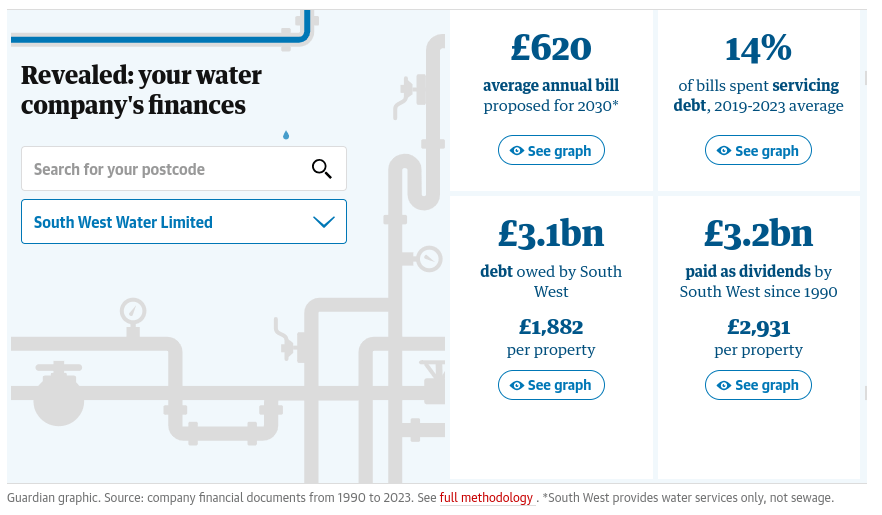
Water bills in England could be a quarter more expensive by 2030. But customers may not realise that almost 20p of every pound they pay goes to servicing company debts, rising to more than 25p for customers in some parts of the country.

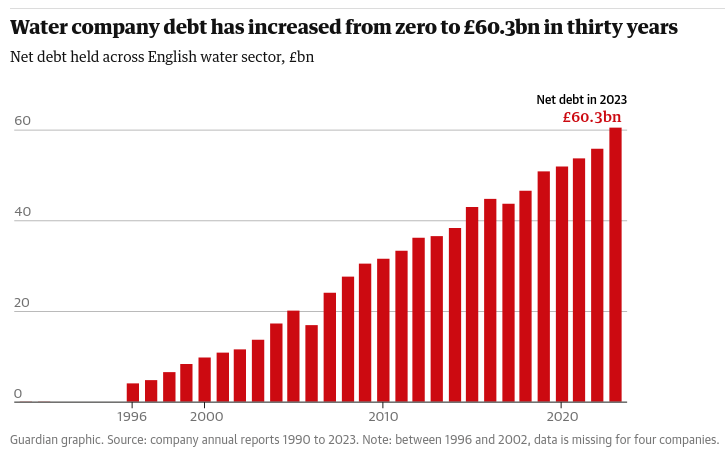
England’s privatised water companies have a huge £60.3bn debt pile, which they say was taken on to fund essential infrastructure. The last 33 years of company accounts tell a different story about where the money from those loans has gone.

Between 1990 and 2023, English water companies have paid out a total of £53bn in dividends, meaning that they have given almost the same amount to shareholders as they currently have in debt.

Find out how much your bill could rise, how much your local water company spends servicing debt and which companies have been giving out the most money to their shareholders, by using our interactive tool. [Accessible through this link to original article] 

In contrast to the English system, at publicly owned Scottish Water, Guardian analysis found that 10% of revenue was spent paying costs associated with debt. As it is a public company with no shareholders, no dividends have been paid out, while its debts amounted to £4.1bn as of March 2023, equivalent to £1,493 per property provided with water.

Since Margaret Thatcher’s government privatised England’s water companies in 1989, debts have been piling up almost every year, going from no debt in 1989 to a combined £60.3bn between them in 2023.

While companies argue that debt has been used for investment, experts say that the debt has not been taken to finance investment but to pay “huge returns for shareholders”. Over the three decades, water companies have paid close to £53.1bn as shareholder dividends – more than £83.7bn in today’s prices.

The water companies’ five-year business plans with the proposed increase in bills will still need to be approved by the industry regulator, Ofwat, which will announce its decision in December.

Methodology

The Guardian analysed net debt and dividends from all England’s water companies using every year’s annual reports. Dividends include special and interim dividends and cover all payments out of the licensed utility under the category “dividends”. Definition of net debt and accounting periods might vary across companies.

Certain companies have changed name or merged with other companies over the 33-year period; we have analysed the documents submitted to Companies House for each of the current Ofwat water-supply licence holders.

Full explanation on how the cost of debt has been calculated can be found here, along with responses by companies to the figures uncovered by this Guardian analysis.

We collected data about the proposed increase in water bills from each of the companies’ business plans for 2025-2030.

The number of total connections per water company, provided by the Consumer Council for Water, includes household and not-household premises with a water and/or sewage connection. This has been used to normalise figures to be able to compare companies of different sizes.

Honiton and Sidmouth: Richard Foord anticipates close battle

At the next election, local people face a clear choice – a strong Liberal Democrat champion fighting hard for our communities, or another silent Conservative who will always vote in his Party’s interest. It’s all to play for and every vote will matter. – Richard Foord

[Today Richard Foord moves the adjournment debate on Transport infrastructure in Cullompton] 

Will Goddard www.midweekherald.co.uk

It’s “all to play for” in the newly formed Honiton and Sidmouth seat at the next general election, according to Liberal Democrat candidate Richard Foord. 

The current MP for Tiverton and Honiton believes people are fed up with the current Conservative government and he has a real prospect of winning. 

A former British Army major, the 45-year-old was voted in during a by-election in 2022 following the resignation of former Tory MP Neil Parish after he watched pornography in the House of Commons. 

Mr Foord, who is married with three children and lives in Uffculme, will go head-to-head with East Devon Tory MP Simon Jupp in the contest for the new constituency. 

Large parts of the new seat are formed from the current East Devon and Tiverton and Honiton constituencies, which up until last year’s by-election win by Mr Foord for the Lib Dems, have always been Conservative. His majority is 6,144.

Mr Foord will go head-to-head with East Devon MP Simon Jupp for the seat. (Image: Gareth Williams)

Simon Jupp’s margin in the general election in 2019 was only marginally higher at 6,708.

The runner-up with over 40 per cent of the vote was independent Claire Wright, who is backing Mr Foord

Richard Foord MP said: “I think the fact that she came very close when the Conservatives nationally did so well in the 2019 general election… indicates that this part of the constituency (Sidmouth, Ottery and West Hill) should not be taken for granted by the Conservatives. 

“The feedback that I’ve been getting on the doorstep is very much that even long-term Conservative voters are at this time, in these circumstances, frustrated with this Conservative government and looking for an alternative.” 

Asked whether he thought he only won by a protest vote, as is often the case with by-elections, he said: “If we’re presenting it that by-elections are somehow different, I would say these are not usual times and the government’s polling has not improved since the by-election in June last year. 

“The popularity of Rishi Sunak as prime minister has hit lows that Boris Johnson didn’t quite reach. 

“I would definitely say it’s very much all to play for and it will come down to potentially every last vote. 

“I grew up here in the West Country. I came of political age at a time when the Liberal Democrats controlled most constituencies here.  

“When I was first able to vote in 1997, and at the subsequent election in 2001, you could walk from Truro to Bristol on Lib Dem-held territory.” 

Claire Wright, who stood as an independent candidate in 2019. (Image: Claire Wright)

If elected, Mr Foord says he will tackle healthcare problems, seek to boost the local economy, and put pressure on water companies to reduce sewage spills. 

He said: “I do feel that if we begin to lose community hospitals like the one in Seaton, it could be the thin end of the wedge for community hospitals more broadly.  

“Sidmouth has a community hospital, Ottery has a community hospital.

“I think we really need to protect these things because what I’m hearing on doorsteps is people want to be able to have access to healthcare close to home.  

“Linked to that, we have NHS dental services that are collapsing.

“NHS dentistry is something I care very deeply about. I also know that it’s something my constituents care very deeply about. 

“We need to have a local economy that enables businesses to thrive. This is where local politics meets national politics, because businesses cannot thrive if there isn’t a stable business environment for them to work in.  

“I’m hearing myself from businesses, large and small, that they want to get back to a time when politics was predictable. 

“They don’t like the uncertainty that our politics has brought us in recent years. And that… has had the effect of places closing up, shops shutting up, pubs shutting up. Hospitality is big business in this part of the world. 

“We know that sewage dumping is rife here on the Jurassic Coast and on the broader East Devon coast. 

“I think we need to take the responsibility for water quality monitoring away from the water companies, because it has been found that some of them have not been revealing all of the data that they should to the regulator, the Environment Agency.  

“The Liberal Democrats have been very strong in this area. We want to see water companies run as public benefit companies.  

“We want to see people with environmental concerns… community representatives with environmental concerns on the board of these companies, so that they’re not run purely to extract profit.” 

A general election is expected to be called next year, and must be held by the end of January 2025. 

‘They all knew’: Michelle Mone hits out at Rishi Sunak over PPE deals

“I was honest with the Cabinet Office, the government and the NHS in my dealings with them. They all knew about my involvement from the very beginning.”

When it was put to her that she had admitted lying to the press, Mone replied: “That’s not a crime.”

But wasn’t she threatening legal action? – Owl

Peter Walker www.theguardian.com 

Michelle Mone has condemned Rishi Sunak after he expressed concern at her admission she lied about involvement in a company that won lucrative deals during Covid, saying the government “knew about my involvement from the very beginning”.

After the former Conservative peer admitted in a BBC interview on Sunday that she had been untruthful in denying a connection to PPE Medpro, which made millions of pounds in profits over a contract to provide personal protective equipment, Sunak said No 10 was taking the case “incredibly seriously”.

In a furious response to the prime minister’s comments, Mone tweeted: “What is Rishi Sunak talking about? I was honest with the Cabinet Office, the government and the NHS in my dealings with them. They all knew about my involvement from the very beginning.”

Her comments place even greater pressure on ministers to explain what they knew about the affair, particularly Michael Gove, the levelling up secretary. The Labour leader, Keir Starmer, has already called for Gove to make a statement on Mone and PPE Medpro,

In the interview on Sunday, Mone said she had not told the truth about her involvement in the firm to protect her family from media attention. When it was put to her that she had admitted lying to the press, Mone replied: “That’s not a crime.”

Asked during a trip to Scotland about Mone’s admission, Sunak said: “The government takes these things incredibly seriously, which is why we’re pursuing legal action against the company concerned in these matters. That’s how seriously I take it and the government takes it.

“But it is also subject to an ongoing criminal investigation, and because of that, there’s not much further that I can add.”

Mone was made a Conservative peer by David Cameron in 2015, but has been on a leave of absence from the Lords since last year and is no longer in the party.

Speaking earlier on Monday, Lord Callanan, the energy efficiency minister, told BBC Radio 4’s Today programme that he hoped Mone would not return to the upper house.

Asked whether as a self-confessed liar she should come back, Callanan said: “I would hope that she would see sense.” Pressed on what he meant, he added: “I would hope that she would not be coming back to the House of Lords.”

Guardian investigations found Mone and her husband, Doug Barrowman, were involved with PPE Medpro, which was awarded contracts worth £203m in May and June 2020 after she approached ministers, including Gove, with an offer to supply PPE equipment.

Asked about the case during a visit to Leeds, Starmer called it “a shocking disgrace from top to bottom”, adding: “There are now serious questions that I think Michael Gove, the government, needs to answer. Who made the original contact? What was the nature of that discussion that led to the situation that we now learn developed?

“I think they should make a statement in the House of Commons today about this so that the public can hear first-hand what actually happened here.”

The Labour leader added: “I don’t think she should be in the Lords. I think the government should be held to account for this.”

Speaking to BBC One’s Sunday with Laura Kuenssberg, Mone admitted that she and Barrowman, through their lawyers, repeatedly falsely denied they had any connection to PPE Medpro.

She said she regretted having done so: “We’ve done a lot of good but if we were to say anything that we have done that we are sorry for, and that’s … we should have told the press straight up, straight away, nothing to hide … I was just protecting my family. And again, I’m sorry for that, but I wasn’t trying to pull the wool over anyone’s eyes. No one.”

“‘Ever get the feeling you’ve been cheated?’”

“My God, have we been cheated! Absolutely shafted. Seventy two billion paid in dividends! Sixty billion of debt! Nearly three million hours pumping out raw sewage in 2021! Three billion litres lost in leaks every day! Just 14 per cent of our rivers with “good” ecological status and every single one polluted to some extent. Studies say that will soon be down to 6 per cent without massive intervention.”

Feargal Sharkey on river pollution, interviewed by Robert Crampton www.thetimes.co.uk

Don’t Mone about it

Away from the leadership fun, businesswoman Michelle Mone is back in the headlines after sitting down with the BBC in an attempt to rehabilitate her reputation. She has been facing accusations that she and her husband failed to declare their interest in a major PPE contract awarded during the COVID-19 pandemic. 

London Playbook Sunday Crunch www.politico.eu 

Her argument: Mone claims she and her husband Doug Barrowman have been made scapegoats for the government’s wider failings over PPE. The pair last week issued a YouTube documentary trying to clear their name, alleging a Department for Health official told them they could pay to make a National Crime Agency investigation go away — an accusation they repeated in the BBC interview this morning.   

Sorry about that: Mone and Barrowman emphatically denied their involvement in PPE Medpro in statements issued by their lawyers when the story first surfaced. They admitted involvement through lawyers last month, but on the BBC this morning, Mone admitted they had lied. “I wasn’t trying to pull the wool over anyone’s eyes, and I regret and I’m sorry for not saying straight out, yes, I am involved.” 

Case for the defense: Mone went on to insist: “DHSC [the health department], the NHS, the Cabinet Office, they all knew of my involvement,” but said she didn’t want the press intrusion when she was asked by the press about her links. 

Did Dowden know: Asked if he knew about the links, Dowden, albeit culture secretary at the time, told the BBC: “No, I didn’t.”

Did it work? The Laura Kuenssberg show panel made up of actor Brian Cox, presenter Susanna Reid and Tory MP Robert Buckland were pretty unanimously scathing about her case for the defense, particularly that she had lied because of fears of press intrusion. Reid said it was “utterly remarkable she does not see how sensitive this is for people.”

Not just a title: Buckland had little time for the excuses: “When you’re in the House of Lords, it’s not just like a bauble or a title, it’s a public role,” he said, explaining it was up to members of both houses to declare their interests. 

Why it matters: Labour wants to make political capital out of this. Shadow Health Secretary Wes Streeting was quick out of the blocks this morning claiming government attempts to claw back money from PPE contracts gone wrong had been pathetic,” and keen to pin failings on Sunak himself. “It’s his name on all of those checks. He was the Chancellor who was splashing the cash.”

From inews.co.uk 

The Liberal Democrats have called for Baroness Mone to be kicked out of the Conservative Party, with the party’s Cabinet Office spokesperson Christine Jardine calling the situation “shameful”.

“It is jaw-dropping that Michelle Mone has admitted lying to the country over this shameful PPE scandal and is now trying to play the victim card. She repeatedly denied she would make money from this contract, now it emerges she’s set to profit to the tune of millions,” she said.

“Rishi Sunak was too weak to withdraw the Conservative whip from Baroness Mone when this scandal emerged last year. He must finally do the right thing now. The Prime Minister should kick Michelle Mone out of the Conservative Party and withdraw the whip if she has the gall to return to the Lords.

She continued: “This shameful saga is an insult to the British public and shows why we need to bring an end to this Conservative cronyism and sleaze at the next election.”

Morrisons makes it easy to buy British online

A campaign for a ‘Buy British’ section on supermarkets’ online stores supported by Devon’s Liberal Democrat MP Richard Foord has first major success as Morrisons launch ‘British’ section online.

Lewis Clarke www.devonlive.com

In August 2023 Mr Foord, Member of Parliament for Tiverton & Honiton, joined with 120 other cross-Party MPs to sign an open letter calling on supermarkets to highlight the very best of British produce by implementing a ‘Buy British’ section online.

The letter stated ‘Our ask is simple, create a tab that collates produce from farmers,’ citing consumer choice, environmental benefits and support for farmers as reasons to make the change.

Now, Morrisons chief executive Rami Baitiéh confirmed that “we have implemented a ‘British’ section to morrisons.com which enables customers to quickly navigate to British [produce]”. This includes homegrown meat, dairy, fish and vegetables.

This new section of the website, which groups together key British lines, can be found via the ‘Shop Groceries’ drop-down menu on the morrisons.com homepage, with Morrisons saying they “intend to continue developing this section of the website and highlight new lines as they come into season.” Food has been increasingly imported in recent years, which is unhelpful for local producers and bad for the environment.

In addition to the letter, over 27,000 people have signed a National Farmers Union (NFU) petition in support of a ‘Buy British’ section online and on Back British Farming Day, September 13th, the Government endorsed the campaign and called for industry-led action by supermarkets.

Commenting on the news, Richard Foord MP said: “I applaud Morrisons for making this small but meaningful change to help customers know how they can buy British produce more easily. We know that Devon has some of the best farmers in the world, and it’s right that we showcase them.

“The reaction to this campaign has been overwhelmingly positive, with producers across the country supporting the call and consumers asking why supermarkets weren’t doing it already.

“The ball is now firmly in the courts of other supermarkets. I hope they will follow suit and implement the ‘Buy British’ section soon. I look forward to seeing the new display at the Tiverton store in the coming weeks.”

Minette Batters, president of the National Farmers Union, said: “It’s great to see Morrison’s launching a ‘British’ section online to signpost shoppers to British produce – something we have been asking retailers to commit to since 2016.

“We know from our own independent survey that 86% of the public want to buy more British food and this simple change with an online button will help shoppers just do that.

“I hope today’s news will pave the way for other supermarkets to follow suit.”

Allegations of Bullying discussed at Audit & Governance Committee 14 December

Bullying, that is: seeking to harm, intimidate, or coerce (someone perceived as vulnerable); is never acceptable.

But, as a search of EDW archives reveals, it is a term banded around frequently in local councils. 

Owl suspects that it is sometimes confused with the cut and thrust of political debate between those holding strongly opposing views.

The investigation reported on by Grant Thornton to the Audit & Governance Committee (see press article below) dates from allegations made by Mark Williams in 2021. These allegations arose from a survey he appears to have conducted after the new political leadership took over EDDC in June 2020.

Background

Following the 2019 elections, the Tories lost overall control of EDDC but formed a working arrangement with Independents under the leadership of Ben Ingham (then an Independent who has subsequently returned to the Conservative Party). 

In May 2020, after a series of defections, this arrangement broke down and a new Majority Group was formed. (A coalition between the East Devon Alliance Independents, other Independents and the LibDems, but excluding the Tories).

The opportunity for a smooth transition was dashed when Conservative Cllr and Council Chairman, Stuart Hughes, took the opportunity provided by a change in legislation by the government, relating to Covid, to cancel the May Annual Council Meeting. Constitutionally this is when leadership elections are held. The Tories held only one third of the seats at the time.

This decision created a constitutional crisis and required five extraordinary general meetings to be convened, under Covid restrictions, to formally make the change.

Given this fraught background with the Tories trying any means to retain some vestige of control it is perhaps not surprising that the atmosphere in EDDC was somewhat tense.

The CEO, Mark Williams, held the keys to facilitate a smooth transition. Indeed it was his duty as EDDC’s senior public servant, acting apolitically, to ensure it.

Owl has always found it incongruous that it was the CEO who was the first to make allegations of bullying so soon after the transfer of power, as the new administration was bedding in. 

Owl has similarly found difficulty in understanding why, a year later, Mark Williams appeared to drag his heels over setting up the inquiry into how John Humphreys continued as a councillor, then alderman, for three years whilst under investigation by the police, without a safeguarding risk assessment. The final Verita report records the difficulties the authors had in getting him to respond to questions about new information that had come to light.

Grant Thornton findings

Despite this, the message coming out of the Grant Thornton audit is positive. A message strongly reinforced by the comments made in the Audit & Governance Committee by recently elected Cllr Charlotte Fitzgerald (Independent, Budleigh and Raleigh), who comes with fresh, and younger eyes, to the scene, see below.

Allegations of bullying at East Devon District Council

 Will Goddard www.exmouthjournal.co.uk

East Devon District Council has had an “unacceptable culture” of behaviour, an external auditor has found.

There were allegations of bullying by some council officers and elected councillors, according to an independent report from audit firm Grant Thornton, which looked at a period between April 2021 and March 2023.

The report found “poor working relationships” meant there was a “significant weakness” in how the council was governed.

The firm heard suggestions some councillors didn’t stand for re-election because of behaviour and culture at the council, which at the time was controlled by a political group called the East Devon Alliance.

On a positive note, the auditor found “many excellent examples” of officers and councillors working well together during the pandemic and said relationships between “most officers and portfolio holders were generally effective”.

Grant Thornton has given the council several recommendations on how to fix problems in the way it is governed.

These include having a zero-tolerance policy on bullying, and revising the code of conduct and the protocols for how councillors and officers interact to include examples of unacceptable behaviour and sanctions. 

The council’s management said it already had such a policy, and that refresher training would be provided.

Cllr Helen Parr (Conservative, Coly Valley) found the report “extremely concerning” and said: “It’s all very well doing training of new councillors, but it goes back to the people who were in the council at the times you looked at and whether they have changed their behaviour. 

“I think it’s very questionable whether all this training has made behaviour changes. 

“Culture comes from the top and that’s where we needed to have changes.  

“It’s upsetting that we are a council with this problem when three, four years back we got the Investors in People platinum award.  

“This council was an excellent council and now we have a report like this. I’m extremely worried about it.”

Cllr Charlotte Fitzgerald (Independent, Budleigh and Raleigh), who was elected in May, described the report’s findings as “foreign” to her experience so far.  

She said: “I’ve only been on the council for eight months, I wasn’t here at the time that this report covers.  

“I don’t recognise an unacceptable culture in any of my interactions so far. The officers have just been absolutely positive and constructive. 

“We have had a change of councillors, we’ve had quite a lot of turnover in the last election.

“There’s also been a turnover of a significant amount of the senior executive leadership team in the last six to 12 months. 

“I don’t want to dismiss or diminish the concerns that are raised here.

“But… it does seem to me that a lot of action is and has been taken in the last year or so to address some of these issues.  

“I’m really looking forward to the next report… so we can actually see Grant Thornton’s external assessment of how we’re tracking against some of the recommendations that have been made.” 

Councillors voted to keep track of the auditor’s recommendations to see whether they are implemented. 

Footnote

Helen Parr says: “Culture comes from the top and that’s where we needed to have changes.”  Owl agrees and thinks that significant changes have already happened.

Sunak’s missed targets leave NHS facing catastrophic winter crisis

Once upon a time we had locally based community hospitals where the elderly especially could be looked after while they were prepared to return home. – Owl

The NHS is facing another catastrophic winter crisis because Rishi Sunak is failing to meet key targets he set last January for improving emergency care, leaving patients facing more delays for treatment during the busiest months, the Observer can reveal.

Toby Helm www.theguardian.com 

Figures on how much time patients have to wait for emergency care, how long ambulances are taking to respond, the number of new beds and the level of bed occupancy are all way behind where they were expected to be under the Sunak blueprint, according to official data.

On Saturday night, Dr Adrian Boyle, president of the Royal College of Emergency Medicine, said that it was now clear that firm pledges made by the government less than a year ago to deliver the “largest and fastest” improvement in emergency response times ever, before this winter, would not be honoured.

“They are clearly not achieving what they set out to do,” Boyle said. “And the consequence of this is that we will see the same scenes of ambulances waiting outside emergency departments, and if you are inside an emergency department, people receiving care in corridors.

“Last year was awful and this year is only just a tiny bit better, nowhere near where we need to be, and nowhere near the position we hoped we would be.

“It is very disappointing because it is an utterly predictable and largely preventable problem. It is not a surprise that winter comes along every year.”

Prof Philip Banfield, chair of the British Medical Association council, added: “As we approach what we know will be another incredibly difficult winter, colleagues are not feeling any more optimistic or prepared than last year – rather the opposite. We are still short of beds, have huge rota gaps and patients are not getting the care they need or deserve.

“The waiting list is still unfathomably long, cancer and emergency department performance targets are being missed and ambulance handover delays are unacceptable. Meanwhile, demand and workload in general practice are unsustainable.”

On 30 January this year, amid much fanfare, Sunak announced a new “delivery plan”, which he presented as a blueprint for avoiding another winter of chaos in 2023-24. “I think we will see – in fact I know we will see – the largest and fastest-ever improvement in emergency waiting times in the NHS’s history,” he said.

At the heart of the plan was a series of pledges, including one to ensure 5,000 more beds were brought into NHS hospitals before the winter.

Last week, with winter well under way, NHS England said that only 3,000 more “core beds” were in place, though it claimed more were on the way.

Another “fundamental” part of the plan was a promise to improve bed occupancy rates. However, the latest official figures show a record 94.8% of beds in England were occupied in November. This is higher than any previous month since the Covid-19 pandemic began. The occupancy rates for previous years were 87.4% in November 2020, 92.8% in November 2021 and 94.4% in November 2022.

In the executive summary of the Sunak plan was an ambition to ensure at least 76% of patients are admitted, transferred or discharged within four hours by March 2024. Official data, though, shows the current rate is 69.5%, a fall since last January, and way off target. NHS sources admitted that the 76% level, which is anyway regarded as unambitious and compares with the official accepted level of 95%, was unlikely to be reached by next March.

Another key target was for ambulances to respond to serious category 2 cases on average within 30 minutes during 2023-4. The current average is 38 minutes. Although this has improved, NHS sources concede there is little chance of the target being met by the spring. In the plan, 800 new ambulances were promised but NHS England has not said how many have been delivered, although it admits that many are just replacing ones that have gone out of service.

Labour’s shadow health secretary, Wes Streeting, said: “I think it is outrageous that Rishi Sunak has broken his promises to the NHS and sent it naked into the winter. What we see now is the NHS sounding the alarm, facing what could be the worst winter crisis it has faced, where patients face unacceptable waits and poor quality care.”

Streeting added: “We didn’t have an annual winter crisis when Labour was last in government because we delivered both the investment and reform needed. That is what is going to be needed again after the next general election.

“We have got to shift the centre of gravity of the NHS out of the hospital and into the community. That means not just training thousands more nurses but also double the number of district nurses qualifying so that people can receive care in their own homes.”

Health officials say they have invested in more doctors and nurses, as well as increased diagnostic and surgical capacity. The waiting list for routine hospital appointments fell in October to 7.71m, compared with a record high of 7.77m in September.

A Department of Health and Social Care spokesperson said: “Our work delivered through the urgent and emergency care recovery plan is already cutting both A&E waits and ambulance response times compared with last year as we make progress towards our ambitious targets.

“We are on track to create an additional 5,000 permanent staffed hospital beds this winter and have met our target to deliver 10,000 virtual ward beds, allowing patients to recover from the comfort of familiar surroundings.

“We’re working to get 800 new ambulances on the road and we recently provided £800m to support capacity in the NHS and help patients get the care they need as quickly as possible this winter.”

Rishi Sunak accused of misleading public over Tory campaign questionnaire landing on doorsteps

If you were expecting a Christmas Card from Rishi you will be disappointed. He’s sending out “questionnaires” instead.

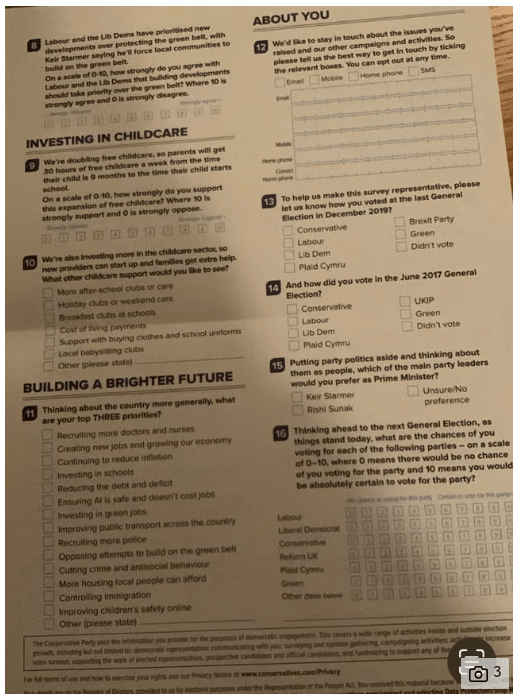
Rishi Sunak has been accused of misleading the public after a “PM survey” asking voters probing questions, including who they backed at the last election, proved to be a marketing ploy by the Conservative Party

Kate Devlin www.independent.co.uk

With a general election expected next year, households are being sent a survey giving voters the opportunity to “share your views with the prime minister”.

But the small print says the information will be used by the Tory party for campaigning, rather than by the government to improve the country.

The leaflets, branded potentially misleading and “routine party propaganda”, ask who voters backed at the last election and who they would prefer as prime minister – Mr Sunak or Sir Keir Starmer.

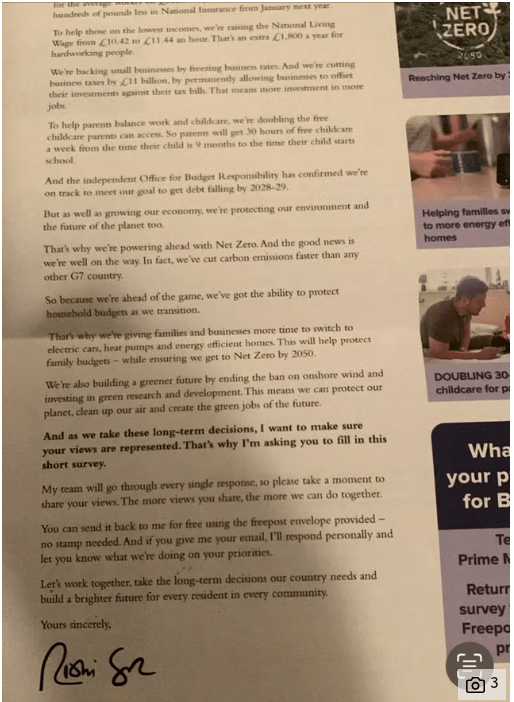
It is delivered alongside a letter headed “Rishi Sunak Prime Minister”, which twice asks: “What are your priorities for Britain? Tell the prime minister”.

Sir Alistair Graham, the former chair of the Committee on Standards in Public Life, said the survey “has the potential to mislead people that it has come directly from the prime minister.

“It is being unfair to the electorate, really, and is rather cheeky in that it sounds to me like routine party propaganda.”

One page of the ‘PM survey’ being sent to households (Supplied)

The Liberal Democrats accused Mr Sunak of “desperate stuff”.

“No doubt some people will think they are speaking to the prime minister, not Conservative Party headquarters,” Lib Dem MP Sarah Olney said.

“This is desperate stuff from a prime minister on his way out. Using the prime ministerial office name to try to win back angry voters is not going to change a thing. The small print makes clear what this is, a last-ditch attempt for the Conservative Party to cling onto power, and nobody is buying it.”

People are encouraged to return the questionnaire in a prepaid envelope headed “PM survey”.

In his letter, Mr Sunak also tells those who fill it out that “my team will go through every single response”. The questions do include asking people to set out some of their priorities, including on the economy.

The letter is signed by the prime minister (Supplied)

But they are also asked how they voted at the last election and the one before that. Households are also asked how likely – on a scale of 0 to 10 –they would be to vote Tory at the next election, which could be called in a matter of months.

And they are asked, putting politics aside, who as a person they would prefer as prime minister – Keir Starmer, Rishi Sunak or unsure.

The Conservatives declined to comment but it is understood that the party views the survey as standard campaign material.

No 10 has been approached for comment.

Tory donor’s firm paid for Sunak’s £16,000 one-way helicopter trip to Leeds

Why take a train when someone will pay for a helicopter? – Owl

Rishi Sunak took a £16,000 one-way trip to Leeds on a helicopter courtesy of a firm owned by Frank Hester, the Tory megadonor, taking the total for the prime minister’s donor-funded air travel to more than £100,000 this year.

Rowena Mason www.theguardian.com 

The prime minister once again showed his fondness for short-haul air travel as he took a helicopter from Battersea to Leeds Bradford airport last month – a journey of about 90 minutes. The quickest train from London to Leeds takes about 2 hours and 13 minutes, and costs in the region of £60 off-peak.

Sunak registered the trip as paid for by The Phoenix Partnership (TPP), which as a group has won more than £135m of NHS and government contracts to supply IT since April 2020.

Labour said it was the fourth helicopter ride taken by Sunak that was funded by wealthy Conservative party donors who have been paying tens of thousands of pounds to allow the prime minister to avoid public transport or long car journeys. His regular private air travel has also raised questions about the prime minister’s commitment to tackling the climate crisis.

Hester, who is sole owner of the company, made a £5m donation to the Conservatives earlier this year – the joint biggest gift by a living donor. TPP has previously said it was “unequivocally apolitical”.

Jo Maugham, the director of the Good Law Project, said: “None of us can look into Mr Hester’s mind to see what motivates him to make these generous donations to Mr Sunak and his government of vast sums of money and a helicopter ride. What is beyond doubt is that he has made an enormous fortune from contracts given to him by the government.”

Sunak has long been criticised for taking flights and helicopters for short trips, including an RAF chopper from London to Dover, despite the trip being just over an hour by train.

Emily Thornberry, the shadow attorney general, said: “Yet again we have the prime minister asking a Tory donor to pay thousands of pounds for a luxury helicopter just so he doesn’t have to spend two hours on a train with the general public.

“If it seems like it happens every month, that’s because it usually does. Four different donors this year for four different helicopters, to go with the two he normally uses at taxpayers’ expense. If he spent half as much time thinking about the country’s cost of living as he does about his own options for flying, we would all be a damn sight better off.”

During the visit, which was in the same constituency as TPP’s main office, Sunak visited a jewellery maker and was later mocked on social media for having used a hammer sideways – even though he was told to do so by the instructor.

TPP supplies software to about 2,700 GP surgeries in England as well as support services to allow them to hold medical records for patients electronically.

Downing Street and TPP have been approached for comment.

Hospitals ‘falling to bits’ as NHS in England faces record £12bn repair bill

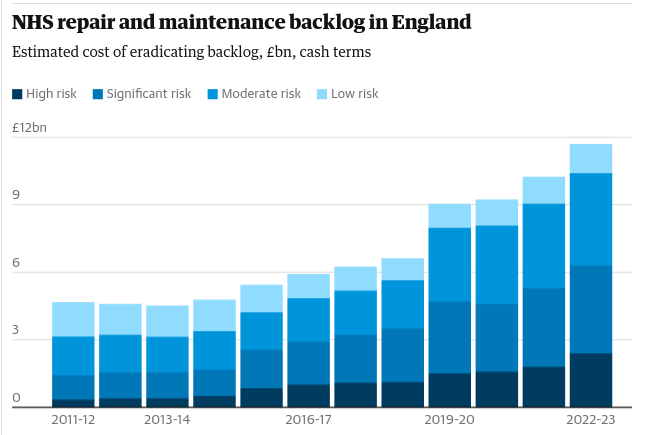
The NHS in England has a record repair bill of almost £12bn, new figures show, with ministers needing to find more than £2bn for urgent maintenance to prevent catastrophic failure.

Michael Goodier www.theguardian.com 

The annual report on the condition of the health service’s estate said on Thursday that the cost of improving rundown buildings and decrepit equipment was two and a half times larger than in 2011-2012, when it stood at £4.7bn.

The cost of the “high-risk” backlog – situations where the need to repair or replace facilities and equipment must be urgently addressed to prevent serious failure, significant injury or major disruption to clinical services – rose by almost a third to a record £2.4bn. This was £0.3bn in 2011-2012.

However, investment to reduce the backlog fell in the last year from £1.41bn to £1.38bn, a fraction of what is needed to restore the NHS estate back to acceptable levels of risk. The stark figures cover a time prior to the health service becoming embroiled in the crumbling concrete crisis which initially hit school buildings.

Sir Julian Hartley, the chief executive of NHS Providers, said that “too many NHS buildings are quite simply falling to bits”, and that we need “a step change in the government’s approach to planning and funding essential capital investment in the NHS”.

He said: “The eye-watering cost of trying to patch up creaking infrastructure and out-of-date facilities is mounting at an alarming rate.

“Mental health, hospital, community and ambulance services are crying out for much-needed funding for critical projects to overhaul ageing estates and to give patients and staff the safe, reliable conditions they need.

“We should be planning for how to transform the NHS estate as well as addressing urgent maintenance challenges.”

The costs of the “high-risk” backlog have risen by 31% in 2022-2023, while the overall repair bill has risen by 13.6% in the same period. The level of investment only covered 11% of the cost.

The hospital with the largest high-risk backlog was Airedale general, where it would take £335.2m to fix all of the serious safety and maintenance issues. Airedale is part of the NHS programme to remove reinforced autoclaved aerated concrete (Raac) from its buildings. Raac is a lightweight construction material that is susceptible to structural failure.

There were 42 hospital sites confirmed to contain Raac as of October, 18 of which had joined the national Raac programme since May, meaning the cost of any repairs needed was excluded from the latest figures.

However, the maintenance crisis is broader than one single issue. Charing Cross hospital in London had the second-largest high-risk backlog, with £173.7m worth of repair work needed.

But it did not appear on the government’s list of hospitals with Raac. Neither did St Mary’s hospital in London, Croydon university hospital or Wycombe hospital, which had the third, fourth and fifth largest high-risk backlogs respectively.

The Health Service Journal recently reported that Doncaster Royal Infirmary, some of which dates back to the 1930s, had been testing contingency plans for a “full or partial site closure” because of the problems it faces with parts of its infrastructure.

In 2021, a leak from a water pipe got into the electricity supply for the women and children’s hospital. This knocked out power cables for an entire wing of the hospital, started several fires and forced staff to evacuate premature babies and mothers who were in labour.

Siva Anandaciva, the chief analyst at the King’s Fund, said the government’s failure to build the “40 new hospitals” Boris Johnson promised in 2019 “has left parts of the NHS estate in such a poor condition they pose serious risks to staff and patients”.

In September Julian Kelly, NHS England’s deputy chief executive, told MPs on the Commons public accounts committee that the NHS had “examples all the time where hospitals are having to shut units, decant patients into other spaces, where we are losing [operating] theatres … which limits our capacity to treat patients”.

Rory Deighton, the director of the NHS Confederation’s acute network, said: “The growing cost of the high-risk maintenance needed to prevent catastrophic failures or major disruption to clinical services is particularly worrying.”

NHS trust bosses regarded the “urgent” need for more capital investment as the NHS’s top funding priority, he added.

Separate figures show the NHS was badly hit by the rise in the cost of energy due to Russia’s invasion of Ukraine. The service spent £1.2bn on energy costs in 2022-23, up by 53% on the year before, despite using less energy overall (down by 1.7%).

A Department of Health and Social Care spokesperson said: “We have invested significant sums to upgrade and modernise NHS buildings so staff have the facilities needed to provide world-class care for patients, including £4.2bn this financial year.

“Trusts are responsible for prioritising this funding to maintain and refurbish their premises, including the renewal and replacement of equipment.

“This is on top of the £3.7bn made available for the first four years of the new hospital programme and a further £1.7bn for over 70 hospital upgrades across England alongside a range of nationally funded infrastructure improvements in mental health, urgent and emergency care and diagnostic capacity.”

Christmas is coming, and the GESP is getting fat.

Extract from CPRE December newsletter:

As we head into the festive season, a spectre has risen Jacob Marley-like, clanking its chains. The Greater Exeter Strategic Plan, whose obituary was published as recently as 30 October, seems to have leapt straight back out of its grave.

GESP was an ambitious plan for the zone around Exeter including East Devon, Mid Devon and Teignbridge, which was declared technically dead when East Devon pulled out. But now we hear news of three new ‘towns’: 8,000 houses just east of Exeter (East Devon), another 1,000 in Alphington/Marsh Barton (Teignbridge) and 1,100 in East Cullompton as part of the planned 5,000 intended for the Culm Garden Village (Mid Devon).

We look forward to the plans to expand the networks of schools, post offices, police stations, reservoirs, GPs, dentists, pharmacists and the RD&E.

And how many of these homes will be priced for genuine local need? An important CPRE study shows that fewer than 10,000 social homes and fewer than 18,000 ‘affordables’ were built in Devon – in the last 30 years! More on this in the next Newsletter.

Devon and they potholes

The Daily Mail carries a report that drivers in Devon have submitted claims amounting to more than £1million for vehicle damage caused by potholes in just eight months, but the council has paid out less than five per cent of the claims.

A total of 966 vehicle damage claims have been submitted to Devon County Council since April this year with the value totalling £1.1million.

The figures were obtained by Councillor Frank Letch (Lib Dem, Crediton), who was seeking information on the number of potholes the county is dealing with.

Cllr Letch said the figures showed that 28,801 reports of potholes have been made by members of the public in this financial year alone, and that the council had identified 1,505 potholes for repair.

Devon County reports:

We’re receiving an extra £6.663 million for highway maintenance this financial year.

The money is a share of the Government’s £8.3 billion investment in roads over the next 11 years using funds redirected from the cancelled HS2 rail line extension to Manchester.

The initial schemes prioritised to start in the coming weeks are mostly minor routes and residential roads across the county.

The funding will also accelerate patching and pothole repairs across Devon’s 8,000 mile road network – the biggest of any authority in the country. The aim is for the repair schemes to be completed this financial year……

Derriford Hospital long ambulance waits revealed

The Tories have forgotten, and taken for granted, Devon and Cornwall for too long.

All they seem to be interested in is closing beds. – Owl

Long ambulance waits and “hours lost” mark a worrying situation for Derriford Hospital chiefs in a new report.

David Dubas-Fisher www.plymouthherald.co.uk 

The latest Integrated Performance Report by the University Hospitals Plymouth NHS Trust board, held on December 1, noted a series of performance indicators which showed worrisome figures relating to some waiting times – but also a plan for new development and enlargement of the hospital after it secured funding.

In April PlymouthLive reported that according to the NHS’s own figures, Derriford Hospital had some of the longest accident and emergency waiting times in the country, with more than 24 percent of people arriving at the hospital having to wait more than 12 hours before being admitted, discharged or transferred.

But the latest set of performance indicators in the 574-page long report, suggests that while in April the “ambulance handover lost hours” sat at 3,350, it has risen steadily to 5,108 in August, 6,359 in September and 8,906 hours in October. With a “national target” of 76 percent, Derriford is languishing with its latest figures at 54.1 percent.

The report also notes that the number of patients who wait 12 hours or more in A&E has increased from 1,491 in April to 1,774 in October.

In it’s ‘responsive’ metrics for Urgent and Emergency Care, it noted how ambulance handover delays had increased to alarming levels. In April this year it stated that 3,350 hours had been lost against a ‘trajectory’ of 2,393. By September this year that had risen to 6,359 hours lost, against a trajectory of 3,039. However, the figures had sky-rocketed during October when 8,906 hours had been lost, against a trajectory of 3,554.

The report went on to state that the trajectory had been “assigned to us by our regulators and represents the improvement required to allow SWAST to achieve their Categrory-2 response time target. It broadly represents a 60 percent improvement at UHP (University Hospitals Plymouth) on previous volumes of lost hours due to handover delays. This is currently off trajectory and review of improvements actions is in progress.”

According to weekly figures recently released by the NHS on Monday, November 27, the average handover time at University Hospitals Plymouth NHS Trust was four and a half hours. That was the longest average wait at any trust in the country last week.

Things improved slightly at the trust on Tuesday when handover delays were four hours six minutes. On Wednesday it was four hours, on Thursday three hours 44 minutes, on Friday four hours six minutes, on Saturday ‘just’ two hours 12 minutes, and on Sunday three hours two minutes.

That compares with Great Western Hospitals NHS Foundation Trust where the average was two hours 34 minutes, and at University Hospitals of North Midlands NHS Trust it was two hours 30 minutes, both also on the Monday.

University Hospitals Plymouth NHS Trust also had the worst record for making patients wait for over an hour in ambulances. A total of 377 arrivals by ambulance had a handover delay of over an hour. That works out as 63 percent of arrivals. That’s up from 57 percent the previous week.

A Department of Health and Social Care spokesperson said: “We have prepared for winter earlier than ever before and we are making good progress in cutting both A&E waits and ambulance response times.

“Compared to the same time last year, ambulance handover delays have fallen by 28 percent, thousands more 111 calls are being answered within 60 seconds, and there were nearly 1,500 more hospital beds available.

“We know there is more to do and that’s why we’re working to get 800 new ambulances on the road and create 5,000 extra permanent hospital beds, on top of 10,000 hospital at home beds already rolled out, to free up hospital capacity and cut waiting times.”

A spokesperson for University Hospitals Plymouth NHS Trust said: “As the Major Trauma Centre for the southwest peninsula, we receive some of the most acutely unwell patients by air and road ambulance and continue to face pressure across the health system. It’s important to note that the data reflects seasonal changes and we expect to see higher demand for our services as we head into the winter months, which we have been preparing for.

“We understand patients and their families will be concerned about long waits and we have a relentless focus on getting patients to the right place at the right time to reduce ambulance waits.

“In addition to our clinical management of patients, we have introduced a number of measures which to help alleviate the pressure on the Emergency Department including; investing in more staff, expanding our Same Day Emergency Care service until 2am, (with plans to extend to 24 hour opening), and creating additional beds in both the hospital and community.

“Finally, we would always ask the public to choose well this winter and there are some things you can do to help ease the pressure on the Emergency Department:

  1. If your relative is in hospital and ready to go home, please collect them as soon as you can to get them safely home.
  2. Please use your local pharmacy, GP, and Urgent Treatment Centre if appropriate.
  3. Think 111 – If you think you, or someone you care for, needs to attend an emergency Department (ED), call 111 or visit www.111.nhs.uk, first. “

Labour’s prospective parliamentary candidate for Plymouth Moor View Fred Thomas has rounded on the Government after Derriford Hospital revealed its long waiting times for ambulance handovers.

He said: “After 13 years of Tory neglect, the NHS desperately needs a Labour Government to resuscitate it. The last Labour Government reduced waiting times by using the private sector, increasing staff numbers and spreading good practice. We did this before. We will do it again.

“We will train more GPs and bring back ‘family doctors’ for those with ongoing needs, Labour will double the number of district nurses and train 5,000 more health visitors. This will allow far more patients to be seen in the comfort of their home and provide a route to catching problems early and setting healthy habits. We must fix these problems in primary care that are driving avoidable footfall to the A&E.

“There can be no doubt the staff at our hospital continue to work in incredibly challenging conditions doing their best for us but without the staffing and bed resources they need to care for our people the way they would want to, or in a way patients deserve. We don’t clap NHS workers on a Thursday night anymore, but we probably should.”

Last month, Plymouth Moor View MP Johnny Mercer, in his opinion piece for PlymouthLive, said he understood locals “continued frustrations with your health services in Plymouth” saying each week he heard from “distressed constituents who are filed onto waiting lists”.

His concerns were highlighted when in May 2022 he revealed he had been admitted to Derriford Hospital and was left sitting on a chair in a hospital corridor for 21 hours in excruciating pain thanks to a herniated disc in his neck. He praised health staff and hospital chief Ann James, but claimed that not enough was being done to meet demand.

At the time he stated: “I have promised a new hospital by 2027, and that is my defining objective as the member of Parliament for Derriford. I also accept that the government has spent £20 million on the emergency department that is being developed as we speak.

“But whatever is being done is not being done fast enough, or at enough scale to meet the demand, and so I intend to meet with both local and national healthcare leaders to express these views and make it clear that the situation must improve in the near-term.”

Ofgem plans £16 household charge to help energy firms recover £3bn in bad debts

The energy watchdog has set out plans that would result in households paying an extra £16 on top of their energy bills to help suppliers recover almost £3bn in bad debts from customers struggling to pay bills.

Mark Sweney www.theguardian.com 

Ofgem said the one-off extra charge, which would be levied at £1.33 a month on bills paid between April next year and March 2025, was to “protect the market and consumers” after figures showed energy debt had hit a record £3bn.

The level of bad debt, which refers to the amount of money owed by customers that is unlikely to realistically be repaid, has soared because of increases in wholesale energy prices and the wider cost of living crisis putting pressure on household finances.

“We know that cost of living pressure is hitting people hard and this is evident in the increase in energy debt reaching record levels,” said Tim Jarvis, the director general for markets at Ofgem.

“The record level of debt in the system means we must take action to make sure suppliers can recover their reasonable costs, so the market remains resilient, and suppliers are offering consumers support in managing their debts.”

Ofgem, the energy regulator for Great Britain, said this one-off move would be less costly to consumers than if suppliers were forced out of business.

When wholesale energy prices began to rise in 2021, and soared dramatically after Russia’s invasion of Ukraine last year, about 30 energy companies went out of business.

Ofgem said this led to every UK energy customer being charged an extra £82 to cover the costs of making sure that households were not cut off.

The regulator said the consultation on the proposal would include the energy industry, consumer groups and the public.

“The proposals set out today are not something we take lightly,” Jarvis said. “However, we feel that they are necessary to address this issue. This approach will ensure the costs are recovered fairly, without penalising a particular group of customers.”

The proposed plan does not include passing extra costs on to customers who use prepayment meters. This is because they operate on a top-up system so PPM customers do not build the same debt level as credit customers.

Ofgem said that other industry sectors already “commonly make provisions” within their prices for bad debt costs and that the energy sector could do so within the price cap mechanism to “ensure these costs are recovered as fairly and efficiently as possible”.

Since the beginning of the year the energy price cap, the regulated cost of the average annual dual-fuel bill in Britain, has fallen from £2,500 to £1,928 from January 2024.

“The price cap has helped to protect consumers from a volatile gas market,” Jarvis said. “However, it remains a blunt instrument in a changing energy sector, and the way it works may need to change in the future, so customers continue to be protected.”

Government warned over recruitment of care workers from ‘red list’ countries

The government is potentially draining countries of vital medical staff, despite committing not to do so – and has been warned it should come up with a plan to change direction and help the countries in question.

Tim Baker news.sky.com 

The independent Migration Advisory Committee (MAC) has released its annual report on the state of the UK’s immigration system.

It comes at a particularly prescient time, as the government struggles with the issue following the revelation that net migration is at its highest ever level.

Sky News Monday to Thursday at 7pm. Watch live on Sky channel 501, Freeview 233, Virgin 602, the Sky News website and app or YouTube.

One of the highlighted areas in the report is the health and social care sector.

The MAC report describes how roughly 35% of doctors and 20% of nurses recruited to the UK are from “red list” countries, as described by the World Health Organization (WHO).

Under WHO rules, employers and recruitment agencies must not actively recruit health and social care personnel from “red” countries.

The list is also part of the government’s own code of practice for recruiting in the sector.

Countries on the “red list” include the likes of Bangladesh, Pakistan, Nigeria, Zimbabwe, and Ghana.

Health workers leaving these regions are reportedly “having a negative impact” in their domestic sectors.

The report says it is possible that “social media algorithms” are resulting in UK recruitment adverts being seen by those in red list countries – and it recommends the government “consider careful planning within the UK to reduce reliance and consequent negative effects on red list countries”.

The MAC report also highlights how low-paid foreign care workers are propping up the UK sector – seemingly without a government plan to deal with it.

Current high-levels of foreign recruitment have been precipitated by the addition of the care workers and home workers on the Shortage Occupations List – meaning people entering from abroad can be paid less.

Image: The number of people applying for a health and care worker visa by country. Pic: MAC

In 2021, 31,800 people applied for a health and care worker visa to work in the UK. From October 2022 to September 2023, this number was 144,000.

The report says the committee previously recommended this “to potentially alleviate some of the difficulties in the short-term whilst funding issues were addressed”.

But none of the other 19 steps they recommended to help address the underlying causes of workforce difficulties have been adopted.

The report also highlighted another issue – that people entering the UK on health and social care visas had been able to bring in dependents with them, such as children.

In 2021, 31,500 dependent visas were applied for on this route – this rose to 173,900 from October 2022 to September 2023.

However, the government has now said that it will be closing this dependent route off.

The MAC report says that, when calculating the benefit to the economy of hiring cheap labour from abroad, the cost of schooling migrant children and other impacts on the state’s purse are “generally ignored” – and cheap foreign labour is not necessarily “almost costless” when compared to “addressing the underlying pay issue”.

The government said this month that it will be reforming the Shortage Occupations List.

Spreaker This content is provided by Spreaker, which may be using cookies and other technologies. To show you this content, we need your permission to use cookies. You can use the buttons below to amend your preferences to enable Spreaker cookies or to allow those cookies just once. You can change your settings at any time via the Privacy Options. Unfortunately we have been unable to verify if you have consented to Spreaker cookies. To view this content you can use the button below to allow Spreaker cookies for this session only.

Another sector with low pay is migrant nurses – who get 18% lower wages than domestic counterparts when accounting for factors like age.

This is possibly down to those arriving in the UK having to start on the lowest pay band – a factor which may contribute to the NHS “reliance” on immigration.

Sky News has contacted the Home Office for a response.