Cheshire East council says it faces bankruptcy due to HS2 link cancellation

A council in one of the wealthiest parts of the UK has warned it faces potential bankruptcy due to the “devastating” impact of cancelling the northern leg of HS2.

Josh Halliday www.theguardian.com 

Leaders of Cheshire East council in north-west England said the authority had spent £11m preparing for the high-speed rail link, and this would now have to be written off. Most of this money – £8.6m – had been funded by borrowing and would now have to be funded from the council’s already stretched revenue budget.

As a result, the council, which is a unitary authority covering Crewe and Macclesfield, could be forced to trigger a section 114 notice, in effect declaring bankruptcy, according to a report by council officers.

Nearly one in five council leaders in England have said they are likely to declare effective bankruptcy within the next year due to a lack of government funding. One in four councils in Scotland said they faced the same prospect.

Labour-run Nottingham city council last month became the fourth authority in the past year – and the eighth in six years – to declare effective insolvency.

Cheshire East council said it faced “direct and devastating impacts” from Rishi Sunak’s decision to abandon HS2 north of Birmingham. It said these impacts were not mitigated by the government’s “network north” proposals which were released to quell widespread anger from political and business leaders over the axing of HS2.

The report submitted to a full meeting of Cheshire East council on Wednesday said it was seeking a “fair and equitable deal to compensate for the losses to the council and the opportunity cost to the borough” of Sunak’s decision.

The council, which reported a forecast £18.7m shortfall in its budget earlier this year, has already introduced a number of cost-saving measures, including charges for green bins, cuts to library opening hours and closing its headquarters.

The council’s Labour leader, Sam Corcoran, has met the rail minister, Huw Merriman, who “agreed that a dialogue between the council and government would continue”, the meeting was told.

The Conservative group leader, Janet Clowes, added that there was “very much a cross-party Cheshire East remonstration with government”.

She said: “I accept that it’s my government, if you like to put it that way, but we have a really good case to bring forward and we have a right to expect more in terms of the response that we can get as how those monies are now going to be allocated. Because Crewe deserves it, as does the rest of Cheshire East that was set to benefit indirectly from being the gateway to the north.”

The mayor of Cheshire East, the Liberal Democrat Rod Fletcher, said he wanted to take the “unusual step” of speaking on the issue as he was a retired railway operating manager. “I was personally devastated,” he said of the cancellation.

A Department for Transport spokesperson said: “Cheshire East is set to receive significant additional support from a new £4.7bn fund to transform local transport across the North and Midlands, as well as a £110m uplift of over 11 years for local road maintenance.

“This is on top of a funding boost of more than £2.2m for bus services in the area as well as the extension of the £2 bus fare cap to the end of 2024 – all part of our Network North plans using redirected HS2 funding to benefit more people in more places, more quickly.”
Council apologises after palm tree felling

Locals furious at ‘total destruction’

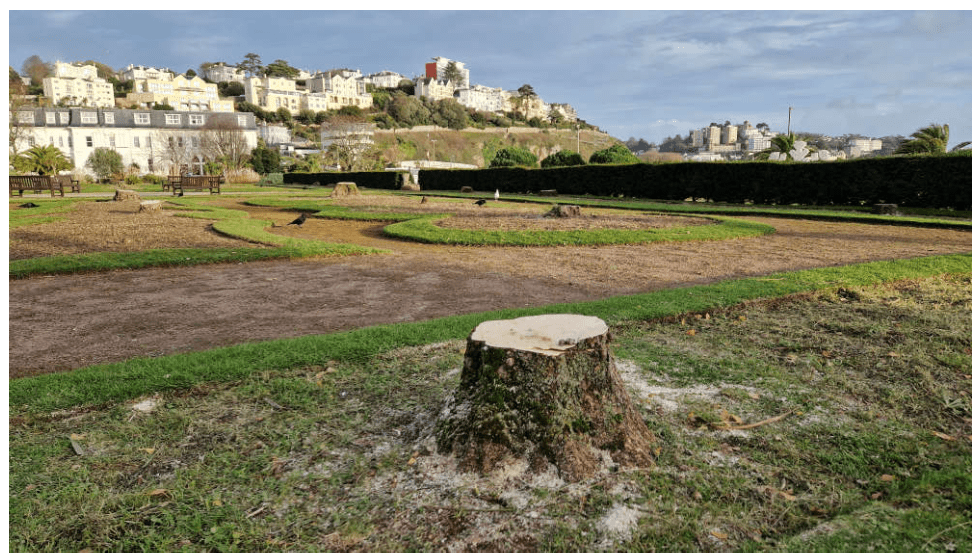
Torbay Council has apologised for cutting down 40 iconic palm trees in a Torquay seaside park without telling anybody.

Guy Henderson, local democracy reporter www.radioexe.co.uk

Tree felling at the Italian Gardens in Torquay (image: Guy Henderson)

A social media outcry followed the felling of the much-loved palms in the Italian Gardens near Torre Abbey Sands, and the story has hit the national headlines. Some comments described the cull as ‘total destruction.’

Now the council’s parks and gardens company SWISCo has said sorry.

In a statement released on Wednesday, the company said: “You may have seen or heard about the work taking place and that we have removed some palm trees.

“We want to apologise for not adequately communicating with you about those plans in advance, and we should have shared our plans earlier and more widely.

“In our enthusiasm to deliver, we raced ahead and failed to let you know that we were going to be making a start on the scheme, so causing this breakdown in communication.”

Consultation over the restoration of the gardens in time for their 100th anniversary next year began in 2019, but the pandemic and budget pressures meant the work was delayed.

SWISCo says the trees were showing ‘signs of advanced decline.’ None was in its prime after years of battering from the seafront weather, the company claims.

The trees were cabbage palms, which have a lifespan of 50 to 70 years. Most were around 50 years old, having been planted in the 1970s.

SWISCo’s statement continues: “Of late, the quality of the gardens had diminished and they were looking far from their best. With the 100th anniversary of the gardens being next year, now felt the right time to make improvements.”

The new garden will feature 1,600 new plants from 12 different species, including some replacement palms. Palm trees did not feature in the gardens when they were first planted in 1924.

“As work continues in the new year, we will be sure to share with you how it is developing with updates on both our website and Torbay Council’s,” said the statement.

Plymouth council set to spend millions on housing crisis

Homes will be bought by Plymouth Council at a cost of £10 million to help ease the city’s housing crisis.

Alison Stephenson, local democracy reporter www.radioexe.co.uk 

The council’s cabinet has agreed to borrow money to purchase around 50 properties to use as temporary homes.

It will also be bidding for a grant of between £3 million and £5 million from Homes England.

Demand for temporary accommodation in the city has more than doubled with the number of households requiring homes rising from 160 to 413 (158 per cent).

Many families are now live in B&B establishments and short stay holiday lets as there are no homes available.

Like other cities, Plymouth is facing a homelessness crisis brought about by  the cost of living and the economic impact of the pandemic.

These have significantly affected the housing market and people’s ability to meet day-to day bills such as rent, mortgage, utilities, food and travel. Inflation and the lack of affordable housing has resulted in further demand for housing and homelessness services.

The council needs to find £2.4 million to support homeless people and says it can make savings of more than £1 million a year if it buys properties.

Cabinet member for housing and communities Cllr Chris Penberthy (Lab, St Peter and the Waterfront) said it would ease pressure on families and have less impact on children.

“We have done the sums. An average family in temporary accommodation costs £23,000 a year. Once we have figured in all the costs, we can make savings of £16,000 and provide them with a temporary home which is exactly that and not a stop-start solution like B&Bs. This will give them something more stable.

“We are putting our money where our mouth is in terms of how we treat people.”

Councillors heard how 366 children currently live with their families in temporary accommodation, including 83 children in B&Bs and 35 under fives. B&B stays are limited to two weeks, so families are being moved around.

Children are being moved away from friends and schools, have to share rooms with siblings and parents, and often have nowhere quiet to do homework or revise for exams.

Cllr Penberthy said many families are finding themselves in a situation they have never experienced before because of section 21 ‘no-fault’ eviction notices from landlords who have decided to sell up. Many of these people were working and not claiming benefits.

A shortage of homes to rent meant that there are up to 100 enquiries for each one that becomes available.

He said he did not want anyone to suffer in silence. “We know people are saying they can manage and there will be something else, but it’s not like that any more. I want them to come to us. Please don’t be afraid or ashamed. Come to us as quickly as you can and we can begin to plan together.”

Council leader Tudor Evans (Lab, Ham) saidthe rise in people coming through the council’s doors for help is “alarming.” He said the authority’s action in allocating the £10 million was “proportionate and timely” and it would give hope to hardworking staff. “This money will help our staff to help people,” he said.
 

Plymouth councillor quits Tories in shock move

A Conservative councillor has quit the group and gone independent, causing the gap between the Plymouth’s governing party and their rivals to widen further.

Carl Eve www.plymouthherald.co.uk

The May this year the local elections in Plymouth saw the city change from blue to red, with Labour accruing a total of 31 seats, against the Conservatives 18, after it lost five seats. Two months later, Labour went on to celebrate securing two more seats with by-election victories. This led to Labour having 33 seats and the Conservatives 16 seats.

However, Plympton Erle Councillor Andrea Loveridge, elected to her seat representing the Conservatives in May 2016 and re-elected in May 2021, has now revealed she no longer has confidence in her party and has announced she will now represent residents as an Independent.

In a statement released on her Facebook page and provided to PlymouthLive, Cllr Loveridge said: “It’s with a heavy heart, and after careful, consideration, and reflection that I have decided to part ways with The Conservative Party and take a leap of faith as an Independent.

“Unfortunately, I have lost confidence with the Conservative Party going forward and as an Independent member it will provide me with the flexibility to engage in open dialogue, collaborate across political spectrum and focus on issues that matters within the constituency, which I am honoured to serve. This means I will be working with former Conservative Cllr Terri Beer in Plympton Erle Ward, together we will be a voice for our community and face issues together within the constituency”.

Cllr Loveridge will now sit as an independent member, in addition to both former Conservative councillors Maddi Bridgeman and Stephen Hulme who have previously become independents. According to Plymouth City Council’s website, Cllr Loveridge has chosen to not join the Independent Group, which currently is represented by former Conservative councillors Patrick Nicholson and Terri Beer.

In response to Cllr Loveridge’s move, Cllr Terri Beer, said: “This is amazing news as we are now on the same page and can both continue our hard work for the community in Plympton Erle.

“Behind the scenes Andrea and I have been working on many projects but things started to become difficult with her in a main party. Being Independent with me is the best possible outcome.

“We are also very close and good family friends and because of this strong bond we will work extremely well together as one.”

The current situation at Plymouth City Council is now:

  • Labour – 33
  • Conservative -15
  • Green – 2
  • Free Independents – 2
  • Independent Group – 2
  • Independent – 3

BUST!

From an East Devon Correspondent:-

Sadly, it comes as no surprise to so many local people that the new homes element of Burrington Estates will cease trading and has gone BUST! For far too long advisors have predicted a financial fragility attached to this particular company (which is one of around 30 subsidiary companies flying under the Burrington Estates Group banner).

Even before EDDC planners were cajoled into recommending approval of the hugely ambitious growth masterplan for the refurbishment of Winslade Park, Clyst St Mary to provide an innovative Live, Work, Play environment, warning bells were ringing within the local community regarding the vulnerability of a company that is dependent on debt to finance its acquisition and build programme.

Indeed, from the onset, Burrington Estates freely admitted to EDDC planners that in order to make the refurbishment of the Winslade Park commercial offices complex financially viable, Burringtons would require the granting of planning permission for approximately 40 homes on an adjacent green, agricultural field (which was outside of the EDDC Local Development Plan to 2031, the local Neighbourhood Plan and the Built-Up-Area Boundary of the village), together with another 40 x 4.5- storey apartments on a brownfield car park. Crucially, approval of these two new Winslade Park residential areas would significantly increase the value of the overall assets of the Company, thus enabling them to borrow even more for further acquisition and building projects.

Apparently, Burrington Estates have now ceased trading with a pre-tax loss of £14m – but where has all the investment money gone? Sceptics working in financial fraud may suggest that many development companies have little or no intention of ever completing such building projects and merely use the planning approvals as a means to increase their borrowing capacity?

With local planning authorities desperate to keep pace with Government- imposed 5-year housing numbers, at the same time as some individuals attempting to accelerate their professional and political careers, it is ‘open season’ for property developers to ‘dangle the carrot’ of large-scale developments to tempt decision-makers to bathe in the potential future kudos!

Unfortunately, our local communities have already seen property developers’ promises being broken (e.g. thousands of housing in the new town of Cranbrook -but no town centre – plus significant housing numbers in Axminster – but no promised vital ring-road infrastructure) – but there is nothing to gain from stating the obvious that local communities warned EDDC planners that this would likely occur in future – but their warnings were not heeded, leaving too many communities the losers. Yes, local people were legally consulted for their views – but the decision-makers ignored their warnings, preferring to adopt an authoritarian stance of ‘we know better’ and local people are NIMBYS! Around 500 objections were submitted to the Winslade Park masterplan (many highlighted Burrington’s flawed business model and advised caution to protect the community).

Unfortunately, the current, national financial climate has put extreme pressure on everyone within our society; many financial failures are being attributed to the effects of the worldwide Covid pandemic and the Ukraine War and certainly those catastrophes have played a major part – but are they the root cause? If we all continuously borrow money and never pay off our debts – then at some stage – we should expect to ‘crash and burn’!

The future for Winslade Park is impossible to predict and extremely complicated! The Company states that it will sell off undeveloped sites- so what will be the impact of the ‘winding-up’ of Burrington Estates on the two sizeable residential proposals of approximately 80 units, that to date show no sign of developmental progression? Will Burrington Estates proceed to build these two approved sites to completion themselves – or prefer to sell the sites with residential planning permission to another developer to pay off their debts?

So many questions remain unanswered – will the conditions imposed by EDDC be thrust upon another new developer, if the two residential areas are sold off by Burrington Estates? Surely, it is unworkable to impose conditions on a different developer, who will not own the adjoining land where the conditions have previously been imposed? To mitigate against any losses to the community, the two residential planning permissions incorporated conditions for the primary school to access the refurbished swimming pool, for enhancement to the sports field facilities (to include new changing rooms/toilets/social facilities), for renovation/improvements to the cricket pavilion and tennis courts, for the provision of community access to a large public open space for leisure purposes and for the building of new additional, significant car parking areas to avoid Winslade users overflowing into nearby residential areas or blocking the village car parks and streets– but to date none of the aforementioned have been provided – so what will become of these promised community facilities?

To outsiders, the commercial/employment aspects of the refurbishment of both Winslade Manor and Winslade House appear to be successful (although the renovation of the two large employment areas within both Clyst and Brook Houses seems to have significantly slowed recently?) – Or are the plush, office interiors and the fine-dining experiences just window-dressing, aiming to encourage further investment, whilst masking the reality of the true worth of the commercial side of business?

Many of us are experiencing daily bombardment by telephone/online scammers lying in wait for us to make mistakes during bouts of lack of concentration, so the important lesson we must all learn is:-

– If it sounds too good to be true – then it probably is?

If you dive into crocodile-infested waters – then at best you will lose a limb or two – but at worst you will be devoured whole! Top predators are successful at what they do, there is no room for naivety – the stakes are far too high!

Hopefully, there will be acceptable answers to this Winslade Park conundrum that will benefit our local communities and not destroy them!

However, what would be totally unacceptable is if (with such colossal financial losses) any Burrington Estates’ directors/shareholders/investors have already ‘creamed off’ and stashed huge personal profits, which will see them this Christmas sipping pina colada cocktails on a tropical island, wearing Versace designs, whilst driving Ferraris or Lamborghinis, whilst East Devon residents are swaddled in blankets, endeavouring to save energy and avoid visiting local food banks!

. . . .. . Now that scenario would be a very bitter pill to swallow for the average East Devon resident!

Second homeowners could be be charged double council tax

Nearly 200 homeowners in Mid Devon could see their council tax double next year as part of changes to how second properties are charged.

Alex Richards www.devonlive.com

The government’s Levelling Up and Regeneration Act gives councils the option to charge second homeowners double council tax to provide a small boost to their finances.

A second home is defined as one that is substantially furnished and periodically occupied, but is not the owner’s sole or main residence. Mid Devon District Council has 194 properties ranging across all council tax bands that could attract the premium from April next year.

“We will be writing to all those who may be affected so that they are aware of the change regarding their billing,” a council spokesperson said.

The advance warning is aimed at giving second homeowners the chance to sell their properties if they don’t want to pay the higher fee, or alternatively rent them out or make them their main residence.

Linked to these changes is the ability for councils to define a home as empty after just one year of it being unoccupied, rather than two years under previous rules.

Empty properties can also be charged double council tax, with even higher, staggered premiums possible if they are empty for more than five years or more than 10 years .

Mid Devon has 203 empty homes, and so could also be charging some of these a 100 per cent council tax premium once they have been empty for a year.

The proposed charges will be put to the full council in February to be ratified. Bath & North East Somerset made the headlines last month after deciding to hike council tax charges for second homes.

Other authorities in Devon are also looking to increase their charges once they are able to, with East Devon District Council proposing such a move. More than 11,000 homes in Devon are considered to be second homes, according to the county council.

Camberley residents ‘should get free water bills’ after sewage tanks stench

More than 200 tankers of raw sewage were driven to a Surrey town and left there for six months, causing a “nightmare” for residents after all of Thames Water’s 360 treatment plants reached critical capacity.

Thames Water has told councillors in Surrey it had had no choice. Either they moved the sewage to storage tanks in Camberley, emptied it into rivers causing massive pollution, or left it in tankers on the roadside which could have exploded, causing a major national incident.

Yuk! – Owl

Chris Caulfield www.getsurrey.co.uk

More than 200 tankers of human poo were shipped in to Camberley from across Surrey, Hampshire and London, saving Thames Water millions in potential pollution fines and its sewage trucks from “exploding”.

This comes at the expense of 11,600 residents who got nothing in return, save for a summer of vile stench, a committee heard.

Chiefs from the utility firm were called in to Surrey Heath Borough Council to answer questions as to how 12,000 cubic metres of raw untreated sewage and sludge was left to fester in the heat – forcing thousands of people to stay inside with their windows closed during the summer.

The committee also challenged water bosses over pledges they thought had been made on compensation to Camberley residents who “bore the cost” so the company, which recorded a total revenue of £2.3 billion last year, could profit.

Councillors said they were led to believe Thames Water would contribute towards a playground as a goodwill gesture to children who had been forced to stay indoors, with committee chair, Councillor Rob Lee, going as far as to say Thames Water should offer “a year’s free water bills” to those affected.

Thames Water’s representatives said they never made a firm commitment to contribute to any scheme. The company claims they have made organisational improvements since.

The committee heard that Thames Water could not have made any offers of goodwill as the people attending the meeting did not have the power to do so.

In the end, Thames Water’s leadership offered to let staff have a charity day to support building a local project that never got off the ground.

The sewage started being shipped into Camberley Sewage Works in February this year and by March the two 6,000 cubic metre tanks were “completely full”.

At the time, the committee heard, odour suppression was in place but it wasn’t 24/7 and didn’t cover the entire tank, which also suffered from maintenance issues.

By June, the council began to receive formal complaints. Initially the council was told the problem was due to blockages and drainage.

It took until the middle of July for Thames Water to publicly admit it was a holding tank with a “large quantity of sewage sludge within it”. It would remain untreated until the beginning of August with the tanks finally cleared and cleaned of waste on September 25.

Speaking to the committee was operations director James Bentley.

He apologised “unreservedly” and said: “We didn’t get everything right in that process and we’re not here to pretend that we did.” He said the firm should have put in odour controls in place and communicated with residents much sooner.

He said: “We had been experiencing a very extreme sludge event…where our system across the whole of the Thames Water estate, was overloaded.

“Not only with liquid sludge but also with cake which is the solid material when we process sludge and remove a chunk of the water from it.

“That system was overloaded on the liquid and solid side.” Thames Water staff told the meeting it left them with no choice but to put liquid sludge into reserve tanks.

Mr Bentley said: “It has to go somewhere, it cant just be discarded into the environment. We have to store it until we are able to treat it.

His colleague added: “If we didn’t move the sludge we’d have pollution trucks potentially exploding, and that’s why we’d done it.”

Cllr Rob Lee said: “You act in the shareholders best interest, you don’t intend to cause a substantial sewage leak unless its a commercially managed one, you don’t intend to cause a Heath and Safety Executive incident, so what you did was you moved the sludge to Camberley.

“So the people that bore the cost of that were the residents of Camberley, substantially through the summer, through their loss of enjoyment and I think it’s understanding the loss position those residents bring.

“They are your customers, they pay you money, and they missed out substantially on the enjoyment of their summers. Raw sewage smell around your home is pretty different to that in a treatment plant as that is your job.

“You need to consider a gesture of goodwill to residents. A starting point is a year’s complimentary water bill.

“It clearly saved Thames Water in material terms millions if not tens of millions of pounds, so I think we need to start exploring that avenue.”

The two hour meeting concluded with the Thursday, November 28 executive partnerships select committee agreeing to formally ask for a “decision maker who has the ability to sign off on compensation” to appear before the next meeting, in March.

The council’s executive team will also write to regulators Ofwat, MP Michael Gove and the environment secretary to ask them to consider the wider sense of pollution and whether Thames Water diverted the risk of fines by increasing the air pollution in Camberley.

Thames Water apologises to MPs for ‘confusion’ over £500m loan

Water companies were sold with no debt when they were privatised in 1989. In fact, they were given a £1.5 billion green dowry by the Government. Since then, they have taken on borrowing of £60.6 billion, diverting income from customer bills to paying dividends and interest payments. – Owl

Sandra Laville www.theguardian.com 

Thames Water has apologised to a House of Commons committee for causing confusion by describing a £500m shareholder loan as equity.

One MP called the complex financial structure of Thames Water an “absolute shambles”, as senior executives were pulled in to explain themselves.

Thames Water’s chair, Sir Adrian Montague, said the company was facing a “seminal moment” as Ofwat for the first time suggested special adminstration for the company was an outcome the regulator would not shirk from.

Ian Byrne, a Labour MP and member of the environment, food and rural affairs committee, said: “69% of the nation wants the water industry nationalised. I think after listening to this, it will be 100% … the whole structure is an absolute shambles.”

He added that the situation reminded him of Carillion, the collapsed construction company.

Thames Water, which provides water to about 25% of the population in England, is struggling with debts of £18bn and is seeking an injection of £1.5bn of cash from shareholders to turn itself around.

The company was recalled to give evidence to MPs on Tuesday after describing part of the shareholder money – £500m – as equity rather than debt.

Montague, the chair of Thames Water and its parent company, Kemble Water Limited, said he was sorry if the management had caused “confusion” when it described the shareholder contribution as equity when it was a convertible loan charging 8% interest.

But he said he stood by the phrase. “In July we described the shareholder contribution of £500m as equity. That’s a description that has been fiercely challenged. We stand by what we said. If we were not clear enough in unpacking the different elements of that … I’m sorry if we caused any confusion,” he said.

Montague told MPs Kemble relied upon dividends paid by Thames Water to secure its future. Ofwat is investigating dividends of £37.5m paid to the parent company in the six months to 30 September to see whether Thames Water has breached the conditions of its licence.

Montague said: “It is not obligatory for Thames Water to pay these dividends … Thames Water has paid dividends to put Kemble in a position where it can service its debt. If Kemble was allowed to go into default, our concern from Thames’s perspective is that that would derail the possibility of us delivering further equity from shareholders.”

Barry Gardiner, a Labour MP, said although promises of change had been made, its holding company was behaving the same as Macquarie. Macquarie, the Australian bank that previously owned Thames Water, has been heavily criticised for building huge debts at Thames Water to pay dividends to shareholders.

“It’s the bill payer that ends up paying for whatever trouble the holding company gets itself into, in exactly the same way as Macquarie did,” said Gardiner.

Thames Water is seeking a 40% increase in customer bills to pay for new investment in its treatment works, pipes and sewage outflows, as it faces huge problems over rising pollution incidents, infrastructure failings and continued raw sewage discharges into the environment.

Executives admitted on Tuesday that if Ofwat rejected its business plan and the bill rises it has asked for, the company would be left in huge difficulties.

Given refusing the plan was likely to lead to Thames Water collapsing, something that Ofwat would not contemplate, Gardiner told the Ofwat chief executive, David Black: “They have got you by the short and curlies, haven’t they?”

But Black told MPs the regulator would act if it had to and put the company into administration. “We have never seen a water company fail but that remains a possibility,” said Black. “If we have to take steps that lead to the failure of the parent company then we are prepared to do so.”

Gove to slash housebuilding targets for green belt

Local councils will no longer be forced to set aside greenfield land to meet their future housing needs, under a new planning system to be announced by ministers.

Oliver Wright www.thetimes.co.uk

In a move that industry sources have claimed would be “disastrous”, Michael Gove will allow local authorities to reduce the number of houses to be built if development would significantly alter the character of their areas or impinge on the green belt.

Councils will also be given an exemption from building new homes on prime agricultural land.

The reforms, which could be announced as soon as Thursday, are designed to appease rebel Conservative MPs who have warned that opposition to housebuilding in their constituencies will cost them their seats at the next election.

But critics have warned that they amount to a “nimby’s charter” that will lead to a continuing shortage of housing in the areas of greatest need.

Under the previous system local authorities were required to set aside and designate enough land to meet their future housing needs for five years in a local plan even if the proposals were opposed by local residents.

Councils that failed to do so risked having new developments forced upon them by the planning inspectorate under a “presumption in favour of sustainable development”.

But under the changes councils will be able to set local plans with fewer homes if they can demonstrate to the planning inspectorate that meeting the target would damage the character of an existing area or require building on the green belt.

Ministers argue that the changes will, in the long run, allow more homes to be built because local councils will be incentivised to produce realistic plans for their areas that have broad democratic consent.

However, developers fear that the rules will be exploited by opponents of new housing to block sites from being built on, significantly reducing land supply in areas where demand is greatest.

“This will be disastrous,” said one senior industry source. “Under the old system there were strong incentives for councils to produce realistic plans to meet their future housing needs. Under this system there will be next to nothing to stop councils effectively imposing a moratorium on building the homes that we need.”

As part of the package of measures due to be announced by the government, Gove is expected to argue that the government will prioritise brownfield and higher-density development in inner-city areas. He will also make it harder for planning committees of local councillors to block developments that have been approved in principle by local planning officers.

A government source said: “We are reforming the planning system to put local plan-making at its heart. This will allow communities to take back control of housing in their area, while supporting much-needed development in brownfield and inner-city sites.

“We are on track to see a million new homes completed this parliament and are accelerating our plans in Cambridge, central London and the heart of Leeds.”

The government will also point to measures in the autumn statement designed to speed up the planning process. Under the new system local authorities will be able to charge an additional fee for accelerated planning decisions but would be forced to refund all planning charges if it failed to meet faster timelines.

Government sources said there had been more than 26,000 responses to a consultation on the proposed changes, which will form part of a new national policy planning framework (NPPF).

It follows weeks of negotiations with rebel Tory backbenchers, who last year forced ministers into a U-turn on plans for mandatory housing targets.

They said that the new plan would strike the “right balance” between the rights of existing residents with concerns about new development and the need to increase housing supply.

Labour is expected to condemn the proposals. “This is formal confirmation that this government prioritises party management over doing what it takes to get Britain building again,” said a Labour source.

The former Northern Ireland secretary Theresa Villiers, who led the backbench rebellion against the existing planning rules, said she hoped the new plan would respect “local democratic input”.

“The government has a longstanding commitment to ensure the voice of local communities continues to be heard in relation to what is built in their neighbourhood,” she said.

“We all recognise how important it is to build the homes we need. It is possible to do that whilst still respecting local democratic input, for example by focusing on high-density delivery in urban city centre sites. Once it is published, I’m sure the new NPPF will be carefully scrutinised by all sides of the debate.”

‘Toothless’ sewage watchdog fails to visit 90% of toxic water spills in England

The Environment Agency failed to visit 90 per cent of toxic water spills last year, including more than 60 per cent of the most serious incidents, i can reveal.

Lucie Heath inews.co.uk

Freedom of Information data obtained by the charity WildFish, and shared with i, shows there has been a significant drop off in in-person inspections of water pollution since the Covid-19 pandemic, despite an increase in the total number of incidents being investigated by the watchdog.

Inspectors were rarely turning up in person to investigate incidents such as sewage discharges and pollution run-off from farms and motorways into England’s waterways.

Campaigners and politicians told i the environmental regulator was “toothless” and blamed the Government for overseeing the decline of Britain’s rivers, lakes and coastal waters.

They accused the Environment Agency of “pretending pollution isn’t there” and called for a complete overhaul of the regulatory process for water.

It comes as BBC Panorama claimed that one water company United Utilities wrongly downgraded the severity of more than 60 of its own pollution incidents last year in a move that saw the cases wiped from its official records.

The downgrades were reportedly signed off by the Environment Agency without inspectors attending any of the incidents. United Utilities denies the allegations.

Now i can reveal the extent to which the Environment Agency has scaled back in-person inspections of water pollution across the country since the Covid-19 pandemic.

Pollution incidents are divided into four categories from category one (most serious) to category four (little to no impact). Incidents are given an initial categorisation when reported, but these can be changed after inspection.

In 2022, Environment Agency inspectors attended just 2,060 (10.7 per cent) of the water pollution incidents reported to them that were initially classified in categories one to three.

This included 161 visits (35 per cent) to category one incidents, 861 (23 per cent) category two visits and 1,038 (7 per cent) category three visits.

Unsurprisingly, the number of Environment Agency visits to water pollution incidents dropped off significantly during the Covid-19 pandemic. However, the latest figures show that visits remained at this level in 2022 despite the ending of lockdowns.

In-person visits were down almost 50 per cent in 2022 compared to 2019, despite a 10 per cent increase in the number of incidents being investigated by the Environment Agency.

The figures also show that pollution spills caused by water companies were being visited at a rate below the average, with the Environment Agency visiting just 5 per cent of these cases in 2022, including 36 per cent for category one, 15 per cent for category two and three per cent for category three.

Guy Linley-Adams, Solicitor at WildFish, said: “Sadly, this just shows that the Environment Agency has continued the decline in its performance that began in the early 2000s. You can’t deal with pollution by just pretending it isn’t happening, refusing to see it.

“However, fault lies both with Agency managers, but also with politicians of both main parties, who have hamstrung the Agency with the Regulators’ Code and other such deregulatory nonsense over years, starved it of cash and refused to let it take on polluters to protect rivers, lakes and coastal waters. The very best you can say about the Agency is that it is now charged with presiding over the managed decline of the aquatic environment in England”.

It comes as water companies continue to come under scrutiny for the amount of sewage being dumped into Britain’s rivers, lakes and coastal waters, with water companies reporting over 384,000 discharges of raw sewage in 2022.

Water companies have been permitted to discharge untreated sewage into water bodies during exceptional circumstances when their pipes are at risk of becoming overwhelmed, but investigations have shown this has become common practice.

Stuart Singleton-White, head of campaigns at the Angling Trust, described the Environment Agency as “toothless”.

He said the regulation of the water sector is “completely broken” and that it was “time to sweep away the current system”.

Labour’s shadow Environment Secretary Steve Reed said the Government has “wilfully turned a blind eye to corruption at the heart of the water industry” and said his party will “strengthen regulation to make sure every single water outlet is monitored”.

Labour will table a motion in the House of Commons on Tuesday to call on the Government to give the water regulator Ofwat powers to ban the payment of bonuses to water bosses whose companies are found to cause pollution.

An Environment Agency spokesperson said: “We take our responsibility to protect the environment very seriously and will always pursue and prosecute companies that are deliberately obstructive or misleading.

“We assess and record every incident report we receive – between 70,000 and 100,000 a year. We respond to every incident and attend those where there is significant risk, and we are increasingly able to use off-site data checks and technology from a range of different monitoring sources to assess them.

“We are strengthening our regulation of the water industry by expanding our specialised workforce, increasing compliance checks and using new data and intelligence tools to inform our work. We will also soon have new powers to deliver civil penalties that are quicker and easier to enforce.”

New homes builder to cease trading after £14m loss

The new homes element of Burrington Estates is set to cease trading but the wider Burrington Estates Group, however, is unaffected, including the company’s interest in Exeter’s Winslade Park.” Complicated – Owl

South West new homes builder Burrington Estates is to cease trading after making a £14m pre-tax loss. The Exeter-headquartered company, which builds and sells houses across the West Country and Midlands, will complete the projects it is working on, sell off undeveloped sites and wind up the business.

William Telford www.devonlive.com

Directors blamed “increasingly difficult trading conditions” and an uncertain UK housing market, partly fuelled by rising interest rates. They also put the blame on the cost-of-living crisis and the war in Ukraine. The new homes element of Burrington Estates is set to cease trading but the wider Burrington Estates Group, however, is unaffected, including the company’s interest in Exeter’s Winslade Park.

David Jervis, director, said: “After looking at a range of options for the future of the business, including its ownership and markets, the directors reluctantly agreed in 2023 that the business would complete its committed project to its recognised high standard and would thereafter cease trading and commence an orderly wind down of the business. The directors would like to thank all its customers, supply chain, staff and funders for their continued support during this period.”

Burrington Estates will become the fourth major regional construction firm to cease operating in the past two years. Midas Group Ltd, Henry W Pollard and Sons Ltd and Brady Construction Services Ltd have all gone under as the construction industry continues to be hit by economic difficulties.

Burrington Estates, which employed about 70 people, was set up in 2011 by Mark Edworthy and Paul Scantlebury and has completed more than 600 homes in the region, including current schemes in Exeter, Tiverton and Bude. It purchased The Ship, Plymouth’s former home of The Herald and Western Morning News, in 2015, much of which is currently being offered for let as small business space.

It also developed landmark business sites at Sky Park and Sky Park II, in Exeter; West Park, in Wellington; Roundswell, in Barnstaple; Oak Tree, in Newton Abbot; and Plymouth’s Eurotech Park. These were transferred to ONYX Business Parks Ltd, when subsidiary Burrington Business Parks rebranded in May 2023, and appear to be unaffected by Burrington Estates’ winding up.

In 2021, Burrington Estates embarked on ambitious growth plans boosted by a £15.5m investment from main shareholder BGF Group Plc to expand its residential portfolio .In January 2022 Burrington Estates secured a £28m funding package from Paragon Development Finance to support its Winslade Park development in Exeter.

In August last year, Mr Edworthy and Mr Scantlebury stepped down and Mr Jervis became group managing director, having joined in 2019 to head the new Midlands division. Burrington Estates’ highest paid director was paid £279,333 and a pension contribution of £16,000 in 2021.22.

Plymouth’s Eurotech House and the former Good Companions site in the city centre have been put on sale. Both are still being advertised, the former for £850,000.

Newly published accounts for the 18 months from January 2021 to June 2022 show Burrington Estates sold 36 properties and had a turnover of £29,522. But it made an operating loss of £9,031,000 and a pre-tax loss of £14,345,000.

Burrington Estates Group, a holding company, is dependent on cash generated by more than 30 subsidiary companies and funding from ultimate parent company BFG, which has now recognised it won’t be repaid in full and reserved the right to amend its support. Mr Jervis said the company was hit by “increasingly difficult trading conditions”.

In his strategic report, he highlighted “increased uncertainty in the UK housing market” driven by interest rate hikes and a fall in house prices “triggered by economic uncertainty and reductions in attractive mortgage deals for buyers”. He also blamed supply chain problems and delays caused by the planning system.

He continued: “In addition, the cost of finance for the group rose significantly due to the significant and numerous increases in UK commercial lending rates.” He said this was key as the company was dependent on debt to finance its acquisition and build programme.

He said that as a result the company was unlikely to be able to settle or refinance all its loans from shareholders and would seek a “managed closure” of the business. The accounts showed about £73m was owed to creditors, most of which was loans and borrowings, and was in breach of loan covenants and had to therefore replay its main lender immediately.

New artwork set to be unveiled at Honiton train station

Councillor Eleanor Rylance, chair of East Devon District Council, said: “We are delighted to showcase the creativity of local young people and celebrate the remarkable natural environment which surrounds Honiton.”

Adam Manning www.midweekherald.co.uk 

New artwork and a town map are to be unveiled at Honiton station by the Mayor of Honiton, Councillor Helen Hurford.

The unveiling will take place on Wednesday, December 13 at 12.30pm.

The project has been led by the Friends of Honiton Station and has seen attractive new artwork installed on the inside of the station’s footbridge and a shed on Platform 1.

In addition, an illustrated town map has been placed in the station forecourt. The project is the brainchild of Friends’ member East Devon and Honiton Town Councillor Jenny Brown.

Honiton Primary School pupils created the new artwork on the station footbridge during workshops with artist Alistair Lambert at Thelma Hulbert Gallery (THG), Honiton Museum and the Blackdown Hills National Landscape.

The workshops were part of THG’s Honiton Hippo project for the national Wild Escape campaign. Local families also created animals to add to the artwork during workshops at the gallery and in the St. Paul’s area of Honiton over the Easter holidays.

Local artist Brittany E Lakin created the artwork on both sides of the Platform 1 shed.

The £6,700 project has been made possible thanks to funding from South Western Railway, Honiton Town Council and grants organised by the Devon & Cornwall Rail Partnership from CrossCountry Trains and the Community Rail Development Fund, a joint initiative of the Department for Transport and the Community Rail Network.

Cllr Jenny Brown said: “I am thrilled to see the unveiling of this vibrant, colourful artwork. This project would not have been possible without the strong partnership that has been created over the past few years with our stakeholders, who are always very receptive of our ideas.

“I hope as commuters and visitors to Honiton walk past it, they will take the time to enjoy these latest additions.”

Martin Long chairman of the Friends of Honiton Station said: “Honiton station is important to so many people, and we are very proud of it, and all that it tries to do. We believe that the station is the perfect venue to promote and develop community-based art. To that end, we have been delighted to work with a range of partners to bring even more exciting artwork to our station.”

Councillor Eleanor Rylance, chair of East Devon District Council, said: “We are delighted to showcase the creativity of local young people and celebrate the remarkable natural environment which surrounds Honiton.”

Covid testing restarts as new fast-growing strain could trigger a winter wave

Random swab testing is restarting in the UK due to concerns about a new Covid-19 variant that could cause a winter surge in infections. The UK Health Security Agency (UKHSA) reports that the JN.1 variant has been the fastest-growing variant for at least eight months.

Suruchi Sharma Diwan www.inyourarea.co.uk 

According to the Mirror, the Office for National Statistics has resumed random testing amid early indications that 1.2 per cent of the population had the virus in the last week of November, up from one per cent the previous week. However, despite worries, Covid-19 rates in the UK are still low.

The UKHSA is now closely monitoring JN.1, which accounts for one in 13 cases detected. Designated as an official variant (V-23DEC-01), 302 cases of the strain have been identified in the UK so far. JN.1 has a mutation suggesting it could better evade immunity, emphasising the importance of recent vaccination for protection.

Dr Meaghan Kall, an epidemiologist at the UKHSA, tweeted: “JN.1 has been designated variant V-23DEC-01 due to increasing sequence prevalence in the UK and internationally.” She added: “With variant status, we will closely monitor JN.1. It seems likely we must now add variant pressures to the forecast of a winter Covid-19 wave.”

With a weekly growth rate advantage of 84.2 per cent, JN.1 is still a small proportion of infections. Despite this, Prof Stephen Griffin, professor of cancer virology at Leeds University, tweeted that he had ‘not seen a growth advantage like that in some time’.

The possibility of a winter Covid-19 wave, coupled with a rise in flu cases, could strain the NHS. It comes as flu cases have already started to spike, with an increase in hospitalised cases by more than half in just last week.

The Winter Coronavirus Infection Study, a scaled-back version of the previous Covid-19 Infection Survey, found 1.2 per cent of participants had the virus in the week ending November 29, with higher rates among 18 to 30-year-olds. However, this early data from lateral flow tests has not yet been ‘weighted’ to represent the demographics of the population at large.

New data also showed the percentage of hospital admissions testing positive for Covid-19 remains low at 2.9 per 100,000 patients in the week to December 3. This was up from 2.6 the previous week but the same level as a fortnight ago, according to the UKHSA.

An average of 2,343 people tested positive for Covid-19 in hospitals in England each day last week – less than half the number at this point last year. Dr Mary Ramsay, UKHSA director of public health, warned families to avoid mixing when they feel unwell.

She said: “Getting vaccinated as soon as possible will help reduce your risk of getting seriously ill with flu or Covid-19 this festive season. The vaccines can take a week or two to provide maximum protection, so get booked in now to keep your Christmas plans on track.”

Huge power shift sparks anger in Torbay

Local Tories say they’ve been “thrown under the bus” and the electorate disrespected!

It’s all about entitlement shattered by a “coalition of the willing”. – Owl

Guy Henderson www.devonlive.com

A huge power shift on Torbay Council unfolded in a marathon meeting which stretched over five often ill-tempered hours. The Liberal Democrat, Independent and Prosper Torbay groups united to undo many of the now-minority Conservative administration’s structures.

After last May’s elections, the Tories had an overall majority and ran the council, but the defection of two of their members to form the new Prosper Torbay group last month changed the balance completely.

The Tories remain the largest party, with 17 seats, but the combined opposition now has 19 members. The meeting of the full council gave the new non-Conservative ‘team’ their first chance to challenge the administration, and they seized it.

The meeting, which ran well beyond its four-hour time limit after the opposition councillors voted to press on past 10pm, made a long list of changes to the chairmanship of council committees.

Out went a number of Conservative councillors, who found themselves sidelined in favour of the opposition, leading to angry exchanges.

“Maybe this is where the love-in stops!” said council leader David Thomas (Con, Preston), as his fellow Tories began to lose their posts.

The most heated debate centred on chairing the influential planning committee, which went to Prosper Torbay rebel Katya Maddison (Shiphay) with current chair Cllr Jackie Thomas (Con, Kings Ash) sidelined.

Cllr Adam Billings (Con, Churston with Galmpton) urged members to stick with the current chair, and said: “Planning is one of the most important committees this council has. Its decisions affect people’s lives. Why change something that at the moment is working well?”

And Cllr Jackie Thomas argued: “This is simply making change for change’s sake.”

There was also argument over chairing the harbours committee, with Cllr Andrew Strang (Con, Furzeham with Summercombe) removed in favour of Cllr Nicole Amil (Ind, Cockington with Chelston).

Cllr Strang argued that although the committee covered all of the bay’s harbours, with millions of pounds in ‘levelling up’ money to be spent on Brixham fish quay in the near future, a Brixham councillor should chair the committee.

Cllr Nick Bye (Con, Wellswood) said Brixham’s Tory councillors were being “thrown under the bus” and the opposition groups were “disrespecting the electorate.” The Conservatives took a clean sweep of Brixham’s council seats in May.

He continued: “It’s a disgrace that you are removing all responsible positions from the Brixham councillors. Of all the shoddy deals made tonight, this is the worst.”

The Conservatives warned that the council should be united when it came to securing more than £100 million pledged by the government for major projects across the bay.

But opposition members disputed the risk to the funding and said the Tories were playing “petty political parlour games.”

The wrangling had started with changes to the number of representatives of each party on various committees, to reflect the new balance of the council.

“This could herald a new way of collaborative working,” said Independent group leader Darren Cowell (Shiphay). “We need to show that we are a stable council.”

And Liberal Democrat leader Steve Darling also called for stability. “It’s about making sure we have firm foundations,” he said. “The easiest thing would be to have a revolution, but it’s important that we keep stability.

“I hope we can build on a collaborative approach.” But Cllr Bye accused the opposition group of packing his fellow Tories off to less important committees and keeping the best jobs for themselves.

“You’ve got to let us get on and do the jobs we were elected to do,” he pleaded.

Cllr David Thomas said he had offered seats on the ruling cabinet committee to the opposition, but they had declined. He went on: “This doesn’t feel very much like working together.

“We are on the edge of a precipice. We’ve got the money, the plans, the partners, the ambition and the political will to get these projects across the line, and we owe it to our communities.

“I desperately want us to deliver, and I think what we are doing tonight hinders us.”

Planning applications validated by EDDC for week beginning 27 November

‘Open season’ for developers in East Devon

It is “open season” for housing developers in East Devon as the council can’t show the government it has at least five years’ worth of land for new homes. 

Will Goddard, local democracy reporter www.radioexe.co.uk 

That’s the view of local councillor Jess Bailey (Independent, West Hill and Aylesbeare), who spoke of her frustration this week. 

Because it can’t prove it has identified land for new housing for five years means the council’s policies for locating new developments are deemed out-of-date for deciding whether to grant planning permission. 

[See also this article on the Tory Poison Chalice to put the Conservative Government policy in the context of the local Conservative pro-development legacy – Owl]

Cllr Bailey said: “I am concerned that effectively East Devon is declaring an open season for developers [who think] ‘don’t worry about planning policies because we haven’t got a five-year land supply.’

“The responsibility for this state of affairs must lie with the Conservative government and its flawed algorithm, which is putting so much pressure on East Devon. 

“What I really want to focus on is what East Devon District Council can do to put in maximum effort to resist speculative development when faced with this government’s algorithm.  

“I’m certainly not saying that we start refusing everything, but what I am saying is that we draw on everything that we can to ensure that we’re in the best position to refuse applications that are not in accordance with our planning policies, regardless of the five-year land supply.” 

Most councillors at the meeting agreed with Cllr Bailey and voted to ask all Devon district councils and the Local Government Association to agree to a legal challenge to “robustly” resist speculative development and uphold councils’ policies for where new houses should be built. 

Cllr Vicky Johns (Independent, Ottery St Mary) said: “Three-quarters of our area is covered by AONB [an area of outstanding natural beauty], and yet that is not taken into account at all in any way, shape or form when we’re allocated the housing that we’re supposed to put in.  

“We’ve already built all we’re supposed to have built and yet we’re still being told we need to build more, and build more, and build more. 

“I do agree that all the councils in the area should club together… and ask the government why they’re stating we have to do this when we don’t have the capacity to do it. It’s ridiculous.” 

Cllr Olly Davey (Green, Exmouth Town) added: “It’s understood as of January 2023, nearly 40 per cent of English local authorities could not demonstrate a five-year housing land supply, so the position EDDC finds itself in is by no means uncommon.” 

Tories facing general election wipeout with just 130 seats, says polling guru

[But help is at hand for Simon. Under a proposed “career transition” scheme he could receive free advice with tasks such as writing a CV from a designated career coach. bbc.co.uk]

Rishi Sunak’s Conservatives are facing their worst ever result at the general election and could be left with just 130 seats, according to Professor Sir John Curtice.

Adam Forrest www.independent.co.uk 

The country’s top polling guru warned of the bleak situation faced by the Tories as they head into winter with the news dominated by infighting over the prime minister’s Rwanda deportation plan.

Prof Curtice said Mr Sunak’s party would be “lucky to win [many] more than 200 seats” and could see an even worse result if its dire poll ratings continued.

“If these patterns were to be replicated in a general election, the outcome for the Conservatives could be bleak indeed – maybe as few as 130 seats, the worst outcome in the party’s history,” he wrote for The Sunday Telegraph.

The outcome would be even worse than the 165 seats the Tories were left with in 1997, when the party, then led by John Major, was thumped by Tony Blair’s Labour – which won a landslide 179-seat majority.

With Labour enjoying a consistent polling lead of close to 20 points, Prof Curtice said voters appear to have “stopped listening” to the Tories on the big issues.

He warned Mr Sunak that his recent anti-immigration push had “not gone well”. The elections expert said it looked like the Rwanda bill “could divide the party just as [Theresa] May’s ill-fated Brexit deal did in 2019”.

On the major split currently looming in response to Mr Sunak’s plans, Prof Curtice wrote: “Divided parties rarely prosper at the polls. In pursuing their disagreements with Mr Sunak over immigration, Tory MPs should realise they are potentially playing with fire.”

He added: “Even though the polls have repeatedly indicated that the government’s Rwanda policy is relatively popular – at least among those who voted Conservative in 2019 – the first polls since this week’s developments suggest they also are unlikely to move the electoral dial.”

He continued: “We should not be surprised. Although many 2019 Conservative voters are unhappy about the level of legal and ‘illegal’ immigration, those who feel that immigration has gone up a lot are not especially likely to say they will not vote Conservative again.”

There is speculation at Westminster that Mr Sunak may be forced into a snap election in the early part of 2024 if he struggles to get his Rwanda bill through parliament.

But cabinet minister Michael Gove insisted that Mr Sunak’s government is “not contemplating” holding an early general election if the Rwanda bill is voted down. Asked if it was an option, the senior Sunak ally told Sky News: “No, we’re not contemplating that.”

A group of unnamed Tory MPs have told The Mail on Sunday that they would like to get rid of Mr Sunak – with some even keen to bring back Boris Johnson as leader.

Dubbed the “pasta plotters”, a small group of anti-Sunak MPs and strategists were said to have met at an Italian restaurant to plan “an Advent calendar of s***” for the current Tory leader over the Rwanda issue this December.

“Whatever you feel about him, one thing no one can question is [Mr Johnson]’s effectiveness as a campaigner,” one red-wall MP told the newspaper. But with Mr Johnson out of parliament, the so-called pasta plotters are said to be uncertain who could realistically replace Mr Sunak.

Damian Green – chair of the One Nation wing – offered a warning to any right-wing rebels pouncing on the Rwanda issue as a way to get rid of Mr Sunak.

“Anyone who thinks that what the Conservative Party or the country needs is a change of prime minister is either mad, or malicious, or both,” he told the BBC’s Sunday with Laura Kuenssberg.

Mr Green added: “It is a very, very small number doing that [plotting to oust Mr Sunak].”

PPE bought via ‘VIP lane’ was on average 80% more expensive, documents reveal

“The British public are sick of being ripped off under the Conservatives. Billions of pounds of taxpayers’ money have been squandered … when it could have been spent in our schools, hospitals and police.” – Rachel Reeves, the shadow chancellor.

Rowena Mason www.theguardian.com 

PPE was on average 80% more expensive when the government bought it from firms referred through a special “VIP lane” by Conservative ministers, MPs and officials, new information has revealed.

The Good Law Project, which has long been investigating PPE deals during the Covid pandemic, said internal government documents showed that the unit price paid for items under VIP lane contracts was up to four times higher than average.

The organisation highlighted one example as being the cost of PPE delivered by Meller Designs, a fashion company at the time co-owned by the Tory donor David Meller, which was referred through the VIP lane by Michael Gove’s office. Meller Designs was awarded six PPE supply contracts worth £164m during the coronavirus pandemic.

In three of these contracts with Meller Designs, the government paid between 1.2 and 2.2 times the average unit price. The average price for medical gowns was £5.87 but the gowns bought from Meller Designs cost £12.64. About £8.46m worth of the equipment supplied by Meller Designs was later found to be not used in an NHS setting.

A spokesperson for Meller Designs said: “Meller Designs approached the government in March 2020 and offered to supply PPE for the NHS and other essential public services.

“We are extremely proud of the role we played at the height of the Covid-19 crisis and managed to secure more than 100m items of PPE – including masks, sanitiser, coveralls and gloves direct from the manufacturers – at a time when they were most needed. This PPE was used in hospitals and by emergency services throughout the country.

“In responding to the national emergency, we were able to rely on our many years’ experience of sourcing, testing and quality control of a wide range of products.

“As a company Meller Designs has been in business for more than 100 years but we can honestly say this was one of the most difficult and important contracts we have ever been asked to respond to and we would like to thank all our colleagues who worked so hard to make it happen.”

Responding to the PPE figures, Rachel Reeves, the shadow chancellor, said: “The British public are sick of being ripped off under the Conservatives. Billions of pounds of taxpayers’ money have been squandered … when it could have been spent in our schools, hospitals and police.

“That is why Labour will appoint a [commissioner] to go through pandemic contracts line by line and whenever they have failed to deliver, we will clawback every pound we can for the public.”

A Department of Health and Social Care spokesperson said its priority throughout the pandemic “was to save lives and we acted swiftly to procure PPE at the height of the pandemic, competing in an overheated global market where demand massively outstripped supply”.

“Due diligence was carried out on all companies and every company was subjected to the same checks,” the spokesperson said.

Separately, the Conservative peer Michelle Mone said she was wrong to publicly deny involvement in a PPE firm now under investigation by the National Crime Agency (NCA).

Lady Mone released a YouTube documentary in which she and her husband, Douglas Barrowman, launched a fightback “because we have done nothing wrong”.

Mone had lobbied ministers, including the communities secretary, Michael Gove, and officials for PPE Medpro to win contracts and it went on to obtain £200m in deals to supply masks and medical gowns. Her lawyers subsequently denied to the Guardian repeatedly that she was involved in the firm.

The DHSC is suing PPE Medpro for the full return of the £122m it paid for the surgical gowns but never used, claiming they were unsafe for use in the NHS. The company is defending the claim.

The NCA has been conducting an investigation into PPE Medpro since May 2021, which is continuing.

Gove said he could not comment on matters under NCA investigation but insisted it was wrong for anyone to suggest that ministers were doing favours for their contacts.

He told the BBC’s Laura Kuenssberg on Sunday: “Ministers did not take individual decisions about who should receive contracts … teams of civil servants assessed the worthiness of any contracts put forward.

“The suggestion that somehow ministers were seeking to deliberately do favours for or line the pockets of other individuals is totally unjustified because the decisions were only taken after a proper coherent and fair procurement process.”

Housing crisis poses threat to survival of rural communities – CPRE Report

www.cpre.org.uk

An affordable, healthy home is the foundation for a decent life. But our new report shows that rural communities in England are facing an existential threat from an acute and overlooked shortage of genuinely affordable housing.

The report, entitled ‘Unraveling a crisis: the state of rural affordable housing in England’, launched today and lays bare the impact of this crisis on real people, along with what is needed to fix it.

Read the report

‘Chronic shortage’ of affordable housing

A chronic shortage of genuinely affordable housing is creating huge social housing waiting lists and forcing people out of the communities they know and love. This worrying crisis is being fed by record house prices, stagnating wages and an increasing number of second homes and short term lets.

The countryside, where levels of homelessness have leapt 40% in just five years, is being drained of skills, economic activity and vital public services.

There is an extreme disparity between rural house prices, which are higher than those in other parts of the country, and rural wages, which are much lower. House prices in the countryside increased at close to twice the rate of those in urban areas in the five years to 2022. While the average cost of a home jumped 29% and is now £419,000, rural earnings increased by just 19% to a total of £25,600.

89-year waiting lists

More than 300,000 people are on waiting lists for social rented housing in rural England, an increase of over 10% since 2018. At the current rate of construction, it would take 89 years to offer a home to everyone on the waiting list. Current planning policies allow for the building of new ‘affordable’ housing costing anything up to 80% of market value. This means that in many rural areas the ‘affordable homes’ being provided are often anything but.

Local authorities have not replaced social housing at the rate properties have been sold under the Right to Buy policy, leading to a chronic shortage of housing for people who need it most.

Damaging short-term lets and second homes

In Cornwall, where more than 15,000 families are on social housing waiting lists, the number of properties for short-term let, (at much higher prices than social rents), grew by 661% in the five years to 2021. Half of the families on social housing waiting lists in South Lakeland could be accommodated in local properties available exclusively as holiday rentals. Devon has seen 4,000 homes taken off the private rental market and 11,000 new short-term listings since 2016.

The government has legal powers to protect council housing purchased under the Right to Buy scheme from being sold off at market rates or as second homes. Our research is the first published study to look at the overall coverage of these so-called ‘Section 157’ powers.

We found that these powers only apply to half of all rural parishes in England. They exclude whole counties such as Bedfordshire and Cambridgeshire, and also large towns. There are several large towns, particularly in south west England, where there is a particular lack of affordable housing.

‘Decades of inaction’

CPRE’s Chief Executive Roger Mortlock said:

‘Decades of inaction have led to an affordable housing crisis that is ripping the soul from our rural communities. Solutions do exist and the next government must set and deliver ambitious targets for new, genuinely affordable and social rented rural housing, curbing the boom of second homes and short-term lets.

‘Record house prices and huge waiting lists for social housing are driving people out of rural communities, contributing to soaring levels of often hidden rural homelessness. We need urgent change to ensure we don’t end up with rural communities that are pricing out the very people needed to keep them vibrant.’

Urgent recommendations

The report contains a list of recommendations that CPRE believes will help to solve the severe housing crisis in the countryside. It includes calls for the government to:

  • Redefine ‘affordable housing’ to directly link to average local incomes
  • Increase the minimum amount of genuinely affordable housing required by national planning policy and implement ambitious targets for the construction of social rented homes.
  • Support local communities to deliver small-scale developments of genuinely affordable housing and make it easier for councils to purchase land at reasonable prices, enabling the construction of social housing and vital infrastructure.
  • Introduce a register of second homes and short-term lets, with new powers for local authorities to levy additional council tax on second homes.
  • Extend restrictions on the resale of ‘affordable housing’ to all parishes with fewer than 3,000 inhabitants to ensure local workers can continue to use properties, rather then allowing them to become second homes or holiday lets.

Read the full report

Read our 2023 affordable housing report here. We’ve also created a jargon-busting explainer, to help readers interpret the report and understand some of the key policy mechanisms.

An affordable housing scheme in Cornwall Kevin Britland / Alamy Stock Photo

Rishi Sunak has no purpose. It’s time to call an election  

He is an unelected prime minister with no mandate, no coherent agenda and no answer to the profound challenges facing the country, from sluggish productivity and poor growth, to the dire state of social care, to the climate crisis. Devoid of substance, and fearful of the country’s likely verdict on his party’s increasingly wretched period in office, he is determined to make reducing migration a key election battleground.

Observer editorial www.theguardian.com 

Another week, another crisis in the Conservative party. This time, it was prompted by the resignation of the immigration minister, Robert Jenrick, who claimed that Rishi Sunak’s emergency legislation to enact his plan to fly asylum seekers to Rwanda was a “triumph of hope over experience”. Rival Tory factions reportedly spent the rest of the week plotting opposing amendments to the bill for when it is introduced to the Commons on Tuesday. It is the latest manifestation of the weakness of a government riven by internal division, led by a prime minister with no strategic purpose save holding his party and his premiership together.

This is a crisis of Sunak’s own making. He is an unelected prime minister with no mandate, no coherent agenda and no answer to the profound challenges facing the country, from sluggish productivity and poor growth, to the dire state of social care, to the climate crisis. Devoid of substance, and fearful of the country’s likely verdict on his party’s increasingly wretched period in office, he is determined to make reducing migration a key election battleground.

There are two aspects to this: first, record net migration levels are the product of Sunak’s own policies. Migration is high mainly because after Brexit, the government significantly liberalised the migration regime for people coming to work in the UK on skilled worker visas, reducing salary thresholds and skill requirements, particularly for shortage jobs such as care work. Four in 10 skilled worker visas now go to care workers; six in 10 to workers in the health sector more broadly.

Instead of investing in the skills, qualification levels and pay of the domestic health and social care workforce to reduce staff shortages, the government is simply looking to reverse its own policy and make it harder for people to come here to fill those gaps; last week, the home secretary James Cleverly announced the government will significantly increase the minimum salary threshold for skilled worker visas, with the exemption of those for health and social care, prevent people coming to the UK to work in health and social care from bringing their children with them, and also, significantly, double the minimum income that British citizens need to earn in order to sponsor their spouses or children for family visas. These policies will depress net migration, but at what human cost? None of this gets to the heart of the British economy’s fundamental problems: medium-term skill shortages but also an ageing population that, in the long run, creates a choice between higher tax rates for working-age citizens or expanding the working population through migration.

The second thrust of Sunak’s migration agenda addresses asylum seekers: Sunak has pledged to “stop” the small boats carrying people across the Channel to claim refuge in the UK. These movements are notoriously difficult to prevent; if he was really interested in reducing the tragic loss of life in the Channel, he could try to negotiate a returns agreement with France in exchange for taking an agreed number of their asylum seekers.

Instead, he has inexplicably hitched his fortunes to a scheme to detain every asylum seeker on arrival in the UK, and deport them to a third safe country in an attempt to deter people from making the crossing in the first place, despite evidence suggesting any deterrent effect would be minimal. The only country the government struck a deal with was Rwanda; but last month, the supreme court ruled it would be unlawful to deport asylum seekers there because there would be a danger of them being returned to their home countries where they would face persecution or inhumane treatment.

Sunak’s hare-brained plan to get round the supreme court is an emergency bill that designates Rwanda as safe despite the judgment of the British courts, and disapplies the Human Rights Act for the purposes of the legislation. Legal experts still think it would be in breach of international law, and so subject to challenge in the European Court of Human Rights. But the bill allows ministers to ignore any interim measures issued by the EHCR as a matter of domestic law.

This is a dishonest fudge, which not only undermines the separation of powers between parliament and the courts, but is contingent on the UK breaching its obligations under international law. All for a scheme that even if it came off, and it seems highly unlikely the bill will survive passage through the Lords before an election, would lead to at most a handful of vulnerable people being deported even as the government has to permanently detain tens of thousands of asylum seekers at great expense to the taxpayer.

It beggars belief that Sunak has made this a defining pledge of his premiership. It has divided his party, between those like Jenrick and former home secretary Suella Braverman who want the bill to go even further in closing off any form of challenge to deportation, and those on its more moderate wing rightly appalled at its disregard for the UK’s international obligations. It is a manufactured row over something that will make no substantive difference to the UK, or the wellbeing of its citizens: political posturing by the same old Conservative party that imploded over a hard Brexit, which has permanently damaged Britain’s economic potential. This is a rotten government led by a prime minister incapable of governing and wholly unsuited to confronting the huge challenges we face. The country can ill afford to wait any longer for a general election.