Eyes on the Bill: lessons from a year and a half of legislative campaigning – CPRE

The Levelling Up and Regeneration Act has shown us that Bill work is hard work. In this reflective piece, CPRE’s Campaigns Officer Mark Robinson explains how it’s all been worth it. 

By Mark Robinson www.cpre.org.uk

Over the last year and a half, we’ve been working both on our own and in collaboration to influence the Government’s Levelling Up and Regeneration Bill (LURB), which has now become an Act of Parliament.

It’s been a long slog, a steep learning curve, and a big headache at times. Getting your head around hundreds of pages of legislation and amendments-within-amendments-within-amendments hasn’t been easy.

But this piece aims to tell you one thing above anything – it’s been worth it.

Whether you’re interested in planning legislation or not, the areas under its remit are pretty limitless – from the climate emergency to the housing crisis. Our experience has shown the importance of holding the government’s feet to the fire whenever key legislation is being developed. You can’t look the other way for a moment – influencing legislation is critical to building a planning system fit for people, nature and the climate. 

One Bill, a suite of issues

To understand just how wide the scope of this legislation was, let’s rewind to July 2020 when the government had just published its Planning White Paper. Within it were a host of radical proposals that essentially deregulated the planning system. It was an attack on local democracy and the environment, and along with others, we spent the best part of the subsequent year mobilising against it.

Several joint letters, petitions, stinging media attacks, and one award later, the government finally caved in, and the Levelling Up and Regeneration Bill – published in May 2022 – was its answer. A Bill ostensibly about the government’s aims to level up the country but, above anything, it was about – you guessed it – planning.

The LURB contained a range of damaging provisions, including replacing a huge portion of existing environmental law with a new regime that may be far less rigorous than current standards. Net zero was virtually absent, alongside an evident lack of changes to address the escalating affordable housing crisis.

Of biggest concern to CPRE was the introduction of National Development Management Policies (NDMPs). These are a new type of planning policies that could be set, modified and enforced at the behest of the Secretary of State and – it seemed at the time – no one else.

NDMPs: the Long and Winding Road

Having a national streamlined policy for a range of key planning issues, from Green Belt to social housing provision, seemed like a potentially good idea. But it was completely wrong and undemocratic that according to the draft legislation, the Secretary of State could create and modify these policies without any public or parliamentary input. And it was a major risk that whoever happened to be the Secretary of State at any given time could set or change the planning direction of a whole area without any checks or balances.

Together with our partners, we formed the Better Planning Coalition in May 2022, representing 34 organisations across the environment, housing, planning, heritage and transport sectors with one common goal: a planning system fit for climate, nature and people. Splitting into working groups to influence the range of areas in the Bill – from climate to housing – we worked in the local democracy group to challenge the government on NDMPs.

Through a tremendous effort of back and forth – Commons and Committee, Commons and Lords – we were able to carry an amendment calling for public and parliamentary scrutiny of NDMPs almost to the last minute. But it wasn’t to be.

Despite major efforts of CPRE supporters and local campaigners across the country, less than a week before the Bill became an Act, the government managed to dissuade the Lords from voting for parliamentary scrutiny of NDMPs.

It was a huge disappointment, but we had some significant wins:

  • NDMPs, unlike before, will require full public consultation unless in ‘exceptional circumstances’
  • Verbal assurances (known as ‘legitimate expectations’) that these exceptional circumstances really would be exceptional, like in the case of a pandemic. These reassurances can be used to hold ministers to account should they abuse these powers in future.
  • Ministers will need to take climate change into account when preparing NDMPs

It may seem small, but legislation lasts for a long time. Any changes made can be seismic, and thanks to collaborative efforts across the sector and on the ground, alongside the tireless work of pro-democracy parliamentarians, we now have a mechanism to feed into the creation of a new suite of national planning policies and hold ministers to account if they try and bypass this democratic process. It wasn’t everything we wanted by a long shot, but it’s something to build on when previously we had nothing.

Other losses, other wins

As mentioned before, NDMPs weren’t the only concern we had in the Bill. Splitting the work between us, the Better Planning Coalition drafted a range of amendments for Peers to table in the House of Lords that would improve the Bill or remove its most damaging provisions, continually refining them throughout the process. Some of these amendments met their fate far too early, others lasted their way into the final text.

Climate change

A comprehensive amendment was drafted that would impose a duty on planning decision-takers to have special regard to climate change when considering their verdicts. Given the severity of the climate emergency, you’d have hoped this wouldn’t have been controversial. And yet, the government defeated this amendment when it came to a final vote in the House of Lords, claiming that the duty would leave decision-makers open to ‘legal challenges’.

This was an absolute cop-out – last year’s approval of the UK’s first deep coal mine in 30 years (set to create more emissions than all of the currently open UK coal mines combined) shows that the planning system is clearly not delivering for the climate and is in dire need of an update.

Health and wellbeing

An impressive coalition of organisations united in collaboration with Lord Crisp to table an amendment that ensured all new developments follow a set of ‘healthy homes principles’, but the government simply wouldn’t have it, making up yet another poor excuse that such principles were already covered in existing or upcoming legislation and guidance. One need only look to the state of many housing developments to see that current legislation absolutely isn’t working!

A final, compromise amendment simply calling on planning decision-takers to ‘have regard’ to health and wellbeing also fell through because of a lack of support in the Lords. This particularly sad ending is a damning indictment of a government that refuses to walk the walk when it comes to building beautiful, for the sake of everyone in the community.

It’s fair to say though that this isn’t the end of the road for either the climate or health and wellbeing work. Both campaigns now have their sights on upcoming opportunities to build these desperately needed principles into the planning system, ensuring the work done up to now won’t have been in vain.

Nature’s recovery

Onto the good news. Through the work of Wildlife and Countryside Link and the Better Planning Coalition, campaigners were able to secure several wins through the Bill, including:

  • A strengthening of the duty on public bodies to protect our most precious landscapes
  • A bolstering of the role of ‘Local Nature Recovery Strategies’ in the planning system
  • Fighting back against the government’s attempts to scrap rules on ‘nutrient neutrality’
  • A lot of this work will now need cementing and implementing, but some solid foundations have been laid in law thanks to some top-class collaboration.

Social housing

Perhaps the most progress of all was made on social housing, where work spearheaded by Shelter, both inside and outside the Better Planning coalition and supported along the way by CPRE, managed to secure a reform of ‘hope value’. This will allow local authorities to purchase land for social housing and other critical infrastructure at much cheaper prices.

In addition, CPRE’s long-running campaign for better regulation of second homes – which are strangling rural communities in holiday hotspots – made a huge step forward. In the final Act, a registration scheme was introduced for second homes and a new provision for councils to charge a council tax premium of up to 100% on second homes.

Learnings and lessons

All of this shows that, above all, sustained campaigning on legislation can have tangible outcomes that last for decades to come, even if you don’t achieve everything you set out for. A few other key learnings come to mind:

  • Work in coalition, wherever you can. Legislation is intimidating enough, let alone if you’re approaching it on your own or from the view of just one organisation. By forming the Better Planning Coalition, and working in partnership with other fighting forces like Wildlife and Countryside Link and the RTPI, we were able to spread out our expertise and efforts, share vital information in real-time, build collective relationships with key parliamentarians, and have a real impact on the final Bill.
  • Keep your eyes on the Bill. Excuse the pun, but the pace of change was erratic throughout the entire 18-month passage of the Levelling Up and Regeneration Act, and we needed to be constantly vigilant. This was especially the case when votes or hearings of the Bill were announced within a week’s notice, and we had to prepare briefings, reach out to our allies in the House of Commons and the House of Lords, and mobilise our supporters to get the turnout and vote in our favour.It was a lot of work, but the pressure evidently felt from government ministers during considerations of the Bill – particularly in its latter stages – and the concessions given, made it definitely worth it.
  • The work never stops. With consultations galore to come, a revised version of the National Planning Policy Framework (NPPF), and an election on the horizon, it’s become evident that there’ll be no point at which we can draw a line in the sand on this campaign. It’s just simply been transposed into different battlegrounds, and that’s where we’ll be turning our attention to next.

Besides, the fight to ensure our planning system is fit for the 21st century, tackling the nature and climate emergencies and building a thriving countryside for all, never really ends.

But now is at least a good chance to pause and reflect. Who knows, the next time a big piece of legislation comes out, we might even be more ready to take it on. I can say with certainty that it’ll be worth it.

Dentistry to be abandoned in North Devon – Here’s why!

Is North Devon an exception to the rule in Devon? – Owl thinks not.

North Devon councillors have claimed that dentistry is being abandoned after experts failed to attend an important meeting this week.

Alison Stephenson, local democracy reporter www.radioexe.co.uk

Representatives from NHS Devon, Plymouth University and dentists themselves were invited to talk to North Devon Council’s policy development committee about the lack of NHS provision in the ara, but they refused.

Cllr John Patrinos (Ind, Lynton and Lynmouth) said he was saddened but not surprised at “the refusal of anyone with professional knowledge of the delivery of dentistry and orthodontics to talk to us.”

He told the committee that one person said they were not willing to discuss the matter again having already done so at a health care scrutiny meeting in Devon, and sent a link so councillors could view that meeting instead.

“We have been fobbed off with internet links when people are in pain.”

Cllr Peter Jones (Ind, Witheridge) said it was “horrendous that no-one had turned up to the meeting.”

“What is our society coming to when an entire area of healthcare is being absolutely abandoned,” he said.

NHS Devon figures show 6,287 people are on NHS dental waiting lists in North Devon and Torridge, of which 1,183 are children. Across Devon, almost 100,000 people are waiting to see a dentist.

Cllr Patrinos said the “strange payment system” imposed by the government meant dentists receive the same payment from the NHS for a patient who requires 10 fillings as for a patient who needs just one.

“Treating a patient earns three Units of Dental Activity (UDA) points, regardless of the length and expense of the procedure. Every practice has to meet an annual UDA target. So there is no incentive to practise preventive dentistry, and every incentive to exclude the patients with the greatest needs.

“To make it even worse, the NHS allocates dental funding to areas, like Devon, on the assumption that about one in six people won’t need any care and about one in three are treated privately. So funding is given for half the population, and the money per person isn’t enough to pay for their treatment. “

He quoted an example from a dentist who said there is a £1,350 difference between what the NHS pays and private fees in the case of a patient needing four hours of surgery to extract two teeth and receive several fillings.

Cllr Patrinos said there is no orthodontist in North Devon to adjust children’s braces as their mouths grow.  He claimed that Ukrainian refugees in the district were flying back to their home country for dental treatment because they couldn’t find it here.

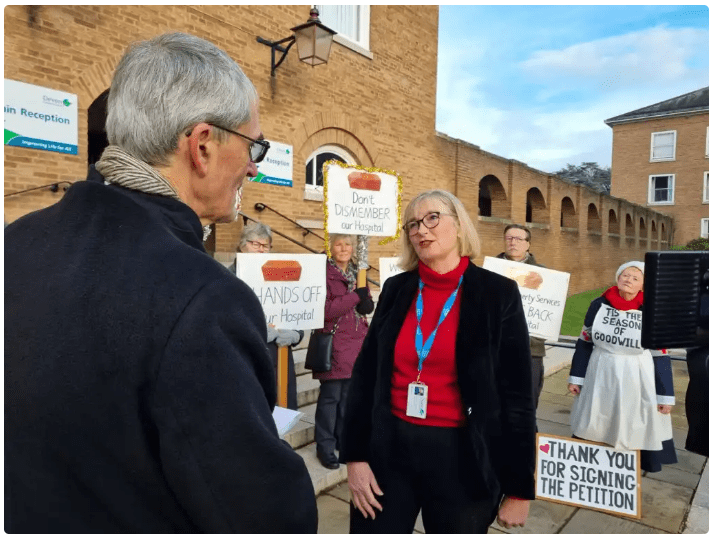
He said he had tried to get a NHS dentist to open in Lynton after 1,000 residents sign a petition, but it didn’t come to fruition because of funding issues. Residents in this part of North Devon have to travel 20 miles to see a dentist, he said.

Cllr David Clayton (Lib Dem, Barnstaple with Westacott) said dentistry had been flagged up by North Devon’s Conservative MP Selaine Saxby since she was elected and he hoped she would to more to raise the issue in parliament.

Members agreed to write to her to ask her to make dentistry the thrust of a private members’ bill, which allow her to try to get an issue made law.

Ms Saxby said last year the government reformed dental contracts so dental practices can maximise the number of NHS patients they can see.

In April, dental contracts becamethe responsibility of Integrated Care Boards, and the government is considering how to speed up the recruitment of overseas’ dentists.

But she said the changes are not happening soon enough. “Whilst I welcome the long term plans the government is bringing in for more dentists in areas like North Devon, concrete steps need to be taken now so that people’s health is not negatively affected,” she said.

“I urge everyone in North Devon to sign this petition which I will take back to Westminster as a demonstration of just how much immediate action is needed.”

The petition is at https://change.org/DentistsinNorthDevon

Calls for round-the-table talks to aid the success of Exmouth seafront and town revamp

The planned revamp of Exmouth town and seafront will rely on round-the-table talks between town, district, and county councils for success, it is believed.

Local Democracy Reporter eastdevonnews.co.uk

Exmouth’s regeneration vision can succeed more easily if it is not developed in isolation, proponents have claimed, writes local democracy reporter Bradley Gerrard.

East Devon Councillors want to create a steering group including all levels of local government to streamline the proposals.

Last week, members of East Devon District Council’s (EDDC) ‘placemaking in Exmouth town and seafront’ group suggested that the plans, which are at an early stage, may hit fewer challenges if town, district and county councillors work together.

East Devon’s leader Paul Arnott (Lib Dem, Coly Valley) gave the example of Exmouth’s Dinan Way extension, which has nearly £16 million of Levelling Up funding from the Government, as a project that could clash with the town’s regeneration plan if the different authorities don’t communicate with each other.

“In practical terms, we do need to have some form of political meeting with the county and town authorities,” he said.

“There’s an opportunity here with our plan, but there are also risks that we could diverge.

“And so, I think we should reach out in the next few days to the town and county councils to officially share our plan with them in its current form, start discussions and even form a steering group.”

Cllr Arnott’s suggestion was supported by the meeting’s chair, Councillor Nick Hookway (Lib Dem, Exmouth Littleham). The motion was approved.

The regeneration plans were presented by East Devon’s project manager Gerry Mills, and Gayatri Suryawanshi from WSP, a consultancy firm assisting with the plan.

Mr Mills stressed that any ideas in the plan at present were just that, and that nothing was confirmed.

Councillors debated competing issues, such as suggestions about further development on the seafront against the need for greater levels of sea defences, and encouraging more water sports activities in the town against the need to protect wildlife, the environment and ensure the beach remains accessible for all.

A key plank of the plan centres on making the seafront better connected with the town centre.

Councillors were generally in favour of this, however, some noted that if the area between the town and seafront was too open, then the effects of bad weather from the beach could make its way into the town.

Other suggestions included allowing development on some car parks and expanding others to help ensure the number of spaces remained the same.

However, Councillor Eileen Wragg (Lib Dem, Exmouth Town) said that one proposal to develop a car park into business units had existed for some time, but never got off the ground.

Cllr Wragg also balked at the suggestion of moving the leisure centre.

“I just can’t get my head around that,” she said.

“The cost of moving an organisation that has already had to have financial support from us and the government means that, at the moment, I think that’s a non-starter.

Suggestions of improving the entrance to the railway station, creating hubs of activity in different parts of the town, and considering reducing traffic in the town were broadly welcomed.

Councillor Olly Davey (Green Party, Exmouth Littleham), who chairs East Devon’s strategic planning committee, welcomed a focus on reducing cars in the town.

However, he questioned some proposals, including whether Exmouth Pavilion would make a better arts hub than the sports hub suggested in the current proposals.

“Also, if we are considering removing some parking along the seafront, this implies a loss of parking income for Devon County Council, so we would have to ensure we factor that in,” he said.

Mr Mills added that he had a strong relationship with the county council and that he and his team had been working to generate more regular dialogue with the authority in relation to various topics.

“Our plan will have to involved the county as we [East Devon District Council] don’t existing in isolation, and I’m quite sure that when they see our plan, they will see it as an opportunity,” he said.

Confusion reigns in Mid Devon 

Tension at a Devon local authority is escalating after claims that a vote on how it makes decisions could be illegal.

Bradley Gerrard, local democracy reporter www.radioexe.co.uk

Mid Devon District Council has agreed to enhance the decision-making system that it currently uses, but one councillor believes this at odds with a motion passed in February for a wholesale change.

Councillor Nikki Woollatt (Ind, Cullompton St Andrews) expressed her shock that an agreement earlier in the year to switch to a committee style of decision-making was ditched this month.

Cllr Woollatt tabled February’s motion to change from the current executive structure, which includes a leader and a cabinet, to a modernised committee system, and this was approved.

However, some who voted for it suggested they did not think it was a cast-iron agreement.

A committee system, which can be set up in multiple ways, is viewed by the Centre for Governance and Scrutiny (CfGS) as enabling “more consensus decision-making,” with the leader-cabinet system less so, and a mayoral system less so again.

“The current leader, Luke Taylor, seconded my motion in February, and it was a momentous decision,” Cllr Woollatt said.

“It’s a very personal issue for me, as I have campaigned on it for 12 years, including with [the late] Councillor Jenny Roach, who died in 2018.

“This U-turn is very disappointing to say the least.”

Cllr Woollatt said her motion had been “clear and unambiguous”, and therefore was surprised that a report at this month’s meeting provided an option to essentially remain with the status quo.

“What we’ve been asked here I don’t think is legal, and I think it is highly irregular to vote on a decision that has already been made,” she said.

Confusion seemed to centre on what had actually been voted for in February.

Some felt that the motion was merely an indication that the council would investigate a possible move to a committee system, rather than a binding vote.

Councillor Polly Colthorpe (Cons, Way) said she felt officers had been asked to look at what would be required to change to a new system.

“Some of the wording in this report suggests a decision was taken by that council, but I do not consider that it was,” she said.

Councillor James Buczkowski (Lib Dem, Cullompton St Andrews) voted in favour of Cllr Woollatt’s motion in February, but said he did so in order for “further work with detailed options and a further final decision required by council.”

Monitoring officer Maria De Leiburne said she had made a “big caveat” at the February meeting as to the vote being an indication of what members might want, with the different options set to be brought back to full council another time for a proper decision.

Councillor Frank Letch (Lib Dem, Crediton Lawrence) raised the issue that most councillors this month were not present in February because a significant number were only elected in May.

Liberal Democrat leader Luke Taylor (Bradninch) supported Cllr Woollatt’s motion in February but said this was due to what he claimed had been “dictatorial practices” witnessed in previous administrations.

He said he preferred the hybrid-style the council uses now, which has policy development groups to support decision-making alongside the leader and cabinet. He also worries about potential “dither and delay” with the committee system.

He proposed to implement a more robust hybrid system, which was passed, although Cllr Woollatt, who voted against it, stated: “I believe that decision is illegal.”

A 2020 report by the Centre for Governance and Scrutiny (CfGS) says if a change in governance structure happens by way of resolution, the council is “effectively locked in to the new arrangement five years.

Cllr Woollatt believes that means Mid Devon District Council has to adopt a committee-style system, and this has to be done at its next annual general meeting by law.

A Mid Devon District Council spokesperson said the question of how the council was set up had been a hot topic for years, with a decision in 2021 being made to retain the cabinet system.

They added that when the issue re-emerged last February, the monitoring officer was “crystal clear” that if members voted for the motion, it would need to be brought back to full council.

“In debate, councillors heard and discussed that there were lots of options about what a ‘modernised committee system’ could look like,” the spokesperson said.

“This was precisely why the monitoring officer advised, before members voted on the motion, that this would not be the final decision – since she would need to work up these options for members to consider what exactly they were minded to move to.

“Members heard this advice, every indication is that they understood this advice, and voted in the context of having received it.”

The spokesperson added it was “unfortunate” that recollections of this differed, but that the tape recording of the February meeting “captures the clear advice at the time” that a final decision would be needed in the future.

The current council has a Liberal Democrat majority after the party gained 21 seats in May’s local election, giving it 33 of the 42 seats.

UK Environment secretary took donation from funder of climate sceptic thinktank

“This government will have integrity, professionalism and accountability at every level.”

The new environment secretary, Steve Barclay, received a donation from a major funder of a climate sceptic thinktank just weeks before taking up his role, the Guardian can reveal.

Helena Horton www.theguardian.com 

Barclay accepted £3,000 from Michael Hintze on 20 October, and is being asked by campaigners to reveal whether he has been lobbied on climate issues by those who seek to deny the extent of climate breakdown.

Lord Hintze has been one of the key funders of the Global Warming Policy Foundation, a UK-based thinktank that has denied the legitimacy of climate science, and he was one of its earliest backers.

The thinktank focuses on questioning policy on the climate crisis, and was set up by the former Conservative chancellor Nigel Lawson, who has said that climate change is not a threat, but “happening very gently at a fraction of a degree per decade, which is something we can perfectly well live with”. The thinktank has produced reviews – at odds with mainstream science – that claim the climate emergency is not happening, or downplay the extent of it.

Tory MPs have at various times been trustees of the thinktank, including until recently the Northern Ireland minister, Steve Baker. He quit his trusteeship when he took up the ministerial post.

It has recently led the backlash against government net zero policies, and celebrated when Rishi Sunak recently announced announced his intention to roll back on climate measures. The Guardian revealed last year that the thinktank had received funding from groups with oil and gas interests.

The environment secretary already faces conflict of interest concerns over his wife’s job at a water company. Karen Barclay holds a senior position at Anglian Water as head of major infrastructure, planning and stakeholder engagement. As secretary of state, Barclay is responsible for overseeing the regulation of water companies. He is responsible for ensuring water firms make improvements regarding sewage pollution via the government’s storm overflow reduction plan.

Regarding the donation, campaigners have said it is inappropriate for someone charged with protecting the natural world to take funds from someone who is such a major backer of a climate sceptic group.

Jolyon Maugham, the director of the Good Law Project, said: “Steve Barclay is taking money from a man who has been a key funder of a climate change denial group and who has ties to Tufton Street. And he’s the environment secretary? Is this some kind of hilarious Conservative party in-joke? Because the younger generation aren’t laughing – and neither is the global south.”

MPs are expected to ask if Barclay agrees with or endorses the views of the GWPF.

Caroline Lucas, the Green MP for Brighton Pavilion, said: “Steve Barclay has some serious questions to answer. When our natural world faces ever-increasing threats as a result of the climate emergency, we can’t have an environment secretary taking donations from a major backer of the climate-denying GWPF. I’d like to know why Barclay accepted this donation; what conversations with Lord Hintze he had before and since receiving it; and whether he agrees with GWPF’s climate-denying views.”

Hintze has been contacted for comment.

A source close to Steve Barclay said: “All donations to Steve’s office are declared in line with the MPs’ code of conduct.

“Lord Hintze is a Conservative peer and regular party donor who supports a number of Conservative MPs. Steve has never discussed environmental policy with him.

“Steve is fully committed to the government’s net zero aims. Protecting our environment for future generations is one of his key priorities and that includes urgently tackling climate change.”

Cornwall’s Brexit replacement cash runs out

“When the Conservatives broke their promise to match EU funding at £100m a year and gave us just £43m a year we warned this would be nowhere near enough. Now we have the stark proof. Cornwall was lied to. There will be a general election next year and council election early the year after. In the meantime no-one will be able to apply for any Shared Prosperity Funding because there isn’t any.” Cllr Tim Dwelly, Labour, the council’s shadow cabinet member for economy,

Lee Trewhela, local democracy reporter www.radioexe.co.uk

Cornwall Council has confirmed that the money it receives from the government to replace EU grants following Brexit will run out in a month’s time, leaving over £230m of fund applications by Cornish communities and businesses unmet.

The council’s shadow cabinet member for economy has said this is “devastating” and has accused the government of lying to Cornwall.

The government confirmed in 2021 that “total funding through the UK Shared Prosperity Fund (SPF) will at a minimum match the size of EU funds in each nation and in Cornwall each year” and it was estimated that “no worse off” equated to an average of £100 million a year for the Duchy until 2025, with an additional three years to complete the spend of the investment. In reality, Cornwall has received around £43m a year.

The government has currently not made clear to Cornwall if the Shared Prosperity Fund will continue after 2025, when the current tranche of money is due to end.

Cornwall Council’s £138m Good Growth programme consists of the £132m Shared Prosperity Fund and a £5.6m Rural Prosperity Fund. As of October 2023, the programme received 1,395 expressions of interest which have resulted in 461 applications, requesting a total of £375m in SPF grant.

A total of 127 projects have been approved to date at a SPF value of £128m and a total project value of £189.4m. The council anticipates that the total £138m programme will be fully committed, with funding approved for specific projects, by the end of this year.

That means that over £230m of SPF requests will not be met, although they may have been rejected for a variety of reasons.

Cllr Tim Dwelly, the council’s shadow cabinet member for economy, said: “These figures are devastating. They show that Cornwall’s disappointing Shared Prosperity Fund allocation will have been all spent by next month. It’s depressing to see that over £230m of funds applied for will now be refused. The applications from Cornish community groups and businesses were for almost three times the amount Cornwall got.

“When the Conservatives broke their promise to match EU funding at £100m a year and gave us just £43m a year we warned this would be nowhere near enough. Now we have the stark proof. Cornwall was lied to. There will be a general election next year and council election early the year after. In the meantime no-one will be able to apply for any Shared Prosperity Funding because there isn’t any.”

Independent councillor and former leader of Cornwall Council Julian German added: “Cornwall needs Government to sort out its urban funding bias for local government services – urban areas get 38 per cent more in government funding spending power than rural areas. On top of this, it costs more to deliver services in rural areas.

“If government is serious about levelling up, then councils need certainty of regeneration funding over a number of years. For Cornwall, the starting point is the government promise of £100m a year for seven years. It’s very sad that this isn’t happening as it will harm people’s prospects and the vitality of our communities.”

When responding to questions about SPF post-2025, Government ministers have consistently pointed out the limits of any government in making commitments beyond the current spending review and indeed beyond the current parliament. Cornwall Council has not had clarity from Westminster on the fund beyond March 2025, largely due to the prospect of the general election which is due to take place no later than January of that year.

Conservative Cllr Linda Taylor, leader of Cornwall Council, has written to highlight the importance of an extension to the SPF programme beyond the 2025 cut-off date and Cornwall Council continues to make representations to the Government to seek clarity on how the SPF programme will be funded post-2025 and advocate for continued investment for Cornwall and the Isles of Scilly including longer investment periods.

A Cornwall Council spokesperson said: “The current tranche of SPF funding is designed to cover the three financial years up to 2025 and we are on course to meet the timetable for allocating the funding, having considered each application in line with our Good Growth UK Shared Prosperity Investment Plan.

“We await confirmation from the government of how and when the next tranche of funding after 2025 will be delivered, and we will continue to push for a fair deal for Cornwall and the Isles of Scilly.”

The council’s leader Cllr Linda Taylor, deputy leader and portfolio holder for resources Cllr David Harris and Cllr Louis Gardner, portfolio holder for economy, have all been approached for comment but have not responded.

Tory Junk Mail and their record on “Five Point Plans” 

Martin Shaw seatonmatters.org

More expensive junk mail from the party that sabotaged Seaton Hospital

I’m feeling rather cross about this. Royal Mail have delivered yet another lavish piece of propaganda from the party that sabotaged Seaton Hospital. It’s filed in my special place for them (pictured) but before I add it to my recycling, a reminder of the Conservatives’ 5-point plan for Seaton Hospital:

  1. Hand over the hospital – which Seaton people paid for – to a property company, NHS Property Services, which charges market rates to use it (2016).
  2. Switch Seaton’s beds to Sidmouth to save the skin of Tory MP Hugo Swire, then use the Tory majority on the Scrutiny Committee to defeat our attempt to block the decision (2017)
  3. Let NHS Property Services turn down Seaton’s proposals to use the empty space because we can’t afford to pay market rates to use our own hospital (2020).
  4. Accuse anyone who expresses fears for the hospital of scaremongering – yes, that’s what they did to me when I stood for re-election (2021).
  5. Allow the NHS to hand back the underused wing to NHS Property Services for disposal (2023).

Our Liberal Democrat MP, Richard Foord, who we elected in last year’s by-election, hasn’t got the big money backing that the Tories are using to pay for this propaganda.

Richard is doing a brilliant job supporting Seaton Hospital. I’m not a Lib Dem, but I think we need to raise some funds for him to compete with this corporate propaganda.

Seven Churches  to ring their bells on Saturday to begin new Seaton protest

The local community’s campaign to save the threatened wing of Seaton Hospital takes another step forward this Saturday:

1. Seven local churches will be ringing their bells to mark the beginning of a day of action  

  • Seaton St Gregory (pictured below): a bell will be slowly tolled from 9 am; Beer St. Michael, Axmouth St. Michael, Musbury St Michael, Colyford St Michael, Colyton St. Andrew (from 10.00), St. Winifred’s Branscombe – nonconformist churches are also supporting but they don’t have bells! The organiser of this is Rev Barry Brewer barrybrewer29@gmail.com

2. Hospital supporters will meet in the main centres to leaflet shoppers and collect signatures (in Seaton we’ll have a loudhailer and there will be speeches at the start)

  • in Seaton (outside Tramway), Beer (Mariners Hall) and Colyton (Market Square)

3. Supporters have distributed 9,000 leaflets in all the towns and villages of the local area in the last 3 days (see attached artwork).

4. Petition forms are being widely circulated & everyone is signing, and two online petitions have already gathered over 1500 signatures between them.

5. The campaign is greatly heartened by the support of the Devon Health Scrutiny last Thursday and in the parliamentary debate obtained by our MP, Richard Foord, on Monday. 

6. We believe the Integrated Care Board and NHS Property Services must now listen to our case. Seaton paid 100 per cent of the threatened wing and we need it to be used for local health provision without paying exorbitant rents.

MARTIN SHAW / 07972 760254

Acting secretary, Seaton Hospital Steering Committee

Batshit 

Noun: vulgar description of bat excrement

Adjective: slang meaning  very foolish or strange in a way that is hard to understand; insane or crazy.

So not an expression you would expect a Foreign Secretary to use to describe government policy.

But wait…….

James Cleverly refuses to deny he called Rishi Sunak’s Rwanda scheme ‘batshit’

www.independent.co.uk (Extract)

James Cleverly has repeatedly refused to deny that he called Rishi Sunak’s Rwanda deportation plan “batshit”.

The new home secretary said he “doesn’t remember” describing the scheme that way after Yvette Cooper claimed he did during a grilling in the House of Commons…..

Not to be confused with:

Bullshit: slang something that is untrue, complete nonsense, exaggerated or boastful.

I pray you, remember the porter!

Tory MP calls out Keir Starmer’s ‘lack of manners’ after he ‘fails to say thank you’

Express headlines!

Is this really him? – Owl

Richard Ashmore www.express.co.uk (Extract)

A Conservative MP has claimed Sir Keir Starmer just gives him a “glare, stare, or blank expression” whenever he holds a door open for the Labour leader in Westminster.

Simon Jupp, who represents East Devon, made the bad manners accusation on X, formerly known as Twitter, and said “most people signal their thanks” but “never Sir Keir”.

An indignant Mr Jupp tagged Sir Keir in his post and wrote: “On several occasions, I have held the door open on the Parliamentary estate for Sir Keir Starmer and did so moments ago, as I try to do for everyone.

“Most people signal their thanks, but never Sir Keir. I just get a glare, stare, or blank expression. Good manners cost nothing.”…..

Quite a lot of “interesting” comment on social media including:

“You’re a fine one to talk about ignorance! How many of us [constituents] have you ignored in the past few months? You block us on social media for just asking relevant questions about our local community! We won’t be voting for you next election! From Sam

Letting rules ‘could destroy’ self-catering sector in Wales

An attempt to force empty second homes on to the market by demanding that businesses let their properties for 182 days a year risks destroying the self-catering holiday industry in Wales, business leaders have warned.

Will Humphries www.thetimes.co.uk

The high threshold set by the Labour government in Wales is said to be impossible for many holiday let owners to reach and is penalising farmers and homeowners trying to supplement their incomes by converting barns and outbuildings on their land.

If owners do not hit the threshold of 182 days let and 252 days available to let, they revert to paying council tax as an “empty second home”. The threshold in England is 70 days let and 140 available to let.

Once reverted to council tax, each Welsh council has been given the option to charge an additional premium of up to 300 per cent council tax on empty second home properties.

The Welsh government brought in the rule last year to combat the number of second homes in holiday destinations by forcing empty second homes to be put on the market as residential properties.

However, in a survey by the Professional Association of Self Caterers UK — which received responses from 1,500 Welsh business operators — only 51 per cent said they had hit the 182 days’ let target in the year to March 2023 and only 25 per cent thought they would reach the target in the year to next March. Seventy per cent said they were discounting to try to hit the 182-day threshold, so were losing money because they were unable to pass on rising energy and electricity costs.

Alistair Handyside, executive chairman of the association, said: “Getting these enormous [council tax] bills at the end of a poor year’s trading is horrendous. We are seeing real mental health issues as a result of the pressures. What other kind of business has to hit a deliberately high threshold set by government in order to not pay tax?”

Handyside said there were only so many holiday days for which most operators could find customers. “It’s illegal to take kids out of school in term-time and empty nesters are not a big enough market to fill weeks in the out season,” he said. “Even if you filled all the holidays, bank holiday weekends and every weekend in the year you would not achieve close to 182. It would be nearer 100, which is why all the industry has been asking for a 105-day threshold for years. To achieve 105 you would still need to be open all year — and add to this the variables of the economy, weather and market demand.

“This summer was pretty much a washout. This creates a double whammy for self-caterers. Less income, more tax. With [a] beach luxury pad you can probably hit 182 [easily], but with a small cottage nestling in the Welsh hills in a less known area? Not a chance, even if [the] economy, weather and marketing all aligned.”

Mandy McDermott, 58, who bought a farmhouse with three holiday lets in converted barns, said the mental stress of chasing the 182-day target was “horrendous” and that if she did not make it she could face paying about £5,000 in taxes.

McDermott, who runs her Golly Farm Cottages business near Wrexham, north Wales, said: “My holiday lets are clearly a business because they can’t become second homes under planning restrictions. There are a lot of us with converted barns and outbuildings who shouldn’t be caught up in this.”

She said that the cost of living crisis was affecting bookings while at the same time pushing up her own costs. “The council doesn’t tell a baker they have to sell 150 granary loaves,” she said. “It just leaves you thinking who is running my business here? Someone in the government sitting somewhere with a bonkers idea.”

A Welsh government spokesman said: “The changes to the local tax rules for self-catering accommodation and second homes are designed to help develop a fairer housing market and ensure property owners make a fair contribution to the communities where they own homes or run businesses.

“Tourism makes an important contribution to the Welsh economy and to Welsh life. We do, though, need to ensure appropriate balance. We believe that everybody has a right to a decent, affordable home to buy or to rent in their own communities so they can live and work locally.”

High inflation has cost UK workers equivalent of a 3p income tax rise

“Rishi Sunak congratulating himself over today’s [15 November] figures will be cold comfort for all the hard-working people still bearing the brunt of this Conservative chaos. 

“For months on end, people across the country have been watching as their pay cheque gets squeezed from all sides, draining every spare penny. From the ever-increasing cost of the weekly shop to skyrocketing mortgage payments. 

“Enough is enough. With next week’s Autumn Statement the Government must properly help families and pensioners struggling with the cost-of-living crisis and give our NHS the funding it desperately needs.” Liberal Democrat Treasury spokesperson Sarah Olney MP 

Lib Dem analysis as reported in the Times:

Oliver Wright www.thetimes.co.uk 

Higher prices have cost workers the equivalent of a 3p rise in income tax over the past two years, new research suggests, as Rishi Sunak looks set to finally hit his 5 per cent inflation target.

An analysis by the House of Commons library found that for 22 months of the last two years, average salaries increased by less than the rising cost of living.

Researchers calculated that a worker earning £28,400 in October 2021 was now £697 worse off than they would have been if pay had kept pace with inflation. For someone earning £55,000 a year the loss was even greater with average salaries now £1,348 less than might have been expected without steeply rising prices.

They added that the losses were greater than if the government had increased income tax by 3p in the pound and average earnings had kept pace with inflation.

The analysis comes ahead of new data from the Office of National Statistics due to be published on Wednesday which is likely to show that the prime minister has met his pledge to bring down inflation to below five per cent two months earlier than he promised.

Inflation stood at 6.7 per cent in September but economists expect it to fall sharply when October’s figures are released because last year’s Ofgem energy price cap increase will have dropped out of the data.

The consensus forecast is that inflation will have fallen to 4.8 per cent — 0.2 percentage points below Sunak’s target, which he pledged to meet by the end of the year.

In other good news for the government, separate figures showed that despite the hit on living standards over the last two years wage growth is now finally outstripping inflation.

The ONS said average regular earnings, excluding bonuses, increased by 7.7 per cent in the three months to September, down from an upwardly revised and record high of 7.9 cer cent in the previous three months.

At the same time, the unemployment rate was unchanged at 4.2 per cent, although job vacancies fell to the lowest level for more than two years, down 58,000 quarter-on-quarter at 957,000.

Jeremy Hunt said it was “heartening” to see inflation falling and real wages growing which meant “keeping more money in people’s pockets”. Speaking in the House of Commons, the chancellor said the government was starting to “win the battle” against inflation which would allow the government to “focus on the next stage” at his autumn statement next week.

“As we start to win the battle against inflation, we can focus on the next stage which is growth,” he said.

But the Liberal Democrats, which commissioned the Commons research on lost earnings, said the words would “ring hollow for families who have seen their wages decimated by years of Conservative chaos”.

“The squeezed middle has been hardest hit by this toxic mix of stagnant wages and high inflation,” Sarah Olney, the party’s Treasury spokeswoman, said.

‘The Conservative Party has completely run out of steam and is holding our economy back.”

Economists said the latest wage growth figures, together with last week’s official data showing a stalling economy with zero growth in the third quarter, were likely to persuade the Bank of England to hold off from further interest rate rises.

Policymakers at the Bank are watching wage growth closely, with the recent record highs having been a cause for concern in its battle to bring inflation back down to the 2 per cent target.

Rates are now widely seen as having peaked at 5.25 per cent and with the threat of recession looming large, some economists believe the Bank will move to begin cutting borrowing costs in 2024.

Samuel Tombs at Pantheon Macroeconomics said: “Wage growth is slowing sufficiently quickly for the Monetary Policy Committee to conclude that bank rate already is high enough at 5.25 per cent”.

Hunt suggested that the autumn statement was likely to extend — or even make permanent — tax breaks for companies who invest in new technology or equipment.

In his budget in March announced a three-year policy of “full expensing” under which companies could set off investments from higher levels of corporation tax.

There have been calls to make the tax break permanent at a cost to the Treasury of around £10 billion a year. Hunt said: “I will focus on increasing business investment because, despite the fact that our growth has been faster than many of our European neighbours, our productivity is still lower.”

Flood protection plans for English homes cut by 40%

The number of properties that will be better protected from flooding by 2027 has been cut by 40%, and 500 of 2,000 new flood defence projects have been abandoned, according to the National Audit Office (NAO).

Helena Horton www.theguardian.com 

The number of homes forecast to be under enhanced flood protection by 2027 has been slashed from 336,000 to 200,000. This means 136,000 more homes will be at risk of flooding since plans were drawn up in 2020, figures from an NAO report show.

Despite the government doubling its capital funding in England to £5.2bn to combat the danger of flooding, a quarter of new flood defence projects will now not go ahead. The Environment Agency (EA) has blamed inflation for the cuts in protection.

Thousands of homes have been flooded during storms this autumn. Storm Babet was confirmed to have caused more than 2,000 homes to flood, while Storm Ciarán flooded more than 1,000. Storm Debi, which is causing havoc in Ireland, is expected to hit the west of England this week. Climate experts say storms are becoming more frequent and severe due to climate breakdown.

The EA has added protection from floods to 59,000 properties in England since 2020. It had a target of protecting 336,000 homes by 2027.

A shortfall in the agency’s finances means it cannot keep enough flood protections in the required condition to prevent destruction to homes. Due to inflation, the EA is £34m short of its expected budget, which means it will be be able to maintain only 94% to 95% of its assets at the required condition, resulting in 203,000 properties at increased risk of flooding. It had aimed to maintain 98% of its high-consequence assets at their required condition.

The flood protection programme got off to a slow start. There was an underspend of £310m in its first two years, which has been deferred by the Treasury to make sure the government meets its target of spending £5.2bn on flood defences by 2027. Because of this underspend the EA will have to spend an average of almost £1bn each year over the remaining four years of the programme. There are fears from the NAO that these pressures will further erode value for money if hasty decisions are made to spend the funds.

The NAO has also warned that the government has not set a long-term target for the level of flood resilience it expects to achieve and that there are no concrete plans beyond 2026 to meet long-term goals, meaning that long-term investment could be inefficient and not sufficiently protect enough homes from flooding.

Gareth Davies, the head of the NAO, said: “Government recognises the growing dangers from flooding and has committed to doubling its capital funding in England in the six years to 2027, as well as doing more to understand flood risk.

“However, the capital funding is forecast to better protect only 60% of the properties that were promised when the programme was launched in 2020, while inflation and other programme risks mean the Environment Agency could deliver even fewer than that. If there are further delays to the capital programme, Defra must work with HM Treasury to make sure it is in a position to switch money quickly into maintenance, where this would provide value for money.

“EA will have to manage a record level of capital investment in flood defences for the remaining four years of the programme. In doing so, it must resist pressure to accelerate projects or initiate new ones too quickly, if this is likely to lead to cost overruns and delays and put value for money at risk.”

Caroline Lucas, the Green party MP, said: “This report should be right at the top of new environment secretary Steve Barclay’s red box, laying bare the scale of ministers’ unforgivable neglect of this flooding crisis. Just weeks after huge numbers of homes were hit by devastating flooding, people are crying out for support and protection – yet this government has utterly failed to provide it. To add insult to injury, thousands more are expected to be unprotected from flooding risk in the years ahead.”

Tenth incumbent in thirteen years: ‘worst environment secretary ever’ 

A leading environmentalist described her to me as “the rudest and most uninterested politician” they had met. Farmers named her “the worst environment secretary ever” when all she could say about the devastating recent storms was that her department was ill prepared for “rain from the east”.

From Pig World magazine to Grocery Gazette, The National Trust, the RSPCA, the Country Land and Business Association and the fishing industry, no one lamented her demise. Senior civil servants called her “sullen, haughty and divisive”. The right to roam advocate Guy Shrubsole uttered the only kind words: “May you roam freely into the political wilderness, although the beavers might complain.”

Alice Thomson www.thetimes.co.uk (Extract)

Sixteenth Housing Minister in thirteen years!

Strong and stable government? – Owl

The sacking of Rachel Maclean means the UK is about to get its 16th housing minister since 2010. Housing campaigners are appalled, saying the government is failing to tackle problems in the sector because ministers change too frequently.

From Guardian Live:

This is from Polly Neate, chief executive of the housing charity Shelter.

The revolving door of housing ministers over the past decade, and in particular the last 18 months, proves the government’s failure to grasp the scale and urgency of the housing emergency. Rents are rocketing, evictions are soaring and homelessness is at a record high, yet we haven’t had a minister stay in the job long enough to get to grips with the problem.

The 16th housing minister since 2010 has to hit the ground running and the first thing on their to do list must be to pass a watertight renters (reform) bill and scrap no fault evictions.

And this is from Tom Darling, campaign manager at the Renters’ Reform Coalition.

Rachel Maclean attended our events and, though we don’t believe the government are going far enough on rental reform, she was always willing to engage with us – we wish her well for the future.

It is frankly shambolic that we will now be on to our 16th housing minister since 2010, and incredibly 9 just since the government promised to end no-fault evictions.

Now, just before the first day of the important committee stage, which involves poring over the detail of the bill, she is sacked – it makes a mockery of government and shows a shocking lack of respect for England’s 11 million private renters.

Planning applications validated by EDDC for week beginning 30 October

Will Simon Jupp now reinvent himself as a “wet”

Under the headline:

Rishi Sunak’s reshuffle gamble has set up a life and death struggle with the Tory right

the political editor of the Express reports:

“There is a belief widely shared that the reshuffle was “about destroying the right of the party.”

In so doing, it was also about “abandoning the new Red Wall seats won in 2019.”

One MP noted: “All the campaign cash is going to wet MPs in the south of England. They are more worried about dealing with the Lib Dem vote.”

This would mean that after an election the party will be “dominated by lefty Lib Dem-ish wets” as one put it.”

Using 1980’s terminology, do we think Simon Jupp is a “wet”, as defined above, or one of the right wing “dries”.

One thing is certain is that Simon Jupp is clearly politically ambitious gaining his experience in “interesting” company.

 He started his political career as a SpAd to Dominic Raab, generally described as a rightwinger, even as being more rightwing on education than Thatcher.

This seemed to give him an entrée into being selected as the Tory candidate to follow Hugo Swire and he was elected an MP in 2019.

Fast forward.

In October 2022 he “united” behind Liz Truss and was rewarded by being newly promoted as a PPS to right-winger Simon Clarke when he became Secretary of State for Levelling-up, Housing and Communities. 

His old boss Simon Clarke used unsubtle sporting metaphors on Monday to make his position clear:

Source

Owl’s view is that Leopards don’t change their spots: be on the lookout for Simon trying  to “reinvent” himself as a lefty LibDemish wet.

“Care in the community” – Does the Minister know much of it is unsustainable?

In answer to Richard Foord’s debate on the closure of the Seaton Hospital wing,  the Minister for Social Care, Helen Whately, extolled the virtue of virtual care and care in the community in place of hospital beds, saying:

“Across the country, we have achieved a lot as part of our commitment to move more care out into the community.”

However, as described in the article below, much Social Care is contracted out to public charities on an unsustainable basis, for example:

The Stroke Association, which is contracted by the NHS and local authorities to deliver stroke recovery services for tens of thousands of patients once they have been discharged from hospital, said last year it was paid just under £11m for services costing nearly £17m, with the £6m gap met through public fundraising.

What happens when this “outsourcing” dries up? – Owl

English charities ‘near insolvency’ after subsidising public sector contracts

Patrick Butler www.theguardian.com 

Charities in England are on the brink of insolvency after subsidising heavily underfunded local authority and NHS contracts to the tune of hundreds of millions of pounds donated to them by the public, voluntary sector leaders have warned.

Donations, will legacies and charity shop profits are being used to prop up thousands of state-funded services in danger of closure, including care homes, homeless shelters, addiction projects and physical rehabilitation support schemes.

One charity told the Guardian it used £6m a year raised from the public and other donors to subsidise clinical and care services it provided under contract to the NHS and local authorities, a sum it described as “unsustainable”.

The refusal of local authorities, the NHS and government departments to fund the real cost of local service contracts – and the built-in assumption that voluntary sector will deliver “on the cheap” – was threatening the existence of vital local services, the National Council for Voluntary Organisations (NCVO) said.

“It’s potentially catastrophic for communities if these services stop,” said Sarah Vibert, the chief executive of NCVO. “Many services, like homelessness interventions and support for victims of domestic violence or sexual abuse, wouldn’t currently exist without charities.”

She added: “For too long, the goodwill of charities has been taken for granted. [Public sector contract managers] know charities will do everything possible, including subsidising public services with charitable funds, to prevent closing their door to someone. But this can’t continue.”

Although charities have been embedded in delivery of public services for years, the scale of the funding gap has pushed many charities to the edge as inflation and demand has soared, and councils and NHS bodies, many in financial crisis themselves, slash grants and refuse to uplift the value of contracts.

The Stroke Association, which is contracted by the NHS and local authorities to deliver stroke recovery services for tens of thousands of patients once they have been discharged from hospital, said last year it was paid just under £11m for services costing nearly £17m, with the £6m gap met through public fundraising.

It said the funding gap was unsustainable, meaning it would have to cut the volume and quality of services or walk away from contracts. “This will have an impact on people’s recovery from their stroke, emotionally and physically,” said Jen Garner, the Stroke Associations’s associate director in north-west England.

Charities fear more will follow in the footsteps of Leonard Cheshire, the social care charity that has been forced to shut care homes and evict vulnerable residents as a result of a financial crisis caused when its multimillion pound subsidy of hundreds of underfunded council contracts became unsustainable.

A detailed NCVO survey of its members reveals bitterness and frustration among charities who feel their focus on the needs of vulnerable beneficiaries is exploited by public bodies which routinely expect charities not to charge for the full cost of the service or to deliver it for “next to nothing”.

One respondent said: “[The local authority] see contract payments as ‘handouts to do-gooders’ instead of recognising that they are paying us to work for them because we able to do it better, cheaper, faster and with a more human and empathic approach.”

The survey of more than 330 charities found:

  • The vast majority were subsidising the cost of providing public services. Nearly half had not received an uplift in the value of the contract in the past two years, despite increasing demand and rising wage and energy costs.
  • Contracts were often only viable by freezing or cutting staff pay and conditions. One charity made a senior member of staff redundant, then took them back on as a volunteer to do their old job to keep vital services afloat.
  • A social care charity started a public fundraising campaign, and sold a building it owned, to raise the cash to maintain a service the council would only part fund. “[We are] not sure we can carry on unless something changes,” it said.

Although there is sympathy for councils and NHS bodies which are themselves in dire financial straits there is anger at public sector “double standards” that accept private contractors must make a profit while routinely expecting charities to run services at a loss, with donors picking up the tab.

A government spokesperson said: “We are backing the NHS with record funding. The NHS resource budget in England will be £165.9bn in 2024-25 – and that doesn’t include the additional £8.1bn for adult social care and discharge over two years.

“Local authorities have seen an increase in core spending power of up to £5.1bn or 9.4% in cash terms on 2022-23, with almost £60bn available for local government in England.”

“Local people helping local people” is how Nick Ralph describes the Good Neighbours network, a loose federation of 123 neighbourhood groups providing low-level informal care to vulnerable people across Hampshire in south-east England.

Its 4,000 volunteers drive isolated older citizens to hospital appointments, help them with shopping, dog walking or DIY tasks, and organise lunch clubs and other social events. It is classic preventive charity work, knitting communities together and reducing pressure on overstretched hospital and care services.

“It keeps vulnerable people independent and in their homes for longer, and out of expensive hospital beds. It’s the oil that keeps community wheels turning,” says Ralph, the executive director of the Council for Social Responsibility, a charity that supports the scheme on behalf of the Church of England diocese of Portsmouth.

The scheme costs £150,000 a year to run, but is under threat. Hampshire county council – itself facing financial “meltdown” – scrapped its grant in March and local NHS commissioners say their own £50,000 a year grant is at risk.

The charity, whose four staff ensure the countywide army of volunteers are trained, insured and security checked, will use its own funds to keep the service running until April. After that, it is unclear how many local groups will be able to continue.

Ralph understands the council’s predicament – its budget has been squeezed by government cuts – but believes the savings are shortsighted. “There will a loss of community support and as a result much more cost will be thrown on to the state,” he said.

Alarm raised over water firm job of new environment secretary’s wife

The new State for the Environment is surely going to have to “recuse” himself from any decision regarding pollution our rivers and seas or have we not moved on one iota from recent Tory sleaze? – Owl 

Sandra Laville www.theguardian.com 

Campaigners have raised concerns over a potential conflict of interest for the new UK environment secretary, Steve Barclay, whose wife is a senior executive at Anglian Water.

Barclay took on the environment role in Rishi Sunak’s cabinet reshuffle this week. His wife, Karen Barclay, holds a senior position at the water company, as head of major infrastructure (DCO) planning and stakeholder engagement.

As secretary of state, Barclay is responsible for overseeing the regulation of water companies. He is responsible for ensuring the water firms make improvements regarding sewage pollution via the government’s storm overflow reduction plan.

Anglian Water is one of six companies under investigation by the regulator Ofwat for potential illegal dumping of raw sewage. The Environment Agency is separately in the middle of a huge criminal investigation into illegal sewage dumping by water companies involving more than 2000 water treatment works.

Water companies are pressing government and the regulator Ofwat to approve £96bn investment in infrastructure improvements to fix leaks, stop sewage discharges and build more capacity at treatment plants, which they want customers to pay for via bill rises. Many critics say the public has already paid once for the investment, and should not be made to pay again for fixing problems which put the companies in breach of their legal duties.

Tim Farron, the rural spokesperson for the Liberal Democrats, said: “Ministers’ spouses do of course have the right to their own careers, but I do worry about the possible conflict of interest here for the man charged with forcing the water companies to clean up their act.

“We need to make sure the secretary of state is fully committed to doing everything in his power to stop the sewage scandal.”

This summer, Anglian Water pleaded guilty to allowing millions of litres of untreated sewage to overflow from a water recycling centre in Essex. It was fined £2.65m, the largest penalty imposed for environmental offences in the east of England region.

Ashley Smith, of Windrush Against Sewage Pollution, said there was a possible conflict of interest for the new secretary of state.

“It’s not just that the new environment secretary’s wife holds a senior post at Anglian Water, it is the fact that the water industry routinely operates outside the law, has misappropriated billions of bill payers’ money and now holds the country to ransom to hike bills to fix the mess it made and cannot be trusted to not make off with another windfall gifted by government,” said Smith.

A government spokesperson said: “All Defra ministers declare their interests in line with the ministerial code.

“There is an established regime in place for the declaration and management of interests held by ministers. This ensures that steps are taken to avoid or mitigate any potential or perceived conflicts of interest.”

Craig Bennett, the chief executive of the Wildlife Trusts, who chairs Anglian Water’s independent challenge board, said: “It would prudent for him to make sure this has been declared publicly and that it is all out in the open. Then it is something that can be managed.”

Karen Barclay has been approached for a comment. Anglian Water did not comment.

Concerns over new Health Secretary Victoria Atkins’ ‘conflict of interest’ in war on obesity as it’s revealed 47-year-old’s husband is sugar tycoon 

Conflict of interest concerns were today raised over the appointment of Victoria Atkins as Health Secretary.

This government will have integrity, professionalism and accountability at every level. – Owl

www.dailymail.co.uk  (Extract)

Just hours after being handed a prominent role in Rishi Sunak’s cabinet reshuffle, details of Ms Atkins’ husband role as chief executive of a world-leading sugar firm circled online.

Department of Health chiefs said Ms Atkins ‘will recuse herself’ from decisions that may be impacted by ‘outside interests’ because of Paul Kenward’s role at ABF Sugar, which supplies supermarkets and food manufacturers……..

7 hidden side effects of sugar | HCF

7 hidden side effects of sugar

  • Sugar makes your organs fat. …
  • It can lead to heart disease. …
  • It plays havoc with cholesterol levels. …
  • It’s linked with Alzheimer’s disease. …
  • It turns you into an addict. …
  • It disables your appetite control. …
  • It can make you depressed.