Does our East Devon District Council Chief Executive have a split personality when it comes to voter registration and engagement?

Our CEO, Mark Williams (shared with South Somerset) appears to have a split personality when it comes to voter registration.

In the large rural area of South Somerset, where door to door canvassing has always been done he sides with the Parliamentary Committee on Voter Registration which says that this is a mandatory step and it is breaking the law not to do it. A Committee member noted that the canvassing produced some 11,000- 12,000 extra names on the register in South Somerset.

In the large rural area of East Devon, where door to door canvassing has not been done since at least 2011, he sides with – er, well, himself and the ERO of Mid Devon – who say they are NOT breaking the law when they fail to do the canvassing. He says that this does not result in losing any voters as they are picked up “by other means” and that the other means are “more amiable” than going out to individuals on cold dark nights and trying to bribe them to register by saying that if you don’t you might not get a credit card. He did not address the concerns of EDA which says at least 6,000 voters were missing from the register at the last Euro election.

Here is a press release from the Electoral Commission, that says you MUST conduct house to house canvassing:

http://www.electoralcommission.org.uk/i-am-a/journalist/electoral-commission-media-centre/news-releases-reviews-and-research/electoral-registration-officers-must-all-conduct-house-to-house-canvassing-during-transition-to-new-electoral-registration-system?

Here is the relevant part of the legislation. In South Somerset, Mr Williams follows it to the letter, in East Devon he chooses to believe that it gives him the right to be “flexible”.

http://www.electoralcommission.org.uk/__data/assets/electoral_commission_pdf_file/0008/43955/Part-C-Annual-canvass-final-August-2009.pdf

“Duties of the Electoral Registration Officer

Steps to be taken by the Electoral Registration Officer

1.1 Under Section 9 of the Representation of the People Act 1983 (RPA 1983) an Electoral Registration Officer has a duty to maintain registers of UK Parliamentary and local government electors containing the name, qualifying address and electoral number of those persons appearing to them to be entitled to be registered in it.

1.2 This duty on the Electoral Registration Officer to maintain the register includes, but is not limited to, the requirement to conduct an annual canvass in accordance with Section 10 of the RPA 1983 for the purpose of ascertaining any persons who are entitled to be registered. This annual canvass is conducted with reference to the relevant date of 15 October, the relevant date being the date on which a person must be resident at the address they are applying to be registered at.”

From http://www.legislation.gov.uk/ukpga/1983/2/section/10/enacted

section 10 of the RotPA says:

“the registration officer shall—

(a) have a house to house or other sufficient inquiry made as to the persons entitled to be registered (excluding persons entitled to be registered in pursuance of a service declaration);”

In East Devon, Mr Williams relies on the last sentence to justify NOT canvassing, in South Somerset he relies on the information preceding it above to justify canvassing.

So, it seems Mr Williams has one rule for the Liberal Democrat controlled South Somerset District Council and one rule for the Conservative controlled East Devon District Council.

Will he explain the reasons for this difference at tomorrow’s Cabinet meeting?

Highlights of Mr Williams audio transcript of evidence to the Parliamentary Select Committee on Voter Engagement

This is a personal summary of major points from an EDA correspondent, based on the audio transcript above.

In his evidence to the Select Committee, Mark Williams said:

He had decided not to do house-to-house canvassing, even though it was a performance standard of the Electoral Commission. When asked if he believed himself to be in breach of the law he said, ” No”.

The two EROs were asked if they had made clear to their officers that they were repeatedly breaching the law by not doing house to house canvassing – neither answered the question.

He thought there were more “amenable ways” of registering voters than having people on their doorsteps on dark nights and mentioned telephone and internet registration. Earlier, both he and the ERO of Mid-Devon noted that one of the reasons people had not registered was low internet use!

He called people who did not respond to written requests to register as “Refusniks” although he had earlier said that sometimes lack of response was because people had died or moved into nursing homes.

Mr Williams said that if people had presented themselves for the Euro elections earlier this year and had not been registered, they were dealt with by officers at polling stations phoning his office when they would be told that they were on the “old register” and given advice to allow them to vote with the reason “clerical error”.

One of the committee noted that, in South Somerset, door to door canvassing had resulted in between 11,000 and 12,000 extra voters being registered. He gave a number of 3,231 homes not having been canvassed after non-registration in East Devon in 2013.

Both EROs were asked,” What price democracy?” £40,000 (the mid-Devon estimate of how much house to house canvassing cost) seemed a very small part of the overall budget. Each ERO said that their way of doing things was better than canvassing (and presumably cost almost nothing). The committee member wondered why, if this was the case, their method had not met with wider enthusiasm from other EROs!

Mr Williams said that he worked well with the “local” branch of the Electoral Commission, which seemed to understand his approach better than the national office. His was a “purposive” approach and resulted in less bureaucracy. Door to door canvassing was a “weak” element of the process and it was no use telling people that they would not get a credit card if they did not register [however, as he hasn’t done door to door canvassing since 2010 one wonders how he can make this claim].

He said it was much like when the Audit Commission had said how things should be done and he had ignored them and the outcomes had been better because sometimes we can do it better with alternative ways.

Mark Williams had no idea how many East Devon people were registered to vote overseas.

Mark Williams said that he preferred to do his electoral registration by “goal setting” rather than “prescriptively” – i.e. his way and not the Electoral Commission way, his way was more flexible.

A committee member said that he believed the two officers had repeatedly and brazenly broken the law, which they denied.  The member said he would check up on that.  A member said: if a Minister now writes to you and gives you a formal direction to do it the way the Electoral Commission says it should be done, what will you do. Mr Williams said he would do it and is already doing it this year.  If everyone did what these two EROs had done more than 3 million people would be missing from the Electoral Roll.

He said that all canvassers were now in place, would start work on 28 October and were being paid £8 per hour and not the living wage originally advertised (see post below on this).

He was asked who his line manager was – he said he didn’t have one. Then amended it to he supposed councillors.

He was asked if his Scrutiny Committee had examined the issue and if not, why not. He said no it had not and that was the choice of the Scrutiny Committee.

He was asked if there were any concerns. He said no. Not until very recently and only one person had addressed a recent [July 2014!] council on the matter.

He was asked how many people he had “knocked off” the register – he said none although he said that “a blog” had mentioned 6,000.

The two EROs were asked how their work could be improved. The Mid Devon ERO said that voting should be made obligatory and that if people did not vote they should be fined and the money should go to the local authority. [So, effectively spend no money on getting people to vote but take money from them if they don’t!]

EROs were asked what would be helpful for the next election. Mr Williams said that people should get more interested in politics, and do lobbying (yes, he did say that!) and he said that people would not vote if the councillors who put themselves up for election were not inspiring!

He said that the process should be smooth and convenient and that remedies such as “clerical error” and “breach of regulations” should be available on the day to enable those not registered to vote..

The Mid Devon ERO said that more devolution of responsibilities to local level where councillors had more accountability for local functions instead of a lot of central direction would help.

“I think you are one of the few authorities that have repeatedly and brazenly broken the law” , MP tells EDDC’s ERO

When asked today by the Parliamentary Select Committee whether his council’s scrutiny committee had expressed concerns about his performance,  EDDC’s Chief Executive, Mark Williams, who is also its Electoral Registration Officer (ERO) ,  replied,  “Not hitherto”. “There’s nobody else overseeing you,” was the swift retort from one MP.

Hear the full interview for yourself at  http://www.parliamentlive.tv/Main/Player.aspx?meetingId=16033

EDDC APPEARS TO BE STILL RECRUITING CANVASSERS

There seems to be confusion about whether EDDC has recruited all the canvassers it needs to follow up the missing 6,000 voters. On the one hand CEO Mark Williams told the Parliamentary Select Committee on Voter Engagement at its session this evening that all canvassers had now been recruited, whereas EDA understands that on Tuesday 7th October Jill Humphrys of East Devon District Council put out an appeal to every town and parish clerk in East Devon which read as follows:

Subject: Personal Canvassers – Earn £8.50 per hour – UNCLASSIFIED:

Hi

We are looking for Personal Canvassers to go door knocking between 28 October and 28 November 2014.
Personal Canvassers will be sent out to areas with pre-printed forms and a canvasser worksheet. The aim is to get a form completed on the doorstep, if the first visit is unsuccessful you will leave a calling card and put the form through the letter box. If you spot anything else that could be of use to us such as a new property or different address than we have pre printed, you will make a note on the supplied worksheet.

You will be asked to collect both Household Enquiry Forms and Invitation To Register forms. We will send you an email each Monday and Thursday to let you know of any returns and to prevent any wasted visits! Training and first issue of forms will be on the afternoon of Monday 27 October. We are paying £8.00 per hour (hours to be recorded on a timesheet), 45p per mile and 50p per form that you return to the office and that is determined as a completed application or provides sufficient information to enable us to remove someone.

Please do not hesitate to contact me if you require any further information (01395 517550).
Kind regards. Jill

Mark Williams and the Parliamentary Select Committee: first impressions – If any problems use clerical error on polling day!

MW said Doorstep Canvassing was not a legal requirement until this year. Chris Ruane appeared to then accuse him of breaking the law. MW and the Mid-Devon guy both said that they took the decision on the basis of alternatives being as good or better, but MW half side-stepped whether this was lawful or not.

MW said temporary canvassers were all now fully recruited, and were being paid on an hourly basis but he was not pressed to prove this.

MW said his role was to facilitate electors being able to vote even if they ask for the vote on polling day – using “clerical error” procedures to enable it.

[this does not sound to be a very sensible strategy as it is unlikely that local officials will all know how to do this or will be exceptionally busy on the day]

Chris Ruane definitely put MW under pressure at key points. He asked about how they maintain the property database but MW gave a simplistic answer and there wasn’t time to follow it up.

MW was sounding very flustered at times. But time was too tight to give him the real detailed grilling needed.

Info on Parliamentary Select Committee who will question Mark Williams this afternoon

The interview can be viewed live at 5.15 today (see details on EDA homepage). For the names of the MPs who sit on the committee, and more about its purpose, follow links given here: http://www.parliament.uk/business/committees/committees-a-z/commons-select/political-and-constitutional-reform-committee/news/voter-engagement-13th-evidence-session/

Scrutiny and where it is lacking

This thoughtful and insightful short report on scrutiny, commissioned in the wake of the Rotherham scandal, should be required reading for all our councillors:

….. “Effective scrutiny involves looking beyond the information with which scrutiny is presented in formal meetings. We talk a lot about the need for scrutiny to work closely with the executive. This does not mean uncritically accepting reports and performance information at face value. It means providing constructive, critical challenge based on gathering data from a range of sources and triangulating it to see where official information might be at variance with reality. We still see far too many councils engaging in discussions on agenda items at scrutiny committees where the committee’s only source of evidence on that subject is a report written and presented by a chief officer. Very often these are reports are presented “to note” – requiring no action, seemingly placed on agendas as a tick-box exercise so that officers can console themselves that they have “consulted” members on a topic, and members can similarly console themselves that they have received an “update” on an issue, and that all is well. This kind of committee activity is at best lacking in value and at worst can be dangerous, as it lulls everyone into a false sense of security that effective governance and oversight exists where it does not. Furthermore, it uses up precious resources which should correctly be used to carry out the real business of scrutiny.

So what *is* the real business of scrutiny? Repeated service failures and tragedies suggest to us that scrutiny should be playing a much more active role in challenging councils, and their partners, to back up their assertions of the quality of service that public agencies provide to local people. There are three key questions which scrutiny should be asking – not just in relation to child protection or healthcare, but every service.

 How do I know that this council, and those with whom it works, will be aware when significant problems rear their head – and do I have confidence that this information will be acted on? This is about making sure that performance indicators measure the right things – it is also to ensure that performance systems have within them a sense of humanity, with officers and members remembering that they are taking responsibility for people’s lives in ways that will have a profound effect on their future. If members cannot be assured that such systems for picking up on and addressing problems exist, they cannot effectively carry out their oversight role. This is because limitations of resources will require that scrutiny look at issues “by exception”. If members lack confidence in the council’s own performance management systems – and/or if they do not fully understand those systems and how they operate – scrutiny can become disjointed, disproportionate and meaningless. We have published more detailed thoughts on performance management which may help;

 Does scrutiny itself have access to information which will allow me to confidently challenge, on the basis of evidence, the council’s assertions about the quality of a service? Relying exclusively on the council’s official data for this exercise is inadequate. Scrutiny will have to know that it has systems in place to delve deeper into a service to explore the frontline reality that sits behind the views of senior officers at the committee table. In some cases this might involve reviewing a random, anonymised sample of case files (the kind of review which would have immediately highlighted problems in Rotherham). In others, it may involve speaking to frontline workers, and to service users themselves. It is important to say that anecdotes like these are not a replacement for performance information, but they set that information in a vital, human context. CfPS has explored the various different sources of corporate information available to councillors in a recent Practice Guide;Do council officers and officers from other agencies agree and accept that scrutiny has this role to play? One of scrutiny’s principal strengths is in policy and service development. But in order to develop and improve you need evidence on how things are done now. You also need the respect and acknowledgement of those at every level of an organisation. When scrutiny involves sitting in a committee room talking to no-one except senior officers and other carefully-vetted witnesses, it risks becoming part of the same groupthink that we criticised earlier in this piece. Some councils need to seriously reappraise their standing practices about how and when scrutiny engages with frontline officers and others who might have different stories to tell about how services are delivered. There is, for example, a serious case for building scrutiny formally in to whistleblowing procedures.

Questions for political and managerial leaderships

We believe it is important to restate that council leaderships – political and managerial – bear some responsibility for ensuring they have effective arrangements for scrutiny and challenge. Too often we hear from leaders and senior officers either complaints that scrutiny members are ineffective or a rejection of the very idea that better scrutiny of what the executive is doing should be encouraged. Leaders and Chief Executives are statutorily responsible each year for signing off the council’s accounts, including the Annual Governance Statement in which they confirm that there are effective arrangements for ensuring good governance, probity and accountability. Where scrutiny is acknowledged to be weak or where there is either overt or covert collusion in keeping it weak, it is hard to see how such statements can reasonably be made. Research we carried out around our Accountability Works campaign and, more recently, when we looked at public sector transparency, sets out these cultural expectations clearly and unambiguously.

The Stafford and Rotherham examples present instances of councillors being blocked from accessing critical information about council services. Anecdotally we know that a worrying number of scrutiny functions experience this level of obstruction, leading in some extreme cases to councillors having been forced to use Freedom of Information Act to require their own council to provide them with information to which they are in fact entitled. This kind of difficulty continues, notwithstanding enhancements in councillors’ information access rights brought in by secondary legislation. When faced with this kind of blockage – both to information, and to attempts to effect change through asking difficult questions and making challenging recommendations – there can be few places to which scrutiny can turn. Likewise the officers who support scrutiny – often relatively junior compared with the chief officers whose directorates their members may be questioning – can be pressured not to let the members get too close to a problem. There are statutory scrutiny officers with a responsibility for promoting and ensuring the effectiveness of scrutiny. However, it seems to us that their role and status may need to be strengthened, and Monitoring Officers need to step up to the plate in ensuring the constitution functions correctly and protects those whom it is designed to protect.

We have recently set out proposals for the establishment of local Public Accounts Committees which we see having a formal power of referral to national bodies like the national PAC and NAO. We see no reason why powers should not also be given to enable scrutiny committees to refer issues formally to bodies such as Ofsted and the Care Quality Commission where they have concerns which are being blocked or ignored locally. While there is nothing to prevent scrutineers from contacting these bodies directly now, that kind of formal power could act as a much-needed incentive to councils and others to take the role and responsibilities of scrutiny much more seriously. There is strong evidence that the existing power of referral held by health overview and scrutiny committees over NHS reconfigurations has been used responsibly and to achieve better outcomes.

Even without these powers, and in councils with limited resources, scrutiny must be prepared to take action along the lines we have suggested above. No-one else is going to. As elected councillors, scrutiny members have a unique credibility and legitimacy to exercise this role – robustly, on the basis of evidence and in a public forum. It is not about poring over every figure, every piece of data, being suspicious and sceptical of everything a senior officer tells you. It is about scrutiny members asking the questions to assure themselves that there are systems locally which mean that, in future, they will be able to trust the data they get – to know that it is recording the right things, to know that big issues are not being ignored, and to know that emerging risks of failure are recognised and acted on without delay.

This is not a job for next month or next year. It’s a job for right now. If scrutiny isn’t fundamentally about the central issue of improving outcomes for people, there’s no point to it. The only way that it can go about making that improvement happen is by understanding how services are really experienced on the ground, and challenging those responsible to review and improve. Receiving reports and performance scorecards at committee meetings is not the way to do this. Forensic, targeted, meaningful scrutiny – crucially, incorporating listening to the voices of those who experience the services – is.”

Centre for Public Scrutiny September 2014

W: http://www.cfps.org.uk

Tw: https://twitter.com/CfPScrutiny

Click to access 06_09_17_Rotherham_report_1.pdf

‘Work and challenges of a council chief executive’. Talk by Mark Williams, EDDC CEO, on Oct 30th.

Hosts are the Sidmouth Men’s Forum. Venue: All Saints Church Hall, 3pm on Thursday 30th October. The forum welcomes new members who can just turn up on the day.
Contacts: membership secretary Peter Lacey, 01395 579100, or treasurer Mike Newman on 01395 513313.

October is proving an extra busy month for EDDC’s CEO..who has been summoned to London today,to appear before a Parliamentary Committee, who want to know why East Devon had 6,000 voters missing from its electoral roll.

Summary of the missing voters story in this Express and Echo report: http://www.exeterexpressandecho.co.uk/Chief-executives-East-Mid-Devon-councils-attend/story-23062955-detail/story.html

..”We can only look for change via the ballot box”

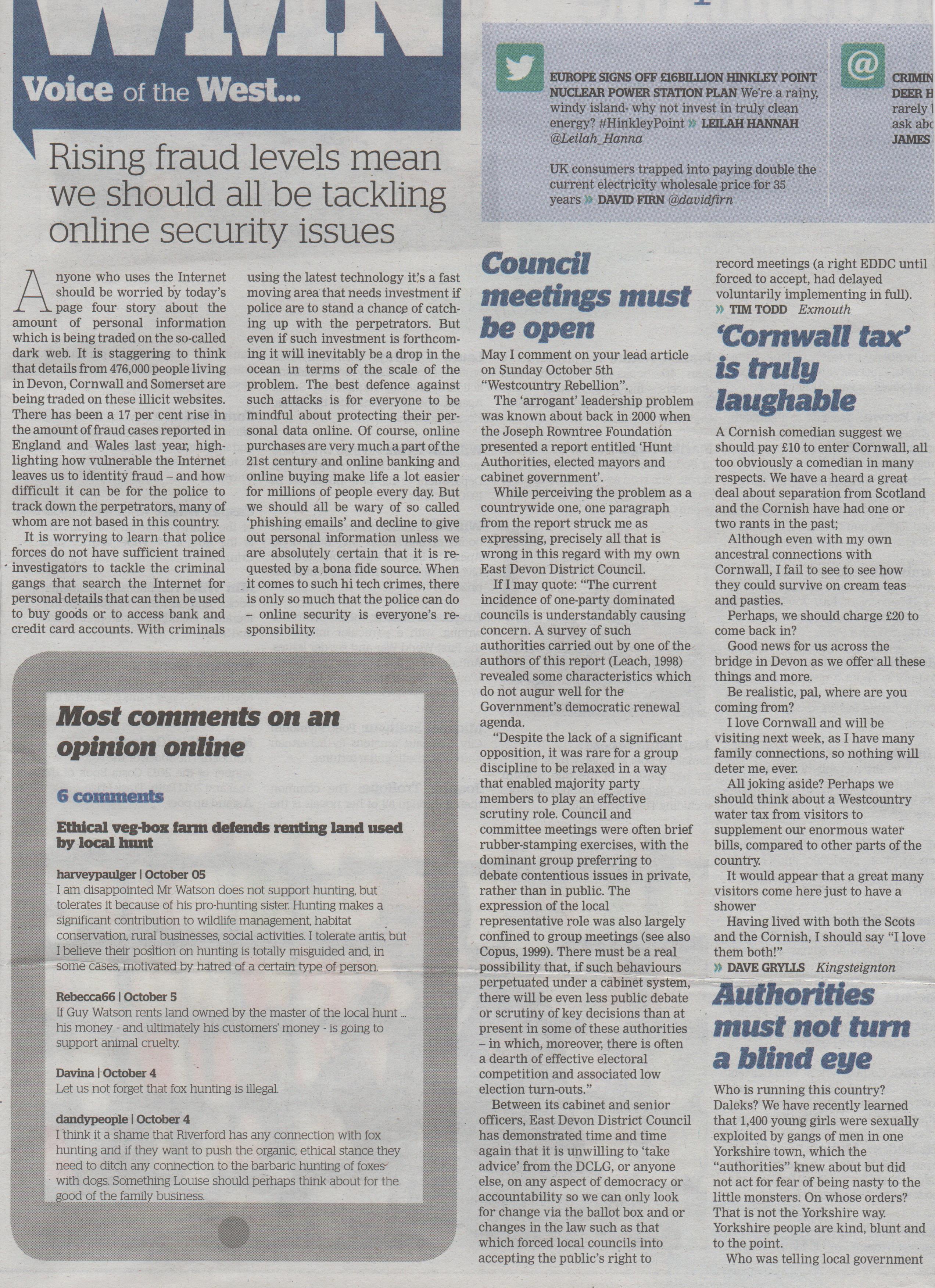
The Western Morning News has given prominence to this letter,dated 7th October, from EDA member, Tim Todd.

‘Dear Sir,

May I comment on your lead article on Sunday Oct 5th.

The ‘arrogant’ leadership problem was known about back in 2000 when the Joseph Rowntree Foundation presented a report entitled ‘Hung Authorities, elected mayors and cabinet government’. Whilst perceiving the problem as a country wide one, one paragraph from the report struck me as expressing precisely all that is wrong in this regard with my own East Devon District Council . If I may quote :

“The current incidence of one-party dominated councils is understandably causing concern. A survey of such authorities carried out by one of the authors of this report (Leach, 1998) revealed some characteristics which do not augur well for the Government’s democratic renewal agenda. Despite the lack of a significant opposition, it was rare for group discipline to be relaxed in a way that enabled majority party members to play an effective scrutiny role. Council and committee meetings were often brief rubber-stamping exercises, with the dominant group preferring to debate contentious issues in private, rather than in public. The expression of the local representative role was also largely confined to group meetings (see also Copus, 1999). There must be a real possibility that, if such behaviours perpetuated under a cabinet system, there will be even less public debate or scrutiny of key decisions than at present in some of these authorities – in which, moreover, there is often a dearth of effective electoral competition and associated low election turn-outs.”

Between its cabinet and senior officers, East Devon District Council has demonstrated time and time again that it is unwilling to ‘take advice’ from the DCLG , or anyone else, on any aspect of democracy or accountability so we can only look for change via the ballot box and or changes in the law such as that which forced local councils into accepting the public’s right to record meetings, (a right EDDC , until forced to accept, had delayed voluntarily implementing in full).’

Yours sincerely

Tim Todd

Charity shop for Cranbrook?

The Cranbrook Herald gives exciting news of the first seven shops to be occupied in Cranbrook.

Already taken are a Co-op, a fish and chip shop, a pharmacy and an estate agent and one of the remaining shops is rumoured to be of interest to a charity …..


Newton Poppleford: Little Orchard, big problem

Readers will recall that in September 2013 the planning application by Clinton Devon Estates for 40 houses in King Alfred’s Way, Newton Poppleford was recommended for approval by EDDC Planning Officers and subsequently approved by the DMC

In October 2013 a planning application for the adjacent site Badgers Close was, however, recommended for refusal by EDDC Planning Officers. It was refused by the DMC and the subsequent appeal, by the applicant, to Her Majesty’s Planning Inspectorate also failed. (In each case EDDC Planning Officers argued very differently

An application on the same site has been resubmitted, rebranded as “Little Orchard” see application 14/2174.
With regard to the previous Badger Close application EDDC planning officers noted that Newton Poppleford lacks employment opportunities, giving rise to the necessity to commute to work. They considered that the village should only accommodate a limited scale of development, as defined by its built-up area boundary.

The Planning Inspector also concluded that the Badger Close appeal site did not represent a sustainable location for the proposed development. The decisive argument turned on access to the village centre. The Inspector noted that the poor quality of the pedestrian linkages between the appeal site and the village’s main services and facilities represented a serious failing. Those who know Newton Poppleford will know that there is no simple “Section 106” agreement solution to this

The site is also only 300m outside the 400m building exclusion zone that surrounds the Pebblebed Heaths. As we have mentioned before on this blog, the Heaths are not only an SSSI and within the AONB but have European designations under which EDDC has a legal duty to protect from any increased recreational use as a result of nearby development. On this subject the Inspector deferred to the view of Natural England. So it is interesting to see the Natural England consultee comment on this new application 14/2174.

These seem to have profound consequences for all developments within 10Km of the Heaths and indicate that EDDC has been in breach of its legal duties which appear to be much tougher for a European designation than for an AONB or even the protection UK gives to its World Heritage Sites

Key sections of this comment are

“The East Devon (Pebblebed) Heaths SAC / SPA are c. 700m from the application site. This is in the 10km zone within which impacts of residential development on the SPA could reasonably be expected to arise in the absence of appropriate mitigation: Evidence submitted with your “Submission Draft Local Plan” – the Habitats Regulations Assessment (Nov 2012) and the draft “South East Devon European Sites Mitigation Strategy” (June 2013) – both indicate that it would not be possible to reach a conclusion of “no likely significant effect” for housing in this location, in combination with other residential development close to the site, in the absence of appropriate mitigation. …

In the case of the European sites referred to a above, your authority cannot grant permission for this proposal in the absence of a Habitat Regulations Assessment which concludes either i) no likely significant effect due to mitigation included by the applicant or, ii) no adverse effect on integrity following an Appropriate Assessment.”
What we are supposed to get are alternative natural green space sites (SANGS).

So, EDDC, where are these or have they all been given planning permission?

EDDC’s untimely curtailment of public speaking is”self-defeating, reactionary and arrogant”

The latest Sidmouth Herald’s report (10th October, p.4) on East Devon District Council’s New rules to trim ‘unwieldy ‘talks , includes strong criticism by the East Devon Alliance Chair, Paul Arnott. In summary, Mr Arnott warns, “Our beautiful district is under pressure from speculative planning applications as never before, and while EDDC fails to have its Local Plan in place this will only increase. In this context, public speaking at the DMC has repeatedly prevented the council from rubber-stamping a hard-pressed officer’s recommendation to approve. To curtail the right for such sincere people to contribute at this very moment is self-defeating, reactionary and arrogant. For the leaders to claim that EDDC’s new speaking restrictions make them somehow better than other councils in the south west ignores the elephant in the room – the severe crisis in public confidence in planning and democratic practice specific to East Devon.”

‘Council meetings must be open’

Following its recent front page report on the widespread local unrest, the Western Morning News today highlights a letter from EDA member Tim Todd. WMNSunday12thOctTim 001

(Bigger version will be posted here shortly).
For those who missed it, here’s the WMN story: http://www.westernmorningnews.co.uk/Grassroots-rebellion-arrogant-leadership-Devon/story-23044099-detail/story.html

We have had enough … sack the man in charge

“We have had enough. Since he came to power [he has] has undermined local democracy, contravened the local plan, and gone against the wishes of local people – enough is enough.”

Relax Mr Diviani – this is a petition circulating about the Mayor of Torbay who has sacked the majority of his Cabinet because they do not agree with him.

But today Torbay, tomorrow … who knows.

Read more: http://www.torquayheraldexpress.co.uk/Hundreds-sign-online-campaign-oust-Mayor-Gordon/story-23119861-detail/story.html

EDDC’s new website – another Council Bloxham project, oh dear …..

Anyone tried the “new” EDDC website yet – the responsibility for which can be laid at the door of the redoubtable Councillor Ray Bloxham – you know, the one who cut down public speaking so much at EDDC that it is now virtually non-existent and you can’t say anything until you have told EDDC in triplicate a year before what you intend to say …..

Well, he’s at it again – trumpeting the newly-designed EDDC website. Except that we hear it is generating lots of complaints. Unwieldy, not-fit-for-purpose, a step backwards rather than a step forwards, etc etc.

Trying to find out what is going on at meetings to come or meetings past is an absolute nightmare – minutes linked individually so that you have to go back and forwards many times to read them all, links that don’t lead anywhere, you name it, all in the name of “progress” so that EDDC can offer “more services” online.

Except that it is almost impossible to find the services!

However, see what Councillor Bloxham has to say here (if you can find it):

http://new.eastdevon.gov.uk/news/2014/07/open-for-business/

Well, yes, we do know that EDDC is open for business for SOME people who get unlimited access to REAL people – mostly developers. But for the rest of us are we to be subjected to “New-EDDC website lite beta” rather like “New Labour” or “New Fairy Liquid” … not always a step in the right direction!

Information Commissioner v East Devon District Council and Knowle relocation updates

http://futuresforumvgs.blogspot.co.uk/2014/10/knowle-relocation-project-latest-news.html

Just about every seat is now a marginal seat

There are now very, very few “safe seats” if any.

There must be some current MPs who thought they had “safe seats” that would see them to their dotage (and even further) beginning to wonder if they will be having to go to the job centre next May.

Watch out for more silly stunts from them as they try to convince us that they are different to the rest whilst behaving the same way!