Why did Cllr. Stuart Hughes, Chairman, EDDC cancel the May Annual Meeting?

Owl has made a number of posts recently explaining the formation of the Democratic Alliance; the new power grouping in EDDC;  and the reasons why those who formed the Independent Progressive group felt they had to leave Ben Ingham’s group.

Owl has also posted the cancellation of the EDDC Annual Meeting scheduled for 13 May, but has been unable to find out why, until now.

The comment below, from the Democratic Alliance, is appearing on various twitter feeds.

It doesn’t look to Owl that Stuart Hughes has been acting other than in the narrow interest of himself and his party – the sooner he goes, the better for democracy in East Devon. Owl has refrained from using stronger language, with difficulty.

twitter comment reads:
“Unfortunately Cllr Stuart Hughes, the Conservative chairman of East Devon District Council, has caused democratic chaos by cancelling its annual meeting just at the time when current council leader Cllr Ben Ingham’s administration has fallen apart. In a situation entirely of Cllr Ingham’s own making, 10 of the 20 members in his ruling group (including 3 of his cabinet members) have decided over recent months that he cannot be allowed to carry on as council leader, and have left. 
At this time of crisis it is imperative that democracy is protected and restored so that the public’s best interests can be safeguarded. Therefore it is critical that a proper majority administration be voted. We are three dreadful months into the pandemic crisis, but we are far from out of the woods and must have clear majority leadership both for now and as we plan for the future based on stronger foundations of collaboration and transparency. The formal coalition of the Democratic Alliance and the Progressive Independents contains more than half of all council members who share this vision and will be able to lead the district, seeking consensus with other groups too. A breath of fresh air for EDDC.
 If Councillor Hughes had not made the political decision to cancel the Annual Meeting for no good reason this would have been an unremarked routine changing of the guard. Instead, like many “disrupter” figures in world politics he has created havoc in the hope that he will be able to cling to the chair for a second year.”

Planning Applications week ending 16 May


Every week dozens of planning applications are submitted to the local councils, and the coronavirus pandemic has not changed that.

Daniel Clark www.devonlive.com

While some council services have been suspended as a result of COVID-19, planning departments are still working as usual to validate and to decide upon applications.

Here is the list of applications that have been submitted and validated by East Devon, the devonlive article contains the complete list for the various local councils or planning authorities in Devon in the last week.

EAST DEVON

BMJ on The UK’s public health response to covid-19

Too little, too late, too flawed

www.bmj.com /content/369/bmj.m1932

Gabriel Scally, visiting professor of public health,

Bobbie Jacobson, senior associate

Kamran Abbasi, executive editor

The UK government and its advisers were confident that they were “well prepared” when covid-19 swept East Asia. The four-pronged plan of 3 March to contain, delay, research, and mitigate was supported by all UK countries and backed, they claimed, by science.1 With over 30 000 hospital and community deaths by 12 May, where did the plan go wrong?2 What was the role of public health in the biggest public health crisis since the Spanish flu of 1918? And what now needs to be done?

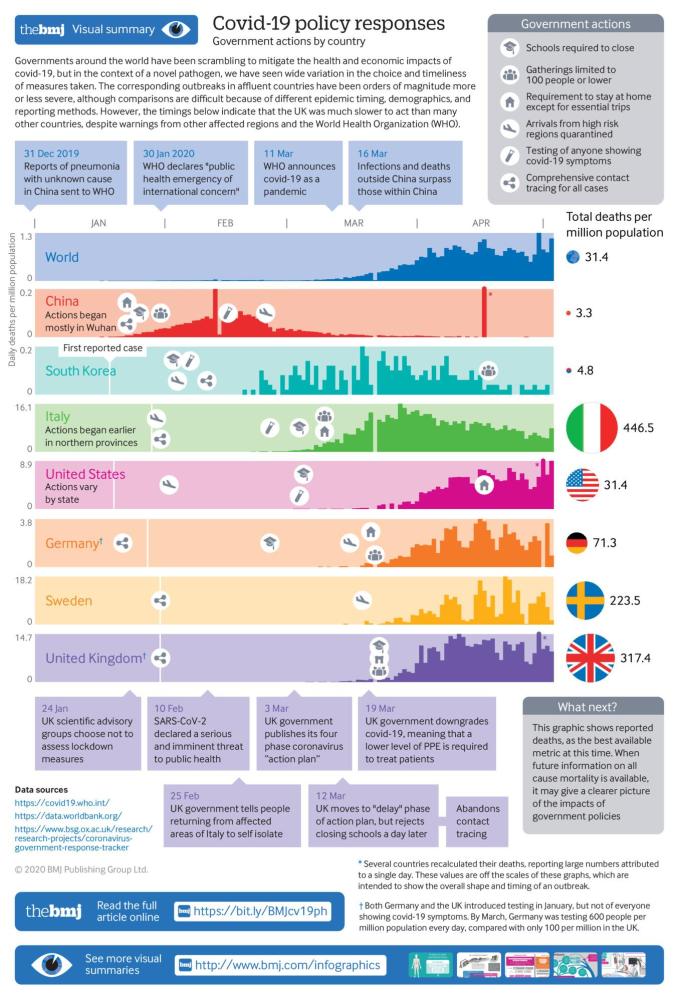
What is clear is that the UK’s response so far has neither been well prepared nor remotely adequate (see infographic). The weakness of the preparations was exposed in 2016 by Exercise Cygnus, a pandemic simulation, and the necessary remedial steps were not taken.3 On 30 January, the World Health Organization declared a public health emergency of international concern and governments were urged to prepare for global spread of covid-19 from East Asia.4 Detailed case studies followed showing the need for high levels of mechanical ventilation and high death rates.5,6 But the UK ignored these warnings.
Delay and dilution

By 11 March, Italy had taken firm public health action and was in full lockdown, followed closely by Spain and France. The UK’s Scientific Advisory Group for Emergencies (SAGE) rejected lockdown, believing that the population would not accept it. SAGE, chaired by Patrick Vallance, the government’s chief scientific adviser, reports into the Civil Contingencies Committee (popularly known as Cobra), which coordinates the governmental response to national or regional emergencies.7

One day later, the government inexplicably announced a move from the containment phase in its strategy to the delay phase.8 Chris Whitty, England’s chief medical officer, explained it was no longer necessary to identify every new case and that all testing capacity across the UK, despite major regional variation in cases, would be “pivoted” to hospital patients. NHS 111 and Public Health England teams working on contact tracing were confused and overwhelmed. WHO’s standard containment approach of find, test, treat, and isolate, which has worked well in countries that have successfully suppressed viral spread, was abandoned; entry via ports and airports remained unrestricted.9 There was no future plan for community based case finding, testing, and contact tracing. Procurement and delivery of testing resources was ineffective, despite a readymade viral test and offers of help from university and private sector laboratories.10

On 19 March, the status of covid-19 was downgraded from level 4, the highest threat level, to level 3 by the four nations group on high consequence infectious diseases and the Advisory Committee on Dangerous Pathogens.11 This enabled the required standard of personal protective equipment to be lowered for staff in hospitals and to nurse patients in non-infectious disease settings. Meanwhile, a reckless policy of discharging older patients from hospitals to care homes without testing allowed the virus to spread and kick start a second epidemic of community infection.12

Matters worsened when Vallance initially rejected “eye catching measures” such as stopping mass gatherings or closing schools. To widespread criticism, he floated an approach to “build up some degree of herd immunity” founded on an erroneous view that the vast majority of cases would be mild, like influenza.13 When subsequent modelling estimated that 250 000 people might die in this scenario, but that physical distancing measures could limit deaths to about 20 000, a sharp reversal of policy followed.14 By the time the UK formally announced a lockdown with a huge package of economic support measures, almost two months of potential preparation and prevention time had been squandered.15 The delay in the face of emerging evidence that the Italian lockdown reduced viral transmission by about half16 looks likely to have cost many lives.

If the government failed in its duty to protect the public, it also failed to protect staff in the NHS and social care by not delivering sufficient amounts of personal protective equipment (PPE) of the right specification, again deviating from WHO advice.17 By late April, only 12% of hospital doctors felt fully protected from the virus at work, as staff deaths in health and social care began to rise.18 The broken promises on testing were matched by those on PPE.

Narrow scientific view

How did a country with an international reputation for public health get it so wrong? The UK’s response to covid-19 is centrally coordinated through a series of scientific advisory groups led by Whitty and Vallance. Critical to this is the Scientific Pandemic Influenza Group on Modelling (SPI-M), which models the future epidemic and feeds into SAGE. SPI-M and SAGE are dominated by modellers and epidemiologists. None of the members were experts in developing and implementing a public health response, and other relevant groups such as communicable disease experts, women, and ethnic minorities are under-represented.19

The Guardian revealed that several SAGE meetings had been attended by Dominic Cummings, the prime minister’s chief political adviser, and Ben Warner, his adviser on data science.20 The involvement of two influential political advisers makes a mockery of SAGE’s claim to provide independent scientific advice to the government. To date, we do not even know the details of that advice. Such is the furore about SAGE’s composition and operations, that David King, the UK’s former chief scientific adviser, established an alternative “Independent SAGE” with a diverse membership including from public health,18,19 which advises publicly on the UK’s response to covid-19,21

Membership of SAGE and its national committees reflects England’s marginalised public health infrastructure. Reorganisation of public health in England, largely resulting from the Health and Social Care Act 2012, led to a critical loss of senior posts and staff.22 The Health Protection Agency, regional public health teams, and regional public health observatories were abolished, and the remnants incorporated into a slimmed down Department of Health agency, Public Health England. This new agency lacks an independent voice and clear public health leadership. England’s chief medical officer is no longer seen as the leader of public health. With these reforms, England’s new public health system was born critically flawed.

By the start of the coronavirus pandemic only one of the UK’s four territories had a trained public health physician as its chief medical officer. At a local level in England, many public health responsibilities were sensibly transferred back to local authorities with the 2012 act. But since then, close to £1bn (€1.1bn; $1.2bn) has been cut from public health budgets and the position made worse by cuts to other local authority services such as environmental health.23,24

Public health approach

The UK government’s decimation of public health during years of austerity, and its impact on vulnerable groups, is for a public inquiry to investigate, although any inquiry report will be hollow without legislative change. The system failings are being exposed brutally by covid-19. For now, the focus must be on a strategy to minimise harm from ill advised relaxation of physical distancing in ways that will trigger further epidemic spikes with prospects of a vaccine or treatment still distant.

Firstly, SAGE must exclude political advisers and recruit more public health experts. Secondly, a clear population strategy based on case finding, testing, contact tracing, and isolation is required for each of the four nations to inform and justify future decisions about how the lockdown can be safely relaxed. The plans for case finding, testing, and community contact tracing must be adequately resourced, decentralised, and led by local public health teams who know their communities and the nature of the outbreaks in their localities. Public Health England and the NHS must fully support these plans. And implementation of testing, data monitoring, and reporting must be optimised from all sources: hospital, primary, and social care.

In time, findings from the first population surveillance study will help effective targeting.25 Meaningless political soundbites promising to recruit 18 000 contact tracers, test 200 000 people a day, or invest in unjustified contact tracing apps, divert focus and could lead to more deaths.26 These headline grabbing schemes should be replaced by locality led strategies rooted in communicable disease control.

An effective pandemic response requires not only speed and clarity but also a willingness to accept mistakes and a commitment to international cooperation. Sharing the science and the uncertainties that inform political decisions will help rebuild lost public trust. Politicians and their advisers cannot hide behind science to avoid responsibility for making difficult decisions in a global crisis or merely repeat that they are following the science.

Above all, the response to covid-19 is not about flattening epidemic curves, modelling, or epidemiology. It is about protecting lives and communities most obviously at risk in our unequal society. The most serious public health crisis of our times requires a strong and credible public health community at the heart of its response. A UK government that prioritises the health and wellbeing of the public will see the importance of rebuilding the disempowered and fragmented infrastructures of its public health system. Anything less is an insult to the tens of thousands of people who have lost their lives in a pandemic for which the UK was forewarned but not forearmed.

Footnotes

Competing interests: We have read and understood BMJ policy on declaration of interests. GS is a member of Independent SAGE. KA is an honorary visiting professor in the department of primary care and public health at Imperial College, London. We have no other relevant interests to declare.

Provenance and peer review: Commissioned; not externally peer reviewed.

This article is made freely available for use in accordance with BMJ’s website terms and conditions for the duration of the covid-19 pandemic or until otherwise determined by BMJ. You may use, download and print the article for any lawful, non-commercial purpose (including text and data mining) provided that all copyright notices and trade marks are retained.

https://bmj.com/coronavirus/usage

References

(See original BMJ article)

Council tax to rise as coronavirus hits town hall investments

“Families face higher tax bills and reduced public services as councils’ multibillion-pound investments in commercial property sour in the coronavirus lockdown.”

How many times in the past have we heard stories of unwise council investments? And still they do it.

It is, of course, partly a consequence of inadequate central funding, though some councils seems to be all to ready to play the role of entrepreneur. The money being risked is public money.

Andrew Ellson, Consumer Affairs Correspondent | Gareth Davies  www.thetimes.co.uk
Local authorities have borrowed £6.6 billion since 2016 to buy shopping centres and office blocks to replace revenue lost by government cuts.

One council bought a shopping centre for £40 million weeks before lockdown in which more than 90 per cent of the stores are now shut. Another council paid £6.2 million for a hotel that the tenant has said will go bust without a rent cut of up to 80 per cent.

The British Property Federation says that only two thirds of office rents and one third of retail rents were paid on time in March. It expects those figures to halve again in June.

Property groups are finding it difficult to sell retail parks at any price, and analysts predict lower office rents for years as more people work from home.

Analysis by the Bureau of Investigative Journalism has found that dozens of councils are reliant on income from investments to fund public services.

One in eight pounds spent by Woking council, for example, is paid for by investment and rental income. In a recent report the council said reserves were in place to cope with temporary falls in rent but admitted that if there were a permanent reduction, “service provision would need to be reviewed”.

Spelthorne council also has huge exposure to commercial property, having spent £1 billion on offices and shops in the past five years, including buying Elmsleigh shopping centre in Staines for £40 million 12 weeks ago.

Almost £10 million of Spelthorne’s annual spending on services is funded by these investments — more than by council tax, business rates and government grants.

Lord Oakeshott of Seagrove Bay, of Olim Property, the commercial property manager, said: “Professional investors have been warning these council amateurs for years about their wild property gambling spree. Councils have splashed billions of taxpayers’ cash but now they’d be lucky to get half their rents paid or half their money back if they sold. The Treasury must wake up and stop this scandalous waste of public money.”

Demand for local authority services has risen in the pandemic but income from council tax and other services, such as parking, has fallen. Ministers have agreed to provide £3.2 billion to meet the extra costs but this week a group of MPs told the chancellor that the funding gap was four times greater.

This week Rob Whiteman, head of the Chartered Institute of Public Finance and Accountancy, told MPs he was “quite worried” about councils “overexposed” to property. He said that Spelthorne had “borrowed too much”.

Once interest and maintenance costs had been taken into account, Spelthorne’s £1 billion portfolio generates a return of less than 1 per cent for services. Mr Whiteman told MPs: “You don’t have to be accountant of the year to know that’s quite a lot of risk.”

Spelthorne said that it had built up a £20 million fund that would protect against the financial impact of lockdown and was confident there would be no impact on services. It admitted to collecting only 30 per cent of the rent due on Elmsleigh shopping centre but said that the purchase was a regeneration project and not to fund services.

The council said it was very confident in its approach to investing, adding: “Investment in frontline services made possible in recent years by our commercial income has enabled the council to respond more effectively to support its residents during this crisis.”

Woking council said: “It is too early to tell what the long-term impact of Covid-19 will be on the national and local economy and right now our focus is on supporting businesses to safeguard local jobs and services beyond the current crisis.”

The big spenders

● Warrington council Eighteen months ago, Warrington paid £26 million for Eddie Stobart’s distribution HQ. Within a year, its chief executive stood down after an accounting error overstated profits. In February, the company announced a loss of £200 million.

● Surrey Heath council In 2016, the council paid £86 million for a shopping centre in Camberley. The anchor tenant, House of Fraser, said it was closing 18 months later, forcing the council to cut the rent.

● Northumberland council In 2016, Arch development, owned by the council, paid £78 million for a shopping centre in Cramlington. Two years later Arch was dissolved amid claims of mismanagement. Ownership was transferred to a new council-owned company.

● Norwich council In November, Norwich bought the site of a Travelodge in Essex for £6.2 million. The hotel chain has asked for rent cuts to avoid administration.

● Stockport council In 2016 the council bought Merseyway shopping centre for £75 million even though it had been in receivership for seven years.

All you need to know about LINO

A correspondent reveals all you need to know about Lino:

Lino has been around for countless years and the high quality version has durability and a general lifespan of well over 40 years. However, lower graded lino is prone to wear and tear and it has often been used as a stop-gap measure until a better option can be afforded.

Nowadays, when everyone is looking to be environmentally friendly, lino seems an all natural, green, product. It is excellent at holding its original colour, which permeates entirely throughout but it is susceptible to yellowing with exposure. It comes in various colour options but care must be taken with colour choice to ensure it will stand the test of time and is exactly to your taste.

It has long been known that lino can spell potential disaster if it is not installed correctly and some find it too high maintenance because it requires regular polishing and buffing to achieve the required finish.

Although many believe that no one chooses lino anymore – a few have championed its revival but the majority are looking for a stronger product that they can trust.

(In Owl’s experience Lino also hardens and tends to crack with age.)

Why the Independent Progressives felt they had to leave Ben Ingham’s coalition with the Tories

Owl has found more explanation of why the new group of seven Independent Progressives split from Ben Ingham, and his “surprised” reaction to them, in the second part of this post on exmouth.nub.news.

Ben Ingham is quoted: “They have been pretty secretive so far about it and they are putting together a merger of several groups that no-one voted for just 12 months after an election. It is profoundly disappointing.” – bit rich coming from last year’s post election “plotter-in-chief” who formed a coalition between some Independents he had recruited, as such, and the Tories.

(Owl has not posted the first part as it is very similar to the earlier post announcing the formation of the partnership seeking to take control, but the link to the full article is above.)

……Cllr Ingham has called the decision of the eight councillors to leave his group as ‘profoundly disappointing’ and said that it is a shame that during a time of such turmoil for everyone, this is when two political groups in East Devon have decided to play political games of the highest order in order to further their own political ambitions.

Cllr Geoff Jung last week left the Independent Group to join the Democratic Alliance, while Cllrs Nick Hookway, Vicky Johns, Tony McCollum, Kathy McLauchlan, Geoff Pratt, Jess Bailey and Megan Armstrong have formed the Independent Progressive Group.

In a joint statement, the seven said: “We all stood as Independent councillors so that we could make a difference for the people that we represent and feel we will be better able to achieve this by being part of a forward-thinking, more progressive administration.

“We all look forward to continuing doing our utmost for the communities we serve.”

The statement added: “A group of seven Independent councillors, six of whom were newly elected last May, have left the Independent Group because over the course of the year they have realised that they view things differently to some others in the Independent Group.

“The new Independent Progressive Group has this week formed a coalition partnership with the ‘Democratic Alliance’ and it is hoped that the two groups will work together to form a new ​administration, following ​an extraordinary council meeting which is expected to be held on June 4.

“The coalition represents a total of thirty one members which would then be the majority in the council.”

Three of the defecting councillors – Cllrs Jung, Bailey and Armstrong – were part of the nine-strong cabinet in charge of the council, but Cllr Ingham confirmed that he had taken the decision to keep them in place and not sack them.

He said: “I decided not to fire them. Geoff Jung done a really good job as a portfolio holder. He has undermined the Group, which I am not happy about, but I certainly couldn’t fire him for lack of effort, and at the moment, as leader of the council, when we have a pandemic across the country and district, continuity is very important and that is what the officers need.

“It is annoying to have these distractions at and I am not convinced that firing three portfolio holders will help.”

Asked why he felt they left the Group, Cllr Ingham said: “I know a number of councillors who left the Independent Group found the work load difficult to cope with, which is why we had decided to work with political parties to form a new administration.

“Unfortunately that was not good enough for them and so they have formed the Progressive Independent Group. I understand they are currently signing a Memorandum Of Understanding with the Democratic Alliance, which will give them overall control of the Council by 31 councillors to 29.

“It is a shame that during a time of such turmoil for everyone, this is when two political groups in East Devon have decided to play political games of the highest order in order to further their own political ambitions. Our officers at East Devon are under considerable strain to support our communities as it is, without any further distractions, but perhaps no one should expect politicians to behave reasonably nowadays.

“It is always a shame when anything stops something you believe can work, and it is profoundly disappointing as a leader because I look back over the last 12 months and I am very pleased with what we achieved as a team. Crikey, we set one hell of a council plan for the next few years, and stepped up to the plate on hat incredibly quickly. For long term strategic thinking, we have come up trumps.

“We have been progressive and did some ground-breaking stuff that makes you think why the Tories didn’t do that. I am proud of our track record and it will be a great shame if anyone undoes that and I am not sure it would be in the interests of our communities.”

On Wednesday, the first virtual meeting of East Devon’s cabinet will take place, with Cllr Ingham saying that all members of his cabinet will as usual be given the free reign to speak for and on whatever they like, and then the following Wednesday will see an extraordinary full council meeting held.

Cllr Ingham said that after the meeting over the future leadership and control of the council the cabinet would be reshaped – either by him if he was still the leader, or by a new leader of the council if they were elected.

He added: “If the Democratic Alliance and IPGs finally organise themselves to work together, there will be ample opportunity for them to take control of East Devon District Council in the next few weeks. They seem to have been plotting and scheming this for a long time so they should be able to work it out.

“The Progressive Independent Group, that’s interesting as they not progressive in my definition at all and are quite regressive, as there is a whole load of things they don’t want which is why they split away. But for an independent group, to sign a memorandum within 10 days with three different political parties, I am not sure how independent that is.

“They have been pretty secretive so far about it and they are putting together a merger of several groups that no-one voted for just 12 months after an election. It is profoundly disappointing.”


Reuters Review contradicts Boris Johnson on claims he ordered early lockdown at UK care homes


Exclusive: Review contradicts Boris Johnson on claims he ordered early lockdown at UK care homes

Uk.reuters.com Reporting by Andrew MacAskill and Stephen Grey; editing by Janet McBride

LONDON (Reuters) – Prime Minister Boris Johnson told Britain’s parliament on Wednesday that his government moved swiftly to protect the country’s vulnerable care homes. Under increasing pressure to defend his record on fighting Covid-19, he said: “We brought in the lockdown in care homes ahead of the general lockdown.”

An examination by Reuters of the guidance issued to care homes, as well as interviews with three care home providers, has provided no evidence that any such early lockdown was ordered.

The government’s handling of care homes has emerged as a major controversy in parliament. According to a Reuters analysis of official figures (here), the pandemic has resulted in over 20,000 deaths in UK care homes.

The prime minister’s spokesman told reporters on Wednesday that in his comments earlier that day to parliament, Johnson was referring to government advice to care homes, issued on March 13. This advice, he said, was “recommending essential visits only, that obviously came before we took steps nationwide in relation to social distancing.” The government issued a general lockdown order to the nation on March 23.

The March 13 guidance bit.ly/2WWkoFW by the government was equivocal, a review of the documents shows. The advisory, reviewed by Reuters, did not impose a ban on visits from family or friends.

Instead, the document from Public Health England, an official agency, advised home providers to “review their visiting policy by asking no one to visit who has suspected Covid-19 or is generally unwell, and by emphasising good hand hygiene for visitors.” Balancing those restrictions, it said that care home policies “should also consider the wellbeing of residents, and the positive impact of seeing friends and family.”

At a press conference on March 16, Johnson commented that “absolutely, we don’t want to see people unnecessarily visiting care homes.”

Reuters found no official guidance which made that advice mandatory. The news agency asked 10 Downing Street, Johnson’s office, if it could point to any official order that care homes must close to outside visitors, prior to the broader UK lockdown on March 23. A government spokeswoman referred Reuters to the March 13 advice. Asked if there were further instructions to care homes between March 13 and the March 23 general lockdown, the spokeswoman said there were not.

In a statement, the government said it had been “keeping in regular contact with care homes to provide guidance on reducing the spread of infection. We have continued to review and update our guidance, in line with the latest scientific advice.”

The government’s cautious approach to imposing restrictions was signalled earlier in March by Chris Whitty, the chief medical adviser. At the launch of the government’s coronavirus action plan, on March 3, Whitty told journalists that specific advice for care homes would be issued in future, “but one of the things we are keen to avoid … is doing things too early.” He explained that premature action would bring no benefit “but what you do get is a social cost.”

A Reuters investigation last week here detailed how the government’s focus on shielding hospitals, to prevent emergency wards from being overwhelmed, left care home residents and staff exposed to COVID-19. To free up hospital beds, many patients were discharged into homes for the elderly and vulnerable, many without being tested for the coronavirus that causes the disease.

On May 5, when Reuters initially asked the Department for Health and Social Care when an order was first given to ban care home visits by family and friends, a press officer responded: “There was no order, care providers make their own decisions about visitors.”

Later that day, another press officer said the guidance was issued in a document dated April 2 here which said visits should only be made in exceptional circumstances, such as when residents are dying. That guidance was issued 10 days after the national lockdown and 20 days after the earlier, more nuanced advice to care homes.

Joyce Pinfield, who runs two care homes and is on the board of directors at the National Care Association, a body which represents care providers, said she spent time Wednesday after Johnson’s comments to parliament trying to find out when the order to lock down care homes was made. She said she found no trace of any order prior to the wider UK lockdown on March 23 and the April 2 instruction closing homes to outside visits, and concluded there hadn’t been one.

“The guidance should have been far better,” she said. “It was left to care providers to make their own decisions.”

Pinfield’s view was echoed by Julie Nicholls, the manager of the Appleby Lodge residential home in Cornwall. Nicholls said care home managers were left to make their own decisions about whether to restrict visits. She closed her care home on March 13, the day after the government moved the threat level of the virus to “high” and the prime minister warned the nation to expect to lose loved ones.

Nicholls said she “definitely didn’t have any government guidance” to close before the general lockdown ordered by Johnson on March 23. “There was never a formal order,” she said.

Opposition MPs have accused Johnson this week of misleading parliament over the government’s handling of the coronavirus.

Labour leader, Keir Starmer, confronted the prime minister in parliament on Wednesday with Public Health England guidance for care homes that was in place from February 25 to March 12. This stated, as reported by Reuters on May 5, that “it remains very unlikely that people receiving care in a care home will become infected.” A government spokesman told Reuters in early May that the advice “accurately reflected the situation at the time when there was a limited risk of the infection getting into a care home.”

Johnson replied to Starmer that “it wasn’t true that the advice said that.”

After the debate, Starmer wrote to Johnson asking him to correct his remark. The prime minister responded that he stood by his comments and accused the Labour leader of selectively and misleadingly quoting from the documents.


Coronavirus: Daughter’s anger as father dies after COVID-19 patient entered care home

Owl has previously posted a cry of anguish from someone deeply affected by the treatment of loved ones during the closure of the Shandford Care Home in Budleigh and their fears for the future.

Now, with great sadness, Owl feels it in the public interest to post to post another. This time it is from local Independent Councillor Dr Cathy Gardner who articulates the anger of many at the cause of the loss of her father in an Oxfordshire Care Home.

Owl extends deepest sympathy to Dr Gardner and to all those who have lost loved ones during the pandemic.

Owl’s next post is on an exclusive Reuters review that contradicts Boris Johnson on claims he ordered early lockdown at UK care homes. (Following Keir Starmer during this week’s Prime Minister’s questions)

news.sky.com

The daughter of a man who died with suspected coronavirus has told Sky News she wants to know who signed off on a government policy to allow untested COVID-19 patients to be sent to care homes, potentially spreading the virus.

Dr Cathy Gardner says she fears the policy could have been a factor in the death of her 88-year-old father Michael Gibson, who passed away in a care home in Oxfordshire on 3 April.

She has described the government’s discharge policies as “irresponsible”.

Dr Gardner said: “I think the government guidance that hospitals implemented to discharge people as rapidly as possible into care homes full of vulnerable people was incredibly irresponsible… I think it was an unbelievable act and they need to be held accountable for that.”

The original advice the government gave regarding the discharge of patients to care homes said: “Negative tests are not required prior to transfers/admissions into the care home.”

The policy was changed as of 15 April to say: “We can now confirm we will move to institute a policy of testing all residents prior to admission to care homes.

“This will begin with all those being discharged from hospital and the NHS will have a responsibility for testing these specific patients, in advance of timely discharge.

“Where a test result is still awaited, the patient will be discharged and pending the result, isolated in the same way as a COVID-positive patient will be.”

The Department of Health and Social Care’s strategy was to prevent the NHS being overwhelmed.

Mr Gibson, who had advanced Alzheimer’s, was a resident at the Cherwood House Care Centre in Oxfordshire, a place which Dr Gardner said looked after her father with great kindness.

She said that staff told her a COVID-positive patient was discharged back to the home in mid-March.

Sky News understands the care home felt pressured to take the resident back and were told the patient “hadn’t had a temperature for 48 hours”.

Cherwood House have said they weren’t given any guarantees the patient wasn’t still infectious, and said taking back the COVID-positive resident was “one of several possibilities” which could have caused Mr Gibson’s death.

Dr Gardner, who is an independent councillor in Devon, has a degree in microbiology and a PhD in the airborne spread of infection through the respiratory tract.

She said: “Coronavirus is so easily spread. The government knew the risks. It’s so easily carried around even when people are doing their best the risk is so great. At a time when over-70s and vulnerable people were being told to stay at home.”

Dr Gardner said she would like to see a public inquiry into the government’s social care and hospital discharge policies leading up to and during the pandemic.

She said: “I hold the PM and the government responsible for the policy. It’s got HM Government on the top of it. Whoever wrote it originally, whoever signed it off for publication must be held responsible for the consequences.”

In life, Mr Gibson was a registrar registering the births, deaths and marriages of others.

Dr Gardner said it was a sad irony that the precise cause of her father’s death will never be known because of the lack of testing in care homes.

She said: “My father’s GP was extremely good. She really suspected that patients dying like my father were infected with coronavirus and she put ‘probable COVID-19‘ on the death certificate.

“It seems such a shame after what he did for a living that his own death certificate isn’t accurate. Because he was never tested and no samples were taken after death to confirm the diagnosis or not of coronavirus.

“It’s only recorded on his death certificate as probable.”

Dr Gardner said: “It’s difficult to deal with the loss of my father at the same time as understanding the background to his death because you’re always angry when you’re grieving anyway.

“To know that this might have played a factor and the government might have contributed directly to my father’s death is almost unbelievable. It’s so difficult to get my head around it. It makes me extremely angry.”

David Isaac is chair of the Equality and Human Rights Commission, which is currently considering whether human rights laws have been breached in discharging patients into care homes.

He told Sky News that the commission was “sympathetic in relation to the challenge in resources and how priorities have to be made”.

“But equally we think discharging without testing into care homes is high risk and poses substantial risk to those in those care homes who are people with underlying health conditions and often are very isolated and are not in close contact with their families.

“So talk to us, be mindful of those issues and work with us to come up with a solution. The reality is if that doesn’t happen, we’ll have to look very carefully at how we exercise our legal powers to ensure that government and local authorities are actually meeting their obligations.”

Sky News put Dr Gardner’s concerns to the Department for Health and Social Care, and are waiting to hear back from the government.

Government to ease requirements on planning publicity and consultation during COVID-1

Government to ease requirements on publicity and consultation in latest measures to help planning system operate during COVID-1

Looks like more than just that – Owl

localgovernmentlawyer.co.uk

The Ministry of Housing, Communities and Local Government has announced further, temporary measures to make it easier to operate the planning system during the coronavirus outbreak.

The MHCLG said: “The current public health guidelines have had a profound impact on how local planning departments can operate, and, in many authorities, local planners and support staff are contributing to the wider response to COVID-19.

“We understand the pressure that authorities are under, and the importance of practical measures which can ease the impact as well as support the wider efforts to keep the country running. It is important to keep the planning system moving as much as we can, so that it is able to play its full part in the economic recovery to come, at both national and local levels.”

The planning update, which can be viewed here, includes measures relating to publicity and consultation for planning applications.

From tomorrow (14 May), the MHCLG will introduce temporary regulations to supplement the existing statutory publicity arrangements for planning applications, listed building consent applications and environmental statements for EIA development in response to the coronavirus.

“Local planning authorities (and applicants of EIA development under the TCPA) now have the flexibility to take other reasonable steps to publicise applications if they cannot discharge the specific requirements for site notices, neighbour notifications or newspaper publicity,” the Ministry said.

“These steps will notify people who are likely to have an interest in the application and indicate where further information about it can be viewed online. These steps can include the use of social media and other electronic communications and must be proportionate to the scale and nature of the proposed development.”

The MHCLG said guidance to accompany these regulations will also be published to highlight what alternative publicity local planning authorities could undertake. “In particular, if local newspapers are not circulating in their area, authorities should seek to use local online news portals in the first instance.”

Other measures include:

  • Community Infrastructure Levy: to help small and medium sized developers, amendments will be introduced to the Community Infrastructure Levy Regulations 2010 to enable charging authorities to defer payments, to temporarily disapply late payment interest and to provide a discretion to return interest already charged where they consider it appropriate to do so. These ‘easements’ can be applied to developers with a turnover of less than £45m. It is intended that they will not be open-ended. CIL regulations are subject to an affirmative resolution procedure, which requires debate in Parliament. “However, existing flexibilities and the Government’s clear intention to legislate should give authorities confidence to use their enforcement powers with discretion and provide some comfort to developers that, where appropriate, they will not be charged extra for matters that were outside of their control.”
  • New time-limited permitted development rights: The MHCLG highlights the new right that came into force on 9 April until 31 December 2020 for health service bodies and local authorities.
  • Validation of applications: The encouragement of all planning applications to be made online should continue to enable the remote processing of planning applications to continue as far as possible. “However, it is important that arrangements are in place to ensure paper applications can still be validated. Priority should continue to be given to the validation of any urgent COVID-19-related applications for planning permission and associated consents, including hazardous substance consents, where statutory consultees if necessary, should be contacted immediately.”
  • Determination timescales: The MHCLG says it does not intend to change the determination timescales for planning applications set out in the Development Management Procedure Order 2015, although it acknowledges timescales may not be met in all cases. “Developers should be encouraged to agree extensions of time where necessary but retaining the timescales means there is still the option to appeal to the Secretary of State on the grounds of non-determination.”
  • Virtual planning committees: the Ministry highlights the Local Authorities and Police and Crime Panels (Coronavirus) (Flexibility of Local Authority and Police and Crime Panel Meetings) (England and Wales) Regulations 2020. “To ensure planning decisions continue to be made, local planning authorities should take advantage of these powers to hold virtual planning committees – rather than deferring committee dates. They should also consider using ‘urgency powers’ within their constitutions to give senior officers delegated authority to make decisions.”
  • Local Plans: the MHCLG says it continues to want to see Local Plans progressing through the system “as a vital means for supporting economic recovery” in line with the Government’s aspirations to have plans in place across the country by 2023. “We recognise the challenges that some local authorities may face, and are working on ways to address this, from temporarily relaxing requirements on community engagement and the need for physical documents, to engaging with the Planning Inspectorate on the use of virtual hearings and written submissions.”
  • Neighbourhood plans: the MHCLG says it has introduced changes to the neighbourhood planning process to support local authorities and provide some reassurance to communities with neighbourhood plans that are awaiting referendum. Regulations linked to the Coronavirus Act 2020 mean that no elections or referendums can take place until 6 May 2021. This includes neighbourhood planning referendums. Current planning guidance has also been updated to set out that neighbourhood plans awaiting referendums can be given significant weight in decision-making. The guidance also provides further advice on the implications for conducting publicity and consultation, and examinations. Local authorities will be able to make claims for new burdens grants at an earlier point in the neighbourhood planning process.
  • Compulsory purchase: The government wants to see CPOs continue to be progressed. “But we recognise the statutory process for making and confirming a CPO under the Acquisition of Land Act 1981 has several requirements which are more challenging to achieve within current public health guidelines, such as in relation to public access to documents. Acquiring authorities should consider pragmatic ways of adhering to these requirements given the exceptional circumstances.” The Ministry has issued further guidance to help acquiring authorities on specific matters.
  • Nationally Significant Infrastructure Projects: the MHCLG says it is “working closely with consenting Departments to support the continuation of decision-making, and with the Planning Inspectorate and National Infrastructure Planning Association to minimise the impact of current restrictions on the consideration of DCO applications.”

The planning measures have been unveiled at the same time as measures to further support house building. The latter include steps to allow more flexible working hours on construction sites. The MHCLG has also issued a statement that site visits and the use of digital technology and virtual meetings should become the norm in planning casework. [Owl emphasis]

Cllr David Renard, Housing spokesman for the Local Government Association, said: “It is good that government has brought forward measures to ensure that planning departments can continue to operate effectively within current public health guidelines.

“We are pleased it has also acted on our calls by increasing flexibility on publicity requirements for planning applications and providing a clear steer to the Planning Inspectorate to make greater use of virtual technology and written submissions so that councils can quickly get Local Plans in place to support economic recovery.”

LINO finally floored! New coalition bids to take control of EDDC

Newly-formed district council coalition bids to take control after eight councillors leave ruling independent group.

A year after the false dawn when Ben Ingham seized control, then jumped into bed with the Tories, at long last looks like the voters will get the change they voted for.

Owl congratulates all those who have formed the coalition partnership and wishes them good luck in these incredibly challenging times, particularly in local government.

Seven of the group have formed a new Independent Progressive Group while the eighth has joined the Democratic Alliance – a group formed of the East Devon Alliance, Liberal Democrats, the Green Party, and now three Independents.

East Devon District Council leader Ben Ingham has called the decision ‘profoundly disappointing’.

It leaves the ruling Independent Group, which runs the council, with just 10 members, with 24 in the Democratic Alliance, seven in the Independent Progressive Group, and 19 Conservatives.

But the new Independent Progressive Group has formed a coalition partnership with the Democratic Alliance and the two groups aim to work together to form a new administration

The coalition of the Independent Progressive Group and the Democratic Alliance contains 31 councillors – and therefore they would have an outright majority of the 60 strong council.

The coalition plans to form a new administration to run the council and an extraordinary virtual full council has been called and is set to take place on Wednesday, May 27.

However, it is expected that a second meeting a week later would be when the vote on the leadership of the council would take place.

In a joint statement, the seven said: “We all stood as Independent councillors so that we could make a difference for the people that we represent and feel we will be better able to achieve this by being part of a forward-thinking, more progressive administration.

“We all look forward to continuing doing our utmost for the communities we serve.”

Cllr Ingham has confirmed that three of the councillors, who were part of the cabinet, have not been sacked from their positions.

He said: “It is always a shame when anything stops something you believe can work, and it is profoundly disappointing as a leader because I look back over the last 12 months and I am very pleased with what we achieved as a team.”

The Guardian view on pandemic secrecy: wrong and counter-productive

“British governments have never been at ease with openness, and this continuing unease is now significantly affecting and weakening the national effort….”

Editorial www.theguardian.com 

In the battle against Covid-19, transparency about the facts is key to maintaining public support. The government is undermining its own credibility

The official documents consisted of line after line of blacked out information. They gave every appearance of top secret cold war papers from which the slightest hint that might be useful to an enemy had been redacted. In reality, though, they were nothing more than part of a report by behavioural scientists on how the British public might respond to Covid-19 lockdown measures. With heavy irony, they were published last week as part of an attempt to be more transparent.

The language of war has been too common throughout the Covid-19 crisis, never more than in the mouth of Boris Johnson, a leader who is happier trading in florid metaphors than in plain facts and practical details. Yet there is a huge difference between a war and the pandemic. In a real war there is a human enemy. In the pandemic there is a viral one. This difference is crucial when it comes to mobilising the public’s support.

In a war, the enemy craves vital information. As a result, the national effort must indeed often be kept secret, plans concealed and information controlled. In a fight to preserve the national health, however, openness is all. Transparency is fundamental to good decision-making about an elusive enemy. It is also vital to ensuring national confidence, so that the public cooperates with evidence-based restrictions and sacrifices – including control over their own data – that can help bring the viral scourge to an end.

British governments have never been at ease with openness, and this continuing unease is now significantly affecting and weakening the national effort, especially as the lockdown is loosened in England. Too much is being subordinated to “comms strategy”. This is not just wrong in principle, but counterproductive in practice. It is wrong because the public has a right to know about the threat and to take highly personal decisions which are laden with risk. And it is counterproductive because it disables ministers from the very task – gathering information in order to act rationally and effectively to combat the virus – in which public confidence and cooperation are most essential.

But the secrecy persists. It was always ridiculous that the membership of the government’s Sage advisory committee was kept secret. The Guardian’s revelation of the names this month has had no adverse public consequences and at least one positive one, since we now know that Sage members were not asked to approve the new message to England to stay alert. Whitehall has now published an incomplete list of names.

Even less defensible is the fact that the government continues to keep most of Sage’s key papers and some of its most recent conclusions secret, despite occasional promises to publish them. The findings of the Exercise Cygnus test drill in 2016, which exposed a health sector that could be overwhelmed by a pandemic, have long been suppressed, when they could have made possible a more effective resilience strategy that might have saved lost lives. The documents published last week revealed only that No 10 is politically paranoid about losing hold of the debate.

Yet these papers and conclusions are “the science” that the government still claims to be following in its Covid-19 policy. They are documents which ought ideally to provide a gold standard of credibility that ministers are doing the right thing. Yet the public cannot see what they say and the conclusions, where they are known, are open to challenge. As long as this continues, ministers risk precisely the loss of trust that has been such a mark of this most troubling week in the crisis.

Models behind coronavirus plans mostly ‘educated guesses’

“…..a half-good answer given before the decision is made is infinitely more useful than a perfect answer given after the decision is made.”

[Don’t treat the models with reverence – they are only the tools of the trade.]

Rhys Blakely, Science Correspondent www.thetimes.co.uk

The mathematical models underpinning the government’s Covid-19 strategy are largely informed by “educated guesswork, intuition and experience”, one of its scientific advisers has said.

Graham Medley, who sits on the scientific advisory group for emergencies (Sage), made the remarks on Monday during an online lecture organised by the Isaac Newton Institute for Mathematical Sciences at the University of Cambridge.

“At the moment, we’re having to do it by making educated guesswork, and intuition and experience, rather than being able to do it in some kind of semi-formal way,” Professor Medley told his audience. “But a half-good answer given before the decision is made is infinitely more useful than a perfect answer given after the decision is made.”

He also chairs the Spi-M sub-committee, which focuses on modelling and feeds into Sage. He said that it lacked good information on how Covid-19 might be spread in shops, pubs, gyms and hairdressers. “If we want to get an idea of when, for example, in the United Kingdom we’re going to be able to open pubs, we’re going to have to understand how people might use them.”

He included a cartoon taken from Private Eye, the satirical magazine, as part of his lecture. It depicted a scientist standing beside a graph marked “Covid cases”. The caption read: “We have, according to the revised projection of the adjusted figures, something more or less approaching no idea.”

Professor Medley said that it was estimated that 10 per cent of the population had been exposed to the virus so far, meaning that the UK was still at the early stage of the epidemic. One main concern was how to gather data on how small, localised outbreaks were likely to flare up as measures were relaxed.

“We are, of course, worried very much about data,” he said. “Where are we going to get the data from? What is it that we should be measuring?”

He added that Spi-M, which had focused on the dangers of an influenza pandemic, had not considered the possibility of offices, shops and restaurants being shut down, presuming that a lockdown would be limited to schools.

Professor Medley also said that a “policy science gap” meant that as scientists tried to convey their findings to ministers and civil servants they were being met with “blank faces”.


East Devon public conveniences set to reopen

More than a third of the East Devon public conveniences closed due to coronavirus are set to reopen.

How difficult to respond locally when decisions are taken in London, on the spur of the moment, to launch all in sundry onto their favourite beauty spots and beaches. – Owl

Daniel Wilkins www.midweekherald.co.uk

East Devon District Council (EDDC) has announced that 10 of the 26 accessible public toilets will open on Friday, May 22 – subject to completion of a risk assessment and delivery of hand sanitiser.

Following the Prime Minister’s statement relaxing some of the ‘lockdown’ restrictions, EDDC undertook a review with the view to resuming access to the toilets.

The remaining 16 toilets cannot be reopened due to ‘resource, building design and budget limitations’.

The public toilets set to reopen are:

  • West Street Car Park, Axminster
  • East End (Lime Kiln), Budleigh Salterton
  • Jubilee Gardens, Beer
  • Foxholes Car Park, Manor Gardens, Queen’s Drive (old lifeboat station), Exmouth
  • King Street, Honiton
  • West Walk, Seaton
  • Connaught Gardens, Sidmouth

“Longer term solutions involving alterations to buildings to allow easy access, minimising touch points and provide a more Covid-19 secure endorsement are being investigated which hopefully can include longer opening hours,” said councillor Geoff Jung, environment portfolio holder for EDDC.

If you value what this story gives you, please consider supporting the Midweek Herald. Click the link in the yellow box below for details.


Care homes told they were safe as coronavirus ran rampant

Government advisers warned ministers that there was “sustained transmission” of coronavirus in Britain a fortnight before official advice to care homes stated it was “very unlikely” that residents would be infected.

Sean O’Neill, Greg Hurst www.thetimes.co.uk 

The early warning about the virus spread came from the Scientific Pandemic Influenza Modelling committee (SPI-M) which feeds directly into the Scientific Advisory Group for Emergencies (Sage), the government’s panel of scientific advisers.

The committee circulated an assessment on February 10 stating: “It is a realistic probability that there is already sustained transmission in the UK, or that it will become established in the coming weeks.” On February 25, however, Public Health England (PHE) told the care sector “the current position in the UK” was that “there is currently no transmission of Covid-19 in the community”.

The PHE guidance said that care home staff did not need to wear facemasks and added it was “very unlikely that anyone receiving care in a care home or the community will become infected”.

That guidance, which remained in force until March 12, was at the centre of Wednesday’s Commons clash between the prime minister and Sir Keir Starmer.

The Labour leader pointed to the PHE statement when he questioned Boris Johnson over the high death toll and whether the government had been “too slow to protect people in care homes”. Downing Street accused Sir Keir of quoting “selectively and inaccurately” from the guidance but the emergence of the SPI-M advice note raises new questions about ministers’ repeated claim that they have always been guided by scientific advice.

Liz Kendall, the shadow care minister, said: “Ministers deny they were slow to tackle the virus in care homes, and say they acted as soon as they had advice, but according to this document there were clear warnings that community transmission was happening as early as February.

It is not clear who read the SPI-M assessment on February 10 or why it was apparently disregarded before the PHE guidance was written.

Professor Paul Johnstone, national director at PHE, said: “All of PHE’s advice and guidance, including specific guidance for care homes, is based on the latest scientific evidence. The care homes guidance we produced in February was related to what we knew at the time, and with further evidence, it was updated in March.

“Care homes have always been a priority for government and, along with the wider health sector, PHE is working closely with care homes and the wider social care sector to provide advice and support to them in preventing and managing cases and outbreaks.”

Ministers said that the situation in care homes was the “top priority” for the health department and an extra £600 million was being ploughed into infection control. But care homes say much of the money has been given to local councils and has not been forwarded to them to help with extra staffing and PPE costs.

Unheeded warnings

February 10 SPI-M advisory committee warns there is “a realistic probability that there is already sustained transmission in the UK”.

February 25 PHE says there is no transmission and it is “very unlikely” people in care will be infected.

March 5 Chris Whitty says it is “highly likely” it is being transmitted.

March 12 PHE’s guidance to care homes is withdrawn.

March 19 Health department tells NHS to discharge 15,000 people within a week who aren’t tested.

April 2 Guidance says negative tests are not required prior to transfers / admissions to care homes.

April 15 Testing required for hospital patients before care home transfer.

May 6 Boris Johnson “bitterly regrets” care home deaths number.

May 13 Government announces a further £600 million to protect against infection in care sector.


We can’t restart Britain’s economy until we get coronavirus under control 

There is a two-stage optimal strategy for dealing with Covid-19, and it is being implemented in a number of countries around the world. Our Government is still trying to play catch-up after “doing its own thing”. The result is an “Omnishambles”. The cost of delay can be measured in lives and damage to the economy – Owl

Simon Wren-Lewis is emeritus professor of economics and fellow of Merton College, Oxford www.theguardian.com

There is a two-stage optimal strategy for dealing with Covid-19, and it is being implemented in a number of countries around the world. The first stage is a lockdown to stop the spread of the virus, implemented as quickly as possible. A lockdown gives a country time to build up its test, trace and isolate (TTI) infrastructure.

The lockdown needs to continue until three conditions are met. The first is that the number of new cases is very low. The second is that the TTI infrastructure is tested and ready to go. The third is that travellers from overseas are effectively quarantined for two weeks.

The second stage involves ending the lockdown step by step – and making sure that enough time has passed to ensure that the TTI regime can still cope before moving on to the next one. If at any stage the TTI regime cannot cope, that element of the lockdown has to be reinstated and some other relaxation tried, or the TTI regime has to be improved. The experience of a number of east Asian countries, and in particular South Korea, suggests that if the TTI regime works well most elements of lockdown can be removed.

Once people have confidence that the number of cases are very low and well controlled, they will leave their homes, they will happily send their children to school and they will travel to work. The economy can almost fully recover, although it may still be necessary to ban large social gatherings. South Korea’s TTI regime is so good that it decreased the number of cases without the need for the first-stage lockdown, but countries such as the UK, with less experience of TTI, should not be so ambitious.

A well functioning TTI regime, together with restrictions on overseas travel, is therefore the solution to how we get from here to when a vaccine is developed with as few deaths as possible, and with as little damage to the economy as possible. This is why there is no conflict between opening up the economy and saving lives.

What about those demanding a quicker end to the lockdown to “save the economy”? They seem to be making a simple error. Without a government-imposed lockdown the economy would not return to normal. With minimal measures to contain the pandemic and therefore many new cases each day, most people will stay at home and keep their children at home out of choice. Nearly all academic economists understand that you cannot restart the economy without getting the virus under control.

I can be confident about this because of work I helped to produce on the economic impact of a flu pandemic about 10 years ago. That included a severe case not unlike the current pandemic, and our estimate was that economic output would initially decline by 30%. This fall in GDP is very similar to the Bank of England’s best guess at the initial impact of this pandemic, yet in our study this fall in GDP was mainly the outcome of voluntary decisions by consumers rather than any action by the government. If lots of people are still dying from the virus most people will stay at home out of choice, whatever the government does. Lockdown is designed for the irresponsible minority, and to avoid intimidation by employers.

It has taken far too long for the UK government to understand this. Probably the most important task for any inquiry into our government’s handling of the pandemic is to find out why scientists advising the government appeared to discount the possibility of a TTI solution. It is a standard method for dealing with a deadly infectious disease, and in early March it was clear that South Korea had managed to get its outbreak under control by employing it. Despite this, together with advice from WHO and the actions of other major countries, our government convinced itself that herd immunity was the only way forward, as long as it was managed so the NHS could cope.

It was a mistake that probably cost most of the 50,000 or so excess deaths we have seen so far as a result of the pandemic. The failure to consider the obvious alternative of a TTI regime and instead to go for managed herd immunity was not just a failure of the scientific advice: I still find it incredulous that a prime minister can be told of a strategy that will see tens of thousands die and not demand that alternatives are investigated.

The result of their initial failure is not just tens of thousands of lives unnecessarily lost, but also a longer lockdown with greater damage to the economy. The longer a country takes to go into lockdown, the longer the lockdown must last to bring cases down to a level that TTI can manage. Herd immunity will be remembered as one of the most costly mistakes a UK government ever made in peacetime.

We can only hope that the government now has the right strategy and it can implement it successfully. There are worrying signs. Effective messaging has been ditched for something dangerously ambiguous because of needless fears that people have become addicted to staying at home. Most people will stay at home as long as the pandemic is uncontrolled. Significant voices in cabinet are calling for premature lockdown easing. As this government has messed up almost every aspect of responding to the pandemic, from testing to care homes, and from inadequate PPE stockpiles to confused messaging, hope is pretty well all we have left.

Office life is not over – but the way we work must surely change 

Does spending all that money on The Knowle move to Blackdown House now stack up?  Particularly if working from home could = the ‘new normal’…

Gaby Hinsliff www.theguardian.com 

“Don’t bother coming back to the office.” It’s the kind of message everyone dreads receiving, but for Twitter’s employees it was benign. The tech company announced this week that home-working arrangements made for the pandemic would stay for good: nobody need ever commute in again, unless they particularly wanted to. In Britain, the telecoms giant BT also declared that staff could choose whether to come back to call centres or just carry on from home.

The idea that office life is over is almost certainly overdone. Not everyone loves typing away on the sofa day after day, panicking about being out of the corporate loop. But for those lucky enough to have the choice to work from home, the collective near-death experience we’ve endured as a nation may be prompting a re-evaluation of what matters.

Commuter dads who once rarely saw their children awake have got used to the casual intimacy of being around them all day long. In the privacy of their personal Facebook feeds, more than one hard-hitting Westminster type has melted into a puddle of baby pictures. For the less sentimental, savings from seven weeks of raiding the fridge for lunch and not filling the car are adding up; the environmental benefits of keeping traffic off the roads are a happy bonus. But if the shift to home-working has been relatively painless, that’s merely the beginning.

Modern working hours are in part a legacy of the Great Depression of the 1930s, when collapsing demand for labour encouraged companies to share around what work there was: what had been a six-day week for many shrank to five. Now it may be shrinking again.

The world’s largest law firm, Dentons, is among companies asking staff to work a four-day week for 80% of salary due to falling demand. The Adam Smith Institute, one of the more bracingly rightwing thinktanks, is pushing its “four days on, ten days off” model designed by an epidemiologist for a safer return to work: companies would split staff into groups, each doing four days in the office or factory followed by 10 days off, with the groups rotated in order to limit numbers and help social distancing. (If you do get infected, the idea is that symptoms would be more likely to emerge during the days off, allowing people to self-isolate).

It sounds hell to match with childcare, but at least it’s evidence of right as well as left accepting that we cannot simply return to business as usual. The next step, however, is working out how to make any of this fair on people who can’t afford a pay cut. Rishi Sunak made a big leap of imagination, for a Conservative chancellor, to embrace furloughing – but to get us out of it will require another one.

This week it emerged that from August, employers must start picking up some of the bill for furloughing their own people, currently met by the Treasury. The risk is that redundancies will follow, but the best hope of avoiding them is for the Treasury to allow part-time furloughing. People could be paid conventionally to work, say, three or four days a week, with the furlough scheme topping up their salaries.

An enlightened government could effectively turn furloughing into a mechanism for spreading work around in lean times, while buying time to re-imagine working hours for the longer term.

Around the world, people are already grappling with the question of how to shorten the working week. The organisation 4 Day Week Global has been experimenting for years in New Zealand with reorganising companies so that five days’ work can be done in four, giving employees a longer weekend for the same pay. (The reward for their bosses is better productivity, happier people, and lower staff turnover.) Now it’s looking at adapting that model through the current crisis.

In Scotland, the Post-Covid-19 Futures Commission, created by the Royal Society of Edinburgh, is examining four-day weeks; Labour too could dust off its report on them, commissioned by John McDonnell long before the pandemic. But is the current government up to such bold thinking?

This week’s clumsy stab at thawing a frozen economy hardly inspires confidence. In England, the treatment of teachers has been a model of how not to encourage anxious people back, with unions accused of sabotage for daring to express concerns about the risk of infection spreading and people dying. Social distancing on public transport visibly isn’t working, and mixed messages about what is now allowed have eroded trust.

Why can an estate agent visit your home, but not your grandchildren? True, you’re less likely to hug the former. That doesn’t, however, explain why you can car-share with colleagues if going to work, but not sit next to them in the park. It looks horribly as if rules can be bent for anything that makes a profit.

But there is still just about time to go back to the drawing board. When, and only when, it’s safe to go back to the workplace, the return should be framed much as lockdown was seven weeks ago: as an act of social solidarity that helps others, while also benefiting individuals. It should come with encouragement for anyone who has dreamed of cutting their hours, focusing on working fathers who constantly tell surveys they’d like to work less but feel they can’t actually do it.

But most of all, it should come with a promise of living better, and sharing the pain of slumping economic demand. Theresa May was once mocked for insisting nothing had changed. Her successor must acknowledge that something profoundly has.

Councillor welcomes Sidmouth coastal defence funding, but ‘it doesn’t address the present problem’.

The funding for Sidmouth’s coastal defences is ‘excellent news’, according to a local councillor, but urgent action is needed now to tackle erosion at Pennington Point.

The eligibility changes for central Government grant money has increased enough to sufficiently cover the BMP’s current funding gap of more than £1m. See this Devonlive article for announcement.


Philippa Davies www.sidmouthherald.co.uk 

The funding for Sidmouth’s coastal defences is ‘excellent news’, according to a local councillor, but urgent action is needed now to tackle erosion at Pennington Point.

Stuart Hughes is deeply concerned about the series of rock falls there, including one last night, and has repeatedly called for East Devon District Council to take emergency steps to shore up the crumbling cliffs.

The expected £1million government grant bridges the funding gap for the beach management plan, but the project still needs to go through lengthy consultation, design and planning processes before any work can begin.

The Sidmouth Sidford councillor, who is also a member of the Beach Management Plan Steering Group, said: “This is excellent news and has got to be welcomed, but what it doesn’t address is the present problem.

“You’ve really got to grasp the nettle on this issue that’s facing us now, because the coastal flooding may be a bigger threat to Sidmouth than Covid-19, when you think about it.”

Cllr Hughes, who is a town, district and county councillor, has used his locality budget to pay for a survey on the erosion at Pennington Point, but said the worsening situation was obvious to anyone.

He said: “The survey was on whether the erosion rate had increased since the last survey was done.

“Well, the naked eye would tell you yes, certainly it’s eroding in the place where you don’t want it to erode, around that Pennington Point area, because now the sea is actually getting in behind the old bridge abutments, and once it gets in there we’ll have problems.

“Things aren’t going to get better, they’re going to get worse, and you need something to stem the amount of erosion that’s taking place now. Time and tide wait for no-one.

“I have sent an email to the bridge engineers and the engineers who are looking at this, and they’ve got the survey and all the data but I think they’ve been slowed up with Covid-19 and various other things, a bit stretched just like everybody at the present time.

“But life has to go on, Covid-19 can’t stand in the way of everything, we mustn’t let it.

“If something’s got to be done it’s got to be done, it’s not getting better there, that’s for sure.”

Read more here: Sidmouth finally has the £8.7million needed to protect its crumbling cliffs


Only a Government team devoid of women could have drafted a plan so full of holes

“Mightn’t it have been an idea for the Government to have used the “good solid British common sense” Boris Johnson is now advocating when it drafted its new lockdown rules?……..

….Team Johnson is not just decidedly blokey, but as inexperienced as his Government, staffed by Cummings’ Vote Leave acolytes who know how to win campaigns but not necessarily how to govern. Few of them appear to have run anything before.”

Camilla Tominey Associate Editor 12 May 2020 www.telegraph.co.uk

If the Prime Minister urging people on Sunday to go back to work “from tomorrow” without releasing further instructions until 19 hours later wasn’t nonsensical enough, we were then presented with a roadmap with half of the directions missing. Women swiftly came to the conclusion that such an omnishambles of a plan, full of blind spots and obvious pitfalls, could only have been drafted by men. As one working mother texted me after Mr Johnson’s TV address, which left more questions than it answered: “Does this Government think the only people who go to work are men with stay-at-home wives?”

Unfortunately, the answer to that question, when you make a brief assessment of the current “alpha” cohort running No 10 is probably, yes. So testosterone-fuelled was the guidance that the first form of exercise it thought to mention was “angling”.

Men say women can struggle with directions, but I’d guarantee at least 51 per cent of the population could have foreseen the fundamental flaw in a proposal that only allows parents of children in Reception, Year 1 and Year 6 to return to work. What was missing in a roadmap more akin to a spaghetti junction was an understanding of the nuts and bolts of how people actually live their lives. And while we can all sympathise with plumber Ryan Price’s demand that we “behave sensibly”, one man in his van does not represent the entire population.

Had no one in No 10 thought about childcare, as they instructed those who cannot work from home to return? The PM’s recommendation that people should cycle did not appear to take the suggested quasi-school run into account, either.

Parents would ordinarily turn to grandparents for help in such situations but the advice on the over-70s remains harder to pin down than jelly. First Dominic Raab said we could meet both grandparents in the park. Then Downing Street said we could only meet either Mum or Dad. Then Mr Johnson reminded us that pensioners are still considered ‘clinically vulnerable’, regardless of their health, so we were back to square one again. And we are still no closer to answering that most common-sensical of questions: “When will I be able to hug my grandchildren again?”

Yesterday, Health Secretary Matt Hancock went on This Morning to confirm that we could see our parents 10 minutes apart, as long as it’s only “one at a time.” Speaking for the nation, Phillip Schofield asked: “But don’t you see that is utterly bonkers?”

But the trouble is, Downing Street wonks, largely in their 20s and 30s, spearheaded by uber-geek Dominic Cummings, don’t take a daytime TV view of anything. Which is a shame, because if they did they would learn more about the British people than the choreographed focus groups upon which they appear so reliant.

The average This Morning viewer would have been able to tell the PM that saying we can invite cleaners into our homes but not relatives sounds about as rational as expecting five and six year olds to socially distance.

A woman might have had the balls to point this out, but unfortunately female ministers have been conspicuous by their absence from the all-male Covid-19 sub committee that is making the decisions. Remarkably, Home Secretary Priti Patel is the only woman in Government to have been entrusted with a Downing Street press conference (only twice, mind), and even she hasn’t been let into the coronavirus “war cabinet quad”.

Meanwhile the Cabinet, hand-picked for its loyalty to the PM, has been rendered so supine by the overly centralised approach that they didn’t even get to see the roadmap before he pre-recorded his special broadcast.

Team Johnson is not just decidedly blokey, but as inexperienced as his Government, staffed by Cummings’ Vote Leave acolytes who know how to win campaigns but not necessarily how to govern. Few of them appear to have run anything before.

Mr Johnson might be minded to heed the words of his predecessor Margaret Thatcher when she said: “Any woman who understands the problems of running a home will be nearer to understanding the problems of running a country.”


River Coly pollution prompts correspondent to offer ideas and discuss a fair deal for farmers

On River Pollution

A correspondent notes draft Welsh regulations contain several policy ideas on slurry including

– 14 days notice before construction begins on a new or improved slurry or silage store

– Sufficient sufficient storage for all slurry produced on the holding for the regulatory storage period

– Maintenance of a “Risk Map” showing all the fields, all surface waters, boreholes etc, areas with shallow or sandy soils, land with an incline of greater than 12⁰ , land drains, and sites of temporary field heaps (TFH) (if used)

See these two references: draft Welsh proposals here and a short blog discussion here.

The correspondent noted that there’s a public consultation on Reforming Regulation : deadline of 11 June 2020 where such ideas can be submitted by organisations or members of the public.

https://www.gov.uk/government/consultations/reforming-regulation-initiative

Giving Farmers a fair deal

The correspondent goes on to say that if farmers are going to incur regulatory costs we need to support them in making a decent income. Britain needs a proper national food strategy that supports smaller traders, local economies, community benefits and sustainable practices and supports farm gate prices through a Groceries Code Adjudicator, cooperatives like the Milk Marketing Board, and invests in and promotes skills, technology, market access and innovation as part of a long term plan. All rural-proofed. 

The current agriculture bill supports landowning, not farming. The Tories voted down amendments to protect prices and standards in British farming.

(Tory MP Neil Parish’s amendment to ensure agriculture imports adhere to UK animal health and welfare, environment and environmental standards was rejected by 328 votes to 277, majority 51 in an electronic vote last night. The move against Parish’s amendment will once again raise fears that the UK could water down its standards as it strikes post-Brexit free trade deals.)


Infection passed on twice as often in the northeast

“The coronavirus infection rate is twice as big in the northeast and Yorkshire as in London, figures suggest.”

But the quoted figures show the South West is almost as bad – stay alert, spot the small print  – Owl

(And all the decisions are made in London of course)

Kat Lay, Health Correspondent | Charlotte Wace | Francis Elliott www.thetimes.co.uk 

Every ten people infected in the capital will pass the virus on to only four others. In the northeast and Yorkshire, ten people will pass it on to eight others.

In both cases the R rate — which measures how many people, on average, each infected person will pass the virus on to — is below one, at 0.4 and 0.8 respectively. An R rate of less than one means that the virus will eventually die out.

The figures come from a joint Public Health England (PHE) and University of Cambridge modelling group. Their estimates form the basis of forecasts used by the Scientific Advisory Group on Emergencies (Sage) and regional PHE teams.

The report suggests that R in eastern England is 0.71, in the Midlands 0.68, in the northwest 0.73, in the southeast 0.71 and in the southwest 0.76. R for the whole of England is about 0.75.

Paul Birrell of the MRC biostatistics unit at Cambridge, who leads the modelling group, told BBC Radio 4’s More or Less that the lower rate in London could be because more residents had been infected. He said: “Currently, the belief of the group in which I work is that London has seen sufficient infection that the very sharp drop we have seen in the number of deaths in London is to some degree attributable to a drop in the pool of susceptible individuals.”

The Office for National Statistics is set to publish the first results from a survey to determine the true infection rate in England today.

The mayors of Greater Manchester and Liverpool have called on the government to publish official calculations of the R rate at a regional and sub-regional level. More people are in hospital in the northwest with Covid-19 than anywhere else in Britain.

Andy Burnham, the mayor of Greater Manchester, said: “If we are at greater risk, we need to know what the risk is and make adjustments accordingly. If it’s not safe anywhere, it’s not safe everywhere. If you see a spike of cases in any region, it would quickly pass back from the northwest to the Midlands and back to London. I’m constantly arguing for a national approach to this, but I think we will be able to manage the situation better with the regional breakdown of information.”

Sir Ian Diamond, national statistician, told MPs on the public administration and constitutional affairs committee that “we need to be worried as a nation” about the seeds for a sharp increase in cases being sown as the lockdown is lifted. He said that there had been a reduction in deaths in the community, care homes and hospitals “but not as speedy as we would like”.

He said that a national approach might be replaced with “much more localised strategies” to stop a second peak, adding: “We need therefore to be able to have the data to enable the policy to be made.”

Asked whether he envisioned individual cities having different approaches, he suggested that it could be specific to only one school.

Properly tracking the course of the pandemic, he said, would mean relying on “community spirit” to encourage people to promptly report symptoms.