Call to Exmouth residents to help rejuvenate seafront

An art gallery is encouraging Exmouth residents to join a new project which hopes to rejuvenate a section of the Exmouth seafront.

Owl curious how “The Abode of Love ” got its name – a rare gap in Owl’s local knowledge.

The Abode of Love is a 342-foot long, flood defence in Exmouth and is a popular area for residents and tourists.

Honiton based art gallery Thelma Hulbert Gallery (THG) has been asked by East Devon District Council (EDDC) to develop an arts commission for the area but the project was cancelled to due to the coronavirus.

Instead, THG alongside Exmouth artist Anna Fitzgerald will be creating a ‘To be continued…’ commission at the Abode of Love and wants to hear the opinions from local artists and creatives on what the future of the area should look like.

A panel including Mrs Fitzgerald, designer Gary Cook, EDDC councillor Joe Whibley, THG and local business owners will select 50 participants from the respondents who will be invited to ‘make their mark’ on the Abode of Love.

This commission will eventually be replaced by art projects planned for 2021 created by Exmouth Town Council, EDDC, Exmouth Artists and young people from Exmouth schools and community groups.

THG Curator, Ruth Gooding said: “We want to acknowledge the melting pot of creative voices in the area.

“The commission is an invitation to the creative community as we collectively reimagine a future together.

“We want to celebrate the incredible creativity in Exmouth by reaching out to and engaging with local residents for this project.

“The Abode will become a creative frame, celebrating diversity and engaging the communities of Exmouth.”

Councillor Joe Whibley, the district council’s lead member for culture and a ward member for Exmouth Town, said: “After a difficult few months, it’s great to see this project happening now. Cultural regeneration can play an important part in Exmouth’s recovery.

Mrs Fitzgerald said: “Exmouth has many brilliant artists and creatives and it is great to have this opportunity to work together building and strengthening our creative networks.”

To get involved in the Abode of love project, please email info@thelmahulbert.com.

A survey will be sent, to be completed by July 26 and successful applicants will be notified by August 3.

Devon in ‘good position’ should local coronavirus outbreak occur

“The job of monitoring how the outbreak plan is implemented will fall to Team Devon, the Local Outbreak Engagement Board which is headed up by council leader Councillor John Hart.”

Owl thinks this is the best way to control the epidemic and that there should have been much greater devolution of management much earlier. As Leader of Devon County Council, John Hart is the individual with the authority to head this. But Owl can’t forget his weak approach to flooding in February when “Self-help, he said, is going to be the order of the day.” From now on the “order of the day” will require a much more pro-active approach.

[E.g.Tim Spector’s new calculations, using his tracking app, estimates 80 current prevalent cases (rising) in Torbay]

Dr Virgina Pearson was answering questions at Devon County Council’s DCC cabinet meeting on Wednesday, April 8 about the county’s Local Outbreak Management Plan.

The plan is a blueprint for managing any future outbreaks of the virus in Devon, outlining how they would be managed and how transmission would be contained.

It involves bodies including the NHS, local authorities, emergency services, schools, care providers and businesses all working closely together in partnership.

It also highlights additional support needed for those particularly vulnerable to the virus such as the elderly, those with chronic health conditions and those in vulnerable ethnic groups.

Dr Pearson also chairs the COVID-19 Health Protection Board, a committee of specialists who can coordinate a swift response to an outbreak of the virus.

Dr Pearson told the cabinet that the board has already begun meeting.

“The Local Outbreak Management Plan is a dynamic document and it is subject to change as we learn,” she said.

“We are working with partners on how we put in place these operating procedures in the event of any outbreaks, and how we test these procedures so that we are practised in how we would work should we get any outbreaks.

“Currently levels of Covid-19 within the county are very low.

“We have the second lowest cases in the national league table per 100,000 population…so actually we’re in a very positive position.”

She added: “We’ve been very fortunate in the South West. Because we’ve had the level of data that we needed for many weeks now…that’s helped us to constantly track what’s going on.

“Understanding the data and monitoring it is critical to keeping on top of what’s happening locally. It helps us with prevention and helps us with early intervention should we need it.”

As of July 8 there have been 1,190 confirmed cases of Covid-19 in Devon.

There have been 234 cases in Exeter, 210 in East Devon, 205 in Mid Devon, 204 in Teignbridge, 119 in North Devon, 98 in South Hams, 71 in West Devon and 49 in Torridge.

The job of monitoring how the outbreak plan is implemented will fall to Team Devon, the Local Outbreak Engagement Board which is headed up by council leader Councillor John Hart.

Cllr Hart said: “Local government asked for the responsibility of managing any local outbreak should it occur, on the grounds that we can do the job better than London.

“It’s now up to us to make it work and this we can do with our Team Devon partnership working together for our residents.”

Channel Islands airline to take over former Flybe routes

A Channel Islands airline is to take over a number of former Flybe routes after landing a loan of up to £10million from the Government of Jersey.

Blue Islands, which has been operating “lifeline” flights from Jersey to Southampton and Gatwick during the pandemic, has also relaunched with a new livery.

The airline was a franchise carrier for Flybe until the company’s collapse in March.

Blue Island’s new schedule includes flight routes from Jersey to Bristol and Southampton; Exeter and Southampton to Manchester; and new routes to Birmingham and Exeter.

Rob Veron, chief executive of Blue Islands said the company had been working “really hard” over the past few months with the aim of “re-emerging, post-pandemic, stronger and better than ever”.

He said: “Channel Islanders told us that they want flying to be simple and easy again with no hidden costs and stresses over bag restrictions.

“We’ve listened, taking all the ideas onboard, and we are proud to announce our new product offering, refreshed brand identity and new website.”

Mr Vernon said Blue Islands had re-established itself as an independent carrier and there would be “more announcements in the coming days and weeks”.

Jersey reopened to tourists on 3 July – ahead of England – after Island senators voted to open the borders to unrestricted travel.

Matt Thomas, chief executive of Ports of Jersey, said the £10million support package would help Blue Islands “develop connectivity” into Europe.

He said: “At first, they will focus on key regional routes into the UK, complementing the services provided by British Airways and easyJet.

“In time, we share an ambition to develop connectivity into Europe. We look forward to working together to achieve this ambition.”

Blue Islands started in 1999 when it was formed as Le Cocq’s Air Link to supply perishable goods to the Channel Island of Alderney from Bournemouth using Britten Norman Islanders.

Blue Islands’ flight routes

Service Commences
Exeter to:
Jersey 01 September
Manchester 31 August
Service Commences
Guernsey to:
Jersey 31 August
Southampton 31 August
Service Commences
Jersey to:
Birmingham 31 August
Bristol 03 August
East Midlands 29 September
Exeter 01 September
Guernsey 31 August
Southampton Ongoing
Service Commences
Southampton to:
Dublin 31 August
Guernsey 31 August
Jersey Ongoing
Manchester 31 August

Ottery town councillor steps down – Tipton St John Ward unrepresented

An Ottery town councillor has resigned after nearly 10 years in the post.

Lyn Harding announced at the council meeting via Zoom on Monday, July 6 that she is retiring from her position as the councillor for Tipton St John.

Her resignation leaves the Tipton ward with no representative, after Geoff Pratt vacated his post at an earlier council meeting.

The council’s chief executive, Christine McIntyre, said: “Regrettably Ottery St Mary Town Council received two resignations recently from Geoff Pratt and Lyn Harding.

“Geoff was a councillor for six years and in his last year was appointed Deputy Mayor to the Town Council.

“Lyn was a councillor for nine years, having first been elected to the council in 2011.

“Both councillors represented the Tipton St John Ward and made an excellent contribution to the work of the town council and will be very much missed.

“They will be invited to a future town council meeting (when public meetings are resumed) where they will be presented with a certificate to thank them for their service to the town council.

“The council is currently co-opting for a councillor for Geoff`s seat. Once the statutory electoral processes have been gone through with regards to Lyn`s seat – and if it is in order to co-opt – then any interested party should contact Christine McIntyre, chief executive officer, via the town council’s website

“It is unlikely that the Tipton St John Ward will be without representation for long.”

East Devon urged ‘be patient’ while lockdown cardboard recycling backlog is collected

Kerbside cardboard recycling has doubled in East Devon since the coronavirus lockdown and households are asked to be patient while the backlog is collected.

Becca Gliddon eastdevonnews.co.uk 
East Devon District Council (EDDC) said since the coronavirus lockdown in March, monthly cardboard collections have increased from 250 tonnes to 526 tonnes, with no signs of any let up.Council waste contractors have laid on extra lorries to collect the additional cardboard and residents are asked to show understanding if any is left behind.

Households are asked to store uncollected cardboard and help the crews by putting out smaller loads over several collections.

An EDDC spokeswoman said: “The increased volumes means that our partners Suez UK, who collect recycling and waste on the council’s behalf, are having to work doubly hard to do so.

“There have been occasions when the collection crews have had to leave some cardboard at the kerbside as recycling vehicles have filled so quickly.

“To help this situation, extra vehicles have been deployed just to collect cardboard and residents are asked to be patient if their cardboard may have been left behind.

“Households are asked to store any uncollected cardboard and put it out over a number of collections to help spread the load for the crews.”

During the lockdown period, from March to June, the East Devon’s 70,000 households recycled a ‘far greater volume’ of materials than ever before, the council said.

Glass recycling increased by an extra 20 tonnes and there was a 50 tonne increase in food waste during the pandemic.

The council said the greatest increase was cardboard as internet shopping and home delivery soared when all non-essential shops were shut.

“This has meant that the amount of cardboard packaging put out at the kerbside for collection in East Devon has increased two-fold,” EDDC said.

Cllr Geoff Jung, EDDC portfolio holder for coast, countryside and environment, said: “The coronavirus pandemic has forced us all to change our habits, and recycling has become even more important than usual as we adjust to the changes.

“East Devon households have responded to this magnificently.

“The recyclables we all put out for collection are valuable resources and by recycling in the way we are, we are all helping to provide the raw materials to help re-start the UK economy and protect our environment as we recover.”

Hillingdon hospital boss blames staff for A&E closure after Covid-19 outbreak

“The chief executive of the hospital that serves Boris Johnson’s constituency, which has shut its A&E unit after an outbreak of coronavirus, has blamed staff for flouting the rules by not wearing masks at work.”

However: “In April the trust was criticised by a healthcare assistant who quit when managers at the hospital refused her permission to wear a surgical mask to protect herself and her patients.” [One she had bought herself].

[Hillingdon’s infrastructure has long been recognised within the NHS as a problem and the trust has developed plans for it to be replaced.]

Denis Campbell www.theguardian.com

Hillingdon hospital in north-west London stopped letting patients attend its emergency department or accepting any new emergency admissions on Tuesday after 70 of its staff had to self-isolate.

It has had to tell the London ambulance service to take patients from the area to other hospitals because the number of its own staff who are now in quarantine means it has too few personnel to provide a full range of services.

The outbreak began last Friday, but its impact on the hospital’s workforce has escalated since then as growing numbers of staff have been identified through the track-and-trace scheme as having been in contact with colleagues who have tested positive and so have had to self-isolate.

Hillingdon is the main hospital used by voters in the prime minister’s Uxbridge and South Ruislip constituency, in the London borough of Hillingdon.

However, the Guardian can reveal that the hospital’s chief executive, Sarah Tedford, has blamed the outbreak on “irresponsible” staff flouting infection control rules by not wearing a mask while at work, as all NHS staff in England now have to do, and standing or sitting too close to each other.

In a message she sent to staff last Friday, Tedford said: “All the way through this [pandemic] we have followed national guidance and it has kept us safe. So what is happening now? I am told some of you are not wearing appropriate masks and you are not adhering to social distancing. This has resulted in an outbreak on a ward where our staff have contracted Covid-19.

“If you do not follow the guidance, we cannot keep you safe. I don’t like wearing a mask, but it would be irresponsible of me not to do so. Please think very carefully about what you are doing and ask yourselves if you are keeping yourself safe and if you are keeping each other safe. This is no time to be complacent: we are not out of the woods yet.”

She then added: “Can I please remind you to take responsibility for yourself and your team and help us all beat Covid-19? The lockdown is being lifted. Please ensure we play our part in not spreading Covid-19 and leading by example.”

Tedford went on: “This is such a serious matter, and at the moment I’m afraid some of us are not demonstrating the behaviour we should be. If you see someone not adhering to the guidance, please remind them of their responsibilities. We all need a little nudge at times.”

In a statement on Wednesday, a spokesman for Hillingdon hospitals NHS foundation trust said: “An outbreak of Covid-19 was declared on Friday 3 July 2020. As of Tuesday 7 July, 70 members of staff are now isolating, a number of whom have tested positive for Covid-19.

“As a result, the trust has taken the precautionary decision to close Hillingdon hospital to emergency ambulances and emergency admissions. The trust is managing the outbreak in line with Public Health England guidance.”

In April the trust was criticised by a healthcare assistant who quit when managers at the hospital refused her permission to wear a surgical mask to protect herself and her patients.

Tracy Brennan had self-isolated for 14 days after her daughter had shown symptoms. When she returned to work, she wore a surgical mask she had bought herself, to reduce the risk of her contracting or passing on the infection. But when her bosses told her that the next day she could not do so, she removed it. However, she explained in her resignation letter that managers again told her later that day that she could not wear the mask even though a patient had accidentally coughed into her unprotected face when she was taking blood.

In her letter she said: “With a heavy heart and sadness I feel I have no alternative but to hand this letter in as my formal resignation and will be unable to work my notice due to not being allowed to wear sufficient PPE [personal protective equipment] for the duties I perform.”

At the time, the trust said it took the safety of all its staff extremely seriously and followed national guidelines.

A spokesperson for Hillingdon hospital said: “The vast majority of our staff are maintaining social distancing and it is essential that everyone follows the guidance if we are to provide the safest care to our patients.”

Hold a Public Inquiry into the handling of the Covid-19 crisis? Oh no!

If you signed this petition you will have had the response posted below. This seems to say that because Covid-19 is a “new” virus you should expect an “omnishambles” and the Government shouldn’t be held to account, certainly not just yet and, possibly, never.

The petition has reached 20,000 but needs to get to 100,000 to trigger action.

Petition: Hold a Public Inquiry into the handling of the Covid-19 crisis petition.parliament.uk /petitions/30257

The Government should hold a Public Inquiry to Confirm what decisions were made around preventing the spread of the coronavirus and protection of the UK population, and how this was balanced with the level of health care services available and effects on the economy.

Government responded

This response was given on 7 July 2020

The response to a new virus inherently involves a continuous process of learning, adapting and responding. Government regularly publishes data that underpins its decision making on GOV.UK.

COVID-19 is the biggest challenge the UK, together with nations around the world, has faced in decades. The Government, the NHS, the public and private sectors, and many more, have been working day and night in the fight against the virus.

The Government has been clear from the outset that its approach has been guided by science and the Government continues to rely on and consult the latest scientific developments in order to make decisions. Government Ministers, including the Prime Minister, have pointed to this during their press conferences setting out the response and approach to date. The Government has also been working with, and consulting widely with, businesses and organisations throughout the pandemic and continues to receive expert science advice from SAGE, the Chief Medical Officer and the Chief Scientific Adviser.

The Government is committed to transparency and on a regular basis publishes data that underpins its decision making, this can be found at https://www.gov.uk/coronavirus. The Government will continue to share documents with Parliament and the public when it is appropriate to do so.

The fact that this is a new virus means a key feature of the response, from the start, has inherently been a continuous and active process of learning, reviewing, adapting and responding as we discover more about how the virus works in light of the latest science and available data. Relevant information about the role of the Scientific Advisory Group for Emergencies (SAGE), including its role in the response, can be found here: https://www.gov.uk/government/groups/scientific-advisory-group-for-emergencies-sagecoronavirus-covid-19-response

There will be opportunities to look back, analyse and reflect on all aspects of COVID-19. However, at this critical phase, the focus of the Government continues to be on responding to the pandemic.

Cabinet Office

The Petitions Committee will take a look at this petition and its response. They can press the government for action and gather evidence. If this petition reaches 100,000 signatures, the Committee will consider it for a debate.

The Committee is made up of 11 MPs, from political parties in government and in opposition. It is entirely independent of the Government. Find out more about the Committee: https://petition.parliament.uk/help#petitions-committee

Thanks,
The Petitions team
UK Government and Parliament

Stamp Duty Holiday – We’ve been here before

History tells us that the stamp duty holiday could have a negative impact on the market, argued London tax barrister Patrick Cannon.

by Ryan Bembridge www.propertywire.com


He compared the change to the stamp duty holiday introduced in 1992 from Norman Lamont, Chancellor of the Exchequer under Prime Minister John Major.

The change could result in vendors raising their asking prices, falling house prices when the cut ends, and people falling into negative equity.

Cannon said: “If anyone remembers Norman Lamont’s ‘stamp duty holiday’ for eight months in 1992, they’ll recall that he raised the stamp duty threshold from £30k to £250k to get the house market moving in a time of recession.

“Sound familiar? It had a negative impact, because vendors raised their asking prices by roughly the same amount as the tax saving. It therefore worked out as a subsidy to sellers, at the cost of the taxpayer.

“Also, when the holiday ended, prices fell to reflect the re-imposition of the tax. Buyers who had bought at the higher prices then got burned as values fell with some put in to negative equity.”

He added: “An FOI request to HM Treasury found that Mr Lamont’s holiday eventually forced a collapse in the number of transactions, and prices fell sharply.

“The announcement of this fall in house prices further discouraged potential buyers.

“The stamp duty holiday, which had been intended to bring forward a recovery in the housing market, ended up further undermining the confidence that was essential to recovery.

“When the government reintroduced stamp duty, the holiday had cost £400m.

“Shortly afterwards, the pound tumbled out of the exchange rate mechanism on Black Wednesday.

“My concern is that a stamp duty change will not benefit first time buyers, and it could have repercussions for years to come.”

Green space the size of Cornwall lost since 1990

An area of countryside and green space almost the size of Cornwall has been lost to development over 25 years, a study has revealed. See:

https://www.ceh.ac.uk/press/almost-2-million-acres-gb-grassland-lost-woodland-and-urban-areas-expand

Ben Webster, Environment Editor www.thetimes.co.uk 
Researchers used high-resolution satellite images to produce the most accurate analysis to date of how the UK landscape has been altered by new housing, roads, industrial facilities, solar farms and other development.

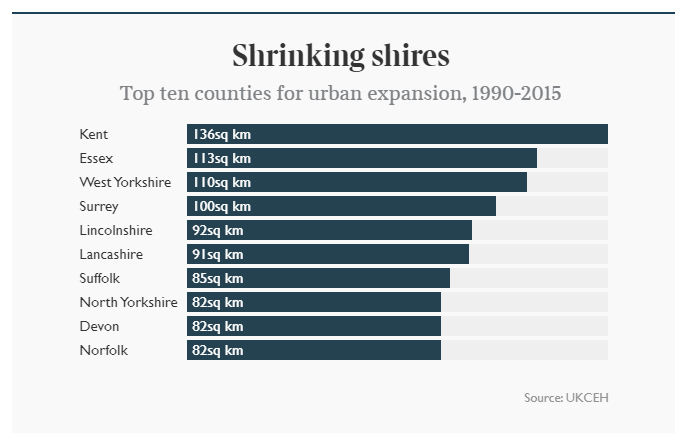
Kent had the largest increase in built-up area, with 136km2 (52.5 square miles, 33,606 acres) developed between 1990 and 2015. Essex had the second biggest rise, gaining 113km2 of urban area, followed by West Yorkshire with 110km2 and Surrey 100km2.

The built-up area in Great Britain increased by 3,376km2 over the 25-year period, according to the study by the UK Centre of Ecology & Hydrology.

The vast majority of the newly urbanised area was in England, with 2,639km2 developed, compared with 440km2 in Scotland and 298km2 in Wales. The proportion of Great Britain that is built up rose from 5.8 per cent in 1990 to 7.3 per cent in 2015.

Researchers calculated overall changes in land use and found that there had been a net reduction of 7,689km2 — 1.9 million acres — in the amount of grassland and playing fields. That includes woodland areas, which grew by 5,236km2, with Scotland accounting for two thirds of the increase. Trees covered 10.3 per cent of Great Britain in 1990 and 12.5 per cent in 2015. This is still only a third of the EU average of 38 per cent. The Committee on Climate Change has said that 17 to 19 per cent of the UK should be woodland by 2050 to help meet a commitment to be carbon neutral by then.

Dr Clare Rowland, who led the research, said: “We have been able to produce the most reliable picture to date of the changes across the British landscape in recent years.

“Our data show the scale of grassland loss in Great Britain not only to make way for urban development but also woodland expansion. This information on how land cover in Great Britain has altered is crucial for understanding the impact of these changes on our environment, and helping us plan for the next 25 years.”

Dr Daniel Morton, who developed the software for the new UKCEH maps, said: “Producing land cover maps annually will enable the tracking of the UK’s progress towards the net zero emissions target by 2050 and the success of national tree planting initiatives, as well as give us greater ability to monitor vegetation responses to climate and land use changes plus extreme weather events.”

Tom Fyans, campaigns and policy director at the Campaign to Protect Rural England (CPRE) said that it was “worryingly easy” for developers to build low-density housing estates “that unnecessarily gobble up our precious green belt, local green spaces and grasslands”.

Research by CPRE and UCL found that low-density schemes were more likely to be poorly designed than those that fitted more houses into the same area.

Mr Fyans said: “We can tackle the housing crisis without unnecessarily concreting over precious grassland.”

Hilary Newport, director of the Kent branch of CPRE, said that the government was focusing too heavily on the southeast to meet its housing targets despite the region already being at risk of water shortages.

Meanwhile, a global study by the National Geographic Society and Wyss Foundation has found that meeting a UN proposal to double the area of land and quadruple the area of sea that is protected — to a total of 30 per cent of the world’s surface — would yield £280 billion in annual benefits in terms of improving mental health, preventing climate change and reducing pollution. The report said that that would outweigh the costs by at least five to one.

[Note added by Owl from study reference: The top 3 grassland losses were in: Argyll & Bute (-739 km2), Devon (-508km2), Wiltshire (-325 km2)]

Prescient

A Guardian comment on underpaid workers:

I recently read the Penguin Great Ideas edition of Utopia – a book Thomas More wrote over half a millennium ago. Whenever I read about care workers, this passage returns to my mind (sorry to quote at such length, but it’s stunningly pertinent):

For what justice is there in this: that a nobleman, a goldsmith, a banker, or any other man, that either does nothing at all, or, at best, is employed in things that are of no use to the public, should live in great luxury and splendour upon what is so ill acquired, and a mean man, a carter, a smith, or a ploughman, that works harder even than the beasts themselves, and is employed in labours so necessary, that no commonwealth could hold out a year without them, can only earn so poor a livelihood and must lead so miserable a life, that the condition of the beasts is much better than theirs?

£27 million extra for Devon’s roads – Potholes a priority

Devon County Council is going to spend an extra £27 million on the county’s roads this year, making it the largest ever annual investment in Devon’s road network.

www.radioexe.co.uk 

Devon County Council is going to spend an extra £27 million on the county’s roads this year, making it the largest ever annual investment in Devon’s road network.

The news follows one of the wettest winters on record. The funding, from the government’s potholes fund, will be used to repair roads, increase pothole prevention and combat the damage caused to highways, bridges and structures during the winter.

The extra money has also enabled the council to improve plans already in place to tackle the effects of weathering and previous storm damage. Community knowledge will be used to highlight specific areas that require maintenance. Structural repairs of bridges and improvement of main roads and ‘B’ roads will be the priority.

Smaller roads, such as ‘C’ and unclassified roads, will receive the majority of the available funding, with a focus on improving the condition and resilience of high-usage local route networks. Bridges and structures and main roads will receive the remaining share, concentrating specifically on structural repairs and making Devon’s highways safer for all users.

In addition, the council has been awarded another £5 million from the Department of Transport to support the Teign Viaduct to Ashcombe Cross major maintenance scheme. The scheme is approximately six miles long and comprises of a maintenance programme to upgrade an important section of the A380. The upgrade includes resurfacing, drainage, bridge maintenance and structural repairs.

Councillor Stuart Hughes, Devon County Council Cabinet Member for Highway Management, said: “The announcement of additional highway maintenance funding is great news for Devon. It will be integral to providing appropriate long-term repairs to Devon’s road network and the safety of our highways. All parts of Devon benefit as a result of this funding. Devon’s covid-19 recovery has also introduced different challenges and new considerations for the improvement of Devon’s highways and the funding will be invaluable in enabling high-usage routes to be safe, properly maintained, and appropriate for active travel, like walking or cycling.”

East Devon beaches named some of the best in the country

Sidmouth and Exmouth beaches have been ranked among the best in the country by an environmental charity.

Keep Britain Tidy makes the awards for achieving high standards of beach management, as well as water quality for bathing beaches.

Sites are assessed for safety and services, environmental management, water quality and information.

The Blue Flag award is an international award presented to well-managed beaches with excellent water quality and environmental education programmes.

Seaside Awards are presented to the best beaches in England and celebrate the quality and diversity of the country’s coastline.

It is the first time Sidmouth has won the Blue Flag award since the 1990s,whilst Exmouth has retained the award for a second year.

The pair were also both awarded Seaside Awards, alongside Budleigh and Seaton.

East Devon district councillors Denise Bickley and Cathy Gardner, who represent Sidmouth Town ward, said: “We are delighted that Sidmouth has been awarded a Blue Flag this year.

“This is a great team effort and thanks must go to East Devon District Council staff, Sidmouth Town Council staff and councillors, Jurassic Paddle Sports, Sidmouth Lifeboat, as well as the army of volunteers who play a huge part in keeping the beach clean. Working together is an example of community spirit at its best.”

Cllr Geoff Jung, East Devon’s coast, country and environment portfolio holder, said: “It’s great that our beaches have again achieved the Blue Flag Awards.

“This clearly demonstrates that East Devon District Council, through its team of officers and staff, its various partners and our many volunteers have again worked tremendously hard to gain these awards.”

“On behalf of all our residents and our many visitors to our beaches, I would like to congratulate our hardworking team for the work that it has done.”

More information on Keep Britain Tidy, which also runs The Green Flag Award scheme, which recognises and rewards well-managed parks and green spaces, as well as information about the Blue Flag and Seaside Awards can be found at https://www.keepbritaintidy.org/local-authorities/improve-public-spaces/blue-flag-and-seaside-award

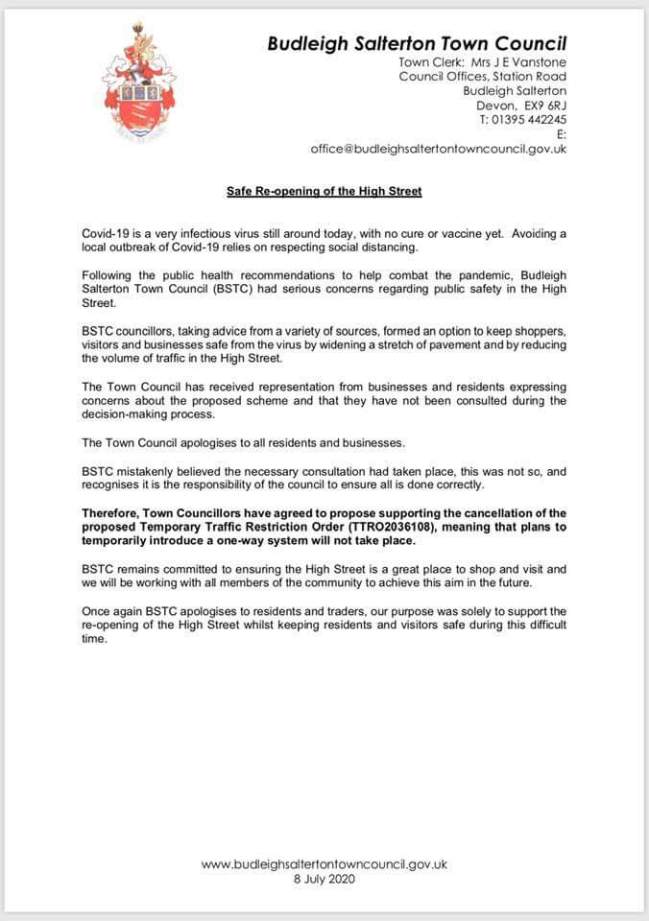
Budleigh Salterton Town Council apologies to all residents and businesses – retracts one way proposals

“BSTC mistakenly believed the necessary consultation had taken place, this was not so, and recognises it is the responsibility of the council to ensure all is done correctly.”


Budleigh in revolt – businesses ‘angry’ at council’s proposed one-way system!

Ooops! – looks like the Budleigh Town Council, supported by Conservative District Councillors Alan Dent and Tom Wright (“For the greater good”- see link below) have decided on a major change to traffic and parking in the High Street without properly consulting the traders (and, from what Owl hears, the public).

Owl understands their concern over social distancing but questions whether this is so great a problem in Budleigh as to merit taking any risk with High Street trading.

The decision has to be agreed by Devon County Council.

Budleigh businesses ‘angry’ at council’s temporary one-way system sign ‘scrap it’ petition

Becca Gliddon eastdevonnews.co.uk 

Businesses ‘angry’ at a temporary one-way system for Budleigh Salterton High Street want it scrapped believing it will harm already Covid-hit trade.
More than 45 traders and the public have hit back at the town council-agreed scheme, signing a petition to oppose the move.The one-way system, to run the entire length of Budleigh High Street, aims to keep shoppers safe and boost social distancing.The town council said it was continuing to look into the one-way system and was reviewing the petition and the comments made.

It said the temporary widening of the pavements was to safeguard pedestrians and road users while social distancing restrictions continued.

It said the move showed shoppers and residents the town was a safe place to visit.

The council, who backed the move a week ago, said it had taken into account representations of residents before drawing up the scheme.

Traders slammed the decision, calling for a U-turn saying it was made without any consultation and will deter shoppers at a time when customers are key to boosting Budleigh’s economy after the coronavirus lockdown forced businesses to close.

More than 45 businesses, and members of the public, have come out in support of scrapping the ‘unnecessary’ system, which would create temporary wider pavements for pedestrians through the use of barriers, one-way traffic, diversions and road closures.

East Devon News understands the petition to abandon the move has been signed by all but four Budleigh traders.

Essential shops allowed to stay open during the pandemic lockdown have also backed the scrapping of the one-way system.

Richard Long, owner of Richard’s Menswear in Budleigh High Street, launched the petition with his wife, Jane, owner of Orchard Foods, also in High Street.

He said shoppers had been seen safely using the existing pavements and called on the council to scrap the ‘crazy’ one-way system, fearing it will deter customers.

Mr Long said: “The town council has used public safety as the reason. We feel that everybody is managing perfectly well as it is.

“People have been using their common sense to get around without causing problems.

“A diversion and one-way system will put people off coming to Budleigh. It just seems unnecessary.

“Everybody is quite angry that the town council didn’t have a proper consultation with either the businesses or the residents.

“To introduce this just at a time when businesses are trying to reopen after the lockdown, when that’s obviously been financially difficult for all the businesses, it seems crazy.

“The big complaint is there wasn’t a proper consultation. The town council are meant to be representing the town but they seem to have done this off their own bat.”

Budleigh

Richard Long with a poster highlighting the concerns of the majority of town’s traders to a one-way system being introduced because of Covid-19 social distancing.

The petition was handed to Devon County Councillor Christine Channon, who lives in Budleigh.

She said: “There has been a local uproar since traders and residents became aware of what exactly the town council were intending to do with regards to a one-way system in Budleigh High Street.

“The local traders consider that they have already lost business due to the Covid-19 lockdown and will lose out on the summer season.

“As local residents have become aware of what exactly has been proposed they too are signing up to protest.

“The town council now have to face up to the fact that their consultation regarding this scheme has been inadequate and so far, there has not been any realistic idea of the costs.”

The list of Budleigh Salterton businesses which have signed the petition.

The list of Budleigh Salterton businesses which have signed the petition.

Mr and Mrs Long said Budleigh’s High Street ‘appears no less safe now than at any other time over the last twenty years’.

They said: “Anyone who observes the flow of traffic and pedestrians on a daily basis, as we do, might wish to challenge this assertion and ask what hard evidence there is to support it.

“As traders of long standing in the High Street, it appears no less safe now than at any other time over the last twenty years.

“We have not witnessed any recent difficulties for pedestrians with the existing pavement width and on street parking provision. It is more the lack of pedestrians and proper toilet facilities being open for them which should be of greater concern.

“We feel that the proposed one-way system is therefore trying to address a problem that does not exist and that it is likely to deter both residents and visitors from accessing the town and its amenities.”

They added: “We feel that this scheme has not been well thought through and will be detrimental to the prosperity and well-being of the town just at the time many businesses are desperately trying to recover from the adverse effects of the lockdown.

“We hope it is not too late to reconsider the introduction of this scheme.”

The campaign group's petition poster can be seen in many shop windows around d the town.

The campaign group’s petition poster can be seen in many shop windows around the town.

In a statement issued by Budleigh Salterton Town Council on the changes to the road layout, it said members had become aware of the issues encountered by pedestrians using the High Street.

The council said: “The width of the pavements means that to observe social distancing regulations pedestrians are having to walk into the road.

“This is, in turn, endangering both pedestrians and road users.

“The town council would like to encourage visitors and residents to use its High Street by showing that Budleigh Salterton is safe to visit whilst still allowing shoppers to follow social distancing restrictions.

“Members feel that by allowing more space for people to walk freely and browse, it will be a more enjoyable atmosphere, with a knock-on effect of helping the town’s traders.”

Former Budleigh mayor and town councillor, Courtney Richards joined traders in calling for a rethink of the one-way system.

He said the town council should take public opinion into account before going ahead.

In a letter to Devon County Council to oppose the move Mr Richards outlined the ‘tremendous negative impact’ the one-way system would have on the town centre.

He said: “As long-time residents we have seen the High Street struggle to survive.

“In recent times the closure of West Hill seriously impacted businesses. Just as they were recovering, along came Covid-19 to impact them again.

“Now, just as the restrictions on business are relaxed, the town council has seen fit to endorse a scheme which will again seriously impact businesses.”

See the earlier East Devon Watch post on the details of the proposals.

Sir John Armitt: Council houses ‘only way to reach 300,000 homes goal’

A huge expansion of council housing, including using the green belt, will be needed to meet Boris Johnson’s “build, build, build” commitments, a government infrastructure adviser has said.

Chris Smyth, Whitehall Editor www.thetimes.co.uk 
Sir John Armitt suggested that the government was stuck in the 1980s with “ideological” objections to social housing as he warned that tweaking the planning system was not enough to hit a target of 300,000 homes a year.He told The Times: “I’ve made this point to housing ministers over the last couple of years on a number of occasions. Clearly they don’t agree. But I am convinced that we will not get to what we need to get to if we rely simply on the private sector.”

Sir John, chairman of the National Infrastructure Commission, told Mr Johnson it was “man-on-the-moon time” for his goal of making Britain carbon neutral by 2050, saying the government needed an urgent focus on developing hydrogen boilers and to “get off the pot” by deciding on how many nuclear power stations to build.

Last week Mr Johnson promised radical reform of the planning system in a “new deal” designed to rebuild the country and stimulate the economy.

Sir John said the planning system was not the main obstacle to affordable homes and that there was no point hoping “somebody’s going to decide that they’re going to build lots of homes, even though there isn’t a market for the homes or they’re not going to make a profit”.

“The last time we built 300,000 homes plus was in the 1960s and 1970s, 50 per cent of those were private sector homes, 50 per cent delivered by local authorities,” he said. “To get to 300,000 personally, I don’t see how we get there in a meaningful way without some sort of government intervention with local authorities, or with the housing associations, to deliver more affordable homes on a large scale.”

Figures released last week suggested that just 4,000 homes for social rent would be built this year, the lowest level since the Second World War.

Sir John said: “If you want to increase that figure much higher, you can’t rely on the private sector, because the business case just isn’t in there within the private sector model.”

The ministry of housing said: “We’re taking steps to ensure more much-needed social housing is delivered by removing the borrowing cap for councils and we are spending more than £12 billion on affordable housing from 2021 — the biggest cash investment in a decade.”

Tim Spector’s Symptom Tracing app. Data update: New COVID prevalence figures for the UK

Three months on, the data science team at ZOE and King’s College London behind the COVID Symptom Study app have taken the decision to update the way prevalence is calculated.

New tabulation for the four Seaside districts Owl is following posted below indicating 70 prevalent cases in East Devon. (Owl’s personal view is that this is most informative Covid-19 tracking data in UK. It just seems to Owl be following the classic scientific approach, unlike many of the others.)

covid.joinzoe.com

We are committed to sharing all our data and findings with our users, so we wanted to take the time to explain how and why these changes have been made and what that means in terms of the data.

Why change the model now? 

As with any scientific study, over time things change and develop, so it’s important to constantly be reviewing and updating how we are doing things to make sure we are giving our users the most accurate information.

For the last two months, we have been running the testing programme with the Department of Health and Social Care in England, which has seen more than 350,000 users being invited to take swab tests when they begin to feel unwell. Users then log results of the test into the app, helping us to build a better picture of what symptoms are related to a positive test. We have also been inviting users who previously tested positive to be retested so we could understand for how long they are COVID positive and exhibiting symptoms.

This new data, combined with all the other data our users have kindly shared with us (including 100million symptoms assessments) means we have a greater insight into COVID symptoms. As a result we have been able to improve our predictions on who is sick, and most importantly we know how long people are likely to still be infectious and therefore test positive to a swab test.

How do we calculate prevalence rates? 

Now that we have a better picture of how long it takes to recover from COVID, we have built a recovery model that tells us how many people recover within a specific number of days from symptom onset. For example, we observe that only 52.2% of people recover within 13 days.

We have combined this recovery model with our daily new cases model to produce our prediction of the number of daily active cases.

In a nutshell, prevalence is:

Yesterday’s active cases + today’s new cases – today’s recoveries = Number of active cases

We have run this formula from the start of our first testing programme (12th June) as we have large numbers of swab tests from this date. As a result we have a much more reliable estimate of daily active cases than we did before.

With this information, we have also recalibrated the prediction model of symptomatic cases to better understand the current levels of COVID in your area and updated the interactive map in data page. We will be separately estimating the numbers of people with long duration symptoms and updating our website with these figures. We want to emphasise that there are lots of people who continue to have symptoms long after they are no longer infectious – this is an area of huge importance, and one that our researchers are very keen to understand better with your help.

The introduction of this new model means that our prediction of prevalence has fallen significantly, because in the last few weeks our previous prevalence estimates included those people who are long term sufferers. These individuals are no longer in the prevalence figures and instead we will be reporting on them separately. It is also important to recognise that we do not identify people who show no symptoms whatsoever (asymptomatic).

What do the latest figures show us? 

Our new prevalence figures show that 23,459 people in the UK currently have symptomatic COVID and highlight the big regional differences across the UK. While nations like Northern Ireland have almost no active cases, the rates for other English regions, like the Midlands, have been decreasing less steeply.

This estimate is in line with the latest ONS Infection survey in which 25,000 people in England were estimated to be infected with COVID-19 during the two week period that goes from the 14th to the 27th of June.

We will be continuing to update all the data on our data page: https://covid.joinzoe.com/data

We hope you found this blog informative and as always, we want to thank all our amazing users who make all this research and data possible!


Active case/million people 8 July

North Devon

79

East Devon

483

Torbay

386

South Hams

529

Prevalence cases under the revised calculations (estimated)

Note: the population of East Devon (2018) was 144,317 so actual estimated symptomatic cases from this table equate to 70.

Additional notes:

[*] This analysis requires swab testing, which was kindly provided by the Department of Health and Social Care for England. As Scotland and Wales are not yet offering tests to app users, we provided indirect estimates using countrywide averages and wide confidence limits.  Testing is happening in Northern Ireland, but the number of participants is too few to generate an accurate estimate. These figures exclude care homes as there is not enough data from the app to estimate this population.

Millions of eligible voters may be missing from electoral registers, a Lords report has warned today.

LocalGov.co.uk – Your authority on UK local government – Millions of voters missing from electoral registers, report warns

Revision: [Owl should have linked this to this previous post]

Laura Sharman www.localgov.co.uk 

Millions of voters missing from electoral registers, report warns image


The report from the Electoral Registration and Administration Act 2013 Committee finds the completeness of registers has not improved in the past seven years, which risks damaging the integrity of elections.

It calls on the Government to modernise registration by introducing ‘assisted registration’ to prompt eligible voters to register when accessing other public services and automatic registration for young people coming of age.

Lord Shutt of Greetland, the chair of the committee, said: ‘Millions of voters may still be missing from electoral registers. The Act has helped to make registers more accurate but they remain significantly incomplete. This is particularly the case with under-registered groups such as young people, frequent home movers, care home residents and people from BAME backgrounds. Incomplete registers can only be damaging to the integrity of elections. Urgent steps must be taken to address this.’

The report also argues local authorities should be compensated for the cost of registration activity during elections and ensure voter ID plans are implemented fairly.

Ailsa Irvine, director of electoral adminstration and guidance at the Electoral Commission, said: ‘Whilst positive reforms to the annual canvass in Great Britain are currently underway, further, more fundamental changes to the framework could make registration easier for everyone – particularly groups who are less likely to be registered, such as young people and private renters.’

Birds of a Feather will flock together – from an Eagle- Eyed Feathered Friend on GESP

“In response to an earlier post from a Correspondent commenting on the GESP and asking –

“Is the Watch readership so gobsmacked with this plan that there is a great silence (no comments posted so far) or are they happy that East Devon will take the lion’s share of the GESP growth?”

Your correspondent need not fear that the lack of birdsong from flocks of native species within the East Devon resident bird population in any way reflects any apathy or acceptance of such inappropriate development of our East Devon countryside that has been proposed in the recently published GESP Draft Policies and Site Options document.

Many of Owl’s feathered friends have chosen to settle in small, rural nesting places within East Devon and these bird populations remain territorial, watchful and perched in anticipation to defend their valued homes.

There has already been much tweeting, screeching, crowing, cawing, clucking and hooting in East Devon around the Clyst St Mary, Farringdon, Woodbury, Sowton, Clyst St George, Clyst Honiton and Aylesbeare areas concerning the indicative minimum number of homes (totalling around 17,000) plus substantially increased employment use on agricultural, green fields at Higher Greendale, Hill Barton, Oil Mill Lane and around the M5! This deafening, cacophonous sound of those defending their village environments and countryside must have reached the ears of those wise birds as far afield as Blackdown House, who are now sitting on strategic, high branches of control.

We are confident that the new breed of decision makers will protect our special rural environment from those predatory, vulture-like species, whose aim appears to be the total annihilation and destruction of our valued East Devon natural environment, primarily to feed their own self-sustenance. This raptorial flock (commonly known as “The Feather Their Own Nests Birds”) has already received suitable culling but their voracious, insatiable appetites have the potential to cause the ruination of many distinct, valued habitats throughout East Devon.

Hopefully those who hear this birdsong will listen and understand the significance of protecting our East Devon stunning countryside and idyllic villages because once our rural, green areas are subjected to build, build build – they are lost forever! 

 With a GESP public consultation due in September, we must ensure that birds of a feather will flock together to protect their special environment because their collective birdsong has the potential to be so momentous 

that it can effect change.

An Eagle-Eyed Feathered Friend “

Sky News Daily podcast: Dr Cathy Gardner gives a detailed account of why she seeks a Judicial Review

Sky News Daily podcast: Careless words from the PM on social care in England?

Although the interview with Cathy Gardner starts around 3 min 40 sec, it is worth listening to the whole podcast obviously prompted by the latest Boris Johnson comments.

Her crowdfunding site can be found here.

news.sky.com 

On this edition of the Sky News Daily podcast with Dermot Murnaghan, we examine the impact of Boris Johnson’s comments about care homes during the COVID-19 pandemic.

We are joined by Dr Cathy Gardner, whose elderly father died in a care home in Oxfordshire in April with suspected coronavirus.

We also speak to Age UK trustee Martin Jones about the challenges facing the sector, funding issues and creating a model for the future.

Listen to the Daily podcast on Apple PodcastsGoogle PodcastsSpotifySpreaker

Credits:
Producer – Annie Joyce
Assistant producer – Sabah Choudhry

A Correspodent comments on the GESP

“Is the Watch readership so gobsmacked with this plan that there is a great silence (no comments posted so far) or are they happy that East Devon will take the lion’s share of the GESP growth?

As I have written before “Has not East Devon sacrificed enough Grade 1 agricultural land to build Cranbrook? Were we not told that this sacrifice would be EDDC’s contribution to housing need?” Now if this plan were to go through we would lose more such land.

The EDDC Local Plan and GESP are based on a jobs led scenario. In EDDC’s case this assumed the creation of 950 jobs a year. Since the start of the plan job creation has been around a quarter of that. Now, with the pandemic recession it will take years to get our jobs back to what they were at the start of the plan in 2013.

Our focus now should be on the economy and job creation opportunities. We do not need to plan any more houses until that has been achieved.

The only people to win if this goes ahead are the landowners.

I urge our Council to see sense and firmly reject the GESP”


Owl recalls that the referenced post mentioned the enthusiasm of Conservative Cllr Philip Skinner for a “network of linked villages being built in the North West Quadrant area of East Devon. (Poltimore, Huxham, Clyst St Mary, Clyst St George, Ebford, West Hill, Woodbury​, Woodbury Salterton, Exton and Farringdon).

Last October EDDC’s  Strategic Planning Committee  unanimously recommended to the Cabinet that East Devon supports the Exeter and East Devon garden communities status (part of another Exeter driven development scheme).

Cllr. Philip Skinner was appointed by “Independent” Leader, now Conservative ex-leader, Cllr Ben Ingham to lead strategic planning with Independent Cllr Susie Bond.


See response: “Birds of a Feather will flock together”