Opinion: It’s time Boris Johnson admitted he’s to blame for Britain’s disastrous coronavirus response

Boris Johnson knows he’s to blame for Britain’s disastrous coronavirus response – it’s time he admitted it. 

www.independent.co.uk 

Covid-19 has so far killed some 60,000 people in Britain. Many should still be alive. Our record is among the worst in the world. Boris Johnson may not be criminally culpable for this national catastrophe, but he is undeniably responsible for the decisions that led to it.

He must know that himself. Why else would he be trying so hard to dodge the blame?

The fate of Public Health England says it all. PHE is accountable to ministers. If they didn’t like its approach, they could have imposed another. They could have given it more money and staff, hollowed out as it was by years of cuts. They could have changed its mandate.

Instead they make it the villain in an alternative reality drama whose heroes – themselves – would be leading us to the Promised Land if only they were not undermined at every turn by obstructive public servants and institutions bent on sabotage. “Following the science” means “blame the boffins”. Anonymous fingers have pointed by turns at civil servants; doctors, nurses and carers; NHS England; local authorities; previous governments; young people; and even Matt Hancock.

With this comes the full repertoire of Trumpian techniques to draw attention away from the government’s mistakes. Statistics manipulated, goalposts moved, dead cats slammed down, fights picked, culture wars unleashed, hapless officials thrown under buses and, yes, lies told, all to sustain the illusion that we are fortunate indeed to be so wisely and decisively led.

But despite early warnings, the prime minister came slowly to the helm. Through March, he flirted with a lethal strategy of herd immunity, abandoned test, trace and isolate (TTI), ruled out quarantine for arrivals from Covid-19 hotspots, and delayed the lockdown: all to the alarm of most independent public health professionals. 

More followed. Abandonment of care homes, and the entire care sector, behind claims about a “protective ring”. Failure to get a grip on shortages of protective clothing amid denials that these were costing lives. When TTI resumed, instead of it being entrusted to experienced local public health teams, it was outsourced to Serco, Sitel, Deloitte and G4S, under a false NHS flag and the leadership of an unqualified and commercially unexceptional, but politically reliable, former telecoms boss. Predictably this has yet to deliver the service we need.

Compounding this has been an approach to communication guaranteed to erode trust and confidence. From the prime minister down, those speaking for the government have been reactive, not proactive, evasive not candid, patronising not sympathetic. They have said one thing one day and another the next. They have offered no plan, only slogans. Averse to listening and consultation, they won’t trust those who must implement their often last-minute pronouncements.

They have shown no empathy with the victims of this pandemic and those most at risk. And when push came to shove with the Cummings Northern Tour, it was “do as we say, not as we do”.

The pandemic has stretched everyone. But the key choices have been political. A prime minister who insists on slavish obedience from his cabinet and total control from No 10 can’t complain when the buck stops with him.

Each blunder was warned against. Each could have been mitigated if not avoided by applying basic public health principles. From South Korea, Taiwan and New Zealand to Germany and Ireland, leaders who have combined these principles with honesty and humility have invariably done better.

The public inquiry will, it must be hoped, work forensically through all this. But the prime minister has already kicked it so far ahead as to ensure it can neither confront him in real time with the consequences of his decisions nor help us learn urgent lessons. Meanwhile worse now awaits us as the nights draw in after an eerie summer, perhaps from the virus itself, certainly from its social and economic effects.

We urgently need an autumn reset. We need a government, and a prime minister, running our country not fighting campaigns or chasing headlines. We need them to talk to us with honesty and grace, to win back our trust and to bring us together behind a credible plan.

Scotland rightly aims, with its “zero Covid” strategy, to eliminate community transmission of the virus. That should be the plan in England too. It should have been all along. Only when the daily fear of contagion has gone will people find the confidence to bring our country fully back to life.

The prime minister’s hero, Winston Churchill, wrote: “The use of recriminating about the past is to enforce more effective action at the present.” Boris Johnson must urgently apply this to his own performance. He needs, in short, to take responsibility.

The British people are the real heroes in this drama. They know the prime minister’s job is thankless and he too nearly died. Even now, after all they have endured, they will forgive and move forward if only he can find the courage to own the choices he makes and the consequences for everyone else.

Otherwise, at a price, we will eventually find a way past those consequences. But they will hang like an albatross for evermore around Boris Johnson’s neck.  

John Ashton has been a senior civil servant and diplomat, and latterly a full-time carer. His cousin John Ashton is a former president of the Faculty of Public Health and a regional medical officer. The latter’s book, Blinded by Corona, will be published by Gibson Square on 1 October

 

Sasha’s Diaries – Tutting at the decor while Britain burns: that’s life in the Cameron chumocracy! 

“The paperback of Cameron’s memoirs is out this week….

[They] …… are not a great fit for the Personal Growth section of any bookshop – then again, nor is the other opus in which Dave plays a significant role this week. The former prime minister appears extensively in Sasha Swire’s diaries, serialised at length in the Times. Sasha is married to the former MP and minister Hugo Swire, a Cameron-era Tory so obscure I’m amazed even his own wife has heard of him.”

Marina Hyde www.theguardian.com 

What ho, David Cameron! I note the artisan politician has surfaced briefly from his money trench to offer a wan opinion on the government’s plan to break international law. Such is the Cameron Paradox – most of the time I’m thinking: “Where’s David Cameron?! This is all his mess!” But when he materialises, I pivot immediately to: “Oh YOU’VE turned up, have you? Well we ARE honoured…”

On Johnson’s mooted lawbreaking, Cameron helpfully says we’re “in a vital negotiation with the EU to get a deal … and that’s why I have perhaps held back from saying more up to now”. Is it? I doubt it’s why at all. The paperback of Cameron’s memoirs is out this week, so there’s now something in it for him to belatedly join all the other living Tory leaders who’ve expressed much stronger views.

Those memoirs are not a great fit for the Personal Growth section of any bookshop – then again, nor is the other opus in which Dave plays a significant role this week. The former prime minister appears extensively in Sasha Swire’s diaries, serialised at length in the Times. Sasha is married to the former MP and minister Hugo Swire, a Cameron-era Tory so obscure I’m amazed even his own wife has heard of him.

She is, however, the right diarist for the period in question: clique-obsessed, throbbing with misplaced entitlement and declining to learn from any of the events she witnesses. Just as Dave’s innate overconfidence failed to spot that his way of doing business was going to end in cataclysm, so Sasha seems surprised that people are calling her indiscriminate indiscretion “social suicide”.

No one emerges with credit. Swire seems to regard herself as easily as grand as a Mitford, which isn’t the case, while Cameron is the sort of locally sourced wanker who not only knows that lemon juice will spoil mozzarella, but says it out loud at someone else’s house. “At one point, on the coastal path,” Sasha relates of some Cornish holiday hike, “he asks me not to walk in front of him. ‘Why?’ I ask. ‘Because that scent you are wearing is affecting my pheromones. It makes me want to grab you and push you into the bushes and give you one.’”

If there are any remaining Cameroons out there, they may well regard this as evidence of Dave’s wit and virility. From this end of the telescope, though, all I can make out is a load of rugby-shirted not-quite-theres making dreary vanilla innuendo with one another. The episode takes place shortly after the fall of Tripoli, prompting Cameron to opine: “A great day on the beach … and I’ve just won a war.” Yup, well: SPOILER ALERT.

Everyone seems permanently on the verge of some class-related nervous breakdown. Sasha’s first instinct on visiting George Osborne at the grace-and-favour Dorneywood is to strip it for decorative errors made by the previous tenant, Pauline Prescott, while Michael Gove’s wife – the Daily Mail columnist Sarah Vine – is cast as a sort of below-stairs Madge Allsop to glamorous SamCam. I see Vine has taken it well, with just the 1,200 words of seething in Monday’s Mail, in which Swire is lambasted for being “amazingly confident in her own opinions”. An opinion columnist takes against the opinionated: very good. Of course, we do have to remember that Vine had frightfully strong views about Ed Miliband’s kitchen, so perhaps all the looking down on people was catching.

The clique are forever noticing the wrong tiles or mild social neediness, but not the freight train coming towards them. If only they’d spent as much time worrying about, say, the country, as they did on all the not-very-niceties. Cameron learned nothing from the divisively bitter and close-run Scottish independence referendum – indeed, he doesn’t seem to have even noticed it was divisive and embittering. Then again, in Swire’s diaries, the mistake of the EU referendum for Cameron would be classed as less significant than using the wrong word for loo or omitting to void oneself in diamonds.

Thereafter, all is not well in the £25,000 shepherd’s hut, where Cameron finds his memoirs a huge Farrow & Ball-ache. “He seems bored by the process,” writes Sasha, “and so is speaking into a microphone, which converts it into text.” Six months later the microphone has farted out a book, and Cameron is raking in so much cash he “has no interest in taking on a big public job like Nato”. Their loss, of course. “As for all the dosh, he says every time he looks for a loophole to stash it away, he realises that George and he closed it, and laughs.”

Cameron was so incapable of seeing life beyond his chumocracy that he made the sensational category mistake of judging the referendum a loyalty test, as opposed to issue-driven. When it all goes tits up, he is “incandescent with anger, which is almost wholly directed against Michael [Gove]”. He can forgive Boris Johnson his narcissistic ambition, but not Gove his principles. Ah well. As Swire non-reflected last weekend: “I just think, fuck it. People come into your life and they go out of it.” Well quite. People, jobs, houses, money, countries – nice not to have to worry too much about any of them.

  • Marina Hyde is a Guardian columnist.


Hitachi ‘withdraws’ from Wylfa nuclear project

Plans for a £15-£20bn nuclear power plant in Wales have been scrapped.

[Owl doubts this will be as big a “blow” to the Welsh economy as claimed]

www.bbc.co.uk

Work on the Wylfa Newydd project on Anglesey was suspended in January last year because of rising costs after Hitachi failed to reach a funding agreement with the UK government.

Isle of Anglesey council said the company had now confirmed in writing it is withdrawing from the project.

Council leader Llinos Medi said: “This is very disappointing, particularly at such a difficult time economically.”

Developer Horizon Nuclear, which is owned by Hitachi, said it would not comment.

The UK government also declined to comment.

However Anglesey council said it had received a letter from the Tokyo-based parent company confirming its decision.

Mrs Medi has asked to meet both the Welsh and UK governments to discuss the future of the site.

A two-reactor plant at Wylfa was the biggest energy project ever proposed in Wales.

It was earmarked as having the potential to power up to five million homes, but the project was put on hold as the upfront costs rose.

With 9,000 workers ready to start the construction phase, the decision in January 2019 was described as “a tremendous blow” to the Welsh economy by business leaders.

The company said in June it was hoping to secure extra funding from the UK government to resume the project but has now thrown in the towel.

Analysis by BBC Wales business correspondent Brian Meechan

As one of Wales’ biggest proposed construction projects, Wylfa Newydd has faced turbulent times.

The company behind it, Hitachi, has always been concerned about the costs of building the new nuclear power plant.

The UK government went some way in offering financial support to the project but it wasn’t enough to satisfy Hitachi’s concerns over the financial risks.

The UK government also held a consultation on plans that would see energy customers pay upfront for the costs of construction.

The industry has been waiting for months for an outcome to that.

When the UK government said nuclear was part of its push for green energy, the industry thought it was a positive sign for Wylfa Newydd.

But critics question how green nuclear energy really is, not to mention how safe it is.

Wales has been called the “land of artists’ impressions” with many big schemes that are talked about and never happen.

Supporters of Wylfa Newydd will be concerned it will become another of those, while its critics would be glad to see the back of the plans.

The decision will have “a big effect on the economy”, according to Edward Jones, lecturer in economics at Bangor University.

“We are currently feeling the effect of Covid-19 and Brexit is around the corner, and we will feel the negative impact of that on the economy,” he said.

“A lot of people were investing in learning new skills with the thought of getting jobs at Wylfa.

“We know businesses are investing in new production methods to be part of the supply chain of the nuclear power plant.

“The challenge now is to find other projects that can make use of these skills.”

Mr Jones said other energy projects on the island, such as the Morlais tidal energy scheme, could make use of the investment already made.


Did your MP vote to break international law? (Yes)

Did your MP vote to break international law?

Many senior Tories did not vote, and two Conservative MPs rebelled in the first Commons division on Boris Johnson’s internal market bill, which would give ministers the power to break international law

Seán Clarke www.theguardian.com

Internal market bill, second reading

First vote on the PM’s controversial Brexit bill

Interactive list here

Both Simon Jupp and Neil Parish voted to break the law – Owl


The real ‘social housing waiting list’ is 500,000 more than official figures

“A coalition of charities, businesses, banks, and think tanks has launched a campaign calling on the government to put building social homes at the heart of its plans for recovery from the coronavirus crisis.”

The mutant housing needs algorithm is going to do nothing to address this problem, it’s just another developers’ charter to build, build, build the wrong sort of houses in the wrong places – Owl

15 September 2020 www.housing.org.uk 

The real ‘social housing waiting list’ in England is 500,000 households bigger than official figures suggest, reveals our new data today.

The findings are published in our annual People in Housing Need report, the most comprehensive report to date on the state of the nation’s housing crisis. It is the only research to analyse the true number of people in need of social housing in England, which has now hit 3.8m. This equates to 1.6m households – 500,000 more than the 1.16m households recorded on official waiting lists.[i]

Due to the severe shortage of social homes, some of these people have been on their council waiting list for almost two decades and may never be housed.[ii]

Already at critical levels, the National Housing Federation is warning that the number of people in need of social housing is set to rise rapidly as a result of the coronavirus pandemic – with low-income earners roughly twice as likely to lose their jobs.[iii] Worse still, those currently in need are likely to be forced further into poverty and debt and as the eviction ban ends, many more will become homeless.

Social rented homes are typically 50% of market rent. They are the most affordable and secure homes for people on low incomes.

Last year only 6,338 new social rented homes were built, a fall of 84% since 2010. New lettings from existing properties also fell by 17% in the same time period and the most expensive areas of the country saw the smallest proportion of new lettings, despite having the highest number of people in need and on waiting lists. [iv]

In the last two years the number of people in need of social housing has increased by 5% and 165,000 people, whilst the number of households has largely remained the same. This suggests that new and growing families are now suffering the worse effects of the housing crisis. The report shows that there are now 3.4m people living in overcrowded homes.

Now in its second year of publication, People in Housing Need reveals the true number of people hit by housing problems, what issues they are facing; such as unaffordability, overcrowding or poor conditions, and what housing would be most appropriate to meet their needs, based on income and circumstances.

Previously, council housing waiting lists were the only way of measuring how many people needed social housing. But these lists, which only record people who apply and meet strict criteria, are a way of prioritising the most vulnerable. They are not intended to be an accurate reflection of everyone in need of an affordable and secure home. Today’s report gives a significantly clearer and more accurate picture of housing need in this country.

The largest number of people on the real ‘social housing waiting list’ are in private rented homes (1.5m), with many having to choose between living in poverty and getting into debt in order to keep a roof over their heads. Others are living in overcrowded, poor quality or unsuitable homes, stuck with friends, family or ex partners because they cannot afford a home of their own, or are homeless. Official figures show that the number of homeless children living in temporary accommodation has risen by 88% since its low point in 2011 to 129,380.[v]

A coalition of charities, businesses, banks, and think tanks has launched a campaign calling on the government to put building social homes at the heart of its plans for recovery from the coronavirus crisis.

The Homes at the Heart campaign is a partnership between Chartered Institute of Housing, Crisis, National Federation of ALMOs, Association of Retained Council Housing and National Housing Federation; along with over 60 supporters from across different sectors – from Carers UK to NatWest.

Last month the HCLG committee inquiry into building more social housing, endorsed the National Housing Federation and Crisis’ recommendation that the government invest £10bn a year in social housing. This would be enough to build 90,000 new social rented homes every year. The report added that this should be a top priority to rebuild the country from the impact of Covid-19.

Kate Henderson, Chief Executive of the National Housing Federation, said: “Today’s report shows that the sharp end of the housing crisis is getting sharper, and at a rapid rate. Under-investment in social housing has left us with virtually no affordable homes available for people on the lowest incomes.

“The real tragedy is that these are same people impacted the most by the coronavirus crisis, which had led to huge job losses for low income workers. When the government’s Job Retention Scheme and ban on evictions end, we are likely to see people in need of social housing skyrocket.

“Everyone deserves a safe, secure and affordable home and social housing provides that vital safety net for low income people including thousands of key workers who have been keeping our country going at this time. We are calling on the government to commit to a once-in-a-generation investment in social housing and put homes at the heart of its plans for economic and social recovery.”

For more information on the Homes at the Heart Campaign visit: https://www.housing.org.uk/HomesAtTheHeart


Sasha’s Secret Diaries reveal a government of “eight smug, aloof, and slightly aimless people”

Tory wife’s diary reveals all about the party

“….the more one reads of the world of Mrs Swire, the more inevitable the subsequent collapse of British politics starts to seem. How were they supposed to end, those years of government by about eight smug, aloof, and slightly aimless people who were only bothering because they didn’t have anything better to do? …..”

[Owl finds the extracts themselves rather boring and repetitive unless you like descriptions of endless dinner parties but the reviews are interesting]

Hugo Rifkind www.thetimes.co.uk 

It’s obviously simplistic to conflate political projects with cliques, but it can be helpful, too. Particularly when you’re trying to figure out why people hate each other so much.

In many respects, for example, the Blair government was best understood as a club of Islington lawyers who had had enough of left-wing politics being dominated by whiffy old men with bundles of pamphlets in plastic bags. And then, later on, the Corbyn movement was dominated by those same whiffy old men, often also from Islington, and often also with the same pamphlets, who were still very cross about it.

Similarly, over on the other side, the Cameron government was a bunch of chummy, middlebrow chaps from glamorous public schools, and the Brexiters who usurped them were a bunch of resentful middlebrow chaps from slightly less glamorous public schools, who the first lot had never once had over for a weekend in the Cotswolds. Caricature? Of course. But not, I think, untrue.

The memoirs of Sasha Swire, serialised in The Times this week, offer the sort of perspective into the Cameron tribe we could only otherwise have got with a periscope punching up through an unspeakably expensive kitchen island. She is the wife of the former Tory Foreign Office minister Sir Hugo Swire, and the daughter of a former Tory defence secretary, and she is tall and blonde and rich and glamorous, and seems to convey the very essence of being a very particular sort of Tory. As in, you know the sort of Tory that Ruth Davidson is? That Theresa May is, and John Major is? Well, not that sort. No.

Like all the best memoirists, Swire seems to understand her own life with the perfect mix of insight and a complete lack of it. For the latter, I offer you the bit in Decca Aitkenhead’s interview in The Sunday Times, where Swire mused that her husband should have been foreign secretary, or at least international development secretary, because he had Etonian charm and “knows all the countries”. What, all of them? Get you, Mr Google.

For the former, though, ponder her epiphany, in yesterday’s extract, at the Cameron’s Notting Hill Christmas party. “Poor old Sarah Gove” is there, apparently doing the catering, and our author has a flash of being “in the court of King David”. It is, she writes, “a very particular, narrow tribe of Britain and their hangers-on” and “enough to repulse the ordinary man”. I’m not sure which ordinary man. Maybe her gardener.

Fifteen years after it began and four years after it so abruptly ended, there remains something enigmatic about the Cameron project. One looks back, still, and one is not quite sure what it was for. Asked why he wanted to be PM, Cameron famously replied “because I think I’d be good at it”. It always reminded me of that Billy Connolly routine, where he meets a well-spoken Englishman who tells him he’s a tobogganist. “A tobacconist?” says Connolly, confused. From the right sort of background, you can have a decent crack at doing almost anything. So why not, thought Dave, do that?

Perhaps that’s why it all never really seemed to matter. Facetiousness can be a pose for the upper classes because earnestness is gauche but the characters we see through Swire don’t even seem to notice that they’re doing it. “What more do I want?” chuckles Cameron, after the fall of Tripoli in 2011. “A great day on the beach . . . and I’ve just won a war.” Contrast this with Blair on Iraq, with the handwringing, and the angst, and the talking to God. Despite all that “heir to Blair” stuff, the two PMs don’t seem to have much in common, either in earnestness or in charisma. This is seen most abruptly when the PM tells Mrs Swire, I suppose in what he imagines to be a charming way, that her perfume makes him want to “push you into the bushes and give you one”.

The clique has codes. A few months after hosting the Camerons in Cornwall, the Swires mention to the Osbornes that they still haven’t been invited to Chequers. Twenty-four hours later an invitation materialises, because while joking about forcibly humping your friend’s wife in the bushes is basically fine, forgetting to return an invitation definitely isn’t. Also, there is the strange, awkward, status of the Goves. Alone among the clique, they are precarious, with lives that would be very different if they weren’t in it. Thus, eventually, they aren’t. In a world where everybody is blithe, their crime seems to be not being. Almost explicitly, in fact, Boris Johnson is forgiven for backing Brexit because he didn’t really believe in it, whereas Michael Gove isn’t, because he did. As Sarah Vine, otherwise known as Mrs Gove, wrote yesterday: “Hugo toyed with the idea of coming out for Brexit, but in the end decided to support Dave instead.” Brexit or Dave: the real referendum choice.

As I said, a clique theory of politics will always be simplistic. Speaking as somebody who was also at a public school, and who is also from a Conservative family and who is, indeed, even also called Hugo, I might also seem to be dancing on a pinhead in separating one bunch of Tories from another.

Still, the more one reads of the world of Mrs Swire, the more inevitable the subsequent collapse of British politics starts to seem. How were they supposed to end, those years of government by about eight smug, aloof, and slightly aimless people who were only bothering because they didn’t have anything better to do? What else could possibly have happened, if not the storming of their expensively tasteful barricades, by all of those colleagues that they relied upon, and looked down upon, and never invited in?


North-south divide in housing targets

More on the impact of the mutant housing algorithm – Owl

Melissa York, Assistant Property Editor www.thetimes.co.uk 

A new housebuilding algorithm will mean that northern councils have to cancel their plans while huge numbers of homes are built in the south, according to an analysis.

Last month the government said that it was looking to revise quotas for local councils using a formula based on “relative affordability”, among other factors. The targets would be compulsory and create local “growth” zones that would automatically approve developments with little input from local councillors.

The Local Government Association (LGA) compared housebuilding targets under the proposed regime with the current one and found that the results would lead to a housing boom in London and the south and fewer homes being built in the north.

In Dover, the council would be expected to deliver 294 per cent more homes than it has done in recent years, according to the LGA’s estimate, while Tunbridge Wells, in Kent, would have to increase housebuilding by 184 per cent.

In the north, it found that housebuilding would decrease, with 66 per cent fewer homes built in Newcastle, 59 per cent in Liverpool, 20 per cent in Sheffield and 16 per cent in Leeds. Rural areas would be disproportionately affected, with some of them seeing a 59 per cent increase in homes under the updated algorithm, compared with a 20 per cent increase in urban areas. The LGA said it was not the planning system but housing delivery that was “fundamentally broken”, because nine out of ten applications were approved.

The Ministry for Housing, Communities and Local Government said: “The LGA’s fears are unfounded. The current formula for local housing need is inconsistent with our aim to deliver 300,000 homes by the mid-2020s.”


Devon & Cornwall covid cases up 50 per cent

www.radioexe.co.uk

122 new Devon cases confirmed this week

The number of coronavirus cases confirmed in the last seven days has risen by 50 per cent across Devon and Cornwall.

One hundred and twenty-two new cases have been confirmed in Devon in tests carried out by the NHS and by commercial partners, compared to 96 new cases confirmed last week. Most, 71, were in the Devon County Council area, which excludes Torbay, which had 12 cases, and Plymouth, which had 39, down one from last week.

Cases confirmed across Cornwall and Devon County Council areas have doubled, in Torbay tripled, but in Plymouth, they have fallen, with 39 cases compared to the 40 last week.

Of the new Devon County Council area cases, 18 were in East Devon, 17 in Exeter, four in Mid Devon, eight in North Devon, seven in the South Hams, nine in Teignbridge, six in Torridge, and two in West Devon.

There is a cluster of four cases in Clyst, Exton and Lympstone, and in Cranbrook, Broadclyst and Stoke Canon, in East Devon, three cases in Wonford and St Loyes, and Pennsylvania and University, in Exeter, a cluster of three Bishop’s Nympton, Witheridge & Chulmleigh in North Devon, and four cases in Wellswood and Churston and Galmpton in Torbay.

Plymouth currently has four clusters, all of three cases, in Cattedown and Prince Rock, Mutley, Plymstock Hooe and Oreston, and Honicknowle and Manadon. Clusters in Dartington and Loddiswell, and Ivybridge, in the South Hams, Bradninch, Silverton and Thorverton, Chudleigh and Bovey Tracey, Plympton Underwood, North Prospect and Mannamead and Hartley have dropped off the map in the last week.

And while the number of cases being confirmed still remains relatively low, not all of the new cases are linked to returning international travellers, which has been the pattern previously.

Dr Virginia Pearson, director of public health Devon and chair of the multi-agency covid-19 health protection board, said: “Although Devon’s rates have been comparatively low so far, we cannot be complacent. Just like the rest of the country, we have seen a significant rise in the number of confirmed cases in September. Not all new cases are now linked to returning international travellers, which was the pattern we had seen recently. We must remember that coronavirus is still a very real threat to us all, especially to our older and vulnerable residents.

“It’s very easy, with the relaxation of restrictions we’ve had over recent months- the call for people to return to work and to support our high streets; our children returning to schools, colleges and soon to Universities – to believe that life is back to normal. It is not back to normal.  The virus is still here and it is very easy to get infected, especially indoors.  I am therefore urging all Devon residents, of all ages, but specifically to our younger residents who perhaps do not feel the risk felt by older and more vulnerable residents, to follow the public health advice at all times.

“We are continuing to monitor the data very closely so that we can react immediately to situations as they arise.  But we also need you, the Devon public, to carry on doing your bit to reduce the risk of coronavirus spreading in our county this autumn.”

However, despite the rise in cases across the region from previous figures, the number of people in hospital with coronavirus has continued to remain relatively low. The R Rate for the wider South West region is now estimated as between 0.9 and 1.2, up from 0.8 – 1.1 last week. 

In total, Torridge has had 64 positive cases, West Devon 78, with 123 in the South Hams, 143 in North Devon, 235 in Mid Devon, 238 in Teignbridge, 274 in East Devon, 291 in Exeter, 318 in Torbay, 793 in Plymouth and 1026 in Cornwall and the Isles of Scilly.


Urgent improvements needed at failing  Devon Doctors service

Urgent improvements have been demanded at Devon’s NHS 111 and out of hours GP service after inspectors found ‘deep rooted issues’ and that not all patients are receiving safe care or treatment.

Anita Merritt www.devonlive.com 

It was also criticised for not treating patients promptly enough, with national performance targets failing to be met, and some patients having been put at risk, including deaths which have since been the subject of serious incident investigations.

Shocking examples included a patient who died some time after a fall and had not being properly assessed due to the clinician’s heavy workload, and a patient who had sustained an injury, but no call back was made and they subsequently died.

Devon Doctors Limited, which provides an Urgent Integrated Care Service (UICS) across Devon and Somerset, was inspected by independent health and social care regulator the Care Quality Commission (CQC) in July, after concerns were raised about the service including safety fears and insufficient staffing to meet expected demand.

They included that prior to lockdown in March 2020, up to 300 call backs were reallocated back to patients’ own in hours GPs on Monday mornings as they had not been addressed by the service over the weekend.

It resulted in considerable delays for some patients in accessing advice or treatment, with some patients having waited up to 17 hours for contact from the service.

The inspection looked specifically at Devon NHS 111 and out of hours service, and some areas of the Somerset out of hours provision.

Devon Doctors, which is based at Manaton Court in Exeter, provides a primary medical service to approximately 1.1 million people, a figure which increases substantially in the summer months due to the area’s tourism industry.

Janet Ortega, CQC’s head of inspection for Primary Medical Services in the south, said: “People who call the NHS 111 service are entitled to quick and easy access to healthcare advice and information, or access to urgent attention when that’s appropriate.

“This should never impede on patient care. Our inspectors visited Devon Doctors in July and were not assured that patients were being treated promptly enough and, in some cases, they had not received safe care or treatment.

“It is clear there are deep rooted issues and the provider needs to address these. We have shared our findings with the leadership team at Devon Doctors and they know what they must do to improve.

“The provider recognised the concerns highlighted by our inspection team and is working very closely with Devon CCG and Somerset CCG through an improvement programme.

“We will continue to monitor Devon Doctors extremely closely and will return to inspect services again on an unannounced basis in the near future.”

The service was last inspected in January 2017 when it was rated as good overall.

However, during the latest visit, CQC inspectors found the systems in place to keep patients safe and safeguarded from abuse were not always followed. This meant the risk to patients was not always minimised.

Not all staff had received up-to-date safeguarding and health and safety training appropriate to their role. Records showed there were gaps in staff completing training and records that had been completed did not show what level of training had been undertaken.

Some staff said they were not always confident that the training they had received was sufficient to enable them to carry out their roles.

The leadership team was unable to show that actions to address any challenges to the quality of service had been effectively put into place or monitored. Not all staff felt supported by leaders to perform their role effectively.

Information to enable staff to deliver safe care and treatment to patients was not always up to date.

The data relating to performance for the NHS 111 service was consistently considerably below England averages. The service was not achieving the required national targets.

Performance targets for answering calls within 60 seconds were not always met and regularly fell below the national average.

There were a lack of systems to ensure risks were reduced and the safety of patients’ health and welfare was protected.

The service was not rated at the latest inspection due to it being a focused inspection.

A spokesman for Devon Doctors said: “We were inspected by the CQC in July 2020 and some areas for improvement were identified.

“An improvement plan has been developed and agreed with the CQC and commissioners in Devon and Somerset.

“We are working very closely with all three of these organisations to address specific areas for improvement and this work has already begun.

“We are confident that we can resume the high-quality service that we have successfully provided to patients for the last 20 years.”

To read the full report click here.

NHS reminder about face-to-face appointments angers GPs

NHS bosses have sent a letter to GPs to remind them to offer face-to-face appointments where necessary, sparking an angry response from professional bodies who say such comments risk insulting hard-working doctors.

Nicola Davis www.theguardian.com

In March, GPs were urged to move to remote consultations where possible in a bid to reduce the spread of Covid-19. The result was a surge in the number of appointments conducted at a distance: in May alone, 48% of GP appointments were carried out over the phone.

Now NHS England has written to GP practices reminding them they must make sure patients are aware face-to-face appointments are available, where clinically appropriate, and warning practices they face investigation by local commissioners if they fail to offer such appointments where needed.

“We know that the vast majority of practices have made significant efforts to remain accessible to patients through the pandemic, and to keep staff and patients safe,” the letter states.

But, it adds: “It is important that no practice suggests in their communication that the practice is closed or that the practice is not offering the option of face-to-face appointments.”

Nikki Kanani, the medical director of primary care for NHS England, said general practice had adapted quickly during the coronavirus outbreak to offer remote services, while providing face-to-face appointments where necessary.

“While many people, particularly those most vulnerable to Covid-19, want the convenience of a consultation over the phone or video, the NHS has been and will continue to offer face-to-face appointments and I would urge anyone who feels they need medical support to come forward so they can get the care, support and advice they need – the NHS is here for you,” she said.

Prof Martin Marshall, the chair of the Royal College of GPs, said the proportion of appointments carried out face-to-face is increasing, with more than 300,000 delivered each day last week.

“General practice is open and has been throughout the pandemic. GPs have been delivering a predominantly remote service in order to comply with official guidance and help stop the spread of Covid-19,” he said.

“Where face-to-face appointments are necessary, they are being facilitated, and we have called on CCGs to work with practices where this is not possible – for example, if all GPs at a practice are at high risk of Covid-19 – to ensure that they can be.

“Any implication that they have not been doing their job properly is an insult to GPs and their teams who have worked throughout the pandemic, continued delivering the vast majority of patient care in the NHS, and face an incredibly difficult winter ahead.”

Dr Richard Vautrey, the GP committee chair at the British Medical Association, agreed, adding that doctors have experienced a significant increase in workload.

“GPs have been working incredibly hard to keep their services as accessible as possible during the Covid-19 pandemic, with most offering virtual triage as the first point of contact in order to help keep their workforce and communities safe. This is exactly what the government has been encouraging them to do,” he said.

“This does not mean practices have stopped face-to-face appointments, and they continue to be offered where safe and necessary. Any inference that in-person consultations were put on hold does a great disservice to the committed GPs who have continued to go to work throughout the pandemic.”

Chief scientist Patrick Vallance ‘was told off’ for backing lockdown

The government’s chief scientist was ‘told off’ for pushing too hard for lockdown as coronavirus cases soared, a private email revealed today. 

James Tapsfield www.dailymail.co.uk

Sir Patrick Vallance said he ‘argued stronger than anyone’ for harsh restrictions early in the crisis, as he defended his own performance during internal wrangling.

In the message to fellow science officers, Sir Patrick complained that he had been rebuked by chief medical officer Chris Whitty and then-Cabinet Secretary Mark Sedwill over the tough stance.

The spat – disclosed in an email released to the BBC under freedom of information rules – sheds light on the tensions at the heart of government as it struggled to cope with the challenge from the deadly disease.

Sir Patrick and Prof Whitty in particular have always tried to present a united front, as they are jointly responsible for interpreting the complex evidence on coronavirus for Cabinet and often flank the PM at press conferences. 

It comes as experts condemned the government’s response handling of coronavirus as ‘one cautious, catastrophic error after another’. Professors Carl Heneghan and Tom Jefferson, from Oxford University warned that the draconian ‘Rule of Six’ restrictions imposed today had ‘no scientific basis’ and could ‘tip the public over the edge’.  

The internal row emerged as Sir Patrick and colleagues were discussing how to respond to allegations from the Sunday Times that there had been too much delay in announcing a lockdown – which finally happened on March 23.

The message from Sir Patrick, dated May 23, said it was ‘very clear what we warned of and what needed to be prepared for’.

He added: ‘It is also the case that I argued stronger than anyone for action for lockdown (with a telling off from CMO, PS DHSC and CabSec).’

CMO is an abbreviation for ‘chief medical officer’, Prof Whitty, while PS DHSC refers to the permanent secretary at the Department of Health, Chris Wormald and ‘CabSec’ at the time was Sir Mark. 

Sir Patrick came under heavy fire early in the crisis for citing the idea of ‘herd immunity’, that the disease would need to be contracted by a large proportion of the population.

However, he has denied that was the government’s active policy, and insisted in the email that ‘herd immunity is what is achieved by vaccines and that is what stops epidemics’. 

A government spokeswoman said: ‘As recorded in the SAGE minutes there was no disagreement on the substance of the scientific advice to Ministers.

‘This is a new virus and at every stage, we have been guided by the advice of world renowned scientists.

‘There was no delay to lockdown. SAGE advised on March 16th that further measures should be introduced as soon as possible.

‘Our response ensured the NHS was not overwhelmed even at the virus’ peak, so that everyone was always able to get the best possible care.’

Sir Patrick is regarded as one of the most sceptical major players in government over the chances of overcoming the disease quickly.

At a press conference with Mr Johnson and Prof Whitty last week, he voiced doubts about the prospects that a ‘moon shot’ mass testing system could remove the need for lockdown and social distancing soon.

He cautioned that there was a lot of uncertainty around the development of accurate saliva tests. 

Asked whether the ‘moonshot’ technology worked, Sir Patrick said: ‘Some of them we don’t yet know that they work. 

‘So things like lateral flow tests are not yet being used widely, they’ve not been validated.

‘There are prototypes which look as though they have some effect, but they’ve got to be tested properly and so there are, as always with technologies, unknowns and we would be completely wrong to assume this is a slam dunk that can definitely happen. I think this needs to be tested carefully.’ 


Shooting And Hunting Exempt From Covid ‘Rule Of Six’ Ban 

Exclusive: Cabinet ministers were sent an agenda item titled “Exemption: hunting and shooting”.

[An example of what this Government sees as a priority – Owl]

By Paul Waugh www.huffingtonpost.co.uk 

Boris Johnson is facing a fresh row over his new coronavirus “rule of six” curbs after it emerged that the government has exempted grouse shooting and other “hunting” with guns from the restrictions.

Pro-hunting and shooting groups can continue to hold gatherings of between six and 30 people because they are covered by a loophole that permits licensed “outdoor activity”.

New regulations published by the government for England just before midnight on Sunday have a string of exemptions for sports clubs, wedding receptions and even political protests.

But they also have an exemption for when “a gathering takes place outdoors (whether or not in a public outdoor space)” for the purpose of “a physical activity which is carried on outdoors”, where a licence, permit or certificate is held by the organiser.

HuffPost UK has learned that the Cabinet Office’s special Covid-19 Operations ministerial committee – chaired by Michael Gove – scheduled a meeting on Saturday, with one agenda item titled: “Exemption: hunting and shooting.”

The meeting was abruptly cancelled just hours beforehand, with cabinet ministers and officials told that this issue would be discussed later or via ministerial correspondence.

Insiders believe that the meeting was axed to avoid any ministers raising objections.

Instead, the “outdoor activity” wording was inserted into the regulations, opening the way for an exemption for so-called “country sports” such as grouse and pheasant shooting and hunting.

One source said the entire issue held up the publication of the regulations until shortly before the new law was due to kick in at midnight on Sunday.

Brand new government guidance published by the Department for the Environment, Food and Rural Affairs (Defra) on Monday lists “shooting (including hunting and paintball that requires a shotgun or firearms certificate license)” as a “sport or organised outdoor activity”.

It appears that foxhunting may not be exempted, but the current position is unclear.

When asked by HuffPost UK if the reference to “shooting (hunting)” included foxhunting, a spokesperson said “the exemptions are as listed in the guidance”.

Former minister Tracey Crouch said: “Many will find this topsy-turvy prioritisation from government.

“I’ve had queries about choirs, community bands, addiction therapy groups, all of whom would be worthy of an exemption and instead we are scrabbling around prioritising shooting animals. It’s bonkers.”

Shadow environment secretary Luke Pollard added: “Across the country, people are struggling to get COVID-19 tests anywhere near their homes.

“But the Conservatives are distracted with trying to exempt the bloodsport passions of their big donors from coronavirus regulations. It shows where this government’s priorities really lie.

“It is clear there’s one rule for the cabinet and their mates and another for the rest of us.”

Chris Luffingham, director of campaigns at the League Against Cruel Sports, said: “The Government is giving the shooting industry carte blanche to continue its murderous activities despite the threat posed by gatherings during this awful pandemic.

“The recent Government People and Nature Survey for England found that an increasing number of people (42%) are saying that nature and wildlife are more important than ever for their wellbeing – this government exemption flies in the face of that and condemns many animals to being shot for ‘sport’.

“Lockdown offered animals a respite from the activities of hunters so we think the Government’s move to allow shooting is a backward step.”

Much of the Tory party has long been proud of its links to hunting and shooting, believing it boosts rural communities with vital income, and has received donations from its advocates.

Former Countryside Alliance chairman Simon Hart is now in Johnson’s cabinet as Welsh Secretary.

Chancellor Rishi Sunak, who sits on the Covid-19 Operations committee, was this summer praising the work that grouse shooting can do for moorland.

Johnson himself has written in the past that he “loved” foxhunting with dogs, once writing in the Spectator magazine of the “semi-sexual relation with the horse” and the “military-style pleasure” of moving as a unit.

Sir Humphry Wakefield, father-in-law of the PM’s chief adviser Dominic Cummings, who has shoots on his Chillingham Castle estate in Northumberland, has said “I love shooting, hunting”.

The party’s fundraising balls have frequently auctioned pheasant shooting events in Scotland. In 2017, one supporter handed over £15,000 for an eight-person excursion to shoot pheasants on a Scottish estate.

However, several Tory MPs have long campaigned against foxhunting and other “blood sports”.

Shooting – including grouse, pheasant and pigeon shooting and “recreational deer stalking” – was one of several activities permitted when lockdown was eased this summer, with no restrictions on how far people could travel to do so. 

Mask-wearing shooters were out in force for “the Glorious 12th”, the first day of the grouse shooting season in August.

A UK Government spokesperson said: “We have exempted over thirty types of sport, exercise and physical activity such as football, rugby and other outdoor pursuits

“Outdoor activity is safer from a transmission perspective, and it is often easier to social distance. Where such activities take place, safety measures must be taken including conducting a risk assessment and compliance with COVID-19 Secure guidance.”

The British Association for Shooting and Conservation said in a statement last week: “The latest guidance says that there will be exceptions where groups can be larger than six, including work or voluntary services as well as outdoor sport and physical activity events.

“BASC continues to press ministers for further detail but believes that these exemptions encompass shooting where shoots operate in accordance with Covid secure guidance issued by representative shooting organisations, including BASC.”

The Countryside Alliance also said last week: “From our understanding at present businesses and organised sports operating in England to Covid secure standards will be exempt from the new restrictions on social gatherings.

“Details to follow, but we are confident rural activities will be able to continue with current safeguards in place.”


Sasha’s Sensational Diaries – The Hissy Fits Start

SARAH VINE: I hope Sasha Swire has got her tin hat on

[And the toilet seat down – owl]

Sarah Vine www.dailymail.co.uk 

I can count on the fingers of one hand the number of times I’ve met Sasha Swire, the wife of former Tory MP Hugo Swire whose sensational memoir, Diary of an MP’s Wife, was the subject of an interview with her this weekend

I can count on the fingers of one hand the number of times I’ve met Sasha Swire, the wife of former Tory MP Hugo Swire whose sensational memoir, Diary of an MP’s Wife, was the subject of an interview with her this weekend.

But to be honest, once would have been enough. 

She is one of those women who leaves an indelible impression on the mind, a force of nature whose innate self-confidence and complete inability to self- censor makes her the centre of attention at any social gathering.

She certainly used to make me feel like a bit of a wallflower, and that’s no mean feat. 

A big part of it, I think, was to do with class: She has that effortless, unconscious entitlement common among the British upper classes, that unbridled sense of self-importance that comes with growing up around power.

And, judging by the interview and extracts, she hasn’t changed. Still as mischievous as ever, still fond of her own opinions and unsparing in her criticism of those – invariably almost everyone – found wanting.

The daughter of the former defence secretary and one-time Lazard bank chairman Sir John Nott (who, as it happens, has form when it comes to racy memoirs, once confessing that he fancied Margaret Thatcher something rotten), she is married to Old Etonian Hugo Swire, whom David Cameron fired as shadow culture secretary after he intimated that the Conservatives might put an end to free museum entry.

At the time Sasha was furious and made no secret of the fact – something I rather respect her for. 

But it was always understood that Cameron, a fellow Etonian, would make it up to his old pal Swire. He never made it into the Cabinet – but Cameron did knight him in his resignation honours list.

Indeed the Swires were a key part of the support network the Camerons fell back onto after the fallout from the 2016 referendum (Hugo toyed with the idea of coming out for Brexit, but in the end decided to support Dave instead). They were guests at the Camerons’ house in Cornwall just a few weeks ago.

So quite how this book will go down in their immediate social circle is anyone’s guess. But judging by the messages I had yesterday from various mutual friends, not entirely favourably. 

Theresa May is described as ‘Old Ma May’, while George Osborne becomes ‘Boy George’ in the book. 

One described it as ‘an act of social suicide’, another as ‘baffling’. Another said, ‘Sasha always felt that Hugo should have been in the Cabinet. She never quite forgave Dave for that. Perhaps this is her revenge.’

Who knows. Perhaps she just needed the money, but more likely, I suspect, is her desire to be seen as a writer in her own right. Certainly allowing herself to be photographed next to a prominent copy of the Alan Clark diaries gives you a sense of how she sees herself. 

And she has written at least one literary novel (not bad, by all accounts) that has never been published, and when interviewed she was keen to mention its existence. Perhaps her hope is that this will now see the light of day.

Nevertheless, it does seem odd that someone whose position in society has always been of paramount importance should choose to spill the beans so dramatically. I wonder if, because of the breezy confidence her background has instilled in her she may have dramatically underestimated the ripples this may cause.

Swire herself grew up in London, living in the family’s grand house in Chelsea but also, for a while, in Admiralty House in Whitehall when her father was defence secretary under Thatcher. 

According to another mutual friend she harboured ambitions of being an ‘It girl’; that never quite transpired, possibly because in truth she’s more country than town, the kind of woman who makes a pair of wellies look impossibly sexy, and who talks enthusiastically about ‘bonking’ – more Jilly Cooper than Candace Bushnell, if you know what I mean.

I certainly always got the impression that she thought the whole lot of us were utter fools, and that she and Hugo were the only people with any iota of sense. And I’m not sure she was even that certain about Hugo.

If I recall rightly, the first time I encountered her was at supper at the Camerons house, in their old place in North Kensington, probably circa 2005.

Those suppers were always fairly convivial, relaxed affairs, but I remember her being amazingly confident in her own opinions and, it seemed to me, overtly and unnecessarily combative. 

She had a way of haranguing people, particularly men, that hovered somewhere between a come-on and a punishment beating.

Poor things never quite knew how to respond to this rangy blonde with legs that seemed to go on forever. 

Hugo would look on in abject adoration as she held forth with breezy confidence about everything, from welfare cheats to the Big Society.

I’ve not had sight of the book itself. In the extracts published she describes me as ‘always meddling’, and she pooh-poohs my friendship with Samantha Cameron, painting me as some sort of willing skivvy, making fish pie while Samantha swanned around being glamorous.

Sasha Swire’s candid journal about her life as wife of former Foreign Office minister Sir Hugo Swire is due to be published next week. In it, she calls Boris Johnson a ‘calculating machine’ and his partner Carrie Symonds a ‘hot young vixen’ 

I honestly don’t recall ever making fish pie for Samantha, in fact I don’t think I’ve ever made a fish pie in my life (not one you could serve to guests at No10 Downing street, at any rate). 

As to being Samantha’s skivvy, yes it’s true I used to help her out – but only insofar as good friends do when life gets busy and complicated. 

There were many during those years who saw our friendship as a threat to their own sphere of influence, and it would appear that Swire was one of them.

But perhaps what’s most disturbing – and many of those I spoke to yesterday about the book echoed this sentiment – is the calculated nature of these diaries. The idea that, after every dinner party or weekend away, she was recording events in a manner designed clearly to be malicious, feels somewhat sinister.

Over the years people have often asked me if I’ve been keeping a diary, but the truth is I have not (more fool me, if the rumours of the large advance she received are true). 

I’ve done and witnessed some incredible things in my time, and while I’m always happy to share some of the more harmless anecdotes of my existence (often with readers of this newspaper), there are some which will forever be out of bounds to all but those concerned.

And that’s the trouble with these kinds of memoirs: No one’s interested in reading about the good times; being nice doesn’t sell. 

To be successful you have to be as uninhibited and unsparing in detailing the foibles of others as possible. And, judging by what I’ve read so far, Sasha has certainly managed that.

No doubt these diaries will provoke a good deal of mischief and scandal. Inevitably, though, there will be a price to pay and, as someone who has seen first hand what a rough old game politics can be I do hope for Sasha’s sake she’s got her tin hat firmly on.


Firms get public data in Dominic Cummings tech drive

“Mr Cummings is also working to set up a “skunkworks” in No 10, with the establishment of a fellowship scheme for ten data analysts and advertisements for a £200,000-a-year role as chief data officer working alongside Michael Gove, the Cabinet Office minister. The term “skunkworks” was first used by workers at the aircraft maker Lockheed Martin to describe a group working on innovative projects, unencumbered by bureaucracy.”

George Grylls www.thetimes.co.uk 
Private companies will get access to public data under a pilot scheme announced by the government to start Dominic Cummings’s unshackling of the tech industry.

The National Data Strategy, published last week, says that “perceived and genuine” legislative barriers had prevented greater data sharing. The paper claimed that releasing anonymised data could aid research. It gave the example of court submissions being shared with researchers to establish patterns of repeat criminal behaviour.

Oliver Dowden, the culture secretary, speaking at London Tech Week alongside representatives from Facebook and Microsoft, said that data was one of the most valuable commodities in the world. “Forget oil,” he said. “The fuel of our modern economy . . . is data.”

The £2.6 million pilot scheme will “test the possibilities” of sharing data with private companies, initially on a project to detect online dangers such as cyberbullying. A contract is understood to be going out for tender.

Mr Cummings, the prime minister’s chief adviser, has long been critical of data privacy laws. No 10 now appears convinced that there needs to be a permanent change in the way that public data is used after collaborating with companies during the pandemic. Palantir, Faculty, Amazon, Google and Microsoft were invited to use government databases to help to co-ordinate the response to the coronavirus.

Anonymised information provided included chest scans and NHS bed occupancy levels. Mr Dowden noted that the pandemic had set a “high watermark” for data-sharing.

Mr Cummings is also working to set up a “skunkworks” in No 10, with the establishment of a fellowship scheme for ten data analysts and advertisements for a £200,000-a-year role as chief data officer working alongside Michael Gove, the Cabinet Office minister. The term “skunkworks” was first used by workers at the aircraft maker Lockheed Martin to describe a group working on innovative projects, unencumbered by bureaucracy.

It comes after the government proposed the use of online ID cards for anything from drinking in pubs to registering with a GP.

Silkie Carlo, director of Big Brother Watch, the civil liberties group, criticised the influence of Mr Cummings. “When most governments are trying to rein in data grabs by the private sector, our government seems to be doing the opposite,” she said. “This government is churning out increasingly dystopian plans at a huge cost to the public purse and civil liberties.”

The tech industry, however, welcomed the proposals. Darren Hardman, general manager of Amazon Web Services in Britain, said: “Making more effective use of data . . . is key to the UK’s long-term economic growth.”

Chi Onwurah, the shadow digital secretary, said that without a regulatory framework the plans amounted to “a power grab by No 10 for people’s personal information”.

Mr Dowden maintained in his speech that the government would only use people’s data “ethically”.

Planning applications validated by EDDC for week beginning 31 August

Revealed: ex-MPs use parliament access passes over 2,500 times in a year

A “strategic counsel” for the lobbying firm Crosby Textor is among 324 former MPs who together used grace and favour passes to access the Houses of Parliament more than 2,500 times in a single year.

Katherine Purvis www.theguardian.com 

Data released after a significant freedom of information victory by the Guardian reveals how frequently individual former MPs have been using their “category X” parliamentary pass, which grants the bearer continued access to the corridors of power after they step down, along with parliament’s subsidised restaurants and bars.

MPs who serve a single parliamentary term are automatically eligible to apply for a pass, but critics argue the system is open to abuse.

Commons authorities attempted to prevent the information being released, claiming it would infringe former members’ personal data rights. However, the information commissioner ruled in the Guardian’s favour, determining that the public interest in the material was of such strength that it should override data protection safeguards.

The data revealed that Stewart Jackson, the Conservative MP for Peterborough from 2005 to 2017, used his grace and favour pass 82 times in the year from July 2018 to June 2019 – almost one in every two days on which parliament sat in that period.

According to his LinkedIn profile, he has worked as a lobbyist since August 2018, first for Crosby Textor as a “strategic counsel” and latterly for his own outfit, Political Insight, as well as being a columnist for The Telegraph. Jackson did not respond to attempts to contact him.

The most prolific returnee was Nick de Bois, the Conservative MP for Enfield North from 2010 to 2015, who visited 84 times. He said he served as Dominic Raab’s chief of staff and later as a volunteer for his campaign to be leader of the Conservative party during the year in question. He was also a radio host during the same period.

Phil Woolas, the deputy leader of the Commons at the time the passes were introduced and subsequently a Labour minister, said the reasons for introducing the scheme were purely social.

“If you’ve worked for somewhere for 40 years, and you get your gold watch and you get thrown out, it’s quite nice to be able to meet your old mates. It was as simple as that,” he said. “It was just a reason for ex-MPs to meet up and have dinner.”

Woolas, who used his pass once, was removed as MP for Oldham East and Saddleworth in 2010 after an electoral court found his campaign had made false allegations that his Liberal Democrat opponent was linked to Islamist extremism.

He now works for the consultancy UK Partnerships. He said he had not held a category X pass for several years and did not use it in connection with business purposes.

Ivor Caplin, the Labour MP for Hove from 1997 to 2005 who now runs Ivor Caplin Consultancy, used his grace and favour pass 48 times.

A profile on the website of a volunteering charity where Caplin serves as a trustee describes how his consultancy work “has continued to bring him into regular contact with both politicians and officials” in the UK and abroad.

However, Caplin said he did not use the pass for his private work, visiting in his capacity as a national spokesman and then chair of the Jewish Labour Movement.

“Given the antisemitism crisis in the party at that time I made numerous visits to the house to discuss this with MPs, peers and others, including journalists,” he said. “I do not and never have used the house for the purposes of my business.”

Stephen Dorrell, a health secretary under John Major and now chair of the companies Dorson Group and LaingBuisson, visited 29 times. However, he also denied using his pass for any company business and said in an email that his visits related to his work with the European Movement campaign group.

“I attended numerous meetings convened by MPs of all parties who were opposed to Brexit, and keen to link with European Movement grassroots activity,” he wrote. “I also attended occasional meetings in parliament in that period in connection with my role as chair of the NHS Confederation and, in a social capacity, to visit former colleagues who remain friends,” he added.

The Guardian first wrote to the House of Commons requesting information about the use of grace and favour passes in August last year. Citing data protection, the Commons released a list of the numbers of times each pass had been used in a single year, but refused to link each number to a named former MP.

Following a complaint by the Guardian, the Information Commissioner’s Office, which regulates freedom of information and data protection regulations, ordered that the information be released and warned that the parliamentary authorities’ current system was so unregulated as to be vulnerable to misuse.

The ruling observed that while ministers, MPs, peers, political journalists and parliamentary assistants are required to make transparent their identities and financial interests, ex-MPs with grace and favour passes are not.

“Given that the evidence suggests that several of the passholders are employed by lobbying or public relations companies, there is a legitimate concern about how such passes are used,” it read. “Whilst the commissioner is not aware of any evidence to suggest widespread misuse of the passes, she does consider that the current system is vulnerable to abuse.”

Rachel Davies Teka, the head of advocacy at the anti-corruption campaign Transparency International UK, said grace and favour passes threatened the integrity of parliament and should be banned.

“Close access to lawmakers is highly valued by those seeking to influence public policy. Using a parliamentary security pass in the course of paid lobbying activity is an abuse of that privilege,” she said. “We cannot see any justification for this entitlement that warrants accepting this risk.”

A Commons spokesperson said: “It has been practice for some time to provide Palace of Westminster security identity passes to former members of parliament,” adding that it was forbidden for former MPs to use their passes for lobbying.

Additional reporting by Katherine Purvis and Felix Irmer

The Diaries on why Hugo Swire launched campaign to save local hospital – to annoy Claire Wright!

Second extract:

“Hugo launches a campaign to save a local hospital for no other reason than to annoy an independent candidate in his constituency who’s been getting on his nerves,……”

“A dynastic sense of entitlement to rule runs through the book……..”

Decca Aitkenhead www.thetimes.co.uk 

Sasha Swire on the Camerons, Boris and her sensational secret diaries

…..Swire couldn’t care less about the optics of democracy. Her diary is full of references to her “marchioness dowager” mother-in-law, who travels with a butler, records Hugo bunking off from parliament to go shooting and quotes him cracking an eye-wateringly offensive joke about people on benefits while hosting an A-list Tory party fundraising auction. When Cameron’s resignation honours list, in which Hugo was knighted, is roundly condemned in the press, she writes: “I don’t know what all the fuss is about. Why can’t Dave pack out the list with his cronies if he wants to?” Hugo launches a campaign to save a local hospital for no other reason than to annoy an independent candidate in his constituency who’s been getting on his nerves, yet Swire fumes indignantly about Cameron promoting MPs on the basis of their “good back story — ethnic, woman” because “this isn’t the serious politics of government”. By the end of the book I realise I’ve scribbled “Pot, kettle!” in the margins of at least a dozen pages.

A dynastic sense of entitlement to rule runs through the book. One entry huffs, “The thing that’s really got my goat is the fact that [her father] John is not in the Lords,” and Hugo even puts in a call to No 10 to complain on Nott’s behalf. This strikes me as a bit rich, for Swire is endlessly ridiculing everyone else for their vanity and ambition. At one point, I remind her, she notes that the diplomat Hugh Powell, “being a Powell, has a genetic assumption of divine rule and is wondering when and how he is ever going to get into Downing Street”. She nods. “Mmm, he won’t like that. But it’s true.” Weren’t she and Hugo just as bad as everyone else? “Of course we would have been,” she concedes casually…..


Sasha Swire’s Sensational Secret Diaries – which local councillors are the “Toilet Seats”

[Owl can make an educated guess but doesn’t want to spoil the fun for readers.]

Sasha Swire on the Camerons, Boris and her sensational secret diaries

Decca Aitkenhead www.thetimes.co.uk (a short extract from her interview published in the Sunday Times Magazine)

Two thoughts occur within minutes of picking up Diary of an MP’s Wife. The first is that this is clearly a spoof — probably written by the creators of The Thick of It, or if not then Yes, Minister. The second is: if Sasha Swire really did write this, she has amazingly forgiving friends.

Lady Swire is gloriously rude about almost everyone in the Tory circles she has shared for 20 years. Theresa May is Old Ma May, the former chancellor is Boy George, the foreign secretary is Raab C Brexit. A pair of diligent local councillors are referred to as “toilet seats”, and her close friend Amber Rudd’s dress sense is despaired of. One entry achieves a simultaneous swipe at the wives of both Michael Gove and David Cameron. “Poor old Sarah Gove, who bends over backwards to please the Camerons, was lumbered with cooking all the food while Samantha was upstairs learning to cut patterns (she wants to set up a fashion business). She then had her hair done! Turning up at her own party feeling perfectly relaxed while Sarah is laden down with dishes of fish pie she has herself cooked.” When Cameron, Swire’s great friend, arrives at her Devon manor house, he spots one of her barns and exclaims: “You could put a snooker table in there!” As the prime minister walks on she mutters witheringly to her husband: “So home counties.”

So when we sit down to lunch and she tells me the story of how her private diary came to be published, one of my first questions is naturally: at what point did she contact everyone who appears in it, to request their permission? She stares across the soup at me in surprise. “Oh, I haven’t done that.” She didn’t even tell her husband, she adds, until a publishers’ bidding war was already under way…………………………………

Tory MPs rage at housing plan to ‘concrete’ over the shires

Owl still doesn’t know what Simon Jupp and Neil Parish think.

North Somerset faces an increase of 134% and Somerset West and Taunton 129% (East Devon sounds a mere trifle in comparison at 70% = 1,614 houses p.a.) – from tabulation in print edition. Owl highlights comments by Bob Seely, the Tory MP for the Isle of Wight, which seem to echo what we see here.

Caroline Wheeler, Deputy Political Editor www.thetimes.co.uk

Robert Jenrick, the housing secretary, has been accused of “concreting out, not levelling up” as 30 Tory MPs join a rebel WhatsApp group aimed at fighting his planning reforms.

The cabinet minister is facing a backlash from his MPs after he launched a plan last month to build more than 300,000 homes a year, giving councils compulsory targets and creating local zones in which development is automatically approved.

The plan will use an algorithm to produce targets for every area in England based on “relative affordability” and the extent of development.

But figures released by Stantec, the design firm, show huge increases in house building targets in Tory-held suburbs and shires at the expense of largely Labour controlled cities and towns in the Midlands and the north.

According to analysis being circulated among MPs, the 12 biggest reductions in housing targets on 2018-19 delivery are in Labour-controlled urban areas.

These include Salford (-59% dwellings a year), Newcastle upon Tyne (-56%), Liverpool (-48%), Nottingham (-38%), and Leeds and Manchester (both -30%).

Instead, rural and suburban areas will see the biggest rises, including Three Rivers in Hertfordshire (+292%), Eastbourne (+274%), Epsom and Ewell (+266%), Thurrock (+263%), Oxford (+262%), Havant (+261%), Thanet (+246%), Bromsgrove (+244%,), Tonbridge and Malling (+241%), Arun in Sussex (+239%), Sevenoaks (+222%), Isle of Wight (+199%) and Worthing (+198%).

Leaked messages on the rebel WhatsApp group, which has been named the housing algorithm concern group, show the level of dissent among Tory MPs.

One wrote: “This is lighting a slow fuse for an explosion … when our constituents see that we are fast-tracking housing developments in all the wrong places.”

Another added: “This is the equivalent of Gavin Williamson’s disastrous exams algorithm fiasco.”

A third said: “I have spoken to the chief whip and told him there is no way on earth I will vote for this.”

Bob Seely, the Tory MP for the Isle of Wight, said: “Take my constituency … the proposals will see our target increased by more than 100%. Half the island is designated as an area of outstanding natural beauty, yet we will be ordered to build more houses a year than either Portsmouth or Southampton, both cities with major infrastructure and services, and populations almost 70% larger.”

He added: “It won’t help our young, either. Increasing house building does not necessarily result in increased affordability.

“As with many other parts of the UK, we need one- and two-bed homes for residents, built in sensitive numbers in existing communities, with rent-to-buy schemes to support the young.

“We get three- and four-bed, generic housing in soul-destroying, low density, greenfield estates because that is what suits developers.

“From all sides of the political spectrum, people are fed up. This is concreting out, not levelling up.”

Last night a source close to Downing Street said the prime minister was iaware of the backbench concerns.

Jenrick is likely to face a battle on two fronts as he also seeks to push through his devolution white paper, which will create hundreds of new mayors and merge county and district councils into combined authorities.

One Tory MP said: “Both plans are desperately unpopular in the Tory shires, which are the areas that will be most affected by the reforms. This could finish off Jenrick’s cabinet career.”

A ministry of housing, communities and local government spokesman said: “The current formula for local housing need is inconsistent with our aim to deliver 300,000 homes by the mid-2020s and so we committed to reviewing it at this year’s budget.”


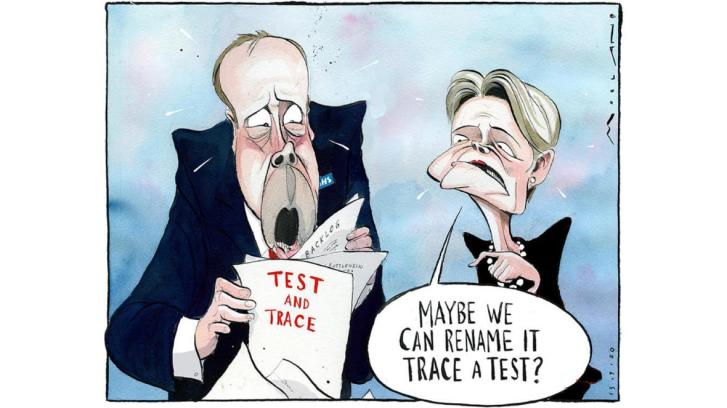
When things go horribly wrong: re-brand and re-launch

Owl recommends the classic Business School solution to Matt Hancock and Dido Harding to save the need to pay consulting fees to Deloitte:

Morten Morland Sunday Times Cartoon

13 September, 2020