How data from intensive care units shows second wave won’t be as deadly as the first

Chance of surviving Covid-19 for at least 28 days in intensive care has risen from 61 per cent to 72 per cent between the two virus waves.

By Sarah Knapton, Science Editor 21 October 2020 www.telegraph.co.uk 

With coronavirus cases rising and hospitals filling up, it might be tempting to worry that Britain is heading for a second wave as deadly as the first – but new data from intensive care units is telling an altogether different story.

According to the most recent Intensive Care National Audit and Research Center report (Icnarc), the chance of surviving Covid for at least 28 days has risen from 61 per cent to 72 per cent between the two waves.

The fall is seen across all ages, although the news is even better for the under-70s. For those aged between 50 and 69, the risk of death in intensive care has almost halved, dropping from around 38 per cent to just over 20 per cent.

For the under-50s, the mortality risk has fallen from around 18 per cent to below 10 per cent.

Experts believe treatment improvements are starting to have a major impact – particularly the steroid dexamethasone, which prevents the devastating immune system overload that can trigger organ failure. 

The drug – commonly used to treat arthritis, severe allergies and asthma – was rolled out across the NHS in June following successful trials by Oxford University, and was expected to have a major impact on the virus pandemic.

“I reckon about half of the improvement in the deaths was probably down to dexamethasone,” said Paul Hunter, professor of medicine at the University of East Anglia.

“It’s really interesting. The thing that got me is that although there is not much difference in the people going in, what really jumped out is the decline in the probability of deaths. For anyone under 70, deaths have nearly halved.

“If you’re under 70 and go into intensive care now, you’ve got a good chance of surviving.” 

The team at Icnarc has compared 10,900 patients admitted up to August 31 with 1,233 who entered intensive care on September 1 or later.

In the second wave so far, of the 643 people whose outcomes are known, 14.1 per cent have died and 38 per cent discharged, with 47.9 per cent still receiving care.

Icnarc has warned that the figures are slightly skewed towards those who recover or die early. But at a similar point in the first wave in April, where the outcomes of 690 people were known, 15 per cent had died and just 15 per cent had been discharged, with 70 per cent still needing critical care. 

The report also shows that far fewer people are needing intensive breathing or organ support compared to the first wave. While 58 per cent of those up to September 1 needed mechanical ventilation within the first 24 hours of admission, that number is now just 26 per cent – less than half.

Just 28 per cent now need advanced respiratory support, compared to 78 per cent in the first wave, and only 13 per cent require advanced cardiovascular support – fewer than half of those earlier in the year. Almost four times fewer people need kidney support, and three times fewer require neurological help.

Experts say it is possible that doctors have set a lower clinical threshold for admission to intensive care because the system is not as overloaded as during the first wave. 

Yet the improvements have come even though patients are entering intensive care with roughly the same “Apache” score as the first wave – an indicator of the probability of dying based on age, oxygen levels, blood pressure, heart rate and blood cell counts.

So although patients are just as sick, they are far less likely to die.

The hopeful findings are not just positive news for lives saved but could also impact lockdown decisions. The average time spent in intensive care is now just five days, compared with 12 in the first wave, which should free up beds (the graphic below shows the locations of critically ill patients since September).

“There are significant differences in ICU admissions, outcomes and survival in those admitted since September 1 compared with the outbreak in spring,” said Professor Carl Heneghan of the Centre for Evidence-Based Medicine at Oxford University.

“For every 100 people admitted to intensive care units after September 1, 12 more will survive to 28 days compared with before this date. In those admitted, their need for mechanically ventilatory support, their length of stay and need for renal support are all significantly lower. These improved outcomes are highly reassuring and leading to lower overall mortality of Covid-19.

“There is an urgent need to place the hospital data into context of what normally happens at this time of year. The lack of transparent data and the tendency to over predict and exaggerate the problems is not helping decision-makers and affecting policy.”

Experts say it is crucial to match the admissions data to the discharge data to get a true picture of the pandemic. 

Once we do, we will realise we are doing better than we think.

There is still a long way to go but, rather than wringing our hands, we should be celebrating the ingenuity of our scientists and doctors and realise just how far we have come.

Plan for new park that will cover land ‘half the size of Exeter’

Plan for new park that will cover land ‘half the size of Exeter’

Consultation on a masterplan for a new regional valley park that will cover land ‘half the size of Exeter’ has been agreed.

Cllr Geoff Jung, East Devon District Council Portfolio Holder for Coast, Country & Environment, added: “I’m delighted that this exciting plan is available for a full public consultation. The coronavirus pandemic has been a stark reminder of the importance of spending time outdoors to our health and wellbeing.

Daniel Clark www.devonlive.com 

The Clyst Valley Regional Park is set to consists of a number of greenspaces will be linked by greenways and will extend from Clyst St George to the south to Killerton House to the north, and to the Cranbrook Country Park to the east.

A masterplan has been produced to set out a long-term, broad guide to how the Regional Park could develop and to set out the big picture and the general direction of travel and opportunity.

It articulates the potential benefits of delivering projects and in so doing, it will be used to support funding bids, attract investors, and to pull in partners and resources to work up and deliver projects.

The front cover of the Clyst Valley Regional Park masterplan

The front cover of the Clyst Valley Regional Park masterplan

The masterplan says: “The Clyst Valley Regional Park is crucial for the health and wellbeing of a growing population, and to restore the natural capital on which we all depend. The purpose of this masterplan has been to set out a long-term, broad guide to how the Regional Park could develop. It is a first draft and is not perfect. A five year action plan for delivery will then follow and progress will be monitored and reported annually to EDDC.”

Cllr Geoff Jung, East Devon District Council Portfolio Holder for Coast, Country & Environment, added: “I’m delighted that this exciting plan is available for a full public consultation. The coronavirus pandemic has been a stark reminder of the importance of spending time outdoors to our health and wellbeing.

For more of the latest news near you, sign up to receive our newsletters.

The daily and weekly bulletins are simple, easy to read and we’ll only send the most important stories.

Our teams are committed to bringing you the latest news, guiding you through this global pandemic and writing the stories that matter.

See our Devon newsletters here, sign up for bulletins from Cornwall here and pick your Plymouth emails here.

“Devon is well-known for its countryside with national parks, areas of outstanding natural beauty, estuaries and beautiful coastline. But there is greater pressure than ever on these stunning locations.

“With a growing population, it is necessary to provide much-needed homes, jobs and infrastructure. As more people explore the countryside, it is imperative that we protect and enhance our green spaces because getting active outdoors keeps us healthy and happy, plus the countryside can help us address climate change by storing carbon and water, as we work towards becoming carbon neutral by 2040.

“The Clyst Valley Regional Park will play a valuable role in providing new open spaces near major growth areas. The idea for a Regional Park was included in the East Devon District Council Local Plan in 2016 and will ensure that the new town of Cranbrook and developments close to Exeter are provided with large scale, high quality greenspace.

The Clyst Valley Regional Park area

The Clyst Valley Regional Park area

“The Clyst Valley Regional Park will enhance the land surrounding the River Clyst and its tributaries, with linked green corridors enabling people to visit the outdoors via cycleways and footpaths. The Park will improve biodiversity, for example through natural woodland regeneration, urban tree planting, creating nature reserves, and helping to reduce flooding by careful natural, waterflow management.

“The creation of the Regional Park will help reduce the pressure on more environmentally sensitive locations and help to conserve heritage assets, protecting our cultural identity. It will be managed to the highest standard.”

He added that pieces of this jigsaw are coming together as East Devon District Council is working with landowners and partners to deliver a Country Park at Cranbrook and at Pin Brook, the first sections of the Clyst Valley Trail are being built, 3,500 broadleaved trees and shrubs have been planted through the ‘Great trees in the Clyst Valley’ initiative.

Tuesday’s Strategic Planning Committee saw councillors unanimously agree the draft Clyst Valley Regional Park Masterplan for public consultation.

They heard the masterplan will be a material consideration in assessing planning applications within the Regional Park and it should be used by land owners, developers and their agents as additional guidance on how, and where, green infrastructure can be delivered

The view from an orchard in Whimple

The view from an orchard in Whimple

MAJOR PROJECTS

Ashclyst Forest

The National Trust provides access to 272 hectares of the forest along a choice of colourcoded trails ranging from 2.4 km to 11.3 km, and including a 3.5 km butterfly trail suitable for wheelchairs and buggies. The forest is an important site for pearl-bordered and small pearlbordered fritillary butterflies, twelve species of bats, dormice, and breeding birds. It is probably of national importance.

The National Trust plans to make the forest a more-attractive and enjoyable destination for walking, cycling and horse-riding. The intention is to create a visitor hub at Ashclyst Farm and an outdoor field studies centre at Caddihoe, the latter in collaboration with the Scout Association.

Bishops Court

A hugely important piece of the jigsaw. Ownership is split across three private land holdings but all have a desire to protect and enhance the natural and built heritage.

Over the next five years, parkland tree planting should continue alongside protection and maintenance of the existing old trees, one of which (an English oak) is estimated to be 700 years old.

A new permissive path and picnic area in Alder Croft woodland could create a circular trail from Sowton village without needing to use Bishops Court Lane, which is a ‘rat run’ during rush hour. A strategy needs to be defined, and funding secured, to restore, and if possible, provide public access to the wonderful tithe barn and stables.

Clyst Valley Trail

The Clyst Valley Trail will be a commuting and recreational trail for walkers, cyclists, mobility scooters and where feasible, horse riders. It will link the Exe Estuary trail with the historic Killerton House and Park, via an existing multi-use trail from Broadclyst. There is future potential to reach Ashclyst Forest and the Exe Valley Way

It will provide a direct, safe, green route to employment centres at Science Park, Sky Park, and close access to Exeter Business Park & Sowton Industrial Estate. On the way, it passes through historic parkland at Poltimore, forming the backbone of the new Clyst Valley Regional Park.

Hayes Farm

It provides a green buffer between the housing at Mosshayne and the Lidl warehouse as without this the landscape of the Park would be severed at this point, and the site is the only remaining recreational green space of useable size for the community of Clyst Honiton.

Planning obligations secured the enhancement of wetland habitats within this project area, including reed bed and additional wet woodland. There is potential to site a bird hide overlooking this small reserve, and a remote camera in the ‘bat house’, designed solely for the protection of a population of bats, could be an excellent educational resource.

Lower Clyst

This is a very significant area of freshwater grazing marsh and fen. It is at risk from sea level rise and the river banks downstream of Winslade Barton will not be defendable in the long term. Sea level rise will lead to the loss of internationally important mud and sand flats on the Exe Estuary, and this loss will have to be compensated by inter-tidal habitat creation elsewhere.

The route of the proposed Clyst Valley Trail from Darts Farm follows the ridge to the east of the river. This will be a multi-use trail, but a return footpath following the toe of the ridge back to Dart’s Farm offers great opportunities for screened wildlife viewing of the river and marsh, whilst also providing a beautiful circular walk for all abilities.

Mosshayne

Mosshayne Farm is situated just north of Blackhorse/Clyst Honiton and together with the Hayes Farm site it is an important piece of green infrastructure between the new Lidl distribution centre to the east and land allocated for housing to the west.

The owner is keen to explore options for willow biomass or habitat creation (meanders, ponds, fen, wet woodland, marshy grassland) in conjunction with 1.7 km of river restoration and enhanced public access.

Pin Brook

The Brook is an important wildlife corridor flowing out of Pinhoe and into the River Clyst and is being delivered in connection with Linden Homes. The 7 ha Minerva Country Park has now been delivered by Barratt David Wilson Homes and, subject to contract, will be managed by EDDC Countryside Team. A further 3 ha immediately adjacent to it has been secured as public greenspace.

Poltimore House & Park

Poltimore House Trust and their dedicated volunteers continue to make excellent progress towards the conservation of the house and gardens. Paths in the arboretum have been improved and there are plans for a disability ‘sensory garden’ route. Full restoration of the house is acknowledged as a multi-million pound project.

A planning obligation has secured the restoration of 34 hectares of this parkland in connection with housing at Old Park Farm, which includes the restoration of the old carriageway and establishment of a public bridleway along it, extensive tree planting and linear permissive public access for 30 years.

A further 13 ha of this land is part of the 1840’s parkland extension. The land should be protected via extension of the Regional Park policy boundary, with new public access and replacement tree planting delivered as part of a holistic restoration scheme.

Winslade Park

Winslade Park is a late-18th century mansion built for an East India merchant. The sale particulars of 1905 noted the ‘pleasure grounds of great natural beauty’.

They slope away from the mansion in a southerly direction, and contain a large number of specimen trees. The terrace walk (early-19th century) along Grindle Brook, an ornamental lake formed by the widening of the stream, and parts of the kitchen garden survive.

It is hoped that a mixed use redevelopment of the site could secure the historic park and garden for public access along with the restoration of the sweeping carriageway, possibly as part of the Clyst Valley Trail.

Aylesbeare Stream & Holbrook

The Aylesbeare Stream and Holbrook are important biodiversity corridors connecting extensive habitat on the heathlands at Aylesbeare with extensive habitat in the Lower Clyst valley. They also connect with hotspots of biodiversity at Rockbeare (parkland), Beautiport Farm (broadleaved woodland and grasslands), and Farringdon (parkland and ancient woodland).

Grindle Brook

The Grindle Brook is characterised by smaller floodplain meadows and patches of riverine woodland. There are also some traditional orchards. It is an important biodiversity corridor. A public footpath passes through the site too. No other land is in an agreement and in many places intensive arable cultivation takes place right up to the river.

The reversion of arable to pasture and new woodland via natural regeneration would considerably enhance biodiversity, landscape, water quality and provide greater natural flood storage.

Treasbeare

Land is safeguarded as SANGS and is contiguous with the existing Cranbrook County Park and also with the proposed greenspace at Rockbeare Court. The potential therefore exists to create a large, linked publically accessible greenspace with natural habitats, and enhanced landscape, as a buffer to Rockbeare village.

Cranbrook to Exeter

As Cranbrook expands eastwards and new housing comes forward at Tithebarn and Mosshayne, this will provide an alternative off-road commuting and recreational route . The route begins at Station Road and proceeds around the back of the Amazon/Lidl warehouse. A new bridge crossing of the River Clyst estimated at £1 million is required.

Nicola Sturgeon to follow Owl’s advice!

She said the Scottish system would start with a zero-level tier “which is the closest to normality we can reasonably expect to live with until we have a vaccine or a more effective treatment for this virus”.

A week ago Owl pointed out the absurdity of Boris Johnson’s three tier system starting at “medium risk” level. Scotland’s First Minister has also added another one at the top “just in case”.

Sturgeon accuses Johnson of ignoring advice on ‘extreme’ Covid curbs

Severin Carrell www.theguardian.com 

Nicola Sturgeon has accused Boris Johnson of ignoring expert advice about the need for a Covid restrictions strategy that includes an “extreme” top level close to the full lockdown imposed in March.

Sturgeon confirmed she would announce a five-tier system of restrictions on Friday that will partly mirror England’s three-tier traffic light system of controls, as Scotland’s Covid-19 infections and fatalities climbed sharply to levels not seen since May.

She said the Scottish system would start with a zero-level tier “which is the closest to normality we can reasonably expect to live with until we have a vaccine or a more effective treatment for this virus”.

After confirming Scotland had passed the 50,000 infections threshold overnight, with 28 new fatalities, the first minister said her government had heeded warnings from England’s chief medical officer, Prof Chris Whitty, that a very tough top tier of controls was needed in extreme situations.

“The English system starts at medium, which is quite a high level of restriction,” she said. “We also think we need another one at the top because if you remember when England published theirs, the chief medical officer in England said he thought that the top level was not enough to necessarily get the virus down.

“We think we need one above that which is not identical to but perhaps closer to a full lockdown, if things got to be that serious.”

The first minister said temporary restrictions affecting millions of people across central Scotland, including the closure of pubs and cafes that serve alcohol, and a ban on contact sports and outdoor live events, would remain until the five-tier system starts on 2 November.

Business leaders and hospitality firms are furious, arguing it will lead to thousands of job losses. They say the Scottish government’s emergency grants are inadequate, comparing badly with those offered to English councils.

Sturgeon refused to set out what each tier would involve in advance of Friday’s announcement but confirmed strict travel restrictions would be included at higher levels, while schools would not automatically close if the top tier was imposed.

Sturgeon said Ireland and New Zealand were among countries with five-tier systems; Ireland went to its top tier earlier this week, but the New Zealand government website shows it actually has a four-level alert system. Scotland’s new alert system will be implemented to coincide with council boundaries, and could flex up from regional level to national level if needed.

“We need to apply those tiers in a sensible way with allowing people to live with as proportionate and as targeted a set of interventions as is possible at any given time,” she said.

Stephen Montgomery, a hotelier in Glasgow who represents the Scottish Hospitality Group, an umbrella body for pub and hotel chains that employ about 6,000 staff in total, said many of the 17,000 businesses affected by the restrictions in central Scotland may no longer be viable.

The UK government furlough scheme would end next week but the ban on pubs opening would continue, leaving firms unable to keep on staff. Scottish government funding of £40m compared badly with the tens of millions offered to English cities, he said.

“Recent restrictions were framed as a ‘temporary’ short, sharp shock, but the extension is an indication that we can only expect a continued government stranglehold on hospitality that will have devastating consequences,” he said.

How did my MP vote on Marcus Rashford’s plea for free school meals

Heartless Tory MPs have defeated a bid to extend free school meals for hungry children over the school holidays. [Including “Jumping Jupp Flash” but no apparent sign of Neil Parish anywhere – Owl

Oliver Milne www.mirror.co.uk

In shameful scenes, Conservatives voted down a motion to feed more than 1.4 million children during school breaks until Easter next year.

The bid, tabled by Labour, was defeated by 322 votes to 261 – with a majority of 61.

Downing Street had ruled out a late u-turn after Boris Johnson repeatedly dodged pleas from MPs to support footballer Marcus Rashford’s campaign to guarantee meals for the poorest children as the pandemic’s second wave hits.

The England and Manchester United striker, who forced a u-turn on the same issue in the summer, said children would go to bed tonight “not only hungry but feeling like they do not matter”.

He appealed to MPs to put aside their differences, saying: “This is not politics, this is humanity.

“We talk about the devastating impact of COVID-19 but, if projections are anything to go by, child food poverty has the potential to become the greatest pandemic the country has ever faced. We must start working together and unite to protect our most vulnerable children.”

Shadow Education Secretary Kate Green said the Tories had let down struggling families and urged the Prime Minister to drop his opposition to extending the free school meals scheme.

“Boris Johnson and the Conservatives have badly let down more than one million children and their families,” she said.

“No child should go hungry over the holidays, but the Government is blocking the action needed to prevent this.”

Child Poverty Action Group Chief Executive, Alison Garnham, said the country had plummeted to new lows “if in the midst of a pandemic we decide we can’t make sure children in the lowest income families have a nutritious meal in the middle of the day”.

“Tonight’s vote means more children going without and more desperately anxious parents – just as a coronavirus winter approaches,” she said.

“In short it ducks our moral responsibility to protect the country’s most vulnerable children.”

The result comes after a day of furious clashes, with disquiet from some Tories over the failure to act to help the poorest children.

Kevin Courtney of the National Education Union slammed the “callous” result, adding: “No MP who voted against this will be going hungry tonight. This isn’t right. No child should return to school after the half term too hungry to learn.”

Five Tory MPs rebelled against the Government and backed Labour.

They were Caroline Ansell, Robert Halfon, Jason McCartney, Anne Marie Morris and Holly Mumby-Croft.

Mr Halfon said: “If we acknowledge that children risk going hungry in term time by providing them with free school meals… we know that they risk going hungry in the holidays too.”

But other Conservative MPs lined up to criticise the idea of feeding the 1.4million kids already eligible for free school meals and an estimated million more who have signed up since lockdown.

Brendan Clarke-Smith said parents needed to take responsibility, bizarrely adding: “I do not believe in nationalising children.”

David Simmonds sneered: “I have no doubt Mr Rashford is an expert in his own experience, but we should not forget the experiences he so movingly described took place under a Labour government.”

Tory Minister Paul Scully sparked fury by saying the bid would not be backed as kids “have been going hungry for years”.

When Tory MP Ben Bradley likened it to “extending freebies”, Rashford hit back: “The economy already pays a high price for child hunger. If children were fed properly you would increase educational attainment and boost life chances.” 

A Labour analysis found nearly 900,000 children in Covid hotspots will miss out on free school meals unless the Government extends the scheme.

Some 61% of the over 1.4 million children eligible for free school meals are living in Tier 2 and Tier 3 areas, according to House of Commons Library figures.

So how did your MP vote on the issue – you can find their name on the list below (Although hitting Cntrl and F to open up the seach function might make it easier if you are on a computer).

Here is the breakdown of the division list published after the vote as reported by Parliament’s own website.

MPs who voted against the measure

Tellers for the noes were Conservative MPs Tom Pursglove (Corby) and Leo Docherty (Aldershot).

318 Conservative MPs

Nigel Adams (Selby and Ainsty), Bim Afolami (Hitchin and Harpenden), Adam Afriyie (Windsor), Imran Ahmad Khan (Wakefield), Nickie Aiken (Cities of London and Westminster), Peter Aldous (Waveney), Lucy Allan (Telford), David Amess (Southend West), Lee Anderson (Ashfield), Stuart Anderson (Wolverhampton South West), Stuart Andrew (Pudsey), Edward Argar (Charnwood), Sarah Atherton (Wrexham), Victoria Atkins (Louth and Horncastle), Gareth Bacon (Orpington), Richard Bacon (South Norfolk), Kemi Badenoch (Saffron Walden), Shaun Bailey (West Bromwich West), Duncan Baker (North Norfolk), Steve Baker (Wycombe), Harriett Baldwin (West Worcestershire), Steve Barclay (North East Cambridgeshire), Simon Baynes (Clwyd South), Aaron Bell (Newcastle-under-Lyme), Scott Benton (Blackpool South), Paul Beresford (Mole Valley), Jake Berry (Rossendale and Darwen), Saqib Bhatti (Meriden), Bob Blackman (Harrow East), Crispin Blunt (Reigate), Peter Bone (Wellingborough), Peter Bottomley (Worthing West), Andrew Bowie (West Aberdeenshire and Kincardine), Ben Bradley (Mansfield), Karen Bradley (Staffordshire Moorlands), Graham Brady (Altrincham and Sale West), Suella Braverman (Fareham), Jack Brereton (Stoke-on-Trent South), Andrew Bridgen (North West Leicestershire), Steve Brine (Winchester), Paul Bristow (Peterborough), Sara Britcliffe (Hyndburn), James Brokenshire (Old Bexley and Sidcup), Anthony Browne (South Cambridgeshire), Fiona Bruce (Congleton), Felicity Buchan (Kensington), Robert Buckland (South Swindon), Alex Burghart (Brentwood and Ongar), Conor Burns (Bournemouth West), Rob Butler (Aylesbury), Alun Cairns (Vale of Glamorgan), Andy Carter (Warrington South), James Cartlidge (South Suffolk), William Cash (Stone), Miriam Cates (Penistone and Stocksbridge), Maria Caulfield (Lewes), Alex Chalk (Cheltenham), Rehman Chishti (Gillingham and Rainham), Jo Churchill (Bury St Edmunds), Greg Clark (Tunbridge Wells), Simon Clarke (Middlesbrough South and East Cleveland), Theo Clarke (Stafford), Brendan Clarke-Smith (Bassetlaw), Chris Clarkson (Heywood and Middleton), James Cleverly (Braintree), Thérèse Coffey (Suffolk Coastal), Damian Collins (Folkestone and Hythe), Alberto Costa (South Leicestershire), Robert Courts (Witney), Claire Coutinho (East Surrey), Geoffrey Cox (Torridge and West Devon), Virginia Crosbie (Ynys Môn), James Daly (Bury North), David T C Davies (Monmouth), James Davies (Vale of Clwyd), Gareth Davies (Grantham and Stamford), Mims Davies (Mid Sussex), Philip Davies (Shipley), David Davis (Haltemprice and Howden), Dehenna Davison (Bishop Auckland), Caroline Dinenage (Gosport), Sarah Dines (Derbyshire Dales), Jonathan Djanogly (Huntingdon), Michelle Donelan (Chippenham), Nadine Dorries (Mid Bedfordshire), Steve Double (St Austell and Newquay), Oliver Dowden (Hertsmere), Jackie Doyle-Price (Thurrock), Richard Drax (South Dorset), Flick Drummond (Meon Valley), David Duguid (Banff and Buchan), Iain Duncan Smith (Chingford and Woodford Green), Philip Dunne (Ludlow), Mark Eastwood (Dewsbury), Ruth Edwards (Rushcliffe), Michael Ellis (Northampton North), Tobias Ellwood (Bournemouth East), Natalie Elphicke (Dover), George Eustice (Camborne and Redruth), Luke Evans (Bosworth), David Evennett (Bexleyheath and Crayford), Ben Everitt (Milton Keynes North), Michael Fabricant (Lichfield), Laura Farris (Newbury), Simon Fell (Barrow and Furness), Katherine Fletcher (South Ribble), Mark Fletcher (Bolsover), Nick Fletcher (Don Valley), Vicky Ford (Chelmsford), Kevin Foster (Torbay), Mark Francois (Rayleigh and Wickford), Lucy Frazer (South East Cambridgeshire), George Freeman (Mid Norfolk), Mike Freer (Finchley and Golders Green), Richard Fuller (North East Bedfordshire), Marcus Fysh (Yeovil), Mark Garnier (Wyre Forest), Nusrat Ghani (Wealden), Nick Gibb (Bognor Regis and Littlehampton), Peter Gibson (Darlington), Jo Gideon (Stoke-on-Trent Central), Cheryl Gillan (Chesham and Amersham), John Glen (Salisbury), Robert Goodwill (Scarborough and Whitby), Michael Gove (Surrey Heath), Richard Graham (Gloucester), Helen Grant (Maidstone and The Weald), James Gray (North Wiltshire), Chris Grayling (Epsom and Ewell), Chris Green (Bolton West), Damian Green (Ashford), Andrew Griffith (Arundel and South Downs), Kate Griffiths (Burton), James Grundy (Leigh), Jonathan Gullis (Stoke-on-Trent North), Luke Hall (Thornbury and Yate), Stephen Hammond (Wimbledon), Matt Hancock (West Suffolk), Greg Hands (Chelsea and Fulham), Mark Harper (Forest of Dean), Rebecca Harris (Castle Point), Trudy Harrison (Copeland), Sally-Ann Hart (Hastings and Rye), Simon Hart (Carmarthen West and South Pembrokeshire), John Hayes (South Holland and The Deepings), Oliver Heald (North East Hertfordshire), Chris Heaton-Harris (Daventry), Gordon Henderson (Sittingbourne and Sheppey), Darren Henry (Broxtowe), Antony Higginbotham (Burnley), Damian Hinds (East Hampshire), Kevin Hollinrake (Thirsk and Malton), Philip Hollobone (Kettering), Adam Holloway (Gravesham), Paul Holmes (Eastleigh), John Howell (Henley), Paul Howell (Sedgefield), Nigel Huddleston (Mid Worcestershire), Eddie Hughes (Walsall North), Jane Hunt (Loughborough), Jeremy Hunt (South West Surrey), Tom Hunt (Ipswich), Alister Jack (Dumfries and Galloway), Sajid Javid (Bromsgrove), Ranil Jayawardena (North East Hampshire), Mark Jenkinson (Workington), Andrea Jenkyns (Morley and Outwood), Robert Jenrick (Newark), Boris Johnson (Uxbridge and South Ruislip), Caroline Johnson (Sleaford and North Hykeham), Gareth Johnson (Dartford), David Johnston (Wantage), Andrew Jones (Harrogate and Knaresborough), Fay Jones (Brecon and Radnorshire), David Jones (Clwyd West), Marcus Jones (Nuneaton), Simon Jupp (East Devon), Daniel Kawczynski (Shrewsbury and Atcham), Alicia Kearns (Rutland and Melton), Gillian Keegan (Chichester), Julian Knight (Solihull), Greg Knight (East Yorkshire), Danny Kruger (Devizes), Kwasi Kwarteng (Spelthorne), John Lamont (Berwickshire, Roxburgh and Selkirk), Robert Largan (High Peak), Andrea Leadsom (South Northamptonshire), Edward Leigh (Gainsborough), Ian Levy (Blyth Valley), Andrew Lewer (Northampton South), Brandon Lewis (Great Yarmouth), Ian Liddell-Grainger (Bridgwater and West Somerset), Chris Loder (West Dorset), Mark Logan (Bolton North East), Marco Longhi (Dudley North), Julia Lopez (Hornchurch and Upminster), Jack Lopresti (Filton and Bradley Stoke), Jonathan Lord (Woking), Craig Mackinlay (South Thanet), Cherilyn Mackrory (Truro and Falmouth), Rachel Maclean (Redditch), Alan Mak (Havant), Kit Malthouse (North West Hampshire), Anthony Mangnall (Totnes), Scott Mann (North Cornwall), Julie Marson (Hertford and Stortford), Theresa May (Maidenhead), Jerome Mayhew (Broadland), Karl McCartney (Lincoln), Mark Menzies (Fylde), Johnny Mercer (Plymouth, Moor View), Huw Merriman (Bexhill and Battle), Stephen Metcalfe (South Basildon and East Thurrock), Robin Millar (Aberconwy), Maria Miller (Basingstoke), Amanda Milling (Cannock Chase), Nigel Mills (Amber Valley), Andrew Mitchell (Sutton Coldfield), Gagan Mohindra (South West Hertfordshire), Robbie Moore (Keighley), Penny Mordaunt (Portsmouth North), David Morris (Morecambe and Lunesdale), James Morris (Halesowen and Rowley Regis), Wendy Morton (Aldridge-Brownhills), Kieran Mullan (Crewe and Nantwich), David Mundell (Dumfriesshire, Clydesdale and Tweeddale), Sheryll Murray (South East Cornwall), Andrew Murrison (South West Wiltshire), Robert Neill (Bromley and Chislehurst), Caroline Nokes (Romsey and Southampton North), Jesse Norman (Hereford and South Herefordshire), Neil O’Brien (Harborough), Guy Opperman (Hexham), Owen Paterson (North Shropshire), Mark Pawsey (Rugby), Mike Penning (Hemel Hempstead), John Penrose (Weston-super-Mare), Chris Philp (Croydon South), Christopher Pincher (Tamworth), Rebecca Pow (Taunton Deane), Victoria Prentis (Banbury), Mark Pritchard (The Wrekin), Jeremy Quin (Horsham), Will Quince (Colchester), Tom Randall (Gedling), John Redwood (Wokingham), Jacob Rees-Mogg (North East Somerset), Nicola Richards (West Bromwich East), Angela Richardson (Guildford), Rob Roberts (Delyn), Laurence Robertson (Tewkesbury), Mary Robinson (Cheadle), Andrew Rosindell (Romford), Lee Rowley (North East Derbyshire), Dean Russell (Watford), David Rutley (Macclesfield), Gary Sambrook (Birmingham, Northfield), Selaine Saxby (North Devon), Paul Scully (Sutton and Cheam), Bob Seely (Isle of Wight), Andrew Selous (South West Bedfordshire), Grant Shapps (Welwyn Hatfield), Alok Sharma (Reading West), Alec Shelbrooke (Elmet and Rothwell), David Simmonds (Ruislip, Northwood and Pinner), Chris Skidmore (Kingswood), Chloe Smith (Norwich North), Greg Smith (Buckingham), Henry Smith (Crawley), Julian Smith (Skipton and Ripon), Amanda Solloway (Derby North), Ben Spencer (Runnymede and Weybridge), Mark Spencer (Sherwood), Alexander Stafford (Rother Valley), Andrew Stephenson (Pendle), Jane Stevenson (Wolverhampton North East), John Stevenson (Carlisle), Bob Stewart (Beckenham), Iain Stewart (Milton Keynes South), Gary Streeter (South West Devon), Mel Stride (Central Devon), Rishi Sunak (Richmond (Yorks)), James Sunderland (Bracknell), Desmond Swayne (New Forest West), Robert Syms (Poole), Derek Thomas (St Ives), Maggie Throup (Erewash), Edward Timpson (Eddisbury), Kelly Tolhurst (Rochester and Strood), Justin Tomlinson (North Swindon), Michael Tomlinson (Mid Dorset and North Poole), Craig Tracey (North Warwickshire), Anne-Marie Trevelyan (Berwick-upon-Tweed), Laura Trott (Sevenoaks), Tom Tugendhat (Tonbridge and Malling), Martin Vickers (Cleethorpes), Matt Vickers (Stockton South), Theresa Villiers (Chipping Barnet), Robin Walker (Worcester), Charles Walker (Broxbourne), Jamie Wallis (Bridgend), David Warburton (Somerton and Frome), Matt Warman (Boston and Skegness), Giles Watling (Clacton), Suzanne Webb (Stourbridge), Helen Whately (Faversham and Mid Kent), Heather Wheeler (South Derbyshire), Craig Whittaker (Calder Valley), John Whittingdale (Maldon), Bill Wiggin (North Herefordshire), James Wild (North West Norfolk), Craig Williams (Montgomeryshire), Gavin Williamson (South Staffordshire), Mike Wood (Dudley South), William Wragg (Hazel Grove), Jeremy Wright (Kenilworth and Southam), Jacob Young (Redcar), Nadhim Zahawi (Stratford-on-Avon).

One Independent MP

Julian Lewis (New Forest East).

MPs who voted to support the measure

Tellers for the ayes were Labour MPs Bambos Charalambous (Enfield Southgate) and Jeff Smith (Manchester Withington).

Five Conservative MPs

Caroline Ansell (Eastbourne), Robert Halfon (Harlow), Jason McCartney (Colne Valley), Anne Marie Morris (Newton Abbot), Holly Mumby-Croft (Scunthorpe).

191 Labour MPs

Diane Abbott (Hackney North and Stoke Newington), Debbie Abrahams (Oldham East and Saddleworth), Rushanara Ali (Bethnal Green and Bow), Tahir Ali (Birmingham, Hall Green), Rosena Allin-Khan (Tooting), Mike Amesbury (Weaver Vale), Fleur Anderson (Putney), Jonathan Ashworth (Leicester South), Paula Barker (Liverpool, Wavertree), Margaret Beckett (Derby South), Apsana Begum (Poplar and Limehouse), Hilary Benn (Leeds Central), Clive Betts (Sheffield South East), Olivia Blake (Sheffield, Hallam), Paul Blomfield (Sheffield Central), Tracy Brabin (Batley and Spen), Ben Bradshaw (Exeter), Kevin Brennan (Cardiff West), Nicholas Brown (Newcastle upon Tyne East), Lyn Brown (West Ham), Chris Bryant (Rhondda), Karen Buck (Westminster North), Richard Burgon (Leeds East), Dawn Butler (Brent Central), Ian Byrne (Liverpool, West Derby), Liam Byrne (Birmingham, Hodge Hill), Ruth Cadbury (Brentford and Isleworth), Alan Campbell (Tynemouth), Dan Carden (Liverpool, Walton), Sarah Champion (Rotherham), Feryal Clark (Enfield North), Rosie Cooper (West Lancashire), Yvette Cooper (Normanton, Pontefract and Castleford), Jeremy Corbyn (Islington North), Neil Coyle (Bermondsey and Old Southwark), Stella Creasy (Walthamstow), Jon Cruddas (Dagenham and Rainham), Judith Cummins (Bradford South), Alex Cunningham (Stockton North), Janet Daby (Lewisham East), Wayne David (Caerphilly), Geraint Davies (Swansea West), Alex Davies-Jones (Pontypridd), Marsha De Cordova (Battersea), Thangam Debbonaire (Bristol West), Tanmanjeet Singh Dhesi (Slough), Anneliese Dodds (Oxford East), Stephen Doughty (Cardiff South and Penarth), Peter Dowd (Bootle), Jack Dromey (Birmingham, Erdington), Rosie Duffield (Canterbury), Maria Eagle (Garston and Halewood), Angela Eagle (Wallasey), Clive Efford (Eltham), Julie Elliott (Sunderland Central), Chris Elmore (Ogmore), Florence Eshalomi (Vauxhall), Bill Esterson (Sefton Central), Chris Evans (Islwyn), Colleen Fletcher (Coventry North East), Yvonne Fovargue (Makerfield), Vicky Foxcroft (Lewisham, Deptford), Mary Kelly Foy (City of Durham), Gill Furniss (Sheffield, Brightside and Hillsborough), Barry Gardiner (Brent North), Preet Kaur Gill (Birmingham, Edgbaston), Mary Glindon (North Tyneside), Kate Green (Stretford and Urmston), Lilian Greenwood (Nottingham South), Margaret Greenwood (Wirral West), Nia Griffith (Llanelli), Andrew Gwynne (Denton and Reddish), Louise Haigh (Sheffield, Heeley), Fabian Hamilton (Leeds North East), Emma Hardy (Kingston upon Hull West and Hessle), Harriet Harman (Camberwell and Peckham), Carolyn Harris (Swansea East), Helen Hayes (Dulwich and West Norwood), John Healey (Wentworth and Dearne), Mark Hendrick (Preston), Mike Hill (Hartlepool), Meg Hillier (Hackney South and Shoreditch), Margaret Hodge (Barking), Sharon Hodgson (Washington and Sunderland West), Kate Hollern (Blackburn), Rachel Hopkins (Luton South), George Howarth (Knowsley), Rupa Huq (Ealing Central and Acton), Imran Hussain (Bradford East), Dan Jarvis (Barnsley Central), Diana Johnson (Kingston upon Hull North), Kim Johnson (Liverpool, Riverside), Darren Jones (Bristol North West), Gerald Jones (Merthyr Tydfil and Rhymney), Kevan Jones (North Durham), Ruth Jones (Newport West), Sarah Jones (Croydon Central), Mike Kane (Wythenshawe and Sale East), Barbara Keeley (Worsley and Eccles South), Liz Kendall (Leicester West), Afzal Khan (Manchester, Gorton), Stephen Kinnock (Aberavon), Peter Kyle (Hove), David Lammy (Tottenham), Ian Lavery (Wansbeck), Emma Lewell-Buck (South Shields), Tony Lloyd (Rochdale), Rebecca Long Bailey (Salford and Eccles), Holly Lynch (Halifax), Justin Madders (Ellesmere Port and Neston), Khalid Mahmood (Birmingham, Perry Barr), Shabana Mahmood (Birmingham, Ladywood), Seema Malhotra (Feltham and Heston), Rachael Maskell (York Central), Christian Matheson (City of Chester), Steve McCabe (Birmingham, Selly Oak), Kerry McCarthy (Bristol East), Siobhain McDonagh (Mitcham and Morden), John McDonnell (Hayes and Harlington), Pat McFadden (Wolverhampton South East), Conor McGinn (St Helens North), Catherine McKinnell (Newcastle upon Tyne North), Jim McMahon (Oldham West and Royton), Anna McMorrin (Cardiff North), Ian Mearns (Gateshead), Edward Miliband (Doncaster North), Navendu Mishra (Stockport), Jessica Morden (Newport East), Stephen Morgan (Portsmouth South), Grahame Morris (Easington), Ian Murray (Edinburgh South), James Murray (Ealing North), Lisa Nandy (Wigan), Charlotte Nichols (Warrington North), Alex Norris (Nottingham North), Chi Onwurah (Newcastle upon Tyne Central), Abena Oppong-Asare (Erith and Thamesmead), Kate Osamor (Edmonton), Kate Osborne (Jarrow), Taiwo Owatemi (Coventry North West), Sarah Owen (Luton North), Stephanie Peacock (Barnsley East), Matthew Pennycook (Greenwich and Woolwich), Toby Perkins (Chesterfield), Jess Phillips (Birmingham, Yardley), Luke Pollard (Plymouth, Sutton and Devonport), Lucy Powell (Manchester Central), Yasmin Qureshi (Bolton South East), Angela Rayner (Ashton-under-Lyne), Steve Reed (Croydon North), Christina Rees (Neath), Ellie Reeves (Lewisham West and Penge), Rachel Reeves (Leeds West), Jonathan Reynolds (Stalybridge and Hyde), Bell Ribeiro-Addy (Streatham), Marie Rimmer (St Helens South and Whiston), Matt Rodda (Reading East), Lloyd Russell-Moyle (Brighton, Kemptown), Naz Shah (Bradford West), Virendra Sharma (Ealing, Southall), Barry Sheerman (Huddersfield), Tulip Siddiq (Hampstead and Kilburn), Andy Slaughter (Hammersmith), Cat Smith (Lancaster and Fleetwood), Nick Smith (Blaenau Gwent), Karin Smyth (Bristol South), Alex Sobel (Leeds North West), John Spellar (Warley), Keir Starmer (Holborn and St Pancras), Jo Stevens (Cardiff Central), Wes Streeting (Ilford North), Graham Stringer (Blackley and Broughton), Zarah Sultana (Coventry South), Mark Tami (Alyn and Deeside), Sam Tarry (Ilford South), Gareth Thomas (Harrow West), Nick Thomas-Symonds (Torfaen), Stephen Timms (East Ham), Jon Trickett (Hemsworth), Karl Turner (Kingston upon Hull East), Derek Twigg (Halton), Liz Twist (Blaydon), Valerie Vaz (Walsall South), Catherine West (Hornsey and Wood Green), Matt Western (Warwick and Leamington), Alan Whitehead (Southampton, Test), Mick Whitley (Birkenhead), Nadia Whittome (Nottingham East), Beth Winter (Cynon Valley), Mohammad Yasin (Bedford), Daniel Zeichner (Cambridge).

46 Scottish National Party MPs

Hannah Bardell (Livingston), Mhairi Black (Paisley and Renfrewshire South), Ian Blackford (Ross, Skye and Lochaber), Kirsty Blackman (Aberdeen North), Steven Bonnar (Coatbridge, Chryston and Bellshill), Deidre Brock (Edinburgh North and Leith), Alan Brown (Kilmarnock and Loudoun), Amy Callaghan (East Dunbartonshire), Lisa Cameron (East Kilbride, Strathaven and Lesmahagow), Douglas Chapman (Dunfermline and West Fife), Joanna Cherry (Edinburgh South West), Ronnie Cowan (Inverclyde), Angela Crawley (Lanark and Hamilton East), Martyn Day (Linlithgow and East Falkirk), Martin Docherty-Hughes (West Dunbartonshire), Dave Doogan (Angus), Allan Dorans (Ayr, Carrick and Cumnock), Marion Fellows (Motherwell and Wishaw), Stephen Flynn (Aberdeen South), Patricia Gibson (North Ayrshire and Arran), Patrick Grady (Glasgow North), Peter Grant (Glenrothes), Neil Gray (Airdrie and Shotts), Neale Hanvey (Kirkcaldy and Cowdenbeath), Drew Hendry (Inverness, Nairn, Badenoch and Strathspey), Stewart Hosie (Dundee East), Chris Law (Dundee West), David Linden (Glasgow East), Kenny MacAskill (East Lothian), Angus Brendan MacNeil (Na h-Eileanan an Iar), Stewart Malcolm McDonald (Glasgow South), Stuart C McDonald (Cumbernauld, Kilsyth and Kirkintilloch East), Anne McLaughlin (Glasgow North East), John McNally (Falkirk), Carol Monaghan (Glasgow North West), Gavin Newlands (Paisley and Renfrewshire North), John Nicolson (Ochil and South Perthshire), Brendan O’Hara (Argyll and Bute), Kirsten Oswald (East Renfrewshire), Tommy Sheppard (Edinburgh East), Alyn Smith (Stirling), Chris Stephens (Glasgow South West), Alison Thewliss (Glasgow Central), Richard Thomson (Gordon), Philippa Whitford (Central Ayrshire), Pete Wishart (Perth and North Perthshire).

Nine Liberal Democrat MPs

 Alistair Carmichael (Orkney and Shetland), Wendy Chamberlain (North East Fife), Daisy Cooper (St Albans), Tim Farron (Westmorland and Lonsdale), Wera Hobhouse (Bath), Christine Jardine (Edinburgh West), Layla Moran (Oxford West and Abingdon), Jamie Stone (Caithness, Sutherland and Easter Ross), Munira Wilson (Twickenham).

One DUP MP

Jim Shannon (Strangford).

Three Plaid Cymru MPs

Ben Lake (Ceredigion), Liz Saville Roberts (Dwyfor Meirionnydd), Hywel Williams (Arfon).

Two SDLP MPs

Colum Eastwood (Foyle), Claire Hanna (Belfast South).

One Alliance MP

Stephen Farry (North Down).

One Independent MP

Claudia Webbe (Leicester East).

Worried young help to slow spread of Covid-19

The rise in coronavirus cases in England has slowed as young people have been frightened into following social-distancing rules, officials believe.

Chris Smyth, Whitehall Editor | Francis Elliott, Political Editor www.thetimes.co.uk 

The trend appears to have been a key factor in helping the northeast to escape Tier 3 restrictions. Concern about “long Covid” has been suggested as one reason for the young changing their behaviour.

A key government “gold” meeting on the pandemic, chaired by Matt Hancock, the health secretary, was told yesterday that infection rates appeared to be falling among younger people, slowing the national surge in cases.

Although the government is “very cautious” about the trend, there is tentative optimism that a rise in cases after university freshers’ week has been driven down and younger people have changed their behaviour as deaths go up.

Cases are still rising in the over-60s and hospital admissions and deaths are expected to carry on rising as a result. However, after a rise in infections was seen in the young first, there are hopes that a fall in the same group could be followed by an easing of infections in older adults.

Analysis by The Times has found that student-dominated areas now have infection rates 2.5 times higher than elsewhere, down from five times higher two weeks ago.

Infections among teenagers in the northeast have fallen by about a sixth in the past two weeks, government figures show, and as cases level off in the region it is understood that talks on moving Tyneside and Teesside into Tier 3 have been “paused”.

The government believes that tighter measures imposed on the region a month ago are starting to have an effect: there were 276.1 cases of coronavirus per 100,000 people in the northeast for the week to October 16, down from 316.6 the previous week. The prime minister’s spokesman said yesterday that the R rate in the region had “fallen slightly”.

Coronavirus: Call for clarity over half-term travel advice

Devon tourism boss calls for clarity.

www.bbc.co.uk

A tourism boss wants clearer government advice on people travelling from areas with England’s highest level of coronavirus restrictions.

Sally Everton, from Visit Devon, said they had to rely on people sticking to guidance that they should not travel.

“Those areas are in lockdown and I’m trying to believe those people will remain in lockdown,” she said.

A holiday park owner said he had cancelled bookings made by people from tier three areas.

Ms Everton said tourism businesses were on a “knife edge” and she was concentrating on encouraging local tourism for day trips.

Malcolm Bell, chief executive of Visit Cornwall, urged all his members to call guests in advance to find out where they are from.

He said it was “easier to have that conversation” before people travelled down and he hoped those conversations would lead to people rebooking or maybe being refunded.

The government advice for people in tier three areas states: “You should avoid staying overnight in another part of the UK if you are resident in a very high alert level area, or avoid staying overnight in a very high alert level area if you are resident elsewhere.”

John Hyatt, the director at Hendra Holiday Park near Newquay, which has cancelled bookings, said he was surprised people from tier three areas had only been given guidelines, not restrictions.

He said: “We made contact with those guests from tier three and relocated their booking or gave them a refund.”

Carolyn Armstrong, who owns the Headland Hotel in Newquay, said the hotel was “extraordinarily busy still”.

She said: “We can certainly all look up the addresses of people who have made bookings but it is going to be jolly tricky because if they have got a contract and they are allowed to travel legally then they can travel.”

Oi! Northerners! Stay away! Contrasting stories from Torquay and Woolacombe

Devon holiday home provider refuses Barnsley booking

Ed Oldfield, local democracy reporter and Radio Exe News www.radioexe.co.uk

A holiday let owner in Devon has warned others to beware of bookings from people in areas facing the toughest coronavirus measures.

They posted a message on Facebook reporting an inquiry from a visitor who lives in Barnsley in South Yorkshire.

It is one of the areas about to go into the tier three category at the weekend under the new coronavirus alert system.

The accommodation owner received a call in response to a listing on the Airbnb website for a double room in Torbay. The caller wanted to book a weekend stay from Friday night. When the owner asked where the caller was from and was told Barnsley, the booking was refused.

The caller then protested that the alert status did not start until after midnight on Friday night, so it should be accepted. But the owner stood by her decision, posted a warning on a Facebook page, and contacted the Local Democracy Reporting Service, run by the BBC and in which Radio Exe is a partner, to highlight the issue.

The ‘very high’ alert rules which will apply in South Yorkshire include residents being told to avoid staying overnight in another part of the UK.

Torbay, along with the rest of Devon and the South West region, is in the tier one ‘medium risk’ category.

The seven-day infection rate for covid-19 in Barnsley was reported on Tuesday as 335 per 100,000 population and rising. In the Exeter University and Pennsylvania areas on 10 October it was 322 cases per 100,000, but that has since dropped to 88.

The local council in Barnsley said around 875 people were being infected in the town every week, with around a quarter of them aged 60 and over.

Barnsley is one of several areas of South Yorkshire due to go into very high alert status from Saturday, along with Doncaster, Rotherham and Sheffield. Other areas of the country including Liverpool, Manchester and Lancashire are already in the highest category.

In Torbay, the seven-day average on October 17 was 76 cases per 100,000, just below the regional average and less than half the England rate of 169.

People in High alert areas including London, parts of the Midlands and the North East, are still allowed to travel, and an influx of visitors to Devon is expected during half-term next week.

Some comments on the post on the Spotted Torquay Facebook page praised the decision to to refuse the booking.  One said: “They should not be allowed to bring a killer virus to Torbay.”

Others warned that it was inevitable that people from higher risk areas would be visiting Devon.  One pointed out people needed the money from holiday lets and another said visitors should be encouraged to protect the economy. One commenter pointed out it was difficult for businesses to filter bookings if people did not say where they were from.

Torbay’s director of public health Caroline Dimond has said there are concerns about visitors from areas with a higher rate of infection, but so far Torbay has not seen a major problem from imported cases. She said it was important visitors followed the hygiene measures in place.

Dr Dimond told BBC Radio 4’s Today programme on Friday: “We would very much encourage people to make sure they were following all the guidance and remember even if they do come to Torbay we still have cases. 

Meanwhile up in Woolacombe:

‘Crazy, isn’t it?’ Devon resort reports no shortage of visitors

Steven Morris www.theguardian.com 

A bright, breezy day in north Devon. Hundreds of people are taking bracing walks along Woolacombe beach. The pubs, cafes, fast-food outlets and surf shops are doing excellent business.

“Actually we’ve had an amazing season,” said Roger Ashford, whose B&B, the Imperial, enjoys stunning views of the surf. “It’s never been so busy here. There are a couple of hundred people out there walking on the beach now, it’s unreal.”

Ashford, like most of the hospitality businesses in the village, has reduced his capacity to meet Covid restrictions. But over this autumn half-term his B&B is as full as it can be. “We could fill up twice over easily. People are desperate to get away. Crazy, isn’t it?”

Places like Woolacombe are expecting a late-season boost this half-term. But it does come with the risk that visitors could bring the virus into spots that have so far largely escaped.

Over at the Red Barn pub in Woolacombe, Roger’s cousin, Angus Ashford, said he knew people from tier 2 areas who were already in the village and that more were bound to come at half-term.

The pub has worked hard to keep its visitors and staff safe. “But there is a risk,” he said. “Visitors come here from Birmingham, Bristol, London. If you get some waves and some sunshine, people will come if there is no travel ban.”

During half-term more than 1,000 families are booked into the four holiday centres run by Woolacombe Bay Holiday Parks.

Kevin Darvill, the sales and marketing manager, said the different travel restrictions across England and Wales were making life difficult. The holiday parks have, with huge regret, had to stop people coming from Welsh lockdown areas where people are not allowed by law to leave without good reason.

But it has been trickier to tell people from areas of high infection in England not to come because the UK government has not imposed the same firm ban. “English customers are bamboozled and we’re bamboozled too,” he said.

Andrew Baragwanath, the national chairman of the British Holiday and Home Parks Association and a partner in the Ayr Holiday Park in St Ives, Cornwall, said he was sure people from high-risk areas continued to come to the south-west. He said a holiday business owner could not be expected to be a “tourism policeman”.

The presence of lifeguards on some Cornish beaches until the end of October shows the holiday season is very much still on.

Councillor Rob Nolan, a member of Cornwall council’s cabinet and the owner of a B&B in Truro, said the message there was that the county remained open.

Nolan conceded that some people were anxious at the prospect of people arriving from areas of high Covid prevalence and a few probably liked the idea of closing the border.

“Cornwall is open but anxious,” he said. “We want people who come down to be sensible. Book ahead and don’t come if you have symptoms. Wear a mask, be prepared to sanitise.”

Other areas across England are taking the same approach. The Liberal Democrat MP Tim Farron, who represents the Cumbrian constituency of Westmorland and Lonsdale, said visitors would still travel to the Lake District over half-term.

“I think that so long as people are compliant with the rules and respectful of local communities, people are happy for visitors to come,” he said.

The ban coming into force in Wales on Friday evening to stop people travelling into the country from hotspots in England, Scotland and Northern Ireland is a blow to holiday businesses there. The prospect of a circuit-breaker lockdown for the whole country is also deeply troubling for holiday businesses.

On Friday MWT Cymru, which represents 600 tourism businesses in mid Wales, was still making the point on its website that its region is still open. Its chairman, Rowland Rees-Evans, said people had worked tirelessly to keep the sector going this summer and autumn but business owners felt very worried now.

“The region has one of the lowest Covid-19 rates in the UK, which is a reflection on who we are in mid-Wales, the way our visitors, communities and businesses have all pulled together to protect our fragile economy whilst keeping everyone safe.”

The Association of Scotland’s Self-Caterers expressed concern that the Scottish government could follow the Welsh administration and impose a travel ban. Its chief executive, Fiona Campbell, said: “The unwarranted restrictions already imposed on Scottish self-catering have had a severely negative impact on our sector.

“Across our £723m industry, we’ve seen scores of bookings cancelled resulting in many self-catering operators facing uncertain futures with some even taking the ultimate decision of closing down completely.

“To hear that the first minister and her government are now entertaining the idea of imposing a travel ban further adds to the fear and uncertainty spreading throughout our sector and across Scottish tourism more generally.”

Work to begin on new Local Plan for East Devon

Work on a new Local Plan for East Devon is set to begin shortly with an issues and options report set to be consulted on from January 2021.

Daniel Clark www.devonlive.com

The existing East Devon local plan, covering the 18-year period from 2013 to 2031, was adopted in January 2016 and needs to be reviewed within five years.

Following the decision in August by the council to withdraw from the Greater Exeter Strategic Plan, officers were tasked with bringing forward the review of the Local Plan.

East Devon District Council’s strategic planning committee on Tuesday agreed to progress with the production of a new Local Plan but called for a further report to come back to their December meeting over the timescales.

While two options had been presented – one that would see the new Local Plan adopted in December 2023 and one in November 2024 – the committee called for a hybrid option to be explored, in which the timescale of the first option but with the consultation of the second option.

Cllr Susie Bond called for the “speediest option” to be taken to get a new Local Plan in place, saying that previously when there wasn’t one “it was truly dire and a miserable time for all the community”.

Cllr Eleanor Rylance said that there needed to be community engagement from those that will be affected, and called for the timescale of the first option but to consult more and to shrink the windows for consultation.

Cllr Philip Skinner added: “We need to move with speed, but need to ensure with the speed, we get things right. We can’t keep talking and talking and asking the public about everything, as we’ll end up with slippage.”

But Cllr Olly Davey said: “It feels as though we are looking and a straight choice between consultation and speed and I am wary of dichotomies like that.

“If you schedule a meeting and send out dates, people either respond if the first few days or not at all, and if you ask the right questions in the right way, then they will engage.”

Cllr Mike Howe added the length of time for consultation periods could be shortened, while Cllr Andrew Moulding said there was no need for engagement to take months of time.

The committee agreed to recommend to the Cabinet that the staffing budget for the Planning Policy Team be increased to enable the recruitment of two additional Planning Officers and to endorse production of a local plan issues and options report to come back to committee in December 2020 with a view to consultation starting in January 2021.

That December 2020 meeting will also see a further report brought forward around timescales for the Local Plan production to see if the amount of consultation in option 2 can be carried out with the option 1 timescale.

Exeter Council rejects PR voting system

The first-past-the post system favours the big, traditional, parties so Turkeys won’t vote for Christmas. This article shows how unfair it is, minority views are excluded – Owl 

Paul Nero www.radioexe.co.uk

A small group of Exeter councillors who represent different parties or none and who collectively call themselves the Progressive Group have asked the city council to move to a system of proportional representation for electing councillors in future.

The sole Green, sole independent and two Lib Dems want the council to ditch the traditional first-past-the-post system so that seats are divvied up proportionately to parties based on their share of the overall vote.

The first past the post system traditionally favours established larger parties. Proportional representation can mean that small groups win seats, which in some countries has led to extremist parties gaining a greater share of voice and in other places more frequent elections as governments become deadlocked. 

Cllr Diana Moore, Green councillor for St David’s ward, said: “I urge all members to support reform of our electoral system for local elections so that all votes matter and all votes count. This will send a clear message to the government that any plans to reorganise local government must include the introduction of a fairer voting system.

“For example, in the last Exeter City Council elections held in 2019, Labour won nine of the 14 seats on just over a third of the vote, while councillors in the Progressive Group won three seats on just under a third of the vote. Clearly, the makeup of the council does not reflect the way people in Exeter vote.

Cllr Kevin Mitchell, leader of the Progressive group and a Liberal Democrat councillor in St James and Duryard ward, added: “Proportional representation has been shown to result in higher turnout in elections, lower income inequality, higher social expenditure, more effective action on climate change, and improved satisfaction with governance. This is not only a matter of making elections fairer; it’s about creating a more just society.”

Exeter City Council, in which the Labour Party has 28 of the current 38 councillors, six members are Conservatives and there is one vacancy, has rejected the proposal by the four Progressives.  

The Green’s Diana Moore seemed surprised that the larger parties don’t want to vote for a system that would see fewer of them being elected. She said: “We know the Tories are opposed to anything but our unfair First-Past-the-Post (FPTP) electoral system, but it was shocking to see the Labour leader block debate on our motion by preventing Labour councillors expressing their views. At least 54 other Constituency Labour Parties in the UK have passed motions backing PR and Cllr Bialyk himself acknowledged there is strong support amongst Labour members and voters for electoral reform.

“Clearly, Exeter City Council doesn’t have powers to introduce such a system by itself, but as our motion pointed out this was a chance to indicate support for PR for local elections by backing a straightforward call for reform. We made clear that the reason for raising this now is the proposed white paper on devolution. This provides an opportunity for councils to indicate to the government that they back changing local elections to a fairer system where seats match votes.”

The success of Owls – they can never be knocked off course!

Owls find flying in gusts a breeze

Tom Whipple Science Editor The Times 20 Oct

When an owl swoops across a field on silent wings, it does not worry about being knocked off course by a gust of wind. Yet ask a drone operator to negotiate such conditions and their craft would struggle to stay in the air.

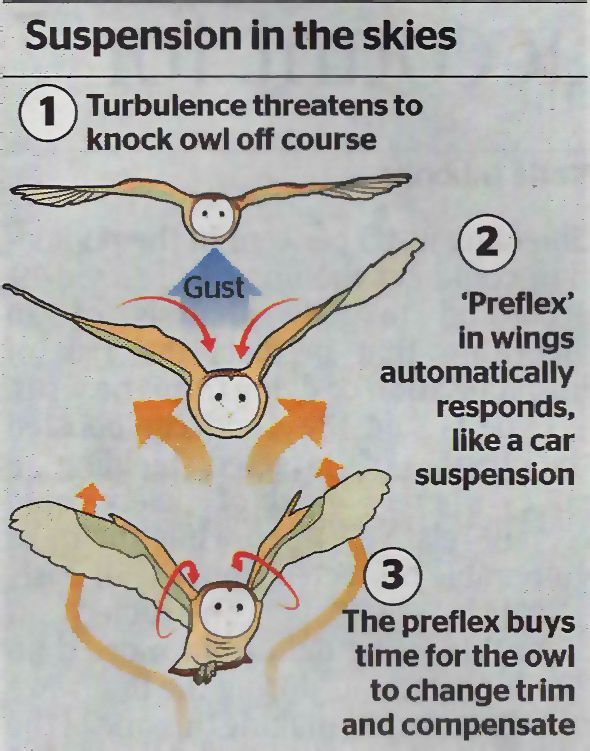
Now, thanks to a barn owl called Lily, scientists have uncovered one of the secrets of how birds cope so well with turbulence. They have, the researchers found, “preflexes” in their wings that provide suspension and respond mechanically to gusts, meaning that they can adjust their flight even before their brain has received a signal that anything is wrong.

Shane Windsor, from the University of Bristol, carried out the research because, as someone who works with drones, he was jealous of birds. “When you use unmanned aerial vehicles, you realise how challenging it is when it is gusty,” he said. “But birds make it look easy.”

By getting Lily, a trained bird of prey, to fly through artificial gusts, Dr Windsor’s team found. the answer. To the naked eye, as she passed through the gust it appeared as “just a flutter” but in slow motion, “the wings moved massively”. He wrote in the journal Proceed ings of the Royal Society B, “I thought, ‘I know what that is — it’s suspension.’ “

Just as a car responds to a bumpy road without any need for sensors, so the wings were doing the same, hinging and twisting to keep the body on course.

This is what Dr Windsor meant by a “preflex”. “A preflex is a mechanical response built in. The bird’s wings respond to the gust so quickly that it can’t be due to a response in the brain.”

They also seemed to be tuned to respond in such a way that the body would barely notice. “A tennis racket has a sweet spot where you don’t feel a judder. That’s the same with wings —they take the force but don’t transmit.”

These preflexes bought the bird time, so that its brain could respond with more sophisticated actions, flexing the wings to reduce lift.

Dr Windsor hopes to translate the idea for use in unmanned aircraft but said it was unlikely it would end turbulence in larger craft. “This wouldn’t scale up to a Boeing 747,” he said. You don’t want those wings rotating.”

‘Bleak’ future for leisure centres unless extra cash received

Leisure centres and swimming pools across East Devon may be forced to close as LED and East Devon District Council may be unable to afford to keep them open.

Daniel Clark www.devonlive.com

The picture and position facing the council has been described as ‘bleak’ by the leader of the council and chief executive in a letter they have sent to the region’s three MPs in calling for extra financial support.

And it warns that there is a real fear that they will be unable to afford to keep open the swimming pools and leisure centres with LED asking for a £1.3m bailout from the council as a result of the coronavirus pandemic.

While in-house leisure services, such as in Mid Devon and Teignbridge, will see budget income replaced by 75p in the £1 – minus the first five per cent – by the Government, as LED is a charitable leisure trust, there is no support available either to the Council or LED.

LED have asked for funds in the region ranging between £616,000 and £1.276m, and it was expected that a decision as to whether to provide it was set to be made at next Wednesday’s cabinet meeting, but the Local Democracy Reporting Service understands that the item is no longer set to be on the agenda with concerns over the content of the draft report that had been prepared.

In the letter, written jointly by Cllr Paul Arnott and the council’s chief executive Mark Williams, to East Devon’s three MPs Simon Jupp, Neil Parish and Mel Stride, it says: “Put simply the position facing LED is now acute. As we go into Winter there is a real fear that we will be unable to afford to keep open our swimming pools and leisure centres.

“Faced as we are with an un-level playing field, the Council’s ability to plug the gap for LED is limited and we are finding it increasingly hard to explain to our residents why east Devon is being left out of the support programme that the Government has set up for other parts of the South West.

“The issue is now becoming urgent and we really need your help. Please let us know how you can assist in what would be a real good news story in showing that the Government understands the position we face and is willing to extend the same hand of support that Exeter and Mid Devon have received.”

A previous letter, written in August, had added: “The lifeline where leisure facilities operated by Local Authorities are going to be able to claim 75 per cent of lost income does not apply to authorities like East Devon which operate a model whereby its Leisure Services are operated through a charitable leisure trust. In our case this Trust (LED) is estimating a loss of £1.3m in the current year as a result of COVID-19 restrictions.

“For this model of operation there is no Government support available either to the Council or LED. If the Council wishes to see leisure services continue it will have to consider funding this loss, which will mean that we will have to make corresponding cuts to a wide range of frontline services that the public rely on.

“Why should a charity or the Council be penalised because the Government has chosen to only support one type of leisure service provider? We are sure you will agree that this position is not equitable and we would ask that you use your influence to ensure that either we or LED are placed in the same position as other Councils.”

The three MPs have written a joint letter to the Cabinet Office and HM Treasury, although as of earlier this week, had not yet received a response.

While leisure centres in Sidmouth, Ottery St Mary, Axminster, Colyton, Exmouth and Honiton have reopened, Broadclyst and Cranbrook leisure centres remain closed.

Covid: Latest Greater Manchester talks end with no agreement

“There is a blizzard of numbers flying around about Greater Manchester, and the North West more widely, as national and local politicians argue about whether to introduce local restrictions.

But a curious element that seems to have been missed is that the rise in cases may have already stalled.” [See the analysis of the Health issues below – Owl]

www.bbc.co.uk 

In a joint statement, Mr Burnham and the Labour leader of Manchester City Council Sir Richard Leese said: “We had been encouraged by earlier discussions at an official level where the idea of a hardship fund, to top up furlough payments and support the self-employed, had been tabled by the government.

“It was both surprising and disappointing when this idea was taken off the table by the secretary of state.”

But a spokesperson for the Ministry of Housing Communities and Local Government (MHCLG) said that while it was “disappointing” no agreement had been reached, Mr Burnham was “incorrect in claiming that officials made this proposal today”.

A key sticking point of the dispute is that Mr Burnham wants the government to reintroduce the 80% furlough scheme used during the UK’s first lockdown, instead of the new Job Support Scheme which covers 67% of the wages of people affected by tier three closures.

2px presentational grey line
Analysis box by Laura Kuenssberg, political editor

This evening, the two sides can’t even agree on what they actually discussed earlier.

Believe the local leaders and this morning there seemed to be hope in the air. Officials from central government had mooted the possibility of a hardship fund to help support low-paid workers who stand to lose out if businesses close their doors under tighter restrictions.

The message local leaders took from their meeting was that, while the Treasury is adamant they are not going to extend their national furlough scheme that has supported millions of wages any further – nor increase the level of cash available from its replacement, the Job Support Scheme – Westminster might sign off extra money that could be spent that way, if local politicians saw fit.

There was no concrete agreement on the numbers, but sources in Greater Manchester suggest the cost of supporting those who need the extra help comes in at around £15m a month.

After that call, the consensus among North West leaders was moving in the direction of signing on the dotted line, with another call planned with Communities Secretary Robert Jenrick for the afternoon.

But rather than ushering in a new spirit of co-operation, that meeting went south.

The prime minister’s official spokesman said that in Greater Manchester the number of new cases in people over the age of 60 had tripled in the most recent 15 days of full data – from 89 cases per 100,000 on 27 September to 282 per 100,000 on 12 October.

He said government projections suggested coronavirus patients would take up the entire current intensive care capacity in Greater Manchester by 8 November, not including capacity in Nightingale hospitals.

Graph showing Covid-19 cases in Manchester

However, Prof Jane Eddleston, the region’s medical lead for the coronavirus response, said Greater Manchester’s intensive care capacity was not at risk of being overwhelmed.

Prof Eddleston said the situation was “serious” but despite the “stark” figures on hospital admissions and cases, extra capacity would be available.

In their joint statement, Mr Burnham and Sir Richard said Greater Manchester’s intensive care unit occupancy rate was “not abnormal for this time of year” and it was “essential… public fears are not raised unnecessarily”.

2px presentational grey line
Analysis box by Nick Triggle, health correspondent

There is a blizzard of numbers flying around about Greater Manchester, and the North West more widely, as national and local politicians argue about whether to introduce local restrictions.

But a curious element that seems to have been missed is that the rise in cases may have already stalled.

The last few days show no rise in the average number of new infections across the North West, while Manchester itself may actually be seeing cases fall after peaking at more than 500 a day on average at the end of September.

This will take some time to filter through into hospital cases as the people who are ill enough to be admitted to hospital have been infected a few weeks before.

But already there are signs the rises in hospital admissions are slowing.

That’s not to say hospitals and intensive care in particular is not busy. The pressures are akin to what the NHS would normally see in the peak of winter and, of course, it’s only October.

But talk of units becoming overwhelmed when they have not even really dipped into their “surge capacity”, transforming other parts of the hospital into temporary intensive care wards, seems somewhat premature.

What happens in the coming weeks though will be crucial.

Local Politics and Strange Bedfellows – who IS Ben Ingham?

Old Owl comments on yesterday’s post about Ben Ingham’s ambition to become a Conservative County Councillor:

“I read with interest New Owl’s observations on Ben Ingham, who has run the gamut of political parties he has joined, left and sometimes led.

To recap: he has been a Conservative, an “Independent”, an Independent with the East Devon Alliance (and short-term Leader of that group), an Independent again (and short-term Leader of that group too) and now he has gone back full-circle to his first (East Devon) home – the Conservatives. For all I know he could have started off his political life as a Communist or Labour and he still has enough years left in him to join Greens, Lib Dems (assuming somewhat optimistically that they would have him) or UKIP, or Reclaim or any of the crackpot parties that pop up on both sides of the political divide from time to time.

It begs the question: what does Ingham ACTUALLY believe in politically?  And could we really believe him if he attempted to answer that question?

It seemed at one point he had a Damascene conversion – from blinkered thinking to open thinking but that has now been completely scotched.

One thing we can be absolutely sure of – he seeks political power and preferably wants to be a top dog and paid for it.  I see no evidence (though I am willing to be corrected) that he works within the community in any unpaid capacity (other than using political stepping stones) or that he gives more to his community than he takes.

Perhaps Mr Ingham might offer us all (not just his new Tory bedfellows) his thoughts on this political bed-hopping BEFORE standing again for elected office?

I guess, as New Owl points out,  he has not been interrogated substantially by his new political mates to any degree – as simply paying subs these days almost guarantees you will get a crack at a paid job, so old and ailing are many East Devon Conservative Party members (according to Sasha Swire).

Right-leaning voters of East Devon – is this really someone you think will represent your interests?  Or any interests?”

Anger as Environment Agency executive takes job at Southern Water

Critics say move an example of ‘cosy relationship’ between industry and regulator

Sandra Laville www.theguardian.com 

One of the most senior executives at the Environment Agency is leaving to join a water company that is under criminal investigation by the watchdog.

The departure of Dr Toby Willison, the director of operations for the EA, to take up a role at Southern Water has angered campaigners seeking to reduce pollution in rivers and coastal waters. Willison has previously been the acting chief executive of the environmental watchdog.

The EA has been investigating Southern Water over serious failures in the operation of its sewage treatment sites. Last year Ofwat fined Southern Water and ordered it to pay reparations to customers in a £126m penalty package. Ofwat found the company had deliberately misreported data about the performance of its wastewater treatment works, which led to unauthorised premature spills of untreated waste.

Documents submitted to the regulator revealed that employees at the company would routinely drive tanker-loads of sewage from one waste treatment plant to another to dodge water-quality inspections by EAofficials as part of deliberate manipulation of data to avoid millions of pounds in fines.

In March, Southern pleaded guilty at Maidstone crown court to 51 charges brought by the EA of dumping poisonous, noxious substances including raw sewage, after a criminal inquiry that ran alongside the Ofwat investigations. Sentencing in the criminal case is due in February.

An EA spokesperson said the criminal investigation into Southern was ongoing. This month the EA chastised water companies including Southern over the worst levels of environmental pollution in five years.

The agency said Willison was leaving at the end of November to take up the Southern role. A spokesperson for the EA and Willison said “clear rules around conflict of interest” were put into place as soon as he decided to take up the new job. They would not go into detail about the measures taken, but said: “During [Willison’s] notice period he has stepped out of all relevant water company discussions and decision-making. He remains bound by and understands his ongoing duty of confidentiality once he takes up his new job.”

Stuart Singleton-White, the head of campaigns at the Angling Trust, said the agency had too often been too slow to act and to hold water companies to account. “By jumping ship from the EA to Southern Water, Dr Willison is shining a light on the cosy relationship between these companies and those who are supposed to be regulating them on behalf of consumers and our rivers,” he said. “I can only hope he has more impact inside the company and demands his new employer does more to clean up its act and protect our precious rivers and chalk streams.”

A spokesperson for Southern Water said it hired Willison after an opportunity arose to recruit a high-calibre candidate. The company said Willison was taking the role of natural capital and environment director. It said his job signalled a strengthening of focus on environment and sustainable capital programmes while continuing to build effective working partnerships with key stakeholders, regulators and government.

Willison also holds a role as a board member of British Water, which he took up last May. British Water is a trade body that lobbies and campaigns on behalf of the water industry.

Ashley Smith, who campaigns to stop sewage releases by water companies, said: “The more we have looked into the regulation of the water industry, the more appalled we have become. The industry is definitely in charge, with the regulators providing little more than false public assurance, misleading comments and token prosecutions.”

Durham Council mounts bid to get Dominic Cummings to pay backdated council tax

A council boss has vowed to “find a way” to make Dominic Cummings pay a backdated council tax bill of around £30,000.  

Jeremy Armstrong www.mirror.co.uk 

Cllr Simon Henig, leader of Durham County Council, is also calling for a review of the Valuation Office Agency’s decision to not impose charges retrospectively.  

Labour Cllr Henig was responding to mounting public anger at Boris Johnson ’s chief aide.

He said: “It seems that anyone working for the Prime Minister is exempt from the rules that apply to the rest of us.  

“I have asked that all options to appeal this decision be considered.”   

A joint Mirror and Guardian investigation revealed Mr Cummings ignored lockdown guidance to leave London and stay on the farm with his wife and son when they started experiencing coronavirus symptoms at the end of March.

They also famously made an ill-advised trip to Barnard Castle, around 30 miles away, on his wife’s Mary Wakefield’s birthday on April 12. 

Mr Cummings claimed that he was checking to see if his eyesight was good enough to drive. 

It is believed that he and his family had a council tax bill of around £30,000 written off.

Two properties, including Mr Cummings’ ‘lockdown cottage’ at the family farm near Durham, were built in breach of planning regulations.  

They are now liable for council tax, the Valuation Office Agency (VOA) ruled last week.

But they decided the charges at North Lodge Farm – estimated at around £3,000 a year – would not be backdated to 2002 when the conversion was carried out. 

Cllr Henig said he was acting out of a sense of ‘fairness’ at the VOA decision.

He has requested that chief officers look into all possible options for an appeal of the national decision and believes the ruling should be justified in Parliament. 

Cllr Henig added: “As a party that is committed to fairness, as soon as we were aware of a potential breach in regulations at North Lodge, council officers were instructed to investigate the matter. The council alerted the Valuation Office Agency, which provided the required changes in respect to property. 

“While there have been historical breaches of planning and building control regulation, which date back to the time of the former Durham City Council, the current council was unable to take enforcement action due to the amount of time that had elapsed.

“People will want to know how, once again, the Government’s senior adviser is avoiding facing any consequences for breaching a set of regulations to which everyone else is expected to adhere. 

“It is imperative the Valuation Office Agency be made accountable for this decision in Parliament so that public confidence in the council tax system be maintained.”

The VOA, which is part of HM Revenue and Customs, does not comment on individual cases, but said: “We treat all council taxpayers equally and in accordance with the law. Changes to show multiple self-contained units would not be backdated.

“If the property has remained in your ownership during the period when any changes were made there would not typically be backdated liabilities.”

Mr Cummings’ family and Downing Street have both declined to comment on the backdated bill.

People won’t follow stricter rules if they’re imposed by an incompetent government

“The Dominic Cummings effect – one law for us and another law for them – has generated more than a burning sense of injustice”

Zoe Williams www.theguardian.com 

Hypotheticals are more interesting than brass tacks. When it was announced that the police would get access, on a “case by case basis”, to the details of people who had been asked to self-isolate through NHS test and trace, the immediate concern of the British Medical Association was a what if: what if it deterred people from getting tested in the first place? What if they mistook this for the app, which is anonymised, and ceased downloading it? What if (this is my personal hypothetical) this erodes the trust of the one person left in the country who doesn’t know that “NHS test and trace” is actually a euphemism for operation run by the cock-up behemoth that is Serco?

Yet as interesting as those questions are, by far the more pressing one is: how on earth are the police supposed to track self-isolation refuseniks? With whose army? Never mind the powers that have been bestowed on them by rushed legislation, you have to ask who gave the gift of time, the blessing of infinite resource? As the constabulary freely admitted before this pandemic erupted, they didn’t have the manpower to chase down things that were already illegal; a swath of new laws means very little in that context.

Lockdowns function not by force but by consent, which is tougher to generate the second time round. In March there was novelty, there was ambition, there was the human spirit questing for an upside. With no planes in the sky, we could hear birdsong. We could imagine things being better afterwards. Maybe we would learn Spanish. Now we know that those things won’t happen, and it is simply a miserable grind. If we want to understand human behaviour at all, and with it likely outcomes, we need to park moral questions – how can a responsible person put their desire for a pint above their shielding neighbour? – and consider what the factors are for citizenly obedience.

In order to follow strict rules, people need to believe they will make a difference: a drop in cases is not enough. If no progress is made during the lull, it feels like an outcome postponed rather than averted. In areas over which the government has the least purview there has been progress: treatment for the virus in a hospital setting has improved; death rates have gone down. Yet the government has nothing to show for the time we bought it. Indeed, every week since March has brought some new instalment of their inadequacy. When it’s not a calamity directly related to the virus – million-dollar consultants selling mixed messages, PPE procurement from amateur chums – it’s an A-level fiasco, or a university debacle. Deferred gratification is something most of us, at our most responsible, can comprehend, but it presupposes some future that is indeed gratifying. When tomorrow simply looks like a worse version of today – and the spectre of a no-deal Brexit doesn’t help, here – why kick the can down that road?

Compliance relies, furthermore, on altruism, trust, community spirit, notions that only sound abstract until you’re confronted by the chasm of their absence. The very real and fatally corrosive sense that it’s one law for us and another for them – for brevity, the Dominic Cummings effect – has generated more than a burning sense of injustice. It turns out that anyone, if you look closely enough, has breached the intent behind one rule or another, whether it’s Tony Blair returning from the US straight into an eaterie, or the SNP’s Margaret Ferrier boarding a train knowing she had tested positive for Covid-19. Which all raises more of an existential question: are those in power uniquely bad at following rules? Or are they just the most visible of a whole nation of scofflaws? Will I wake from this nightmare to find that nobody was ever obeying anything?

This all could have been allayed if the Barnard Castle visit had had consequences: but possibly the more egregious mistake of the prime minister has been to sporadically try to thrust blame back on to the population for relaxing too much. Some of us spiralled into accusing one another, some disregarded him as a man wriggling on the hook of his own insufficiency, some of us cycle through those two responses multiple times on any given day. But it doesn’t matter who you distrust most, between your fellow citizen and your government, the damage to national unity is the same.

The very low levels of buy-in for the self-isolation rules – only 11% of people who test positive go on to stay at home for a full 14 days – hint at the practical failures that will have an impact on every new guideline. If people can’t afford to stay at home, they won’t. If the state’s best idea of support is to suggest you use your annual leave for your 14-day sojourn, it has effectively resiled from its duty of care, which undermines its rhetoric and credibility. The deficiencies at a regional level carry the same message more starkly: a government that doesn’t care whether or not you can feed yourself has no place in the matter of your health.

The important thing is not to blame one another for the failures of whatever lockdown comes our way. Instead we must demand a functioning find, test, trace and isolate system, administered by local authorities in conjunction with public health, bulwarked by financial support, which would stem this overwhelming sense of futility. The opposition, meanwhile, must avoid painting a fresh lockdown as a moral good: it will maroon itself on the wrong side of a false binary.

• Zoe Williams is a Guardian columnist

Dozens to be deliberately infected with coronavirus in UK ‘human challenge’ trials

Young, healthy people will be intentionally exposed to the virus responsible for COVID-19 in a first-of-its kind ‘human challenge trial’, the UK government and a company that runs such studies announced on 20 October. The experiment, set to begin in January in a London hospital if it receives final regulatory and ethical approval, aims to accelerate the development of vaccines that could end the pandemic.

Ewen Callaway www.nature.com

Human challenge trials have a history of providing insight into diseases such as malaria and influenza. The UK trial will try to identify a suitable dose of the SARS-CoV-2 virus that could be used in future vaccine trials. But the prospect of deliberately infecting people — even those at low risk of severe disease — with SARS-CoV-2, a deadly pathogen that has few proven treatments, is uncharted medical and bioethical territory.

Proponents of COVID-19 challenge trials have argued that they can be run safely and ethically, and that their potential to quickly identify effective vaccines outweighs the low risks to participants. But others have raised questions about the safety and value of these studies, pointing out that large-scale efficacy trials involving tens of thousands of people are expected to deliver results on several COVID-19 vaccines soon.

“Deliberately infecting volunteers with a known human pathogen is never undertaken lightly. However, such studies are enormously informative about a disease,” Peter Openshaw, an immunologist at Imperial College London and investigator on the study, said in a press statement. “It is really vital that we move as fast as possible towards getting effective vaccines and other treatments for COVID-19, and challenge studies have the potential to accelerate and de-risk the development of novel drugs and vaccines.

Dose testing

The planned COVID-19 challenge study will be led by a Dublin-based commercial clinical-research organization called Open Orphan and its subsidiary hVIVO, which runs challenge trials on respiratory pathogens. It will take place in the high-level isolation unit of the Royal Free Hospital in north London, says Open Orphan executive chair Cathal Friel.

The UK government’s COVID-19 Vaccine Taskforce has agreed to pay the company up to £10 million (US$13 million) to conduct the trial, with the possibility of contracting Open Orphan to run several more to test various vaccines. The UK Medicines and Healthcare Regulatory Agency (MHRA), which regulates clinical trials in the United Kingdom, and an ethical review committee, still need to approve the initial trial and its design, and that of future studies.

The initial trial will involve an estimated 30 to 50 participants, says Andrew Catchpole, a virologist and the chief scientific officer at Open Orphan who is leading the work. It is open only to healthy adults aged 18 to 30.

The precise design of the study has not been finalized. But it is likely that a small number of participants will receive a very low dose of a SARS-CoV-2 ‘challenge strain’ derived from a currently circulating virus and grown under stringent conditions. If none or few of the participants become infected, the researchers will seek permission from an independent safety monitoring board to expose participants to higher doses. This process will be repeated until researchers identify a dose that infects most of those exposed, says Catchpole.

Once an appropriate dose is identified, Open Orphan could be asked to run a series of challenge trials testing several vaccines. Catchpole says that the design of these trials, including which vaccines will be included, has not been determined. He envisions that some trial participants will receive a placebo injection instead of a vaccine, but he also says that head-to-head trials comparing two or more vaccines could be run. Other vaccine studies that the company runs typically enrol 40–50 volunteers for each trial arm, he says.

Catchpole says that his team will take every precaution against participants in the initial trial developing severe disease. Volunteers will be treated with an antiviral, such as remdesevir, once a nasal swab gives a positive result for SARS-CoV-2 genetic material. In addition to age and health, participants will be screened for risk factors that have been associated with severe COVID-19.

Selecting participants at the lowest risk is the most important safety step in running a challenge trial, says Matt Memoli, an infectious-disease physician and virologist at the US National Institute of Allergy and Infectious Diseases (NIAID) in Bethesda, Maryland. “Once you’ve given that virus to the person, anything’s possible,” he says. “You can’t control it, you can only react to it.”

If Open Orphan moves on to vaccine trials, it will aim to recruit around 500 participants altogether, but Friel says the company will need to screen many times more people to identify suitable volunteers. An ethical review board will determine how to compensate participants. Open Orphan typically pays volunteers around £4,000 for their time, says Catchpole.

Ethical issues

There is a concern that people will participate for the money without appreciating the risks, says Nir Eyal, a bioethicist at Rutgers University in New Brunswick, New Jersey, who has argued that COVID-19 challenge trials can be run safely and ethically. But a well-designed online course, for instance, could ensure participants understand the risks, he says.

Ensuring participants understand the limitations of challenge trials will also be important, says Seema Shah, a bioethicist at Lurie Children’s Hospital and Northwestern University in Chicago, Illinois. With phase III trials of numerous COVID-19 vaccines in the works, she thinks it unlikely that challenge trials will speed the development of the first vaccines. Instead, their payoff could lie in helping to test later-generation vaccines or laying the groundwork for fresh insights into the disease. In this context, says Shah, “It becomes a little bit harder to justify them, and we need to take a close look at risks.”

Meagan Deming, a vaccine scientist and virologist at the University of Maryland Medical Centre in Baltimore, sees challenge trials as more appropriate for studying basic aspects of SARS-CoV-2 infection — such as the potential for reinfection or how previous exposure to cold-causing coronaviruses influences susceptibility to COVID-19 — than for vetting vaccines. Because such trials are likely to involve only young, healthy people, they might not reveal much about how vaccines could protect those most at risk of severe disease, such as older people and those with conditions such as diabetes, Deming says. “There’s a reason we don’t have a lot of vaccines approved by challenge models, because they don’t apply to everyone and you want a vaccine to protect almost everyone,” she says.

Phase III trials might not offer clear evidence of whether vaccines work in older people because of their low participation in those trials, says Peter Smith, an epidemiologist at the London School for Hygiene and Tropical Medicine who has been involved in challenge trials. Researchers will probably need to determine vaccines’ likely effectiveness in older people, based on how their immune systems respond to COVID-19 vaccines prior to exposure to the virus. And compared with field trials, challenge studies are better at identifying the type of immune responses that predict whether a vaccine is likely to work or not, adds Memoli.

Other trials

The United Kingdom isn’t the only country investigating COVID-19 challenge trials. Belgium’s government has committed €20 million (US$23.6 million) for facilities to host challenge trials, potentially involving COVID-19. NIAID is funding the development of two SARS-CoV-2 challenge strains by a lab at Colorado State University in Fort Collins, while a team led by Memoli is also laying the groundwork for such trials. In a statement, NIAID said it was awaiting data from phase III studies before making decisions on COVID-19 challenge trials.

Proponents of the trials argue that the consequences of delaying them should be taken into account, alongside the risks of going forward. For instance, Eyal and economists Pedro Rosa Dias and Ara Darzi at Imperial College London have calculated that speeding the development of COVID-19 vaccines by one month would avert the loss of 720,000 years of life and prevent 40 million years in poverty, mostly in lower-income countries.

But Deming thinks that challenge trials should wait until their value is clearer and the risks can be better mitigated, for instance, by deploying more potent therapies. “We don’t yet know enough about this disease to say for this person: you will not die,” she says. “We’ve learned so much in the past nine months. In a year, we will be able to do this safely.”

‘We had more than 60 calls from test-and-trace’

This helps us to understand where all the money is going – but is it “value for money”? – Owl

Two weeks ago, Martin Usborne, a publisher who lives in east London, found out a close family contact had coronavirus. A few days later his wife, Ann, and their one-year-old daughter, also tested positive.

5-6 minutes www.bbc.co.uk

From that moment on, Martin says his wife’s phone would not stop ringing. Over the course of 10 days, Ann had 30 separate calls from NHS Test and Trace that she managed to pick up. On top of this were another 27 calls that were missed. And then there were the half a dozen calls her husband received.

“At one point she would finish one call and as soon as she put the phone down – literally seconds later – another contact tracer would ring. And as soon as that call was over, test-and-trace would call my phone.

“This really was not the easiest situation to deal with, particularly while looking after our two small children,” Mr Usborne told the BBC.

Some calls were made because Ann had been in contact the family acquaintance, who works in her home, while others were to tell her that her young girls (one and three years old) had been near the same person.

‘Dog with the wrong bone’

Next came the calls because Ann had tested positive, calls because her little one had tested positive and then calls to alert her older toddler that she had been in contact with someone else one who had the virus (this time her mother).

The family understands some of these calls were necessary and is keen to stress that everyone they spoke to was kind and considerate and did their job well, but Mr Usborne is very concerned there has been a significant waste of resources.

“The majority of calls were long and repetitive, with different callers reading out the same script each time, asking the same questions and giving the same answers,” he says.

And the family say when they told contact tracers they had heard the exact same thing several times already, the callers apologised but said they would have to complete the entire phone call or it would not register and someone else would simply ring again.

Mr Usborne told the BBC: “Essentially we were dealing with a broken excel spreadsheet, personified by a very nice person.

“In a way it was quite impressive as they were really persistent – but it was like a dog who had got the wrong bone.”

Later in the week, calls from contact tracers became more helpful, with some checking the family were OK and giving them information on when their isolation would end.

But Mr Usborne says they received conflicting advice about how long they had to remain at home. The NHS Covid-19 app recommended his wife stay indoors a few days longer than contact tracers suggested, for example.

He added: “The people were super-nice about it but one contact tracer admitted they worked on a different system to the app and would continue to use theirs. Which one is right?”

‘Losing trust’

They are now not quite certain when exactly it is safe to go out and are isolating for the longest suggested time. And, more crucially, they say they are not sure if they can trust the advice at all.

The family feels there needs to be a lot more done to join up the dots, so that contact tracers are alerted if someone has already been called and the system recognises when callers have already spoken to parents or carers responsible for small children in the same household.

Mr Usborne also feels there should be a way for the hard-working humans on the other end of the phone to override the computer system if a family tells them they have received multiple, repetitive calls, all week long.

According to the Department of Health and Social Care, NHS Test and Trace has reached a total of 901,151 people since it was started.

The first week of October saw the service successfully reach 76.8% of people who tested positive and 76.9% of contacts where communication details were provided.

But there have been issues over the time taken for test results to be returned.

‘Duty to self-isolate’

And the system had its worst week for reaching close contacts who were not in the same household as the person testing positive. Just 62% were reached in the week to 7 October, down from 67% the week before.

In the same week, the number of people transferred to test-and-trace more than doubled, to 88,000.

A spokesperson said the government’s test-and-trace programme “is working hard to break chains of transmission, with over 900,000 people who may otherwise have unknowingly spreading coronavirus contacted and told to isolate”.

“We all have a crucial part to play in keeping the number of new infections down, which is why there is now a legal duty to self-isolate, and steps have been taken to make sure that people are complying with the rules.”

Britain’s second Covid wave is more of a ripple — but still a threat

Coronavirus arrived like a stone thrown into a still pond. Out from this impact surged a first wave, a tsunami of infections that subsumed countries as it spread. Behind it, as many had predicted, has come the second wave, almost exactly six months later.

Tom Whipple, Science Editor www.thetimes.co.uk

But just as with a stone in a pond, this ripple does not match up to the first. Of all the statistical comparisons between the waves, two from hospitals exemplify the trends that matter. One is a graph going up, and the other a graph going down.

The first, the graph that is going up, shows how fast hospital beds are filling. Between March 1 and April 1, the number of covid patients entering hospital went from 0 a day to 3,500 a day. Between September 1 and October 1, the number went from 100 to 500.

Ours is not the naive, socially undistanced, office-working world of spring 2020. Today, the virus can still spread — we are very far from herd immunity — but with the connections between people and groups cut or fractured it finds its task a lot harder.

Back in March, the number of new infections doubled every three to four days. Today, at the speediest end of estimates, it managed seven to eight days. Probably, it took longer still. This tells us that we have longer to respond, and have to do less to bring outbreaks under control.

However, ours is also a society where there is less that we can do. The easiest social restrictions are already in place. Some, such as school closures, will never be enacted again. This leaves us with just a few tools with which to bring that graph of new hospital cases down.

So far, the levers we have available have not worked so well — as the same graph shows us. The first wave may have been more dramatic, but it also faded faster. After a month, back in spring, new admissions to hospital started to fall. Six weeks into the second wave, and they are still continuing their slow and steady upwards path. If anything, in fact, they are accelerating.

Partly, the trajectory is a sign there has been a shift in who is being infected. This is not a disease that strikes all sections of society equally. When the second wave started, some hoped it would stay where it began, in the young.

Was it inevitable that teenagers and students, tired of a virus that did not affect them but still demanded so much of them, would pass it to their grandparents?

Heat maps of its spread among society show that it seems it was indeed inevitable: the idea we could somehow seal off one section of society appears to be misplaced.

Despite our efforts, an infection of the young is rapidly becoming one of the old yet again. Or as one expert memorably put it, trying to have an infection-free demographic in a pandemic is like trying to have a urine-free lane in a swimming pool.

How worrying is this? With deaths lagged from infections by around a month, it is too soon into the second wave to judge how deadly the virus will be this time.

It is, in fact, hard to even judge how deadly it was the first time. Calculating fatality rates depends on who is counted as a Covid-19 case when they die and who is spotted as a Covid-19 case when they don’t. In April, when testing levels were a 20th of what they are now, scientists estimate that we missed 90-95 per cent of all cases.

We don’t tend to miss ICU cases though. When assessing what has changed, statistics of critical care beds provide a reasonably solid anchor in a shifting sea of data.

This is where the second graph, the one going down, becomes useful. It is a measure of how likely it is that those who go into intensive care, almost entirely the late middle-aged and elderly, will go on to leave it alive.

The graph shows that in the first wave for every ten Covid-19 patients who entered critical care, four never left. So far in the second wave things look marginally more promising. A month after entering ICU, more than seven in ten patients are still alive.

This should not be surprising. Unlike in the spring, the most severe cases today have a drug that works — dexamethasone. They also have protocols that have been refined and improved. In March and April, 60 per cent of those entering ICU were put on ventilators in the first 24 hours.

Today, with better understanding of what helps and what hinders, the proportion is less than half that. Paradoxically, the rise in cases gives us hope this might improve further. As more patients end up in hospital, we have more people to test new drugs on.

By Christmas it is very likely the world’s doctors will be given another proven drug, to complement dexamethasone. Even so, there is no disguising that winter looks likely to be long, depressing and, for many, lonely.

We will not be buoyed by the weather of April. Nor — perhaps — will we be carried along by the cohesion of a country that met its neighbours every Thursday to clap the NHS. But, with a grim determination and a lot of hard-won knowledge, the statistics show that we can still keep our heads above water as the second wave passes.

Minette Batters, NFU president: Boris told me, ‘I would rather die than hurt British farmers’

Minette Batters started her day at 5.30am with 25 press-ups and a run round her farm with her dog to check the sheep, cattle and horses before waking her teenage twins, then jumping in the car with a black coffee to wind her way through the Wiltshire countryside to catch the train to London. There she changed into heels to meet the prime minister.

Alice Thomson and Rachel Sylvester www.thetimes.co.uk 

Ushered into No 10, worried that she might still have mud on her face and straw in her hair, the National Farmers’ Union president found herself sitting opposite an even more dishevelled Boris Johnson. “I was keen to prove I don’t have a set of horns and I am not a raving lunatic,” she explains. Instead she felt concerned about the prime minister. “He looked like a man understandably with the weight of the world on his shoulders so I said, ‘I want to take farming and food off your desk and I can do that. There is a viable plan.’ I ended the meeting by saying, ‘Look, Prime Minister, I will carry you aloft myself on my shoulders to achieve this.’ He laughed and said he’d have to lose a bit more weight.”

Batters may be half Johnson’s size, but she was determined to explain to him why farmers, chefs and environmentalists are running a campaign to convince the government to think again about their refusal to ensure imported food meets domestic standards after Brexit.

Instead of launching into the pros and cons of chlorinated chicken, the prime minister and the president spent ages chatting about Nethercote, the Johnson farm on Exmoor. “He said where he grew up was a very disadvantaged area with a few sheep. ‘It’s a difficult place to farm and we couldn’t make a living just farming there, Minette,’ he said, ‘but I love it,’ and he sounded sincere.’”

When she finally left, “There was a line of 20 people looking very unhappy, including ministers and the chief whip. I think they were expecting to see Rishi Sunak appear, and they were horrified to see me,” Batters says.

Was she successful? Batters can mimic the prime minister’s voice perfectly, suddenly sounding grave. “He said, ‘I would rather die than hurt British farmers,’ and I think he really means that.” In return, she had prepared her own speech. “You are prime minister at the time the Agriculture Bill goes through and I am president of the NFU and for the first time in 70 years we are setting a new course for the future of British agriculture,” she explained to him. “I told him we both have a moral duty to get this right.”

Batters, a former caterer, then showed the prime minister the million-strong list of those supporting the NFU petition to amend the Agriculture Bill now going through its last stages in parliament. “I explained to him that we now have this extraordinary unprecedented tsunami of a coalition from the best chefs, all the farmers across the country, the environmentalists and all the NCOs, even the mammals’ association.”

Batters explained her request for a trade standards commission with experts on the environment, sustainability, animal welfare and food safety allowed to scrutinise any potential deal. “He looked surprised when I made the point that the US has exactly the same thing, an independent trade commission that reports into Congress. He said, ‘Oh right, I hadn’t realised.’ He has a lot of things on his desk and with Covid he just hasn’t had the bandwidth.”

But his aides could have briefed him. Why does Batters think the government voted against the proposal last week? “I think there has been ping-pong between Defra [the Department for Environment, Food and Rural Affairs] and the department of trade. They are on different pathways, but only the prime minister can decide his priorities. He is overrun with things, some small, some huge to be sorted out, but it is clear to me now that he just has to make a decision, however tired he is; we can’t just drift towards disaster. So many people care desperately about upholding the values of food production in this country.”

Batters has been surprised by the recent surge in support for farmers. “The chefs have been incredible. We have Delia Smith, Prue Leith, Jamie Oliver, Richard Corrigan and Raymond Blanc, and more, all saying they support farmers — it’s just like Christmas.”

Liberal Democrat, Green and Labour politicians have also visited her farm. “We are an apolitical organisation, so I was pleased when Keir Starmer wanted to come, but I’d also love to have Boris Johnson, to put the record straight.”

Batters was still shocked when she saw the Labour leader outside her stables. “I thought it was a man delivering something. We were in the yard. I knew he was coming to the farm, but then this man walked around the corner in a bomber jacket, black T-shirt, jeans and wellies and I looked at him and I thought, ‘Oh my goodness.’ His wellies and jacket had clearly been well worn; it was so different from the booted and suited Starmer, which is all we ever see usually.”

Covid, she says, has proved how vital the farming industry is to Britain. “We had a nation to feed; every single person couldn’t buy exactly what they wanted to buy during lockdown. I couldn’t find flour at one stage. Now 86 per cent of people say British farmers should grow as much food as they can.”

Yet Britain’s 46,000 farmers, she warns, are fearful they won’t be able to compete with food made to lower standards from abroad. “I have farmers beside themselves about what the future is going to hold for farms that they have been looking after for generations. They have huge amounts of debt and don’t know what the future holds on trade or policy and they are frantic.”

However, the UK can’t block all imports, or it sounds like protectionism and fortress Britain rather than global Britain. “We’ve been very clear from the beginning we are not asking Australian farmers to cut their hedges at a certain time of year. That’s why we have always wanted the compromise route of having experts on a committee who write a report for parliament to sign off before a trade deal is concluded.”

In Britain, she says, “We now have laws that dictate stocking density of poultry sheds, that dictate no growth promoters, and the retailers are always wanting higher standards, but the farmers aren’t getting any more money; they are getting the same for milk and strawberries as 20 years ago. We are now the lowest user of antibiotics in the world, box ticked, we’re on our way to producing carbon-neutral food, and we aren’t getting any reward. Yet we are saying to the rest of the world you can import what you like, reared how you like, bring it on in.”

What upsets her most is when farmers are told that it will be fine because there will be labels on food so consumers can decide. “Out of the home, when you pick up a sandwich, in a hospital or school, there is no requirement to give you the country of origin. Some suppliers will always go for the cheapest even by a couple of pence if they can. But the least well off should be able to eat ethically too. We already have the most affordable food in Europe, with the safest, most traceable animal welfare and environmentally friendly agenda; we are a huge success story. Now we are going to undermine our producers in a way that isn’t fair when they are trying their hardest to provide what we say we want. We can’t be moralistic about how our food is grown here and then import food and not care how the animals are treated abroad.”

But Britain can’t refuse to do any trade deals. “It sounds like we are saying no to American food. That’s not right. Take California. It has very high standards. They have banned all consumption of pork meat produced with growth promoters.”

Brexit, though, makes matters more complicated. She must find it infuriating that more than half of farmers voted to leave the European Union, ignoring NFU advice. “No, I’m a passionate believer in democracy,” she says. “We had a referendum. This is the result.”

Meanwhile, the prime minister has promised to return almost a third of the country to nature by 2030, declaring in his conference speech that people would soon be enjoying “picnics in the new wild belts”. “I do think his commitment is a good one, but he needs everybody else around that cabinet table to back him and to make a success of farming,” Batters says. “And I know there is conflict.”

“Rewilding” the entire country is not the way to do it, she warns, “There are some rich landowners who just think, ‘We can get our food produced somewhere else in the world and we’ll rewild the country and have this lovely quintessential cottage industry of people making bread,’ but if we’re going to deliver on the prime minister’s commitment on the environment, we’ve got to be able to have thriving, profitable agriculture too.”

The “think tank operators” who promote a revolution in land use misunderstand the reality of rural life. “It’s all very well if you live surrounded by four square walls and you’re thumping away on your laptop, but I represent people. These are real, beating hearts that are out in the countryside at the end of farm tracks, small isolated communities and families. This is an old culture that is deep and embedded in our countryside.”

Not all farmers can diversify and have holiday cottages, she says. “I meet a lot of farm businesses who say absolutely no way can they get planning for glamping instead of sheep.” Nor would it necessarily encourage more participation in the countryside since rewilding would leave some areas inaccessible, she suggests. “I have never seen my footpath so busy. It’s been wall-to-wall walkers and that’s been brilliant to see people getting out into the countryside, but if we rewild everything there are all sorts of situations that come about with access.”

Nor, she insists, is it practical to reintroduce lynx and wolves. “We’ve got too many people here. You’d have a lynx released in the Lake District and it would probably turn up in Birmingham before you knew it. The line is with a lynx, ‘They can go and kill a deer and they will keep deer populations down.’ Well, it’s a damn sight easier for them to go and kill a lamb.” As for beavers: “You only have to go to Scotland to see the damage that the beavers have done.”

Over 70 per cent of the country, she points out, is a farmed landscape. “We can only rebuild our stone walls, we can only plant our hedges, we can only feed the nation if we have highly skilled farmers doing it. We don’t necessarily want someone who doesn’t have that commitment to the land.”

Batters, the first female NFU president in its 111-year history, took over the tenancy of her farm in 1998. Her father, who had it before her, “was always quite convinced that women weren’t farmers”, she says. “But the more you’re told you cannot have something from a very young age, the more inquisitive you become about ‘Why can’t I?’ And you start to challenge the status quo.”

Managing the land is far more than a job for her. “For me farming is about a sense of place and identity. I can look to the north towards Salisbury Cathedral, and whenever I come back I see the spire. My small corner of south Wiltshire is just the best place in the world because it’s home. That’s what farming families across the country feel. Some of them will have been there for six or seven generations and they wouldn’t necessarily want to farm anywhere else in the country; that’s quite a unique thing.”

That sense of local identity will matter more than ever after Brexit, she says, combined with a sense that Britain can be the best in the world. “We need to build a global brand. But there’s no point me running Brand Britain when the government is off with Brand America.”