Budget 2021: From “Santa” to “Scrooge” IFS analysis

Rishi Sunak “isn’t really levelling with people” about painful cuts that will be needed to repair the public finances, according to budget analysis by a respected economic think-tank.

John-Paul Ford Rojas news.sky.com 

Institute for Fiscal Studies (IFS) director Paul Johnson said “Santa Sunak… looks more like Scrooge Sunak” under plans for a squeeze totalling more than £50bn compared to the pre-pandemic outlook.

That is the scale of spending cuts and tax rises over coming years compared to what the chancellor outlined in his first budget a year ago – implying a spending outlook that seems “implausibly low”, Mr Johnson said.

“The chancellor isn’t really levelling with people about the choices the government is making to repair the public finances,” he added.

Mr Johnson characterised the plans outlined by Mr Sunak as a “tale of two budgets” with £65bn more coronavirus-related spending and a “super-deduction” tax break for investment followed by fiscal belt-tightening of £30bn, adding further to a squeeze outlined in November.

Spending heavily on policies such as furlough and business rates support this year will mean borrowing at historically high levels in the current fiscal year and the next.

But the chancellor’s plans, if delivered, put him on course to balance the books by 2025/26 – partly thanks to an income tax threshold freeze set to drag more than a million more people into paying it, as well as a hike in corporation tax to 25% in 2023.

“The sad truth is that that would be a balance built on the highest sustained tax burden in UK history and yet further cuts in unprotected public service spending,” said Mr Johnson.

The IFS director described the freezing of tax thresholds as “screeching U-turns” and the corporation tax hike a gamble that it “won’t have too terrible an effect on investment”.

He also pondered the likely impact of a plan to trim public service spending trimmed by £4bn a year, adding to a £12bn reduction outlined last November.

“If delivered, this additional £4bn cut in cash spending will cause additional pain,” Mr Johnson said.

One part of the plan to bring public finances back under control is to end the £20 a week temporary uplift in Universal Credit – though it has been extended for six months for now.

Unlike the gradual phase-out of furlough and other business support measures, this will be a “cliff edge” that sees some of the poorest families see their income drop by £80 from one month to the next, Mr Johnson pointed out.

The scale of the planned cuts is also likely to mean pain for services such as justice and local government – whose budgets, unlike the NHS, schools and defence, are not protected, he added.

Mr Johnson also called into question the assumption that the NHS would next year revert to its pre-COVID spending outlook.

“In reality, there will be pressures from all sorts of directions,” he said.

“The NHS is perhaps the most obvious. Further top-ups seem near-inevitable.

“Catching up on lost learning in schools, dealing with the backlogs in our courts system, supporting public transport providers, and fixing our system for social care funding would all require additional spending.

“The chancellor’s medium-term spending plans look implausibly low.”

Mr Johnson also pointed to “perennial absurdities” on pensions – with the lifetime allowance for savers frozen again – and climate change.

“This is the 11th year in a row that a government supposedly committed to net zero greenhouse gas emissions has cut the tax on burning petrol and diesel,” he said

Camper van site could replace seaside lorry park

Exmouth’s former lorry park which overlooks the Exe Estuary could become a dedicated location for motorhomes and camper van pitches.

Daniel Clark www.devonlive.com

The site off The Royal Avenue, near to the train station, has been put forward as a possible location in East Devon where ‘appropriate facilities’ would be provided by the council to allow longer stays, and for which a premium overnight rate comparable with commercial campsites could be charged.

The East Devon Car Parking TAFF, when they met on Wednesday morning, backed officer proposals to explore the possibility of creating dedicated motorhome / camper van pitches at the site.

Subject to approval by cabinet at a later date, the council would begin a formal consultation process Natural England this winter to consider the impact of the first such development on the site of Exmouth’s former lorry park adjacent to the Estuary, although Andrew Ennis, East Devon’s service lead for car parks, said that this could be a ‘significant hurdle’ to overcome.

The TAFF also recommended that the existing ‘absolute bargain’ charge for £11 for 24 hours be increased to between £15-20 a night, with overnight stays in car parks allowed in any of the pay and display car parks that are “deemed suitable”.

Mr Ennis, in his report, said that East Devon is seeing an increasing number of motorhomes in the beauty spots and the car parks, and the revised policy he had put forward was not about encouraging visitors but to alleviate some of the issues that may arise or offer services that could benefit the community and generate some useful revenue for the council in the process.

He said that increasing the charges to £15-20 a night would cover the extra cost of providing fresh water and additional refuge at the site where we are allowing stopovers.

On the proposals for the former lorry park, he said that it would need Natural England consent and planning consent, and that while consent from Natural England could be a significant hurdle, he would begin to make the enquiries if councillors supported the proposals.

DAY VISITORS

The TAFF backed keeping the policy unchanged and that visitors and residents may use any public car parks, but if their vehicle is unable to park wholly within one of the standard parking bays (2.4m x 4.8m) then they must parking with care

STOPOVERS/SHORT OVERNIGHT STAYS

The TAFF backed the proposals that overnight stays in car parks can be allowed, subject to strict terms and conditions of use, in any of the pay and display car parks that are “deemed suitable” in consultation with Ward Members and the relevant Town or Parish Council. It may be appropriate to allow overnight stays of three consecutive nights in suitable locations.

FIRE SAFETY

The Council can allow overnight stays in circumstances that are compliant with relevant fire safety legislation and therefore car parks must be managed in accordance with the appropriate guidance on the safe separation of vans staying overnight.

The TAFF agreed to the suggestion made by Cllr Eleanor Rylance that bays in different colours be marked out for people parking overnight so they can manage spacing to stop people parking wherever they like

The view across the Exe Estuary from the Exmouth lorry park (Image Google Maps)

The view across the Exe Estuary from the Exmouth lorry park (Image Google Maps)

TARIFFS

The current tariff of £11 per night is set to be increased to between £15-20 a night, with the TAFF allowing the cabinet to decide upon the final figure. Mr Ennis, in his report, said: “An appropriate tariff to reflect the value of these “casual” overnight stays in approved car parks for one, two or three consecutive nights only needs careful consideration.

”In my view, our current tariff of £11 per night in the Exmouth pilot is deliberately inexpensive (bearing in mind that it also includes 24 hours parking in a prime location). It was based on the previously charged on-street tariff so that the pilot did not act as a deterrent and sought to encourage existing visitors to relocate from the desirable seafront highway parking spaces into a less intrusive location within an off-street car park.

“If we were to up the charge to £15-20 a night, it would cover the extra cost of providing fresh water and additional refuge at the site where we are allowing stopovers

Cllr Maddy Chapman said that £20 a night wasn’t a great deal, while Cllr Olly Davey said that £18 was a better figure as it was just low enough to overcome the physiological barrier of a £20 fee and would ensure it wasn’t too high and driving visitors out from using the car parks

ARRANGEMENTS FOR LOCAL RESIDENTS

Residents will still be unable to purchase a parking permit to use our public car parks for long-term storage of motorhomes and campervans when they are not in use, but it has to be a vehicle that fits into a standard bay.

One safeguard to be introduced is to make it a condition that the exemption will only apply in areas where the resident lives in close proximity to the car park in question and where the vehicle is registered and insured in their name at that home address.

DEDICATED SITES

The TAFF backed the proposals from officers to explore the possibility of creating dedicated motorhome / camper van pitches within sites with appropriate facilities to allow longer stays and for which a premium overnight rate comparable with commercial campsites could be charged.

Mr Ennis said that they would propose beginning a formal consultation process with local members and Natural England this winter to consider the impact of the first such development on the site of Exmouth’s former lorry park adjacent to the Estuary.

He added: “The implementation of this would be subject to further consideration by members in due course in terms of financial investment decisions and might also need to be the subject of a planning application depending on the exact details of the change from Lorry Park to camp site.”

Cllr Rylance said that the Lorry Park site was perfect for overnight camping, with Cllr Davey adding that it would be a very attractive site and an exciting opportunity, while Cllr Joe Whibley said that camper vans and motorhomes won’t stop coming so the council needs to encourage them to a certain extent but to manage them in some way.

LOCAL PLAN

The TAFF agreed to proposals from Cllr Val Ranger that a formal planning policy for motorhomes and campervans should be tied into the Local Plan review to address the issue across the whole of East Devon.

The recommendations of the TAFF will now go to the scrutiny committee for consideration, before finally being sent to the cabinet for a final decision as to whether to move forward with the suggestions made as part of the revised motorhomes policy for East Devon.

Budget small print hides an awkward list of surprises – from ‘NHS cut’ to Brexit

Extract from Dan Bloom www.mirror.co.uk

Rishi Sunak today presented yet another £65billion of Covid support in his annual Budget.

The Chancellor extended most schemes until September and gave businesses another shot in the arm as they wait for a vaccine.

But all that help comes at a cost, and we’re not just talking about a hike in Corporation Tax.

A stealth tax hike on working Brits will raise £8bn a year and schemes could run out in September while 2million are still furloughed.

The Budget speech is always a triumphant affair, burying the awkward details to a few lines or none at all. To get a real feel for what’s going on, you must read the hundreds of pages of documents slipped out when the Chancellor sits down.

We’re still trawling through the mammoth pile of Budget documents, including analysis from the Office for Budget Responsibility watchdog (OBR). But here are the biggest surprises in the small print that have leaped out at us so far.

1. NHS spending overall looks set to be cut

2. Public spending could be ‘cut by £4bn a year’

3. 2million people ‘will still be on furlough’ just before it ends

4. Brexit will leave us worse off – it’s official

5. The self-employed face a hit earlier than expected

6. Massive firms could escape the Corporation Tax hike

7. New Stamp Duty cut won’t actually help first-time buyers

8. Stealth tax raid on working Brits will rake in £8bn a year

9. Eye-watering cost of the fuel duty freeze

10. We have no idea how much 95% mortgages will cost the nation

11. The Green Homes Grant looks to have been buried

Our Local Enterprise Partnership gets it wrong (again) or Government isn’t listening

Our LEP has been spending its effort in backing a “Freeport” bid centred on Bridgewater, did we know?

“Freeport aims to bring innovation and jobs to Somerset – Heart of the south west LEP”

But yesterday the Government chose Plymouth instead. 

From heartofswlep.co.uk

“Somerset has a key role to play in the bid to develop a new Great Western Freeport – a project which could create thousands of jobs and boost the region’s reputation as a leader in high-value design and innovation…….

..Karl Tucker, Chairman of Heart of the South West LEP, said: “We are delighted to have worked in partnership with public and private sector partners to submit this bid to government for a Great Western Freeport, which will deliver thousands of jobs and support businesses and their supply chains both within and well beyond its boundaries across the region.

“It would create significant potential for the Gravity site near Bridgwater and the Freeport would become a national hub for green manufacturing and trade, building on the wider South West’s key strengths and helping to deliver clean and inclusive economic growth for our region.

The submitted bid has been put together by the combined authority working with public and private sector partners, including large-scale businesses across the aerospace and nuclear sector, the region’s universities and colleges, innovation centres, local authorities and business networks.”

Free ports – or sleaze ports? Opinion divided.

From www.theguardian.com 

Proponents say free ports can attract investment to areas that have been left woefully short, bringing jobs and prosperity to deprived regions as part of the “levelling up” agenda, helping prioritise greener industry, and breathing new life into, say, the former Redcar steelworks site, or the Grimsby docks.

But others fear the move signals the creation of “mini-tax havens” and a race to the bottom on regulation, keeping revenues from councils and the Treasury to line the pockets of business and landowners, with profits sent offshore rather than reinvested in the UK.

Support is found predominantly among those who voted – and campaigned – to leave the EU; backers call it a Brexit dividend enabled by the final deal. The EU has started to clamp down on the 80-odd free zones within its jurisdiction, over tax evasion, corruption and crime concerns.

Sunak’s £1bn of ‘town deals’ will nearly all go to Tory constituencies (but not Exmouth)

Labour accused the government of using public money “to serve their own party’s needs” after Sunak’s own constituency of Richmond in Yorkshire, and those of other cabinet ministers, were put in the top tier to receive money from a new fund.

Peter Walker www.theguardian.com

Rishi Sunak has denied that funds intended to boost struggling towns are biased towards Conservative-held areas after it emerged that 40 of the 45 places to receive a share of the first £1bn in funding are represented by Tory MPs.

Labour accused the government of using public money “to serve their own party’s needs” after Sunak’s own constituency of Richmond in Yorkshire, and those of other cabinet ministers, were put in the top tier to receive money from a new fund.

The allocations from what are officially called the towns fund and the levelling up fund, unveiled as part of the budget, highlight the government’s intention to focus spending on areas outside major cities, particularly in northern England and the Midlands.

Separately, Sunak used the budget to announce that two new economic hubs will open in the north, in Darlington and Leeds, in another apparent attempt to strengthen the Conservatives’ support outside their traditional heartlands.

But in his post-budget press conference, Sunak was accused of “pork barrel politics” given that 40 of the 45 towns in the first tranche of towns fund spending were represented by Conservative MPs, while his constituency is in tier 1 of the levelling up fund, while less prosperous neighbouring areas are not.

The chancellor rejected this, saying: “The formula for the grant payment for the new fund is based on an index of economic need, which is transparently published by MHCLG [the Ministry of Housing, Communities and Local Government], and based on a bunch of objective measures.”

He said that the tier 1 areas were only receiving extra capacity funding to bid for support as they “might need a bit of extra help” and that this did not mean other places would lose out. Sunak added: “If you look at things we’re doing, they’re benefiting people in every corner of the country.”

Neither the Treasury or MHCLG said where the formula was published. Labour has tabled a parliamentary question to seek the information.

Labour said the levelling up fund not only now had Sunak’s local authority in tier 1, but also areas represented by the communities secretary, Robert Jenrick, the Welsh secretary, Simon Hart, the Scottish secretary, Alister Jack, and the Northern Ireland secretary, Brandon Lewis.

Labour said ministers needed to be more open about the metrics used. Steve Reed, the shadow communities secretary, said: “This research raises big questions marks over the fairness of the government’s regeneration funding schemes.

“This government should be investing to rebuild the foundations of our economy, but they’re pulling the country further apart by pitting regions and nations against each other for crucial funding, then diverting the money to serve their own party’s needs.”

Announcing the new northern hubs in his speech, Sunak said a Treasury campus will be set up in Darlington and a national infrastructure bank will be situated in Leeds.

Sunak announced plans for a regional Treasury site in last year’s budget and, after an extensive scoping exercise, revealed on Wednesday that Darlington in Tees Valley would be the location.

Sunak promised that the infrastructure bank in Leeds would be up and running “in an interim form” by the spring. Its role will be to dole out £13bn of equity and debt capital, and to issue up to £10bn of guarantees, as well as offering loans to local authorities from the summer. “Redrawing our economic map means rebalancing our economic investment,” said Sunak.

Details about how many civil servants could be relocated to Darlington and how many jobs could be created in the region have yet to be clarified, but the government plans to move 22,000 civil servants out of London by 2030. The policy mirrors a pledge in Labour’s 2019 manifesto when the then shadow chancellor, John McDonnell, pledged to “break up No 11” and move it “to the north”.

Axminster business recovery hopes

This needs to be read in conjunction with Simon Jupp’s public support for Exmouth.

Tim Dixon www.midweekherald.co.uk

Hard-hit traders in Axminster have their attention fixed on Chancellor Rishi Sunak’s Budget today as he announces his financial route out of lockdown.

A survey of businesses by the Totally Locally Axminster traders’ group shows that optimism over the town’s future is being tempered by concerns whether crucial support will be available to help them get through the recovery stages. 

As chief executive of one of the town’s most high profile businesses, River Cottage managaing director Stewart Dodd said that businesses would be unlikely to return to pre-Covid revenue levels until 2022. He spoke for most with his assessment of the critical factors for local businesses, including a furlough scheme extension until July 31 to support a phased return to work. He believed both the reduced VAT rate of five per cent and businesses rates relief should be further extended to the end of March 2022, and urged pressure be put on banks and lenders to allow further capital repayment breaks, plus encouragement to landlords to allow rent breaks.

He added: “Its highly likely that the UK economy will be buoyant throughout the summer months whilst people remain cautious booking international vacations but it’s important that the government continues support through the winter months, as the economy slows. Hopefully, in the spring of 2022 the economy will bounce back to pre-Covid levels.”

The longer term need for business rates reform is regarded as a key issue by Ian Styles, who has invested heavily in Axminster during lockdown through the restoration of the Trinity House anchor store as a haven for small independent businesses.

“The promised review of the business rates system is long overdue,” he said. “For those that have to pay it locally it can be a crippling burden – there is a real need to level the playing field between large and small businesses.”

At Collate Interiors, owner Naomi Eden highlighted the need for further grant support to cover the true cost of being closed for three months and funding for small towns to help with post Covid regeneration plans. Archway Bookshop’s Simon Holmes was cautious about an online tax designed to help small shops, fearing it could rebound on businesses like his own that have greatly increased their website trading through lockdown.

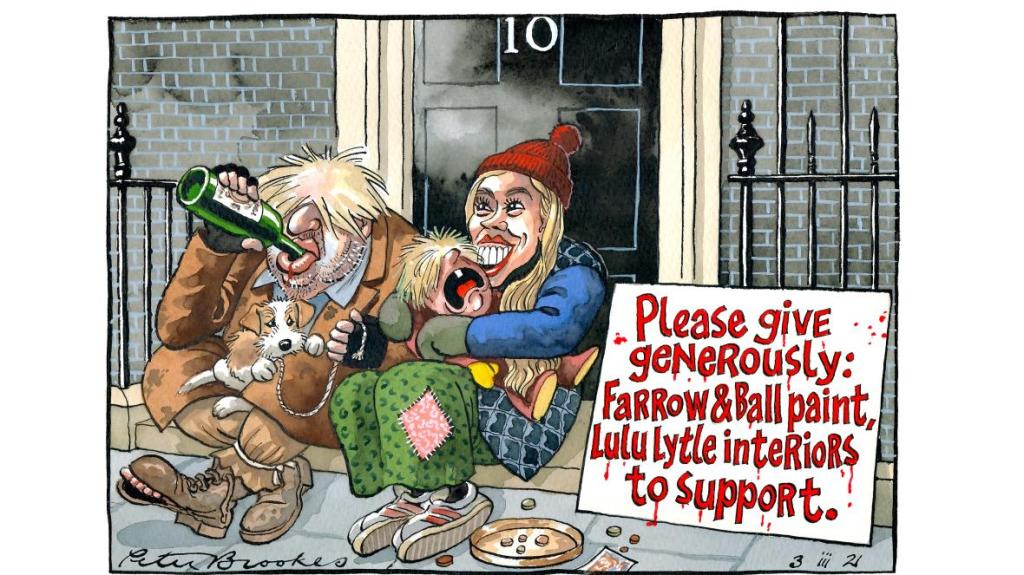
Boris Johnson sets up charity to fund Downing St renovation

An in-depth article in Tatler reveals that Symonds, 32, has been overhauling the flat to remove all vestiges of Theresa May’s “John Lewis furniture nightmare”. 

Owl believes that ardent Tory, Philip Skinner, has a grand mahogany dining table that is definitely not John Lewis; perhaps he could donate it to a cash strapped PM?

Extract from Oliver Wright, Policy Editor www.thetimes.co.uk

Boris Johnson’s plan to set up a charity to help pay for improvements to Downing Street is “inappropriate” and “monstrous”, a former standards chief has said.

The prime minister reportedly wants the new body to be based on one used by the White House to raise millions of dollars for interior design, antiques and art. He is said to be struggling to fund the makeover of his official flat by his fiancée, Carrie Symonds.

Johnson is said to have asked Lord Brownlow of Shurlock Row, a Tory peer and multimillionaire financier with close links to the royal family, to run the charity. An application to register it with the Charity Commission is said to be under way.

The charity could be funded by private donors, which would risk claims of a conflict of interest if it were seen as a backdoor way of providing benefit to the prime minister.

While its official purpose would be to raise funds to preserve No 10 and No 11 on heritage grounds, insiders say that the plans stemmed from the costs of Symonds’s makeover.

Sir Alistair Graham, a former chairman of the Committee on Standards in Public Life, told The Times that the charity idea was “quite inappropriate”.

Graham said: “It looks like he is seeking to set up the charity for personal benefit rather than for the benefit of a wider group in need. I would quite like to set a charity up to refurbish my flat in York, but I don’t think it’s a practical proposition. That’s not what charities are for: to provide enhanced living standards for the prime minister and his wife.”

Graham said that the idea of the charity being funded by party donors was “monstrous”. He said: “If you’re making a donation, you’re making it to a political party for the purposes of ensuring that party stays in power, you don’t do it for the personal benefit of the leader of the party. It would seem to me an abuse of his position as prime minister. I cannot believe how it crossed his mind. If there is a need to do certain things in terms of maintenance, that should be paid out of government funds.”

An in-depth article in Tatler reveals that Symonds, 32, has been overhauling the flat to remove all vestiges of Theresa May’s “John Lewis furniture nightmare”. The flat, above No 11 Downing Street, is larger than the one over No 10 and has been used by every prime minister since Tony Blair took it over.

In a separate piece the Daily Mail said that Johnson, 56, had complained that the cost of the project was “totally out of control”. The decor is said to have been inspired by Lulu Lytle, a celebrated eco-interior designer, who makes furniture “based on traditional crafts, including blacksmiths”.

Johnson is said to have first expressed concern last year after being informed by the Cabinet Office that the maximum taxpayer contribution would be about £30,000……

Simon is backing Exmouth, which town are you backing Neil?

From yesterday’s posts (see here and here) we learn that Simon Jupp continues to back Exmouth as a candidate to receive funding from either: the levelling-up fund, or the UK shared prosperity fund; and  only last week lobbied his election campaign pal, the Secretary of State for Housing, Communities and Local Government, Robert Jenrick. (Eat your hearts out Cranbrook, Ottery, Sidmouth and Budleigh).

So, Neil Parish, which East Devon Town are you backing? Honiton, Axminster or Seaton? Perhaps you favour Mid-Devon and are rooting for Tiverton instead? 

As we come up to the County Council elections do drop Owl an email with your choice.

Oi, government, where’s Exmouth’s dosh?

Some councillors think MP pulled a fast one

Daniel Clark, local democracy reporter www.radioexe.co.uk

East Devon District Council will seek answers about why Exmouth has not yet been given the promised £150,000 of Future High Streets funding.

Councillors have agreed to write to East Devon’s MP and a cabinet minister to ask why the town has yet to benefit from the cash.

Three days before the 2019 general eection, Simon Jupp, the Conservative candidate who subsequently became East Devon’s MP, announced that Exmouth will receive new funding from the fund.

His statement said that the secretary of state for housing, communities and local government, Robert Jenrick, had confirmed that Exmouth will receive funding of up to £150,000 to help secure up to £20 million pounds from the government’s Future High Streets Fund.

The news surprised East Devon District Council as they had submitted what turned out to be an unsuccessful bid for Axminster as part of the fund and during the debate about which town to submit, Exmouth was not mentioned.

When the announcement of the towns to receive funding was made on Boxing Day 2020, Exmouth was not on the list.

East Devon District Council has now voted to establish what actually happened, and to write to Mr Jupp and Mr Jenrick to express disappointment that Exmouth was not, as promised, given the opportunity to engage with the bidding process for the Future High Streets Fund.

When contacted by the Local Democracy Reporting Service, Mr Jupp,  said that he spoke up for Exmouth last week in parliament and that the secretary of state confirmed that new funding and the process to apply will be revealed very soon and that he was looking forward to seeing Exmouth’s application, and added he hoped that the council would work with him on any application.

Putting forward his motion, Cllr Joe Whibley (Democratic Alliance), who represents the Exmouth Town ward, said: “Just three days before the election, Exmouth was given a free pass to the next round of the Future High Streets Funding. According to details at the time from Mr Jupp, Exmouth would get £150,000 to put together a bid for substantial funds.

“But why was Exmouth in the running for a bid it hadn’t applied for, as the council had chosen Axminster to be its representative and in July 2019 received notice it had been unsuccessful. The money to put a bid together never arrived, there was no contact, and attempts to illicit contact yielded no response.”

Cllr Whibley said: “The promise of money was for one thing only – to win the East Devon seat as it was looking as though Mr Jupp wouldn’t be as secure as they had hoped. The offer of money was a complete fabrication and a carrot on a non-existing stick for East Devon.

“The deal struck in 2019 was a sham and any deal with the secretary of state was in the best light possible, a flight of fancy, and at worst, a blatant attempt to mislead the public to gain last minute votes. We need a clear honest explanation as to what happened as why.”

Cllr Paul Millar (Independent), who represents the Exmouth Halsdon ward, and who seconded the motion, said: “You can talk about elections promises and pledges, but this was a formal announcement that Mr Jupp had secured £150,000 through Robert Jenrick for Exmouth to bid for £20 million for the next group of towns for the money.

“We are concerned that this was fake news. Our town centre requires urgent regeneration. We have a clock that doesn’t even tell the time, a symbol of long term decline and austerity and continued lack of investment in the town, and Exmouth is a town in most in need of funding.”

Cllr John Loudoun (East Devon Alliance) said that he fully understood the annoyance and irritation of the “inappropriate election statement,” added: “I believe it was a deliberate and cynical attempt to influence and mislead voters ahead of the election. What took place was a disgrace by the candidate and appalling that he stooped to this level in order to gain power.”

Cllr Paul Arnott (East Devon Alliance), the leader of the council, said the question amounted to what was the difference between: “a promise of hard cash on the front page of the Exmouth Journal or the difference between something only a fool will believe.”

He said: “There is no need to seek legal advice and if the Electoral Commission went after everyone who didn’t deliver promises then they would be the busiest people on the planet,” adding that if the council voted against the motion, he would write to Mr Jupp on fact finding mission anyway, as “we have a right to know.”

Cllr Sarah Jackson (East Devon Alliance) added that her concern was that if there was another round of funding, then as a result of Mr Jupp politicising the matter, it would be difficult for East Devon to justify putting forward any town other than Exmouth, irrespective of whether Exmouth was the town most likely to succeed according to the criteria or to benefit from the funding.

She called the council to agree to meet with all of the MPs in East Devon (Simon Jupp, Neil Parish and Mel Stride) to prepare a bid for the town, which according to the criteria of the funding, is the most likely to succeed in any such bid, if another round of funding came forward.

But Conservative councillors criticised the decision to bring forward the motion and spoke up in favour of what Mr Jupp had done for East Devon since his election.

Cllr Maddy Chapman, who represents the Exmouth Brixington ward, said: “Simon Jupp is taking every opportunity to secure much needed town centre funding regeneration. Throughout the election campaign, he spoke to residents and businesses and the need for regeneration came up time and time again, and that is why Simon lobbied Robert Jenrick to put Exmouth on his radar for the next round of funding, which has delayed due to the pandemic. The only justified frustration is the delay due to the ongoing challenges of the pandemic.”

Cllr Fred Caygill, also for Exmouth Brixington, added: “We have to work with the MP, not against him. The next round of funding is not open yet. Why not wait for the details of the new fund process and then work with him instead.”

He also quoted what Mr Jenrick had said in parliament last week, when the Secretary of State had said: “I very much enjoyed visiting East Devon during the General Election campaign, I look forward to seeing Exmouth’s application in due course, as I said then, Exmouth is exactly the sort of town we want to benefit from the towns regeneration funds we’ve made available.”

Cllr Philip Skinner added: “Let’s not put up the barriers and let’s see in the course of time in funding comes forward, put our arms out and collaborate rather than fight before we have even started,” while Cllr Jess Bailey, an Independent councillor, said that she didn’t think the motion would help the residents of East Devon as it was confrontational rather than collaborative.

Councillors voted by 25 votes to 15, with nine abstentions, in favour of the motion, which aims to get answers from some of the outstanding questions over the status of the Future High Streets Fund and Exmouth.

The council will write to Mr Jupp and Mr Jenrick to express their disappointment that Exmouth was not given the opportunity to engage with the bidding process for the Future High Streets Fund, and to ask:

  • Why the announcement four days before a General Election was not followed with any communication, a firm process and confirmation of the next steps to be announced to East Devon District Council (the responsible authority for submitting such bids)
  • Why no reply was received to the letter sent by the former Leader of the Council in January 2020
  • If there will be future iterations of Future High Street funding
  • Was a unilateral decision taken by the secretary of state anywhere else in the country to subvert the bidding process?

After the meeting, Cllr Whibley added: “I want to make it clear that the Democratic Alliance are ready and keen to work with Mr Jupp, collaboratively and cross-party, to secure future funding for the region.

“We are not a Conservative administration, but our aims are the same – to secure the best outcomes for our residents and it’s important that the Conservatives nationally recognise that, if we’re going to secure positive results in East Devon, we have to work together. We cannot collaborate with silence.”

Mr Jupp, when asked for his response, said: “I spoke up for Exmouth last Monday in Parliament and asked when the next round of funding to improve high streets, towns and transport would be made available. The Secretary of State confirmed that new funding and the process to apply will be revealed very soon and he’s looking forward to seeing Exmouth’s application.

“Although the process will have been delayed due to the Covid-19 pandemic, proper plans to boost the town will need to be submitted by East Devon District Council and the Secretary of State said he hoped the council will work with me to put together an application. I urge EDDC to grasp this opportunity for the good of our town.”

Owl has no authority but…… Zoom legend Jackie Weaver cuts first dance track

Jackie Weaver might have no authority, but she’s got the grooves

David Barnett www.theguardian.com

The 62-year-old parish council clerk who became an internet sensation after a car crash Zoom meeting has now cut her first dance track, to help raise awareness of the lack of diversity and representation at local government level.

Jackie Weaver’s Kicked Him Out single artwork f

Artwork for Jackie Weaver’s Kicked Him Out. Photograph: Supplied

Weaver, a full-time clerk for the Cheshire Association of Local Councils, shot to fame after the December meeting of Handforth parish council descended into farcical chaos. Footage of the meeting went viral and birthed a meme when one councillor furiously declared: “You have no authority here, Jackie Weaver!”

Among those whose imaginations the incident captured was Helen Meissner, who for the past few years has run her own folk and acoustic independent record label, Folkstock, from her Hertfordshire home. Last summer, at the age of 54, Meissner started to make her own electronic music tracks.

‘Read the standing orders!’: chaotic parish council Zoom meeting goes viral – video

After a Twitter conversation Weaver agreed to collaborate with Meissner on the track Jackie Weaver’s Kicked Him Out, which is being released under the name Helefonix ft Jackie Weaver and Joe Rose.

The track, which is being released on streaming platforms such as Spotify and Apple Music, aims to raise awareness of the issue at the heart of the Handforth debacle.

The single will be used to promote the Make a Change campaign, which sets out to improve diversity and representation at local government level, breaking what is often seen as a stranglehold on local politics – especially in rural and suburban parishes – by middle aged white males.

Joe Rose and Helen Meissner, aka Helefonix 02.

Joe Rose and Helen Meissner, aka Helefonix 02. Photograph: Supplied

“When Helen got in touch I just thought, why not?” Weaver said. “It’s not necessarily the sort of music I’m into but I just said I want it to be catchy, and it’s certainly that.

“It’s really important to all of us that we get the message out that there needs to be more diversity on all levels in local government.

“We in the sector have been trying to do this for a long time and something like this gets the point across as well as being a lot of fun.”

Meissner said: “I think what that video did was throw a light on the kind of negative behaviour that pervades public life. Shouting and misogyny like that is rife — you see it in the House of Commons and people think it’s all right and copy it, so in a way we’re calling it out here.

“I think the fact I’m over 50 appealed to Jackie, which is why she agreed to do it. I know that ageism in the music industry and the media is a problem. It’s very important that we harness the wisdom and experience of our older generations and not pigeonhole anybody.”

Meissner started putting the track together at the beginning of last week after asking Weaver her musical preferences – she likes the Rolling Stones – then recruited her husband John Froggett, 62, an accountant who sings as Joe Rose, to voice some of the quotes from the meeting. Finally, she sent it to Weaver for approval who then recorded her own vocal contributions on her phone.

It’s not the first time Weaver has been immortalised in song – Andrew Lloyd Webber released his own ode to her last month.


Woking council accused of discouraging vulnerable voters

A Conservative-run council has been accused of potentially shutting vulnerable people out of May’s elections by asking people to show photo ID if they want a postal or proxy vote, even though it is not required by law.

Peter Walker www.theguardian.com 

Woking borough council in Surrey says that because voters are only “requested” to provide ID and proof of address, it is not breaching electoral rules.

But rights groups say the tactic could discourage groups of voters who are less likely to have the relevant documents, including older people, people who are homeless, those with disabilities, or people from black, Asian and minority ethnic communities.

They say this is particularly vital in the 6 May election as many more people are expected to seek postal or proxy votes because of coronavirus, particularly older voters.

The government plans to introduce mandatory ID for all in-person voting from 2023, a plan criticised separately as likely to suppress voter numbers from some communities.

In England, Scotland and Wales, for a postal or proxy vote, people only need to provide a signature and date of birth in advance, which is then checked against the same data on the vote itself.

But on its website, Woking council says that to apply for a postal or proxy vote, “you are requested to provide” copies of photo ID such as a passport or driving licence, and proof of residence, for example a utility bill or bank statement.

This page does not tell people that this is not mandatory. If voters then click on the link to apply for a postal or proxy vote, they are told, the subsequent document says: “If you do not provide such evidence, your application will still be processed, but your registration at the property will be examined further. This could result in your name being removed from the electoral register.”

Toby James, a professor of politics at the University of East Anglia and an expert on voting practices, said he had never previously seen an English council act in this way.

“Generally speaking, postal vote fraud is not really a big issue now,” he said. “The biggest issue at this election is going to be turnout, and people worrying about casting their votes. The wording of this certainly would seem to put people off. Voting really should be made as easy as possible for people.”

Grey Collier, an advocacy director at the civil rights group Liberty, said the Woking tactic was part of a “worrying trend to normalise the idea that showing ID to vote safeguards democracy, when it in fact does the opposite.”

Collier said: “If you’re young, if you’re a person of colour, if you’re disabled, trans or you don’t have a fixed address, you’re much less likely to have valid photo ID and could therefore be shut out of voting.”

It is understood that the Electoral Commission will not intervene, as the council is only requesting details, and local returning officers are given some discretion over how they run elections locally.

Woking says it wanted to have extra safeguards because of previous local cases of postal voting fraud.

A council spokesperson said: “We request the additional information to ensure that the person seeking a postal vote both lives at the address and is the person they claim to be. Through this process, the electoral registration officer seeks to ensure the integrity of the election by minimising the risk of electoral fraud.”

Collapse of social care could force more elderly people out of their own homes

Elderly and vulnerable people could be forced to move out of their own homes into institutional care unless the chancellor invests billions of pounds to shore up social services and reform England’s broken care model, The Independent has been told.

www.independent.co.uk

In an exclusive interview ahead of Rishi Sunak’s Budget on Wednesday, James Bullion, president of the Association of Directors of Adult Social Services (ADASS), warned the care system risked “catastrophic failure in some areas” without urgent changes to the way vulnerable people, including younger disabled people, are looked after.

He warned the number of people needing care had doubled in some parts of the country since March, as a result of the coronavirus pandemic.

Ministers are planning to bring forward reforms to social care later this year, but Mr Bullion, who leads social services in Norfolk, said the system needed at least £4bn over the next two years “just to keep the show on the road”.

He warned the sector had been rocked by more than 30,000 deaths in care homes from Covid, with a 40 per cent turnover in staff, higher sickness, and more than 100,000 vacancies on top of rising costs.

“We’ve got social care providers who are very much more fragile and at risk than they were a year ago. We were able to pay premiums to providers to keep going, but we’ve now reached the point where the revenue consequences of the last year will come home to roost. And we’re very worried about the impact on the social care market and whether it will still be there for us in a way that it’s been in the past year if we take that support away.”

He said in some areas this could lead to the “catastrophic failure” of providers who could go out of business while others refuse to take more residents.

He warned: “If somebody wants to be supported at home, but we can’t find home-care providers, then we have to start looking at alternatives to make sure their needs are met. You can get situations where, because you can’t be supported at home, you end up being supported in an institutional setting like a care home.

“There are vacancies in care homes at the moment so one of our worries is that if we can’t reshape the way social care works with better wages and recovery, then we might have very limited choices for people.”

He added that rising unmet need in social care would lead to more pressure on hospitals as people’s health worsens.

Age UK has estimated there could be at least 1.4 million people with unmet care needs but Mr Bullion said he believed that had probably increased by at least half a million now.

“If you take March 2020 as a baseline, many people’s health has been made worse as a result of Covid. In some cases, during the peaks, we’ve seen a doubling of the numbers of people we’re dealing with.

“In Norfolk, we normally see 700 people come through our doors in a month, but that’s up to an average of 1,200 now.”

He added: “We need respite from the current situation to stabilise it, we need a recovery model that gets social care on a par with the NHS and gets it functioning properly, and then we need reform.

“If all we get from the chancellor next week is that they’ll be laying out proposals for adult social care later in the year then we will be bitterly disappointed. We think the evidence is there that social care should be part of how you build back better.”

Councils have been given £1bn extra for social care from April along with the option to add a 3 per cent council tax levy. Mr Bullion said this was inadequate to meet the rising costs and not all councils had opted to increase their share of council tax.

“The reality is the settlement left us very short,” he said.

ADASS is calling for a rise in pay for social care workers, with hourly rates of £10.90, equivalent to what an NHS healthcare assistant can earn. Most social care staff are paid the national living wage, which will reach £8.91 from April.

Mr Bullion warned: “The social care workforce needs parity of value with the NHS and that means raising the wages of that workforce. Around 15 to 20 per cent of all care services have got a quality problem. If we want to solve that problem, we’ve got to invest in training and in the workforce. We need half a million new people working in social care over the next 10 years and we won’t get them by keeping wages low.”

MPs on the Health and Social Care Committee have said social care needs at least an annual funding boost of £7bn to begin the process of reform.

Debate has raged over whether care costs could be capped and whether the value of people’s homes should be used to pay for care.

But Mr Bullion said half of the social care budget was spent on looking after younger disabled people who didn’t have any capital of their own.

He said: “Solving the ‘selling your house problem’ will not impact on any of those people, and that’s half of our challenge.”

He said the emphasis had to be on “pooling the risk” as much as possible and in exchange the social care sector had to accept tougher regulation and more rights for residents and councils.

“The current arrangements are not working well. People using services have very few rights, they can be evicted just because their needs change, or because they’ve gone into hospital and come out, they can be refused entry. We find people having to move home because companies are collapsing or changing hands. If we’re to ask people to contribute their own resources to social care, people need better protection.

“We can’t just leave the care market to drift, which is I think what’s happening at the moment.”

He said the traditional care home model would need to change to one where more people are given help earlier to stay in their own homes or live in their own flats as part of assisted living schemes.

He said: “We have a problem, because our system really rewards very large institutions with high occupancy in order to get to the breakeven point. If you try and fit everything into that one model, you end up dragging in people who could be at home.”

He urged the chancellor and prime minister to summon the bravery of postwar governments.

“In 1948, three things were born, the NHS, the welfare benefits system, and the social care system. All in the same year, under complementary legislation. We have got it right when it comes to health and thinking about that as part of our national infrastructure, but we need to return to the spirit of those times. We need to get social care right, otherwise we are going to be creating poor health.

“I see lots of evidence of local politicians having to make brave decisions with adult social care as a result of funding constraints. What we need is national bravery.

“That will take a long-term view and to see it as an investment; a practical business case for growing the economy and for minimising future costs for future generations.”

East Devon District Council agrees £5 annual Council Tax increase for average band D property

Looking at the details; the support to LED at £1.3m just to keep them afloat is a reminder that EDDC has some significant legacy problems remaining. – Owl

Authored by News Desk www.thedevondaily.co.uk 

In line with many other councils across the country, East Devon District Council have agreed to a small Council Tax increase. This amounts to a £5 annual Council Tax increase for an average Band D property for 2021/22 to ensure EDDC continues to secure crucial front line services for its residents and businesses.

The increase means the authority’s portion of the annual Council Tax bill for a Band D property will be £151.78 a year or £2.92 a week for all the services it provides. The increase, which was approved by the council on 24 February 2021 is less than 10p extra per week.

The council takes 7p in every pound of the total Council Tax bill with the rest of the money going to Devon County Council, Devon and Cornwall Police, Devon and Somerset Fire and Rescue Service along with town and parish councils.

Councillor Jack Rowland, East Devon District Council’s portfolio holder for finance said: “I appreciate that any news announcing an increase in costs may be difficult to accept and understand during the current situation caused by Covid-19. However, I hope the following explanation will help clarify the reason for the 3.41% (on average £5 a year) increase from April on the East Devon District Council’s element of your Council Tax.

As a direct result of Covid-19 EDDC has over the past year seen a fall in income and a rise in expenditure and we are legally obliged to present a balanced budget for 2021/22.

The mandatory service costs involving, for one example, the waste and recycling service, have risen due to increased volumes and we have decided to retain all the discretionary services as well.

The discretionary services cover sports centres, swimming pools, parks and public toilets. As an example the council contracts Leisure East Devon (LED) to operate the sports centres and swimming pools owned by the authority. In the current financial year up to the end of March we will have supported LED with an additional £1.3m to keep them afloat due to the restrictions and lockdowns we have all experienced, but EDDC have only received £280k back from Central Government to offset this extra financial support.

In addition we have decided not to increase the EDDC owned car park charges from April, but to achieve a balanced budget we are using £300k from the general reserves that will reduce that reserve to the lowest level. Obviously we cannot continue to use those reserves going into the future to support income and certain car park charges will eventually have to be increased from April 2022 as by then they will not have been increased for 11 years so have not kept pace with inflation and the VAT rises over that period.

I hope residents will understand the need for the EDDC percentage increase as part of the overall precept charge that the council collects on behalf of themselves, Devon County Council, Devon & Cornwall Police, Devon & Somerset Fire & Rescue Authority and the Town and Parish Councils.”

Tory-linked PR firm hired to provide test and trace ‘reputation management’

A PR firm owned by Matthew Freud, who was closely associated with the Conservatives during David Cameron’s time as prime minister, was awarded a contract to provide “strategic communications”, including “reputation management”, for England’s beleaguered coronavirus test-and-trace system without a tender process, the Guardian can reveal.

Haroon Siddique www.theguardian.com 

The contract with Freud Communications Limited was for services to be carried out between 1 November last year and 15 January this year but it only came to light after details were published on a government website on 19 February.

They appeared on the same day as a high court judge ruled that Matt Hancock acted unlawfully by failing to publish details of multibillion-pound Covid-19 government contracts within the 30-day period required by law, amid allegations of “chumocracy” and lack of transparency in the awarding of contracts during the pandemic.

Although the start date for the £55,000 contract with Freud Communications was 1 November, the government website says it was awarded on 8 February 2021.

Freud, a friend of Cameron and George Osborne, is listed by the Electoral Commission as having made a one-off non-cash donation of £11,000, relating to travel, to the Conservative party in 2008. When married to Elisabeth Murdoch, he was part of the Chipping Norton set.

Gemma Abbott, the legal director of Good Law Project, which brought the high court action against the government, said of the contract: “Another day, another deal awarded with only a handshake and documented later. The fact we are just seeing the details of this arrangement now, months after work began and after the work has already been completed, speaks volumes about this government’s complete disregard for transparency.

“For the sake of good governance and protecting taxpayers’ money, government must get its house in order on procurement.”

The £12bn NHS test-and-trace system, which despite its moniker has been outsourced to private contractors, has been beset by criticism. In October, shortly before the start of the Freud Communications contract, Boris Johnson and his chief scientific adviser, Sir Patrick Vallance, admitted to failings, with the Scientific Advisory Group for Emergencies (Sage) describing the success of the supposedly “world-beating” system as “marginal”. Other experts have claimed it is not fit for purpose.

The contract with Freuds says: “A carefully curated group of senior reputation management specialists from across agency specialisms (eg corporate, crisis and issues) will be available to NHS test and trace to assist in reputational issues and provide counsel and assistance.”

The Freuds website says it can help “construct communications strategies that protect our clients at the time they need it most”. Work for past clients has included making “very factual changes” to their Wikipedia pages.

Last month, Freuds announced it had hired Sheila Mitchell, who was the Public Health England (PHE) marketing chief before leaving in September last year. In 2011, while Mitchell was at PHE, Freud Communications was accused of a conflict of interest over its approximately £500,000 contract to advise on PHE’s Change4Life anti-obesity scheme while at the same time promoting businesses selling fizzy drinks and sweets. As Mitchell only commenced work with Freuds this month, she was not involved in the NHS test-and-trace contract.

A Department of Health and Social Care (DHSC) spokesperson said: “As part of our response to this global pandemic we have drawn on the enormous expertise and resources of a number of public and private sector partners. The government has been clear from the outset that public authorities must achieve value for taxpayers and use good commercial judgment.”

A Freuds spokesperson said: “We’re proud of our long-term association with PHE and the DHSC for whom we have worked continuously for over 15 years through a procurement process that strictly adheres to government guidelines.”

Beware Tories making “promises” at election time. EDDC to ask Jupp and Jenrick what happened to General Election Exmouth pledge

A salutary story to bear in mind as we approach the County Council elections.

At the full Council on Wednesday, 24th February, EDDC agreed by 25 votes to 15 with nine abstentions to write to both Simon Jupp MP and the Secretary of State for Housing, Communities & Local Government Robert Jenrick to express their disappointment that Exmouth was not, as promised on December 8th 2019, given the opportunity to engage with the bidding process for the Future High Streets Fund.

Robert jenrick had just visited Exmouth to boost Simon Jupp’s general election campaign a few days before the general election. He made this promise as recorded by Simon Jupp: Exmouth will receive new funding from the Government’s new Future High Streets Fund. The Secretary of State for Housing, Communities & Local Government, Robert Jenrick, has confirmed that Exmouth will receive funding to help secure up to £20 million pounds from the Government’s new Future High Streets Fund. Also widely reported in the press eg here.

Only the funding, £150K, to support a bid never happened .

Now Councillors want answers to four questions:

1) Why the announcement four days before a General Election (see this link) was not followed with any communication, a firm process and confirmation of the next steps to be announced to East Devon District Council (the responsible authority for submitting such bids)?

2) Why no reply was received to the letter sent by the former Leader of the Council in January 2020 (see this link)?

3) If there will be future iterations of Future High Street funding, even though the previous process was described as ‘once in a lifetime’ and a spokeswoman from the Ministry of Housing, Communities & Local Government has stated that the rest of the funding has been transferred elsewhere? (see this link)

4) Was a unilateral decision taken by the Secretary of State anywhere else in the country to subvert the bidding process?

Remember: Axminster had been chosen by EDDC as the preferred candidate Town to receive funding but failed to get short-listed in 2019. Owl subsequently posted an article suggesting that the explanation could relate to the fact that Axminster lay in a “safe” seat. So this highly politicised promise came out of the “blue”.

“Coincidentally”, last week two days before the EDDC Council meeting, Simon Jupp asked the following question of the Secretary of State and received an answer further muddying the waters by holding out hope in reference to two new funds: the levelling-up fund and the UK shared prosperity fund.

No apology for misleading the people of Exmouth, no explanation.

Topical Questions 22 Feb

Simon Jupp Conservative, East Devon

Since I was elected, I have been speaking up for Exmouth and East Devon in Parliament, and working hard to secure support for our hospitality industry, Exeter airport and the mighty Exeter Chiefs. Exmouth continues to grow, and I want to work with East Devon District Council to help the town stay a great place to live and work. Could the Secretary of State provide an update on when the next round of funding to improve towns, transport and high streets will be made available?

Robert Jenrick The Secretary of State for Housing, Communities and Local Government

I very much enjoyed visiting East Devon during the general election campaign, and I look forward to seeing Exmouth’s application in due course. As I said then, Exmouth is exactly the sort of town that we want to benefit from the town regeneration funds that we have made available. I am pleased to tell my hon. Friend that we are driving forward our plans to boost town centre regeneration in every corner of the country. The levelling-up fund and the UK shared prosperity fund will build on the work of the future high streets fund and the towns fund, and the prospectuses for those will be published very soon. I hope East Devon District Council will work with him to grasp this opportunity and put in good proposals that we can consider carefully.

If there really is hope of securing future funding the Council resolved to request a meeting with all MPs to work together on a cross-party basis to prepare a bid for which ever Town or community EDDC judges to be the candidate with the best chance meeting the criteria for success. [Owl paraphrases. At the meeting the proposers accepted s more generalised wording proposed by Cllr Sarah Jackson]

Owl would just reinforce the point made by Sarah Jackson during the debate: it is not for Simon Jupp to decide whether Exmouth should be the choice of community most in need, though the inappropriate intervention of December 2019 has now raised expectations.

The EDDC Council debate can be watched on the youtube replay for 24 Feb, starting at 2:20:50. See if you can spot any Tory showing signs of remorse/guilt/regret.

Using photo ID in British elections will harm democracy, say US civil rights groups

Plans to force people to show photo ID to take part in UK elections amount to Republican-style voter suppression and are likely to erode faith in the democratic process rather than reinforce it, three leading US civil rights groups have warned.

Peter Walker www.theguardian.com 

In an intervention that could prove embarrassing to ministers, US groups that were at the frontline of efforts to combat vote-blocking efforts by Donald Trump and his allies, said ID laws disproportionately affected people from poorer and more marginalised communities.

The American Civil Liberties Union (ACLU), Southern Poverty Law Center (SPLC), and Commons Cause said that while they did not campaign directly in the UK it was a common principle that such laws, without evidence of widespread election fraud, had a harmful impact.

Boris Johnson’s government is due to introduce a bill in the spring to make photo ID mandatory from 2023 for all UK-wide and English elections following two years of small-scale trials, despite repeated warnings from charities and others about its impact on groups less likely to possess the necessary documents.

“The real reason these laws are passed is to suppress the vote, and that is in fact what happens,” Caren Short, senior staff attorney with the SPLC, told the Guardian.

“There are certain communities that do not possess the required ID, or the underlying documents required to get the ID, and so it makes it harder for those folks to vote. That is what these laws are designed to do, and that is in fact what they do.”

Molly McGrath, a voting rights campaign strategist for the ACLU, said voter ID is “not about proving who you are – it’s about excluding the people who are least likely to have that ID”.

She said: “I can go to almost any place and find somebody who’s been disenfranchised. I’ve never gone to a food bank and not found somebody who needs an ID so they can vote.”

UK ministers insist a law is needed to combat what is officially termed voter personation – someone going to a polling station to physically cast a vote while pretending to be someone else.

But critics point out that the offence is virtually unknown in the UK. Following the 2019 general election, there was one conviction for voter personation. Between 2010 and 2016, spanning two general elections and the EU referendum, there were 146 allegations with seven convictions, including five in one single incident.

UK charities representing groups including older people, those from minority ethnic backgrounds and the homeless have urged the government to reconsider the law.

Sylvia Albert, the director of voting and elections at Common Cause, a Washington DC-based civil rights group, said introducing voter ID when there was negligible evidence of a problem tended to have the paradoxical effect of making voters trust elections less.

“They try to say that they want to protect the integrity of the election, but the reality that our elections have strong integrity,” she said. “By doing this you’re actually undermining their integrity.

“Instituting aspects of voter suppression, including voter ID, is allowing the politicians to choose their voters, and that is not the strength of a democracy.”

Whereas the UK trials of voter ID at English council elections in 2018 and 2019 permitted different areas to show a variety of documents, the law is expected to mandate photo ID such as a passport or driving licence. Those who do not have such ID will need to apply to their local council in advance of elections.

Cat Smith, Labour’s shadow Cabinet Office minister, said the government “should heed the warnings of these respected civil rights groups, who have seen first-hand the undemocratic and discriminatory impact of mandating voter ID at elections”. The ID law is also opposed by the Lib Dems, SNP, Plaid Cymru and Greens.

A Cabinet Office spokeswoman said mandatory ID was “a reasonable way to combat the inexcusable potential for voter fraud in our current system and strengthen its integrity”, and that the “overwhelming majority” of people were able to vote successfully in the pilots.

She added: “We will make sure this policy works for everyone. There will be free electoral ID available locally and we continue to work with a broad range of charities and civil society organisations.”

NHS hospital bosses urge ministers to increase ICU beds in England

Hospital chiefs are urging ministers to expand the NHS’s supply of beds in intensive care units, which have borne the brunt of the Covid-19 pandemic over the last year.

Denis Campbell www.theguardian.com 

It is unsafe for patients and unfair on frontline staff for the health service to continue with one of the lowest numbers of intensive care beds in Europe, they have told the Guardian.

ICUs across the UK have played a key role in treating more than 25,000 people whose health has been the worst affected by Covid since it struck last March. Patients at serious risk of death have received oxygen through either a ventilator or continuous positive airway pressure and also steroids in an attempt to keep them alive, with some spending many weeks in ICU.

Hospitals had to double and in some cases triple their stock of intensive care beds during the pandemic to cope with the number of patients. But they did so only by turning wards, operating theatres and recovery areas into makeshift mini-ICUs and redeploying staff from other areas to work there.

But hospital bosses in England say the NHS can no longer provide proper care with so few beds and are demanding the government order a review into whether it has enough. They want a major increase in both the number of beds and also medical specialists needed to staff them.

“Trusts’ experience of Covid-19 has strongly confirmed what we already knew: that the NHS is significantly short of intensive care capacity, both beds and staff,” Chris Hopson, the chief executive of NHS Providers, told the Guardian.

“We now need a formal review of what intensive care capacity is required going forward. It’s neither safe nor sensible to rely on NHS hospital trusts being able to double or triple their capacity at the drop of a hat as they’ve had to do so over the last two months, with all the disruption to other care and impossible burdens on staff that involves.

“The UK is towards the bottom of the European league table for intensive care beds per head of population. Whilst the UK has 7.3 intensive care beds per 100,000 people, Germany has 33.8 and the USA 34.3. We also have comparatively fewer than France, Italy, Australia and Spain.”

A series of international studies over the last decade have confirmed the gap between the UK and many other European or industrialised nations.

Hopson added: “A significant expansion in the number of intensive care beds needs to be a lasting legacy of Covid-19. That would ensure that the NHS can provide the right quality of intensive care to the sickest patients where access to that care is literally a matter of life and death.”

He urged ministers to not just instigate a review but also commit to implementing and funding whatever changes in bed numbers and increase in staffing it recommends.

The Faculty of Intensive Care Medicine (FICM), which represents doctors working in ICUs, backed the call. “FICM has been saying for years, long before Covid, that there needed to be a review of adult critical care capacity in the UK”, said Dr Alison Pittard, its chair.

“However, it is more complex than just increasing beds. As the pandemic has shown, staff are our most valuable resource and we cannot have more beds without a corresponding increase in trained staff … not just intensive care doctors and nurses but also the entire multi-professional team such as physiotherapists, pharmacists, speech and language therapists and dieticians.”

FICM has been concerned for some time that, while demand for ICU beds had been rising by 4% a year from 2009 until Covid, the number of beds and staff had remained almost unchanged, which meant hospitals were less able to respond to the growing need for life or death care.

Hopson said the review would need to look at why some areas in the east, south-east and south-west of England have far fewer intensive care beds than the rest of the country. For example, the east of England had five beds open per 100,000 people in 2020-21 compared with 21 in London.

Acute shortages of intensive care beds during the recent surge of Covid forced the NHS to transfer record numbers of those with the disease to hospitals outside their home area. Some London hospitals were so overwhelmed that patients were taken as far afield as Newcastle, Yorkshire and the Midlands .

One intensive care consultant in London said they expected the capital to permanently increase its supply of intensive case beds by about 400 in the coming months but mainly by adding more beds that are used for “enhanced care” and post-operative monitoring, which need fewer staff.

“The plans I’ve heard are proportionate and pragmatic but it will be a fight for any money at all. Claps not cash. Plus ça change,” the doctor said.

A Department of Health and Social Care spokesperson said: “We are hugely grateful to all the NHS and care staff working tirelessly on the frontline of the pandemic.

“The government is determined to back the NHS in every possible way in its fight against this virus, investing £52bn this year and £20bn next. This is on top of £9.4bn capital funding to build and upgrade 40 new hospitals and £3bn earmarked for supporting recovery and reducing the NHS waiting list.

“We know how integral staffing is, and there are a record numbers of qualified doctors working in our NHS, with over 6,500 more doctors and over 10,500 more nurses compared to the previous year, and the government is on track to deliver 50,000 more nurses by the end of this parliament.”

Masterplan to explore expanding Honiton industrial estate into fields

Work is to get under way on a masterplan to explore turning ‘pretty to look at’ green fields near Honiton into an ‘economic driver’ for East Devon.

Daniel Clark eastdevonnews.co.uk 

District council cabinet members in February backed committing up to £20,000 towards the costs of the exercise to look at commercial development at the Hayne Lane plot.

The site is allocated for employment use in the authority’s existing Local Plan.

East Devon District Council (EDDC) owns land to the west of Hayne Lane in Gittisham, close to Honiton’s Heathpark Industrial Estate.

An adjoining plot is owned by Combe Estates.

Costs of the masterplan will be met equally by the council and Combe Estates.

The February meeting of EDDC’s cabinet heard plans to extend the Heathpark Industrial Estate in Honiton have been ‘bubbling away for many years’.

Members were told the joint masterplan exercise will consider the feasibility of undertaking a commercial development on the Hayne Lane site, what opportunities are suitable, and what constraints need to be overcome.

Project manager for place, assets and commercialisation Alison Hayward, told the meeting that the masterplan work will include commissioning a number of surveys and studies to identify relevant site issues and provide evidence for the proposed uses.

Consideration will be given to uses that will support the council’s agenda to tackle climate change, will include a report on the viability of the development and the implications for the respective land owners.

Councillor Susie Bond, whose Buckerell ward the site sits in, said that while it is a visually sensitive plot, the extension of the Heathpark Industrial Estate has been ‘bubbling away for many years’.

She called for representatives from the parish and town councils to be involved in the development.

Cllr Paul Hayward, portfolio holder for economy and assets, added: “The input from the parish and town council will be critical as they are the boots on the ground.

“This is a joint project as they need us to get access to the land, and we need them as they have more land than us.

“This has been a long time coming. The land is pretty to look at, but is doing nothing at the moment, but as an economic driver for East Devon and Honiton, it has huge potential.”

Go-ahead for plans totalling 240 homes in the ‘Topsham gap’

Exeter Councillors have unanimously approved proposals totalling 240 new homes for the ‘Topsham gap’.

About Author Daniel Clark eastdevonnews.co.uk 

Exeter City Council’s planning committee gave the go-ahead to a trio of separate applications for plots on the edge of the town.

They include outline blueprints for 61 residential units on land at Broom Park Nurseries and Five Acres off Exeter Road.

Also backed were outline plans for 24 homes at an adjacent site.

And councillors also granted permission to detailed proposals for 155 new homes in Clyst Road.

The reserved matters application was supported only after the authority’s initial decision to reject initial outline plans was overturned on appeal.

Fifty-four of the Clyst Road homes will be ‘affordable’.

The development’s dwellings will range from one to five bedrooms.

An artist's impression of the Clyst Road development of 155 homes in the Topsham gap.

An artist’s impression of the Clyst Road development of 155 homes in the Topsham gap.

The Clyst Road site in the Topsham gap.

The Clyst Road site in the Topsham gap.

Planning committee chair Councillor Emma Morse said: “The concept of developing the land has been tested and approved at appeal, despite our feelings on the matter.

“It is a good application, if you have to develop the land there.”

Recommending approval, officers said: “The principle of the residential development of this site, the access arrangements and off-site highway improvement works have already been established through the outline consent allowed on appeal.

“In this context the detailed proposals comprised in this application are considered acceptable in terms of design, layout, scale, appearance and landscaping and the proposals are also considered in respect of residential amenity standards and open space provision.”

An artist's impression of the Clyst Road development of 155 homes in the Topsham gap.

An artist’s impression of the Clyst Road development of 155 homes in the Topsham gap.

The Clyst Road site in the Topsham gap.

The Clyst Road site in the Topsham gap.

All three applications won unanimous support from councillors.

Officers said of the two Exeter Road schemes: “It is fact that the scheme would result in development of part of the Topsham gap and landscape setting around Topsham, and would consequently harm the character of part of it.

“However, the development of this site, which already contains a single residential dwellings and holiday accommodation, would not in itself lead to any material coalescence between the two settlements.

The Exeter Road site where 85 homes will be built in the Topsham gap.

The Exeter Road site where 85 homes will be built in the Topsham gap.

“The development is considered acceptable in terms of its design/amenity and transportation impacts, and sustainable in terms of its location.

“In terms of design/visual amenity impact it is considered that in principle the site is capable of accommodating the level of development proposed in a satisfactory manner through a subsequent ‘reserved matters’ application.”