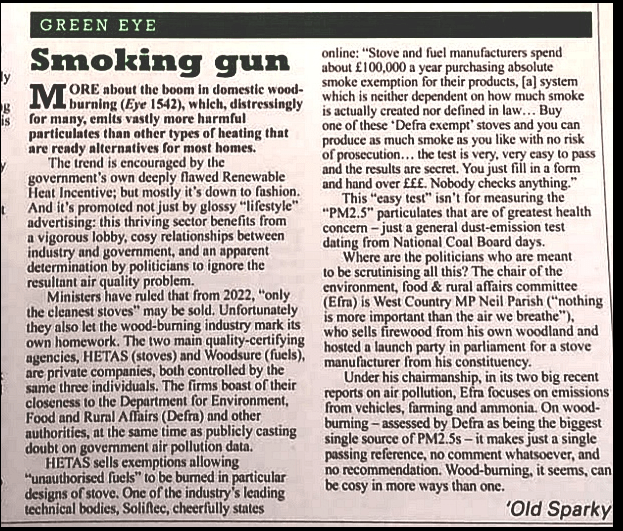
As a coroner says there is “no safe level of particulate matter” in the air and calls for national pollution limits to be reduced, Neil Parish MP is caught out operating dual standards in the “eye”.
“Nothing is more important than the air we breath” – except when giving wood burning stoves a bit of a puff. (Penultimate paragraph). Neil Parish is Chair of the Environment, Food & Rural Affairs Committee.
A coroner has called for a change in the law after air pollution led to the death of a nine-year-old girl.
Ella Adoo-Kissi-Debrah, who lived near the South Circular Road in Lewisham, south-east London, died in 2013.
An inquest had found air pollution “made a material contribution” to her death.
Coroner Phillip Barlow said there is “no safe level of particulate matter” in the air and called for national pollution limits to be reduced.
Ella was the first person in the UK to have air pollution listed as the cause of death on their death certificate, following the inquest ruling by Mr Barlow last December.
The role of a former Tory parliamentary candidate and party donor in a £100m government deal to buy PPE has been revealed after an apparent admin error.
The deal for face masks was signed in July, but the names of those involved were blacked out when the contract was finally published seven months later.
A second document listed Samir Jassal, an ex-councillor who has campaigned with the PM, as the supplier’s contact.
The government has said ministers have no part in deciding who gets contracts.
But it is the latest in a series of revelations about PPE deals awarded to those with government connections.
A ‘good friend’
Although the deal, for protective masks for hospital workers, was signed last year, the details only came to light in March after a court rebuked the government for failing to publish contracts within the legal time frame. Health Secretary Matt Hancock was found to have acted unlawfully for this failure.
Even when the deal involving Mr Jassal was finally published, the contact details for the supplier were blacked out. Full contracts are routinely redacted when published by the government.
However, in what appears to have been a clerical error, a separate document published with the contract gives Mr Jassal’s name. He is listed as the “supplier’s contact” to Pharmaceuticals Direct Limited, the company paid to supply the masks.
He told the BBC he was a consultant for the firm.
Contact details on the contract (top) were blacked out, but Mr Jassal was listed as the “supplier’s contact” on a separate document (below)
The contract was negotiated in the aftermath of the first coronavirus wave in the UK.
At the time, with a rising global demand for PPE, the government directly awarded contracts under emergency terms, which meant it didn’t have to spend time following the usual tendering process.
However, this has led to concerns over why particular suppliers were chosen and accusations of favouring firms with political connections to the Conservative Party.
Who is Samir Jassal?
Mr Jassal, a former Conservative Party councillor, appears well connected to the government.
He joined the prime minister on an official trip to a recycling plant in west London last October, and accompanied him on a campaign visit to a Sikh temple during the 2019 general election campaign.
Mr Jassal himself stood as a Conservative candidate in two general elections and he is standing as a councillor again in Gravesham Borough Council in next month’s local elections.
His LinkedIn profile claims he worked as an adviser to the now Home Secretary Priti Patel between 2014 and 2015. The BBC understands this was unpaid. He describes her as a “good friend” on social media. In 2016, he donated £4,000 to the party.
At the height of the UK pandemic in 2020, the government set up a “high-priority lane” for businesses endorsed by Whitehall officials or politicians, to fast-track PPE orders. Ministers have refused to reveal the full list of firms that went through this fast lane.
In November, the spending watchdog found these companies were 10 times more likely to win contracts than suppliers that came through the normal route.
Mr Jassal’s involvement in the £100m face masks contract was uncovered by the Good Law Project, a campaign group which took the government to court over not publishing PPE contracts. It is now seeking to bring a case against the government in relation to this contract.
“It’s of profound public importance that we discover who has benefited from the special arrangements put in place, who has benefited from the billions of public money spent, and at whose direction,” Gemma Abbott, the group’s legal director told the BBC.
More on our PPE investigation
The Department of Health and Social Care (DHSC) declined to answer whether Pharmaceutical Direct Limited’s (PDL) contract was processed as part of the high-priority lane.
Mr Jassal says PDL has 20 years’ experience in the healthcare sector and it asked to supply PPE via an online government portal. The company, he said, had supplied PPE to various outlets for many years.
Despite costing more than £100m, at least two hospital trusts have reported issues with the fit of the model of masks supplied under the contract
PPE orders in pandemic
£12.3bnvalue of PPE contracts awarded by UK govt between March and July 2020
Source: NAO Investigation into government procurement during the COVID-19 pandemic, Nov 2020
Mr Jassal said the masks “successfully entered the NHS supply chain in a timely manner” and they met “all technical standards which were rigorously vetted and approved by the Health and Safety Executive, the DHSC and the NHS”.
PDL said it had engaged its own independent expert consultants to test and certify that all masks were fully compliant. It said, to the best of its knowledge, all masks supplied had been distributed to, and put to use by the NHS.
A Department of Health spokesperson said: “The first duty of any government in a national crisis is to protect the public and save lives, and to do that when confronted with this global pandemic we had to rapidly procure and produce PPE.
“This involved setting up a new logistics network from scratch and expanding our PPE supply chain from 226 NHS Trusts in England to more than 58,000 different settings, all of which was taking place at a time when global demand was greater than ever before.
“All PPE procurement went through the same assurance process. Due diligence has been carried out on every contract and Ministers have no involvement in deciding who is awarded contracts.”
Residents across East Devon have been left split over how development should take place and the number and location of new homes to be built in the district.
Earlier this year, the council went out to consultation on its draft Local Plan Issues and Options report, giving residents the chance to comment on a series of topic based sections around how future development across East Devon should be planned.
A report to next Tuesday’s East Devon District Council Strategic Planning Committee outlines the responses from the consultation, with officers set to bring a more detailed feedback report to May’s meeting of the committee.
But the responses reveal a divide among those who took the time to give their thoughts – as while 30 per cent indicated that less than the required 928 new houses a year should be built, the same number backed the options for up to 1,200 homes a year or planning to build considerably more than the Government target.
And in terms of where strategic development should be located, around a third of respondents felt that there should be more of a focus in the ‘West End’ of the district around Cranbrook and the edge of Exeter, a similar percentage wanted less of a focus in the West End, with around one third wanted the existing strategy to be continued.
The responses revealed that 43 per cent wished that new development should be focused around a combination of areas where large scale development will support the delivery of new services and clusters of growth in locations within easy walking and cycling distance of existing services and facilities, although 30 per cent had no preference.
Views were also sought on possible end dates with questions asking whether the council should plan for an end date that was well after 2040, whether or not a new town or a ‘second Cranbrook’ is proposed, with 30 per cent saying yes it should plan for a date further into the future, just under 20 per cent saying that was undesirable, with around 15 per cent saying it should only be done if a new town was being planned.
On the question of the importance of facilities to people in their community, access to full fibre broadband, paths for walking and cycling, open spaces, healthcare facilities and a convenience store/post office scored highest, with a place of worship, a train station and a supermarket bottom of the list.
On future use of town centres, the strongest support was for community uses, followed by mixed commercial use and then leisure uses, with dominance of retail and change of use to housing having the most opposition.
But on preference for locations for future job provision, more home working had the greatest support from those who responded, with the most opposition to a focus on the West End and in villages and countryside. In towns, or close to Exeter, had neither opposition nor support from the consultation.
And the consultation revealed that there was a divide between those who wished to see all the issues addressed in a single local plan covering all policy matters (45 per cent) and those who wished for a strategic plan to come first and then subsequent plans to follow that deal with the detail latter (41 per cent), with the other 14 per cent expressing no preference.
The Strategic Planning Committee, when they meet next Tuesday, are recommended to note the initial feedback received in consultation responses to the Local Plan issues and options report, with the May 2021 meeting set to have a more detailed feedback report from officers, including commentary on matters raised in free text boxes of the questionnaire and in other correspondence.
Councillors will also be asked to consider the proposed options for engaging with developers and site promoters on production of the Local Plan, with five options put in front of them.
They are to have no engagement at all with site promoters and developers, to restrict engagement to written submissions, to have engagement through site specific meetings, engagement via a working party, or engagement through the Strategic Planning Committee only, with officers recommending the latter.
The report says: “The agreed timetable for plan production proposes a debate of potential site options by the Committee in November. It is considered that part of this meeting could include providing a time slot for developers and site promoters to present to the committee to aid members’ understanding of the options prior to making decisions regarding which options they wish to put forward for consultation in the draft plan.
“It is considered that this option presents the most open and transparent option given that the presentations would then be given in a public meeting and it would also ensure that all of the committee could hear each presentation whereas this would be difficult to accommodate if separate meetings were to be held for each site.
“It may also cause some frustration among developers and site promoters if they have to wait until much later in the year to engage more fully in the process and they may also not wish to make their plans open to wider public scrutiny but clearly this would be their choice, but if this approach is favoured it is suggested that a special committee meeting be arranged and that each presentation be time limited to ensure parity across all of the sites being presented and to fit the time available.”
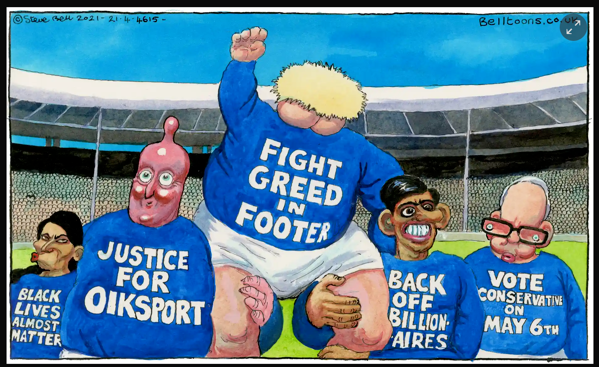
Lobbying can be absolutely legitimate. It’s part of how Westminster lives and breathes. Who would object to a small charity approaching its local MP to ask for help?
What about however, when the most powerful politician in the country sends a direct message to an influential businessman promising: “I will fix it tomo”?
Who would complain about the pub industry pushing the government for answers about when they can serve pints again inside after the year we’ve all had?
Who would begrudge health unions trying to persuade ministers that their staff members deserve a pay rise?
Who wouldn’t see the logic of big business groups trying to make their arguments to decision makers at the top to help them thrive and prosper, when decisions made in SW1 affect millions of us, and billions of pounds?
There are thousands of different circumstances in which having those discussions is perfectly valid.
What about however, when the most powerful politician in the country sends a direct message to an influential businessman promising: “I will fix it tomo”?
What about when the request from the company in question was about the tax rules? What about when the exchange between the two ends with a guarantee from the prime minister, long before any official announcement: “You can take it that we are backing you to do what you need”?
Sir James was trying to respond to the urgent call for help at the start of the pandemic, when there was deep and genuine fear that the NHS simply wouldn’t have the equipment to look after many thousands of patients at risk.
But Dyson also, understandably perhaps, wanted to be clear about protecting its business from any extra costs or liabilities. (In the end remember, they lost money from the project.) And the prime minister was heavily involved in efforts to get hold of ventilators and in touch with many businesses as the pandemic took hold.
Both Number 10 and Dyson stress the terrible urgency of the situation last year, rejecting the notion that the conversations were in any way inappropriate.
You can read both the government and Sir James’ responses to our story here.
But the rules that govern ministers’ behaviour aren’t just about what is being discussed, they are about how the conversations are had.
The principles are clear – contacts are allowed as long as there aren’t conflict of interests, and everything is transparent and out in the open.
Dyson had made an official approach to the Treasury on this issue. But it is not clear at this stage whether the prime minister did or didn’t tell officials about these specific exchanges of texts.
The practice of the principles that are meant to govern what is permitted has proved troublesome recently, provoking one of the all too regular concerns about lobbying of government.
Downing Street let it be known last week that the prime minister was shocked about some of the revelations that emerged, particularly about civil servants’ behaviour as the lobbying row got deeper and deeper.
But in the next few hours, some of his critics are likely to claim to be shocked by his.
Number 10 makeover scandal: New leaked memo shows Conservative Party chief knew £58,000 donation was earmarked for Boris Johnson’s Downing Street flat.
New evidence of how Tories used £58,000 to renovate PM’s Downing Street flat
Leaked emails show Tory co-chairman was told in October money was for refit
Lord Brownslow told the Conservatives he was giving two donations to them
One gift of £15,000 was to be given for general party funds, the email disclosed
A second donation of £58,000 was to pay for new decor for Boris Johnson
……“Dramatic new evidence of the way the Tories used nearly £60,000 of party funds on a lavish makeover of Boris Johnson’s Downing Street flat emerged last night
This was duly declared to the Electoral Commission watchdog, in accordance with transparency rules.
Crucially, the email, also sent to Conservative chief executive Darren Mott, shows a second donation of £58,000 was to pay for new decor for Mr Johnson and fiancee Carrie Symonds’s flat at 11 Downing Street.
This has not yet been declared to the Electoral Commission.
The £58,000 was to cover an identical amount secretly paid months earlier by Tory HQ for the refurbishment, including expensive wallpaper – in an attempt to disguise it.
The email appears to prove that the Tories planned to claim the £58,000 was paid not by Lord Brownlow but by a ‘soon to be formed Downing St Trust’ that did not exist – and still doesn’t, officially.”….
The government’s back in the business of underwriting mortgages, in a move that sees Rishi Sunak using a taxpayer-funded helicopter to spray petrol on to the house price wildfire currently burning.
The market was running hot before this latest intervention, which sees the state underwriting 95 per cent mortgages for homes worth up to £600,000. Rightmove, for example, recently reported a 2.1 per cent jump in asking prices month on month, taking them to a record £327,797. The annual increase was 5.1 per cent.
That’s what happens when a shortage of supply meets heavy demand, the first lesson your child will learn when they start taking economics classes, but something Mr Sunak, a former banker, seems to have forgotten.
There are multiple reasons for this: the forthcoming end of the stamp duty holiday, the gradual opening up of the economy post-lockdown, people reassessing their circumstances as home working is much more widely adopted are just a few of them.
The problem with throwing the government-backed mortgages into the mix is that it will further increase demand, and thus prices, by bringing an army of new buyers when there will be no corresponding increase in supply.
It has justified this, and similar policies, by arguing that it’s helping people to get on to the housing ladder.
But the policy is ultimately self-defeating because, sure, some buyers who couldn’t raise the deposit for a 90 per cent home loan will now be able to get on the ladder at 95 per cent (although mortgages at this level are proving to be quite expensive).
Trouble is, it doesn’t matter if your mortgage is for 95 per cent of a home’s value, 90 per cent or even 100 per cent, you aren’t going to get one if you can’t pass the strict affordability tests financial watchdogs force lenders to apply.
So Peter, who’d saved diligently for a deposit for a home he could just afford prior to the scheme, gets robbed by Paul, who, with a higher salary but less savings, can afford to buy at a higher price through one of the new subsidised 95 per cent loans.
This is exactly what happened with the previous help to buy schemes, a point made by housing charity Shelter.
“The fundamental problem with help to buy is that it tries to solve the problem of unaffordable house prices by making it easier for potential buyers to access a mortgage.
“As the amount of mortgages issued are a key driver of house prices, the schemes push up prices further,” it said.
History looks set to repeat itself. Think about this as well: to afford a 95 per cent mortgage for one of the £600,000 home at the top of the scheme you’ll need to be among the fortunate few with an annual household income of £127,000 or more.
Quite why the government is subsiding home loans for these people at a time when it’s next to impossible to get a council house in some parts of the country is beyond me.
The policy is a nonsense so profound you simply couldn’t make it up.
The biggest beneficiaries will inevitably be the fat cats at the top of the big house builders, who must be drooling right now. Profits – and CEOs’ bonuses – are set to go through the roof.
Meanwhile, Britain has a chronic shortage of affordable housing, while those forced to rent privately have few rights and scant chance of making genuine homes of the properties they live in given they can be turfed out whenever it’s convenient for the landlord to cash in.
And don’t even get me started on cladding and Grenfell.
But that’s Tory housing policy for you: a disaster whichever way you look at it.


 East Devon Watch