NHS in Devon is under ‘significant strain’ due to heavy demand

Devon’s health and care system is under “extreme pressure” and the public is being asked to find ways not to overburden it.

Carl Eve www.devonlive.com 

A statement released by the NHS Devon Clinical Commissioning Group (CCG) has highlighted the medical groups serious concerns about the current situation.

The Devon CCG – which acts as the headquarters for the NHS in the county and has a budget of more than £1.9 billion – has said that the county’s “health and social care system is under extreme pressure due to high demand for services, sustained demand for Covid beds, pressure on staffing and the need for social care exceeding the available capacity.”

The group said the pressures are being seen across the system, in mental health care, primary care (GPs) and adult social care as well as the acute hospital trusts.

Dr Paul Johnson, Chair of NHS Devon Clinical Commissioning Group said: “The NHS throughout Devon is under a significant strain at the moment because there’s a large number of people who are needing emergency care, there’s a large number of people who are in hospital who are waiting to get home, but they need carers in order to support them to get home and we haven’t got those carers available.

NHS Devon issue advice to help them cope with "extreme pressure"

NHS Devon issue advice to help them cope with “extreme pressure” (Image: NHS Devon Clinical Commissioning Group (CCG))

“This means that the amount of beds and the amount of staff that we’ve got available to look after them in hospital is really limited and that means those people coming into hospital in need of care are struggling to be seen in a timely way and then we’re struggling to get them if they need to stay in hospital into a ward and onto a bed, where we can get them the care and the investigations that they need.

“So, our ask to you is really two-fold. Firstly, if you need emergency care, then just go to the right place for that care.

“Now, sometimes it would be the emergency department and you’ve absolutely got to go there.

“But other times it could be your pharmacist, your GP, or to go 111, either by dialling that or going online and getting help in a different way.

“Secondly, if you are in hospital, or you’ve got a relative in hospital who is looking to get home, just think about how quickly can you on the day they’re due to get home, get in and pick them up because the sooner they’re home, the sooner we can make a bed available for someone who’s been waiting – potentially – for several hours in the emergency department.

“Also, if they are waiting for carers to be available for them to get home, is there any way that either friends or family or relatives can support them at home, even if there’s something that we need to do to help make that possible?

“If that’s the case, then talk to your teams on the ward and we will do everything we can to get people out of hospital so that those who need those beds and that medical care can then get through the emergency department and get the treatment they need.”

Dr Johnson said the NHS in Devon “really need you (the public) to support us.”

He said: “Please ask yourself whether you have a genuine life-threatening emergency before attending an emergency department (ED).

“If you are not in the right place, you may be redirected to a more appropriate service. This is because we need to safely prioritise those with the most urgent need.

“Finally, we are seeing high numbers of children coming to hospital. There is a really useful HANDi paediatric app for advice on common childhood illnesses and when to seek help.”

The group have highlighted a number of ways the public can assist in supporting the hard-pressed services, including:

* Using your local pharmacist for minor conditions such as insect bites, ear ache and skin rashes.

* Using NHS 111 – online or by phone if you need advice or medical treatment quickly and can’t wait to see your GP. If you need to be seen by a Minor Injuries or Emergency Department they can book you in.

* Getting vaccinated against Covid-19. Have both jabs and your booster if you are eligible

* Staying away from hospitals if you have Covid symptoms, or diarrhoea and vomiting

The Devon CCG said other causes of pressure include some people using the emergency departments “inappropriately”, high numbers of staff off-work due to Covid or other reasons and a high number of vacancies in the current competitive jobs market.

The group added: “The enhanced infection prevention and control measures that were implemented during the height of the pandemic has been reduced to some extent, but are still higher than before the pandemic and mean we can treat fewer people in the same time period than in normal times.

“The NHS is working hard to address pressures across the system by promoting the most appropriate places to seek medical help, vaccinating people against Covid-19 and through staff working long hours and extra shifts.

“Longer term measures include recruiting more staff and creating extra capacity with new theatres and diagnostic facilities in Plymouth and at the former NHS Nightingale hospital in Exeter.”


Fed-up fishermen take on Boris Johnson

Two local interest aspects in this article: the Carters involvement and the story of skipper Dominic Welsh of Newton Poppleford. Should Simon Jupp have joined the party? – Owl

Edward Oldfield www.devonlive.com  [Extract]

Fishing has been the lifeblood of the port of Brixham on the south Devon coast for hundreds of years. And the current generation working in the industry have a message for prime minister Boris Johnson – don’t let us down again.

The fish market at Brixham is the biggest in England by the value of catch sold and around 600 fishermen are based at the port, which has seen fishing boats in its naturally sheltered waters at the southern end of Tor Bay since the Middle Ages.

Some in the industry say fishing is thriving locally, despite Brexit. The merchants, who report extra costs and delays due to new rules on exports, have a different view. And for producers of molluscs like mussels it has been a disaster, with live exports to the EU effectively blocked. The deal is still a sore point with French fishermen, who are threatening to disrupt cross-Channel trade in protest at the refusal of some licences to fish in UK waters.

The government has set aside a £100million investment fund for the industry, and has promised to replace funding that came via the EU. Now the local fishermen, who number around 600, and the workers who depend on the industry, want to see Brixham land the money to safeguard the future of their historic industry.

The picturesque harbour, with its pirate ship and backdrop of rows multi-coloured houses, has become a hotspot for tourists, and locals say its popularity is closely linked to the town’s character as a fishing port, illustrated by the branch of the restaurant Rockfish next to the entrance to the fish market.

Fishermen were some of the strongest supporters of breaking away from the European Union, convinced by the potential to take back control of the UK’s waters, and harvest more of the fish in them. But many now see the government’s trade deal and fishing agreement with the EU as falling far short of what was promised.

The town is in the constituency of Totnes MP Anthony Mangnall, who is planning to join a trawler crew overnight this weekend to find out for himself what the job involves. He has been invited aboard the Georgina of Ladram, a beam trawler that is one of the fleet’s newest, built in 2019 and operated by Waterdance, a family owned company that is part of the Exeter-based Greendale Group.

Mr Mangnall has spoken out in support of the industry in Parliament, and wants to see a fishing school set up to educate the next generation. The MP’s press release about his fishing trip says more news is expected soon about the £100 million fisheries fund “which will be beneficial to the fishing communities in Brixham, Salcombe and Dartmouth.” He says the first part of the fund has recently been announced, with £24 million of investment available to fishing businesses across the UK to develop technology, trial new gear and support world-class research.

Fishing boat skipper Dominic Welsh at Brixham Harbour

Fishing boat skipper Dominic Welsh at Brixham Harbour (Image: Ed Oldfield/Devon Live)

The lack of an easy route into the industry was highlighted by young skipper and owner Dominic Welsh. The 31-year-old was working on the quayside at Brixham on his new boat the Southern Spirit, which represents a total investment of £1.7million.

The father-of-two, from Newton Poppleford, near Exmouth, said he left school at the age of 13, unable to read or write. He taught himself at sea, and bought his first licensed fishing boat at the age of 16. Mr Welsh has worked his way up through the industry, and is now close to the end of a £400,000 refit of his new vessel, employing 17 local workers. He is aiming to put to sea with his crew of four in around a month’s time. The Brixham-registered boat will fish in the seas around the UK, mainly for scallops, dover sole, plaice, turbot, brill and cuttlefish, mostly for export.

Mr Welsh said the industry has recovered from the setback of the pandemic, despite rules that are ‘strangling’ operators, with the area for fishing getting smaller and only a small increase in quotas in recent years, despite growing fish stocks and the promise of Brexit.

He regrets the government’s failure to secure sole fishing rights up to the 12-mile limit in British waters. But looking forward, he says the industry is thriving, and he wants to see it grow, with investment in education and training like the French are doing already. Mr Welsh said: “The industry is huge, and it would keep getting bigger, but there is not the manpower to run it.”……………….

Keep calm – wear a jumper

Faced with queues at the petrol pumps; empty shelves; rising fuel prices; welfare cuts; imminent tax rises and a Prime Minister who is on holiday [or has he fled the chaos?], this seems practical advice – Owl 

Extract from Trevor Phillips interview with Kwasi Kwarteng. See more here www.radioexe.co.uk 

Asked if he would advise people to wear another woolly jumper to keep warm this winter, Mr Kwarteng said: “It’s up to people – it’s amazing how different people’s cold thresholds can be very different.

“Some people feel comfortable wrapped up in lots of different clothes, others wear relatively little – I think people should be sensible. I think people should do what they feel comfortable with.”

Pressed on whether this meant he was telling people to turn down their thermostat and put on more clothing, he said: “My job as an energy minister is not to tell people how many layers of clothing they should wear, that’s not really my job.”

Jurassic Visitors centre remains closed

….Whilst the council works out what to do with the building.

This is another Albatross seaside “regeneration” project whose genesis can be traced as far back as 2005. It was opened by the Princess Royal in 2016 and soon after claims were made that it attracted visitors in the tens of thousands.

In 2005 the Conservative “magic ingredients” of regeneration for both Exmouth and Seaton comprised: a supermarket close to the beach; a Premier Inn and an “iconic” building. The “Ocean” bowling alley in Exmouth and the Jurassic Centre in Seaton represented the “iconic” buildings.

Budleigh Salterton was “pencilled in” for a cut down version of the Ocean, using the same architect (Longboat Cafe site). Planning permission was eventually granted after a drawn out battle with objectors, spanning something like seven years, by which time the economic circumstances had drastically changed. As is now all too plain to see.

Exmouth has swallowed up over £3m of public funds for its non-commercially viable icon and now Seaton needs a minimum of £200K on top of the original £4m it cost to build with no guarantee that any business is waiting in the wings to take it on. (And, of course, we have the costs of the “no cost” spanking new EDDC HQ in Honiton)

So far Sidmouth has managed to escape.

Have these Conservative investment plans passed the test of time? Exmouth was looking to Robert Jenrick’s begging bowl before he was sacked. – Owl

Joe Ives, local democracy reporter www.radioexe.co.uk

Seaton’s Jurassic Visitors centre will remain closed while the council works out what to do with the £4.2 million building.

The centre, which opened in 2016, closed in September after Devon Wildlife Trust decided to cease acting as its operator.

The charity blamed “unique and unprecedented challenges posed by the covid-19 pandemic” as well as the need to undertake substantial, costly renovations to the attraction’s exhibitions, thought to potentially cost in the region of £200,000.

The number of people visiting dropped from 48,000 people in 2019/20 to 8,000 between March and September this year. The centre now falls under the responsibility of East Devon District Council (EDDC), which own the building.

Seaton’s Jurassic Visitors centre was an educational hub celebrating the 95-mile length of coast that stretches along east Devon and west Dorset where many fossils can be found. The coastline has World Heritage Status in recognition of its geological importance. 

The council is now exploring options including a repurposed Seaton Wetlands Visitor Centre or a ‘wetlands experience’ cycle route with hire bikes available from the centre, alongside health and wellbeing courses and activities.

EDDC is also considering leasing the building to someone who will use it as a general attraction centre, not necessarily focussed on the Jurassic Coast. The council is also discussing selling or renting the site.  If nothing happens in the coming months, the centre may be temporarily used as a café during the 2022 tourist season.

Either way, EDDC’s cabinet is setting aside £45,000 to pay for ongoing running costs of the unused building for the rest of the current financial year, which ends next March.

Speaking at a cabinet meeting this week, councillor Marianne Rixson (Independent East Devon Alliance, Sidmouth Sidford) requested that, given the centre’s hefty price tag, it should be referred to EDDC’s audit and governance committee so as to “understand the full ramifications of this failed project”, a suggestion approved unanimously by cabinet.

Echoing his colleagues concerns, Councillor Geoff Jung (Independent East Devon Alliance, Woodbury and Lympstone) said lessons needed to be learned. He added: “It was a great effort to introduce the Jurassic centre to Seaton and it really saddens me to see the facilities closed. Let’s hope we can make something out of this now. I would like to thank the Devon Wildlife Trust for their endeavours to make it a success and it’s a shame that it wasn’t.”

In a statement released after the cabinet meeting, council leader Paul Arnott (Independent East Devon Alliance, Coly Valley) blamed previous administrations and said: “We will work tirelessly to make sure that the eventual outcome is a vast improvement on what exists, and out of respect for the thousands of free hours given by Seaton people doing their best, we will make sure we find out and publish how this project was commissioned against the better judgement of so many people at the time.”

Devon County Council to get £5m from Household Support Fund for struggling families as furlough, Universal Credit uplift ends

“So we’re losing £15.5 million and we’re getting £5 million back. That doesn’t seem like a good deal for the people of Devon somehow.” Opposition leader Councillor Alan Connett. 

Never rains but it pours, as a lot of support ends at the same time. John Hart’s instinctive political reaction as the rains fell in February 2020 was: “Self-help is going to be the order of the day”. Boris Johnson seems to be distancing the government from current problems as well. – Owl

Ollie Heptinstall, Local Democracy Reporter sidmouth.nub.news 

Devon County Council is to receive just over £5 million as part of the government’s household support fund for struggling families over the winter.

The money is part of a £500 million national fund and comes just days after the end of furlough and the £20 uplift in universal credit. It’s to help people struggling with the cost of food, heating, water and other essentials.

Through their local councils, residents will be able to apply for what the government says are “small grants to meet daily needs such as food, clothing and utilities”.

Announcing the news at a full meeting of Devon County Council on Thursday, Councillor Roger Croad (Conservative, Ivybridge) said: “I’m anticipating significant allocations to the districts.” The council is expecting more information about who will be eligible for support shortly.

“We’re looking at voluntary, community and social enterprise organisations supporting responses to poverty and food insecurity, the Citizens Advice Bureau, fuel advice and support, children’s centres, early help teams [and] support organisations linked to water, energy and essential supplies.”

Councillor Rob Hannaford (Labour, Exwick & St Thomas) said the money was “extremely welcome” but warned, with the current cost of living pressures on households, that “it must be spent and spent urgently”.

But opposition leader Councillor Alan Connett (Lib Dem, Exminster & Haldon) compared it to the reduction families will face as the uplift in Universal Credit ends: “This really is a case that we’ve had a fiver taken out of our pocket and we’re getting sixpence back.”

“The five million is valuable – good work will be done with it no doubt. But 14,770 individuals across Devon claiming universal credit and were getting the £20 a week uplift; those families are faced with rising fuel costs as we’ve seen. We’ve seen that they’re obviously going to see increased food costs.

“So we’re losing £15.5 million and we’re getting £5 million back. That doesn’t seem like a good deal for the people of Devon somehow.”

Echoing Cllr Connett’s remarks, Councillor Yvonne Atkinson (Labour, Alphington & Cowick) said the new fund instead of the £20 a week uplift was “really a loss to people and people will have to go and beg.”

She added: “For already desperate people, to actually force them into that – perhaps for bus journeys or where they can ill-afford to go and make that case – I think it’s deeply shocking that the £20 has been taken away and replaced by this.”

Earlier in the meeting, Cllr Croad admitted he would “probably have to agree” that the Universal Credit uplift should have continued through the winter, but said: “The chancellor would tell us the uplift on the UC is in effect about £6 billion a year and I don’t think the country could probably afford it.”

More details are expected to be announced about the fund in Devon in the coming days.

Property news from the 2021 Conservative Party conference

Replacing stamp duty and council tax with a proportional property tax – an idea discussed by Lord Willetts [given the nickname “Two Brains” in the 1990s – Owl].

Brexit may have finally been replaced by net zero and levelling up as the main topic of conversation, but one thing remains constant as the Conservative Party conference reconvened this week — housing is still at the top of the agenda.

Carol Lewis, Emanuele Midolo www.thetimes.co.uk 

Not unsurprisingly for a party with the slogan “build back better”, there was a focus on construction: from the housing secretary Michael Gove’s promises to build on brownfield sites in the Midlands and the north, to the charity Shelter’s banners adorning the buildings outside Manchester’s convention centre telling the prime minister the solution to the housing emergency was to build social housing. With more than 100 mentions of the words “housing” and “homes” the Tories’ agenda was clear.

UK construction statistics published this week showed that building faltered in September amid a lack of materials and staff. However, in a small room high above the trade hall — away from the TV crews, the party faithful and stall holders — delegates at a fringe event, hosted by the think tank Bright Blue and the campaign group Fairer Share, had alighted on a solution.

Lord Willetts, the president of the Resolution Foundation’s advisory council, and Aaron Bell, the MP for Newcastle-under-Lyme, were among those discussing how replacing stamp duty and council tax with a proportional property tax could release up to 600,000 homes into the market over the next five years without the need to lift a single brick. [Source seems to be Fair Share Campaign – Owl]

The tax — an annual charge equivalent to 0.48 per cent of a property’s value, rising to 0.96 per cent for second homes and foreign-owned homes — would release an additional 315,000 properties through extra market activity plus 135,000 second homes and 55,000 empty homes over five years, as well as 90,000 houses to be built on undeveloped plots. Some 255,000 of these would be one and two-bedroom homes suitable for first-time buyers, according to the groups.

Construction was not forgotten though, with the tax forcing an additional 90,000 more homes to be built as developers were spurred into action by the tax instigated at the point of planning permission to combat land banking.

Overall, the tax would mean 76 per cent of homeowners in England would be better off, with any increase compared with council tax capped at £100 per month. But most importantly, explained Andrew Dixon, the founder of Fairer Share, it would free up homes and the movement of people, helping more first-time buyers on to the ladder while encouraging downsizers out of family-sized homes.

Fairer Share’s calculations, based on data from 2020 showing 270,000 long-term empty homes in England, could be an underestimate, however, with the latest official statistics revealing that the number of vacant homes stood at 665,000 in October 2020.

Chris Bailey, the campaigns manager at Action on Empty Homes, says that homes are often inherited by families who don’t have the money, time or energy to renovate them. “Some remain empty for years or even decades, often ending up in a run-down state sold at auction. They are a wasted resource,” he says. “With so much focus on working towards net zero, making best use of our housing stock should be a no-brainer.”

It might be a case of taking back control rather than building back better to solve the housing crisis.

Network Effects – Shocking Transport Gap – Onward

New dataset reveals for the first time how many jobs are reachable by car and public transport in every small local area in Britain – exposing a shocking transport gap between North and South.

[This summary concentrates on the “Red Wall” constituencies but the full report also shows the particular problems faced by Devon and Cornwall. Neil O’Brian MP was one of the founders of the “Onward” think-tank in 2018. He has recently been appointed to Parliamentary Secretary of State, Department for Levelling Up, Housing and Communities – Owl]

Robert Largan MP www.ukonward.com

If Levelling Up is to mean anything, then it must be about fixing the transport inequalities between regions. I sincerely hope the Government take this report on board carefully.

How many jobs can you reach within an hour’s drive or 90 minutes on public transport from your front door?

We have created a brand new dataset that for the first time reveals the number of jobs accessible by car and public transport from every local area (LSOA) in the country across different time horizons. The subsequent analysis, Network Effects, exposes a yawning transport gap between different parts of the country:

  • Public transport is so poorly connected in some parts of England that people can access fewer jobs within an hour on public transport than they can reach within a 5-miles radius of their local area. In Stoke-on-Trent, Newcastle-under-Lyme and Bolsover, workers can access only around three-quarters of local jobs within an hour on public transport. This compares to some towns in London’s hinterland, like Redbridge, Barnet or Epping Forest, where an hour on public transport unlocks access to 7 times more jobs than exist locally.
  • This transport gap becomes even clearer when comparing similarly sized towns in different parts of the country. Halifax in Yorkshire and Mansfield in Nottinghamshire have similar levels of population as Aldershot in Hampshire. But using public transport you can reach twice as many jobs within 90 minutes from Aldershot (1.2 million jobs) than from Halifax (581,837), and over four times as many as from Mansfield (246,857). Aldershot is 30 miles from London, while Halifax is 8 miles from Bradford and 14 miles from Leeds and Mansfield is within 14 miles of Nottingham, 22 miles from Derby and 30 miles from Sheffield.
  • In some of Britain’s most important regional cities, public transport barely improves access to jobs at all. In Newcastle and Glasgow, an hour on public transport boosts job access by a third. This compares to London where public transport nearly quadruples local jobs access: i.e. there are 3.7 times as many jobs within 60 minutes on public transport as within a 5 mile radius.
  • You can reach more than 50% more jobs within 30 minutes by car in parts of the Home Counties bordering Greater London (482,000 jobs) than you can in central Birmingham, reflecting the latter’s byzantine road network

The transport gap is particularly acute around towns in the Red Wall regions of the North West and West Yorkshire, where geographic proximity to jobs is no guarantee that workers will be able to reach them.

  • In the Greater Manchester area, people in Prestwich, Droylsden and Blackley can access around 90% of the nearby jobs (within 5 miles), despite being just inside the M60 and close to the city centre. But people in Wigan, Rochdale and Bolton can access twice as many jobs within 60 minutes as there are locally.
  • In West Yorkshire, towns in the middle of the conurbation like Batley, Brighouse and Mirfield can access only 94% of the jobs that exist locally by public transport, while Huddersfield or Bingley, which are further from Leeds and Bradford, can access 94% more jobs than exist locally.

This suggests that spending dedicated to public transport could be much better directed towards improving jobs access in Britain’s regional towns and cities, rather than improving transport in places that are already well-connected.

The report also suggests that the Government should not rely solely on transport investment to support stronger regional growth.

Successive governments have placed considerable emphasis on transport investment to unlock growth, with transport projects typically scoring higher on benefit cost ratios under the Treasury’s Green Book rules. However, our research suggests that this may be a mistake, as transport connectivity to jobs appears to have little overall bearing on the average income and productivity of a place:

  • Only a small share of the local variation in median incomes is explained by the number of jobs accessible within 90 minutes by public transport, and access to jobs by car is not at all related to income. 
  • Differences in income are far better explained by qualification levels and the mix of occupations and industries than by connectivity to jobs. These three combined account for over four-fifths of the variation in median income between places.
  • This suggests that further transport investments will struggle to improve incomes and living standards in a place without addressing other economic fundamentals like education and the quality of jobs available.

We are publishing the dataset as open data

We have published the dataset openly to allow others to analyse it and create their own maps and graphs. Head over to our GitHub page to download all the journey time data used in this report. Please credit Onward if you do.

We are particularly grateful to Alasdair Rae, founder of Automatic Knowledge Ltd, who developed the measure of access to jobs used in this paper. A full methodology is available in the Annex of the full report.

East Devon’s Development Planning – The Dream – The Vision – The Reality! 

From a correspondent:

On paper there is little doubt that development planning in East Devon has been well documented. 

The Government’s National Planning Policy Framework (NPPF) recommends decision-making should be genuinely plan-led, to achieve high quality designs, conserve and enhance the natural environment, reduce pollution to support a low-carbon, climate-resilient economy, whilst taking account of the diverse character of different areas, by providing a framework within which local people and their accountable councils can produce their own distinctive local and neighbourhood plans which reflect the needs and priorities of their communities. 

The role of the Local Plan is to help set out what we want East Devon to be like in the years to come, the type of development we want to see and where development should occur and what benefits it will bring to our communities based on local insight. 

Moreover, the Bishops Clyst Neighbourhood Plan represents the community’s vision and priorities for how we would like to see our neighbourhood area evolve. It puts us, as a community, in the driving seat when it comes to having a say over what, how and where development should take place. 

Sadly, after the production of all these copious documents, containing a myriad of protective policies and advice in both our East Devon Local and Neighbourhood Plans – alongside the colossal amounts of time and public money expended in their preparation and approval – these policies were completely ignored by East Devon Planners in their decision on 20/1001/MOUT at Winslade Park, Clyst St Mary! So the reality is that Clyst St Mary’s vision and ideology for the future growth of their valued, special village were crushed, pulverised and brushed aside by politicians and officials exclusively for unproven, economic benefits for East Devon. 

There is anxiety that any future changes to our community will now be entirely developer-led and contain incalculable numbers of lucrative housing – but the promised sports, leisure, economic, social and environmental benefits to the community will be scaled down significantly. Will our primary school children learn to swim in the pledged indoor swimming pool, before they reach adulthood? Only, perhaps, with the loss of additional sports fields or agricultural land to more housing? The tried and tested developers’ mantra will be that without additional housing – the financial viability of the whole masterplan will be at risk! 

Meanwhile, the local residents watch as the directors of the development company fly-in regularly and land their private helicopter on the pledged community sports fields; they listen to the deep-throbbing engines of the directors’ Porsches parking in the car park adjacent to their homes, whilst these entrepreneurs banquet at the high cost, high-end Winslade Manor restaurant and bars!

However, this is expected behaviour from directors of development companies – so we can’t blame them for reaping the benefits and taking advantage while they can? So who is to blame? 

Burringtons’ proposals for 39 homes on a protected green field, together with their horrendous designs for 40 four-storey flats (that resemble 1960s urban car park designs) in this rural village, opposite a Grade II* Listed Manor House, are accelerating at speed through the local planning processes with two Reserved Matters applications submitted (21/2217/MRES and 21/2235/MRES) under consultation. 

Can those responsible for the flawed recommendations and decision-making at the outline planning stage, now ‘claw back’ some credibility within this neighbourhood, to ensure that the Reserved Matters plans represent the wishes of those people who actually live in this community? Can we not secure housing designs that will be judged with pride, that are sustainable and will not detrimentally affect many existing homes in this community? Can EDDC Planners build back better and more beautiful or has the damage already been done to gain economic benefits for East Devon that are unlikely to be achievable – so now there is no way back? Or can the decision-makers now condition the Reserved Matters to ensure that the benefits to the community are provided alongside the housing provision in a staged process? Otherwise the developers will give precedence to the development of the 79 homes by  ‘cherry- picking’ the lucrative 39 on a green field and 40 inappropriate, four-storey flats in a village with no local  housing need  – but  the much-valued community facilities will be relegated and banished! 

Will the economic benefits that were so lauded by EDDC’s professional and elected planners and resulted in them ignoring protective planning policies in the NPPF and the Local and Neighbourhood Plans, ever be realised post-pandemic with innumerable business employees now electing to ‘work from home’ in future and not requiring the 2,000 predicted jobs offered at Winslade Park to East Devon? 

Clyst St Mary wonders if these plans will follow the example of Cranbrook with thousands of houses but no town centre – or Axminster with a profusion of housing but with no ring road – or Newton Poppleford with increased housing but no doctors’ surgery or health centre – or more locally – 80 homes at Greenspires with no footpath provided for children to walk to the primary school? 

Are we to forget the dream and the vision of aesthetically-pleasing growth proposals that will stand the test of time and be admired in the future? Is the reality likely to be  that Clyst St Mary will be sacrificed to become a giant housing estate of urban sprawl with none of the pledged infrastructure, resulting in it losing its special characteristics as a valued  rural, historic village? 

The decision is in the hands of a few elected members of the Planning Committee on recommendations from EDDC’s planning officials – is this a lottery governed only by chance – or does the local authority actually have jurisdiction to control the future development of our communities?  For the answers  . . . . . Watch This Space! 

Gofundme started for MP who described his £82,000 a-year salary as ‘really grim’

A fundraiser has been set up poking fun at a Tory MP who used a media interview to complain about his £82,000 salary amid a cost of living crisis.

www.independent.co.uk 

Sir Peter Bottomley, the Conservative MP for Worthing West and the Father of the House of Commons, described MPs’ pay packets as “really grim”, despite their wages putting them in the top 5 per cent of earners in the UK.

He called for members’ salaries to be boosted to somewhere in the region of £100,000, saying the situation was “desperately difficult” for newer MPs, adding: “I don’t know how they manage”.

Now, a Gofundme user going by the name of Simon Harris has shown his concern for Sir Peter by attempting to raise £20,000 to boost his earnings.

“Support this Tory MP struggling on £80k a year,” the page description reads.

“I am raising £20,000 for Sir Peter Bottomley who has courageously admitted that he is ‘struggling’ on the current MP’s salary of £80,000 per year,” it adds.

The page was created on Wednesday and has so far raised £70 from six generous donors.

In an interview with the New Statesman, published on the day when the £20 uplift to Universal Credit was axed, Sir Peter called for MPs to get a pay rise,  pointing out that their salaries do not cover expenses.

He suggested taxpayers should foot the bill for the things the rest of the public has to pay for, such as food and travel.

The median salary in the UK is just over £31,000, according to the Office for National Statistics, while those paid in excess of £80,000 are in the top 5 per cent of earners.

An increase of £18,000 a year to MPs’ salaries would represent a rise of almost 22 per cent.

The government this year offered NHS staff a rise of 3 per cent.

Speaking on LBC Radio on Thursday morning, Sir Peter defended his comments and suggested he would be in favour of slashing numbers in the Commons in order to increase MPs’ pay.

He also claimed that “a good teacher, a good social worker or a good trade union official” would be “significantly worse off” if they went into politics.

According to the government’s Get Into Teaching website, a qualified teacher working in inner London can earn a maximum of £50,953 and up to £41,604 for the rest of England and Wales.

The median salary for a social workers is £37,000 according to payscale.com.

Trade union officials can earn between £30,000 to £80,000, according to the National Careers Service.

Private hospitals treated just eight Covid patients a day despite deal to help NHS

Private hospitals treated a total of just eight Covid patients a day during the pandemic despite a multi-billion pound deal with the government to help stop the NHS being overwhelmed, a report reveals.

Denis Campbell www.theguardian.com

And they also performed far fewer operations on NHS-funded patients than usual, even though hospitals has suspended much non-Covid care, according to research by a thinktank.

The Treasury agreed in March 2020 to pay for a deal to block-book the entire capacity of all 7,956 beds in England’s 187 private hospitals along with their almost 20,000 staff to help supplement the NHS’s efforts to cope with the unfolding pandemic. It is believed to have cost £400m a month.

However, the Centre for Health and the Public Interest’s report (Pdf) says that on 39% of days between March 2020 and March this year, private hospitals treated no Covid patients at all and on a further 20% of days they cared for only one person. Overall, they provided only 3,000 of the 3.6m Covid bed days in those 13 months – just 0.08% of the total.

And while private hospitals undertook 3.6m NHS-funded planned procedures the year before, that dropped to only 2m during the first year of the pandemic – a fall of 43% – the thinktank says. Its conclusions are based on its analysis of two major sets of published NHS activity data.

“Despite the fact that the taxpayer paid undisclosed billions to the private hospital sector, which prevented some of the companies going bust, the official data shows that they barely treated any Covid patients and delivered less elective work for the NHS than they did prior to the pandemic,” said Sid Ryan, a researcher at the CHPI who wrote the report.

The NHS’s “under-utilisation of the private hospital sector” should not have surprised ministers, Ryan added, “because private hospitals may have beds and operating theatres, but they rely on NHS staff to carry out operations, and these NHS staff were busy working in NHS hospitals. Which begs the question: why then did the government agree to this generous deal?”

At the time NHS England (NHSE) lauded the deal as a vital way of boosting healthcare capacity at a time when it was feared that NHS hospitals would run out of space to treat Covid sufferers. In two letters to the wider NHS explaining why the deal had been struck and what it would cover, senior NHS officials were clear that it would include care for Covid patients with serious breathing problems as well as routine operations, such as hip and knee replacements.

Ryan criticised the continuing secrecy around the contract. Neither ministers nor NHSE have ever disclosed how much it cost the Treasury or given a breakdown of the number of non-Covid procedures that resulted.

Labour MP Meg Hillier, who chairs the Commons public accounts committee, said the findings showed the government and NHS had got poor value for money from the very expensive deal.

“Millions of pounds of unfit PPE languishing in costly storage and the £530m spent on unused Nightingale hospitals, the Department of Health and Social Care (DHSC) has repeatedly demonstrated its lack of competence in dealing with the private sector.

“Here taxpayers have covered an entire year of private hospitals’ costs in return for less treatment and care than before, and many of them now feel forced to pay those same private hospitals over again in the face of an NHS beset with lengthy backlogs.”

The DHSC should be open about how much care private hospitals did provide and try to claw back moneys for treatment that was paid for but not given, she added.

Under questioning by Hillier at the PAC in June 2020 Simon Stevens, NHSE’s then chief executive, promised to write to her disclosing how many of the 8,000 beds had been used and how much the deal was costing. However, when NHS England’s chief financial officer, Julian Kelly, later replied on Stevens’ behalf, he said the contract had cost £853m in just over its first four months but did not clarify how many beds had been pressed into service.

The Independent Healthcare Providers Network, which negotiated the deal on behalf of private hospitals, insisted that it was never intended to cover people with Covid, despite NHS England’s two letters making it clear that such patients were included.

“Given that the NHS asked the independent sector to maintain Covid-free sites for vulnerable patients including those with cancer it is not surprising that few Covid patients were treated in independent hospitals. To have done so would not have been appropriate or safe,” said David Hare, the IHPN’s chief executive.

He added that more than 3.2 million NHS patients were treated in the independent sector under the contract, without which the NHS’s 5.6m-strong backlog would be even bigger.

A DHSC spokesperson said: “We will make no apology for ensuring that the NHS has the resources it needs to provide care for patients during a global pandemic. The primary aim of the independent sector deal was to treat non-Covid 19 patients, providing urgent cancer services and other life-saving treatments.”

The contract meant that “around two million consultations, tests, operations and chemotherapy sessions for NHS patients [took place] between March 2020 and the end of 2020”, they added – far fewer than the 3.2m claimed by the IHPN.

Looted temples, poisoned towns and latest Pandora Papers impact

A flurry of fallout continues around the world days after ICIJ and global media partners begin to publish findings from the biggest offshore leak in history.

No mention of UK taking swift action despite more than one in four of the individuals named in the Pandora leaks are UK citizens.

us15.campaign-archive.com /

Lawmakers, officials and regulators from more than a dozen countries have responded to the Pandora Papers with calls for inquiries and promises of swift action to plug loopholes that have allowed secrecy to flourish in the financial system. Here are some highlights so far:

The Pandora papers have exposed the ‘for sale’ sign hanging over Britain 

“More than one in four of the individuals named in the Pandora leaks are UK citizens….” 

“Most worryingly, the corruption that infects our economy and our property market is now infecting our politics and the public sphere, from dodgy donations, to government contracts dished out to cronies….”

Margaret Hodge www.theguardian.com 

There’s a “for sale” sign hanging over Britain. The Pandora papers have exposed how secrecy, influence, property and other assets are freely available to the highest bidder. Huge data dumps like this provide an invaluable peek into the secret world of offshore finance and the way it is exploited by the world’s richest people. Yet again, the UK and its tax havens stand at the heart of the world’s tax avoidance and dirty money crises. Britain asks few questions, doesn’t care who you are, and doesn’t mind where your money comes from.

We now know that 35 current or former heads of state have exploited secrecy to avoid paying fair taxes, to hide their wealth from the population, or to launder money they have stolen from their own people into Britain and elsewhere. We’ve also learned that the Conservative party has received millions of pounds in donations from oligarchs in foreign jurisdictions, who used their wealth to gain access to and influence over our government leaders here in Britain.

The Pandora papers identified secret property transactions worth £4bn. That’s a huge amount, but it barely touches the sides of the £170bn of UK property that is estimated to be owned offshore. It is outrageous that property in the UK is so liberally used as a vehicle to launder money and to hide personal wealth.

Abuse of the property market often works like this. You set up an anonymous shell company in a secret offshore jurisdiction such as the British Virgin Islands. You transfer your money (which may have been stolen from your fellow countrymen and women) into that shell company. The company then buys a property in the UK. You then have a luxury home in the UK. Or you sell the company to a UK citizen who pays you with legitimate money. You have then successfully laundered your money into a trusted jurisdiction. And as an added bonus, because the transaction involves a company and not an individual, you avoid paying UK stamp duty on the property.

More than one in four of the individuals named in the Pandora leaks are UK citizens. This includes some who have secured “golden visas” into the UK because of their individual wealth, which they have then effortlessly converted into British citizenship. Others, such as Tina Green, the wife of the British businessman and former BHS owner Philip Green, are British citizens who have set up shop in tax havens. Green grew her multimillion pound property empire in Monaco while BHS crumbled, leaving many jobless.

There are other striking stories. The crown estate bought a £67m London property from the notoriously kleptocratic ruling family of Azerbaijan. The Pandora papers show this family alone making £400m-worth of property transactions. The Russian oligarch Mikhail Gutseriev is under sanction by the UK for his close ties to the corrupt Belarusian regime, yet his family owns £50m of London property. The family behind the “world’s biggest bribe scandal” – Unaoil – allegedly laundered money into commercial property in the UK.

Central London is the heartland for much of this wrongdoing. Meanwhile, farther out in the capital, in my constituency of Barking, working people are facing a tough winter as a result of the cut to universal credit, skyrocketing energy bills, the end of furlough, rising prices and long queues at the petrol pumps. It’s one rule for the super-rich, and another for the rest of us.

Using secretive tax havens and shell companies is not necessarily illegal. But it often involves aggressive tax avoidance and it is certainly immoral. Too often such structures are set up to facilitate money laundering. These complex financial arrangements are mostly created by those who provide services to the super-rich – the lawyers, accountants, bankers and estate agents. They provide cover for anonymous transactions, yet they, the enablers, are not held to account for their role in this scandal.

There are ways to fix this mess. We need a public register of the overseas or offshore ownership of UK property. With transparency and accuracy we can then follow the money, limit tax avoidance and prevent shady individuals abusing the UK property market. For all their faults, David Cameron and George Osborne understood this. In 2016 they promised us this public property register. The Tories consulted in 2017; drafted a bill in 2018; included it in the 2019 Queen’s speech; and committed to it again at the recent G7. Yet we are still waiting for it to come into force. I am tired of empty promises.

At the same time the Tories have promised – but failed – to reform Companies House so that ne’er-do-wells stop using our institutions to set up companies in the UK that are then used for illicit purposes. The government consistently refuses to hold the professional enablers to account. It fails to resource the regulatory bodies that police financial crime properly – from HMRC to the National Crime Agency to the Serious Fraud Office and the police. It is always reluctant to enforce even our weak laws by taking court action against the super-rich.

Most worryingly, the corruption that infects our economy and our property market is now infecting our politics and the public sphere, from dodgy donations, to government contracts dished out to cronies. If we’re serious about tackling tax avoidance, illicit finance and putting an end to corruption then we need to get our own back yard in order. Sadly, we are led by a prime minister who simply doesn’t seem to care.

  • Margaret Hodge has been the Labour MP for Barking since 1994

Eight false claims made in Boris Johnson’s Conservative party conference speech

Rich with jokes but devoid of new policy announcements – or a plan for “levelling up” – Boris Johnson’s crowd-pleasing Manchester speech was also peppered with inaccuracies.

www.independent.co.uk 

1.The claim:

“After years of stagnation – more than a decade – wages are going up, faster than before the pandemic began.”

The reality:

The respected Institute for Fiscal Studies says wages are rising no faster than in recent years. Furthermore – while pay is up by about four per cent – inflation is above three per cent, so there is no “significant wage growth”.

2. The claim:

“We will make this country an even more attractive destination for foreign direct investment. We are already the number one.”

The reality:

Last month’s UN World Investment Report said foreign investment had “declined for the second year in a row” – leaving the UK the 16th largest recipient, down “five positions”.

3. The claim:

“It was not the government that made the wonder drug. It was capitalism that ensured that we had a vaccine in less than a year.”

The reality:

The AstraZeneca jab was made by scientists at Oxford University through a programme that was overwhelmingly funded by taxpayers and charities, with less than two per cent from private funding.

4. The claim:

“We are going to use our Brexit freedoms to do things differently… we have seen off the European Super League and protected grassroots football. We are doing at least eight freeports.”

The reality:

The Super League had nothing to do with the EU or Brexit, it was a private venture, while freeports were entirely possible as an EU member. In fact, the UK used to have seven.

5. The claim:

“We have done 68 free-trade deals.”

The reality:

All but two are “rollovers” of deals that the UK already enjoyed as an EU member. The Japan deal added no significant extra, trade experts found, while the agreement with the EU itself is vastly inferior, causing a massive slump in exports.

6. The claim:

“This party that has looked after the NHS for most of its history should be the one to rise to the challenge – 48 new hospitals.”

The reality:

Many of the 48 promised are new units at existing hospitals, or major refurbishments of them, while others are rebuilds of community hospitals. In August, it was revealed that NHS bosses had been ordered to describe all such projects as “a new hospital”.

7. The claim:

“When I stood on the steps of Downing Street, I promised to fix this [social care] crisis. This government… is going to get social care done.”

The reality:

In that speech in July 2019, the prime minister said he already had “a clear plan we have prepared”. The plan took two years to emerge and the vast majority of new funding will go to the NHS, not social care

8. The claim:

Labour “decided to oppose step four of the roadmap in July”, which would have meant the UK “would still be in lockdown”.

The reality:

Labour supported the lifting of social distancing restrictions – the key aspect of step four – reserving its criticism for ending the requirement to wear masks in crowded indoor settings and the lifting of work-from-home guidance.

EDDC to combat housing crisis with creation of affordable housing task force

An affordable housing task force to combat the housing crisis in East Devon is to be created following a decision by the cabinet at East Devon District Council (EDDC) this week.

Joe Ives, Local Democracy Reporter sidmouth.nub.news 

The task force will be a team of newly hired staff with the aim of increasing affordable housing in the district.

According to a report by Devon Home Choice, more than 2,650 households are in housing need in East Devon, the third-highest in the county.

The affordable housing task force is expected to cost around half a million pounds and to run for at least two years, paid for from a budget underspend in the 2021/22 financial year, which ends next March.

A report by officers into a potential task force said: “The need for more affordable housing is highly evident, with demand outstripping supply and has resulted in an increase in the housing register and homelessness.”

Councillor Steve Gazzard (Liberal Democrat, Exmouth Withycombe Raleigh) told the cabinet: “It is imperative that we do something…There is a crisis in housing.

“There’s not a day goes by that, as a councillor, I don’t have people contacting me saying ‘I’m at my wit’s end. I’m pulling my hair out. I see somewhere advertised and by the time the morning comes and I pick the phone up it’s gone.’ That’s happening every day.”

The report says that the council should continue to look at multiple ways of delivering affordable housing, including working with housing associations, supporting community land trusts and seeking opportunities to build new homes through the planning process, whilst in the short term searching for “quick wins” by buying homes that are currently available.

The council says it provides 200 to 300 new affordable homes per year, mainly through the purchase of existing properties, but this isn’t enough. One officer described it as “no small feat, but insufficient to keep pace with current demand.”

It is also thought the government’s Right to Buy policy is undermining efforts to provide social housing. At present EDDC is forced to sell around 30 properties each year as people choose to buy their council house. One officer described it as a process that is “haemorrhaging” social housing in the area.

Though fully in support of creating the new task force, Councillor Jack Rowland (Independent East Devon Alliance, Seaton) said he expected East Devon’s housing crisis to get worse before it gets better, citing the end of the eviction ban in May and the end of the furlough scheme last month.

Councillor Eileen Wragg (Liberal Democrats, Exmouth Town) agreed: “I believe we are facing an extremely harsh winter”, saying rising fuel costs and the end of the £20 Universal Credit uplift this week will heap pressure on people already struggling to get by.

She added: “Far from it being a better Christmas than last year, as the prime minister has said, I believe it’s going to be a pretty grim Christmas and we’re going to see an increase in homelessness and people on the streets.”

Last month EDDC agreed to hire two extra housing officers to help to manage soaring levels of homelessness in the district. A council report said an “unsustainable” number of people were approaching it for help, with some housing staff having to take time off because of stress.

The decision to create the affordable housing task force was unanimously agreed by East Devon’s cabinet. It will now be presented to the rest of the council for final approval.

Pollution warnings issued for Devon beaches

More than a dozen beaches lining the Devon coasts have been issued with ‘do not swim’ warnings by an environmental charity.

Including Exmouth and Budleigh Salterton where the alert system hasn’t been working for ages.

Ami Wyllie www.devonlive.com 

According to the Surfers’ Against Sewage water quality map, sewers have been emptied into the water of 13 popular beaches on both the North and South coasts.

Messages on the alerts state that the situation has been made worse or, in some cases, caused by recent heavy rain which battered the county.

Read more:Heroic cyclist was tragically unable to save dying man’s life

The charity, who campaign against water pollution, advise that swimmers and surfers stay out of the water to avoid getting sick or ingesting sewage.

Warnings are put in place on beaches where a sewer has been ‘discharged’ within 48 hours, often due to heavy rainfall causing an overflow.

(Image: Surfer’s Against Sewage)

Here’s a round-up of the beaches you should avoid and where the sewage is coming from, according to Surfer’s Against Sewage:

Combe Martin

Storm sewage has been discharged from a sewer overflow in this location within the past 48 hours.

A sewer overflow discharges into the Umber River some 30m upstream of the beach with two more discharging further upstream. Other discharges from the surrounding urban area may also affect water quality particularly after heavy rainfall.

Woolacombe

Storm sewage has been discharged from a sewer overflow in this location within the past 48 hours.

A sewer overflow discharges to the sea just under 700m to the NW of the beach. Other forms of discharge may flow into the Woolacombe Stream and may affect bathing water.

Goodrington

Storm sewage has been discharged from a sewer overflow in this location within the past 48 hours.

There is one sewer overflow discharging directly onto the beach in the middle of Goodrington while another discharges 500m upstream in the Goodrington Stream that then meets the sea towards the southern end of the beach.

Paignton Sands

Storm sewage has been discharged from a sewer overflow in this location within the past 48 hours.

There are two sewer overflows located on Paignton Sands – one at the southern end of the beach and another offshore of the harbour.

Westward Ho!

Storm sewage has been discharged from a sewer overflow in this location within the past 48 hours.

A sewer overflow discharges to the sea at Nose Rock at the southern end of the beach while the Tawe/Torridge estuary also receives overflows from the surrounding urban area which may affect water quality especially after heavy rainfall.

Preston Sands

Storm sewage has been discharged from a sewer overflow in this location within the past 48 hours.

There is a sewer overflow that discharges at the northern end of the beach from the Preston Green Attenuation Tank.

Torre Abbey

Storm sewage has been discharged from a sewer overflow in this location within the past 48 hours.

There is a sewer overflow in the urban catchment directly behind the beach that discharges into the Torre Abbey stream.

Teignmouth Town

Storm sewage has been discharged from a sewer overflow in this location within the past 48 hours.

A sewer overflow at the railway station discharges northeast of the beach.

Shaldon

Storm sewage has been discharged from a sewer overflow in this location within the past 48 hours.

Shaldon is located on the west side of the Teign estuary.

There is a sewer overflow on the other side of the estuary, some 220m away.

Teignmouth Holcombe

Storm sewage has been discharged from a sewer overflow in this location within the past 48 hours.

A sewer overflow discharges into the Holcombe Stream 40m upstream of the beach.

Dawlish Coryton Cove

Storm sewage has been discharged from a sewer overflow in this location within the past 48 hours.

A sewer overflow discharges over the rocks at the southern end of the beach.

Exmouth

Storm sewage has been discharged from a sewer overflow in this location within the past 48 hours.

There is a sewer overflow discharging through an outfall to the south east which may affect bathing water quality especially after heavy rainfall.

Budleigh Salterton

Storm sewage has been discharged from a sewer overflow in this location within the past 48 hours.

There are three sewer overflows in the area, one discharges directly onto the beach, another 400m east and another that discharges 1.3km away into the sea.

Boris Johnson’s conference speech was all rhetoric over substance

Inside the hall, it was a typical Boris Johnson performance: a cross between a summing-up speech at the Oxford Union, some after-dinner jokes, and the kind of unguided, busking campaign oratory that helped him win the London mayoralty, Brexit referendum, the Tory leadership and the 2019 general election.

Editorial: www.independent.co.uk 

Some of the lines were incomprehensible, meaningless, or both, often pointless schoolboyish puns, such as “Build Back Beaver” and “Jon Bon Govi”, or just random – “Hereward the Woke” and hydrogen-powered buses. There was only one item that could be remotely classified as substance: the £3,000 bonus for teachers of shortage subjects in hard-up areas, and even that wasn’t entirely fresh.

The trick with political speeches, as much as to galvanise the devotees in the hall, is to make them resonate with a much wider public. In this respect, the prime minister’s speech was a disappointment (assuming anyone had much hope for it in the first place).

Outside the hall, Mr Johnson’s boosterism and cheesy gags felt very much out of place. Perhaps it was bad luck or poor planning, but the speech was delivered shortly after about 1 million workers had come off the furlough support scheme, and on the very day that 6 million families were to suffer a reduction in their income of about £20, thanks to the end of the uplift in universal credit.

The breezy, confident tone of the prime minister may have sent his activists back to their constituencies prepared with new excuses for the state of the country, but it seemed entirely inconsistent with the mounting sense of chaos felt across the nation at large. Mr Johnson seemed out of touch; a great fan of Winston Churchill (duly referenced in the speech, a sure sign of a man who knows he needs an audience with him), the prime minister wasn’t offering blood, sweat and tears, but beavers, satire and Google Maps.

He did continue his efforts to turn the post-Brexit shortage of haulage drivers, and much else, into a new economic paradigm – a high-wage, high-productivity economy. Only days ago, ministers were telling anyone who would listen that it had nothing to do with leaving the EU and ending free movement of labour; now the public is expected to believe that it was the master plan all along. Of course, it is nonsense.

In a healthy economy, higher productivity gradually drives and justifies higher wages, and leads to healthier profits without pushing up costs and prices. In a struggling economy, as the UK now is, higher wages are caused purely by a sudden shortage of labour in certain sectors, partly due to Covid-19 in the current situation and exacerbated by Brexit. They will squeeze profits and lead to lower investment and thus lower productivity, and leave the UK with a shrunken economy and higher price inflation. Besides, for many workers, especially in the public services Mr Johnson showered with compliments, there will be real-term pay cuts, and every employee and every employer will be faced with higher national insurance contributions next year.

Not for the first time, Mr Johnson presented himself as a break from the past. He claimed that his government of “reform” was the first to have the “guts” to tackle huge changes such as reshaping the UK’s economic model and “fixing” social care, as well as getting Brexit “done”.

You would not think, listening to Mr Johnson, that the Conservatives have been in power, albeit sometimes including the influence of the Liberal Democrats or the Democratic Unionists, for more than a decade. There was not so much as a nod to his Conservative predecessors; as in the old Soviet Union, David Cameron, George Osborne and Theresa May are non-people, political losers and failures. Maybe, and Mr Johnson has been a consistent election winner, but his alibis – Brexit and Covid-19 – are receding and, like all leaders, he will soon have to show that he can live up to his rhetoric and keep his innumerable promises.

Tesco credits use of rail freight for keeping shelves stocked in supply crisis

Tesco is to increase its use of trains to distribute products by almost 40% as its boss credited investment in rail freight for helping to keep its shelves stocked during the lorry driver crisis.

Sarah Butler www.theguardian.com 

Ken Murphy, the chief executive, said the retailer had continued to cut prices despite commodity price increases and rising delivery costs but admitted it had reduced the level of discount promotions as well as the choice of products, such as pasta, in order to ensure it was fully stocked.

Murphy said the supermarket aimed to deliver 90,000 40ft containers of goods a year to its warehouses via trains by the end of 2021, up from about 65,000 at present. The tactic comes amid a battle for lorry drivers that led Tesco to offer new sign-ups a £1,000 incentive this summer.

Tesco’s rail service already includes five trains a week that bring fresh produce to the UK from Spain. From next month, Tesco will add two new UK food transport train services, including one that will link Spain with Scotland.

Murphy said Tesco was one of only three retailers that used a significant amount of rail freight. “This is a fantastic story from a sustainability point of view but it has really come into its own helping our supply chain resilience,” he said.

The UK’s biggest supermarket doubled profits in the first half of the year as it reduced costs related to the coronavirus pandemic and said its strong supply chain had meant it experienced fewer shortages than rivals despite the industry’s widespread delivery problems.

Sales rose 3% to £27.3bn in the six months to 28 August and profits soared by 107% to £1.1bn.

Tesco said its shoppers had sought out clothing and other household goods while it got a boost from more families holidaying in the UK because of travel restrictions and the Euro 2020 football tournament, which was postponed to the summer of 2021.

“As industry supply chains came under increasing pressure, we were able to leverage our strong supplier relationships and distribution capability to maintain good levels of availability for customers, contributing to our market outperformance,” it said.

Tesco’s online business continued to grow – by 2.3% – and shoppers stuck to big shops and large supermarkets as Covid concerns remained. Sales in its convenience stores fell as those in commuter areas lost out from the switch to working from home. The company is testing out a fast-track grocery service – Whoosh – from its convenience stores and this is now in 60 shops.

Murphy said Tesco was launching a £500m share buyback for investors as it expected to make up to £2.6bn of profits for the full year, about £700m more than previously anticipated.

Shares in Tesco jumped 5.9% to 268.05p, the top riser on the FTSE 100 index.

The profits upgrade came despite a £193m payout to shareholders related to a legal case linked to an accounting scandal at Tesco from 2014. A recovery at Tesco’s bank, which returned to profit, helped offset continued additional costs relating to Covid-19 and the repayment of business rates relief to the government.

Sign up to the daily Business Today email or follow Guardian Business on Twitter at @BusinessDesk

Murphy said sales growth continued to be strong and he did not expect any significant stock shortages in the run-up to Christmas because Tesco would use its strong relationships with suppliers to secure enough goods.

The supermarket has secured 10% more turkeys for Christmas than last year, for example, with sales of frozen birds already running ahead as shoppers aim to secure a festive centrepiece early.

Future profits will be partly boosted by a new target of £1bn in cost savings over the next three years. Tesco’s finance director said this would not be about significant job cuts but about many efficiencies, including more automation in warehouses and considering the closures of some head office space now that more staff were working from home.

The group will take on 30,000 temporary staff in the run-up to Christmas and Murphy said half of those were already in place and he did not expect major problems with recruiting the rest.

Devon covid up again

Covid cases have again risen in the Devon County Council area and Plymouth, but fallen slightly in Torbay.

Ollie Heptinstall, local democracy reporter www.radioexe.co.uk

In the week to Thursday 30 September cases increased by 20 per cent in the Devon County Council area and six per cent in Plymouth but were down by seven per cent in Torbay.

All three council areas are below the national average of 348. Devon’s  cases per 100,000 people now stands at 311, while the numbers in Torquay and Plymouth are 338 and 256 respectively.

Of the county’s eight district areas, North and Mid Devon recorded the biggest rises of around 45 per cent, putting North Devon infection rate now above the national average at 380 cases per 100,000. Mid Devon’s is still significantly lower at 247.

Torridge and Teignbridge also had increases of around a third (35 per cent), with the infection rate in Torridge now above the UK figure. East Devon mirrored the county with cases here going up by a fifth, while Exeter’s cases increased by 24 per cent.

Elsewhere, South Hams recorded the only significant fall in Devon, of 27 per cent, though West Devon did see a minor drop of four cases compared to the previous week.

Last week the covid enhanced response area for Devon and Cornwall, put in place after infections soared during the summer tourist season, came to an end after public health officials didn’t request an extension.

HOSPITALISATIONS

Despite fluctuating case numbers in some parts of the county, there seems to be a clear trend downwards in the number of people being treated for covid in Devon’s hospitals. The figure is again down on last week – by 24.

Latest figures for Tuesday 28 September show 73 covid patients in the county’s hospitals, 28 of which are at Derriford in Plymouth, 28 at the RD&E, 10 in Torbay, 5 in North Devon and two at Devon Partnership mental health trust sites. Of the total number of patients, eight are on mechanical ventilation beds.

DEATHS

Fourteen more people died in the county within 28 days of testing positive for covid in the latest complete weekly period (up to Wednesday 29 September). Nine were in the Devon County Council area, three in Plymouth and two in Torbay.

A total of 1,225 people in Devon (including Plymouth and Torbay) have died within 28 days of a positive test since the pandemic began.

VACCINATIONS

The government has announced that vaccination percentages for the UK “will not be updated while we work on a solution to include 12-15 year olds”.

Last week’s figures showed the number of people aged over 16 who have received at least one dose of a vaccine was 87 per cent in the Devon County Council area, 86 per cent in Torbay and 84 per cent in Plymouth.

The proportion of people who were fully vaccinated with both jabs was 82 per cent in Devon, 79 per cent in Torbay and 77 per cent in Plymouth.

From the Devon Covid Dashboard

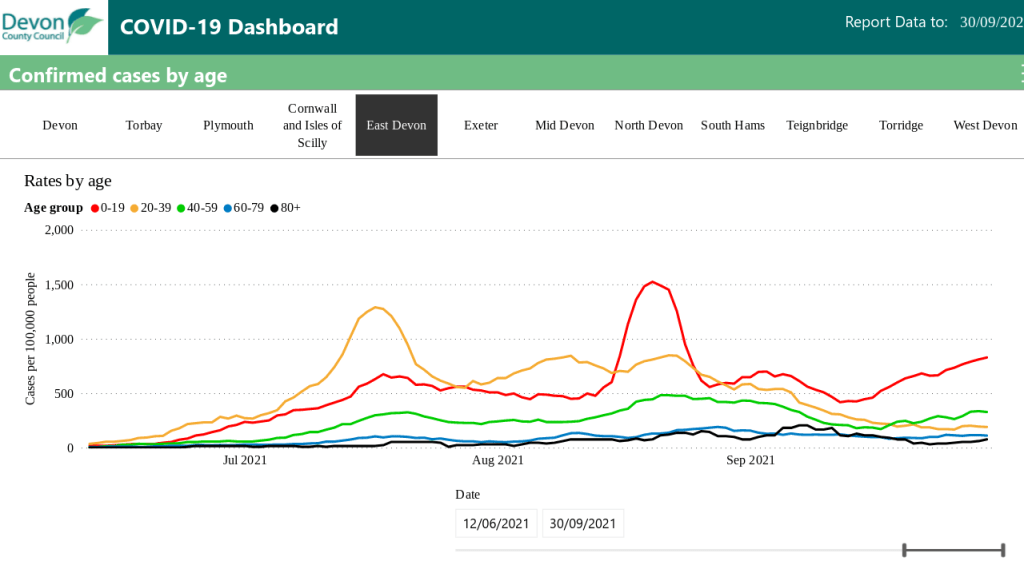
Current rises in East Devon are concentrated in two age groups: 0-19 and 40-59 year olds; school children and their parents?

Covid: Little headroom before NHS becomes “heavily stressed”

COVID-19: UK has little ‘headroom’ for coronavirus cases to surge before NHS ‘heavily stressed’, professor warns

Connor Sephton news.sky.com 

The UK has little “headroom” for rising coronavirus cases before the NHS becomes “heavily stressed”, an expert has warned.

Professor Neil Ferguson – a member of the Scientific Advisory Group for Emergencies (SAGE) – told MPs that levels of transmission in the UK are currently far higher than in other countries.

At present, about 600 people are being admitted to hospital with COVID-19 every day. He believes the NHS may struggle to cope if this doubles to 1,200 in the winter months.

The government has previously said that mandatory face masks could return, COVID passports could be introduced and people could be told to work from home once again if pressure on the NHS needs to be alleviated.

Speaking to the all-party group on coronavirus, Prof Ferguson said: “We are starting with quite a high incidence and so we don’t have very much headroom for increases.

“If we compare, for instance, incidence of COVID cases per day in France, Germany, Spain, Italy and Portugal, there is a much lower level than us, so they can afford to see something of a surge of transmission, which they may well, without unduly stressing the health system.”

The SAGE member went on to warn, “we are much closer to the limit of what the NHS can cope with”.

Prof Ferguson’s modelling was instrumental when the UK first went into lockdown in March 2020, but he said there is a high level of unpredictability when it comes to what will happen this winter.

He added: “We could see continued flat incidence, even slow decline if we get boosters out quickly.

“So it’s not guaranteed we will see a large winter surge by any means, but we can’t afford, at the current time, to have too much of a winter surge before really the NHS is very heavily stressed.”

The professor said that, given a political decision has been made to “live with COVID”, keeping a close eye on the data will be crucial.

“The lesson we have learned is that if you start seeing an upward trend and that is sustained for a period of time, then you need to get ahead of it,” he added.

Please use Chrome browser for a more accessible video player

Whitty: ‘Near certainty’ unjabbed kids will get COVID

Prof Ferguson also said that he had been more content with the timeliness of the government’s interventions to curb the spread of coronavirus since last December.

He said people in the UK are not having the same level of contact as they were before the pandemic, which is helping the situation.

However, the professor pointed to data that suggests the UK is now behind Spain and Portugal – and probably France and the Netherlands – in terms of population immunity.

He added: “I personally think it’s unlikely we’ll see a very large wave comparable to what we saw in the second wave last year, but we could still see quite a substantial wave of transmission, and the real challenge will be the extent to which that stresses the NHS, where capacity is limited.”

When it comes to the long-term view, Prof Ferguson said he believes the UK will see seasonal surges of transmission that will “challenge the health system on top of flu and everything else”.

“Whether we need in some years to come to rely on some degree of mitigation beyond just vaccination remains to be seen,” he said.

Government data released on Monday showed that the UK had recorded 35,077 new COVID-19 cases and a further 33 coronavirus-related deaths in the latest 24-hour period.

By comparison, 37,960 cases and 40 deaths were recorded over the same period one week earlier.

The number of people in hospital with COVID-19 stood at 6,556 – down from 6,905 seven days earlier – with 805 of those on ventilators.

Invoking the “Magic Potion” Boris Johnson solves the Productivity Puzzle at a stroke!

Solving this puzzle has evaded Heart of the South West for years but yesterday Superman found his Kryptonite.

After two shots of the game changing “magic potion invented in Oxford University and bottled in Wales” Boris Johnson felt empowered, in his conference speech, to share with us his solution to the productivity puzzle. This is the essential key to his “vision for Britain” “building back better”.

“We are not going back to the same old broken model with low wages, low growth, low skills and low productivity, all of it enabled and assisted by uncontrolled immigration.

And the answer to the present stresses and strains, which are mainly a function of growth and economic revival, is not to reach for that same old lever of uncontrolled immigration, to keep wages low.

The answer is to control immigration to allow people of talent to come to this country, but not to use immigration as an excuse for failure to invest in people, in skills and in the equipment, the facilities, the machinery they need to do their jobs.

The truckstops – to pick an example entirely at random – with basic facilities where you don’t have to urinate in the bushes.

And that is the direction in which this country is going now. Towards a high wage, high skill, high productivity and yes, thereby low tax economy.”…..[interesting non sequitur! – Owl]

……“And that is how we solve the national productivity puzzle: by fixing the broken housing market, by plugging in the gigabit, by putting in decent safe bus routes and all other transport infrastructure and by investing in skills skills skills.”

Easy peasy, except none of these things are going to happen here any time soon are they?

Watch and read every boosterism of Boris Johnson’s Conservative Party conference speech here inews.co.uk [Or possibly not, it doesn’t travel very well!]

Elsewhere Owl reads that an announcement is expected shortly to raise the minimum hourly wage to to the high rate of £9.42.